THE CARABINIERS ("Tichborne's Own.")
Reading edition
"It is your sex that makes us go forth to fight…. It is your sex who cherish our memories." Nelson.
There is not a woman in our vast Empire who has not good cause to regard with admiration and gratitude those noble protectors and terrible avengers of the honour of their sex—the Carabiniers. During the Indian Mutiny—but first a brief word as to their history.
It dates from the time of Monmouth's rebellion, when they were raised by Lord Lumley to support King James. Owing to the fact, however, that Lord Lumley was no supporter of the king's tyrannies, the regiment seceded, and later, when the Prince of Orange landed, threw in their lot with him whole-heartedly. Their title, "The Carabiniers," was bestowed upon them in recognition of the great part they played in the battle of the Boyne, for William had in mind the famous carabiniers of Louis XIV.
In the list of the glories of the Carabiniers is Aughrim. Macaulay says about this occasion: "St. Ruth laughed when he saw the Carabiniers and the Blues struggling through a morass under a fire which, at every moment, laid some gallant hat and feather on the earth." "What did they mean?" he asked, and then he swore it was a pity to see such fine fellows marching to certain destruction. Nevertheless, at the issue of that business, it was he, and his troops, that reaped the destruction.
It was some little time later that the Carabiniers saved the situation for King William at Landen, by an obstinate stand against his pursuers, while he crossed the bridge. As Corporal Trim in "Tristram Shandy" says; "If it had not been for the regiments of Wyndham, (i.e., the Carabiniers) Lumley and Galway, which covered the retreat over the bridge at Neerspecken, the king himself could scarcely have gained it."
In three continents the Carabiniers have fought their way to an exalted fame. At Ramillies they captured the standard of the Royal Regiment of Bombardiers of France. At Malplaquet they measured steel and courage with the formidable Household Brigade of France and came out victorious. And from that time onward their glorious career can be traced through Europe, Asia and Africa in such clear lines that the enemy who runs has read.
But it was during the time of the Indian Mutiny that they performed feats of valour for which we British men, as well as the women, owe them heartfelt gratitude. They were among the reinforcements sent out to stay the terrible tide of massacre and rapine. How they struggled for life and empire at Delhi; repulsed the rebels outside Lucknow with fearful carnage, with loss of their leader; and, finally, when Lucknow had fallen, pursued the rebels with relentless wrath, dealing vengeance with a heavy hand—all this has been written by many pens. It has been the theme to make the driest book most vivid reading. It was the story of stern, ruthless punishment and revenge for the horrible crimes committed by the then unregenerate Sepoy against helpless women and children—crimes of torture, murder, wholesale massacre, and unconceivable outrage.
One has only to remember the horrible atrocities of the Indian Mutiny to acquit the Carabiniers of any charge of undue ferocity; one has only to remember Cawnpore, and the women and the babies, in order to admire their offices of stern, relentless retribution. And all this happened at the very time when all London was celebrating the centenary of the sublime victory of Plassey, and the brilliant acquisition of the Indian Empire under the genius of Clive.
When, at Meerut, on that never-to-be-forgotten Sunday, they pursued the fiends responsible for that awful massacre, the Carabiniers, together with the 60th Rifles drew a very determined line between righteous revenge and feeble long-sufferance; between just wrath, that ever-potential factor in heroic blood: primitive wrath, and its cognate barbarity of act. "Remember the women! Remember the babies!" ran through the ranks on that occasion; and, with one heart and mind, the Carabiniers and the 60th, an avenging host, pursued the rebels, and cut them to pieces, right up to the very gates of Delhi, imprecating as they slew. And well they might be forgiven for that. Never were the lives of the innocent and defenceless so quickly, terribly, yet justly avenged; never has a more awful nemesis from human hands fallen upon the destroyers of women and women's honour. And, remembering all this, we defend it and uphold it, for we know full well that, in this present war, the barbarities and atrocities committed by an unprincipled enemy must again meet with this righteous kind of vengeance. And, if it is the traditional and special aspiration of the Carabiniers of to-day to cry "Remember Louvain! Remember the women and babies of Belgium!" shall we say "Hold and spare!" No! shall we say, "Vengeance is God's: God will repay!" Yes, with all our heart and soul; and what better agency for repayment than that of our noble Carabiniers! They are not of the kind to repay barbarity with barbarity; but they are of the kind to use their swords with singular effect, and like English gentlemen, whose special office it is to wreak proper vengeance to-day as in the past on the destroyers of women and children.
At Gungaree the Carabiniers lost three of their officers, but for this they took a heavy toll. Meeting the rebels three days later, they defeated them completely, taking their leaders prisoners. Again the terrible work began. Hotly they pursued the flying rebels, and put them to the sword without a show of quarter. Rebel blood flowed like water for the rebel deeds they had committed against right and honour.
THEIR BATTLE HONOURS, ETC.
Battle Honours.—Blenheim, Ramillies, Oudenarde, Malplaquet, Sevastopol, Delhi, Afghanistan 1879-80, S. Africa 1889-1902, Relief of Kimberley, Paardeberg.
Uniform.—Blue, white facings, white plume.
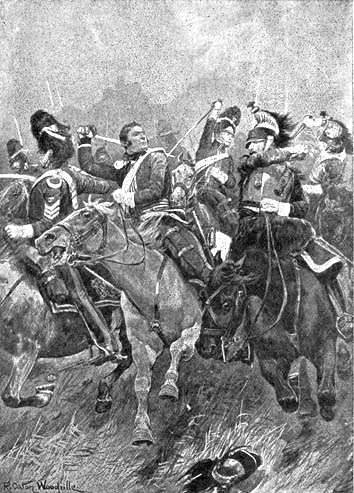
CHARGE OF SCOTS GREYS AT WATERLOO. From a Painting by R. Caton Woodville.