THE ARGYLL AND SUTHERLAND HIGHLANDERS ("The Thin Red Line")
Reading edition
"Wherever they have lived and fought they have carried with them the fearless picturesqueness of their indomitable mountains."
At Sevastopol, as at few other battles in the history of wars, was displayed the most magnificent valour of the Highlander. The approaches to Balaclava were protected by six batteries manned by Turks, who, it will be remembered, were in those days our allies. On October 25th, 1854, the Russians made a determined attack on these redoubts, speedily captured three of the batteries, and at once turned them on the 93rd Highlanders, under Sir Colin Campbell, compelling them to seek cover behind a slight ridge. No sooner had they done so than a horde of Russian cavalry swept down upon them, whereat Sir Colin ordered his men to breast the ridge and hold it against them at all costs. "Men," he said, "there is no retreat from here; you must die where you stand." "Ay, ay, Sir Colin," was the cool response, "and we'll do that if needs be."
The men were only two or three deep, but that "thin red line," bristling with steel, was none the less formidable for that. Every heart was staunch and every hand was steady. Nearer and nearer came the rolling thunder of the Russian cavalry, quickening as it came. They were now at 600 yards. "Fire!" the order was given, and the lead went forth, but the Russians, though galled, still came on. At 200 yards a second volley rang out, and this time the enemy wavered and could only be rallied by the remarkable determination of their officers. Their swerve was headed into a flank attack, but the Highlanders stood firm as their native rocks, and met their last onrush with volley on volley.
"Then had you seen a gallant shock When saddles were emptied and lances broke."
The enemy, now in confusion, looked at the cold steel awaiting them, turned in dismay and fled in disorder to the shelter of their own guns.
The 93rd were also at Lucknow, and the way they came to the rescue of the hard-pressed garrison of that city makes a thrilling episode.
Well known is the story of Jessie, the Scotch nurse, who was within the fortifications of Lucknow when the final grip of despair was closing on the beleaguered garrison. Sitting musing on the hope of death as against the horrors of surrender, she suddenly raised her head and listened. Was she dreaming of the hills and glens of her native land, which she might never see again, or was that the sound of the pibrochs floating on the breeze from far away? She started up, declaring that she heard the wild music of her own country drawing nearer and nearer out of the distance. Others listened, but could hear nothing, and thought that Jessie was fey. But the simple-living Scotch folk are renowned for their second sight and clairaudience, and the event proved that Jessie was right; for at that moment, though far beyond the range of physical hearing, the Highlanders, under Sir Colin Campbell, were marching swiftly towards Lucknow, with Cameron striding at their head, blowing his loudest.
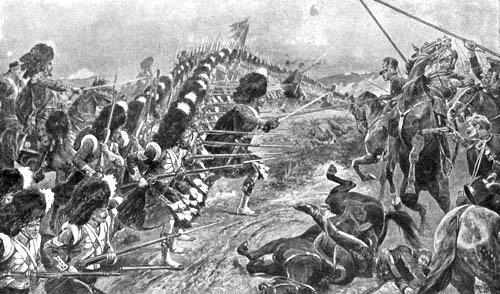
THE ARGYLL AND SUTHERLAND HIGHLANDERS AT BALACLAVA. From a Painting by R. Caton Woodville.
When they arrived at the city they made no pause, but swept down on the dastardly foe with irresistible force, while the bagpipes screamed and the men cheered wildly. Then ensued a running fight lasting some hours, after which post after post was seized and occupied until finally the siege was raised, and Sir Colin Campbell and Sir Henry Havelock met within the city and shook hands on a glorious relief.
THEIR BADGES, BATTLE HONOURS, ETC.
Badges.—A Boar's Head within a wreath of myrtle. A Cat within a wreath of broom, all over the label as represented in the arms of the Princess Louise, and surmounted with H.R.H.'s coronet. In each of the four corners the Princess Louise Cypher and Coronet.
Mottoes.—"Ne obliviscaris." "Sans peur."
Battle Honours.—Cape of Good Hope 1806, Rolica, Vimiera, Coronna, Pyrenees, Nivelle, Nive, Orthes, Toulouse, Peninsula, Alma, Balaclava, Sevastopol, Lucknow, S. Africa 1846-47, 1851-53, 1879, 1899-1902, Modder River, Paardeberg.
Uniform.—Regular and Reserve Battns., scarlet with yellow facings.
[1st Battn. (Argyllshire Highlanders): raised in 1794 by the Duke of Argyll. 2nd Battn. (Sutherland Highlanders): raised by the Duke of Sutherland in 1800. The 1st Battn. formed the bulk of the heroes of the wreck of the Birkenhead. The 2nd Battn. were the celebrated "thin red line" at Balaclava. The regiment won great distinction during the Indian Mutiny. It formed part of General Wauchope's force at Magersfontein (1899).]