AUBREY'S 'BRIEF LIVES' (continued 3)
Reading edition
In 1658 he returned into England and so little before the death of Oliver Cromwell that he never sawe him since he was Protector.
Memorandum—when he tooke his leave from Zurich, June 23, 1658, he made a Latin speech, which I have seen.
Memorandum that in his negociation he did no disservice to King Charles IId, nor to the church, as may appeare by his letters which are in the Secretarie's Office.
[525]Richard Cromwell, Protector, did not fully pay him for his business in Piedmont, wherby he was in some want; and so when King Charles II was restored[526], Dr. Sanderson, bishop of Lincoln, perswaded him to take Holy Orders. He was not adroit for preaching.
[527]When King Charles II had been at home ten months, Mr. John Pell first tooke Orders. He was made deacon upon the last of March, 1661, by bishop Sanderson of Lincoln, by whom he was made priest in June following.
Gilbert Sheldon, bishop of Lundon, [procured[528] for] him the parsonage of Fobbing[AO] in Essex, 1661, and two yeares after (1663) [gave him] the parsonage of Laindon cum annexa capella de Bartelsdon in eodem comitatu, which benefices are in the infamous and unhealthy (aguesh[529]) hundreds of Essex.
Mr. Edward Waller on the death of the countesse of Warwick:—
Curst be alreadie those Essexian plaines Where ... Death and Horrour reignes.— etc.
[At Fobbing, seven curates dyed within the first ten yeares]; in sixteen yeares, six of those that had been his curates at Laindon are dead; besides those that went away from both places; and the death of his wife [servants, and grandchildren].
Gilbert Sheldon being made archbishop of Canterbury, 16—[530], John Pell[XLVI.] was made one of his Cambridge[XLVII.] chapleines; and complaining one day to his Grace at Lambith of the unhealthinesse of his benefice as abovesayd, sayd my Lord, 'I doe not intend that you shall live there.' 'No,' sayd [Doctor] Pell, ('but[531] your grace does intend that) I shall die there.'
Now by this time (1680), you doubt not but this great, learned man, famous both at home and abroad, haz obtained some considerable dignity in[533] the church. You ought not in modestie to ghesse at lesse then a deanery.—Why, truly, he is stak't to this poor preferment still! For though the parishes are large, yet (curates, etc., discharged) he cleares not above 3-score pound per annum (hardly fourscore), and lives in an obscure[XLVIII.] lodging, three stories high, in Jermyn Street, next to the signe of the Ship, wanting not only bookes but his proper MSS. which are many, as by and by will appeare. Many of them are at Brereton at my lord Brereton's in Cheshire.
Memorandum:—... lord Brereton[534] was sent to Breda to recieve the instruction of this worthy person, by his grandfather (George Goring, the earle of Norwich) anno 1647, where he stayed ...[535], where he became a good proficient, especially in algebra to which his genius most inclined him and which he used to his dyeing day, which was 17 March, 1679/80: lies[536] buried in ...[537] St. Martin's church in-the-fields. I cannot but mention this noble lord but with a great deale of passion, for a more vertuous person (besides his great learning) I never knew. I have had the honour of his acquaintance since his comeing from Breda into England. Never was there greater love between master and scholar then between Dr. Pell and this scholar of his[538], whose death March 17, 1679/80[539] hath deprived this worthy doctor of an ingeniose companion and a usefull friend.
Scripsit[540].
His[541] table of squares, printed at London, 1672; 8 sheetes fol.
Rhonius's Algebra, in High-Dutch, was (indeed) Dr. Pell's; is translated into English, halfe.—Rhonius was Dr. Pell's scholar at Zurich and came to him every Friday night after he (J. Pell) had writt his post-lettres.
Controversia de vera circuli mensura inter Longomontanum et Pellium, Amstel. (?) Blaeu, 1651/2.
J. Pellii Idea of[542] Mathematicks printed in English and in Latin at the same time, 16mo.
Inaugural oration, p. 33[543].
{ Ψαμμίτης, a quarter of a sheet of paper one Both MSS. { side; and also { Euclid's[544] Xth Element(orum liber) (vide infra) which is in Cheshire at my lord Brereton's.
He hath written on the tenth booke of Euclid, which is in Cheshire at the lord Brereton's, and he hath also done[545] the greatest part of Diophantus[546], which is there[547]—both unprinted[548].
Also he hath donne[549] the second booke of Euclid in one side of a large sheet of paper most clearly and ingeniously.
He hath donne most succinctly and clearly Archimedis Ψαμμίτης in one side of an 8vo paper.
Also he hath demonstrated the proportion of the diameter to the circumference, and shewes what was the reason why Archimedes did use these two numbers—he did it at the instance of Sir Charles Scarborough—one sheet.
☞ In the booke called Branker's Algebra that which is purely Dr. Pell's beginnes at p. 79 and so continues to FINIS—this I had from his owne mouth.—Desire Mr. A. Wood to take some paines to enquire for Mr. Turner, M.A. at Oxon (I thinke of Exon. Coll.), who tooke some paines about Branker's Algebra.
Dr. Pell haz often sayd to me that when he solves a question he straines every nerve[550] about him, and that now in his old age it brings him to a loosenesse.
[551]Dr. J. Pell was the first inventor of that excellent way or method of the marginall working in algebra.
I have heard him say several times that the Regula falsi was falsly demonstrated by Mr. William Oughtred (quod N.B.) and that Petiscus hath donne it right.
See Dr. Pell's letter, printed by Joachim Jungius in his Doxo ... in 4to at Hamborough—Mr. Cluverus haz it.
He could not cringe and sneake for preferment though otherwise no man more humble nor more communicative. He was cast into King's Bench prison[552] for debt Sept.[553] 7, 1680.
[554]In March 1682 he was very kindly invited by Daniel Whistler, M.D., to live with him at the Physitians College in London, where he was very kindly entertained. About the middle of June he fell extreme sick of a cold and removed to a grandchild of his maried to one Mr. Hastings in St. Margaret's Churchyard, Westminster, neer the tower, who now (1684) lives in Brownlow Street in Drury Lane, where he was like to have been burnt in his bed by a candle. Nov. 26, fell into convulsion fitts which had almost killed him.
[555]Gilbert Sheldon, Lord Bishop of London, gave Dr. Pell the parsonage of Lanedon[C] cum Basseldon in the Hundreds of Essex (they call it kill-priest[556], sarcastically); and king Charles the Second gave him the parsonage of Fobing[XLIX.], 4 miles distant. Both are of the value of two hundred pounds per annum (or so accounted); but the Doctor was a most shiftless man as to worldly affaires, and his tenants and relations cousin'd him of the profits and kept him so indigent that he wanted necessarys, even paper and inke, and he had not 6d. in his purse when he dyed, and was buried by the charity of Dr. Richard Busby and Dr. <John> Sharp, Rector of St. Giles-in-the-fields and Dean of Norwich, who ordered[557] his body to lye in a vault[558] belonging to the Rector (the price[559] is x li.).
I could not persuade him to make a will; so his books and MSS. fell by administratorship to Capt. ... Raven, his son-in-law.
His son (John) is a Justice of Peace in New Yorke[560], and lives well. He thought to have gonne over to him.
This learned person dyed in St. Giles' parish aforesaid at the house of Mr. Cothorne the reader in Dyot Street on Saterday December the twelfth 1685, between 4 and 5 P.M. Dr. Busby, schoolmaster of Westminster, bought all his bookes and papers of Captain Raven, among which is the last thing he wrote (which he did at my earnest request) viz. THE TABLES, which are according to his promise in the last line of his printed tables of squares and cubes (if desired) and which Sir Cyrillus Wych (then president of the Royall Society) did license for the press. There only wants a leafe or two for the explanation of the use of them, which his death hath prevented. Sir Cyril Wych, only, knowes the use of them. I doe (imperfectly) remember something of his discourse of them, viz. whereas some questions are capable of severall answers, by the help of these tables it might be discovered exactly how many, and no more, solutions, or answers, might be given.
I desired Mr. Theodore Haake, his old acquaintance, to make some additions to this[561] short collection of memoires of him, but he haz donne nothing[562].
He dyed of a broaken heart.
[563]Dr. Whistler[564] invited Dr. Pell to his house in anno ..., which the Dr. likt and accepted of, loving good cheer and good liquour, which the other did also; where eating and drinking too much, was the cause of shortning his daies.
Dr. Pell had a brother a chirurgian and practitioner in physick, who purchased an estate of the natives of New-York and when he died he left it to his nephew John Pell, only son of the Doctor. It is a great estate 8 miles broad and ... miles long (quaere Capt. ... Raven).
He had 3 or 4 daughters.
[565]This <is> writt by Mr. Theodore Haake.
In the year 1638 I came first to be acquainted with Mr. Pell by Mr. S. Hartlib's meanes, who having heard of his extraordinarie parts in all kinde of learning, especially the mathematics, perswaded that the same might be farre more usefully employed and improoved for the publick advancement of learning, he never left soliciting and engaging frends heer to perswade Mr. Pell instead of keeping scool, as he then did at ... in Sussex, to come up to London, where he soon got into great esteem among the most learned, both natives and forreigners, with whom he conversed. But he so minded and followed still the cultivating of his more abstracting studies, and naturally averse from suing or stooping much for what he was worthy of, it was a good while before he obtained any suteable place or settlement.
I recommended him once to my Lord Bishop of Lincoln[566] (quondam Lord Keeper of England), who became very desirous to see the man, inviting us of purpose to dine once with his lordship for the freer discourse of all sorts of literature and experiments, to get a touch and taste that satisfaction Mr. Pell could give him. Which proved so pertinent and abundant that my lord put the question to him whether he would accept of a benefice which he was ready, glad, and willing to bestow on him for his encouragement. Mr. Pell thankd his lordship, saying he was not capacitate for that, as being no divine and having made the mathematics his main studie, for the great publick need and usefullnesse therof, which he had in a manner devoted himself to improve and advance to the uttmost of his reach and abilities. Which answer pleased my lord so well that he replyed, 'Alasse! what a sad case it is that in this great and opulent kingdome there is no publick encouragement for the excelling in any profession but that of the law and divinity.[567]Were I in place as once I was, I would never give over praying and pressing his majesty till a noble stock and fund might be raised for so fundamentall, universally usefull, and eminent science as mathematicks.' And therupon his lordship requested Mr. Pell to befriend him with his visits as often as he could spare time, promising him always a very hearty welcome. Yet Mr. Pell who was no courtier came there no more.
In the mean time he communicated to his friends his excellent Idea Matheseos in half a sheet of paper, which got him a great deal of repute, both at home and abroad, but no other special advantage, till Mr. John Morian, a very learned and expert gentleman, gave me notice that Hortensius, mathematical professor at Amsterdam, was deceased, wishing that our friend Mr. Pell might succeed. Sir William Boswell, his majestie's ambassador in Holland, being here then, I conferred with him about it, who promised all his assistance; and between them, and by these two, a call was procured from Amsterdam for Mr. Pell, in 1643: and in May 1644 I met him settled there on my return out of Denmarke. Where he was, among others, dearly welcome to Gerardus Joannes Vossius. And soon after his fame was much augmented by his refuting a large book of Longomontanus Quadratura, which caused the Prince of Orange (Henry Frederick) being about to erect an Academic at Breda, borrowed[568] Mr. Pell from the magistrate of Amsterdam, to grace his new Academy with a man of that fame for a few years. And there being comfortably stayed, the most learned of the then parliament heer, jealous that others should enjoy a countryman of their own, they never left offers and promises till they got him hither to be—they gave out—Professor Honorarius heer. But the sucesse prov'd soon deficient, and reduced him to much inconvenience, as having now a charge of a pretty large family, viz. his wife with 4 or 5 children. And this continued till T. H.[569] was offerd by Th.[570] to be employed in Swisse and about the E.[571] collection for Pyemont; who excused himself it and recommended Mr. Pell.
This[572] account of Dr. John Pell I had from my worthy friend Mr. Theodore Haak, whose handwriting it is.
[573]John Pell, D.D., was borne at Southwick in Sussex on St. David's day, anno Domini 1611; his youngest uncle ghesses about noon.
Anno 1632 he maried.
1643, went to Amsterdam and was there professor of Mathematiques.
1646, the Prince of Orange called for him to be publique professor at Breda.
1654, Oliver, Protector, sent him envoyé to the cantons of Switzerland.
1661, Gilbert Sheldon, bishop of London, gave him a scurvy parsonage in Essex ('kill-priest').
1680, August last, he was arrested and layd in prison.
Notes.
William Penn (1644-1718).
[574]William Penn natus Oct. 14, 1644, horâ 7 mane, Londini.
[575]William Penn[AP], the eldest son of Sir William Penn, knight, [admirall[576] both of the English navy before the restauration of the king, and commanded as captain-generall under the D. Y.[577] in 1665 against the Dutch fleet[578]], was borne in London, at Tower hill, the 14[579] day of October 1644. 'Twas upon a Monday he thinkes; but 'twas about 7 a clock in the morning.
(His father was a very good man, but no Quaker; was very much against his sonne.)
Went to schoole in London, a private schole on that hill, and his father kept a tutor in the house: but first he went to school at Chigwell in Essex.
<He was> mighty lively, but with innocence; and[580] extremely tender under rebuke; and very early delighted in retirement; much given to reading and meditating[581] of the scriptures, and at 14 had marked over the Bible. Oftentimes at 13 and 14 in his meditations ravisht with joy, and dissolved into teares.
The first sense he had of God was when he was 11 yeares old at Chigwell, being retired in a chamber alone. He was so suddenly surprized with an inward comfort and (as he thought) an externall glory in the roome that he has many times sayd that from thence he had the seale of divinity and immortality, that there was a God and that the soule of man was capable of enjoying his divine communications.—His schoolmaster was not of his perswasion.
To Christ's Church in Oxon anno 1660, anno aetatis 16; stayed there about two yeares.
Anno 1662, went into France; stayd there two yeares.
Returnd and was entred of Lincoln's Inne.
About the plague, growing entirely solitary, was again diverted. Was employed by his father in a journey into Ireland to the duke of Ormond's court: the diversions of which not being able to keepe downe the stronger motions of his soule to a more religious and retired life, upon the hearing of one Th<omas> Lowe, a tradesman, of Oxon, at Cork, 1667, was so thoroughly convinced of the simplicity and selfe-deniall of the way of the people called Quakers that from thence he heartily espoused that judgment[582] and beliefe.
Since which time he haz passed a life of great variety of circumstances[583], both with respect to good and evill report, divers controversies orall and written[L.], severall imprisonments[LI.] (one in Ireland, one in the Tower, <a> 3rd in Newgate).
Travelled into Germany, Upper and Lower, annis 1671 and 1677, where severall were affected with his way[LII.].
Notwithstanding those many odd adventures of his life, he hath severall times[586] found favour from his majestie and also the D. Y.[587], with divers of the nobilitye[588], and men of quality and learning in this kingdom.
His majestie owing to his father 10,000 li., 16—, (which, with the interest of it, came not to lesse than 20,000 li.,) did, in consideration therof, grant to him and his heirs a province in America which his majesty was pleased to name Pensylvania[AQ], the 4th day of March 1680/1, to which he is now goeing this next September 1681.
[589]His patent for Transylvania[590] is from the beginning of the 40th degree to 43 degrees in latitude, and 5 degrees in longitude from Chisapeak-bay.
E. W.[591] <says[592] that there are> 2 or 3 things, e.g. military, mighty necessary <for the colony>—quaere some proposalls.
He speaks well[593] the Latin and the French tongues, and his owne with great mastership. He often declares[594] in the assemblies of his Friends, and that with much eloquence[595] and fervency of spirit—by which, and his perpetuall attendances on K<ing> and P<rince> for the reliefe of his Friends, he often exposes his health to hazard.
He was chosen (ballotted) November 9th, nemine contradicente, admitted Fellow of the Royal Societie, London[596], with much respecte.
[597]August 26, 1682, Saturday. This day about 4 a clock P.M. W. Penne, esq., went towards Deale to launch for Pensylvania. God send him a prosperous and safe voyage.
Last Wednesday in August (scil. Aug. 30, 1682) about noon he tooke shippe at Deale.
He returned into England, October (about the middle[598]) 1684—quaere diem.
[599]W. Penn, esq., married Gulielma Maria Springet, daughter of Sir William Springet, of the Springets of the Broyles in Sussex.
She was a posthuma of her father, a young gent. of religion and courage who dyed at the siege of Arundel. His daughter was his image in person and qualities, virtuous, generous, wise, humble[600]; generally beloved for those good qualities and one more[601]—the great cures she does, having great skill in physic and surgery, which she freely bestows.
She early espoused the same way[602], about anno 1657. She was a great fortune to her husband, being worth de claro above 10,000 li. Her fortune, quality, and good humour gave her the importunity of many suitors of extraordinary condition, e.g. lord Brookes and lord J<ohn> <Vaughan>, etc.; but valueing the unity of beliefe and the selfe deniall of her profession above the glories of the world, resisted their motions till Providence brought a man of equall condicion and ⦻[603] to herself to the syncere embracing of the same fayth, whose mariage haz been crowned with a continued affection.
[Sir William Penn, knight[604],] his father, was a man of excellent naturall abilities, not equalled in his time for the knowledge of navall affayres and instrumentall to the raysing of many families. Bred his son religiously; and, as the times grew loose, would have had his sonne of the fashion, and was therfore extreme bitter at his sonne's retirement. But this lasted not alwayes; for, in the conclusion of his life, he grew not only kind, but fonde; made him the judge and ruler of his family; was sorry he had no more to leave him (and yet, in England and Ireland, he left him 1500 li. per annum). But, which is most remarkeable, he that opposed his sonne's way because of the crosse that was in it to the world's latitude, did himselfe embrace this faith, recommending to his son the plainesse and selfe deniall of it, sayeing 'Keep to the plainesse of your way, and you will make an end of the priests to the ends of the earth.' And so he deceased, desiring that none but his son William should close his eies (which he did). Obiit anno aetatis 49, 4 months.
[605]Pen m. ... | ... Penn, of Mynety com. m. Joane Gilbert Wilts (Hale-house in | (of the Gilberts Minety). He lies buried | of Yorkshire). in Myntie chancell, vide | the inscription. | +----+ | Sir William Penn, m. Margaret Jasper, knight. | daughter of John | Jaspar, merchant, | of Roterdam. +---------------------------+--------------+ | | | 1. W. Penn, m. Gulielma 2. Richard, 3. Margaret, m. Anthony Lowder esq. | Maria obiit sine | of Mask in | Springet. prole. | Cleaveland | | in Yorkshire. +-----+----------+------------+ +---+-+-+---+ | | | | | | | 1. Springet Pen, 2. William. 3. Laetitia. 1 2 3 4 eldest son.
[606]A Catalogue of William Penn's writings.
Sheets. No.
8. 1. The guide mistaken, being an answer to J. Clapham, 1668, 4to.
6. 2. The sandy foundation shaken, or an answer to Vincent, etc., 1668, 4to.
2. 3. An apology for the sandy foundation, 1669, 8vo.
3. 4. Truth exalted, or a testimony to rulers, preists, and bishops, 1669, 4to; addit. <16>71.
24. 5. No cross, no crowne[607], 1669, 4to. Reprinting.
36. 6. A serious apology for <the> people cal'd Quakers; answer to Taylor and Tyms of Ireland; 1-1/2 written by G. Whithead, 1669, 4to.
1. 7. A letter of love to the young convinc'd, 1669, 4to.
8. 8. A seasonable caveat against popery, 1669, 4to.
8. 9. The[608] ancient liberties of the people asserted in W. P. tryal, 1670, 4to.
6. 10. Truth rescued from imposture, being an answer to S. Sterling[609], 1670, 4to.
6. 11. The great case of liberty of conscience asserted, 1670, 4to.
4. 12. New wittnesses proved old hereticks, being an answer to Mugleton, 1672, 4to.
10. 13. The spirit of truth vindicated, being an answer to a Socinian, 1672, 4to.
2. 14. Plaine dealing with a traducing Baptist; answer to Morse, 1672, 4to.
1 larg sheet. 15. A winding-sheet for controversy ended; answer to Morse, 1672, 4to large.
1. 16. Propos'd comprehension seriously to be considered, 1672, broadside.
18. 17. Quakerisme, a new nickname for old Christianity, answer to Faldo, 1672, 8vo large.
32. 18. The invalidity of J. Faldo, being a rejoynder in answer to him, 1673, 8vo large.
12. 19. Wisdom justified of her children, or an answer to Hallywell, 1673, 8vo large.
16. 20. Reason against rayling, or an answer to Hicks Dialogues, 1673, 8vo large.
12. 21. The counterfitt Christian detected, answer to Hicks 3d. Dialogue, 1674, 8vo large.
2. 22. A briefe returne to J. Faldo's curbe, 1674, 8vo large.
169. 23. The Christian Quaker and his divine testimony vindicated, 1674, folio.
2. 24. Vrim and Thummim or light and righteousness vindicated, 1674, 4to.
4. 25. A just rebuke[610] to 21 divines that vindicated J. Faldo's book, 1674, 4to.
1. 26. Christian liberty desired, in a letter to the States at Emden, 1674, 4to.
1. 27. A solemn offer to the Baptist to vindicate truth, 1674, broadside.
1. 28. Naked truth needs no shift, being an answer to The last shift, 1674, broadside.
1. 29. Libels no prooffs, 1674, broadside.
1. 30. A returne to Jer. Jues sober request, 1674, broadside.
24. 31. A treatise of oathes or not-swearing vindicated, 1675, 4to.
6. 32. England's present interest, with honour to the prince, and safty to the people, 1675, 4to.
2. 33. Saul smitten to the ground, or Mathew Hide's remorse, 1675, 4to.
5. 34. The continued cry of the oppressed, or Friends' sufferings presented, 1675, 4to.
1. 35. Epistola consulibus Emdeni, 1675, 4to.
6. 36. The skirmisher defeated or an answer to ... 1676, 4to.
2. 37. An epistle to the churches of Jesus, 1677, 4to.
4. 38. A briefe answer to a foolish libell, 1678, 4to.
1. 39. To the children of light in this generation, 1678, 4to.
3. 40. One project more for the good of England, 1679, folio.
3. 41. An account of the province of Pensilvania[AQ], 1681, folio.
1. 42. An abstract of the province of Pennsilvania, 1681, folio.
Notes.
Sir Thomas Penruddock.
[611]<It was a> capital <offence> for a native Irishman to come to Dublin without a passe.
Sir ... espying ... went into the corne ... found him and hung him up immediately—Mr. Anderson.
Sir William Petty (1632-1687).
<His coat of arms[612]: MS. Aubr. 6, fol. 12v.>
Ermine, on a bend gules[LIII.], a <magnetic> needle, pointing to the Polar Star, or, for Petty: impaling, sable three walnut leaves, between 2 bendlets, or, for Waller[613].
The crest is a beehive, or, with bees about it: the motto is
Ut apes Geometria.
<His horoscope[615]: MS. Aubr. 6, fol. 12v>.
Monday, Maii 26to, 1623: 11h 42´ 56˝ P.M., natus Gulielmus Petty, miles, sub latitudine 51° 10´ (tempus verum), at Rumsey in Hants.
This was donne, and a judgement[616] upon it, by Charles Snell, esq., of Alderholt neer Fordingbridge in Hampshire—'Jupiter in Cancer makes him fatt at heart.' John Gadbury also sayes that vomitts would be excellent good for him.
[617]Sir William Petty, knight, was the [eldest[618], or only,] son of ... Petty, of Rumsey in Hampshire, by ... his wife.
His father was borne on the Ashwednsday, before Mr. Hobbes, scil. 1587; and dyed and was buryed at Rumsey 1644, where Sir William intends to sett up a monument for him. He was by profession a clothier, and also did dye his owne cloathes: he left little or no estate to Sir William.
He[619] was borne at his father's house aforesaid, which is ..., on Monday, the twenty-sixth of May 1623, eleven houres 42´ 56˝ afternoone (vide Scheme[620]): Xtned on Trinity Sunday.
Rumsey is a little haven towne, but hath most kinds of artificers in it. When he was a boy his greatest delight was to be looking on the artificers,—e.g. smyths, the watch-maker, carpenters, joyners, etc.—and at twelve years old could have worked at any of these trades. Here he went to schoole, and learn't by 12 yeares a competent smattering of Latin, and was entred into the Greek. He haz had few sicknesses. About 8, in April very sick and so continued till towards Michaelmas. ☞ About 12 (or 13), i.e. before 15, he haz told me, happened to him the most remarkable accident of life (which he did not tell me), and which was the foundation of all the rest of his greatnes and acquiring riches.
He[621] enformed me that, about 15, in March, he went over into Normandy[622], to Caen, in a vessell that went hence, with a little stock, and began to merchandize[623], and had so good successe that he maintained himselfe, and also educated himselfe; this I guesse[624] was that most remarkable accident that he meant. Here he learn't the French tongue, and perfected himselfe in the Latin, and had Greeke enough to serve his turne. Here (at Caen) he studyed the arts. Memorandum:—he was sometime at La Flesshe in the college of Jesuites. At 18, he was (I have heard him say) a better mathematician then he is now: but when occasion is, he knows how to recurre to more mathematical knowledge. At Paris he studyed anatomie, and read Versalius with Mr. Thomas Hobbes (vide Mr. Hobbs' life), who loved his company. Mr. H. then wrot his Optiques; Sir W. P. then had a fine hand in drawing and limning, and drew Mr. Hobbes's opticall schemes for him, which he was pleased to like. At Paris, one time, it happened that he was driven to a great streight for money, and I have heard him say, that he lived a weeke on two peniworth (or 3, I have forgott which, but I thinke the former) of walnutts. Quaere whether he was not sometimes a prisoner there?
Anno Domini 164- he came to Oxon, and entred himselfe of Brasen-nose college. Here he taught[625] anatomy to the young scholars. Anatomy was then but little understood by the university, and I remember[626] he kept a body that he brought by water from Reding a good while to read on, some way preserv'd or pickled[627].
Anno Domini <1650> happened that memorable accident and experiment of the reviving Nan Green[628], which is to be ascribed and attributed to Dr. William Petty, as the first discoverer of life in her, and author of saving her. Vide and insert the materiall passages in the tryal, and anatomicall experiment of Nan Green at Oxon: vide the narrative.
Here he lived and was beloved by all the ingeniose scholars[629], particularly Ralph Bathurst of Trin. Coll. (then Dr. of Physique); Dr. John Wilkins (Warden of Wadham Coll.); Seth Ward, D.D., Astronom. Professor: Dr. <Robert> Wood; Thomas Willis, M.D., &c.—Memorandum:—about these times experimentall philosophy first budded here and was first cultivated by these vertuosi in that darke time.
Anno Domini ... (quaere) he was chosen musique professor at Gresham Colledge, London, v. pag.[e] 2.
Anno Domini ... (quaere Edmund Wyld, esq., when) the Parliament sent surveyors to survey Ireland; vide pag.[630] 2.
[631]Dr. Petty was resident in Oxon 1648, 1649, and left it (if Anthony Wood[632] is not mistaken) in 1652. He tooke his degree of Dr. of Physique anno Domini ... at ... (quaere).
He was about 1650 (quaere) elected Professor of Musique at Gresham Colledge, by, and by the interest of, his friend captaine John Graunt (who wrote the Observations on the Bills of Mortality), and at that time was worth but fourtie pounds in all the world.
Shortly after (scil. anno Domini 1652 in August, he had the patent for Ireland) he was recommended to the Parliament[LIV.] to be one of the surveyors of Ireland, to which employment capt. John Graunt's interest did also helpe to give him a lift, and Edmund Wyld, esq., also, then a member of Parliament, and a great fautor of ingeniose and good men, for meer meritt sake[LV.] (not being formerly acquainted with him) did him great service, which perhaps he knowes not of.
To be short, he is a person of so great worth and learning, and haz such a prodigious working witt, that he is both fitt for, and an honour to, the highest preferment.
By this surveying employment he gott an estate in Ireland (before the restauration of King Charles II) of 18000 li. per annum, the greatest part wherof he was forced afterwards to refund[634], the former owners being then declared innocents. He hath yet there 7 or 8000 li. per annum and can, from the Mount Mangorton in the com. of Kerry, behold 50000 acres of his owne land. He hath an estate in every province of Ireland.
The kingdome of Ireland he hath surveyed, and that with that exactnesse (quaere Sir J. H. de modo), that there is no estate the<re> to the value of threscore pounds per annum but he can shew, to the value, and those that he employed for the geometricall part were ordinary fellowes, some (perhaps) foot-soldiers, that circumambulated with their box and needles, not knowing what they did, which Sir William knew right well how to make use of.
Anno Domini 1667 (vide his Scheme[635]), he maried on Trinity Sunday ... the relict of Sir <Maurice> Fenton, of Ireland, knight, daughter of Sir Hasdras Waller of Ireland by ..., a very beautifull and ingeniose lady, browne, with glorious eies, by whom he hath ... sonnes, and ... daughters, very lovely children, but all like the mother. He has a naturall daughter that much resembles him, no legitimate child so much, that acts at the Duke's play-house, who hath had a child by ... about 1679. She is (1680) about 21.
[636]I remember about 1660 there was a great difference between him and Sir ... ..., one of Oliver's knights, about.... They printed one against the other: this knight was wont to preach at Dublin. The knight had been a soldier, and challenged Sir William to fight with him. Sir William is extremely short sighted, and being the challengee it belonged to him to nominate[637] place and weapon. He nominates, for the place, a darke cellar, and the weapon to be a great carpenter's axe. This turned the knight's challenge into ridicule, and so it came to nought.
He can be an excellent droll (if he haz a mind to it) and will preach extempore incomparably, either the Presbyterian way, Independent, Cappucin frier, or Jesuite.
[638]He recieved the honour of knighthood Anno Domini....
He had his patent for earle of Kilmore and baron of ... 166- which he stifles during his life to avoyd envy[LVI.], but his sonne will have the benefitt of the precedency.—[I expected[639] that his sonne would have broken-out a lord or earle: ☞ but it seemes that he had enemies at the court at Dublin, which out of envy obstructed the passing of his patent.]
Anno 1660 he came into England, and was presently recieved into good grace with his majestie, who was mightily pleased with his discourse.
Anno Domini 1663 he made his double-bottom'd vessell (launched about new-yeere's tide), of which he gave a modell to the Royall Societie made with his owne hands, and it is kept in the repository at Gresham College. It did doe very good service, but anno 16—happned to be lost in an extraordinary storme in the Irish sea. (Memorandum:—there is yet a double bottomd vessell in the Isle of Wight, made by one Mr. ... ... which, they say, sailes well: quaere capt. Lee.)
[640]Anno Domini 1675/6 (vide the yeare of T. Deer's lettres), March 18, he was correpted by the Lord Chancellor Finch, when the patent for the farming of Ireland was sealed, to which Sir William would not seale. Monday, 20th March, he was affronted by Mr. Vernon: Tuesday following Sir William and his ladie's brother (Mr. Waller). Hectored Mr. Vernon and caned him.
[641]He went towards[642] Ireland in order to be a member of that Parliament, March 22, 1679/80—God send him a prosperous journey.
1680[643] ..., he went to Rumsey to see his native country, and to erect a monument to his father.
He is a person of an admirable inventive head, and practicall parts. He hath told me that he hath read but little, that is to say, not since 25 aetat., and is of Mr. Hobbes his mind, that had he read much, as some men have, he had not known so much as he does, nor should have made such discoveries and improvements.
I remember one St. Andrewe's day (which is the day of the generall meeting of the Royall Society for annuall elections), I sayd, 'methought 'twas not so well that we should pitch upon the Patron of Scotland's day, we should rather have taken St. George or St. Isidore' (a philosopher canonized). 'No,' said Sir William,' I would rather have had it[644] on St. Thomas day, for he would not beleeve till he had seen[645] and putt his fingers into the holes,' according to the motto Nullius in verba.
He haz told me that he never gott by legacies in his life, but only x li. which was not payd.
[646]He has told me, that wheras some men have accidentally come into the way of preferment, by lying at an inne, and there contracting an acquaintance; on the roade; or as some others[LVII.] have donne; he never had any such like opportunity, but hewed out his fortune himselfe—quod N.B.
He is a proper handsome man, measured six foot high, good head of browne haire, moderately turning up: vide his picture as Dr. of Physique. His eies are a kind of goose-grey, but very short sighted, and, as to aspect, beautifull, and promise sweetnes of nature, and they doe not decieve, for he is a marveillous good-natured person, and εὔσπλαγχνος. Eie-browes thick, darke, and straight (horizontall). His head is very lardge, μακροκέφαλος. He was in his youth very slender, but since these twenty yeares and more past he grew very plump, so that now (1680) he is abdomine tardus. This last March, 1679/80, I perswaded him to sitt for his picture to Mr. Loggan, the graver, whom I forthwith went for myselfe, and he drewe it just before his goeing into Ireland, and 'tis very like him. But about 1659, he had a picture in miniture drawne by his friend and mine, Mr. Samuel Cowper (prince of limners of his age), one of the likest that ever he drew.
Scripsit:
1. W. P.'s Advice concerning the Education of Youth[648], sticht, 4to, printed.
2. [A[649] contest and controversie between him and Sir ...: about which Sir William printed a little discourse in 8vo: quaere nomen libri.]
3. Historie or Discourse of Taxes, 4to.
4. Duplicate Proportion, 8vo., printed. [G.[650] 28, p. 5.]
5. Politique Arithmetique, MS. [vide[651] part 3, p. 2a: G. 28, 6.]
6. Politique Anatomie of Ireland, MS.
7. A treatise of building shippes, which he presented to the Royall Societie about 1661; which the lord Brounker was pleased to keepe to himselfe, and never returned it; a MS.
Observations on the Bills of Mortality[652] were really his.
Translation of ... Psalme in Latin hexameter, stitch't, folio, printed, London, 1677 (quaere[653]).
Since his death I have seen, in his closet, a great many tractatiuncli in MS.—e.g. Religio Christiana Puerilis; Via brevis ad Medicinam; An Essay to know or judge the Value of Landes; His owne life in Latin verse; De Connubiis; Severall Epigrammes and Verses by him; Of Mills; An Engine very usefull for raysing of water; cum multis aliis that have slipt out of my memorie. Memorandum: his 2 last printed tracts were comparisons or paralleling of London and Paris, stitcht, 8vo.
[654]I have heard Sir William say more than once, that he knew not that he was purblind till his master[LVIII.] (a master of a shippe) bade him climbe-up the rope ladder, and give notice when he espied such a steeple (somewhere upon the coast of England or France, I have forgot where), which was a land-marke for the avoyding of a shelfe; at last the master sawe it on the deck, and they fathom'd and found they were but ... foot water, wherupon (as I remember) his master drubb't him with a cord.
Before he went into Ireland, he sollicited, and no doubt he was an admirable good sollicitor. I have heard him say that in solliciting (with the same paines) he could dispatch severall businesses, nay, better than one alone, for by conversing with severall he should gaine the more knowledge, and the greater interest.
In the time of the warre with the Dutch, they concluded at the councell-board at London, to have so many sea men out of Irland (I thinke 1500). Away to Irland came one with a commission, and acquaints Sir William with it; sayes Sir William, 'you will never rayse this number here.' 'Oh,' sayd the other, 'I warrant you, I will not abate you a man.' Now Sir William knew 'twas impossible, for he knew how many tunne of shipping belongd to Ireland, and the rule is, to ... tunnes so many men. Of these shipps halfe were abroad, and of those at home so many men unfit. In fine, the commissioner with all his diligence could not possibly rayse above 200 seamen there. So we may see how statesmen may mistake for want of this Politique Arithmetique.
Another time the councell at Dublin were all in a great racket for the prohibition of coale from England and Wales, considering that all about Dublin is such a vast quantity of turfe; so they would improve their rents, sett poor men on worke, and the city should be served with fuell cheaper. Sir William prima facie knew that this project could not succeed. Sayd he, 'If you will make an order to hinder the bringing-in of coales by foreigne vessells, and bring it in vessells of your owne, I approve of it very well: but for your supposition of the cheapnesse of the turfe, 'tis true 'tis cheape on the place, but consider carriage, consider the yards that must contayn such a quantity for respective houses, these yards must be rented; what will be the chardge?' The<y> supputated, and found that (every thing considered) 'twas much dearer then to fetch coale from Wales, or etc.
Memorandum:—about 1665 he presented to the Royall Societie a discourse of his (in manuscript, of about a quire of paper) of building of shippes, which the lord Brounker (then president) tooke away, and still keepes, saying, ''Twas too great an arcanum of state to be commonly perused'; but Sir William told me that Dr. Robert Wood, M.D., aforesayd, has a copie of it, which he himselfe haz not: quaere Dr. Wood for it.
Sir William Petty died at his house in Peccadilly-street (almost opposite to St. James church[655],) on Fryday, 16th day of December, 1687, of a gangrene in his foot, occasioned by the swelling of the gowt, and is buried with his father and mother in the church at Rumsey in Hampshire. ☞ See his will.
My lady Petty was created baronnesse of Shelburn in Ireland, and her eldest sonne baron of the same, a little before the comeing-in of the Prince of Orange.
[656]Sir William Petty had a brother ..., like him, who dyed sine prole: he has his picture.—Quaere if I have mentioned Nan Green[657] out of the printed narrative?
[658]His picture by Fuller in his Dr. of M<edicine> gowne, a skull in his hand; then a spare man; <with a> little band; Veslingius' Anatomie by him. 'Twas he (Sir William) that putt Fuller to drawe the muscles as at Oxon gallery[659].
[660]Quaere nomen of the knight his antagonist, Sir ... ...? Resp.—'Twas Sir Hierome Sanchy that was his antagonist: against whom he wrote the 8vo booke, about 1662. He was one of Oliver's knights, a commander and preacher and no conjuror. He challenged Sir William to fight with him. Sir William being the challengee named the place, a darke cellar, the weapon, carpenter's great axe; so by this expedient Sir William (who is short-sighted) would be at an equall tourney with this douty knight.
[661]Sir W. Petty was a Rota man, and troubled Mr. James Harrington with his arithmeticall proportions, reducing politie to numbers.
[662]Sir W. P. 18 March <1675/6> correpted by the Lord Chancellor when the patent was to be sealed, which he would not seale. Monday, 20th, he was affronted by Mr. Vernon; Tuesday, he hectored him.
[663]Sir William Petty scripsit A Politicall Anatomie of Ireland. He assured me by letter from Dublyn, July 12, 1681:—'I am not forward to print this Politicall Arithmetique but doe wish that what goeth abroad were compared with the copie in Sir Robert Southwell's hand, which I corrected in March 1679.' He told me some yeares since, before the copie was dedicated to the Royal Societie, that 'the doeing of it would cost 50,000 li., but Ireland will be donne.'
<In MS. Aubr. 22 is a printed tract, 26 pages (besides prefatory matter), 'The advice of W. P. to Mr. Samuel Hartlib for the advancement of some particular parts of learning,' Lond. 1648: the preface signed 'W. P., London, 8 Jan. 1647/8,' i.e. W. Petty.>
<In MS. Aubr. 26, at p. 24, are 'Directions from Sir William Petty to me heretofore, scil. 1671,' for collecting national statistics.>
<In MS. Aubr. 8, fol. 62, are 4 folio printed pages containing the evidence of Sir William Petty, as sole surviving trustee for 900 soldiers commonly called the three Regiments, given on 25 July, 1681, before Henry Hen, Lord Chief Baron of Ireland, about lands in the baronies of Iveragh, Dunkeron, and Glanoroght in county Kerry.>
[664]Sir William Pety—his eldest sonne is baron of Shelbrooke in Ireland; and his lady (widow) is baroness by patent from king James the 2d, anno 1688.
[665]In the Paris Gazette about January, 1687/8, 'Monsieur Coussin travaille pour faire éloge de Sir W. Petty which will be inserted in the Journal de Scavans'—which see.
[666]Sir William Petty had a boy that whistled incomparably well. He after wayted on a lady, a widowe, of good fortune. Every night this boy was to whistle his lady asleepe. At last shee ... marries him.... This is certeyn true;—from himselfe and Mrs. Grant[667].
Fabian Philips (1601-1690).
[668]Fabian Philips[AR]—from himselfe, 1682—borne hard by Prestbury in Gloucestershire, anno Domini 1601, in September, on Michelmas-Eve. His mother's name was Bagehott (an heire to a younger brother); his father was Andrew Philips, of an ancient familie in Herefordshire, seaven descents, who sold 600 li. per annum in Herefordshire, in Leominster; some of it his sonne Fabian (of whom I write) bought again. He was of the Middle Temple, London; a filizer of London, Middlesex, Cambridgeshire, and Huntingdonshire. Of great assiduity, and reading, and a great lover of antiquities. He haz a great memorie, which holds still well now in his 80th yeare. He told me St. Austin wrote at 90; judge Coke at 84; and bishop Hall, of Norwych, at 8-. His house is over against the middle of Lincoln's Inne garden, in Chancery Lane. Two dayes before king Charles 1st was beheaded, he wrote a 'protestation against the intended murther of the king,' and printed it, and caused it to be putt upon the posts. When all the courts in Westminster-hall were voted-downe by Barebones Parliament, he wrote a booke to justifie the right use of them, and Lenthall (the speaker) and the Keepers of the Libertie did send him thanks for saveing of the courts.
Scripsit:
... ...
... ...
[669]M.S. Fabiani Philipps, armigeri, Medii Templi socii, qui quosdam perfidos et ingratos nimium amando seipsum non (uti potuit) amavit, curis librisque consenuit, aliorum totus vix suus, tandem per varios vitae vortices et aerumnarum anfractus ad amoris et lucis aeternitates coeli sedesque beatissimas transmigravit ... die ... aerae Christianae millessimo sexcentessimo ... cum ... soles vixisset.
Qui vero fidus veri Fabianus amator Decumbens requiem morte Philippus agit.
<Catalogue of his writings.>
[670]1. King Charles the First no man of blood, but a martyr for his people.
2. The antient legall fundamentall and necessary rights of courts of justice in their writs of capias arrests and proces of outlawry against peremptory summons and citations: printed 1676.
3. The reforming registry, against publick registries; printed 1678.
4. Reasons for the continuance of the writs of capias and proces of arrest against peremptory summons, etc.: printed 1675.
5. A view of the chancery.
6. The pretended perspective glasse.
7. Tuenda non tollenda.
8. Ligeancia lugens.
9. The antiquity of fines and amerciaments.
10. The mistaken recompence.
11. Restauranda.
12. Monenda.
13. Ursa major et minor.
14. Investigatio jurium et antiquorum et rationalium regni etc.: printed 1687.
15. Legale necessarium: about estreateing and leavying fines and amercements and other profits of the king's casuall revenues.
Tristia diffugiunt, paupertas, cura, labores, Quae tulit ingratis gratior urna tulit. O miseris miserans, Jesus, miserere Philippo; Defesso Fabian sanguine parta tuo, Sanguine parta tuo, da gaudia luce perenni, Gaudia coelicolis morte parata tua.
Oh ens entium, deus misericordiarum, amator animarum, spes viventium et mortuorum, miserere mei et posterorum.
He dyed the 17th of November 1690, and lies buried by his wife at Twyford, a little church neer Acton in Middlesex, in the southwest part of the church at the lower end of the church.
His sonne will not be at the chardge to sett this up for his father. But I have spoken to his good daughter to sett his name and obiit. His workes will praise him in the gates[671].
—From his eldest sonne, who succeeds him in his place of filazer.
[672]Old Fabian Philips has told me severall times that it hath cost him 800 li. in taking paines searching and writing to assert the king's prerogative and never gott a groate. Only, when the regulation of the lawe was, he was made one of the commissioners, which was worth 200 li. per annum—I thinke it lasted two yeares.
Note.
John Philips (1631-1706).
[673]Mr. Philips, author of Montelion[674] and Don Juan Lamberto[675], is very happy at jiggish poetrey.
Montelion is happy for a jiggish phancy and gypsies and ballads.
Katherine Philips (1631/2-1664).
[676]Orinda—From Mr. J. Oxenbridge, her uncle (now prisoner in the Fleet on her account for a dept of her husband, scil. bound for him 28 yeares since), and lady Montagu.
Mris[677] Katharine Fowler was the daughter of John Fowler of London, merchant (an eminent merchant in Bucklersbury), and Katherine Oxenbridge, daughter of ... Oxenbridg, M.D., President of the Physicians' College—quaere de hoc in <the London> Dispens<atory>.
She was ... christned in Woollchurch. If alive now (July 1681), she might be 48 or 49; vide register[678].
[679]Katharine, the daughter of John Fowler and Katharine his wife, was baptized January 11, 1631, as per the register booke of St. Mary Woole-church appeareth.
I say, Robert Watkins, churchwarden.
[680]She went to schoole at Hackney to Mris Salmon, a famous schoolmistris, Presbyterian, <John> Ball's catechism[681]. Amici[682],—Mris Mary Aubrey and Mris ... Harvey since, lady (Sir ...) Deering. Loved poetrey at schoole, and made verses there. She takes after her grandmother Oxenbridge, her grandmother, who was an acquaintance of Mr. Francis Quarles, being much inclined to poetrie herselfe.
Maried to James Philips of the Priorie at Cardigan, esq., about 1647 (scil. the yeare after the army was at Putney), by whom she had one sonne, dead (in her booke), and one daughter married to Mr. Wgan of ..., in some degree like her mother.
She was very religiously devoted when she was young[683]; prayed by herself an hower together, and tooke sermons verbatim when she was but 10 yeares old.
She died of the small pox in Fleet Street. Shee lies buried at St. Benet-Sherehog at the end of Syth's lane in London.
Ex registro istius ecclesiae:—'Mris Katherine Philippes, the wife of James Philippes, was buried the 23 of June 1664 in the north ayle under the great stone with the brasen monyment'—the brasse is now lost.
She was when a child much against the bishops, and prayd to God to take them to him, but afterwards was reconciled to them. Prayed aloud, as the hypocriticall fashion then was, and was overheared—vide [=a] of T<homas> H<obbes> Civill Warres and Satyre against Hypocrites.
My cozen Montague <told me that she had a> read pumpled face; wrote out verses in innes, or mottos in windowes, in her table-booke.
[684]Memorandum:—La Solitude de St. Amant was englished by Mris Katherine Philips. 'Tis 20 stanzas—I thinke not yet printed—I had them from Elizabeth, the countesse of Thanet, 1672.
Quaere what shee wrote?
Poemes.
Pompey—tragedy.
She went into Ireland (after her mariage) with the lady Dungannon (whom she calles Lucatia); and at Dublin she wrote Pompey.
Her husband had a good estate, but bought Crowne landes; he mortgaged, etc. His brother Hector tooke off the mortgages and haz the lands.
From her cosen Blacket, who lived with her from her swadling cloutes to eight, and taught her to read:—She informes me viz.—when a child she was mighty apt to learne, and she assures me that she had read the Bible thorough before she was full four yeares old; she could have sayd I know not how many places of Scripture and chapters. She was a frequent hearer of sermons; had an excellent memory and could have brought away a sermon in her memory. Very good-natured; not at all high-minded; pretty fatt; not tall; reddish faced.
Quaere my cosen Montagu[685] when she began to make verses.—Quaere how many children she had.—Quaere her coat of arms, and her husband's.
Major-Generall Skippen[686] was her mother's third husband.
'She[687] lies interred under a gravestone with her father and grandfather and grandmother, just opposite to the dore of the new churchyard, about 3 yards distant'—quaere if from the doore or the opposite wal; and quaere if any inscription on her relations on the said stone.
She had only one daughter ... who is maried to ... Wgan esq. of Pembrokeshire or Caermarthenshire—quaere iterum her uncle Oxenbridge.
Thomas Pigot (1657-1686).
[688]Mr. Thomas Pigot was borne at Brindle, in Lancashire, about eleven a clock at night (sed quaere his brother Henry + de hoc)—from Mr. Pond.
[689]I have got Mr. Pigot's birth, as to the month and howre from his kinswoman who was at his mother's labour and recieved him in her lapp. If you are acquainted with his brother, desire him to give you the anno Domini.
[690]Mr. Thomas Pigot, M.A. Coll. Wadh., my worthy friend, obiit August 14, A.D. 1686, of a feaver, about one a clock in the afternoon.
He was fellow of Wadham College and chaplain in ordinary to the earle of Ossory, at whose house in St. James' Square he deceased. He was buried in St. James's church by St. James's fields, Sunday the 15th, in the middle aisle between the pulpit and the railes of the communion-table of the north side of this aisle, in the grave of Mr. Rigby, the first rector[691] here, upon whose coffin he lies. His head lies under 14.
His brother haz a MS. of musick written by him, a little 4to.
Quaere for his decyphering the inscription on Sir Thomas More's family-picture at Bessills-Leigh. Memorandum—this decyphering gives great light to the antiquitie of the family which els would be lost utterly.
He haz some pieces of opus tessellatum found at or near Badmanton (the duke of Beauford's) not long before his death.
Thomas Pittis (1636-1687).
[692]Dr. Thomas Pittis, rector of St. Botolph's Bishopsgate, died Wednesday in Christmas weeke in December 1687. He was buryed in the Isle of Wight at the west Cowes.
He haz a sonne of the same College[693] in Oxford that he was of.
Sir William Platers.
[694]Sir William Plater[695], knight, was a Cambridgeshire gentleman at.... He had a good estate (about 3000 li. per annum). He was a very well bred gentleman, as most was of those times; had travelled France, Italie, etc., and understood well those languages. He was one of the Long Parliament in the time of the late warres.
He was a great admirer and lover of handsome woemen, and kept severall. Henry Martyn and he were great cronies, but one time (about 1644) there was some difference between them—Sir William had gott away one of Henry's girles, and Sir John Berkinhead inserted in his Mercurius Aulicus how the saintes fell out. He was temperate and thriftie as to all other things.
He had onely one sonne, who was handsome and ingeniose, and whome he cultivated with all imaginable care and education[696].... He allowed his son liberally but enjoyned him still temperance, and to sett downe his expences[697]....
The father was a good linguist and a good antiquary. This beloved sonne of his dyeing ..., shortned his father's dayes. He built the triumphall-like arch wheron the king's armes is in the partition between church and chancell at St. Margaret's Westminster, under which he lies buried. The following inscription is on the arch[AS], viz....
[698]Sir William Platers[AT], knight and baronet; about 5000 li. per annum. His sonne very ingeniose, and made a very good returne of his education. He was a colonel in the king's army and was killed in his service, which his father tooke so to heart that he enjoyed not himselfe afterwards.
Henry Martyn, his crony, invited him to a treat, where Sir William fell in love with one of his misses and slockst her away—which Sir J<ohn> B<irkenhead> putt in the Mercurius Aulicus.
In St. Margaret's Westminster he erected a monument against the south wall for Mr. James Palmer[AU], B.D., sequestred minister of St. Bride's London. He (Mr Palmer) was a very pious good man, and a benefactor to his native parish here, where he built an almes-howse; obiit 1659; and this monument was erected at the sole chardge of Sir William Platers, knight and baronet—sett downe so there.
Notes.
Sir Thomas Pope (1508-1559).
[700]Sir Thomas Pope, founder of Trinity College, Oxon, bought church-lands without money. His way was this. He contracted, and then presently sold long leases, for which he had great fines and but a small rent. These leases were out in the reigne of King James the first, and then the estate was worth 8000 pounds per annum. He could have rode in his owne lands from Cogges (by Witney) to Banbury, about 18 miles.
[701]I have a curious MSS. manuall of Sir Thomas Pope, which if I thought would be chained in Trinity College library, I would dedicate it there, but I know not how magistracy, etc., have altered somebody[702].
Sir John Popham (1531-1607).
[703]Sir John Popham[AV], Lord Chiefe Justice of the King's Bench, was the ... son of ... Popham, of ... in the countie of Somerset.
He was of the Societie of ... and for severall <years> addicted himselfe but little to the studie of the lawes, but profligate company, and was wont to tak a purse with them. His wife considered her and his condition, and at last prevailed with him to lead another life, and to stick to the studie of the lawe: which, upon her importunity, he did, being then about thirtie yeares old. <He> spake to his wife to provide a very good entertainment for his camerades to take his leave of them; and after that day fell extremely hard to his studie, and profited exceedingly. He was a strong, stout man, and could endure to sit at it day and night[LIX.]; became eminent in his calling, had good practise; called to be a Serjeant <1578>, a Judge <1592>: vide Origines Juridiciales.
Sir ... (John, I think) Dayrell, of Littlecote, in com. Wilts, having gott his ladie's waiting woman with child, when her travell came, sent a servant with a horse for a midwife, whom he was to bring hood-winked. She was brought, and layd the woman, but as soon as the child was borne, she sawe the knight take the child and murther it, and burnt it in the fire in the chamber. She having donne her businesse was extraordinarily rewarded for her paines, and sent blinfold away. This horrid action did much run in her mind, and she had a desire to discover it, but knew not where 'twas. She considerd with herselfe the time that she was riding, and how many miles might be rode at that rate in that time, and that it must be some great person's house, for the roome was 12 foot high; and she could know the chamber if she sawe it. She went to a Justice of Peace, and search was made. The very chamber found. The knight was brought to his tryall; and to be short, this judge had this noble howse, parke, and mannor, and (I thinke) more, for a bribe to save his life[LX.].
I have seen his picture; he was a huge, heavie, ugly man. He left a vast estate to his son, Sir Francis (I thinke ten thousand pounds, per annum); he lived[705] like a hog, but his sonne John was a great waster, and dyed in his father's time.
He[706] was the greatest howse-keeper in England; would have at Littlecote 4 or 5 or more lords at a time. His wife (Harvey) was worth to him, I thinke, 60000 li., and she was as vaine as he, and she sayd that she had brought such an estate, and she scorned but she would live as high as he did; and in her husband's absence would have all the woemen of the countrey thither, and feast them, and make them drunke, as she would be herselfe. They both dyed by excesse; and by luxury and cosonage by their servants, when he dyed, there was, I thinke, a hundred thousand pound debt.
Old Sir Francis, he lived like a hog, at Hownstret in Somerset, all this while with a moderate pittance.
Mr. John would say that his wive's estate was ill gott, and that was the reason they prospered no better; she would say that the old judge gott the estate unjustly, and thus they would twitt one another, and that with matter of trueth.
I remember this epitaph was made on Mr. John Popham:—
Here lies he, who, not long since, Kept a table like a prince, Till Death came, and tooke away. Then ask't the old man, What's to pay?
[707]Memorandum:—at the hall in Wellington[AW] in the countie of Somerset (the ancient seate of the Pophams), and which was this Sir John's, Lord Chiefe Justice, (but quaere if he did not buy it?) did hang iron shackells, of which the tradicion of the countrey is that, long agoe, one of the Pophams (lord of this place) was taken and kept a slave by the Turkes for a good while, and that by his ladie's great pietie, and continuall prayers, he was brought to this place by an invisible power, with these shackells on his legges, which were here hung up as a memoriall, and continued till the house (being a garrison) was burn't. All the countrey people steadfastly beleeve the trueth hereof.
[708]Lord Chief Justice Popham first brought in (i.e. revived) brick building in London (scil. after Lincolne's Inne and St. James's); and first sett-afoote the Plantations,—e.g. Virginia (from Fabian Philips)—which he stockt or planted out of all the gaoles of England.
Notes.
Samuel Pordage (1633-1691?).
[709]Samuel Pordage I knew very well. He was head-steward of the lands to the right honourable Philip, earl of Pembroke.
His father was called Dr. Pordage, a physitian and astrologer; I know not whether he was rector. His picture was graved three or four yeares since, I thinke 'tis before a book.
The son (Samuel), a civil courteous person, and a handsome man; gave me (1660) his translation of Seneca's Troas in English; and I think he hath printed something since.
Francis Potter (1594-1678).
[710]Mr. Francis Potter's father[711] was one of the benefactors to the organ at the cathedrall church at Worcester, and there amongst others is this coate—'..., a chevron between 3 flower-vases ...' [Potter].
[712]Francis Potter, B.D., borne at Mere, a little market-towne in Wilts, 'upon Trinity-Sunday-eve 1594, in the evening.'—'Anno Domini 1625, December 10th, horâ decimâ, inventum est mysterium Bestiae' as he went up the staire to his chamber (which was at his brother's, scil. the great roome that nowe is added to the President's lodgeing).
[713]'A.D. 1625, December 10th, hora decima inventum est Mysterium Bestiæ'—these words I found wrote in his Greeke Testament. He told me the notion came into his mind as he was goeing up staires into his chamber at Trin. Coll. which was the senior fellowe's chamber then (he lay with his brother, Dr. Hannibal Potter): this chamber is now united to the President's lodgeings.
[714]Francis Potter, B.D.: Anthony Ettrick adviseth me to write
'To the worthy successor of Mr. Potter at Kilmington,'
and it will oblige the said rector to speed an answer, and also an account of the picture of Sir Thomas Pope—No answer! Quaere my brother Tom who is successor; and quaere and vide register and place of buriall.
[715]Mr. Francis Potter, B.D., was borne at the [vicaridge[716]] house at Mere in the county of Wiltes, anno Domini [1594, upon Trinity Sunday eve, in the evening].
His father was minister there, and also of Kilmanton in com. Somerset about 3 miles distant, and was also a prebendary of the Cathedrall Church of Worcester. He had three sonnes, Hannibal, Francis, and.... His wife's name was Horsey, of the worshipfull and ancient family of the Horseys of Clifton in com. Dorset.
He was taught his grammar learnings by Mr. <Henry> Bright (the famous school master of those times) of the schoole at Worcester.
Anno ætatis <15> (vide A. Wood's Antiq. Oxon.) he went to Trinity Colledge in Oxon, where his father (who was an Oxfordshire man borne) had been a fellowe. His brother Hannibal was his tutor. Here he was a commoner twenty-seaven yeares, and was senior to all the house but Dr. Kettle and his brother.
His genius lay most of all to the mechanicks; he had an admirable mechanicall invention, but in that darke time wanted encouragement, and when his father dyed (which was about 1637) he succeeded him in the parsonage of Kilmanton, worth, per annum, about 140li. He was from a boy given to draweing and painting. The founder's (Sir Thomas Pope's) picture in Trinity Colledge hall is of his copying. He had excellent notions for the raysing of water; I have heard him say, that he could rayse the water at Worcester with lesse trouble, i.e. fewer ..., then there are; and that he had never seen a water-house engine, but that he could invent[717] a better. Kilmanton is on a high hill, and the parsonage-well is extraordinary deepe. There is the most ingeniose and usefull buckett-well, that ever I sawe. Now, whereas some deepe wells have wheeles for men or doggs to go within them, here is a wheele of ... foot diameter, with steps (like stayres) to walke on as if you were goeing up staires, and an ordinary bodye's[718] weight drawes-up a great bucket, which holdes a barrell, and the two bucketts are contrived so that their ropes alwaies are perpendicular and consequently parallell, and so never interfere with one another. Now, this vast buckett would be to combersome to overturne to power out the water; and therefore, he contrived a board with lifts about the sides, like a trough, to slide under the bucket, when 'tis drawne up; and at the bottom of the buckett is a plug, the weight of the water jogging upon the sliding trough, the water powres out into the trough, and from thence runnes into your paile, or other vessell. 'Tis extremely well worth the seeing. I have[719] taken heretofore a draught of it. I have heard him say that he would have undertaken to have brought up the water from the springs at the bottom of the hill to the towne of Shaftesbury, which is on a waterles hill.
Anno Domini 16<25> (see[720] part ii) goeing into his chamber, the notion of 25, the roote of 666, for the roote of the number of the Beast in the Revelation, came into his head; so he opposed 25 to 12, the roote of 144.
When he tooke his degree of Batchelaur in Divinity, his question was, An Papa sit Anti-Christus? Aff.—In his younger yeares he was very apt to fall into a swoune, and so he did when he was disputing in the Divinity-schoole upon that question.—I remember he told me that one time reading Aristotle de Natura Animalium, where he describes how that the lionesses, when great with young, and neer their time of parturition, doe goe between two trees that growe neer together, and squeeze out their young ones out of their bellies; he had such a strong idea of this, and of the paine that the lionesse was in, that he fell into a swoune.
He was of a very tender constitution, and sickly most of his younger yeares. His manner was, when he was beginning to be sick, to breath strongly a good while together, which he sayed did emitt the noxious vapours.
He was alwayes much contemplative, and had an excellent philosophicall head. He was no great read man; he had a competent knowledge in the Latin, Greeke, and Hebrue tongues, but not a critique. Greeke he learn'd by ... Montanus's Interlineary Testament[721], after he was a man, without a grammar, and then he read Homer. He understood only common Arithmetique, and never went farther in Geometrie then the first six bookes of Euclid; but he had such an inventive head, that with this foundation he was able to doe great matters in the mechaniques, and to solve phaenomena in naturall philosophy. He had but few bookes, which when he dyed were sold for fifty-six shillings, and surely no great bargaine. He published[722] nothing but his Interpretation of the number 666, in 4to, printed at Oxford, 1642, which haz been twice translated into Latin, into French, and other languages[AX]. He made the fine diall with its furniture, on the north wall of the quadrangle at Trinity Colledge, which he did by Samminitiatus's booke of Dialling (it haz been gonne about 1670, and another is there putt). He lived and dyed[723] a batchelour. He was hospitable, vertuous, and temperate; and, as I sayd before, very contemplative. He lookt the most like a monk, or one of the pastours of the old time, that I ever sawe one. He was pretty long visagd and pale cleare skin, gray eie. His discourse was admirable, and all new and unvulgar. His house was as undeckt[724] as a monke's cell; yet he had there so many ingeniose inventions that it was very delightfull. He had a pretty contrived garden there, where are the finest box hedges of his planting that ever I sawe. The garden is a good large square; in the middle is a good high mount, all fortified (as you may say) and adorned with these hedges, which at the interstices of ... foot have a high pillar (square cutt) of box, that shewes very stately and lovely both summer and winter.
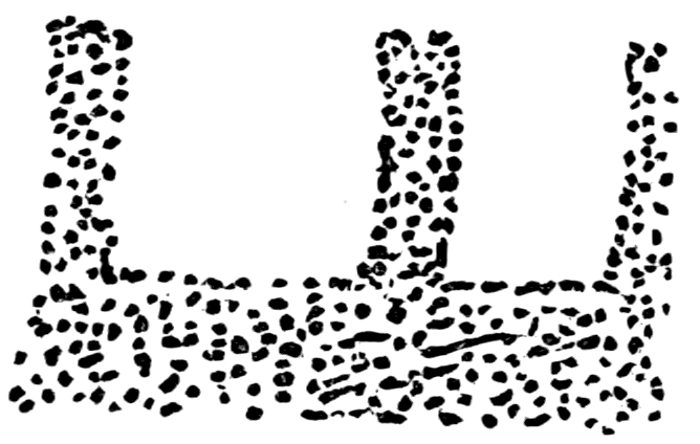
On the buttery-dore in his parlour he drew his father's picture at length, with his booke (fore-shortned), and on the spectacles in his hand is the reflection of the Gothique south windowe. I mention this picture the rather, because in processe of time it may be mistaken by tradition for his son Francis's picture, author of the booke aforesayd.
I never have enjoyed so much pleasure, nor ever so much pleased with such philosophicall and heartie entertainment as from him. His booke was in the presse at Oxford, and he there, when I was admitted of the College, but I had not the honour and happinesse to be acquainted with him till 1649 (Epiphanie), since which time I had a conjunct friendship with him to his death, and corresponded frequently with him. I have all his letters by me, which are very good, and I beleeve neer 200, and most of them philosophicall.
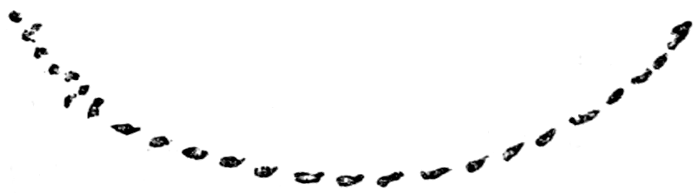
I have many excellent good notes from him as to mechaniques, etc., and I never was with him but I learn't, and alwayes tooke notes; but now indeed the Royall Societie haz out-donne most of his things, as having a better apparatus, and more spare money. I have a curious designe of his to drawe a landskip or perspective (1656), but Sir Christopher Wren hath fallen on the same principle, and the engine is better work't. He was smyth and joyner enough to serve his turne, but he did not pretend to curiosity in each. He gave me a quadrant in copper, and made me another in silver, of his owne projection, which serves for all latitudes. He shewed me, 1649, the best way of making an arch was a parabola with a chaine; so he tooke of his girdle from his cassock, and applyed it to the wall, thus:
He invented and made with his owne handes a paire of beame[725] compasses, which will divide an inch into a hundred or a thousand parts. At one end of the beame[725] is a roundle, which is divided into 100 equall parts, with a sagitta to turne about it with a handle: this handle turnes a skrew of a very fine thread, and on the back of the saile or beame is a graduation. With these compasses he made the quadrants aforesayd. He gave me a paire of these compasses, which I shewed to the[726] Royall Societie at their first institution, which they well liked, and I presented them as a rarity to my honoured friend, Edmund Wyld, esqre. There are but[727] two of them in the world.
☞ Memorandum that at the Epiphanie, 1649, when I was at his house, he then told me his notion of curing diseases, etc. by transfusion of bloud[LXI.] out of one man into another, and that the hint came into his head reflecting on Ovid's story of Medea and Jason, and that this was a matter of ten yeares before that time. About a yeare after, he and I went to trye the experiment, but 'twas on a hen, and the creature to little and our tooles not good: I then sent him a surgeon's lancet. Anno ... I recieved a letter from him concerning this subject, which many yeares since I shewed, and was read and entred in the bookes of the Royall Societie, for Dr. Lower would have arrogated the invention to himselfe, and now one [R.[728] Griffith,] Dr. of Physique, of Richmond, is publishing a booke of the transfusion of bloud, and desires to insert Mr. Potter's letter: which I here annex in perpetuam rei memoriam.
[729]'Worthy Sir,
'I am sorrie that I can as yet give you no better account of that experiment of which you desire to heare. I am as yet frustrated in ipso limine (but it is by my owne unexpertnes, who never attempted any such thing upon any creature before); for I cannot, although I have tried divers times, strike the veine so as to make him bleed in any considerable quantity.
'I have prepared a little cleare transparent vessel (like unto a bladder), made of the[730] craw of a pullet; and I have fastened an ivory pipe to one of the neckes of it, and I have put it into a veine which is most conspicuous about the lowest joint of the hinder legges; and yet I cannot procure above 2 or 3 drops of blood to come into the pipe or the bladder.
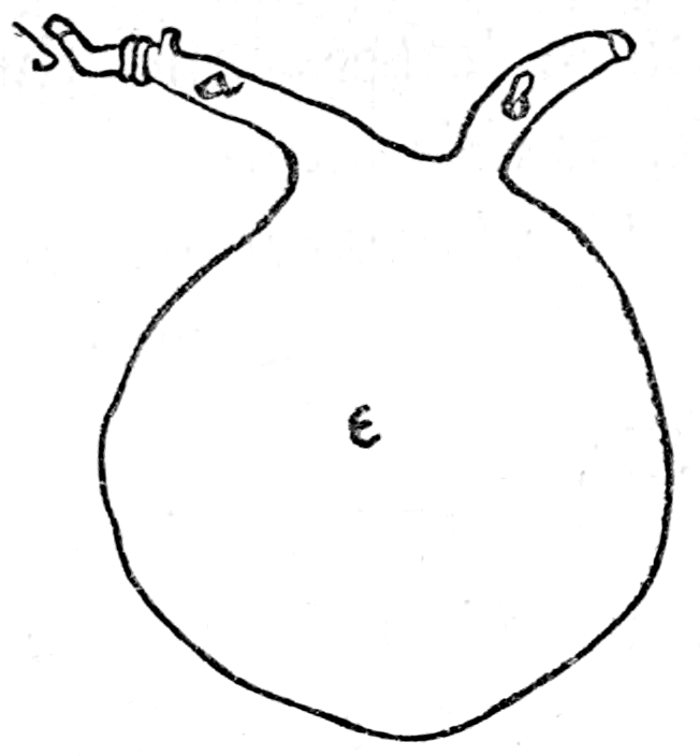
'I would have sent this bladder and pipe in my letter unto you but that I feare it might be an occasion that my letter might not come into your hands.—This is the rude figure of it which I do here set down because I thinke it the most convenient for this purpose:—
'a = the necke of the craw which goeth to the mouth.
'b = the other necke which goeth from the craw to the gissar. Another pipe may be tied to this end and put into the veine of another living creature at the same time.
'd = a little crooked ivory pipe, fastened (as a clister pipe is) to a bladder.
'e = the capacity of the craw or bladder.'
'Sir,
'I received that oyle in a little glasse which you had from Mr. Decreet and a receipt in another letter, and I desire you not to impute it to my unthankefulnes that I did not thanke you for it in my last letter. I have most times such sorrow and discontents in my breast which make me forget my selfe and my best friends and such things as I most delight in.
'If I should have occasion to write anything unto you in characters you may be pleased to remember this key, that the three first letters and every other three letters doe quiescere and that a comma is placed at the end of every word. As for example this writing:—
'Sed cæssat ar, otracci elusus, subest:— 'that is, 'cæsar occisus est,
'You need but cancell or make a line under every other three letters, and then you may easily and speedily read it, as this example:—
'Sed cæssat ar, otracci elusus, subest.
'Sed cæssat ar, otracci elusus, subest.
'Sir,
'I humbly present my service and best wishes unto you and shall still be
'Yours, in all true affection, to be commanded
Ffrancis Potter. 'Kilmanton, Decemb. 7º, 1652.'
<The address (on fol. 62v) is:—
'To the right worshipfull, his 'much honoured friend, Mr. John 'Aubrey, at the signe of the 'Rainebowe, a stationer's shop 'In Fleetstreet by Temple 'gate, give these 'Post-payd.'
The letter has been sealed with numerous seals: e.g. (1) a rose; (2) 'on a cross, 5 pheons; impaling, 2 lions rampant combattant'; (3) Aesculapius, with his staff, a vase in front of him; (4) a male head, in profile, with long hair and moustaches; (5) an antique head, with basket-work cap having a circle of spikes round it.>
[731]Anno Domini 166—he was chosen fellowe of the Royall Societie, and was there admitted and recieved with much respect.
As he was never a strong man, so in his later times he had his health best, only about four or five yeares before his death his eie-sight was bad, and before he dyed quite lost. He dyed ... and is buryed in ... of the chancell at Kilmanton.
Memorandum: he played at chesse as well as most men. Col. Bishop, his contemporary at Trinity Coll., is accounted the best of England. I have heard Mr. Potter say that they two have played at Trin. Coll. (I thinke 2 daies together) and neither gott the maistery. Memorandum: he would say that he look't upon the play at chesse <as> very fitt to be learn't and practised by young men, because it would make them to have a foresight and be of use to them (by consequence) in their ordering of humane affaires. Quod N.B.
He haz told me that he had oftentimes dream't that he was at Rome, and being in fright that he should be seised on and brought before the pope, did wake with the feare.[LXII.]
'Twas pitty that such a delicate inventive witt should be staked to a private preferment in an obscure corner (where he wanted ingeniose conversation), from whence men rarely emerge to higher preferment, but contract a mosse on them like an old pale in an orchard for want of ingeniose conversation, which is a great want even to the deepest thinking men (as Mr. Hobbes haz often sayd to me).
The last time I sawe this honoured friend of mine, Octob. 1674. I had not seen him in 3 yeares before, and his lippitude then was come even to blindnesse, which did much grieve me to behold. He had let his beard be uncutt, which was wont to be but little. I asked him why he did not get some kinswoman[732] or kinsman of his to live with him, and looke to him now in his great age? He answer'd me that he had tryed that way, and found it not so well; for they did begrudge what he spent that 'twas too much and went from them, whereas his servants (strangers) were kind to him and tooke care of him.
In the troublesome times 'twas his happinesse never to bee sequestred. He was once maliciously informed against to the Committee at Wells (a thing very common in those times). When he came before them, one of them (I have forgot his name) gave him a pint of wine, and gave him great prayse, and bade him goe home, and feare nothing.
[733]Kilmington, November 8th, 1671. Sir,
I recieved your letter but yesterday. I was borne upon Trinitie Sunday eave; baptized May the 22, 1594, but what day of the moneth Trinity Sunday was that year[734] I know not.
1671 1594 ---- 0077
I heare that bis<hop> Ironsid is lately dead, but where hee was borne or when he was buried I know not.
I will see those bookes you mention if I can get them.
I have writte no booke called The Key of Knowledg, but there is a booke called The Key of the Scripture written by a London divine, who is something large upon the Revelation, and preferreth my interpretation of 666 before all others.
I shalbe very glad to see you here at Kilmington; and rest,
Your humble servant Francis Potter.
Note.
Hannibal Potter (1592-1664).
[735]At Oxford (and I doe believe the like at Cambridge) the rod was frequently used by the tutors and deanes on his pupills, till bachelaurs of Arts; even gentlemen-commoners. One Dr. I knew (Dr. Hannibal Potter, Trin. Coll. Oxon) right well that whipt his scholar with his sword by his side when he came to take his leave of him to goe to the Innes of Court.
Vavasor Powell (1618-1670).
[736]Life and death of Vavasour Powell, 1671, p. 106:—Mr. Vavasour Powell 'was borne of honest and honourable parentage. His father, Mr. Richard Powell, of a very ancient family in Wales, living in the burough of Knocklas in Radnorshire, where his ancestors had lived some 100 yeares before; his mother of the Vavasors, a family of great antiquity, that came out of Yorkshire into Wales: and so by both allyed to most of the best families in North Wales. He was brought up a scholar, and taken by his uncle Mr. Erasmus Powell to be curate at Clun, where he also kept a schoole.'
Concerning his severall imprisonments, vide pag. 126, etc.
Mrs. Bagshawe haz heard him say that he was at Jesus College, Oxon; and Mr. Oliver, a minister, did remember it. Vavasor Powell told Mris Bagshaw of a sermon that he preached when he was of Jesus College.
Vide his Life[737] concerning his imprisonments etc.—'Sir J. A.' there is Sir John Aubrey; and 'Dr. B.' is Dr. Basset, LL.D.; 'C.' is Caerdif in Glamorganshire.
'Israel's Salvation, or a collection of the prophecies which concern the calling of the Jewes and the glory that shall be in the later dayes,' by E. B.: London, printed for Francis Smith of the Elephant and Castle without Temple barre, 1671.
He wrote a very good concordance, printed <1671>.
Sir Robert Poyntz (1589-1665).
[740]Sir Robert Pointz of Iron-acton in com. Gloc., knight of the Bath, is the same family with Clifford (as may be seen by the pedegree), Clifford being called de Pons till he was lord of Clifford Castle in com. Hereff. adjoyning to Breconshire.
In Henry III they maried with a daughter and heire of Acton, by whom they had the mannor aforesayd and perhaps other lands.
[743]When I was sick of the smallpox at Trinity College[744], Mr. Saul, who was an old servant of his, told me I thinke that he was of Lincoln (or, perhaps, that he lay there in the warres).
[745]Sir Robert Poynts, knight of the Bath; his seate was Iron Acton, in com. Gloc., which came to that family by match of daughter and heire, tempore Hen. III. Mr. Player, Mr. Anthony Ettrick's son-in-lawe, who bought this estate, June, 1684, haz all the old evidences, and can farther enforme me.
But this family and Clifford are the very same, as may be seen by the pedegre of Clifford, who was de Pons till he gott Clifford-castle, in com. Hereff. juxta com. Brecon.
This family have had a great estate, and were men of note at Court.
Sir Robert, son of Sir John, Poyntz of whom I now write, and with whom I had some small acquaintance, was a loyall, sober, and a learned person. His study, law; chiefly towards the Civill Lawe. Since[746] the king's restauration he published in print, a pamphlet, about the bignesse of a good play-booke, entitled, The Right of Kings (or to that purpose[747]; but to my best remembrance, that is the very title).
As I remember he told me when I was of Trin. Coll. Oxon, 1643, that he was of Lincoln college. He maried first, Gresill, one of the daughters and co-heires of ... Gibbons, of ... Kent, by whom he had only two daughters.
After her decease he had a naturall sonne by Cicely Smyth, who had been his lady's chamber-mayd, whose name was John, as I remember, who maried ... daughter of ... Cesar, in com. Hertf. He dyed without issue about 4 or 5 years since (1684), or lesse. So there is an end of this ancient family.
Memorandum:—Newark (now the seate of Sir Gabriel Lowe) was built by Sir Robert's grandfather to keep his whores in. Sir Robert dyed at ... anno Domini 16— and buryed....
William Prynne (1600-1669).
[748]Memorandum Sir John B<irkenhead> and Mr. Prinne were allwayes antagonists in the Parliament howse.
William Prinne[AY], esq., was borne (as his nephew George Clarke assures me[749]: quaere plus de hoc) at Aust in Glocestershire, where his father had an estate. I find by the Heralds' bookes that he is descended of an ancient family (vide Bibliothecam Sheldonianam[AZ], no. 115). His father, and also he, lived at ... wyck[750], a pleasant seate in Somerset, about 3 miles from Bathe, where his grand-father, ... Sherston, his mother's father, lived, and had been mayer, and a very wise magistrate; here[751] he learn't his grammar-learning. He was of Oriall College in Oxon[BA], where, I thinke, he tooke the degree of M.A. From hence, anno ... was admitted of Lincoln's-Inne. He was alwayes temperate and a very hard student, and he had a prodigious memorie.
Anno <1637> he was stigmatiz'd[LXIII.] in the pillorie, and then banished to Cornet-castle in <Guern>sey[752], where he was very civilly treated by the governour ... Carteret, a very ancient familie in that island. Anno 164<0> he was, with Burton and Bastwyck, called home by the Parliament, and hundreds mett him and them, out of London, some miles.
He was a learned man, of immense reading, but is much blamed for his unfaithfull quotations.
His manner of studie was thus: he wore a long quilt cap, which came, 2 or 3, at least, inches, over his eies, which served him as an umbrella to defend his eies from the light. About every 3 houres his man was to bring him a roll and a pott of ale[LXIV.] to refocillate his wasted spirits. So he studied and dranke, and munched some bread: and this maintained him till night; and then he made a good supper. Now he did well not to dine, which breakes of one's fancy, which will not presently be regained: and 'tis with invention as a flux—when once it is flowing, it runnes amaine; if it is checked, flowes but guttim: and the like for perspiration—check it, and 'tis spoyled.
Thou that with ale, or viler liquors, Didst inspire Wythers, Prinne, and Vicars[LXV.], And teach, though it were in despight Of nature and the starres, to write, &c.
Hudibras: part 1st.
He was burghesse of the citie of Bath, before and since the king's restauration. He was also Keeper of the Records in the Tower of London.
He endured severall imprisonments for the king's cause, and was (really) very instrumentall in his restauracion.
..., upon the opening of the Parliament, viz. letting in the secluded members, he girt on his old long rustie sword (longer then ordinary). Sir William Waller marching behind him (as he went to the Howse), W. Prynne's long sword ranne between Sir William's short legges, and threw him downe, which caused laughter.
He was of a strange Saturnine complexion. Sir C. W.[754] sayd once, that he had the countenance of a witch.
He dyed at his chamber in Lincolne's-Inn, anno ... and is interred at ... Quaere Ant. Wood <pro> catalogo librorum.
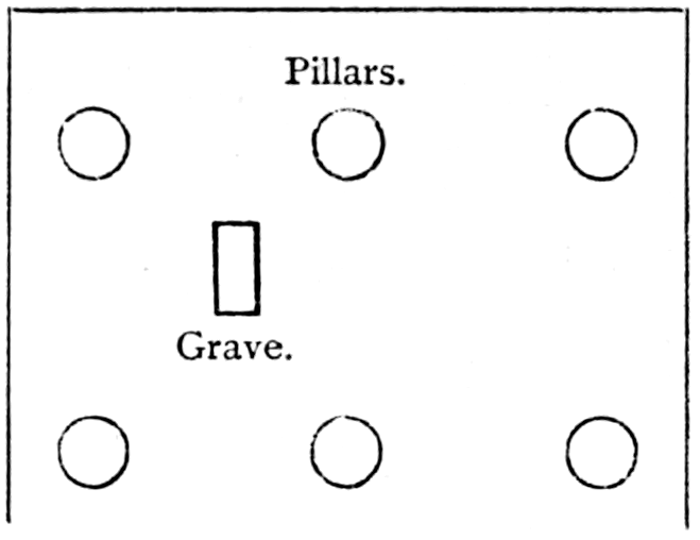
[755]William Prynne, esq., was buryed under Lincolne's Inne chapell, ut apparet ex inscriptione et inscripta tabula in capella suspensa, viz.
'Gulielmus Prynne, armiger, de Banco hujus hospitii, obiit 24º die Octobris, anno Domini 1669, aetatis 69.'
Notes.
Robert Pugh (1609-1679).
[756]Captain Pugh, my acquaintance, a writer and a poet. Bred up in Societate Jesu; but turn'd out because he was a captaine, viz. in the late warres.
He hath a Latin poem, printed, which will be augmented; and printed a booke against Dr. <George> Bates' Elenchus motuum nuperorum.
He was borne of a good family in ... North Wales (I thinke, Caernarvonshire).
[757]The native place of captain R. Pugh is spelt thus—Penrhyn.—When you saw him at Bathe, he wrot this discourse in 8vo, viz.
Bathonensium et Aquisgranensium thermarum comparatio, variis adjunctis illustrata: R. P.: epistola ad illustrissimum virum, Rogerum, Castlemaini comitem: Londini: Jo. Martyn, at the Bell in St. Paul's church-yard, 1676.
He was educated at St. Omar's.
When his studie was searcht, his orders were there found, and also a lettre from the Queen-mother, whose confessor he had sometimes been, to the king, that, if he should fall into any danger of the lawe, upon sight of that lettre he should obtaine his majestie's pardon.
[758]My honoured friend, captain Robert Pugh, dyed in Newgate, on January 22 <1678/9>, Wednesday night, 12 a clock; and lyes buryed in Christ Church churchyard on the north side, a yard or two from the wall, neer about the middle of the length. He writt a booke, which is almost finished, 'Of the severall states and goverments that have been here since the troubles,' in the earl of Castlemaine's hands.
All his bookes were seised on; amongst others his almanac, wherin he entred omnia Caroli II deliramenta[759], which was carryed to the councell boord: but, as I have sayd, the earl of Castlemain hath gott the former-mentioned treatise.
Francis Quarles (1592-1644).
[760]Francis Quarles, lived at Bath at the Katherine-wheele inne (opposite to the market-house), and wrote there, a yeare or two.
William Radford (1623-1673).
[761]William Radford, my good friend and old acquaintance and fellow coll<egiate>, ended his dayes at Richmond, where he taught schoole, 14 dayes since. I was with him when he first tooke his bed.
And when I was sick of the small-pox at Trinity College Oxon, he was so kind as to come to me every day and spend severall houres, or I thinke melancholy would have spoyled a scurvey antiquary. He was recounting not many dayes before he dyed your brother Ned's voyage[762] and Mr. <Thomas> Mariett's to London on foote.
[763]Mris Anne Radford, the widowe of Mr. William Radford, schoolmaster of Richmond, is now (1673) 33 yeares old. Was borne the 4th of June at 4h P.M. She haz a solar face (yet the sun <in her horoscope> could not be in ascendente), and thrives well, and has a good sound judgment.
Note.
William Radford (of North Weston, Oxon, aged 17) was elected Scholar of Trinity June 4, 1640, and afterwards Fellow; took M.A. July 4, 1646; and was ejected from his fellowship by the Parliamentary Visitors in June, 1648.
Sir Walter Raleigh (1552-1618).
[764]Sir Walter Ralegh, knight:—vide Howe's continuation of Stowe's Chronicle.—Vide Gerard Winstanley's Worthies of England, where he hath 5 or 6 leaves concerning Sir Walter Ralegh.
<Coat[765] of arms.>
[766]Gules, four fusils conjoined in bend argent.
<Pedigree.>
... Ralegh m. (2nd wife) Katherine Champernon m. ... Gilbert. | | | Adrian Gilbert, chymist, | sine prole. +-------------+----------------------------------+ | | Sir Carewe m. ..., relict ... m. Sir Walter m. (2nd) ... ... Ralegh, | of Sir John Throckmorton | Ralegh, 4tus | 3tius | Thynne, of | filius. | filius; | Longleate. | | obiit 1623, | Walter R., killed Carew R., m. ... sepultus at | in America, sine of ... in | Downton, | prole; vide History Surrey. | Wilts. | of the World, by +--------+ | Sir W. Ralegh, | | pag. —. ... R. m. Sir John | | Elowys. +--------+----------------------------+-----------------+ ... | | | Gilbert R. m. ... <daughter Captain George Walter Raleigh, D.D., | of> Sir Giles Ralegh, sine deane of Wells and rector | Wroughton. prole. of Chedzoy in Somerset: a +-----+------------------+------------+ millenarie (his tract of | | | that doctrine is lost), 1. Gilbert, m. ... 2. Walter, 3. Thomas, but he was conformable, | Godard. sine prole. sine prole. and chaplaine to King | Charles 1st: vide ... m. ... Erneley, of Whitehall. proximam pag.[767] | ... m. ...
<His marriages and issue.>
[768]He had two wives. His first was <Elizabeth> Throckmorton; second, ... ..., mother of Carew Ralegh, second[769] son.
[770]Sir John Elwowys maried the daughter and heir of Sir Walter Ralegh, who was the sonn of Carew Ralegh of ... in Surrey, who was the second son of Sir Walter Ralegh, the hero. Quaere Sir John Ellowys pro his skull[771] pro Oxon or Royal Societie.
[772](I[773] cannot yet heare where Sir Edward Shirburne is.) About the beginning of April I shall satisfy you about Carew Ralegh's daughter—I doe verily believe 'twas his only child.
<His brother's family.>
[774]Sir Carew Ralegh, of Downton in com. Wilts, was his eldest[LXVI.] brother, who was gentleman of the horse to Sir John Thynne of Longleate, and after his death maryed his lady; by whom he had children as in the pedigre.
I have heard my grandfather say that Sir Carew had a delicate cleare voice, and played singularly well on the olpharion[LXVII.] (which was the instrument in fashion in those dayes), to which he did sing.
His grand-children, Walter and Tom (with whom[775] I went to schoole at Blandford in Dorset 4 yeares) had also excellent tuneable voices, and playd their parts well on the violl; ingeniose, but all proud and quarrelsome.
<At Oxford.>
Sir Walter Ralegh was of ... in Oxford: vide de hoc Anthony Wood's Antiquities.
<A 'poor' scholar.>
[776]In his youth for severall yeares—quaere Anthony Wood how long[777]—he was under streights for want of money. I remember that Mr. Thomas Child of Worcestershire told me that Sir Walter borrowed a gowne of him when he was at Oxford (they were both of the same College), which he never restored, nor money for it.
[778]Sir Walter Ralegh was of Oriel College. Mr. Child's father of Worcestershire was his chamber-fellow, and lent him a gowne, which he could never gett, nor satisfaction for it.—from Mr. Child.
<Raleigh in Elizabeth's reign.>
[779]He went into Ireland, where he served in the warres, and shewed much courage and conduct, but [LXVIII.]he would be perpetually differing with ... (I thinke, Gray) then Lord Deputy; so that at last the hearing was to be at <the> councell table before the queen, which was that he desired; where he told his tale so well and with so good a grace and presence that the queen tooke especiall notice of him and presently preferred him. (So that it must be before this that he served in the French warres.)
[780]Queen Elizabeth loved to have all the servants of her Court proper men, and (as beforesaid Sir W. R.'s gracefull presence was no meane recommendation to him). I thinke his first preferment at Court was Captaine of her Majestie's guard. There came a countrey gentleman (or sufficient yeoman) up to towne, who had severall sonns, but one an extraordinary proper handsome fellowe, whom he did hope to have preferred to be a yeoman of the guard. The father (a goodly man himselfe) comes to Sir Walter Raleigh a stranger to him, and told him that he had brought up a boy that he would desire (having many children) should be one of her majestie's[781]guard. Quod Sir Walter Raleigh 'Had you spake for your selfe I should readily have graunted your desire, for your person deserves it, but I putt in no boyes.' Said the father, 'Boy, come in.' The son[782] enters, about 18 or 19, but such a goodly proper young fellow, as Sir Walter Raleigh had not seen the like—he was the tallest of all the guard. Sir Walter Raleigh sweares him immediately; and ordered him to carry-up the first dish at dinner, where the Queen beheld him with admiration[LXIX.], as if a beautifull young giant had stalked in with the service[783].
[784]Vide lord Bacon's apothegms and letters. As the queen (Elizabeth) was playing on the virginalls, ... made this observation, that 'when Jack's went up, keys went downe,' reflecting on Ralegh.
<Tobacco.>
[785]He was the first that brought tobacco into England, and into fashion.—In our part of North Wilts, e.g. Malmesbury hundred, it came first into fashion by Sir Walter Long.