AUBREY'S 'BRIEF LIVES' (continued 5)
Reading edition
He returned into England an extraordinary accomplished gentleman, grew famous at court for his readie sparkling witt which was envyed, and he was (Sir William sayd) the bull that was bayted. He was incomparably readie at repartyng, and his witt most sparkling when most sett-upon and provoked.
He was the greatest gallant of his time, and the greatest gamester, both for bowling[LXXXVII.] and cards, so that no shop-keeper would trust him for 6d., as to-day, for instance, he might, by winning, be worth 200 li., the next day he might not be worth half so much, or perhaps be sometimes minus nihilo. Sir William (who was his intimate friend, and loved him intirely) would say that Sir John, when he was at his lowest ebbe in gameing, I meane when unfortunate, then would make himselfe most glorious in apparell, and sayd that it exalted his spirits, and that he had then best luck when he was most gallant, and his spirits were highest.
Sir William would say that he did not much care for a lord's converse, for they were in those dayes damnably proud and arrogant, and the French would say that 'My lord d'Angleterre ...[1021] comme un mastif-dog'; but now the age is more refined, and much by the example of his gracious majestie, who is the patterne of courtesie.
Anno Domini 163- there happened, unluckily, a difference between Sir John Suckling and Sir John Digby (brother to Sir Kenelme) about a mistresse or gameing, I have now forgott. Sir John was but a slight timberd man, and of midling stature; Sir John Digby a proper person of great strength, and courage answerable, and yielded to be the best swordman of his time. Sir John, with some 2 or 3 of his party assaults Sir John Digby goeing into a play-house; Sir J. D. had only his lacquey with him, but he[1022] flew on them like a tigre, and made them run. 'Twas pitty that this accident brought the blemish of cowardise to such an ingeniose young sparke. Sir J. D. was such a hero that there were very few but he would have served in the like manner.
Anno Domini 163- when the expedition was into Scotland, Sir John Suckling, at his owne chardge, raysed a troope of 100 very handsome young proper men, whom he clad in white doubletts and scarlett breeches, and scarlet coates, hatts, and ... feathers, well horsed, and armed. They say 'twas one of the finest sights in those dayes. But Sir John Menis made a lampoon[BV] of it (vide the old collection of lampoons):
'The ladies opened the windows to see So fine and goodly a sight-a,' &c.
I thinke the lampoon sayes he made an inglorious chardge against the Scotts.
Quaere in what army he was in the Civill Warres.
[1023]Anno ... he went into France, where after some time being come to the bottome of his fund that was left, reflecting on the miserable and despicable condition he should be reduced to, having nothing left to maintaine him, he (having a convenience for that purpose, lyeing at an apothecarie's house, in Paris) tooke poyson, which killed him miserably with vomiting. He was buryed in the Protestants church-yard. This was (to the best of my remembrance) 1646.
His picture, which is like him, before his Poems, says that he was but 28 yeares old when he dyed.
He was of middle stature and slight strength, brisque round eie, reddish fac't and red nose (ill liver), his head not very big, his hayre a kind of sand colour; his beard turnd-up naturally, so that he had brisk and gracefull looke. He died a batchelour.
Memorandum:—he made a magnificent entertainment in London, at ..., for a great number of ladies of quality, all beauties and young, which cost him ... hundreds of poundes, where were all the rarities that this part of the world could afford, and the last service of all was silke stockings and garters, and I thinke also gloves.
Anno Domini 1637 Sir John Suckling, William Davenant, poet laureat (not then knighted), and Jack Young came to the Bathe. Sir John came like a young prince for all manner of equipage and convenience, and Sir W. Davenant told me that he had a cart-load of bookes carried downe, and 'twas there, at Bath, that he writt the little tract in his booke about Socinianism. 'Twas as pleasant a journey as ever men had; in the heighth of a long peace and luxury, and in the venison season. The second night they lay at Marlborough, and walking on the delicate fine downes at the backside of the towne, whilest supper was making ready, the maydes were drying of cloathes on the bushes. Jack Young had espied a very pretty young girle, and had gott her consent for an assignation, which was about midnight, which they happened to overheare on the other side of the hedge, and were resolved to frustrate his designe. They were wont every night to play at cards after supper a good while; but Jack Young pretended wearinesse, etc. and must needes goe to bed, not to be perswaded by any meanes to the contrary. They had their landlady at supper with them; said they to her, 'Observe this poor gentleman how he yawnes, now is his mad fit comeing uppon him. We beseech you that you make fast his dores, and gett somebody to watch and looke to him, for about midnight he will fall to be most outragious: gett the hostler, or some strong fellow, to stay-up, and we will well content him, for he is our worthy friend, and a very honest gentleman, only, perhaps, twice in a yeare he falls into these fitts.' Jack Young slept not, but was ready to goe out as the clock struck to the houre of appointment, and then goeing to open the dore he was disappointed, knocks, bounces, stampes, calls, 'Tapster! Chamberlayne! Hostler!' sweares and curses dreadfully; nobody would come to him. Sir John and W. Davenant were expectant all this time, and ready to dye with laughter. I know not how he happened to gett-open the dore, and was comeing downe stayres. The hostler, a huge lusty fellow, fell upon him, and held him, and cryed, 'Good sir, take God in your mind, you shall not goe out to destroy your selfe.' J. Young struggled and strived, insomuch that at last he was quite spent and dispirited, and faine to goe to bed to rest himselfe. In the morning the landlady of the house came to see how he did, and brought him a cawdle. 'Oh sir,' sayd she, 'you had a heavy fitt last night, pray, sir, be pleased to take some of this to comfort your heart.' Jack Young thought the woman had been mad, and being exceedingly vexed, flirted the porrenger of cawdle in her face. The next day his camerades told him all the plott, how they crosse-bitt him. That night they went to Bronham-house, Sir Edward Baynton's (then a noble seat, since burnt in the civill warres), where they were nobly entertained severall dayes. From thence, they went to West Kington, to parson ... Davenant, Sir William's eldest brother, where they stayd a weeke—mirth, witt, and good cheer flowing. From thence to Bath, six or seven miles.
Memorandum:—parson Robert Davenant haz told me that that tract about Socinianisme was writt on the table in the parlour of the parsonage at West Kington.
[1024]My lady Southcot, whose husband hanged himselfe, was Sir John Suckling's sister, to whom he writes a consolatory letter, viz. the first. She afterwards maried ... Corbet, D.D., of Merton Coll. Oxon[BW]. At her house in Bishop's Gate-street, London, is an originall of her brother, Sir John, of Sir Anthony van-Dyke, all at length, leaning against a rock, with a play[1025]-booke, contemplating. It is a piece of great value. There is also another rare picture, viz. of that pretty creature, Mris Jane Shore, an originall.
When his Aglaura was <acted>, he bought all the cloathes himselfe, which were very rich; no tinsill, all the lace pure gold and silver, which cost him ... I have now forgott. He had some scaenes to it, which in those dayes were only used at masques.
Memorandum:—Mr. Snowdon tells me, that after Sir John's unluckie rencounter, or quarrell, with Sir John Digby, wherin he was baffled: 'twas strange to see the envie and ill nature of people to trample, and scoffe at, and deject one in disgrace; inhumane as well as un-christian. The lady ... Moray (quaere) had made an entertainment for severall persons of quality at Ashley (in Surrey, near Chertsey), whereat Mr. Snowdon then was. There was the countesse of Middlesex, whom Sir John had highly courted, and had spent on her, and in treating her, some thousand of pounds. At this entertainment she could not forbeare, but was so severe and ingrate as to upbraid Sir John of his late recieved baffle; and some other ladys had their flirts. The lady Moray (who invited them) seing Sir John out of countenance, for whose worth she alwaies had a respect: 'Well[1026],' sayd shee, 'I am a merry wench, and will never forsake an old friend in disgrace, so <co>me sitt downe by me, Sir John' (said she), and seated him on her right hand, and countenanced him. This raysed Sir John's dejected spirites that he threw his reparties about the table with so much sparklingness and gentilenes of witt, to the admiration of them all.
[1027]Sir John Suckling—from Mr. William Beeston—invented the game of cribbidge. He sent his cards to all gameing places in the country, which were marked with private markes of his: he gott 20,000 li. by this way. Sir Francis Cornwallis made Aglaura, except the end.
Notes.
Thomas Sutton (1532-1611).
[1028]... Sutton, founder of the Hospitall[1029]—from old Thomas Tyndale, esq., the father—was first a garrison-soldier at Barwick[1030]. He was a lusty healthy handsome fellowe, and there was a very rich brewer who brewed to the navy, etc., who was ancient and he had maried a young buxome wife.... The old brewer doted on his desirable wife and dies and left her all his estate which was great[1031].
Sutton was a man of good understanding, and improved it[1032] admirably well, but the particular wayes by which he did it I have now forgot; but he was much upon mortgages, and fed severall with hopes of being his heire.
'Twas from him that B. Johnson tooke his hint of the fox, and by Seigneur Volpone is meant Sutton.
The later end of his dayes he lived in Fleetstreet at a wollendraper's shop opposite to Fetterlane, where he had so many great chests full of money that his chamber was ready to groane under it; and Mr. Tyndale, who knew him and I thinke had money of him on mortgage during his lawe-suite (vide the lord Stafford's case in Coke's Reports), was afrayd the roome would fall. He lived to establish his hospitall, and was governor there himselfe. Obiit....
The earle of Dorset (I thinke, Richard) mightily courted him and presented[1033] him, hoping to have been his heire; and so did severall other great persons.
Vide his life in 4to.
William Sutton (1562-1632).
[1034]Mr. William Sutton came to Ch. Ch. Oxon at eleaven. He wrote much, but printed nothing but a little 8vo against the Papists.
Note.
The Matric. Reg. does not bear out the statement as to his age: he appears there as matriculating Nov. 20, 1580, aged 18. He may have previously been chorister. He was elected Student of Ch. Ch. in 1579; took B.D. in 1592; and was Aubrey's schoolmaster at Blandford St. Mary's, Dorsetshire, where he was rector from 1592 till his death.
Sir Philip Sydney (1554-1586).
[1035]Sir[1036] Philip Sydney, natus 29 November, 1554, 19h 50´ P.M., Cantiae, polo 51° 52´; ex MSS. Eliae Ashmole[1037], armigeri.
[1038]Sir Philip Sydney[BX], knight, was the most accomplished cavalier of his time. He was the eldest son of the right honourable Sir Henry Sydney, knight of the noble order of the Garter, Lord President of Wales, and Lord Deputie of Ireland, 1570. I suppose he was borne at Penshurst in Kent (neer Tunbridge); vide.
He had the best tutors provided for him by his father that could then be had, as ... Vide my Grammar[BY] notes.
He travelled France, Italie, Germany; he was in the Poland warres, and at that time he had to his page[LXXXVIII.] (and as an excellent accomplishment) Henry Danvers (afterwards earle of Danby), then second son of Sir John Danvers of Dantesey in Wilts, who accounted himselfe happy that his son was so bestowed. He makes mention, in his Art of Poesie, of his being in Hungarie (I remember).
He was not only of an excellent witt, but extremely beautifull; he much resembled his sister, but his haire was not red, but a little inclining, viz. a darke amber colour. If I were to find a fault in it, methinkes 'tis not masculine enough; yett he was a person of great courage. He was much at Wilton with his sister, and at Ivy-church[1039] (which adjoyns to the parke pale of Clarindon Parke), situated on a hill that overlookes all the country westwards, and north over Sarum and the plaines, and into that delicious parke (which was accounted the best of England) eastwards. It was heretofore a monastery (the cloysters remayne still); 'twas called coenobium Edrosium. My great uncle, Mr. Thomas Browne, remembred him; and sayd that he was often wont, as he was hunting on our pleasant plaines, to take his table booke out of his pocket, and write downe his notions as they came into his head, when he was writing his Arcadia, (which was never finished by him).
He was the reviver of poetry in those darke times, which was then at a very low ebbe,—e.g. 'The Pleasant Comoedie of Jacob and Esau,' acted before King Henry VIII's grace (where, I remember, is this expression, that the pottage was so good, that God Almighty might have putt his finger in't); 'Grammar Gurton's Needle'; and in these playes there is not 3 lines but there is 'by God,' or 'by God's wounds.'
He was of a very munificent spirit, and liberall to all lovers of learning, and to those that pretended to any acquaintance with Parnassus; in so much that he was cloyd and surfeited with the poetasters of those dayes. Among others[1040] Mr. Edmund Spencer[1041] made his addresse to him, and brought his Faery Queen. Sir Philip was busy at his study, and his servant delivered[1042] Mr. Spencer's booke to his master, who layd it by, thinking it might be such kind of stuffe as he was frequently troubled with. Mr. Spencer stayd so long that his patience was wearied, and went his way discontented, and never intended to come again. When Sir Philip perused it, he was so exceedingly delighted with it, that he was extremely sorry he was gonne, and where to send for him he knew not. After much enquiry he learned his lodgeing, and sent for him, mightily caressed <him>, and ordered his servant to give him ... pounds in gold. His servant sayd that that was too much; 'No,' said Sir Philip, 'he is ...,' and ordered an addition.
From this time there was a great friendship between them, to his dying day.
I have heard Dr. Pell say, that he haz been told by ancient gentlemen of those dayes of Sir Philip, so famous for men at armes, that 'twas then held as great a disgrace for a young gentleman[1043] to be seen riding in the street in a coach, as it would now for such a one to be seen in the streetes in a petticoate and wastcoate; so much is the fashion of the times nowe altered.
He maried the daughter of Sir Francis Walsingham, Principall Secretary of Estate (I thinke his only child—quaere), whom he loved very well....
Having recieved some shott or wound in the warres in the Lowe-countreys, where he had command of ... (the Ramikins, I thinke), he <acted> contrary to the injunction of his physitians and chirurgions, which cost him his life: upon which occasion there were some roguish verses made.
His body was putt in a leaden coffin (which, after the firing of Paule's, I myselfe sawe), and with wonderfull greate state was carried from ... to St. Paule's church, where he was buried in our Ladie's Chapell: vide Sir William Dugdale's Paul's, and epitaph. There solempnized this funerall all the nobility and great officers of Court; all the Judges and Serjeants at Lawe; all the soldiers, and commanders, and gentry that were in London; the Lord Mayer, and Aldermen, and Livery-men. His body was borne on men's shoulders (perhaps 'twas a false coffin).
When I was a boy 9 yeares old, I was with my father at one Mr. Singleton's, an alderman and wollen-draper in Glocester, who had in his parlour, over the chimney, the whole description of the funerall, engraved and printed on papers pasted[1044] together, which, at length, was, I beleeve, the length of the room at least; but he had contrived it to be turned upon two pinnes, that turning one of them made the figures march all in order. It did make such a strong impression on my young[1045] phantasy, that I remember it as if it were but yesterday. I could never see it elswhere. The house is in the great long street, over against[1046] the high steeple; and 'tis likely it remaines there still. 'Tis pitty it is not re-donne.
In St. Mary's church at Warwick is a sumptuose monument of the lord Brooke, round a great altar of black marble is only this inscription:—
'Here lies the body of Sir Fulke Grevill, knight, servant to Q. Elizabeth, counsellor to K. James, and friend to Sir Philip Sydney.'
On a little tablet of wood:—
'England, Netherlands, the Heavens and the Arts Of ... Sydney hath made ... parts; ... for who could suppose, That one heape of stones could Sydney enclose.'
[1047]Sir Henry Sydney, knight of m. Mary, daughter of John Dudley, the Garter, and President of | duke of Northumberland, sister Wales. | to Ambrose, earle of Warwick. | +-------------------------+----+------------+-------+-----+---+ | | | | | | 1. Sir Philip m. ... daughter 2. Robert, 3. Thomas. Mary. \—-/ Sydney | and ... of viscount two sisters, | secretary Lisle, married to | Walsingham: 1616. 2 Mansells of | obiit 22 Sept. Glamorganshire, | 1586. brothers. | Elizabeth, daughter m. Roger Manners, earl and heir | of Rutland. | sine prole.
Sir,
All the good bodies thanke you for your remembrance, which I ought to have told you sooner if a paine in my head had not hinderd me.
I wishe I could give you the key you desire, but all I know of it is not worth anything; though conversant amongst his relations, could learne noe more then Pamela's being my lady Northumberland[1049], Philo[clea] my lady Rich[1050], two sisters, the last beloved by him, upon whose account he made his Astrophell and Stella; Miso, lady Cox, Mopse, lady Lucy, persons altogether unknowne now; Musid[orus] and Pericles, the two ladies' husbands. Lord Ri[ch] being then his friend, he perswaded her mother to the match, though he repented afterwards: she then very young and secretly in love with him but he no consern for her. Her beauty augmenting, he sayes in his Astrophel and Stella, he didnt think 'the morn would have proved soe faire a daye.' Their mother[1051] was beautifull and gallant (whether he meant Ginesia by her or noe, I know not); but their father died, they being young. She remaried to Dudley, Leycester and Northumberland, and afterwards to her gentleman of the horse, Sir Cristopher Blunt, which was beheaded with lord Essex. It was thought he meant himself by Amphi[alus] and his lady, Sir Francis Walsingham's daughter and heire, the queen of Corinth. If he did make his owne character high, they sayd Philisides was himself to, but it was all a guesse. He made it young, and diyng desired his folies might be burnt.
Some others I have heard guessed at, but have forgot. Therfore canot satisfie the lady, which I would for your sake.
I give you thankes but shall not want my grandmother's epitaph (which was for a relation of ours heere, who desird it), having found it of your giving.
I knew of my brother's place, but know nothing of his mariyng yett.
My service to your brother. I am sorry all thinges should not answear both your desires.
You have perfectly the good wishes of,
Your humble servant, D. Tyndale. [Langton[1052] in Lincolneshire] Feb. 18, 1686/7.
Service to my lady Long. Whye doe you tell us no newes? Does not Mrs. Mason's mar[1053]....
Notes.
Sir Robert Talbot (1641/2-1681).
[1054]Sir Robert Talbot natus 1641/2, Friday, January 21, 14h 0´ 14˝ P.M.
Sent by King Charles 2d into France to cure Madamosille d'Orleans, May last, 1678.
Oct. 1678, knighted.
A second voyage into France, being sent for by that king, Decr. 1678.
Married February 1678/9.
He dyed about September 1681.
[1055]Sir Robert Talbot, ague doctor, natus 21 Januarii 1641/2, 14h 0´ 14˝ P.M.
John Tap.
[1056]... Tappe:—he writ a very good Arithmetique for those times, with an introduction to Algebra, in English, in 8vo.
John Taylor (1580-1654).
[1057]John Tayler, the water-poet:—his Workes are a fair folio, printed, London, 1630.
<He> was borne in the citie of Glocester:—.... Tayler, a painter, was his brother[1058], who told me thus 23 yeares since (he lives yet at Oxon): and his picture hung in the Schooles gallery.
He came to London and bound himselfe to a water-man, in which capacity he wrote his poems. I have heard Josias Howe, M.A., say that he will choose out 6 verses (quaere) there as good as you will find in any other.
He was very facetious and diverting company; and for stories and lively telling them, few could out-doe him.
Anno 1643, at the Act time, I sawe him at Oxon. I guesse he was then neer 50. I remember he was of middle stature, had a good quick looke, a black velvet, a plush-gippe and silver shoulder-belt; was much made of by the scholars, and was often with Josias Howe at Trinity College.
He had heretofore in the long peace severall figgaries, e.g. he came from London to Salisbury in his skuller. He went so to Calais. He went to Scotland (I think round Great Britaine) littus legens in his skuller.
Ever since the begining of the civill warres he lived in Turne-stile-alley in Long Acre, about[1059] the middle on the east side over against the Goate (now[1060]), where he sold ale. His conversation was incomparable for three or four mornings' draughts. But afterwards you were entertained with crambe bis cocta. His signe was his owne head, and very like him, which about 22 yeares since was removed to the alehowse, the corner howse opposite to Clarendon howse. Under his picture are these verses; on one side:—
There's many a head stands for a signe. Then, gentle reader, why not mine?
On the other:—
Though I deserve not, I desire The laurell wreath, the poet's hire.
This picture is now almost worne out.
Obiit ... (about 25 years since): sepult. in the church-yard of St. Martin's-in-the-fields.
[1061]John Taylor, water poet, quaere his obiit. Quaere his brother the paynter at Oxon. A<nthony> W<ood> respondet that he haz notes from the paynter who is dead.
Silas Taylor (1624-1678).
[1062]Mr. Baker, the printseller, by the Royal Exchange, hath a MS., a thin folio, viz. the description of Harwich and all its appurtenances and antiquities by capt. Silas Tayler.
[1063]Captain Silas Tayler: vide A. Wood's Hist. et Antiq. Oxon. He was a captaine in the Parliament army, under col. <Edward> Massey. He was a sequestrator, in Herefordshire, and had, in those times, great power, which power he used civilly and obligeingly, that he was beloved by all the King's party.
He was very musicall, and hath composed many things, and I have heard anthemes of his sang before his majestie, in his chapell, and the king told him he liked them. He had a very fine chamber organ in those unmusicall dayes. There was a great friendship between Matthew Lock, since organist of the Queen's chapell, and him[LXXXIX.].
His father left him a pretty good estate, but he bought church lands and had the moeity of the bishop's palace, at Hereford, where he layd out much money in building and altering. Col. John Burch[1064] had the other moeity.
The times turning, he was faine to disgorge all he had gott, and was ruined, but Sir Paul Neile got for him the keeper of the King's stores at Harwich, worth about Cli. per annum.
He was a great lover of antiquities, and ransackt the MSS. of the Church of Hereford (there were a great many that lay uncouth and unkiss).
He also garbled the library of the church of Worcester, and evidences, where he had the originall grant of King Edgar (θαλασσιαρχης) whence the Kings of England derive their right to the soveraignty of the sea. 'Tis printed in Mr. Selden's Mare Clausum. I have seen it many times, and it is as legible as but lately written (Roman character). He offered it to the king for 120li. but his majesty would not give so much. Since his death, I acquainted the Secretary of Estate that he dyed in debt, and his creditors seised on his goods and papers. He told me that it did of right belong to Worcester Church. I told one of their prebends, and they cared not for such things. I beleeve it haz wrapt herings by this time.
He had severall MSS. by him of great antiquity: one thin 4to. of the Philosopher's Stone, in Hieroglyphicks, with some few Latin verses underneath; the most curiously limned that ever I sawe. His Majesty offered him 100li. for it, and he would not accept it. Tell Dr. Crowder[1065] of the deed of king Edgar.
Memorandum:—Capt. Tayler search<ed> the Records in the Tower, etc., and retrived some privileges that the borough[1066] had lost, for which the borough ought ever to have his remembrance in esteeme: and tho' he dyed above 100li. in their debt, yet the towne lost not by him, for the reason aforesaid.
The history or collection of this ancient borough he pawned a little before his death to Mr. Baker, the printseller by the Old Exchange, for 4li. 15s. I acquainted Sir Philip Parker, whom the borough uses to choose for their burghesse, to buy it for his borough. He would not lay out so much money, which would doe them more service then all his roast-beefe, wine, and ale at an election.
Digitus Dei[1067]. All that family came to unfortunate ends. His eldest sonne, wife, and children, were all burnt in their beds in ... near Lothbury; another son, ...; another son (a dragoon[1068]), a churchyard wall fell on him and killed him.
[1069]He surveyed very ingeniously and carefully the antiquities of Herefordshire, scil. about 3/4 of the county, before the restauration of his majesty. He then left the country and went to his friend, Sir Edward Harley, then governour of Dunkirke, who gave him some command.—These papers[1070] are in the hands of Sir Edward Harley at Brampton-Bryan Castle.
[1071]Silas Domville alias Taylor, comitatus Salopiensis, xvito die mensis Julii anno Domini MDCXXIVto in Harleya natus: in scholis Westmonasteriensi, Salopiensi (Scrobesbyriensi, si placeat), et aliis alumnatus: in tabulis publicis Aulae Novi Hospitii Oxoniensis circa annum MDCXLI conscriptus erat. Anno MDCLX apparatus bellici, armorum, et munimentorum rerum nauticarum Harvici in extrema maritima parte Essexiae pro serenissimo rege Carolo secundo usque adhuc ab anno MDCLXV custos et agens.
Inter alios libros scripsit de terrarum partitione inter liberos secundum tenuram Wallensium, Anglicé the History of Gavel kind, et ad finem ejusdem historiolam quandam ducum Normannorum tempore Henrici primi Latiné scriptam divulgavit, quae vocatur Brevis relatio.... In historia et descriptione comitatus Herefordiensis per quadriennium, immo vero lustrum, enixe laboravit sed nec absolute aut ad plenum perfecit.
[1072]For what other bookes, besides Gavel-kind, I have wrote, as my name for cogent reasons when first printed was not to them because of the nature of them, soe I shall not be soe vaine as now, after soe long a sleep, to awaken them with it.
Herbert Thorndyke (16—- 1672).
[1073]Mr. Herbert Thorndyke was borne at ... in Lincolnshire, went to schoole at ... (quaere if at Westminster); ..., was fellow of Trinity College in Cambridge; afterwards prebendary of Westminster[1074].
He was a good poet. I have seen a poemation of his on the death of Gustavus Adolphus, king of Sweden, in Latin hexameters, about 100 verses or better.
He was (as I am enformed by Seth Ward, Lord Bishop of Sarum, and other learned men) one of the best scholars and mathematicians of this age.
He printed ... but he does not write clearly (quaere Dr. Pell de hoc).
Richard Busby, schoolmaster of Westminster, has his MSS.; quaere what they are.
He dyed[1075] <July>, 167<2>; and lies interred in the north-east angle of Westminster cloysters, next to the grave-stone of <Thomas> Nurse, M.D., a piece of a blew marble stone on him but yet no inscription.
He made his own inscription which is mentioned by Mr. Andrew Marvell in his Rehearsall Transpros'd, viz.:—
Hic jacet corpus Herberti Thorndike praebendarii hujus ecclesiae, qui vivus veram Reformatae Ecclesiae rationem et modum precibus studiisque persequebatur. Tu, Lector, requiem et beatam in Christo resurrectionem precare.
A parallel written by the bishop[1076] and found under his owne hand and appointed for his epitaph, but I heare that Dr. <William> Lloyd his successor will have it altered to avoyd offence:—
Exuviae[1077] Isaaci, Asaphensis episcopi, In manus Domini depositae, In spem laetae resurrectionis per sola Christi merita. O vos transeuntes[1078] domum[1079] Domini, Domum orationis, Orate pro conservo vestro Ut inveniam misericordiam die Domini. June 30, 1680.
John Tombes (1603-1676).
[1080]Mr. John Tombs, B.D. (quaere A. Wood's Antiq. Oxon.) was borne at Beaudley in Worcestershire; his father was a....
Anno Domini <1617/8> he was admitted at Magdalen-hall, in Oxon. Anno <1621>, A.B.; Anno <1624>, A.M. He read to pupills, and was tutor there to John Wilkins, afterwards bishop of Chester. He was a great master of the Greeke tongue, and the Hebrue he understood well. He alwaies carried a little Greeke Testament about with him; he had <it> almost memoriter. He was an admirable disputant; I remember he was wont to say, that to be a good disputant, 'tis requisite for one to be a good grammarian, as well as logician. I have forgott if he was pupill to the learned Mr. <William> Pemble; but his favourite he was. He was soon taken notice of for his curious searching, piercing witt: he preached somewhere eastwards from Oxon, and had a company[1081] followed him; and 'twas predicted he would doe a great deale of mischiefe to the Church of England, reflecting upon what ... sayes, that the greatest witts have donne the most mischiefe to the Church, introducing new opinions, etc. Anno ... he was vicar of a market-towne[1082] in Herefordshire, where he was very well beloved by his parish, and Sir ... Croftes, eldest brother to the now bishop of Hereford, built a house in Leominster, to live there, to heare him preach. Anno ... he writt ..., 8vo, dedicated to John Scudamore, viscount Slego, baron of ... drum[1083]. Anno 1645, 1646, he was master of the Temple at London, i.e. minister. In 1647 he was supplanted there by parson Johnson. Then he went into his owne country, to Beaudley (a market-towne), at which time Mr. Baxter (his antagonist) preacht at Kitterminster, the next market-towne, two miles distant. They preacht against one another's doctrines, and printed against each other. Mr. Tombes was the Coryphæus of the Anabaptists: both had great[1084] audience; they went severall miles on foot to each doctor. Once (I thinke oftner), they disputed face to face, anno ...; and the followers were like two armies, about 1500 of a party; and truly, at last they fell by the eares, hurt was donne, and the civill magistrate had much adoe to quiet them. About anno 1664 he came to the Act at Oxford (quaere), and did there in vesperiis sett up a challenge to maintaine contra omnes gentes the Anabaptisticall doctrine; but not a man would grapple with him. Now, though primâ facie this might seeme very bold to challenge a whole University, 'twas not so very strange neither, for he came throughly prepared, after 30 yeares' study and thoughts, and most of them surprised.
Scripsit....
Dr. <Robert> Sanderson, lord bishop of Lincolne, and he, had a greate esteeme for each other, so also had Dr. <Thomas> Barlowe (now bishop there). Putting aside his Anabaptisticall positions, he was comformable enough to the Church of England. About 1658 or 9, he maried the widowe of ... Dove, of Salisbury, and went to hear the Common Prayer there, and recieved the Sacraments; and sometimes wayted on bishop Ward, who respected him for his learning. He was thought to be as great a divine as most we had after bishop Sanderson dyed. I remember he never, or seldome, was wont to say Our Saviour Christ, but My Lord Christ. He seemed to be a very pious and zealous Christian. I have heard him say (though he was much opposite to the Romish religion) that truly, for his part, should he see a poor zealous friar goeing to preach, he should pay[1085] him respect. He was but a little man, neat limbed, a little quick searching eie, sad, gray. He dyed at Salisbury, May 22, and was buried 25th, in St. Edmund's church-yard, anno Domini 1676, opposite to the steeple, a good distance on the north side. His daughter dyed 7 yeares before him, and haz a grave-stone on her, with an inscription. He lyes there, and in the same stone is since engraven an inscription to the purpose already written of Mr. John Tombes.
According to your desire I have sent you (although long, for it), my cozen Gore and my cozen Gastrell's nativityes; also your brother William who is now in this countrey desired mee to send you up Mr. Francis Potter's place of interment in the church at Killmanton, and the inscriptions on Mr. Tombs' and his daughter's tombston.
I have enquired of Mr. Kent; and hee sayth that Mr. Potter is buryed in Killmanton church, but in what part of the church hee knoweth not.
The inscription on Mr. Tombes his tomb is first:—
'Here lyeth the body of Elizabeth the wife of Mr. Wolston Abbott,'
and under itt this inscription on the same stone:—
'Here <lyeth> the body of Mr. John Tombes, Batchelour in Divinity, a constant preacher of God's word, who deceased the 22d of May 1676, aged 73.'
I will finish Mr. Penruduck's[CB] genesis as soone as I can; but I am somewhat bussy att present; therefore must begge his pardon.
I will write to H. Coley shortly, for lately I received a letter from him.
Soe in hast I am, Sir,
Your faythfull servant to bee commanded, Charles Snell.
Sarum; Saturday, 2do Aprilis 1618.
Yesterday the good lord bishop of Sarum arrived att his pallace in the Close.
[1087]To John Aubrey, esq., att Mr. Hooke's chamber in Gresham Colledge with care these present.
London.
Notes.
Ezreel Tonge (1621-1680).
Obiit ... Decemb., sepultus 23 Decemb. <1680> in the vault of the church-yard of St. Mary Stayning, London; where, before the conflagration, was a church, of which he was the parson[1089]; but I have heard his brother, captain Tong (of the King's Guards) say 'twas worth but 18 li. per annum, for he had gathered it.
Mr. <Thomas> Jones (who preached his funerall sermon: printed) sayes that he haz left two tomes in folio of alchymie. His excellency lay there.
About 1658, or 1659, the then-Power made an Academie of the Bishop's Pallace at Durham, for the benefit of the North. Dr. Tonge was the governour, or one of the professors. Ned Bagshawe was proposed to have been another. The Dr. had an excellent schoole there, and followed precisely the Jesuites' method of teaching; and boyes did profit wonderfully, as needes they must, by that method.
He afterwards taught at Islington, at Sir Thomas Fisher's house[CD], where was a long gallery, and he had severall printed heads of Caesars, &c.; verbes under such a head, governed a dative case; under another, an ablative. The boyes had it as readie as could be. I have been there.
[1090]Ezerel Tong, D.D.:—Mr. Cadnam, bookeseller, New Exchange, hath his papers, among which is a MS. (folio) of chymistrie: quaere title. Respondet quod non: Captain Tonge (his brother) gave all his papers to my lord Culpepper[1091], when he went to Virginia. I spake to Sir R. Reding to quaere <about them>, and my lord heeded not such things. So there is a precious collection of other men's labours lost.
[1092]Ezerel Tong, D.D., invented (among other things) the way of teaching children to write a good hand in twenty dayes' time, by writing over, with black inke, copies printed from copper-plates in red inke:—viz., the children (scilicet, about 8 or 9 aetatis) were to do it four howers in the day; i.e. 2 howers or 2 halfe-howers in the morning at a time (as the boyes' temper could endure it, without tyring him); and then to play as long; and then to it again, to keep up the idea in the child fresh. Since his death, Mr. Robert Moray (projector[1093] of the Penney Post) haz engraven severall plates printed-off in red letters, by which meanes boyes learne (to admiration) as aforesayd—quod N.B.
His funerall sermon was preached in the church of St. Michael, Wood-street; the church of St. Mary Stayning being burn't, and never to be re-edified, but both parishes putt together.
Notes.
Nathaniel Torporley (1563-1632).
[1094]Mr. J.[1095] Torporley—Mr. <Robert> Hooke affirms to me that Mr. J. Torporley was amanuensis to Vieta[1096]; but from whom he had that information he haz now forgot, but he had good and credible authority for it, and bids me tell you that he was certainly so.
He printed something against Vieta by the name of John Poulterey (a disguised name, the same letters a little transpos'd).
[1097]Memorandum:—Mr. Nicholas Mercator (who taught the last earl of Northumberland[1098], then lord Percy, at Petworth) assures me that the earle of Northumberland who was prisoner in the Tower gave also a pension to one Mr. ... Torporley, Salopiensis, a learned man; and that in the library of that family (I thinke) at Petworth, are some papers of his: quaere iterum.
Ex catalogo librorum Bibliothecae Bodleianae:
Nath. Torporlaeus, Diclides coelometricae, seu valvae astronomicae universales: Lond. 1602, 4to: C. 46 Art.
Thomas Triplett (1603-1670).
[1099]Next to Dr. Outram's inscription <in the south aisle of Westminster abbey> stands this of Dr. Triplett, in the very place where Mr. Thomas May's stood, of white marble[1100]:—
Hic requiescit vir Reverend. Dr. Thomas Triplett, ex agro Oxoniensi, Praebendarius hujus ecclesiae, Qui postquam ad annum aetatis septuagesimum pietate et cultus assiduitate, Deo, Graecae linguae peritia non vulgari, doctis, largitate et continua beneficentia, egenis, morum innocua jucunditate, omnibus, carum se praebuisset, Ab hac vita ad meliorem commigravit, Anno Domini 1670 Die Julii 18.
He went to schoole to Dr. Gill, as appeares by his ballad[1101], which will last longer then any sermon that ever he made.
After his sequestration[1102] he kept a schoole at Dublyn (when the king was beheaded); afterwards at Hayes, Surrey, 12 miles from London. 'Twas here our[1103] common friend George Ent went to schoole to him, who told me that he had forgot the smart of his old master, Gill; he was very severe.
I'le tell you a story of our old friend. His master Triplett was a great lover of honey, and one of his schoolefellow's mother having sent a pott of honey to the doctor, G. Ent putt his schoolefellow to beg a little of his master, and he had gott a manchet and so they would have a regalio. The doctor was in his study; and the boy takes the confidence to approach, with his 'Quaeso, praeceptor, da mihi mel.' G. Ent was sneaking behind. Qd. the disturbed doctor, 'You audacious raskall,' and gave him a good cuffe on the ear, 'how dare you be thus impudent? Sirrah, who putt you on?' The boy answered (whiningly) 'G. Ent.' The enraged doctor flies out of his study (he was a very strong man), gives poore George a kick in the breech, and made him fly downe a flight of 7 or 8 staires to the landing-place, where his head first came to. He was stunn'd, but 'twas well his neck was not broken. 'Twas a most cruel and inhumane act to use a poore child so. It so happened that a day or two before G. E. had shaled a tooth. He writes a letter to his father (now Sir George Ent) and incloses the tooth in it; relates the story and that he lost the tooth by that meanes[1104]. The next day the grave and learned Dr. Ent comes to Hayes (the fame of whose learning and testimonie did give great credit and reputation to this schoole); expostulates with the doctor about his sonne. To be short, tooke him away, and placed him with Mr. William Radford at Richmond (an honest sequestred fellow of Trinity College, Oxon, and an excellent schoolmaster, having been bred at Thame under Dr. Birt[1105] and afterwards sent to Winton.) This accident well-nigh did breake Dr. Triplett's schoole. But shortly after this time, happened the restauration of his majestie, and then he was also restored to his former preferments.
Thomas Tusser (1527-1580).
[1106]Memorandum:—Edward Bullock, of Fayburne-hall, in Essex, esq. assures me, that this Tusser was borne at Riven-hall in Essex. The howse wherein he was borne they doe yet shew. He rented the parsonage of Fairested. He speakes in his booke of the people's cosening him of his tythes.
William Twisse (1574-1646).
[1107]... Twisse, D.D., of Newbury:—his sonne Dr. ... Twisse, minister of the new church neer Tothil street, Westminster, told me that he had heard his father say that when he was a schoole-boy at Winton Colledge that he was a rakell, and that one of his schoolefellowes and camerades (as wild as himselfe) dyed there; and that his father goeing in the night to the house of office, the phantome or ghost of his dead schoolefollow appeared to him and told him 'I am damn'd'; and that this was the beginning of his conversion.
Memorandum:—the Dr. had a melancholique and hypo-condriaque temperament.
John Twyne (15—- 1581).
[1108]Jo. Twini, Bolingdunesis, Angli, de rebus Albionicis, Britannicis, atque Anglicis commentariorum libri 2, ad Thomam Twinum, filium: Lond. 1599.
The father was schoolmaster of St. Saviour's in Canterbury. John Leland haz verses on him.
Thomas Twyne (1543-1613).
[1109]☞ From Mr. Meredith Lloyd—'The Breviarie of Britaine of Humphrey Lloyd, dedicated to Ortelius, translated out of Latine by Mr. Twyne, wherein are the etymologies of the Welsh names, rivers, cities, etc.' He says that the Latin edition is altogether false writt, which names Mr. Twyne hath printed true in the English edition.
Thomas Tyndale (1588-1671/2).
<In MS. Aubr. 21, among the notes Aubrey has jotted down for his projected comedy The Country Revel, are a number under the initials of T. T., i.e. of Thomas Tyndale (see p. 190, supra), whom Aubrey took for his model in depicting an old gentleman ('Sir Eubule Nestor') of the heroic age. Some of these opinions of 'an old courtier of the Queen's' are collected here.>
In those days (Elizabetha regina) the great men had a gate (the yettes), and when a senator went to the Parliament-house a-foote, or a horse-back with his foot-cloath, he had at his heeles 1/2 a dozen or 10 tall fellowes with blew coates and badges and long basket-hilt swords. Now forsooth only a laquey and a little spitt-pig[1110].
T. T.—The advantage that king Charles I had: gentlemen tho[1111] kept good horses, and many horses for a man-at-armes, and men that could ride them; hunting horses. Now we are come all to our coaches forsooth! (Sir Philip Sydney[1112]). Now young men are so farre from managing good horses, they know not how to ride a hunting nag nor handle their weapons. So God help the king if, etc.
In Sir Philip Sydney's time 'twas as much disgrace for a cavalier to be seen in London rideing in a coach in the street as now 'twould be to be seen in a petticoate and wastcoate. They rode in the streets then with their rich footcloathes, and servants wayting on them with blewe coates and badge, 6[1113], 8, 12 +.
T. T., an old gentleman that remembers Queen Elizabeth's raigne and court, one of true gravity and prudence, not one that depends upon the grave cutt of his beard to be thought so. He hath seen much in his time both at home and abroade; and with much choler inveighes against things now:—'Alas! O' God's will! Now-a-dayes every one, forsooth! must have coaches, forsooth! In those dayes gentlemen kept horses for a man-at-armes, besides their hackney and hunting horses. This made the gentry robust and hardy and fitt for service; were able to be their owne guides in case of a rout or so, when occasion should so require[1114]. Our gentry forsooth in these dayes are so effeminated that they know not how to ride on horseback.—Tho when the gentry mett, it was not at a poor blind sordid alehouse, to drinke up a barrell of drinke and lie drunke there two or three dayes together; fall together by the eares. They mett tho in the fields, well-appointed, with their hounds or their hawkes; kept up good hospitality; and kept a good retinue, that would venture that bloud and spirit that filled their vaines which their masters' tables nourisht[1115]; kept their tenants in due respect of them. We had no depopulacion in those dayes.
'You see in me the ruines of time. The day is almost at end with me, and truly I am glad of it: I desire not to live in this corrupt age. I foresawe and foretold the late changes, and now easily foresee what will follow after. Alas! O' God's will! It was not so in Queen Elizabeth's time: then youth had[1116] respect to old age.
'Revels—Tho the elders and better sort of the parish sate and beheld the pastimes of the young men, as wrastling, shooting at butts, bowling, and dancing. All this is now lost; and pride, whoreing, wantonnesses, and drunkennesses. Tho the charity of the feast, St. Peter's box[1117], maintayned the old impotent poore.'
James Usher (1580/1-1655/6).
[1118]Memorandum:—... Usher, Lord Primate <of Ireland>, was at Llantrithed[1119] for severall moneths, and divertised himselfe much to talke with the poore people to understand Welsh, for that 'it had,' he sayd, 'a great affinity with the Irish.' He sayd the Old Testament was translated by the Universities, but the New Testament was translated by the bishops; but the Old is much better donne.
Henry Vaughan (1621-1695). Thomas Vaughan (1621-1666/7).
[1120]There are two Vaughans, twinnes, both very ingeniose and writers. One writt a poeme called Olor Iscanus (Henry Vaughan, the first-borne), and another booke of Divine Meditations. His brother wrote severall treatises, whose names I have now forgott, but names himself Eugenius Philalethes.
They were borne at Llansanfraid in Brecknockshire, by the river Uske (Isca). Their grandmother was an Aubrey: their father, a coxcombe and no honester then he should be—he cosened me of 50s. once.
Eugenius Philalethes was of Jesus College. Whither Henry was I have forgotten; but he was a clarke sometime to Judge Sir Marmaduke Lloyd[1121].
[1122]Henry Vaughan, 'Silurist':—you know Silures contayned Breconockshire, Herefordshire, etc.
[1123]My brother and I were borne att Newton, in Brecknockshire, in the parish of St. Briget's, in the year 1621.
I stayed not att Oxford to take my degree, but was sent to London, beinge then designed by my father for the study of the law, which the sudden eruption of our late civil warres wholie frustrated.
My brother continued there for 10 or 12 yeares, and I thinke he could be noe lesse than Master of Arts. He died upon an imployment for his majesty, within 5 or 6 miles of Oxford, in the yeare that the last great plague visited London. He was buried by Sir Robert Murrey, his great friend (and then secretary of estate for the kingdome of Scotland); to whome he gave his bookes and MSS.
[1124]My profession allso is physic, which I have practised now for many years with good successe (I thanke God) and a repute big enough for a person of greater parts than my selfe.
[1125]My brother died in the seaven and fortieth year of his age, upon the 27th of Februarie in the yeare 1666, and was buried upon the first of March.
[1126]Sir Robert Moray ... told me he buryed <my cosen Thomas Vaughan> at Albery neer Ricot within three miles of Oxford. He dyed at Mr. [Sam.[1127]] Kem's howse, the minister.
Edward de Vere, 17th earl of Oxford (15—- 1604).
[1128]Mr. Thomas Henshawe, Regiae Societatis Socius, tells me that Nicholas Hill was secretary to ..., the great earle of Oxford, who spent fourty thousand pounds per annum in seaven yeares travell. He lived at Florence in more grandeur than the duke of Tuscany[1129].
This earle of Oxford, making of his low obeisance to queen Elizabeth, happened to ..., at which he was so abashed[1130] that he went to travell 7 yeares. On his returne the queen welcomed him home and sayd, 'My lord, I had forgot the ...'
A poor man[1131] askt of Mr. Hill one time to give him 6d. (or 1s. or such an almes). Sayd Mr. Hill 'What doest say, if I give thee ten pounds?' 'Oh!' sayd he, 'ten pounds would make me a man.' And he did put it downe in the account—'Item, xli. for making a man'—which his lordship allowed and was well pleased at it.
Villiers, duke of Buckingham.
[1132]George Villiers, 1st duke of Buckingham, natus 28 Aug. 1592, 4h 40´ A.M., at Brookesby, Leicestershire.
George, filius of the duke of Buckingham, natus 30 Januarii, 1627/8; obiit in Yorkshire, Saturday, 16 Apr. 1687.
[1133](a) George, duke of Buckingham, borne Aug. 28, Thursday, 15h P.M. 1595.—(b) George Villiers, duke of Buckingham, natus Tuesd. 28 Aug. 1592, 16h 45´ P.M.—[Here (b) the yeare is 1592; but in the former (a) 1595.]
The duke's sonne borne Wedn. 30 January 1627/8, 1h P.M.
The countesse of Bucks[1134] died of a dropsi and phisick, 14 Apr. 1632.
William de Visscher.
[1137]From Mr. Bovey:—William de Visscher, merchant in London, borne at Emden in East Frisland in Germany, a Hans-towne—now under the Dutch. At 2 yeares old was brought into England by his father, an eminent merchant; lived 55 yeares in one house at St. Mary Hill, and dyed in the 74th yeare of his age. He lived there till the fire of London; he dyed about 3 yeares after—he did not enjoy himselfe afterwards.
In the last great dearth of corne in England, which was in anno[XC.] ..., when there was a great complaint and cry of the poore, he bade them bee of good comfort for they should not starve, for he would give them his labour and the use of his estate for that yeare. He being a man of vast credit, gave his factors order that what corne they could buy at such and such rates beyond sea, to hire flye-boates and send them over to the port of London, of which he bought in one yeare two thousand five hundred sayle. The corne that cost him 12s. per bushell beyond sea, he sold here for 14s.; and some of the places from whence he had corne (they selling it by reason of the greatnesse of the price) afterwards wanted it themselves and were faine to be supplied from hence, i.e. in some places, for which they were faine to pay halfe value more then the first cost, or els must have starved.
Many disasters happened to many of the shippes that were bound for London (some that never arrived were destroyed by foule weather; some wind-bound so long till their corne fired for want of ayering, and was faine to be throwne over-board) that in the whole matter, after all the adventures runne, he did not gaine five and twenty hundred pounds. The fly-boates caryed 800 tunne, and some more.
He left two sonnes and <one> daughter behind him, named Isabella (who was maried to Mr. James Bovey, by which he haz one sonne and one daughter).
He was a very eminent merchant, as most was of his time; and was valued by common reputation (when he maried his daughter) to be worth sixscore thousand pounds.
He stayed in London during the whole time of the plague, and had not all that time one sick in his family. He was a temperate man, and had his house very cleanly kept.
Isaac Vossius (1618-1688).
[1138]Isaac Vossius died at his lodgeings in Windsor Castle, February the tenth, anno 1688/9; and hath left the best private library, they say, in the world. 'Tis sayd king William will buy it to send into Holland[1139].
Johannes Gerhardus Vossius (1577-1649).
[1140]He alwayes wrote his Adversaria on one side only of a sheet of paper, so that as occasion required, he only tore his papers and fixt them together, and would so send them to the presse without any more transcribing. If his paper would beare ink of one side 'twas as much as he desired. This way did save him a great deale of paines—quod N.B.:—from Dr. John Pell.
Vide Drexelii, e Soc. Jesu, de legendis auctoribus cum proficuo.
Sir Isaac Wake (1575-1632).
[1141]Sir Isaac Wake: he had a fine seate at Hampsted in Middlesex, which lookes over London and Surrey, where he made those delicate walkes of pines and firres, also corme-trees, etc.—The Lord Chiefe Baron Wyld[1142] had it afterwards. His study was mighty pleasant.
The lord de la Ware, who maried the daughter and heire of the chiefe baron, sold this seat about 1683 to a citizen of London, who pulled it downe to build a house (1686).
The Chief Baron told his cosen Edmund Wyld, esq., that Sir Isaac Wake was the first that planted pines and firres in England. E. W. might have had the study for 8 li. per annum.
Clement Walker (1595-1651).
[1143]Clement Walker, esq. ('Theodorus Verax'), author of the History of Independency, was of Christ Church, Oxon. Obiit ..., in the Tower (about Worcester fight).
[1144]Clement Walker[CE], esq.—vide registrum at All Hallows, Barking, about 1650, ubi sepultus, November:—he asked about an hower before he dyed, how long it was to full-sea. They sayd, an hower. 'Then,' sayd he, 'at that time I shall depart'; and he did so, quietly—from E. P—.,, esq., his fellow-prisoner there, who told me that he wrote a continuation of his Historic of the king's comeing to Worcester: 'tis pitty 'tis lost.
His son[CF], W. W., now living, was a minor when his father dyed; and ..., an elder brother of his, was made executor, who is also dead.
Notes.
Edmund Waller (1605/6-1687).
[1145]Mr. Edmund Waller of Beconsfield, the poet, was borne[XCI.] at Colshill[CG] in Hertfordshire neer Agmundesham A.D. 1606, Martii die 13, horâ 18, min. 16 P.M.—scilicet March after the Gunpowder plot.
This was done in Italie by an Italian:—
'Hic Mercurius in 12ª monstrat felix et sublime ingenium, sed ipsi autori noxium propter □ cum Luna. Saturnus in Medio Coeli indicat multos inimicos, quibus tamen natus praevalebit propter △ quem habet Saturnus cum Venere. Supervivet natus suae uxori; caveat tamen sibi 1655, minantur enim tunc astra morbum periculosum, quem si natus superat, poterit (naturaliter loquendo) pervenire ad annum 1669. Apparet tamen periculum ab aquis et a veneno. Videtur honorandus ab aliquo principe externo.—Complexio est frigida et humida, unde bonum erit uti cibis calidis, sed facilis digestionis propter debilitatem stomachi.'
Obiit Octob. 20, 1687; sepultus at Beconsfield in the churchyard with his father and grandfathers, where are two walnutt-trees sett at the head and foot of his grandfather's grave.
[1146]Edmund Waller[CH], esq., son and heire of <Robert Waller> by <Anne> Hamden. He was cosen-germane to Oliver Cromwell, Protector, whose mother was his mother's sister.
He was borne at Beconsfield, in Bucks, Anno Domini ... (quaere) in the fair brick house, the farthest on the left hand, as you goe to Wickham.
He had grammer learning from the information of Mr. <Gerard> Dobson[CI], minister of Market Wickham, who taught a private schoole there, and was (he told me) a good schoolmaster, and had been bred at Eaton College schoole. I have heard Mr. Thomas Bigge, of Wickham, say (who was his schoole-fellow, and of the same forme), that he little thought then he would have been so rare a poet; he was wont to make his exercise for him.
His paternall estate, and by his first wife, was 3000 li. per annum. His first wife was ... (vide Heralds' Office) of Worcestershire, by whom he had ... per annum, and issue by her, son. His second wife (maried to her A.D. ...) was ... Brace; a woman beautifull and very prudent, by whom he has severall children (I thinke 10 or 12).
About[1147] 23, or between that and thirty, he grew (upon I know not what occasion) mad; but 'twas (I thinke) not long ere[1148] he was cured:—this from Mr. Thomas Bigg.
Non tulit aethereos pectus mortale tumultus.
Ovid.
Memorandum:—he was proud: to such, a check often gives that distemper.
He was passionately in love with Dorothea, the eldest daughter of the earle of Leicester[CJ], whom he haz eternized in his poems: and the earle loved him, and would have been contented that he should have had one of the youngest daughters; perhaps this might be the check[XCII.].
... Waller (I thinke, Walter) was his tutor at King's College, Cambridge, who was a very learned man, and was afterwards vicar of Broad Chalke, Wilts.
A burghesse in Parliament, for Beconsfield, in king James's[1149] time, and has been of all the Parliaments since the restauration of king Charles II (1680, aetat. 74 +).
One of the first refiners of our English language and poetrey. When he was a brisque young sparke, and first studyed poetry, 'Methought,' said he, 'I never sawe a good copie of English verses; they want smoothnes; then I began to essay.' I have severall times heard him say, that he cannot versify when he will; but when the fitt comes upon him, he does it easily, i.e. in plaine termes, when his Mercurius and Venus are well aspected.
He told me he was not acquainted with Ben. Johnson (who dyed about 1638), but familiarly with Lucius, lord Falkland; Sydney Godolphin, Mr. Hobbes; &c.
He was very much admired at Court before the late civill warres. 164-, he being then a member of the House of Commons, he was committed prisoner to the Tower, for the plott, with <Nathaniel> Tomkins (his cosen-germane)[1150] and <Richard> Chaloner, for firing the City of London, and delivering the Parliament, etc. to the King's partie: vide Transactions of those times. He had much adoe then to save his life, and in order to it, sold his estate in Bedfordshire, about[1151] 1300 li. per annum, to Dr. Wright, M.D. for 10,000 li., (much under value) which was procured in 24 hours' time, or els he had been hanged (quaere E. Wyld, esq.). With which money he bribed the whole House, which was the first time a House of Commons was ever bribed. His excellent rhetoricall speech to the House (vide his speech to save his life), as also his panegyrique to Oliver, Lord Protector, he would not suffer to be inserted in the edition of his Poems since the restauration of king Charles II.
After he had obtayned his pardon of the Parliament, he went to France, where he stayed ... yeares, and was there very kindly recieved, and esteemed. Anno Domini ... he returned into England.
When king Charles II returned, he recieved Mr. Waller very kindly, and no man's conversation is more esteemed at court now then his. The dutches of Yorke (daughter to the duke of Modena) very much delights <in> his company, and hath layed her commands on him to write, which he hath dedicated to her highnes.
His intellectualls are very good yet[1152] (1680), and makes verses; but he growes feeble. He wrote verses of the Bermudas 50 yeares since, upon the information of one that had been there; walking in his fine woods, the poetique spirit came upon him.
He is of somewhat above a middle stature, thin body, not at all robust: fine thin skin, his face somewhat of an olivaster; his hayre frizzd, of a brownish colour; full eye, popping out and working: ovall faced, his forehead high and full of wrinckles. His head but small, braine very hott, and apt to be cholerique—Quanto doctior, eo iracundior.—Cicero. He is something magisteriall, and haz[1153] a great mastership of the English language. He is of admirable and gracefull elocution, and exceeding ready.
He has spent most of his time in London, especially in winter; but oftentimes in the summer he enjoyes his muse at Beconsfield, which is incomparable aire, and where are delicious walks in the woods. Now I speake of woods, I remember he told us there, that he cutt downe and grubbed-up a beech wood of his, at Beconsfield in Bucks, and without soweing, but naturally, there grew up[1154] a wood all of birch.
A.D. ... he was admitted a fellow of the Royall Societie.
He haz but a tender weake body, but was alwayes very temperate. ... (quaere Samuel Butler) made him damnable drunke at Somerset-house, where, at the water-stayres, he fell downe, and had a cruell fall. 'Twas pitty to use such a sweet swan so inhumanely[1155].
[1156]He hath a great memory, and remembers a history, etc. etc. best when read to him: he uses to make his daughters read to him. Yet, notwithstanding his great witt and mastership in rhetorique, etc. he will oftentimes be guilty of mispelling in English. He writes a lamentably <bad> hand, as bad <as> the scratching of a hen.
I have heard him say that he so much admired Mr. Thomas Hobbes' booke De Cive, when it came forth, that he was very desirous to have it donne into English, and Mr. Hobbes was most willing it should be done by Mr. Waller's hand, for that he was so great a master of our English language. Mr. Waller freely promised him to doe it, but first he would desire Mr. Hobbes to make an essaye; he (T. H.) did the first booke, and did it so extremely well, that Mr. Waller would not meddle with it[1157], for that nobody els could doe it so well. Had he thought he could have better performed it, he would have himselfe been the translator.
Memorandum: his Speech against Ship-money which is in his booke of Poems: his Panegyrique to Oliver the Protector I have: and also to King Charles II.
He sayes that he was bred under severall ill, dull, ignorant schoolmasters, till he went to Mr. Dobson, at ... Wickham, who was a good schoolmaster, and had been an Eaton scholar.
Memorandum:—later end of Aug. 1680, he wrote verses, called 'Divine Love,' at the instance and request of the lady viscountesse Ranulagh.
He missed[1158] the Provostship of Eaton Colledge, <Feb.> 1680 <i.e. 0/1>; <Zachary Cradock> haz it.
[1159]He lies buried in the church-yard (south east of the church), where his grandfather and father were buried. This burying-place <is> railed about like a pound, and about that bignesse. There is a walnut tree planted, that is, perhaps, 50 yeares old: (the walnut tree is their crest.) There are nine graves or cippi, no gravestone or inscription. They lye thus:
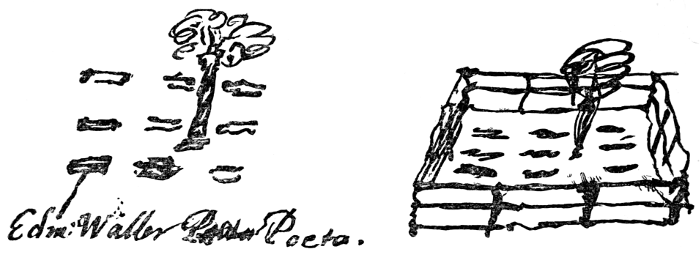
Edm. Waller Pastor Poeta.
[1160]From Capt. Edmund Hamden, his cousin-german, 1690:—Edmund Waller, esq., was borne in the parish of Agmundesham, in Buckinghamshire, at a place called Winchmore-hill, which was sold by his father, and which he had a very great desire to have bought again, not long before his death, but the owner would not sell it: part of the house haz been new-built, but the roome wherein he was borne is yet standing. Said he, to his cousin Hamden, A stagge, when he is hunted, and neer spent, alwayes returnes home. He dyed at 83, and his witt was as florid then as at any time of his life. He derived his poëtick[1161] witt from the Hamdens; severall of them have been poets.
Whereas Rutt, that kept the ... Inne (the Crowne, I thinke) at Beconsfield, told me, many yeares since, that he had been distempered; captain Hamden affirmes it is false; but his brother was a foole, as to discourse or businesse, but was very learned. And whereas Dr. <Peter> Birch told me that he had a prodigiouse memorie; his sonnes affirme that he had no good memorie, and was never good to learne a thing by heart, but some things that pleased him he did strongly retaine.
[1162]Captain Hamden told me that the soldiers came to Beconsfield to search for money; his mother told them if they would goe along with her, she would shew them where she had buried five thousands pounds, and had them to the house of office.
[1163]Edmund Waller, esq., poet:—Mr. Christopher Wase repeating to him the bitter satyricall verses[XCIII.] made on Sir Carre Scroop, viz.—
Thy brother murdred, and thy sister whor'd, Thy mother too—and yet thy penne's thy sword;
Mr. Waller replyed sur le champ 'that men write ill things well and good things ill; that satyricall[1164] writing was downehill, most easie and naturall; that at Billingsgate one might hear great heights of such witt; that the cursed earth naturally produces briars and thornes and weeds, but roses and fine flowers require cultivation.'
All his writings are free from offence.
His poems are reprinted now (1682) by his owne orders and his pictures (young and old) before it, and underneath
Sed Carmina major imago.
Ovid. <Trist. I. vii. 11.>
[Edmund Waller[1165]:—] he made some verses of his owne dyeing, but a fortnight, or little more, before his decease.
Notes.
John Wallis (1616-1703).
[1166]John Wallis, D.D.—I find at Lid in Kent that his father was Mr. John Wallis, minister of Ashford, in Kent.
[1167]John Wallis[CK], D.D., was borne at Ashford, in the county of Kent, Anno Domini <1616>. His father was minister there. He went to schoole there.
At ... yeares old he was admitted at Emanuel Colledge in Cambridge; 'ubi fuit alumnus, deinde Collegii Reginalis ibidem socius' (Mr. Oughtred's preface to his Clavis). Anno <1636/7> A.B.; anno <1640> M.A. He was a good student, but fell not to the study of the mathematiques till he was above twenty.
A[CL] remarkable passage of his life, was, that he was a witnesse of W. Laud's (archbishop of Canterbury) tryall, for his introducing popish innovations into the University of Cambridge: see Canterbury's Doome, printed 1646, pag. 73, and elswhere. The first remarqueable passage of his life was his decyphering the letters of King Charles I taken at the battle at Nasby, which booke is called The King's Cabinet Opened, printed at London, ... Anno ... was scolar to Mr. W. Oughtred.
Anno 164<9> after the Visitation by the Parliament, he came to Oxon, and was made Savillian Professor of Geometrie. ..., <elected> Fellow of the Royall Societie. Great[1168] contests between him and Mr. Thomas Hobbes, of Malmesbury: sure their Mercuries are in □[1169] or opposition. Anno Domini 1657, he gott himselfe to be chosen by unjust meanes[XCV.] to be Custos Archivorum of the University of Oxon, at which time Dr. <Richard> Zouch had the majority of voyces, but because Dr. Zouch was a malignant (as Dr. Wallis openly protested, and that he had talked against Oliver), he was putt aside. Now, for the Savillian Professor to hold another place besides, is so downeright against Sir Henry Savile's statutes, that nothing can be imagined more; and if he does, he is downeright perjured. Yet the Dr. is allowed to keepe the other place still.
Anno <1654> he tooke his degree of Doctor, at the Act, at Oxon, and went out grand-compounder (which costes 200 li.), only that he might take place[1170] of Dr. Seth Ward, who was about a yeare his senior. In 1661 Dr. Ward was made deane of Exon, and the next yeare bishop of the same place; and so Dr. Wallis's 200 li. was meerly cast away. The bishop protested he was troubled for the losse of his brother Wallis's two hundred pounds.
He hath writt severall treatises, and well; and to give him his due prayse, hath exceedingly well deserved of the commonwealth of learning, perhaps no mathematicall writer so much.
'Tis certaine that he is a person of reall worth, and may stand[CM] with much glory upon his owne basis, needing not <to> be beholding to any man for fame, of which he is so extremely greedy, that he steales flowers from others to adorne his owne cap,—e.g. he lies at watch, at Sir Christopher[1171] Wren's discourse, Mr. Robert Hooke's, Dr. William Holder[1172], &c.; putts downe their notions in his note booke, and then prints it, without owneing the authors. This frequently, of which they complaine.
But though he does an injury to the inventors, he does good to learning, in publishing such curious notions, which the author (especially Sir Christopher Wren) might never have the leisure to write of himselfe.
When Mr. Oughtred's Clavis Mathematica was printed at Oxford (editio tertia, with additions), Mr. W. O.,[1173] in his preface, gives worthy characters of severall young mathematicians that he enformed, and, amongst others, of John Wallis, who would be so kind to Mr. Oughtred, as to take the paines to correct the presse, which the old gentleman doth with respect there thus acknowledge, after he hath enumerated his titles and preferments; viri ingenui, pii, industrii, in omni reconditiore literatura versatissimi, in rebus Mathematicis admodum perspicacis, et in enodatione explicationeque scriptorum intricatissimis Zipherarum involucris occultatorum (quod ingenii subtilissimi argumentum est) ad miraculum foelicis. This last, of the cyphers, was added by Dr. Wallis himselfe; which when, the booke being printed, the old gentleman sawe, he was much vexed at it; and sayd, that he had thought he had given him sufficient prayse, with which he might have rested[1174] contented.
He maried ... and haz a good temporall estate in Kent.... He has only two daughters, handsome young gentle-woemen; one maried to Mr. ... Blencowe, of Middleton-Cheyney, in....
He lives at a well-built house, near New Colledge, in Oxon; is a Justice of the Peace there, and has been 167-, 1679, 1680.
Catalogus librorum ab illo scriptorum.
. . . . . . . . . . . .
Notes.
Lucy Walters.
[1175]Memorandum:—Mr. Freeman (who maried the lady Lake) has the duke of Monmouth's mother's—Mrs. Lucy[1176] Walters, who could deny nobody—picture, very like her, at Stanmore neer Harrow-on-the-hill.
Seth Ward (1617-1688/9).
<Birth and education.>
[1177]Seth Ward[CN], lord bishop of Sarum, was borne at Buntingford, a small market-towne in Hartfordshire, anno Domini 1618[1178], December the ..., (when the great blazing starre appeared). His father was an attorney there, and of a very honest repute.
At <16> yeares old he went to Sydney Colledge in Cambridge; he was servitor[XCVI.] to Dr. <Samuel> Ward (Master of the Colledge, and Professor of Divinity), who, being much taken with his ingenuity and industry, as also with his suavity of nature, quickly made him scholar of the howse, and after, fellowe. Though he was of his name, he was not at all akinne to him (which most men imagined because of the great kindnesse to him); but the consimility of their dispositions was a greater tye of friendship then that of blood, which signifies but little, as to that point.
<Mathematical studies.>
His father taught him common arithmetique, and his genius lay much to the mathematiques, which being naturall to him, he quickly and easily attained.
Sir Charles Scarborough, M.D. (then an ingeniose young student, and fellowe—quaere—of Caius Colledge in Cambridge), was his great acquaintance; both students in mathematiques; which the better to perfect, they went to Mr. Willam Oughtred, at Albury in Surrey, to be enformed by him in his Clavis Mathematica, which was then a booke of aenigmata. Mr. Oughtred treated them with exceeding humanity, being pleased at his heart when an ingeniose young man came to him that would ply his Algebra hard. When they returned to Cambridge, they read the Clavis Mathematica to their pupills, which was the first time that that booke was ever read in a[1179] university. Mr. Laurence Rooke, a good mathematician and algebrist, (and I thinke had also been Mr. Oughtred's disciple[1180]) was his great acquaintance. ☞ Mr. Rooke (I remember) did read (and that admirably well) on the sixth chapter of the Clavis Mathematica in Gresham Colledge.
<Ejected from Cambridge.>
Anno Domini 164<4>, at the breaking out of the civill warres, he was a prisoner, together with Dr. <Samuel> Ward, Dr. <Samuel> Collins, Sir Thomas Hatton, &c. for[1181] the king's cause, in St. John's Colledge in Cambridge, and was[1182] putt out of his fellowship at Sydney Colledge. Being gott out of prison, he was very civilly and kindly received by his friend and neighbour, Ralph Freeman, of Apsten, esq., a vertuous and hospitable gentleman, where he continued....
<Professor in Oxford.>
Anno Domini <1648> the Visitation of the Parliament was Oxford, and turned out a great many professors and fellowes. The Astronomy Reader (Dr.[1183] <John> Greaves) being sure to be ejected, Seth Ward, A.M. (living[1184] then with my lord Wenman, in Oxfordshire, and ... Greaves was unwilling to be turned out of his place, but desired to resigne it rather to some worthy person, wherupon Dr. Charles Scarborough and William Holder, D.D. recommended to ... Greaves, their common friend, Mr. Seth Ward) was invited to succeed him, and came from Mr. Freeman's to Oxford, had the Astronomy Professor's place, and lived at Wadham Colledge, where he conversed with the warden, Dr. John Wilkins.
<First ecclesiastical dignity.>
[1185]Anno Domini 165- (quaere), he had from B<rownrigg> bishop of Exon, the grant of the chantor's place of Exon, which then signified nothing.
<President of Trinity College, Oxford.>
Anno Domini 165<9> William Hawes, ...[1186], then president of Trinity Colledge in Oxford, having broken in his lunges a vein (which was not curable), Mr. Ward being very well acquainted and beloved in that colledge; by the consent of all the fellowes, William Hawes resigned up his presidentship to him, and dyed some few dayes after[CO]. Anno 1660, upon the restauration of King Charles II, Dr. Hannibal Potter (the president sequestred by the Parliamentary Visitors) re-enjoyed the presidentship again.
[1187]Dr. Seth Ward, now bishop of Sarum, when he was president of Trinity College, Oxon, did draw his geometricall schemes with black, red, yellow, green, and blew inke to avoid the perplexity of A, B, C, etc.
<His doctorate.>
[1188]I should have said that, anno 165<4>, he[1189] tooke his degree of doctor in Divinity, at the Act, at Oxford, at the same time with Dr. John Wallis.
<Church preferment.>
He then enjoyed his chanter's place at Excester, and, I thinke, was certainly minister of St. Laurence <Jewry> church (quaere) in London.
Anno Domini 166<1>, the deane of Exon dyed, and then it was his right to step-in next to the deanry.
<Becomes bishop of Exeter.>
Anno Domini 1663, the bishop of Exon dyed: Dr. Ward, the deane, was in Devonshire at that time, at ... (I thinke 'twas Taverstoke), at a visitation at ...,[XCVII.] where were a great number of the gentrey of the countrey. Deane Ward was very well knowne to the gentry, and his learning, prudence, and comity had wonne them[1190] all to be his friends. The newes of the death of the bishop being brought to them, who were all very merry and rejoycing with good entertainment, with great alacrity the gentlemen cryed all, uno uno[1191], 'Wee will have Mr. Deane[1192] to be our Bishop.' This was at that criticall time when the House of Commons were the king's darlings. The deane told them that for his part he had no interest or acquaintance at Court; but intimated to them how much the king esteemed the members of parliament (and a great many Parliament men were then there), and that his majestie would deny them nothing. 'If 'tis so, gentlemen' (sayd Mr. Deane), 'that you will needes have me to be your bishop, if some of you make your addresse to his majestie, 'twill be donne.'—With that they[XCVIII.] dranke the other glasse, a health to the king, and another to their wished-for bishop; had their horses presently made ready, putt foot in stirrup, and away they rode merrily to London; went to the king, and he immediately graunted them their request. This is the first time that ever a bishop was made by the House of Commons. Now, though envy cannot deny, that this worthy person was very well worthy any preferment could be conferred on him, yet the old bishops (e.g. Humphrey <Henchman>, bishop of London; John Cosins, bishop of Durham; etc.)[1193] were exceedingly disgruntled at it, to see a briske young bishop that could see through all their formall gravity, but 40 yeares old, not come in at the right dore but leape over the pale. It went to their very hearts. Well, bishop of Excester he was, to the great joy of all the diocese[1194]. Being bishop he had then free accesse to his majestie, who is a lover of ingenuity and a discerner of ingeniose men, and quickly tooke a liking to him.
[1196]His great friend and patrone, Dr. <Samuel> Ward, ...; quaere what preferment did Dr. <Seth> Ward give him in the Church?
<Translated to Salisbury.>
[1197]Anno 1667, Alexander Hyde, the bishop of Sarum, dyed, and then he was made bishop of Sarum, mense <Sept.>
<Personal characteristics.>
He is (without all manner of flattery) so prudent, learned, and good a man, that he honours his preferment as much as the preferment does him; and is such a one that cannot be advanced too high. My lord (Lucius) Falkland was wont to say that he never knew any one that a paire of lawne sleeves had not altered from himselfe, but only bishop Juxon; had he knowne this excellent prelate, he would have sayd he had knowne one more. As he is the pattern of humility and courtesie, so he knowes when to be severe and austere; and he is not one to be trampled or worked upon. He is a batchelour, and of a most magnificent and munificent mind.
He hath been a benefactor to the Royall Societie, (of which he was one of the first members and institutors[XCIX.]), gave them, Anno Domini ... li. He also gave a noble pendulum clock to the Royall Societie (which goes a weeke), to perpetuate[1198] the memory of his deare and learned friend, Mr. Laurence Rooke.
Quaere, was the bishop ever professor at Gresham College?
He gave anno 167-, ... li. towards the making of the river at Salisbury navigable to Christ Church. Anno 1679 he gave to Sydney Colledge a thousand pounds.
He haz perused all the records of the Church of Sarum, which, with long lyeing, had been conglutinated together; read them all over, and taken abridgements of them, which haz not been donne by any of his predecessors I beleeve for some hundreds of yeares.
He had an admirable habit of body (athletique, which was a fault), a handsome man, pleasant and sanguine; he did not desire to have his wisdome be judged by the gravity of his beard, but his prudence and ratiotination. This, methinkes, is strange to consider in him, that being a great student (and that of mathematiques and difficult knotty points, which does use to make men unfit for businesse), he is so cleare and ready, as no sollicitor is more adroit for looking after affaires.
Sicknes[1199].
[1200]The black malice of the dean[CP] of Sarum—he printed sarcasticall pamphletts against him—was the cause of his disturbd spirit, wherby at length he quite lost his memorie. For about a moneth before he dyed he tooke very little sustenance, but lived on the stock and died a skeleton. He deceased at his house at Knightsbridge neer London, on Sunday morning, January the sixth, 1688/9: the Gazetts and Newsletters were severally mistaken as to the day of his death.—This from Mr. Seth Ward, B.D.
<His burial.>
[1201]Seth, episcopus Sarum, is buried at Sarum as neer as may be to John Davenant, episcopus.
<His papers.>
[1202]I searcht all Seth, episcopus Sarum's, papers that were at his house at Knightsbridge where he dyed: of which I will give and bring you an account when I come to Oxon about the latter end of this moneth. I have taken care with his nephew and heir[1203] to looke over his papers in his study at Sarum. He tells me the custome is, when the bishop of Sarum dies, that 'the deane and chapter lock-up his studie and put a seale on it.' It was not opened lately, but when it is he will give me an account for you.
[1204]Scripsit:—
That there is a God—16mo: quaere nomen libri.
Vindiciae, 4to, Oxon.
... contra Thomam Hobbium, 8vo, Oxon.
Trigonometria, 4to, Oxon.
Astronomia geometrica, 4to, Oxon.
Severall sermons, wherof one was at the funerall of the duke of Albemarle, who was his great friend, and whose eies he closed.
[1205]Seth Ward, lord bishop of Salisbury, studied the common lawe, and I find this paper, which is his owne handwriting, amongst his scattered papers which I rescued from being used by the cooke since his death, which was destinated with other good papers and letters to be put under pies.
[1206]He writ a reply to Bullialdus, which might be about the bigness of his Astronomia Geometrica, which he lent to somebody (forgot), and is lost. In the bishop's study are several letters between Bullialdus and him, and between Hevelius and him.
<His foundation at Buntingford.>
[1684.
This hospitall was erected and endowed by Seth Ward, D.D., lord bishop of Salisbury and chancellor of the most noble order of the Garter, who was born in this towne within the parish of Aspden and educated in the free-schoole of Buntingford.]
The bishop's will not observed: the people there say so: cosen Freeman[1208] said <so>.
<Corrigendum.>
[1209]Seth Ward, episcopus Sarum:—Whereas I put downe in my memorandums, from his owne mouth, viz. that he said, occasionally, that 'he was borne when the great comet appeared' (that, I am sure, was in anno 1618); but his nephew, Seth Ward, treasurer of the church of Sarum and his executor, told me that the last sommer he searched in the register at Buntingford where he was born, and finds thus:—
'Seth Ward christned April 5, 1617.'
Notes.
Walter Warner (15—- 1640).
[1210]From Dr. John Pell:—Mr Walter Warner:—his youngest brother was High Sheriff of Leicestershire, about 1642. He and his brother dyed both batchelors. Dr. Pell haz seen him that was sheriff; but was well acquainted with Walter. The estate came to a middle brother, a lame man.
Walter had but one hand (borne so), he thinks a right hand; his mother was frighted, which caused this deformity, so that instead of a left hand, he had only a stump with five warts upon it, instead of a hand and fingers. He wore a cuffe on it like a pockett. The Doctor never sawe his stump, but Mr. Warner's man[1211] has told him so.
This Walter Warner was both mathematician and philosopher, and 'twas he that putt-out Thomas Hariot's Algebra, though he mentions it not.
Mr. Warner did tell Dr. Pell, that when Dr. Harvey came out with his Circulation of the Blood, he did wonder whence Dr. Harvey had it: but comeing one day to the earle of Leicester, he found Dr. Harvey in the hall, talking very familiarly with Mr. Prothero (Wallicè ap Roderic), to whom Mr. Warner had discoursed concerning this exercitation of his De Circulatione Sanguinis, and made no question but Dr. Harvey had his hint from Prothero. Memorandum:—Dr. Pell sayes that Mr. Warner rationated demonstratively by beates of the pulses that there must be a circulation of the blood.
When Mr. Hariot dyed, he made Sir Thomas Alesbury and Mr. Prothero his executors, by which meanes his papers came to be divided into two hands. Those which fell to Sir Thomas Alesbury, fell, after his death, to his sonne-in-lawe, Edward, earle of Clarendon, Lord Chancellor, and in his sonne's hands (this present, 1680, earle of Clarendon) 'tis beleeved are those that are yet left; none of them were printed, save that Artis Analyticae Praxis, which was printed by Mr. Warner upon this occasion, viz. Sir Thomas Alesbury obtained of Algernon, earle of Northumberland (son to that earle, prisoner in the Tower), a continuation of the annuity, dureing Warner's life, upon condition that he should, out of Mr. Hariot's papers, drawe out some piece fitt to be published[1212], which he did, under the title aforesayd, in folio, 1631, London: but did not sett his name to it, and accordingly Warner had his money as long as he lived. The other part of Mr. Hariot's papers, which were in Mr. Prothero's keeping, came to the hands of the lord John Vaughan, eldest son to the earle of Carbery, lately governor of Jamaica, which vide.
Mr. Warner's youngest brother was a good husband and an industrious man, and would say that had he so much money, he could improve it to very great advantage; wherupon his eldest brother (Walter) did lett him sell his land, by which meanes he did so improve his estate by graseing, etc. that he became High Sheriff as aforesaid (quaere of the attorneys when). Dr. Pell has seen him, and spake with him.
Mr. Walter Warner made an Inverted Logarithmicall Table, i.e. whereas Briggs's table fills his margin with numbers encreasing by unites, and over-against them setts their logarithms, which because of incommensurability must needs <be> either abundant or deficient; Mr. Warner (like a dictionary of the Latine before the English) fills the margin with logarithmes encreasing by unites, and[1213] setts[C.] to every one of them so many continuall meane proportionalls between 1 and 10[1214], and they for the same reason must also have the last figure incompleat. These, after the death of Mr. Warner, came to the hands of Mr. Herbert Thorndyke, prebendary of Westminster, and by him left in the hands of Dr. Richard Busby, schoolmaster and prebendary of Westminster, which, before Mr. John Pell grew acquainted with Mr. Warner, were ten thousand, and at Mr. Warner's request were by Mr. Pell's hands, or direction, made a hundred thousand. The difference of the hands will shew the workman's in the originalls, which Dr. Busby haz.
Memorandum:—he wrote a Treatise of Coynes in relation to mint affaires, of which Mr. John Collins haz a copie:—from Mr. Herbert Thorndyke.
The sixth booke of Optiques in Merçennus is expressly his; the 7th is Mr. Thomas Hobbs's.
Mr. Tovey, of Leicestershire, was his kinsman: he could tell when and where he dyed:—from Seth <Ward>, bishop of Sarum.
The bishop thinkes he was of Cambridge university, but is not certaine. Dr. Pell believes that he was of no university.
Quaere Dr. Pell, what is the use of those Inverted Logarithmes? for W. Warner would not doe such a thing in vaine. Mr. Tovey was fellowe of Christ College in Cambridge; was beneficed in Leicestershire; and maried a neice of Mr. Warner's; and from Mr. Tovey they[1215] came to Mr. Thorndyke.
William Watson (15—- 1603).
[1216]... Watson, who wrote the Quodlibets[1217], was taken in a field by the Hay in Herefordshire (or Brecknockshire—vide the mapp) by Mr. ... Vaughan, and was executed, at Brecknock (as I take it). 'Twas observed that Mr. Vaughan did never prosper afterwards.
George Webb (1581-1641).
[1218]Dr. ... Webbe, one of king Charles I's chaplaines, afterwards bishop of Limrick in Ireland, hath some sermons, or divinity, in print; and a translation of Terence, English and Latin.
He dyed and was buried in Limrick about two or three daies before the towne was taken by the Irish, who digged up the body again—it was about 1642.
He was of Corpus Christi College, Oxon: borne at Brumhum in Wiltshire.
[1219]I confess I doe not like that super-zeale in the Canon Lawe, not to let alone there the bodys of heretiques. It is too inhumane.—This, as to the bishop's body being digged up again, which I feare was so: for his nephew who was his archdeacon, was with him when he dyed and the towne taken, and I remember, being then a fresh man, I heard him tell the story. He was minister next parish to Mr. Hine.
... Webb.
[1220]Dr. Webb:—his way of teaching children, in Duck lane. It taught them also to make verses. He wrote severall bookes—from Mr. Michael Weekes: quaere +.
John Wells.
[1221]John Wells[CR], esq.:—he was borne at ..., educated at.... He was a Roman Catholique. He published an excellent treatise of dialling, entituled[1222]:—
Sciographia, or the art of shadowes, plainely demonstrating out of the sphaere how to project both great and small circles upon any plane whatsoever, with a new conceit of the reflecting of the sunne beames upon a diall contrived upon a plane which the direct beame can never shine upon, together with the manner of cutting the five regular Platonical bodies and two other the one of 12, the other of 30 rhombes never discovered heretofore, also the finding of their declinations and reclinations and adorning them with variety of dialls, all performed by the doctrine of triangles, and for ease and delight sake by helpe of the late invented and worthily admired numbers called by the first inventor logorithmes; by John Wells, esquire; London, printed by Thomas Harper and are to be sold in Paul's churchyard at the signe of the Bell, 1635.
Mr. Henry Gellibrand, professor of <Astronomy> at Gresham College, hath put a learned preface to it, wherein it is mencioned that Mr. Henry Brigges and Mr. Edmund Gunter did earnestly sollicite Mr. Wells to publish it.
[1223]<In> Deptford <church at the> east end <of the> south aisle <on a> white marble:—
Memoriae Sacrum. Hic sita est Catherina Welles, generosa, summae pietatis et virtutis, filia Thomae Wailinger armigeri et Benedictae Gonson primogenita, uxor charissima Johannis Welles armigeri pro regia classe pridem diribitoris ejusque navalium armamentorum per triginta plus annos totius Angliae generalis custodis, cui septem filios sexque filias feliciter enixa est, quarum duo nati tres natae hîc unâ cum illa contumulantur. Animam coelo pie reddidit 5 Julii 1634 aetatis 47 felicem in Christo resurrectionem indubitanter expectans. Ad maritum superstitem. Pignora conjugii remanent tibi plurima nostri, Pluraque praemisit mors mihi dira rogo: Parte fruor tumulo, reliqua tibi prole relicta; Festina charos lentus ad hos cineres.
Note.
Sir George Wharton (1617-1681).
[1224]Sir George Wharton, baronet, treasurer and paymaster to the office of his majestie's Ordinance, dyed at his howse at Enfield, 12th of August 1681, and lyes buryed in the Tower chapell, 25 of August following.
Note.
At the end of this note Anthony Wood has added the reference 'see p. 39b,' i.e. fol. 90v of the MS., where is the note—'Sir George Wharton, baronet, obiit in Turri London, ubi sepultus est, Aug. 10th 1681.' Wood has noted there 'in page 45,' i.e. fol. 97, ut supra, 'you say 12 August.' Aubrey there gives in trick the coat:—'<sable>, a maunch <argent>, on a canton ..., a lion's gamb,' and adds 'sans bordure, quod N.B.'—On fol. 9v of the MS. is still another version:—'Sir George Wharton, knight, buryed at the Tower chapel (quaere), 26 August, Friday, 1681'; and Wood there objects 'in page 45, you say 25 August: see page 39b.'
Diggory Wheare (1574-1647).
[1225]Mr. Gibbon, Blewmantle, showed me in an old collection in MSS., ἀνονυμῶς, that in anno 1634 was the number of 92 students in Glocester Hall, Degory Whear then master there.
Abraham Wheloc.
[1226]... Wheelock, <a> simple man—<from Seth Ward> bishop of Sarum.
Note.
Abraham Wheloc printed notes on Bede, Camb. 1643. How thoroughly Anthony Wood used up every scrap of opinion he received is shown by the fact that even this expression (of Wheloc's 'simplicity') is taken up by him: see Clark's Wood's Life and Times, iv. 258.
Daniel Whistler (1619-1684).
[1229]Daniel Whistler, M.D., dyed (May 11, 1684), president of the Physitians' College.
James Whitney (1593-166-).
[1230]Parson Whitney was a great nomenclator of Oxford men, being an old fellow there; and were he alive now would be 81.
[1231]My old cosen, parson Whitney, told me that in the visitation of Oxon in Edward VI's time they burned mathematical bookes for conjuring bookes, and, if the Greeke professor had not accidentally come along, the Greeke testament had been thrown into the fire for a conjuring booke too.
John Whitson (1557-1629).
[1232]John Whitson, alderman of the city of Bristol. John Whitson was borne at Cover in the Forest of Deane in the countie of Glocester. He went to schoole at Bristow, where he made a good proficience in the Latin tongue. He was bound apprentice to alderman Vawr, a Spanish merchant of this city. He was a handsome young fellow; and his old master the alderman being dead, his mistress one day called him into the wine-cellar and bad him broach the best butt in the cellar for her.... His mistresse after maried him. This story will last perhaps as long as Bristol is a city.
He had a good naturall witt, and gaind by the Spanish trade a fair estate.
His second wife was ... the daughter of ... Hine, alderman of London, a very beautifull dame, as by her picture, at length, in the dining rome, doeth appear. By her he had a daughter, his only child, who was counted the flower of Bristol, who was maried to Sir Thomas Trenchard of Dorsetshire, who dyeing (together with her child), the alderman gave him compensation for the mannour of Dunderhill[1233] and had it again.
His third wife was ... by whom he had no issue. His fourth and last wife was Rachel, daughter of Richard Danvers of Tokenham, Wilts, esq., relict of John Aubrey of Burleton in the county of Hereford, esq. (my father Richard Aubrey being then eleaven yeares of age). He had no issue by her. The alderman made him[1234] a good falkoner, but did cutt downe his woods and never made him any satisfaction: but lett his good workes be sett in balance against it.
He lived nobly; kept a plentifull table; and was the most popular magistrate[1235] in the city, alwaies chosen a member of Parliament. He kept a noble house, and did entertain and treat the peers and great persons that came to the city. He kept his hawkes.
I remember five that had been bred-up under him, but not one of them came to good, they lived so luxuriously, just as the servants of Sir John Robinson, governor of the Tower.
He had a very good healthy constitution, and was an early riser; wrote all his letters and dispatched his businesse betime in the morning.