Front matter (continued 4)
Reading edition
This was but one of many similar adventures which made the name of Morford feared and hated through the Confederate states. The most desperate as well as the most generous of his many exploits was his rescue of three fellow-scouts who were held in jail at Harrison, Tennessee, and were to be shot on May 1st. Morford was then in Chattanooga and there heard of the capture of these scouts. Chattanooga at that time was a Confederate town, although it had a number of Union residents. There did not seem to be any chance of rescuing the condemned men, yet from the minute that Morford heard that these scouts were facing death, as he had so often faced it, he made up his mind that he would rescue them if he had to do it alone.
Morford's mother's name was Kinmont and her earliest ancestor had been Kinmont Willie, celebrated in the border-wars between England and Scotland in the latter part of the sixteenth century. Many and many a time had she sung to him as a child an old Scotch ballad handed down for centuries through the family, which told of the rescue of this far-away ancestor by his leader on the night before the day fixed for his execution. In 1596 Salkeld was the deputy of Lord Scroope, the English warden of the West Marches, while the Laird of Buccleuch, the keeper of Liddesdale, guarded the Scotch border. In that year these two held meetings on the border-line of the kingdoms according to the custom of the time for the purpose of arranging differences and settling disputes. On these occasions a truce was always proclaimed from the day of the meeting until the next day at sunrise. Kinmont Willie was a follower of the Laird of Buccleuch and was hated by the Englishmen for many a deed of arms in the numerous border-raids of those times. After the conference he was returning home attended by only three or four friends when he was taken prisoner by a couple of hundred Englishmen and in spite of the truce lodged in the grim Castle of Carlisle. The Laird of Buccleuch tried first to free him by applying to the English warden and even to the Scotch embassador, but got no satisfaction from either and when at last he heard that his retainer was to be hung three days later, he took the matter into his own hands, gathered together two hundred of his men, surprised the Castle of Carlisle and rescued Kinmont Willie by force of arms. The story of this rescue is told in one of the best as well as one of the least-known of the Scotch ballads, "Kinmont Willie," the verses of which run as follows:
O have ye na heard o' the fause Sakelde? O have ye na heard o' the keen Lord Scroope? How they hae ta'en bauld Kinmont Willie, On Haribee to hang him up? They band his legs beneath the steed, They tied his hands behind his back; They guarded him, fivesome on each side, And they brought him over the Liddel-rack. Now word is gane to the bauld Keeper, In Branksome Ha' where that he lay, That Lord Scroope has ta'en the Kinmont Willie, Between the hours of night and day. He has ta'en the table wi' his hand, He garr'd the red wine spring on hie— "Now Christ's curse on my head," he said, "But avenged of Lord Scroope I'll be! "O were there war between the lands, As well I wot that there is none, I would slight Carlisle castell high, Though it were builded of marble stone. "I would set that castell in a low, And sloken it with English blood! There's never a man in Cumberland, Should ken where Carlisle castell stood. "But since nae war's between the lands, And there is peace, and peace should be; I'll neither harm English lad or lass, And yet the Kinmont freed shall be!" He has call'd him forty Marchmen bauld, Were kinsmen to the bauld Buccleuch; With spur on heel, and splent on spauld, And gleuves of green, and feathers blue. And as we cross'd the Bateable Land, When to the English side we held, The first o'men that we met wi', Whae sould it be but fause Sakelde? "Where be ye gaun, ye hunters keen?" Quo' fause Sakelde; "come tell to me!" "We go to hunt an English stag, Has trespass'd on the Scots countrie." "Where be ye gaun, ye marshal men?" Quo' fause Sakelde; "come tell me true!" "We go to catch a rank reiver, Has broken faith wi' the bauld Buccleuch." "Where are ye gaun, ye mason lads, Wi' a' your ladders lang and hie?" "We gang to berry a corbie's nest, That wons not far frae Woodhouselee." "Where be ye gaun, ye broken men?" Quo' fause Sakelde; "come tell to me!" Now Dickie of Dryhope led that band, And the nevir a word of lear had he. "Why trespass ye on the English side? Row-footed outlaws, stand!" quo' he; The nevir a word had Dickie to say, Sae he thrust the lance through his fause bodie. And when we left the Staneshaw-bank, The wind began full loud to blaw; But 'twas wind and weet, and fire and sleet, When we came beneath the castle wa'. We crept on knees, and held our breath, Till we placed the ladders against the wa'; And sae ready was Buccleuch himsell To mount the first before us a'. He has ta'en the watchman by the throat, He flung him down upon the lead— Had there not been peace between our lands, Upon the other side thou hadst gaed! "Now sound out, trumpets!" quo' Buccleuch; "Let's waken Lord Scroope right merrilie!" Then loud the warden's trumpet blew— "O wha dare meddle wi' me?" Then speedilie to work we gaed, And raised the slogan ane and a', And cut a hole through a sheet of lead, And so we wan to the castle ha'. They thought King James and a' his men Had won the house wi' bow and spear; It was but twenty Scots and ten, That put a thousand in sic' a stear! Wi' coulters, and wi' forehammers, We garr'd the bars bang merrilie, Until we came to the inner prison, Where Willie o' Kinmont he did lie. And when we cam to the lower prison, Where Willie o' Kinmont he did lie— "O sleep ye, wake ye, Kinmont Willie, Upon the morn that thou's to die?" "O I sleep saft, and I wake aft, It's lang since sleeping was fley'd frae me; Gie my service back to my wife and bairns, And a' gude fellows that spier for me." Then Red Rowan has hente him up, The starkest man in Teviotdale— "Abide, abide now, Red Rowan, Till of my Lord Scroope I take farewell." "Farewell, farewell, my gude Lord Scroope! My gude Lord Scroope, farewell!" he cried— "I'll pay you for my lodging maill, When first we meet on the Border side." Then shoulder high, with shout and cry, We bore him down the ladder lang; At every stride Red Rowan made, I wot the Kinmont's airns play'd clang. "O mony a time," quo' Kinmont Willie, "I have ridden horse baith wild and wood; But a rougher beast than Red Rowan I ween my legs have ne'er bestrode." "And mony a time," quo' Kinmont Willie, "I've prick'd a horse out oure the furs; But since the day I back'd a steed, I never wore sic cumbrous spurs." We scarce had won the Staneshaw-bank, When a' the Carlisle bells were rung, And a thousand men on horse and foot Cam wi' the keen Lord Scroope along. Buccleuch has turn'd to Eden Water, Even where it flow'd frae bank to brim, And he has plunged in wi' a' his band, And safely swam them through the strem. He turn'd him on the other side, And at Lord Scroope his glove flung he— "If ye like na my visit in merry England, In fair Scotland come visit me!" "All sore astonish'd stood Lord Scroope, He stood as still as rock of stane; He scarcely dared to trew his eyes, When through the water they had gone. "He is either himsell a devil fra hell, Or else his mother a witch maun be; I wadna have ridden that wan water, For a' the gowd in Christentie."
The memory of that brave rescue nearly three hundred years before, as the scout afterward told his friends, was what inspired him to save his fellow-scouts as Buccleuch had saved the first William Kinmont. By saving the lives of these three men he would pay with interest for the life of his ancestor. Shakespeare writes somewhere that the good which men do is oft buried with their bones, but that their evil deeds live on forever. No more mistaken lines have ever been written. Evil brings about its own death. No good deed is ever forgotten or ever buried. Hundreds of years later it may flash out through the dust of centuries and light the path of high endeavor.
Morford scoured Chattanooga and finally found nine men who were ready to go with him and try to rescue the condemned scouts. Leaving Chattanooga they traveled by night and hid by day in caves and thickets among the mountains. Occasionally they would meet or get word from men whom they knew to be Union sympathizers. Finally they hid on the top of Bear Mountain which towered above the river and which separated them from Harrison where was located the jail. Although they had traveled fast and far they were only just in time. The second noon after the night when they reached the mountain had been fixed for the execution. On Bear Mountain they hid in a cave which Morford himself had discovered when hunting there many years before. It could only be reached by a narrow path which ran along a shelf of rock which jutted out over a precipice three hundred feet deep. The path turned sharply and led under an enormous overhanging ledge and ended in a deep cave with a little mountain spring bubbling up on a mossy slope only ten feet wide which led up to the cave's entrance. Inside was a dry, high cavern large enough to hold fifty men. It could not be reached from above by reason of the over-hanging ledge. At that point the path stopped and where the slope ended was a sheer drop to the rocks below which extended around the farther side of the slope so that the only entrance was around the path's bend along which only one man could pass at a time. Morford reached the foot of Bear Mountain just at sunset and led his little band up the steep side by a winding deer-path, the entrance to which was concealed in a tangled thicket of green briar and could only be reached by crawling underneath the sharp thorns like snakes. The path to the cave was no place for a man with weak nerves. It was bad enough as it skirted the precipice, but where it took a sharp bend around the jutting point of rock, it narrowed to nothing more than a foothold not three inches wide. He who would pass into the cave must turn with his back to the precipice and edge his way with arms outstretched along the smooth face of the rock for nearly ten feet. The point at the turn was the worst. There it was necessary to take one foot off the ledge and grope for a tiny foothold below the path while one shuffled around the curve. It was not absolutely necessary for Morford and his men to spend the night in this cave. There were other places where they could have stayed in safety, as no one suspected their presence. Morford, however, had made up his mind to choose his men with the utmost care. It was necessary in order to save the lives of the three condemned scouts to pass through the camp of the soldiers and the ring of guards encircling the jail, break open the jail, rescue the prisoners and break out again. It was a desperate chance and Morford's only hope of success was to have men who would show absolute coolness and daring throughout the whole adventure. The nine men whom he had selected all bore a high reputation for courage, but Morford decided like Gideon of old to cut out every factor of weakness and leave only the picked men. When Gideon was chosen of God to rescue the children of Israel from the unnumbered host of Midianites and Amalekites and the other Bedouin hordes of the desert which were encamped in the great valley that lay at the hill of Moreh, he started with a force of thirty-two thousand. When this army looked down upon the innumerable hosts of the fierce desert warriors, it began to weaken and Gideon sent back twenty-two thousand soldiers who had showed signs of fear. The night before the day fixed for battle, Gideon decided to select from this ten thousand a picked band of men who would be not only brave, but watchful and ready for any emergency. As his army swarmed down to the water-hole Gideon watched the men as they drank. They had kept watch and ward on that bare sun-smitten mountain top all through the long, hot day. As they came to the water some of the thirsty men dashed forward out of the ranks and fell on their faces and lapped the water like dogs without a thought that there might be an ambush at the ford and without a care that they were lying absolutely defenseless before any enemy who might attack them. Others kneeled on their hands and knees and drank. Of the ten thousand only three hundred had bravery and self-control enough to maintain the discipline of a vigilant army. Without laying down their weapons they drank as a deer drinks, watching on every side for fear of a surprise. With one hand they scooped up the water, in the other they held fast their weapon. It was slower, but it was safer. These three hundred men Gideon chose for that band which for three thousand years has been the symbol of bravery and watchfulness. With this little force just before dawn he burst down upon the sleeping Midianites which were as the sand by the sea for multitude. The three hundred were divided into three companies. Each man carried a sword, a trumpet, and an earthenware pitcher with a lighted lamp inside. From three separate directions they rushed down upon the sleeping foe and sounded the trumpets and brake the pitchers and held the flashing lamps on high and then shouting as their watchword, "The Sword of the Lord and of Gideon," they burst into the great camp of the invaders. Roused from sleep, hearing the trumpet notes and the crash of the breaking pitchers and seeing the flash of lights from all sides and mighty voices shouting the fierce slogan, the Midianites scattered like sheep and all that great host ran and cried and fled and every man's sword was against his fellow in the darkness, and when day dawned the ground was covered with dead men, the camp was abandoned and nothing was left of that mighty army but a fringe of fugitives scattered in every direction.
It may be that some such test was in Morford's mind as the little band of nine scaled the heights of Bear Mountain. At any rate as they approached the precipice-path he halted them.
"Boys," he said, "I got word this afternoon that these scouts have only thirty-six hours to live unless we save them. The guards have been doubled. It's going to be a desperate chance to get to them and none of us may ever come back. Now if any of you fellows want to quit, the time to do it is now rather than later. I'm going to lead the way along the path which we used to say was the best nerve-tonic in this county. If any of you fellows get discouraged and don't want to make the last turn past old Double-Trouble, why back out, go over the top of the mountain and down the other side. You know your way home and you've got provisions enough to last for the trip. Only travel fast, for those of us who are left are going to come right over the top of this mountain on the run with those scouts—if we save 'em."
With this characteristic oration, Morford started along the path, first tightening his heavy revolver belt so that it might not swing out and over-balance him at the critical moment. He was instantly followed by six others, quiet, self-contained men who like him had taken up scouting as the best way of showing their devotion to the Union. The other three hesitated a moment, looked at each other shamefacedly and then slowly followed along the dangerous route. As Morford reached Double-Trouble, he stopped and in a low voice told the next man how to put one foot out into space and search for the little foothold which jutted out below the main path and then how to swing around that desperate curve. Slowly and with infinite caution each one of the six followed their leader and found himself safe on the slope of the cave. The seventh man listened carefully to the instructions of the man before him as to how he should round the curve and gave a gasp of horror when he found that he must balance himself on one foot on a three-inch ledge while the other was in mid-air.
"Tell General Morford," he finally said, "that I ain't no tight-rope walker. I draw the line at holdin' on like a fly, head downward over this old precipice. Anyway I don't think there's any chance to do anything and I'm goin' home."
He seemed to have voiced the exact sentiments of the other two who had sidled up and with out-stretched necks were examining in the faint light the curve around Double-Trouble. The last man spent no time in any argument.
"Good-bye, General," he called in a low voice. "Go as far as you like—but go without me."
That was the last Morford and the other six ever saw of those men. They reached home in safety after some days of wandering, but decided to choose another territory where the scouting would not be quite so strenuous. Morford and his men made themselves comfortable that night. They drank deep from the spring and then had a much-needed scrub. After a hearty meal they turned in and slept like dead men through the next day on the crisp springy moss, first rolling a big boulder against the side of Double-Trouble so that no one could pass.
Late the next afternoon they awoke and found that the path was not so bad the second time as it had been the first. Down the mountainside by the same concealed route they marched in single file and just at dark crossed the river and entered the little village of Harrison. There they were met by an old man with whom Morford had previously communicated. He had obtained by strategy the countersign which would take them through the soldiers, the guards and to the very entrance of the jail itself. Curiously enough, some Confederate officer had fixed as the countersign that very one with which Gideon had conquered so many years ago. "The Sword of Gideon" was the open sesame which would take them past the guards and unlock the gates which ringed about the doomed men. Morford accepted it as a good omen. The night before he had told his companions the old story of Gideon's test and it came to them all as a direct message that God was fighting on their side as he had fought of old against even greater odds. Morford planned to use Gideon's tactics. He decided to surprise and confuse his enemy and escape in the confusion. He tied the hands of two of his band behind their backs and with the other four marched directly to the Confederate camp, gave the countersign, and stated that he had prisoners to deliver to the jail. The sleepy sentry passed him through without any comment and they marched until they came to the high board fence with a double row of spikes on top which surrounded the prison-yard. This fence at one point touched the edge of a marsh filled with rank grass, briars and tussocks. To this point Morford had gone earlier in the evening and had bored two auger-holes in one of the boards and then with a small saw dipped in oil had carefully sawed out one of the old timbers, leaving a space just large enough to admit of a man passing through. There was only one entrance to the prison grounds which was through the main gate besides which night and day sat two guards. Morford rang at this gate and when it was opened, presented himself with his pretended prisoners. One of the guards accompanied them to the main jail toward which Morford marched with his prisoners and two men, leaving the other two behind with the remaining guard. Morford had no more than passed around the corner when these two suddenly seized the unsuspecting guard at the gate, pressed a revolver against his temple and in an instant gagged him, tied him up hand and foot with rope which they had brought and started to the jail to assist the others. Usually the jail was only guarded by the jailer and one deputy or assistant who lived there with him. To-night, however, there was a death-watch of three extra men heavily armed stationed around in the corridor in front of the cells of the condemned men. The jailer opened the door and the sentry who had accompanied Morford from the gate explained that these were two prisoners coming under guard from Chattanooga, and Morford and his men were admitted. Every detail had been planned out ahead and the prisoners tottered into the corridor in an apparently exhausted condition and approached the guards who were waiting in front of the cells, or rather cages, in which were the condemned men. Suddenly just as the supposed prisoners came close, the ropes dropped off their hands and each of said hands grasped a particularly dangerous looking revolver which was aimed directly at the heads of the astonished guards.
"Sit still," said one of the prisoners, "and keep on sitting still because I have very nervous fingers and if they twitch, these revolvers are likely to go off."
The guards followed this advice and in an instant were disarmed and roped up like the guard at the gate. So far everything had gone like clockwork according to program. The jailer, however, had yet to be reckoned with. As he did not seem to be armed, Morford had stepped forward to assist in disarming the guards when with a tremendous spring the jailer reached the door, pulled it open and with the same motion kicked a chair at Morford who had sprung after him. Morford tripped over the chair and before he could get the door open, the jailer had cleared the staircase with one jump and was out of the jail, running toward the entrance. Morford and two others ran after him, but he had too much of a start and reached the gate fifty yards ahead. This jailer was cool enough to stop at the gate long enough to pull a knife from his belt. With this he slashed the ropes of the bound guard, pulled him to his feet and they both disappeared together through the open gate in spite of a couple of revolver shots which Morford sent after them. The latter, however, was prepared for any emergencies. He told off two of his men to shut and bar the gates and to guard against any attack. Two others were to run around and around the fence on the inside shouting and firing as rapidly and as often as their breath and ammunition would allow. With one companion he returned to the jail and demanded the keys from the tethered guard.
"The jailer's got them, Captain," said one of the guards; "he always carries them with him and there isn't a duplicate key in the place."
There was no time to be lost. Already could be heard outside the Confederate camp the shouts of the officers to the men to fall in. Only the tremendous turmoil which apparently was going on inside saved the day for Morford. It would have been an easy thing to force the rickety old fence at any point or to dash in at the gate if the Confederates had known how small a force of rescuers there were. They, however, believed that the jail must have been surprised by some large Union force and they spent precious time in throwing out skirmishers, mustering the men and preparing to defend against a flank attack. In the meantime Morford had rushed into the jailer's room and found lying there a heavy axe. With this he tried to break into the cells of the condemned men who were shaking the bars and cheering on their plucky rescuers. The door of the cell was locked and also barred with heavy chains. Morford was a man of tremendous strength and swinging the axe, in a short time he managed to snap the chains apart and smash in the outer lock and with the aid of an iron bar pried open the door only to find that there was an inside door with a tremendous lock of wrought steel against which his axe had absolutely no effect. Time was going. Already they could hear the shouted commands of the Confederate officers just outside the fence and Morford expected any moment to see the door fly in and receive a charge from a couple of hundred armed men. As he wiped the sweat off his forehead, out of the corner of his eye he saw one of the guards grinning derisively at him. This was enough for Morford. Dropping the axe, he cocked his revolver and with one jump was beside the guard. Placing the cold muzzle of his weapon against the guard's temple, he ordered him to tell him instantly where the keys were. There's no case on record where any man stopped laughing quicker than did that guard.
"I ain't got 'em, Captain," he gasped, "really I ain't."
"I'm going to count ten," said Morford, inflexibly, "and if I don't hear where those keys are by the time I say ten, I'm going to pull the trigger of this forty-four. Then I'm going to count ten more and do the same with the next man and the next. If I can't save these prisoners, I'm going to leave three guards to go along with them."
Morford got as far as three when the guard, whose voice trembled so that he could scarcely make himself heard, shouted at the top of his voice:
"There's a key in the pants-pocket of each one of us."
In spite of the emergency they were facing Morford's men could not help laughing at the expression on their leader's face as he stood and stared at the speaker.
"I have a great mind," he said at last, "to shoot you fellows anyway as a punishment for being such liars and for making me chop up about two cords of iron bars."
"You wouldn't shoot down prisoners, General," faltered one of the Confederates.
"No, I wouldn't," said Morford, commencing to grin himself, "but I ought to."
As he talked he had been fitting the key into the locks and with the last words the door opened and the condemned scouts were once more free men. There was not an instant to lose. Already the Confederates were battering away at the front gate with a great log and a fusillade of revolver-shots showed that the outer guards were doing all they could to stand off the attack. It took only a moment to arm the scouts with the weapons taken from the guards and in a minute the seven men were out in the prison-yard. Morford himself ran to the gate, stooping in the darkness to avoid any chance shots that might fly through and ordered the two guards, who were lying flat on either side of the gate shooting through the bars at the soldiers outside, to join the others at the place where the plank had been removed. It took only a minute for the men to rush across the dark yard and reach the farther corner of the fence. Morford sent them through the opening one by one. Like snakes they crept into the tall grass, wormed their way through the tussocks into the thick marsh beyond and disappeared in the darkness. They were only just in time. As Morford himself crept through the opening last the gate crashed in and with a whoop and a yell a file of infantry poured into the yard. At the same moment another detachment dashed around on the outside in order to make an entrance at the rear of the supposed Union forces. Morford had hardly time to dive under the briars like a rabbit when a company of soldiers reached the opening through which he had just passed.
"Here's the place, Captain," he heard one of them say in a whisper. "Here's the place where they broke in."
The Confederate officer hurried his men through the gap, not realizing that it was really the place where the rescuers had broken out. As the last man disappeared through the fence, Morford crept on into the marsh, took the lead of his men and following a little fox-path soon had them safe on the other side and once again they started for Bear Mountain. They reached the boat in safety and in a few minutes they were on the other side of the river. Instead of getting out at the landing, however, Morford rowed down and made the men get out and make a distinct trail for a hundred yards or so to a highway which led off in an opposite direction from the mountain. Then they came back and got into the boat again while Morford rowed to where an old tree hung clear out over the water. A few feet from this tree was a stone wall. Morford instructed his men to swing themselves up through the tree and jump as far out as possible on the wall and to follow that for a hundred yards and then spring out from the wall some ten or fifteen feet before starting for the mountain. When they had all safely reached the wall, Morford himself climbed into the tree and set the boat adrift and again took charge of his party. Some of the younger scouts, who had never been hunted by dogs, were inclined to think that their leader was unnecessarily cautious. The next morning, however, as they lay safe and sound on the slope of the cave at the top of Bear Mountain and saw party after party of soldiers and civilians leading leashed bloodhounds back and forth along the river-bank, they decided that their captain knew his business. Their pursuers picked up the trail which was lost again in the highway and finally decided that the men must have escaped along the road, although the dogs were, of course, unable to follow it more than a hundred yards. For three days the scouts lay safe on the mountainside and rested up for their long trip north. Several times parties went up and down Bear Mountain, but fortunately did not find the hidden deer-path nor was Morford called upon to stand siege behind old Double-Trouble. When the pursuit was finally given up and the soldiers all seemed to be safe back in camp, Morford led his little troop out and following the same secret paths by which they had come, landed them all with the Union forces at Murfreesboro.
So ended one of the many brave deeds of a forgotten hero.
CHAPTER
THE BOY-GENERAL
Boys are apt to think that they must wait until they are men before they can claim the great rewards which life holds in store for all of us. History shows that courage, high endeavor, concentration and the sacrifice of self will give the prizes of a high calling to boys as well as to men. One is never too young or too old to seek and find and seize opportunity. Alexander Hamilton was only a boy when in New York at the outbreak of the Revolution, white-hot with indignation and patriotic zeal, he climbed up on a railing and in an impassioned speech to a great crowd which had collected, put himself at once in the forefront along with Patrick Henry, Samuel Adams, John Otis and other patriots who were to be the leaders of a new nation. David was only a boy of seventeen when he was sent to take provisions to his brethren in the army of the Israelites then encamped on the heights around the great battle-valley of Elah. There he heard the fierce giant-warrior of a lost race challenge the discouraged army. By being brave and ready enough to seize the opportunity which thousands of other men had passed by, he that day began the career which won for him a kingdom.
George Washington was only a boy when he saved what was left of Braddock's ill-fated army in that dark and fatal massacre and was hardly of age when the governor of Virginia sent him on that dangerous mission to the Indian chiefs and the French commander at Venango. On that mission he showed courage that no threats could weaken and an intelligence that no treachery could deceive and he came back a man marked for great deeds. As a boy he showed the same forgetfulness of self which he afterward showed as a man when he refused to take any pay for his long services as general of the Continental Army and even advanced heavy disbursements from his own encumbered estate.
Napoleon was only a boy when, as a young lieutenant, he first showed that military genius, that power of grasping opportunities, of breaking away from outworn rules which made him one of the greatest generals of all time and which laid Europe at his feet. If only to his bravery and genius had been added the high principle and the unselfishness of Washington, of Hamilton, of David, he would not have died in exile hated and feared by millions of men and women and children whose countries he had harried and whose lives he had burdened.
In the Civil War the youngest general in both the Union and the Confederate forces was Major-General Galusha Pennypacker, who still lives in Philadelphia. He became a captain and major at seventeen, a colonel at twenty and a full brigadier-general a few months before he became twenty-one. His last and greatest fight was at Fort Fisher and the story of that day, of which he was the hero, is typical of the bravery and readiness which made him the only boy-general in the world. By the end of 1864 the Union forces had captured one by one the great naval ports of the Confederacy, the gates through which their armies were fed by the blockade-runners of Europe. New Orleans, Mobile and Savannah had at last fallen. By December, 1864, Wilmington, South Carolina, was the only port left through which the Confederacy could receive provisions from outside. In that month an expedition was sent against the city by sea and land. The river-forces were commanded by Admiral Porter while Generals Ben Butler and Witzel had charge of the land-forces. General Butler conceived the fantastic idea of exploding an old vessel filled with powder close to the ramparts. In the confusion which he thought would result, he hoped to carry the place by assault. Fort Fisher was the strongest fortress of the Confederacy. Admiral Porter afterward said that it was stronger than the famous Russian fortress Malakoff, which next to Gibraltar was supposed to be the most impregnable fortification in the world. Fort Fisher consisted of a system of bomb-proof traverses surrounded by great ramparts of heavy timbers covered with sand and banked with turf, the largest earthworks in the whole South and which were proof against the heaviest artillery of that day. The powder-boat was an abandoned vessel which was loaded to the gunnels with kegs of powder and floated up to within four hundred yards of the fort. When it was finally exploded, its effect upon the fortress was so slight that the Confederate soldiers inside thought it was merely a boiler explosion from one of the besieging vessels. General Butler and his assistant, General Witzel, however, landed their forces, hoping to find the garrison in a state of confusion and discouragement. General Butler found that the explosion had simply aroused rather than dismayed the besieged. From all along the ramparts as well as from the tops of the inner bastions a tremendous converging fire was poured upon the attacking force. Back of these fortifications were grouped some of the best sharp-shooters of the whole Confederate Army and after a few minutes of disastrous fighting, General Butler was glad enough to withdraw his forces back to the safety of the ships. He refused to renew the battle and reported to General Grant that Fort Fisher could not be taken by assault. General Grant was so disgusted by this report that he at once relieved General Butler of the command and this battle was the end of the latter's military career and he went back to civil life in Massachusetts. President Lincoln too was deeply disappointed at the unfortunate ending of this first assault on the last stronghold of the Confederacy. General Grant sent word to Admiral Porter to hold his position and sent General Alfred H. Terry to attack the fort again by land with an increased force. General Robert E. Lee learned of the proposed attack and sent word to Colonel Lamont, who commanded the fort, that it must be held, otherwise his army would be starved into surrender.
On January 13, 1865, Admiral Porter ran his ironclad within close range of the fort and concentrating a fire of four hundred heavy guns rained great shells on every spot on the parapets and on the interior fortifications from which came any gun-fire. The shells burst as regularly as the ticking of a watch. The Confederates tried in vain to stand to their guns. One by one they were broken and dismounted and the garrison driven to take refuge in the interior bomb-proof traverses. The attacking forces were divided into three brigades. The attack was commenced by one hundred picked sharp-shooters all armed with repeating rifles and shovels. They charged to within one hundred and seventy-five yards of the fort, quickly dug themselves out of sight in a shallow trench in the sand and tried to pick off each man who appeared in the ramparts. Next came General Curtis' brigade to within four hundred yards of the fort and laid down and with their tin-cups and plates and knives and sword-blades and bayonets, dug out of sight like moles. Close behind them was Pennypacker's second brigade and after him Bell's third brigade. In a few moments, Curtis and his brigade advanced at a run to a line close behind the sharp-shooters while Pennypacker's brigade moved into the trench just vacated and Bell and his men came within two hundred yards of Pennypacker. All this time men were dropping everywhere under the deadly fire from the traverses. It was not the blind fire with the bullets whistling and humming overhead which the men had learned to disregard, but it was a scattering irregular series of well-aimed shots of which far too many took effect. The loss in officers especially was tremendous and equal to that of any battle in the war. More than half of the officers engaged were shot that day while one man in every four of the privates went down.
When the men had at last taken their final positions, the fire of the vessels was directed to the sea-face of the fort and a strong naval detachment charged, with some of Ames' infantry of the land-forces, at the sea angle of the fort. The besieged ran forward a couple of light guns loaded with double charges of canister and grape and rushed to the angle all of their available forces. The canister and the heavy musketry fire were too much for the bluejackets and they were compelled to slowly draw back out of range while the Confederates shouted taunts after them.
"Come aboard, you sailors," they yelled; "the captain's ladder is right this way. What you hangin' back for?"
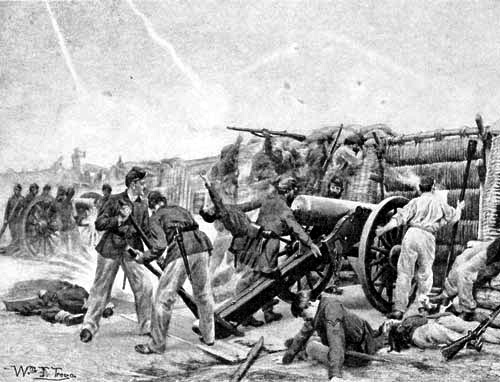
Attacking the Inner Traverses of Fort Fisher
The last words were drowned in a tremendous Rebel yell as they saw the bluejackets break and retreat out of range. The Confederates, however, had cheered too soon. In manning the sea-wall they had weakened too much the defenses on the landward side and the word was given for all three brigades to attack at once. The color-bearers of all the regiments ran forward like madmen, headed by the officers and all sprinting as if running a two hundred and twenty-yard dash. The officers and the color-bearers of all three brigades reached the outer lines almost at the same time. With a rush and a yell they were up over the outer wall and forming inside for the attack on the inner traverses which yet remained. It was desperate work and the hardest fighting of the day was done around these inner bomb-proofs, each one of which was like a little fort in miniature. The crisis came when the first brigade was barely keeping its foothold on the west end of the parapet while the enemy which had repulsed the bluejackets were moving over in a heavy column to drive out Curtis' panting men. It was at this moment that the boy-general Pennypacker showed himself the hero of the day. He had already carried the palisades and the sally-port and had taken four hundred prisoners and then wheeled and charged to the rescue of Curtis' exhausted men. Ahead of them was the fifth traverse which must be stormed and crossed before Curtis' men could be relieved. Already the men were wavering and it was a moment which called for the finest qualities of leadership. Pennypacker himself seized the colors of the 97th Pennsylvania, his old regiment, and calling on his men to follow, charged up the broken side of the fifth traverse. His troops swarmed up after him side by side with the men of the 203d Pennsylvania and the soldiers of the 117th New York, but Pennypacker was the first man to fix the regimental flag on the parapet and shouted to Colonel Moore of the other Pennsylvania regiment:
"Colonel, I want you to take notice that the first flag up is the flag of my old regiment."
Before Colonel Moore had time to answer, he pitched over with a bullet through his heart and Colonel Bell was killed at the head of his brigade as he came in. The gigantic Curtis was fighting furiously with the blood streaming down from his face. Just at that moment, at the head of his men, General Pennypacker fell over, so badly wounded that never from that time to this was a day to pass free from pain. His work was done, however. His men fought fiercely to avenge his fall, broke up the enemies' intended attack, freed the first brigade and all three forces joined and swept through the traverses, capturing them one by one until the last and strongest fort of the Confederacy had fallen. The only remaining gateway to the outer world was closed. After the fall of Fort Fisher, it was only a few months to Appomattox. One of the bloodiest and most successful assaults of the war had succeeded. General Grant ordered a hundred-gun salute in honor of the victory from each of his armies. The Secretary of War, Stanton, himself, ran his steamer into Wilmington and landed to thank personally in the name of President Lincoln the brave fighters who had won a battle which meant the close of the war.
General Pennypacker was to survive his wounds. This was the seventh time that he had been wounded in eight months. At the close of the war he was made colonel in the regular army, being the youngest man who ever held that rank, and was placed in command of various departments in the South and was the first representative of the North to introduce the policy of conciliation. Later on he went abroad and met Emperor William of Germany, the Emperor of Austria and Prince Bismarck and von Moltke, that war-worn old general, who shook hands with him and said that as the oldest general in the world, he was glad to welcome the youngest.
So ends the story of a great battle where a boy showed that he could fight as bravely and think as quickly and hold on as enduringly as any man. What the boys of '64 could do, the boys of 1915 can and will do if ever a time comes when they too must fight for their country.
CHAPTER XVI
MEDAL-OF-HONOR MEN
To-day in the world-war that is being waged in two hemispheres among twelve nations, we hear much of the Victoria Cross and the Iron Cross, and the decoration of the Legion of Honor, those tiny immortal symbols of achievement for which men are so willing to lay down their lives and which are cherished and passed on from father to son as a heritage of honor undying. Not since gunpowder sent armor, swords, spears, arrows, bows, catapults and a host of other outworn equipment to the scrap-heap has the method of warfare been changed as it was in the year 1914. Battles are now fought in the air and under the water and armies move forward underground. Automobiles and power-driven cars, trucks and platforms have succeeded the horse. Aeroplanes have taken the place of cavalry. Vast howitzers carried piecemeal on trucks, which can run across a rougher country than a horse, have made the strongest fortress obsolete. Bombs which kill every living thing within a circle one hundred and fifty yards in diameter, vast cylinders of gas which turn the air for miles into a death-trap, airships which can drop high-power explosives while invisible beyond the clouds, aerial and submarine torpedoes which can be automatically guided by electric currents from vessels miles away, guns that send vast shells a mile above the earth to carry death and destruction to a point twenty miles away, concealed artillery equipped with parabolic mirrors and automatic range-finders which can shoot over distant hills and mountains to a hair's breadth, and destroy concealed and protected bodies of men, rifles which shoot without noise and without smoke, machine-guns that spray bullets across a wide front of charging men as a hose sprays water across the width of a lawn, wireless apparatus which send messages thousands of miles across land and sea, all these and hundreds of other devices would be more of a mystery to Grant and Lee and the other great commanders of the Civil War than the breech-loading magazine rifles and artillery and iron-clads of their day would have been to Napoleon. The warfare of to-day is farther removed from the period of the Civil War of half a century ago than the Napoleonic wars were from those of Hannibal over a thousand years before.
Methods have changed, but men are the same to-day as they were when they first built that great tower on the plain of Shinar. The eternities of life are still with us. Brave deeds, acts of self-sacrifice, truth, honor, courage, unselfishness still stand as in the days of old. Every man or woman or child, small or great, can achieve such deeds. At the end of this chronicle of the brave deeds wrought by our fathers and grandfathers in a war which was fought for an ideal, it is most fitting that the boys and girls of to-day should read what was done by commonplace men as a matter of course. From the great list prepared by the War Department of the United States of those whom their country have honored have been selected a few stories of the way different men won their Medal of Honor.
In 1864 General Sherman was in the midst of his great march to Atlanta. Grant had begun the campaign against Lee's army which was to end at Richmond, while to Sherman was given the task of crushing his rival, Joseph E. Johnston. Inch by inch the whole of that march was fought out in a series of tremendous battles. One of these was the hard battle of New Hope Church in sight of Kenesaw Mountain. The battle was fought as a successful attempt on the part of Sherman to turn the flank of Johnston's position at Alatoona Pass. During the battle, Follett Johnson, a corporal in the 60th Infantry, did not only a brave, but an unusual deed. While his company was awaiting the signal to take part in the battle which was raging on their left, they were much annoyed by the deadly aim of a Confederate sharp-shooter concealed in an oak tree a quarter of a mile away. Every few minutes there would be a puff of smoke and the whine of a minie bullet, too often followed by the thud which told that the bullet had found its billet. When at last the sixth man, one of Johnson's best friends, was fatally wounded through the head, Johnson made up his mind to do his share in stopping this sharp-shooting permanently. Unfortunately he was only an ordinary shot himself, but he crawled down the line and had a hasty conference with one of the best shots in the regiment.
"You get a good steady rest," said Johnson, "and draw a bead on that oak tree. I'll kind of move around and get the chap interested and when he gives you a chance, you take it."
The Union sharp-shooter agreed to carry out his part of the bargain. Johnson suddenly sprang to his feet and ran in a zigzag course to a position farther down the line. A bullet from the watcher in the tree shrieked close past his head.
"Lie down, you fool," shouted his captain. "Are you trying to commit suicide?"
"Captain, we're fishing for that fellow over in the tree," returned Johnson. "I'm the bait."
"Well, you won't be live-bait if you keep it up much longer," said his captain as Johnson again took another run while a bullet cut through his coat hardly an inch from his side. Johnson did keep it up, however. Now he would raise his cap on a stick and try to draw the enemy's fire in safety. Again he would suddenly spring up and make divers disrespectful gestures toward the sharp-shooter in his tree. Sometimes he would lie on his back and kick his legs insultingly up over a little breastwork that had been hurriedly thrown up. One bullet from the Confederate marksman nearly ruined a pair of good boots for Johnson while he was doing this, taking the heel off his left boot as neatly as any cobbler could have done. The hidden marksman, however, commenced to show the effect of this challenge by this unknown joker. Little by little he ventured out from behind the trunk of the tree in order to get a better aim. By the captain's orders no one fired at him in the hopes that he would give the watching Union sharp-shooter a deadly chance. At last his time came. Johnson started his most ambitious demonstration. He suddenly stood up in front of the breastworks in an attitude of the most irritating unconcern. Yawning, he gave a great stretch as if tired of lying down any longer, then he kissed his hand toward the sharp-shooter and started to stroll down the front of the line, first stopping to light his pipe. The whole company gave a gasp.
"That will be about all for poor old Folly," said one man to his neighbor and every minute they expected to see him pitch forward. His indifference was too much for the Confederate. Emboldened by the absence of any recent shots, he leaned out from behind the sheltering trunk in order to draw a deadly bead on the man who had been mocking him before two armies. This was the chance for which the Union sharp-shooter had been waiting. Before the Confederate marksman had a chance to pull his trigger there was the bang of a Springfield rifle a few rods from where Johnson was walking and the watching soldiers saw the Confederate sharp-shooter topple backward. The rifle which had done so much harm slipped slowly from his hand to the ground and in a minute there was first a rustle, then a crash through the dense branches of the oak as the unconscious body lost its grip on the limb and pitched forward to the ground forty feet below. Johnson's captain was the first man to shake his hand.
"It takes courage to fish for these fellows sometimes," he said, "but it takes braver men than I am to be the bait."
Nearly thirty years later this occurrence was remembered and Corporal Johnson awarded the medal of honor which he had earned.
Another man who drew the enemy's fire in order to save his comrades was John Kiggins, a sergeant in one of the New York regiments. It was at the battle of Lookout Mountain on November 24, 1863. The terrible battle of Chickamauga had been fought. The Union Army had been reduced to a rabble and swept off the field, except over on the left wing where General George H. Thomas with twenty-five thousand men dashed back for a whole afternoon the assaults of double that number of Confederates and earned the title which he was henceforth to bear of the "Rock of Chickamauga." The defeated army, followed afterward by General Thomas' forces, withdrew to Chattanooga, that Tennessee battle-ground surrounded by the heights of Missionary Ridge and Lookout Mountain. Here the Union forces were invested on all sides by the Confederate Army under General Bragg. The supplies of the Union Army gave out. The Confederates commanded the Tennessee River and held all of the good wagon-roads on the south side of it. The Union Army was nearly starved. General Rosecrans had never recovered from the battle of Chickamauga. Not only was his nerve shattered, but he seemed to have lost all strength of will and concentration of purpose. General Grant, who had just been placed in supreme command of all the military operations in the West, decided to place Thomas in command of the Army of the Cumberland in place of the dispirited Rosecrans. He telegraphed Thomas to hold Chattanooga at all hazards.
"We'll hold the town until we starve," Thomas telegraphed back.
When Grant reached Chattanooga on October 23d, wet and dirty, but well, he realized as he saw the dead horses and the hollow-cheeked men how far the starving process had gone. Although he was on crutches from injuries received from a runaway horse, yet his influence was immediately felt throughout the whole army. He was a compeller of men like Napoleon and, like him, had only to ride down the line and let his men see that he was there in order to accomplish the impossible. He at once sent a message to Sherman, who was coming slowly along from Vicksburg. His messenger paddled down the Tennessee River in a canoe under a guerrilla-fire during his whole journey and handed Sherman a dispatch from Grant which said, "Drop everything and move your entire force toward Stevenson." Sherman marched as only he could. When his army reached the Tennessee River he laid a pontoon bridge thirteen hundred and fifty feet in length in a half day, rushed his army across, captured all the Confederate pickets and was ready to join Grant in the great battle of Chattanooga. General Hooker marched in from one side on November 24th and fought the great battle of Lookout Mountain above the clouds, through driving mists and rains and on the morning of November 25th the stars and stripes waved from the lofty peak of Lookout Mountain. The next day eighteen thousand men without any orders charged up the almost perpendicular side of Missionary Ridge and carried it, and the three-day battle of Chattanooga was ended in the complete defeat of Bragg's army and the rescue of the men whom he thought he had cornered beyond all hopes of escape.
It was during this first day's battle in the mist on Lookout Mountain that Kiggins distinguished himself. The New York regiment, in which he was a sergeant, had crawled and crept up a narrow winding path, dragging their cannon after them up places where it did not seem as if a goat could keep its footing. They had already come into position on one side of the higher slopes when suddenly a battery above them opened fire and the men began to fall. Through the mists they could see the stars and stripes waving over this upper battery, which had mistaken them for Confederate soldiers. They were shielded from the Confederate batteries by a wall of rock, but it was necessary to stop this mistaken fire or every man of the regiment would be swept off the mountain by the well-aimed Union guns. Sergeant Kiggins volunteered to do the necessary signaling. He climbed up on the natural wall of rock which protected them from the Confederate batteries and sharp-shooters and waved the Union flag toward the battery above him with all his might. They stopped firing, but evidently considered it simply a stratagem and wigwagged to Kiggins an inquiry in the Union code. It was necessary for Kiggins to answer this or the fire would undoubtedly be at once resumed. Unfortunately he was a poor wigwagger and as he stood on the wall, he was exposed to the fire of every Confederate battery or rifleman within range. The perspiration ran down his face as he clumsily began to spell a message back to the battery above. Over his head hummed and whirled solid round shot and around him screamed the minie balls from half-a-dozen different directions. Once a shot pierced his signaling flag right in the middle of a word. He not only had to replace the flag, but he had to spell the word over again which was even worse. The whole message did not take many minutes, but it seemed hours to poor Kiggins. His life was saved as if by a miracle. Several bullets pierced his uniform, his cap was shot off his head and when the last word was finished, he dropped off the wall with such lightning-like rapidity that his comrades, who had been watching him with open mouths, thought that at last some bullet must have reached its mark. Kiggins, however, was unharmed, but made a firm resolve to perfect himself in wigwagging. We have no record whether he carried out this good resolution, but his unwilling courage saved his regiment in spite of his bad spelling and won for himself a medal of honor.
It was at the end of that terrible Wilderness campaign of Grant's which in a little more than a month had cost him fifty-four thousand nine hundred and twenty-nine men, a number nearly equal to the whole army of Lee, his antagonist, when the campaign was commenced. Grant's first object in this campaign was to destroy or capture Lee's army. His second object was to capture Richmond, the capital of the Confederacy. A special rank of Lieutenant-General had been created for him by President Lincoln with the approval of the whole country. His victory at the dreadful battle of Shiloh, his successful siege of Vicksburg and his winning above the clouds the battle of Chattanooga, had made the silent, scrubby, commonplace-looking man, with the gray-blue eyes, who never talked but acted instead, the hope of the whole nation. In this campaign, Grant's one idea was to clinch with Lee's army and fight it as hard and as often as possible. He fought in the wilderness, tangled in thickets and swamps. He fought against strong positions on hilltops, he fought against entrenchments defended by masked batteries and tremendous artillery. He fought against impregnable positions and although he lost and lost and lost, he never stopped fighting. Lee had beaten McClellan and Pope and Burnside and Hooker, all able generals, who had tried against him every plan except that which Grant now tried, of wearing him out by victories and defeats alike. Grant's army could be replenished. There were not men enough left in the Confederacy to replace Lee's army. It was a terrible campaign and only a president of Lincoln's breadth of view and only the supreme confidence which the American people have in a man who fights, no matter how often he is beaten, kept Grant in command. If, after the bloody defeats in the Wilderness and at Spottsylvania or at Cold Harbor, he had turned back like any of his successors would have done, undoubtedly his past record would not have saved him the command. It was like the celebrated battle between Tom Cribb, the champion of England, and Molineaux, the giant black, in the eighteenth century for the championship of the world. Again and again and again Cribb was knocked down by blows so tremendous that even his ring generalship could not avoid them. Battered and bloody he always staggered to his feet and bored in again for more. Molineaux at last said to his seconds, "I can't lick a fellow like that; the fool doesn't know when he is beaten." It was so with Grant and Lee. Grant never knew when he was beaten. Lee's generalship could knock him down, but could not keep him back, and the Confederate leader realized himself that sooner or later some chance of war would give Grant the opportunity for a victory from which the Confederate Army could not recuperate.
Cold Harbor was the last of this series of defeats which helped wear out Lee's army and ended in its capture and the occupation of Richmond. At the time, however, it was bitter to be borne by the millions of men and women and children who were hungering and thirsting for a victory of the Union arms. Marching and fighting and fighting and marching every day for a month, Grant was almost in sight of the spires of the Confederate capital. About six miles outside the city Lee had taken his last stand at Cold Harbor. He held a position of tremendous natural strength and had fortified and entrenched it so that it was practically impregnable. Grant tried in vain to flank it. On June 30th he ordered an assault in front. Against him was the flower of the Confederate Army commanded by the best general of the world and securely entrenched in a position than which no stronger was ever attacked throughout the whole war. Grant first gave his command to attack on the afternoon of June 2d, but then postponed it until the early morning of June 3d. Officers and men alike knew that they were to be sacrificed. All through the regiments men were pinning slips of paper, on which were written their names and addresses, to the backs of their coats, so that their dead bodies might be recognized after the battle and news sent to their families at the North. The battle was a short one. The second corps of General Hancock, one of the bravest and most dashing of all of Grant's generals, was shot to pieces in twenty-two minutes and fell back with three thousand of its best men gone, including most of its officers. All along the line the story was the same. At some places the Union men were beaten back without any difficulty and at other spots they penetrated the salients, but were driven back. Attack after attack was in vain against the generalship of Lee, the bravery of his men and the almost impregnable strength of his position.
Eugene M. Tinkham, of the 148th New York Infantry, was in that corps directly under the eye of Grant himself which attacked and attacked the Confederate position throughout that bloody morning, only to be driven back each time with tremendous losses. The 148th Infantry, in which Tinkham was a corporal, charged right up to the very mouth of the guns. Flesh and blood could not stand, however, against the volleys of grape and canister which ripped bloody, struggling lanes right through the masses of the charging men. As the corps of which Tinkham's regiment was a part was stopped by the wall of dead and wounded men piled up in front of them, the Confederates with a fierce Rebel yell charged over the breastworks on the confused attackers. For a minute the New York regiment held its own, but were finally slowly forced back fighting every foot to the shelter of their own rifle-pits. There they made a stand and the Confederate sally stopped and the men in gray dashed back to their own fortifications. In this charge, Tinkham received a bayonet wound through his left shoulder while a jagged piece of canister had ripped through his left arm. Not until he found himself back in the rifle-pit, however, did he even know that he was wounded. His bayonet and the barrel of his rifle were red clear up to the stock and he did not at first realize that the blood dripping from his left sleeve was his own. It was only as he lay on the dry sand and saw the red stain beside him grow larger and larger that he realized that he was hurt. One of the few men who had returned with him stripped off his coat, cut away the sleeve of his shirt and made a couple of rough bandages and extemporized a rude tourniquet from the splinters of one of the wheels of a battered field-piece which had flown into the pit. When that was over, Tinkham lay back and shut his eyes and felt the weakness which comes over a man who has lost much blood. To-day there was not the tonic of victory which sometimes keeps even wounded men up. He had seen his comrades, men with whom he had eaten and slept and fought for over two years, thrown away, as it seemed to him, uselessly. He was yet to learn, what the army learned first and the country last, that Grant was big enough and far-sighted enough to know that some victories must be wrought from failure as well as success. This was one of the hammer-strokes which seemed to bound back from the enemy's armor without leaving a mark, yet the impact weakened Lee even when it seemed that he was most impervious to it. It was absolutely necessary to Grant's far-reaching plans that Lee be fought on every possible occasion. Whether he won or lost, Grant's only hope lay on keeping Lee on the defensive. None of this, of course, could a wounded corporal in a battered, beaten and defeated regiment realize. All he knew was that his friends were gone, that he was wounded and, worst of all, had been forced to again and again retreat. He shut his eyes and there was a sound in his ears like the tolling of a great bell. It seemed to swell and rise until it drowned even the rattle and roar of the battle which was still going on. When Tinkham opened his eyes everything seemed to waver and quiver before him. Suddenly there came a short, thin, wailing sound which cut like a knife through the midst of the unconsciousness which was stealing over him. It was the cries of two wounded men lying far out in the field over which he had come. Tinkham raised his hand and strained his eyes. He could recognize two of his own file, men who a moment before had been by his side and who now lay moaning their lives away out on that shell-swept field. Tinkham listened to it as long as he could. Then he set his teeth, scrambled to his feet and in spite of his comrades who thought that he was delirious, climbed stiffly over the edge of the rifle-pit and began to creep out between the lines toward the wounded men. At first every motion was an agony. He was weakened by the loss of blood and he could bear no weight on his left arm, yet there was such a fatal storm of bullets and grape-shot whizzing over him that he knew that, if he rose to his feet, there would be little chance of his ever reaching his friends alive. Slowly and doggedly he sidled along like a disabled crab. Sometimes he would have to stop and rest. Many times bullets whizzed close to him and cut the turf all around where he lay. As soon as he had rested a few seconds, he would fix his eye on some little tuft of grass or stone or weed and make up his mind that he would crawl until he reached that before he rested again. It was a long journey before he reached his goal. On the way he had taken three full canteens of water from silent figures which would never need them more. When at last he reached the men, they recognized him and the tears ran down their faces as they called his name.
"God bless you, Corporal," said one; "it's just like you to come for us."
Tinkham had no breath left to talk, but he gave each wounded man a refreshing drink from the canteens. Both of them were badly, although not fatally, wounded. One had a shattered leg and the other was slowly bleeding to death from a jagged wound in his thigh which he had tried in vain to staunch. Tinkham bandaged them up to the best of his ability and started to drag them both back to safety. With his help and encouragement, each of them crawled for himself as best he was able. It was a weary journey. During the last part of it, however, he was helped by other volunteers who were shamed into action by seeing this wounded man do what they had not dared. All three recovered and lived to take part in the latter-day victories which were yet to come.
Tinkham was but one of the thousands of brave men who risked their lives to save their comrades. There was Michael Madden who at Mason's Island, Maryland, was on a reconnaissance with a comrade within the enemy's lines. His companion was wounded. A number of the enemy's cavalry started out to cut off the two men who were at the same time exposed to concentrated fire from the enemy's sharp-shooters. Madden picked his comrade up as if he had been a child, hoisted him to his back and ran with him to the bank of the Potomac, and plunged off into the water. Swimming on his back, he kept his comrade's head up and crossed the river in safety with the bullets hissing and spattering all around him.
Then there was Julius Langbein, a drummer-boy fifteen years old. In 1862 at Camden, N.C., the captain of his company was shot down. Langbein went to his help, but found that unless he received surgical treatment, he could not live an hour. Unstrapping his drum, he ran back to the rear and found a surgeon who was brave enough to go out to the front with him and under a heavy fire give first-aid to the wounded officer. Then the two carried the unconscious captain back to safety.
It is a brave man that can rally himself in a retreat. Usually men go with the crowd. Once let the tide of battle begin to ebb and a company or a regiment or a brigade commence a retreat, it takes not only unusual courage, but also unusual will-power for any single man to stand out against his fellows and resist not only his own fears, but theirs. Such a man was John S. Kenyon. At Trenton, S.C., on May 15, 1862, the whole column of his regiment, the 3d New York Cavalry, was retreating under a murderous fire from the enemy. Kenyon was in the rear rank. The retreat had started at a trot, had increased to a gallop and finally the whole column was riding at breakneck speed away from the shot and shell which crashed through their ranks. At the very height of their speed a man riding next to Kenyon was struck in the right shoulder by a grape-shot. The force of the blow pitched him headlong from the saddle. He still held to his reins with his left hand with a death-grip and was dragged for yards by his plunging, snorting horse. Kenyon was just ahead and knew nothing of the occurrence until he heard a faint voice behind him calling breathlessly, "Help, John, help!" He looked back and saw his comrade nearly fifty yards behind lying on the ground. Already his fingers were loosening their grip on the rein and the blood was flowing fast from the gash on his shoulder. Behind him the Confederate cavalry came thundering along not a quarter of a mile away while the massed batteries behind them swept the whole field with a hail of lead and steel. John hesitated for a minute and for the last time he heard once more the call of help, this time so faint that he could hardly hear it above the din of the battle. With a quick movement, he swung his horse to one side of the column.
"Don't be a fool, John," shouted one of the men ahead; "it's every man for himself now. You can't save him and you'll only lose your own life."
It was the old plausible lie that started when Satan said of Job, "Skin for skin, all that a man hath will he give for his life." It was a lie then and it is just as much a lie to-day.
"Greater love hath no man than that he lay down his life for his friend," said our Master. Every day when the crisis comes we see men who will do that. Kenyon was one of these men. As he said afterward, "I should never have been able to get Jim's voice out of my mind if I hadn't stopped."
It only took an instant to cover the distance from the column to the wounded man. Kenyon reached him just in time to catch the riderless horse which had at last freed his bridle from the weak grip of his wounded master. Kenyon swung himself to the ground and holding the two plunging horses with his right hand, pulled his friend to his feet and with a tremendous effort finally hoisted him into his saddle again. By this time the pursuing cavalry was within pistol-shot and the revolver bullets began to sing around the heads of the two men.
"You hang on to your saddle, Jim," said Kenyon, "and I'll take care of your horse."
Bending low in his saddle, he dug his spurs deep into his horse's sides, at the same time keeping his grip on the reins of the other horse and in a few minutes the two were back again in the rear of the retreating column. All through the retreat Kenyon stuck to his comrade and finally landed him safely in the field-hospital in front of which the Union Army had thrown up entrenchments which stopped all further pursuit.
War, like everything else, is always a one-man job. It was the one man Hannibal that took a tropical army of sunburned Arabs, Carthaginians, Abyssinians, Berbers and soldiers from half a score of other southern nations and cut and built and tunneled his way through the ice and snow and cold of the Alps. Not only did his indomitable will carry his men through an impossible and unknown region, but it was this one man who for the first time in the history of the world marched elephants up over the Alps. Over two thousand years later it was one man again who took a ragged, battered, beaten army and marched over the same route and through the avalanches and snow-covered peaks and blinding snow-storms of the Great Bernard Pass. When the men turned trembling back from the brink of immeasurable precipices and before cliffs which seemed as if they could be climbed only by the chamois, Napoleon would order the drums and bugles to strike up the signal for a charge and up and over his soldiers went. It was this one short, frail, little man that fused this army into a great fighting machine, marched it over impossible mountains and swept down into Italy to win as great victories as did his fierce predecessor twenty centuries before.
The records of the War Department are full of instances where men singly did seemingly impossible things. There was Patrick Ginley, a private in a New York regiment. At Reams Station, Virginia, the command in which he fought deserted important works which they occupied and retreated under the tremendous fire of the advancing enemy. Patrick remained. It seemed impossible that only one man could do anything except throw away his life, but Patrick made up his mind that he would accomplish everything that one man could. Accordingly as the enemy surged up to occupy the works with cheers and laughter at the sight of the retreating bluecoats, they were suddenly staggered by receiving a tremendous cannonade of grape-shot which cut down the entire first two ranks of the approaching company. It was Private Ginley who, single-handed, had loaded and sighted the gun and coolly waited until the enemy were within pointblank range. The Confederates were thrown into confusion. They suspected a Yankee trick and thought that the retreat had been made simply to lure them into close range. In the confusion they fell back, although they could have marched in without any further opposition, for as soon as Ginley had fired the gun, he escaped out of the rear of the earthworks and hastened to another Union regiment which was holding its ground near by. Waving his arms over his head and shouting like a mad-man, he rushed up to the astonished men and grabbed the colors out of the hands of the bewildered color-sergeant.
"Come on, boys!" he shouted. "I've got some good guns and a nice bit of fortification just waitin' for you. Look at the way I drove them back all by myself."
And he waved the colors toward the shattered Confederates who were slowly forming into line again preparatory to an assault, and started back for the works as fast as his legs could carry him.
"Come on, you fellows," he yelled over his shoulder; "do you want me to drive them back twice?"
His example was all that was needed. There was a cheer from officers and men alike and close behind him thundered the charge of the regiment. With a rush they swept up over the earthworks, drove the Confederates, who had just entered from the other side, out headlong, manned the whole works and in a minute were pouring charges of grape and canister from the retaken guns which completed their victory. A defeat had been changed into a victory, eleven guns and important works had been retaken from the enemy and a regiment of Confederates disorganized and driven from the field. One man did it.
The deeds that most appeal to our imagination are single combats—one man against a multitude when daring and dash and coolness and skill take the place of numbers. History is full of such stories. We love to read of that great death-fight of Hereward the Wake, the Last of the English, when with sturdy little Winter at his back, he fought his last fight ringed around with hateful, treacherous foes. At his feet the pile of dead and wounded men grew high and higher until no one dared step within the sweep of that fatal sword. At last when Winter had fallen, some treacherous coward thrust a spear into Hereward's defenseless back. As he lay fallen on his face, apparently dead, one of his foemen stepped over to rob him of his sword when Hereward struggled to his knees and struck forward with his shield so fiercely, the last blow of the last Englishman, that he laid his man dead on the field.
Then there was the death-fight of Grettir the Outlaw which Andrew Lang calls one of the four great fights in literature of one man against a multitude. No boy should ever grow up without reading the Grettir Saga which tells how after being unjustly driven into outlawry Grettir finally took refuge on a rocky island which could only be climbed by a rope-ladder. There with his brother and a cowardly, lazy servant he lived in safety until his enemies hired a witch-wife to do him harm. At midnight she cut grim runes into a great log of driftwood and burned strange signs thereon and stained it with her blood and then after laying upon it many a wicked spell, had it cast into the sea by four strong men. Against wind and tide it sailed to Drangy, Grettir's island of refuge. There he found it on the beach, but recognized it as ill-fated and warned the servant not to use it for fire-wood. In spite of this the lazy thrall brought it up the next day and when Grettir, not recognizing it, started to split the accursed log, his axe glanced and cut a deep gash in his leg. The wound festered and the leg swelled and turned blue so that Grettir could not even stand on it. When he was at last disabled, the witch-wife raised a storm and under her direction a band of his bitterest enemies went out to the island and found that his servant had left the rope-ladder down. One by one they climbed the sheer cliff and made a ring around the little hut where Grettir and his young brother slept. They dashed in the door. Grettir seized his sword and shield and fought on one knee so fiercely that they dared not approach him. Some of the attackers tried to slip behind his watchful sword.
"Bare is the back of the brotherless," panted Grettir and his boy-brother stood behind him and fought over him until they were both overborne by the sheer weight of heavy shields, and Grettir killed, although not until six men lay dead in front of the great chieftain. Illugi, the brother, was offered his life if he would promise to take no vengeance on the murderers of his brother. He refused to do this because they had killed Grettir by witchcraft and treachery and not in fair fight. So they slew him, trying in vain to avoid the vengeance which came to them all many years later at the hands of another of Grettir's kin.
We read also of battles won against what seem to us impossible odds. The Samurai stories of old Japan have several instances where chieftains defeated whole armies single-handed by their wonderful swordsmanship. The Bible contains several such stories. There is the story of Jonathan and his armor-bearer who together captured a fortress. Jonathan said to the young man that bare his armor, "Come and let us go over unto the garrison. It may be that the Lord will work for us." And his armor-bearer said unto him, "Do all that is in thine heart, behold I am with thee." Then they agreed to wait for a sign. If when they came before the garrison the men should invite them to come up, then they would go. If not, they would not make the attempt. The account goes on to say that when they both discovered themselves unto the garrison of the Philistines, the men of the garrison cried out to Jonathan and his armor-bearer and said, "Come up to us and we will show you a thing." And Jonathan said unto his armor-bearer, "Come up after me for the Lord hath delivered them to us." And Jonathan climbed up upon his hands and upon his feet and his armor-bearer after him and they fell before Jonathan and his armor-bearer slew after him. In a half-acre of ground which a yoke of oxen might plough, these two fought and slew and cut their way back and forth until the band that held the fort broke and fled and the stronghold was captured by the two.
Then there was Jashobeam the Hachmonite, one of the first three men of David's body-guard of heroes who slew with his spear three hundred men at one time. There was Eleazar, who with David fought in that bloody barley field when these two warriors single-handed dispersed a company of Philistines. There was Abishai who slew three hundred men. These were the three mighty men who were besieged with David in the cave of Adullam in the midst of a parched and burning desert and David longed and said, "Oh, that one would give me to drink of the water of the well of Bethlehem that is at the gate." The three heard what their captain said and alone they broke through the ranks of the Philistines, drew water out of the well of Bethlehem and brought it back to David. And David did not drink of it, but poured it out to the Lord and said, "Lord forbid that I should drink the blood of these men that have put their lives in jeopardy for me."
When we read these and other hero-stories, we are apt to think that the time for such deeds is past and that the men of to-day can never equal the accomplishments of the fighters of olden time. Yet the Civil War shows stories just as stirring and accomplishments seemingly as impossible. There was George Wilhelm, a captain in the Ohio Infantry. At Bakers Creek he was badly wounded in the breast and after he had fallen was captured by a Confederate, forced to his feet and though faint from loss of blood marched to the Confederate camp. As he saw himself farther and farther away from his own army a Berserkir rage came over him which made him forget his wound and his weakness. With one tremendous spring he caught his captor around the neck, wrested his drawn sabre from out of his hand, slashed him over the left shoulder and then picking up the loaded revolver which had dropped from the disabled hand faced him around and marched him back to the Union lines a prisoner although, toward the end of that journey, Wilhelm was so weak that he had to lean on the shoulder of his unwilling attendant.
There was William G. Whitney a sergeant in the 11th Michigan Infantry, at the battle of Chickamauga who, just as his men were about to face a fierce charge from the Confederates, found that their ammunition had given out. Outside the Union works was a shell-swept field covered with dead and wounded men. Whitney never hesitated. He leaped over the works and ran back and forth over that field, cutting off and loading himself down with cartridge-boxes, although it did not seem as if a man could live a minute in that hissing storm of bullets and shell. Just in time he brought back the ammunition which enabled his men to beat back the charge and hold their position.
At Rappahannock Station, Virginia, J. Henry White, a private in the 90th Pennsylvania Infantry, like David's men brought back water to his thirsty comrades at the risk of his own life. The enemy had concentrated their fire on the only spring from which Union men could get water, but White crawled through the grass like a snake, covered from head to foot with canteens, filled them every one and crawled back under a fire which seemed as if it must be fatal. The Union forces were able to hold out and win the fight through his brave deed.
On May 12, 1864, Christopher W. Wilson, a private in the 73d New York Infantry at the battle of Spottsylvania in a charge on the Confederate works, seized the flag which the wounded color-bearer had dropped, led the charge and then for good measure cut down the color-bearer of the 56th Virginia Regiment, captured the Confederate colors and brought back both flags in safety to the Union lines.
Another color-bearer who won his share of battle-glory was Andrew J. Tozier, a sergeant in the 20th Maine Infantry at the battle of Gettysburg. Tozier believed that it was the duty of a color-bearer having done all to stand fast. At the very flood-tide of the fight when it was a toss-up which side would be the victor of that crisis-battle of the war, Tozier's regiment, which was in the forefront, was borne back leaving him standing with the colors in an advanced position. Tozier stood there like a rock and coolly picked off with his musket every Confederate that attacked him until his ammunition gave out. He then pushed forward a few yards until he reached the body of one of the soldiers of his regiment who had fallen and stooping down, still keeping his colors flying, he managed to loosen some cartridges from the dead man's belt. With these he recharged his rifle and fought a great fight alone. Again and again he would stoop for a minute to get more cartridges, but the flag never went down. From all over the field the officers from the scattered regiment rallied their men and hurried toward the colors and just as a Confederate troop thundered down on Tozier, intending to ride over him and carry away the precious flag, from every part of the field little squads of fighting men reached him in time to pour in a volley that saved the colors which Tozier for many minutes had been protecting single-handed. That was the turning-point of this part of the battle. The Maine regiment pressed on and never retreated a foot again through all those days of terrible fighting. Tozier was one of the many men who saved that day for the Union by being brave in the face of tremendous odds.
Freeman C. Thompson of the 116th Ohio Infantry won his medal of honor at Petersburg, Virginia. On April 2, 1865, the Union forces were storming Fort Gregg. Both sides had poured in murderous volleys at short range and then had rushed to close quarters, fighting desperately with bayonet and butt. Thompson scrambled up on his hands and knees, but had no more reached the parapet when he was knocked off it headlong by a tremendous blow on the head from a clubbed musket. When he returned to consciousness he found himself lying in the ditch with two dead men on top of him. Thompson made up his mind that this was not the kind of company which he ought to keep and springing to his feet, he started again for the parapet. This time he was more fortunate for he gained a footing and managed to bayonet the first man who attacked him, but before he could withdraw the bayonet, once again he received a tremendous smash full in the face from a clubbed musket and went clear over backward with a broken nose. He struck on the heap of bodies from which he had just emerged and though not unconscious, lay for a few minutes unable to move. Finally he managed to wipe the blood out from his eyes and spit out the blood and broken teeth from his battered mouth. Some men would have felt that they had had enough, but not so with this one. For the third and last time he scrambled up and as he reached the edge of the parapet caught sight of the man who was responsible for his battered face. Thompson rushed at him and there was a battle royal between the two, bayonet to bayonet, but Thompson at last by a trick of fence which he had learned, suddenly reversed his musket and smashed the heavy butt down on his opponent's right forearm, breaking the latter's grip on his own weapon. Before he could recover, Thompson's bayonet had passed through his throat and Thompson himself had gained a foothold within the works. Shoulder to shoulder he fought with the rest of his comrades in spite of the streaming blood and only stopped when the garrison surrendered.
It is a brave man in civil life that will give up his vacation and it takes a hero to relinquish a furlough, that precious breathing spell away from battles and hardships back at home with his dear ones. Martin Schubert, a private in the 26th New York Infantry, had gained this respite and had paid for it by his wounds. Hearing that his regiment was about to go into battle again at Fredericksburg, he gave up his furlough, hurried back to the front and fought fiercely through all that brave day. Six men of his regiment, one after the other, had been shot down that fatal afternoon while carrying the colors. Schubert, although he already had one half-healed and one open wound, seized the flag when it went down for the last time and carried it to the front until the very end of the battle, although he received an extra wound for doing it. Thirty-one years later he received a medal of honor for that day's work.
It is easier to save a wounded friend or wounded comrade than a wounded enemy. He who dares death to save one whom he is fighting against shows courage of the highest type. Such a deed occurred during the battle of Chancellorsville. Those four fatal May-days were filled as full of brave deeds as any days of the Civil War. Though General Hooker, the Union general, flinched and lost not only the battle, but forever his name of Fighting Joe Hooker, his men gave up only when they were outflanked and out-fought and unsupported.
Elisha B. Seaman was a private in one of the regiments which was surprised and attacked by the twenty-six thousand infantry of Stonewall Jackson, the best fighters in the Confederate Army. The Union men were not suspecting any danger. Word had been sent a number of times both to Hooker and to General Howard who commanded the eleventh corps under him that Jackson was crossing through the woods to make a flank-attack. Neither general would believe the message. Both were sure that Jackson was in retreat. When the attack came the Union troops were attacked in front and from the flank and rear at once. They held their ground for a time, but they were new troops and even veterans could not have long sustained such an assault. At first they attempted to make an orderly retreat, but the Confederates pressed on them so close and fought so fiercely that the retreat became a run and the corps of which Seaman's regiment was a part was not rallied until they met reinforcements far over in the wilderness and gradually came to a halt and threw up defenses. There they were too strong to be driven back further by the Confederates and managed to hold their ground although attacked again and again. After the last attack the Confederate forces withdrew and took up a strong position on the Union front, brought up artillery and opened up a tremendous rifle-fire mingled with the cannonade from all their available batteries, hoping to throw the Union forces into disorder so that they would not stand another charge. During the fiercest of the fire while every man was keeping close under cover, Seaman's attention was caught by the sight of a Confederate officer who lay writhing in terrible agony not a hundred yards outside of the Union lines. He had been shot through the body in the last charge and had been left on the field by the retreating Confederates. The pain was unbearable. Seaman could see his face all distorted and although not a sound came through the clenched teeth, the poor fellow could not control the agonized twitching and jerking of his tortured muscles. Seaman tried to turn his face away from the sight, but each time his eyes came back to that brave man in torment out in front of him. At last he could stand it no longer. He slipped back to the rear and got hold of a surgeon.