Front matter (continued 3)
Reading edition
"If you're from the North," said one, "why don't you show us a Yankee trick before you go?" for the Southerners were thoroughly convinced that all Yankees were sly foxes full of sudden schemes and stratagems.
"Well, I will before long," said Pike, as he waved good-bye and galloped off.
Five miles out of the village he came to a fork in the road where one road led to Decatur, which was where the main Confederate forces were located, and the other to Huntsville. Just as he was turning into the Decatur road, he saw a wagon-train coming in from Huntsville and decided that here was a chance for his promised Yankee trick. He rode up to the first wagon.
"Drive that wagon up close to the fence and halt," he said.
"How long since you've been wagon-master?" said the driver, cracking his whip.
"Ever since you left your musket lying in the bottom of the wagon," said Pike, leveling his revolver at the man's head. He drove his wagon up and halted it without a word and stood with his arms over his head as ordered by Pike.
One by one the other wagons came up and the drivers assumed the same attitude. Last of all there was a rattle of hoofs and the wagon-master, who had been lingering in the rear, galloped up.
"What the devil are you fellows stopping for?" he shouted, but as he came around the last wagon, he almost ran his head into Pike's revolver and immediately assumed the same graceful attitude as the others. Pike rode up to each wagon, collected all the muskets, not forgetting to remove a couple of revolvers from the belt of the wagon-master and then inquired from the latter what the wagons had in them.
"Provender," said the wagon-master, surlily.
"What else?" said the corporal, squinting along the barrel of his revolver.
"Bacon," yelled the wagon-master much alarmed; "four thousand pounds in each wagon."
"Well," said the corporal, "I've always been told that raw bacon is an unhealthy thing to eat and so you just unhitch your mules and set fire to these wagons and be mighty blamed quick about it too, because I have a number of engagements down the road." The men grumbled, but there was no help for them and in a few minutes every wagon was burning and crackling and giving out dense black smoke. Waiting until it was impossible to put them out, the corporal lined the men up across the road.
"Now you fellows get on your marks and when I count three you start back to Fayetteville and if you are in reach by the time I have counted one hundred, there's going to be some nice round holes in the backs of your uniforms. When you get back to the village tell them that this is the Yankee trick that I promised them."
Before Pike had counted twenty-five there was not a man in sight. He at once turned back and raced down the road toward Decatur. He had gone about ten miles when he came to a small country church and as it was Sunday, it was open and nearly filled. Fearing that there might be a number of armed Confederate soldiers in the church who would start out in pursuit as soon as the word came back from Fayetteville, the corporal decided to investigate. Not wishing to dismount he rode Bill up the steps and through the open door and down the main aisle, just as the minister was announcing a hymn.
"Excuse this interruption," said Pike, as the minister's voice quavered off into silence, "but I notice a number of soldierly-looking men here and I will take it as a great favor if they will hold their hands as high above their heads as possible and come down here and have a talk with me."
As this simple request was accompanied by a revolver aimed at the audience, one by one six soldiers who had been attending the service came sheepishly down the aisle. They looked so funny straining their arms over their heads that some of the girls in the audience unkindly burst out laughing. Pike removed a revolver from each one and dumped his captured arms into one of his saddle-bags.
"Now, parson," he said, "I want to hear a good, fervent prayer from you for the President of the United States." The minister hesitated. "Quick and loud," said Pike, "because I'm going in a minute."
There was no help for it and the minister prayed for President Lincoln by name, while Pike reverently removed his cap. Then backing his horse out of the door, he started on toward Decatur. Not a half mile from the church he met two Confederate soldiers who were leisurely riding to the church. There was no reason at all why the corporal should meddle with these men. They were two to one and he had no way of disposing of them even if he made them captives. However, the sight of the Confederate parson praying for Abe Lincoln had tickled Pike and he made up his mind to have some fun with these soldiers. As he came abreast of them he whipped out his revolver, ordered them to halt and to give their names, regiments and companies. They did so with great alacrity.
"Well, gentlemen," he said, "you are my prisoners and I am very sorry for I am so far outside of my lines that I am afraid there is only one way to safely dispose of you."
"Great heavens, man," said one, "you don't mean to shoot us down."
"I'm sorry," said Pike, "but you can see for yourself that that's the only thing to do. You are Rebel soldiers and to leave you alive would mean that you will keep on doing harm to the Union forces."
"Don't shoot, captain," both of them chorused; "we'll take the oath of allegiance."
Pike seemed to hesitate.
"Well," he said finally, "I hate to kill men on Sunday. I suppose I ought not to do this, but if you'll solemnly swear allegiance to the United States of America and that you'll never hereafter serve against the Union or be late to church again, I'll let you go."
With much solemnity, the Confederates took the oath in the form dictated, delivered up their revolvers and rode away.
The next man that Pike encountered was an old gentleman on his way to Fayetteville, who admitted that he was a judge and the next day was intending to serve in a number of political cases involving the property of certain Union sympathizers. Pike made him also take the oath of allegiance, and promise not to enter judgment contrary to the interests of the Union. He then left the road and rode along a shallow creek through the woods. About sunset he suddenly came upon an old man under the trees. He questioned him and found that he was a Union sympathizer and was told by him that there were twelve Tennessee cavalrymen and fifteen mounted citizens on the lookout for him.
"That is," said the old man, "if you're the chap that has been going around capturing wagon-trains and churches and soldiers and judges."
"That's me," said Pike.
The old man took him home and fed him and with him he left his horse and started out on foot, feeling that the hue and cry would now be out all over the country against a mounted man in Union uniform. Leaving his friend, he followed the path through the woods toward Decatur until it was dark and then wrapped himself up in a blanket and slept all night in the pouring rain. In the morning he made his way toward the railway and followed it until about ten o'clock when he stopped at a house and bought a breakfast. He had not been there long before he was joined by several Confederate cavalrymen.
"What's your business," said one, "and what are you doing in that uniform?"
"Well," said Pike, "I was told to wear it and not to tell any one my business until it was done and if you fellows don't like it, you had better take it up with the general."
Once again the Confederates concluded that he was on some secret mission. They insisted, however, on taking him to camp with them and there he stayed two days and nights, incidentally obtaining all the information possible as to the forces and the guard about the bridge. Just before dawn on the second morning, he managed to give them the slip and started across country, wading and swimming and toiling through one swamp after another until he finally reached the river bank, traveling only by night and sleeping by day. Along this bank he went for miles until finally he found concealed in a little creek a small rowboat which was tied to a tree and in which were two oars. He spent the better part of the day in loading this up with pine knots and bits of dry driftwood which he planned to use in firing the bridge. Just at evening he pushed off into the middle of the river and started again down for the bridge. He had found by his inquiries that the Confederate camp was located on a bank some distance from the bridge, as no one expected any attack there so far within the Confederate lines. All night long he tugged at the oars and aided by the current reached the bridge about three o'clock in the morning. The bridge was an old-fashioned one erected on three piers. Pike made a careful survey of the whole length of the bridge from the river and found it absolutely unguarded although he could hear the sentry call on the hill a quarter of a mile away where the troops were encamped by the town. Concealing his skiff under an overhanging tree, he toiled up to the bridge with armful after armful of fire-wood. At each end and in the middle he made a little heap of fat-wood and pine knots with a strip of birch-bark, which burns like oiled paper, underneath each. Starting from the far end, he lit the first two piles and by the time he had crossed and was working on the last, he could hear the flames roaring behind him as they caught the dry weather-beaten planking of the bridge. And now he made a mistake which was to prove well-nigh fatal to him. As soon as the fire had obtained a headway, he should have instantly stolen back up the river in his skiff. In his anxiety to make a thorough job of it he stayed too long, forgetting that in the bright light of the fire every motion he made would be plainly visible from the hilltop. Suddenly he heard the alarm given from the camp and almost instantly it was followed by the wail of a minie ball as the sentry above fired down upon him. By this time the river was as bright as day for a quarter of a mile on both sides of the bridge. Near the Confederate camp were a number of boats and Pike was already nearly exhausted by his long row and his work in firing the bridge. He heard the shouts of men as they dashed down for their boats. If he attempted to escape by water he was certain to be overtaken. Another bullet close to his head decided him and he dashed down from the bridge into the road, and plunged into the thick woods on the farther side. All the rest of that night and through the first part of the next day he traveled, following one path after another and keeping his general direction by a pocket compass. By noon he was so tired that if it had been to save his life he could not have gone any farther. The little stock of provisions which he had carried with him had been exhausted the night before and he threw himself on a bed of dry pine-needles under a long-leafed pine which stood on the top of a little knoll and lay there for nearly an hour until part of his strength came back. The first thing to do was to find something to eat. Pike did not dare shoot anything with his revolver, even if there had been anything to shoot, for fear of attracting the attention of Confederate pursuers or bushwhackers. It was now that the corporal's wood-craft proved to be as valuable as his scout-craft. If he were to go further, he must have food and he commenced to wander back and forth through the woods, his quick eye taking in everything on the ground or among the trees. On the other side of the knoll where he had been lying, he noticed a rotten log where the dry, punky wood had been scattered as if a hen had been scratching there. Pike commenced to look carefully all along the ground and finally just on the edge of the slope where the thick underbrush began, he nearly stepped on a large brown speckled bird so much the color of the leaves that if he had not been looking for it, he never would have discovered the nest. The bird slipped into the underbrush like a shadow, leaving behind fifteen brown, mottled partridge eggs. The corporal sat down over the nest and gulped down, one after the other, those eggs, warm from the breast of the brooding bird. As he said afterward, never had he tasted anything half so good. This was a step in the right direction, but even fifteen partridge eggs are not enough for a man who hadn't eaten for nearly thirty hours. Once again he began to prowl restlessly through the woods and this time his attention was attracted by something growing on the side of a dead maple stub. It was dark red and looked like a great tongue sticking out from the bark. To his great joy, Pike recognized it at once as the beefsteak mushroom. It was a magnificent specimen which must have weighed nearly two pounds and as he pulled it off from the tree, red drops oozed out and it looked and smelled like a big, fresh beefsteak. The corporal went down the hollow into the thickest part of the swamp and there picked an armful of perfectly dry cedar and scrub-oak twigs which burn with a clear, smokeless flame. Out of these he built a little Indian cooking fire by arranging the twigs into the form of a little tepee so that a jet of clear flame came up with hardly a sign of any smoke. It was the work of only a moment to whittle and set up a forked stick and to fasten a slab of that meaty-looking fungus on a spit fixed in the fork. Fortunately he had left in his haversack a little salt and pepper with which he seasoned the broiling, hissing steak. In about ten minutes it was done to a turn. Cutting a long strip of bark from off one of the red river-birches which grew near, Pike squatted down on the ground and in fifteen minutes more there was nothing left of that savory, two-pound, broiled vegetable steak. With fifteen eggs and two pounds of beefsteak mushroom under his belt, the corporal felt like another man. He coiled himself up on the dry pine-needles in a little hollow which he found under the low-hanging boughs of a long-leaf pine and resolved to take a sleep to make up for what he had lost during the last two nights. It was early afternoon and everything was still and hot and the drowsy scent of the pine mingled with puffs of spicy fragrance from the great white blossoms of the magnolia with which the woods were starred. As he fell asleep the last thing the corporal heard was the drowsy call of flocks of golden-winged warblers on their way north. How long he slept he could not tell. He only knew that he awoke with a sudden consciousness of danger, that strange sixth sense which most Indians and a few white hunters sometimes develop. Perhaps he inherited it from old Zebulon Pike who, like Daniel Boone and Kit Carson, had the power of hearing and sensing the approach of an enemy even in their soundest sleep. The corporal was alert the second he opened his eyes, but made not a movement or a rustle. The sun was well down in the sky and there was nothing in sight, but the birds had stopped singing. Finally way down through the little tunnel which a near-by flowing stream had made through the hillocks came a sound which brought him to his feet in an instant. It was a ringing note that chimed like a distant bell. Three times it sounded and there was silence, then again three times, but a little nearer and louder, then again silence. A third time it came and this time it seemed around the bend of the bayou not half a mile away. Pike knew in a minute what it was. It was the bay of the dreaded bloodhounds, those man-hunters who had learned to trail their prey through forest and fen, no matter how much he doubled nor how fast he ran. There was but one thing to do if there was time. Springing up, the corporal ran down to the little stream and leaped in. It was hardly up to his knees, but he splashed along for a hundred yards, now and then plunging in up to his waist. It ran a hundred yards or so through the swamp and then emptied into a larger bayou. Along this Pike swam for his life as silently as a muskrat, for now he could hear the baying of the dogs close at hand and suddenly there was a chorus of deep raging barks followed by shouts and he knew that his pursuers had found his lair under the pine trees. Soon the stream ran into another one and then another until Pike had swam and waded and plunged through half a score of brooks which made a regular network through the middle of the swamp. By this time the sound of the dogs had died far away in the distance and he had every reason to believe that he had thrown them off the track. Down the last stream there was a deep, sluggish creek nearly fifty feet wide. He swam until he could go no farther. It opened out into a series of swampy meadows and to his joy he saw in the very midst of the swamp through which it ran a pile of newly-split rails. Swimming over to this he found that they had been piled on a little island about five feet above the level of the swamp and surrounded on all sides by masses of underbrush and deep sluggish water. By this time it was nearly sunset and he resolved to crawl up here and find a dry place and spend the night on this island, which could not be approached except by boat. As he climbed up to the top of the mass of rails, he heard a low, thick hiss close to his face and outstretched hand. He had never heard the sound before, but no man born needs to be taught the voice of the serpent. He started back just in time. Coiled on one of the rails was a great cotton-mouth moccasin whose bloated swollen body must have been nearly five feet in length and as big around as his arm. The great creature slowly opened its mouth, showing the pure white lining which has given it the name and hissed again menacingly. The corporal was in a predicament. Behind him was the cold, dark river in which he no longer had the strength to swim. In the approaching darkness, he might not be able to find any other island of refuge on which to pass the night. There was nothing for him but to fight the grim snake for the possession of the rails. He dropped back and twisted off the thick branch of a near-by willow-tree and began again to climb up toward the snake cautiously, but as rapidly as possible, for the light was beginning to die out in the sky and Pike preferred not to do his fighting in the dark in this case if possible. As he reached the top of the pile, the king of the island was ready for him and struck viciously at him as he approached. The movable poison fangs protruded like poisoned spear-heads from the wide-open mouth and from them could be seen oozing the yellow drops of the fatal venom which makes the cotton-mouth more dreaded even than the rattler or the copperhead. The fatal head flashed out not six inches from Corporal Pike's face, but it had miscalculated the distance and before it could again coil, he had struck with all his might at the monstrous body just where it joined the heart-shaped head. Fortunately for him, his aim was good and the crippled snake writhed and hissed and struck in vain in a horrible mass at Pike's feet. Two more blows made it harmless and inserting the stick under the heavy body, the corporal heaved it far over into the water and it floated away. Pike then made a careful examination of the rails and the island on which he stood so as to make sure that the moccasin had not left any of his family behind. He found no others, however, and before it was dark the corporal moved the rails and piled them around him in a kind of barricade which shut him off from view from the water and shore and which he sincerely hoped would discourage the visits of any more moccasins. Inside of this he laid three rails lengthwise and wrung out his sodden coat and coiled up for the night on his hard bed. He woke up surrounded by the gleaming mist of the early morning and shaking with the cold after sleeping all night in his soaked clothing. As he was too cold to sleep and it was light enough now to see, he decided to start off for dry land again. For over two hours he swam and waded along big and little bayous until, just as the sun was getting up, he came out through the morass and found himself at the rear of a lonely plantation. Just in front of him an old negro was at work hoeing in a field. The corporal crept up near him through the bushes and looked all around cautiously to see whether there were any white men in sight. Seeing none, he decided to take a chance on the negro being friendly.
"Hi, there, uncle!" he called cautiously from behind a little bush.
The old man jumped a foot in the air.
"That settles it," he observed emphatically to himself, "I'se gwine home. This old nigger ain't gwine to work in any swamp whar he hears hants callin' him 'uncle.'"
At this point the corporal came out of his hiding place and finally managed to convince the old man that he was nothing worse than very hungry flesh and blood. The old darkey turned out to be a friend indeed and going to his cabin in less than fifteen minutes he was back with a big pan full of bacon and corn bread which the corporal emptied in record-breaking time. Moreover, he brought his son with him who promised to guide Pike by safe paths to the road which led to Huntsville where General Mitchel had located his headquarters. Hour after hour the two wound in and out of swamps which would have been impassable to any one who did not know the hidden trails which crossed them. Twice they heard Confederate soldiers, evidently still hunting for the Union soldier who had been making them so much trouble. Toward noon they came to a broad bayou which went in and out through the swamp. At one point where it approached the bend it became very narrow and Pike's guide showed him a fallen tree half hidden in the brush.
"Cross that, boss," he said, "and at the other end you'll find a little hard path. Follow that and you'll come out clear down on the Huntsville road, only a few miles from the Union soldiers."
Pike said good-bye to his faithful guide and gave him one of the numerous Confederate revolvers which he had captured on his trip as the only payment he could make for his kindness.
The corporal found the path all right and was soon wearily trudging along the Huntsville road. He had not gone far before he was overtaken by another negro dressed in a style which would have made the lilies of the field take to the woods. With his panama hat, red tie and checked suit, he made a brave show. What impressed the corporal, however, more than his clothes was the fact that he was driving a magnificent horse attached to a brand-new buggy.
"Stop a minute," said Pike, stepping out into the road.
"No," said the negro, pompously, "I'se in a great hurry."
The corporal whipped out a revolver and cocked it.
"Come to think of it, Massa," said the darkey in quite a different tone, "I'se got plenty of time after all."
"Whose horse is this?" said the corporal, climbing into the buggy.
"This is Mistah Pomeroy's property," said the negro with much dignity.
"Well," said the corporal, "you turn right around and drive me to General Mitchel's camp just as fast as the law will let you."
"But, boss," objected the other, "Massa will whip me if I do."
"And I'll shoot you if you don't," returned the corporal.
This last argument was a convincing one and half an hour later General Mitchel and his forces were enormously impressed by seeing Corporal Pike, who had been reported shot, drive up back of a magnificent horse in a new buggy and beside a wonderfully-dressed coachman. The general was even more impressed when the corporal reported that the bridge was gone and gave him an accurate statement as to the Confederate forces.
Corporal Pike found Mr. Pomeroy's horse a very good substitute for his faithful Bill and, to his surprise, the coachman went with the horse, since he was afraid to go back, and became a cook in General Mitchel's mess.
CHAPTER XI
RUNNING THE GAUNTLET
In the old days of the Indian wars a favorite amusement of a raiding party was to make their captives run the gauntlet. On their return home two long lines of not only the warriors, but even of the women and children would be formed armed with clubs, arrows, tomahawks and whips. The unfortunate captive was stationed at one end of this aisle of enemies and given the choice of being burned at the stake or of running for his life between the lines from one end to the other. Sometimes a swift runner and dodger escaped enough of the blows to stagger blinded with blood from a score of wounds, but still alive, across the line which marked the end of this grim race against death. It was always a desperate chance. Only the certainty of death if it were not taken ever caused any man to enter such a terrible competition. There is no record of even the most hardened Indian fighter ever running the gauntlet for any life save his own.
In the summer of 1863, three men ran the gauntlet of shot and shell and rifle-fire for forty miles to save an army, with death dogging them all the way. Brigadier-General Thomas, who afterward earned the title of the Rock of Chickamauga by his brave stand in that disastrous battle, was entrenched on one of the spurs of the hills around Chattanooga. General Bragg with a much superior army of Confederates had hunted the Union soldiers mile after mile. At times they had stopped and fought, at times they had escaped by desperate marches. Now exhausted and ringed about by the whole Confederate Army, they must soon have help or be starved into surrender. Yet only forty miles to the eastward was a body of thirty thousand men commanded by General Stockton. This general was one of those valuable men who obey orders without any reasoning about the why and the wherefore of the same. He had been commanded to hold a certain pass in the mountains until further orders and that pass he would hold, as General Thomas well knew, until relieved or directed to do otherwise. If only the duty had been assigned to some other officer, it might be that not hearing anything from the main body, he would send out a reconnoitering party. Not so with General Stockton. That general would stay put and only a direct order or an overpowering force of the enemy would move him.
It was in vain that General Thomas tried to get a messenger through with secret despatches in cipher. General Bragg knew that he had the Union Army cornered and he had stationed a triple row of pickets who caught or shot every man that General Thomas sent.
Supplies and ammunition were both running low and General Thomas was considering massing a force of men on some point in the line in an attempt to break through far enough for a messenger to escape. This meant a great loss of life and probably would not be successful as the messenger would almost certainly be captured by an outer ring of scouts which Bragg would throw out as soon as he realized what was going on. There was only one other chance. The Confederates were so sure of their own strength, and that they would eventually capture the whole army, that they had not destroyed the railroad line which ran between the two Federal camps, hoping to use the same for shipping soldiers, prisoners and captured supplies later on. Both sides of the track, however, were lined with guards and covered by a number of Confederate batteries. General Thomas decided to make the attempt and called for volunteers who were willing to run this forty-mile gauntlet between the Confederate lines and batteries. Two old railroad men offered their services as engineer and fireman and they were accompanied by an adjutant who was to be the bearer of the despatches. There seemed to be only one chance in a thousand for this engine to get safely through and the men themselves, if they were not shot in their flight or wrecked with the engine, stood a good chance of being captured and hung as spies. In fact it seemed such a hopeless chance that at the last moment General Thomas was on the point of countermanding the order when one of the men themselves gave the best argument in favor of the plan.
"It's worth trying, General," said he, "for even if we fail, you only lose three men. The other way you would have to throw away at least a thousand before you could find out whether it was possible to cut through the lines or not."
It was decided to make the trial and a dark, moonless night when the sky was covered with heavy clouds was selected as the best time for starting. The men shook hands with their comrades and each left with his best friend a letter to be sent to his family if he were not heard from within a given time. There were but few engines in the Union ranks and none of them were very good as the Confederates had captured the most powerful. However, the ex-engineer and fireman picked out the one which seemed to be in best repair, put in an extra supply of oil to allow for the racking strain on the machinery and filled up the tender with all the fuel that it could carry. At half-past ten they started after firing up with the utmost care and in half a mile they were running at full speed when suddenly there was the sharp crack of a rifle and a minie bullet whined past the panting, jumping, rushing engine. Another one crashed through the window of the caboose, but fortunately struck no one. By this time the little engine was going at her utmost speed. At times all four of the wheels seemed to leave the track at once, she jumped so under the tremendous head of steam which the fireman, working as he had never done before, had raised. The engine swayed so from side to side as it ran that it was all that the adjutant could do to keep his feet. Finally they reached the first battery. Fortunately it had miscalculated the tremendous speed of the engine. A series of guns stationed close to the track hurled a shower of grape and solid shot at the escaping engine. It cut the framework of the caboose almost to pieces, but fortunately not a shot struck any vital part of the machinery or injured any of the three men. As they whirled on, the last gun of all sent a solid shot after them which struck the bell full and fair and with a last tremendous clang it was dashed into the bushes by the side of the road. All along the track there was a fusillade of musket-fire and bullets whizzed around them constantly, but none struck any of the crew. The next danger-point was at a junction with this road and another which ran off at right angles. This junction was protected by no less than two batteries and furthermore on the junction-track was an engine standing with smoke coming out of her smoke-stack showing that she was fired up ready for pursuit. It seemed absolutely impossible to escape these two batteries. Already they could see lanterns hurrying to and fro on both sides of the track where the guns were trained so close that they simply could not fail to dash the engine into a hissing, bloody, glowing scrap-heap of crumpled steel and iron. The men set their teeth and prepared for the crash which every one of them felt meant death. It never came. By some oversight, no alarm had been given and before the guns could be manned and sighted, the engine was whirling along right between both batteries, a cloud of sparks and a column of fire rushing two feet above her smokestack. The Confederates succeeded in only turning one gun and training it on the little engine fast disappearing in the darkness. The gunner, however, who fired that gun came nearer putting an end to the expedition than all the others. He dropped a shell in the air directly over them. It shattered the roof of the caboose, wounded the fireman and blew out both windows, but almost by a miracle left the machinery still uninjured. The adjutant laid the fireman on the jumping, bounding floor of the cab and under his faint instructions fired the engine in his place. As he was heaping coal into the open fire-box with all his might, there came a deep groan from the wounded fireman.
"Try and bear the pain, old man," shouted the engineer over the roar of the engine. "We'll be safe in a few minutes if nothing happens."
"Something's goin' to happen," gasped the fireman. "Listen!"
Far back over the track came a pounding and a pushing. The engineer shook his head.
"They're after us," he said to the adjutant, "and what's more they're bound to get us unless we can throw them off the track."
"Can't we win through with this start?" said the captain.
"No, sir," said the engineer, "they've got an engine that can do ten miles an hour better than this one and beside that, they've got a car to steady her. I don't dare give this old girl one ounce more of steam or she'd jump the tracks."
Before long far back around the curve came the head-light of the pursuing engine like the fierce eye of some insatiable monster on the track of its prey. Steadily she gained. Once when they approached the long trestlework which ran for nearly a mile, the sound of the pursuit slackened off as the lighter engine took the trestle at a speed which the heavier one did not dare to use. Bullet after bullet whizzed past the escaping engine as the soldiers in the cab of her pursuer fired again and again. Both engines, however, were swaying too much to allow for any certain aim. Finally one lucky shot smashed the clock in the front engine close by the engineer's head, spraying glass and splinters all over him. Now the front engine had only ten miles to go before she would be near enough to General Stockton's lines to be in safety. The rear engine, however, was less than a quarter of a mile away and gaining at every yard.
"How about dropping some of the fire-bars on the tracks?" suggested the captain. "We've got enough coal on to carry her the next ten miles. We shan't need the fire-bars after we get through and we certainly won't need them if they capture us."
It seemed a good idea and the wounded fireman dragged himself to the throttle and took the engineer's place for a moment while he and the captain climbed out upon the truck and carefully dropped one after the other of the long, heavy steel rods across the track. Then they listened, hoping to hear the crash of a derailed engine. It never came. Instead there was a loud clanging noise followed by a crackling of the underbrush and repeated again as the pursuing engine struck each bar with its cow-catcher and dashed it off the rails. The captain suddenly commenced to unbutton and tear off his long, heavy army overcoat.
"How about putting this in the middle of the track on the chance that it may entangle the wheels?" he suggested.
In a minute the engineer clambered out on the truck.
"If only it gets wedged in the piston-bar, it may take half an hour to get it out," he panted as he climbed back into the cab.
Suddenly from behind they heard a heavy jolting noise and then the sound of escaping steam.
"We got her," shouted the engineer and the captain to the wounded fireman whose face looked ghastly white against the red light of the open fire-box. The engineer and the captain shook hands and decided to do a little war-dance without much success on the swaying floor of the cab, but they were suddenly stopped by a whisper from the fireman.
"They've got it out," he said. Sure enough once more there came the thunder of approaching wheels and the start which they had gained was soon cut down again. The heavy engine came more and more rapidly on them as the fire died down, although the captain tried to stir up the flagging flames with his sword in place of the lost fire-iron. Only a mile ahead they could see the lights which showed where the Union lines lay. Before them was a heavy up-grade and it was certain that the Confederate engine would catch them there just on the edge of safety. In a minute or so the men crowded into the cab of the engine behind to be close enough to pick off the fugitives at their leisure. The three men stared blankly ahead. Suddenly the dull, despairing look on the engineer's face was replaced by a broad grin. Entirely forgetting military etiquette, he slapped his superior officer on the back and said:
"Captain, come out to the tender with me and I'll show you a stunt that will save our lives if you will do just what I tell you."
The captain obeyed meekly while the wounded fireman stared at his friend under the impression that he was losing his mind under the strain. The engineer took one of the large oil-cans with a long nozzle and then wrapping his two brawny arms tightly around the captain's waist, lowered him as far as he could from the tender and directed him to pour the oil directly on each rail without wasting a drop or allowing a foot to go unoiled. It was hard in the dark to see the rail or to keep one's balance on the bounding engine, but the captain was a light weight and the engineer let him down as far back from the tender as he dared and held him there until one rail was thoroughly oiled. He repeated the operation on the other side and the two once more came back to the fireman who was clinging limply to the throttle.
"Now," said the engineer, "keep your eye open and you'll see some fun."
The front engine puffed more and more slowly up the grade and the pursuing engine seemed to gain on them at every yard. Already the men in the cab were commencing to aim their rifles for the last fatal volley. At this moment the front wheels of the pursuing engine reached the oiled track and in a minute her speed slackened, the wheels whirled round and round at a tremendous speed and there was a sudden rush and hiss of escaping steam. The engine in front suddenly drew away from her anchored pursuer. The engineer took a last long look at them through his field-glasses.
"It seems to me, captain," said he, "as if they are cussin' considerable. Her old wheels are spinnin' like a squirrel-cage."
The engine dashed on more and more slowly, but there was no need for haste. In a few minutes a shot was fired in front of them and a sentry shouted for them to halt. They were within the picket lines of the Union Army. The engine was stopped and the three men staggered out holding tightly the precious dispatches which they carried in triplicate and in a few minutes more they were in the presence of General Stockton. A force was at once sent out and the Confederates and their locomotive were captured and within an hour thirty thousand men were on their way to relieve the beset Union forces.
The gauntlet had been run and General Thomas' army was saved.
CHAPTER XII
FORGOTTEN HEROES
"There was a little city and few men within it and there came a great king against it and besieged it and built great bulwarks against it. Now there was found in it a poor wise man and he by his wisdom delivered the city, yet no man remembered that same poor man." Thus wrote the great Solomon, hearing of a deed, the tale of which had come down through the centuries. The doer of the deed had been long forgotten.
History is full of memories of brave deeds. The names of the men who did them have passed away. The deeds live on forever. Like a fleck of radium each deed is indestructible. It may be covered with the dust and débris of uncounted years, but from it pulsates and streams forever a current of example and impulse which never can be hidden, never be forgotten, but which may flash out ages later, fighting with a mysterious, hidden inner strength against the powers of fear and of wrong.
The annals of the Civil War are full of records of forgotten doers of great deeds, humble, commonplace men and women who suddenly flashed out in some great effort of duty and perhaps were never heard of again. Pray God that all of us when the time comes may burst if only for a moment into the fruition of accomplishment for which we were born and not wither away like the unprofitable fig-tree which only grew, but never bore fruit.
In 1862, the battle-hospitals were crowded with wounded and dying men. The best surgeons of that day had not learned what every doctor knows now about the aseptic treatment of wounds and conducting of operations. Accordingly too often even slight wounds gangrened and a terrible percentage of injured men died helplessly and hopelessly. In the fall of that year the hospitals at Jefferson were in a fearful condition. Thousands and thousands of wounded and dying men were brought there for whom there were no beds. One poor fellow lay on the bare, wet boards, sick of a wasting fever. He was worn almost to a skeleton and on his poor, thin body were festering bed-sores which had come because there was no one who could give him proper attention. From his side he had seen five men one after the other brought in sick or wounded and carried away dead. One day an old black washerwoman named Hannah stopped in the ward to hunt up a doctor for whom she was to do some work. She saw this patient lying on his side on a dirty blanket spread out on the boards unwashed and filthy beyond all description with gaping sores showing on his wasted back. There he lay staring hopelessly at the body of a man who had recently died next to him and which the few overworked attendants had not had time to carry out to the dead-house. Old Hannah could not stand the sight. When she finally found the doctor she begged him to give her leave to take the man up and put him in her own bed.
"It's no use, Hannah," said the doctor kindly, "the poor chap is dying. He will be gone to-morrow. I wish we could do something for him, but we can't and you can't."
Hannah could not sleep that night thinking of the sick man. Bright and early the next morning she came down and found him still alive. That settled it in her mind. Without asking any one's permission, she went out, looked up her two strapping sons and made them leave their work and bring her bed down to the hospital. It was covered with coarse but clean linen sheets and she directed them while they lifted the sufferer on to the bed and carried him down to her shanty. There she cut away the filthy shirt which he wore and washed him like a baby with hot water. Then she settled down to nurse him back to life. Every half hour, night and day, she fed him spoonfuls of hot, nourishing soup. That and warm water and clean linen were the only medicines she used. For a week she did nothing else but nurse her soldier. Several times he sank and once she thought him dead, but he always rallied and single-handed old Hannah fought back death and slowly nursed him back to health. Finally when he was well, he was given a furlough to go back to his home in Indiana. He tried to persuade Hannah to go back with him.
"No, honey," she said, "I'se got my washing to do and besides I'm goin' to try to adopt some more soldiers."
She went with him to the steamboat, fixed him in a deck chair, as he was still too feeble to walk, and kissed him good-bye and when she left the man broke down and cried. Old Hannah went back to her shanty and did the same thing again and again until she had nursed back to life no less than six Union soldiers. As she was not in active service, the government never recognized her work and even her last name was never known, but six men and their families and their friends have handed down the story of what a poor, old, black washerwoman could and did do for her country and for the sick and helpless.
The exploit of Lieutenant Blodgett and his orderly, Peter Basnett, was a brave deed of another kind. He had been sent by General Schofield during the engagement at Newtonia with orders to the colonel of the Fourth Missouri Cavalry. As the two rode around a point of woods, they suddenly found themselves facing forty Confederate soldiers drawn up in an irregular line not fifty yards away. There was no chance of escape, as they would be riddled with bullets at such a short range. Moreover neither the lieutenant nor his orderly thought well of surrendering. Without an instant's hesitation they at once drew their revolvers and charging down upon the Confederates, shouted in loud, though rather shaky voices, "Surrender! Drop your arms! Surrender at once!" The line wavered, feeling that two men would not have the audacity to charge them unless they were followed by an overwhelming force. As they came right up to the lines, eight of the men in front threw down their muskets. The rest hesitated a minute and then turned and broke for the woods and the lieutenant and his orderly rode on and delivered eight prisoners along with their orders.
In the battle of Rappahannock Station, Colonel Edwards of the Fifth Maine showed the same nerve under similar circumstances. While his regiment were busy taking a whole brigade of captured Confederates to the rear, the colonel with a dozen of his men rode out into the darkness after more prisoners. Following the line of fortifications down toward the river, he suddenly came out in front of a long line of Confederate troops lying entrenched in rifle-pits. Like Lieutenant Blodgett, he decided to make a brave bluff rather than be shot down or spend weary years in a Confederate prison. Riding directly up to the nearest rifle-pit where a score of guns were leveled at him, he inquired for the officer who was in command of the Confederate forces.
"I command here," said the Confederate colonel, rising from the middle pit, "and who are you, sir?"
"My name is Colonel Edwards of the Fifth Maine, U.S.A.," replied the other, "and I call upon you to surrender your command at once."
The Confederate colonel hesitated.
"Let me confer with my officers first," he said.
"No, sir," said Colonel Edwards, "I can't give you a minute. Your forces on the right have been captured, your retreat is cut off and unless you surrender at once, I shall be compelled to order my regiment," pointing impressively to the whole horizon, "to attack you without further delay. I don't wish to cause any more loss of life than possible."
The Confederate colonel was convinced by his impressive actions and that there would be no use to resist.
"I hope you will let me keep my sword, however," he said.
"Certainly," said Colonel Edwards, generously, "you can keep your sword, but your men must lay down their arms and pass to the rear immediately."
The whole brigade including a squad of the famous Louisiana Tigers were disarmed and marched to the rear as prisoners of war by Colonel Edwards and his twelve men. One of these men said afterward, "Colonel, I nearly lost that battle for you by laughing when you spoke about their 'surrendering to avoid loss of life.'"
The most terrible missile in modern warfare is the explosive shell. Records show that the greatest loss of life occurs from artillery fire and not from rifle bullets. In the Civil War these shells were especially feared. The solid shot and the grape and the canister were bad enough, but when a great, smoking shell dropped into the midst of a regiment, the bravest men fled for shelter. The fuses were cut so that the shell would explode immediately on striking or a very few seconds afterward. The explosion would drive jagged fragments of iron and sometimes heated bullets through scores of men within a radius of fully one hundred yards. No wounds were more feared or more fatal than the ghastly rips and tears made by the jagged, red-hot fragments of shells. The men became used to the hiss and the whistle of the solid shot and the whirling bullets, but when the scream of the hollow shell was heard through the air overhead, like the yell of some great, fatal, flying monster, every man within hearing tried to get under shelter.
In 1864, the 101st Ohio Infantry were fighting at Buzzards Roost, Georgia. Company H was drawn up along the banks of the stream there and one of the Confederate batteries had just got its range. Suddenly there came across the woods the long, fierce, wailing scream of one of the great shells and before the echo had died out it appeared over the tree tops and fell right in the midst of a hundred men, hissing and spitting fire. All the men but one scattered in every direction. Private Jacob F. Yaeger was on the edge of the group and could have secured his own safety by dodging behind a large tree which stood conveniently near. Just as he was about to do this he saw that some of the men had not had time enough to get away and were just scrambling up only a few feet from the spluttering shell. He acted on one of those quick, brave impulses which make heroes of men. Like a flash, he sprinted across the field, tearing off his coat as he ran, wrapped it round the hissing, hot shell and started for the creek, clasping it tight against his breast. By this time the fuse had burned so far in that there was no opportunity to cut it below the spark. His only chance was to get it into the water before the spark reached the powder below. He reached the bank of the creek in about two jumps, but, as he said afterward, he seemed to hang in the air a half hour between each jump. Even as he reached the bank, he hurled the shell, coat and all, into the deep, sluggish water and involuntarily ducked for the explosion which he was sure was going to come. It didn't. The water stopped the spark just in time and Private Yaeger had saved the lives of many of his comrades.
Of all the prizes which are most valued in war the captured battle-flags of an enemy rank first. The flag is the symbol of an army's life. While it waves the army is living and undefeated. When the flag falls, or when it is captured, all is over. In battle the men rally around their colors and the flag stands for life or death. It must never be given up and the one who carries the flag has not only the most honorable but the most dangerous post in his company. Against the flag every charge is directed. The man who carries the flag knows that he is marked above all others for attack. The man who saves a flag from capture saves his company or his regiment not only from defeat, but from disgrace.
In the battle of Gettysburg, Corporal Nathaniel M. Allen of the First Massachusetts Infantry was the color-bearer of his company. On the 2d of July his regiment had been beaten back under the tremendous attacks of the Confederate forces. Their retreat became almost a rout as the men ran to escape the murderous fire which was being poured in upon them by concealed batteries of the enemy as well as from the muskets of the advancing infantry. Corporal Allen stayed back in the rear and retreated slowly and reluctantly so as to give his company a chance to return and rally. Beyond and still farther back than he, marching grimly and doggedly from the enemy, was the color-bearer of his regiment carrying the regimental flag. Suddenly Allen saw him falter, stop, fling up his arms and fall headlong on the field tangled up in the flag which he was carrying. There came a tremendous yell from the advancing Confederate forces as they saw the flag go down. Allen stopped and for a moment hesitated. It was only his duty to carry and wave his own colors, but at that moment he saw a squad of gray-backs start out from the advancing Confederate forces and make a rush to capture the flag which lay flat and motionless in a widening pool of the color-bearer's blood. This was too much for Allen. With a yell of defiance he rushed back, heedless of the bullets which hissed all around him, and rolling over the dead body of the man who had given his life for his colors he pulled the regimental flag from under his body, and started back for the distant Union forces. By this time the Confederates were close upon him, but his brave deed had not gone unnoticed. Seeing him coming across the stricken field with a flag in either hand, the rear-guard of his regiment turned back with a cheer and poured in a volley into the approaching Confederates which stopped them just long enough to let Allen escape and to carry back both the colors.
"What's the matter with you fellows anyway," said Allen, as he reached the safety of the rear rank; "do you think I'm going to do all the fighting?"
A storm of cheers and laughter greeted this remark and the rear-guard stopped. Slowly the others, hearing the cheers, and stranger still, the laughing, came back to the colors and in a few minutes the line was again formed and this time the regiment held and drove back the attack of the Confederates. One man by doing more than his duty had changed a defeat into a victory.
Sometimes in a battle a man becomes an involuntary hero. In some of Sienkiwictz's war-novels, he has a character named Zagloba who was constantly doing brave deeds in spite of himself. In one battle he became caught in a charge and while struggling desperately to get out, he tripped and fell on top of the standard-bearer of the other army who had just been killed. Zagloba found himself caught and entangled in the banner and finally, as the battle swept on, he emerged from the place in safety carrying the standard of the enemy and from that day forward was held as one of the heroes of the army.
At the battle of Chancellorsville Major Clifford Thompson at Hazel Grove became an involuntary hero and did a much braver deed than he had intended, although, unlike Zagloba, he had shown no lack of courage throughout the battle. General Pleasonton was forming a line of battle along the edge of the woods and was riding from gun to gun inspecting the line when suddenly not two hundred yards distant a body of men appeared marching toward them. He was about to give the order to fire when a sergeant called out to him:
"Wait, General, I can see our colors in the line."
The General hesitated a moment and then turning said, "Major Thompson, ride out and see who those people are and come back and tell me."
As the major said afterward, he had absolutely no curiosity personally to find out anything about them and was perfectly willing to let them introduce themselves, but an order is an order, and he accordingly rode directly toward the approaching men. He could plainly see that they had Union colors, but could see no trace of any Union uniforms. When he was only about forty yards distant, the whole line called out to him:
"Come on in, we're friends; don't be afraid."
The major, however, had heard of too many men being made prisoners by pretended friends and accordingly rode along the front of the whole line in order to determine definitely the character of the approaching forces, fearing that the colors which he saw and which they kept waving toward him might have been Union colors captured from the Union forces the day before. Seeing that he did not come closer, one of the front rank suddenly fired directly at him and then with a tremendous Rebel yell the whole body charged down upon the Union forces. Thompson turned his horse to dash back to his own lines, but realized that, caught between two fires, he would evidently be shot either by his own troops or by the Rebels behind him. Dashing his spurs into his horse, he rode like the wind between the two lines, hoping to get past them both before the final volley came. Fortunately for him both sides reserved their fire until they came to close quarters although he received a fusillade of scattered shots all along the line. Just as he rounded the ends, the lines came together with a crash and simultaneous volleys of musketry. There were a few moments of hand-to-hand fighting, but the Union forces were too strong and the Confederate ranks broke and retreated in scattering groups to the shelter of the woods beyond. The major reached the rear of his own lines just in time to help drive back the last rush of the Confederates. A few moments later he saw General Pleasonton sitting on his horse nearly in the same place where he had been when he had first sent him on his errand. Riding up to him, Major Thompson saluted.
"General," he said, "those men were Confederates."
"I strongly suspected it," said the General, "but, Major, I never expected to see you again, for when that charge came I figured out that if the Rebs didn't shoot you, we would. You did a very brave thing reconnoitering the enemies' front like that."
"Well," said the major, "I am glad, General, that it impressed you that way. It was such a rapid reconnoiter that I was afraid that you might think it was a retreat."
When Henry C. Foster, who afterward became famous as one of the heroes of Vicksburg, joined the Union Army, he was the rawest recruit in his regiment. His messmates still tell the story of how, before the regiment marched, he was visited by his mother who brought him an umbrella and a bottle of pennyroyal for use in wet weather and was horrified to find that soldiers are not allowed to carry umbrellas. Henry was impatient of the constant and never-ending drilling to which he was subjected. One day after a trying hour of setting-up exercises, he suddenly grounded his gun and said engagingly to the captain:
"Say, Captain, let's stop this foolishness and go over to the grocery store and have a little game of cards."
The captain stared at Foster for nearly a minute before he could get his breath, then he turned to a grinning sergeant and said:
"Sergeant, you take charge of this young cabbage-head after the regular drilling is over and drill him like blazes for about three extra hours," which the sergeant accordingly did.
In spite of his greenness and his peculiarities, however, Henry had good stuff in him and the making of a brave soldier. He was known as a dead-shot and a good soldier, although still retaining some of his peculiarities. Among others he insisted upon wearing a coonskin cap and was known throughout his company as "Old Coonskin." He soon showed such qualities of courage and self-reliance that in spite of his early record he was gradually promoted until by the time his regiment reached Vicksburg, which the Union Army was then besieging, he was a second lieutenant. The siege of Vicksburg was a long and tedious affair. The investing forces did not have sufficient artillery to make such a breach in the defenses of the Confederates that a successful attack could be made. The besiegers out in the wet and mud wearied of the slow process under which the encircling lines were brought closer and closer and longed for more active operations. Lieutenant Foster especially, just as formerly he had protested against the interminable drilling, now chafed against the enforced inaction of the troops. Finally he made up his mind that he at least would get some interest out of the siege. As one of the best shots in his regiment, he had no difficulty in being detailed for sharp-shooting duty. One dark night, loaded with ammunition and with a haversack of provisions and several canteens of water, he crawled out into the space between the Union lines and the defender's ramparts. The next morning, to his comrades' intense surprise, they found that Old Coonskin had dug for himself a deep burrow like a woodchuck close to the enemy's defenses and had thrown up a little mound with a peep-hole. There he lay for three days picking off the Confederates and scoring each successful shot with a notch on the butt of the long rifle which he had obtained especial permission to use. At first the Confederates could not locate the direction from which the fatal shots kept coming. When they did discover Foster in his burrow, volley after volley was directed at his refuge, but he kept too close to be hit and at regular intervals men who showed themselves on the ramparts were kept dropping before his unerring fire. At the end of the third day, the Confederates had learned their lesson and there were no more shots to be had and once more Old Coonskin began to be bored. It finally occurred to him that if he could in any way gain possession of a height which would allow him to shoot over the ramparts, he could make the Confederate position very uncomfortable. There was no tree or hill, however, near by which would lend itself to any such idea. Accordingly the third night Foster crawled back again to his regiment and spent a day in resting and reconnoitering and receiving the congratulations of the whole regiment for his marksmanship and daring. The next night was dark and stormy. At daylight the sentries inside the city were amazed to see a rude structure standing close beside the fatal burrow. It was in the form of a log-cabin hastily built out of railroad ties and reinforced with heavy railroad iron and containing peep-holes so that its occupant could shoot with entire safety. At first it did not seem to be any more dangerous than the burrow had been so long as the besieged kept off the breastwork. By the second day, however, it had grown visibly higher and the third night found it built up by slow degrees so that it began to look really like a low tower. Finally it reached such a height that from an upper inside shelf, protected by heavy logs and planks, Old Coonskin could lie at his ease and overlook all of the operations inside the city. Then began a reign of terror for the besieged. They had no artillery and it was necessary to concentrate an incessant fire on the tower, otherwise the sharp-shooter within could pick off his men without difficulty. It was absolutely impossible for the besieged to keep under cover and still properly man the defenses against an attack. One by one the officers went down before Old Coonskin's deadly fire and it seemed to be only a question of time and ammunition before the whole garrison succumbed to his marksmanship. In the meantime, the besieging lines drew closer and closer and the never-ceasing artillery fire and incessant attacks gradually wore down the courage and the resources of the besieged. One day within an hour eleven men went down before the deadly aim of Old Coonskin, most of them officers. Suddenly the firing ceased from the ramparts and slowly and reluctantly a white flag was hoisted, followed shortly by an envoy to the Union lines with a flag of truce. A tremendous cheer went up through the weary Union lines. Vicksburg had fallen, and to this day you never will be able to convince Old Coonskin's company that he was not the man who, along with Grant, brought about its surrender.
CHAPTER XIII
THE THREE HUNDRED WHO SAVED AN ARMY
Twenty-three hundred and fifty years ago, three hundred men beat back an army of three millions of the Great King, as the King of Persia was rightly called. The kingdom of Xerxes, who then ruled over Persia, stretched from India to the Ægean Sea and from the Caspian to the Red Sea. He reigned over Chaldean, Jew, Phœnician, Egyptian, Arab, Ethiopian and half a hundred other nations. From these he assembled an army, the greatest that has ever gone to war. This mass of men from all over the Eastern world he hurled at the tiny free states in Greece. It was as if the Czar of all the Russias with his vast armies from Europe and Asia should suddenly attack the state of Connecticut.
Greece's best defense was the ring of rugged mountains which surrounded its seacoast. The Persian army had gathered at Sardis. From there to gain entrance into Greece they must follow a narrow path close to the seashore with a precipice on one side and impassable morasses and quicksands on the other. Beyond this the way widened out into a little plain and narrowed again at the other end. It was an ideal place to be held by a small army of brave men. A Council of all the states of Greece was held at the Isthmus of Corinth. There all the states except one resolved to fight to the death for their freedom. Thessaly alone, which lay first in the path of the Great King, sent earth and water to his envoys who had come to all the states in Greece to demand submission. The Council sent to guard this pass, which was named Thermopylæ, a little army of four thousand men. It was commanded by Leonidas, one of the two kings of Sparta, who led a little band of three hundred Spartans who had sworn never to retreat. Before they left Sparta, each man celebrated his own funeral rites. This little army built a wall across the pass and camped there waiting for the enemy. Before long they were seen coming, covering the whole country with army after army until the plain below the pass was filled as far as the eye could see with hordes of marching, shouting warriors. High on the mountainside a throne had been built for Xerxes where he could see and watch his armies sweep through the little force which stood in their way. His great nobles waited for the chance to display before him their leadership and the splendid equipment and discipline of the armies which they led. The first attack was made by an army of the Persians and Medes themselves, supported by archers and slingers and flanked with cohorts of magnificently appareled horsemen mounted on Arab steeds. With a wild crash of barbaric music they rushed to the charge expecting by mere weight of numbers to break through the thin line of men who manned the little wall across the path, but the slave regiments of the Persians were made up of men who were trained under the lash. They were officered by great nobles who had led self-indulgent lives of luxury and pleasure. Against them was a band of free men, every one an athlete and able to use weapons which the lighter and weaker Persians could not withstand. The onslaught broke on the spears and long swords of the Spartan warriors and in a minute there was a huddle of beaten, screaming men and plunging horses and demoralized officers. Into the broken and defeated ranks plunged the Greeks and drove them far down the plain, returning in safety to their ramparts with the loss of hardly a man. Again and again this happened and regiment after regiment from the inexhaustible forces of the Persians were hurled against the wall only to be dashed backward and driven defeated down the plain by the impenetrable line of heavy-armed Greeks. Three times did Xerxes the Great King leap from his throne in rage and despair as he saw his best troops slaughtered and defeated by this tiny band of fighters. For two days this went on until the plain in front of the wall was covered with dead and dying Persians and mercenaries while the Greeks had hardly any losses.
Baffled and dispirited Xerxes was actually on the point of leading back his great army when a traitor, for a great sum of gold, betrayed a secret path up the mountainside. It was none other than the bottom of a mountain torrent through the shallow water of which men could wade and find a way which would lead them safely around to the rear of the Grecian army. On the early morning of the third day word was brought to Leonidas that the enemy had gained the heights above and that by noon they would leave the plain and entirely encircle the little Grecian army. A hasty council of war was called. All of the allied forces except the Spartans agreed that the position could not be held further and advised an honorable retreat. The Spartan band alone refused to go, although Leonidas tried to save two of his kinsmen by giving them letters and messages to Sparta. One of them answered that he had come to fight and not to carry letters and the other that his deeds would tell all that Sparta needed to know. Another one named Dienices, when told that the enemy's archers were so numerous that their arrows darkened the sun, replied, "So much the better, for we shall fight in the shade."
The little band took a farewell of their comrades and watched them march away and then without waiting to be attacked, this tiny body of three hundred men marched out from behind their ramparts and attacked a force nearly ten thousand times their own number. Right through the slave-ranks they broke and fought their way to a little hillock where back to back they defended themselves against the whole vast army of the Persians. Again and again waves of men dashed up from all sides against this little hill, but only to fall back leaving their dead behind. At last the spears of the Spartans broke and they fought until their swords were dulled and dashed out of their hands. Then they fought on with their daggers, with their hands and their teeth until not one living man was left, but only a mound of slain, bristled over with arrows and surrounded by ring after ring of dead Persians, Medes, Arabs, Ethiopians and the other mercenaries which had been dashed against them. So died Leonidas and his band of heroes. Nearly ten thousand of the Persian army lay dead around them during the three days of hand-to-hand fighting. By their death they had gained time for the armies of the Grecian states to organize and, best of all, they had taught Persian and Greek alike that brave men cannot be beaten down by mere numbers.
Leonidas and his band are drifting dust. The stone lion and the pillar with the names of those that died that marked the battle-mound have crumbled and passed away long centuries ago. Even the blood-stained Pass itself has gone and the sea has drawn back many miles and there is no longer the morass, the path or the precipice.
After the passage of more than twoscore centuries in a new world of which Leonidas never dreamed, in another great war between freedom and slavery, this same great deed was wrought again by another three hundred men who laid down their lives to hold back an enemy and dying saved an army and perhaps a nation. Their story might almost be the old, old hero story of the lost Spartan band.
The great Civil War was in its third year. Disaster after disaster had overtaken the Union armies. English writers were already chronicling The Decline and Fall of the American Republic. It was a time of darkness and peril. The great leaders who were afterward to win great victories had not yet arrived. Under McClellan nothing had been accomplished. At the first trial Burnside failed at the terrible battle of Fredericksburg where nearly thirteen thousand Union soldiers—the flower of the army—died for naught. There was another shift and "Fighting Joe Hooker" took command of the Army of the Potomac. Through continuous defeats, the great army had become disheartened and the men were sullen and discouraged. It was a time of shameful desertions. The express trains to the army were filled with packages of citizens' clothes which parents and wives and brothers and sisters were sending to their kindred to help them desert from the army. Hooker changed all this. He was brave, energetic and full of life and before long the soldiers were again ready and anxious to fight. Unfortunately, their general, in spite of his many good qualities, did not have those which would make him the leader of a successful army. He was vain, boastful and easily overcome and confused by any unexpected check or defeat. Encamped on the Rappahannock River he had one hundred and thirty thousand men against the sixty thousand of the Confederate forces on the other side. These sixty thousand, however, included Robert E. Lee, the great son of a great father, as their general. "Light-Horse Harry Lee," his father, had been one of the great cavalry commanders of the Revolution and one of Washington's most trusted generals. With Robert E. Lee was Stonewall Jackson, the great flanker who has never been equaled in daring, rapid, decisive, brilliant flanking, turning movements which so often are what decide great battles. Hooker decided to fight. By the night of April 30, 1863, no less than four army corps crossed the river in safety and were assembled at the little village of Chancellorsville under his command. His confidence was shown in the boastful order which he issued just before the battle.
"The operations of the last three days," he declared, "have determined that our enemy must either ingloriously fly or come out from behind his defenses and give us battle on our own ground where certain destruction awaits him."
Well might it have been said to him as to another boaster in the days of old, "Let not him that girdeth on his armor boast as him that taketh it off."
The morning of the battle came and Hooker said to his generals that he had the Confederates where God Almighty Himself could not save them. At first Lee retreated before his advance, but when he had reached a favorable position, suddenly turned and drove back the Union forces with such energy that Hooker lost heart and ordered his men to fall back to a better position. This was done against the protests of all of his division commanders who felt as did Meade, afterward the hero of Gettysburg, who exclaimed to General Hooker, "If we can't hold the top of a hill, we certainly can't hold the bottom of it."
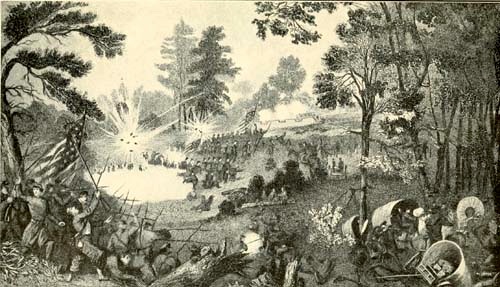
In the Woods Near Chancellorsville
Hooker took a position in the Wilderness, a tangled forest mixed with impenetrable thickets of dwarf oak and underbrush. Here he hoped that Lee would make a direct attack, but this pause gave the great Confederate general the one chance which he wanted. All that night Jackson with thirty thousand men marched half-way round the Union Army. Again and again word was sent to Hooker that the Confederate forces were marching toward his flank, but he could see in the movement nothing but a retreat and sent word that they were withdrawing so as to save their baggage trains. At three o'clock the next afternoon Jackson was at last in position. In front of Hooker's army lay the main forces of Lee. Half-way to the rear of his forces were Jackson's magnificent veterans. The first warning of the fatal attack which nearly caused the loss of the great Union Army of the Potomac came from the wild rush of deer and rabbits which had been driven from their lairs by the quick march of the Confederate soldiers through the forest. Following the charge of the frightened animals came the tremendous attack of Jackson's infantry, the toughest, hardiest, bravest, best-trained troops in the Confederate Army. The Union soldiers fought well, but they were new troops taken by surprise and as soon as the roar of the volleys of the attacking Confederates sounded from the rear, Lee advanced, with every man in his army and smashed into Hooker's front. The surprise and the shock of possible defeat instead of expected victory was too much for a man of Hooker's temperament. At the time when he most needed a clear mind and unflinching nerve, he fell into a state of almost complete nervous collapse. The battle was practically fought without a leader, every corps commander did the best he could, but in a short time the converging attacks of the two great Confederate leaders cut the army in two and defeat was certain. At this time came the greatest loss which the Confederate Army had received up to that day. Stonewall Jackson's men had charged through the forest and cut deeply into the flank of the Union Army. After their charge the Confederate front was in confusion owing to the thick and tangled woods in which they fought. Jackson had ridden forward beyond his troops in order to reform them. The fleeing Union soldiers rallied for a minute and fired a volley at the little party which Jackson was leading. He turned back to rejoin his own troops and in the darkness and confusion he and his men were mistaken for Union cavalry and received a volley from their own forces which dashed Jackson out of his saddle with a wound in his left arm which afterward turned out to be mortal. At that time General Lee sent his celebrated message to Jackson, "You are luckier than I for your left arm only is wounded, but when you were disabled, I lost my right arm."
In a short time the whole Union Army was nothing but a disorganized mass of men, horses, ambulance-wagons, artillery and commissary trains, all striving desperately to cross the Rappahannock before the pursuing Confederates could turn the retreat into a massacre. Unless the Confederate pursuit could be held back long enough to let the men cross the river and reform on the opposite bank, the whole army was lost. History is full of the terrible disasters which overtake an army which is caught by the enemy while in the confusion of crossing a river. General Pleasonton of Pennsylvania was in command of the rear of the Federal retreat. He was striving desperately to mount his guns so as to sweep the only road which led to the river and hold back the Confederate forces long enough to let his men cross. Already the van of the Union Army had reached the ford when far down the road appeared the whole corps of Stonewall Jackson, maddened by the loss of their great leader. Every man that Pleasonton had was working desperately to get the guns into position, but it was evident that they would be captured and their pursuers would sweep into the huddle which was crossing the river unless something could be done to hold them back. As the general looked silently down the road, he saw near to him Major Keenan of the Pennsylvania cavalry. Keenan had been a porter in a Philadelphia store, but his rare faculty for handling men and horses had made him one of the most efficient cavalry officers of any Pennsylvania regiment. The three companies which were with him were all the cavalry that Pleasonton had. They were bringing up the rear of the retreat like a pack of wolves who, though driven back from their prey, move off sullenly only waiting for the signal from their leader to turn again and fight. General Pleasonton had rallied his gunners and they would stand if only they had a chance. There was no hope of bringing any order into the mass of broken, terrified infantry rushing on toward the river.
"Major Keenan," shouted General Pleasonton, "how many men have you got?"
"Three hundred, General," replied Keenan, quietly.
"Major," said the general, low and earnestly, riding up to him, "we must have ten minutes to save the Army of the Potomac. Charge the Confederate advance and hold them!"
Keenan never hesitated. When the Six Hundred charged at Balaclava, some of them came back from the bite of the Russian sabres and the roar of the Muscovite guns. When Pickett made that desperate, fatal charge at Gettysburg, there was still a chance to retreat, but Major Keenan knew that when three hundred cavalry met the fixed bayonets of thirty thousand infantry on a narrow road, not one would ever return. It was not a splendid charge which might mean laurels of victory, but a hopeless going to death, the buying of ten minutes of time with the lives of three hundred men, yet neither Keenan nor his men questioned the price nor flinched at the order.
The sunlight of the last day he was to see on earth caught the gleam of his uplifted sabre as he gave the quick, sharp command to charge. He flung his cap into the bushes, bent his head and rode bareheaded in front of his flying column and then like an avalanche, like a hurricane of horse, he and his three hundred men thundered down the narrow road. Just around the curve, with a crash that broke the necks of a score of the leading horses, this charging column hurled themselves against the astonished, packed ranks of infantry rushing on with fixed bayonets. For five, for ten, for fifteen minutes horses rose and fell to the clashing of dripping sabres and the bark of revolvers thrust into the faces of the oncoming foemen. For fifteen long minutes there was a swirl and a flurry which held back the head of the charging forces and then shattered by volley after volley of musketry and pierced by thousands of charging bayonets, horse and men alike went down. Not one ever came back. Keenan and his Three Hundred had bought the ten minutes and had thrown in five more for good measure and the price was paid. The head of the Confederate column reformed, passed over and by the struggling horses and the silent, mangled men and then again swept on around the bend and down the road toward the fords crowded with a hundred thousand helpless, escaping soldiers. General Pleasonton, however, had made good use of those precious moments. As the Confederate column came around the curve, they were met by a hell of grape and canister from the batteries which at last had been mounted in position. Right into their front roared the guns and the road was a shamble of writhing, struggling, dying men. No army ever marched that could stand up against the grim storm of death that swept down that road and in a moment the Confederate forces broke and rushed back for shelter. The Army of the Potomac was saved. Bought at a great price, it was yet to be hammered and forged and welded under a great leader into the sword which was to save the Union.
"Year after year, the pine cones fall, And the whippoorwill lisps her spectral call. They have ceased, but their glory will never cease, Nor their light be quenched in the light of peace. The rush of the charge is sounding still, That saved the Army at Chancellorsville."
CHAPTER XIV
THE RESCUE OF THE SCOUTS
The man who will risk his life for his friends, the leader who never deserts his band, the soldier who will not escape alone, these are the men whom history has always hailed as heroes. Some of the greatest stories of devotion and courage have been those which chronicle the rescue of men from almost certain death. Courage and devotion have often opened the dark doors of dungeons, stricken the fetters from despairing prisoners and saved men doomed to death from the stake, the block and the gallows.
When the Civil War broke out, the lot of the few Union men left in the South was a hard one. The fierce passions of those days ran so high that not only was a Unionist himself liable to death and the confiscation of his property, but even his family were not safe. In 1863 there was a Georgian who assumed the name of William Morford in order to protect those of his family who lived in Georgia from the bitter hatred which his services for the Union had aroused. He was one of many devoted scouts who worked secretly and single-handed for their country, claiming no reward if they won and losing their lives on the gallows if they lost. Morford throughout 1863 was attached to the command of General Rosecrans and performed many a feat during that stormy year. It was Morford who burned an important bridge under the very eyes of a Confederate regiment sent to guard it and who, when the light from the flames made escape impossible, coolly mingled with the guards and actually received their congratulations for his bravery in attempting to put out the fire which he himself had lighted. It was Morford who single-handed captured a Confederate colonel while he was sleeping in a house surrounded by his regiment and with his staff in the next room. Morford obtained access to him under pretense of bearing an important oral dispatch from General Beauregard himself. They were left alone with an armed sentry just outside the half-opened door. Stepping to one side so that he could not be seen by the guard, Morford suddenly placed a cocked revolver close against the substantial stomach of the colonel.
"I have been sent, Colonel," he muttered sternly, "to either capture or kill you. I would rather capture you, for if I kill you I shall have to fight my way out, but it is for you to say which it shall be."
The colonel was a brave officer, but a cocked revolver against one's stomach is discouraging even for a hero. He decided instantly that he much preferred being a prisoner to being a corpse and said as much to Morford.
"Well," said the latter, still in a tone so low that the sentry could not make out the words, "I'm glad you feel that way. Get your hat and tell the guard that you're going to take me out for a talk with some of the other officers. I'll be right behind you with this revolver in my sleeve and if anything goes wrong, two bullets will go through the small of your back."
With this stimulant, the colonel arranged matters entirely to the scout's satisfaction. He led the way out of the house and through the lines, giving the countersign himself, in a somewhat shaky voice, and in a short time the two found themselves within the Union lines.
"I hope I didn't startle you too much, Colonel," said Morford, as he turned his prisoner over to the guard. "You weren't in any danger, for my revolver wasn't loaded. I didn't find it out until just as I got to your lines and I figured out that I probably wouldn't have to shoot anyway."
As this is a book for good boys and girls, it would not be proper to set down the colonel's language as he looked at the empty chambers of Morford's revolver.
Another time the scout was sent by General Rosecrans to find out whether certain steamboats were on the Hiawassee and if so, where they were located. On this trip he climbed Cumberland Mountain and on looking down over the famous Cumberland Gap, he discovered a force of Confederates who were busily engaged in fortifying the Gap so as to prevent any federal troops from passing through it. The force consisted of twenty soldiers and forty or fifty negroes who were doing the work. Morford made up his mind that it was his business as a Union scout to stop all such work. Standing out in full sight of the troop, he fired his revolver at the officer in command. The shot killed the leader's horse, and horse and man pitched over into the little troop throwing it into confusion. Morford at once fired a second time and then turning, waved his hand to an imaginary aide and shouted so that the Confederates could hear:
"Run back and tell the regiment to hurry up."
He then turned to the opposite ridge and shouted across the Gap to another imaginary force:
"Lead your men down that path and close in on 'em. Hurry up. My men will come from this side and we'll beat you down."
By this time the Confederate officer was on his feet again and started to rally his men. Morford made a rush toward them, firing his revolver as he came, waving his arms in both directions, shouting to his imaginary forces and bellowing at the top of his tremendous voice—"Come on, boys, we've got them now. Surround 'em. Don't let a man escape!"
The negro workmen felt that this was no place for neutrals and they dropped their shovels and made a rush for the mouth of the Gap. The Confederate soldiers stood for a minute, but as they saw Morford rushing toward them, they broke and followed the workmen. The scout chased them until he saw that they were well on their way and then started back along the ridge chuckling to himself over the way in which they had scattered. He laughed too soon. The Confederates had not gone far before they found out the trick which had been played upon them. They turned back and in a short time fifty men were riding along the ridge at full speed to capture the Yankee who had fooled them so. Unfortunately for Morford, he had kept to the path along the ridge which was better going, but which offered very little chance of escape, since on one side was a sheer precipice while on the other was a long, bare slope which offered no place for concealment. From the top of a little knoll he caught sight of the Confederates before they saw him. At that time they were only a half mile behind. The scout tried to escape by running far out on a rocky spur which jutted out over the Gap and which was filled with trees, hoping that he might dodge in among these, double on his pursuers and so get away. The same officer, however, whom he had unhorsed caught sight of him as he ran from one tree to another and with a tremendous shout, the whole band galloped after him at full speed. Morford had hoped that as the way led up a steep hill covered with rocks, his pursuers would have to dismount, but they were riding horses which had been bred in the mountains and which were trained to go up and down hill-paths like goats. They gained on him fast. Spreading out they cut off every chance of his escaping back to the slope or skirting their ranks. There was nothing left for him to do except to go on and on to the very edge of the precipice. The scout knew that if he were caught he would be hung on the nearest tree and that knowledge was a considerable incentive to keep ahead of his pursuers as long as possible. He ran as he had never run before and as he could follow paths too narrow for the horses, for a while he managed to hold his lead. He could see, however, that some of the band had ridden around the slope and held the whole base of the spur so that it would be only a question of time before he would be hunted out and caught. He was running now along the very edge of the precipice which dropped six hundred feet to the rocks below. The gorge narrowed until finally at one point it was not more than twenty feet wide. This was too wide, however, for the scout to clear, even if he were not wearing heavy boots and carrying a rifle. Several feet below where he stood, on the opposite shelf a hickory tree had grown out so that some of the branches extended within ten feet of his side of the gorge. Below that tree was a fissure through the rock down which a desperate man might possibly clamber. It was a slight chance, but the only one which he had. At this point he was hidden from the Confederates by a wall of rock. Without allowing himself to stop, for fear that he would lose his nerve, Morford took a run and launched himself through the air ten feet out and ten feet down against the spreading boughs of the hickory tree. He broke through them with a rush but wound his arms desperately around the bending limbs and though they bent and cracked, the tough wood held and he found himself firmly hugging the shaggy bark of the trunk with all his might. He slid down, ripping his clothes and skin, until finally his feet touched the beginning of a possible path down to the gorge. He could hear the shouts of his pursuers only a few rods away. If they had gone to the edge, nothing could have saved him, as they would have shot him down before he could have escaped, but they beat carefully through the trees and rocks for fear lest he should crawl back through their line. Without stopping to weigh his chances, Morford let himself drop from one shelf of rock to another, clinging to every little crevice and every twig and plant which he could find. Several times he thought he was gone as his feet swung off into the space below, but always he managed to get a hand-grip on some rock which held, and almost before he realized the terrible chance he had taken, he had passed down the side of the cliff and was safe around a bend in the rock which hid him from view. From there the path was easier and in a short time he found himself in the gorge far below. There he crawled carefully along behind rocks and took advantage of every bit of cover and in a few minutes was far on his way, leaving the Confederates to hunt for hours every square yard of ground on the rocky promontory whence he had come.