Front matter (continued 2)
Reading edition
"Boys," he said simply, "I have chosen you to come with me and capture a train from an army and then run it two hundred miles through the enemy's country. We will have to pass every train we meet and while we are doing this we must tear up a lot of track and burn down two bridges. There is every chance of being wrecked or shot and if we are captured, we will be hung for spies. It is a desperate chance and I picked you fellows out as the best men in the whole army to take such a chance. If any of you think it is too dangerous, now is the time to stand up and draw out."
There was a long pause. Each man tried to see what his companions were thinking of in the dim light.
"Well, captain," at last drawled a long, lank chap with a comical face, who had the reputation of being the worst daredevil in his regiment, "I would like to stand up for you've got me kind of scared, but my foot's asleep and I guess I'll have to go with you."
"That's the way I feel," said the man next to him, as every one laughed, and the same answer went all around the circle.
In a whisper the scout then outlined his plan. The men were to change their uniforms and put on the butternut-colored clothes of the South and to carry no arms except a revolver and bowie-knife. Then they were to cross the country on foot until they got to Chattanooga and were then to go back on their tracks by train and meet at a little town called Marietta in the middle of Georgia. No one would, of course, suspect men coming out of a Confederate city to be Union soldiers. If questioned they were to say that they were Kentuckians on their way to join the Southern army. At Marietta they were to take rooms at the Marietta Hotel and meet at the scout's room on the following Saturday morning at two o'clock.
Disguised as a quinine seller, Andrews reached Marietta ahead of the others. At the time appointed, he sat fully dressed in the silent hotel waiting for the arrival of his little company and wondering how many would appear. Just as the town clock struck the hour from the old-fashioned court house, there came a light tapping at the door and one by one nineteen of the twenty-four glided in and reported for duty. All had gone through various adventures and several had only escaped capture by quick thinking and cool action. One of the missing ones had been delayed by a wreck and did not reach Marietta in time, two others were forced to enlist in the Southern army, and two more reached Marietta but by some mistake did not join the others. The twenty who were left, however, were the kind of men whose courage flares highest when things seem most desperate and they were not at all discouraged by the loss of a fifth of their force, and they all agreed with Brown, the man whose foot had been asleep, when he drawled out in his comical way, "The fewer fellows the more fun for those who are left."
After reporting, they went back to their rooms and got what sleep they could. At daylight they were all at the ticket office in time for the north-bound mail train. In order to prevent any suspicion, each man bought a ticket for a different station along the line in the direction of Chattanooga. Eight miles out of Marietta was a little station called Big Shanty where the train was scheduled to stop twenty minutes for breakfast. It was a lonely place at the foot of Kenesaw Mountain and there were only the station, a freight-house, a restaurant and one or two dwelling houses. Andrews had planned to capture the train there, believing that there would be few, if any, bystanders at so small a place early in the morning. As the train came around the curve of the mountain, however, the scout and his men, who were scattered through the train, were horrified to see scores of tents showing white through the morning mist. A detachment of Confederate soldiers was in camp there and it was now necessary for the little squad of Union soldiers to capture the train not only from its crew and passengers, but under the very eyes of a regiment. There was no flinching. The minute the train stopped there was the usual wild scramble by the passengers for breakfast in which the engineer, fireman and conductor joined. In a minute the engine was left entirely unguarded. In those days engines were named like steamboats, and this one had been christened "General." Andrews and his men loitered behind. In his squad were two engineers and a fireman. These at once hurried forward and began to uncouple the engine with its tender and three baggage-cars. The rest of the party grouped around, playing the part of bystanders, but with their hands on their revolvers, for within a dozen feet of the engine stood a sentry with his loaded musket in his hand watching the whole thing, while other sentries and a large group of soldiers were only a few yards farther off. The men worked desperately at the coupling and finally succeeded in freeing the cars. Then the engineers and fireman sprang into the cab of the engine while Andrews stood with his hand on the rail and foot on the step, and the rest of the band tumbled into the baggage-cars. This was the most critical moment of all, for although the watching soldiers might think it natural to change the crew, yet their suspicions would certainly be aroused at the sight of fifteen men climbing into baggage-cars. The nearest sentry cocked his musket and stepped forward to investigate. At this moment Brown climbed into the engine along with one of the engineers, coolly smoking a cigar. Poking his head out of the window he called back as if to one of the crew, "Tell those fellows not to eat up all the breakfast. We'll be back just as soon as we can take those other cars on at the siding." All this time Andrews was standing with his foot on the step watching the men enter the baggage-cars. The track was on a high bank and it was necessary for the first man to be raised up on the shoulders of two others in order to open the door. Once inside, the other men were tossed up to him and he pulled them in like bags of meal. Finally there were only two left and these jumped, caught the outstretched hands of two inside and were hauled up into the car. Not until then did Andrews step aboard under the very nose of the suspicious sentry. The engineer was so anxious to start that he pulled the throttle wide open and for a few seconds the wheels spun round and round without catching on the rails. He finally slowed up enough to allow the wheels to bite and the engine started off with a jerk which took all the soldiers in the baggage-cars off their feet. Just at this moment the fat engineer waddled out of the eating-house shouting at the top of his voice, "Stop, thief! Stop, thief!" He was followed by the fireman who bellowed to the sentry, "Shoot 'em, shoot 'em! They're Yanks!" It was too late. The General was taking the first curve on two wheels, leaving the quiet little station swarming and buzzing like a hornet's nest struck by a stone. The train had been captured without losing a man.
Now came the even more difficult part of the undertaking, to run the engine for two hundred miles through an enemy's country and to force it past all the other trains between Big Shanty and Chattanooga. The first thing to do was to prevent any message of the capture being sent on ahead. There was no telegraph station at Big Shanty, but there was no telling how soon word would be sent back to the nearest telegraph operator. Accordingly, four miles out the engine was stopped and a man named Scott, who had been a great coon-hunter before entering the army, shinned up a telegraph pole and sawed through the wires. While he was doing this, the rest of the party took up one of the rails and loaded it into a baggage-car. Others piled in a lot of dry railroad ties to be used in burning the bridges. The General was an old-style engine the like of which is never seen nowadays. It had one of the round, funny smoke-stacks which we still see on old postage stamps and it burned cord-wood instead of coal, but it was a good goer for those times and was soon whirling through the enemy's country at what seemed to the raiders a tremendous rate of speed. Before long they were compelled to stop at one of the stations to take in wood and water. Andrews explained to the station-agent that they were agents of General Beauregard running a powder-train down to the Confederate headquarters at Corinth. At one station named Etowah, they found an old locomotive belonging to a local iron company standing there with steam up. It carried the name of Jonah and so far as the raiders were concerned, it certainly lived up to its name. Brown, who was acting as engineer, wanted to stop and put Jonah out of business, but Andrews decided to push on. It was a fatal mistake. At Kingston, thirty miles from their starting place, they learned that the local freight coming from Chattanooga was about due, so Andrews put his engine over on the siding and waited. After a long delay, the freight arrived, but it carried on its caboose a red flag showing that another train was behind. Andrews stepped up to the conductor and indignantly inquired how any train dared delay General Beauregard's special powder-cars.
"Well, you see," said the freight's conductor, "the Yanks have captured Huntsville thirty miles from Chattanooga and special trains are being run to get everything out."
Andrews realized that General Mitchel had started against Chattanooga and that if he could burn even one bridge, the capture of the city was certain. Another long wait and the special freight came in, but it carried another fatal red flag. It turned out that it was so large that it was being run in two sections. There was nothing to do but wait. By this time crowds of passengers and train-hands had gathered around the so-called powder-train, all curious to look it over. The four men in the engine sat there smoking, seemingly unconcerned. As a matter of fact, however, they were ready any moment to fight for their lives. If any of the crowd opened the baggage-cars and saw the other men hidden there, no amount of explanation could persuade them that there was not something wrong. If the waiting was hard on the men in the engine, it was still worse for the men crouched back in the cars, not knowing what was wrong and expecting to hear the alarm given any moment. For an hour and five minutes the Union train was kept at Kingston. At last a whistle was heard and the long-expected freight passed by and the General was again on its way. A mile out from Kingston the coon-hunter was sent up another telegraph pole and the wires again cut. The rest of the party were leisurely trying to loosen another rail with the poor tools which they had, when from far in the rear a sound was heard which brought the man at the wires down with a run. It was the whistle of an engine coming their direction and meant that in some mysterious way the enemy was on their track.
"Pull, you men!" shouted Andrews. "They've got word somehow and they're after us."
Again the whistle sounded, this time much nearer, and with a last frantic pull the rail broke and eight men tumbled head over heels down an embankment. They were up in a minute and scrambled into the baggage-car and the old General was off once more at top speed. At Adairsville, the next station, a freight and passenger train were waiting and there Andrews heard that another express was due from Chattanooga which had not yet arrived. There was no time to wait now that the pursuit had begun and the old General was pushed at full speed in order to reach the next siding before meeting the express. The nine miles between stations were covered in as many minutes, Brown and the fireman heaping on the cord-wood and soaking it with kerosene-oil until the fire-plate was red hot. They reached the station just in time, for the express was about to pull out when the whistle of Andrews' train was heard, and it backed down so as to allow the "powder-train" to take the side track. It stopped, however, in such a manner as to completely close up the other end of the switch. The engineer and conductor of the express were plainly suspicious and refused to move their train until Andrews had answered their questions. With the pursuing engine on his track, any more delay would be fatal. Cocking his revolver, Andrews poked it into the stomach of the engineer.
"My instructions from General Beauregard," he said, "are to rush this train through and to shoot any one that tries to delay it and I am going to begin on you."
The engineer lost all further desire to ask questions, climbed into his cab and pulled out. The way was now clear to Chattanooga. Beyond the next station Andrews stopped once more to cut the wires and to try to take up a section of the track, when right behind suddenly sounded the whistle of an engine like the scream of some relentless bird of prey that could not be turned from its pursuit. Far down the track rushed a locomotive crowded with soldiers armed with rifles. Two minutes more would have saved the day for Andrews. The rail bent, but did not break, although the men tugged at it frantically until the bullets began pattering around them. There was only just time to jump aboard and the General was off again with the Confederate engine thundering close behind.
The story of this pursuer is the story of two men who refused to give up and who won out by accepting the one chance in a thousand which ordinary men would let go by. When the stolen train whirled off at Big Shanty there were two men who didn't waste any time in shouting or swearing. They were Fuller, the conductor of the stolen train, and Murphy, the foreman of the Atlanta railway machine shops. There was no telegraph station nor any locomotive at hand in which to follow the runaways. Apparently it was hopeless, yet out of all the crowd of civilians and soldiers who rushed around and asked questions and shouted answers, Fuller and Murphy were the only two who took the long chance and ran after the flying train. The rest of the crew could not help laughing to see two men chase a locomotive on foot. But Murphy and the other let them laugh and ran on. Before they had gone a half mile they found a hand-car on a siding. This they lifted over to the main track, manned the pump-bars and were soon flying along at the rate of some fifteen miles an hour. As they came near Etowah the hand-car suddenly flew off the track and went rolling down the embankment. It had met the first of the broken rails. The two men were much bruised and shaken up, but no bones were broken and they managed to hoist the hand-car back on to the rails again and were soon on their way, this time keeping a lookout for any traps ahead. At Etowah they found old "Jonah" puffing on the siding, the engine that Brown had advised blowing up. It was at once pressed into service, loaded with soldiers and in a minute was flying toward Kingston, where Andrews had his life-shortening wait of over an hour. Fuller knew of the tangle of trains at that point and told his escort to get their muskets ready and be prepared for a fight, but Andrews had been away just four minutes when the pursuers reached the station, and Fuller there found himself stopped by three heavy trains. It was hopeless to wait for them to move, and besides old Jonah was not much on speed. Fuller and his men jumped out, ran through to the farthest train, uncoupled the engine and one car, in spite of the protests of its crew, filled it with forty armed men and once more started after the flying General.
It was their whistle which so startled Andrews and his men when they were breaking the second rail. Fuller and Murphy saw what they had done and managed to reverse the engine in time to prevent a wreck. Again at this point ordinary men would have given up the chase for it was impossible to go farther in that engine or to get it over the broken rail, but these Confederates were not ordinary men. Leaving their escort they started down the track again on foot alone, doggedly and relentlessly after their stolen General. Before they had gone far they met the mixed train that had told Andrews of the express. They signaled so frantically that it stopped and when the crew learned that the so-called "powder-train" was on its way to destroy the great bridges which formed the backbone of their railway, they consented to turn back. So uncoupling the locomotive and the tender and filling them with armed soldiers and civilians from among the passengers, Fuller and Murphy made their sixth start. On foot, by hand-car, in two locomotives, on foot again and now once more in a locomotive, they began what was to be the last lap of this race on which a city and a state depended.
Beyond Adairsville the Confederates could see far ahead in the distance Andrews and his men making desperate efforts to raise the rail. With long screams from her whistle, the Confederate engine fairly leaped over the tracks. The rail bent slowly, but the spikes still held. Two minutes, or even a minute more would break the track and the road and bridges would be defenseless before the Union raiders. But it was not to be. Andrews and his men tugged at the stubborn rail until the pursuing engine was so close that the bullets were dropping all around them and then sprang into the engine and thundered off again. If only a little time could be gained the Union men could burn the Oostinaula Bridge. So while the engine was running at a speed of nearly a mile a minute, the men in the last car crowded into the next and the last car was dropped off in the hope that it would block the road for the pursuer. But the engine behind pushed it ahead until the next station was reached where it could be switched off the main track. This slowed the chaser's speed, however, so that the General was able to take on wood and water and also to cut the wires beyond the station so that the news of their coming would not be telegraphed ahead and give the station-master a chance to either side-track them or block the track. The pursuing engine began to gain again and the little band of Union soldiers moved into the first car and the end of the second car was smashed and it was cut loose. Railroad ties were also dropped across the track and time enough was gained once more for the General to take on wood and water at two more stations and to cut the wires beyond each. Twice they stopped and tried in vain to raise a rail, but the pursuers came within rifle range each time before they could finish. The rain prevented the burning of the bridges and now slowly and surely the pursuing engine began to gain. The raiders tried every way to block the track. At one point they spied a spare rail near a sharp curve. Stopping the engine they fitted it into the track in such a way that it seemed certain to derail the Confederate engine. The latter came thundering on at full speed, struck the hidden rail, and leaped at least six inches from the rail, but came down safely and went whirling along as if nothing had happened. Not once in a hundred times could an engine have kept the track after such a collision. This was the time. Now they were too close to the General to allow of any more stoppages even for wood and water. Andrews decided to risk everything on one last stroke. A mile or so ahead was a wooden-covered bridge. At his orders out of the last car his men swarmed into the engine filling every inch of space, even the tender and the cow-catcher being covered with men. All of the fuel left was piled into the one remaining car, smeared with oil and set afire. Both the doors were opened and the draught as it was whirled along soon fanned the fire into furious flames. They dashed into the dark of the covered bridge with the car spurting flame from both sides. Right in the middle of the bridge it was uncoupled and left burning fast and furiously. It did not seem possible that any engine could pass through such a barrier. There was just enough pressure left in the boiler to reach the next wood-yard and the Union scouts looked back anxiously at the bridge. In a minute they heard around a far-away curve the whistle which sounded to them like the screech of a demon. The Confederates had dashed into the bridge and pushed the flaming car ahead of them to the next switch. The Union scouts had played their last card. There would be no chance of taking in wood before they were overtaken. One thing only was left. They stopped the engine, sprang out, reversed the locomotive and sent it dashing back to collide with their pursuer and then separated to try to make their way back some three hundred miles through the enemy's country to the Union lines. The Confederates, when they saw the engine coming, reversed their own and kept just ahead of this last attack of the old General until its fires died down and it came to a stop.
Mitchel, the Union general, but thirty miles west of Chattanooga, waited in vain for the engine which never came. Chattanooga was saved and the most daring railroad raid in history had failed.
The story of the fate of the brave men who volunteered for the forlorn hope is a sad one. Several were captured that same day and all but two within a week. These two were overtaken and brought back when they were just on the point of reaching the Union outposts and had supposed themselves safe. Even the two who reached Marietta but did not take the train with the others were identified and added to the band of prisoners. Being in civilian clothes within an enemy's lines, they were all held as spies and the heroic Andrews and seven others were tried and executed. Of the others, eight, headed by Brown, overpowered the guards in broad daylight and made their escape from Atlanta, Georgia, and finally reached the North. The other six started with them, but were recaptured and held as prisoners until exchanged in the early part of 1863.
So ends the story of an expedition that failed in its immediate object, but that succeeded in the example which these brave men set their fellows.
CHAPTER VII
SHERIDAN'S RIDE
There are as many different kinds of courage as there are different kinds of men. Some men are brave because they were born so. They are no more to be praised for their bravery than a bulldog deserves credit because it is a natural born fighter or a hare deserves blame because it specializes in running away. Some men belong to the bulldog class. They are brave because it is natural for them to be brave. Others belong to the hare-family and they show far more real courage in overcoming their natural instincts than does the other for whom it is natural to do brave deeds. Much also depends on the circumstances. We all know from our own experience of athletes who can play a good winning game, and who perform well against inferior competitors. The rarer type, however, is the boy or man who can play a good up-hill game and who with all the odds against him, is able to fight it out and never to let up or give up until the last point is scored or the last yard is run and who often is able to win against better, but less dogged, less courageous competitors. It is so in battles. It is easy for any commander to be courageous and to take unusual chances when he is winning. The thrill of approaching victory is a stimulant which makes even a coward act like a brave man. Even General Gates, the weak, vacillating, clerkly, self-seeking, cowardly general of the Revolutionary War, whose selfishness and timidity were in such contrast to Washington's self-sacrifice and courage, was energetic and decisive at the battle of Saratoga after Benedict Arnold, who was there only as a volunteer, had made his brave, successful charge on the British column in spite of Gates' orders. After attacking and dispersing the reserved line of the British army, Arnold called his men together again and attacked the Canadians who covered the British left wing. Just as he had cut through their ranks, a wounded German soldier lying on the ground took deliberate aim at Arnold and killed his horse and shattered his leg with the same bullet. As he went down, one of his men tried to bayonet the wounded soldier who had fired, but even while disentangling himself from his dead horse and suffering under the pain of his broken leg, Arnold called out, "For God's sake, don't hurt him, he's a fine fellow," and saved the life of the man who had done his best to take his. That was the hour when Benedict Arnold should have died, at the moment of a magnificent victory while saving the life of a man who had injured him. Gates went on with the battle, closed in on the British and in spite of their stubborn defense, attacked them fiercely for almost the only time in his career as a general and completely routed them. There is no doubt that on that occasion after Arnold's charge Gates displayed a considerable amount of bravery, yet such bravery cannot really be termed courage of the high order which was so often displayed by Washington, by William of Orange and later by his grandson, William of England, by Fabius the conqueror of Hannibal and by many other generals who were greatest in defeat.
Napoleon once said that the highest kind of courage was the two-o'clock-in-the-morning courage. He meant that at that gray hour, when the tide of life is at its ebb before the dawn, a man who is brave is brave indeed. The best test of this kind of courage is in defeat. Fabius showed that in the long, wasting campaign which he fought against Hannibal, one of the greatest generals of his or any other age. Following, retreating, harassing, Fabius always refused a pitched battle until his enemies at Rome forced the appointment of Minucius as joint dictator with him. In spite of the protests of Fabius, the army was divided and the younger and rasher Minucius offered battle with his army. He was like a child before the crafty Hannibal who concealed a great force of men in ravines around an apparently bare hill and then inveigled Minucius into attacking a small force which he sent up to the top of this hill as a bait to draw him on. Once there the ambuscade of Hannibal attacked the Roman army on all sides and almost in a moment it was in disorder and a retreat was commenced which was about to become a rout when Fabius hurried up and by his exhortations and steadfast courage rallied the men, re-formed them, drove through Hannibal's lighter-armed troops and finally occupied the hill in safety. The grateful Minucius refused to act as commander any further, but at once insisted upon thereafter serving under Fabius.
At the Battle of Boyne, that great battle between William of England and his uncle, James II, which was to decide whether England should be a free or a slave nation, William showed the same kind of courage. In spite of chronic asthma, approaching age and a frail body, King William was a great general. He never appeared to such advantage as at the head of his troops. Usually of reserved and saturnine disposition, danger changed him into another man. On this day, while breakfasting before the battle, two field-pieces were trained on him and a six-pound ball tore his coat and grazed his shoulder drawing blood, and dashing him from his horse. He was up in an instant, however, and on that day in spite of his feeble health and wounded shoulder, was nineteen hours in the saddle. The crisis came when the English soldiers charged across the ford of the Boyne River. General Schomberg, William's right-hand and personal friend, was killed while rallying his troops. Bishop Walker, the hero of the siege of Londonderry, had been struck by a chance shot and the English, who had hardly obtained a firm foothold on the opposite bank, commenced to waver. At this moment King William forced his horse to swim across, carrying his sword in his left hand, for his right arm was stiff with his wound, and dashed up to rally the troops. As he rode up, the disorganized regiment recognized their king.
"What will you do for me?" he cried, and almost in an instant he had rallied the men and persuaded them to stand firm against the attacks of the ferocious Irish horsemen.
"Gentlemen," he said, "I have heard much of you. Let me see something of you," and charging at their head, this middle-aged, wounded invalid by sheer courage shattered the Irish and French troops and saved his kingdom.
Our own Washington was never greater than in defeat and not once but many times rallied a defeated and disheartened army and saved the day. At the Battle of Monmouth, the traitorous Charles Lee had turned what should have been a great victory into a disorderly retreat. After outflanking Cornwallis, instead of pressing his advantage, he ordered his men to retreat into a near-by ravine. Lafayette's suspicions were aroused and he sent in hot haste to Washington who arrived on the field of battle just as the whole army in tremendous disorder was pouring out of the marsh and back over the neighboring ravine before the British advance. At that moment Washington rode up pale with anger and for once lost control of a temper which cowed all men when once aroused.
"What is the meaning of all this?" he shouted to Lee and when he received no answer, repeated the question with a tremendous oath. Then immediately realizing the situation, he sent Lee back to the rear and wheeled about to stop the retreat and form a new front. Riding down the whole line of retreating soldiers, the very sight of him steadied and rallied them and in less than half an hour the line was reformed and Washington drove back the British across the marsh and the ravine until night put an end to the battle. Before morning the whole British force had retreated, leaving their wounded behind and the Battle of Monmouth had been changed by the courage and fortitude of one man from defeat into a victory for the American forces.
The most striking instance in the Civil War of what the courage of one brave, enduring, unfaltering man can do was at the Battle of Cedar Creek. In the year 1864, General Sheridan, the great cavalry leader, took command of the Army of the Shenandoah. Sheridan was an ideal cavalry leader. Brave, dashing, brilliant, he had commanded more horsemen than had any general since the days of the Tartar hordes of Tamerlane and Genghis Khan. There was no watchful waiting with Sheridan. This he had shown at the great mountain battle of Chattanooga. At that battle, Missionary Ridge was the keystone of the Confederate position. It was occupied by Confederate batteries and swarming with Confederate troops. A storming party was sent from the main body of the Union forces to drive out the Confederates who held the woods on the flanks of the Ridge. The orders were to attack the Confederates and hold the captured positions until the main body could come up. Grant was watching the battle through his field-glasses and saw the attacking party gain possession of the slopes of the Ridge. Suddenly, to his surprise and horror, the whole regiment charged directly up the Ridge. It was a mad thing to do for the top was held by a tremendous force of Confederates and guarded by massed batteries. General Grant called General Granger up to him and said angrily:
"Did you order those men up, Granger?"
"No," said the general, "they started up without orders. When those fellows get started, all hell can't stop 'em."
General Grant then sent word to General Sheridan to either stop the men or take the Ridge.
"I guess it will be easier to take the Ridge than it will be to stop them," said Sheridan.
Before starting, he borrowed a flask and waved it toward the group of Confederate officers who were standing on top of the Ridge in front of the headquarters of Bragg, the Confederate general.
"Here's at you," he shouted, drinking to them. They could plainly see his action through their field-glasses and immediately two field-guns, which were known as Lady Breckenridge and Lady Buckner, were trained at Sheridan and his group of officers and fired. One shell struck so near Sheridan as to splash dirt all over him.
"I'll take those guns just for that," was all he said and, followed by his officers, he dashed up the Ridge after the climbing, attacking-party. The way was so steep that the men had to climb up on their hands and knees while the solid shot and shell tore great furrows in their ranks. Sheridan was off his horse as soon as the slope became steep, and, although he had started after the charge, was soon at the front of the men. They recognized him with a tremendous cheer.
"I'm not much used to this charging on foot, boys," he said, "but I'll do the best I can," and he set a pace which soon brought his men so far up that the guns above could not be depressed enough to hit them. Behind him came the whole storming party clambering up on their hands and knees with their regimental flags flying everywhere, sometimes dropping as the bearers were shot, but never reaching the ground because they would be caught up again and again by others. At last they were so near that the Confederate artillerymen, in order to save time, lighted the fuses of their shells and bowled them down by hand against the storming party. Just before they reached the summit, Sheridan formed them into a battle-line and then with a tremendous cheer, they dashed forward and attacked the Ridge at six different points. The Confederates had watched their approach with amazement and amusement. When they found, however, that nothing seemed to stop them, they were seized with a panic and as the six desperate storming parties dashed upon them from different angles, after a few minutes' fast fighting, they broke and retreated in a hopeless rout down the other side of the Ridge. Sheridan stopped long enough to claim Lady Breckenridge and Lady Buckner as his personal spoils of war and forming his men again, led them on to a splendid victory.
As soon as he took command of the Army of the Shenandoah, aggressive fighting at once began. Twice he defeated Jubal Early, once at Winchester and again at Fisher's Hill, while one of his generals routed the Rebels so completely in a brilliant engagement at Woodstock that the battle was always known as the Woodstock Races, the Confederate soldiers being well in front in this competition. Finally, General Sheridan had massed his whole army at Cedar Creek. From there he rode back to Washington to have a conference with General Halleck and the Secretary of War. When that was finished with his escort he rode back to Winchester, some twelve miles from Cedar Creek, two days later. There he received word that all was well at his headquarters and he turned in and went to bed intending to join the army the next day. Six o'clock the next morning an aide aroused him with the news that artillery firing could be heard in the direction of Cedar Creek. Sheridan was out of bed in a moment and though it was reported that it sounded more like a skirmish than a battle, he at once ordered breakfast and started for Cedar Creek. As he came to the edge of Winchester he could hear the unceasing roar of the artillery and was convinced at once that a battle was in progress and from the increase of the sound judged that the Union Army must be falling back. The delighted faces of the Confederate citizens of Winchester, who showed themselves at the windows, also convinced him that they had secret information from the battlefield and were in raptures over some good news. With twenty men he started to cover the twelve miles to Cedar Creek as fast as their horses could gallop. Sheridan was riding that day a magnificent black, thoroughbred horse, Rienzi, which had been presented to him by some of his admirers. Like Lee's gray horse "Traveler" and the horse Wellington rode at Waterloo, "Copenhagen," Rienzi was to become famous. Before Sheridan had gone far and just after crossing Mill Creek outside of Winchester, he commenced to meet hundreds of men, some wounded, all demoralized, who with their baggage were all rushing to the rear in hopeless confusion. Just north of Newtown he met an army chaplain digging his heels into the sides of his jaded horse and making for the rear with all possible speed. Sheridan stopped him and inquired how things were going at the front.
"Everything is lost," replied the chaplain, "but it will be all right when you get there."
The parson, however, in spite of this expression of confidence, kept on going. Sheridan sent back word to Colonel Edwards, who commanded a brigade at Winchester, to stretch his troops across the valley and stop all fugitives. To most men this would have been the only plan of action possible, to stop the fugitives and rally at Winchester. Sheridan, however, was not accustomed to defensive fighting and instantly made up his mind that he would rally his men at the front and if possible, turn this defeat into a victory. The roads were too crowded to be used and so he jumped the fence into the fields and rode straight across country toward the drumming guns at Cedar Creek, which showed where the main battle was raging. From the fugitives, as he rode, Sheridan obtained a clear idea of what had happened. His great rival, Early, had taken advantage of his absence to obtain revenge for his previous defeats. Just after dawn he had made an attack in two different directions on the Union forces and had started a panic which had seized all the soldiers except one division under Getty and the cavalry under Lowell. The army which Sheridan met was a defeated army in full rout. As he dashed along, the men everywhere recognized him, stopped running, threw up their hats with a cheer and shouldering their muskets, turned around and followed him as fast as they could. He directed his escort to ride in all directions and announce that General Sheridan was coming. From all through the fields and roads could be heard the sound of faint cheering and everywhere men were seen turning, rallying and marching forward instead of back. Even the wounded who had fallen by the roadside waved their hands and hats to him as he passed. As he rode, Sheridan took off his hat so as to be more easily recognized and thundered along sometimes in the road and sometimes across country. As he met the retreating troops, he said:
"Boys, if I had been with you this morning this wouldn't have happened. The thing to do now is to face about and win this battle after all. Come on after me as fast as you can."
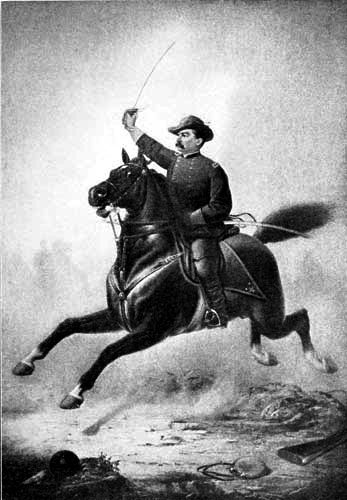
Sheridan Hurrying to Rally His Men
So he galloped the whole twelve miles with the men everywhere rallying behind him and following him at full speed. At last he came to the forefront of the battle where Getty's division and the cavalry were holding their own and resisting the rapid approach of the whole Confederate Army. Sheridan called upon his horse for a last effort and jumped the rail fence at the crest of the hill. By this time the black horse was white with foam, but he carried his master bravely up and down in front of the line and the whole brigade of men rose to their feet with a tremendous cheer and poured in a fierce fire upon the approaching Confederate troops. Sheridan rode along the whole front of the line and aroused a wild enthusiasm which showed itself in the way that the first Rebel charge was driven back. Telling Getty's and Lowell's men to hold on, he rode back to meet the approaching troops. By half-past three in the afternoon, Sheridan had brought back all the routed troops, reformed his whole battle line and waving his hat, led a charge riding his same gallant black horse. As they attacked the Confederate front, Generals Merritt and Custer made a fresh attack and the whole Confederate Army fell back routed and broken and was driven up the valley in the same way that earlier in the day they had driven the Union soldiers. Once again the presence of one brave man had turned a defeat into a victory.
Sheridan took no credit to himself in his report to Lincoln, simply telegraphing, "By the gallantry of our brave officers and men, disaster has been converted into a splendid victory."
"My personal admiration and gratitude for your splendid work of October 19th," Lincoln telegraphed back and the whole country rang with praises of Phil Sheridan and his wonderful ride. The day after the news of the battle reached the North, Thomas Buchanan Read wrote a poem entitled "Sheridan's Ride," with a stirring chorus.
The last verse sang the praise both of the rider and the horse:
"What was done? what to do? A glance told him both, Then striking his spurs with a terrible oath, He dashed down the line, mid a storm of huzzas, And the wave of retreat checked its course there because, The sight of the master compelled it to pause. With foam and with dust the black charger was gray; By the flash of his eye, and the red nostrils' play, He seemed to the whole great army to say, 'I have brought you Sheridan all the way From Winchester, down to save the day.'"
CHAPTER VIII
THE BLOODY ANGLE
It takes courage to charge, to rush over a space swept by shot and shell and attack a body of men grimly waiting to beat back the onset with murderous volleys and cold steel. Sometimes, though, it takes more courage to stand than to charge, to endure than to attack. The six hundred gallant horsemen of that Light Brigade who charged an army at Balaclava were brave men. The six hundred Knights of St. John who at the siege of Malta by Solyman the Magnificent defended the tiny fortress of St. Elmo against thirty thousand Turks until every man lay dead back of the broken ramparts and the power and might of the Turkish Empire had been wasted and shattered against their indomitable defense were braver. The burghers of Leyden who lived through the siege of their city on shoe-leather, rats and bark, who baked their last loaves and threw them down to the besiegers in magnificent defiance, who shouted down to the Spaniards that they would eat their left arms and fight with their right, and who slept on the ramparts night and day until they drove back the greatest army in all Europe were braver.
"It's dogged that does it," said the grim Duke of Wellington when his thin red line of English fighters endured through that long summer day against attack after attack until at twilight the Old Guard were repulsed for the last time and the great battle of Waterloo won.
Many men are brave in flashes. They are good for a dash. Few are those who can go the distance.
This is the story of a Union general who could endure and whose courage flared highest when defeat and death seemed certain. It is the story of a little band of men who were brave enough to stand against an army and whose endurance won a seven-day battle and opened the way for the capture of the Confederate capital.
It was the fourth year of the War of the Rebellion, and the end was not yet in sight. The Confederate cause had fewer men, but better officers. Robert E. Lee was undoubtedly the most able general in the world at that time. Stonewall Jackson had been his right arm, while Longstreet, Johnston, Early and a host of other fighting leaders helped him to defeat one Union army after another. The trouble with the Union leaders was that they didn't know how to attack. There had been McClellan, a wonderful organizer, but who preferred to dig entrenchments rather than fight and who never believed that he had enough men to risk a battle.
Then came Meade who won the great battle of Gettysburg and beat back the only invasion of the North, but who failed to follow up his advantage and had settled down to the old policy that the North knew so well of watchful waiting. At last came the Man. He had been fighting in the West and he had won,—not important battles, but more important, the confidence of the people and of Abraham Lincoln, the people's president. For this new man had a new system of generalship. His tactics were simple enough. He believed that armies were made to use, not to save. He believed in finding the enemy and hammering and hammering and hammering away until something broke—and that something was usually the enemy. His name was Ulysses S. Grant.
"He fights," was all that President Lincoln said about him when a party of politicians came to ask that he be removed. That was enough. What the North wanted was a fighter. Other generals would fight when they had to and were satisfied to stop if they defeated the enemy or broke even, but Grant was like old Charles Martel, Charles the Hammerer, who won his name when he saved all Europe from the Saracens on the plains of Tours by a seven-day battle. The great host of horsemen which had swept victorious through Asia, Africa and half the circle of the Mediterranean whirled down on the solid mass of grim Northmen. For six long days Charles Martel hammered away at that flashing horde of wild warriors. On the seventh his hammer strokes shattered the might of the Moslems and they broke and fled, never to cross the Pyrenees again. Now like Charles, the Hammerer of the Union Army was facing his great test, the terrible Seven Days in the Wilderness. Between him and the Confederate capital lay Lee's veteran army entrenched in that wild stretch of Virginia territory which was well named the Wilderness. Every foot of the puzzling woods, ravines, thickets and trails were known to the Confederates and well they ought to know it since they had already won a great battle on nearly the same field. In this tangled waste an army that knew the ground had a tremendous advantage. Lee chose his battle-field, but did not believe that Grant would join battle. He was to learn to know his great opponent better. Grant would always fight.
On May 4, 1864, the head of Grant's army met Lee's forces on one of the few roads of the Wilderness, known as the Orange Plank Road. The battle was joined. At first the Union forces drove the Confederates back into the thick woods. There they were reinforced and the knowledge of the field began to tell. Everywhere Confederate soldiers were sent by short cuts to attack the entangled Union forces and before long the Union line was shattered and driven back only to form again and fight once more for six long days. And what a battle that was! As in the fierce forest-fight between David and Absalom the wood devoured more people that day than the sword devoured. The men fought at close quarters and in the tangled thickets of stunted Virginia pine and scrub-oak they could scarcely see ten yards ahead. Every thicket was alive with men and flashed with musketry while the roar and rattle of guns on all sides frightened the deer and rabbits and wildcats that before that day had been the only dwellers in those masses of underbrush. The men fought blindly and desperately in both armies. Artillery could not be used to much advantage in the brush. It was largely a battle of musket and bayonet and wild hand-to-hand fights in the tangle of trees. The second day the Confederate lines were rolled back to the spot where Lee himself stood. Just as they were breaking, down the plank road at a steady trot came a double column of splendid troops paying no attention to the rabble and rout around them. Straight to the front they moved. It was the brigade of Longstreet, Lee's great "left hand." At once the Union advance was stopped and the Confederates began to reform their lines. At this moment from the pines streamed another Federal brigade with apparently resistless force down upon the still confused line. Then it was that a little force of Texans did a brave deed. They saw that if the Union advance was not checked, their men would not have time to form. Although only eight hundred strong, they never hesitated, but with a wild Rebel yell and without any supports or reinforcements, charged directly into the flank of the marching Union column of many times their number. There was a crash, and a tumult of shouts and yells which settled down into a steady roar of musketry. In less than ten minutes half of the devoted band lay dead or wounded. But they had broken the force of the Federal advance and had given the Confederate line time to rally.
Back and forth, day after day the human tide ebbed and flowed until the lonely Wilderness was crowded with men, echoing with the roar and rattle of guns and stained red with brave blood. At times in the confusion scattered troops fired upon their own men, and Longstreet was wounded by such an accident.
At one place the Federal forces had erected log breastworks. These caught fire during the battle and both forces fought each other over a line of fire through which neither could pass. From every thicket different flags waved. The forces were so mixed that men going back for water would find themselves in the hands of the enemy. In places the woods caught fire and men fought through the rolling smoke until driven back by the flames that spared neither the Blue nor the Gray. Both sides would then crawl out to rescue the wounded lying in the path of the fire. In some places where the men had fought through the brush, bushes, saplings and even large trees were cut off by bullets four or five feet from the ground as clean and regularly as if by machinery. For the first few days the Confederates had the advantage. They knew the paths and the Union men were driven back and forth among the woods in a way that would have made any ordinary general retreat. But Grant was not an ordinary general. The more he was beaten the harder he fought. The more men he lost the more he called into action from the reserves.
"It's no use fighting that fellow," said one old Confederate veteran; "the fool never knows when he's beaten. And it's no use shooting at those Yanks," he went on; "half-a-dozen more come to take the place of every one we hit."
At last the Union soldiers got the lay of the land. They couldn't be surprised or ambushed any more. Then they began to throw up breastworks and to cut down trees to hold every foot that they had taken. The Confederates did the same and the two long, irregular lines of earthworks and log fortifications faced each other all the way through the Wilderness. Yet still the lines of gray lay between Richmond and the men in blue. For six days the men had fought locked together in hand-to-hand fights over miles and miles of wilderness, marsh and thicket. The Union losses had been terrific. All along the line the Confederates had won and again and again had dashed back the attempts of the Union forces to pass through or around their lines. The Union Army had lost eleven officers and twenty thousand men and had fought for six days without accomplishing anything. Yet on that day Grant sent to Washington a dispatch in which he wrote: "I propose to fight it out on this line if it takes all summer."
Through all this tumult of defeats and losses he sat under a tree whittling and directing every movement as coolly as if safe at home. Finally the great Hammerer chose a spot at which to batter and smash with those tremendous strokes of his. The Confederates had built a long irregular line of earthworks and timber breastworks running for miles through the tangled woods. At one point near the center of the lines a half-moon of defenses jutted out high above the rest of the works. At the chord of this half-circle was an angle of breastworks back of which the Confederates could retreat if driven out of the semicircle. Grant saw that this half-moon was the key of the Confederate position. If it could be captured and held, their whole battle line could be broken and crumpled back and the Union Army pass on to Richmond. If taken at all, it must be by some sudden irresistible attack. He chose General Hancock, a daring, dashing fighter, to make the attempt for the morning of May 12th. It rained hard on the night of May 11th and came off bitter cold. The men gathered for the attack about ten o'clock and huddled together in little groups wet and half-frozen. All that long night they waited. Just at dawn the word was passed around. Crouching in the darkness, a division pressed forward and rushed like tigers at the half-circle and began to climb the breastworks from two sides. The sleepy sentries saw the rush too late. The first man over was a young sergeant named Brown. With a tremendous jump he caught a projecting bough, swung himself over like a cat and landed right in the midst of a crowd of startled soldiers. Finding himself entirely alone with a score of guns pointed at him, he lost his nerve for a minute.
"I surrender, don't shoot," he bellowed like a bull. At that moment from all sides other soldiers dropped over the rampart.
"I take it all back," shouted Brown, now brave again, and to make up for the break in his courage he rushed into the very midst of the defenders and, single-handed, captured the colors. The Confederates were taken entirely by surprise. In the dim light they fought desperately, but they were attacked from two sides with bullets, bayonets and smashing blows from the butt-ends of muskets used like clubs. Almost in a moment the entrenchments were in the hands of the Union soldiers and over three thousand prisoners, two generals and twenty cannon were captured. Those who were left took refuge back of the angle-breastworks which guarded the approach to the half-moon. There they fought back the charging troops until Lee, who had heard of the disaster, could pour in reinforcements. He knew full well that this center must be retaken at any cost. Every man and gun that could be spared was hurried to the spot. Lee started then to take command in person. Only when the soldiers refused to fight unless he took a safe place did he consent to stay back.
With all his available forces Grant lapped the half-circle on every side and began to hammer away at this break in the Confederate line. The Confederate reinforcements came up first and Hancock's men were driven back from the angle until they met the reinforcements pouring in from the troops outside. For a moment they could not face the concentrated fire that came from the rear breastworks. Flat on their faces officers and men lay in a little marsh while the canister swished against the tall marsh-grass and the minie balls moaned horribly as they picked out exposed men here and there. Soon another regiment came up and with a yell the men sprang to their feet and dashed at the breastworks which loomed up through the little patch of woods through which they had retreated. In a minute they had rushed through the trees with men dropping on every side under the murderous fire. Before them was the grim angle of works to be known forever as the Bloody Angle.
As they came nearer they found themselves in front of a deep ditch. Scrambling through this they became entangled in an abattis, a kind of latticework of limbs and branches. As they plunged into this many a man was caught in the footlocks formed by the interwoven branches and held until he was shot down by the fire back of the breastworks. These were made of heavy timber banked with earth to a height of about four feet. Above this was what was called a "head-log" raised just high enough to allow a musket to be inserted between it and the lower work. Inside were shelves covered with piles of buck and ball and minie cartridges. Through the ditch and the snares, up and over the breastworks charged a Pennsylvania regiment, losing nearly one hundred men as they went.
Once again there was the same confused hand-to-hand fighting as had taken place at the outer fortifications. This time the result was different. The crafty Lee had hurried a dense mass of troops through the mist. These men crawled forward in the smoke, reserving their fire until they got to the very inside edge of the Angle. Then with the terrible long-drawn Rebel yell, they sprang to their feet and dashed into the breastworks with a volley that killed every Union soldier who had crossed over. Down too went the men in front, still tangled in the abattis. Every artillery horse was shot and Colonel Upton of the 95th Pennsylvania Volunteers was the only mounted officer in sight.
"Stick to it, boys," he shouted, riding back and forth and waving his hat. "We've got to hold this point!"
In a dense mass the Confederates poured into the breastworks and for a moment it seemed as if they would sweep the Union forces back and retake the half-moon salient. At this moment the Pennsylvanians were reinforced by the 5th Maine and the 121st New York, but the Confederates had the advantage of the breastworks and the Union men began to waver. Then a little two-gun battery of the Second Corps did a very brave thing. They were located at the foot of a hill back of a pine-grove. As the news came that the Union men were giving way, they limbered the guns, the drivers and cannoneers mounted the horses and up the hill at full gallop they charged through the Union infantry and right up to the breastworks, the only case of a charge by a battery in history. Then in a second they unlimbered their guns and poured in a fire of the tin cans filled with bullets called canister which was deadly on the close-packed ranks of the Confederates hurrying up to the Angle. The Union gunners were exposed to the full fire of the men back of the breastworks, but they never flinched. The left gun fired nine rounds and the right fourteen double charges. These cannonades simply mowed the men down in groups. Captain Fish of General Upton's staff left his men and rushed to help this little battery. Back and forth he rode before the guns and the caissons carrying stands of canister under his rubber coat.
"Give it to 'em, boys," he shouted. "I'll bring you canister if you'll only use it."
Again and again he rode until, just as he turned to cheer the gunners once more, he fell mortally wounded. The guns were fired until all of the horses were killed, the guns, carriages and buckets cut to pieces by the bullets and only two of the twenty-three men of the battery were left on their feet. Leaving their two brass pieces which had done such terrible execution still on the breastworks cut and hacked by the bullets from both sides, the lone two marched back through the cheering infantry.
"That's the way to do it," shouted Colonel Upton. "Hold 'em, men! Hold 'em!" And his men held.
The soft mud came up half-way to their knees. Under the continued tramping back and forth, the dead and wounded were almost buried at their feet. The shattered ranks backed off a few yards, then closed up and started to hold their place out in the open against the constantly increasing masses of the enemy back of the breastworks of the Angle. The space was so narrow that only a certain number of men on each side could get into action at once. A New Jersey and Vermont brigade hurried in to help while on the other side General Lee sent all the men that could find a place to fight back of the breastworks. Into the mêlée came an orderly who shouted in Colonel Upton's ear so as to be heard over the rattle of musketry and the roar of yells and cheers:
"General Grant says, 'Hold on!'"
"Tell General Grant we are holding on," shouted back Colonel Upton.
The men in the mud now directed all their fire at the top of the breastworks and picked off every head and hand that showed above. The Confederates then fired through the loopholes, or placed their rifles on the top log and holding by the trigger and the small of the stock lifted the breach high enough to fire at the attacking forces. The losses on both sides were frightful. A gun and a mortar battery took position half a mile back of the Union forces and began to gracefully curve shells and bombs just over the heads of their comrades so as to drop within the ramparts. Sometimes the enemy's fire would slacken. Then some reckless Union soldier would seize a fence-rail or a piece of the abattis and creep close to the breastworks and thrust it over as if he was stirring up a hornet's nest, dropping on the ground to avoid the volley that was sure to follow. One daring lieutenant leaped upon the breastworks and took a rifle that was handed up to him and fired it into the masses of the Confederate soldiers behind. Another one was handed up and he fired that and was about aiming with a third when he was riddled with a volley and pitched headlong among the enemy.
A little later a party of discouraged Confederates raised a piece of a white shelter tent above the works as a flag of truce and offered to surrender. The Union soldiers called on them to jump over. They sprang on the breastworks and hesitated a moment at the sight of so many leveled guns. That moment was fatal to them for their comrades in the rear poured a volley into them, killing nearly every one.
All day long the battle raged. Different breastworks in the same fortifications flaunted different flags. Gradually, however, all along the line the firing and the fighting concentrated at the Angle. The head logs there were so cut and torn that they looked like brooms. So heavy was the fire that several large oak trees twenty-two inches in diameter back of the works were gnawed down by the bullets and fell, injuring some of the South Carolina troops. Toward dusk the Union troops were nearly exhausted. Each man had fired between three and four hundred rounds. Their lips were black and bleeding from biting cartridge. Their shoulders and hands were coated and black with grime and powder-dust. As soon as it became dark they dropped in the knee-deep mud from utter exhaustion. But they held. Grimly, sternly they held. All the long night through they fired away at the breastworks. The trenches on the right of the Angle ran red with Union blood and had to be cleared many a time of the piles of dead bodies which choked them. At last, a little after midnight, sullenly and slowly the Confederate forces drew back and the half-moon and the Bloody Angle were left in possession of the Union forces. The seven days' hammering and the twenty hours of holding had won the fierce and bloody Battle of the Wilderness.
CHAPTER IX
HEROES OF GETTYSBURG
Heroes are not made of different stuff from ordinary men. God made us all heroes at heart. Satan lied when he said "all that a man hath will he give for his life." The call comes and commonplace men and workaday women give their lives as a very little thing for a cause, for an ideal, or for others. When the great moment comes, the love and courage and unselfishness that lie deep in the souls of all of us can flash forth into beacon-lights of brave deeds which will stand throughout the years pointing the path of high endeavor for those who come after.
Women the world over will never forget how Mrs. Strauss came back from the life-boat and went down on the Titanic with her husband rather than have him die alone.
Boys have been braver and tenderer their lives long because of the unknown hero at Niagara. With his mother he was trapped on a floe when the ice-jam broke. Slowly and sternly it moved toward the roaring edge of the cataract. From the Suspension Bridge a rope was let down to them. Twice he tried to fix it around his mother, but she was too old and weak to hold on. The floe was passing beyond the bridge and there was just time for him to knot the rope around himself. Young, active and strong, he would be safe in a moment, but his mother would go to death deserted and alone. He tossed the rope away, put his arm around his old mother and they went over the Falls together.
Every American sailor has been braver and gentler from the memory of Captain Craven who commanded the monitor Tecumseh when Fighting Farragut destroyed the forts and captured the Rebel fleet at Mobile Bay. The Tecumseh was about to grapple with the Tennessee, the great Rebel ram, when she struck a torpedo, turned over and went down bow foremost. Captain Craven was in the pilot-house with the pilot. As the vessel sank they both rushed for the narrow door. Craven reached it first, but stood aside saying, "After you, pilot." The latter leaped through as the water rushed in and was saved. Craven went down with his ship.
The great moments which are given to men in which to decide whether they are to be heroes or cowards may come at any time, but they always flash through every battle. Danger, suffering and death are the stern tests by which men's real selves are discovered. A man can't do much pretending when he is under fire, and he can't make believe he is brave or unselfish, or chivalric when he is sick, or wounded, or dying. We can be proud that the man who went before us made good and that we can remember all the great battles of the greatest of our wars by the brave deeds of brave men.
The battle of Gettysburg was the most important of the Civil War. Lee with seventy thousand men was pouring into the North. If he defeated Meade and the Union Army, Washington, the capital, would fall. Even Philadelphia and New York would be threatened. In three days of terrible fighting, thirty thousand men were killed. In one of the charges one regiment, the 1st Minnesota, lost eighty-two per cent. of its men—more than twice as many as the famous Light Brigade lost at Balaclava. Pickett's charge of fifteen thousand men over nearly a mile and a half against the hill which marked the center of the Union lines was one of the greatest charges in history. When the Confederates were driven back, two-thirds of the charging party had been killed or wounded. It was the crisis of the war. If that charge went home Gettysburg was lost, the Union Army would become a rabble and the whole strength of the Confederate forces would pass on into the North. On the Union batteries depended the whole fate of the army. If they could keep up a fire to the last moment, the charge must fail. Otherwise the picked thousands of the Confederate Army would break the center of the Union forces and the battle would be lost. Lee gathered together one hundred and fifteen guns and directed a storm of shot and shell against the Union batteries as his regiments charged up the hill. On the very crest was a battery commanded by young Cushing, a brother of Lieutenant W. B. Cushing, who drove a tiny torpedo launch over a boom of logs under the fire of forts, troops and iron-clads and destroyed the great Confederate iron-clad Albemarle. This Cushing was of the same fighting breed. During the battle he was shot through both thighs but would not leave his post though suffering agonies from the wounds. When the charge began he fought his battery as fast as the guns could be loaded and fired and his grape-shot and canister mowed down the charging Confederates by the hundred. In spite of tremendous losses the Rebels rushed up the hill firing as they came and so fierce was their fire and that of the Confederate batteries that of the Union officers in command of the batteries just in front of the charge, all but two were struck. But the men kept up the fire to the very last. As what was left of the Confederates topped the hill, a shell struck the wounded Cushing tearing him almost in two. He held together his mangled body with one hand and with the other fired his last gun and fell dead just as the Confederates reached the stone wall on the crest. They were so shattered by his fire that they were unable to hold the hill and were driven back and the battle won for the Union.
Old John Burns was another one of the many heroes of Gettysburg. John was over seventy years old when the battle was fought and lived in a little house in the town of Gettysburg with his wife who was nearly as old as he. Burns had fought in the war of 1812 and began to get more and more uneasy every day as the battle was joined at different points near where he was living. The night before the last day of the battle the old man went out to get his cow and found that a foraging band of Confederates had driven her off. This was the last straw. The next day regiment after regiment of the Confederate forces marched past his house and the old man took down his flintlock musket which had done good service against the British in 1812 and began to melt lead and run bullets through his little old bullet mould. Mrs. Burns had been watching him uneasily for some time.
"John, what in the world are you doing there?" she finally asked.
"Oh," he said, "I thought I would fix up the old gun and get some bullets ready in case any of the boys might want to use it. There's goin' to be some fightin' and it's just as well to get ready. There ain't a piece in the army that will shoot straighter than Betsy here," and the old man patted the long stock of the musket affectionately.
"Well," said his wife, "you see that you keep out of it. You know if the Rebs catch you fightin' in citizens' clothes, they'll hang you sure."
"Don't you worry about me," said John. "I helped to lick the British and I ain't afraid of a lot of Rebels."
Finally the long procession of Confederate forces passed and for an hour or so the road was empty and silent. At last in the distance sounded the roll and rattle of drums and through a great cloud of dust flamed the stars and stripes and in a moment the road was filled with solid masses of blue-clad troops hurrying to their positions on what was to be one of the great battle-fields of the world. As regiment after regiment filed past, old John could stand it no longer. He grabbed his musket and started out the door.
"John! John! Where are you going?" screamed his wife, running after him. "Ain't you old enough to know better?"
"I'm just goin' out to get a little fresh air," said John, pulling away from her and hurrying down the street. "I'll be back before night sure."
It was the afternoon of the last day when the men of a Wisconsin regiment near the front saw a little old man approaching, dressed in a blue swallow-tail coat with brass buttons and carrying a long flintlock rifle with a big powder-horn strapped about him.
"Hi, there!" he piped, when he saw the men. "I want to jine in. Where'll I go?"
The men laughed at the sight.
"Anywhere," shouted back one of them; "there's good fightin' all along the line."
"Well," said John, "I guess I'll stop here," and in spite of their attempts to keep him back, he crept up until he was at the very front of the skirmish line. There was a lull in the fighting just then and there was a good deal of joking up and down the line between the men and John.
"Say, grandpa," called out one, "did you fight in the Revolution?"
"Have you ever hit anything with that old gun of yours?" said another.
But John was able to hold his own.
"Sure I fought in the Revolution," he piped loudly, "and as for hittin' anything, say, boys, do you know that at the Battle of Bunker Hill I had sixty-two bullets in my pocket. I had been loadin' and firin' fifty times and I had shot forty-nine British officers when suddenly I heard some one yellin' to me from behind our lines and he says to me, 'Hi, there, old dead-shot, don't you know that this is a battle and not a massacre?' I turns around and right behind me was General George Washington, so I saluted and I says, 'What is it, General?' and he says, 'You stop firin' right away.' 'Well,' I said, 'General, I have only got twelve more bullets; can't I shoot those?' 'No,' he says to me, 'you go home. You've done enough,' and he says, 'don't call me General, call me George.'"
This truthful anecdote was repeated along the whole line and instantly made John's reputation as a raconteur. He was allowed to establish himself at the front of the line and in a minute, as the firing commenced, he was fighting with the best of them. They tried to persuade him to take a musket from one of the many dead men who were lying around, but like David, John would not use any weapon which he had not proved. He stuck to old Betsy and although he did not make quite so good a record as at the Battle of Bunker Hill, according to his comrades he accounted for no less than three Confederates, one of whom was an officer. Before the day was over he received three wounds. Toward evening there was an overwhelming rush of the Confederates which drove back the Union soldiers and the Wisconsin regiment fell back leaving poor old John lying there among the other wounded. He was in a dilemma. Although his cuts were only flesh-wounds, yet he would bleed to death unless they were properly dressed. On the other hand if he was found by the Rebels in civilian clothes with his rifle, he would undoubtedly be shot according to military law. The old man could not, however, bear the thought of parting with old Betsy, so he crawled groaningly toward a hollow tree where he managed to hide the old flint-lock and the powder-horn and soon afterward attracted the attention of the Confederate patrol which was going about the field attending to the wounded. At first they were suspicious of him.
"What are you doing, old man, wounded on a battle-field in citizens' clothes?" one of the officers asked.
"Well," said John, "I was out lookin' for a cow which some of you fellows carried off and first thing I knew I was hit in three places. So long as you got my cow, the least you can do is to carry me home."
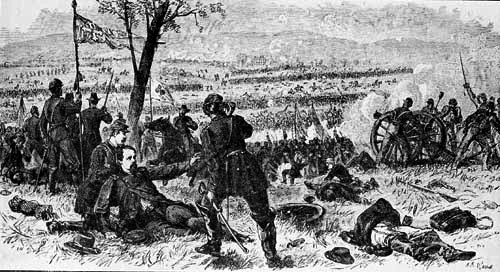
The Battle of Gettysburg
This seemed fair to the officer and a stretcher was brought and the old man was carried back to the house. His next fear was that his wife would unconsciously betray him to the patrol that were bringing him into the house. Sure enough as they reached the door, old Mrs. Burns came rushing out.
"John," she screamed, "I told you not to go out."
"Shut up, Molly," bellowed John at the top of his voice. "I didn't find the old cow, but I did the best I could and I want you to tell these gentlemen that I am as peaceable an old chap that ever lived, for they found me out there wounded with a lot of soldiers and think I may have been doin' some fightin'."
Mrs. Burns was no fool.
"Gentlemen," she cried out, "I can't thank you enough for bringing back this poor silly husband of mine. I told him that if he went hunting to-day for cows or anything else, he would most likely find nothing but trouble, and I guess he has. He's old enough to know better, but you leave him here and I'll nurse him and try to get some sense into his head."
So the patrol left Burns at his own house, not without some suspicions, for the next day an officer came around and put him through a severe cross-examination which John for the most part escaped by pretending to be too weak to answer any particularly searching question. Mrs. Burns nursed the old man back to health again and never let a day go by without a number of impressive remarks about his foolhardiness. The old man hadn't much to say, but the first day after he got well he disappeared and came back an hour or so later with old Betsy and the powder-horn which he found safe and sound in the tree where he left them. These he hung again over the mantelpiece in readiness for the next war, "for," said John, "a man's never too old to fight for his country."
Another hero in that battle was Lieutenant Bayard Wilkeson. Only nineteen years old he commanded a battery in an exposed position on the Union right. His two guns did so much damage that Gordon, the Confederate general, could not advance his troops in the face of their deadly fire. Wilkeson could be seen on the far-away hilltop riding back and forth encouraging and directing his gunners.
General Gordon sent for the captains of two of his largest batteries.
"Train every gun you've got," he said, "on that man and horse. He's doing more damage than a whole Yankee regiment."
Quietly the guns of the two far-apart positions were swung around until they all pointed directly at that horseman against the sky. A white handkerchief was waved from the farthest battery and with a crash every gun went off. When the smoke cleared away, man and horse were down, the guns dismounted and the gunners killed. The Confederate forces swept on their way unchecked across the field that had been swept and winnowed by Wilkeson's deadly guns. As they went over the crest, they found him under his dead horse and surrounded by his dead gunners still alive but desperately wounded. He was carried in to the Allen House along with their own wounded and given what attention was possible, which was little enough. It was plain to be seen that he was dying. Suffering from that choking, desperate thirst which attacks every wounded man who has lost much blood he faintly asked for water. There was no water to be had, but finally one of the Confederate officers in charge managed to get a full canteen off a passing soldier. Wilkeson stretched out his hands for what meant more to him than anything else in the world. Just then a wounded Confederate soldier next to him cried out, "For God's sake give me some."
Wilkeson stopped with the canteen half to his mouth and then by sheer force of will passed it over to the other. In his agonizing thirst the wounded Confederate drank every drop before he could stop himself. Horror-stricken he turned to apologize. The young lieutenant smiled at him, turned slightly—and was gone. It took more courage to give up that flask of cold water than to fight his battery against the whole Confederate Army.
The hero-folk on that great day were not all men and boys. Among the many, many monuments that crowd the field of Gettysburg there is one of a young girl carved from pure translucent Italian marble. It is the statue of Jennie Wade, the water-carrier for many a wounded and dying soldier during two of those days of doom. Although she knew it not, Jennie was following in the footsteps of another woman, that unknown wife of a British soldier at the Battle of Saratoga in the far-away Revolutionary days. When Burgoyne's army was surrounded at Saratoga, some of the women and wounded men were sent for safety to a large house in the neighborhood where they took refuge in the cellar. There they crouched for six long days and nights while the cannon-balls crashed through the house overhead. The cellar became crowded with wounded and dying men who were suffering agonies from thirst. It was only a few steps to the river, but the house was surrounded by Morgan's sharp-shooters and every man who ventured out with a bucket was shot dead. At last the wife of one of the soldiers offered to go and in spite of the protests of the men ventured out. The American riflemen would not fire upon a woman and again and again she went down to the river and brought back water to the wounded in safety.
Jennie Wade was a girl of twenty who lived in a red-brick house right in the path of the battle. They could not move to a safer place, for her married sister was there with a day-old baby, so the imprisoned family was in the thick of the battle. Recently when the old roof was taken off to be repaired, over two quarts of bullets were taken from it. During the first day, Jennie's mother moved her daughter and her baby so that her head rested against the foot of the bed. She had no more been moved than a bullet crashed through the window and struck the pillow where her head had lain an instant before. While her mother watched her daughter and the baby, Jennie carried water to the soldiers on the firing-line. At the end of the first day fifteen soldiers lay dead in the little front yard and all through that weary day and late into the night Jennie was going back and forth filling the canteens of the wounded and dying soldiers as they lay scattered on that stricken field. Throughout the second day she kept on with this work and many and many a wounded soldier choking with thirst lived to bless her memory. On this day a long procession of blue-clad men knocked at the door of the house asking for bread until the whole supply was gone. After dark on the second day, Jennie mixed up a pan of dough and set it out to rise. She got up at daybreak and as she was lighting a fire, a hungry soldier-boy knocked at the door and asked for something to eat. Jennie started to mix up some biscuit and as she stood with her sleeves rolled up and her hands in the dough, a minie ball cut through the door and she fell over dead without a word. Her statue stands as she must have appeared during those first two days of battle. In one hand she carries a pitcher and over her left arm are two army-canteens hung by their straps. Not the least of the heroic ones of that battle was Jennie Wade who died while thus engaged in homely, helpful services for her country.
These are the stories of but a few who fought at Gettysburg that men might be free and that their country might stand for righteousness. The spirit of that battle has been best expressed in a great poem by Will H. Thompson with which we end these stories of some of the brave deeds of the greatest battle of the Civil War.
HIGH TIDE AT GETTYSBURG A cloud possessed the hollow field, The gathering battle's smoky shield; Athwart the gloom the lightning flashed, And through the cloud some horsemen dashed, And from the heights the thunder pealed. Then, at the brief command of Lee, Moved out that matchless infantry, With Pickett leading grandly down To rush against the roaring crown Of those dread heights of destiny. Far heard above the angry guns, A cry across the tumult runs, The voice that rang through Shiloh's woods And Chickamauga's solitudes, The fierce South cheering on her sons. Ah, how the withering tempest blew Against the front of Pettigrew! A khamsin wind that scorched and singed, Like that infernal flame that fringed The British squares at Waterloo! "Once more in Glory's van with me!" Virginia cries to Tennessee, "We two together, come what may, Shall stand upon those works to-day." (The reddest day in history.) But who shall break the guards that wait Before the awful face of Fate? The tattered standards of the South Were shriveled at the cannon's mouth, And all her hopes were desolate. In vain the Tennesseean set His breast against the bayonet; In vain Virginia charged and raged, A tigress in her wrath uncaged, Till all the hill was red and wet! Above the bayonets mixed and crossed, Men saw a gray, gigantic ghost Receding through the battle-cloud, And heard across the tempest loud The death-cry of a nation lost! The brave went down! Without disgrace They leaped to Ruin's red embrace; They only heard Fame's thunder wake, And saw the dazzling sun-burst break In smiles on Glory's bloody face! They fell, who lifted up a hand And bade the sun in heaven to stand! They smote and fell, who set the bars Against the progress of the stars, And stayed the march of Motherland. They stood, who saw the future come On through the fight's delirium! They smote and stood, who held the hope Of nations on that slippery slope Amid the cheers of Christendom! God lives! He forged the iron will That clutched and held that trembling hill. God lives and reigns! He built and lent Those heights for Freedom's battlement, Where floats her flag in triumph still! Love rules; her gentler purpose runs. A mighty mother turns in tears The pages of her battle years, Lamenting all her fallen sons!
CHAPTER X
THE LONE SCOUT
Single-handed exploits, where a man must depend upon his own strength and daring and coolness, rank high among brave deeds. Occasionally a man has confidence enough in himself to penetrate alone into the enemy's country and to protect his life and do his endeavor by his own craft and courage. Of such was Hereward, the Last of the English, who, like Robin Hood, many centuries later, led his little band of free men through fen and forest and refused to yield even to the vast resources of William the Conqueror. Once disguised as a swineherd he entered the very court of the king and sat with the other strangers and wanderers at the foot of the table in the great banquet-hall and saw in the distance the man who was first to conquer and then to make unconquerable all England. To this day we love to read of his adventures on that scouting trip. How the servants who sat at meat with him played rough jokes on him until, forgetful of his enormous strength, he dealt one of them a buffet which laid him lifeless across the table with a broken neck. How he was taken up to the head of the table and stood before William on an instant trial for his life. His loose jerkin had been torn during the struggle and showed his vast chest and arms covered with scars of old wounds which no swineherd would ever have received. The old chronicle goes on to tell how they imprisoned him for the night and when his jailer came to fetter his legs with heavy irons, he stunned him with a kick, unlocked the doors and gates, broke open the stable door, selected the best horse in the king's stable and, armed with an old scythe blade which he had picked up in the barn, cut his way through the guard and rode all night by the stars back to his band.
In 1862 Corporal Pike of the Fourth Ohio Regiment led an expedition for a hundred miles through the enemy's country, which was worthy of Hereward himself. The expedition consisted of Corporal James Pike, who held all positions from general to private and who also had charge of the commissary department and was head of the board of strategy. The corporal was a descendant of Captain Zebulon Pike the great Indian fighter and inherited his ancestor's coolness and daring. Old Zebulon used to say that he never really knew what happiness was until he was in danger of his life and that when he started into a fight, it was as if all the music in the world was playing in his ears and that a battle to him was like a good dinner, a game of ball and a picnic all rolled into one. The corporal was very much this way. He had taken such particular pleasure in foolhardy exploits that his officers decided to try him on scout duty. There he did so well that General Mitchel's attention was attracted to him.
In April, 1862, it was of great importance for the general's plans to obtain information in regard to the strength of the Confederates in Alabama, and to have a certain railroad bridge destroyed so as to cut off the line of communications with the forces farther south. Out of the whole regiment the general picked Corporal Pike. The corporal's plan of procedure was characteristic of the man. He wore his regular full blue uniform and throughout the first part of his trip made no attempt at disguise or concealment. This was not as reckless as it sounds. The country was filled with Confederate spies and messengers who almost invariably adopted the Union uniform and it had this advantage—if captured, he could claim that he was in his regular uniform and was entitled to be treated as a soldier captured on the field of battle and not hung as a spy. The corporal, however, did not attach any very great weight to the protection of this uniform, as he figured out that if he were caught burning bridges and obtaining reports of Confederate forces, they would hang him whatever the color of his uniform. He had no adventures until he drew near Fayetteville in Tennessee. He spent the night in the woods and bright and early the next morning rode into the village and up to the hotel and ordered breakfast for himself and a similar attention for his horse. The sight of a Union soldier assembled all the unoccupied part of the population and in a few minutes there were three hundred men on the sidewalk in front of the hotel. As the corporal came back from looking after his horse, for he would never eat until he had seen that old Bill was properly cared for, a man stepped up and inquired his name.
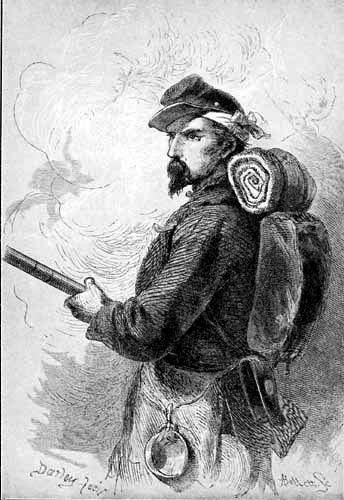
Corporal Pike
"My name, sir," said the corporal, "is James Pike of the Fourth Ohio Cavalry, which is located at Shelbyville. What can I do for you?"
There was a few moments' silence and then a great laugh went up as the crowd decided that this was some Confederate scout, probably one of Morgan's rangers in disguise.
"What are you doing down here?" asked another.
"I am down here," said Pike coolly, "to demand the surrender of this town just as soon as I can get my breakfast and find the mayor."
The crowd laughed loudly again and the corporal went in to breakfast, where he sat at a table with a number of Confederate officers with whom he talked so mysteriously that they were fully convinced that he must be one of Morgan's right-hand men. After breakfast he ordered his horse and started out, first saying good-bye to the crowd who were still waiting for him.