"A Story for Girls" (continued 4)
Reading edition
She spoke in the gracious and graceful way habitual to her, and the retired tradesman left her with feelings of warm sympathy and respect. Mrs Derwent had gained a friend.
Blanche and Stasy had not fallen asleep the night before without having fully discussed the younger girl’s idea.
Chapter Sixteen.
Stasy’s Inspiration.
Blanche did not speak for a minute or two. Then she looked up with a rather peculiar expression.
“Well, Stasy?” she said, as if expecting her sister to continue speaking.
But Stasy hesitated.
“What has all this to do with your inspiration?” said Blanche.
“I’m half afraid of telling you,” said Stasy. “You’re rather snubby too, to-night, Blanche, in your manner, somehow.”
“I don’t mean to be,” said Blanche gently. “Do tell me all about it.”
“Well, you see,” began Stasy, “it just came into my head with a flash. Supposing we were to join Miss Halliday, and be milliners in real earnest. Of course it would be more you than I. I should still have to go on doing some lessons. But I could help a good deal, and we could have the same rooms in her house that we had before. We were very comfortable there. It would be better than going away to some horrid, strange place, into stuffy lodgings, where mamma would be miserable.”
“You didn’t say anything of this to Miss Halliday, did you?” inquired Blanche.
“Oh no,” said Stasy; “of course not. But do tell me what you think of it, Blanche.”
Blanche sighed.
“It is almost impossible to say all at once,” she answered. “It is rather difficult to take it in—the idea of our really having to work for our daily bread, to be actually shopkeepers.”
“I don’t feel it that way,” said Stasy eagerly.
“You are hardly old enough to realise it,” said her sister.
“Yes, I think I do,” said Stasy; “but it seems to me that anything would be better than being separated—being governesses or companions, or anything like that. What would mamma do without us?”
“Mr Mapleson proposed our beginning a small school,” said Blanche.
Stasy made a face.
“Oh, that would be quite horrid, I think. We should be far more independent if we were milliners. And do you know, Blanchie,” she went on, her eyes sparkling, “it’s quite different nowadays in England. Miss Milward has a cousin who’s a milliner in London, and people don’t look down upon her for it in the very least. Not even regular—worldly sort of people, you know.”
“I’ve heard of that,” Blanche replied; “but in London it’s different. Miss Milwards cousin probably has her own friends and relations who know her and back her up. It wouldn’t be the same thing at all in a little country town, and in a neighbourhood where people have not been too kind to us as it is. And living ‘on the premises,’ as people say—oh no, it would be quite different.”
Stasy’s face fell.
“I was afraid,” she said, rather dejectedly, “that you wouldn’t like the idea of it at all. But, oh Blanchie, a school would be detestable! We should never feel free, morning, noon, or night; and just fancy mamma having to hear all sorts of horrid fault-findings from vulgar parents.”
“They needn’t be vulgar,” remarked Blanche; “at least not all of them.”
“They would be at Blissmore,” said Stasy.
“I should never dream of beginning a school at Blissmore,” said Blanche quickly. “The high school would spoil all chance of success.”
“Where would we go, then?” said Stasy. “We are such strangers in England; and, of course, it would be madness to think of returning to France. No, Blanchie, I won’t give up my idea yet, till you have something better to propose.”
“I don’t mean to snub you about it,” said Blanche. “Possibly it was an inspiration. I will speak about it to mamma to-morrow, and see how it strikes her. Of course there would be a great deal to talk about to Miss Halliday. She may require more money than we should be able to give.”
“I don’t think so,” said Stasy, “but she would tell you. Good-night then, dear. I can see you’re very tired; but I’m so glad you haven’t squashed the idea altogether. I think it would be capital fun! Just fancy all the people coming in and ordering their bonnets and hats. I used to long to go into the shop to take orders, when we were helping Miss Halliday.”
She kissed her sister lovingly and ran off, with the light-heartedness of her age, to dream of fabricating a marvellous cap for Mrs Burgess, or some bewitching hats for Lady Hebe’s trousseau.
Blanche said nothing of Stasy’s scheme to her mother till after Mr Bracy’s visit the next morning. But when she found that the negotiations for letting their house at once seemed so likely to go through, she thought it well to tell her mother of this new idea.
At first, there is no denying, it was very startling to Mrs Derwent. She was almost astonished at Blanche’s entertaining it for a moment. But a few days passed, and gradually, as often happens in such cases, she grew to some extent familiarised with the possibility. There came two letters from Mr Mapleson, the effect of which was indirectly favourable to the realisation of Stasy’s scheme.
“I have consulted my good wife,” wrote the old lawyer, “as I said I would. I am sorry to say she rather shakes her head over the idea of a school. There is so much less opening for private establishments of the kind nowadays, and this applies, I fear, to some extent to governesses too, unless they have been trained in the orthodox modern way. It would, no doubt, add greatly to your troubles to be separated from your charming daughters. If you will pardon the suggestion, and not consider it impertinent, what would you say to beginning some sort of dressmaking or millinery business in which you could all keep together? This kind of thing has become rather a fashion of late years, even for women of first-rate position.”
This letter arrived at breakfast-time one morning. Mrs Derwent read it and handed it to Blanche, remarking as she did so: “It is rather curious that the same idea should have struck him, isn’t it?”
Stasy looked up eagerly.
“What is it? Oh, do tell me! Do read it quickly, Blanchie.” And when she had got the letter in her own hands, and mastered its contents, she turned round triumphantly. “There now,” she said, “I hope you’ll allow in the future that I’m not a silly child. When a wise old lawyer of nearly a hundred proposes the very same thing, I should say it’s worth listening to.”
“I never thought it was not worth listening to, practically speaking,” said Mrs Derwent. “My hesitation was simply that I didn’t like the idea, and one of my reasons for disliking it is, that it would be so entirely you two, my darlings, working for me, for I am not at all clever at millinery.”
“And I am not a genius at it, mamma,” said Blanche. “Nothing like Stasy. It is she who has the ideas.”
“But I am not nearly so neat as you, Blanche,” said Stasy. “I would never have done so well without you to fasten off my threads, and that sort of thing.”
Blanche smiled.
“What I was going to say, mamma,” said Blanche, “is that there would be a great deal to do besides the actual millinery. All the business part of it—ordering things and keeping accounts, the sort of thing you’re so clever at. You know grandpapa used always to say that you were as good as a head-clerk or private secretary any day. And if the business were extended, as Miss Halliday hopes, there would be a great deal more of that side of it.”
“Yes,” said Stasy. “She told me the last time I saw her that that is one of her difficulties. She’s not very well educated, you know, poor little woman, and her accounts, such as they are, are rather a trouble to her. Indeed,” she went on, looking preternaturally wise, “I’ve a great idea that she is cheated sometimes.”
“I can quite believe that she cheats herself,” said Mrs Derwent. “I was always finding out things she had forgotten to put down in our weekly account. That reminds me, Blanche, of some things that came into my mind in the night—I didn’t sleep very well—about the arrangements we should have to make with Miss Halliday, if—if,” with a little hesitation—“this idea really goes farther. We should have to guarantee Miss Halliday against any risk to a certain extent; for, you see, she would have to give up ever having any lodgers if we went to live there.”
“Yes,” said Blanche thoughtfully; “and yet we could not now afford to pay as much as when we were her lodgers.”
“Perhaps we should pay half the house rent,” said Mrs Derwent, “and, of course, a larger proportion of the housekeeping. All that, I could guarantee out of capital for a time—the first year or so—till we saw how we got on. Miss Halliday is such an unsuspicious creature that I should be doubly anxious to be fair to her.”
“Perhaps it would be best to consult Mr Mapleson,” said Blanche.
“Yes, I think it would be quite necessary,” her mother agreed. “I should like to have a talk with Miss Halliday before doing so, however, so that we might know our ground a little; and then, again, I can’t say anything definite till I hear more from Mr Bracy.”
She got up from her seat as she spoke, and crossed the room to the window, where she stood looking out.
It was a perfectly lovely, early summer morning. The grounds at Pinnerton Lodge were now beginning to reward the care that had been bestowed on them when the Derwents first took the house. The view from the window across the neat lawn, its borders already gay with flowers, was charming.
No wonder that poor Mrs Derwent sighed a little.
“I think almost the worst part of this sort of trouble,” she said, “is waiting to see what one should do; though in some cases, no doubt, this goes on for months.”
At that moment the click of the gate was heard.
“I don’t think we are going to be kept very long waiting,” said Blanche cheerfully—she too had left her seat, and was standing beside her mother—“that’s the Bracys’ page coming up the path; he must be bringing a note.”
Her conjecture was correct. Two minutes later the note was in Mrs Derwent’s hand.
“They are really very kind and considerate,” she said, looking up after she had read it. “This is to ask if Mrs Bracy may come to look through the house more particularly, as they have quite made up their minds about it. Fancy, Blanche, he has actually telegraphed to India, and has got a reply. I do believe he has done it more for our sake than for their own, for I said to him we wanted to know as soon as possible. They are very rich, I suppose, but they are certainly also very kind.”
“And how horrid I was to Adela Bracy the first time I saw her,” said Stasy, contritely. “Well, never mind, I’ll make up for it by fabricating the loveliest hats that ever were seen, for her, if she patronises our millinery establishment.”
“Stasy,” said Blanche softly, “I wouldn’t joke about it if I were you; and you know it isn’t the least settled yet. At least not before mamma,” she went on, in a lower voice, seeing that her mother was not listening, as she was again reading Mr Bracy’s note.
An answer was sent, arranging for Mrs Bracy to see the house that same morning, and by that afternoon the negotiation was virtually concluded. The rent Mr Bracy proposed to pay would in itself have been a sufficient income for the mother and daughters to have lived upon very modestly, had Pinnerton Lodge been their own; but deducting the amount Mrs Derwent was responsible for, as the tenant of the house unfurnished, a very small income was to be counted on, and that but for one year.
“We may feel sure of two hundred,” said Mrs Derwent, “for I have still a good balance in the bank, and I have almost paid everything we owe, up to this.”
“You are counting, of course, the eighty pounds a year that Mr Mapleson spoke of as quite certain,” said Blanche.
“Oh dear, yes,” her mother replied; “it is indeed our only certainty in the future, except what we would realise by selling the furniture and plate, and so on.”
“And I’m sure it is better not to do that in a hurry,” said Blanche. “Don’t you think, mamma,” she went on, “that we know enough now to justify us in having a talk with Miss Halliday?”
Mrs Derwent considered.
“Yes,” she said, “I think that is the first thing to be done now, for I have practically promised to give possession of the house early next month.”
“Would you like me to see her first, mamma?” Blanche proposed. “Could it make it any less disagreeable for you if I were to sound her, as it were?”
“Oh no, dear,” said her mother. “I shall not feel it disagreeable, and even if I did, why should I not take my share when you and Stasy are so good about it all? You would hardly be able to go into it definitely without me. I must make a rough calculation as to what ready money I could promise her at once, subject, of course, to Mr Maplesons approval.”
“And he should be written to without delay,” said Blanche. “Yes, mamma, if you’re able for the walk, I think we should certainly see Miss Halliday to-day. If we go rather late in the afternoon, she would be better able to speak to us uninterruptedly.”
They found the milliner in rather low spirits, though the flutter of nervousness at the honour of Mrs Derwent’s visit made her forget her own troubles for a little. She was full of sympathy, yet afraid of presumption if she expressed it. But before long Blanche and her mother managed to put her at her ease.
But the calm was only of a few minutes’ duration. When Mrs Derwent laid before her with quiet composure the object with which they had sought her, Miss Halliday’s excitement grew uncontrollable. She cried and laughed, thanked them and apologised to them, all in a breath, till Mrs Derwent at last made her see that the proposal was for their interest as well as for hers, and managed to calm her down by matter-of-fact discussion of ways and means, and pounds, shillings, and pence.
“It is too good to be true,” said Miss Halliday. “I have got silly lately with brooding over things all by myself. Since the day Miss Stasy talked to me, I have not said a word of my troubles to any one, and knowing, of course, how much worse anxieties you dear ladies had to bear, I couldn’t have troubled you by asking for advice.”
Her confidence in Mrs Derwent was touching. She would have agreed to almost anything proposed, so that Blanche and her mother left her, empowered to tell Mr Mapleson that the milliner was ready to accept any arrangement he thought fair and equitable.
Chapter Seventeen.
A Visitor.
Two months later. A sunny day towards the end of July, the sort of day on which one longs to have nothing to do but to saunter about a garden, or lounge under trees with the lightest of light literature in his hands. It was rather hot in the milliner’s shop in the Blissmore High Street, though the sun-blinds had been down since the early morning to protect the few, though pretty, bonnets and hats tastefully displayed in the window. These sun-blinds were a new addition to Miss Halliday’s frontage, and she was very proud of them.
“Such a convenience,” she said, “making such a nice shade, and yet not stopping passers-by seeing what was to be seen. Not that that would matter,” she went on, complacently. “If we had nothing but a plain front door, customers would come in plenty, I feel sure, now that we’re getting such a name.”
It was quite true. Even during the few weeks that had passed since the Derwents had joined her, Miss Halliday’s connection had steadily increased, though just at this season it consisted mainly of the residents at Blissmore itself.
Some came out of curiosity, no doubt, for no secret had been made of the change in the Derwents’ position and the courageous step they had taken. It was a new sensation, in a provincial town, at least, to be waited upon by “ladies,” and very charming ladies too; though, to tell the truth, the adjective was chiefly drawn forth by Blanche, whose sweet grave face and perfect patience and courtesy of manner rarely failed to win her customers’ hearts. But if curiosity brought several of these in the first place, real satisfaction at the way in which their orders were executed was pretty sure to lead to repeated visits. And added to the increasing conviction that not many milliners out of Paris had prettier wares, and “so moderate too,” was a sensation, agreeable to the Blissmore ladies, that somehow or other they were acting in a praiseworthy fashion by lending a helping hand to the “poor things.”
Yes, as far as the town was concerned, there was no doubt that the new departure was a decided success, though the very success brought certain difficulties in its train, the management of which called for considerable tact.
“You mustn’t let yourselves be patronised, dear young ladies,” said Miss Halliday, when an invitation to a small evening party was left one day for “Miss Derwent” by Mrs Burgess’s parlour-maid. “She wouldn’t have dared do it, if you had been at Pinnerton Lodge; and, to my mind, it’s a greater freedom now than it would have been then.”
“She counts herself an old acquaintance, I suppose, as she called upon us at first,” said Blanche; “and Dr Burgess was very good to Stasy when she was ill, you know, Miss Halliday. Still, of course, I would never dream of accepting this. Only we must not risk offending any one, and I believe, in her way, Mrs Burgess has done her best to help us by recommending us.”
Miss Halliday gave a little snort, Mrs Burgess being no very great favourite of hers.
“I will answer her note quite civilly,” said Blanche, “and just say we do not intend to go out at all. To begin with, mamma would certainly not let me go alone.”
“And they’d scarcely venture to ask her,” said Miss Halliday with satisfaction. “But I wish you wouldn’t say you don’t mean ever to go anywhere, for when the county ladies are home again, there’s no saying but that you may have invitations of quite a different kind.”
Blanche smiled.
“The county ladies didn’t trouble themselves about us much before,” she said. “I can scarcely think it likely they will now, though I certainly hope they will come to us for their bonnets.”
“I’ve not much fear but what they’ll do that,” said Miss Halliday, whose impressionable nature now saw everything on its bright side. “And even more than that, my dear Miss Blanchie, people are ‘funny’—you can’t count upon them. Anything that makes a sensation is the thing nowadays;” for the milliner was, in her way, a shrewd observer of human nature. “And there’s many nice ladies among them too—real ladies—who’d feel with you more truly than such as Mrs Burgess. There’s that sweet Lady Hebe, now!”
A deep sigh from the farther corner of the shop seemed to come in appropriate response to her last words.
“Stasy!” exclaimed Blanche. “What are you sighing so about? I thought you were working up-stairs beside mamma. What is the matter?”
“Oh, a lot of things,” replied Stasy dolefully. “I’m so hot, and I can’t get these beastly flowers to go the way I want them. My fingers seem all thumbs this afternoon.”
“Stasy!” said Blanche again, this time in a tone of reproof. “Is that the way Blissmore young women talk?”
“I’m a Blissmore young woman myself, now,” said Stasy. “So what can you expect?”
“You’re overworking yourself,” said Blanche. “Instead of doing less, now that your classes are over for the holidays, you’re fagging yourself out; and it is really not necessary just now. We got on very well when you only helped us part of the day, didn’t we, Miss Halliday?”
“Of course we did,” said Miss Halliday, “though we couldn’t do without Miss Stasy’s taste in anything. But do go out into the garden for a little, my dear; you’ll only make your head ache, and not be pleased with what you do in the end, when you’re feeling so.”
Stasy looked regretfully at the hat on her knee.
“I meant to make it so pretty,” she said. “And so you will, if you put it away in the meantime. There’s no hurry for it—there isn’t, really. Miss Bracy’s not leaving home till the end of the week,” said Miss Halliday.
Blanche had crossed the room to her sister, and took up the hat to look at it.
“It is pretty already,” she said, “and it is going to be quite charming, I can see. So uncommon!”
Stasy looked up with tired eyes.
“Do you really think so?” she said more cheerfully. “I am so glad, for I do want to make it very nice.”
It was an uncommon hat, even in these modern days of eccentricity without end—uncommon, but still more, perfect in taste—and in imagination Blanche already saw Adela’s piquant face and beautiful dark eyes looking their best under its shade.
“I want the roses to droop over a little on to her hair, do you see?” said Stasy. “And they will look rather sprawly.”
“They will come all right in the end, I am quite sure,” said Blanche encouragingly, as Stasy rose half reluctantly from her place.
“I just wish you’d go out with her too, Miss Blanchie,” said the milliner. “It is hot in here, and you’re looking pale yourself. I can call you in a moment when you’re wanted. I’ll tell you what,” she went on, with a sudden inspiration, “shall I tell Aline to take your tea out into the garden? Your dear mamma might like it, for she’s been writing all the afternoon, and Master Herty will help Aline to lay it.”
Aline was the only servant who had been added to the High Street establishment, and with her happy French faculty of adapting herself to varying circumstances, she had proved so far a real boon to the little family.
So Miss Halliday opened the door leading to the kitchen and gave her directions, while Blanche and Stasy made their way out to the long, pleasant strip of walled-in garden at the back of the old-fashioned house.
“Blanche,” said Stasy, as they slowly walked up and down the gravel path, “it wasn’t only about the hat I gave that sigh. I do feel so hurt at Lady Hebe, and I do so wish Miss Halliday hadn’t put her into my head again.”
“She doesn’t know anything about Hebe a not answering my letter,” said Blanche. “There was no use speaking of it.”
“No, of course not,” Stasy agreed.
“And I feel certain there must be some reason for it,” Blanche resumed. “She is the very last girl in the world to change to us because of all this. Besides, I think it was quite as difficult for her before to be nice to us, as it would be now.”
“Perhaps so,” said Stasy, rather absently. “Blanche, I do feel so dull and cross now, somehow. It isn’t, after all, as much fun as I expected. I do so dislike some of the people that come with their orders.”
“Yet, I think, on the whole, they have been wonderfully kind,” said Blanche. “Kind, and even delicate.”
“Oh, I daresay they have,” said Stasy. “But they have such ridiculous ideas! That woman yesterday, who wanted a bonnet that would ‘go’ with everything. And yet it wasn’t to be black or any neutral colour.”
“Yes, but Stasy,” said Blanche, “I was trembling for fear she should find out that you were making fun of her, when you proposed a— What is it, Aline?” she said, as the maid came out with the tea-tray, which she hastily deposited on a garden seat.
“Some one is at the front door,” replied Aline. “The bell rang as I left the kitchen. Will mademoiselle excuse my leaving the tray there? I must answer the door, for that stupid little girl has not yet dressed herself,” and she hastened off.
Just at that moment Herty put his face out at the glass door, which was slightly ajar.
“Where is Aline?” he said. “She promised I was to help her to carry out the tea things.”
“She has gone to open the door,” said Blanche. “She will be back in a moment. Come out here and help us to lay the table.—We may as well, Stasy,” she said to her sister; “the tray is not very secure on that chair.”
She began unfolding the little table-cloth which Aline had brought out.
“Herty must have run to the door,” said Stasy with some annoyance. “I am afraid he is getting rather common in his ways, Blanche, now that we live so plainly. I think we must be more particular with him. It does seem so vulgar for a child to be peeping out to see who is at the door.”
“I doubt if Herty will content himself with peeping,” said Blanche. “I wonder if all little boys are as inquisitive as he is.”
At that moment Herty’s shrill voice was heard in eager excitement.
“Blanchie, Blanchie,” he cried; “Stasy—somebody’s come to see you.—Come along, do,” he added to some one, as yet invisible in the drawing-room. “We’re going to have tea in the garden; won’t it be jolly? You’re just in time.”
Some inaudible words of remonstrance must have been addressed to him by the unfortunate individual he had under his convoy. But Herty was not to be so easily balked of his prey.
“You must come out,” they heard him say. “They’ll be as pleased as anything to see you.”
And apparently the invisible new-comer judged it wiser to resist no more, though it was with somewhat heightened colour, and less appearance of being equal to the occasion than was usual to him, that Mr Archibald Dunstan followed, or, more correctly speaking, allowed himself to be dragged out into the garden by the irrepressible Herty.
“I do beg your pardon, Miss Derwent,” he said as he shook hands, “but I couldn’t help myself, Herty is such a determined young person.”
Blanche looked up at him, serenely enough to all appearance, though in her heart she was not sure how this unexpected visit should be regarded.
“I had no idea you were in the country,” she said.—“Herty, go and tell mamma that Mr Dunstan is here. We are just going to have tea, as you see; we hoped it would be a little cooler in the garden than in the house.”
“It has been very hot lately,” Archie replied, slightly disconcerted, he scarcely knew why, and disgusted with himself for finding nothing more original to say; though Blanche was to the full as self-possessed as if she were receiving him in the pretty little home in which she had last seen him, as if no crash had completely broken the tenor of their life.
Archie almost felt as if he were dreaming, and yet—there could be no doubt that all he had heard was true. The facts spoke for themselves. Here the Derwents were, installed in the back rooms of the Blissmore milliner’s house.
And yet how nice it was! The sunny afternoon and the old garden; nothing to jar even upon the ultra refinement with which he was often taxed. Was it that Blanche Derwent, by the perfect sweetness and dignity of her presence, shed harmony and beauty about her wherever she might happen to be? He almost thought that herein was to be found the secret of it all.
“Why are we all standing?” said Stasy, with her rather incisive, girlish abruptness. Her voice recalled the young man to matters of fact. He hastily turned to draw forward some of the seats that were standing about.
“I daresay mamma won’t come down for a minute or two,” Stasy continued. “She told me just now that she had two or three letters that she must finish for the post.”
Mr Dunstan looked rather guilty.
“I do hope she will not hurry on my account,” he said. “I am in no hurry, but I do want to see Mrs Derwent. I have a”—and he hesitated—“a message for her from an old friend. At least I promised to give her news of him the first time I saw her.”
“Indeed,” said Blanche, who, if she felt curious as to who the old friend might be, for her own reasons repressed her curiosity.
But Stasy was less self-contained.
“An old friend,” she repeated eagerly. “How interesting! I wonder who it was. Do tell us, Mr Dunstan.”
Archie was by no means reluctant to do so. Anything to get out of the stilted commonplace-isms which had begun the conversation.
“It is no one you know personally,” he said, turning rather pointedly to Stasy; “though you have probably heard of him, as he was your grandfathers greatest friend—I mean old Sir Adam Nigel.”
Stasy almost clapped her hands.
“Oh, how glad I am,” she exclaimed, “and how delighted mamma will be! She has been longing to hear of him again. Is he in England? He was to have come in the spring.”
“No,” Mr Dunstan replied, “I came across him at Cannes. I ran down there for a week last month to see an old relation of mine. Sir Adam has not been in England for two years, but he hopes to come over before very long, and he is sure to stay at Alderwood with my aunt, if he does so, as Mrs Lilford has suggested it. He asked me if I had met Mrs Derwent when I was staying there, and he was so pleased to hear about you all. I am staying at Alderwood again just now, you know, for a day or two by myself.”
Blanche suddenly raised her eyes and looked at him.
“Does,” she said—“did Sir Adam know, when you saw him, of—of what had happened to us? That we had lost all our money?”
“No,” said Archie. He could not hesitate or feel awkward, when the girl was so straightforward. “No, he certainly had heard nothing about it. I doubt if he has heard it even now.”
“I am glad of that,” said Blanche, “for he has not written.”
“I did not know myself—I had not the slightest idea of it—till two days ago, when I came down here,” said the young man; “and I cannot tell you how dreadfully sorry I was, for I suppose it is all quite true?”
“Quite true,” replied Blanche. “Thank you for being sorry about it. I am rather surprised at your not having heard of it before. Not, of course, that our affairs are of general interest. But have you not seen Lady Hebe lately? I wrote to tell her about it, because it affected the work I had undertaken to do for her.”
“And has she not written to you direct?” inquired Mr Dunstan quickly.
Blanche shook her head slightly.
Archies face darkened.
“I don’t understand her,” he said, as if speaking to himself.—“No,” he went on aloud, “I have not seen her for some time; she has been away for several weeks at Coblenz, of all places in the world at this time of year. She is back in London now, but I didn’t call before coming down,” he finished, rather abruptly.
“I thought you were such very great friends,” said Stasy, looking him full in the face. “Have you had a quarrel?”
“Stasy!” said Blanche, her colour rising as she spoke.
But before she had time to say more, the rustle of a skirt across the grass made her start up. Their mother had just come out to join them.
Chapter Eighteen.
Herty’s Confidences.
Derwent greeted Mr Dunstan with quiet courtesy, scarcely, however, amounting to friendliness. He was instantly conscious of the slight change in her manner, and at exerted himself to regain the ground he found he had somehow lost. This, under usual conditions, would have required little effort on the young man’s part, for he was gifted with that charm of manner which springs from a really unaffected and unselfish character. “Spoilt” he might well have been, and to some extent, in fact, he was so. But the spoiling did not go far below the surface. Yet it was second nature to him to feel himself more than welcome wherever he chose to go. Awkwardness of any kind was a perfectly novel sensation.
What was the matter this afternoon? He felt embarrassed and self-conscious, as if treading on ground where he had no right to be.
Mrs Derwent’s attitude was that of tacit expectation, as if waiting to hear the reason of his visit, so Archie’s preliminary remarks about the heat in London, and the refreshment of getting a day or two in the country, fell rather flat.
So at last he plunged abruptly into the only tangible explanation of his visit he could lay hold on.
“I have just been telling Miss Derwent,” he began, “that I met a very old friend of yours the other day at Cannes. He is an old friend of some of my people’s too—Sir Adam Nigel—who used long ago to live at Alderwood, you know.”
Mrs Derwent’s manner grew more cordial, and her face lighted up.
“Oh,” she exclaimed, “I am so glad to hear about him. He spoke of us—of me—then, to you?”
“Oh dear, yes,” said Archie, delighted at his success. “He asked me no end of questions about you, when he heard I had had the pleasure of meeting you. And he begged me to give you all kinds of messages, as I told him I was sure to see you again before long. I’m always turning up in this neighbourhood,” he went on, “though my own home is in another county, for my uncle Dunstan was my guardian, and they’ve been at Alderwood for fifteen years or so now. Mrs Lilford has never really settled there.”
“Dear me,” said Mrs Derwent, “that makes it seem still longer since it was almost like home to me,” and her face saddened again a little. “Did Sir Adam say nothing about coming over this year?” she added. “I had hoped to see him before this.”
“Mamma,” said Blanche gently, “Mr Dunstan tells us that Sir Adam had no idea of what has happened, or that we had left Pinnerton Lodge.”
“No indeed,” said Archie eagerly.
Mrs Derwent’s face cleared again.
“I am not surprised,” she said. “Indeed, I felt sure of it, from his not having written again.”
“He is pretty certain to be in this neighbourhood before the winter,” added Archie, “and then, of course.” But he hesitated. It was not his place to assure Mrs Derwent that her old friend would look her up.
“Yes; then, of course, I shall see him,” she said, finishing the sentence for him. “But I think perhaps I will write, as, no doubt, Mr Dunstan, you can give me his present address.”
“Certainly I can,” the young man replied. “That’s to say, I can give you the Cannes address, and from there his letters are sure to be forwarded.”
Just then Herty reappeared, carefully carrying a plateful of buttered toast.
“There were no tea-cakes,” he said apologetically; “so Aline and me have been making this.”
“Buttered toast in July!” exclaimed Stasy contemptuously. “And you look as if you’d been toasting your face too, Herty; you’re as red as a turkey-cock.”
Herty’s beaming face clouded over.
“I thought you’d like it so much,” he said. “You generally do, Stasy.”
“Of course we like it,” said Blanche, as she began to pour out the tea.
“I think there’s nothing better than buttered toast at any time of the year,” said Archie heartily, at once following Blanche’s lead.
He was beginning to feel quite himself again. More than that, indeed, when Blanche glanced at him with an approving smile such as she had not yet favoured him with. How lovely she looked! He had always thought her lovely, but never, it seemed to him, had he seen her to such advantage as now; the afternoon sunshine adding a glow to her fair hair, and a touch of warmth to the delicate tints of her face, which had struck him as rather pale when he first saw her. Yet nothing could be simpler than the holland dress she was wearing. What made it so graceful in its folds? He had often condemned holland as too stiff and ungracious a material to be becoming, for Archie was a great connoisseur in such matters. Its creamy shade even seemed to deepen her blue eyes, lighted up by the transient smile. He had been a little doubtful about the colour of her eyes before, but now he was quite satisfied. They were thoroughly blue, but never had he seen so rich a shade in conjunction with that complexion and hair. He forgot he was looking at her, till a slight flush, for which the sunshine was not responsible, creeping over the girl’s cheeks, made him realise his unconscious breach of good manners.
The little bustle of handing cups and plates covered his momentary annoyance with himself.
“Really,” he thought, “what’s coming over me? I must be losing my head.”
The next quarter of an hour or so, however, passed very pleasantly. Mr Dunstan began to hope that he might feel himself re-established in the little family’s good graces.
“Are you going to be at Alderwood for some time?” asked Mrs Derwent in the course of conversation. “Isn’t it rather dull for you?”
“I don’t mind it,” replied Archie. “I’m rather used to being alone—in the country, that’s to say. I’ve no one but myself at my own home. I’ve been an orphan, you know, since I was a little fellow, and my only sister has been married for several years. Her husband is Norman Milward’s half-brother, Charles Conniston. They live in Ireland. By the way, you must have seen them that—that first afternoon I met you at Alderwood. They were staying at Crossburn then.”
“No,” said Blanche, whom he seemed to be addressing. “I don’t think I remember any one except old Mrs Selwyn that day, though I have seen young Mr Milward—Lady Hebe’s fiancé—once or twice, and his sister several times.”
“Oh, Rosy!” said Mr Dunstan. “Isn’t she nice? But isn’t she plain—almost odd-looking?”
Blanche did not reply.
“Blanche never thinks people that she likes, plain,” said Stasy.
“I beg your pardon,” said Blanche, “I’m not so silly. But the word doesn’t seem to me to suit Miss Milward, she has such wonderful eyes.”
“Yes indeed,” agreed Archie, almost too evidently eager to endorse whatever Blanche said. “I quite agree with you. They are really beautiful eyes, because there’s no sham about them. She is as good as they would lead you to believe.”
Again the same bright smile of approval came over Blanche’s face, and Mr Dunstan felt himself rewarded. Just then Aline appeared at the door.
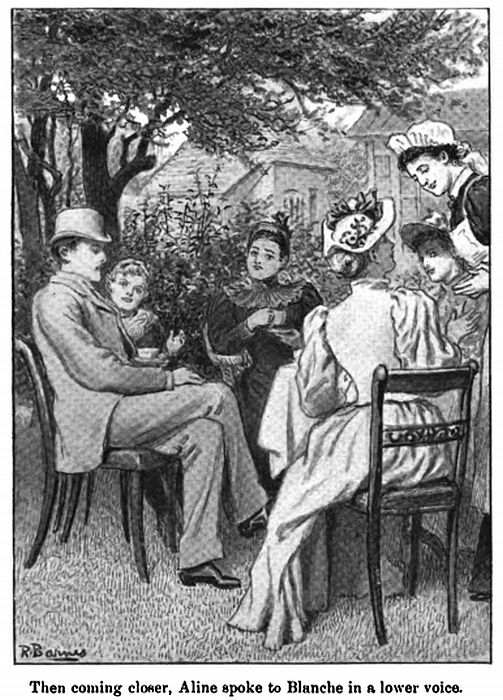
“Mademoiselle,” she said; then coming closer, she spoke to Blanche in a lower voice, though unluckily Mr Dunstan was so near that he could not but overhear what she said.
“Some ladies are in the shop. Miss Halliday is very sorry, but she fears you must come.”
“Of course,” said Blanche, springing to her feet—for the moment, she had begun to forget the present facts of her daily life, and she gave herself a sort of mental shake—“of course,” she repeated, “I’ll come at once.—Mr Dunstan, will you excuse me?” and she held out her hand, as if in farewell.
The young man’s face had grown visibly redder.
“Good-bye,” he said, repressing the effect that Alines words had had upon him.
Then turning to Mrs Derwent:
“Will you allow me to call again?” he said very clearly. “I intend to stay at Alderwood for two or three days longer.”
“Oh, certainly, if you happen to be anyway near,” she replied simply.
Then a bright idea struck Archie, as his glance fell on Herty.
“I wish you’d allow this young man to spend a day with me,” he said. “I’d take good care of him, and it is holidays just now, I know. I shall be driving in to-morrow morning in my dog-cart, and I will call for him, if he may come.”
“Oh mamma, mamma,” said Herty, ecstatically, “do say I may!”
It would have required a heart of stone to refuse the poor little fellow, and Mrs Derwent’s heart was by no means of that material.
“It is very good indeed of you, Mr Dunstan,” she replied; “and I am sure Herty would enjoy it immensely. Of course he has not nearly so much to amuse him here as at Pinnerton.”
“Then I will call for him at—let me see—shall we say eleven o’clock? and I’ll bring him safe back in the afternoon. Between four and five, if that will do?”
“Perfectly,” said Mrs Derwent, and then Mr Dunstan left taking care not to glance into the shop as he passed its open door on his way out.
Herty was ready the next morning betimes. Long before eleven had struck he was fidgeting about, asking every one half-a-dozen times in a minute what o’clock it was, so that it was a relief to everybody when the dog-cart drew up to the door and Herty was safely hoisted up to his seat beside his friend.
“I was so afraid it would rain or something, and that perhaps you wouldn’t come,” said the little boy.
“I would have come all the same if it had rained,” said Archie. “I could have wrapped you up in a mackintosh, and I daresay we’d have found something to amuse you at Alderwood.”
“These holidays are very dull,” said Herty with a sigh. “I have got no rabbits, nor nothing like I had at Pinnerton. I’d almost rather go back to France.”
“There’s no chance of that?” said Mr Dunstan quickly.
“Oh no,” said Herty. “Blanchie says we must stay here for—always, I suppose. Anyway, till I’m a man; and then I mean to make money for them. You know we’ve got no money now, at least scarcely any except what they make with having a shop. It’s rather horrid, don’t you think?”
“Yes,” agreed Archie, somewhat incautiously; “I think it’s exceedingly horrid. And I can quite understand that you feel in a great hurry to be a man, so as to be able to help them.”
“It’ll take a good while, though,” said Herty prudently, and then he began talking about the horse, extracting a promise from Archie that he would let him hold the reins when they got to a perfectly quiet part of the road.
But with some skill Mr Dunstan managed to bring him back to the subject they had been discussing.
“Do you think your sister minds much?” he asked, when Herty had been retailing some of his own grievances.
Herty considered.
“Well,” he said, “she hadn’t any rabbits, you see, and I think she likes making bonnets. They made them for the girls at Pinnerton, you know. But I think she does rather mind not having such a nice garden; she minds it for mamma, you see. And Stasy gets awfully cross sometimes! I heard Blanche speaking to her one day about being cross to the people in the shop.”
“And is Blanche never cross?” inquired Mr Dunstan, with great interest.
“Not like Stasy,” said Herty. “But she was very angry with me once when I was little. It was when I cut some hairs off Flopper’s tail. Flopper was grandpapa’s dog, an English dog, and those hairs are very particular, and then—and then,” said Herty, very slowly, “I said I hadn’t done it. It was that made Blanchie so cross. Telling a story, you know.”
“Yes,” said Archie, with preternatural gravity. “But that was a long time ago; of course you know better now,” he went on, cheerfully. “You never vex your sister now.”
“No, not as badly as that,” said Herty. “But one day, not long ago, I did see her crying. It wasn’t my fault, but I was very sorry; I think she had a headache, perhaps.”
The horse gave a spring forward at that moment, nearly dislodging Master Herty from his seat.
“I say, Mr Archie,” he exclaimed reproachfully, “what are you whipping him for? He’s going along quite nicely! I nearly tumbled out, I really did.”
“I beg your pardon, Herty,” said Mr Dunstan. “I’ll be more careful in future. I suppose I wasn’t thinking.”
Herty’s visit was a great success, the day passing to his complete satisfaction; and between four and five that afternoon the pair of friends found themselves at Miss Halliday’s door. Not this time in the dog-cart, for Mr Dunstan had left it at the “George,” a little way down the High Street.
“I won’t come in, I think, Herty,” he said, as Aline appeared in answer to the bell.
But Herty clung on to him.
“Oh, you must, just for a minute,” said the child. “I’m sure mamma would like to see you.”
“Madame is in the drawing-room,” put in Aline discreetly.
So, between the two, Archie allowed himself to be over-persuaded.
As Mr Dunstan, an hour later, passed the post-office on his way to the “George,” it suddenly struck him that he might call for the afternoon letters. There were two for himself, forwarded from his club—one of no special interest; the other a few hurried words from Norman Milward, whom he had not seen for a considerable time. “Hebe wants to see you,” he wrote. “She is back in London, but we have been in great anxiety lately. She wants to tell you about it herself. Do come as soon as you can.”
Chapter Nineteen.
Something Important.
The very next afternoon found Mr Dunstan standing at the door of the Marths’ house in London.
“Is Lady Hebe at home?” he inquired at once when it was opened, glancing up with some anxiety as he asked the question.
But nothing was to be learned from the man-servant’s impassive face, though—yes, it was surely unusually grave, for Archie was no stranger to him.
Her ladyship was at home, he replied, and expecting Mr Dunstan. For Archie had telegraphed that he would call at a certain hour.
Then he was ushered up-stairs to Hebe’s own little sitting-room, where many a happy half-hour had been spent by the circle of young “old friends.”
“Well, Hebe,” he said, as the door closed behind him, “here I am. I only got Norman’s letter yesterday afternoon, for I have been out of town for a few days. What an age it is since I have seen you!”
He had hardly as yet noticed her face, for the room was very dark; but as she came forward, holding out her hand, he almost started. She was unusually pale.
“You’ve not been ill, have you?” he said. “Its surely not that that has been the matter?”
“Then Norman did tell you something was the matter?” were her first words. “No, I have not been ill, at least not exactly. But, sit down, Archie, dear; I’ve a good deal to tell you.”
The young man drew a chair near her—she sat with her head to the light—with a feeling of increasing uneasiness.
“You make me feel quite frightened, Hebe,” he said. “What is this mysterious trouble?”
To his distress Hebe—happy Hebe—gave a little gasp that was almost like a sob.
“Archie,” she said, “it is a very great trouble that has come upon me, or rather upon us, for I am sure it is quite as bad or worse for Norman. Do you know there have been, there still are, grave fears that I am going blind? That is what I have been at Coblenz for. You know there is a very great oculist there.”
Archie’s bright, sunburnt face had paled visibly.
“Good heavens!” he exclaimed. “My poor child—my dear little Hebe. It can’t be true; those specialists are always alarmists as well.”
“No,” she said. “I will tell you all about it, for I quite understand. They’ve not hidden anything from me. My guardian has been very kind, and Josephine—I did not think there was so much tenderness in her. It is not hopeless. It has come on gradually. But till this summer I did not realise it at all; I have always been so strong and well, you know, in every way. Then the glare and the heat of London seemed to make it worse suddenly. I began to think it must be something more serious than short-sightedness.”
“You never were short-sighted,” Archie interrupted. “You had splendid sight.”
And indeed, as he looked at her eyes now, deep and lustrous, but with a sadness in their brown depths which he had never seen there before, it was difficult to believe that there could be anything wrong.
“Yes,” she agreed; “but for some time I have not seen so well, and I got in the way of thinking I must be short-sighted. But this summer pain began, very bad sometimes, and then we consulted our doctor, and he sent me to Coblenz.”
“And the opinion you got there was?—”
“I will tell you exactly,” said Hebe, “for I know you care.”
And she gave him a rapid resumé of the whole. It had ended in an operation being decided upon, in the anticipation of which she was already under a course of treatment.
“We are going back to Germany in a fortnight,” she said. “It is to be in about a month or six weeks from now. The Marths can’t stay with me all the time, but when Josephine leaves, Aunt Grace will come; and if all goes well—or, indeed, in any case—I hope to be back at East Moddersham some time in October. But what I wanted to see you about. Archie, was to ask you to look after Norman. He is so miserable, and it is much better for us not to be together. It breaks my heart to see him, and he says it breaks his heart to see me.”
“What can I do?” said Archie.
“I thought,” said Hebe, with some hesitation—“I thought perhaps, if it didn’t interfere too much with your own plans, you might propose taking him off to Norway, or something like that.”
Archie did not at once reply.
“You are such very old friends, you know,” said Hebe. “I wouldn’t ask such a thing only for my own sake.”
There was just a touch of hurt feeling in her tone. She had been so sure of the heartiest response from him. She was changed—her happy, almost childlike confidence seemed to have deserted her, and as Archie glanced up at her pale face, he felt disgusted with himself for his even momentary hesitation.
“My dear Hebe,” he exclaimed, “as if I wouldn’t do far more than that, for you as well as for Norman! I was just considering if I could explain everything to you! But I can’t just yet. Of course you may count upon me for Norway. I will set about it at once, and plan it so that Norman shall not in the least suspect that you had suggested it.”
“Oh, thank you,” said Hebe, in a tone of great relief.
“Let’s see,” Archie went on. “We might start in ten days or so, and you’d like me to keep him away till after—”
“Yes,” said Hebe calmly, “till after the operation. That is to say, till its result can be known. I am not afraid of the operation itself—nowadays those things are managed painlessly—but it is the afterwards. Oh Archie, I mustn’t cry, they say it is so bad for my eyes; but if I am going to be blind, I can’t marry Norman. He’s so young and full of life, it would be terrible for him to be tied to—”
She drove the tears back bravely, but it was all Archie himself could do to reply cheerfully.
“He would never give you up, I feel convinced,” he said. “But I am quite certain that what we have all got to do just now is to be hopeful. I will see you again soon, Hebe, when I’ve got things into shape a little. Trust it all to me. I must go back to—the country again to-night, for a day or two.”
He rose as if preparing to go.
“Where are you staying?” said Hebe—“at Saint Bartram’s?”
“N-no, I’m at Alderwood,” he replied. “I had some things to see to about there.”
Hebe’s brown eyes looked at him curiously.
“At Alderwood,” she repeated. “Oh, by-the-bye,” and she sighed, “I am so sorry never to have replied to a letter I had from Blanche Derwent. It was a private letter, and I have not been allowed to write at all.”
“Yes,” said Archie coolly, “I know about it. She told me.”
“You know all about their troubles, then—their loss of money?” asked Hebe, with some surprise.
“Yes, I heard it when I went down there. And then I saw them. They have left Pinnerton; they are living at Blissmore. They—no, I hate talking about it—they’ve actually joined that funny old milliner there; they are working for their daily bread.”
Hebe gasped.
“Is it so bad as that?” she said. “But how splendid of them, how brave, and oh how horrid I must have seemed! Oh Archie, could you explain about me if you see them again? I can’t write myself, and there is really no one I can ask to do so, especially now, after what you’ve told me.”
“Certainly I can do so,” replied Archie briskly. “Nothing can be easier. I will make a point of seeing Miss Derwent as soon as possible.”
“Thank you very much,” said Hebe, but some amount of reservation crept into her tone; something in Archie’s voice and manner struck her, and revived her former misgivings.
“It was thoughtless of me to propose it,” she said to herself. “Archie,” she began again, “I—”
“No,” interrupted Mr Dunstan, with some impatience. “Don’t ask me anything, Hebe, for if you do, I can’t answer. You blamed me before undeservedly, and I deserve it still less now.”
His words startled Hebe still more. She looked very grave.
“I didn’t blame you, Archie,” she said. “I only wanted you to be careful. You have always treated some things so lightly, it makes it difficult to believe you could be in earnest. And in this case—under the circumstances”—She did not like to say what was in her mind—that serious attentions on the part of the rich and much-made-of Archie Dunstan to Blanche Derwent, however charming personally, would appear in the eyes of the world highly improbable. Doubly so considering the change in the latter’s position. “I mean,” she went on hesitatingly, “you must be very careful.”
Archie smiled at this somewhat lame conclusion to her warning.
“You may trust me, dear Hebe,” he said, as he pressed her hand in farewell, and then he was gone.
But Hebe sat thinking deeply for some time after he had left her.
“What would Josephine say?” she thought to herself. “What a romantic goose she would think me. But I have never seen Archie quite like this before. And if such a thing came to pass—if I could be sure he is in earnest for once—it would be delightful in many ways. But”—and here a new view of the subject struck her—“I don’t believe Blanche would accept him,” she thought. “She is proud, rightly proud, and she has seen so little of him. She is not a girl to marry a man without thoroughly caring for him. No, I don’t believe she would accept him. But if he is in earnest now, he has certainly never been so before.”
Mr Dunstan returned to Alderwood that same evening, having already written to Norman Milward with some suggestion of the proposed plan, and promising to see him in London early the following week.
“It would have been perfectly impossible to refuse Hebe,” he thought to himself, as he was sitting alone in the small room where dinner had been served for him, “but it does seem dreadfully unlucky. I don’t see my way at all, and yet can I go away for an indefinite time and leave things as they are? I must trust to chance, I suppose. I must call there to-morrow, for I promised Hebe to give her message. Beyond that, I see nothing.”
Mr Dunstan’s visit had not made any great impression on the members of the little household in the High Street, with the exception possibly of Miss Halliday and Herty.
An unexpected and rather important order coming at a dull season had made the milliner and her young assistants unusually busy, and it was not without a feeling almost amounting to annoyance that Blanche found herself called away from the workroom the day after Archies return from London, to join her mother in the drawing-room.
“Do you want me particularly, mamma?” she said as she went in. “I am so busy just now. I could come in half an hour or so.”
As she spoke she suddenly became aware that her mother was not alone. Mr Dunstan was standing by the window.
“I did not know any one was here,” she went on, with an instinct of apology, “I had not heard the bell ring.”
“I am exceedingly sorry for interrupting you,” said the young man as he came forward, “but I could hardly help myself. I promised to see you personally to give you a message from Lady Hebe. I have been telling Mrs Derwent about it, but I know it would be a satisfaction to Hebe to hear that I had seen you, yourself.”
Blanche looked perplexed, and glancing at her mother’s face, she saw that it was unusually grave.
“Is there anything the matter?” she said quickly.
“Yes,” said Mrs Derwent. “You will be very sorry for poor Lady Hebe. A great trouble has come upon her.”
“Has anything happened to Mr Milward?” asked Blanche, and somehow Archie felt pleased that this was her first idea.
“No,” he answered. “Norman is all right. The trouble has come to Hebe herself, though, of course, it is terrible for him too.”
And then he went on to give the details of the grievous loss with which the young girl was threatened.
Blanche’s face grew graver and graver as he spoke. “Oh dear!” she exclaimed, when he had finished. “How dreadfully sad! Those pretty, happy eyes of hers. I can’t believe it. May I write to her, Mr Dunstan, do you think? I do feel so inexpressibly sorry for her. Mamma, our troubles don’t seem much in comparison with this, do they?”
“No, indeed,” Mrs Derwent agreed heartily. “But still it is not hopeless by any means, is it, Mr Dunstan?”
“I trust and believe not,” he replied. “But then I have only Hebe’s own account, you see. I shall know more after I have seen Norman and the Marths.—About writing to her,” he continued, turning to Blanche, “I don’t quite know. I don’t fancy she’s allowed to read at all, and you might not care for your letter going through other hands.”
Blanche looked disappointed.
“Then will you tell her from me?” she began, but he interrupted her.
“I’ll tell you what,” he said, “if you won’t think me officious—if you like to write to her and will give me the letter, I’ll take it myself, and she can have it read to her by some one you would not mind—Rosy—Rosy Milward, perhaps.”
“Thank you,” said Blanche. “I would like to write a little, however little, if I were sure she would get it herself. I can write it at once,” she went on, “if you don’t mind waiting a few minutes;” and she left the room as she spoke. She had hardly done so, when Stasy made her appearance.
“Blanche,” she said, as she came in, “Miss Halliday does so want you—How do you do, Mr Dunstan? I did not know you were here.—Where is Blanchie, mamma?”
“She is writing a note,” Mrs Derwent replied—“something rather particular. Can I not do instead of her?”
“Oh, well, perhaps you can; it’s about a letter she is wanted,” said Stasy. “If you could come, Miss Halliday will explain about it.” And with a word of apology to Mr Dunstan, Mrs Derwent left the room with her younger daughter.
“What a life of slavery for women in their position!” said Archie to himself. “To be at the beck and call of all the Blissmore shopkeepers. It is insufferable!”
He strolled restlessly to the window and stood looking out, feeling very indignant with the world in general and, most unreasonably, with Miss Halliday in particular.
He had not stood there long when Blanche returned with an envelope in her hand.
“This is my little letter,” she said, holding it out to him. “Thank you for taking charge of it, though it does not say half—not a hundredth part—of what I feel for her.”
“I know that she will value your sympathy,” said Archie, wishing he could think of something less commonplace to say.
He stood there, feeling, if not looking, uncertain and embarrassed, Blanche’s evident expectation—for she did not sit down again—that he was on the point of going, not tending to set him more at his ease.
Suddenly he spoke.
“I know you are busy, Miss Derwent,” he began. “I’ve no doubt you are wishing I would go. But the truth of it is, I can’t go without saying something more to you.”
Blanche looked up, a gleam of surprise in her face.
“I am busy,” she said, smiling a little. “But if it is anything important, I can wait a few minutes.”
Archie glanced irresolutely towards the window.
“Would you mind,” he said, “coming out into the garden. It is something important, and if we stay here they will be calling for you immediately.”
Chapter Twenty.
A Nephew and an Aunt.
Blanche did “mind,” for she was anxious to go back to the workroom. But Mr Dunstan had been very kind, and it was not in her nature to be unyielding in small lings.
“Perhaps he has something more to tell me about, Hebe,” she thought, as she led the way out through the open glass door.
“Miss Derwent,” began Archie again, when they had strolled towards the farther end of the long strip, “the fact of the matter is—and you must forgive me if it seems impertinent—I cannot stand this.”
“What?” asked Blanche, looking up in bewilderment.
“This—this position for you,” he said. “This horrid slavery.”
“Oh,” said Blanche, somewhat coldly. “I couldn’t think what you meant. It’s very good of you, but you really needn’t trouble about it. On the whole, I think we are very fortunate indeed. Lots of people have far worse things to bear. I thought you were going to tell me something about Hebe.”
“I see you do think me impertinent,” Mr Dunstan resumed, with some slight bitterness in his tone. “You don’t understand. I don’t care about ‘lots of people’s’ troubles. It is you I care about. It is for you I can’t endure it.”
Blanche looked up again, this time with slightly deepened colour.
“Thank you again,” she said, “for your kindly meant sympathy. But if you knew me better, or had known me longer, you would understand that there are many kinds of troubles which would be much worse to me. I am really not unhappy at all—none of us are. Indeed, in some ways, the having more to do makes life more interesting.” And then she stopped, at a loss what more to say—feeling, indeed, that there was nothing more to be said.
Archie grew desperate.
“You are not like any girl I have ever met,” he said; “you won’t understand me. Can’t you see that the reason I mind it so much is that I care so much for you?”
“Mr Dunstan!” exclaimed Blanche, and in the two words a calmer hearer would have detected some indignation as well as the astonishment which was unmistakable. “No, I don’t understand you,” she went on. “We are almost strangers.”
“Strangers!” he repeated reproachfully. “You have never seemed a stranger to me since the first day I saw you, for since then you have never been out of my thoughts. You must understand me now. Can I speak more plainly? I don’t want to vex you by seeming exaggerated, but I care for you, and have done so all these months, as much, I honestly believe, as it is possible for a man to care for a woman. I did not mean to have said this so soon. Of course I don’t ask you to say you care for me as yet, but don’t you think you might get to do so in time? I could be very patient.”
It was impossible to reply with any feeling of indignation to a suit so gently urged.
“I am very sorry,” was all Blanche could say.
“I would do anything,” he went on—“anything in the world that you wished. I am perfectly independent, entirely my own master, and I have no one very near me. Your family would be like my own to me. It would be a delight to be able to release them from any necessity like this present arrangement.”
“You are very good,” murmured Blanche, really touched, “but—”
“Don’t say ‘but’ just yet; let me finish,” he went on. “I am leaving England almost immediately, for two months at least. I won’t ask to see you again till I come back. I won’t say anything if you feel that you must stay on here in the meantime, though I would give worlds to see you back in your own home. If you will only agree to think it over, to try to get accustomed to the idea? That is all I ask just now.”
Blanche stopped short. They had been walking on slowly.
“Please don’t say any more,” she said. “Mr Dunstan, I can’t agree to anything, I don’t care for you—I mean, I don’t love you in the very least. I never dreamt of your having thought of me in any way. You must see, under the circumstances, it would be perfectly impossible for me to say I would try to get to care for you, except as a friend. Your very goodness and kindness make it impossible. I do thank you most heartily for what you have said about us all I am not proud in some ways. If—if I loved anybody, it would not be painful to me to accept whatever he was able to do for those I love. But you wouldn’t have me try to care for you because of that?”
“It might come to be for myself,” said Archie. “Certainly, I agree with you that nothing I could possibly do would deserve such a reward.”
“I don’t mean that,” said Blanche. “I could never disassociate the two. I should always feel that pity and sympathy had made you imagine your own feelings deeper than they were.”
“No, no,” he almost interrupted. “It was long before I knew of all this. It is hard upon me that you will not even give me the chance, which you might have done had circumstances been otherwise.”
Blanche shook her head.
“I want to be quite fair,” she said. “Honestly, I can’t imagine myself ever caring for you in that way, putting all secondary feelings out of consideration.”
“You are so young,” he said, “you can’t judge.”
“I think I can,” she replied. “I am older in some ways than you imagine. Good-bye, Mr Dunstan,” she went on. “I am glad you are going away, for I hate to feel myself ungrateful, and yet, what could I do? Good-bye.”
She held out her hand.
“Good-bye, then,” he repeated, and in another moment he was gone.
She was wanted indoors, Blanche knew. A quarter of an hour before, she had felt almost feverishly anxious for Mr Dunstan to leave, for she was much interested in the important order they had unexpectedly received. Nevertheless, when she had seen the young man’s figure disappear into the house, she turned again and slowly retraced her footsteps along the gravel walk to the farther end of the garden, feeling that for a few minutes she must be alone.
Every sensation seemed absorbed for the time in an intense, overpowering rush of pity for the disappointment she felt she had inflicted.
“I wonder if all girls feel like this when this sort of thing happens,” she said to herself. “If so, I pity them; it is quite horrible. I feel as if I had been so terribly unkind and ungrateful. But how could I have guessed that such a thing was in his mind! It seems too extraordinary. And why should he have thought of me, among the crowds of girls he must meet?”
She went on musing to herself a little longer. Then, though not without some amount of effort, she made her way slowly back to the house.
“I will not tell mamma,” she decided. “I don’t think it would be wrong not to do so, and though she is so good and unworldly, she might feel, considering everything, a little disappointed that I had been so decided about it.”
Five minutes later she was in the middle of a discussion as to the prettiest shade of blue for Miss Levett’s bridesmaids’ hats.
The next few weeks passed, on the whole, quickly; for though it was what Miss Halliday described as “between the seasons,” the good woman had never, even in her palmiest days, been so busy. She was overflowing with delight; her most sanguine dreams bade fair to be realised.
It was an unusually fine and hot summer, and early autumn crept on imperceptibly, so mild and genial did the weather continue. Blissmore and the neighbourhood broke out into an unprecedented succession of tennis and garden-parties, picnics and the like. And whether the entertainers and the entertained on these festive occasions belonged to the exclusive county society or to the inhabitants of the town itself, the practical result, so far as the milliner and her friends were concerned, was the same.
Everybody needed new hats and bonnets, for a fine and prolonged summer necessarily makes great havoc with such articles of feminine attire, and orders succeeded orders from all directions with almost overwhelming rapidity.
The secret of the young milliners’ extended fame was not long left undivulged. For one day, a week or two after young Mr Dunstan’s visit, a carriage from Alderwood drew up again at the door in the High Street, and from it descended, without any preliminary summons by bell or knocker, the short stout figure of Lady Harriot in person.
She walked straight into the shop, looking round as she did so with short-sighted eyes. The first person they lighted upon was Miss Halliday.
“Oh—ah,” began the visitor, “I came to see Miss Derwent. Is she not here?”
Blanche emerged from the farther part of the shop and came forward.
“How de do?” began the old lady, holding out her hand with what she intended for marked affability. “I’m pleased to see you again. Well, now, I don’t exactly know whether I should say that. At least, I mean, I should rather have seen you at Pinnerton than here. I’m very sorry for what’s happened—I am indeed. Mrs Selwyn told me all about it, and I promised her I’d look you up as soon as I came back. I think you’re a very brave girl, I do indeed, my dear. I wish you success with all my heart.”
“Thank you,” said Blanche cordially. “It was very good of Mrs Selwyn to think of us. And is there anything I can do for you, Lady Harriot?” she went on, with a twinkle of fun in her eyes. “I do hope you want a new bonnet.”
The fun was lost upon Lady Harriot, whose density was her predominating characteristic, but the practical suggestion was quite to her mind.
“Yes,” she said, “that’s just what I do want. I’ve gone through such a number this year in London, with the fine weather and the sun and the dust. And I was going to bring down one or two new ones with me, just when I saw Aunt Grace; so then I said to her I would wait till I came back here, and see what you could do for me. And I hope to get you some more customers, but the best way to begin is by getting something for myself. One’s head shows off a bonnet so, you know.”
Blanche glanced up at the good woman’s headgear with some trepidation. She felt rather caught in her own trap, for Lady Harriot’s bonnets were remarkable, to say the least. Like many stout, elderly ladies, she loved bright colours, and was by no means amenable to her milliners suggestions, and Blanche’s misgivings were great as to the desirability of Lady Harriot in the shape of an advertisement.
An amusing consultation followed. Blanche would have liked to summon Stasy to her aid, but she dared not.
“What would happen,” she asked herself, “if Stasy made fun of the old woman to her face? I couldn’t keep my gravity, even if Lady Harriot didn’t find it out.”
And probably her own tact and powers of persuasion were far more effectual than Stasy’s rather despotic decisions on all questions of taste or arrangement.
And Lady Harriot departed in immense satisfaction, firmly convinced that the bonnet was to owe its success to her own suggestions, and that Blanche Derwent was really “a sensible girl, with no nonsense about her.”
“And really very pretty,” she added to herself. “I must call on their mother the next time I am in the town, and I mustn’t forget to speak about them everywhere. I do hope, for their sakes as well as my own, that she’ll remember all I said about the bonnet.”
Two or three days later saw her again at Miss Halliday’s. The bonnet was ready, and this time Stasy was with her sister, having faithfully promised to behave with immaculate propriety. Blanche’s face was very grave as she lifted out her handiwork—or more strictly speaking, Stasy’s, for it was the young girls clever fingers that were usually entrusted with orders of special importance—out of its nest of tissue-paper, and held it up for their visitors inspection.
Out came Lady Harriot’s pince-nez.
“Very nice, very nice indeed, so far as I can tell before trying it on. I will do so at once.” And she proceeded to divest herself of the bonnet she had on, a creation which Stasy’s eyes took in with silent horror.
“Stasy!” said Blanche, when the new erection was placed on Lady Harriot’s head, and there was a decided touch of triumph in her tone.
Stasy came a little nearer.
“It must be just a shade farther forward,” she said, skilfully touching it as she spoke.
Lady Harriot submitted, but looked at the girl with surprise.
“Do you mean to say?” she began, hesitating.
“Oh yes,” said Blanche, replying to the unspoken inquiry. “My sister’s much cleverer at millinery than I am. She always does our most particular things.”
“Really,” said Lady Harriot; but she could not say more, for by this time she was absorbed in her own reflection in the looking-glass.
“Doesn’t it look nice?” said Blanche gleefully. “You are pleased with it, aren’t you, Lady Harriot?”
“Yes; it really does you great credit. I like it better than any bonnet I’ve had in London this year. You have so thoroughly carried out all my suggestions—that is a great point for young beginners.”
“And, of course, we have the benefit of Miss Halliday’s experience, too,” said Blanche, glancing towards their good little friend, who, she was determined, should not be left altogether out in the cold.
Miss Halliday smiled back to her. It was a proud day for the milliner when a woman of Lady Harriot’s position patronised her shop, but she was well content that all the honour and glory should fall to the sisters’ share.
“Ah yes, of course,” Lady Harriot replied civilly. “Now, my dear Miss Derwent, I shall make a point of wearing this bonnet everywhere. I wish my nephew could see me in it. He is very particular about what I wear, and he’s really quite rude about my bonnets sometimes. I must get my winter ones from you, and then he will see them, for he is out of England just now for some time.—Is Mrs Derwent at home this afternoon?” she went on. “Do you think she could see me?”
“I am sure she would be very pleased,” said Blanche readily. “She is in the drawing-room,” and as she spoke she led the way thither.
Lady Harriot exerted herself to be more than agreeable, and Mrs Derwent was really won over, by her visitors praise of her daughters, to meet her present cordiality responsively.
“By-the-bye,” said Lady Harriot, as she rose to take leave, “I expect a few neighbours the day after to-morrow at afternoon tea. I shall have some people staying in the house by then, and we like to have tea in the garden in this lovely weather. Couldn’t you manage to come over?”
Blanche glanced at her mother doubtfully.
“We are really very busy,” Blanche began; but her mother interrupted her.
“I think you might give yourselves a holiday for once,” she said, and the old lady hastened to endorse this.
“Yes, indeed,” she said good-naturedly. “All work and no play. Oh dear, I forget the rest, but I’m sure it meant it wasn’t a good thing. Won’t you bring them yourself, Mrs Derwent? Your younger daughter is not out, I suppose; but you know this sort of thing doesn’t count, does it?”
Mrs Derwent smiled.
“We can’t think much about questions of that kind, now,” she said. “But I shall be very glad to bring Stasy too.”
“That’s right,” said Lady Harriot, increasingly pleased with them because she was feeling so very pleased with herself. “Then I shall expect you between four and five. You may like to walk about the grounds a little if you come early,” she added to Mrs Derwent, “as you used to know the place so well.—And remember, my dear,” she said to Blanche in conclusion, “that whomever I introduce you to, it will be done with a purpose. It will be an excellent thing for you to see some of the people about, especially as I shall make a point of wearing my bonnet.”
Blanche’s face looked very grave when their visitor had taken leave, and her mother glanced at her anxiously, fearing that Lady Harriot’s eminently clumsy remarks at the end had annoyed her.
“You mustn’t mind it, dear,” she said. “She is a stupid, awkward woman, but she means to be kind now, and we must really take people as we find them, to some extent.”
Blanche started as if recalling her thoughts, which had, indeed, been straying in a perfectly different direction.
“Of course we must,” she said cheerfully. “I don’t mind what she said in the very least. I don’t particularly care about going there, it is true; but if it amuses Stasy, and if you don’t mind it, mamma, I daresay I shall like it very well. We may see Miss Milward, and hear about poor Lady Hebe.” And then for the moment the subject was dismissed, though Mrs Derwent had her own thoughts about it.
“It is strange,” she said to herself, “how things come about. To think that our first invitation of any kind from the people I used to be one of, should have come in this way—almost out of pity.”
Chapter Twenty One.
Mrs Burgess’s Caps.
Blanche’s hope or expectation of meeting Miss Milward at Alderwood was not fulfilled. She had not, however, been there many minutes before she caught sight of Mrs Harrowby, the wife of the Pinnerton vicar, among the guests, and of her she made inquiry as to Rosy’s absence.
She was away, paying visits, for a few weeks, Mrs Harrowby replied; and something in her manner made Blanche feel that it was better to hazard no further inquiry, as she had been half-intending to do, about Lady Hebe herself. For some slight allusion to the East Moddersham family only drew forth the remark that the Marths were expected back some time in October.
“Either,” thought Blanche, “she doesn’t know how bad it is, or she has been asked not to speak of it.”
“The guild girls are getting on wonderfully well,” volunteered the vicars wife, “thanks to Adela Bracy and her cousin, though, in the first place, thanks to you. They miss you very much—indeed, we all do, at Pinnerton. Adela says you have been most kind in allowing her to apply to you about some little difficulties that occurred;” as was the case.
“I was so sorry to have to give it up,” said Blanche simply. “I only wish I could help Miss Bracy more.”
Just then Lady Harriot appeared with some of the numerous members of the Enneslie family in tow, to whom Miss Derwent was introduced with great propriety. Some irrepressible allusions to the bonnet followed on the good hostess’s part, which Blanche minded very much less than the Misses Enneslie minded them for her. They were nice girls, ready to be almost enthusiastic in their admiration of Blanche and of her sister, whom the youngest of them took under her wing, with the evident intention of making her enjoy herself. And the sight of Stasy’s brightening face was enough to make her sister’s spirits rise at once, more especially when she saw how, on her side, her mother was enjoying a tour of the grounds under old Mr Dunstan’s escort.
Other introductions followed, several of them to families whose names were not altogether unfamiliar to the girl, for as they sat working together, Miss Halliday was not above beguiling the time by a little local gossip of a harmless kind. And Lady Harriot’s good offices did not stop with “the county.” Blanche was trotted out, so to say, for the benefit of some of the Alderwood house-party, her hostess challenging their admiration, not only of the chef d’oeuvre reposing on her own head, but of the charming “confections,” which she described as to be seen in the High Street at Blissmore.
“You must really drive in with me one day, before you leave,” she would exclaim to some special crony of her own. “You would think yourself in Paris, you really would.—And yet none of your things have come from there as yet, have they, Miss Derwent?”
“None of those you saw, I think,” Blanche replied, “though I did write for a few models to a shop we used to get our own things from. The hat I have on is copied from one of them.”
“I was just thinking how pretty it was,” said the mother of some daughters, standing beside her. “I should extremely wish to have one like it for each of my girls, if we may call some day soon. That’s to say, if you don’t mind our copying yours, Miss Derwent. It isn’t as if we lived in this neighbourhood; we’re only here for a few days.”
“I shall be delighted to make them for you,” Blanche replied pleasantly.
And the perfect good taste of her manner increased the favourable impression she had created.
Indeed, that afternoon at Alderwood bade fair to see her and her sister exalted into the rank of heroines. It was plain that “taking up” the Derwents was to be the fashion in the neighbourhood, and to a less entirely single-minded and well-balanced nature than Blanche’s, the position would not have been without its risks. But, without cynicism, she appreciated the whole at its just value. The neglect and indifference and stupid exclusiveness shown to them during their first few lonely months in England had been a lesson not lost upon her, all the more that she had in no way exaggerated its causes.
“There are lots of kind people in the world, I suppose,” she said to Stasy, whose head was much more in danger of being turned than her own. “But there are not many who go out of their way to make others happier, like dear Lady Hebe, or to help them practically, like kind Mrs Bracy; and the sort of attention that comes from ones being in any way prominent is really worth very little.”
“I know,” Stasy agreed. “People are very like sheep; still, Blanche, the Enneslies are very nice girls. You are not going to advise mamma not to let me go to see them, when they asked me so very kindly, and not at all in a patronising way. You have always wanted me to have nice companions.”
“Mamma can judge much better than I,” said Blanche. “I should not think of advising her one way or the other, though I hope she will let you go to spend a day with the Enneslies.”
“Really,” said Stasy, “if it’s to be made such a fuss about, I’d much rather not go; if I were a poor apprentice, I should be allowed ‘a day out’ now and then, I suppose.”
For Stasy’s temper just now was, to say the least, capricious. She was growing tired of the steady work required of her, now that the first blush of novelty and excitement had worn off. And this invitation to the Enneslies, a simple and informal affair, such as there could be no possible objection to for any girl of her age, was but the precursor of others, which, while they gratified Mrs Derwent to a certain extent, yet gave her cause for a great deal of consideration and some anxiety.
“Stasy is too young,” she said to Blanche, “too young and excitable to go out, even in this ungrownup way, as much as would now be the case if we laid ourselves out for it. And for her it would not be the simple sort of thing that it is for girls in an ordinary position. Wherever we go, you would just at present be more or less picked out for notice and attention, and however kindly that may be meant, it would not be good for Stasy.”
“Nor for me either, mamma,” said Blanche. “I dare say I should get very spoilt. I know I feel dreadfully lazy after these garden-parties and things of the kind, and disinclined to do anything at all.”
“My darling,” said her mother, “I can scarcely imagine anything spoiling you. The spoiling would go deeper with Stasy than in the common sense of the word, for immediately people began to make less of her, she would be exaggeratedly embittered and cynical.”
“We must save her from that,” said Blanche eagerly; “and it is just what would happen. Still, mamma, I think we should let her have all the change and recreation possible, for she does work so hard—harder than she needs. She throws herself so intensely into whatever she is doing. She gets as flushed and nervous over a hat as if her life depended upon it.”
“It is even better when she is doing some lessons,” said Mrs Derwent, “and the classes will be beginning again soon. We must just take things as they come, Blanchie, and do our best.”
So a great part of the invitations that were sent to them was courteously declined on the plea of want of time, none being accepted save such as it was desirable for Stasy to take part in, and which did not involve the expense of long drives or of much loss of working hours.
One day early in October, “business”—to use Miss Halliday’s expression—“being rather slack just then,” Mrs Burgess made her appearance in a great state of excitement. She wanted some caps at once, as she was going off unexpectedly on a visit.
It was late in the afternoon. Blanche had persuaded her mother to go out for a little stroll. Miss Halliday, in her corner of the shop, had, to confess the truth, been indulging in a little nap, and Stasy, some lace-frilling in her hands, which she was working at in a rather perfunctory way, glancing between times at a story of thrilling incident in a volume lent her by the Enneslies, was feeling unusually restful and contented.
“I do hope no one else will come to-day,” she thought to herself. “It is nice to have a little breathing-time before the winter season begins, which Miss Halliday expects to be such a success.”
Suddenly the shop door opened. Miss Halliday started up, looking and feeling very guilty.
“Good-afternoon, Miss Halliday,” said Mrs Burgess, the new-comer. “Dear me, what a colour you are! I hope you’re not going to get apoplectic! Where is Miss Derwent? I must see her at once;” and she proceeded to explain the reason of her visit, and the urgency of her wants.
Now, Mrs Burgess’s caps were even more marvellous works of art than Lady Harriot’s bonnets. They had indeed set Stasy’s teeth on edge to such an extent that Blanche had taken them altogether into her own hands, especially since some over-plain-speaking of Stasy’s on the subject had gone very near to deeply offending the doctor’s wife.
No visitor could have been more unwelcome. What imp had suggested to Blanche the desertion of her post that afternoon?
“I am sorry,” Miss Halliday replied, as she collected her scattered faculties, speaking with unusual dignity as she took in the sense of Mrs Burgess’s uncalled-for remark on her own appearance—“I am sorry, but Miss Derwent is not in at present. If you will kindly explain to me what you want, I will do my best, and I will tell Miss Derwent all particulars as soon as she comes back.”
“No,” interposed Stasy, coming forward, before Mrs Burgess had time to reply. “You are tired, Miss Halliday: I know you had a bad headache this afternoon. Let me take Mrs Burgess’s orders;” and she darted a wrathful glance at the visitor. “Miss Halliday apoplectic indeed!” she thought inwardly; “she looks far more so herself.”
The doctor’s wife looked at Stasy rather dubiously. She had not the same faith in the young girl as in her elder sister, and at the bottom of her heart she was a little afraid of Stasy, whom she was given to describing to her own friends as an impertinent, stuck-up little monkey. But her friends did not always agree with her—that is to say, not those among them who had benefited by the girls cleverness, or been fascinated by the charm of manner Stasy could exert when it suited her.
Furthermore, there was no choice. The caps must be had by a certain hour the next day, and as Mrs Burgess expected a guest to dine at her house that evening, she knew she would have no time to call again.
“I’m sure Miss Anastasia’s taste will please you,” said Miss Halliday, full of gratitude to Stasy, and recalling dire failures of her own in time past, anent Mrs Burgess’s head-dresses.
“Ah well,” said the lady, “you will do your best, I have no doubt, my dear, and I will explain exactly, so that you scarcely can go wrong. See here”—and she drew out a little parcel from the voluminous folds of her cloak—“I have brought one of my old caps as a pattern. This one was made by a French milliner in London, and was a great beauty in its day.”
“Indeed,” said Stasy, as she took up the crumpled and faded article gingerly by the tips of her long delicate fingers. “That was a good while ago, I suppose, though of course fashions change quickly. You do not wish this to be copied exactly?”
“You couldn’t do it if you tried,” said Mrs Burgess, already on the defensive, as she scented danger.
“No,” replied Stasy, with apparent submissiveness, “I don’t suppose I could. But if you will be so good as to take off your bonnet and put this cap on, it will be a guide as to the size of your head and the fit. Then I can show you some lace and flowers, or whatever you prefer.”
It took some little time for Mrs Burgess to divest herself of her bonnet and veil, as precautions had to be observed lest the remarkable addition to her somewhat scanty locks, which she called her “chignon,” should come off too. But at last the feat was safely accomplished, Stasy standing by and eyeing her the while with preternatural gravity.
Then the cap was hoisted to its place and adjusted with the help of a hairpin or two, Stasy marching round and round her victim, so as to get a view from all sides, with no more regard for Mrs Burgess, who was hot and flurried, and very doubtful as to the behaviour of her chignon, than if the poor woman had been a hairdresser’s block.
“Yes,” she said at last, composedly, “I quite see how it should be. Miss Halliday, please give Mrs Burgess her bonnet.—Now as to the lace you would like the caps to be made of, and the colours? I forget how many you said you wanted?”
Mrs Burgess had made up her mind to have three. But something quite indescribable in Stasy’s tone aroused her spirit of contradiction.
“I didn’t speak of more than one,” she said.
“I beg your pardon,” said Stasy, with extreme deference. “I must have been mistaken. I thought you alluded to some caps.”
“Well, and what if I did?” said Mrs Burgess, growing illogical as she waxed cross. “I came, hoping to see Miss Derwent, and there’s no saying how many I mightn’t have ordered if she had been in. But as it is, I don’t know but what I’d do better to wait till I get to London. I’m not at all sure that you’ll be able to manage it.”
“That must be as you prefer,” said Stasy, preparing to replace the lid on a box of tempting-looking laces which had just caught Mrs Burgess’s eye. The girl knew quite well that the doctor’s wife did intend to order the caps, and in her heart she was beginning to feel some interest—the purely disinterested interest of the artist—in fabricating something which should for once show off her customer’s plain features to the best advantage; but she was determined to reduce Mrs Burgess in the first place to a proper attitude of humility and deference. Her air of profound indifference was perfect.