"A Story for Girls" (continued 2)
Reading edition
“Sir Conway and Lady Marth?” she replied. “Oh yes, they are there most of the year; they have several sons, some grown up and some still at school, and one quite little daughter. They are very much liked and highly thought of in the county.”
“And,” began Blanche, “there is a grown-up girl, is there not? A niece or a ward of Sir Conway’s?” Miss Halliday’s face grew still brighter.
“Lady Hebe, Miss, you must mean; Lady Hebe Shetland. Yes, she is their ward, and Sir Conway’s niece too. A great heiress, and to my mind the most beautiful and charming young lady in all the country round. Her face makes one think of everything sweet and pleasant.”
“And happy,” said Blanche. “I never did see any one look so happy.”
“She has everything to make her so,” said Miss Halliday. “But that wouldn’t do it without a happy nature.”
“How old is she?” asked Stasy abruptly.
“Nineteen, I think, Miss. They do say she is engaged to young Mr Milward, a fine young gentleman, and well suited to her. But I don’t know if it is true.”
“Do you mean the Milwards of Crossburn?” said Mrs Derwent.
“Yes; that is where they live, I believe,” was the reply.
“I hope it’s not true that that girl of Blanche’s is engaged,” said Stasy, later in the evening, after she had been sitting silent for some time.
“Why?” said her sister, looking up in surprise; “what difference could it make to us?”
“All the difference. If she were married, she’d go away to a home of her own, and we would never see her. But living there, so near, she would be a nice friend for us. She is just about your age, Blanchie.”
“Well,” said Blanche, “we shall see. It is not even certain yet that we are going to live at Pinnerton at all.”
“I’m sure we shall. I have a presentiment that we shall,” said Stasy oracularly.
Chapter Six.
The Doctor’s Wife.
Stasy’s presentiment came true. The reports of the builder the next morning, when he called to enter into particulars with Mrs Derwent, were favourable; and later in the day the mother and daughters returned to London with very little doubt in their minds as to their future home being Pinnerton Lodge.
London looked very grim and dreary after the clear fine sky in the country, and Stasy shivered at the thought of how many days must yet forcibly be spent there, before they could install themselves in their new quarters.
But the things we dread are not always those that come to pass. Mrs Derwent, as I have said, was in some ways extremely inexperienced in English life and rates of expenses. Busy and eager about the arrangements for their new house, she put off asking for her hotel bill till fully a fortnight after the little party’s arrival in London. And when she received it and glanced at the total, she was aghast!
“Blanche, my dear,” she exclaimed, “just look at this. Is it not tremendous? Why, we might have lived at a hotel at home for nearly a year for what this fortnight has cost us!”
“Not quite that, mamma,” said Blanche, smiling, though her own fair face was flushed with annoyance. “But, no doubt, it is very dear. And yet we seem to have lived plainly enough. Mamma,” she went on decidedly, “we mustn’t stay here; that is quite certain. All you have got in reserve for furnishing our house and paying for the alterations will be wasted, and what should we do then?”
Mrs Derwent sat silent, considering.
“You are quite right, dear,” she said at last. “We must look out for lodgings. But I have a horror of London lodgings. They are so often detestable.”
“Why stay in London at all?” said Stasy suddenly from her corner of the room, where, though engrossed with a story-book, her quick ears had been caught by the sound of vexation in her mother’s voice. “I am sure it is horrid—so dull, and knowing nobody. Why shouldn’t we go down to Blissmore, to that nice little Miss Halliday’s, and stay there till the house is ready? We meant to go there for the last week or two, anyway.”
Blanche’s face lighted up, and she looked at her mother anxiously. But Mrs Derwent hesitated.
“It would certainly be comfortable enough,” she said; “quite as comfortable as here. But to stay there for so long—for several weeks? Is it not rather lowering? I don’t want to get mixed up with Blissmore people: they must be a very heterogeneous society; not like in the old days when there were just a very few thoroughly established people living in the town, whom everybody knew and respected.”
“I don’t see that we need know people we don’t want to know, any more when living in the town than in the neighbourhood,” said Blanche. “We can keep quite to ourselves; unless, of course, you can look up some of your old friends, who would understand how we were placed.”
Mrs Derwent seemed perplexed.
“I wish I could,” she said, “but I scarcely know how to begin. There seems nothing but changes. It is such a disappointment about dear old Sir Adam to start with.”
“Still we are gaining nothing in that way by remaining in London,” said Blanche. “And when at Blissmore you can find out about the people you used to know, and perhaps write to them.”
“I can find out about them, certainly,” Mrs Derwent agreed. “But I don’t think I should actually write or suggest any one’s calling, till we are in our own house, and have everything nice and settled. People are so prejudiced. They would immediately begin saying we lived poorly or messily because we had been so long in France.”
“I don’t think any one could live ‘messily’ in Miss Halliday’s house if they tried. It is so beautifully neat,” said Stasy, who had taken a great fancy to their little landlady. “Do let us go there, mamma. I am so tired of being here. London is horrid in winter, especially if you have no friends. And why should you and Blanche worry about the hotel bills, when there is no need, and none of us want to stay?”
And in the end, as not unfrequently happened—for there was often a good deal of wisdom in her suggestions—Stasy’s proposal was adopted; so that about three weeks after their first arrival in England, the Derwents found themselves settled for the time being at Number Twenty-Nine in the old High Street of Blissmore.
It was not exactly the beginning of life in England which Mrs Derwent had pictured to herself. It was a trifle dreary to be back again, really back again in the immediate neighbourhood of her old home, with no one except Miss Halliday—herself a new-comer in the place—to welcome her and her children, or take the slightest interest in their advent.
“If there had been even one or two of our old servants left somewhere near,” she could not help saying to Blanche that night, when Stasy and little Hertford had gone to bed, in high spirits at having really got away from “that horrid London,” as they both called it. “But every one seems gone that I had to do with,” she concluded, in a depressed tone.
“You really can’t judge yet, mamma,” said Blanche. “You haven’t looked up anybody except Sir Adam Nigel, and you said you would rather wait till we were settled in our own house.”
“I know I did. Oh yes, I daresay it will all be right enough. I am going to make out a list of all the friends I remember, and inquire about them by degrees. Some day soon we must drive over to Fotherley, Blanchie. Just think, I have never even seen your dear grandfather’s grave! I am tired to-night, and everything seems wrong when one is tired.”
Things did brighten up even by the next morning. The weather, though cold, was clear and bracing; very different from the murkiness of London, which had been peculiarly trying to nerves and lungs accustomed to the pure smokeless air of southern France. And the work at Pinnerton Lodge was already begun. It was most interesting to go all over the house again with the delightful sense of proprietorship, planning which rooms should be for what and for whom; how the old furniture would “come in,” and what it would be necessary to add to it. And an occasional day in London, with definite shopping for its object, made Stasy allow that for some things, and in some ways, the great city was not altogether a bad place after all.
Still, though they were not “dull” in the sense of having nothing to do, and feeling in consequence listless and dreary, the little family felt curiously lonely.
Miss Halliday was no gossip—that is to say, she drew the line at the concerns of her visitors, and sternly refused to tell any of her cronies anything about them. And though this rule of hers was well known, still it added a slight element of mystery to her present lodgers, which, in reality, led to more gossip about them than they were in the least aware of. It was not often that visitors stayed so long at Miss Halliday’s; as a rule, her rooms were merely taken as a half-way house for a very few days, by families pitching their tents in the now sought-after little town. And for some time no one knew anything about Pinnerton Lodge, as the distance between it and Blissmore was sufficient, in winter especially, to prevent much passing by. Added to which one of the good qualities of the Otterson and Bewley firm was discretion carried to the limits of surliness, in their determination that all knowledge of their clients’ affairs should be confined to the office itself.
So Blanche and Stasy walked up and down the Blissmore streets, intent on such amount of shopping as Mrs Derwent would allow them to do there, or marched out bravely to Pinnerton and back, however cold it was, rejoicing in the “delightful English freedom,” as Stasy called it, which made it possible for them to do so without any breach of accepted rules, innocent of the remarks and comments their appearance in public called forth.
“I can’t make them out,” said the wife of one of the doctors—Blissmore now rejoiced in four or five, though formerly one and an assistant had been all that was required—the wife, unluckily, of the doctor whose house in the High Street was nearest to Miss Halliday’s. “I can’t make them out. Do they never mean to know anybody or tell who they are? People who have come from abroad should tell all about themselves, or how can they expect any one to notice them.”
Which was, to say the least, a begging-the-question kind of reproach, seeing that in no way had the Derwent family expected, or seemed to expect, the “notice” of Mrs Burgess or any of her coterie!
But it is not only the brave that chance sometimes favours. It favours the idle and inquisitive and the busy-bodies too, now and then. And I am afraid, without judging her too harshly, Mrs Burgess might come under these heads.
The chance was that of Stasy getting a sore throat. It was not a very bad one, but she was rather subject to sore throats, and the change of climate made Mrs Derwent extra cautious about her. It got suddenly worse one evening, and though Stasy was not cowardly or impatient when she was ill, she had to own to feeling pretty bad, and depressing visions of a quinsy she had had on one or two occasions rose before her.
“We must not trifle with it,” her mother decided, and Miss Halliday was summoned and consulted as to sending for the doctor. Her own doctor, the one of oldest standing in the place, was unfortunately away for a few days, she happened to know. But there were others. Mr Meyrick was considered second best, but he lived quite at the other side of the town, and—
“I do not think it is anything complicated,” said Mrs Derwent. “If we were at home”—and she sighed just a little—“I should know how to treat it myself. But I have forgotten the names of English medicaments, and, indeed, I doubt if we could get the herbs and simple drugs here at all. No, it is best to have a doctor. Who is the nearest, Miss Halliday?”
“Mr Burgess lives only a few doors off,” the little woman replied. “And he is clever, I believe.”
“But you don’t like him, I see,” said Mrs Derwent. “Is there anything against him?”
“Oh dear, no. But they—Mr Burgess and his wife—are not like Dr Summers and Miss Summers. Mrs Burgess has the name of chattering a great deal, and rather spitefully sometimes,” Miss Halliday admitted.
The Derwents only smiled.
“That really does not matter,” said the mother. “We shall have nothing to do with the wife. I think you had better send round for Mr Burgess and ask him to look in at once.”
The throat was not a quinsy, but still rather troublesome and painful. Mr Burgess doctored it—or Stasy rather—skilfully enough, and being pleasant and good-tempered, a certain amount of friendliness naturally sprang up between himself and his new patient’s family, including Stasy herself.
“He is not his wife, and you can say anything to a doctor,” she replied to Blanche, when, some days later—by which time Stasy was almost quite well again—the elder sister was remonstrating with her for talking too fast to her new friend, considering the warning they had been given. “Besides, there is no secret about who we are, and where we come from, or anything about us.”
“Certainly not,” said her mother, “but we do not want these Blissmore ladies to begin calling upon us simply out of curiosity, and I did hear you saying to the doctor this morning that it was very dull not to have any friends here. I daresay he will have sense enough not to pay any attention to it, otherwise, it almost sounded like asking his wife to call.”
But Stasy was sure she could not have been so misunderstood, and the subject dropped. Only, however, to be revived more disagreeably when, two days later, Mrs Burgess did call. Her husband was really not to blame for it, but he was an easy-going man, and, by a great show of sympathy “with the poor things,” feeling so lonely as they must be doing, she extracted from him a reluctant half-consent to her taking advantage of his professional acquaintance with the ladies, whose doings had so occupied her empty head.
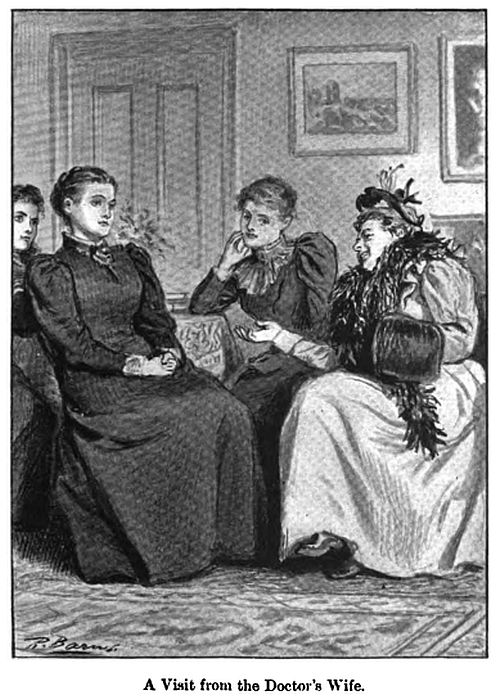
They were at home, and Deborah, somewhat overcome by the honour of a call from Mrs Burgess, admitted and announced her without hesitation. It was not in lady nature, certainly not in Mrs Derwent’s nature, to be other than perfectly courteous in her own house to any visitor, however little desired, and, as was almost a matter of course with a woman of Mrs Burgess’s calibre, she mistook the gentle gravity with which she was received for somewhat awe-struck gratification at her visit, and speedily proceeded to make herself very much at home, very much at home indeed.
This process consisted of several stages. In the first place, after ensconsing herself in the most comfortable chair—Mrs Burgess had a quick eye for a comfortable chair—and amiably waving her hostess to one conveniently near, and, as she expressed it, on her “best side”—for the doctor’s wife was deaf—she loosened her cloak, remarking that, though cold out-of-doors, it was rather “warm in here,” the ceilings were low, and low rooms get quickly “stuffy.”
“Indeed,” said Mrs Derwent. “I am sorry you find it so. We think these rooms very well ventilated. Old-fashioned, thick-walled houses are often warm in winter as well as cool in summer.”
“Pr’aps so,” said Mrs Burgess, “but I’m all for modern improvements. We’ve done a deal to our house; we’d almost better have rebuilt it. But you’ve been living abroad, I believe. Foreign houses are quite another style of thing, I suppose? Very rough compared with English.”
Mrs Derwent could not repress a smile.
”‘Foreign’ is a wide word,” she said, “if you mean it in the sense of anything or everything not English. No, I cannot say that we have been accustomed to living in very rough ways, and there are many beautiful houses in the south of France.”
“Oh, the south of France!” repeated her visitor, who had not very clearly caught the rest of Mrs Derwent’s speech. “Yes, I suppose that’s very much improved by so many English going over there for the winters. And was it for health, then, that you lived there? These young ladies don’t look so very strong. I must tell Mr Burgess to keep his eye on them—living so near, it would be quite a pleasure. But, oh, I was forgetting. You’re thinking of living out of town a bit?”
“Yes,” said Mrs Derwent. “I have taken a house at Pinnerton Green—Pinnerton Lodge.”
Mrs Burgess screwed up her lips.
“Damp,” she said oracularly. “I don’t hold with all these trees. And these delicate girls—”
“Thank you, you are very kind,” said Mrs Derwent, more stiffly; “but my daughters are not delicate, and—”
The only word that caught Mrs Burgess’s ears was the objectionable adjective.
“Of course, of course,” she repeated; “I could see it in a moment. But I’ll tell you what you must do—have the trees thinned. That’s what the Wandles did in their grounds at Pinnerton; they had the trees well thinned, especially at the side of the house, where the children’s windows look out. Mrs Wandle is most kind. I’m sure a word from me, and she’d come to see you and tell you all about it. You don’t know her, of course? Never mind; I’ll ask her to call. You see this is a great tree country, and if you’re not used to—”
“I know all about this part of the country very well, thank you; and I think it particularly healthy. I was brought up here, and we are not the least afraid of Pinnerton being damp,” said Mrs Derwent, in her irritation adding more than she need have done, or had meant to do.
Mrs Burgess, in her eagerness at some volunteered information, had listened with extra attention.
“You were brought up here?” she exclaimed. “Where? Here, at Blissmore?”
“No; at Fotherley,” Mrs Derwent replied, in a sort of desperation, thinking, perhaps, that the best policy would be to tell all there was to tell, and so get rid of this unwelcome visitor. “My father, Mr Fenning, was the vicar of Fotherley, and I lived there with him till a short time before his death. I married abroad, and have never been in England since.”
“Dear, dear, how very interesting!” Mrs Burgess exclaimed. “I have heard the name, Mr Fleming of Fotherley; though, of course, it was before my time.”
“Fenning, not Fleming,” said Mrs Derwent, who had reason for objecting to this mistake.
“Ah yes; Fleming,” responded Mrs Burgess serenely.
And Mrs Derwent, afraid of beginning to laugh out of sheer nervousness and irritation, gave up the attempt to set her right.
Then followed more cross-questioning, in which the doctor’s wife was almost as great an adept as the smartest of great ladies. She varied her inquiries skilfully from mother to daughters, and back to mother again, till none of the three felt sure what sort of correct or “crooked” answers they had been beguiled into giving, and finally took leave in high good-humour, reiterating at the last that she would not forget to speak to Mrs Wandle; Mrs Derwent might depend upon her. “A word from me will be enough: we are such great friends. I am sure she will call as soon as she hears how anxious you are to see her.”
As the door closed upon her, Mrs Derwent and Blanche looked first at each other, then at Stasy, who put on an expression of extra innocence and indifference. This hardened Blanche’s heart.
“Well, Stasy,” she said, “I hope you are satisfied. See what you have done by telling Mr Burgess we felt dull, and so on.”
“I don’t mind her having called,” said Stasy, determined to keep up a brave front. “I think she is most amusing; and what possible harm can she do us?”
“Every harm of the kind; though, of course, I suppose one should try to be above those things,” said Blanche doubtfully. “But still, we didn’t come to live in England to have as our only friends and companions people we cannot feel in sympathy with. It is not wrong not to want to live among coarse-natured, vulgar-minded people, if it isn’t one’s duty to do so.”
“There are vulgar minds in every class, I fear,” said Mrs Derwent. “Still, that is a different matter. I do wish this had not begun; for I do not like to seem arrogant or ill-natured. And it is very difficult to keep a pushing woman like this Mrs Burgess at a distance, without being really disagreeable to her.”
“We could stand her even,” said Blanche, regretfully. “There would be a sort of excuse for it, as she is the doctor’s wife; but it is all these other awful people she is going to bring down upon us, ‘butchers and bakers and candlestick-makers,’ like the nursery rhyme you used to say, mamma! And if other people—refined people—hear we are in the midst of such society as that, they won’t want to know us. I wish we hadn’t come to Blissmore.”
It was not often that Blanche was so discomposed. Her mother tried to soften matters.
“It will only call for a little tact, my dear,” she said. “I am sure we shall be able to make them understand. It is not as if we were going to live in the town.”
“But Pinnerton Green is a nest of them,” said Blanche.
“That won’t matter so much. Once we are in our own house we can draw our own lines. And when other people—better people—come to see us, these good folk will keep out of the way,” said Mrs Derwent.
“Well, I wish you would look up some of them, mamma,” said Stasy. “For my part, I would rather amuse myself with the Goths and Wandles, than know nobody at all.”
The others could not help laughing; but, nevertheless, Blanche still felt not a little annoyed. She was more concerned for her sister than for herself; for there was a vein in Stasy’s character which sometimes caused her mother and Blanche uneasiness—a love of excitement and amusement at all costs.
“She must have some really good companions,” thought the elder girl.
And that very evening she persuaded her mother to write to Mrs Lilford, Sir Adam Nigel’s niece, recalling herself to that lady’s memory. The letter was addressed to Alderwood, and marked “to be forwarded.”
“I hope something will come of it,” said Blanche. “And you must try to remember some other nice people, mamma; though, if Mrs Lilford is kind, she can do a good deal in the way of introducing us, even though she no longer lives here herself.”
Chapter Seven.
Mrs Lilford’s Tenant.
In the increasing interest of getting the house at Pinnerton Green into order, the arrival of the furniture from Bordeaux, the unpacking of various precious belongings which had been left to come with the heavy things by sea, all of which necessitated almost daily expeditions to the new home, Mrs Derwent and her daughters forgot to think much of Mrs Burgess and her unwelcome offers of introductions.
And as Mrs Wandle did not present herself, they began to hope that perhaps the doctor’s wife was as short of memory as she was hard of hearing.
Still the latent fear was there, though what was to be done to evade the acquaintance, it was difficult to say.
One afternoon—a dull, December afternoon, when the air was misty and penetratingly cold, and one could only feel thankful it had not the addition of smoke to turn it into fog of the first quality—the little family was sitting in Miss Halliday’s well-warmed, best parlour, glad that the walk to Pinnerton Lodge had taken place that morning, before the day had become so ungenial; and Stasy was proposing that, to cheer them up a little, they should have afternoon tea rather earlier than usual, when suddenly a sharp rat-tat-tat at the front door—for the house owned both knocker and bell—followed by a resounding tinkle, made them all start.
“Who can it be?” said Blanche. “It isn’t often that any one both rings and knocks.”
“A telegram,” said Mrs Derwent. “No; that isn’t likely. There is no one to telegraph to us.”
Then Deborah was heard hurrying along the passage; her footsteps sounded as if she were somewhat flurried with the anticipation of a visitor of more importance than the postman or milkman. The ladies listened with curiosity, as a colloquy ensued between Deborah and some person or persons unknown, ending, after some little delay, by footsteps slow and heavy, following the small servant’s patter along the passage.
Blanche glanced at her mother.
“Mrs Wandle,” she ejaculated in a stage whisper.—“Stasy, jump up. For goodness’ sake, let us be dignified to her.”
For Stasy was sitting on a low footstool on the hearthrug, doing nothing, as was rather a favourite occupation of hers, and greatly enjoying the agreeable glow of the fire, which had sunk down to the pleasant redness preceding the sad necessity of “fresh coals,” and the consequent “spoiling it all” for the next half-hour.
“Coal-fires are very interesting, I find,” she had just been saying. “It almost makes up for the pleasure of turning the logs and seeing the sparks fly out, to watch the pictures in a coal-fire. The fairy castles and the caverns, and the— Oh, there is Monsieur Bergeret’s nose! Do look, Blanche. Did you ever see anything so exactly like?”
But “Jump up, Stasy,” was all the reply she got, and as the door slowly opened, a repeated whispered warning—“Mrs Wandle.”
The name was not clearly audible which Deborah announced, but she announced something, and to the prepossessed ears of her audience it sounded as like “Mrs Wandle” as anything else. And in trotted, with as much dignity as a stout, short person can achieve, a lady enveloped in furs and wraps, who, after glancing round her with a sort of “nonchalant” curiosity, held out a somewhat limp hand to Mrs Derwent.
“How de do?” she began. “I heard from Mrs—” (afterwards, with a sensation of guilt and self-reproach, Blanche had to own to herself that the name had not sounded like “Burgess”) “that you—I mean that she would like me to call, though it’s quite out of my way to come into Blissmore. Are these your daughters?—How de do? how de do?”
And then she sank into a chair, apparently at an end of her conversational resources.
“What an impertinent, vulgar old cat!” thought Stasy, shivering prospectively at the “all your doings” which she felt sure were in reserve for her.
But aloud, of course, she said nothing, only sat motionless, her great dark eyes fixed on the stranger with a peculiar expression which Blanche knew well.
For a moment or two there was silence. Then Mrs Derwent’s clear, quiet tones sounded through the room.
“I am sorry you should have inconvenienced yourself by coming out of your way to see us,” she said. “I trust you will not dream of giving yourself the trouble a second time.”
“Well, no, I don’t think I shall,” the visitor replied calmly. “I hear you are going to live at Pinnerton. I should be glad to show you the pictures, and anything else you care to see, if you come over some day. It’s not a very long walk over the fields.”
“Some of us go to Pinnerton nearly every day,” said Mrs Derwent, “but it is too far for me to walk. When I go, I drive. But I did not know there was a short cut to Pinnerton. We have always gone by the road.”
“I didn’t say to Pinnerton,” said the visitor. “I said from Pinnerton. I don’t live there, but I heard you were going to live there.”
“So we are,” Mrs Derwent replied, rather bewildered.
Evidently this could not be the Mrs Wandle, the Pinnerton Green Mrs Wandle, that was to say, and yet—she had distinctly said that she had been asked to call upon them.
“You used to live in our neighbourhood, I hear,” the stout lady proceeded. “Fleming, I think that was the name?”
“No,” Mrs Derwent replied rather sharply. If there was one thing in the world she cordially detested, it was to be confused with the Fleming family, whom she remembered, before they came to Fotherley, as very objectionable. “No, my name was Fenning. My father was vicar of Fotherley, and Mr Fleming, who succeeded him there, and was once his curate, had a small living in the neighbourhood.”
“Oh, indeed—yes, Fenning or Fleming. I knew it was some such name. Well, Mrs Flem— I beg your pardon, Mrs Derwent. If you like to come over some day when you are at Pinnerton, you can see through the house, even if I am not at home. I will leave orders. I can’t promise to go to see you at Pinnerton, for it’s quite out of my way. Even when I am at East Moddersham, I always go and come by the other side.”
“At East Moddersham?” said the Derwents to themselves, more completely perplexed than ever. “Did the Wandles visit there?”
“East Moddersham is Sir Conway Marth’s, is it not?” said Blanche. “Can you tell me if that charming-looking girl whom I have seen riding about there is his niece?”
The visitor looked at her for a moment without speaking. It was a calm, deliberate taking stock of her, of which Blanche felt the extreme though, quite possibly, not intended rudeness, and her cheeks grew crimson. On the whole, the taking stock seemed to result favourably.
“No, but she is his ward,” the stout lady replied; “I suppose you mean Lady Hebe Shetland. She is very lovely,” and a softer and more genial expression came over the plain face as she spoke. “You have lived a great deal in France, I hear,” she went on, continuing to address Blanche. “It must have been a great advantage to you. I suppose you speak French quite well—without any accent?”
“Naturally,” said Stasy, and her clear, rather shrill voice almost made the others jump. “How could we help speaking it perfectly, when it was the language of the country we were born and brought up in?” She got no reply. The lady glanced at her for half an instant, as if to say, “What an impertinent child!”—then turned again to Blanche. “I should like you to come to luncheon with me some day. I will let you know a day that I shall be quite alone, so that we could talk French all the time. I want to rub up my French. Mr Dunstan and I go abroad every year, and I like to speak French perfectly.”
Then, quite satisfied that she had made herself most agreeable, the visitor rose, and saying as she shook hands, “I shall tell Mrs Lilford I saw you. And you must come over to see the pictures some day,” she slowly made her way to the door, which Blanche had scarcely presence of mind enough left to open for her. There was no need to ring for Deborah, who was waiting in the passage, in a state of flutter.
“Deborah,” said Blanche, as soon as the front door, disclosing a view of a ponderous-looking carriage in attendance, had finally closed, “Who is that lady? Is it a Mrs Wandle, or who?”
“Lor, Miss—Mrs Wandle! No indeed, Miss; its Lady Harriot Dunstan—the lady as lives at Alderwood Park.”
Blanche went back into the sitting-room, and shut the door.
“Mamma,” she said, “do you know who that was? It was Mrs Lilford’s friend—at least I suppose she is her friend, as well as her tenant—Lady Harriot Dunstan.”
“And we thought she was Mrs Wandle, the brewers wife!” said Stasy, going off into a fit of laughter. “Whoever she is, she is a vulgar, impertinent old cat.—Oh, mamma, are all English people so stupid and horrid? Why, she’s worse than Mrs Burgess.”
The mention of Mrs Burgess brought a look of annoyance to Blanche’s face.
“It has all come of your hinting to Mr Burgess that we should like his wife to call, Stasy,” she said. “Lady Harriot may not be the most charming or intelligent of human beings, but still, if we hadn’t had our heads full of Wandles and Burgesses, we should have met her differently, and perhaps got on better with her. She must have thought us very stiff and queer in our manners.”
“Yes,” agreed Mrs Derwent, “I am sorry about it, certainly. This Lady Harriot seems the only direct link I have, as she is evidently an intimate friend of Mrs Lilford, Sir Adam’s niece. It must be in consequence of my letter to Mrs Lilford that she has called. But—she surely cannot have been told much about us, or she would not have been so—so—”
“So horribly rude and patronising,” said Stasy. “Oh, mamma, whoever she is, and even if we were never to make any friends at all, don’t let us have anything to do with such people as that. And I—I used to think English people were all so nice and refined!”
The tears rose to her eyes—tears partly of disappointment and mortification, partly of vexation with herself. And instantly, as was always the case where Stasy was concerned, the hearts of her mother and sister softened to her again.
“My dear child, how you do rush at conclusions!” Mrs Derwent exclaimed. “Because we have come across two commonplace, perhaps I must say vulgar-minded women, you make up your mind that English society is composed of such people.”
“And,” Blanche added eagerly, “did you notice, mamma, how even Lady Harriot’s dull face lighted up when she spoke of Lady Hebe? Mamma, I am perfectly certain that girl is as good as she is charming. It refreshes me merely to think of her face—Stasy, I wish you had seen her better.”
“I did see her well enough. I thought she was lovely, and she looked as if she’d never had a trouble in her life. Oh, I daresay there are some nice people in England, but I don’t believe we shall know any of them,” said Stasy very lugubriously.
The next morning threw more light on the visit of the day before, for it brought a letter from Mrs Lilford. Mrs Derwent, guessing who was the writer, opened it with interest and some curiosity, but she had not read far before she startled her daughters with a sudden exclamation.
“What is it, mamma?” said Blanche.
“It is from Mrs Lilford, Sir Adam Nigel’s niece,” she said; “and, fancy, Blanchie—I am so delighted—he is not dead. Dear old Sir Adam, I mean. Listen. I may be hearing from him before very long.”
And she went on to read aloud from the letter.
“I am glad to say that you have been misinformed about my uncle. Though he left Alderwood several years ago, at which time he gave it up to me, he is still living. His health would not stand English winters, and he spends eight or nine months of the year in Algeria. When I write to him next, I will tell him of your return to England. In the meantime I have asked my friend and tenant, Lady Harriot Dunstan, to call upon you, and I have no doubt she will be glad to be of any little neighbourly service in her power.” Then followed Sir Adam Nigel’s address, and a few sufficiently cordial words. But the tone of the whole was barely “friendly,” though ladylike and courteous.
Mrs Derwent, however, was too pleased with the news of Sir Adam to think much of anything else.
“I am so delighted,” she repeated—“so glad to think I shall see him again.”
Blanche took up the letter, and toyed with it in her fingers. The distant Sir Adam seemed to her and Stasy of less importance than matters nearer at hand. Her silence caught her mother’s attention.
“It is a nice letter,” Mrs Derwent said.
“Oh yes,” said Blanche; “but she doesn’t seem very interested in us, mamma. And then, of course, as she has let Alderwood, she is not going to live here; so perhaps it doesn’t very much matter. But I wish that Lady Harriot had been nicer.”
Mrs Derwent’s face lost its joyous expression.
“I wish Sir Adam were going to be at Alderwood again,” she said with a little sigh. “That would have made all the difference. Mrs Lilford did not know me well. She was four or five years older, and she married and went to India before I was grown up. She only remembers me as a child more or less. But now I can write to Sir Adam himself, and he will be sure to ask some old friends to come to see us.”
And that very day she did so.
But the result was not what she had hoped. A few thoroughly kind words from her old friend came in response in the course of a week or two, hoping to see her and her children on his return to England the following spring, but evidently not “taking in” the Derwents’ present loneliness. “I hear from Amy Lilford that she has asked her tenants to look after you a little,” he said. “I don’t know them personally, but you will like to have the run of the old place again.”
And Mrs Derwent could not make up her mind to trouble him further. “Men hate writing any letters that are not business ones,” she said to Blanche. “We must just wait till he comes back in the spring, and make ourselves as happy as we can till then; though, of course, I hope some people will call on us as soon as we are settled. The Marths at East Moddersham could scarcely do less.”
To some little extent her expectations were fulfilled. The wife of the vicar of Blissmore called. The vicar was a younger son of the important Enneslie family, enjoying the living in his father’s gift after old-fashioned orthodox fashion, and Mrs Enneslie was a conscientious “caller” on all her husbands parishioners. She had perception enough to discern the Derwents’ refinement and superiority at a glance, but she was a very busy woman, with experience enough to know that to be accepted by the “County,” much more than these qualities was demanded. And she contented herself with such kindly attentions to the strangers as lay in her own power. She did a little more. She spoke of them to her brother, the Pinnerton Green parson, who promised that his wife should look them up as soon as they came under his clerical wing.
“They seem nice girls,” she said, with perhaps some kindly meant diplomacy. “It would be good for them to do a little Sunday-schooling or something of that kind.”
So the weeks passed, bringing with them the exasperating delays which every one in the agonies of house changing thinks peculiar to one’s own case; and Christmas came and went before the Derwents could even name a time with any certainty for taking possession of their new home. It was a dull Christmas. Not that, with their French experience, the young people were accustomed to Yule-tide joviality; but they had heard so much about it—had pictured to themselves the delights of an overflowing country-house, the glories of a real English Christmas, as their mother had so often from their earliest years described it to them.
And the reality—Miss Halliday’s best sitting-room, with some sprigs of holly, a miniature (though far from badly made) plum-pudding, no presents or felicitations except those they gave each other!
“Another of my illusions gone,” said Stasy, with half-comical pathos, which drew forth a warning whisper from Blanche of “Don’t, Stasy. It worries mamma,” and aloud the reminder:
“Everything will be quite different when we are in our own house, you silly girl.”
And when at last the own house did come, and the pleasant stage began of making the rooms home-like and pretty with the old friends so long immured in packing cases, and the new dainty trifles picked up in London, in spite of the fogs, for a short time they were all very busy, and perfectly happy—satisfied that the lonely half-homesick feeling had only been a passing experience.
“I am really glad not to have made new friends till now,” said Mrs Derwent. “It does look so different here, though we have been very comfortable at Miss Halliday’s, and she has been most good to us.”
“Yes,” Blanche agreed; “and I think we should make up our minds to be happy here, whether we know many nice people or not, mamma. The only thing I really care about is a little good companionship for Stasy.”
“She must not make friends with any girls beneath her—as to that I am determined,” said Mrs Derwent.
“Far better have none. Not that anything could make her common, but it would be bad for her to feel herself the superior; and I can picture her queening it over others, and then making fun of them and their homes and ways. She has such a sense of the ridiculous. No; Stasy needs to be with those she can look up to. I am sure, Blanche, it is better not to think of her going to that day-school at Blissmore.”
For Stasy was only sixteen, and the question of her studies was still a question. At Blissmore, under the shadow of the now important public school for boys, various minor institutions for girls were springing up, all, as might have been expected, of a rather mixed class, though the teaching in most was good.
And Stasy, for her part, would have thought it “great fun” to go to school for a year or so.
The matter was compromised by arrangements being made for her having private lessons at home on certain days of the week, and joining one or two classes at the best girls’ school at Blissmore on others, to which she could be escorted by Aline when she took little Herty to his day-school.
Chapter Eight.
Old Scenes.
By March the Derwents felt quite at home in their new abode; in one sense, almost too much so. The excitement of settling had sobered down; the housekeeping arrangements were completed, and promising to work smoothly. For Mrs Derwent had profited by her twenty years of French life in becoming a most capable and practical housewife, and being naturally quick and able to adapt herself, she soon mastered the little difficulties consequent on the very different ideas as to material questions of her own and her adopted country.
So that, in point of fact, time was in danger of hanging rather heavily on their hands; there was really so little to do!
Their peculiar position cut them off from many of the occupations with which most of us nowadays are only too heavily burdened. They had few letters to write, for Frenchwomen are not great correspondents—in the provinces, at least—and when the Derwents left Bordeaux, their old friends there extracted no promises of “writing very often—very, very often.”
“Notes,” of course, which in London seem to use up hours of each day, there was never any occasion for. They had no calls to pay, beyond a rare one at the vicarage; no visitors to receive. For the Pinnerton Green folk had not followed suit, as the Derwents had feared, after Mrs Burgess’s invasion. Nothing had been heard of Mrs Wandle, and—probably through some breath of the great Lady Harriot Dunstan’s visit, and Mrs Enneslie’s introduction of the new-comers to her relations at Pinnerton Vicarage—the immediate neighbours had held back: the “butchers and bakers and candlestick-makers” had left them in peace. Mrs Burgess having been called away to a sick sister or niece early in the winter, and not yet having returned, even the excitement of watching her tactics had been wanting.
In short, the Derwents, socially speaking, were very distinctly in the position, to use a homely old saying, of “falling between two stools.”
And though Stasy was the least to be pitied, for her lessons kept her pretty fairly busy, and she managed to find food for amusement and material for mimicry among her class companions—some of whom, too, she really liked—at Mrs Maxton’s school, she was the readiest to grumble.
“What is the use of making the house pretty when there is no one to see it?” she said to her sister one afternoon, when the two had been employing themselves in hunting for early violets and primroses in the woods, with which to adorn the library, their favourite sitting-room. There were not many of these spring treasures as yet, for the season was a late one, but they were laden with other spoil, as lovely in its way—great trails of ivy and bunches of withered or half-withered leaves of every shade, from golden brown to crimson, which in sheltered nooks were still to be found arrested in their beautiful decay.
“What is the use of making the house pretty when there is never any one to see it?” Stasy repeated, as she flicked away an unsightly twig from the quaint posy she was carrying, for Blanche had not at once replied.
“There is always use in making one’s home as pretty as possible. There are ourselves to see it, and the—the thing itself,” replied Blanche a little vaguely.
“What do you mean by the thing itself?” Stasy demanded.
“The being pretty, or the trying to be—the aiming at beauty, I suppose, I mean,” said Blanche. “Can’t you imagine a painter giving years to a beautiful picture, even though he knew no one would ever see it but himself? or a musician composing music no one would ever hear?”
“No,” said Stasy, “I can’t. That sort of thing is flights above me, Blanchie. I like human beings about me—lots of them; they generally interest me, and often amuse me. I like a good many, and I am quite ready to love some. I want sympathy and life, and—and—well, perhaps, a little admiration. And I do think it’s too horribly dull here; at least, I’m afraid it’s going to be. I would rather leave off being at all grand, and get some fun out of the Wandles, and the Beltons, and all the rest of them.”
“Mamma is still looking forward to Sir Adam’s return in the spring—well, soon, it should be now. It is spring already,” said Blanche, rather at a loss, as she often was, how to reply to Stasy’s outburst.
“I don’t believe he’ll come to see us; or if he does, I don’t suppose it would do us much good. He has been away so long, and is no use to the neighbourhood; and I believe that’s all that most people care about,” said Stasy cynically. “These families round about here live their own lives and have their own circles. They’ll all be going up to London directly, I suppose, for the season. They don’t want us, or care about quiet, not very rich, people like us. England isn’t a bit like what I thought it would be.”
“We can’t quite judge yet,” said Blanche. “And—I am sure you are too sweeping, Stasy. Mamma may have been too sanguine, and have seen things too much through rose-coloured spectacles, but she cannot be altogether mistaken in her pleasant remembrances of her old friends—the ‘best’ people—among whom she lived.”
“Would you give Lady Harriot Dunstan as a specimen?” said Stasy snappishly.
“No; she would be a common-minded, inferior woman in any class,” said Blanche. “I believe that is the truth of it all: there are refined and charming natures to be found in every class, and there are the opposite.”
“Well, then, let us hunt up a few among the Blissmore bourgeoisie, and content ourselves with them,” said Stasy.
“No,” said Blanche again. “It is one’s duty to live in one’s own class unless one is plainly shown it is necessary to leave it. And that reminds me, speaking of Lady Harriot, I really think mamma should call there, now we are settled. She did not mean to be impertinent, we must remember.”
“I don’t need to go, as I’m not out,” said Stasy. “Besides, one of us would be enough in any case. I would have liked to see Alderwood, though, but I won’t go the way those Blissmore girls go, on a ‘show’ day—‘open to the public’—faugh!” with great disgust.
Blanche could not help laughing.
“How consistent you are,” she said.—“Well, Herty,” as at that moment her little brother came flying out of their own gate to meet them, “why didn’t you come with us to the woods to gather leaves and hunt for violets?”
“I meant to come,” said Herty regretfully, “but when I’d finished my lessons for Monday, you were gone, and I couldn’t see you, though I ran as far down the road as I could. Oh, Blanchie,” he went on, “I met such a nice lady riding. She saw I was looking up and down, and she stopped her horse and spoke to me. I asked her if she’d seen two girls like you and Stasy, and she said no, but if she did, she’d tell you I was looking for you. She said she knew you by sight, and she hoped we liked living at Pinnerton.”
“Was it a young lady?” asked Blanche.
“Yes,” said the boy, “and she came out of those big gates, nearly opposite the lane, you know. She had a nice face, not as pretty as yours, Blanchie, but about as pretty as—” And he glanced at his younger sister dubiously. “No, she wasn’t like Stasy. She had a more shiny face.”
“Thank you,” said Stasy. “Perhaps she uses Pears’s soap, which I don’t.”
Herty looked puzzled.
“That’s not what I mean,” he said. “It was a pretty, shiny way—out of her eyes, too. Not soapy. You are silly, Stasy.”
“I know,” said Blanche with interest, and not sorry to divert the quarrel, which she saw impending between the two—“I know who it was. It must have been the girl with the happy face—Lady Hebe. That was what Herty was trying to describe. You might say ‘sunshiny,’ instead of ‘shiny,’ Herty.”
“Yes, that’s what I meant,” he said. “Her face smiled all over.”
“And did you say we did like Pinnerton?” inquired Stasy with some eagerness.
“I said I did, except when I’d too many lessons; and I said Blanchie did, but Stasy said it was very dull.”
Stasy looked uncertain whether to be pleased or vexed.
“What did she say?” she asked.
“She said it wasn’t so bright here as in France, and she’d been there all this time since Christmas, and then she nodded and trotted away,” was Herty’s reply.
“I thought she must be away,” said Blanche.
“Why—because she has not called upon us?” said Stasy, with what was meant for extreme irony.
“No,” said Blanche quietly. “She could not call unless her friends did, of course, and I don’t think the Marths are old acquaintances of mamma’s. But I had a feeling that she was away. We should have met her, riding or walking about.”
“I don’t suppose she ever walks,” said Stasy.
“Nonsense, Stasy! English girls are not like that. And don’t you remember Mrs Harrowby, the vicar’s wife, saying the other day that some of the girls in the neighbourhood were very good about the poor people, but that, unluckily, the most influential were seldom here. It was when she was telling us about the classes she wants to get up for some of the older girls.”
“No,” said Stasy, “I didn’t pay attention. I suppose I thought she was speaking of the Miss Wandles and the Miss Beltons, and all the other Miss Somebodies or Nobodies. I don’t care about poor people: it’s not my line—excepting making a quête. I used to like doing that when I was a little girl.”
Blanche said nothing. She had considerable experience of Stasy’s contrariness.
But a certain pleasurable though vague sense of anticipation had made its way into her mind since hearing of Herty’s meeting with Lady Hebe.
“I do feel so sure she is good and unselfish and thoughtful for others,” she said to herself. “She may not have much in her power, but I feel as if she would like to be kind to us. I don’t care so much for myself, of course, though it would be nice to know her; but it is for Stasy. I am so afraid of the friends she may make if she has not nice ones.”
And Blanche’s face looked anxious and perturbed as they re-entered their own little domain, laden with their pretty spoils.
Two things happened in the course of the next few days, which somewhat broke the monotony of the Derwents’ daily life. The first was a drive to Alderwood, to return Lady Harriot’s call. Blanche impressed upon her mother that whether the visit was expected of them or not, it was due to their own dignity to make it, notwithstanding the unfavourable impression that Mrs Lilford’s tenant had left with them.
“If we don’t call, she will think us fair game for patronising and condescending to. Of course we must, and we should have done so before.”
“I have kept hoping to hear again from Sir Adam or Mrs Lilford,” said Mrs Derwent. “I should much have preferred not to meet Lady Harriot till she understood better about us.”
“She will probably ring the bell and tell the housekeeper to show us the pictures,” said Stasy. “You, not ‘us,’ I should say, for, of course, I needn’t go.”
“You can go with us for the drive and wait in the fly outside,” said Blanche.
For though they had been talking of a pony-carriage “in the spring,” they had not yet heard of a suitable steed; and on the whole, perhaps Mrs Derwent was not sorry to defer for a little any avoidable expense, the installation at Pinnerton Lodge having cost, as is always the case in such matters, much more than she had anticipated.
Stasy received her sister’s proposal with a laugh. “All right,” she said. “Anything for a spree. I’ll come.”
Something in her tone slightly grated on Blanche.
“Stasy,” she said, “I do hope even the little you see of those girls at Mrs Maxton’s is not doing you any harm. You—you seem to be catching up their expressions.”
“What b— nonsense!” said Stasy, quickly substituting the second word, though she could not help reddening a little. “Mamma, you know better than Blanche. Is there anything unladylike in ‘all right,’ or ‘a spree?’”
“I can scarcely say, my dear,” said her mother. “But I know what your sister means. It is the tone we—”
Stasy ran across the room and stopped her mother saying more, by a kiss.
“Don’t be afraid,” she said. “I’m not going to get vulgar and horrid. And some of those girls are really quite nice, mamma. I’ll tell you what—I wish you’d let me invite one or two here one afternoon to tea. Oh, might I? It would be so nice. I’d like them to see you and Blanchie, and then you can judge for yourselves if the ones I bring aren’t quite ladylike. It is so dull sometimes, mamma. Do say I may.”
“I will think about it, dear,” said Mrs Derwent. “It is not that I have any prejudice against the girls. I daresay there are among them truly refined and charming natures, but I do not want to open a visiting acquaintance in Blissmore. I did not bring you to live in England to fall into a lower social position than is naturally ours. It was not for that we left our dear old home at Bordeaux.”
There was a slight catch in the mother’s voice as she said the last words, that made both her daughters look at her anxiously.
“Mamma dear,” whispered Stasy, “do you sometimes wish we hadn’t left it?”
“I can’t say, dear. I did it for the best, and we must be patient still,” she replied.
But when the sisters were alone, Stasy confided to Blanche that she thought “mamma” just a trifle prejudiced and narrow-minded.
“Si on n’a pas ce qu’on aime,” she said in her half-laughing, half-grumbling way, “il faut aimer ce qu’on a. If we can’t have grand friends, much better content ourselves with common ones. We are not put into the world to live alone: anything is better than dullness.”
“I am not so sure of that,” said Blanche.
The next day they went to call at Alderwood.
It was a real spring afternoon, and though the air had still a touch of keenness in it, it was full of the exhilaration which is the essential charm of the childhood of Nature’s year. In spite of some anticipatory shivers, Stasy persuaded her mother and Blanche to have the carriage open, filling it with shawls and rugs, “in case they should be cold,” though as regarded herself, she felt sure that would be impossible.
The first part of the road was familiar to them, as they had to go some considerable part of the way to Blissmore before reaching the cross-country route to Alderwood, which lay on the other side of the town. But once they had turned in the Alderwood direction, a lovely view was before them, and the girls burst into expressions of pleasure; while to their mother, every cottage, every milestone almost, recalled her happy youth.
“I am so glad to find I remember it all so well,” she said. “It makes me feel more at home than I have done yet. Is it not really a charming country? I wish we could have found a house near Alderwood.”
“I don’t,” whispered Stasy, with a private grimace for Blanche’s benefit.
When they reached the lodge gates and were driving slowly up the avenue, Mrs Derwent became perfectly silent, and her daughters respected her mingled feelings. For Alderwood in the old days, as they knew, had been almost as much “home” to her as the pretty Fotherley vicarage.
The anticipation of an interview with Lady Harriot Dunstan was a safe tonic against emotion or overmuch sentiment. And on the servant’s reply that her ladyship was at home, it was with a perfectly calm and dignified demeanour that Mrs Derwent, followed by Blanche, got out of the fly and made her way up the stone steps and across the tiled hall to the inner vestibule, whence opened the drawing-rooms and morning-room, all of which she knew so well. She felt as if in a dream: every footfall seemed to carry her back a quarter of a century. But for a glance at the grave face of the fair, beautiful girl beside her, she could have fancied all the events of the intervening years to have been imaginary, and herself again “Stasy Fenning,” running in with some message from “papa” to her kindly godfather!
Chapter Nine.
Afternoon Meetings.
When the door was thrown open, and the butler’s sonorous tones announcing Mrs and Miss Derwent made the occupants of the room turn round, and the short, stout figure of their hostess came waddling towards all illusion was dispelled, and with a little sigh Blanche’s mother came back to the very different present.
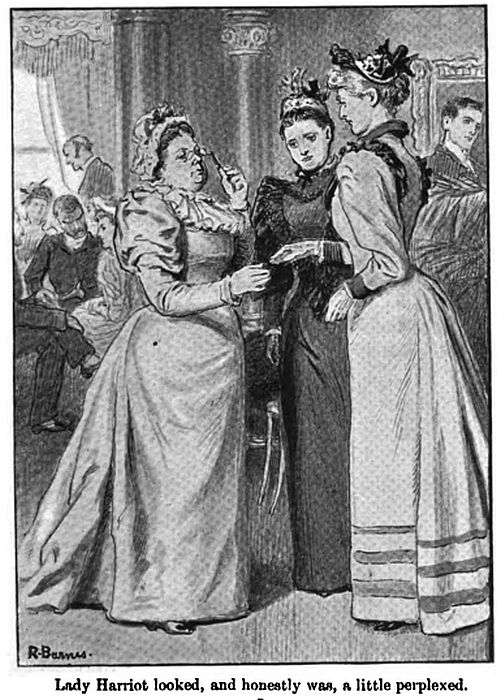
Lady Harriot, whose manners, as I have indicated, were not exactly “grande dame,” looked, and honestly was, a little perplexed.
“How de do?” she said, with as much civility as she was in the habit of showing to any but her immediate cronies, and turning to Blanche, “How de do?”
Blanche happened at the moment to be standing in the full light, and as she looked down in calm response to the little woman’s greeting, even obtuse Lady Harriot was struck by her incontestable beauty.
“She stood there like a picture,” said one of the others present, when describing the momentary scene, and though the words were childish, they expressed the feeling.
Nevertheless, “the picture” was the first to take in the whole situation.
“Mamma,” she said quietly, “I scarcely think Lady Harriot Dunstan recognises us.”
“Oh yes, I do; at least I—I’m sure I’ve seen you before,” began Lady Harriot, in a nearer approach to flutter than was usual with her. For, after all, she was “a lady born,” as the poor folk express it, and conscious of the obligations of a hostess. “I’m sure I—”
“You were so good as to come to see us when we were staying temporarily at Blissmore,” said Mrs Derwent clearly. “I believe you did so at Mrs Lilford’s request. And I should apologise for not having returned your call sooner, but till quite lately we have been in the agonies of furnishing and moving into our house.”
A light broke over Lady Harriot’s face, but with the illumination her slight diffidence disappeared. She relapsed into her stolid, self-satisfied self, and the change was not an improvement.
“Oh yes, I thought I’d seen you before,” she said. “I’ve been away, but you needn’t have minded. I told the housekeeper after I saw you that you might be coming over to see the—”
“Aunt Harriot,” said a masculine voice, suddenly breaking in at this juncture, “excuse me, but is there any reason why your friends and you should be standing all this time? If you specially want to remain in that part of the room, may I not at least bring some chairs forward?”
And then Blanche, lifting her eyes, saw that a man, a very young man he seemed to her at first sight, was standing not many paces off, behind Lady Harriot, slightly hidden by some intervening furniture or upholstery.
He came forward as he spoke, thus entirely disengaging himself from a little group—two or three women sitting, and another older man, who had also, of course, risen from his chair—at one end of the room, and Blanche’s grave eyes scanned him with some interest.
It is sometimes—often—well that we are in ignorance of the unspoken thoughts of those about us, but it is sometimes to be regretted. A link of sympathy would have been quickly forged between the girl and the man in this case, had she known the words which almost forced themselves through his teeth.
“Those confounded pictures! Is Aunt Harriot an utter fool?” he said to himself. “To speak to women like these as if they were her maid’s cousins asking to see the house!”
Lady Harriot turned, and a smile—the first of its kind that the Derwents had seen—came over her face, mellowing its plain features with a pleasant glow, for her husbands nephew, Archie Dunstan, owned perhaps the softest spot in her heart.
“Certainly,” she said. “Won’t you sit down, Mrs— Oh, I know,” triumphantly, “Mrs Fleming?” Irritating as it was, Blanche could not repress a smile; and the smile, like an electric spark, darted across to Archie Dunstan, and was reflected in his face. Mrs Derwent flushed slightly; she too was more than half inclined to laugh.
“No, Lady Harriot,” she said, “I am sorry to contradict you, but in this instance you do not ‘know.’ My name is Derwent. It used to be Fenning, in the old days when this house was almost home to me.”
Mrs Derwent’s intonation, as has before been mentioned, was remarkably distinct. Her words penetrated to the group of ladies, and a slight rustle ensued. Then a very tall, thin, still wonderfully erect figure came forward, both hands outstretched in welcome.
“Then are you Stasy?” said a tremulous, aged voice—“little Anastasia Fenning? And can this be your daughter? Dear me—dear me! Do you remember me? Aunt Grace—Sir Adam’s cousin? I am pleased to see you again.” And the very old lady stooped to kiss her long-ago young friend on the cheek.
“Aunt Grace!” repeated Mrs Derwent; “oh, I am glad to see you;” and her eyes glistened with more than pleasure. It seemed the first real welcome to her old home that she had received.
Lady Harriot stood by, trying to look amiable, but feeling rather bored.
“How very interesting!” she said. “You’ve met before, then. Isn’t it nearly tea-time? Do sit down, Aunt Grace; you will be tired if you stand so long.” But Mrs Selwyn would not sit down till she had drawn Mrs Derwent to a place beside her.
“Tell me all about yourselves,” she said. “What a lovely daughter! She must know Hebe.—Hebe, my dear,” and she turned to look for her.
But “Hebe has gone, Mrs Selwyn,” said one or two voices, the older of the two men adding: “She is to be with us to-night, and Norman was to meet her at the lodge, I think.”
“Oh, I am sorry,” said the old lady; and then seeing the puzzled look on Mrs Derwent’s face, she went on to explain. “Hebe Shetland is the grand-daughter of one of my earliest friends. She is an orphan, and lives with the Marths, and she is a delightful girl Lady Harriot is really my niece on the other side, for she is no relation to Sir Adam or Amy Lilford, whom you remember, of course?”
“Yes,” said Blanche’s mother, “but not very well. Dear Sir Adam, of course, I remember as well as I do my father. But I began to think something must have happened to him—he never answered my first letter.” And she went on to tell how she had written to ask Mrs Lilford about him, and had at last received a letter from himself. And then she repeated her expressions of pleasure at meeting Mrs Selwyn.
“I am only here for a few days,” said the old lady. “In fact, I leave to-morrow. I wish I could have seen more of you, but I fear it is impossible. I shall be back in the autumn again, however, if I am still alive. And you are sure to see Adam when he comes to England.”
“I hope so, indeed,” said Mrs Derwent fervently.
Mrs Selwyn looked at her with kind and understanding eyes.
“You must feel rather strange,” she said, “and perhaps a little lonely, after your long absence and the complete change of life. And some English people are so dull, so slow to take in an idea. She,” with a slight inclination of her head towards their hostess, “is a good woman in her way, but intensely dull and narrow. And I don’t think you would care much for Lady Marth. However, in this world one has to make the best of one’s neighbours, as well as of a good many other things. Now tell me all you can about yourself and your children. But first—Archie, I want to introduce you to my very old friend’s daughter—Blanche, did you say her name was, Stasy? How well it suits her!”
“Archie” asked nothing better; and in another moment—for he had a great gift of chatter—he was talking to Miss Derwent in his most charming manner, Blanche listening quietly, with a slight suspicion of condescension in her tone, which greatly amused the young man. For, after all, he was not so young as he looked. It set him on his mettle, however, and made him feel it a positive triumph when he succeeded in drawing out a smile of amusement, which lighted up her blue eyes into new beauty.
All this time—though, in reality, no very great stretch of minutes had passed since the mother and daughter first entered the room—Stasy was waiting in the fly outside. But, after a while, the distractions of wondering how her mother and Blanche were “getting on;” of listening to the observations which the driver from time to time addressed in a sleepy voice to his horse, while he lazily tickled its ears with the end of his whip; or of peering in as far as she could see, in hopes of a gleam of primroses among the thick growing shrubs at one side of the house, began to pall upon her. And the tantalising possibility of the primroses so near at hand carried the day.
Out of the carriage stepped Miss Stasy.
“If any one should meet me, or if mamma and Blanche were vexed, I could say I was getting too cold sitting still, which would be perfectly true,” she said to herself.
There was no getting in among the shrubs and trees from the immediate front; but the yellow specks were more clearly visible, and Stasy was not a girl to be easily baffled when she had got a thing in her head. So she made her way round by a side path skirting the house at some little distance, saying to the driver as she passed him, that if the ladies came out, he was to say she would be back immediately. The path was somewhat deceptive; it led her further than she knew, till she suddenly came out on a broader one bearing away towards another drive some way off at the back of the house, ending in a small lodge on the road to Crossburn.
A sort of curiosity led Stasy on.
“I’ll look for primroses as I go back,” she said. “I do like finding out about places. I wonder if this way would take us back to Pinnerton across the fields somehow.”
Everything was perfectly still. She stood some little way up the drive, looking towards the gate, and wishing she dared venture as far as the road without risk of keeping her mother and Blanche waiting. The ground was dry and crisp; last year’s leaves were still lying thickly; and at the other side of the drive a small fir-wood was attractively tempting.
“I wish our woods at Pinnerton were more firs than all mixed kinds of trees as they are,” thought Stasy. “I do love cones so, and the pricks make such a nice crackle when you walk on them. We used to get tired of the fir-woods at Arcachon, I remember. I think there is something fresher about them in England.”
And with a sigh at having to cut short the delights of her exploration, she was turning to retrace her steps, when a sound fell on her ears which made her stop short.
It was a woman’s—a girl’s—voice, singing softly, but clearly, the old ballad of “Robin Adair.” Stasy had never heard it; but she was of a sensitive and impressionable nature, and the indescribable charm of the song fell upon her at once. She stood motionless, till, in another moment, the figure of the singer, advancing towards her, grew visible.
“I knew it was a girl,” thought Stasy. “I hope she won’t leave off, I wish I could hide.”
She glanced round her. There was no possibility of such a thing; and in another moment the new-comer had seen her, and had left off singing. She stopped short as she came up to Stasy, and glanced at her inquiringly, with a slight, half-comical smile.
“Have you lost your way?” she said. “Are you not one of the Miss Derwents? It seems always my fate to be directing one or other of you. I met your little brother a day or two ago, looking as if he had lost his way.”
“No,” said Stasy laughing; “he had only lost us. And I have not lost my way either, thank you. I am waiting in the fly at the door for my mother and sister, who are calling on Lady Harriot Dunstan.”
“Are you?” said Lady Hebe. “I should have said, do you know, that you were wandering about the woods at the back of the house, looking for—I don’t know what.”
Stasy laughed again. There was something infectious about Hebe’s comical tone.
“Primroses,” Stasy replied promptly. “It was primroses that first lured me out of the fly, I think. But now I’m beginning to be afraid that mamma and Blanche may be waiting for me; perhaps I had better go back.”
“They can scarcely be ready yet,” said her new friend. “They had not come in when I left the drawing-room, and I have not been long. I only stopped a minute or two to speak to the dogs. There are some dear dogs here. And tea was just about coming in. No; you are safe for a few minutes yet. Would you”—and she hesitated a little—“would you like to walk to the lodge with me, and a little way down the road I can show you another way back to the front of the house?”
Stasy was delighted.
“We know who each other is—or are—oh dear, how can I say it?” she replied as they walked on, “though we have never been introduced. I am only sorry you were not in the house there when Blanche came in. She would have liked to see you so much.”
Lady Hebe’s face flushed a little.
“I wish I had been,” she said. “We must have had the same feeling. I have wanted to meet your sister. I love her face, though I have only seen her twice. Perhaps, some day—” Then she hesitated. “I was rather hurried,” she went on; “I promised to meet—a friend, who will walk back to Crossburn with me.”
“Then you are not staying here, at Alderwood?” said Stasy.
“Oh no; I am not staying anywhere, except at what is my home—East Moddersham, near you. I came over here this afternoon to see Lady Harriot, or, rather, to see a dear old lady who is staying here. I sent my ponies on to Crossburn, as I am dining there, and shall dress there, and drive home late.”
“How nice!” said Stasy. “How delightful to have your own ponies and do exactly as you like! I do think English girls have such nice lives—so much fun and independence. I should have liked England ever so much better than France if I had been brought up in it, but as it is—” And Stasy sighed.
Lady Hebe listened with great interest. “And as it is,” she repeated, “do you not like it?”
“It is so very dull,” said Stasy lugubriously. “At least, I shouldn’t find it dull if I might amuse myself in ways mamma and Blanche would not like.”
Hebe looked rather startled, but Stasy was too engrossed with her own woes to notice it. “I mean,” she continued, “that there are some girls at the school I go to for classes, who are really nice, and there are lots who are very amusing. But mamma and Blanchie don’t want me to make friends with them, because, you see—well, they are not exactly refined.”
“I see,” said Hebe gravely; “and, of course, I think your mother and sister are quite right. But I can quite understand that it must be dull—for your sister too, is it not? She is not much older than you.”
“No,” said Stasy, “but she is different She has always been so very, very good, you see. She has never been—well, rather mischievous, and wanting a lot of fun, you know.”
“But she doesn’t look dull,” said Hebe. “She has a very bright expression sometimes in her eyes. I am sure she has some fun in her too. I don’t think I could have been so attracted by her if she had not had fun in her; I am so fond of it myself,” she added naïvely.
“Oh yes,” said Stasy, “Blanchie is very quick, and very ready for fun too. But she never grumbles. If things we want don’t come, she is just content without I’m not like that. Next to fun, I like grumbling. I couldn’t live without it.”
Hebe smiled, but in her heart she was thinking that there were some grounds for complaint in the present life of these pretty and attractive girls. They attracted her curiously; they were so unlike others—so refined, and yet original; so perfectly well-bred, and yet so unconventional.
“I wish,” she began, but then she stopped. What she was going to wish was nothing very definite, and yet it was better, perhaps, left unexpressed.
“When I am married,” she thought, “I shall have more in my power in many ways. Norman will understand; he always does. I fear there would be no use in trying to get Lady Marth to be kind to them. She would only think it one of my ‘fads.’”
But suddenly Stasy started.
“I am afraid,” she said, “that I am going too far, and mamma and Blanche may be looking for me. Perhaps I had better go back now.”
“I don’t think they are likely to have come out yet,” said Hebe. “But I don’t want to make you uneasy, so perhaps you had better go back. Good-bye, and—I hope we may meet again soon.”
She held out her hand, and Stasy, looking at her as she took it, felt the indescribable charm of the sweet, sunshiny face.
“Yes,” she thought, “Blanche was right, and Herty was right. She is lovely.”
“I do hope so,” she replied eagerly, as they separated. Lady Hebe walked on, thinking. For she thought a good deal.
“Poor little thing,” she said to herself, “it must be very dull. Yet they have each other, and their mother: the only things that have ever been wanting to me, they have! But still, the strangeness and the loneliness, and the not having any clear place of their own. I wonder they cared to settle in England; I wonder if there is nothing I can do for them.”
She had reached the lodge gates by this time. A little further down the road—scarcely more than a lane—was a stile, on the other side of which lay the field path, which was the short cut to Crossburn.
And leaning by the stile was a figure, which, at the first glimpse of Hebe emerging from the Alderwood grounds, started forward, hastening across with eager gladness; young, manly, full of life and brightness, he seemed almost a second Hebe, in masculine form.
“Norman,” she exclaimed, “I haven’t kept you long waiting, have I?”
“I enjoyed it, dear: not very long. I liked to watch for the first gleam of you,” he said simply.
And together, in the long rays of the soft evening sunshine, the two young creatures made their way across the fields.
“What have I done,” said Hebe Shetland to herself—“what have I done to be so very, very happy?”
Chapter Ten.
At the Vicarage.
The second event which about this time made a little break in the monotony of the lives at Pinnerton Lodge came out of the first; for it was the result of much consideration on Lady Hebe’s part as to what she could do to enliven things for these two girls, who seemed in a sense to have been thrown across her path.
She knew that it was useless to appeal to Lady Marth, her guardian’s wife—a woman who had deliberately narrowed her life and her sympathies by restricting all her interests to a small and very exclusive clique, which was the more to be regretted as she was naturally intelligent and quick of discernment, without the excuse of poor Lady Harriot Dunstan’s intense native stupidity. But Hebe managed to have a good talk with Mrs Selwyn—“Aunt Grace”—the very morning after the Derwents’ visit to Alderwood, and Aunt Grace’s own interest in the new-comers being keen, she was delighted to find Hebe’s enlisted on their behalf.
“I am very sorry I am leaving so immediately,” said Mrs Selwyn. “I might have been of a little use to them, even though very little. You see, no one is altogether to blame in a case like this. Life is short, and there are only so many hours in each day, and no one can be in two places at once, or full of conflicting interests at the same time. People who are half their lives in London, in the thick of the things of the day, all have too much upon them; it is difficult to get to know much of those who are quite out of it. And the Derwents are only half English, too.”
“Then do you think it a mistake for them to have come to live here?” said Hebe.
“I scarcely know; I can’t judge. They have put themselves in a difficult position, but there may have been excellent reasons for their leaving France. If they are very high-minded, superior women, they may be happy, and make interests for themselves, and not fret about things they cannot have. Certainly they—the mother, I should say—is far too refined to struggle or strain after society.”
“And the elder one is, I do believe, an extraordinarily high-minded girl,” said Hebe, with a sort of enthusiasm. “Still, it isn’t fair upon her to be shut out from things; and the little one, though she is as tall as I”—with a smile—“says frankly that she finds it woefully dull.”
“And she is only sixteen,” said Mrs Selwyn; “not out, and with French ideas about young girls. Dear me, it must be very dull indeed for a girl brought up on those lines to think it so.”
“She is not the very least French in herself,” said Hebe. “Just a touch of something out of the common in her tone and manners, perhaps. But I never met a more thoroughly English girl in feeling. Yes, indeed. What will she think when she is grown up?”
“Let us hope that things may improve for them a little, before then,” said Mrs Selwyn.
Then the two—the old woman and the young—put their heads together as to what they could do; the result being that, three or four days after the drive to Alderwood, a note was brought to Blanche one morning, inviting her and her sister to afternoon tea at the vicarage.
“I expect one or two young friends living in the neighbourhood,” wrote Mrs Harrowby, the vicaress, “whom you may like to meet, and who, on their side, have some hopes of getting you to help in their little local charities.”
“Humph,” said Stasy, when Blanche read this aloud; “I’ve no vocation for that sort of thing. I think you had better go without me.”
“No, I certainly won’t,” said her sister, without much misgiving. For she saw that, notwithstanding Stasy’s ungraciousness, she was secretly pleased at even this mild prospect of a little variety.
Mrs Harrowby’s attentions hitherto—though her good offices had been bespoken for the Derwents by her brother at Blissmore—had been less friendly, and more, so to say, professional. She was a very busy woman, almost too scrupulous in her determination to be “the same to everybody,” to show no difference between her bearing towards the retired tradespeople of Pinnerton Green, and towards Lady Marth, or other county dignitaries; the result being, that no attention she ever paid to any one was considered much of a compliment. But she was well-born and well-bred, though not specially endowed with tact.
And she was honestly pleased when Lady Hebe appealed to her to suggest something that might help to enliven the sisters at Pinnerton Lodge.
“Yes,” she agreed, “I have thought it must be very dull for them. And yet I could not exactly take it upon me to suggest their making friends with their neighbours here. Something in their manner has caused a slight prejudice against them. None of the families here have called.”
“What neighbours or families are you talking of, Mrs Harrowby?” said Hebe quickly. She knew the vicar’s wife very well—knew, too, her peculiar way of looking at social things, and was not in the very least in awe of her. “Lady Harriot has called, though—”
“Of course, I was not speaking of neighbours of that kind,” replied Mrs Harrowby, interrupting her. “I meant the Wandles at Pinnerton Villa, and the Bracys: I am sure Adela Bracy is as nice a girl as one could wish to see, and Florence Wandle is good-nature itself. It is much wiser, as well as more Christian, to throw aside those ridiculous ideas of class prejudice, and make the best of the people you live among.”
“Then why should not all the county people call upon the Derwents, as well as the Wandles and Bracys?” said Hebe, with a very innocent air.
Mrs Harrowby coloured a little.
“I don’t know. I don’t see why you should blame them if they don’t, as you evidently don’t blame the Derwents for standing off from the Green people. But, the fact of the matter is, they would have nothing in common with the Derwents. You know yourself, Hebe, Lady Marth couldn’t find anything to talk to Mrs Derwent about—now, could she?”
“She could if she chose,” said Hebe; “but I don’t want to talk about Josephine”—she always called her guardian’s wife, who was still a comparatively young woman, by her first name—“she and I don’t agree on several points, but she is very good to me. I am not going to urge her calling on Mrs Derwent, for she wouldn’t, if I did. And I don’t think the Derwents could possibly like the only side of herself she would show them. But putting her aside, I certainly don’t see that the Derwents would have ‘anything in common’ with the Wandles and people like that, if you take that ground.”
“Then they should have,” said Mrs Harrowby, who was apt to take refuge in didactic utterances, when she found herself driven into a corner.
Hebe laughed.
“We have not come to the point at all, though we have been talking all this time,” she said. “What I was thinking of was some plan for enlivening the Derwent girls a little. At present,” and she blushed slightly, “I can do nothing, but supposing we ask them to help us with our girls’ guild? You do want to improve it, don’t you? The last meetings have been so deadly dull. And we were speaking of some new things—cooking lessons, was it?”
“Yes, we spoke of that, but I think we must wait till one of the professional cooking ladies comes round. We were speaking of millinery lessons—the girls do make such vulgar guys of themselves.”
“That would be nice,” said Hebe. “I daresay Miss Derwent could help us. And we must have some treats for the girls when the weather is quite warm enough. Let us have a meeting, and talk it all over. You can ask Miss Wandle and Miss Bracy, and I will get Norman’s sister to come, though it is rather beyond their part of the country. For she might get leave to invite the guild to Crossburn. Yes, do let us have a nice afternoon-tea meeting here, and talk it over comfortably.”
Mrs Harrowby consented. There were not many people who could refuse Hebe anything she had set her heart upon. Besides, the vicars wife had no objection to the proposal. She was kind-hearted, if a trifle dictatorial, and not without a pleasant strain of humour, as well as a fair amount of sympathy.
So, on the appointed afternoon, Blanche and Stasy made their way to the vicarage.
“How pretty you look, Blanchie!” said Stasy, with a gush of sisterly enthusiasm. “I do think you are getting prettier and prettier. England suits you, I suppose,” with a little sigh.
Blanche laughed.
“Suits my looks, I suppose you mean?” she said lightly. Stasy’s admiration amused, but did not much impress her. Indeed she was not of the nature to be much impressed by any admiration. She knew she was “pretty,” as she called it to herself, but the subject never dwelt in her thoughts. And she was entirely without vanity. Many a girl of far less beauty, of no beauty at all, gives a hundred times more consideration to the question of outward appearance than would have been possible under any circumstances for Blanche Derwent.
There seemed to be quite a number of people in the vicarage drawing-room when they entered it. Stasy—who, to tell the truth, was feeling a trifle shy, though wild horses would not have drawn such a confession from her—had insisted on coming some minutes later than the hour at which they had been invited.
“I don’t want to seem so very eager about it,” she said to Blanche. “And if we go early, we are sure to be set down to talk to some of the Green people. It would be horrid.”
To some extent, she was caught in her own trap. A chair was offered her between two girls, neither of whom she had seen before, and who, she immediately decided, must belong to the neighbours she certainly had no reason to feel friendliness towards. For, whatever had been the motive, and though very possibly their staying away was from the social point of view more gratifying than their calling would have been, no kindliness of any kind had been shown or attempted by the good folk of Pinnerton Green to the little family who had come as strangers among them.
Stasy glanced cautiously at the girls beside her. One was plain, not to say ugly, and dressed with almost exaggerated simplicity. Her features were heavy and ill-assorted; her nose was large, and nevertheless seemed too short for the curious length of her face; her eyes—no, she was not looking Stasy’s way—her eyes could not be pronounced upon.
“She is really ugly,” thought Stasy; “I haven’t seen any English girl as ugly as she is. And how very plainly she is dressed: I wonder if it is because she knows she is ugly. It cannot be that she’s poor: all these common people here are rich. Her dress is only”—Stasy gave another covert glance at the cloth skirt touching her own—“only—no, it’s good of its kind, though so plainly made, and yet—”
Yes, there was a “yet,” very decidedly, both as to dress, which was the very best of its kind, and, when the girl slowly turned to Stasy with some trivial remark, as to looks. For her eyes were beautiful, quite beautiful, with the touch of pathos in them which one sometimes sees in eyes which are the only redeeming feature of an undeniably plain face.
“Have a little indulgence for me—I cannot help myself,” such eyes seem to say, and Stasy, sensitive as quicksilver, responded at once to the unspoken appeal.
“Thank you,” she said gently, “I have plenty of room—no, I don’t mind being near the window,” and then she salved over to herself her suavity to “one of those Wandle or Bracy girls,” by reflecting that Blanche had said it would be very wrong indeed to show anything but perfect courtesy and kindliness at a party especially arranged for a charitable object, though a slight misgiving came over her when the owner of the beautiful eyes spoke again in an evidently less conventional and more friendly tone.
“That was your sister who came in with you, was it not? I am so glad to see her more distinctly. She is so—so very lovely.”
Stasy, gratified though she felt on one side, stiffened slightly. Miss Wandle should not comment upon Blanche’s appearance, however favourably.
“Yes,” she said, “every one thinks so. I do, I can’t deny.”
Then she turned to her neighbour on the right. She was a pretty girl, with wavy brown hair, and a charming rosebud of a face. But her dress, though much more studied than the austere but perfectly fitting tweed, jarred at once on Stasy’s correct instincts. So did her voice, when in reply to the inquiry as to whether any guild business had yet been transacted, she said:
“Oh no, we always have tea first. Mrs Harrowby says it makes us feel more at”—was there or was there not a suspicion of the absence of the aspirate, instantaneously and almost obtrusively corrected?—“at—at home; not so shy about speaking out, you know.”
“Oh indeed,” said Stasy.
Then she turned again to the heavy face and the luminous eyes, in whose depths she now read a twinkle of fun.
“I like you, whoever you are,” she thought. And as at that moment Hebe came up with outstretched hand and cordial “How do you do? You found your way the other day, I hope?” an irrepressible little burst of enthusiasm made its way through her caution.
“Is she not charming? She is always so perfectly sweet and happy,” she said.
“Yes indeed,” her neighbour replied, and the bright responsive smile on her face made one forget everything except the eyes. “She is—perfectly charming. I like to see that she gives the same impression to strangers as to those who have known her long. I can remember her nearly all my life, and yet every time I see her there seems something new. She is—I daresay you know?—she is going to be married to my brother Norman. Won’t it be delightful to have her for a sister?”
And again the beautiful eyes gleamed with something brighter than their ordinary expression of appeal.
Stasy gasped. Who, then, was this girl? For an instant, a wild, ridiculous idea rushed through her mind that Lady Hebe must be going to marry one of the Wandles or Bracys, so prepossessed was she with her first guess about her plain-featured neighbour. But she dismissed it at once, and she began to feel shocked at her own want of discernment.
The colour mounted into her face as she replied to her companions question.
“I didn’t know; at least,” hesitatingly, “I am not sure. I think I did hear something, but I can’t remember. I— Please don’t think me rude, but I don’t know your name.”
“I am Rosy Milward. We live at Crossburn, the dearest old, old house in the world,” said the girl.
“Oh!” said Stasy. “Yes, I have heard your name. It will be delightful to have Lady Hebe for your sister.”
But her tone was slightly melancholy. She had been cherishing, half unconsciously perhaps, dreams of special friendship, romantic friendship, between Lady Hebe and herself (though she called it “us,” reluctant to leave out Blanche from anything so charming). And now her dreams seemed shattered. She—Hebe—was going to be married, and here was a sister-friend all ready made for her. It was much better never to expect to see or know any more of the future wife of Mr Norman Milward.
Rosy was conscious of the underlying disappointment, though she could not have defined it.
“I wish I could invite them to come to Crossburn,” she thought to herself. “I don’t like to see such a young girl so subdued and almost sad. But unless grandmamma would call, of course I can’t, and I’m afraid there is no use in trying for that.”