"A Story for Girls" (continued 3)
Reading edition
The Milwards had no mother, and their father’s mother, who had to some extent brought them up, was old, and naturally disinclined to make new acquaintances without strong motives for doing so; somewhat narrow and exclusive she was, too, in her ideas, and in this a great contrast to the old friend, with whom, nevertheless, she had much in common—Mrs Selwyn.
Just as Miss Milward was feeling about for some other topic of conversation which might interest her companion, Stasy bent towards her.
“Would you mind telling me who the girl is on my other side—she can’t hear, she is speaking to some one else?”
Rosy glanced across Stasy: she had forgotten for the moment who was sitting there.
“Oh yes,” she said; “that is—let me see. I often confuse the two families: they are cousins. Oh yes; that is Miss Wandle—Florry Wandle, Mrs Harrowby calls her. She helps a good deal with the guild. She has a nice, pretty face, hasn’t she?”
“Very pretty,” Stasy agreed, and she meant what she said, and something in Miss Milward’s tone gratified her. There was a tacit and tactful taking for granted that their little commentary on Miss Wandle was from the same point of view: there was no touch of surprise that Stasy did not already know the girl, or that the Pinnerton Green folk were not of the Derwents’ “world.”
Then they went on to talk a little of the guild and its interests, till a summons to Miss Milward to help at the tea-table interrupted the tête-à-tête. But Stasy’s mercurial spirits had risen again, and they rose still higher, when, encouraged by an almost imperceptible signal from Lady Hebe, she ventured to leave her place, and, as one of the youngest present, volunteered her services in handing about bread and butter and cakes.
And Blanche, meanwhile? On entering, she had at once been led over to the other end of the room, which was a long one, by Mrs Harrowby, and ensconsed in a corner beside Lady Hebe.
“Now, I want to talk to you very seriously, Miss Derwent,” said Blanche’s “girl with the happy face.”
“Mrs Harrowby and I are counting on your doing great things to help us. You see it is such a disadvantage in any little work of this kind for those who principally manage it to be so much away. And if you could take interest in it, it would be such a good thing for the girls. For I suppose”—and she glanced up with a touch of apology—“I suppose you will not be going to London for the season this year, as you have come here so lately?”
“No,” said Blanche simply, “we shall certainly stay here. I doubt if we shall ever go to London except for a day or two’s shopping: we have no friends there.”
“It will be different, of course, when you have been longer in England,” said Hebe. “And,” she added with a smile, “when your sister comes out, I scarcely think she would be satisfied with nothing more amusing than Pinnerton, however content you are.”
Blanche coloured a little.
“You think me better than I am,” she said. “I should enjoy—things—too, but if one can’t have them? But I think I should mind for Stasy more than for myself. She is naturally more dependent on outside life than I. She does feel it very dull and lonely here, and I wish she had some companions.” Hebe looked and felt full of sympathy.
“I hope your life here will brighten by degrees,” she said. “Don’t you think your sister would do something to help us, too? She seems so clever.”
“Yes, she is very quick, and she can be very amusing,” said Blanche. “We should both be glad to do anything we can. But have you not a good many helpers already? And those other ladies—the residents here—they don’t go away. Could not they take charge in your absence much better than a stranger like me?”
She glanced across the room to where Miss Adela Bracy, a small, capable-looking, dark girl, was at the moment saying something in a low voice to the rosebud-faced Florry Wandle. Lady Hebe’s eyes followed hers.
“They are very good, so far as they go,” she replied, “but they are not quite capable of taking the lead. And they have really as much to do as they can manage. It is some one to replace myself when I am away that I want to find. And I could explain it all to you so well, and get advice from you too, I have no doubt.”
“I am very ignorant about such things,” said Blanche.
“Yes, but you have a good head, and you”—here Hebe smiled and blushed a little—“well, you must know how I mean. It would be so different explaining things to you: you would see them from our point of view. These girls are very good-natured and nice, but I never feel sure that they perfectly understand.”
And then she went on to tell Blanche further details about the little work she had inaugurated and carried on—so simply, and yet earnestly, that Blanche’s full interest was quickly won, and they went on talking eagerly till tea and interruption came, as Hebe had to help Mrs Harrowby with her hostess duties.
After tea, some of the ladies drew a little closer together: they were the committee, I believe, and Mrs Harrowby read aloud, for the benefit of all present, a short report of the work that had been done during the last three months, and then some one else sketched out what they hoped to do during the summer, and what they were in want of to enable them to carry out these intentions. Then Lady Hebe announced Miss Milwards offer of a day’s entertainment for the girls at Crossburn House, and Miss Milward was duly thanked; and there was a good deal of practical and some very unpractical talk, during which Mrs Harrowby and Hebe managed to introduce the Misses Derwent as new members whose assistance would be of great value, Hebe going on to say that Miss Derwent had kindly consented to take her own place during her absence in London. Altogether, it was cheerful and informal, and, to Stasy especially, very amusing.
But just as the Derwents were beginning to feel more at home, and Blanche had been introduced to Rosy Milward, and Stasy was laughing at Miss Wandle’s despair about her girls’ insubordination at the singing class, which was her special charge, there fell a wet blanket on the little party. The door opened, and “Lady Marth” was announced.
Hebe’s face sobered. She had not expected her guardian’s wife to call for her, as she had promised to be back before the hour at which Lady Marth wished her to drive with her to Blissmore, and Hebe was a very punctual person.
“Josephine!” she exclaimed. “It is not late. You said you did not want me till—”
“Oh no, you are not late,” said the new-comer, after shaking hands with Mrs Harrowby and one or two others. “I only came on because Archie”—and here she suddenly turned and looked round her—“where is he? I thought he was behind me—”
“Who—Archie Dunstan?” said Hebe.
“Yes; he wanted to see you about something or other—fishing or something—and he did not venture to come on here alone, when he heard there was a meeting going on. But it’s over, isn’t it? It doesn’t look very solemn.”
“Well, I think we have discussed everything we had to settle,” said Mrs Harrowby, getting up again from the chair beside Lady Marth, which she had momentarily occupied. “I must say a word or two to Miss— Oh, here he is, Lady Marth—here is Mr Dunstan.”
Chapter Eleven.
Ruffled Plumage.
“Yes, here I am,” said the young man, as he entered the room and hastened up to Mrs Harrowby, no one suspecting that in his rapid transit he had managed to take in the fact of certain individuals’ presence. “Yes, here I am; and I should apologise, I know, but it is all Lady Marth’s fault. She dragged me here, and then left me in the lurch with the ponies at the door, quite forgetting I was not the groom. And then, no doubt, she has been wondering ‘what in the world has become of that Archie.’”
The few within hearing could not help laughing, he reproduced so cleverly Lady Marth’s coldly languid tones.
She laughed herself, and her laugh was a pleasant one.
“You are very impertinent,” she said. “And as for dragging you here—you know you were dying for an excuse to get in to see what one of Hebe’s meetings was like. He reminded me of the legendary female who exists in so many families, you know, whose husband was a Freemason, and she hid herself to overhear their secrets,” she went on, to Miss Milward, who happened to be nearest her, Mrs Harrowby by this time having crossed the room to Florry Wandle and her cousin.
“Well, my curiosity has not been rewarded—nor punished,” said Mr Dunstan.
And as he spoke he glanced at Blanche, who was standing a little behind Rosy. He had already shaken hands with her, in an unobtrusive, friendly, yet deferential way, which somehow gratified her, simple and un-self-conscious as she was.
“He is such a rattle of a young fellow,” she said to herself; “I wonder he remembers having met me before.”
“When will Hebe be ready?” said Lady Marth, with a sort of soft complaint, as if she had been kept waiting for hours. “Does she need to go on talking confidentially to all those bakers’ and brewers’ daughters whom she is so fond of?—Can’t you give her a hint to be quick, Rosy?”
She half turned, laying her hand on what she supposed to be Miss Milward’s arm; but, somehow, Rosy had moved away. The arm Lady Marth actually touched was Blanche’s.
Blanche started. She had been watching Archie.
“Can I—” she began; but before she had time to say more, Lady Marth drew herself back.
“Where is Rosy?” she said haughtily. “I thought—I thought the meeting was over, and that we were only ourselves. I really must go,” and she stood up, drawing her cloak, which had partly slipped off, more closely round her shoulders.
Mr Dunstans face grew stern, all the boyishness died out of it, and he looked ten years older.
“Miss Derwent,” he said, in a peculiarly clear and most respectful tone, “I do beg your pardon. I did not notice till this moment that you were standing. If you are going, Lady Marth, you will allow me to move your chair,” and, as he spoke, he drew it forward a little.
Lady Marth gave him an icy glance over her shoulder, and moved away. Blanche simply accepted the courtesy.
“I want to go too,” she said quietly; “but I must see Lady Hebe for one moment, first.”
“Don’t hurry,” said Mr Dunstan; “she is saying good-bye to those girls now, and she is looking towards you. It will do Lady Marth good to be kept waiting for once, so pray be as deliberate as you like. No one asked her to come here, unless—unless, indeed, I did so myself. I don’t— She is quite odious, sometimes,” he went on, disconnectedly, looking, for once, not equal to the occasion.
Blanche lifted her serene eyes to his face.
“Did you think she was rude to me?” she said. “Please don’t mind. She does not know me, or anything about me, so what does it matter? I should mind if any one I knew or cared about was disagreeable or unkind; but when it is a perfect stranger it is quite different.”
The young man looked at her with a mixture of admiration and perplexity. Had she not taken in the covert impertinence of Lady Marth’s speech?
He smiled a little as he replied. “You are very philosophical and very sensible, Miss Derwent,” he said. “But still, I am afraid you must think English people have very bad manners.”
“I have not seen many; I can scarcely judge,” she said. “But I should not like to say so. I think Lady Hebe and that old lady, Mrs Selwyn, and Mrs Harrowby—oh, and others I could name—have charming manners.”
“Why don’t you include my aunt—by marriage only—at Alderwood?” he said maliciously.
Blanche laughed a little.
“Some people can’t help being awkward, I suppose,” she said. “She means to be kind, I think.”
Archie’s face brightened.
“Now you are better than sensible,” he said eagerly—“you are truly kind and charitable. And you are not mistaken. My aunt does mean to be kind, so far as she can understand it. A great many ugly things in this world come from ignorance, after all.”
“And from want of imagination,” said Blanche, thoughtfully. “Want of power to put one’s self in the place of another.”
She was beginning to think there was more in this young man, who had struck her at first as a mere boyish rattle; she was beginning to have a touch of the delightful suspicion that he was one who would “understand” her; and her face grew luminous, and her sweet eyes brighter, as she spoke.
He glanced at her again, with a smile in which there was no disappointment for her.
“Yes, I often think so; I have come to think so. But you are very young to have made such a discovery.”
Blanche could scarcely help laughing at his tone, she had so completely made up her mind that he was little, if any, older than she.
“Why,” she began, “I cannot be much—” But here she suddenly caught sight of Stasy’s face looking across at her with a sort of indignant appeal.
“Do come away, Blanchie,” it seemed to say.
“Something has rubbed her the wrong way,” thought Blanche, and she moved forward at once. “I think my sister wants me,” she said, with a little movement of the head, as if in farewell.
Archie Dunstan followed her with his eyes; but he was not long left in peace.
“Can’t you get Hebe to come away?” said Lady Marth, in a tone that very little more would have rendered querulous. “Rosy has gone now. Everybody has gone. You are as bad as Hebe, Archie. What on earth could you find to talk to that Miss Wandle, or Bracy, or whoever she was, about?”
“She was neither a Miss Wandle nor a Miss Bracy, Lady Marth,” said Mr Dunstan. “I thought you had more discernment,” and he calmly walked away, entirely disregarding her request that he would summon Hebe.
Lady Marth was angry. She had known that the girl he was talking to was not one of the Pinnerton Green tradespeople’s daughters, and she had had a strong suspicion that she was Miss Derwent. But, of course, she was not going to allow this. She had taken one of her violent and unreasonable prejudices to the Derwents, whom she knew almost nothing about, and would not have felt the slightest interest in, had she not found out that Hebe had come across them, and meant or wished to be kind to them. And she was really very much attached to Hebe, and cared for her good opinion. It annoyed her that she had not been herself appealed to by her husband’s ward in the matter, little sympathy though she would have felt about it, as what she called “one of Hebe’s fads.”
Perhaps, on the whole, it had been a mistake on the girl’s part not to have made an effort to enlist Lady Marth’s interest in the Derwents. But she had been afraid to do so, knowing by experience how extraordinarily disagreeable “Josephine” could be to any one she considered beneath her. Still, her reticence had aroused deeper prejudice on Lady Marth’s side than need have been drawn out; and Mr Dunstan’s manner and tone increased it.
Blanche made her way somewhat anxiously to Stasy.
“Do let us go,” said the younger girl in a half-whisper. “I am sure mamma will be wondering why we are so long,” she added in a louder tone, for Mrs Harrowby’s benefit.
“I was only waiting because Lady Hebe wanted to say something to me,” said Blanche; and Hebe, who had said good-bye by this time to Miss Wandle and her cousin, came hurrying up.
“I won’t keep you any longer just now,” she said, for she had an instinctive dread of Lady Marth; “I am so sorry. Just tell me this—can you meet me here alone some afternoon to look over the account-books, so that it may all be quite clear to you?”
Blanche hesitated. Why should they meet “here?” She could understand Hebe’s not asking her to go to East Moddersham, considering that Lady Marth had not seen fit to call upon Mrs Derwent, but why should not Hebe offer to come to Pinnerton Lodge herself? She glanced up. Hebe was slightly flushed, her lips were parted, and she seemed a little anxious. The expression was new to Blanche on that usually untroubled face, and it touched her. Blanche’s dignity was too simple and true for her to think much about what was “due” to it.
“Yes,” she said, “I can easily do so.”
“Oh, thank you,” said Hebe in a tone of relief.
Then a day and hour were rapidly decided upon, and in another minute or two the sisters found themselves outside the vicarage, on their way home, after saying good-bye to Mrs Harrowby, cordially on Blanche’s part, most cordially on that of the vicar’s wife, somewhat stiffly on Stasys. Mr Dunstan held the door open for them as they passed out, and his markedly deferential bow somewhat smoothed the younger girl’s ruffled plumage.
“That man knows how to behave like a gentleman,” she said. “Who is he, Blanchie? Have you seen him before?”
“Yes,” said Blanche; “he was at Alderwood the afternoon mamma and I called there. I thought he was quite a boy—he looks very young—but I’m not sure about it now. Something in his way of speaking and his manner altogether make me think that perhaps he is older than he looks.”
Stasy listened with interest.
“I like him,” she said decidedly, and for the moment Blanche forgot the expression on her sister’s face which had made her hasten the leave-taking.
“What was the matter, Stasy?” she asked, when it recurred to her. “Why did you look so vexed and uncomfortable?”
“Uncomfortable!” repeated Stasy. “Oh dear, no. I am not afraid of any of those people. They couldn’t make me uncomfortable. I was only angry—very angry. What do you think Mrs Harrowby said?”
“I’m sure I don’t know,” said Blanche. “When I looked across at you, I thought you were getting on so well. Lady Hebe said that that was Miss Milward whom you were talking to, and that she is so nice.”
“The plain girl—indeed, she is almost ugly—with the beautiful eyes,” said Stasy eagerly; “yes, she was awfully nice. But Mrs Harrowby spoilt it all. Just when everybody was standing up to go, she came bustling forward—”
“She doesn’t bustle,” interposed Blanche.
“Well, never mind—up she came, and began talking to those Wandle girls and me in a patronising sort of way: ‘Your roads lie in the same direction; you will be going home together, I suppose?’ I stared, and to do them justice, they looked uncomfortable. ‘Oh no,’ I said, ‘I think you do not know me. I came with my sister, Miss Derwent. I have not the—’ Then she interrupted me. ‘You don’t mean to say you have not made friends yet? and such near neighbours!’ And she was on the point, the very point, Blanche, of insisting on our ‘making friends,’ as she called it, when Lady Hebe came up about some books or something, and I managed to get out of the way. That was why I was fidgeting so to get hold of you. Blanchie, I won’t be treated like that. I wish we had never gone to that horrid tea-meeting.”
Blanche looked distressed.
“And yet, Stasy,” she said, “you were the one to want to make friends out of school, so to say, with some of the Blissmore girls—the very same class as those here, some of them actually relations.”
“Not all of the same class,” said Stasy; “some of them are much more ladies, only poor. And, besides, that would have been quite different, don’t you see, Blanchie? It would have been me, or us, being kind to them—not us being put on a level with them, as that Mrs Harrowby wanted to do. But I don’t think she will try that sort of thing again, with me, at least.”
“How did the girls take what you said?” her sister inquired quietly.
Stasy seemed a little uncomfortable.
“Oh well, you know, it wasn’t pleasant for them either. The dark one—she’s much cleverer and quicker than the pretty, stupid, fair one—the dark one looked very grave, and I think she got a very little red.”
“Poor girl!” said Blanche—and something in her tone made Stasy wince—“I daresay she did. They did not deserve to be punished, that I can see.”
“I never said they did, unless—well, if they are to be counted the same as us, they should have tried to be kind and ‘neighbourly.’ How I do detest that word! It is so inconsistent. You seem to think I should have been gushing over with amiability to them, just because they have not even been honestly, vulgarly kind. Not that we wanted anything of the sort, of course. We are completely and entirely independent of them.”
“Yes; and for that very reason you could well have afforded to be simply courteous. You may be pretty sure that if they have not called, it has been that they thought we should not like it; and I don’t say that we are in any way bound to make friends with people whose interests are quite different from ours, and who would have very little in common with us. But it could have done no sort of harm to have spoken pleasantly to them, and even to have walked home together, that I can see.”
Stasy did not reply. She was beginning to feel rather ashamed of herself. Had she behaved “snobbishly?” Her cheeks burned at the thought of having appeared to do so: I fear her first misgiving dealt more with this possible “appearing,” than with the actual wrong or contemptibleness of her feelings. Blanche walked on silently. She was thinking to herself how the same spirit came out in different positions. There was Stasy, now, sixteen-years-old Stasy, showing already the same worldly narrow-mindedness, which, had not Blanche’s own dignity and self-respect been of exceptional quality, might have mortified her not a little when shown to herself by Lady Marth.
“I would not tell Stasy of it at present, on any account,” she thought; “but some day I shall let her know how curiously the two incidents came together, and let her draw her own deductions.”
But she was sorry for Stasy too. She was at all times very tender of her sister’s faults and follies, and intensely sympathising in her troubles. So she exerted herself to disperse the little cloud of mortification which had gathered on Stasy’s face; and when the two entered the library, where their mother was waiting for them, they were both bright and cheerful, and ready to relate to her all the incidents of the afternoon which were likely to interest her.
“Lady Marth was there, you say?” she inquired. “I did not know she was likely to belong to the girls’ guild, or whatever you call it. I don’t know that I should have cared to let you go had I thought she would be there.”
Blanche looked rather surprised.
“Why, mamma, what does it matter? Do you mean because she has not called?”
“Not exactly. But she is the sort of woman who, unless she takes it into her head to be civil to people, can be—very much the reverse. And”—Mrs Derwent’s face hardened a little—“I don’t want you and Stasy, my darlings, to be exposed to that kind of thing. Aunt Grace hinted at something of the kind, and since then I have remembered who Lady Marth is. She belongs to a family of no ancestry, but which has become rapidly prominent through a mixture of cleverness and good luck. They—her people, the Banfleets—are now enormously rich, and pride themselves on their extreme exclusiveness. They are plus royalistes que le roi.”
“How detestable!” said Stasy, “and how contemptible! I am sure I don’t want to know them.”
“You can’t call them really contemptible,” said her mother. “They are a very talented family, in several directions too. And they are very generous and liberal and honourable. But this one weakness—the trying to be just the one thing they are not—spoils them.”
“And, very likely, if they were of very old descent, they would care less about it,” said Blanche reflectively.
“Perhaps so, but that does not always follow. Sir Conway Marth is a much wider-minded man, but not specially clever. And he is of a very old family. I used to know his sisters. They were thoroughly nice; more like that girl you have taken such a fancy to—his ward, I mean,” said Mrs Derwent. “But we cannot expect to know her in an ordinary way if she lives with the Marths. I wish—” And then she hesitated, while a troubled look crept over her face.
Blanche, who was sitting next her, took her hand and fondled it softly.
“I know what you are going to say, mother dear,” she said, “and you are not to say it. Everything you have done has been for the best, and with the best motives, and you are just not to wish it undone. We have a mass of things to be grateful for and happy about, and why should we worry about things that, through no fault of ours, don’t come in our way.”
“Some of them may come in our way,” said Stasy, whoso versatile spirits had already gone up again. “I shouldn’t wonder if that nice, ugly Miss Milward were to call on us, and ask us to go to see her.—Oh Blanchie, there’s Flopper rushing about over the flower-beds; he really must be tied up, till he sobers down a little.”
“Run out and tie him up, then,” said Blanche, and off Stasy set. Flopper was a new acquisition; a very interesting and aggravating retriever puppy, with all the charms and foibles of puppyhood intensely developed in him. Looking after Flopper was very wholesome for Stasy, her sister had discovered.
Blanche turned again to her mother.
“Mamma dear,” she said, “I really think we must not get into the way of seeing the worst side of things. If we are a little lonely, any way we have each other, and such a charming home. Could any one picture to themselves a sweeter room than this library? How our French friends would admire it!”
“Yes,” said Mrs Derwent, “it is a delightful room. Of course, the name is rather inappropriate, we have so few books.”
“We must get some more,” said Blanche; “by degrees, of course.”
“I fear it must be by degrees,” said her mother; “I cannot afford anything for the house at present, it has cost so much more than I expected. And there seems some little difficulty about our income still; the new partners are asking for longer time to pay us out in, and it will make it difficult to get good investments if the capital is realised so irregularly.”
“I don’t understand about it,” said Blanche. “But it doesn’t matter for the present. When Stasy is grown up, it would be nice to take her about a little; perhaps to London now and then, if by that time we have made some friends there. Mamma, couldn’t we invite some of our old friends to come to stay with us a little—Madame de Caillemont, for instance?”
“She is too frail now, I fear, to come so far,” said Mrs Derwent. “And as for any one else—no, I don’t feel as if I should like it. Do not think me small or childish, Blanchie, but—you know French peoples ideas? They are all already expecting, from one day to another, to hear of your making some grand marriage; they thought a good deal of us as well-connected English people, you know. And, I confess, it would mortify me for them, any of them, to see how—how completely ‘out of it all’ we are.”
“Poor little mother!” said Blanche caressingly, “you really mustn’t get gloomy. You don’t think I want to marry and leave you, do you? I can’t imagine such a thing. I cannot in my wildest dreams picture to myself the going away from you and Stasy! Never mind about that; but I do understand that you would feel rather sore at any friends thinking we were more friendless here than in France. There is no need to invite any one at present. I think I had a vague idea that it might cheer you up a little. This house is so pretty; I should enjoy showing it off.”
“I should like you to have the pleasure of doing so,” said Mrs Derwent wistfully. “You are always so sweet, my Blanchie. I can’t help feeling as if nothing and nobody would be good enough for you; the faintest idea of any one in the very least looking down upon you is—”
“Mother dear, it is not that. These people don’t know us, or anything about us. There is nothing mortifying or worth minding that I can see in people’s ignoring you, when they know nothing about you. And as for rudeness—that always lowers the rude person, not the object of it.”
Mrs Derwent looked up quickly.
“You don’t mean that any one has been actually rude to you, Blanchie? Was there anything this afternoon?”
Blanche hesitated. She was incapable of uttering a word that was not true; yet, again, she was determined to tell her mother nothing of Lady Marth’s impertinence.
“Mamma,” she said, “I am thinking a great deal about Stasy. She was rude, at least it was tacitly rude, this afternoon,” and she related the incident we know of.
“It was unladylike and unkind,” said Mrs Derwent. “Yes, I am anxious about Stasy. This uncertain position that we have got into is bad for her in every way.”
“It may all come right,” said Blanche cheerfully. “But I am glad you think I spoke properly to Stasy. Let us hope it will all come right, mamma, if we do our best to be kind and good.”
Chapter Twelve.
A Sprained Ankle.
For a time it seemed as if Blanche’s hopeful prognostications were likely to be fulfilled. The meeting with Lady Hebe at the vicarage led to one or two others, for though Blanche was naturally quick and orderly, it took longer than either she or her new friend had expected to initiate her into work of which the whole idea and details were completely new to her. And the more the two girls saw of each other, the stronger grew the mutual attraction of which both had been conscious since that first evening when they came together in the fog at Victoria Station.
But Hebe was powerless to do more. She found it best to avoid all mention even of the Derwents’ name at East Moddersham, so evident was it that Lady Marth had conceived one of her most unreasonable prejudices against the strangers.
“It is a good deal thanks to Archie Dunstan,” thought Hebe. “He made Josephine furious that day. It’s really too bad of him, and if I can, I’ll give him a hint about it. Of course, it doesn’t matter to him whether people are nice to the poor Derwents or not, but he’s quite worldly wise enough to know that with a woman like Josephine, and, indeed, with all these good ladies here about, his advocacy would do them far more harm than good. Why, I’ve known Josephine jealous and angry when he or Norman refused to give up an engagement of long standing, if she chose to want them. She doesn’t think Archie should know any one whom she hasn’t taken up.”
She did speak to Archie, and he listened attentively. But at the close of her oration, when his silence was encouraging her to hope that she had made some impression, he entirely discomposed her by inquiring calmly if there were to be any more guild meetings at the vicarage before she went to town, as if so, he would make a point of looking in as he had done the week before.
“How can you, Archie?” said Hebe. “The very thing I have been trying. No,” she broke off, “there are to be no more meetings, and if there were, I would not let you know.”
“All right,” said Archie; “it doesn’t matter in the least. I’ve little birds in my service who are much more reliable sources of information than your wise ladyship. And one of them has informed me that there is going to be a tea-fight in the garden at Pinnerton Lodge for the damsels who have the honour to belong to the guild. And I mean to be at it.”
“Archie?” exclaimed Hebe, stopping short, and looking at him in a sort of despair. “You go too far sometimes in your love of fun and amusing yourself; you do, really. The Derwents are not people to take freedoms with. Just because Blanche—Miss Derwent, I mean—is so charming and lovely, and unlike the common run of girls, you’re much mistaken if you think that you can treat her with less deference than if she—”
“If she what?” said Archie.
“Than if she—well—belonged to our set, you know. Was quite in everything.”
“How do you know that I’ve not fallen desperately, in love with her?” he inquired coolly, looking Hebe full in the face.
“For two reasons,” she replied. “You don’t know what really falling in love means; and secondly, if such a thing had happened, you wouldn’t talk about it like that.”
Archie laughed.
“All the same,” he said, “I am going to be at the Pinnerton Lodge tea-fight. See if I’m not.”
Hebe turned away in indignation. She was fond of Archie, and they were very old friends, almost on brother-and-sister-like terms, but he sometimes made her more nearly angry than was at all usual with her.
“How glad I am Norman is not like that!” she said to herself—“turning everything into joke. I wonder if it would be any good to make him speak to Archie, and warn him not to begin any nonsense about Blanche Derwent? No, I am afraid it might lead to disagreeables; Norman would be so vexed with Archie for annoying me.”
It was quite true that there was going to be an entertainment for the members of the guild at Pinnerton Lodge. The idea had been started in one of the talks on the affairs of the little society between Lady Hebe and Blanche, and Mrs Derwent had taken it up with the greatest cordiality. She was glad of anything which promised some variety for her daughters, and delighted to be the means of giving pleasure to others. Nor was she sorry to, as it were, assert her position in even so simple a way as this.
“I shall be so glad to see your Lady Hebe at last,” she said to Blanche.
“I am sure you will like her as much as I do,” said Blanche. “Stasy has promised me,” she went on, “to be very nice indeed to those other girls, to make up for that day at the vicarage.”
A few days later the little entertainment came off. It was almost the eve of the East Moddersham family’s leaving for London. Hebe had been staying at Crossburn for a few days, only returning home the morning of the party, on purpose to be present at it. Rosy Milward accompanied her, in order, as she said, to see how things went off, as she had promised an entertainment of the same kind herself to Hebe’s girls a little later in the season.
Rosy was a little shy of offering herself as a guest to the Derwents, for she had not succeeded in her endeavours to persuade her grandmother to call at Pinnerton Lodge. Old Mrs Milward was becoming increasingly frail, and even a small effort seemed painful to her. Yet, as is often the case with elderly people in such circumstances, she stood increasingly on her dignity, and would not hear of her grand-daughter “calling for her,” as Rosy ventured to suggest.
“We know nothing of these people,” she said, “except that Grace Selwyn knew the mother as a child. But no one else is calling on them, and I really don’t see why we need do so.”
“Lady Harriot has called,” said Rosy.
“I can’t help that, my dear,” was the reply. “Lady Harriot has no young daughters or grand-daughters, so her calling involves nothing.”
“She has a nephew,” Rosy said to herself, for she was far too quick not to have noticed Archie Dunstan’s evident admiration of Miss Derwent. But she had the discretion to keep this reflection to herself.
And, after all, Mrs Milward made no objection to her grand-daughter’s accompanying Lady Hebe to Pinnerton Lodge on the afternoon in question.
“That sort of thing,” she remarked, with some inconsistency, “is quite different. You can go anywhere for a fancy fair or a charity entertainment;” forgetting that her grand-daughter was sure to be specially thrown into the society of the Derwent girls on such an occasion, and little suspecting that Rosy intended to profit to the utmost by such an opportunity of seeing more of both Blanche and Stasy. For Hebe quite reassured her as to the welcome she would receive.
“They’re so thoroughly nice, so simply well-bred,” Hebe said, “so pleased to give pleasure. Otherwise, I should have felt almost ashamed to go myself, for it is much more marked for Josephine not to call, than your grandmother—an old lady, and living at some distance.”
All went well. The weather was mild, almost warm; there were no threatening rain-clouds or clouds of any kind on the afternoon fixed upon; so, to Stasy’s great delight, it was decided that the tea-tables should be set out in the garden, or rather on the tennis-lawn at one side of the house. Lady Hebe and her friend were the first to arrive, and were full of admiration of the way in which the Derwents had arranged their preparations.
“How pretty you have made the tables look!” said Hebe to Mrs Derwent. “It’ll be quite a lesson in itself to the girls. I’m afraid our part of the country is very deficient in taste. We are so dreadfully old-fashioned and conservative.”
“But many old-fashioned ways and things are in much better taste than new-fashioned ones,” Mrs Derwent replied. “Good taste seems to come in cycles. I must say there was great room for improvement in such things when I was a girl.”
“You lived near here then, did you not?” said Hebe. “Yes, at Fotherley, near Alderwood, you know,” said Mrs Derwent. “I was so happy there, that it made me choose this part of England in preference to any other, when the time came for us to make our home here.”
She sighed a little.
“It is a very nice part of the world, I do think,” said Hebe. “But I suppose it takes a little time to get to feel at home anywhere. And it must seem very strange to you to come back to the same place after so many years.”
“It hardly seems like the same place,” said Mrs Derwent, “but that would not matter, if Blanche and Stasy get to feel at home here.”
“I do hope they will,” said Hebe, with such evidently sincere earnestness, that Mrs Derwent’s heart was won on the spot. “If only I had anything in my power”—then she hesitated, and her colour deepened a little—“I may have before long,” she added with a smile. “I mean to say,” she went on, with some slight confusion, “if Miss Derwent cares to have me as a friend, I look forward to being rather more my own mistress than I am just now.”
“You are very good,” said Mrs Derwent simply; but at that moment Stasy came dancing over the grass, to say that the guests of the day, “the guild girls,” had begun to arrive, and Lady Hebe was in request to organise the games.
“Where is Herty?” said Mrs Derwent suddenly. “I haven’t seen him for ever so long!”
“He went off to the wood, to get some more ivy, just after luncheon,” said Blanche. “Yes, he should have been back by now. But you needn’t be uneasy about him, mamma; he’s sure to be all right.”
“Still, I wish he would come back,” said Mrs Derwent. “He was looking forward to the fun of helping us with the tea and everything.”
The next hour passed very busily—so busily, that, except Mrs Derwent herself, no one gave a thought to Herty’s continued absence, and even she forgot it from time to time. But when the games had ceased for the moment, and everybody was no less busily but more quietly occupied at the tea-tables, the thought of Herty returned to Blanche’s mind, as well as to her mother’s.
“What can he be about?” she said to herself. “I don’t want to frighten mamma, but I really think we must send some one to look for him.”
She glanced round, and, thinking she would not be missed for a moment, she hastened across the lawn towards a side gate, whence they generally made their way into the woods by a short cut. There she stood listening, hoping to hear the little boys whistle, or the sound of his footsteps hurrying over the dry ground. But all was silent, save that now and then there came the distant clatter of teacups mingled with cheerful voices, and now and then a merry laugh.
“They won’t hear me,” thought Blanche, “if I call. And possibly Herty may, if he’s still in the woods.”
So she called clearly, and as loudly as she could: “Herty, Herty! where are you? Her-ty, Her-ty!” No reply.
Blanche waited a moment or two, and then tried again. This time she thought she heard something like a far-off whistle. It was a peculiarly still afternoon, and sound carried far. Soon, to her listening ears, came the consciousness of approaching steps, firm and decided, not the light footfall of a child like Herty. Blanche still lingered.
“It may be some one coming through the wood, who has seen him,” she thought; “at least I can ask.” Another moment, and the new-comer was in sight. But—Blanche had good eyesight—but for some seconds the figure approaching her set her perception at defiance. What, who was it? An old man with humped-up shoulders? A woodcutter carrying a load? No, it was not an old man—it moved too vigorously; nor was it a peasant—the step was too easy and well-balanced. And the load on its shoulders—a moment or two more, and it all took shape. The stranger was a young man, and—yes, undoubtedly, a gentleman, and he was carrying a child!
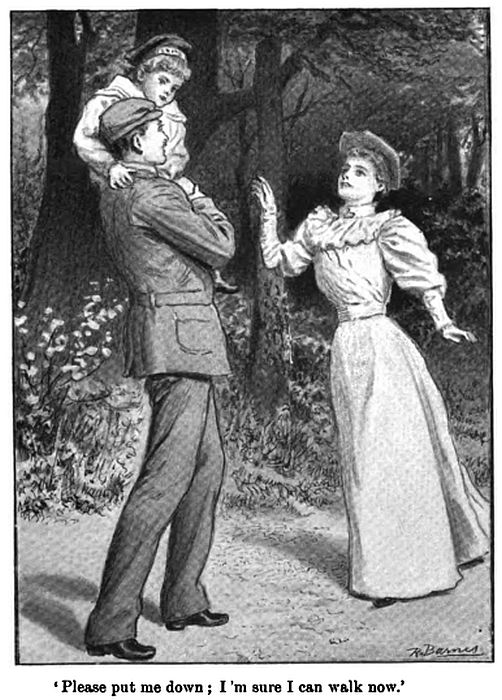
Then Blanche’s heart leaped into her mouth, as the saying goes, with horror. The child was a little boy, and—yes, it was Herty. What, oh! what had happened to him?
She gave no thought to the person who was carrying him; she was over the stile by the gate in half a second, and rushing in frantic haste along the path, towards her little brother and his bearer.
“Herty, darling!” she exclaimed. “What is the matter? Have you hurt yourself?” And then, as the child did not at once reply—“Has he fainted?” she went on. “Oh, do speak!”
“Don’t make such a fuss, Blanchie,” came in Herty’s familiar, high-pitched voice, sweet as music to his sister’s ears, despite his ingratitude. “Please put me down,” he went on, to the person who was carrying him; “I’m sure I can walk now. I don’t like to look like a baby.”
“I’m sure you can’t walk, my little man,” was the reply. “But you may try for yourself if you like,” and the person he addressed carefully lowered the child to the ground, while Blanche, for the first time turning her attention to him, recognised in Herty’s bearer the young man she had met twice before—at Alderwood, and since then at Pinnerton Vicarage, and who had been introduced to her as Mr Archibald Dunstan.
“I beg your pardon,” he said, lifting his cap as soon as his hand was free. “I’m afraid we’ve given you a fright, but—”
“I was frightened for a moment,” said Blanche, half apologetically, “but now I must thank you. Has Herty hurt himself? Where did you find him?”
Mr Dunstan did not at once reply; he was looking at the child, who had grown very white, and nearly fell.
“There now,” he said. “It’s all very well to be plucky, but I told you you couldn’t manage for yourself,” and he put his arm round the little fellow.—“Don’t be alarmed, Miss Derwent,” he went on; “it’s only slight, I think—a sprained ankle; but the pain would be worse if it were bad. He was chatting quite cheerfully as we came along just now. I think the best thing to be done is for me to carry him home, if you’ll allow me to do so.”
“Thank you, oh thank you so much,” said Blanche. “Our house is just on the other side of the gate. I will run on and open it. We are rather busy this afternoon—Lady Hebe’s girls are having tea in the garden, and I shouldn’t like my mother to be frightened. So perhaps if you can carry Herty straight to the house, that would be the best.”
“Certainly,” said Mr Dunstan, passing through the gate as she held it open. “It is unlucky that this should have happened when you’re all so busy.”
But his tone was remarkably cheerful in spite of his expressions of sympathy. And Herty, now comfortably ensconsed again on the young man’s shoulder, began his explanations.
“I was stretching up for a splendid spray of ivy,” he said. “There was a sort of ditch, and I lost my balance and rolled in. And when I tried to get up, my foot hurt me so, I couldn’t stand. So I had to lie down, but I shouted a lot. And at last, after ever so long, he came.—Wouldn’t it have been dreadful if you hadn’t?” he went on, patting Mr Dunstan affectionately: he had evidently taken a great fancy to his rescuer. “Do you think I’d have had to stay there all night?”
“It was lucky, indeed,” said Blanche. “There is a short cut through the woods from Alderwood to East Moddersham, isn’t there? You live at Alderwood, do you not? I suppose you were going to East Moddersham. You can go back the other way round if you like.”
She spoke quite simply, a little faster perhaps than was usual with her, thanks to her late excitement and present relief. But there was no sort of curiosity or arrière pensée in her questions.
What then—or was it her fancy?—what made the young man’s colour deepen slightly as she put them to him? She was almost sure it was so, though he was rather sunburnt, which made it more difficult to judge.
“Thank you,” he said. “Yes, I was bound for East Moddersham. That is to say, not exactly—but—I promised to see Lady Hebe this afternoon,” and as he looked up with the last words, Blanche caught a twinkle of fun in his eyes.
They were very nice eyes—honest grey eyes; she had not noticed them before. And after glancing at them, she turned her own away in some perplexity.
“Lady Hebe is here,” she said. “I don’t think she can be expecting you. It has been settled for some time that she was to come.”
“Ah then, perhaps you—Mrs Derwent, that is to say—will allow me to speak to her—Lady Hebe—in your garden. That will save my needing to go to East Moddersham. Sir Conway is away, and my calls on Lady Marth are never pressing.”
“He is rather queer,” thought Blanche. “I know he and Lady Hebe are very old friends, but I really don’t think she is expecting him this afternoon.”
Mr Dunstan, however, seemed quite satisfied. He spoke cheerfully to Herty, asking him if his foot pained him still, and assuring him that it would soon be all right again.
“Shall I have to have the doctor?” asked the boy. “I don’t like doctors. The old one at home made me stay in bed when it was so hot. I am sure it made me much iller.”
“Oh, our doctors here aren’t like that,” said Archie. “They’re very jolly fellows. But perhaps you won’t need one. I’ll have a look at your ankle if your sister will allow me. I’m a bit of a doctor myself.”
Blanche did not speak.
“Blanchie, don’t you hear?” said Herty, with a touch of querulousness. “It would be much nicer not to have a proper doctor.”
“Very well, dear, we’ll see,” she replied tranquilly. “Mr Dunstan is very kind.”
Chapter Thirteen.
Millinery.
She had spoken in rather a conventional tone, but she was really touched when they got to the house, by Mr Dunstan’s extreme gentleness and concern for the boy. He put Herty on the couch in the library, which they found unoccupied, and got his boot and stocking off as skilfully as a surgeon could have done. It was not very bad, but it was a sprain, undoubtedly; and after Blanche, under Archies directions, had applied cold water bandages, and obtained Herty’s promise to lie perfectly still, she went out to the garden, followed by Mr Dunstan, to explain to her mother and Stasy what had happened.
“I will send Aline in, to look after you, Herty,” she said, “if she can possibly be spared.”
Tea was about coming to an end when the two left the house. After all, Blanche had scarcely been missed, for all that had passed since she went to the wood gate to look for her little brother, had taken but a short time, and everybody in the garden was very busy.
But now there came a breathing-space, and more than one began to ask what had become of Miss Derwent.
“I wonder if she has gone off to look for Herty, and indeed I wonder what can have happened to him,” said Stasy, with sudden anxiety. For in the bustle she had forgotten about her little brother.
She was standing beside Hebe as she spoke, and Hebe looked up to answer her.
“I hope—” she began, then stopped abruptly.
“There is your sister,” she said, but a curious expression came over her face, as she went on, “and—Archie Dunstan.—What an intrusion! How dared he?” she went on, to herself, in a lower tone. Stasy did not catch the words. She only saw the annoyance, almost indignation, on Hebe’s face.
But the next few minutes cleared up a good deal. Blanche hastened to her mother to tell of Herty’s accident and Mr Dunstan’s kindness, and Mrs Derwent was, naturally, eager in her thanks. Then she hurried in to see her boy for herself, and Blanche turned to Mr Dunstan.
“You said you wanted to see Lady Hebe; she is over there—standing by the other table.”
“Oh yes, thank you,” he answered. But he did not seem in any desperate hurry to speak to his old friend.
“I was thinking,” he began again, “that I might perhaps be of use about the doctor. It may be erring on the safe side to let him have a look at the boy’s ankle. I am driving home from East Moddersham, so I could easily stop at Blissmore on the way.”
“Thank you,” said Blanche. “I will see what my mother says.”
“Does she want to get rid of me?” thought Archie to himself.
However that may have been, Miss Derwent certainly gave him no excuse for lingering near her, so he strolled across to where Hebe was standing alone for the moment, as the girls had again dispersed.
She would not refuse to shake hands with him, but her usually sunny eyes were sparkling with indignation.
“Archie,” she said, before he had time to speak, “I could not have believed this of you. If you call it a good joke, I don’t!”
Archie looked at her calmly.
“My dear little lady,” he said, with kindly condescension, “it is not like you to pass judgment on a matter which you know nothing about.”
“I do know about it,” said Hebe. “I know what you said to me—that by hook or by crook you would manage to get here to-day. How you have managed it, I don’t know. I only know that you were not justified in doing anything of the kind.”
“I don’t allow that,” said Archie, nettled in spite of his coolness. “As it happens, my relation, at whose house I am staying, is the only person who has been decently civil to the Derwents at all.”
The colour mounted to Hebe’s face.
“You needn’t taunt me with that,” she said quickly. “I am not responsible, as you well know, for what Josephine does or does not do.”
“Did I say you were?” he replied, raising his eyebrows. “Nor do I take my own stand on my aunt’s behaviour in the matter. If you’ll be so good as to listen, I will tell you how I have come to be here to-day,” and he quickly related what had happened.
Hebe’s face relaxed.
“It is very extraordinary,” she said, half to herself. “And what were you doing prowling about the woods, pray?” she said, unable altogether to suppress a smile.
“Waiting for what fate might throw in my way,” he answered calmly.
Just then they caught sight of Mrs Derwent’s figure coming towards them. Archie started forward.
“If I thought he was in earnest!” thought Hebe to herself, as she followed him more deliberately.
Mr Dunstan’s offer of sending the doctor was accepted, as Herty still seemed in considerable pain, and soon after the whole party dispersed; Archie accompanying Hebe and Miss Milward to East Moddersham, where he had ordered his dog-cart to meet him.
Herty’s sprain proved no very serious matter; but during the next fortnight or so, it formed a plausible excuse for Mr Dunstan’s calling now and then to inquire how he was, and to bring him once or twice books or toys to amuse him while he had to lie still.
Mrs Derwent took a great liking to the young man, and so did Stasy, but he did not seem to get to know Blanche any better. Indeed, on one or two occasions he came and went without seeing her at all. Still, his visits made a little break in the monotony of life at Pinnerton Lodge. During the week or two, also, which preceded the East Moddersham family’s removal to town for the season, there were occasional meetings with Hebe at the vicarage, to discuss guild matters, into which Blanche threw herself with great thoroughness. Mrs Derwent, always sanguine, began to feel more cheerful as to things in general brightening by degrees.
But when Lady Hebe had left, and Mr Dunstan had no longer any excuse for lingering—Alderwood also being shut up—life seemed to return much to what it had been.
“I really don’t know what I shall do with myself,” said Stasy one day, “when the time comes for me to give up my regular lessons. I almost wish you were not so contented, Blanche; it is really rather irritating. If you would grumble too, things wouldn’t seem so bad.”
Blanche laughed.
“Do you know, I really don’t feel inclined to grumble,” she said, “especially now that I’ve got more to do I do find looking after these girls very interesting indeed.”
“You’re a prig,” said Stasy—“a prig or a saint; I’ve not yet made up my mind which.”
Blanche took no notice.
“Stasy,” she said, “I have got an idea in my head. It’s not quite a new one; some one proposed it before; but I can’t manage it unless you’ll help me, you’re so much cleverer about that sort of thing than I am.”
“What sort of thing?” said Stasy.
“Things that require neat-handedness and taste. It’s a millinery class for the girls I’m thinking of. It would be such a surprise to Lady Hebe when she comes back, to see them with neat, pretty hats. It is just the time they’re getting their summer ones, and they do wear such awful things.”
“And I daresay they pay a lot for them, too,” said Stasy.
“No doubt they do,” said Blanche; “and I don’t suppose one of them has the slightest idea of trimming anything neatly.”
Stasy was silent for a moment; then she said, with a little hesitation: “You’re very complimentary about my taste, Blanchie. But as to the actual work, I’m afraid I should not be much good. I know nothing about what may be called the ‘technique’ of the business. I couldn’t line or bind a hat neatly, for instance.”
“I’ve thought of that,” said Blanche eagerly; and, indeed, a great part of her interest in this new idea had to do with the occupation and amusement she had hoped it would give her sister. “I’ve thought about that, and I feel pretty sure that little Miss Halliday would help us. I’m going to Blissmore this afternoon, and I mean to ask her if she would teach us a little. Two or three lessons would give us all we need.”
Stasy brightened up.
“That would really be great fun,” she said. “Do let me go with you, Blanchie. Can we pay her for teaching us, do you think? Won’t it be at all like poaching on her manor?”
“Oh no,” said Blanche. “These girls are not the class who would ever get things from her; and, of course, however clever we become, we mustn’t leave off giving her our own work. That is to say, everything we don’t get from London. She will quite enter into it, I feel sure.”
And that very afternoon Blanche’s idea was carried out. They walked into Blissmore, and went to see Miss Halliday, who was always delighted to have a glimpse of them; and when Blanche unfolded her plan, the little milliner entered into it heartily.
“Of course,” said Blanche, “you must count it as if you were really giving us lessons. It would be quite unfair to take up your time for nothing.”
Miss Halliday hesitated, grew rather pink and nervous.
“I wish, I am sure, I could refuse any payment,” she said at last. “But to tell you the truth, Miss Derwent, things have not been going very well with me lately. There is a great increase of work in Blissmore, as new families keep coming, and, rather than lose the chance of increasing my customers, I had made up my mind to take a partner. After a great deal of inquiry and writing about it, I found what seemed the very person, unexceptionable in every way. She was to put a little money into the concern, and, above all, was said to be extremely clever and tasteful. Just what I wanted! For, you see, there is no denying that I may be getting a little old-fashioned; though I do think my work is always neat, and I use good materials. So I had my shop enlarged a little, and fresh painted, and a new mirror, and altogether went to a good deal of expense, when, just at the last moment, this poor girl—I can’t find it in my heart to blame her—had a sudden call to Australia, owing to some family troubles. I could have held her to the bargain, or made her pay up, but it went against me to do it, so I let her off. That was nearly two months ago, and here have I been ever since trying to find some one else. The season getting on too, more work coming in than I can manage, not daring to refuse any, for fear of it getting about, and leading to some other milliners starting!”
And Miss Halliday wiped away a tear which she could not altogether repress.
The sisters were full of sympathy.
“Poor Miss Halliday!” said Blanche, “I am so sorry.”
“I wish we could help you,” said Stasy impulsively. “Perhaps if you find us very clever, after you’ve taught us a little, we might come down now and then and help you, as if we were apprentices, you know! Wouldn’t it be fun, Blanchie?”
“Bless you, my love,” said the old maid, wiping away another tear. “It is good of you to have such a thought, though, of course, I couldn’t so presume. I’m sure you’ll learn very quickly, having been brought up in France, where, they say, good taste comes with the air. Indeed, I have been thinking of trying for a French young person as a partner, and I once thought of consulting your dear mamma about it.”
“I can tell her what you say,” said Blanche. “But I scarcely think she would advise it. It’s a risk to bring any one so far, and as for what you say of French taste—well, I don’t know—in Paris, perhaps; but one sees plenty of vulgar ugliness in the provinces.”
“Indeed, Miss,” said the milliner, considerably impressed. “Well, I might be safer with an English girl, after all. And thank you, more than I can say, for your kind sympathy. Your visit has quite cheered me—it has indeed. You’ll let me make you a cup of tea before you go. It’ll be ready directly in your own parlour—we always call the drawing-room your own room since you were here, we do indeed.” And the little woman started up in her eager hospitality.
“We’ll stay to tea on one condition, Miss Halliday,” said Stasy—“that is, that if you do find us clever, you’ll promise to let us come and help you after our lessons with you are over.”
“My dear Miss Anastasia,” began Miss Halliday.
“Oh, but you must promise,” said Stasy. “It’s not all out of kindness that I want it! It would be something to do—some fun! I only wish you’d let me serve in the shop a little, it’s so dreadfully dull at Pinnerton, you don’t know.”
Miss Halliday’s face expressed commiseration.
“I’m sorry for that,” said she. “I was hoping that, when you got settled down, you’d feel quite at home, and find it more lively. But, of course, about now most of the families are going up to London.”
“That doesn’t make much difference to us,” said Stasy. “If you want to know, Miss Halliday, I think English people are horribly unfriendly and disagreeable.”
The milliner looked uncomfortable; she had delicacy enough to know that any distinct expression of sympathy in such a case would be an impertinence.
“You may find it pleasanter in the winter,” she said. “There are some nice young ladies in your neighbourhood—Lady Hebe Shetland at East Moddersham, now! She is a sweet young lady.”
“Yes,” said Blanche, speaking for the first time. “We know her a little, but still it is quite different from what it used to be when mamma was a girl here.”
“Well yes, to be sure,” said Miss Halliday, “for it was your dear mamma’s home; and no one was more respected in all the country-side, as I’ve heard my aunt say, than your dear grandpapa, the late Mr Fenning. It was quite a different thing in the next vicars time; his wife and daughters were not, so to say, in the county society at all.”
“Do you mean the Flemings?” asked Blanche; “yes, I have heard of them. I hope people don’t confuse mamma with them; sometimes I’ve been afraid they may do.”
Miss Halliday grew a little pink again.
“Well, Miss, as you’ve mentioned it,” she said, “though I wouldn’t have made free to speak of it myself, I’m afraid there may have been some mistake of the kind in one or two quarters, and seeing that it was so, I made bold to set it right; telling those that had made the mistake, that your dear mamma came of a very high family indeed, as my dear aunt has often told me, and that on both sides.”
Blanche could not help smiling, though she was touched by the little milliner’s loyalty.
“Thank you, Miss Halliday,” she said. “I should certainly be sorry for mamma’s family to be confused with the Flemings, not so much because they were—well, scarcely gentlepeople by birth—but because they were not particularly nice in themselves. It is misleading that the two names are so like, and I am glad you explained it.”
“I won’t mention names,” said Miss Halliday, beaming with satisfaction; “but it will all come right in the end, you will see, my dear young ladies. And now I think tea must be ready in the drawing-room, if you’ll be so good as to step that way.”
“But you are going to have tea with us,” said Stasy. “It would be no fun if you didn’t. And we have to settle the day for our first lesson; and you’ve never been out to see our house yet, Miss Halliday. Mamma sent a special message about that.”
“What a good little soul she is!” said Blanche, as Stasy and she were walking home together.
“Yes, isn’t she?” said Stasy. “Blanche,” she went on, thoughtfully, after a moment’s pause, “do you ever think how nice it would be to be really very rich? Not just comfortable, as we are, but really rich, with lots to give away. What nice things one could do for other people! We could pay for a very clever assistant for Miss Halliday, for instance, so that she might get to be quite a grand milliner, and the people here would go to her for their bonnets instead of sending to London.”
Blanche laughed.
“We should have to frank her over to Paris also once or twice a year. Fancy Miss Halliday in Paris!” she said. “However beautiful her bonnets were, no one could believe in her unless she went to Paris. Yes, it would be very nice to be able to do things like that. But, on the other hand—” She stopped, and seemed to be thinking.
“What were you going to say?” asked Stasy.
“I was only thinking,” Blanche replied, “how little we can realise what it must be to be poor. To feel that one’s actual daily bread—food and clothes and common necessaries—depend on one’s work. I suppose, however, it does not seem hard or depressing to those who have always been accustomed to it.”
“I have thought of it sometimes,” said Stasy. “I’m not sure that there wouldn’t be a sort of pleasure about it. It would be very interesting and exciting. What I dislike most is the being nobody in particular, neither one thing nor the other, as we have rather felt ourselves here! Nothing specially to do, and no feeling that it would matter if you didn’t do it. That is so dull.”
“I suppose,” said Blanche thoughtfully again, “that things to do, things that you feel you could do better than any one else could do them, always do turn up sooner or later if one really wants to use one’s life well.”
“Oh,” said Stasy, with a touch of impatience. “I don’t look at things in such a grand way as you do, Blanchie. I want to get some fun out of life, and, after all, I’m not difficult to please. My spirits have gone up ever so high, just with the idea of learning millinery and teaching the girls, and perhaps helping good little Miss Halliday. Blanchie, don’t you think we might plan some kind of hats that the guild girls would look very nice in—something that Lady Hebe would be sure to notice when she comes back. Perhaps if we ordered a lot of them untrimmed, you know, and got ribbon and things, we could let the girls have them more cheaply than they could buy them. There’d be no harm in that, would there? Of course, I know the guild isn’t supposed to be at all a charity—”
“We may be able to do something of the kind,” said Blanche. “But it wouldn’t do to have them all the same, or even very like each other. The girls wouldn’t care for it, and it would make a sort of show-off of the guild. We must think about it; and I want them to learn to trim their mothers’ bonnets and caps and their younger sisters’ things, as well as their own.”
Chapter Fourteen.
Monsieur Bergeret’s Letter.
The millinery lessons were begun and steadily carried on without the interest of either of the sisters flagging. For, in spite of Stasy’s capriciousness, there was a good of real material in her: she would have despised herself for not carrying out any plan she had formed. And she was not disappointed in her expectation of getting some “fun” out of this new pursuit. It was a pleasure to her to find how deft and neat-handed a little practice made her. Taste in harmonising and blending colours, and a quick eye for graceful form, she had by nature.
Miss Halliday was full of admiration.
“There’s nothing more I can teach you, young ladies,” she said, at the end of a fortnight, during which time they had had about half-a-dozen lessons. “Miss Stasy—if it wasn’t impertinent to say so—I would call you a born milliner. Now, I never would have thought of putting violets with that brown velvet, never! And yet there’s no denying they go most beautifully, and you do make the ribbons and trimmings go so far, too. I’ve always been told it was the best of French work that it’s so light—never overloaded.—And Miss Derwent, you are so neat; indeed, if I might say so, almost too particular.”
Blanche smiled.
“I haven’t got such fairy fingers as Stasy, I know,” she said admiringly, “though perhaps I could beat her at plain-sewing. Yes, I have run on that lace too heavily, I see. Well, and so you think we’re ready now to teach our girls, Miss Halliday, do you?”
“Indeed, yes, Miss; and I shall be so pleased to order the hats you want for you at any time, charging you, of course, just what I pay for them myself.”
“No indeed,” said Blanche; “that wouldn’t be fair; you must charge a little commission. I’ve made out a short list of the things we want to begin with. We’re thinking of having our first millinery class next Wednesday evening. We can’t have more than one a week, for Miss Wandle and Miss Bracy have two other evening classes, and we don’t want the mothers to think the girls are too much away from home.”
“I’m sure it’s better for them than idling about the lanes,” said Miss Halliday, “and that’s what they mostly spend their evenings in at this time of year.”
“Have you got anything settled about your own plans, Miss Halliday?” asked Stasy.
The milliner shook her head, and gave a little sigh.
“Not yet, Miss Stasy,” she replied; “and unless I can find a partner who could put a little money into the concern, I’m afraid I must make shift to go on alone for some time to come. I’ve got so behind with what I owe, for the first time in my life, all through that disappointment about Miss Green.”
“I really think she should have paid you something,” said Stasy. “I’m afraid you’re too good-natured, Miss Halliday. And now you’re going to be good-natured to us, and let us come in two or three times a week to help you a little.”
“You’re really too kind, Miss Stasy,” said Miss Halliday. “I don’t feel as if I could let you do such a thing. And what would your dear mamma think of it?”
“She’s quite pleased,” said Blanche; “she’s always glad for us to be of any use we can.”
“And really I have nothing to do now,” said Stasy. “The dancing class and the gymnastics are given up for the summer, and my lessons don’t take up long at all. I’ve got in the way of coming to Blissmore every day with Herty; it would be dreadfully dull to stay always at Pinnerton.”
So it was settled that the sisters should come two or three mornings a week to help poor Miss Halliday as much as possible, though, of course, the arrangement was to be kept perfectly private.
It certainly did Stasy a great deal of good to have more to do and some feeling of responsibility. She became more cheerful and more equable in temper than she had yet been in their new home. She was even amiable enough to offer no objection to Blanche’s consent to Florry Wandle’s eager, though modest, request that she and her cousin might be allowed to join the millinery class.
“I scarcely see that we have any right to refuse them,” Miss Derwent had said, “seeing that they actually belong to the guild. Anyway, it would be most ill-natured to do so, as they are good, nice girls.”
“I don’t mind,” said Stasy, “if you and mamma think it right. So long as we are not obliged to go to their houses in return, that’s to say.”
But what Stasy really enjoyed was the amateur apprenticeship to Miss Halliday. It gave her the profoundest pleasure to stroll down the High Street and glance in at the milliner’s window, where hats and bonnets of her own creation were displayed to the admiring gaze of the passers-by. And never had Miss Halliday’s stock-in-trade changed hands so quickly. Orders multiplied with such rapidity that the milliner was scarcely able to execute them, and many were the compliments she received on the improved taste and excellent finish of her handiwork.
“You’ve surely got a very good assistant now,” said Mrs Burgess one day. “I don’t think I’ve seen any prettier bonnets even in Paris than some of those you’ve had this year.”
For Mrs Burgess had now returned from her visit to the Continent, and was very full of allusions to her travels.
Miss Halliday smiled as she replied: “Yes, she thought she had been very fortunate.”
But she kept her secret well, and so did her little servant. And no one noticed the frequency of the Misses Derwent’s visits, as they came in and out by the long garden at the back of Miss Halliday’s house, whence a door opening into the lane cut off the necessity of their passing through the entrance to the town, and somewhat shortened their walk.
Summer was advancing by this time with rapid strides. The spring had been a late one, but when the fine sunny weather did come, the delay was amply compensated for. Sunshine, blossoms, and flowers came with a burst. One could almost see everything growing. Mrs Derwent, who was keenly sensitive to such things, enjoyed this first spring in England, after her many years’ absence, intensely, though quietly, all the more so that Stasy, her chief source of anxiety, was now so much more cheerful.
“Things must come right for them both,” thought the mother to herself. “They are really so good! Very few girls would make themselves happy in so monotonous and isolated a life.”
For even Mrs Harrowby had gone to stay with her own relations in London for a time; and Rosy Milward, who had come over to Pinnerton now and then on guild business, had taken flight, like the rest of the world.
The charms of outside nature, the peace and quiet happiness of their own home, and a fair amount of interesting occupation, made the next few weeks pass pleasantly. Afterwards, Blanche felt glad that it had been so. There was a satisfaction in looking back upon this little space of time as bright and cheerful.
“I really think,” said Stasy one day, when she and Blanche were walking back together from Blissmore, “that we are getting acclimatised at last, Blanchie, or rather I should say, I am, for I’m sure you’ve never been anything but contented. I can look forward now to going on living here with mamma and you for—oh! for ever so long, even if nothing more exciting comes into our lives.”
“I’m so glad,” said Blanche heartily. “Yes, we’ve been very happy lately, haven’t we?”
“But some day,” Stasy went on again, “some day, Blanchie, you must marry. Though I can’t, even in my wildest dreams, picture anyone good enough for you. But you are far too pretty to be an old maid!”
“I can’t imagine marrying,” said Blanche musingly; “that’s to say, I can’t imagine any one caring enough for me, or my caring enough for any one! And I can’t imagine marrying without plenty of caring.”
“Of course not,” said Stasy. They walked on in silence for a little, till almost in sight of their own gate.
“I thought mamma would have come to meet us, perhaps, as she often does,” said Blanche. “But let’s hurry on a little, Stasy, and make her come out in the wood before tea.”
“And we might have tea in the garden, don’t you think?” said Stasy. “We’ve not had it out of doors once this week, the afternoons have been so showery.”
So talking, they crossed their own lawn, entering the house by one of the French windows of the drawing-room, where they half expected to find their mother.
She was not there, however, nor was she in the library.
“I hope she hasn’t gone out alone,” said Blanche. “Run up-stairs, Stasy dear, and see if she is in her room.”
Stasy did so, Blanche remaining at the foot of the staircase.
She heard Stasy’s step along the passage, a door opening, and the young girls cheerful “Are you there, mamma dear?” Then—or was it her fancy?—a sort of muffled exclamation, and the slamming to of the door, as there was a good deal of wind that afternoon, and for a moment or two nothing more.
Blanche grew slightly impatient, which was not usual with her. Was there a touch of instinctive anxiety in the impatience?
“Stasy might be quick,” she said to herself. “If mamma is out, we—”
But just then came Stasy’s voice.
“Blanche,” it said, “come up at once. I can’t leave mamma: there is something the matter.”
Blanche flew up-stairs, her imagination, even in that short space of time, picturing to itself a dozen terrible possibilities. “Something the matter!” What suggestions in the simple words.
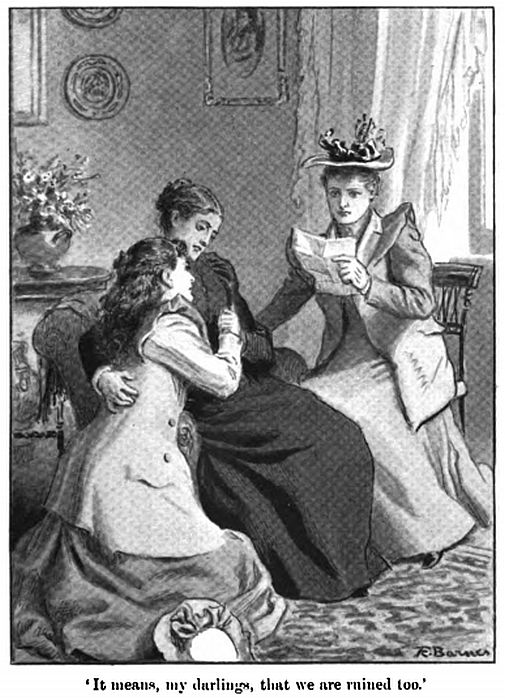
It was a relief, on entering the room, to see her mother seated on her usual chair. Pale, very pale, and looking all the more so from the reddened eyelids which told of recent and prolonged weeping. Stasy was kneeling on the floor beside her.
“Mamma, dearest,” said Blanche, “what is wrong? You are not ill? No, thank God—then it can’t be anything very dreadful.”
For there was a strange side of comfort in the isolated position of the little family. When they were all together and well—they had caught sight of Herty playing happily in the garden—nothing, as Blanche had said, “very dreadful” could be the matter. Still, something grievous and painful it must be, to have thus affected the usually cheerful mother; and again, before Mrs Derwent had time to reply, Blanche’s fancy had pictured every kind of possible and impossible catastrophe, except the actual fact.
Mrs Derwent tried to smile.
“You are right, Blanchie,” she said; “it is ‘Thank God,’ as we are all together. But read this.”
She held out a thick foreign letter, closely written in a clerkly hand which Blanche knew well. It was that of the lawyer at Bordeaux, Monsieur Bergeret, and though couched in a good deal of legal technicality, the general sense was not difficult to gather. The old and honourable house of “Derwent and Paulmier” was bankrupt—hopelessly ruined. Monsieur Bergeret, while expressing his deepest sympathy, held out no hopes of any retrieval of the misfortune.
“Mamma,” said Blanche, looking up with startled eyes, “what does it mean? How does it affect us?”
For she knew that, besides any practical bearing on themselves, the blow to her mother would be severe. Her husband’s and her father-in-law’s universally respected position had for more than half her lifetime been a source of natural pride to Mrs Derwent, and even now, though they were dead, their honourable name must be lowered.
But alas! it was worse than this.
“It means,” the mother replied quietly—“it means, my darlings, that we are ruined too. Our money had not been paid out. You remember my telling you that I was a little anxious about the delay; but nothing would have made any difference: they had not got it to pay. If Monsieur Bergeret had pressed them, it would only have hastened the declaration of insolvency. I understand it all. I have read the letter over and over again, since it came by the afternoon post. Dear me,” and she glanced at the pretty, quaint little French clock on the mantelpiece—“can it be only an hour ago? It came at three, and it is only just four. It seems years—years.”
Her voice seemed faint and dreamy. Blanche looked at her in some alarm. She was utterly exhausted for the moment.
“Mamma dear,” said Stasy, “it is impossible to take it all in at once; we must get used to it gradually. The first thing to attend to just now is you. You mustn’t make yourself ill about it, mamma.”
Blanche glanced at Stasy admiringly.
“Yes,” she said, “that is the first thing to care about. I am going down-stairs to see if tea is ready. Will you come down, mamma, or shall I bring you a cup up here?”
“I will come down,” said Mrs Derwent, adding to herself, in a voice which she tried to make firm: “I must begin to get used to it at once.”
Chapter Fifteen.
Facing Things.
Derwent did not fall ill, as her daughters feared. There was great elasticity, which was, in fact, a kind of strength, in her nature, as well as a rare amount of practical common sense, and before long these triumphed over the shock, which, it must be owned, was to her a tremendous one.
For she realised, as Blanche and Stasy could not be expected to do, the whole bearing upon their lives, of this unexpected change of fortune.
For a week or two, some amount of excitement necessarily mingled with her distress. For, though Monsieur Bergeret held out no hopes of anything being saved from the crash, he yet advised her to consult the English lawyer who had had charge of her interests at the time of her marriage, and of whom the French man of business entertained a high opinion.
So Mrs Derwent and Blanche went up to London by appointment, to meet this gentleman, and had a long talk with him. His view of things entirely tallied with that of Monsieur Bergeret, but he reassured Mrs Derwent on one or two minor points. What she had in the shape of furniture, plate, and so on, was absolutely hers, and could not, as she had vaguely feared, be touched by the creditors of the firm, of whom, indeed, she ranked as first. Furthermore, there still remained to her a trifling amount of income, all that was left of the little property she had inherited from her father, as it will be remembered that, owing to unwise investment, the late Mr Fenning’s capital had almost disappeared.
But anything was something in the present crisis. Even eighty pounds a year was a certainty to be thankful for.
“The best thing you can do, it seems to me,” said Mr Mapleson, at the close of the interview, “is to let your house as soon as possible, thus making sure of the rent for which you are liable: I forget the length of your lease?”
“Seven years in the first place,” replied Mrs Derwent. “You might let it furnished,” the lawyer went on; “that would give you fifty or sixty pounds a year more—not much. Furnished houses in the country don’t let for the rents they used to do, or you might have a sale, thus realising a little capital, till you have, as they say, time to turn round, and make some plan for the future. And”—he went on, with a little hesitation—“should you be short of funds at the present moment, pray do not hesitate to draw upon me. I wish with all my heart I could be of more use to you.”
“You are very kind, very kind and good,” said Mrs Derwent. “But I think I shall be able to manage for a little while. I will see the local house-agent at once, and put the house in his hands. I think I should prefer to be free from it altogether, if possible, and to have a sale.”
“Perhaps it would be best,” said Mr Mapleson. “Refer the agent to me in case of need. Furniture sometimes sells very well in the country.”
“We have some very pretty things,” said Blanche—“uncommon things, too; some good china that we brought from Bordeaux, and things like that.”
Her voice faltered a little as she spoke, and the old man glanced at her sympathisingly.
“What a charming girl!” he thought to himself. “Too pretty to be a governess or companion or anything of that kind.”
“I hope,” he said aloud, “that you will be able to keep your daughters with you, Mrs Derwent. I will talk it over with my wife; she has plenty of good sense, and if any idea strikes us, I will write to you. A school—a small, select school, for instance. Your daughters must have been well educated, though, no doubt, private schools do not succeed nowadays as they used to do.”
“Thank you,” said Mrs Derwent; “we must think it over.”
Then they said good-bye, and made their way back to the station again, feeling perhaps a trifle less depressed than on their arrival.
“Shall we stop at the agent’s on our way through Blissmore, do you think, Blanche?” said Mrs Derwent, as they were nearing the end of their railway journey. “We must drive out, I suppose,” she went on, with a rather wan smile, “though I want to begin those small economies at once.”
Blanche glanced at her. It was a hot, close day, and Mrs Derwent seemed very tired.
“It would be poor economy to begin by making ourselves ill,” said Blanche. “Of course we must drive. I will write to the house-agent to-night, if you will tell me exactly what to say, mamma. It will do quite as well as seeing him, and be far less disagreeable.”
Stasy was watching for them at their own gate as they drove up. She looked bright and eager.
“Tell the man not to drive in,” said Mrs Derwent; “we will get out here, poor Stasy looks so anxious to hear what we have got to say.”
“She looks as if she had something to tell us, I think,” said Blanche. “I must say her good spirits—for she is never low-spirited now—are a great blessing.”
“She doesn’t realise it,” said Mrs Derwent, with a little sigh. “But at sixteen what would you have? That in itself is a blessing.”
“Have you any news?” was Stasy’s first question? “You don’t look so—at least, not any worse than when you went away, except that you’re tired, of course, poor dears.”
“We have certainly nothing worse to tell you,” said Blanche cheerfully. “And one or two things are just a little better than we feared.” And she gave Stasy a rapid summary of their interview with Mr Mapleson.
“That’s all right,” said Stasy. “Come in: I have tea all ready for you in the library. I have some news for you; at least, something to tell you—two things. In the first place,” she went on, as she began pouring out tea, “I’ve had a visitor to-day. Nobody very exciting, but it may be a good thing. My visitor was Adela Bracy.”
“What did she come about?” said Blanche. “I hope they’re not beginning to think they may—well, take freedoms with us, just because we’ve lost our money.”
Blanche’s tone was a trifle bitter. She was tired, and she could not bear to see her mother’s pale face. For the moment, she and Stasy seemed to have changed characters.
“Take freedoms with us!” Stasy repeated. “Oh dear no! Poor Adela! if you had seen how she blushed and stammered over her errand.”
“And what was it?” asked Mrs Derwent, reviving a little, thanks to Stasy’s good cup of tea.
“She wanted to know,” said Stasy, “if her father might call to see you to-morrow morning, mamma, on business. They have heard, you know, about our trouble, because Blanche had to tell them that we couldn’t give the other guild treat that we had promised. You said it was best to be frank about it.”
“Yes, I remember,” said Mrs Derwent. “But both she and her cousin have been very good,” continued Stasy. “They have told no one at all till this morning, and then Adela thought it would be only right to let her father know, for our sake, and it was that that she was in such a fright about. She thought we might be vexed.”
“It doesn’t in the least matter who knows and who doesn’t, it seems to me,” said Blanche. “Besides, I have written to Lady Hebe, to tell her I should probably have to give up the guild work, and I made no secret of our troubles. But you’re so mysterious, Stasy: I wish you’d explain! What can it matter about old Mr Bracy knowing?”
“I’m coming to it,” said Stasy, “as fast as I can, if you wouldn’t interrupt. It’s about this house. You know, mamma, you said one day you thought we’d have to sell all our things, and I think anything would be better than that.”
“I’m afraid it will be the wisest thing to do, however,” said Mrs Derwent, rather dejectedly.
“No, mamma, perhaps not,” said Stasy. “What Adela’s father wants to see you about is this. He has a brother who has been out in India for a good many years—a rich man, Adela says—and he’s coming home almost immediately, with his wife and daughter, for a long holiday; and he wants Mr Bracy to find a furnished house close to theirs for a year, and it struck Adela that this might just do. She says they would take great care of everything, and, oh mamma! think how nice it would be to feel it was still ours, in case, you know, of some good luck turning up!”
Her mother smiled.
“My dear child, we mustn’t begin to hope for anything of that kind, I’m afraid,” she said. “It is better to face the reality. Still, no doubt, it would be very nice not to have to part with our things at once. A year from now, we should better know which of these we could keep. It was very kind and sensible of Adela Bracy to think of it, and I shall certainly be very glad to see her father. Can you send him a note to say so, Blanche? It seems to have been a very good thing that we have said nothing yet to the agent.”
“I will write at once,” said Blanche, rousing herself, for she felt that she had been yielding too much to her unusual depression.
She got up from her place and went towards the writing-table as she spoke.
“What’s the name of the Bracys’ house, Stasy—Green?—”
“Green Nest,” replied Stasy.
“And will eleven o’clock be the best time, mamma?”
“Say any time that suits him, after ten,” Mrs Derwent replied.
She spoke more cheerfully. It really seemed as if this new proposal had come in the nick of time, and there was something infectious in Stasy’s hopefulness, little ground as there might appear for it.
“I suppose Miss Bracy said nothing about the rent her uncle would be likely to give?” asked Mrs Derwent.
Stasy shook her head.
“No,” she replied, “and I didn’t like to ask her, indeed I don’t think I should have understood about it; but she did say he was liberal and kind, as well as rich.”
“Of course I should not expect more than a fair sum,” said Mrs Derwent; “the fact of its being of great consequence to us cannot be taken into consideration. Still, it is much better to have to do with people of that character, and no doubt the house is now unusually attractive in many ways, all being in such perfect order.”
Blanche rang the bell, and gave orders for the note to be sent at once. Then she came back and sat down again.
“And what’s your second piece of news, Stasy?” she said. “You spoke of two.”
Stasy reddened a little.
“It wasn’t a piece of news,” she said. “It was an—an—” And she hesitated.
“What?” asked her mother.
“I’m not quite sure,” Stasy replied. “I’m not quite sure but that it was an inspiration!”
Both Mrs Derwent and Blanche looked up.
“Do tell us,” said Blanche, but Stasy still hesitated.
“If you don’t mind, mamma dear,” she began, “I think I’d rather tell it to Blanchie alone first, and see what she thinks. You might be a little vexed with me. It may have a little to do with what Mr Bracy says to-morrow.”
“Very well, dear,” said Mrs Derwent. “I’m quite content to wait, and not to hear it at all, if you’d rather not tell me after consulting with Blanchie.”
She had not, perhaps, any very great faith in the practicability of Stasy’s inspirations, but she was delighted to see the girl rising with such unselfish cheerfulness to meet their difficulties.
“After all,” she said to herself, “troubles are often blessings in disguise. This may be the making of Stasy, and give her the stability she needs.”
Mr Bracy called the next morning, behaving with so much tact and consideration as to make it easy to forget his somewhat rough and ready manner, and his frequent oblivion of the letter “h.”
The terms he proposed, and which he felt sure his brother would endorse, seemed to Mrs Derwent fair and, indeed, liberal. But before committing herself to accept them, she wished to consult Mr Mapleson, a proposal which Mr Bracy at once agreed to. He was full of admiration of the house, more than once exclaiming that, as far as his brother was concerned, it was a wonderfully good chance.
“And I hope,” said Mrs Derwent, “indeed, I feel almost sure that I shall have cause to congratulate myself on meeting so readily with such an unexceptionable tenant.”