THE BLACK COHOSH. (Cimicifuga racemosa.)
Reading edition
The Black Cohosh, or Black Snakeroot, grows in rich woods from Canada nearly to the Gulf of Mexico. It is a conspicuous plant, with its long stem, which sometimes grows to a height of eight feet, and its large compound leaves, as well as with its long raceme of numerous small white flowers. This raceme during the ripening of the fruit often acquires a length of two to three feet.
This plant is sometimes called Bugbane. The name Cimicifuga is from the Latin words cimex, a bug, and fugo, to drive away. Both the technical name and the name Bugbane allude to the offensive odor of the flowers, which was supposed to drive away insects. In fact, the Black Cohosh is held in high repute by some Indians as a cure for the bite of poisonous snakes, as well as a powerful aid in driving away insects. Were it not for the strong, disagreeable odor of the flowers, which are only frequented by those flies which enjoy the odor of carrion, with its “tall white rockets shooting upward from a mass of large, handsome leaves,” it would be a striking ornament for the flower garden.
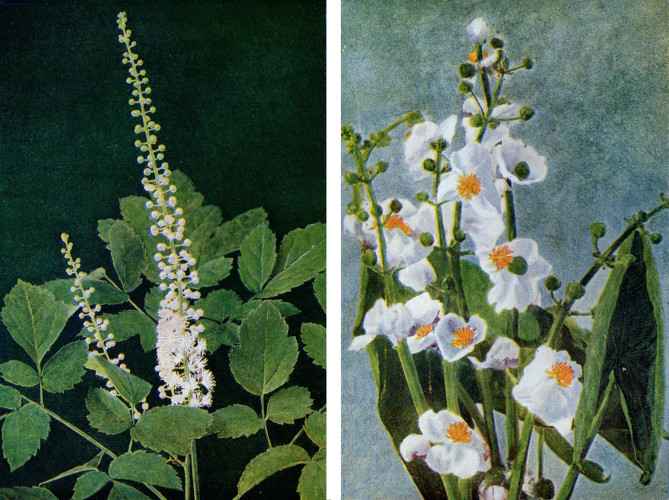
BLACK COHOSH. (Cimicifuga racemosa.) ARROW HEAD. (Sagittaria latifolia.) FROM “NATURE’S GARDEN” COPYRIGHT 1900, BY DOUBLEDAY, PAGE & COMPANY.
185
Someone has said that the Black Cohosh “may truly be classed among those objects which, from the standpoint of frail humanity, distance lends enchantment.” Though this be true, may we not say with Wordsworth,
To me the meanest flower that blows can give Thoughts that do often lie too deep for tears.