ANTICS OF A HUMMINGBIRD.
Reading edition
As the writer was standing one May morning near a clump of bushes in the suburbs of a city in Maine he witnessed, for the first time in a long experience of bird study, the courting antics of a male hummingbird. Two of the tiny creatures appeared, apparently evolved from mid-air, and one alighted in the bush. She was the female. The male immediately began to disport himself in the air in the following remarkable manner:
He dashed back and forth over the head of the female in long, curving swoops such as one describes in a swing, all the time giving utterance to a low, pleasing twitter. He thus swept back and forth ten times, rising at the ends of the curve to a height of perhaps fifteen feet, sustaining himself there a moment, with his ruby throat flashing in the sun, and then darting down the double toboggan slide and up to the other end. Though he flew very swiftly, yet his speed was not the usual flash and his movements could be plainly seen. I had never before seen a hummingbird fly so slowly nor heard from one of them such a prolonged vocal sound. Indeed, it is very rare that one hears the hummingbird’s voice, even if one is on the alert for it. After the tenth swoop there was a buzz of wings and both birds had vanished. A minute after I found the male in a cherry tree sipping honey from the blossoms.
There is evidently a rivalry between the bees and the hummingbirds in their quest for honey. This bird, with an angry dash, expressed its disapproval of the presence of a big bumblebee in the same tree. The usually pugnacious bee incontinently fled, but he did not leave the tree. He dashed back and forth among the branches and white blossoms, the hummingbird in close pursuit. Where will you find another pair that could dodge and turn and dart equal to these? They were like flashes of light, yet the pursuer followed in the track of the pursued, turning when the bee turned. There was no cutting across, for there was no time for that. In short, the bird and the bee controlled the movement of their bodies more quickly and more accurately than the writer could control the movement of his eyes. The chase was all over in half the time that it has taken to tell it, but the excitement of a pack of hounds after a fox is as nothing, in comparison. The bee escaped, the bird giving up the chase and alighting on a twig. It couldn’t have been chasing the bee for food, and there is no possible explanation of its unprovoked attack except that it wished to have all the honey itself. So even as little a body as a hummingbird can show selfishness in a marked degree. However, Mr. Bee continued to take his share of Nature’s bounty, though doubtless he had his weather eye open against another attack. Both scenes afforded me a delightful study and were a rare privilege.
George Bancroft Griffith.
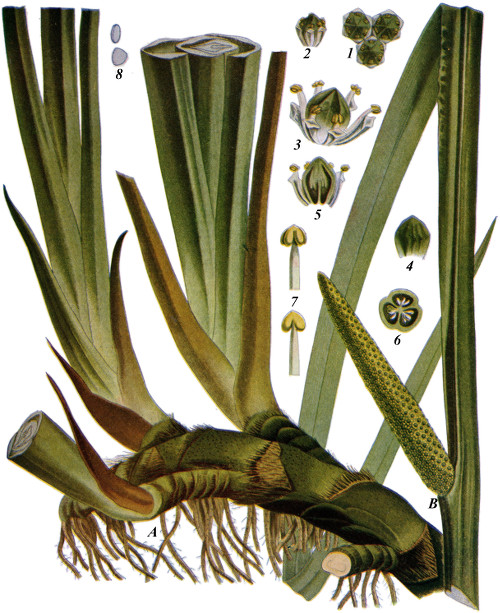
SWEET FLAG. (Acorus calamus.) FROM KŒHLER’S MEDICINAL-PFLANZEN.
Description of plate: A, rhizome and basal portion of leaves; B, upper end of leaf with inflorescence (spike); 1, 2, 3, 5, flowers; 4, stigma; 6, section of fruit; 7, stamens; 8, pollen grains.
191