FROM AN ORNITHOLOGIST’S YEAR BOOK. FLUTE OF ARCADY.
Reading edition
In Ohio are many wide, grassy fields, covering the rounded hillslopes or filling open valleys. One day in March the world was white with snow, and I heard, as if in a dream, the soft cooing of the doves. Never before had I heard it except on sunny afternoons in pine woods, rich with warm, resinous odors. It is hardly a sound—rather silence perceptible, blending so perfectly with the sunshine, the hushed and brooding stillness of the air, the half-conscious sense of life, that I would often hear it a long while without knowing that I listened—the soft, tremulous cooing of the wood-doves, yet here the earth was white with snow and the air chill.
But the doves were right. Spring was near, and in a little while the feathery grass was nodding in the warm wind, gray and hazy, as the great white clouds swept overhead with wing-like shadows, or shining, each tiny blade like burnished steel, in the sunlight. The cooing of the doves had been only a low prelude; now the air was ringing with melody.
“N’er a leaf was dumb; Around us all the thickets rung To many a flute of Arcady.”
The fresh, glad songs of the western meadow larks! Everywhere, everywhere, the air was vibrant with the poignant sweetness of their silvery voices; everywhere you might see the shining yellow of their breasts as they rose with strong wing; everywhere you might perhaps chance to stumble upon some nest of woven grasses. Often with arched covering, on the very ground, with the dear little brownish mother bending over four or six white eggs, freckled with cinnamon spots. It is the season of the larks, and earth and sky are more lovely for the magic of their singing. One hardly knows how to describe it in words. Spring o’ the year! Spring o’ the year! it seems to say to the listener, both in the east and west, but the song of the western meadow lark has a richer melody, a more piercing delight. It seems to talk of forgotten things; of youth and first hopes; first love; it has all the glamour of the far-away, and yet a sweetness of the near. It rises from the thick grass at your feet, yet it mounts towards the blue sky! It is a veritable Flute of Arcady blown with a breath of joy.
Ella F. Mosby.
The dogwood blossoms white as snow Their favors now to rambler show, And where the Winter’s latest drift Through the dark moss did silent sift, All blossomed-starred, above the ground The shy arbutus now is found.
The cloud-capped mountains all appear With verdant slopes and summits clear; The sun has lost its soulless glare— Earth, sea and sky are wondrous fair. —George Bancroft Griffith.
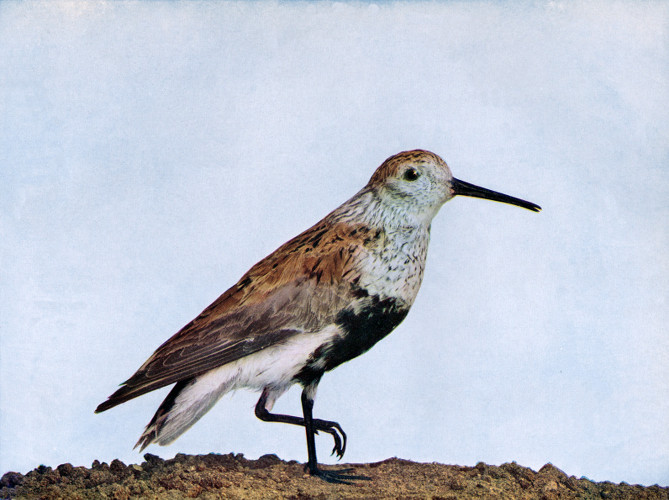
RED-BACKED SANDPIPER. (Tringa alpina pacifica.) ¾ Life-size. FROM COL. CHI. ACAD. SCIENCES.
167