THE GREAT NORTHERN SHRIKE. (Lanius borealis.)
Reading edition
Of the great family Laniidae, the shrikes, of the order Passeres, we have in America only two species, the Great Northern Shrike, Lanius borealis, and the loggerhead shrike, which has been dealt with in a previous article. The name of the Great Northern Shrike is much more than a mouthful, and is all out of proportion to the size and importance of the bird, though when I intimate it lacks in importance I by no means wish to say that it lacks in interest.
There are two hundred species of shrikes altogether, nearly all of them being confined to the Old World. When one comes to know fully the characteristics of the creatures he feels that the birds would not have been out of place if they had been classed in the order Raptores, because they possess the distinguishing traits of the bird of prey. The shrikes, however, do not have talons, and they are singers of no mean order, facts which perhaps disqualify them for association with their larger rapacious brethren.
The Great Northern Shrike, more commonly perhaps called Butcher Bird, comes from northern British-American territory to the latitude of Chicago in the fall and stays through the winter, when it leaves for the vicinity of Fort Anderson in the crown territories, to build its nest. This is placed in a low tree or bush and is composed of twigs and grasses. The eggs number four or five. During the winter the shrike’s food consists almost entirely of small birds, with an occasional mouse to add variety. In the summer its diet is made up chiefly of the larger insects, though at times a small snake is caught and eaten with apparent relish.
The Great Northern Shrike has the habit of impaling the bodies of its victims upon thorns or of hanging them by the neck in the crotch of two small limbs. The bird has a peculiar flight, hard to describe, but which, when seen a few times, impresses itself so upon the memory vision that it can never afterward be mistaken, even though seen at a long distance. The Great Northern’s favorite perch is the very tiptop of a tree, from which it can survey the surrounding country and mark out its victims with its keen eye. In taking its perch the shrike flies until one gets the impression that it is to light in the very heart of the tree. Then it suddenly changes direction and shoots upward almost perpendicularly to its favorite watch tower.
The Great Northern Shrike is larger and darker than its brother, the loggerhead. It is also a much better singer, its notes being varied and almost entirely musical, though occasionally it perpetrates a sort of a harsh half croak that ruins the performance. In general appearance at some little distance the shrike is not unlike a mocking bird. The description here given for the adult answers for both male and female: Upper parts gray; wings and tail black; primaries white at the base, secondaries tipped with white or grayish; outer, sometimes all the tail feathers, tipped with white, the outer feathers mostly white; forehead whitish; lores grayish black; ear coverts black; under parts white, generally finely barred with black; bill hooked and hawk-like. Immature bird similar, but entire plumage more or less heavily barred or washed with grayish brown.
One has to have something of the savage in him to enjoy thoroughly the study of the shrike. As a matter of fact, the close daily observance of the bird involves some little sacrifice for the person whose nature is tempered with mercy. The shrike is essentially cruel. It is a butcher pure and simple and a butcher that knows no merciful methods in plying its trade. More than this, the shrike is the most arrant hypocrite in the whole bird calendar. Its appearance as it sits apparently sunning itself, but in reality keeping sharp lookout for prey, is the perfect counterfeit of innocence. The Great Northern Shrike is no mean vocalist. Its notes are alluringly gentle, and, to paraphrase a somewhat famous quotation, “It sings and sings and is a villain still.”
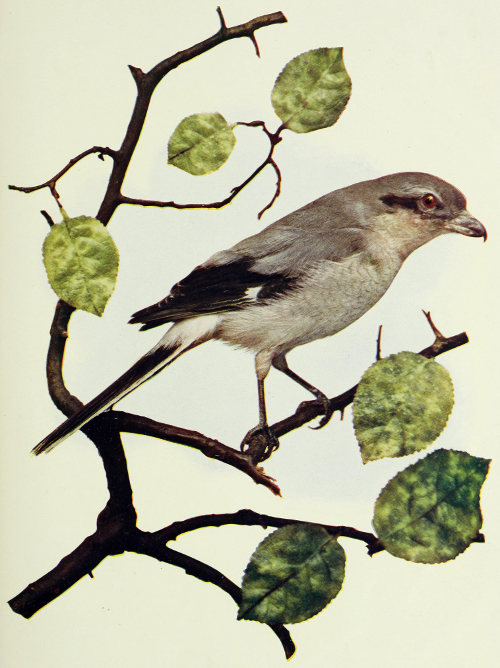
GREAT NORTHERN SHRIKE. (Lanius borealis). About ¾ Life size. FROM COL. CHI. ACAD. SCIENCES.
17
There is one compensation beyond the general interest of the thing for the student who has to endure the sight of the sufferings of the shrike’s victims in order to get an adequate idea of its conduct of life. The redeeming thing is found in the fact that in the winter time the great majority of the shrike’s victims are the pestilential English sparrows, whom every bird lover would be willing to see sacrificed to make a shrike’s supper, though he might regret the attending pain pangs.
My own observations of the shrike have been limited to the city of Chicago and to the fields immediately beyond its walls. For those unfamiliar with the subject it may be best to say that in the winter season the shrike is abundant in the parks of the great smoky city by the lake, and not infrequently it invades the pulsing business heart of the town. No one ever saw the placidity of the shrike disturbed in the least. It will perch on the top of a small tree and never move so much as a feather, barring its tail, which is in well nigh constant motion, when the clanging electric cars rush by or when the passing wagons shake its perch to the foundation.
The Great Northern Shrike reaches the city from its habitat beyond the Canada line about the first of November. For four years in succession I saw my first Northern Shrike of the season on November first, a day set down in the Church Calendar for the commemoration of “All Saints.” It is eminently in keeping with the hypocritical character of Mr. Shrike, sinner that he is, to put in an appearance on so holy a day. From the time of his coming until late March and sometimes well into April, the shrike remains an urban resident and harries the sparrow tribe to its heart’s content.
As far as my own observation goes the Great Northern Shrike in winter does not put very much food in cold storage. I have never seen many victims of the bird’s rapacity impaled upon thorns. Perhaps I should qualify this statement a bit by saying that I have never seen many victims hanging up in one place. I have watched carefully something like a score of the birds, and while every one occasionally hung up one of its victims, there was nothing approaching the “general storehouse” of food, so often described. It is my belief that this habit of impaling its prey upon thorns or of hanging it by the neck in a crotch is one that is confined largely to the summer season, and especially to the nesting period.
The Great Northern Shrike has been said by some writers to be a bully as well as a butcher. I have never seen any evidence of this trait in his character. He does not seem to care for what some small human souls consider the delight of cowing weaker vessels. When the shrike gives chase to its feathered quarry it gives chase for the sole purpose of obtaining food. While the bird is not a bully in the sense in which I have written, it displays at times the cruelty of a fiend. It has apparently something of the cat in its nature. It delights to play with its prey after it has been seized, and by one swift stroke reduce it to a state of helplessness.
Every morning during the month of February, 1898, a shrike came to a tree directly in front of my window on Pearson street, in Chicago. The locality abounded in sparrows and it was for that reason the shrike was such a constant visitor. The bird paid no attention to the faces at the window, and made its excursions for victims in plain view. The shrike is not the most skilled hunter in the world. About three out of four of his quests are bootless, but as he makes many of them he never lacks for a meal. The Pearson street shrike one day rounded the corner of the building on its way to its favorite perch, and encountering a sparrow midway struck it down in full flight. The shrike carried its struggling victim to the usual tree. There it drilled a hole in the sparrow’s skull and then allowed the suffering, quivering creature to fall toward the ground. The butcher followed with a swoop much like that of a hawk and, catching its prey once more, bore it aloft and then dropped it again as it seemed for the very enjoyment of witnessing suffering. Finally when the sparrow had fallen for the third time it reached the ground before the shrike 18 could reseize it. The victim had strength enough to flutter into a small hole in a snow bank, where it was hidden from sight. The shrike made no attempt to recapture the sparrow. It seemingly was a pure case of “out of sight, out of mind.” In a few moments it flew away in search of another victim. The sparrow was picked up from the snow bank and put out of its misery, for it was still living. There was a hole in its skull as round as though it had been punched with a conductor’s ticket clip.
It has been my experience that the Great Northern Shrike hunts most successfully when he, so to speak, flies down his prey. If he gets a small bird well started out into the open and with cover at a long distance ahead, the shrike generally manages to overtake and overpower his victim. If the quarry, however, is sought in the underbrush or in the close twined branches of the treetop, it generally succeeds in eluding the butcher. One of the most interesting incidents of all my bird observations was that of the attempted capture by a Great Northern Shrike of a small brown creeper. The scene of the action was near the south end of the Lincoln Park lagoon in Chicago. The creeper was nimbly climbing a tree hole, industriously picking out insects, as is his custom, when a shrike dropped down after him from its high perch on a tree which stood close and overshadowed the one from whose bark the creeper was gleaning its breakfast. The shrike was seen coming. The creeper, for the fraction of a second, flattened itself and clung convulsively to the tree trunk. Then, recovering, it darted to the other side of the hole, while the shrike brought up abruptly and clumsily just at the spot where the creeper had been. The discomfited bird went back to its perch. The creeper rounded the tree once more and down went the shrike. The tactics of a moment before were repeated, the shrike going back to its perch chagrined and empty clawed. Five times it made the attempt to capture the creeper, and every time the little bird eluded its enemy by a quick retreat. It was a veritable game of hide and seek, amusing and interesting for the spectator, but to the birds a game of life and death. Life won. I ever have believed thoroughly that the creeper thought out the problem of escape for itself. The last time the shrike went back to its perch the creeper did not show round the trunk again, but instead flew away, keeping the hole of the tree between itself and its foe. It reached a place of safety unseen. The shrike watched for the quarry to reappear. In a few moments it grew impatient and flew down and completely circled the tree. Then, seemingly knowing that it had been fooled, it left the place in disgust.
Of the boldness of the Great Northern Shrike there can be no question. It allows man to approach within a few feet and looks him in the eye with a certain haughty defiance, showing no trace of nervousness, save the flirting of his tail, which is a characteristic of the bird and in no way attributable to fear or uneasiness. One morning early in March, when the migration had just started, I saw two shrikes on the grass in the very center of the ball ground at the south end of Lincoln Park. They were engaged in a pitched battle, and went for each other much after the manner of game cocks. The feathers literally flew. I looked at them through a powerful field glass and saw a small dark object on the grass at the very point of their fighting. Then I knew that the battle was being waged for the possession of an unfortunate bird victim. The birds kept up the fight for fully two minutes. Then, being anxious to find out just what the dead bird was which had given rise to the row, I walked rapidly toward the combatants. They paid no heed to me until I was within twenty feet of the scene of their encounter. Then they flew away. I kept my eyes on the much ruffled body of the little victim lying on the grass and, walking toward it, I stooped over to pick it up. At that instant, as quick as the passing of light, one of the shrikes darted under my hand, seized the quarry and made off with it. It was an exhibition of boldness that did not fail to win admiration. I did not have the chance to learn what bird it was that had fallen a victim to the shrikes’ rapacity and had been the cause of that battle royal.
The Great Northern Shrike when it is attempting to capture a mouse, or a 19 small bird that has taken refuge in a bush, hovers over the quarry almost precisely after the manner of the sparrow hawk. There are few more fascinating sights in nature than that of the bird with its body absolutely motionless, but with its wings moving with the rapidity of the blades of an electric fan. Sharply outlined against the sky, it fixes the attention and rouses an interest that leaves little room for sympathy with the intended victim that one knows is cowering below. A mouse in the open has little chance for escape from the clutches of the hovering shrike. Birds, however, which have wisdom enough to stay in the bush and trust to its shelter rather than to launch out into open flight, are more than apt to escape with their lives. In February last I saw two shrike-pursued English sparrows take to the cover of a vine-covered lilac shrub. They sought a place well near the roots. While flying they had shown every symptom of fear and were making a better pace than I had ever seen one of their tribe make before. The shrike brought itself up sharply in midair directly over the lilac, and there it hovered on light wing and looked longingly downward through the interlacing stems at the sparrows. It paid no heed to its human observer, who was standing within a few feet and who, to his amazement, saw an utter absence of any appearance of fear on the part of the sparrows. They apparently knew that; the shrike could not strike them down because of the intervening branches. They must have known also that owing to the comparative clumsiness of their pursuer when making its way on foot through and along twigs and limbs, that they could easily elude him if he made an attempt at capture after that manner. Finally the shrike forsook the tip of the lilac bush and began working its way downward along the outer edge of the shrub. When it had approached to a point as near as the sparrows thought was comfortable, they shifted their position in the bush. The shrike saw that the quest was useless unless he could start them to flight. He tried it, but they were too cunning for him, and he at last gave up the chase, the progress of which actually seemed to humiliate him. He flew afar off, where, perhaps, the prospects of dinner were better.
I once saw a goldfinch in winter plumage escape a Great Northern Shrike by taking a flight directly at the zenith. The shrike followed the dainty little tidbit far up, until the larger bird was only a speck and the little one had disappeared entirely. The shrike apparently could neither stand the pace nor the altitude, and the watchers, with whom the goldfinch was the favorite in the race, rejoiced with the winner.
Edward Brayton Clark.