THE AMERICAN BUFFALO. (Bison americanus.)
Reading edition
The supremacy of man over the lower forms of animal life has no better illustration than that furnished by the rapid extermination of the American Buffalo (Bison or Bos americanus.)
Much less than a century ago, in immense herds, this animal swarmed over the prairies of the United States, unmolested except by the Indians who sought it for food and for the economic value of its hide. It was free to seek those localities which would furnish it the best and most abundant food supply. Even as late as the sixties of the last century the American Buffalo was represented by thousands upon thousands of individuals, whose numerous paths leading from the feeding grounds to a supply of fresh water were known to the frontiersman as “Buffalo trails.” “In 1889 Mr. William T. Hornaday estimated the number of survivors to be eight hundred and thirty-five, inclusive of the two hundred then living in the Yellowstone Park under the protection of the government.”
The passing from the face of the earth of this, the largest of the native animals of North America, has taken place within the last thirty years and this extermination may be laid at the door of the zealous hunter and trapper who systematically shot and destroyed them in order to obtain the small profit that their skins would bring. It is said that one of the railroads crossing the continent from the Mississippi river to the Pacific coast carried about two hundred thousand skins within a year after it was opened to traffic. One writer records the reception of over forty thousand pelts by a single firm in the year 1875. Many instances of the wanton butchery of this noble and useful animal might be mentioned, but it is much better illustrated by the absence of the Buffalo at the present time, from all localities, except where it is protected by the same hand which has brought about its destruction. In 1858, when a party was traversing the country by wagon train from the state of Missouri to Mexico, they were continually surrounded by large herds of Buffaloes. An eye witness said, “In bands, in masses, in hosts, the shaggy, black creatures thundered along in front of us, sometimes from north to south, sometimes from south to north; for forty consecutive hours we had them in sight, thousands upon thousands, tens of thousands upon tens of thousands, an innumerable mass of untamed animals, the flesh of which, as we believed, was sufficient to provide the wigwams of the Indians unto all eternity.”
The American Buffalo belongs to the ox tribe of the family of horned animals (Bovidæ). Among its immediate relatives are the musk ox of the Arctic regions of America, the yak of the mountainous regions of Tibet, the zebu, an East Indian species, the Cape buffalo, a ferocious animal of the central and southern portions of Africa, the Indian buffalo living in southern Asia and the European bison.
The European bison, like its American relative, has suffered from the hunter and the advance of civilization and is practically exterminated. It now exists only in a few forests on the Caucasus and in the famous forest and game preserve of the Czars of Russia called Lithuania. Here, protected by stringent laws through several centuries, the European bison has been saved from absolute extermination. “In former times this was different, for the bison ranged all over Europe and a large portion of Asia.” In the time of Cæsar, according to his own record, they abounded in Germany and Belgium.
So it is with the American Buffalo. Were it not for government and private preserves this, one of the largest of living quadrupeds, would be unknown to future generations except by museum specimens. Correctly speaking, the American species should be called Bison. So universal, however, is the use of the term Buffalo that the word Bison would puzzle many people. Strictly speaking, the name buffalo should be applied only to designate the Cape and Indian species.
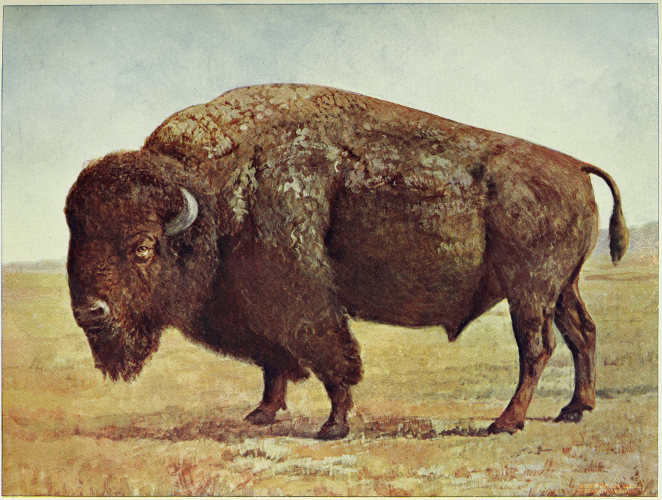
AMERICAN BISON OR BUFFALO. (Bison americanus).
29
The original range of the American Buffalo extended from but little west of the Atlantic coast westward to the Rocky Mountains and from Mexico on the south northward to about the sixty-fifth degree of north latitude. By the trappers the Buffaloes were placed in two classes. Those that frequented the mountain ranges were called Bison. They were seldom seen on the plains, the home of the other class. Their limbs were shorter and stouter and better fitted for a rough country. There existed in former ages two other species entirely distinct from the animal with which we are familiar. They were much larger, possibly as large as an elephant, and were probably associates of the mastodon and the mammoth.
A fully adult male Buffalo will measure about nine or ten feet in length from the muzzle to the tail. Its height at the fore quarters is from five to six and one-half feet. The female is much smaller and weighs from seven to eight hundred pounds less than the male, the weight of which averages eighteen hundred pounds.
The Buffalo’s massive head, with its short, curved horns which are set far apart on the broad forehead, is connected with the body by a short deep and narrow neck. From the neck the body rises, forming a large hump on the back over the forelegs, which gives the animal an odd and unwieldy appearance. This hump consists of fat and strong muscles which control the movements of the massive head. From the hump the body tapers downward so that the hind quarters are low and narrow. The anterior portion of the body, the forelegs and the head are covered with long hair. On the forehead and back the hair is curly and matted. In the early spring most of the long hair is shed, resulting in a modification of the color of the Buffalo. The new coat is a uniform grayish brown, deepening into black-brown in the mane, which covers the top part of the head, forehead, neck and under surface of the throat.
Captain Doyle in an article published in the American Naturalist says, “White Buffaloes have frequently been seen and killed. All the Indian tribes regard them as ‘big medicine,’ but they have different superstitions regarding them. For instance Catlin, the painter, while among the Mandans in 1832, saw a white buffalo robe erected on a pole in their village as a sacrifice to the Great Spirit. It had been purchased from the Blackfeet, who killed the Buffalo, for eight horses and a quantity of goods. On the other hand, the Comanches believe it very dangerous to see a white Buffalo. In 1869 I saw a young Comanche, who had seen a white Buffalo, return to his camp almost dead with fear. He was taken into his tent, the medicine man was sent for and they smoked him and kept up incantations over him day and night for a week. When he came out he believed that he had had a very narrow escape from death. In 1859 a white Buffalo was killed by a white man on the north fork of the Red river. He desired to have it dressed to preserve it, but failed to get any Indian to undertake the task for a long time. At last he prevailed on a Comanche chief, named ‘Horseback’ to have the operation performed. ‘Horseback’ selected one of his squaws, had the medicine man of his band go through various ceremonies over her to preserve her life and then placed her in a tepee some distance from his camp, where the hide was taken to her by a soldier and brought away by him when dressed. No other Indian would look at the hide, much less touch it. Her food was left for her at some distance from the tepee and when the robe was dressed, medicine ceremonies were held over her before she was allowed to join the camp.”
These gregarious animals, during the period of their supremacy, rarely remained for any great length of time in any given locality. Frequently, as if moved by a sudden and general impulse, the whole herd, made up of many smaller companies, each with its leader, would start, all the individuals moving in the same direction. No barriers seemed too great to overcome. Moving in a straight line they would swim or ford rivers, find some means of crossing chasms, but still move on as if led by some irresistible impulse.
These migrations, in many instances, 30 may have been due to the necessity of seeking a more plentiful supply of food, especially when the pastures in the more northern regions became covered with snow. This caused them to move southward. The northern tribes of Indians did not believe that the same individuals returned, as the climatic conditions permitted, but that the Buffaloes were produced in immense numbers under ground and that in the spring they came forth from a great mountain far to the south, a herd of new individuals coming north each season. Since the Buffaloes have disappeared from the plains, some Indians claim that the holes in the southern mountains, in which the Buffaloes were formed, have been closed by some evil spirit.
Dr. Brehm tells us that “among the Buffalo’s perceptive senses those of smell and hearing rank first. In its mental qualities it does not differ from its other relatives. It is little gifted, good-natured and timid, incapable of rapid excitement, but when it is irritated it is apt to forget all considerations which generally influence it and it will then oppose an enemy with courage.”
It would seem that the Buffalo depends upon the sense of smell rather than that of sight, for when running from danger it holds the muzzle near the ground and rushes with incredible swiftness in the opposite direction. Obstinacy is one of the most marked characteristics of the Buffalo. When once moved to a certain action nothing seemed to sway a herd from its decision. Boats on rivers have been known to stop and wait for the passing of a herd that was swimming across the stream. Railroad trains have also been brought to a standstill by the herds crossing the tracks.
The American Buffalo was in reality an inoffensive beast and its ferocious appearance was due to its great bulk. “They are not intractable to domestication, readily entering into friendly relations with individuals who treat them kindly; at least they learn to recognize their keeper and to love him to a certain degree.”
Years ago the Buffalo was the friend of the American Indian. It furnished him not only with food but its skin served him as a blanket and as a covering for his tepees. Its skin also provided the leather from which he made his clothing and footwear. At this time, as Moellhausen has said, “The Buffalo could, in a certain sense, be considered a domestic animal of the Indians, no diminution of the innumerable herds could be noticed; on the contrary, they throve and multiplied on the rich pastures.” Ever content if all their wants were satisfied, the American Indians killed only those that were required for their present needs. It was not till the white man visited them with his stock of glittering trinkets, so attractive to the red man, that he began to kill indiscriminately. He learned that the white man was pleased with their robes and that the flesh of the Buffalo delighted his taste; that he was willing to trade his trinkets for robes and flesh. It was then that the Indian’s whole demeanor toward the Buffalo changed and he became the weak servant of the trader, bartering the lives of thousands of noble animals for valueless things which pleased his eye or caught his fancy.
The value of the Buffalo to the Indian’s welfare can be shown in no better way than by quoting the words of Captain Butler. “‘What shall we do?’ said a young Sioux warrior to an American officer on the Upper Missouri. ‘What shall we do? The Buffalo is our only friend. When he goes, all is over with the red man. I speak thus to you because, like me, you are a brave.’ It was little wonder that he called the Buffalo his only friend. Its skin gave him a house, its robe a blanket and a bed, its undressed hide a boat, its short, curved horn a powder-flask, its meat his daily food, its sinew a string for his bow, its leather a lariat for his horse, a saddle, bridle, rein and bit. Its tail formed an ornament for his tent, its inner skin a book on which to sketch the brave deeds of his life, the medicine robe of his history. House, boat, food, bed and covering, every want from infancy to age and after life had passed; wrapped in his Buffalo robe the red man waited for the dawn.”
31