MR. CHAT, THE PUNCHINELLO. A TRUE STORY.
Reading edition
If Mr. Chat were an ordinary performer he would doubtless select a spot in the center of the village square; he would put up his little stage and his drop-curtain and would send small boys all through the village with his flaming posters:
ATTENTION, EVERY ONE! This Afternoon—in the Village Square At Two O’clock, Mr. Yellow-Breasted Chat will give one of his REMARKABLE PERFORMANCES
Mr. Chat is acknowledged by all to be the best imitator, the most gifted singer, the finest elocutionist, the cleverest ventriloquist, the greatest athlete in all bird-dom.
MR. CHAT Orator, Singer, Gymnast and Punchinello! Don’t fail to see him!
and by two o’clock the village square would be alive with people, and after the show the dimes would rattle into the hat and no one would go away disappointed, as Mr. Chat’s poster would be nearer the truth than most posters of its kind.
All this if Mr. Chat were an ordinary performer, but he is not. His performance is so far ahead of anything that was ever advertised on a poster, that there are not dimes enough in all the world to buy it. You may set a day for him and invite all your friends, or you may take your friends and go seek him in his own haunts; you may try to coax, hire, threaten; you may do everything in your power; but Mr. Chat is a happy creature of inspiration, and makes dates with nobody.
When he will, he will— You may depend on’t; And when he won’t, he won’t— And there’s an end on’t!
His only tent is the blue sky; his stage-setting a jungle of trees near a swamp; his stage a thick bough near the top of a tree; his curtain the leaves of a white birch, or willow, or butternut; his orchestra and curtain-raiser the wind, and his audience his wife sitting patiently on the eggs in her nest, and—you, if you belong to Nature’s elect and happen to be near the swamp at that moment and have the kind of eyes that really see and the kind of ears that really hear. Mrs. Chat can command the performance with one little bird sigh. You could not buy it with the wealth of the world. After the entertainment is over, Mr. Chat drives his wife from the nest and takes her place on the eggs while she flies out over the tree-tops for a little outing. Not many bird husbands are so considerate.
Once upon a time (you see the story is just beginning now) I happened to find myself in a pasture; not a tame, every-day, green pasture tacked on one end of a nice smooth farm—not at all! but a pasture on top of a high hill, with beautiful fields stretching out below it, and all pink and white with laurel. The cows, who, they say, do not care either for laurel or scenery, may not have liked this pasture, but I did. So when I had climbed the bars and seated myself on the top one to view the country, I saw at the far edge of the pasture, a jungle of trees, and I liked it still more, and determined to explore it. On the way I flushed a brown thrasher in a laurel bush, and he flew into the jungle. There seemed to be but one bird singing in all the neighborhood, and this song which was a peculiar one, lured me into the thicket. On I went very cautiously till the sound seemed to be directly overhead. I paused and listened and peered into the tree tops.
“Caw-caw!” cried the bird harshly.
“Nothing but an old crow,” said I in disgust.
32
I started to go, when from the same spot overhead came a loud, clear double note, and again I waited.
“Meow! meow!” remarked my new friend.
“How stupid of me!” said I. “I might have known it was Mr. Catbird.” But immediately there came a glorious trill—first over my head, then almost under my feet, then at my right hand, then at my left; though there was no flutter of wings or other sound in all the jungle. At last the fallen branch upon which I had been sitting gave way and I went into the swamp with a splash of mud. “Look out, look out!” came a sarcastic voice from the tree top.
“It is an escaped Poll-parrot,” said I, to reassure myself, but I took out my handkerchief and mopped my heated brow. The unknown then proceeded to bark like a dog, quack like a duck, and squeal like a pig, with occasionally a measure of song in between. At last in desperation I seized a young sapling near at hand and shook it with all my might, thinking to frighten him into showing himself.
“Haw-haw-haw!” rang out clearly from the top of the very sapling itself.
“That is no bird,” I announced to the swamp; “it is an imp of the forest trying to lure me to destruction in the jungle,” and I turned and fled.
I felt better when I met a cotton-tail rabbit, though he did not stop to be greeted; and still better when I reached the sunlight and the pink and white laurel pasture; and when I neared the bars and saw my horse grazing patiently on the other side, I was quite myself again. On an upright stake at the side of the bars sat a strange, yellowish bird. I did not know him, for I had not so many bird friends then as I have now. Suddenly he rose in the air with a shriek, his legs dangling helplessly. “Is this a magical pasture,” I said to myself, “where birds are shot without the report of a gun?” and then with legs still dangling, he made a beautiful gyration in the air, and calling out: “That’s it—that’s it—tut—tut—tut!” disappeared in the direction of the thicket. This was my first attendance upon one of the remarkable performances of Mr. Yellow-Breasted Chat, and I can without hesitation pronounce it the most wonderful in all bird-dom.
The next day I invited some skeptical friends to prove the truth of my story. So at the same time of day we drove up the long hills till we spied the pink and white of the laurel, and halted at the gray bars. The pasture which had been deserted the day before, was now spotted with cows, the laurel had begun to fade, and though we waited one long, weary hour, not a sight or sound of a bird of any description did we see. The towhee and the shore lark whom I had seen the day before, seemed to have dropped out of existence, and those disagreeable people hinted that even the brown thrasher was a myth. But as I ventured alone into the dark swamp, hoping still to stir up Mr. Chat, I came face to face with the beautiful purple-fringed orchis—the large, early variety—blooming alone in the damp thicket, so straight and stately, and of such a delicate, refined beauty, I fell on my knees beside it, and felt it to be ample compensation for any disappointments. So you see it is true that there is not wealth enough in all the world to force a bird-song at the moment when you want it, but at the same time and in the same swamp the purple orchis may be blooming for you.
Nell Kimberly McElhone.
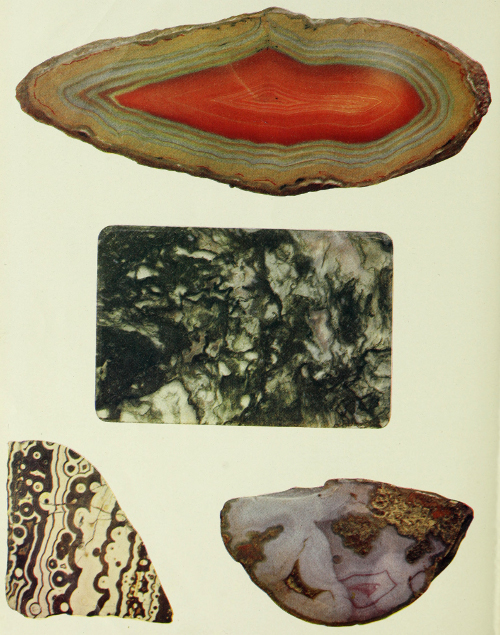
AGATES FROM COL. CHI. ACAD. SCIENCES.
Center Column
BANDED AGATE (Lake Superior).
MOSS AGATE.
Bottom Row
BANDED AGATE (Brazil).
CLOUDED AGATE.
35