Chapter XV · HINTS ON TAXIDERMY, ETC
Reading edition
By Clive Phillipps-Wolley
That ‘the reward lies not in the prize but in the race we run’ is probably more true of sport than of any other pursuit, and yet even in big game shooting there are prizes to strive after which serve at any rate to remind the winners of the races they ran to obtain them. To the man who has won them fairly, the mighty antlers and fierce masks which hang in his hall or study are treasures beyond price. As to the men who buy such trophies, they are not of our guild, nor is it easy to comprehend them or their motives.
When the light is waning and the flames from a wood fire cover the walls of a hunter’s den with quaint shadows of the spolia opima of the chase, it is easy to explain to a kindred spirit the value set upon these hardly-earned treasures. To some they may be mere dry bones or hideous mummies; but out of them and their shadows the tired man, dozing by his hearth, can call up pictures from the deep primeval forest, the sheer snow mountains, or sweet and wild wind-swept upland; pictures such as no artist ever painted or poet fancied. Each head is to that dreamer a key to some locker in his memory. He has but to look at those antlers in the firelight, and the past comes back vivid and glorious, aglow with the colours of an Indian summer, or bright with the blossoms of an Alpine spring, mellow with the beauty distance lends, and painted by the strong happy hand of youth.
If age and feebleness come, shall there be no satisfaction to the old hunter in remembering the ibex he outclimbed, the stag whose senses were not keen enough to detect the stealthy approach of those now clumsy feet tottering to their rest; the grim foe, tiger or grizzly, upon whom his worn-out eyes once gazed without blenching, measuring the shot calmly, upon the success of which hung his life or the beast’s?
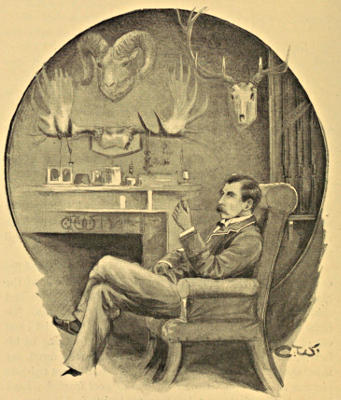
When the light wanes
More than all the pleasures which the rich man feels as he surveys his Murillos or his Raphaels are the hunter’s, as his eyes wander over his antlered walls. He shot the beasts whose spoils are round him, and in the doing of it scenes were graven on his memory which can never be effaced; mental and physical qualities which, but for these silent witnesses, Age the doubter would persuade him that he never possessed, were tried and not found wanting.
But what can bought heads be to the buyer? Furniture for his rooms perhaps, and, even so, misleading; for if a house is to be worth anything, it should represent the tastes and life of the man who lives in it. As a rule, it is long odds that the owners of bought trophies cannot so much as remember the shape of the beasts whose horns they hang up, much less have they any associations connected with them. At the best, they are but costly rubbish; unfortunately they are worse than that. The demand for antlers and sheep’s horns insures a supply being secured in some way, and so it happens that in Canada to-day every up-country trader has been supplied with a printed list of the prices which will be paid for trophies, according to the number of inches they measure round the base or the length and span of the antlers.
In one trader’s house which I know there are nearly a hundred magnificent sheep’s heads waiting for a purchaser, most of which have been brought in by Stony Indians, whom no law can touch for shooting in season or out of season.
The damage done by this head-hunting is twofold: first, to the sportsman, whom it will eventually deprive of his game; secondly, to the country, as tending to rob it of the attractions which it possesses for a class which brings a great deal of money into it. A fair sheep’s head may be bought for twenty-five dollars, but many a hundred pounds of good English money has before now been distributed amongst the natives and traders of British Columbia in the attempt to obtain such a head by fair shooting. No doubt efforts have been made by the legislature to protect the game; but in those countries to which I have had access I have found that, though the laws were good enough, they were rendered useless through lack of men to enforce them.
In Canada no game laws can ever be of much avail as long as the Indian is allowed the privileges which he at present enjoys.
But the principal business of this chapter is to instruct the hunter in the best methods of preserving his trophies when fairly won, until such time as he can hand them over to one of our excellent practical taxidermists at home. In nine cases out of ten, the head is all that a man cares to preserve, and those who are wise will not cumber their houses with too many even of these with the masks on. In spite of infinite pains, moth and dust will corrupt the most carefully guarded collections. However, if you want to mount the head with skin and all complete, let your first care be to sketch or photograph it in profile before the skinner’s knife has touched it, in order that the man who sets up the trophy may have some idea of what it looked like in life.
If the hunter cannot sketch decently, a kodak is a good substitute for the pencil, or the proportions and various bumps and inequalities in the outline may be accurately preserved by laying the head upon a sheet of paper and tracing its outline with a simple instrument, consisting of two pieces of metal four or five inches in length, set at right angles to one another, with a socket at the angle into which a lead pencil is fixed, so that the point projects just far enough to make a mark upon the paper, when, with the lower side upon the paper and the upright side against the head, an outline of the profile is taken. Outlines or photographs should be made as soon after death as possible, before the muscles have time to sink and lose their natural prominence.
In skinning a horned head proceed as follows:—
Slit the back of the neck up the middle to a point between the horns, then make a crosscut from the base of one antler to the base of the other. This will give you a cut shaped thus, T. Now separate the skin from the skull round the base of each antler, and be careful not to cut the coat unnecessarily during the operation. Next turn the head over and begin at the other end, severing the inner side of the lips from the gums as high up as you can reach, and skinning the muzzle as far back as you can. Then peel off the whole mask from the antlers downwards to the muzzle, being specially careful not to slit the skin, either at the eyes or at the nostrils, which are the tenderest portions of it. Be careful to preserve a sufficiently long neck, and do not let your Indian or Tartar cut the beast’s throat (as he will do if you do not watch him), as nothing looks worse than a taxidermist’s stitches showing under the throat of a trophy.
If you have followed these directions, you will have preserved so far the entire lips of the animal. Now take your knife and slit the lips, separating the inner from the outer skin, and dress the cut so made thoroughly well with powdered alum. Having removed the skin from the skull, you may clean this part of the trophy, either by boiling it if you have a pot with you large enough for that operation, or if not, after whittling out the eyes, brains, and any flesh you can readily detach, you may hang it up in a tree, out of reach of coyotes to dry, until fit for packing. Before putting your skins and skulls apart to dry, mark them carefully with corresponding numbers, to prevent mistakes later on.
Should you wish, however, to skin a beast whole for mounting in some museum or elsewhere, you must proceed as directed by my friend, Mr. John Fannin, curator of the Museum of British Columbia, whose directions I have slightly altered to suit my purpose, and inserted below.
Turn the beast on to his back and make cut 1, from the point of the breastbone along the centre of the belly to the root of the tail, taking care only to cut through the skin, and not into the intestines. A few pieces of fine brush, laid on the inside of the skin as you peel it off, serve to protect the skin from any blood which may escape from the bullet wounds or elsewhere during the operation of skinning.
Next, make a cut from the hoof of each foreleg to the upper end of cut 1, making the incision down the hind part of each foreleg. Make a cut from the hoof of each hind leg, along the hinder part of it to the lower end of cut 1. Now skin round the legs; sever the leg bones at the knee and hock joints, leaving these bones with the hoofs attached to the skin, but with the skin freed down to the hoofs. Now skin the animal in the ordinary manner, using the edge and not the point of your knife, and on reaching the neck make the T shaped cut described above, along the top of the neck and between the antlers. This will allow the skin to be removed entirely from the head; but before proceeding with the head the skin should be removed from the body as far as the head, and the head severed at the neck joint.
Having washed any blood off the hair and detached every fragment of meat or fat which you can get off the skin, stretch it out upon the ground in some airy spot where it can dry naturally, unaffected by sun or fire. Dress the skin with powdered alum, or failing that with wood ashes, and don’t peg it out. When prepared in a solution of soda by the taxidermist at home, the alum-dried skin will become as pliable as kid and will resume its natural proportions, and these should satisfy any honest hunter.
The methods recommended in this chapter are of course only for preserving trophies in the field. All trophies should be sent home for final preparation as soon as possible, either prepared with alum and packed dry, or in a tub of pickle composed of alum and salt in the proportion of two-thirds of the former to one-third of the latter.
Some men make a practice of carrying a saw with them to divide antlers and skulls for greater convenience in packing, sawing the skull right through from crest to nose; but though trophies are undoubtedly somewhat easier to pack in this way, I do not recommend it, as a very heavy wapiti head of mine so treated is constantly annoying me now by breaking away from the rivets which should hold it, to come thundering upon the ground.
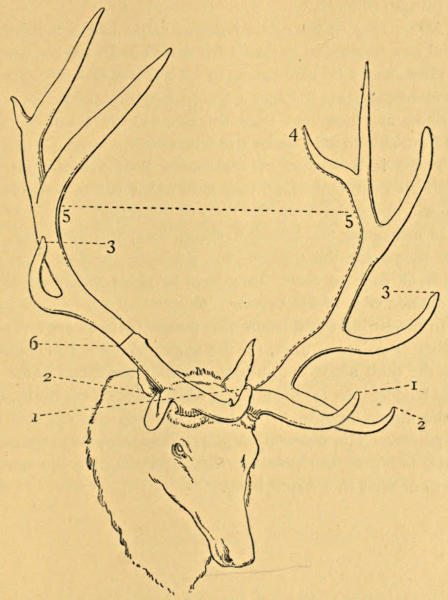
Wapiti head
1, 2, and 3 indicate the brow, bay, and tray antlers respectively; 4, indicates the line along which a head should be measured for length; 5, the line along which to measure for span; 6, where to measure for girth.
In sending skins home from temperate regions I have never found it necessary to use any preservative against insects other than the powdered alum with which the skins are dressed; but in hot climates more elaborate precautions are necessary, and a liberal dose of spirits of turpentine should be applied externally from time to time.
An application of spirits of turpentine put on with a liberal hand, and brushed in, the way of the hair, with a dandy brush at spring-time, will go a long way towards saving trophies from the ravages of moth.
A covering of fine glazed gauze, made like a nosebag, is useful as a protection to heads left stored in an unused room.
Here it may be convenient to set out the ordinary systems of measuring game trophies amongst English sportsmen.
Skins are measured from the snout to the tip of the tail, and from side to side under the forearms.
There is a system of measuring bear skins upon the American continent which may have given rise to some errors—to wit, measuring from the ‘heel to the snout.’
In measuring the heads of sheep, ibex, and such like, the chief points are the girth of the horns at the base, and the length of each of them from base to point measured along the outside edge of the curve.
In measuring stags’ heads the points to note are: (1) the number of points or tines, (2) the length of the horn measured from the skull along the outside curve of the beam to the tip of the longest tine, (3) the greatest width between the horns, and (4) the circumference of the beam between the bay and the tray points. The diagram on p. 419 illustrates these measurements, indicates the points named, and displays the normal growth of tines in a wapiti head.