Chapter XI · INDIAN SHOOTING (continued 3)
Reading edition
Major Greenaway 37 .. .. .. .. .. .. .. ..
Sterndale’s ‘Mammalia’ 36 to 38 54 to 60 .. Average 30 .. .. .. .. ..
Average of good head .. .. .. 30 .. 4 .. .. ..
Measurements
Authority Height at shoulder Total length Weight as shot Length of horn Length of brow antler Girth above brow antler Girth above burr Points Remarks
Rucervus Duvaucelli
ins. ins. lbs. ins. ins. ins. ins. ins.
Major C. S. Cumberland .. .. .. 41 5½ .. .. 6×6 Rowland Ward, ‘Horn Measurements’
” .. .. .. 39¼ 5 .. .. 5×6 ”
Sir E. G. Loder, Bart. .. .. .. 37⅜ 5¼ .. .. 7×6 ”
Col. Erskine about 45 .. .. 37 7 14 .. 7×7
Major Ward .. .. .. 36½ 5 .. .. .. ‘Sportsman’s Guide to Ladak, &c.’
Mr. B. Hodgson .. .. .. 36 5 .. .. 6×5 Rowland Ward, ‘Horn Measurements’
Sir V. Brooke .. .. .. 35⅜ 4⅞ .. .. .. ”
Mr. H. C. V. Hunter .. .. .. 35¼ 5¾ .. .. 7×6 ”
Major C. S. Cumberland .. .. .. 34¾ 5⅝ .. .. 5×5 ”
British Museum .. .. .. 34 5½ .. .. 5×5 Head No. 694 A.
Major C. S. Cumberland .. .. .. 33½ 4¾ .. .. 5×5 Rowland Ward, ‘Horn Measurements’
” .. .. .. 33⅛ 5½ .. .. 5×5 ”
Rowland Ward .. .. about 560 .. .. .. .. .. ”
Forsyth .. .. .. 33½ .. .. .. 6×6 ‘Highlands of Central India’
Major FitzHerbert 49 82 .. 30 .. 10⅜ .. ..
” 47 81 .. .. .. .. .. ..
Sterndale’s ‘Mammalia’ 44 to 46 .. .. about 36 .. .. .. 12 to 14
Average of good head .. .. .. 30 5 .. .. 6×6
Rucervus Schomburgkii
British Museum .. .. .. 30⅛ 5 .. .. 10×10 Rowland Ward, ‘Horn Measurements’
” .. .. .. 29⅞ 5⅛ .. .. 9×8 ”
” .. .. .. 29¾ 4¾ .. .. 10×11 ”
” .. .. .. 28¾ 5½ .. .. 8×8 Head No. 1463 A.
Sir V. Brooke .. .. .. 28½ 5¼ .. .. 11×9 Rowland Ward, ‘Horn Measurements’
British Museum .. .. .. 27⅞ 5⅜ .. .. 9×8 ”
” .. .. .. 27¾ 4⅜ .. .. 7×8 ”
Panolia Eldii
Sir E. G. Loder, Bart. .. .. .. 39⅝ 5 .. .. 20 Rowland Ward, ‘Horn Measurements’
British Museum .. .. .. 38⅞ 6¼ .. .. 16×19 ”
” .. .. .. 37½ 5⅜ .. .. 5×5 ”
Rowland Ward .. .. .. 37 6⅛ 10½ .. .. ”
Mr. A. O. Hume .. .. .. 36⅛ 5½ .. .. 4×3 ”
British Museum .. .. .. 35¾ 5⅜ .. .. 4×5 ”
Hume Collection, British Museum .. .. .. 34⅞ 5½ .. .. 6×6 ”
Mr. A. O. Hume .. .. .. 34⅝ 6⅛ .. .. 5×6 ”
Hon. W. Rothschild .. .. .. 34⅛ 5 .. .. 6×6 ”
Mr. J. Carr Saunders .. .. .. 34 5⅞ .. .. 10×10 ”
The horns of Eld’s deer are very difficult to measure in the ordinary way, owing to the extreme smallness of the burr, the back of the beam in good specimens touching the skull, and because the brow antler does not form an angle with the beam, but is simply a prolongation of the curve of the horn.
XXVII. THE CASHMERE STAG (Cervus cashmirianus)—Sterndale, Kinloch. (Cervus Wallichii)—Jerdon, Ward
Cashmere: Hangal, Barasingh
This is the stag par excellence of India. A sambur has a fine head and so has a swamp deer, but neither approaches in beauty to a barasingh. A good stag’s head is one of the trophies of the Himalayas, but unfortunately it is getting scarcer year by year. Sheep and cattle affect this deer but little, as they keep more or less to the open downs and glades; but the yearly increasing herds of buffaloes that come up from the plains to graze in Cashmere during the summer, at the very time that the stags are growing their horns, are the real mischief-makers. Buffaloes delight in plunging through dense forest, and they and their attendants will clear the deer out of any valley. Unfortunately for the sportsman, buffaloes pay for their feeding in taxes and produce, while deer do not. The best step as regards preservation that the Cashmere authorities have taken as yet is the creation of a Royal Preserve between the Sindh and Liddur rivers, and if they would only exclude buffaloes from this tract entirely it would form a real sanctuary, which would immensely improve the shooting all round. At present, by allowing buffaloes to graze on it, they are depriving it of half its value.
In spite of all drawbacks stags are still to be got, but in no quantity. Two good heads in a month’s shooting are as many as any sportsman can reasonably hope to get, and if one of those measures 40 ins., whether with ten or twelve tines, he is to be congratulated.
The general impression about barasingh seems to be that a full-grown stag always has twelve points, but this the writer believes to be entirely erroneous. I have hunted over some of the best ground in Cashmere on different occasions, and am of opinion that the number of points usually found in full-grown heads depends entirely upon the locality. The stags which do not leave the Cashmere Valley, i.e. harbour on the hills overlooking it, and those that live to the south-east, often run to twelve and sometimes more points; while the stags which harbour across the Kishengunga rarely run to more than ten points. These stags appear to develop ten points very early; the poorest head the writer ever shot was a 10-pointer. I shot a young stag with only six points once, under circumstances that gave no opportunity of previously judging its head, and it had far longer and better horns than the above-mentioned 10-pointer. Crummle and antelope heads are also rare. I once shot a very heavy old stag with a most curious antelope head, the horns having not a tine on them, and being twisted more like a markhor’s than a stag’s. The old fellow was absolute king of the valley, too, and not another stag dared answer his challenge. It was very puzzling at the time. While stalking another stag which had called once among some thick bushes but would not show, the old antelope head appeared far up the hill, sauntering leisurely down, and challenging as he came. Every deer within hearing seemed to hide from him at once. There was a small 6-point stag with a hind cowering behind some bushes about two hundred yards to my right, while the deer that he had originally started after were keeping hidden somewhere to his left, and the old chieftain was coming straight towards him, singing his war-song. Over and over again were the glasses laid on him, but nothing could be made out. The body was that of a royal, but the horns were short, with no antlers visible. Apparently he was a bad three-year-old. What did it mean? If he were a big royal the respect shown him by the other stags was intelligible enough; but why should they be afraid of a beast like that? Fairly puzzled, I crept back to look for the stag I had originally come down after, which there was every reason to believe was a 10-pointer. Not a sign of him could be seen, but while pottering about in some long grass a pair of straight horns suddenly appeared within forty yards of me. Confound this brocket! he has walked on top of me; perhaps he may just miss me! No! he comes straight on and looks me in the face. Now the brute will drive everything away, so here goes—and he drops in his tracks. A brocket? Not a bit of it; twenty years old if he’s a day, and his quaint old head is the pick of the bag.
The general colour of barasingh is much the same as that of red deer, but is rather greyer, and the white patch on the rump appears a little larger. Sterndale says it has a white circle round the eyes, but the writer has never seen anything more distinct of this kind than a ring slightly paler than the rest of the head.
The horns resemble those of the red deer, with the notable exception that with barasingh the bez antler appears to be the fighting one, and is always longer and bigger than the brow antler, while with red deer the reverse is the case. Sir Victor Brooke says its call is just like that of a wapiti, and quite different from that of a red stag. ‘In the former it is a loud squeal, ending in a more guttural tone; in the latter it is a distinct roar, resembling that of a panther.’ According to the writer’s experience, the full call is seldom heard till the rutting season is at its height. When the stags first begin roaring the call is comparatively short. Ward’s remarks on the subject are well worth quoting: ‘The noise a stag can make when “roaring” is much louder than would be imagined, and can be heard at a great distance; but very often, when the animal is lying down, he only utters a prolonged moaning sound, which is very deceptive, and unless frequently repeated, it is difficult to find out the exact direction to follow.’
In the winter nearly all the barasingh are congregated in the Cashmere Valley, but though the smaller stags come down and are pretty easily found, the big ones will not leave the high ground, where it is impossible to follow them (unless they are driven down by an early fall of snow), until the young grass begins to grow in March, which is the best month to get heads, though of course the deer are then in poor condition. Ward writes about winter shooting:
If it could be done, the plan would be not to decide to enter the valley (i.e. Cashmere) until information of a really heavy fall in December or early in January had been obtained. The late falls of snow do not drive the deer down. The hazel buds are swelling, and they can graze on them; the sap is rising in various bushes and trees, and the deer can eat the smaller twigs, but an early fall forces the animals into the valleys.… In the spring, when the snow is melting, is, to my idea, far the best time, and I would sooner have from February 20 to March 20 after the stags than all the rest of the year. They are then down on the young green grass, and are busily devouring the crocuses.
By the end of March all the big stags and most of the smaller ones have shed their horns, and the deer collect into large herds and begin moving off to their summer quarters, those in the western corner of the valley going to the banks of the Kishengunga river. The herds which strike the river at its nearest point below Gurais cross it, and retire to the range of hills on the southern border of Astor. Only a very few stags cross this range, the bulk of the deer remaining on the Cashmere side. The deer on the northern and eastern sides of the valley retire to the slopes of Haramook and the high ground south of the range which separates Cashmere from Dras and Sooroo, but do not appear to cross it. The farther east one goes from Srinugger the less the deer appear to migrate, merely retiring to the heads of the valleys. The altitude of the birch copses just above the limit of the pines is what they seek, and this they can find close at hand on the north and east of the valley, but they have to travel some distance to it on the west. About September 1 the horns should be nearly free from velvet, and as a delicious wild black currant ripens at the same time, the shikaris associate the two. Up to September 20 the old stags are either alone or accompanied by a youngster who acts as fag, and they are not easy to find; in fact, as a rule, shikaris declare that it is useless trying to find them. But when the sportsman knows, from seeing tracks, that there are big stags on the ground, and the heads of the valleys (not the calling grounds) are the places to look for them, then, by carefully watching some glen where tracks have been seen, particularly just about 8 a.m. when the sun is getting hot, a stag may often be discovered as he rises from where he had lain down shortly after sunrise. He is about to move to a more sheltered spot to spend the day—and it is so satisfactory to have a stag or two to one’s credit before they begin to call. Unfortunately it is not always possible. Some of the best valleys during the calling season do not hold stags before that season begins, as the deer move on to them just then, and very often leave immediately afterwards. Good local information is absolutely necessary, and a shikari who does not know every soiling pool, every deer-path, or likely copse for a stag to lie up in is useless.
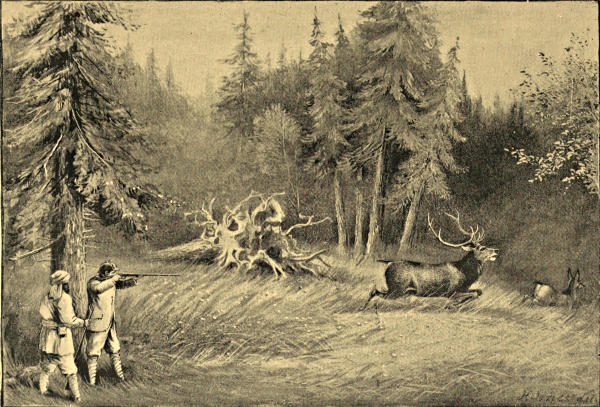
‘A SNAP-SHOT IN THE FOREST’
The calling season generally begins about September 20, and varies according to the weather, and also according to the moon. Fine hot weather and a full moon about the 20th mean that every stag in the place will be calling freely. Wet cold weather and no moon mean the reverse, the weather having more effect than the moon. The idea of the stage of the moon having any effect may be considered fanciful, but if it is taken into consideration that the stags usually begin calling at night and almost invariably fight their battles for supremacy then, it follows that the light of the moon is a decided advantage. A good set-to between two old barasingh stags would be a grand sight. The writer once came across a battle-field, but too late to witness the fight, and the way the turf was ploughed up bore testimony to the severity of the struggle. The rutting season appears to be initiated by the hinds; at least I have observed that the short bark of the hinds is usually heard some days before the roar of the stags, and have seen a stag come best pace out of the forest in answer to a hind’s call in the early morning, before a stag’s challenge had been heard on the ground. It is most amusing to watch a young stag calling, the way he swaggers before his lady-love, tearing up the turf with feet and horns as if nothing could drive him from her, till his challenge is answered by a deeper note, when the youngster curls up at once, flees for his life to the thickest scrub he can find half a mile away and cowers among the bushes, while his mate in the most matter-of-fact way at once attaches herself to his lordly rival, who comes swaggering easily along the hillside with the sunbeams glancing from the burnished points of his glorious antlers. A small calling stag should never be disturbed, as he almost invariably draws out a better beast. Great care, too, should be taken not to frighten away unattached hinds anywhere near a calling ground. If left alone they will sooner or later be joined by stags, though occasionally hinds will run from a stag just as if they had scented a man. The writer on one occasion was watching a hind and calf feeding, when they suddenly galloped off, and presently an old stag came trotting down the hill grunting his displeasure and following their scent like a hound, till, coming within range, he paid the penalty. Probably owing to the scarcity of hinds, even the best stags appear never to be able to collect more than two or three, not counting calves, which seem always to run with their dams for a year.
Old writers talk of stags calling all day long. This may have been so years ago; now-a-days they rarely call after 9 a.m., and do not begin again before 3 p.m. at the earliest. I once heard a grand chorus in the early morning. Five different stags were calling at the same time, but as they seemed to be more or less afraid of one another and kept perpetually on the move, I never got a chance at one of them.
To be successful with stags during the calling season, the sportsman should be on his ground as soon as it is light. The stags are moving about all night, and soon after sunrise they retire into the forest, where, unless they keep on calling, it is almost impossible to find them. This, of course, refers to the open ground at the top of the hills. Ward prefers the lower ground in the pine forest, from 8,000 to 9,000 ft. above the sea level, as he says the stags there seem to settle down into certain spots and remain there for days together. The writer’s own experience is that the upper ground is best when the stags first begin calling, as they all seem to collect there, and that later on, about October 1, when there has often been a slight snowfall on the top of the hills, and the frost at night is beginning to tell, the stags should be followed down into the forest. But as different valleys vary so much, according to whether the deer remain in them during the winter or are merely passing through, no general rule applies to all. Hunting the upper ground as long as the stags are on it is undoubtedly far pleasanter than creeping about in the forest down below, and in the gloom of the pines the chances are very much against the stalker. Stags may occasionally be shot by waiting for them at some favourite soiling or drinking pool, and it is by no means a bad thing to try if the pool is in thick forest and some distance from other water. The most likely time to see anything is about 4 p.m., when the deer begin to draw out. Waiting over salt-licks and water at night is an abomination, like all other night shooting. As a rule, you do more harm than good by disturbing the ground, and if you do get a shot and hit (no certain matter even in the brightest moonlight), unless the stag is dropped on the spot you run a very great risk of losing him. Barasingh are very tough beasts, and an ill-placed bullet is not much use. It is very difficult to know what to do when (as often happens) the stags will not call till just before dark. If this happens among the pine forests, any attempt at night shooting is almost sure to end in failure; and even on the high open ground the chances are so much against the sportsman that it should only be tried if every other plan fails. Patient tracking and watching over likely glades for a stag to draw out on are far more effective in bringing eventual success. The two main points to be remembered during a stalk are, first, to try and get a clear chance at about sixty yards, and not creep up too close to the stag before firing; secondly, to avoid going straight downhill on to a stag. A stone dislodged, a pheasant or musk deer disturbed, will be sure to start him off. On the other hand, if the stalker is moving down sixty or seventy yards to one side, any slight contretemps does not necessarily spoil his chance of a shot. Every native shikari, if conducting a stalk, will try to land his master between the beast’s horns if possible. As soon as he sees a stag, he will begin to try to point him out, with the result that before his master can get his wind and take any aim to speak of, the beast is at full gallop down the hill. The second point never enters into a native’s calculations at all. Ward says that natives can imitate the call, and draw stags, but systematic calling as practised in the Tyrol is practically unknown in Cashmere, and a proficient in the art would undoubtedly have success. The point to aim at in calling is to pitch your note a little weaker than the answering stag, so as to give him confidence in accepting the challenge.
A stalk in the open
The stags generally cease calling towards the end of October (Ward says 20th), and after that there is little chance of getting sport till the snow drives them down, or, failing an early fall, till the spring.
Major Ward says a well-shaped 10-point head of 40 ins. should not be despised, but the majority of heads shot, according to the writer’s experience, do not average more than 37 ins.; 40 ins. and over being exceptional heads.
XXVIII. THE SIKKIM STAG (Cervus affinis vel Wallichi)
Native name: ‘Shou.’ Habitat: Eastern Himalayas; Thibet, in the Choombi Valley, on the Sikkim side of Thibet (Sterndale)
None of the heads of this variety in the British Museum have more than ten points. Their colour, according to Jerdon, is a fine clear grey in winter, with a moderately large disc; pale rufous in summer, quite different from the rich mouse colour of the barasingh. Hodgson’s description of the horns is most accurate, the flatness of the brow antlers is very marked, ‘pedicles elevate; burrs rather small; two basal antlers, nearly straight, so forward in direction as to overshadow the face to the end of the nasal; larger than the royal antlers; median or royal antlers directed forwards and upwards; beam with a terminal fork, the prongs radiating laterally and equally, the inner one longest and thinnest.’ There is an enormous head in the British Museum, the two brow antlers of which bend downwards on each side. As in the case of the barasingh, the second brow antler, or bez, is always longer than the first.
As regards the allied maral stag of Persia and Turkestan, Major Cumberland, in his letters published by ‘Land and Water,’ 1891, writes that the Turkestan name for the stag is ‘bōghè,’ the hind being called ‘maral.’ This deer resembles the red stag, in that the brow antler is longer than the bez, and the crown is more of the wapiti type.
Another variety, with horns also of the wapiti type, Cervus Eustephanus, was discovered by Mr. W. Blanford in the Thian Shan mountains. He describes this variety as also having the brow antler longer than the bez.
XXIX. MUSK DEER (Moschus moschiferus)
Generally ‘Kastura’; Garwhal and Kumaon, ‘Bena,’ ‘Masaknaba’; Cashmere, ‘Roos,’ ‘Rous’
This little deer is found all over the hills above an altitude of 7,000 or 8,000 ft., except in Ladak, though it is said to be plentiful in Thibet, beyond the frontier of Nepal.
Cover of some sort, bushes or timber, seems necessary for it, and the want of this is probably the reason it does not extend to Ladak. Except that district, every shooting ground of the right elevation seems to hold musk deer; and as, particularly in the autumn, they are excellent eating, a chance with a light rifle is well worth taking advantage of, unless in too close proximity to better game. The musk deer has no horns, but the male has two delicate curved tushes, growing down from the upper jaw, which are often over three inches in length outside the gums; these tushes being the only distinguishing mark between the sexes, it is very hard to tell them apart at a distance.
Measurements
Authority Height at shoulder Length nose to tip of tail Tail Girth of body Weight as shot Length of horns Girth above brow antler Girth, beam midway Burr Length brow antler Length bez antler Girth bez antler Length median antler Splay at tips Widest spread Inside span Points Remarks
Cervus cashmirianus
ins. ins. ins. ins. lbs. ins. ins. ins. ins. ins. ins. ins. ins. ins. ins. ins. ins.
Dr. Leith Adams .. .. .. .. .. 48 .. .. .. .. .. .. .. .. .. .. .. Sterndale, ‘Mammalia’
Major Ward .. .. .. .. .. 47 7¾ .. .. .. .. .. .. 29 56 .. 13 ‘Sportsman’s Guide’
” 49½ .. .. .. 400 .. .. .. .. .. .. .. .. .. .. .. .. ”
Sir E. G. Loder, Bart. .. .. .. .. .. 47 6¾ .. .. .. .. .. .. 21¾ .. 36⅜ 5×5 Rowland Ward, ‘Horn Measurements’
Major Ward .. .. .. .. .. 46 8 .. .. .. .. .. .. 32 50 .. 12 ‘Sportsman’s Guide’
‘Oriental Sporting Magazine,’ 1870 .. .. .. .. .. 46 .. 7 10 18 .. .. .. .. .. .. ..
Sir V. Brooke .. .. .. .. .. 45⅝ 6 .. .. .. .. .. .. 25¾ .. 36 8×8 Rowland Ward, ‘Horn Measurements’
Hume Collection, British Museum .. .. .. .. .. 45⅞ 8 .. .. .. .. .. .. 35 .. 41 6×6 ”
Hon. C. Ellis .. .. .. .. .. 43⅞ 5⅞ .. .. .. .. .. .. 15⅞ .. 32 5×5 ”
” .. .. .. .. .. 43⅜ 6½ .. .. .. .. .. .. 25⅜ .. 36½ .. ”
Hume Collection, British Museum .. .. .. .. .. 43¼ 6½ .. .. .. .. .. .. 18⅛ .. 34½ 5×5 ”
Dr. Falconer, Brit. Mus. .. .. .. .. .. 43 5⅞ .. .. .. .. .. .. 6¼ .. 27¾ 5×5 ”
Mr. M. Kennard .. .. .. .. .. 43 5⅞ .. .. .. .. .. .. 26⅛ .. 37⅞ 6×5 ”
Gen. Macintyre .. .. .. .. .. 42 .. 7¼ 10½ .. .. 5½ .. .. .. 33 10 ‘Hindu Koh’
British Museum .. .. .. .. .. 42 5⅞ .. .. .. .. .. .. 29⅜ .. 33½ 6×5 Rowland Ward, ‘Horn Measurements’
Major Greenaway 52 81 .. .. .. .. .. .. .. .. .. .. .. .. .. .. ..
The Writer 47 85 .. .. .. .. .. .. .. .. .. .. .. .. .. .. 10 Showing normal difference between brow & bez antlers
” .. .. .. .. .. 36¾ .. .. 8 11¼ 14½ .. .. 25 35 .. 10
” .. .. .. .. .. 35½ 5½ .. 8 10½ 15½ .. .. .. 35 .. 10
Sterndale, ‘Mammalia’ 48 to 52 84 to 90 5 .. .. .. .. .. .. .. .. .. .. .. .. .. ..
Average of good head .. .. .. .. .. 37 6 .. .. .. .. .. .. .. .. .. 6×6
Cervus affinis
Mr. A. O. Hume .. .. .. .. .. 55¾ 6½ .. .. .. .. .. .. 17¼ .. 40⅜ 7×6 Rowland Ward, ‘Horn Measurements’
British Museum .. .. .. .. .. 55¼ 8½ 7¼ 11 14 19¼ .. .. .. .. .. 5×5
Lord Northbrook .. .. .. .. .. 55 9⅛ .. .. .. .. .. .. .. .. .. 6×7 Rowland Ward, ‘Horn Measurements’
Dr. Campbell, British Museum .. .. .. .. .. 54⅜ 6⅝ .. .. .. .. .. .. 21⅝ .. 37¼ 5×5 ”
Dr. Jerdon quotes a head .. .. .. .. .. 54 .. .. .. .. 12 .. 8 .. 47 .. .. Sterndale, ‘Mammalia’
Mr. B. H. Hodgson, British Museum .. .. .. .. .. 53¾ 6⅞ .. .. .. .. .. .. 26⅛ .. 44 5×5 Rowland Ward, ‘Horn Measurements’
Hume Collection, British Museum .. .. .. .. .. 53¼ 6⅞ .. .. .. .. .. .. 30 .. 45¾ 4×5 ”
Col. Tanner .. .. .. .. .. 53 9 .. .. .. .. .. .. .. .. 40 5×5 ”
British Museum .. .. .. .. .. 52¼ 10¼ 6½ 10⅛ 12 13 .. .. .. .. .. 5×5 ”
Rowland Ward .. .. .. .. .. 52 8 .. .. .. .. .. .. .. .. .. .. Rowland Ward, ‘Horn Measurements’
” about 60 .. .. .. .. .. .. .. .. .. .. .. .. .. .. .. ..
Sterndale, ‘Mammalia’ 54 to 60 about 96 .. .. .. .. .. .. .. .. .. .. .. .. .. .. ..
Cervus maral
British Museum .. .. .. .. .. 48⅝ 6⅛ .. .. .. .. .. .. 38¼ .. 40⅞ 6×5 Rowland Ward, ‘Horn Measurements’
” .. .. .. .. .. 46½ 8 7½ 11¼ 15½ 14½ .. .. .. .. .. 5×5
Mr. E. Buxton .. .. .. .. .. 43½ .. .. .. .. .. .. .. .. 38½ .. 14 ‘Nineteenth Century,’ 1891
Hume Collection, British Museum .. .. .. .. .. 40¼ 5½ .. .. .. .. .. .. 23¾ .. 31¾ 5×5 Rowland Ward, ‘Horn Measurements’
” .. .. .. .. .. 35⅛ 5½ .. .. .. .. .. .. 19¾ .. 26 5×5 ”
Major Cumberland 55 .. .. 57½ .. .. .. .. .. .. .. .. .. .. .. .. 10 ‘Land & Water,’ 1891
Cervus Eustaphanus
Mr. Blanford, ‘Scientific Results, Second Yarkand Mission’ .. .. .. .. .. 51 10⁹⁄₁₀ .. .. .. .. .. .. .. .. .. .. Girth above burr 10½ ins.
Red Deer from Tyrol, &c.
Lord Powerscourt, ‘Pro. Zoo. Soc., 1862’ .. .. .. .. .. 68 .. .. .. .. .. .. .. .. 65 .. 44 From Carpathians? Rowland Ward, ‘Horn Measurements’
Col. Howard .. .. .. .. .. 49¾ .. 7½ 11¼ 18¼ .. .. .. .. 49¾ .. 14 Vienna Exhibition
H.R.H. Duke of Edinburgh .. .. .. .. .. 48½ .. 6 .. .. .. .. .. 30 41½ .. 5×6 (Crimea) Rowland Ward, ‘Horn Measurements’
Lord A. Hay, British Museum .. .. .. .. .. 48⅛ .. 7¼ .. .. .. .. .. .. .. .. 12 Single horn, Asia Minor, Rowland Ward, ‘Horn Measurements’
St. George Littledale .. .. .. .. .. 47⅝ .. 5½ .. .. .. .. .. 38 .. .. 6×5 Caucasus, Rowland Ward, ‘Horn Measurements’
Col. Howard .. .. .. .. .. 47¼ .. 7½ 10¾ 15 .. .. .. .. 50 .. 16 Vienna Exhibition
Sir V. Brooke .. .. .. .. .. 47⅛ .. 7¼ .. .. .. .. .. 34 .. 41⅛ 8×9 Germany, Rowland Ward, ‘Horn Measurements’
St. George Littledale .. .. .. .. .. 47 .. 7⅛ .. .. .. .. .. 36 .. 37¾ 6×7 Caucasus, Rowland Ward, ‘Horn Measurements’
Col. Howard .. .. .. .. 596 .. .. .. .. .. .. .. .. .. .. .. .. Weight of best stags killed in last 8 or 10 years, from Perechinko
” .. .. .. .. 564 .. .. .. .. .. .. .. .. .. .. .. .. ” Munkacs
” .. .. .. .. 544 .. .. .. .. .. .. .. .. .. .. .. .. ” Pomerania
” .. .. .. .. 544 .. .. .. .. .. .. .. .. .. .. .. .. ” Bukowina
” .. .. .. .. 540 .. .. .. .. .. .. .. .. .. .. .. .. ” Munkacs
” .. .. .. .. 540 .. .. .. .. .. .. .. .. .. .. .. .. ” Sieben Bergen
” .. .. .. .. 516 .. .. .. .. .. .. .. .. .. .. .. .. ” East Prussia
” .. .. .. .. 508 .. .. .. .. .. .. .. .. .. .. .. .. ” Lower Austria
” .. .. .. .. 500 .. .. .. .. .. .. .. .. .. .. .. .. ” Slavonia
The hair of the musk deer seems always loose, and comes out readily. A musk deer just grazed by a bullet (by no means an uncommon occurrence with so small a beast) seems to vanish in a cloud of hair. The male has an abdominal gland containing more or less musk according to the season, it being fullest during the rutting season in the winter; this pod is valuable (a good one is worth Rs. 5 in the jungle), and leads to the musk deer being so mercilessly snared and hunted by natives that in many districts they are almost extinct. Pine martens, wild dogs, leopards, eagles, all seem to prey upon the unhappy musk deer, and if it were not that they breed far more rapidly than other deer (according to Hodgson being able to procreate before they are a year old), they would have no chance of existence at all.
When a musk deer has been killed the pod should be cut off in the presence of the sportsman, and hung up in his tent to dry; if the shikari is allowed to meddle with it, he will probably extract the musk, and fill up the pod with rubbish. Another very common trick is for the shikari to present his master with the buck’s scrotum, and keep the pod for himself.
Musk deer are generally found alone or in pairs, and as they keep a great deal to their particular bit of ground, if one has been seen and not fired at the sportsman may nearly always rely upon finding it again near the same place. When startled this deer gives a low hiss, and as it seldom runs far without stopping to gaze, it generally affords an easy shot. Musk deer are occasionally a nuisance on barasingh ground, and the writer once lost a shot by putting up one of them just as he was getting up to a stag which was calling in the forest.
Measurements.—Sterndale gives length about 36 ins., height about 22 ins. Major Ward, height about 22 ins., weight from 25 lbs. to 30 lbs. Colonel Kinloch says it does not stand more than 20 ins., Jerdon 22 or 23 ins.
In Garwhal and Kumaon musk deer appear to be bigger and heavier than in Cashmere.
XXX. BARKING, OR RIB-FACED DEER
(Cervulus Aureus, vel Muntjac)
‘Kakur,’ generally throughout the Himalayas; ‘Ratwa,’ in Nepal and neighbouring states; ‘Jungli Bukra,’ in Central Provinces; ‘Muntjac,’ Sundanese
This deerlet is found pretty generally throughout India, Burmah, Ceylon and the Malay Peninsula, wherever there are fairly high hills covered with forest. Thick cover and plenty of water seem essential to it.
Kakur are not gregarious; they are generally found in pairs, each pair seeming to keep pretty much to its own particular ravine or patch of jungle. They will often live close to villages, and feed on the crops at the edge of the jungle; they rarely venture far into the open, and invariably live close to water. Their general colour is a bright golden bay, with the lower parts white; the tail is rather long, and as the deer when galloping carries his head low and cocks his tail up, he forcibly reminds one of an old buck rabbit. The buck has horns about five inches long, set on bony pedicles about three inches high, which are covered with longish hair. In good specimens there is a small brow antler of about one inch in length, and the tips of the horns should be curved back enough to permit of the head being suspended from a cord by the hooks. The V-shaped creases on the face, from which it derives its name of rib-faced, are dark brown, and there is a dark line up the front of each pedicle. The horns appear to be shed annually. The buck has a pair of sharp stout tushes in the upper jaw, of which he can make very good use. Ward laments the loss of a valuable terrier which was killed by a wounded buck, so that it is advisable to be careful in handling one. The kakur has a peculiar resonant call, like the hoarse bark of a dog, which can be heard for a long distance; and as the buck frequently keeps on barking for some time, it will often betray its locality to the sportsman—its locality certainly, but not much else. The stalk is enlivened with song till just the critical moment, when a glimpse of the performer would be so desirable; then usually comes a dead silence—possibly the buck is waiting for the applause you so ungraciously withhold—no sign of the songster, look as you will there is nothing to be seen but bushes and stems of trees! Suddenly out of emptiness appears a flash of red surmounted with a brilliant white scut, and a derisive bark, in answer to your snap-shot, proclaims your defeat. Moreover, it behoves one to be wary when stalking a barking kakur; he may very possibly be barking at a panther, or even in some localities at a tiger, and it is as well to be careful that you do not entertain—not quite an angel unawares. Jungle warnings, such as monkeys swearing and the alarm notes of peafowl and deer, should never be lightly disregarded.
Occasionally kakur make a curious clicking noise, probably, as Kinloch suggests, with the tongue, which is very long. The writer has watched a kakur walking quietly down a sandy river-bed, clicking all the way at intervals; here certainly the hoofs could not have made the noise in sand. That buck was shot, and as the writer saw another single kakur several times afterwards not far from the same spot, it has struck him that the clicking noise might possibly be a low call from one of a pair to its mate.
In Garwhal the natives occasionally call kakur, using a split ringal cane, and making a call very similar to that used in the Tyrol for roe deer; but the writer’s experience of this class of sport is that one may sit and pipe for a long time before anything comes. Having the covers driven is also poor fun if there is only one gun, as the deer will rarely come right, almost always breaking back; and by far the pleasantest and best way of getting kakur is by strolling through the forest in the early morning and evening when, if there are any about, the sportsman is pretty sure to see or hear them.
Authority Height at shoulder Length, head and body Tail Weight as shot Length of horns Girth of horns Length of brow antler Remarks
Cervulus aureus
ins. ins. ins. lbs. ins. ins. ins.
Major Ward .. .. .. .. .. 8 .. ‘Sportsman’s Guide to Ladak, &c.’
” 27 .. .. 40 7½ .. .. ”
” 26 .. .. 37 7½ .. .. ”
Capt. H. Brooke .. .. .. .. 6½ 3 ..
Mr. B. H. Hodgson, British Museum .. .. .. .. 6½ 2⅝ .. Rowland Ward, ‘Horn Measurements’
Mr. A. O. Hume .. .. .. .. 6½ 3 .. ”
British Museum .. .. .. .. 6⅛ .. 1½
The Writer .. .. .. .. 6 .. 1
Major Ward 27 .. .. 44 6 .. .. ‘Sportsman’s Guide to Ladak, &c.’
” 26 .. .. 42 5½ .. .. ”
” 26 .. .. 37 5½ .. .. ”
” 23 .. .. 32 .. .. .. A doe ”
Major FitzHerbert 20 34 4½ 32 .. .. ..
Col. Kinloch about 18 .. .. .. about 5 .. .. ‘Large Game Shooting’
Sterndale’s ‘Mammalia’ 26 to 28 about 40 7 .. 2 to 5 .. ..
Average of good head .. .. .. .. 5 .. 1
XXXI. THE LARGE WILD SHEEP OF INDIA
(Oves Poli, Ammon, &c.)
In Central and Northern Asia there were at one time no fewer than eight recognised varieties of giant wild sheep, viz. O. Poli, O. Karelini, O. Heinsi, O. nigrimontana, O. Ammon, O. Hodgsonii, O. Brookei, O. nivicola.
Mr. W. T. Blanford, however, after inspecting a magnificent collection of heads, made by Hon. C. Ellis, which exhibit every gradation of curve between the two extreme types, declared in his paper to the Zoological Society in 1884 that he considered O. Poli and O. Karelini to be practically the same species, and the formidable list may be further reduced from a sportsman’s view by massing the varieties into three broad types, viz:
1. O. Poli with its little known varieties, O. Heinsi, and O. nigrimontana; for though these appear to differ somewhat in size (O. nigrimontana being a comparatively small animal), their horns are of the same wide-spreading type.
2. O. Ammon, O. Hodgsonii and O. Brookei; the difference between the first two is very trifling, and O. Brookei is considered by some authorities to be possibly a hybrid between O. Hodgsonii and O. Vignei (Shapoo).
3. O. nivicola, which more nearly resembles O. montana (the Bighorn of the Rocky Mountains).
The first type is found, according to M. Severtzoff, only in Turkestan, from the Pamir through the Thian Shan range as far eastwards as Tengri Khan; its varieties being located as follows: O. Heinsi in the Tockmack district west of Tengri Khan; O. nigrimontana in Karatan, near Samarcand.
The second type is not found in Turkestan. Its range is the Altai from Tengri Khan as far eastward as the sea of Baikal, and then southwards by the sources of the Hoang-ho and Yang-se-kiang rivers down to Ladak and the southern frontier of Thibet.
The third type is found in Kamtchatka.
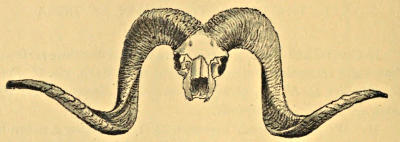
No. 1, extreme type, Ovis Poli
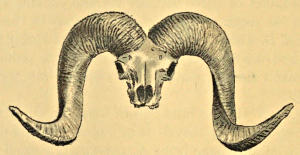
No. 2, intermediate type
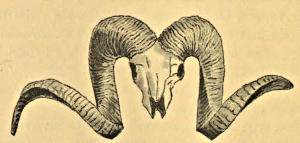
No. 3, extreme type, Ovis Karelini
In colour all these sheep are much the same; generally a rather rich greyish brown fading to greyish white towards the tail and belly, with, in the ram, a greyish white ruff on the neck. This is the chief distinguishing mark of a ram Ovis Ammon at a distance, the ewe having a brown neck; in fact, the ram looks as if his thoughtful spouse had insisted on his wearing a white comforter for fear of catching cold. The horns of the ram, large as they are, are of such a pale colour as to be hardly distinguishable in certain lights at long distances. The Ovis Poli appears to have little or no ruff, but has a dark line down the back, which the Ovis Ammon has not, and has also a more clearly defined white anal disc.
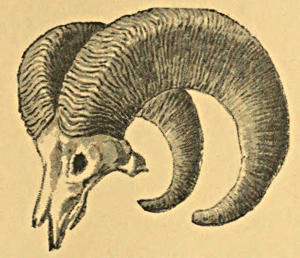
Ovis Ammon
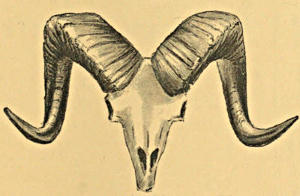
Ovis Nivicola
Measurements
Authority Height at shoulder Length nose to tip of tail Weight Length of horns Girth at base Span between tips Skull Remarks
Ovis Ammon
ins. ins. lbs. ins. ins. ins. ins.
Proc. Zoo. Soc., 1875 43 .. .. 49 18½ 32 12 From Siberia?
” 46 .. .. 48½ 19 31 .. ”
British Museum .. .. .. 48 18¾ .. .. Specimen, No. 45-4-21-9. From Siberia
Mr. O. Shaw .. .. .. 47 .. .. ..
Mr. A. O. Hume .. .. .. 46½ 19¾ 20 .. Rowland Ward, ‘Horn Measurements’
Sir V. Brooke .. .. .. 45½ 17½ 24 14 Proc. Zoo. Soc., 1875
H.R.H. Duke of Teck .. .. .. 45½ 16½ about 17 .. Rowland Ward, ‘Horn Measurements’
Major Ward (‘Sportsman’s Guide to Ladak and Cashmere’) 46 to 48 .. 250 to 280 .. .. .. ..
” .. .. .. 45 20 .. ..
Proc. Zoo. Soc., 1875 44½ .. .. 45 19½ .. ..
Col. Howard Brooke .. .. .. 44 18 .. ..
Mr. H. C. V. Hunter .. .. .. 43½ 16⅝ loose horns .. Rowland Ward, ‘Horn Measurements’
British Museum .. .. .. 43 16¾ .. ..
Major Greenaway .. .. .. 42½ 17 .. ..
Mr. A. O. Hume .. .. .. 42½ 16½ 19 .. Rowland Ward, ‘Horn Measurements’
Hume Collection, British Museum .. .. .. 42½ 16 about 18 .. ”
Rowland Ward .. .. .. 42½ 16 18 .. ”
Mr. J. Carr Saunders .. .. .. 42½? 15¼ .. .. ”
H.R.H. Duke of Edinburgh .. .. .. 42⅝ 16¼ 20 .. ”
Hume Collection, British Museum .. .. .. 42⅛ 16¾ 14¼ .. ”
Mr. A. O. Hume .. .. .. 42⅛ 16½ 18 .. ”
Capt. Ballantyne .. .. .. 42 18 .. ..
Sir V. Brooke .. .. .. 42 17⅜ 17½ 15
Hume Collection, British Museum .. .. .. 42 16¾ about 17¼ .. Rowland Ward, ‘Horn Measurements’
British Museum .. .. .. 42 14 .. ..
Hon. Walter Rothschild .. .. .. 41⅞ 16 .. .. Rowland Ward, ‘Horn Measurements’
British Museum .. .. .. 41½ 16¾ .. ..
Mr. A. O. Hume .. .. .. 41¼ 17½ 16 .. Rowland Ward, ‘Horn Measurements’
Major Ward (‘Sportsman’s Guide to Ladak, &c.’) .. .. .. 41 18½ .. ..
The Writer 44 .. .. 41 17 .. ..
St. George Littledale (British Museum) .. .. .. 40½? 14½ about 26¼ .. Rowland Ward, ‘Horn Measurements’
Hon. C. Ellis .. .. .. 40⅜ 17⅝ 20⅜ .. ”
Hume Collection, British Museum .. .. .. 40¼ 17¼ 20 .. ”
Col. Kinloch (‘Large Game Shooting’) 48 to 49 .. .. 40 17 .. ..
Hume Collection, British Museum .. .. .. 40 16¾ 19½ .. Rowland Ward, ‘Horn Measurements’
” .. .. .. 40 16 18½ ..
Major Greenaway 45 76 212 36 15½ .. .. Weighed in pieces. Estimated 240 lbs. as shot
Gen. Macintyre (‘Hindu Koh’) .. .. 350 about 40 18 .. .. Cleaned, including head
Sterndale 40 to 48 .. .. .. .. .. ..
Mr. K. Mackenzie 48 .. .. .. .. .. ..
” 49 .. .. .. .. .. ..
Jerdon quoting Colonel Markham .. .. .. .. 24 .. ..
Measurements (continued)
Authority Height at shoulder Length nose to tip of tail Tail Length of horns Girth at base Span between tips Skull Girth of chest Remarks
Ovis Poli
ins. ins. ins. ins. ins. ins. ins. ins.
Gen. Lord Roberts .. .. .. 75 16 54½ .. .. ‘Smoothbore,’ letter to the ‘Asian,’ November 13, 1891
Mr. Hume .. .. .. 75 14 48 .. .. ”
Col. Tanner .. .. .. 73 15 48 .. .. Rowland Ward, ‘Horn Measurements’
Sterndale, ‘Mammalia’ .. .. .. 73 14 48 .. .. (Possibly the same head)
Mr. L. Flower .. .. .. 68½ 15 35¾ .. .. Rowland Ward, ‘Horn Measurements’
Col. R. Pole Carew .. .. .. 68 17 43 .. .. ”
Indian Museum, the ‘Asian,’ November 13, 1891 .. .. .. 68 16 52 .. .. ”
Col. R. Pole Carew .. .. .. 67 16½ 42 .. .. ”
Sterndale, ‘Mammalia’ .. .. .. 67 16 53 .. .. ”
Sir E. G. Loder, Bart. .. .. .. 66⅞ 15⅝ 46 .. .. Rowland Ward, ‘Horn Measurements’
Mr. A. O. Hume .. .. .. 66⅞ 13⅞ .. .. .. ”
Hume Collection, British Museum .. .. .. 66 15¼ 44 .. .. ”
” .. .. .. 65⅞ 16 48 .. .. ”
Col. T. E. Gordon, British Museum .. .. .. 65½ 16 53 .. .. ”
Mr. A. O. Hume .. .. .. 65⅜ 16¼ .. .. .. ”
Capt. Blane .. .. .. 65 16½ 49½ .. .. ”
St. George Littledale .. .. .. 65 .. .. .. .. ”
Rowland Ward .. .. .. 65 .. .. .. .. ”
Hon. C. Ellis, quoted Proc. Zoo. Soc., 1884 .. .. .. 58 .. 51 .. ..
” .. .. .. 58 15½ 50½ .. .. No. 1.—Extreme type (O. Poli)
” .. .. .. 57½ .. 47 .. ..
” .. .. .. 62 .. 47½ .. ..
” .. .. .. 63½ .. 48 .. ..
” .. .. .. 61½ .. 46½ .. ..
” .. .. .. 59½ .. 43¾ .. ..
” .. .. .. 61 .. 43 .. ..
” .. .. .. 55 17 37 .. .. No. 2.—Intermediate type
” .. .. .. 60½ .. 39½ .. ..
” .. .. .. 63½ 16 39 .. .. No. 3.—Extreme type (O. Karelini)
M. Severtzoff 46 79 .. 57 .. 42 14 .. Proc. Zoo. Soc., 1875
” 42.6 71 .. 44 .. 32 13.3 .. ” (O. Karelini)
Major Biddulph 41 67 3½ 48 14 .. 11 49½ Yarkand Mission
Ovis Heinsi
M. Severtzoff .. .. .. 33.2 .. 31.4 11.4 .. Proc. Zoo. Soc., 1875
Ovis nigrimontana
M. Severtzoff 34 57 .. 38 .. 29.6 10.8 .. ”
Ovis nivicola
Dr. Guillemard, ‘The Cruise of the Marchesa’ 40 66 .. 38 13½ 26 9¾ 54
” 41 65 .. 35½ 14 26½ 10¾ ..
” 39 67 .. 35 13¼ 25½ .. 55
” 39½ 64 .. 35 13¾ 21 10½ 54
” 37 64 .. 34¾ 14½ 25 10½ 55
British Museum .. .. .. 34½ 11⅞ 17¾ .. .. Rowland Ward, ‘Horn Measurements’
M. Severtzoff 37 .. .. 33 12¾ .. .. .. Proc. Zoo. Soc., 1875
Sir E. G. Loder, Bart. .. .. .. 32¾ 13½ 23 .. .. Rowland Ward, ‘Horn Measurements’
Dr. Guillemard, ‘The Cruise of the Marchesa’ .. .. .. 32½ 13¾ 22½ .. ..
” .. .. .. 32¼ 14 21 .. ..
Ovis Brookei
Sterndale’s ‘Mammalia’ .. .. .. 33½ 13⅜ .. 11 ..
Old rams of the Ovis Ammon are by no means easy to bring to bag. The bare open downs they live on afford little or no cover for a stalk; the wind in Ladak, piercingly cold as it is, seems to take a delight in blowing from all points of the compass in turn, especially if there are any clouds about; the rams themselves are particularly wary and keen-scented, and the least suspicion of danger will set them marching steadily across country for miles without stopping. In the summer, like most hill animals, the old rams leave the ewes and young ones and form small flocks by themselves, selecting favourite valleys to which they repair year after year, and being rarely found on the same ground as the ewes at that season, i.e. after the middle of June. I have, however, seen a flock of five rams and ten ewes together as late as June 11 and secured a big ram out of it. Ward’s remarks about hunting Ovis Ammon are worth quoting:
Stalking in Ladak is very often a matter of time. Many of us will march for a month to get on to Ovis Ammon ground, and yet will not consent to wait a few days after the game is sighted. Naturally, in a country where the hills are devoid of cover, the game is often seen on spots where it is useless trying to approach it; but, if watched for a few hours, it is almost certain to graze its way into a more favourable position. Avoid going after game on gusty and cloudy days, and exercise patience, remembering that you have probably marched some hundreds of miles to obtain a few shots, and one or two days’ more or less work can make but little difference.
Even supposing the sportsman to have everything in his favour, wind, cover, and the rest, there are pretty sure to be some kyang about, and these once disturbed, good-bye to the oves. The writer had once been watching two fine old rams from early morning till 2 p.m. before the wind would let him attempt the stalk; he had got within a quarter of a mile of the rams with absolutely nothing to do but walk straight on up to them, when suddenly a brute of a kyang jumped up from behind a rock where he had been lying hid, galloped straight up the valley past the oves, found seven devils worse than himself, brought them all back to show them the quaint manners of an infuriated man with a gun, and concluded the entertainment by galloping round and round him out of shot. The oves naturally took the hint, and not caring for an asinine circus, simply marched off to the next county.
Large bags of ram oves are consequently seldom made. Mr. O. Shaw got nine in 1877, including one of 47 ins.; the rest of the bag was, one bull yak, eight or ten burrel, one of 27 ins., eleven Thibetan antelope and one shapoo; this was an exceptional bag by an exceptionally hard working sportsman.
The native names for O. Poli are ‘Rass,’ ‘Roosh,’ ‘Goolga’ (the male), and for O. Ammon ‘Nyan.’
XXXII. BURREL (Ovis Nahura vel Burhel)
Native names: ‘Baral,’ ‘Barut’; in Ladak ‘Napo’ the male, ‘Namoo’ the female; Zanskar, ‘Snapo,’ ‘Snamoo’; on the Sutlej ‘Wa’
Sterndale appears to have fallen into a curious mistake about this sheep. He says: ‘The name Ovis Nahura is not a felicitous one, as it was given under a mistake by Hodgson, the nahoor being quite another animal. I think Blyth’s name of Ovis Burhel should be adopted.’ On reference, however, to Blyth’s account in the ‘Proceedings Zoo. Soc. 1840,’ it will be found that he calls the animal generally known as burrel the ‘nahoor,’ and says of Ovis Burhel, ‘It is smaller and more robust than the nahoor, with shorter ears and very dark horns, having no white about it; and general colour dark and rich chestnut brown, with the ordinary black markings upon face, chest, and front of limbs very distinct.’ The specimen came from the Boorendo Pass, but as no more specimens have been obtained from that locality or elsewhere, it appears to be quite possible that Blyth was misled by a native-cured skin. Discoloration by curing is common.
The burrel has a very extended range, reaching from Ladak on the west (it apparently does not extend into Baltistan) to East Thibet, as Père David found it in Moupin. Its southern limit is the line of the Himalayas; it extends up north to the Kuenluen ranges, and was obtained by Prejevalski on the Altyn-Tagh. It seems to require an altitude of at least 10,000 ft., and many of the shooting grounds are quite 17,000 ft. above the sea-level.
Its general colour is a light slaty grey. The ram has black marks on the chest, side, and legs, and these are the points to look for in a distant flock to distinguish the sex; the ram’s horns being of a very pale colour, are often hardly distinguishable.
The old rams in the summer generally live apart from the ewes, and on some grounds, notably about Chumatung on the Indus, the rams seem to take themselves off to separate valleys; usually they keep to another part of the same valley, and occasionally intermix.
Burrel are quite the hardest animals to see on a hillside unless they are moving; their colour so exactly matches the blue shale of Ladak, that when they are lying down a flock may be easily overlooked by even a careful man with glasses. Being pretty plentiful where they are found at all, and as a rule, where not much shot at, fairly easy to approach, a visitor to Ladak, if he works at all, must indeed have been behind the door when the luck was served out if he cannot get a few burrel heads. Ordinarily they are found on fairly broken ground, and usually not very far away from rocky cliffs of some sort; they are capital climbers, no sheep better, and a wounded ram is by no means an easy beast to recover. If a burrel had only the horns of an ibex he would be the most charming beast to hunt in the whole of the Himalayas. An old ibex when he is shot stinks appallingly, and is practically uneatable. A burrel on the other hand, no matter how old a ram he may be, is always excellent; his head, pretty trophy as it is, is his weak point. The writer has seen burrel and ibex on the same ground, though never actually feeding together; a friend in 1866 saw burrel and ther feeding together between Joshimath and the Niti Pass, and General Macintyre also notices this on the same ground.
As with ibex, several shots can generally be obtained at a flock of burrel before they get out of range, provided the stalker keeps hidden; but he should take pains to stop his cripples, if he does not want a stiffish task set him afterwards in recovering them. Major Ward recommends using Baltistan dogs, and if procurable, good dogs no doubt would be invaluable; but the mere fact of having dogs out, unless they are exceptionally good and led by a native of more than ordinary intelligence, generally so multiplies the chances against a successful stalk that one is better without them. English dogs, he says, are useless among rocks and cannot stand the rarefied air.
I remember having a capital day with burrel. I sighted a flock of eight good rams in the morning, but could not attempt to close with them till the afternoon on account of four kyang who persistently kept in the way. At last the kyang fed away, and after a longish détour the burrel, who were lying down, were approached by my sliding down the hillside on my back. Having got within fifty yards of one whose horns were just visible, the expedient of shuffling among the loose stones with the hand was tried to get him to stand up, but this only brought the tips of an ear in sight by the base of the horn. Another shuffle and the ram stood up, but only showed about a couple of inches of the top of his shoulder. Foolishly firing at this instead of at his neck, the shot missed, the whole flock bolted at once, and a running shot with the left barrel also missed. Reloading at once, the chase was carried on down the hillside, and the burrel were again found, standing looking at their pursuer about a hundred and fifty yards off. Picking out the biggest ram, a shot from the shoulder rolled him over, but a snap-shot at the hind-quarters of another disappearing down the hill missed. Another run of about three hundred yards afforded another chance, as when within one hundred and eighty yards of the flock it again halted, and a second ram fell to the shot. The rest went about three hundred yards and stood again. I still followed, and at two hundred and fifty yards broke the forearm of a third ram close to the body. By this time rest was the first necessity, but after a short pause the wounded ram was followed up and bagged with another shot. The first was ten years old, horns 25½ ins. by 14 ins. thick; second eight years, 23 ins. by 12 ins.; third eight years, 22 ins. by 10½ ins. Bad shooting but good fun.
Amongst other varieties of burrel are the Barbary burrel (Ammotragus Tragelaphus), of which there is a skeleton in the British Museum which stands 33½ ins. at the shoulder, and a pair of horns measuring 26 ins. in length by 11 ins. in girth; also the Caucasian burrel (Capra Pallasi), of which there is a specimen in the same museum, whose horns are 29 ins. long by 12 ins. in girth; but the animal looks more like a goat than a sheep, having a rudimentary beard, and the horns are more like those of Capra pyrenaica than Ovis Nahura.
XXXIII. SHAPOO (Ovis Vignei)
Native names: ‘Shapoo’ the male, ‘Shamoo’ the female; in Astor, ‘Oorin’
Shapoo and oorin, though by some naturalists classed as separate varieties, may practically be considered identical; the writer has hunted both, and is unable to distinguish any difference in appearance or habits. The annual winter migration of oorin to the Boonji Plain is probably attributable to the snowfall in Astor being heavier than that of Ladak.
The only other difference (giving the result of individual experience) is that oorin are not nearly so restless as shapoo, being pretty regular in their feeding hours, and lying down throughout the heat of the day. Shapoo, on the other hand, are perpetually on the fidget. In colour they appear identical, generally a pale reddish grey fading into white below. The profuse black beard of the Ovis cycloceros is entirely absent, the shapoo in his winter coat having only a short stubbly brown beard, and in summer a dark line on the throat. The different points of Ovis Vignei and Ovis Cycloceros are briefly as follows, according to Mr. Sclater (‘Pro. Zoo. Soc.’ 1860):
Ovis VigneiOvis cycloceros
Horn rather compressed laterally.Much compressed laterally.
Rounded posteriorly.Much compressed posteriorly.
Curving outward and backward.Curving outward and inward.
Points divergent.Points convergent.
General colour, brownish grey.General colour, rufous brown, with blotch on flanks, and lateral line blackish.
Beard short, of stiffish brown hairs.Beard profuse, reaching to knees, black intermixed with white hairs.
The two varieties are much of the same size, but are entirely different in colour and habits. The horns of the shapoo are generally more massive than those of Ovis cycloceros, but the horns of both so vary in type and so closely resemble those of Ovis Gmelini from Asia Minor, that it is almost impossible, except for a highly trained scientific eye, to decide from this point alone to which of the three varieties a specimen belongs. Shapoo seem only to be found in the valley of the Indus, from a few miles above Leh down to the junction of the Astor river. How far below that they extend the inhabitants of Chilas only know, and they are not famed for hospitality or for communicating their knowledge. There appears to be a gap in the continuity of the species about Shigar and Rondu, which separates the shapoo from the oorin. The writer has never heard of shapoo being obtained there, and it would be interesting to know how far below Leh they are found. Shapoo seem to be very fond of wild thyme, which almost invariably grows plentifully on the ground they frequent. The venison is inferior to that of either Ovis Ammon or burrel.
The ram shapoo is a very game-looking beast, and the horns, standing well out from his head, show off to great advantage; but there is not an animal in the whole of the Himalayas so vexatious to hunt. Markhor are bad enough in all conscience, but even markhor are less heartbreaking to deal with than shapoo.
The writer once met a real typical shapoo, a true son of Belial. The beast started out of a ravine, galloped as hard as he could lay legs to the ground for four hundred yards, and then calmly lay down to think. After about a quarter of an hour he rose, strolled leisurely over a ridge, and then cantered off to some rocks about three-quarters of a mile away, where he lay down again. This necessitated a climb to the top of the hill, whence, wind and cover being perfect, the stalk would be easy enough. He remained there just long enough to enable the pursuer to begin the easy part of the stalk, when up he got, cantered gracefully back across the valley, and lay down on the opposite hill, in another very tempting position. This move entailed a détour, so as to cross the valley out of sight, and another climb up the far hill; half an hour was spent in reaching the desired spot: but though from there a magnificent view could be had of all the country round, there was not a sign of the shapoo, and the ground was too dry to show his tracks. Verily, shapoo are only shot when they give themselves away.
Shapoo are very tough beasts. The writer once regularly raked a ram galloping straight from him at thirty yards; the bullet, from a .500 Express, caught him on the rump, and the base of it was afterwards cut out in front of the liver; yet the ram ran some two hundred and fifty yards, stopped for about a minute to look round, and then started off again at a gallop, but after going a hundred yards fell over dead. The writer remembers no other instance of an animal stopping to gaze in its death gallop.
XXXIV. OORIAL (Ovis cycloceros)
Generally ‘Oorial,’ ‘Kuch,’ in the Suleiman range
This sheep is found in the Salt range near Jhelum, and wherever there are any suitable hills on both banks of the Indus from about Peshawur down to Beloochistan, where it is replaced by the next variety, Ovis Blanfordi. The ram has a long ruff of grizzled black hair which, flowing from his throat and chest down to his knees, emulates the grand beard of a markhor; this beard drops off in the summer, but begins growing again in August, and is at its full length during the rutting season late in September, which is about the best time for procuring good heads.
Measurements
Authority Height at shoulder Length, nose to tip of tail Weight Length of horns Girth at base Splay between tips Remarks
Ovis Nahura
ins. ins. lbs. ins. ins. ins.
Mr. B. H. Hodgson, ‘Proc. Zoo. Soc., 1840’ .. .. .. 32 .. .. Rowland Ward, ‘Horn Measurements’
Mr. A. O. Hume .. .. .. 30⅞ 12¼ 21⅞ ”
” .. .. .. 30 12¼ 22½ ”
H.R.H. Duke of Edinburgh .. .. .. 29½ 11⅝ 25½ ”
Major Ward .. .. .. 29 .. .. ‘Sportsman’s Guide to Ladak, &c.’
Hume Collection, British Museum .. .. .. 28 11 20¼ Rowland Ward, ‘Horn Measurements’
Captain G. Campbell .. .. .. 27¾ 10¼ 10 ”
Mr. St. George Littledale, 1877 .. .. .. 27¼ 11 21¼ ”
Major Ward .. .. .. 27 .. .. ‘Sportsman’s Guide to Ladak, &c.’
” .. .. 150 .. .. .. ”
” .. .. 119 .. .. .. ”
Mr. O. Shaw .. .. .. 27 .. .. ‘Hindu-Koh’
Gen. Macintyre .. .. .. 27 .. ..
Major Greenaway .. .. .. 26½ 12½ ..
” .. .. .. 26½ 10 ..
” .. .. 97 cleaned .. .. ..
Sir V. Brooke .. .. .. 26¼ 11⅞ 23 Rowland Ward, ‘Horn Measurements’
Hon. W. Rothschild .. .. .. 26¼ 12 21¼ ”
Sir E. G. Loder, Bart. .. .. .. 26¼ 10¾ 22 ”
Hume Collection, British Museum .. .. .. 26⅛ 12⅜ 25 ”
Mr. Rowland Ward .. .. .. 26 12 20½ ”
Col. Kinloch .. .. .. 25½ .. .. ‘Large Game Shooting’
The Writer, June 24, 1875 .. .. .. 25½ 14 ..
” 34 .. .. 21 11 ..
Sterndale, ‘Mammalia’ 30 to 36 54 to 60 .. 24 to 30 12 to 13 ..
Average (according to Major Ward) seems fair 33 52 130 22 11 .. ‘Sportsman’s Guide to Ladak, &c.’
Ovis Vignei
Mr. J. Carr Saunders .. .. .. 38⅝ 12¼ 11¼ Rowland Ward, ‘Horn Measurements’
Mr. A. O. Hume .. .. .. 37½ 10¼ 11 ”
” .. .. .. 36⅜ 9⅛ about 17 ”
” .. .. .. 36¼ 11¼ .. ”
Major Ward .. .. .. 36¼ 11¾ .. ‘Sportsman’s Guide to Ladak, &c.’
Dr. J. Aitchison, British Museum .. .. .. 35½ 10½ 16 Rowland Ward, ‘Horn Measurements’
Mr. J. Carr Saunders .. .. .. 34 10 ..
Major Ward .. .. .. 34 .. .. ‘Sportsman’s Guide to Ladak, &c.’
Mr. A. O. Hume .. .. .. 33⅝ 9⅛ .. Rowland Ward, ‘Horn Measurements’
Sir E. G. Loder, Bart. .. .. .. 33⅛ 11½ 10⅝ ”
Major Ward .. .. .. 33 .. .. ‘Sportsman’s Guide to Ladak, &c.’
Major Greenaway 36 53 65 cleaned .. .. ..
” 36 52 .. .. .. ..
The Writer 38 .. .. 22 10½ ..
Captain H. Brooke 38 .. .. 28 12 ..
Average of good head .. .. .. 26 10 ..
Ovis cycloceros
R. A. Mess, Attock .. .. .. 38½ .. .. Sterndale, ‘Mammalia,’ Appendix C
Captain W. Cotton, F.Z.S. .. .. .. 35½ .. .. ”
Sir V. Brooke .. .. .. 32½ 10 11½ Rowland Ward, ‘Horn Measurements’
Hume Collection, British Museum .. .. .. 31¾ 9¼ 5¼ ”
” .. .. .. 31¼ 8½ 16 ”
Col. Kinloch .. .. .. 31 10¼ .. ‘Large Game Shooting’
” about 36 .. .. .. .. .. ”
Sir V. Brooke .. .. .. 30⅞ 9⅞ 20⅛ Rowland Ward, ‘Horn Measurements’
Hume Collection, British Museum .. .. .. 30 10½ 10 ”
Sir V. Brooke .. .. .. 30 9⅜ 11¼ ”
Major FitzHerbert 36 .. .. 30 9½ ..
Capt. H. Brooke .. .. .. 30 6 ..
Major Greenaway 34 .. .. .. .. ..
Sterndale, ‘Mammalia’ about 36 about 60 .. 29½ 10 ..
Average of good head .. .. .. 30 9½ ..
Ovis Blanfordi
Hume Collection, British Museum .. .. .. 36½ 9⅝ single horn Rowland Ward, ‘Horn Measurements’
” .. .. .. 31⅝ 9⅜ 13¾ ”
” .. .. .. 23⅝ 9½ 17¾ ”
Oorial, like stags, seem to affect particular spots at that season, and certain hills which at other times of the year hold nothing but ewes and young ones will just then invariably have big rams on them. Oorial ground has hitherto been practically restricted to the Salt range, and a 30-in. ram there is now a rarity. The country on the right bank of the Indus is being yearly made more accessible, however, and there are large tracts of good oorial ground in that direction that are as yet practically unshot. Oorial shooting, however, is by no means a summer amusement, and there is little to be gained then except dysentery from bad water and sunstroke by hunting the deep stifling ravines and almost red-hot stony hills. In the cooler months it is most enjoyable. As a rule one gets a fair number of chances, the ground being so broken that stalking is by no means difficult. An old ram oorial is a fine game-looking animal, and though not to be compared to burrel, is still very fair eating. The best way of hunting them is by walking along the tops of the ridges and carefully examining the ground below; as there are often a good many bushes on the hillside, oorial are not always very easy to see, especially if they are lying down, so the pace should be slow. The natives of the salt range are generally expert trackers, and as a wounded oorial is by no means an easy beast to recover, their skill is doubly appreciable when following up a good ram with a broken leg. The way they will carry the trail through the marks of a flock of sheep or along stony nullahs and hillsides with perhaps only an occasional spot of blood to help them, is quite charming after the bungling attempts at the art one generally sees displayed by the natives of the Himalayas.
As oorial are perpetually seeing shepherds and other natives they do not become alarmed at the sight of man at a distance; but as they are a good deal driven about, especially by the cultivators whose crops at the foot of the hills they feed on at night, no liberties can be taken during the stalk, and the sides of the ravines being often excessively steep, good noiseless stalking shoes are requisite.
XXXV. OVIS BLANFORDI
This variety is found in Khelat, and a few specimens have been procured near Quetta. Its horns are described as being longer and more slender than those of O. cycloceros or O. Vignei, and as having a second twist outwards at the ends. It has a white beard, unlike either shapoo or oorial.
XXXVI. MARKHOR (Capra megaceros vel Falconeri)
Native names: Cashmere, ‘Markhor’; Ladak, ‘Rache’; Aster, ‘Boom’
Whether this king among goats deserves his name of ‘snake-eater’ or not is hardly likely to be settled. Shikaris all believe that markhor do eat snakes, some going as far as to say that they suck the snakes out of their holes, and swallow them like macaroni; and Colonel Kinloch supports the theory.
But though some hundreds of markhor have been shot by Europeans, the fact has hitherto not been proved; and the writer ventures in all humility to suggest that the tale is derived from some old legend, and refers, in spite of the Persian name which may have become corrupted, to the long snake-like horns.
Be this as it may, an old markhor swaggering along a ledge on a precipitous hillside, with his long black beard and white mane floating down to his knees, showing off every inch of his beautiful horns—as no beast knows better how to do, except perhaps a really big stag in the rutting season—is one of the most glorious sights in the Himalayas.
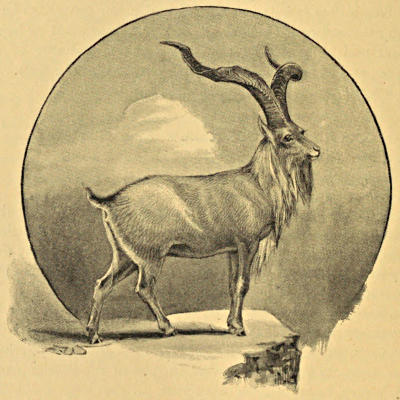
The Astor markhor
The beast looks such a gentleman with his lean head and small ears, his powerful back and quarters, and his dignified carriage. Alas! it is all looks! His smell is something fearful, and manners he has none. Ibex and burrel can be trusted, when they are lying down after their morning feed, at all events not to move far; but markhor, no. You may watch a flock feeding till late in the morning, and they will lie down comfortably, apparently for the day; you begin your stalk with everything in your favour; suddenly there is a clatter of stones and a cloud of dust, you peep over a spur, and see the whole flock galloping wildly down the hill. After going half a mile, they probably pull up, begin feeding again, and again stretch themselves out on the ground as if nothing had happened. This little manœuvre probably necessitates your climbing painfully back to the top of the ridge, and starting your stalk afresh, the intervening ground being impracticable. Once more you try, leaving a man on the top of the hill to watch and signal what the beasts do. You stalk carefully on; the watcher makes no sign; you creep on the last hundred yards, to the exact spot you wish to reach, and there is nothing. You search the ground as far as you can get, and there are only a few footprints leading over impassable ground; you climb back again, probably the only way you can go, vowing vengeance on the watcher, and he tells you that the markhor lay quiet till you were beginning your last crawl in—every second he expected to hear the shot: suddenly they jumped up and disappeared, and owing to the steepness of the ground he could not tell which way they had gone. This sort of thing will happen over and over again, particularly in Astor.
Perseverance combined with good management always brings luck in the end, but big bags of really fine markhor are not to be expected; one fair chance for each fortnight on the shooting ground is a good allowance.
It is always a pretty sight seeing markhor move down to their feeding ground in the evening from the crags above where they have been lying during the afternoon. Full gallop they come, sending the stones whizzing in front of them, over the most breakneck ground as if it were a level plain; rearing up on their hind legs and butting at one another, a venerable old fifty-incher probably playing with his great-grandson, a young spark of only twenty; the whole lot of them thoroughly enjoying the frolic. Ibex will play, and prettily too, but no beast appears so thoroughly to enter into the fun of a good skylark as a markhor. The master buck of the flock, however, seems to keep the youngsters in pretty good order. The writer was much amused once, watching a flock coming down a particularly difficult cliff. The best buck led the way, the flock following in single file soberly enough, the ground apparently was not safe even for a markhor to frolic on; turning a corner, the old fellow came to a wall of rock that, after careful inspection, he did not think good enough to descend, and he turned back to take another route. Just as he made up his mind, one of the smaller bucks in rear evidently chaffed him. The old fellow went for him at once, drove him right up to the edge of the cliff with his horns, as nearly as possible pushed him over, and then, with an air of great importance, led the flock round his own way.
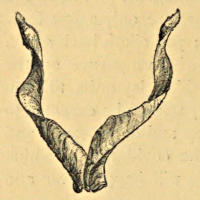
1. Cashmere
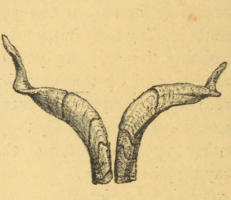
2. Astor
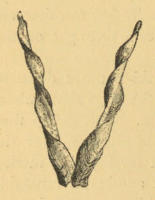
3. Trans-Indus
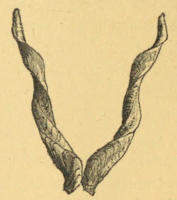
4. Afghanistan
Varieties of markhor
Hitherto most writers have divided markhor into only two varieties, viz. the spiral and straight horned; but the type of horn obtained in Astor is so different from that in Cashmere, and again that in Afghanistan from that in the lower Trans-Indus ranges, that any sportsman can distinguish them at a glance.
The writer has consequently adhered to Colonel Kinloch’s theory, that there are four distinct varieties of this goat, classifying the two spiral types under the name of Megaceros, and the two straight-horned types under that of Jerdoni. In the British Museum the name Falconeri is applied to all four.
The first variety of Capra megaceros is that found in Cashmere on the Pir Punjal and Kajnag ranges; its horns make occasionally three complete spirals, whereas the horns of the second or Astor variety rarely have more than one; and as the horns are measured along the curve, it follows that a 40-in. horn from Astor is far bigger than one of the same length from Cashmere. The Astor markhor is also a larger animal than the Cashmere one, often measuring a couple of inches higher at the shoulder.
As regards habits, the Cashmere markhor is a thoroughly forest-loving beast. He will come out to eat the young grass on the upper slopes of the hill, but his real home is among precipitous cliffs in the middle of forest, and well worth watching those cliffs are when the sun first comes out after heavy rain. If there are any markhor about, they are pretty sure to appear and sun themselves.
The Astor variety, on the contrary, live almost entirely in the open, only taking to the strips of forest when driven there by the gadflies in the summer. In the winter they come down to the cliffs overhanging the main streams, working up about May, till they join the ibex, who never seem to leave the higher ground. In June both ibex and markhor may be seen feeding together. The writer saw a combined flock of nearly one hundred beasts, male and female, in the amphitheatre at the head of the Dashkat or Datchnar valley. Stalk them? Of course we tried, in spite of the long odds against one with a flock of that size. There was a ravine leading up towards them, which we reached all right by crawling on hands and knees through some thick low scrub; then we crept up the ravine till it died away into open ground and found ourselves planted within three hundred yards of the head of the flock, some dozen buck markhor and ibex. There we lay for nearly an hour and a half hoping they would feed towards us, and a capital opportunity we had of comparing the relative size of the beasts; the markhor with his superior height and length making the ibex look quite cobby in comparison. Of course an old buck markhor must needs feed ahead of the rest, well out of shot, get our wind, and lead the whole lot at a gallop back to the rocks on the far side of the basin. There the ibex stayed, but the markhor went clean away over the crest of the hill.
In the evening, while we were watching the ibex in the vain hope they would come down again, behold on the very line the markhor had left by in the morning three male ibex and another flock of markhor appeared descending into the basin. As the markhor were coming down at a good pace we started to cut them off. On came the markhor, which we recognised as a flock we had been hunting all the previous week on another part of the ground. A stiff climb took us near where we had last seen them, and creeping on the shikari who was in front came almost face to face with one, upon which the alarm call began to sound furiously. A run forward only brought the writer within sight of a pair of horns moving off about eighty yards away, but while pushing on to get a shot, suddenly the buck that had convinced us as to the identity of the flock by his upright horns, came into full view broadside on at fifty yards. He rolled over stone-dead to the shot, and as he was lying doubled up with his head underneath him a gun-carrier was sent down to him, while I ran on fast to try for another shot. The rest of the flock, however, had vanished, and as the chase was abandoned a noise was heard: looking round, the spectacle presented itself of the beautiful 50-in. markhor (such was the first impression; in reality it was not quite forty) slipping from the clumsy Cashmeree’s hands, rolling down the slope over one precipice, then over another, and lodging by the greatest luck just on the top of a third; the horns were sadly scarred and chipped, but were fortunately not broken. Many heads of both markhor and ibex get utterly spoilt in Astor by the animals falling over cliffs when shot.
As regards Capra Jerdoni, the straight-horned markhor, the first variety, with a perfectly straight axis to the horn, is found all over the low ranges that run parallel to the right bank of the Indus below Attock; it used to be found in fair numbers near Sheikh Budin, a small station near Dera Ismail Khan, and in the hills, or rather the steep ravines, in the plateau behind Dera Ghazi Khan. The country beyond these places belongs to more or less inhospitable tribes and, for the present at all events, is practically closed against the sportsman. Near Quetta markhor are reported to be obtainable, and in Beluchistan there should be a chance of getting Capra ægagrus and Ovis Blanfordi as well as Capra Jerdoni. Hunting straight-horned markhor is scarcely a summer amusement, as the heat is terrific on the low hills, and drinkable water is extremely scarce.
The second variety is found in Afghanistan, another practically closed shooting ground. It appears to be a link between the straight horn and the spiral, more generally approaching the spiral in size of body and general appearance. As the Astor variety probably extends some distance to the west of Gilgit, and this second variety is found in Northern Afghanistan, it seems possible that its corkscrew bend may be more pronounced towards its eastern limit and less so as it extends to the south-west. The illustration on p. 312 gives the four marked types.
Kinloch notes that markhor horns twist the reverse way to those of domestic goats; and the writer, after looking at many hundreds of tame goats in India for the express purpose of studying their horns, and after inspecting the heads in the British Museum and other collections, is able to confirm the fact that the horns of all wild animals that twist at all do so outwards, while those of tame animals appear invariably to twist inwards.
Measurements
Authority Height at shoulder Weight as shot Horns round curve Straight Girth at base No. of spirals Span at tips Remarks
Capra megaceros
No. 1. Cashmere
ins. lbs. ins. ins. ins. ins.
Col. Cuppage .. .. 63 .. .. .. ..
Major Ward .. .. 59 .. .. .. .. ‘Sportsman’s Guide to Ladak, &c.’
” .. .. 56 .. .. .. .. ”
Major FitzHerbert .. .. 55½ .. .. .. ..
Major Ward 42 .. 53 .. 9½ 2½ 26 ‘Sportsman’s Guide to Ladak, &c.’
” .. .. 48½ .. .. .. .. ”
Col. Kinloch 44 .. 47½ .. .. .. .. ‘Large Game Shooting’
Major Ward .. .. 47 .. .. .. .. ‘Sportsman’s Guide to Ladak, &c.’
Capt. H. Brooke .. .. 45 .. .. .. ..
Major Ward .. .. 43 .. 11 2½ 31 ‘Sportsman’s Guide to Ladak, &c.’
Col. Kinloch .. .. 41 .. .. .. .. ‘Large Game Shooting’
” .. .. 40 .. .. .. .. ”
Average of good head .. .. 40 .. 11 .. ..
Not classified
Mr. A. O. Hume .. .. A 54½ .. 10½ .. 26½ Rowland Ward, ‘Horn Measurements’
Mr. M. Kennard .. .. A 54 .. 10⅝ .. 33¾ ”
Sir V. Brooke .. .. B 53¼ 42½ 11½ .. 52 ”
Mr. R. Ward .. .. B 53½ .. .. .. 37½ ”
Mr. A. O. Hume .. .. A 53 24¼ 9¼ .. 30¼ ”
Mr. M. Kennard .. .. B 52¾ 39¾ 12⅛ .. 33¾ ”
A, probably Cashmere; B, Astor.
No. 2. Astor
Major Ward 41 240 .. .. .. .. .. ‘Sportsman’s Guide to Ladak, &c.’
” .. .. 63 .. .. .. .. ”
” .. .. 61 .. .. .. .. ”
” .. .. 53 .. 11 .. 45 ”
” .. .. 52 .. 12½ .. 43 ”
Capt. H. Brooke .. .. 49 .. .. .. .. ‘Sportsman’s Guide to Ladak, &c.’
Major Ward .. .. 48 .. .. .. ..
The Writer .. .. 39¼ .. 13 .. ..
” .. .. 38 .. 14 .. ..
Average of good head .. .. 40 .. 13 .. ..
Capra Jerdoni
No. 1. Trans-Indus
H.R.H. Duke of Edinburgh .. .. .. 38½ 10½ 23⅞ .. Rowland Ward, ‘Horn Measurements’
Major Ward .. .. .. 36 .. .. .. ‘Sportsman’s Guide to Ladak, &c.’
Sir E. G. Loder, Bart. .. .. 47⅞ 33 9¼ .. 19¾ Rowland Ward, ‘Horn Measurements’
Mr. A. O. Hume .. .. .. 32¼ 9¾ .. 28 ”
Col. Kinloch .. .. .. 32 .. .. .. ‘Large Game Shooting’
Sir V. Brooke .. .. 45¼ 30¾ 8¾ .. 21½ Rowland Ward, ‘Horn Measurements’
British Museum .. .. .. 30½ 10¾ .. .. Skull No. 120
Capt. H. Brooke .. .. .. 29 .. .. ..
Sir E. G. Loder, Bart. .. .. 39 27⅛ 8⅜ .. 21½ Rowland Ward, ‘Horn Measurements’
Mr. G. Landseer, ‘The Field,’ 1873 .. .. .. 25½ .. .. .. ”
Mr. A. O. Hume .. .. .. 25⅜ 8⅜ .. 21½ ”
Average of good head .. .. .. 24 10 .. ..
No. 2. Afghanistan
Major FitzHerbert .. .. 48 38 13 .. 27
British Museum .. .. 40 32½ 12 .. .. Skull No. 121
Major Ward .. .. .. 35 .. .. .. ‘Sportsman’s Guide to Ladak, &c.’
Average of good head .. .. 40 30 12 .. ..
XXXVII. IBEX (Capra sibirica)
Cashmere, ‘Kale’; Ladak, ‘Skeen’; Pangi and Lahoul, ‘Tangrol’
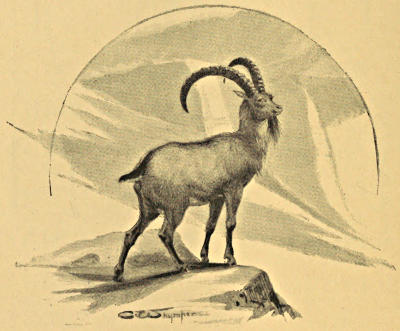
In his summer coat
Ibex vary very much in colour according to age, locality and the season. In their winter coats the old bucks, though looking almost white at a distance, and showing up conspicuously among the brown young bucks and females, are really very patchy looking at close quarters, the head and part of the neck being a sepia brown, the middle of the body generally yellowish white with a dark stripe on the back, and the quarters again brown, with legs of dark sepia. In the summer they are sepia-coloured all over, the head and neck often darker than the body—in fact, an old buck looks sometimes almost black at a distance; the beard is thick and very dark brown.
Ibex are to be found pretty nearly everywhere in the higher ranges of hills from Gilgit to Spiti, though they do not appear to cross the Sutlej to the eastward of Spiti. To name a particular valley would be only misleading. Favourite districts soon get shot out as regards good heads, and the only trustworthy information to work on is that of the year previous. If you get a good nullah, there is no sport in the Himalayas more charming. Parts of the ground no doubt will test your nerve as a cragsman, but it does not entail the perpetual climbing of markhor and ther ground, and in April, May and June a fair number of good chances may be relied upon. As Ward says, ‘Patience and steady shooting are what are necessary; a man does not require to be a first-rate walker or a really brilliant shot during that season; but he does require to be enduring, and not too eager about getting up at once to his game.’ Of course, if the sportsman blazes away at indifferent heads he will not get the big ones; but if he sees a good head one day and cannot get it, if he does not disturb the beast, he will see him again next day somewhere near the same place, and sooner or later be able to close accounts with him; ten heads, all over thirty inches, which would probably include two or three over forty inches, would be a far better bag for two months’ work than twenty heads in the same time, including a lot of rubbishy little things about twenty-five inches.
If you wish thoroughly to enjoy your stalk, and the ground is not too difficult, insist upon going first and making your shikari carry your rifle behind you. He will probably object, but be firm, and listen to none of his plausible arguments; carry out your own stalk without asking his advice, simply telling him what you mean to do. When you are within two hundred yards of where you expect to get your shot, make him lie down, take the rifle from him and go on alone. Warn him beforehand that if he moves till you tell him, you’ll fine him. When you reach your place, get your wind before you look over; you will see perhaps fifteen or twenty ibex in front of you; don’t be in a hurry; make sure that you have really selected the best head for your first shot, and take pains to get it home. When you fire, the smoke will hang in your eyes, and you will dimly see the flock scatter. Keep your head now—don’t show yourself; and if you are in about the right place, a little above, but nearly on a level with the flock, and about eighty yards off, not closer, you will probably see the flock walking up the hillside, occasionally turning round to gaze at the 40-incher lying dead below them. With cartridges handy, and steady shooting, you should add the next two or three best heads to your score. You have no shikari at your elbow nudging you, and whispering advice just as you are going to fire, starting off the flock by showing himself immediately after your first shot, and finally, when you have got all the heads you care for out of the flock, imploring you to shoot a worthless little brute for the coolies to eat. Call him up when you have finished, and let him cut the throats of the slain to make them lawful eating, low down the neck, so as not to spoil the skin for stuffing, and if he objects, tell him he may do without meat. One of the greatest mistakes that all shikaries make in stalking is trying to get too close to the game. It stands to reason, in a country infested by leopards or ounces, that if a beast catches sight of the top of one’s head within five and twenty yards, he will bolt at once, whereas at eighty yards distance he feels at all events safe from a sudden rush, and will stop to gaze.
After the end of June it is practically waste of time trying for ibex. There is grass everywhere, and to escape the gadflies and be out of the way of the flocks of sheep and goats that are driven up into many of the best nullahs in summer, the ibex retire to the highest peaks in the neighbourhood, and rarely descend to ground where there is any chance of getting near them.
XXXVIII.—THE IBEX OF PERSIA AND SINDH (Capra ægagrus)
Native names: ‘Pasang,’ male; ‘Boz,’ female; generally Boz Pasang in Persia (Blanford); Kayeek in Asia Minor (Danford)
This ibex extends from the Taurus mountains in Asia Minor, through the Caucasus range and Persia, to Afghanistan, Beluchistan and Sindh.
It is a smaller animal than the Himalayan ibex, and does not ascend to the same altitude, preferring, according to Mr. Danford, elevations of 2,000 to 5,000 ft., while 8,000 ft. is about the lowest limit of the Himalayan variety. In Beluchistan and Afghanistan these ibex and O. Blanfordi are found on the same ground, just as Capra Jerdoni and Ovis cycloceros are in the Suleiman range; and this peculiar trait of preferring hot low hills is, in the writer’s estimation, the great point of difference between Capra ægagrus, Capra Jerdoni and Ovis cycloceros on the one side, and Capra sibirica, Capra megaceros and Ovis Vignei on the other.
The general colour of the buck Capra ægagrus is brown with a dark line down the back, and a black beard, but the last is not so profuse as in Capra sibirica. The females are lighter in colour, and have small horns. The horns are quite different from those of any other species of ibex; instead of having a flat front and being thinner behind than in front, as most other ibex horns are, these horns have the edge in front, a scimitar-like ridge running up the front of the horn, wavy but unbroken for about one-third above the head, and then represented by knobs which spring up at some distance apart for about another third, when the ridge appears again, but rapidly dies away towards the point. The sides of the horn too are smooth, the outer side rounded and the inner flat, the knobs not running down the sides as in other ibex.
In Persia and Afghanistan these ibex are generally shot in drives. The members of the Afghan Boundary Commission had a great day with them.
In the Sinaitic Peninsula they are replaced by Capra sinaitica vel nubiana, which extends through Egypt. Few people looking at the hills that run down to Suez harbour would imagine that they hold ibex, but such is the case nevertheless. The horns of this type are more like Capra sibirica, being quite as long, but thinner and more curved.
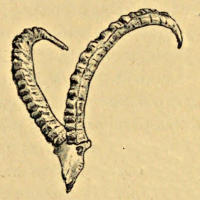
Capra sibirica
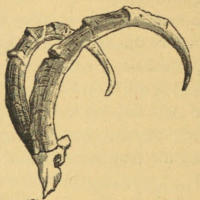
Capra ægagrus
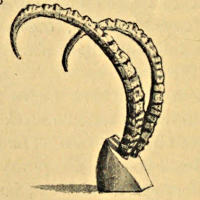
Capra sinaitica
The European ibex, Capra Ibex of the Tyrol, has also horns like Capra sibirica, and nearly as thick, but shorter. His beard, however, is only rudimentary.
The Spanish ibex, Capra pyrenaica, on the other hand, has a peculiar upward twist at the end of the horn that makes it look almost like a markhor. This type is described elsewhere.
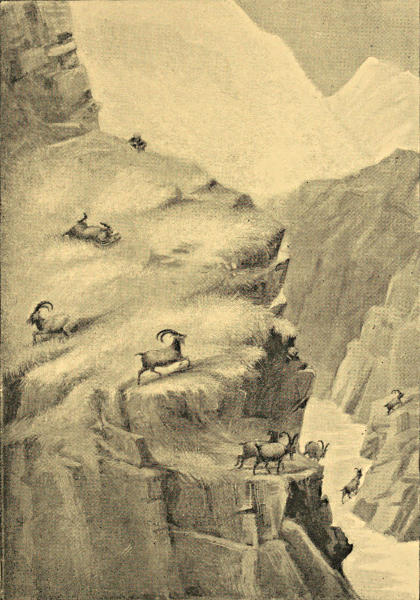
‘WITH CARTRIDGES HANDY AND STEADY SHOOTING’
Measurements
Authority Height at shoulder Length, head and body Tail Weight as shot Length of horns Girth of horns Remarks
Capra sibirica
ins. ins. ins. lbs. ins. ins.
Col. Kinloch about 40 .. .. .. .. .. ‘Large Game Shooting’