Chapter XI · INDIAN SHOOTING (continued 4)
Reading edition
” .. .. .. .. 54 .. ”
Major Ward 38 54 8 188 .. .. ‘Sportsman’s Guide to Ladak, &c.’
” .. .. .. 208 .. .. ”
” (a female) 32 .. .. 104 .. .. ”
” .. .. .. .. 52 .. ”
Mr. M. Kennard .. .. .. .. 51½ .. Rowland Ward, ‘Horn Measurements’
Mr. Blyth, ‘Proc. Zoo. Soc.,’ 1840 .. .. .. .. 51¼ 10½ ”
Sir V. Brooke .. .. .. .. 51 9⅛ ”
Major Ward .. .. .. .. 51 .. ‘Sportsman’s Guide to Ladak, &c.’
” .. .. .. .. 50 11 ”
” .. .. .. .. 50 10 ”
Capt. J. Brickley .. .. .. .. 50 9 Rowland Ward, ‘Horn Measurements’
Sir E. G. Loder, Bart. .. .. .. .. 49¾ 10⅜ ”
Mr. M. Kennard, 1887 .. .. .. .. 49½ 10⅛ ”
Major Ward .. .. .. .. 49 11 ‘Sportsman’s Guide to Ladak, &c.’
Mr. A. O. Hume .. .. .. .. 48½ 9⅝ Rowland Ward, ‘Horn Measurements’
Major Ward .. .. .. .. 48 12 ‘Sportsman’s Guide to Ladak, &c.’
” .. .. .. .. 48 10 ”
” .. .. .. .. 48 10 ”
” .. .. .. .. 48 10 ”
Mr. A. O. Hume .. .. .. .. 47⅞ 9⅛ Rowland Ward, ‘Horn Measurements’
Mr. Rowland Ward .. .. .. .. 47½ 10¼ ”
Mr. C. Hagenback .. .. .. .. 47 11¾ ”
Mr. M. Kennard .. .. .. .. 47 10½ ”
Mr. Manners Smith .. .. .. .. 47 10 ”
Major Greenaway 37½ .. .. .. .. ..
Major FitzHerbert 31 50 4 .. .. .. (A female)
Sterndale, ‘Mammalia’ about 44 .. .. .. .. ..
Average of good head .. .. .. .. 40 10
Capra ægagrus
Col. F. Marston .. .. .. .. 53 .. Rowland Ward, ‘Horn Measurements’
Mr. A. O. Hume .. .. .. .. 52⅜ 7⅞ ”
British Museum .. .. .. .. 48½ 8½ Skull No. 652 Ost. Cat.
Mr. Danford 33½ 65½ included .. 47½ 9¾ Sterndale’s ‘Mammalia’
Capt. Townley Parker .. .. .. .. 45¼ 9½ Rowland Ward, ‘Horn Measurements’
British Museum .. .. .. .. 44½ 8⅞ ”
Hume Collection, British Museum .. .. .. .. 44½ 8⅝ ”
Mr. J. Carr Saunders .. .. .. .. 43½ 9
Mr. A. O. Hume .. .. .. .. 43⅜ 8⅝ Rowland Ward, ‘Horn Measurements’
Sir E. G. Loder, Bart. .. .. .. .. 43 9 ”
British Museum .. .. .. .. 43 9 ”
Capra Ibex (Tyrol)
British Museum (skull No. 650a Ost. Cat.), a doubtful specimen .. .. .. .. 43¾, 41¼ 10½
Sir E. G. Loder, Bart. .. .. .. .. 31¾ 9⅛ Rowland Ward, ‘Horn Measurements’
Senckenberg Museum .. .. .. .. 30¼ 9 (Cord, base to tip, 21¾ inches)
British Museum .. .. .. .. 27½ 8¼
Senckenberg Museum .. .. .. .. 24 9 (Cord, base to tip, 16½ inches)
Capra sinaitica vel nubiana
British Museum .. .. .. .. 51¼ 7¼ (Skull No. 651 Ost. Cat.)
” .. .. .. .. 46 8
Capt. Bartelott .. .. .. .. 42¼ 9¼ Rowland Ward, ‘Horn Measurements’
Capt. W. H. Besant .. .. .. .. 41¾ 7⅝ ”
Capra Wali
Senckenberg Museum .. .. 24 9¾ (Cord, base to tip, 17 inches)
Mr. Sclater gives two other varieties of ibex, Capra caucasica and Capra Wali. The Senckenberg Museum of Frankfort is believed to possess the only known specimens of this last type. Of it Dr. F. Richters, in charge of the Museum, says: ‘The horns of Capra Wali differ from those of Capra sibirica in the following points: the outer surface in Capra Wali is curved (smooth?), while in Capra sibirica it is corrugated. The under side of Capra Wali is sharper than in Capra sibirica. The inner side of Capra Wali has between every two knobs (on the top of the horn) five or six grooves, which correspond with a similar number of notches of equal depth on the under side. C. sibirica, on the other hand, has a fairly smooth inner surface, and on the under side has under every two knobs (on the top of the horn) a deep notch, and between every two deep notches a shallower one. The tip of C. sibirica is more curved than that of C. Wali. The horn of our specimen of wali has eight knobs on it, that of C. sibirica (horns 36¼ ins. in length, girth at base 9½ ins., cord from base to tip 22 ins.) 17 knobs.’ The specimen came from Abyssinia, and its photograph shows the peculiar knob at the base of the horn on the forehead, its absence of beard, and its small size in comparison to C. sibirica, which is photographed with it.
XXXIX. THER (Capra jemlaica)
Gurwhal, ‘Ther,’ female ‘Theri,’ ‘Tahr,’ or ‘Jhula,’ female ‘Tharni’; Chamba and Pangi, ‘Kart’; Cashmere, ‘Jagla’; Khistwar, ‘Kras’; Nepal, ‘Jharál’
Ther are found at high elevations, where the forest line begins to give way to the snow throughout the southern slopes of the Himalayas, from Cashmere to Bhutan. Its north-west limit appears to be where the Jhelum river separates the Kajnag from the Pir Punjal ranges; though fairly common in the latter, it is apparently unknown in the Kajnag, nor is it found in the ranges to the north of the Cashmere valley; from the Pir Punjal it extends south-eastwards through Kishtwar and Chamba, then leaving Lahoul and Spiti to the north on to the upper waters of the Jumna, Ganges, and Aleknanda rivers, and so by Nepal to Bhutan, being most plentiful perhaps in Chamba and Gurwhal.
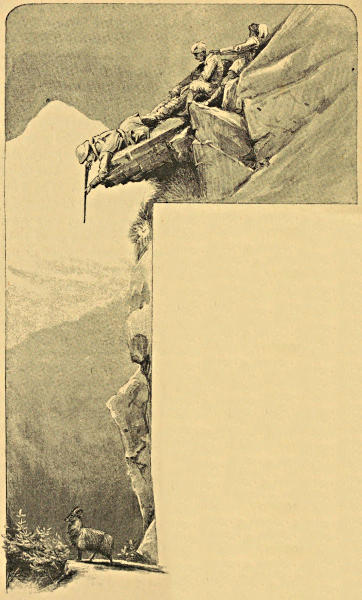
A dream of ther shooting
An old buck ther is a fine beast in his winter coat; his head is long and lean, the face being nearly black; the ears are small; a long, light-coloured mane sweeps down from his neck, chest and shoulders, reaching below his knees and showing up well against his dark brown back and quarters, his long shaggy coat half hiding his short sturdy legs. The horns are his weak point, and the ground he frequents entails such a lot of climbing and hard work that one is always inclined to think, ‘If I must risk my neck, I would sooner do it after a 50-inch markhor than a 15-inch ther.’
Still, ther shooting is very enjoyable in the spring (in the autumn, when the beasts are in their summer coats, they are hardly better worth killing than bears at the same season), and a few days ther shooting, if it can be indulged in before proceeding after markhor or ibex, is the best possible tonic for one’s nerves. The ground—rocky slopes covered thinly with pines and bushes—always looks more dangerous than it really is. The rock is sound limestone, and does not give way under one’s foot; there is nearly always a friendly bush to hang to, and the very blades of grass are tough. The writer does not go quite so far as to confirm the statement of a merry sportsman—that he and two shikaris all hung on to one blade of grass while crossing a difficult bit; but it is wonderful how much weight that grass will support if only subjected to a steady strain.
There is also generally a variety of game to be shot from the same camp—gooral, kakur, black and brown bears, musk deer, markhor in the Pir Punjal, and burrel may often, according to the district, be combined with ther shooting; besides, there is always the 100 to 1 chance of a serow or leopard, and the writer even once came across a tiger within a walk of ther ground. It had killed a buffalo out of a herd close by, and actually walked through the camp one night, passing within a few feet of the tents.
Though ther are often found in large flocks, the big bucks are generally alone, and these solitary old males are particularly crafty and by no means easy beasts to come to terms with. Colonel Kinloch writes unkindly of the ther in respect of his high flavour; all wild goats smell, and whether it be markhor, ibex or ther, the stink of the last beast bagged always seems more appalling than any that one has experienced before, and is only surpassed by the next one. The ‘bouquet’ of ther and markhor, however, appears to fade after the head has been stuffed, but the scent of the ibex will cling to it still. The writer has some stuffed ibex heads that were obtained six years ago, and their aroma on damp days, though pleasing as a reminiscence of past sport, is hardly suited to the house.
Female ther are smaller than the males, have no mane, insignificant horns, and vary a good deal in colour, some being reddish-brown, others a yellowish-drab. They and the bucks in their summer coats have a conspicuous mark on the back, where the hair of what is the mane in the buck parts from the hair on the back. This is particularly noticeable when looking down on the beast from above.
XL. NEILGHERRY IBEX (Hemitragus hylocrius)
Native Names: ‘Warra-adu,’ ‘Warri-atu’; Tamil (Sterndale) ‘Kárd-ardoo’; Canarese (Sanderson)
This wild goat is found in the Neilgherry range, and most of the higher hills in the south of India. It is not found in Mysore nor in Ceylon.
The old buck is of a dark sepia colour, with a light, grizzled saddle mark, lower parts paler brown, legs and face dark, and a short stiff mane on the neck and withers; the young bucks and females being lighter in colour. The horns much resemble those of the ther, Hemitragus jemlaicus, except that they are more ringed and sheeplike, and do not taper so rapidly. There is much the same difference between them on a small scale as between the horns of Capra sibirica and Capra ægagrus, the Neilgherry goat taking after the former and the ther the latter. The two beasts are much about the same size, and have, taking into consideration the different types of forest, much the same habits. In Madras the Neilgherry ibex, being the sole representative of the goat family, has an amount of importance attached to his pursuit which his Himalayan cousin does not enjoy, being crushed by the superior attractions of his mighty relatives the ibex and markhor. They are to be sought for in the same way, watching from above the grassy slopes among the cliffs at an elevation of 5,000 or 6,000 ft., and require the same careful stalking.
XLI. GOORAL (Nemorhædus Goral)
Generally, ‘Gooral’ or ‘Ban bakri’; Chumba, ‘Pij’; Cashmere, ‘Nain,’ ‘Norn’
This is quite the most sporting of the minor beasts of the chase. It is pretty generally distributed along the whole of the lower slopes of the Himalayas from the Indus river to the Kachin hills in Burmah; horns of both gooral and serow were found by the Phunkan column in 1889. In Cashmere they are scarce, a few only being found in the Kajnag and Pir Punjal ranges, but from Kishtwar to the south-east they are pretty plentiful, especially in Chumba, Gurwhal, the Sewalik range, and the valleys of the Ganges, Jumna, and Tonse rivers. They seem indifferent to heat, and abound among the hot precipitous cliffs formed by the big rivers cutting their way through the hills, the Tonse seeming to suit their requirements admirably. Wherever a landslip has occurred, wherever there is a steep rocky slope covered with long grass and occasional bushes and pines, there gooral are sure to be found. Higher up the hills, up to about 8,000 ft. above the sea level, they are often seen on the short turf at the tops of the ridges or in the pine forests, but rocks they must have close to, and the more precipitous the cliff the more likely it is to hold them.
Wary as gooral are, they will often live close to villages, and do not mind the presence of flocks with their attendant shepherds, or hillmen cutting wood and grass near their haunts. They seem to trust to the steep broken ground they frequent for protection. Gooral, as a rule, are fairly easy animals to get a shot at, but they present by no means a large target, and are very tenacious of life; a wounded one will often tax the best nerves to follow. Gooral seem to become particularly attached to certain localities, and will stand a good deal of bullying and firing at before they leave the ground for good, and as they are to be found within easy reach from many of the hill-stations, they afford pretty shooting to sportsmen who are debarred from hunting better game. Few men go out of their way to hunt gooral, but it is very good fun all the same, and first-class practice both in climbing and shooting.
Buck gooral are generally found alone or with one other companion; if four or five are seen together, they are almost invariably does and young ones. It is nearly impossible to distinguish the sexes at any distance, one rarely gets a fair view of the beast to begin with; the horns are well nigh invisible, except against the skyline, and even if seen are hardly any guide, as both sexes carry them, the buck’s horns being only longer and thicker; and it requires the experience of a Tyrolese keeper, accustomed to chamois, to judge the sex from the shape of a beast half hidden in long grass or bushes. Native shikaris certainly never know.
Walking along a ridge or a hillside you hear a sharp hiss: up jumps a brown beast some fifty yards off, gallops twenty yards, and stands for a second to gaze; you fire, and it rolls down the hill; you climb down congratulating yourself—a clean kill!—a single beast—surely a real good head this time—but when you reach it, too often it is another luckless nanny. In chamois the buck is more heavily built than the doe, is darker in colour, and has a ruff of long black-brown hair along the back, but it takes years of practice to tell an old doe from a buck, especially in winter.
The general colour of gooral is a rich brownish-yellow tipped with sepia, and there is a conspicuous white patch on the throat which is more recognisable in the buck than in the doe, and is really, if it can be seen, the best guide in distinguishing the sexes. General Macintyre mentions an albino gooral.
Though gooral seem fond of heat, they do not like being out in the sun, and this fact is a decided convenience to the sportsmen, the shady side of the hill being both pleasanter and more profitable to work over.
Gooral may occasionally be driven, but far the pleasantest and most sportsmanlike way of hunting them is to walk slowly along the top of a ridge, carefully examining every ravine and patch of likely ground. Where gooral are at all plentiful it is almost impossible to take too much pains. The beasts often lie down under overhanging boulders and turn up suddenly in the most unexpected fashion on ground where you thought you had examined every inch, and as surely as you become careless so surely will you hear a hiss and see a beast dash down the hill at whom you might have got an easy shot had you not relaxed your attention.
The comparative measurements of European chamois are given by Colonel Howard as follows:
Good bucks weigh from 45 lbs. to 60 lbs. broken up. Extraordinary ones reach 70 lbs. and over.
Length of hornPerpendicular measurementGirthSplay
ins.ins.ins.ins.
11¼7¾3½6½
10⅜..3½4
These two heads are exceptionally fine; the two next heads are good, but not extraordinary.
Length of hornPerpendicular measurementGirthSplay
ins.ins.ins.ins.
9¼..3¼6¼
9¼6½3½4
There are two more varieties of gooral in the British Museum: the long-tailed gooral from China, which is about the same size as an Indian gooral, but rather more yellow in colour. It has a tail of long brown hair reaching to its hocks, that of the one in the British Museum measuring 17 ins. to the tips of the hair. The Japanese gooral is a delightful beast, and exactly what one would expect from such a quaint country. Its coat is like that of a Langour monkey, long, soft, grey hair, tipped with brown; it has a white ruff on its throat and cheeks, a brown face, and rather rounded brown ears—altogether it looks like a goat-monkey. The horns are the same shape as those of the Indian gooral.
XLII. SEROW (Nemorhædus bubalinus)
Gurwhal, ‘Serow’; Sutlej Valley, ‘Imu’; Cashmere, ‘Ramoo,’ ‘Halj,’ ‘Salabhir’; Chamba, ‘Goa,’ ‘Jhangal’
The serow is a heavily built, awkward looking animal, intensely ugly, suggesting a cross between a donkey and a cow, with a wild-looking bristly black mane, large coarse ears, horns like those of a gooral, only bigger; its general colour is black on the back and head, the muzzle being dirty white; the sides, forearms and thighs are of bright red clay colour, the under parts and legs being white; when seen first, it looks all red and black, and its wild uncanny appearance accords well with the gloomy tangled precipitous ravines it frequents.
It is found thinly scattered along the whole of the southern slopes of the Himalayas, from Cashmere down past Sikkim, to the Burmo-Chinese frontier, but apparently does not cross the snow-line, probably on account of absence of forest on the northern side. Precipitous rocks and their accompanying caves it likes, but forest it must have, and the thicker and more tangled the better. A gloomy damp ravine below a waterfall, the sides mere walls of rock and the bed choked with rank vegetation, is the place where its tracks are oftenest found. The beast itself is rarely seen. It appears to live generally alone; a female with a three-quarter-grown young one may be found together, but rarely two full-grown beasts. Major Greenaway saw three serow in one day, in the Sindh Valley in 1871, two of them together, and one alone, and got shots at all of them, but only bagged one. But this was exceptional luck. Most men who have shot for some years in the hills, have seen one or two serow, but rarely more, and getting a shot at one is generally looked upon as a lucky fluke. Besides being scarce, serow are uncommonly wary, and are said by natives to travel for miles if disturbed.
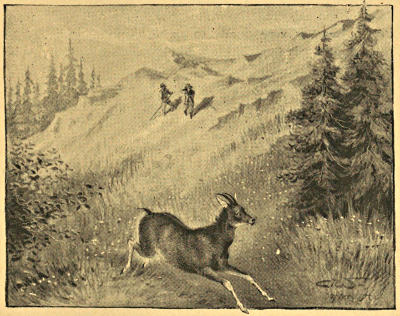
The serow gallops down hill
Colonel Kinloch is one of the very few people who have laid themselves out to hunt serow, and his experiences are scarcely encouraging, though Ward says that in the winter months serow can be found with comparative ease in the Sindh Valley, in Cashmere. The serow seems, like sambur, to be nocturnal in its habits, and its discordant scream is often to be heard after dark in Gurwhal, where it is comparatively plentiful.
The serow’s chief accomplishment is the way that he can gallop down a steep hill, and as he invariably takes that course when disturbed, he can be easily driven, provided the ground is well known. All writers agree that a wounded one will charge. Kinloch mentions having heard of an unwounded male charging when its mate was shot, and Ward gives a graphic account of an adventure he had with one. Mr. O. Shaw shot a serow with a white mane in Cashmere. There are two more varieties of this capricorn described in Sterndale’s ‘Natural History of India.’ The first is the Arakanese capricorn, found in Arakan, Pegu, the Malayan Peninsula, and Sumatra.
This is a brown beast with a yellow bay throat, black forelegs, and bay hind ones. The description is rather vague, and Blyth’s note—‘This species varies much in colour from red to black, and the black sometimes with a white nape, or the hairs of the nape may be white at the base only’—does not explain matters very clearly to an unscientific reader. The second variety is the Thibetan capricorn, discovered by Abbé David, in Eastern Thibet.
This differs from the Indian serow by the uniform blackish brown of the upper parts, tending to ferruginous on the thighs, and the red colour in place of the grey on the lower parts of the legs.
XLIII. TAKIN (Budorcas taxicolor)
Native name: ‘Takin,’ ‘Takhon’
This curious animal, which is found just outside British limits in the Mishmi and Akha hills, north of Assam, and in Eastern Thibet, is a kind of large serow; but its horns, instead of being sharp upright spikes like those of the serow and gooral, are more of the bovine type, being rounded, smooth, and with the distinctive wrinkles and longitudinal marks of genus Nemorhædus faintly defined. Their peculiar twist is best explained by the accompanying sketch.
An article in Sterndale’s ‘Mammalia of India,’ signed ‘J. C.,’ thus describes the animal:
The takin is a large, heavily built ruminant, about 3 ft. 6 ins. high at the shoulder, and 6 ft. in total length. The external peculiarities of the animal are: first, peculiar angularly curved horns in both sexes; second, the enormously arched chevron; third, the very great development of the spurious hoofs, which are obtusely conical, and about 1½ in. in length in a small specimen.
Old bulls appear to become of an uniform brownish black at times, but the colour doubtless depends on the season, as each hair has the basal two-thirds yellow, and its apical third black, and the young its hair brown with a dark tint.
The animal would appear to range from about 8,000 ft. to the Alpine region, which is stated to be its habitat.
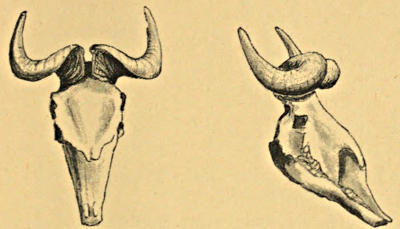
Budorcas taxicolor
As this animal has been found by the Abbé David in Chinese Thibet, future explorations to the north of Burmah should furnish skeletons and details about its habits for the advancement of science.
There are two skulls in the British Museum in which the prominent chevron is particularly noticeable; and there are also several stuffed specimens.
XLIV. THIBETAN ANTELOPE (Pantholops Hodgsonii—Sterndale, Kinloch); (Kemas Hodgsonii—Ward)
Cashmeree shikaris know it as ‘Heran.’ The Ladak name is ‘Chiru,’ or ‘Choos’
This rather curious antelope is pretty plentiful in the Changchmeno Valley, the only easily accessible place for European sportsmen where it is found. A few are said to have been shot in the neighbourhood of the Mansarovárá Lake, near the North-Western frontier of Nepal, and they are also to be met with all over the lofty plateau which has to be crossed on the way to Yarkand. It appears, however, never to have been found in the district beyond the Niti Pass as far as Europeans have been able to penetrate, nor did Colonel Kinloch apparently meet with it when he crossed the frontier in the direction of Gártope.
Measurements
Authority Height at shoulder Total length Weight as shot Length of horn Girth at base Sex Remarks
Capra Jemlaica
ins. ins. lbs. ins. ins.
Mr. A. O. Hume .. .. .. 14⅛ 8⅞ .. Rowland Ward, ‘Horn Measurements’
Major Ward .. .. 200 14 .. .. ‘Sportsman’s Guide to Ladak, &c.’
Mr. Gwynne Griffiths .. .. .. 13⅞ 9 .. Rowland Ward, ‘Horn Measurements’
The Writer, 1884 .. .. .. 13⅞ .. ..
Hume Collection, British Museum .. .. .. 13¾ 9 .. Rowland Ward, ‘Horn Measurements’
Mr. A. O. Hume .. .. .. 13¾ 8⅜ .. ”
Hume Collection, British Museum .. .. .. 13⅝ 8 .. ”
British Museum .. .. .. 13½ 8⅞ .. ”
Mr. Rowland Ward .. .. .. 13½ 8½ .. ”
” .. .. about 200 .. .. .. ”
Hon. W. Rothschild .. .. .. 13⅜ 9⅛ .. ”
Mr. A. O. Hume .. .. .. 13¼ 9½ .. ”
Sir V. Brooke .. .. .. 13¼ 8⅞ .. ”
Sir E. G. Loder, Bart. .. .. .. 13¼ 8¼ .. ”
Mr. J. Carr Saunders .. .. .. 13⅛ 8⅞ .. ”
Capt. H. Brooke .. .. .. 13 .. ..
Major Greenaway 41 52 .. 12½ .. ..
” 36½ .. .. .. .. ..
Sterndale’s ‘Mammalia’ 36 to 40 about 54 .. 12 to 14 .. ..
Col. Kinloch .. .. .. about 15 10 to 11 .. ‘Large Game Shooting’
Average good head .. .. .. 12 9 ..
Hemitragus hylocrius
Gen. McMaster .. .. .. 17 9¾ .. Sterndale’s ‘Mammalia’
Mr. A. O. Hume .. .. .. 16¾ 8⅞ .. Rowland Ward, ‘Horn Measurements’
Mr. St. George Littledale .. .. .. 16½ .. .. ”
Gen. McMaster .. .. .. 16 .. .. Sterndale’s ‘Mammalia’
Sir E. G. Loder, Bart. .. .. .. 15½ 8⅝ .. Rowland Ward, ‘Horn Measurements’
Mr. M. Kennard .. .. .. 15¾ 8¾ .. ”
Mr. St. George Littledale, 1875 .. .. .. 15¾ 8¼ .. ”
Mr. M. Kennard .. .. .. 15⅛ 8⅝ .. ”
Mr. St. George Littledale, 1871 .. .. .. 15⅛ 8⅝ .. ”
Sterndale’s ‘Mammalia’ 41 to 42 .. .. .. .. ..
Average of good head .. .. .. 12 8 ..
Nemorhædus Goral
Major Ward 28 .. 58 8½ .. .. ‘Sportsman’s Guide to Ladak, &c.’
” 28 .. 63 8 .. .. ”
Hume Collection, British Museum .. .. .. 7⅝ 3¾ .. Rowland Ward, ‘Horn Measurements’
Major Ward 28 .. 59 7½ .. .. ‘Sportsman’s Guide to Ladak, &c.’
” 26 .. .. 7½ .. .. ”
Capt. J. A. Orr Ewing .. .. .. 7 3¾ .. Rowland Ward, ‘Horn Measurements’
Mr. J. M. Nicolls .. .. .. 7 3½ .. ”
Col. Kinloch about 26 .. .. up to 8 .. .. ‘Large Game Shooting’
Sterndale’s ‘Mammalia’ 28 to 30 about 48 .. 6 to 9 .. ..
Major Greenaway 26½ .. .. .. .. Female
Average good head .. .. .. 6 .. ..
Nemorhædus bubalinus
Major Ward 37 .. 190 12 .. Male ‘Sportsman’s Guide to Ladak, &c.’
Hon. C. Ellis .. .. .. 10½ 5⅜ .. Rowland Ward, ‘Horn Measurements’
Capt. H. Brooke .. .. .. 10 5½ Male
Major Ward 38 .. 190 10 .. ” ‘Sportsman’s Guide to Ladak, &c.’
” 33 .. 120 10 .. Female ”
Sir V. Brooke .. .. .. 9⅞ 5⅝ .. Rowland Ward, ‘Horn Measurements’
Mr. R. Lydekker, British Museum .. .. .. 9¾ 5⅛ .. ”
Major Greenaway .. .. .. 9½ .. Male
” .. .. .. 7⅛ .. Female
Major FitzHerbert 42 71 .. 9¼ 5½ Male
The Writer 40 .. .. 8 5 Female
Sterndale’s ‘Mammalia’ about 36 60 to 66 about 200 9 to 14 .. ..
Arakanese Capricorn
British Museum, sex unknown, not full grown (the horns are of the ordinary serow type) .. .. .. 8¼ 5½ ..
Authority Height at shoulder Total length Weight as shot Length of horn Girth at base Span at tips Remarks
Budorcas taxicolor
ins. ins. lbs. ins. ins. ins.
British Museum .. .. .. 22⅜ 10⅝ 14¾ Rowland Ward, ‘Horn Measurements’
Hume Collection, British Museum .. .. .. 20⅞ 11⅜ 11⅞ ”
Mr A. O. Hume .. .. .. 20¾ 11⅞ 12½ ”
Hume Collection, British Museum .. .. .. 20¾ 9⅝ 13⅜ ”
Mr. B. H. Hodgson, British Museum .. .. .. 20½ 10⅞ 12⅜ ”
Sir E. G. Loder, Bart. .. .. .. 19⅜ 11 15 ”
British Museum .. .. .. 18 10¼ 8 ”
” .. .. .. 16⅛ 8¾ 10¾ ”
Mr. B. H. Hodgson, British Museum .. .. .. 15¼ 9⅜ 5¾ ”
Lieut.-Col. Graham .. .. .. 14⅜ 8¾ 8⅞ ”
The bucks vary a good deal in colour; some of them are a beautiful golden red, some a light fawn, and others a dirty yellowish white. The colour of the hair seems always to fade after the skin is removed. As a rule the skins are useless in the summer as the antelope are changing their coats; the legs and face are dark brown, and the muzzle, instead of being neat and deer-like, is broad and puffy. The horns are peculiar, having a considerable bend forward at the tips, as if they were pliable, and the buck was standing with his back to a gale of wind.
They have two greatly developed inguinal glands, the tubes of which run right up into the body, and the Tartars are said to believe that the antelope inflate these with air at will, to enable them to gallop faster. A curious point about this antelope is that though he can gallop, and very fast, he generally seems to prefer moving at a sharp trot.
As they are wary and require careful stalking, and as they often lie up for the day in holes, which they have a curious habit of scratching for themselves on the hillsides just deep enough to conceal the whole of their bodies and necks when lying down, leaving the eyes just peeping over the top, the best time to hunt them is when they are feeding in the morning and evening. They are rather soft animals, and succumb to wounds that most deer would travel miles with; the writer once broke the foreleg of a buck who after going about half a mile lay down with his nose on the ground, and let himself be caught. There was a pretty free fight for a bit when he was laid hold of, his sharp horns necessitating a certain amount of caution; a judicious wrench towards his wounded side, however, at length upset him, and a knife-thrust finished him. A Tartar shikari, who was standing by, absolutely refused to lend any assistance during the struggle, contenting himself with applauding the combatants and seeing fair play. The does are smaller than the bucks, are of a light brown colour, and have no horns.
Unlike other antelope, the bucks separate from the does in the summer, and walk about in herds together. They are much worried by the grubs of some fly, which seems to annoy them chiefly when lying down during the heat of the day, for it is a common thing to see one of a herd get up, go for a constitutional gallop—they always gallop then—return to the herd and lie down again with the others. They do not seem to be troubled so much when moving about feeding. The venison in July is excellent.
XLV. THE SAIGA ANTELOPE (Saiga tartarica)
This extraordinary animal, which hails from Central Asia, is said to be a relative of the Thibetan antelope, on account of the peculiar formation of the nose. In the stuffed specimens in the British Museum there is little or no resemblance between the two; the Thibetan antelope having there, as in its natural state, a broad puffy muzzle, while the saiga antelope has, at all events in the Museum, in addition to a very high chevron, an absurd-looking elongated snout like a tapir, projecting far beyond its lower lip. The hair is thick and long, particularly on the cheeks, where it almost resembles a wild boar. The ears are small and rounded in shape, utterly unlike any deer’s ears. The general colour is almost white (probably a very pale yellow in nature), and there is a dark stripe down the quarters and tail. The horns are annulated and of a very pale colour, the stuffed specimen having twelve rings; and though of the gazelle type, with a backward sweep, rising up again at the tips, they have also two curious outward bends, one near the base of the horn, and another near the tip, though the tips eventually incline inwards. A skeleton in the Museum measured 58 ins. in length along the spinal cord, and stood 31¾ ins. at the shoulder. The stuffed specimen stands 30 ins. at the shoulder. Three pairs of horns measured 13¾ ins., 13½ ins. and 13 ins.
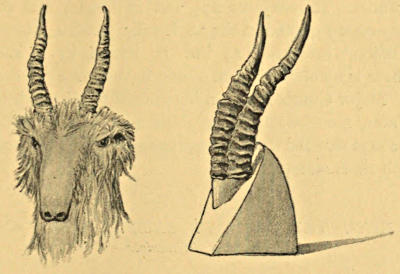
Saiga tartarica
Sterndale remarks that the inflated nostrils ‘are so much lengthened as to necessitate the animal’s walking backwards when it feeds.’ The fortunate sportsman who comes across this rare variety should therefore remember to post himself astern of a herd should he wish it to feed up to him—though he may possibly find that nature has provided the animal with means of twitching its nose out of the way to obviate so uncomfortable a method of grazing.
Gazella gutturosa
This is another little known variety. It is found in Mongolia, and is the one Ward refers to as the ‘hwang yang, or yellow goat.’ There is a stuffed specimen in the British Museum, which stands 31 ins. at the shoulder, is of a pale yellowish white, with coarse hairs, and has horns 10½ ins. in length, of the regular gazelle type in shape and ribbing, much resembling those of the Gazella picticaudata.
Gazella subgutturosa
is a much smaller beast than the last. It is found in Persia,[24] and extends to Yarkand, where a specimen was shot by Major Biddulph when with the Yarkand Mission, between Maral Bashi and Kashgar. It is called by the natives ‘djêrân,’ or ‘jairan.’ Its general colour is pale red, with dark facial marks, a dark band along the side where the white of the belly joins the red of the back, and above it a curious pale streak. The buck has long, annulated, lyrate horns, with the tips inclining inwards. It measures 27½ ins. in height, and the horns of a specimen quoted in the ‘Scientific Results, Second Yarkand Mission,’ measured 14 ins. in length by 5 ins. in girth. There is a coloured plate of one in the same publication.
Major Cumberland, in his journal published by ‘Land and Water,’ mentions hawking these gazelles with trained eagles. He says that the doe is not much bigger than Gazella Bennetti, with short stumpy horns.
XLVI. THE THIBETAN GAZELLE (Gazella picticaudata, Procapra picticaudata—Ward)
Thibetan ‘Goa’
This lovely little animal is of a creamy fawn colour in its winter coat. It has a white anal disc of longish hair, and a black tail about four inches long, which, like the Indian gazelle, it keeps perpetually wagging. The summer coat is slaty grey. The horns are like those of the Indian gazelle, but are longer, of finer grain, and have a far bolder sweep backwards before turning up at the tips. The female has no horns. It frequents the high plateaux along the Chinese frontier, in Eastern Ladak, in the neighbourhood of the Tsomoriri Lake, but apparently does not extend north of the Indus, as far as Ladak is concerned, its limits in Chinese Thibet being at present unknown.
Measurements
Authority Height at shoulder Total length Weight as shot Length of horns Girth at base Span tip to tip Remarks
Pantholops Hodgsonii
ins. ins. lbs. ins. ins. ins.
Colonel Kinloch quotes a head .. .. .. 28½ .. .. ‘Large Game Shooting’
Mr. A. O. Hume .. .. .. 27⅞ 5⅞ 13⅛ Rowland Ward, ‘Horn Measurements’
Sir R. Harvey, Bart. .. .. .. 27⅞ 5½ 11¼ ”
Mr. A. O. Hume .. .. .. 27⅛ 5½ 15⅛ ”
Major Ward 36 .. 85 26½ .. .. ‘Sportsman’s Guide to Ladak, &c.’
Hon. C. Ellis .. .. .. 26⅜ 5⅞ 13⅝ Rowland Ward, ‘Horn Measurements’
The Writer .. .. .. 26 .. ..
Capt. G. Campbell .. .. .. 25½ 5½ 12½ Rowland Ward, ‘Horn Measurements’
Hume Collection, British Museum .. .. .. 25⅜ 5⅜ 12½ ”
” .. .. .. 25¼ 5¾ 12¾ ”
Major Ward 37 .. 85 24 .. .. ‘Sportsman’s Guide to Ladak, &c.’
” 37 .. 90 24 .. .. ”
The Writer 35 .. .. 20½ .. .. ”
Major Ward puts the average length of a full-grown buck’s horns at 22 ins., which seems about right.
Saiga tartarica
Hon. W. Rothschild .. .. .. 14⅜ 5¼ 3½ Rowland Ward, ‘Horn Measurements’
Sir E. G. Loder, Bart. .. .. .. 13¾ 5 .. ”
Sir V. Brooke .. .. .. 13¾ 4⅜ 3½ ”
British Museum .. .. .. 13¾ .. ..
” .. .. .. 13½ .. ..
Hon. W. Rothschild .. .. .. 13⅛ 5⅜ 4⅜ Rowland Ward, ‘Horn Measurements’
British Museum .. .. .. 13 .. ..
Gazella gutturosa
Sir E. G. Loder, Bart. .. .. .. 13⅛ 4⅝ 6¼ Rowland Ward, ‘Horn Measurements’
Mr. St. George Littledale .. .. .. 12¾ 4⅜ 3⅜ ”
” .. .. .. 12¼ 4⅜ 4¾ ”
Mr. R. Beech .. .. .. 11½ 4⅞ 3 ”
Mr. Rowland Ward about 30 .. .. .. .. .. ”
Gazella subgutturosa
Scientific Results, Second Yarkand Mission 27½ .. .. 14 5 ..
Mr. Rowland Ward about 26 .. .. .. .. .. ‘Horn Measurements’
Dr. O. Finsch, British Museum .. .. .. 13¾ 4½ 6 ”
Hume Collection, British Museum .. .. .. 13⅜ 4¾ 5½ ”
” .. .. .. 13 4½ 5 ”
” .. .. .. 12¾ 4¾ 4⅜ ”
” .. .. .. 12⅝ 4¾ 5¼ ”
” .. .. .. 11¾ 5 5⅛ ”
Gazella picticaudata
Major Greenaway .. .. 37 cleaned 13½ .. ..
Hume Collection, British Museum .. .. .. 13½ 3⅝ 5¼ Rowland Ward, ‘Horn Measurements’
Mr. H. C. V. Hunter .. .. .. 13⅛ 4 3⅝ ”
” .. .. .. 13 3¾ 3½ ”
Colonel Kinloch about 24 .. .. 13 .. .. ‘Large Game Shooting’
Major Ward .. .. .. 13 .. .. ‘Sportsman’s Guide to Ladak, &c.’
Major Greenaway 23½ 41 47 13 .. ..
” (a doe) 23 38½ 40 .. .. ..
” .. .. .. 13 .. ..
Captain K. Mackenzie .. .. .. 13 .. ..
Average of good head .. .. .. 13 .. ..
Goa do not appear to lie down much in the middle of the day, and in May and June, at all events, are constantly on the move. They appear to resort to particular spots for dropping their dung, and little heaps of it may be noticed wherever goa are at all plentiful.
As they are generally found on the grass flats that fringe the streams, or on some almost level plateau, stalking them is by no means easy, though they are not generally very shy, will occasionally allow considerable liberties to be taken in approaching them, and will stop to look after a fallen companion. The Tartars say that they can be stalked down wind, but they say this also of the Thibetan antelope, and Major Ward’s advice on this point is sound: ‘Believe it, reader, if you like, but do not try it often.’
XLVII. INDIAN ANTELOPE (Antilope Bezoartica)
Generally ‘Heran,’ or ‘Mirug,’ from the Sanscrit ‘Mirga’
This is the well-known black buck, which is found all over India at intervals from the extreme south to as far north as the Jhelum, following the southern bank of that river till (joined by the Chenab, Ravi and Sutlej) it flows into the Indus, which then becomes the black buck’s northern boundary. Essentially a plains-loving animal, it avoids hills and heavy forest, but is often found in the long grass which covers the islands and banks of many of the large rivers. Though considerable tracts of apparently suitable country do not seem to hold a single herd, special districts where antelope are always to be found seem to crop up unexpectedly all over India. In the North-West Provinces, and along the borders of the Bikanir Desert between Rajpootana and the Punjab, it appears to be more generally plentiful than in the rest of India, and the horns in these districts grow longer. Sanderson says, in ‘Thirteen Years among the Wild Beasts of India,’ that an 18-in. horn is a decided rarity in Mysore, whilst in the Bikanir Desert they are frequently obtained 24 ins., and occasionally 27 ins. or more, in length.
A black buck in his best coat is a very handsome animal, but is too well known to require description.
The buck usually changes his coat after the rutting season, which is in the spring, the season varying slightly according to locality. During the hot months he is generally more or less brown, regaining the black coat after the rainy season. Many full-grown bucks with good heads do not seem to turn black at all, but the master buck of a herd is almost invariably black at the proper season.
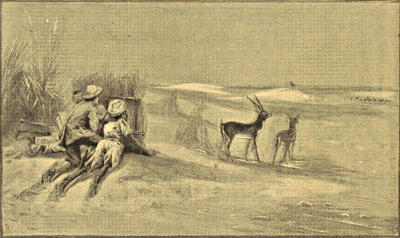
Tame decoys
Major FitzHerbert (a very careful observer of the habits of wild animals) is of opinion that it is usually the master buck of the herd who turns brown in the hot weather; he is then used up, and often leaves the herd to the possession of a younger buck, who has remained black.
The herds, though more frequently consisting of ten or a dozen animals, are occasionally of immense size—indeed thousands are mentioned by some authorities. Antelope in herds are, as a rule, fairly easy to get within shot of; but a solitary old black buck takes precious good care of himself, and as there is rarely cover enough to stalk him without being seen, these wary old gentlemen generally escape. The natives have many methods of hunting antelope. Pursuing them with trained chitas has been so often described that any detailed account of it is unnecessary. It is interesting to see once, the chita’s speed being so amazing, but considered as sport it is poor fun. Black buck are occasionally snared by sending tame bucks among them with nooses attached to their horns. The wild buck attacks the intruder, and gets caught by the horn. This plan is also adopted for snaring ravine deer, but not often, as the gazelle is said to be harder to train than the black buck. The commonest way of snaring antelope is by covering about an acre of ground thickly with nooses and driving a herd over it. Trained bullocks are often used by native shikaris to enable them to get within the close range they love for a shot; and the writer has seen the following curious method practised in Central India. A trained buck and doe are taken out, each having a light cord about ten yards long attached to it, and the pair are led by an attendant, a light screen about three feet square made of grass and leaves with a small hole in the centre being carried by the shikari, and the whole party moves under cover of a third man on horseback to within about three hundred yards of a herd of antelope. The screen is then planted on a spot commanding a good view; the men on foot crouch behind it, and the horseman rides slowly off to a flank. The tame deer are then let out to the full extent of their lines on one side of the screen, and begin playing round one another. The master buck of the herd, seeing an impertinent intruder on his ground, trots out at once to do battle for the doe, but the screen puzzles him, so before coming close he generally circles round to try and see behind it. As he moves the screen is shifted round, the men scrambling round on hands and knees behind it, and if there are two Englishmen bursting with suppressed laughter in addition to the two natives, all scuffling round as the screen moves and trying to keep their legs out of sight, the business is most comical.
Directly the wild buck stops, the screen and the men behind it must remain motionless. Having failed to discover what is behind the screen, the buck, though he is still suspicious, probably because he caught sight of a clumsy English leg, feels that he must try to capture that enticing doe, but decides on having a look from the other side of the screen first, so back he gallops to the other flank, and the scrambling process is repeated. Gradually he comes within range, the rifle is poked through the hole in the screen and he gets his quietus; after this the tame deer are given a handful of corn, and the party sets out to look for another herd. The tame buck employed in this manœuvre should be a brown one, as if an old powerful-looking black one is used the wild buck will often decline the contest.
In some districts the antelope are so wild that sportsmen have to approach them under cover of bullock-carts, and occasionally dress up as natives to get within range. The antelope are accustomed to see carts and natives, and will generally allow them to pass within about a hundred and fifty yards, while the sight of a European will start them off at once; but in most places in Central and Northern India these accessories are not needed. The pleasantest way of shooting is to ride a quiet horse, which will do for stalking if the antelope are wild or for riding down a wounded buck, taking a few coolies with you to carry game, luncheon, guns and cartridges.
A shot-gun enables one to vary the bag pleasantly with small game, without interfering with the chance of getting antelope. If the sportsman is fond of coursing, greyhounds may be taken, the Rampore breed suiting the country best; but after many trials the writer has become unwillingly convinced that dogs do more harm than good. If there are any crops about they soon get unsighted, get on to fresh deer, and disturb the whole country.
On the other hand, if the sportsman has dogs he can often enjoy a course after a fox or a hare to vary the entertainment, and a good course with a wounded buck is a very pretty sight. The usual proceeding is as follows: The sportsman rides till a herd is sighted; he approaches them as far as he thinks safe, probably within about six hundred yards; he then dismounts, and if he is going to use his horse for stalking, goes on with the horse and groom, leaving the coolies and dogs behind, with orders to follow him slowly, keeping as far back as possible without losing sight of him. If the antelope are feeding or moving slowly, the sportsman directs his course so as to cross their path about a hundred yards ahead of them. If the creatures are lying down or stationary, he must try to pass within a hundred yards of the flank which is to the leeward of the herd, walking on the far side of his horse, which is led by the groom on the same side. If he has no horse with him, he should hold his rifle so that the sun does not shine on the barrels. If two sportsmen are working together (a most killing plan with crafty men who play into one another’s hands), they should each take a flank and go rather wider than they would if hunting single-handed, so as to keep the herd between them. As long as that can be managed one or other of the guns is sure to get a chance at the best buck. The sportsman should show himself to the herd a long way off, and walk slowly, without any attempt at concealment; he must remember never to walk straight at them, but always as if he were going to pass them at about a hundred yards; if he finds he is lying too far out of his course, he should edge quietly towards them without turning, and he should never stop until he means to fire. He should never look direct at the herd; quiet side glances will give him all the information he requires.
When he has approached to within two hundred yards, if the herd is lying down some of the does will get up; but the sportsman can go on safely till the buck he wants begins to stir. The old fellow will rise leisurely, stretch himself, and then turn to gaze. This is the time for the shot, and if it can be taken without sitting down or kneeling it is far more likely to be an easy one. An excellent rest[25] for firing standing can be made with a light bamboo having an iron crutch covered with leather on the top to hold the rifle barrels. The crutch should be the exact height of the top of the sportsman’s shoulder, and is held, when firing, with the left hand at arm’s length. The bottom of the stick should be shod, to prevent it wearing away when used as a walking-stick. The advantages of using this rest are particularly noticeable when shooting among low bushes, which so often interfere with a shot when sitting or kneeling.
Frequently, just before the sportsman can get a fair chance at the buck he wants, the herd begins to move off; two or three does commence bucking high in the air, and to a novice it would appear that the whole herd are on the point of galloping away. This, however, by no means follows. The master buck often takes very little notice of their pranks, and follows slowly after them, in which case the does calm down, and though still continuing to move, will lead on slowly. The sportsman should follow them quietly, still keeping on their flanks, and heading so as to cut them off, if possible; sooner or later he will get a chance if he sticks to them quietly, though if he has followed them for some distance he will probably only get a running shot. Each herd has its own district as a rule, and sooner than be forced far over its boundary, it will turn and gallop back past the sportsman, often within fifty yards. This is even more noticeable with ravine deer, whose herd districts appear to be smaller than those of antelope, and who generally require a lot of following up and bullying before they give a chance. A good buck with a herd of either antelope or of ravine deer need never be given up as hopeless as long as it can be followed. In following a wounded buck the main point is just to keep it in sight without pressing it until it lies down, when it should be left for about half an hour before being restalked. If it is intended to ride, or course the buck, the attendants should be signalled up at once, as the half-hour’s rest will spoil the run, but the sportsman should be careful that the dogs are not slipped till the buck is well clear of the herd. The best way is for the sportsman to have the dogs brought up to him, then ride ahead, the slipper running after him with the dogs in leash till the buck begins to gallop; then have the dogs slipped and ride the buck, halloaing on the dogs till they are fairly laid on. If he has no dogs he will be able to get within three hundred yards of the buck before the latter really starts, and then he must send him along; after about half a mile he will find that he can get within twenty yards, but no nearer. A few hundred yards farther the buck will begin to falter and then suddenly throw himself down, and the sportsman can either spear him or dismount and knife him—the buck has run himself out. With Express rifles, unless a buck is hit in the leg, he will give no run at all; with a body wound he can’t gallop any distance, though he may give trouble if pursued on foot. The bucking bounds which antelope make are very peculiar (no wounded animal ever bucks). The distance covered may be only a few feet, the animal jumping apparently to get a good view, but when the deer are galloping, the distance covered in a bound, apparently made without effort, is extraordinary. Major FitzHerbert paced three successive bounds of a doe on softish sand; two measured eight yards and the third seven yards.
A buck slightly wounded in the leg will occasionally give a grand run. In 1875 Major FitzHerbert shot a buck through the hock without breaking the bone. Mounted on a fast Arab, he rode this buck for a mile and a half without being able to get up to him, as the buck led over a succession of gram fields where he was able to keep along the narrow headlands while the horse had to plough through the clods. Finding that he was, if anything, losing ground, the rider pulled up, and the buck stopped and lay down in a patch of grass. The attendants then came up with a couple of deerhounds, which were slipped at the buck with a good start, but could not run into him till he had gone another mile and a quarter, and only then caught the buck when he dislocated his wounded hock.
In 1876 the same sportsman had another brilliant gallop on the same horse after a buck wounded in the fleshy part of the thigh. A brace of dogs were slipped, but got away on to other deer early in the run, and the buck was ridden till he dropped and was despatched with a knife. This run was measured about five miles on the map from point to point, and must have been seven or eight miles as the buck went. Cases have been reported of unwounded black buck being run down by dogs in the Bombay Presidency, but in Northern India, though the writer knows of two instances of unwounded does being successfully coursed (one of these at all events was not in young, as it was examined by a medical officer to decide a bet), the bucks could always gallop away from the dogs.
The biggest bag of black buck the writer knows of was sixty-four bucks in 1883, by two guns in five days and a half. Of these, ten bucks, whose horns were all over 22 in. in length, were shot by one of the sportsmen in a morning’s work. The biggest mixed bag by one gun in a day was two nylghai, five ravine deer, and three black buck in 1875.
Black buck in their wild state are very pugnacious, and when two bucks are fighting they may often be approached without difficulty. I once walked up to within eighty yards of two who were desperately hard at it; sat down and watched the fight till they stood with their horns locked, and then shot the blacker buck of the pair through the lungs. He threw up his head and bolted, pursued by his antagonist, a brown buck with good horns, who seemed to have had rather the best of the battle while it lasted. They ran about one hundred yards, the brown buck driving and horning the other till the latter dropped dead; then, after making two or three attacks on the prostrate body, the brown buck began to swagger round it, head and tail in the air, as proud as could be. By this time I had again got well within range, and as the brown buck now apparently saw me for the first time (not having taking any notice of the shot), I dropped him with another bullet so that he fell over the carcase of his late rival.
Writing of the height that antelope can jump, Williamson mentions a black buck leading a herd over a net which was propped up on poles 13 ft. long, and which must have been at least 11 ft. high.
XLVIII. THE NYLGHAO (Portax pictus)
Native names: ‘Nilghao,’ ‘Lilghao’; in the Punjab, ‘Roz’
This animal is found pretty nearly all over the plains of India. Jerdon says it is not known in the extreme south of India, but Sanderson mentions it as occurring in the Madras Presidency on the borders of Mysore. According to my own experience, it is most plentiful in Central India, though it is common enough in the North-West Provinces.
An old male, usually called a blue bull, is a large beast with a lean head, surmounted by short cow-like horns, but with a curious rib along the base of the horn in front; the neck is long and carried high; the withers are high, and give him a horse-like appearance, but he falls away towards the hind-quarters; the tail is like a cow’s, with a tuft at the end, but only reaches to the hocks. His general colour is a dark iron grey; the chin, lips, and inside of the ears are white; the ears are rather large and cow-like; there is a white spot on each cheek, a large white patch on the throat, below which hangs a tuft of long black hair; the chest and stomach are white, there are white rings on the fetlocks, and he has a thin upright black mane.
The female is fawn-coloured, and is without horns.
Scrub jungle, composed of ‘babul’ trees, ‘dhak’ and ‘beyr’ bushes, is the ground on which to look for nylghai, and if there is a patch of sugar cane adjoining such a jungle, it is an almost certain find. The natives often enclose these patches of cane with grass fences nearly six feet high, but nylghai will always jump them.
As a rule, natives object more or less strongly to nylghai being shot, regarding them as cattle; and as they afford poor sport with the rifle, most men spare them after having obtained a few specimens, especially if the ground is not rideable; but where they can be ridden it is quite another matter. A wounded bull will give a grand run, and even an unwounded one can be ridden down if well pressed at first. This is rather a difficult matter for a single horseman, but parties of three or four have frequently done it. Kinloch mentions an instance of its having been done single-handed, and gives some stirring accounts of his own adventures after nylghai. Cows, he says, it is almost impossible to catch, the only chance being with heavy old bulls.
Blue bulls have frequently been tamed and trained to carry loads. Sterndale mentions one he used to ride, but they are as a rule dangerous in captivity. The writer owned one who would let him sit on his back when lying down, but he would always charge any pony that came near him, dropping suddenly on his knees to use his horns. He used to break loose, and hunt the native gardeners up trees, whilst he enjoyed the produce. As the bull would not consent to be led, he had to be left behind when the writer’s battalion left the station, and his last exploit was to hunt the portly native landlord of the house round and round the premises when he came to look at his property.
The hide is very thick, especially on the shoulders, and is much prized by the boatmen on all the rivers for making up into the inflated skins they use.
Sterndale remarks: ‘He sometimes even devours such quantities of the intensely acrid berries of the aoula (Phyllanthus emblica) that his flesh becomes saturated with the bitter elements of the fruit. This is most noticeable in soup, less so in a steak, which is at times not bad.’
The writer has never had the luck to taste any part of a blue bull that was worth eating except the tongue.
XLIX. INDIAN GAZELLE (Gazella Bennetti)
Commonly called Ravine Deer; native name generally ‘Chikara’
The gazelle is found in suitable localities pretty nearly all over India, with the exception of Lower Bengal, the Western Ghauts, and the Malabar coast. Wherever there is sandy ground, low stony hills, or the network of ravines which fringes the banks of so many Indian streams near their sources, or where they cut their way through low hills, ravine deer are likely to be found. They avoid heavy forest or swamp covered with high grass, nor do they usually frequent closely cultivated ground unless there is scrub, jungle, or a ravine near to which they can retire when disturbed.
They are fidgetty, restless little animals, and, like the Thibetan gazelles, are incessantly twitching their tails. Even where not much hunted they are generally pretty wild, but as they do not as a rule go far when disturbed, the sportsman can usually get a shot by perseveringly following up a herd. A steady shooting horse is of great assistance in stalking them, and on the edge of the Bikanir Desert, where they are very plentiful, the easiest way of approaching them is under cover of a riding camel. As black buck and ravine deer are often found on the same ground, the same tactics in the stalk are applicable to either. The stick-rest recommended for black buck shooting is of the greatest assistance when shooting ravine deer among bushes. The bucks are often seen alone, and herds rarely consist of more than a dozen animals. The does have thin horns, and occasionally, in bad light or jungle, pay the penalty of being mistaken for bucks.
Ravine deer shooting with a light rifle is very good fun. Straight shooting is necessary for so small a mark, and as a rule the day’s amusement can be varied by shots at black buck or small game. Colonel Howard, in 1883, got one ravine buck, one bustard, two peafowl, one sand-grouse, one duck, in a day, all shot with a rifle.
A ravine buck with a broken leg will give a good run to dogs if found in the open, but as a rule the ground these deer frequent is too broken for coursing.
An unwounded doe was run down by three dogs belonging to officers of the Rifle Brigade in 1876, but on another occasion the writer saw a fawn run clean away from a good dog. Kinloch describes how the officers of the Guides used to hunt ravine deer with dogs and falcons.
L. THE FOUR-HORNED ANTELOPE (Tetraceros quadricornis)
Native names: generally ‘Charsingha,’ ‘Choka,’ ‘Doda’; in Chota Nagpur ‘Cháorang’ (Kinloch)
Four-horned antelopes are found thinly scattered all over India, but, according to Sterndale, not in Ceylon or Burmah. They are met with in Rajputana, but the writer has never heard of them in the Punjab.
They generally live alone or in pairs, and frequent bamboo jungle, or the long grass and bushes near forests.
Their colouring varies a good deal, but it is generally a reddish-brown, paler below the forelegs, and fetlocks dark; the latter being ringed with pale marks. The female is hornless. The male has two pairs of short, smooth black horns, the front pair, which is shorter than the other pair, growing almost above the eyes, while the rear pair rises just in front of the ears. The front pair are often mere knobs, and good specimen heads, with the four horns complete, are not easy to get; in fact, this antelope is such a small animal and sticks so persistently to cover, that the majority of those that are killed are bagged by lucky snap-shots. Sterndale quotes a letter in the ‘Asian,’ signed ‘Bheel,’ in which the writer remarks: ‘It is found in the thick jungles at the foot of the hills. It selects some secluded spot, which it does not desert when disturbed, returning invariably to its hiding-place when the coast is clear.’ This peculiarity might well be taken advantage of by any sportsman desirous of obtaining a specimen; on a four-horn being put up, his hiding-place might be noted, the attendants sent on a few hundred yards, and the sportsman remain behind to intercept the animal on its return. The writer has never tried this plan, but only offers the suggestion for what it is worth.
Measurements
Authority Height at shoulder Total length Weight as shot Length of horns Girth of horns Span tip to tip Remarks
Antilope bezoartica
ins. ins. lbs. ins. ins. ins.
Mr. A. O. Hume .. .. .. 28¼ 5 17¾ Rowland Ward, ‘Horn Measurements’
Mr. Rowland Ward .. .. Average 85 .. .. .. ”
Sterndale 32 35 .. 28 .. .. ‘Triangle’ in ‘The Asian’
Major Ward .. .. .. 27¾ .. .. ‘Sportsman’s Guide to Ladak, &c.’
Col. Kinloch .. .. .. 27 .. .. ‘Large Game Shooting’
” .. .. .. 27 .. .. ”
Sir V. Brooke .. .. .. 27 5 19½ Rowland Ward, ‘Horn Measurements’
Captain Brooke .. .. .. 26¾ .. ..
Col. Kinloch .. .. .. 26¾ .. .. ‘Large Game Shooting’
Mr. A. O. Hume .. .. .. 26⅜ 5 17⅞ Rowland Ward, ‘Horn Measurements’
Col. Kinloch .. .. .. 26 .. .. ‘Large Game Shooting’
Gordon Cumming .. .. .. 26 .. .. ‘Wild Men and Wild Beasts’
” .. .. .. 26 .. .. (An albino)
Captn. Hervey .. .. .. 25¾ .. ..
Mr. A. O. Hume .. .. .. 25⅝ 4¾ 20¾ Rowland Ward, ‘Horn Measurements’
Col. Martin .. .. .. 25½ .. 15 ”
Sir J. Morris, K.C.S.I. .. .. .. 25⅛ 5⅛ 21¾ ”
Hume Collection, British Museum .. .. .. 25⅜ 5½ 14½ ”
” .. .. .. 25 4⅞ 19 ”
Colonel Howard .. .. .. 25 .. ..
Capt. H. Petre .. .. .. 25 .. ..
Gordon Cumming .. .. .. 25 .. .. ‘Wild Men and Wild Beasts’
Major Greenaway 33 .. .. .. .. ..
‘Spherical,’ ‘Oriental Sporting Magazine,’ 1870 .. .. 83.4 .. .. .. Average weight of bucks in Allahabad district
” .. .. 70.8 .. .. .. Average weight of bucks in Bundara district
Average of good head .. .. .. 20 .. ..
Portax pictus
Major FitzHerbert 51 .. .. 9½ .. ..
British Museum .. .. .. 9¼ 6¾ 4⅞ Rowland Ward, ‘Horn Measurements’
Col. Kinloch about 56 .. .. .. .. .. ‘Large Game Shooting’
Mr. A. O. Hume .. .. .. 8⅞ 6⅝ 3½ Rowland Ward, ‘Horn Measurements’
The Writer .. .. .. 8¾ 7 ..
” .. .. .. 8¾ 7⅛ ..
Sterndale’s ‘Mammalia’ 52 to 58 96 to 106 .. 8 to 10 .. ..
Major FitzHerbert 53 .. .. .. .. ..
Major Greenaway 55 .. .. .. .. ..
” 53 .. .. 7½ .. ..
” 50 .. .. .. .. ..
Average of good head .. .. .. 8 .. ..
Authority Height at shoulder Total length Weight as shot Length rear horns Length front horns Length of horns Girth of horns Span tip to tip Remarks
Gazella Bennetti
ins. ins. lbs. ins. ins. ins. ins. ins.
Capt. Brooke .. .. .. .. .. 14¼ .. .. Both shot the same evening near Ferozepore
” .. .. .. .. .. 14 .. ..
Major Ward .. .. .. .. .. 14 .. .. ‘Sportsman’s Guide to Ladak, &c.’
Sir V. Brooke .. .. .. .. .. 13¾ 4½ 7 Rowland Ward, ‘Horn Measurements’
Major FitzHerbert .. .. .. .. .. 13½ .. ..
Col. Kinloch .. .. .. .. .. 13¼ .. .. ‘Large Game Shooting’
Major FitzHerbert .. .. .. .. .. 13 .. ..
Sterndale’s ‘Mammalia’ 26 42 .. .. .. 12 .. ..
‘Spherical,’ ‘Oriental Sporting Magazine,’ 1870 .. .. 39½ .. .. .. .. .. Bucks
” .. .. 38 .. .. .. .. ..
” .. .. 36 .. .. .. .. ..
” .. .. 33 .. .. .. .. ..
” .. .. 30 .. .. .. .. .. Does
” .. .. 28½ .. .. .. .. ..
” .. .. 24 .. .. .. .. ..
Average of good head .. .. .. .. .. 12 .. ..
Tetraceros quadricornus
British Museum .. .. .. 4½ 2⅜ .. .. ..
Sir E. G. Loder, Bart. .. .. .. 4⅜ 2½ .. .. .. Rowland Ward, ‘Horn Measurements’
Col. J. Evans (British Museum) .. .. .. 4 2½ .. .. .. ”
Sir R. Harvey, Bart. .. .. .. 3⅝ 1¾ .. .. .. ”
H.R.H. Duke of Edinburgh .. .. .. 3½ 2 .. .. .. ”
Sir E. Durand, Bart. .. .. .. 3¼ 1⅞ .. .. ..
British Museum .. .. .. 3⅛ ½ .. .. .. ”
Sterndale’s ‘Mammalia’ 24 to 26 40 to 42 .. about 5 about 1½ .. .. ..
Average of good head .. .. .. 3 1½ .. .. ..
Memmina indica
The Writer 11 21½ about 10 .. .. .. .. .. Other measurements of this buck for stuffing: Height at croup, 11¼; length of neck, 2¼; girth of neck, 7⁸⁄₁₀; girth behind shoulder, 13½; girth middle of body, 16⁷⁄₂₀; girth in front of stifle, 13½; forearm at elbow, 3⁶⁄₁₀; thigh close to body, 6⁴⁄₁₀ ins.
Jerdon 10 to 12 22 to 23 5 to 6 .. .. .. .. ..
Professor Garrod, ‘Cassells’ Nat. Hist.’ 8 18 .. .. .. .. .. ..
The four-horn has the stilted action peculiar to deerlets, walking on the tips of its toes. Sterndale remarks that it is higher at the croup than the withers, and runs with its neck stuck out in a poky sort of way, making short leaps.
LI. THE MOUSE DEER (Meminna indica)
Native names: ‘Pisora,’ ‘Pisai’
Habitat, the large forests of India; but it is not known, according to Jerdon, in the countries eastward of the Bay of Bengal. It is common in the bamboo forests of the Central Provinces (Sterndale). The writer has never heard of it in Northern India, nor has he even seen it in Central India; in the Western Ghauts it is common enough.
In colour it is an olive dun, with lines of pale yellow spots along the sides; the lower parts are white; the ears small and rounded; the legs fine and delicate, being scarcely thicker than an ordinary pencil; the tail is short. The male has delicate little tushes pendant from the upper jaw, like the Barking deer; the scrotum is hairless, and instead of being between the legs is behind them, like the ordinary little Indian ground squirrel, which it very much resembles in colour and markings. It is commonly found in bamboo jungle, and the writer got a good specimen in the Western Ghauts. Sterndale writes of some tame mouse deer which he had: ‘They trip about most daintily on the tips of their toes, and look as if a puff of wind would blow them away. They are said to rut in June and July, and bring forth two young about the end of the rainy season.’
LII. KYANG (Equus hemionus)
Thibet ‘Kyang’
The kyang was doubtless originally intended by Providence to fulfil some good purpose, but having turned out a failure was located in Thibet, where it was probably considered it would not be much in the way; or else it was designed to take the place of the insect life on the lower ranges and act as a blister on the temper of the sportsman. The shapoo, limb of the devil as it is, has some good points in its favour—e.g. a graceful carriage, fine horns, and it is a desirable acquisition to the bag. The kyang has nothing to recommend or excuse it. It is an ugly, donkeyfied, fiddle-headed brute, with straight shoulders. In colour it is a mealy bay with a dark-brown hog mane, dorsal stripe and tail. Its head and ears are coarse and large, and its screeching bray is as unpleasant as its general appearance. Being absolutely worthless to shoot, it is always trading on that fact, and on the utterly false pretence that it is deeply interested in the actions and habits of human beings, particularly Europeans, is for ever thrusting itself into society where it is not welcome, thereby spoiling the sportsman’s chance of a quiet interview with the animal of his choice. The one trait in its character that might be reckoned as a palliation by an unduly benevolent commentator is that it appears not to be selfish. As soon as it thinks it has got a sportsman’s temper well under way, it will scour the country round for all its friends and relations, and assemble them to enjoy together the interesting spectacle of an angry man armed with a rifle that he dare not discharge for fear of alarming something worth firing at. Hints and persuasion are thrown away, and nothing but a declaration of war has the smallest effect on kyang. A skilful diplomat may occasionally gain a temporary advantage by misleading kyang as to his intended route—getting the kyang, for instance, to believe that he wants to cross a particular pass, and then, by taking advantage of cover, escaping up a side ravine; but as a rule the sportsman has only the choice of two alternatives: either to take the first opportunity of hiding and remaining hidden till the disturbance is over, or else going to some other part of the ground.
Measurements.
AuthorityHeight at shoulder
Col. KinlochAbout 14 hands
Sterndale12 to 14 hands
Major Greenaway5 year old female, 12½ hands5½ inches below the knee
”male, 13 hands
The Writerold male, 13½ hands
LIII. THE WILD ASS (Equus onager)
Native names: ‘Ghor khur,’ Hindi; ‘Ghour,’ ‘Kherdecht,’ Persian; ‘Koulan,’ Kirghiz (Sterndale).
The wild ass is common in Persia and extends through Beluchistan and Sind to the Bikaneer Desert and Kutch, its southern limit according to Jerdon being Deesa, and its eastern 75° E. longitude. It is closely allied to, if not identical with, the wild ass of Assyria, Equus hemippus.
As south of the Indus the wild ass is by no means common, and is very shy and difficult to stalk in the open desert, comparatively few have been shot by Europeans. Sterndale, quoting Major Tytler, says that on the Bikaneer Desert the natives organise a hunt once a year to catch the foals for sale to native princes, and that a full-grown one has more than once been run down fairly and speared. The Beluchis also ride down and catch the foals, and shoot the full-grown ones for food, the ground there being favourable for stalking. A gallop after a wild ass should be exciting, but few sportsmen, the writer imagines, would care to shoot more than one specimen of a beast whose sole trophies are the hoofs.
Sterndale says they stand eleven or twelve hands at the shoulder, which is considerably smaller than the kyang.
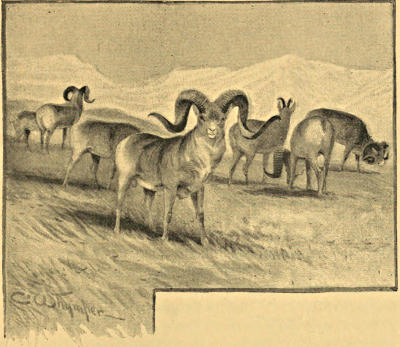
Ovis Poli