Glossary of Terms
Reading edition
Azured. Ornamentation outlined in gold and crossed with horizontal lines.
Bands. (1) The cord whereon the sheets of a volume are sewn. (2) The ridges on the back caused by the bands raising the leather. Head Band. A knitting of silk or thread worked in at the head and foot of the shelf back of the book.
Boards. A temporary binding with a cover made of boards and paper. Mill Boards. The boards that are attached to the book, giving stiffening to the cover.
Bosses. Brass or other metal pieces attached to the covers of a book, for ornamentation or protection.
Burnish. The gloss produced by the application of the burnisher to the edges after coloring, marbling or gilding.
Collating. Examining the signatures, after a volume has been folded and gathered, to ascertain if they be in correct sequence.
Dentelle. A style resembling lace work, finished with very finely cut tools.
Doublé. When the inside of the cover is lined with leather, it is termed a doublé.
End Papers or Lining Papers. The papers, plain or fancy, placed at each end of the volume and pasted down upon the boards.
Fillet. A cylindrical tool used in finishing, upon which a line or lines are engraved.
Finishing. Comprises tooling, lettering, polishing, etc.
Flexible. A book sewn on raised bands, with the thread passed entirely around each band, allowing the book to open freely.
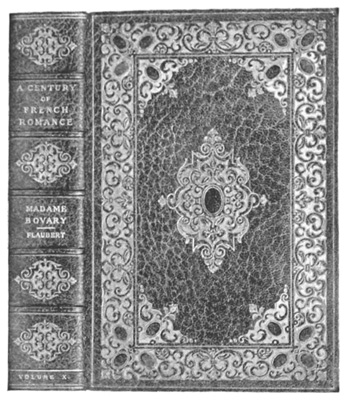
A Century of French Romance Edition work. French Levant with colored inlays. Decoration “stamped” in gold.
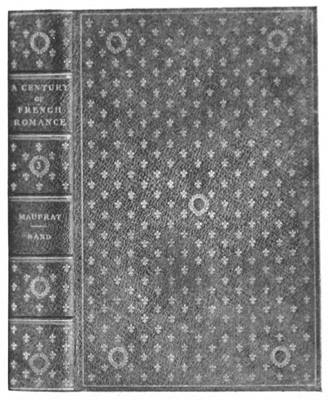
A Century of French Romance Edition work. Persian Morocco. Semis (powder or diaper design) “stamped” in gold.
Fore edge. The front edge of the leaves.
Forwarding. Comprises all the operations between preparing and finishing, including the forming and trimming of the books, and the covering of the boards.
Gaufre Edges. Impressions made with the finisher's tools on the edges of the book after gilding.
Gouge. A finishing tool forming the segment of a circle.
Guards. Strips of paper inserted in the backs of books, upon which inserts are mounted, intended to prevent the books being uneven in thickness when filled.
Inlaying. (1) Extending “extra” illustrations by inserting them in leaves to correspond to the size of a book. (2) A style of Mosaic work made by the insertion of vari-colored leathers or other material on the cover or doublé.
Kettle-Stitch. A catch-stitch formed in sewing at the head and foot.
Lacing-In. Lacing the bands on which the book is sewn through holes in the boards to attach them.
Limp. A cover without boards or other stiff materials, allowing the sides to be pliable.
Marbling. A method of coloring the edges or end papers in various patterns, obtained by floating colors on a gum solution.
Mitred. Tooled lines meeting at a right angle without overrunning.
Morocco. A fine kind of grained leather prepared from goatskin. Levant Morocco. The skin of the monarch breed of goat; a large grained Morocco.
Overcasting. Oversewing the back edges of single leaves of weak sections; also called whipstitching or whipping.
Pointillé. The dotted style of Le Gascon.
Preparing. Comprising all the preliminary operations up to “forwarding,” including folding, gathering, collating, and sewing.
Register. When the printing on one side of a leaf falls exactly over that on the other it is said to “register.”
Rolls. Cylindrical ornamental tools used in finishing.
Sawing-in. When grooves are made in the back with a saw to receive the bands.
Semis. A diaper design made up of the repetition of one or more small tools.
Signature. Each folded sheet or section of a book.
Squares. The portion of the covers projecting beyond the edges of the book.
Tall Copy. So called when the book has not been reduced in size by trimming, with the leaves entirely uncut.
Tooling. Impressing the design or pattern in gold leaf, with finishing tools, by hand. Blind Tooling. The impression of finishing tools without gold leaf.
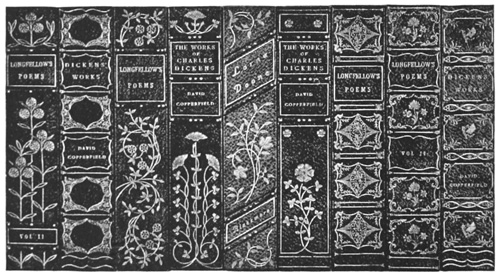
Specimen decorative backs for half or full leather bindings. Edition work or single volumes.