PART IV (continued 5)
Reading edition
[732] Most editors indeed do take it in this sense, though recently Schücking has adopted Stjerna's explanation of "ring-sword." In l. 322, Falk (27) takes hring-īren to refer to a "ring-adorned sword," though it may well mean a ring-byrnie.
[733] Actually, I believe, more: for two ring-swords were found at Faversham, and are now in the British Museum. For an account of one of them see Roach Smith, Collectanea Antiqua, 1868, vol. VI, 139. In this specimen both the fixed ring and the ring which moves within it are complete circles. But in the Gilton sword (Archæologia, XXX, 132) and in the sword discovered at Bifrons (Archæologia Cantiana, X, 312) one of the rings no longer forms a complete circle, and in the sword discovered at Sarre (Archæol. Cant. VI, 172) the rings are fixed together, and one of them has little resemblance to a ring at all.
[734] At Concevreux. It is described by M. Jules Pilloy in Mémoires de la Société Académique de St Quentin, 4e Sér. tom. XVI, 1913; see esp. pp. 36-7.
[735] See Lindenschmit, "Germanisches Schwert mit ungewöhnlicher Bildung des Knaufes," in Die Altertümer unserer heidnischen Vorzeit, V Bd., V Heft, Taf. 30, p. 165, Mainz, 1905.
[736] Salin has no doubt that the Swedish type from Uppland (his figure 252) is later than even the latest type of English ring-sword (the Sarre pommel, 251) which is itself later than the Faversham (249) or Bifrons (250) pommel. See Salin (B.), Die Altgermanische Thierornamentik, Stockholm, 1904, p. 101. The same conclusion is arrived at by Lindenschmit: "Die ursprüngliche Form ist wohl in dem, unter Nr. 249 von Salin abgebildeten Schwertknopf aus Kent zu sehen"; and even more emphatically by Pilloy, who pronounces the Swedish Vendel sword both on account of its "ring" and other characteristics, as "inspirée par un modèle venu de cette contrée [Angleterre]."
[737] The Benty Grange helmet; see below, p. 358.
[738] Depicted by Clark Hall, Stjerna's Essays, p. 258.
[739] Clark Hall's Beowulf, p. 227.
[740] "Von Skandinavien gibt es aus der Völkerwanderungszeit und Wikingerepoche keine archäologischen Anhaltspunkte für das Tragen des Panzers, weder aus Funden noch aus Darstellungen," Max Ebert in Hoops' Reallexikon, III, 395 (1915-16). But surely this is too sweeping. Fragments of an iron byrnie, made of small rings fastened together, were found in the Vendel grave 12 (seventh century). See Graffältet vid Vendel, beskrifvet af H. Stolpe och T. J. Arne, pp. 49, 60, plates xl, xli, xlii.
[741] 54-I. Liebermann, p. 114.
[742] Essays, 34-5.
[743] Elene, 264.
[744] Engelhardt, Denmark in the Early Iron Age, p. 66.
[745] Andreas, 303.
[746] l. 2869.
[747] "Few have corslets and only one here and there a helmet" (Germania, 6). In the Annals (II, 14) Tacitus makes Germanicus roundly deny the use of either by the Germans: non loricam Germano, non galeam.
[748] See above, p. 124.
[749] See Chifflet, J. J., Anastasis Childerici I ... sive thesaurus sepulchralis, Antverpiæ, Plantin, 1655.
[750] That both sword and scramasax were buried with Childeric is shown by Lindenschmit, Handbuch, I, 236-9: see also pp. 68 etc.
[751] l. 2762-3.
[752] Worsaae, Nordiske Oldsager, Kjøbenhavn, 1859; see No. 499; Roach Smith, Collectanea Antiqua, 1852, II, 164; Montelius, Antiq. Suéd. 1873, No. 294 (p. 184).
[753] Essays, p. 198. See also above, p. 124. Mr Reginald Smith writes to me: "Unburnt objects with cremated burials in prehistoric times (Bronze, Early and late Iron Ages) are the exception, and are probably accidental survivals from the funeral pyre. In such an interpretation of Beowulf I agree with the late Knut Stjerna, who was an archæologist of much experience."
[754] Forming vols. 3 and 4 of The Arts in Early England, 1903-15.
[755] It was, however, necessary to leave over for a supplementary volume some of the contributions most interesting from the point of view of the archæology of Beowulf: e.g. spatha, speer, schild.
[756] B. E. Hildebrand, Grafhögarne vid Gamla Upsala, Kongl. Vitterhets Historie och Antiqvitets Akademiens Månadsblad, 1875-7, pp. 250-60.
[757] Fasta fornlämningar i Beovulf, in Antiqvarisk Tidskrift för Sverige, XVIII, 48-64.
[758] Heimskringla: Ynglingasaga, cap. 25, 26, 29.
[759] See B. Nerman, Vilka konungar ligga i Uppsala högar? Uppsala, 1913, and the same scholar's Ynglingasagan i arkeologisk belysning, in Fornvännen, 1917, 226-61.
[760] Heimskringla: Ynglingasaga, cap. 27.
[761] A discovery made by Otto v. Friesen in 1910: see S. Lindqvist in Fornvännen, 1917, 129. Two years earlier (1675) "Utters högen i Wändell" is mentioned in connection with an investigation into witchcraft. See Linderholm, Vendelshögens konunganamn, in Namn och Bygd, VII, 1919, 36, 40.
[762] For a preliminary account of the discovery, see Ottarshögen i Vendel, by S. Lindqvist in Fornvännen, 1917, 127-43, and for discussion of the whole subject, B. Nerman, Ottar Vendelkråka och Ottarshögen i Vendel, in Upplands Fornminnesförenings Tidskrift, VII, 309-34.
[763] Baldwin Brown, III, 216.
[764] 213.
[765] 218.
[766] So Baldwin Brown, III, 213; Lorange, Den Yngre Jernalders Sværd, Bergen, 1889, passim.
[767] Baldwin Brown, III, 215.
[768] It is somewhat similar in Norse literature, where swords are constantly indicated as either inherited from of old, or coming from abroad: cf. Falk, 38-41.
[769] Beowulf, 1489, wǣgsweord; cf. Vægir as a sword-name in the Thulur. In ll. 1521, 1564, 2037, hringmǣl may refer to the ring in the hilt, and terms like wunden- are more likely to refer to the serpentine ornament of the hilt. This must be the case with wyrm-fāh (1698) as it is a question of the hilt alone. Stjerna (p. 111 = Essays, 20) and others take āter-tānum fāh (1459) as referring to the damascened pattern (cf. eggjar ... eitrdropom innan fáþar; Brot af Sigurðarkviðu). It is suggested however by Falk (p. 17) that tān here refers to an edge welded-on: the Icelandic egg-teinn.
[770] The only certainly Anglo-Saxon helmet as yet discovered: traces of what may have been a similar head-piece were found near Cheltenham: Roach Smith, Collectanea Antiqua, II, 1852, 238.
[771] Coll. Ant. II, 1852, 239; Bateman, Ten Years' Diggings, 30; Catalogue of the Antiquities preserved in the Museum of Thomas Bateman, Bakewell, 1855.
[772] A very good description of these continental "Spangenhelme" is given in the magnificent work of I. W. Gröbbels, Der Reihengräberfund von Gammertingen, München, 1905. These helms had long been known from a specimen (place of origin uncertain) in the Hermitage at Petrograd, and another example, that of Vézeronce, supposed to have been lost in the battle between Franks and Burgundians in 524. Seven other examples have been discovered in the last quarter of a century, including those of Baldenheim (for which see Henning (R.), Der helm von Baldenheim und die verwandten helme des frühen mittelalters, Strassburg, 1907, cf. Kauffmann, Z.f.d.Ph. XL, 464-7) and Gammertingen. They are not purely Germanic, and may have been made in Gaul, or among the Ostrogoths in Ravenna, or further east.
[773] Stjerna, Essays, p. 11 = Studier tillägnade Oscar Montelius af Lärjungar, 1903, p. 104: Clark Hall, Beowulf, 1911, p. 228.
[774] See also Graffältet vid Vendel, beskrifvet af H. Stolpe och T. J. Arne, Stockholm, 1912, pp. 13, 54; Pl. v, xli.
[775] ll. 396, 2049, 2257, 2605; cf. grīmhelm, 334.
[776] 2811, 304, 1111 (cf. Falk, 156).
[777] 1453-4 (cf. Falk, 157-9).
[778] securum etiam inter hostes praestat. Germ. cap. 45.
[779] 1031 (cf. Falk, 158).
[780] 1630, 2723. Cf. Exodus, 174, grīmhelm gespēon cyning cinberge, and Genesis, 444. (See Falk, 166.)
[781] Cf. ll. 1503, 1548, 2260, 2754.
[782] Cf. ll. 322, 551, 1443.
[783] Bateman, Ten Years' Diggings, 1861, p. 32.
[784] Cf. Beowulf, 330, 1772, 2042.
[785] "ne scuta quidem ferro neruoue firmata, sed ... tenuis et fucatas colore tabulas," Annals, II, 14; cf. Germania, 6, "scuta tantum lectissimis coloribus distinguunt."
[786] Njáls Saga, cap. XXX.
[787] It is the guess of A. Haupt, Die Älteste Kunst der Germanen, p. 213.
[788] ll. 773-5, 998.
[789] Hist. Eccl. II, 13. The life of man is compared to the transit of a sparrow flying from door to door of the hall where the king sits feasting with his thanes and warriors, with a fire in the midst.
[790] ll. 617-24, 2011-3.
[791] 995.
[792] 725.
[793] 1035 etc.
[794] Proc. Soc. Ant., Sec. Ser. II, 177-82.
[795] Jonckheere (É.), L'origine de la Côte de Flandre et le Bateau de Bruges, Bruges, 1903.
[796] Engelhardt (H. C. C.), Nydam Mosefund, Kjöbenhavn, 1865.
[797] Nicolaysen (N.), Langskibet fra Gokstad, Kristiania, 1882.
[798] Osebergfundet. Udgit av den Norske Stat, under redaktion av A. W. Brøgger, Hj. Falk, H. Schetelig. Bd. I, Kristiania, 1917.
[799] Beowulf, ll. 32, 1131, 1897.
[800] 1862.
[801] 220.
[802] Noreen, Altschwedische Grammatik, 1904, p. 499.
[803] All these places are in Gotland. The Stenkyrka stone is reproduced in Stjerna's Essays, transl. Clark Hall, fig. 24.
[804] The same, fig. 27.
[805] Reproduced in Montelius, Sveriges Historia, p. 283.
[806] Deutsche Mythologie, 3te Ausgabe, 1854, pp. 342, 639.
[807] Academy, XI, 1877, p. 163.
[808] Engl. Stud. II, 314.
[809] Beowulf, p. 177.
[810] Aanteekeningen op den Beowulf, 1892, p. 42.
[811] P.B.B. XVIII, 413.
[812] Z.f.ö.G. LVI, 759.
[813] Beowulf, p. 392.
[814] Engl. Stud. LII, 191. Among the many who have accepted the explanation "bee-wolf," without giving additional reasons, may be mentioned R. Müller, Untersuchungen über die Namen des Liber Vitae, 1901, p. 94.
[815] Both Grimm and Skeat suggested the woodpecker, which feeds upon bees and their larvae: Grimm appealing to classical mythology, Skeat instancing the bird's courage. But nothing seems forthcoming from Teutonic mythology to favour this interpretation. Cosijn, following Sijmons, Z.f.d.Ph. XXIV, 17, thought bees might have been an omen of victory. But there is no satisfactory evidence for this. The term sigewīf applied to the swarming bees in the Charms (Cockayne's Leechdoms, I, 384) is insufficient.
[816] Tidskr. f. Philol. og Pædag. VIII, 289.
[817] Deutsches Wörterbuch, 1854, I, 1122.
[818] "Das compositum Beóvulf, wie Gôzolf, Irminolf, Reginolf, und andre gebildet, zeigt nur einen helden und krieger im geist und sinn oder von der art des Beówa an. Ihm entspricht altn. Biôlfr." (Müllenhoff, in Z.f.d.A. XII, 284.) But certainly this interpretation is impossible for O.N. Biólfr: "warrior of Beowa" would be *Byggulfr, which we nowhere find. See Björkman in Engl. Stud. LII, 191. Müllenhoff at this date, whilst not connecting Bēowulf directly with bēo, "bee," did so connect Bēowa, whom he interpreted as a bee-god or bee-father. But there is no evidence for this, and the w of Bēowa tells emphatically against it. Müllenhoff subsequently abandoned this explanation.
[819] It is actually written Biuuulf.
[820] Biu in Biuuulf cannot stand for Bēo [older Beu] because in Old Northumbrian iu and eo are rigidly differentiated, as an examination of all the other names in the Liber Vitae shows. As Sievers points out, if Biuuulf is to be derived from *Beuw (w)ulf, then it would afford an isolated and inexplicable case of iu for eo[eu], unique in the Liber Vitae, as in the whole mass of the oldest English texts: "Soll ein zusammenhang mit st. beuwa- stattfinden, so muss man auch diesen stamm für einen urspr. s-stamm erklären, und unser biu- auf die stammform biuwi(z)- nicht auf beuwa(z)- zurückführen." (Sievers, P.B.B. XVIII, 413.) The word however is a neut. wa-stem, whether in O.E. (bēow), Old Saxon (bēo) or Icelandic (bygg): see Sievers, Ags. Grammatik, 3te Aufl. § 250; Gallée, Altsächsische Grammatik, 2te Aufl. § 305; Noreen, Altisländische Grammatik, 3te Aufl. § 356. The word is extant in Old English only in the Glossaries, in the gen. sing., "handful beouaes," etc., and in Old Saxon only in the gen. plu. beuuo. It is thought to have been originally a wu-stem, which subsequently, as e.g. in O.E., passed into a wa-stem. (See Noreen, A.f.n.F. I, 166, arguing from the form begg in the Dalecarlian dialect.) The presumed Primitive Norse form is beggwu, whence the various Scandinavian forms, Icel. bygg, Old Swedish and Old Danish biug(g). See Hellquist in A.f.n.F. VII, 31; von Unwerth, A.f.n.F. XXXIII, 331; Binz, P.B.B. XX, 153; von Helten, P.B.B. XXX, 245; Kock, Umlaut u. Brechung im Aschw. p. 314, in Lunds Universitets årsskrift, Bd. XII. The proper name Byggvir is a ja-stem, but Bēow cannot have been so formed, as a ja-stem would give the form Bēowe. Cosijn (Aanteekeningen, 42) was accordingly justified in pointing to the form Biuuulf as refuting Kögel's attempt to connect Bēowulf with Bēow through a form *Bawiwulf (A.f.d.A. XVIII, 56). Kögel replied with a laboured defence (Z.f.d.A. XXXVII, 268): he starts by assuming that Bēow and Bēowulf are etymologically connected, which is the very point which has to be proved: he has to admit that, if his etymology be correct, the Biuuulf of the Liber Vitae is not the same form as Bēowulf, which is the very point Cosijn urged as telling against his etymology: and even so his etymological explanations depend upon stages which cannot be accepted in the present state of our knowledge (see especially Sievers in P.B.B. XVIII, 413; Björkman in Engl. Stud. LII, 150).
[821] Tidskr. f. Philol og Pædag. VIII, 289.
[822] First pointed out by Grundtvig in Barfod's Brage og Idun, IV, 1841, p. 500, footnote.
[823] "Lodmundr hinn gamli het madr enn annarr. Biólfr fostbrodir hans. Þeir foru til Islands af Vors af Þvlvnesi" (Voss in Norway). See Landnámabók, København, 1900, p. 92.
[824] Noreen, Altisländische Grammatik, 3te Aufl. p. 97. See also Noreen in Festskrift til H. F. Feilberg, 1911, p. 283. Noreen seems to have no doubt as to the explanation of Bjólfr as Bý-olfr, "Bee-wolf."
[825] Bugge, has, however, been followed by Gering, Beowulf, 1906, p. 100.
[826] Ferguson in the Athenæum, June 1892, p. 763: "Beadowulf by a common form of elision (!) would become Beowulf." Sarrazin admits "Freilich ist das eine ungewöhnliche verkürzung" (Engl. Stud. XLII, 19). See also Sarrazin in Anglia, V, 200; Beowulf-Studien, 33, 77; Engl. Stud. XVI, 79.
[827] This incompatibility comes out very strongly in ll. 2499-2506, where Beowulf praises his sword particularly for the services it has not been able to render him.
[828] See above, pp. 60-1.
[829] Olrik, Heltedigtning, I, 140: F. Jónsson, Hrólfs Saga Kraka, 1904, Inledning, XX.
[830] Hrólfs Saga Kraka, cap. 17-20.
[831] The trait is wanting in the Grettis saga: Grettir son of Asmund was too historical a character for such features to be attributed to him.
[832] See pp. 62-7.
[833] No. 166. Translated as "Strong Hans." (Grimm's Household Tales, trans. by M. Hunt, with introduction by A. Lang, 1884.)
[834] As, for example, by Cosquin, Contes populaires de Lorraine, I, 7. A comparison of the different versions in which the "strange theme" is toned down, in a greater or less degree, seems to make this certain.
[835] No. 91.
[836] Edinburgh, 1860, vol. I, No. XVI, "The king of Lochlin's three daughters": vol. III, No. LVIII, "The rider of Grianaig."
[837] London, 1866: p. 43, "The Three Crowns."
[838] Notably by von Sydow.
[839] Asbjørnsen og Moe, Norske Folkeeventyr, Christiania, 1852, No. 3.
[840] Popular Tales from the Norse (third edit., Edinburgh, 1888, p. 382).
[841] Visentini, Fiabe Mantovane, 1879, No. 32, 157-161.
[842] "fino a che col capo tocca le travi." Cf. Glam in the Grettis Saga.
[843] "e qui vede il gigante seduto, che detteva il suo testamento."
[844] p. 153. This is Panzer's version 97.
[845] "A fabulous creature, but zoologically the name Norka (from nora, a hole) belongs to the otter," Ralston, Russian Folk Tales, p. 73.
[846] Afanasief (A. N.), Narodnuiya Russkiya Skazki, Moscow, 1860-63, I, 6. See Ralston, p. 73.
[847] Afanasief, VIII, No. 6.
[848] For example, "Shepherd Paul," in The Folk-Tales of the Magyars, by W. H. Jones and L. L. Knopf, Folk-Lore Society, 1889, p. 244. The latest collection contains its version, 'The Story of Tāling, the Half-boy' in Persian Tales, written down for the first time and translated by D. L. R. and E. O. Lorimer, London, 1919.
[849] Cf. von Sydow in A.f.d.A. XXXV, 126.
[850] Ión Arnason's MSS, No. 536, 4o.
[851] Rittershaus (A.), Die Neuisländischen Volksmärchen, Halle, 1902, No. 25.
[852] Færøske Folkesagn og Æventyr, ed. by Jakob Jakobsen, 1898-1901, pp. 241-4 (Samfund til Udgivelse af gammel Nordisk Litteratur.)
[853] This folk-tale is given in a small book, to be found in the Christiania University Library, and no doubt elsewhere in Norway: Nor, en Billedbog for den norske Ungdom (Tredie Oplag, Christiania, 1865). Norske Folke-Eventyr og Sagn, fortalte af P. Chr. Asbjørnsen. A copy of the story, slightly altered, occurs in the Udvalgte Eventyr og Sagn for Børn, of Knutsen, Bentsen and Johnsson, Christiania, 1877, p. 58 etc.
[854] pp. 66-7.
[855] Berntsen (K.), Folke-Æventyr, 1873, No. 12, pp. 109-115.
[856] Grundtvig (Sv.), Gamle Danske Minder, 1854, No. 34, p. 33: from Næstved.
[857] Hans mit de ysern Stang', Müllenhoff, Sagen, Märchen u. Lieder ... 1845, No. XVI, p. 437.
[858] Colshorn (C. and Th.), Märchen u. Sagen, Hannover, 1854, No. V, pp. 18-30.
[859] Cf. Beowulf, ll. 2183-8.
[860] Cf. Beowulf, ll. 815 etc.
[861] Cf. Beowulf, ll. 1516-17; cf. Grettis Saga, LXVI.
[862] Cf. Grettis Saga, LXVI, hann kveikti ljós; cf. Beowulf, 1570.
[863] Contes du roi Cambrinus, par C. Deulin, Paris, 1874 (I. L'intrépide Gayant). The story is associated with Gayant, the traditional hero of Douai.
[864] Cf. Schmidt, Geschichte der deutschen Stämme, II, 495, 499, note 4.
[865] III, 1.
[866] II, 43.
[867] Παῖς ... νέος ἦν κομιδῇ, καὶ ἔτι ὑπὸ παιδοκόμῳ τιθηνούμενος, Agathias, I, 4: parvulus, Gregory, IV, 6.
[868] Gregory, III, 20.
[869] III, 22.
[870] III, 23.
[871] III, 27.
[872] Many recent historians have expressed doubts as to the conventional date, 515, for Hygelac's death. J. P. Jacobsen, in the Danish translation of Gregory (1911) suggested 525-30: following him Severinsen (Danske Studier, 1919, 96) suggested c. 526, as did Fredborg, Det första årtalet i Sveriges historia. L. Schmidt (Geschichte der deutschen Stämme, II, 500, note, 1918) suggested c. 528.
[873] Archæological works bearing less directly upon Beowulf are enumerated in Appendix F; that enumeration is not repeated here.
[874] Most students nowadays will probably agree with v. Sydow's contention that the struggle of Beowulf, first above ground and then below, is a folk-story, one and indivisible, and that therefore there is no reason for attributing the two sections to different authors, as do Boer, Müllenhoff and ten Brink. But that the folk-tale is exclusively Celtic remains to be proved; v. Sydow's contention that Celtic influence is shown in Beowulf by the inhospitable shamelessness of Unferth (compare that of Kai) is surely fanciful. Also the statement that the likeness of Bjarki and Beowulf is confined to the freeing of the Danish palace from a dangerous monster by a stranger from abroad, and that "das sonstige Beiwerk völlig verschieden ist" surely cannot be maintained. As argued above (pp. 54-61) there are other distinct points of resemblance.
v. Sydow's statement no doubt suffers from the brevity with which it is reported, and his forthcoming volume of Beowulf studien will be awaited with interest.
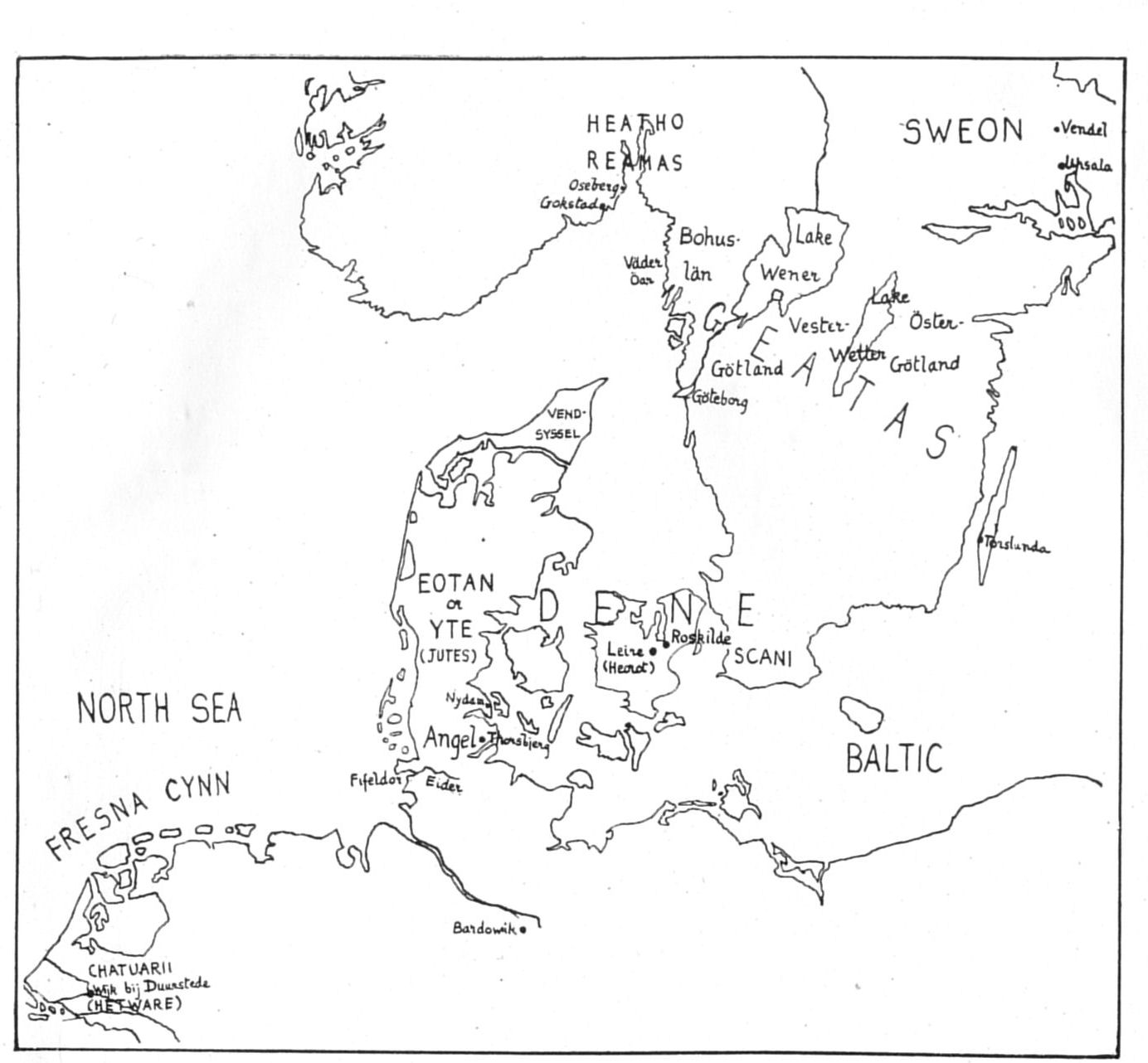
SOUTHERN SCANDINAVIA IN THE SIXTH CENTURY
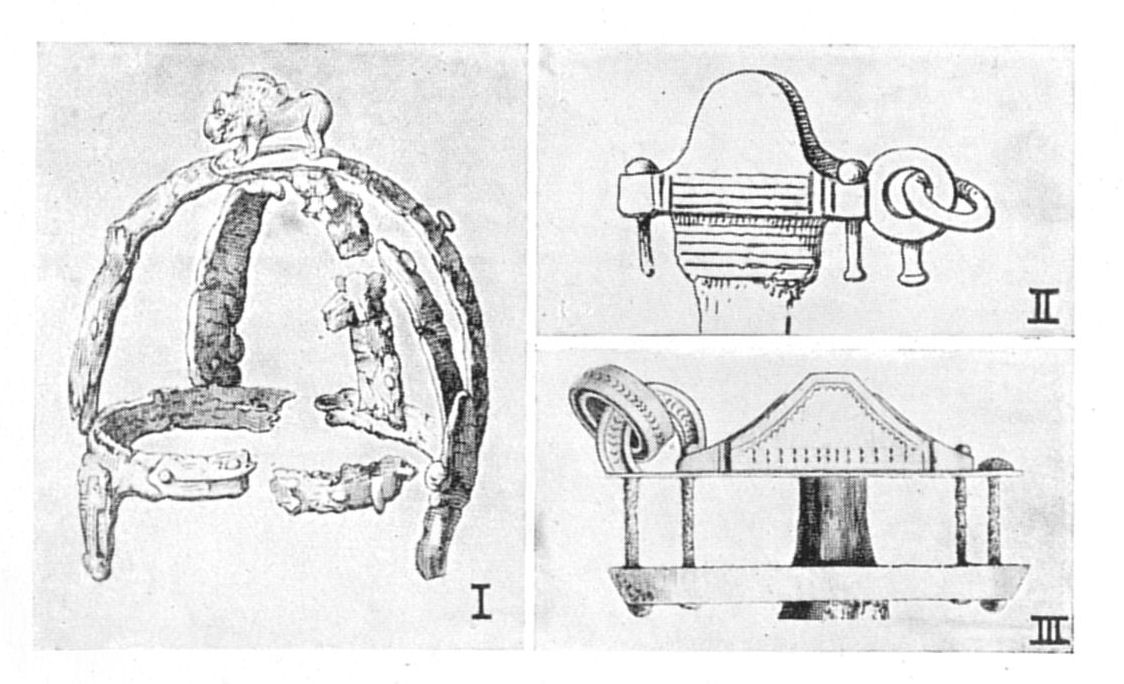
ENGLISH BOAR-HELMET AND RING-SWORDS
I. Benty Grange Helmet (Roach Smith, Collectanea Antiqua, II, 238).
II. Pommel of Ring-Sword from Faversham, Kent (Ibid., VI, 139).
III. Pommel of Ring-Sword from Gilton, Kent (Archæologia, XXX, 132).