PART II (continued 2)
Reading edition
Glam gazed at the portion which he held, and wondered much who could have pulled so hard against him; and at that moment Grettir leapt under his arms and grasped him round the middle, and bent his back as mightily as he could, reckoning that Glam would sink to his knees at his attack. But the thrall laid such a grip on Grettir's arm that he recoiled at the might of it. Then Grettir gave way from one seat to another. The beams[302] started, and all that came in their way was broken. p. 155 Glam wished to get out, but Grettir set his feet against any support he could find; nevertheless Glam dragged him forward out of the hall. And there they had a sore wrestling, in that the thrall meant to drag him right out of the building; but ill as it was to have to do with Glam inside, Grettir saw that it would be yet worse without, and so he struggled with all his might against going out. Glam put forth all his strength, and dragged Grettir towards himself when they came to the porch. And when Grettir saw that he could not resist, then all at once he flung himself against the breast of the thrall, as powerfully as he could, and pressed forward with both his feet against a stone which stood fast in the earth at the entrance. The thrall was not ready for this, he had been pulling to drag Grettir towards himself; and thereupon he stumbled on his back out of doors, so that his shoulders smote against the cross-piece of the door, and the roof clave asunder, both wood and frozen thatch. So Glam fell backwards out of the house and Grettir on top of him. There was bright moonshine and broken clouds without. At times they drifted in front of the moon and at times away. Now at the moment when Glam fell, the clouds cleared from before the moon, and Glam rolled up his eyes; and Grettir himself has said that that was the one sight he had seen which struck fear into him. Then such a sinking came over Grettir, from his weariness and from that sight of Glam rolling his eyes, that he had no strength to draw his knife and lay almost between life and death.
But in this was there more power for evil in Glam than in most other apparitions, in that he spake thus: "Much eagerness hast thou shown, Grettir," said he, "to meet with me. But no wonder will it seem if thou hast no good luck from me. And this can I tell thee, that thou hast now achieved one half of the power and might which was fated for thee if thou hadst not met with me. Now no power have I to take that might from thee to which thou hast attained. But in this may I have my way, that thou shalt never become stronger than now thou art, and yet art thou strong enough, as many a one shall find to his cost. Famous hast thou been till now for thy deeds, but from now on shall exiles and manslaughters fall to thy lot, and almost all of thy labours shall turn to ill-luck and unhappiness. Thou shalt be outlawed and doomed ever to dwell alone, away from men; and then lay I this fate on thee, that these eyes of mine be ever before thy sight, and it shall seem grievous unto thee to be alone, and that shall drag thee to thy death."
And when the thrall had said this, the swoon which had p. 156 fallen upon Grettir passed from him. Then he drew his sword and smote off Glam's head, and placed it by his thigh.
Then the yeoman came out: he had clad himself whilst Glam was uttering his curse, but he dare in no wise come near before Glam had fallen. Thorhall praised God for it, and thanked Grettir well for having vanquished the unclean spirit.
Then they set to work and burned Glam to cold cinders. After, they put the ashes in a skin-bag and buried them as far as possible from the ways of man or beast. After that they went home, and by that time it was well on to day. Grettir lay down, for he was very stiff. Thorhall sent people to the next farm for men, and showed to them what had happened. To all those who heard of it, it seemed a work of great account; and that was then spoken by all, that no man in all the land was equal to Grettir Asmundarson for might and valour and all prowess. Thorhall sent Grettir from his house with honour, and gave him a good horse and fit clothing; for all the clothes which he had worn before were torn asunder. They parted great friends. Grettir rode thence to Ridge in Water-dale, and Thorvald greeted him well, and asked closely as to his meeting with Glam. Grettir told him of their dealings, and said that never had he had such a trial of strength, so long a struggle had theirs been together.
Thorvald bade him keep quiet, "and then all will be well, otherwise there are bound to be troubles for thee."
Grettir said that his temper had not bettered, and that he was now more unruly than before, and all offences seemed worse to him. And in that he found a great difference, that he had become so afraid of the dark that he did not dare to go anywhere alone after night had fallen. All kinds of horrors appeared to him then. And that has since passed into a proverb, that Glam gives eyes, or gives "glam-sight" to those to whom things seem quite other than they are. Grettir rode home to Bjarg when he had done his errand, and remained at home during the winter.
(b) Sandhaugar episode (p. 156 above)
There was a priest called Stein who lived at Eyjardalsá (Isledale River) in Barthardal. He was a good husbandman and rich in cattle. His son was Kjartan, a doughty man and well grown. There was a man called Thorstein the White who p. 157 lived at Sandhaugar (Sandheaps), south of Isledale river; his wife was called Steinvor, and she was young and merry. They had children, who were young then.
People thought the place was much haunted by reason of the visitation of trolls. It happened, two winters before Grettir came North into those districts, that the good-wife Steinvor at Sandhaugar went to a Christmas service, according to her custom, at Isledale river, but her husband remained at home. In the evening men went to bed, and during the night they heard a great rummage in the hall, and by the good-man's bed. No one dared to get up to look to it, because there were very few men about. The good-wife came home in the morning, but her husband had vanished, and no one knew what had become of him.
The next year passed away. But the winter after, the good-wife wished again to go to the church-service, and she bade her manservant remain at home. He was unwilling, but said she must have her own way. All went in the same manner as before, and the servant vanished. People thought that strange. They saw some splashes of blood on the outer door, and men thought that evil beings must have taken away both the good-man and the servant.
The news of this spread wide throughout the country. Grettir heard of it; and because it was his fortune to get rid of hauntings and spirit-walkings, he took his way to Barthardal, and came to Sandhaugar on Yule eve. He disguised himself[303], and said his name was Guest. The good-wife saw that he was great of stature; and the farm-folk were much afraid of him. He asked for quarters for the night. The good-wife said that he could have meat forthwith, but "You must look after your own safety."
He said it should be so. "I will be at home," said he, "and you can go to the service if you will."
She answered, "You are a brave man, it seems to me, if you dare to remain at home."
"I do not care to have things all one way[304]," said he.
"It seems ill to me to be at home," said she, "but I cannot get over the river."
"I will see you over," said Guest.
Then she got ready to go to the service, and her small daughter with her. It was thawing, the river was in flood, and there were ice-floes in it. Then the good-wife said, "It is impossible for man or horse to get across the river."
"There must be fords in it," said Guest, "do not be afraid."
p. 158
"Do you carry the child first," said the good-wife, "she is the lighter."
"I do not care to make two journeys of it," said Guest, "and I will carry thee on my arm."
She crossed herself and said, "That is an impossible way; what will you do with the child?"
"I will see a way for that," said he; and then he took them both up, and set the child on her mother's knee and so bore them both on his left arm. But he had his right hand free, and thus he waded out into the ford.
They did not dare to cry out, so much afraid were they. The river washed at once up against his breast; then it tossed a great icefloe against him, but he put out the hand that was free and pushed it from him. Then it grew so deep that the river dashed over his shoulder; but he waded stoutly on, until he came to the bank on the other side, and threw Steinvor and her daughter on the land.
Then he turned back, and it was half dark when he came to Sandhaugar and called for meat; and when he had eaten, he bade the farm folk go to the far side of the room. Then he took boards and loose timber which he dragged across the room, and made a great barrier so that none of the farm folk could come over it. No one dared to say anything against him or to murmur in any wise. The entrance was in the side wall of the chamber by the gable-end, and there was a dais there. Guest lay down there, but did not take off his clothes: a light was burning in the room over against the door: Guest lay there far into the night.
The good-wife came to Isledale river to the service, and men wondered how she had crossed the river. She said she did not know whether it was a man or a troll who had carried her over. The priest said, "It must surely be a man, although there are few like him. And let us say nothing about it," said he, "it may be that he is destined to work a remedy for your evils." The good-wife remained there through the night.
Now it is to be told concerning Grettir that when it drew towards midnight he heard great noises outside. Thereupon there came into the room a great giantess. She had in one hand a trough and in the other a short-sword, rather a big one. She looked round when she came in, and saw where Guest lay, and sprang at him; but he sprang up against her, and they struggled fiercely and wrestled for a long time in the room. She was the stronger, but he gave way warily; and they broke all that was before them, as well as the panelling of the room. She dragged him forward through the door and so[305] into the porch, and he p. 159 struggled hard against her. She wished to drag him out of the house, but that did not happen until they had broken all the fittings of the outer doorway and forced them out on their shoulders. Then she dragged him slowly down towards the river and right along to the gorge.
By that time Guest was exceedingly weary, but yet, one or other it had to be, either he had to gather his strength together, or else she would have hurled him down into the gorge. All night they struggled. He thought that he had never grappled with such a devil in the matter of strength. She had got such a grip upon him that he could do nothing with either hand, except to hold the witch by the middle; but when they came to the gorge of the river he swung the giantess round, and thereupon got his right hand free. Then quickly he gripped his knife that he wore in his girdle and drew it, and smote the shoulder of the giantess so that he cut off her right arm. So he got free: but she fell into the gorge, and so into the rapids below.
Guest was then both stiff and tired, and lay long on the rocks; then he went home when it began to grow light, and lay down in bed. He was all swollen black and blue.
And when the good-wife came from the service, it seemed to her that things had been somewhat disarranged in her house. Then she went to Guest and asked him what had happened, that all was broken and destroyed[306]. He told her all that had taken place. She thought it very wonderful, and asked who he was. He told her the truth, and asked her to send for the priest, and said he wished to meet him; and so it was done.
Then when Stein the priest came to Sandhaugar, he knew soon that it was Grettir Asmundarson who had come there, and who had called himself Guest.
The priest asked Grettir what he thought must have become of those men who had vanished. Grettir said he thought they must have vanished into the gorge. The priest said that he could not believe Grettir's saying, if no signs of it were to be seen. Grettir said that they would know more accurately about it later. Then the priest went home. Grettir lay many days in bed. The good-wife looked after him well, and so the Christmas-time passed.
Grettir's account was that the giantess fell into the gulf when she got her wound; but the men of Barthardal say that day came upon her whilst they wrestled, and that she burst when he smote her hand off, and that she stands there on the cliff yet, a rock in the likeness of a woman[307].
The dwellers in the dale kept Grettir in hiding there. But after Christmas time, one day that winter, Grettir went to Isledale river. And when Grettir and the priest met, Grettir p. 160 said "I see, priest, that you place little belief in my words. Now will I that you go with me to the river and see what the likelihood seems to you to be."
The priest did so. But when they came to the waterfall they saw that the sides of the gorge hung over[308]: it was a sheer cliff so great that one could in nowise come up, and it was nearly ten fathoms[309] from the top to the water below. They had a rope with them. Then the priest said, "It seems to me quite impossible for thee to get down."
Grettir said, "Assuredly it is possible, but best for those who are men of valour. I will examine what is in the waterfall, and thou shalt watch the rope."
The priest said it should be as he wished, drove a peg into the cliff, piled stones against it, and sat by it[310].
Now it must be told concerning Grettir that he knotted a stone into the rope, and so let it down to the water.
"What way," said the priest, "do you mean to go?"
"I will not be bound," said Grettir, "when I go into the water, so much my mind forebodes me."
After that he got ready for his exploit, and had little on; he girded himself with his short sword, and had no other weapon.
Then he plunged from the cliff down into the waterfall. The priest saw the soles of his feet, and knew no more what had become of him. Grettir dived under the waterfall, and that was difficult because there was a great eddy, and he had to dive right to the bottom before he could come up behind the waterfall. There was a jutting rock and he climbed upon it. There was a great cave behind the waterfall, and the river fell in front of it from the precipice. He went into the cave, and there was a big fire burning. Grettir saw that there sat a giant of frightful size. He was terrible to look upon: but when Grettir came to him, the giant leapt up and seized a pike, and hewed at the new-comer: for with the pike he could both cut and stab. It had a handle of wood: men at that time called a weapon made in such a way a heptisax. Grettir smote against it with his short sword, and struck the handle so that he cut it asunder. Then the giant tried to reach back for a sword which hung behind him in the cave. Thereupon Grettir smote him in the breast, and struck off almost all the lower part of his chest and his belly, so that the entrails gushed out of him down into the river, and were swept along the current.
And as the priest sat by the rope he saw some lumps, clotted p. 161 with blood, carried down stream. Then he became unsteady, and thought that now he knew that Grettir must be dead: and he ran from keeping the rope and went home. It was then evening, and the priest said for certain that Grettir was dead, and added that it was a great loss of such a man.
Now the tale must be told concerning Grettir. He let little space go between his blows till the giant was dead. Then he went further into the cave; he kindled a light and examined it. It is not said how much wealth he took in the cave, but men think that there was something. He stayed there far into the night. He found there the bones of two men, and put them into a bag. Then he left the cave and swam to the rope and shook it, for he thought that the priest must be there. But when he knew that the priest had gone home, then he had to draw himself up, hand over hand, and so he came up on to the cliff.
Then he went home to Isledale river, and came to the church porch, with the bag that the bones were in, and with a rune-staff, on which these verses were exceedingly well cut:
There into gloomy gulf I passed, O'er which from the rock's throat is cast The swirling rush of waters wan, To meet the sword-player feared of man. By giant's hall the strong stream pressed Cold hands against the singer's breast; Huge weight upon him there did hurl The swallower of the changing whirl[311].
And this rhyme too:
The dreadful dweller of the cave Great strokes and many 'gainst me drave; Full hard he had to strive for it, But toiling long he wan no whit; For from its mighty shaft of tree The heft-sax smote I speedily; And dulled the flashing war-flame fair In the black breast that met me there.
p. 162
These verses told also that Grettir had taken these bones out of the cave. But when the priest came to the church in the morning he found the staff, and what was with it, and read the runes; but Grettir had gone home to Sandhaugar.
But when the priest met Grettir he asked him closely as to what had happened: and Grettir told him all the story of his journey. And he added that the priest had not watched the rope faithfully. The priest said that that was true enough.
Men thought for certain that these monsters must have caused the loss of men there in the dale; and there was never any loss from hauntings or spirit-walkings there afterwards.
Grettir was thought to have caused a great purging of the land. The priest buried these bones in the churchyard.
D. Extracts from Bjarka Rímur
(Hrólfs saga Kraka og Bjarkarímur udgivne ved F. Jónsson, København, 1904)
58. Flestir ǫmuðu Hetti heldr, hann var ekki í máli sneldr, einn dag fóru þeir út af hǫll, svó ekki vissi hirðin ǫll. 59. Hjalti talar er felmtinn fær, "fǫrum við ekki skógi nær, hér er sú ylgr sem etr upp menn, okkr drepr hún báða senn." 60. Ylgrin hljóp úr einum runn, ógurlig með gapanda munn, hǫrmuligt varð Hjalta viðr, á honum skalf bæði leggr og liðr. 61. Ótæpt Bjarki að henni gengr, ekki dvelr hann við það lengr, hǫggur svó að í hamri stóð, hljóp úr henni ferligt blóð. 62. "Kjóstu Hjalti um kosti tvó," kappinn Bǫðvar talaði svó, "drekk nú blóð eða drep eg þig hér, dugrinn líz mér engi í þér." 63. Ansar Hjalti af ærnum móð, "ekki þori eg að drekka blóð, nýtir flest ef nauðigr skal, nú er ekki á betra val." 64. Hjalti gjǫrir sem Bǫðvar biðr, að blóði frá eg hann lagðist niðr, drekkur síðan drykki þrjá, duga mun honum við einn að rjá. IV, 58-64. 4. Hann hefr fengið hjartað snjalt af hǫrðum móði, fekk hann huginn og aflið alt af ylgjar blóði. 5. Í grindur vandist grábjǫrn einn í garðinn Hleiðar, var sá margur vargrinn beinn og víða sveiðar. 6. Bjarka er kent, að hjarðarhunda hafi hann drepna, ekki er hónum allvel hent við ýta kepna. 7. Hrólfur býst og hirð hans ǫll að húna stýri, "Sá skal mestr í minni hǫll er mætir dýri." 8. Beljandi hljóp bjǫrninn framm úr bóli krukku, veifar sínum vónda hramm, svó virðar hrukku. 9. Hjalti sér og horfir þá á, er hafin er róma, hafði hann ekki í hǫndum þá nema hnefana tóma. 10. Hrólfur fleygði að Hjalta þá þeim hildar vendi, kappinn móti krummu brá og klótið hendi. 11. Lagði hann síðan bjǫrninn brátt við bóginn hægra, bessi fell í brúðar átt og bar sig lægra. 12. Vann hann það til frægða fyst og fleira síðar, hans var lundin lǫngum byst í leiki gríðar. 13. Hér með fekk hann Hjalta nafn hins hjartaprúða, Bjarki var eigi betri en jafn við býti skrúða. V, 4-13. 23. Aðals var glaðr afreksmaðr, austur þangað kómu, fyrðar þeir með fránan geir flengja þegar til rómu. 24. Ýtar býta engum frið, unnu vel til mála, þar fell Áli og alt hans lið ungr í leiki stála. 25. Hestrinn beztur Hrafn er kendr, hafa þeir tekið af Ála, Hildisvín er hjálmrinn vendr, hann kaus Bjarki í mála. 26. Ǫðling bað þá eigi drafl eiga um nǫkkur skipti, það mun kosta kóngligt afl, hann kappann gripunum svipti. 27. Ekki þótti Bǫðvar betr, í burtu fóru þeir Hjalti, létust áðr en liðinn er vetr leita að Fróða malti. 28. Síðan ríða seggir heim og sǫgðu kóngi þetta, hann kveðst mundu handa þeim heimta slíkt af létta. VIII, 23-28.
Translation of Extracts from Bjarka Rímur
58. Most [of Rolf's retainers] much tormented Hott [Hjalti]; he was not cunning in speech. One day Hjalti and Bothvar went out of the hall, in such wise that none of the retainers knew thereof.
59. Hjalti spake in great terror, "Let us not go near the wood; here is the she-wolf who eats up men; she will kill us both together."
60. The she-wolf leapt from a thicket, dread, with gaping jaws. A great terror was it to Hjalti, and he trembled in every limb.
61. Without delay or hesitation went Bjarki towards her, and hewed at her so that the axe went deep; a monstrous stream of blood gushed from her.
62. "Choose now, Hjalti, of two things"—so spake Bothvar the champion—"Drink now the blood, or I slay thee here; it seems unto me that there is no valour in thee."
63. Hjalti replied stoutly enough, "I cannot bring myself to drink blood; but if I needs must, it avails most [to submit], and now is there no better choice."
64. Hjalti did as Bothvar bade: he stooped down to the blood; then drank he three sups: that will suffice him to wrestle with one man.
IV, 58-64.
4. He [Hjalti] has gained good courage and keen spirit; he got strength and all valour from the she-wolf's blood.
5. A grey bear visited the folds at Hleithargarth; many such a ravager was there far and wide throughout the country.
6. The blame was laid upon Bjarki, because he had slain the herdsmen's dogs; it was not so suited for him to have to strive with men[312].
7. Rolf and all his household prepared to hunt the bear; "He who faces the beast shall be greatest in my hall."
8. Roaring did the bear leap forth from out its den, swinging its evil claws, so that men shrank back.
9. Hjalti saw, he turned and gazed where the battle began; nought had he then in his hands—his empty fists alone.
10. Rolf tossed then to Hjalti his wand of war [his sword]; the warrior put forth his hand towards it, and grasped the pommel.
11. Quickly then he smote the bear in the right shoulder; Bruin fell to the earth, and bore himself in more lowly wise.
12. That was the beginning of his exploits: many followed later; his spirit was ever excellent amid the play of battle.
13. Herefrom he got the name of Hjalti the stout-hearted: Bjarki was no more than his equal.
V, 4-13.
23. Joyful was the valiant Athils when they [Bjarki and Rolf's champions] came east to that place [Lake Wener]; troops with flashing spears rode quickly forthwith to the battle.
24. No truce gave they to their foes: well they earned their pay; there fell Ali and all his host, young in the game of swords.
25. The best of horses, Hrafn by name, they took from Ali; Bjarki chose for his reward the helm Hildisvin.
26. The prince [Athils] bade them have no talk about the business; he deprived the champions[313] of their treasures—that will be a test of his power.
27. Ill-pleased was Bothvar: he and Hjalti departed; they declared that before the winter was gone they would seek for the treasure [the malt of Frothi].
28. Then they rode home and told it to the king [Rolf]; he said it was their business to claim their due outright.
VIII, 23-28.
E. Extract from Þáttr Orms Stórólfssonar
(Fornmanna Sǫgur, Copenhagen, 1827, III. 204 etc.; Flateyarbók, Christiania, 1859-68, I. 527 etc.)
7. Litlu síðarr enn þeir Ormr ok Ásbjǫrn hǫfðu skilit, fýstist Ásbjǫrn norðr í Sauðeyjar, fór hann við 4 menn ok 20 á skipi, heldr norðr fyrir Mæri, ok leggr seint dags at Sauðey hinni ytri, gánga á land ok reisa tjald, eru þar um nóttina, ok verða við ekki varir; um morgininn árla rís Ásbjǫrn upp, klæðir sik, ok tekr vópn sín, ok gengr uppá land, en biðr menn sína bíða sín; en er nokkut svá var liðit frá því, er Ásbjǫrn hafði í brott gengit, verða þeir við þat varir, at ketta ógrlig var komin í tjaldsdyrnar, hon var kolsvǫrt at lit ok heldr grimmlig, þvíat eldr þótti brenna or nǫsum hennar ok munni, eigi var hon ok vel eyg; þeim brá mjǫk við þessa sýn, ok urðu óttafullir. Ketta hleypr þá innar at þeim, ok grípr hvern at ǫðrum, ok svá er sagt at suma gleypti hon, en suma rifi hon til dauðs með klóm ok tǫnnum, 20 menn drap hon þar á lítilli stundu, en 3 kvómust út ok undan ok á skip, ok héldu þegar undan landi; en Ásbjǫrn gengr þar til, er hann kemr at hellinum Brúsa, ok snarar þegar inn í; honum varð nokkut dimt fyrir augum, en skuggamikit var í hellinum; hann verðr eigi fyrr var við, enn hann er þrifinn álopt, ok færðr niðr svá hart, at Ásbirni þótti furða í, verðr hann þess þá varr, at þar er kominn Brúsi jǫtun, ok sýndist heldr mikiligr. Brúsi mælti þá: þó lagðir þú mikit kapp á at sækja híngat; skaltu nú ok eyrindi hafa, þvíat þú skalt hér lífit láta með svá miklum harmkvælum, at þat skal aðra letja at sækja mik heim með ófriði; fletti hann þá Ásbjǫrn klæðum, þvíat svá, var þeirra mikill afla munr, at jǫtuninn varð einn at ráða þeirra í milli; bálk mikinn sá Ásbjǫrn standa um þveran hellinn ok stórt gat á miðjum bálkinum; járnsúla stór stóð nokkut svá fyrir framan bálkinn. Nú skal prófa þat, segir Brúsi, hvárt þú ert nokkut harðari enn aðrir menn. Lítit mun þat at reyna, segir Ásbjǫrn....
Síðan lét Ásbjǫrn líf sitt með mikilli hreysti ok dreingskap.
8. Þat er at segja at þeir þrír menn, er undan kómust, sóttu knáliga róðr, ok léttu eigi fyrr enn þeir kómu at landi, sǫgðu þau tíðindi er gerzt hǫfðu í þeirra fǫrum, kvóðust ætla Ásbjǫrn dauðan, en kunnu ekki frá at segja, hversu at hefði borizt um hans líflát; kvómu þeir sér i skip með kaupmǫnnum, ok fluttust svá suðr til Danmerkr; spurðust nú þessi tíðindi víða, ok þóttu mikil. Þa var orðit hǫfðíngja skipti í Noregi, Hakon jarl dauðr, en Ólafr Tryggvason í land kominn, ok bauð ǫllum rétta trú. Ormr Stórólfsson spurði út til Íslands um farar ok líflát Ásbjarnar, er mǫnnum þótti sem vera mundi; þótti honum þat allmikill skaði, ok undi eigi lengr á Íslandi, ok tók sér far í Reyðarfirði, ok fór þar utan; þeir kvómu norðarliga við Noreg, ok sat hann um vetrinn í Þrándheimi; þá hafði Ólafr ráðit 3 vetr Noregi. Um vórit bjóst Ormr at fara til Sauðeya, þeir vóru því nærr margir á skipi, sem þeir Ásbjǫrn h[,]fðu verit; þeir lǫgðu at minni Sauðey síð um kveldit, ok tjǫlduðu á landi, ok lágu þar um náttina....
9. Nú gengr Ormr þar til er hann kemr at hellinum, sér hann nú bjargit þat stóra, ok leizt úmátuligt nokkurum manni þat í brott at færa; þó dregr hann á sik glófana Menglaðarnauta, tekr síðan á bjarginu ok færir þat burt or dyrunum, ok þikist Ormr þá aflraun mesta sýnt hafa; hann gekk þá inní hellinn, ok lagði málajárn í dyrnar, en er hann var inn kominn, sá hann hvar kettan hljóp með gapanda ginit. Ormr hafði boga ok ǫrvamæli, lagði hann þá ǫr á streing, ok skaut at kettunni þremr ǫrum, en hon hendi allar með hvoptunum, ok beit í sundr, hefir hon sik þá at Ormi, ok rekr klærnar framan í fángit, svá at Ormr kiknar við, en klærnar gengu í gegnum klæðin svá at í beini stóð; hon ætlar þá at bíta í andlit Ormi, finnr hann þá at honum mun eigi veita, heitir þá á sjálfan guð ok hinn heilaga Petrum postula, at gánga til Róms, ef hann ynni kettuna ok Brúsa, son hennar; síðan fann Ormr at mínkaðist afl kettunnar, tekr hann þá annarri hendi um kverkr henni, en annarri um hrygg, ok gengr hana á bak, ok brýtr ísundr í henni hrygginn, ok gengr svá af henni dauðri. Ormr sá þá, hvar bálkr stórr var um þveran hellinn; hann gengr þá innar at, en er hann kemr þar, sér hann at fleinn mikill kemr utar í gegnum bálkinn, hann var bæði digr ok lángr; Ormr grípr þá í móti fleininum, ok leggr af út; Brúsi kippir þá at sér fleininum ok var hann fastr svá at hvergi gekk; þat undraðist Brúsi, ok gægdist upp yfir bálkinn, en er Ormr sér þat, þrífr hann í skeggit á Brúsa báðum hǫndum, en Brúsi bregzt við í ǫðrum stað, sviptast þeir þá fast um bálkinn. Ormr hafði vafit skegginu um hǫnd sér, ok rykkir til svá fast, at hann rífr af Brúsa allan skeggstaðinn, hǫkuna, kjaptana báða, vángafyllurnar upp alt at eyrum, gekk hér með holdit niðr at beini. Brúsi lét þá síga brýnnar, ok grettist heldr greppiliga. Ormr stǫkkr þá innar yfir bálkinn, grípast þeir þá til ok glíma lengi, mæddi Brúsa þá fast blóðrás, tekr hann þá heldr at gángast fyrir, gefr Ormr þá á, ok rekr Brúsa at bálkinum ok brýtr hann þar um á bak aptr. Snemma sagði mér þat hugr, sagði Brúsi, at ek munda af þér nokkut erfitt fá, þegar ek heyrða þín getit, enda er þat nú fram komit, muntu nú vinna skjótt um, ok hǫggva hǫfuð af mér, en þat var satt, at mjǫk pínda ek Ásbjǫrn prúða, þá er ek rakta or honum alla þarmana, ok gaf hann sik ekki við, fyrrenn hann dó. Illa gerðir þú þat, segir Ormr, at pína hann svá mjǫk jafnrǫskvan mann, skaltu ok hafa þess nokkurar menjar. Hann brá þá saxi ok reist blóðǫrn á baki honum, ok skar ǫll rifin frá hryggnum, ok dró þar út lúngun; lét Brúsi svá líf sitt með litlum dreingskap; síðan bar Ormr eld at, ok brendi upp til ǫsku bæði Brúsa ok kettuna, ok er hann hafði þetta starfat, fór hann burt or hellinum með kistur tvær fullar af gulli ok silfri, en þat sem meira var fémætt, gaf hann í vald Menglaðar, ok svá eyna; skildu þau með mikilli vináttu, kom Ormr til manna sinna í nefndan tíma, héldu síðan til meginlands. Sat Ormr í Þrándheimi vetr annan.
Translation of Extract from Þáttr Orms Stórólfssonar
7.
A little after Orm and Asbiorn had parted, Asbiorn wished to go north to Sandeyar[314]; he went aboard with twenty-four men, went north past Mæri, and landed late in the day at the outermost of the Sandeyar[314]. They landed and pitched a tent, and spent the night there, and met with nothing.
Early in the morning Asbiorn arose, clothed himself, took his arms, went inland, and bade his men wait for him.
But when some time had passed from Asbiorn's having gone away, they were aware that a monstrous[315] cat had come to the door of the tent: she was coal-black in colour and very fierce, for it seemed as if fire was burning from her nostrils and mouth, and her eyes were nothing fair: they were much startled at this sight, and full of fear. Then the cat leapt within the tent upon them, and gripped one after the other, and so it is said that some she swallowed and some she tore to death with claws and teeth. Twenty men she killed in a short time, and three escaped aboard ship, and stood away from the shore.
But Asbiorn went till he came to the cave of Brusi, and hastened in forthwith. It was dim before his eyes, and very shadowy in the cave, and before he was aware of it, he was caught off his feet, and thrown down so violently that it seemed strange to him. Then was he aware that there was come the giant Brusi, and he seemed to him a great one.
Then said Brusi, "Thou didst seek with great eagerness to come hither—now shalt thou have business, in that thou shalt here leave thy life with so great torments that that shall stay others from attacking me in my lair."
Then he stripped Asbiorn of his clothes, forasmuch as so great was their difference in strength that the giant could do as he wished. Asbiorn saw a great barrier standing across the cave, and a mighty opening in the midst of it; a great iron column stood somewhat in front of the barrier. "Now it must be tried," said Brusi, "whether thou art somewhat hardier than other men." "Little will that be to test," said Asbiorn....
[Asbiorn then recites ten stanzas, Brusi tormenting him the while. The first stanza is almost identical with No. 50 in the Grettis saga.]
Then Asbiorn left his life with great valour and hardihood.
8.
Now it must be told concerning the three men who escaped; they rowed strongly, and stopped not until they came to land. They told the tidings of what had happened in their journey, and said that they thought that Asbiorn was dead, but that they could not tell how matters had happened concerning his death. They took ship with merchants, and so went south to Denmark: now these tidings were spread far and wide, and seemed weighty.
There had been a change of rulers in Norway: jarl Hakon was dead, and Olaf Tryggvason come to land: and he proclaimed the true faith to all. Orm Storolfson heard, out in Iceland, about the expedition of Asbiorn, and the death which it seemed to men must have come upon him. It seemed to him a great loss, and he cared no longer to be in Iceland, and took passage at Reytharfirth and went abroad. They reached Norway far to the north, and he stayed the winter at Thrandheim: Olaf at that time had reigned three years in Norway.
In the spring Orm made ready for his journey to Sandeyar, and there were nearly as many in the ship as the company of Asbiorn had been.
They landed at Little Sandey late in the evening, and pitched a tent on the land, and lay there the night....
9.
Now Orm went till he came to the cave. He saw the great rock, and thought it was impossible for any man to move it. Then he drew on the gloves that Menglath had given him, and grasped the rock and moved it away from the door; this is reckoned Orm's great feat of strength. Then he went into the cave, and thrust his weapon against the door. When he came in, he saw a giantess (she-cat) springing towards him with gaping jaws. Orm had a bow and quiver; he put the arrow on the string, and shot thrice at the giantess. But she seized all the arrows in her mouth, and bit them asunder. Then she flung herself upon Orm, and thrust her claws into his breast, so that Orm stumbled, and her claws went through his clothes and pierced him to the bone. She tried then to bite his face, and Orm found himself in straits: he promised then to God, and the holy apostle Peter, to go to Rome, if he conquered the giantess and Brusi her son. Then Orm felt the power of the giantess diminishing: he placed one hand round her throat, and the other round her back, and bent it till he broke it in two, and so left her dead.
Then Orm saw where a great barrier ran across the cave: he went further in, and when he came to it he saw a great shaft coming out through the barrier, both long and thick. Orm gripped the shaft and drew it away; Brusi pulled it towards himself, but it did not yield. Then Brusi wondered, and peeped up over the barrier. But when Orm saw that, he gripped Brusi by the beard with both hands, but Brusi pulled away, and so they tugged across the barrier. Orm twisted the beard round his hand, and tugged so violently that he pulled the flesh of Brusi away from the bone—from chin, jaws, cheeks, right up to the ears. Brusi knitted his brows and made a hideous face. Then Orm leapt in over the barrier, and they grappled and wrestled for a long time. But loss of blood wearied Brusi, and he began to fail in strength. Orm pressed on, pushed Brusi to the barrier, and broke his back across it. "Right early did my mind misgive me," said Brusi, "even so soon as I heard of thee, that I should have trouble from thee: and now has that come to pass. But now make quick work, and hew off my head. And true it is that much did I torture the gallant Asbiorn, in that I tore out all his entrails—yet did he not give in, before he died." "Ill didst thou do," said Orm, "to torture him, so fine a man as he was, and thou shalt have something in memory thereof." Then he drew his knife, and cut the "blood eagle" in the back of Brusi, shore off his ribs and drew out his lungs. So Brusi died in cowardly wise. Then Orm took fire, and burned to ashes both Brusi and the giantess. And when he had done that, he left the cave, with two chests full of gold and silver.
And all that was most of value he gave to Menglath, and the island likewise. So they parted with great friendship, and Orm came to his men at the time appointed, and then they sailed to the mainland. Orm remained a second winter at Thrandheim.
F. A Danish Dragon-slaying of the Beowulf-type
Paa den Tid, da kong Gram Guldkølve regierede i Leire, vare der ved Hoffet to Ministre, Bessus og Henrik. Og da der paa samme Tid indkom idelige klager fra Indbyggerne i Vendsyssel, at et grueligt Udyr, som Bønderne kaldte Lindorm, ødelagde baade Mennesker og Kreaturer, gav Bessus det Raad, at Kongen skulde sende Henrik did hen, efterdi ingen i det ganske Rige kunde maale sig med ham in Tapperhed og Mod. Da svarede Henrik, at han vel vilde paatage sig dette, dog tilføiede han, at han ansaae det for umuligt at slippe fra saadan Kamp med Livet. Og belavede han sig da strax til Reisen, tog rørende Afsked med sin Herre og Konge og sagde iblandt andet: "Herre! om jeg ikke kommer tilbage, da sørg for min kone og for mine Børn!" Da han derefter var kommen over til Vendsyssel, lod han sig af Bønderne vise det Sted, hvor Uhyret havde sit Leie, og fik da at vide, at Ormen endnu den samme Dag havde været ude af Hulen og borttaget en Hyrde og en Oxe, og at den efter Sædvane nu ikke vilde komme ud, førend om tre Timer, naar den skulde ned til Vandet for at drikke efter Maaltidet. Henrik iførte sig da sin fulde Rustning, og eftersom Ingen vovede at staae ham bi i dette Arbeide, lagde han sig ganske alene ved Vandet, dog saaledes, at Vinden ikke bar fra ham henimod Dyret. Da udsendte han først en vældig Piil fra sin Bue, men uagtet den rammede nøie det sted, hvortil han havde sigtet, tørnede den dog tilbage fra Ormens haarde Skæl. Herover blev Uhyret saa optændt af Vrede, at det strax gik henimod ham, agtende ham kun et ringe Maaltid; men Henrik havde iforveien hos en Smed ladet sig giøre en stor Krog med Gjenhold, hvilken han jog ind i Beestets aabne Gab, saa at det ikke kunde blive den qvit, ihvormeget det end arbeidede, og ihvorvel Jernstangen brast i Henriks Hænder. Da slog det ham med sin vældige Hale til Jorden, og skiøndt han havde fuldkommen Jernrustning paa, kradsede det dog med sine forfærdelige Kløer saa at han, næsten dødeligt saaret, faldt i Besvimelse. Men da han, efterat Ormen i nogen Tid havde haft ham liggende under sin Bug, endelig kom lidt til sin Samling igien, greb han af yderste Evne en Daggert, af hvilke han førte flere med sig i sit Bælte, og stak Dyret dermed i underlivet, hvor Sksællene vare blødest, saa at det tilsidst maate udpuste sin giftige Aande, medens han selv laae halv knust under dens Byrde. Da Bønderne i Vendsyssel som stode i nogen Afstand, under megen Frygt og lidet Haab omsider mærkede, at Striden sagtnede, og at begge Parter holdte sig rolige, nærmede de sig og fandt Hr. Henrik næsten livløs under det dræbte Udyr. Og efterat de i nogen Tid havde givet ham god Pleie, vendte han tilbage for at dø hos sin Konge, til hvem han gientagende anbefalede sin Slægt. Fra ham nedstammer Familien Lindenroth, som til Minde om denne vældige Strid fører en Lindorm i sit Vaaben.
MS 222. 4o. Stamme och Slectebog over den høiadelige Familie af Lindenroth, in Danmarks Folkesagn, samlede af J. M. Thiele, 1843, I, 125-7.
A DANISH DRAGON-SLAYING OF THE BEOWULF-TYPE.
Translation.
In the days when King Gram Guldkølve ruled in Leire, there were two ministers at court, Bessus and Henry. And at that time constant complaints came to the court from the inhabitants of Vendsyssel, that a dread monster, which the peasants called a Drake, was destroying both man and beast. So Bessus gave counsel, that the king should send Henry against the dragon, seeing that no one in the whole kingdom was his equal in valour and courage. Henry answered that assuredly he would undertake it; but he added that he thought it impossible to escape from such a struggle with his life. And he made himself ready forthwith for the expedition, took a touching farewell of his lord and king, and said among other things: "My lord, if I come not back, care thou for my wife and my children."
Afterwards, when he crossed over to Vendsyssel, he caused the peasants to show him the place where the monster had its lair, and learnt how that very day the drake had been out of its den, and had carried off a herdsman and an ox; how, according to its wont, it would now not come out for three hours, when it would want to go down to the water to drink after its meal. Henry clothed himself in full armour, and inasmuch as no one dared to stand by him in that task, he lay down all alone by the water, but in such wise that the wind did not blow from him toward the monster. First of all he sent a mighty arrow from his bow: but, although it exactly hit the spot at which he had aimed, it darted back from the dragon's hard scales. At this the monster was so maddened, that it attacked him forthwith, reckoning him but a little meal. But Henry had had a mighty barbed crook prepared by a smith beforehand, which he thrust into the beast's open mouth, so that it could not get rid of it, however much it strove, although the iron rod broke in Henry's hands. Then it smote him to the ground with its mighty tail, and although he was in complete armour, clutched at him with its dread claws, so that he fell in a swoon, wounded almost to death. But when he came somewhat to his senses again, after the drake for some time had had him lying under its belly, he rallied his last strength and grasped a dagger, of which he carried several with him in his belt, and smote it therewith in the belly, where the scales were weakest. So the monster at last breathed out its poisoned breath, whilst he himself lay half crushed under its weight. When the Vendsyssel peasants, who stood some distance away, in great fear and little hope, at last noticed that the battle had slackened, and that both combatants were still, they drew near and found Henry almost lifeless under the slain monster. And after they for some time had tended him well, he returned to die by his king, to whom he again commended his offspring. From him descends the family Lindenroth, which in memory of this mighty contest carries a drake on its coat of arms.
This story resembles the dragon fight in Beowulf, in that the hero faces the dragon as protector of the land, with forebodings, and after taking farewell; he attacks the dragon in its lair, single-handed; his first attack is frustrated by the dragon's scales; in spite of apparatus specially prepared, he is wounded and stunned by the dragon, but nevertheless smites the dragon in the soft parts and slays him; the watchers draw near when the fight is over. Yet these things merely prove that the two stories are of the same type; there is no evidence that this story is descended from Beowulf.
G. The Old English Genealogies.
I. THE MERCIAN GENEALOGY.
Of the Old English Genealogies, the only one which, in its stages below Woden, immediately concerns the student of Beowulf is the Mercian. This contains three names which also occur in Beowulf, though two of them in a corrupt form—Offa, Wermund (Garmund, Beowulf), and Eomær (Geomor, Beowulf).
This Mercian pedigree is found in its best form in MS Cotton Vesp. B. VI, fol. 109 b,[316] and in the sister MS at Corpus Christi College, Cambridge (C.C.C.C. 183)[317]. Both these MSS are of the 9th century. They contain lists of popes and bishops, and pedigrees of kings. By noting where these lists stop, we get a limit for the final compilation of the document. It must have been drawn up in its present form between 811 and 814[318]. But it was obviously compiled from lists already existing, and some of them were even at that date old. For the genealogy of the Mercian kings, from Woden, is not traced directly down to this period 811-814, but in the first place only as far as Æthelred (reigning 675-704), son of Penda: that is to say, it stops considerably more than a century before the date of the document in which it appears. Additional pedigrees are then appended which show the subsequent stages down to and including Cenwulf, king of Mercia (reigning 796-821). It is difficult to account for such an arrangement except on the hypothesis that the genealogy was committed to writing in the reign of Æthelred, the monarch with whose name it terminates in its first form, and was then brought up to date by the addition of the supplementary names ending with Cenwulf. This is confirmed when we find that precisely the same arrangement holds good for the accompanying Northumbrian pedigree, which terminates with Ecgfrith (670-685), the contemporary of Æthelred of Mercia, and is then brought up to date by additional names.
Genealogies which draw from the same source as the Vespasian genealogies, and show the same peculiarities, are found in the Historia Brittonum (§§ 57-61). They show, even more emphatically than do the Vespasian lists, traces of having been originally drawn up in the time of Æthelred of Mercia (675-704) or possibly of his father Penda, and of having then been brought up to date in subsequent revisions[319].
One such revision must have been made about 796[320]: it is a modification of this revision which is found in the Historia Brittonum. Another was that which, as we have seen, must have been made between 811-814, and in this form is found in MS Cotton Vespasian B. VI, MS C.C.C.C. 183, both of the 9th century, and in the (much later) MS Cotton Tiberius B. V.
The genealogy up to Penda is also found in the A.-S. Chronicle under the year 626 (accession of Penda).
This Mercian list, together with the Northumbrian and other pedigrees which accompany it, can claim to be the earliest extant English historical document, having been written down in the 7th century, and recording historic names which (allowing thirty years for a generation) cannot be later than the 4th century A.D. In most similar pedigrees the earliest names are meaningless to us. But the Mercian pedigree differs from the rest, in that we are able from Beowulf, Widsith, Saxo Grammaticus, Sweyn Aageson and the Vitae Offarum, to attach stories to the names of Wermund and Offa. How much of these stories is history, and how much fiction, it is difficult to say—but, with them, extant English history and English poetry and English fiction alike have their beginning.
MS Cotton Vesp. B. VI. MS C.C.C.C. 183.
Aeðilred Peding Æðelred Pending
Penda Pypbing Penda Pybbing
Pypba Crioding Pybba Creoding
Crioda Cynewalding Creoda Cynewalding
Cynewald Cnebbing Cynewald Cnebbing
Cnebba Icling Cnebba Icling
Icil Eamering Icel Eomæring
Eamer Angengeoting Eomær Angengeoting
Angengeot Offing Angengiot Offing
Offa Uærmunding Offa Wærmunding
Uermund Uihtlaeging Wærmund Wihtlæging
Uihtlaeg Wioðulgeoting Wihtlæg Wioþolgeoting
Weoðulgeot Wodning Weoþolgiot Wodning
Woden Frealafing Woden Frealafing
Historia Brittonum[321]. MS Harl 3859. Anglo-Saxon Chronicle. MSS Cotton Tib. A. VI. and B.I.[322]
Penda Penda Pybbing
Pubba Pybba Creoding
Creoda Cynewalding
Cynewald Cnebbing
Cnebba Iceling
Icel Eomæring
Eamer Eomær Angelþeowing
Ongen Angelþeow Offing
Offa Offa Wærmunding
Guerdmund Wærmund Wihtlæging
Guithleg Wihtlæg Wodening
Gueagon
Guedolgeat
[U]Uoden
II. THE STAGES ABOVE WODEN.
(1) WODEN TO GEAT.
The stages above Woden are found in two forms: a short list which traces the line from Woden up to Geat: and a longer list which carries the line from Geat to Sceaf and through Noah to Adam.
The line from Woden to Geat is found in the Historia Brittonum, not with the other genealogies, but in § 31, where the pedigree of the Kentish royal family is given, when the arrival of Hengest in Britain is recounted. Notwithstanding the dispute regarding the origin and date of the Historia Brittonum, there is a pretty general agreement that this Woden to Geat pedigree is one of the more primitive elements, and is not likely to be much later than the end of the 7th century[323]. The original nucleus of the Historia Brittonum was revised by Nennius in the 9th century, or possibly at the end of the 8th[324]. The earliest MS of the Historia, that of Chartres, belongs to the 9th or 10th century—this is fragmentary and already interpolated; the received text is based upon MS Harleian 3859, dating from the end of the 11th century[325], or possibly somewhat later.
I give the pedigree in four forms:
A. The critical text of the Historia Brittonum as edited by Th. Mommsen (Monumenta Germaniae Historica, Auct. Antiq., Chronica Minora, III, Berolini, 1898, p. 171).
B. MS Harl. 3859, upon which Mommsen's text is based, fol. 180.
C. The Chartres MS.
D. Mommsen's critical text of the later revision, Nennius interpretatus, which he gives parallel to the Historia Brittonum.
A B C D
Hors et Hengist Hors & Hengist Cors et Haecgens Hors et Hengist
filii Guictgils filii Guictgils filii Guictils filii Guictgils
Guigta Guitta Guicta Guigta
Guectha Guectha Gueta Guectha
VVoden VVoden VVoden Voden
Frealaf Frealaf Frelab Frealaf
Fredulf Fredulf Freudulf Fredolf
Finn Finn Fran Finn
Frenn
Fodepald Fodepald Folcpald Folcvald
Geta Geta G[e]uta Gaeta
qui fuit, ut aiunt, filius dei qui fuit, ut aiunt, filius dei qui sunt [sic], ut aiunt, filius dei Vanli
Saxi
Negua
MS Cotton Vespasian B. VI (9th century) contains a number of Anglo-Saxon genealogies and other lists revised up to the period 811-14[326]. The genealogy of the kings of Lindsey in this list has the stages from Woden to Geat. This genealogy is also found in the sister list in the 9th century MS at Corpus Christi College, Cambridge (MS C.C.C.C. 183).
A similar list is to be found in the Anglo-Saxon Chronicle (entered under the year 547). But there it is appended to the genealogy of the Northumbrian kings. This genealogy has been erased in the oldest MS (Parker, end of the 9th century) to make room for later additions, but is found in MSS Cotton Tiberius A. VI and B. I.
Cotton (Vespasian) MS. Corpus MS. A.-S. Chronicle
UUoden Frealafing Woden Frealafing Woden Freoþolafing
Frealaf Frioðulfing Frealaf Frioþowulsing (sic) Freoþelaf Freoþulfing
Frioðulf Finning Freoþowulf Godwulfing Friþulf Finning
Finn Goduulfing Finn Godulfing
Godulf Geoting Godwulf Geating Godulf Geating
The Fodepald or Folcpald who, in the Historia Brittonum, appears as the father of Finn, is clearly the Folcwalda who appears as Finn's father in Beowulf and Widsith. The Old English w (ƿ) has been mistaken for p, just as in Pinefred for Winefred in the Life of Offa II. In the Vespasian MS and in other genealogies Godwulf is Finn's father. It has been very generally held that Finn and his father Godwulf are mythical heroes, quite distinct from the presumably historic Finn, son of Folcwalda, mentioned in Beowulf and Widsith: and that by confusion Folcwald came to be written instead of Godwulf in the genealogy, as given in the Historia Brittonum. I doubt whether there is sufficient justification for this distinction between a presumed historic Finn Folcwalding and a mythical Finn Godwulfing. Is it not possible that Godwulf was a traditional, probably historic, king of the Frisians, father of Finn, and that Folcwalda[327] was a title which, since it alliterated conveniently, in the end supplanted the proper name in epic poetry?
III. THE STAGES ABOVE WODEN.
(2) WODEN TO SCEAF.
The stages above Geat are found in the genealogy of the West-Saxon kings only[328]. This is recorded in the Chronicle under the year 855 (notice concerning Æthelwulf) and it was probably drawn up at the court of that king. Though it doubtless contains ancient names, it is apparently not so ancient as the Woden-Geat list. It became very well known, and is also found in Asser and the Textus Roffensis. It was copied by later historians such as William of Malmesbury, and by the Icelandic genealogists[329].
The principal versions of this pedigree are given in tabular form below (pp. 202-3); omitting the merely second-hand reproductions, such as those of Florence of Worcester.
H. Extract from the Chronicle Roll.
This roll was drawn up in the reign of Henry VI, and its compiler must have had access to a document now lost.
There are many copies of the roll extant—the "Moseley" Roll at University College, London (formerly in the Phillipps collection); at Corpus Christi College, Cambridge (No. 98 A); at Trinity College, Cambridge; and in the Bibliothèque Nationale, Paris[330]; and one which recently came into the market in London.
Steph | Steldius | Boerinus | ------------------------------------------------------------------- | | | | | | | | | Cinrinicius Gothus Iutus Wandalus Gethius Fresus Suethedus Dacus Geate
WEST-SAXON GENEALOGY—STAGES ABOVE WODEN

Chronicle Parker ms Asser Textus Roffensis I Ethelwerd Chronicle MSS Cott. Tib. A. VI [& B. I]
Woden Fribowalding Uuoden Woden Uuothen Woden Frealafing
Friþuwald Freawining Frithowald Friþewold Frithouuald
Frealaf Friþuwulfing Frealaf Frealaf Frealaf
Friþuwulf Finning Frithuwulf Friþewulf Frithouulf Frealaf Fin[n]ing
Fin Godwulfing Fingodwulf Finn Fin Finn Godwulfing [Godulfing]
Godwulf Geating Godwulf Goduulfe Godulf Geat[t]ing
Geat Tætwaing Geata* ... Geata* ... Geat Geata [Geatt] Tætwaing
Tætwa Beawing Caetuua Teþwa Tetuua Tætwa Beawing
Beaw Sceldwaing Beauu Beaw Beo Beaw Sceldweaing [Scealdwaing]
Sceldwea Heremoding Sceldwea Scaldwa Scyld Scyldwa [Scealdwa] Heremoding
Heremod Itermoning Heremod Heremod Heremod Itermoning
Itermon Hraþraing Itermod Iterman Itermon Haðraing
Hathra Haþra Haðra Hwalaing
Huala Hwala Hwala Bedwiging
Beduuig Bedwig Bedwig Sceafing, [i]d est filius Nóe, se wæs geboren on þære earce Nóes
se wæs geboren in þære earce Noe etc. Seth Scyf, se wæs in ðam arken geboran [but son of Sem, not Noe] Scef. Ipse Scef cum uno dromone advectus est in insula oceani quae dicitur Scani, armis circundatus, eratque valde recens puer, et ab incolis illius terrae ignotus; attamen ab eis suscipitur et ut familiarem diligenti animo eum custodierunt et post in regem eligunt; de cuius prosapia ordinem trahit Athulf [i.e. Æthelwulf] rex.
Noe, etc.
* quem Getam iamdudum pagani pro deo venerabantur * ðene ða hæþena wuþedon for god
Chronicle MS Cott. Tib. B. IV Textus Roffensis II MS Cott. Tib. B. V Langfeðgatal Langebek, 1, 3 Flateyarbók Christiania, 1860, 1, 27
Woden Frealafing Woden Frealafing Woden Frealafing Voden þan kollvm ver Oden Voden, er ver kollum Odinn
Frealaf Finning Frealaf Finning Frealaf Finning Frealaf Frilafr, e.v.k. Bors
Fin Godulfing Finn Godulfing Finn Godulfing Finn Burri, e.v.k. Finn
Godulf Gating Godulf Eating Godulf Eating Godvlfi Godolfr
Geat Tætwaing Eata Teþwafing Eat Beawing Eat
Tætwa Beawing Teþwa Beawing
Beaw Scealdwaing Beaw Scealdwaging Beaw Scealdwaging Beaf Beaf, e.v.k. Biar
Scealdhwa Heremoding Scealwa Heremoding Scealwa Heremoding Scealdna Skialldin, e.v.k. Skiolld
Heremod Itermoning Heremod Hermanning Heremod Itermanning Heremotr Heremoth, e.v.k. Hermod
Itermon Haðrahing Herman Haþraing Iterman Haðraing Itermann Trinaan
Haþra Haðra Hwalaing Haðra Bedwiging Athra Atra
Hwala Beowung Hwala Bedwining
Beowi Sceafing, id est filius Noe, se wæs geboren on þære arce Nones ... Beadwig Sceafing Bedwig Sceafing Bedvig Beduigg
Se Scef wæs Noes sunu and he wæs innan ðære earce geboren se Scef wæs Nóes sunu and he wæs innan þære earce geboren Seskef vel Sescef Seseph
William of Malmesbury. Wodenius fuit filius Fridewaldi, Fridewaldus Frelafii, Frelafius Finni, Finnus Godulfi, Godulfus Getii, Getius Tetii, Tetius Beowii, Beowius Sceldii, Sceldius Sceaf. Iste, ut ferunt, in quandam insulam Germaniae Scandzam ... appulsus, navi sine remige, puerulus, posito ad caput frumenti manipulo, dormiens, ideoque Sceaf nuncupatus, ab hominibus regionis illius pro miraculo exceptus et sedulo nutritus, adulta aetate regnavit in oppido quod tunc Slaswic, nunc vero Haithebi appellatur ... Sceaf fuit filius Heremodii, Heremodius Stermonii, Stermonius Hadrae, Hadra Gwalae, Gwala Bedwigii, Bedwegius Strephii; hic, ut dicitur, fuit filius Noae in arca natus.
The following marginal note occurs:
Iste Steldius primus inhabitator Germanie fuit. Que Germania sic dicta erat, quia instar ramorum germinancium ab arbore, sic nomen regnaque germania nuncupantur. In nouem filiis diuisa a radice Boerini geminauerunt. Ab istis nouem filiis Boerini descenderunt nouem gentes septentrionalem partem inhabitantes, qui quondam regnum Britannie inuaserunt et optinuerunt, videlicet Saxones, Angli, Iuthi, Daci, Norwagences, Gothi, Wandali, Geathi et Fresi[331].
I. Extract from the Little Chronicle of the Kings of Leire
From the Annales Lundenses. These Annals are comparatively late, going up to the year 1307; but the short Chronicle of the Kings of Leire, which is incorporated in them, is supposed to date from the latter half of the 12th century. The text is given in Langebek, Scriptores Rerum Danicarum, I, 224-6 (under the name of Annales Esromenses) from Cod. Arn. Mag. 841. There is a critical edition by Gertz, Scriptores Minores historiæ Danicæ, Copenhagen, 1917, based upon Cod. Arn. Mag. 843. The text given below is mainly that of Langebek, with corrections from Gertz's fine edition. See below, p. 216.
Erat ergo Dan rex in Dacia[332] per triennium. Anno tandem tertio cognouit uxorem suam Daniam, genuitque ex ea filium nomine Ro. Qui post patris obitum hereditarie possidebat regnum. Patrem uero suum Dan colle apud Lethram tumulauit Sialandiæ, ubi sedem regni pro eo pater constituit, quam ipse post eum diuitiis multiplicibus ditauit. Tempore illo ciuitas magna erat in medio Sialandiæ, ubi adhuc mons desertus est, nomine Hekebiarch, ubi sita erat ciuitas quæ Høkekoping nuncupata est; ad quam ut mox Ro rex uidit, quod mercatores a nauibus in uia currus conducentes multum expenderent, a loco illo ciuitatem amoueri jussit ad portum, ubi tenditur Isæfiorth, et circa fontem pulcherrimum domos disponere. Ædificauit ibi Ro ciuitatem honestam, cui nomen partitiuum imposuit post se et Fontem, partem capiens fontis partemque sui, Roskildam Danice uocans, quæ hoc nomine uoca[bi]tur[333] in æternum. Uixit autem rex Ro ita pacifice, ut nullus ei aciem opponeret, nec ipse usquam expeditionem direxit[334]. Erat autem uxor eius fecunda sobole, ex qua genuit duos filios, nomen primi Helhgi et secundi Haldan[335]. Cumque cepissent pueri robore confortari et crescere, obiit pater eorum Ro, et sepultus est tumulo quodam Læthræ, post cuius obitum partiti sunt regnum filii, quod in duas partes diuidentes, alter terras, alter mare possidebat. Rexit itaque terras Haldanus, et genuit filium nomine Siwardum, cognomine Album, qui patrem suum Haldanum Læthræ tumulauit mortuum. Helgi autem rex erat marinus, et multos ad se traxit malificos, nauali bello bene adeptus diuersas partes, quasdam pace, quasdam cum piratica classe[336] petisse perhibetur....
The Chronicle then tells how Rolf was born, the son of Helgi and Yrse or Ursula: also of the death and burial of Helgi.
Filius autem eius et Ursulæ puer crescebat Rolf et fortitudine uigebat. Mater uero eius Ursula, uelo uiduitatis deposito, data est regi Suethiæ Athislo, qui ex ea filiam sibi genuit, Rolf uero ex matre eius sororem nomine Skuld. Interea dum hæc de rege marino Helgi agerentur, frater eius, rex Daciæ, mortuus est Haldanus. Post quem[337] rex Sweciæ Athisl a Danis suscepit tributum.
Interea ... confortabatur filius Helgi, Rolff, cognomine Krake. Quem post mortem Snyo[338] Dani [in][339] regem assumpserunt. Qui Sialandiæ apud Lethram, sicut antecessores sui, sæpissime moratus est. Sororem suam nomine Sculd secum habuit, Athisli regis filiam, et suæ matris Ursulæ, de qua superius dictum est; quam fraterno amore dilexit. Cui provinciam Hornshæræth Sialandiæ ad pascendas puellas suas in expensam dedit, in qua uillam ædificauit, nomine Sculdelef, unde nomen suscepit. Hoc tempore erat quidam Comes Scaniæ, nomine Hiarwarth, Teotonicus genere, Rolf tributarius, qui ad eum procos misit, ut sororem suam Sculd Hiarwardo daret uxorem. Quo nolente, propria ipsius uoluntate puellæ clanculo eam raptam sociauit sibi. Unde conspirauerunt inter se deliberantes Hiarwart et Sculd, quomodo Rolf interficeretur, et Hiarwardus superstes regni heres efficeretur. Non post multum vero temporis animosus ad uxoris exhortationem Hiarwart Sialandiam classe petiit. Genero suo Rolff tributum attulisse simulauit. Die quadam dilucescente ad Læthram misit, ut uideret tributum, Rolff nunciauit. Qui cum uidisset non tributum sed exercitum armatum, uallatus est Rolff militibus, et a Hyarwardo interfectus est. Hyarwardum autem Syalandenses et Scanienses, qui cum eo erant, in regem assumpserunt. Qui breui tempore, a mane usque ad primam, regali nomine potitus est. Tunc uenit Haky, frater Haghbardi, filius Hamundi; Hyarwardum interfecit et Danorum rex effectus est. Quo regnante, uenit quidam nomine Fritleff a partibus Septentrionalibus et filiam sibi desponsauit Rolff Crake, ex qua filium nomine Frothe genuit, cognomine Largus.
K. The Story of Offa in Saxo Grammaticus
Book IV, ed. Ascensius, fol. xxxii b; ed. Holder, pp. 106-7.
Cui filius Wermundus succedit. Hic prolixis tranquillitatis otiis felicissima temporum quiete decursis, diutinam domesticæ pacis constantiam inconcussa rerum securitate tractabat. Idem prolis expers iuuentam exegit; senior uero filium Uffonem sero fortunæ munere suscitauit, cum nullam ei sobolem elapsa tot annorum curricula peperissent. Hic Uffo coæuos quosque corporis habitu supergressus, adeo hebetis ineptique animi principio iuuentæ existimatus est, ut priuatis ac publicis rebus inutilis uideretur. Siquidem ab ineunte ætate nunquam Iusus aut ioci consuetudinem præbuit; adeoque humanæ delectationis uacuus fuit, ut labiorum continentiam iugi silentio premeret, et seueritatem oris a ridendi prorsus officio temperaret. Uerum ut incunabula stoliditatis opinione referta habuit, ita post modum conditionis contemptum claritate mutauit; et quantum inertiæ spectaculum fuit, tantum prudentiæ et fortitudinis exemplum euasit.
Book IV, ed. Ascensius, fol. xxxiv b; ed. Holder, pp. 113-7.
Cumque Wermundus ætatis uitio oculis orbaretur, Saxoniæ rex, Daniam duce uacuam ratus, ei per legatos mandat, regnum, quod præter ætatis debitum teneat, sibi procurandum committat, ne nimis longa imperii auiditate patriam legibus armisque destituat. Qualiter enim regem censeri posse, cui senectus animum, cæcitas oculum pari caliginis horrore fuscauerit? Quod si abnuat, filiumque habeat, qui cum suo ex prouocatione confligere audeat, uictorem regno potiri permittat. Si neutrum probet, armis secum, non monitis agendum cognoscat, ut tandem inuitus præbeat, quod ultroneus exhibere contemnat. Ad hæc Wermundus, altioribus suspiriis fractus, impudentius se ætatis exprobratione lacerari respondit, quem non ideo huc infelicitatis senectus prouexerit, quod pugnæ parcus timidius iuuentam exegerit. Nec aptius sibi cæcitatis uitium obiectari, quod plerunque talem ætatis habitum talis iactura consequi soleat, potiusque condolendum calamitati quam insultandum uideatur. Iustius autem Saxoniæ regi impatientiæ notam afferri posse, quem potius senis fatum operiri, quam imperium poscere decuisset, quod aliquanto præstet defuncto succedere, quam uiuum spoliare. Se tamen, ne tanquam delirus priscæ libertatis titulos externo uideatur mancipare dominio, propria manu prouocationi pariturum. Ad hæc legati, scire se inquiunt, regem suum conserendæ cum cæco manus ludibrium perhorrere, quod tam ridiculum decernendi genus rubori quam honestati propinquius habeatur. Aptius uero per utriusque pignus et sanguinem amborum negotio consuli. Ad hæc obstupefactis animo Danis, subitaque responsi ignorantia perculsis, Uffo, qui forte cum ceteris aderat, responsionis a patre licentiam flagitabat, subitoque uelut ex muto uocalis euasit. Cumque Wermundus, quisnam talem a se loquendi copiam postularet, inquireret, ministrique eum ab Uffone rogari dixissent, satis esse perhibuit, ut infelicitatis suæ uulneribus alienorum fastus illuderet, ne etiam a domesticis simili insultationis petulantia uexaretur. Sed satellitibus Uffonem hunc esse pertinaci affirmatione testantibus, "Liberum ei sit," inquit, "quisquis est, cogitata profari." Tum Uffo, frustra ab eorum rege regnum appeti, inquit, quod tam proprii rectoris officio quam fortissimorum procerum armis industriaque niteretur: præterea, nec regi filium nec regno successorem deesse. Sciantque, se non solum regis eorum filium, sed etiam quemcunque ex gentis suæ fortissimis secum adsciuerit, simul pugna aggredi constituisse. Quo audito legati risere, uanam dicti animositatem existimantes. Nec mora, condicitur pugnæ locus, eidemque stata temporis meta præfigitur. Tantum autem stuporis Uffo loquendi ac prouocandi nouitate præsentibus iniecit, ut, utrum uoci eius an fiduciæ plus admirationis tributum sit, incertum extiterit.
Abeuntibus autem legatis, Wermundus, responsionis auctore laudato, quod uirtutis fiduciam non in unius, sed duorum prouocatione statuerit, potius se ei, quicunque sit, quam superbo hosti regno cessurum perhibuit. Uniuersis autem filium eius esse testantibus, qui legatorum fastum fiduciæ sublimitate contempserit, propius eum accedere iubet: quod oculis nequeat, manibus experturus. Corpore deinde eius curiosius contrectato, cum ex artuum granditate lineamentisque filium esse cognosset, fidem assertoribus habere cœpit, percontarique eum, cur suauissimum uocis habitum summo dissimulationis studio tegendum curauerit, tantoque ætatis spatio sine uoce et cunctis loquendi commerciis degere sustinuerit, ut se linguæ prorsus officio defectum natiuæque taciturnitatis uitio obsitum credi permitteret? Qui respondit, se paterna hactenus defensione contentum, non prius uocis officio opus habuisse, quam domesticam prudentiam externa loquacitate pressam animaduerteret. Rogatus item ab eo, cur duos quam unum prouocare maluit, hunc iccirco dimicationis modum a se exoptatum respondit, ut Athisli regis oppressio, quæ, quod a duobus gesta fuerat, Danis opprobrio extabat, unius facinore pensaretur, nouumque uirtutis specimen prisca ruboris monumenta conuelleret. Ita antiquæ crimen infamiæ recentis famæ litura respergendum dicebat. Quem Wermundus iustam omnium æstimationem fecisse testatus, armorum usum, quod eis parum assueuisset, prædiscere iubet. Quibus Uffo oblatis, magnitudine pectoris angustos loricarum nexus explicuit; nec erat ullam reperire, quæ eum iusto capacitatis spatio contineret. Maiore siquidem corpore erat, quam ut alienis armis uti posset. Ad ultimum, cum paternam quoque loricam uiolenta corporis astrictione dissolueret, Wermundus eam a læuo latere dissecari, fibulaque sarciri præcepit, partem, quæ clypei præsidio muniatur, ferro patere parui existimans. Sed et gladium, quo tuto uti possit, summa ab eo cura conscisci iussit. Oblatis compluribus, Uffo manu capulum stringens, frustatim singulos agitando comminuit; nec erat quisquam ex eis tanti rigoris gladius, quem non ad primæ concussionis motum crebra partium fractione dissolueret. Erat autem regi inusitati acuminis gladius, Skrep dictus, qui quodlibet obstaculi genus uno ferientis ictu medium penetrando diffinderet, nec adeo quicquam prædurum foret, ut adactam eius aciem remorari potuisset. Quem ne posteris fruendum relinqueret, per summam alienæ commoditatis inuidiam in profunda defoderat, utilitatem ferri, quod filii incrementis diffideret, ceteris negaturus. Interrogatus autem, an dignum Uffonis robore ferrum haberet, habere se dixit, quod, si pridem a se terræ traditum recognito locorum habitu reperire potuisset, aptum corporis eius uiribus exhiberet. In campum deinde perduci se iubens, cum, interrogatis per omnia comitibus, defossionis locum acceptis signorum indiciis comperisset, extractum cauo gladium filio porrigit. Quem Uffo nimia uetustate fragilem exesumque conspiciens, feriendi diffidentia percontatur, an hunc quoque priorum exemplo probare debeat, prius habitum eius, quam rem ferro geri oporteat, explorandum testatus. Refert Wermundus, si præsens ferrum ab ipso uentilando collideretur, non superesse, quod uirium eius habitui responderet. Abstinendum itaque facto, cuius in dubio exitus maneat.
Igitur ex pacto pugnæ locus expetitur. Hunc fluuius Eidorus ita aquarum ambitu uallat, ut earum interstitio repugnante, nauigii duntaxat aditus pateat. Quem Uffone sine comite petente, Saxoniæ regis filium insignis uiribus athleta consequitur, crebris utrinque turbis alternos riparum anfractus spectandi auiditate complentibus. Cunctis igitur huic spectaculo oculos inferentibus, Wermundus in extrema pontis parte se collocat, si filium uinci contigisset, flumine periturus. Maluit enim sanguinis sui ruinam comitari, quam patriæ interitum plenis doloris sensibus intueri. Uerum Uffo, geminis iuuenum congressibus lacessitus, gladii diffidentia amborum ictus umbone uitabat, patientius experiri constituens, quem e duobus attentius cauere debuisset, ut hunc saltem uno ferri impulsu contingeret. Quem Wermundus imbecillitatis uitio tantam recipiendorum ictuum patientiam præstare existimans, paulatim in occiduam pontis oram mortis cupiditate se protrahit, si de filio actum foret, fatum precipitio petiturus. Tanta sanguinis caritate flagrantem senem fortuna protexit. Uffo siquidem filium regis ad secum auidius decernendum hortatus, claritatem generis ab ipso conspicuo fortitudinis opere æquari iubet, ne rege ortum plebeius comes uirtute præstare uideatur. Athletam deinde, explorandæ eius fortitudinis gratia, ne domini sui terga timidius subsequeretur, admonitum fiduciam a regis filio in se repositam egregiis dimicationis operibus pensare præcepit, cuius delectu unicus pugnæ comes adscitus fuerit. Obtemperantem illum propiusque congredi rubore compulsum, primo ferri ictu medium dissecat. Quo sono recreatus Wermundus, filii ferrum audire se dixit, rogatque, cui potissimum parti ictum inflixerit. Referentibus deinde ministris, eum non unam corporis partem, sed totam hominis transegisse compagem, abstractum præcipitio corpus ponti restituit, eodem studio lucem expetens, quo fatum optauerat. Tum Uffo, reliquum hostem prioris exemplo consumere cupiens, regis filium ad ultionem interfecti pro se satellitis manibus parentationis loco erogandam impensioribus uerbis sollicitat. Quem propius accedere sua adhortatione coactum, infligendi ictus loco curiosius denotato, gladioque, quod tenuem eius laminam suis imparem uiribus formidaret, in aciem alteram uerso, penetrabili corporis sectione transuerberat. Quo audito Wermundus Screp gladii sonum secundo suis auribus incessisse perhibuit. Affirmantibus deinde arbitris, utrunque hostem ab eius filio consumptum, nimietate gaudii uultum fletu soluit. Ita genas, quas dolor madidare non poterat, lætitia rigauit. Saxonibus igitur pudore mœstis, pugilumque funus summa cum ruboris acerbitate ducentibus, Uffonem Dani iocundis excepere tripudiis. Quieuit tum Athislanæ cædis infamia, Saxonumque obprobriis expirauit.
Ita Saxoniæ regnum ad Danos translatum, post patrem Uffo regendum suscepit, utriusque imperii procurator effectus, qui ne unum quidem rite moderaturus credebatur. Hic a compluribus Olauus est dictus, atque ob animi moderationem Mansueti cognomine donatus. Cuius sequentes actus uetustatis uitio solennem fefellere notitiam. Sed credi potest, gloriosos eorum processus extitisse, quorum tam plena laudis principia fuerint.
L. From Skiold to Offa in Sweyn Aageson
In Langebek, Scriptores, i, 44-7; Gertz, I, 97.
CAP. I.
De primo Rege Danorum.
Skiold Danis primum didici præfuisse. Et ut eius alludamus uocabulo, idcirco tali functus est nomine, quia uniuersos regni terminos regiæ defensionis patrocinio affatim egregie tuebatur. A quo primum, modis Islandensibus, "Skioldunger" sunt reges nuncupati. Qui regni post se reliquit hæredes, Frothi uidelicet et Haldanum. Successu temporum fratribus super regni ambitione inter se decertantibus, Haldan, fratre suo interempto, regni monarchiam obtinuit. Hic filium, scilicet Helghi, regni procreauit hæredem, qui ob eximiam uirtutum strenuitatem, pyraticam semper exercuit. Qui cum uniuersorum circumiacentium regnorum fines maritimos classe pyratica depopulatus, suo subiugasset imperio, "Rex maris" est cognominatus. Huic in regno successit filius Rolf Kraki, patria virtute pollens, occisus in Lethra, quæ tunc famosissima Regis extitit curia, nunc autem Roskildensi uicina ciuitati, inter abiectissima ferme uix colitur oppida. Post quem regnauit filius eius Rökil cognomento dictus "Slaghenback." Cui successit in regno hæres, agilitatis strenuitate cognominatus, quem nostro uulgari "Frothi hin Frökni" nominabant. Huius filius et hæres regni extitit Wermundus, qui adeo prudentiæ pollebat uirtute, ut inde nomen consequeretur. Unde et "Prudens" dictus est. Hic filium genuit Uffi nomine, qui usque ad tricesimum ætatis suæ annum fandi possibilitatem cohibuit, propter enormitatem opprobrii, quod tunc temporis Danis ingruerat, eo quod in ultionem patris duo Dani in Sueciam profecti, patricidam suum una interemerunt. Nam et tunc temporis ignominiosum extitit improperium, si solum duo iugularent; præsertim cum soli strenuitati tunc superstitiosa gentilitas operam satagebat impendere. Præfatus itaque Wermundus usque ad senium regni sui gubernabat imperium; adeo tandem ætate consumptus, ut oculi eius præ senio caligarent. Cuius debilitatis fama cum apud transalpinas[340] partes percrebuisset, elationis turgiditate Teotonica intumuit superbia, utpote suis nunquam contenta terminis. Hinc furoris sui rabiem in Danos exacuit Imperator, se iam Danorum regno conquisito sceptrum nancisci augustius conspicatus. Delegantur itaque spiculatores, qui turgidi principis jussa reportent præfato Danorum regi, scilicet Wermundo, duarum rerum præfigentes electionem, quarum pars tamen neutra extitit eligenda. Aut enim regnum jussit Romano resignare imperio, et tributum soluere, aut athletam inuestigare, qui cum Imperatoris campione monomachiam committere auderet. Quo audito, regis extitit mens consternata; totiusque regni procerum legione corrogata, quid facto opus sit, diligenti inquisitione percontabatur. Perplexam se namque regis autumabat autoritas, utpote cui et ius incumbebat decertandi, et qui regno patrocinari tenebatur. Uultum cœcitas obnubilauerat, et regni heres elinguis factus, desidia torpuerat, ita ut in eo, communi assertione, nulla prorsus species salutis existeret. Nam ab infantia præfatus Uffo uentris indulgebat ingluuiei, et Epicuræorum more, coquinæ et cellario alternum officiose impendebat obsequium. Corrogato itaque cœtu procerum, totiusque regni placito[341] celebrato, Alamannorum regis ambitionem explicuit, quid in hac optione haud eligenda facturus sit, indagatione cumulata senior sciscitatur. Et dum uniuersorum mens consternaretur angustia, cunctique indulgerent silentio, præfatus Uffo in media concione surrexit. Quem cum cohors uniuersa conspexisset, satis nequibat admirari, ut quid elinguis uelut orationi gestus informaret. Et quia omne rarum dignum nouimus admiratione, omnium in se duxit intuitum. Tandem sic orsus cœpit: "Non nos minæ moueant lacessentium, cum ea Teotonicæ turgiditati innata sit conditio, ut uerborum ampullositate glorientur, minarumque uentositate pusillanimes et imbecilles calleant comminatione consternare. Me etenim unicum et uerum regni natura produxit heredem, cui profecto nouistis incumbere, ut monomachiæ me discrimini audacter obiiciam, quatenus uel pro regno solus occumbam, uel pro patria solus uictoriam obtineam. Ut ergo minarum cassetur ampullositas, hæc Imperatori referant mandata, ut Imperatoris filius et heres imperii, cum athleta præstantissimo, mihi soli non formidet occurrere." Dixit, et hæc verba dictauit voce superba. Qui dum orationem complesset, a collateralibus senior sciscitabatur, cuiusnam hæc fuisset oratio? Cum autem a circumstantibus intellexisset, quod filius suus, prius veluti mutus, hunc effudisset sermonem, palpandum eum jussit accersiri. Et cum humeros lacertosque, et clunes, suras atque tibias, cæteraque membra organica crebro palpasset: "Talem," ait, "me memini in flore extitisse iuuentutis." Quid multa? Terminus pugnæ constituitur et locus. Talique responso percepto, ad propria legati repedabant.
CAP. II.
De duello Uffonis.
Superest ergo, ut arma nouo militi congrua corrogentur. Allatisque ensibus, quos in regno præstantiores rex poterat inuestigare, Uffo singulos dextra uibrans, in partes confregit minutissimas. "Hæccine arma sunt," inquit, "quibus et uitam et regni tuebor honorem?" Cuius cum pater uiuidam experiretur uirtutem, "Unicum adhuc," ait, "et regni et uitæ nostræ superest asylum." Ad tumulum itaque ducatum postulauit, in quo prius mucronem experientissimum occultauerat. Et mox intersigniis per petrarum notas edoctus, gladium jussit effodi præstantissimum. Quem illico dextra corripiens, "Hic est," ait, "fili, quo numerose triumphaui, et qui mihi infallibile semper tutamen extitit." Et hæc dicens, eundem filio contradidit. Nec mora; terminus ecce congressioni præfixus arctius instabat. Tandem, confluentibus undique phalangis innumerabilibus, in Egdoræ fluminis mediamne[342] locus pugnæ constituitur: ut ita pugnatores ab utriusque cœtus adminiculo segregati nullius opitulatione fungerentur. Teotonicis ergo ultra fluminis ripam in Holsatia considentibus, Danis uero citra amnem dispositis, rex pontis in medio sedem elegit, quatenus, si unigenitus occumberet, in fluminis se gurgitem præcipitaret, ne pariter nato orbatus et regno cum dolore superstes canos deduceret ad inferos. Deinde emissis utrinque pugilibus, in medio amne conuenerunt. Ast ubi miles noster egregius Uffo, duos sibi conspexit occurrere, tanquam leo pectore robusto infremuit, animoque constanti duobus electis audacter se opponere non detrectauit, illo cinctus mucrone, quem patrem supra meminimus occuluisse, et alterum dextra strictum gestans. Quos cum primum obuios habuisset, sic singillatim utrumque alloquitur, et quod raro legitur accidisse, athleta noster elegantissimus, cuius memoria in æternum non delebitur, ita aduersarios animabat ad pugnam: "Si te," inquit, "regni nostri stimulat ambitio, ut nostræ opis, potentiæque, opumque capessere uelis opulentias, comminus te clientem decet præcedere, ut et regni tui terminos amplifices, et militibus tuis conspicientibus, strenuitatis nomen nanciscaris." Campionem uero hunc in modum alloquitur: "Uirtutis tuæ experientiam jam locus est propagare, si comminus accesseris, et eam, quam pridem Alamannis gloriam ostendisti, Danis quoque propalare non cuncteris. Nunc ergo famam tuæ strenuitatis poteris ampliare, et egregiæ munificentiæ dono ditari, si et dominum præcedas, et clypeo defensionis eum tuearis. Studeat, quæso, Teotonicis experta strenuitas variis artis pugillatoriæ modis Danos instruere, ut tandem optata potitus uictoria, cum triumphi ualeas exultatione ad propria remeare." Quam quum complesset exhortationem, pugilis cassidem toto percussit conamine, ita ut, quo feriebat, gladius in duo dissiliret. Cuius fragor per uniuersum intonuit exercitum. Unde cohors Teotonicorum exultatione perstrepebat: sed contra Dani desperationis consternati tristitia, gemebundi murmurabant. Rex uero, ut audiuit, quod filii ensis dissiliuisset, in margine se pontis jussit locari. Uerum Uffo, subito exempto, quo cinctus erat, gladio, pugilis illico coxam cruentauit, nec mora, et caput pariter amputauit. Sic ergo ludus fortunæ ad instar lunæ uarius, nunc his, nunc illis successibus illudebat, et quibus iamiam exultatione fauebat ingenti, eos nouercali mox uultu, toruoque conspexit intuitu. Hoc cognito, senior jam confidentius priori se jussit sede locari. Nec jam anceps diu extitit uictoria. Siquidem Uffo ualide instans, ad ripam amnis pepulit hæredem imperii, ibique eum haud difficulter gladio iugulauit. Sicque duorum solus uictor existens, Danis irrogatam multis retro temporibus infamiam gloriosa uirtute magnifice satis aboleuit. Atque ita Alamannis cum improperii uerecundia, cassatisque minarum ampullositatibus, cum probris ad propria remeantibus, postmodum in pacis tranquillitate præcluis Uffo regni sui regebat imperium.
M. Note on the Danish Chronicles
The text of Saxo Grammaticus, given above, is based upon the magnificent first edition printed by Badius Ascensius (Paris, 1514). Even at the time when this edition was printed, manuscripts of Saxo had become exceedingly scarce, and we have now only odd leaves of MS remaining. One fragment, however, discovered at Angers, and now in the Royal Library at Copenhagen, comes from a MS which had apparently received additions from Saxo himself, and therefore affords evidence as to his spelling.
Holder's edition (Strassburg, 1886) whilst following in the main the 1514 text of Badius Ascensius, is accordingly revised to comply with the spelling of the Copenhagen fragments, and with any other traces of MS authority extant. I doubt the necessity for such revision. If the text were extant in MS, one might feel bound to follow the spelling of the MS, as in the case of the old English MSS of the Vitae Offarum below: but seeing that Saxo, with the exception of a few pages, is extant only in a 16th century printed copy, the spelling of which is almost identical with that now current in Latin text books, it seems a pity to restore conjecturally mediæval spellings likely to worry a student. Accordingly I have followed the printed text of 1514, modernizing a very few odd spellings, and correcting some obvious printers errors[343].
A translation of the first nine books of Saxo by Prof. O. Elton has been published by the Folk-Lore Society (No. xxxiii, 1893).
Saxo completed his history in the early years of the 13th century. His elder contemporary, Sweyn Aageson, had already written a Brief History of the Kings of Denmark. Sweyn's History must have been completed not long after 1185, to which date belongs the last event he records. The extracts given from it (pp. 211-15) are taken from Langebek's collection, with modifications of spelling. Langebek follows the first edition (Stephanius, 1642); the ms used in this edition had been destroyed in 1728. Cod. Arn. Mag. 33, recently printed by Gertz, although very corrupt, is supposed to give the text of Sweyn's History in a form less sophisticated than that of the received text (see Gertz, Scriptores Minores Historiæ Danicæ, 1917, p. 62). The Little Chronicle of the Kings of Leire is probably earlier than Sweyn's History. Gertz dates it c. 1170, and thinks it was written by someone connected with the church at Roskilde. It covers only the early traditional history. See above, pp. 17, 204.
For comparison, the following lists, as given in the roll of kings known as Langfeðgatal, in the Little Chronicle, in Sweyn, and in Saxo may be useful:
Langfeðgatal Little Chronicle Sweyn Saxo Names as given in Beowulf
Dan Dan
Humblus Lotherus

? = Heremod
Skioldr ... Skiold Skioldus Scyld
Gram
Hadingus
Frothi Haldanus Frotho I ?= Beowulf I
Halfdan Haldanus I Roe I Scato Healfdene
Ro
Hroar Helgi Haldan Helgi Roe II Helgo Hrothgar
Helghi Halga
Rolf Kraki Rolf Krake Rolf Kraki Roluo Krage Hrothulf
Hiarwarth Hiarthuarus Heoroweard
. . . .
Hrærekr Rökil Røricus Hrethric
N. The Life of Offa I, with extracts from the Life of Offa II. Edited from two mss in the Cottonian Collection
The text is given from MS Cotton Nero D. I (quoted in the footnotes as A), collated with MS Claudius E. IV (quoted as B). Minor variations of B are not usually noted. The two MSS agree closely.
The Nero MS is the more elaborate of the two, and is adorned with very fine drawings. Claudius, however, offers occasionally a better text; it has been read by a corrector whose alterations—contrary to what is so often the ease in mediæval mss—seem to be authoritative.
The Lives of the Offas were printed by Wats in his edition of Matthew Paris (1639-40) from MS A. Miss Rickert has printed extracts from the two lives, in Mod. Phil. II, 14 etc., following MS A, "as Wats sometimes takes liberties with the text."
INCIPIT HISTORIA DE OFFA PRIMO QUI STRENUITATE SUA SIBI ANGLIE MAXIMAM PARTEM SUBEGIT. CUI SIMILLIMUS FUIT SECUNDUS OFFA[344].
Fol. 2 a
Inter occidentalium Anglorum reges illustrissimos, precipua commendacionis laude celebratur Rex Warmundus, ab hiis qui historias Anglorum non solum relatu proferre, set eciam scriptis inserere consueuerant. Is fundator erat cuiusdam urbis a seipso denominate, que lingua Anglicana Warwic, id est curia Warmundi, nuncupatur. Qui usque ad annos seniles absque liberis extitit, preter unicum filium; quem, ut estimabat, regni sui heredem et successorem puerilis debilitatis incomodo laborantem, constituere non ualebat. Licet enim idem unicus filius eius, Offa uel Offanus nomine, statura fuisset procerus, corpore integer, et elegantissime forme iuuenis existeret, permansit tamen a natiuitate uisu priuatus usque ad annum septimum, mutus autem et uerba humana non proferens usque ad annum etatis sue tricesimum. Huius debilitatis incomodum non solum rex, sed eciam regni proceres, supra quam dici potest moleste sustinuerunt. Cum enim imineret patri etas senilis, et ignoraret diem mortis sue, nesciebat quem alium sibi[345] constitueret heredem et regni successorem. Quidam autem primarius regni, cui nomen Riganus[346], cum quodam suo complice Mitunno nomine, ambiciosus cum ambicioso, seductor cum proditore uidens regem decrepitum, et sine spe prolis procreande senio fatiscentem, de se presumens, cepit ad regie dignitatis culmen aspirare, contemptis aliis regni primatibus, se solum pre ceteris ad hoc dignum reputando.
Iccirco diebus singulis regi molestus nimis, proterue eum aggreditur, ut se heredis loco adoptaret. Aliquando cor regis blande alliciens, interim aspere minis et terroribus prouocans, persuadere non cessat regi quod optabat[347]. Suggerebat eciam regi per uiros potentes, complices cupiditatis et malicie sue, se regni sui summum apicem, uiolentia et terroribus et ui extorquere, nisi arbitrio uoluntatis sue rex ipse pareret, faciendo uirtutem de necessitate. Super hoc itaque et aliis regni negociis, euocato semel concilio, proteruus ille a rege reprobatus discessit a curie presentia, iracundie calore fremens in semetipso, pro repulsa quam sustinuit.
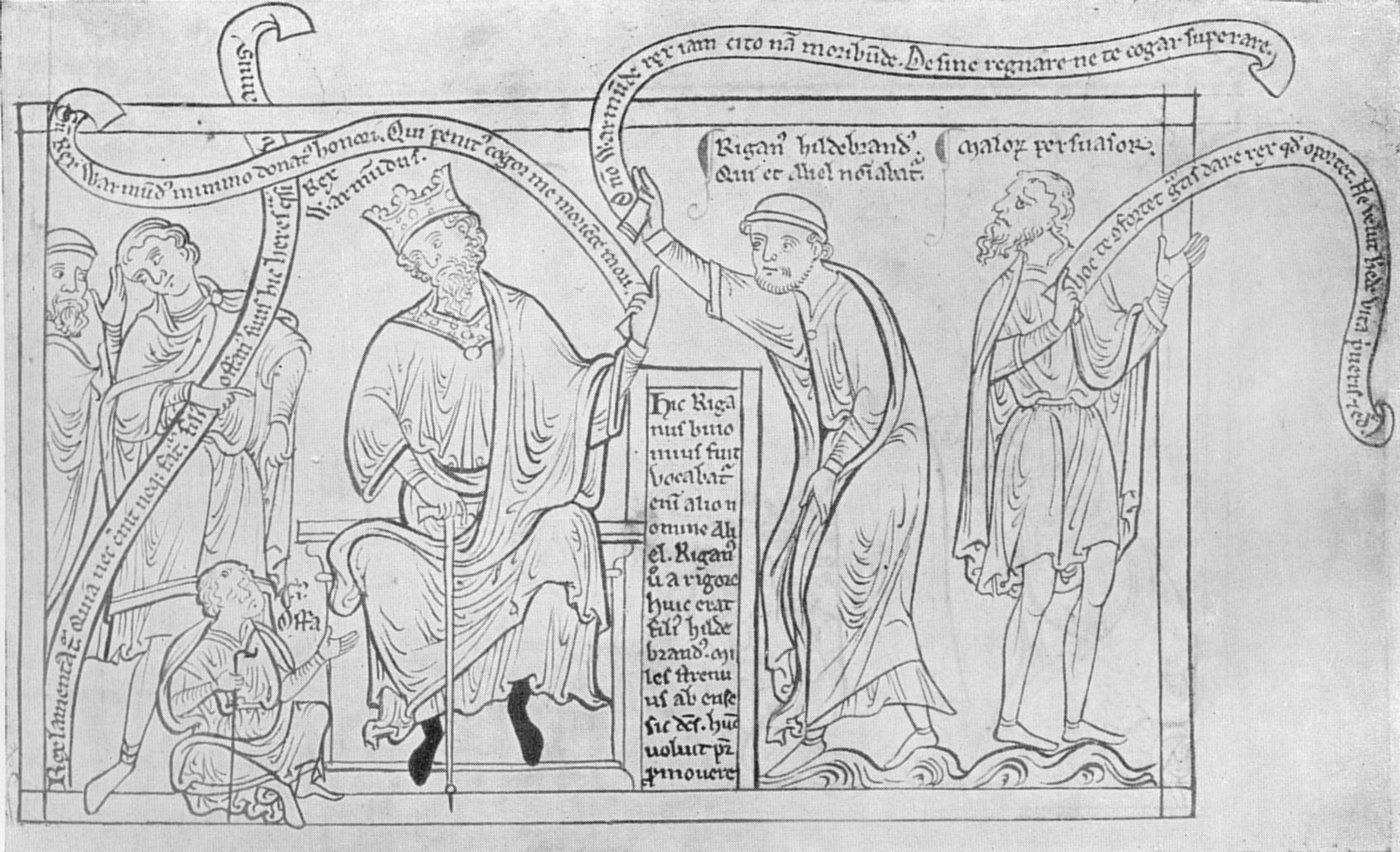
Riganus (or Aliel) comes before King Warmundus to claim that he should be made King in place of the incompetent Offa
From MS Cotton Nero D. I, fol. 2 a.
Fol. 2 b
Nec mora, accitis multis qui contra regis imperium partem suam confouebant, infra paucos dies, copiosum immo infinitum excercitum congregauit: et sub spe uictorie uiriliter optinende, regem et suos ad hostile prelium prouocauit. Rex autem confectus senio, timens rebellare, declinauit aliquociens impetus aduersariorum. Tandem uero, conuocatis in unum principibus et magnatibus suis, deliberare cepit quo facto opus haberet. Dum igitur tractarent in commune per aliquot dies, secum deliberantes instantissime necescitatis articulum, affuit inter sermoci|nantes natus et unigenitus regis, eo usque elinguis et absque sermone, sed aure purgata, singulorum uerba discernens. Cum autem patris senium, et se ipsum ad regni negocia quasi inutilem et minus efficacem despici et reprobari ab omnibus perpenderet, contritus est et humiliatus in semetipso, usque in lacrimarum aduberem profusionem. Et exitus aquarum deduxerunt oculi eius; et estuabat dolore cordis intrinsecus amarissimo. Et quam uerbis non poterat, deo affectu intrinseco precordialiter suggerebat, ingemiscens, reponensque lacrimabilem querelam coram ipso, orabat ut a spiritu sancto reciperet consolacionem, a patre luminum fortitudinem, et a filio patris unigenito sapiencie salutaris donatiuum. In breui igitur, contriti cordis uota prospiciens, is, cui nuda et aperta sunt omnia, resoluit os adolescentis in uerba discreta et manifeste articulata. Sicque de regni principatu tumide et minaciter contra se et patrem suum perstrepentes, subito et ex insperato alloquitur: "Quid adhuc me et patre meo superstite contra leges et iura uobis uendicatis regni iudicium enormiter contrectare: et me excluso, herede geneali, alium degenerem facinorosum eciam in minas et diffiduciacionem superbe nimis prorumpentem, subrogare ut uos non immerito iniquitatis et prodicionis arguere valeamus. Quid, inquam, exteri, quid extranei contra nos agere debeant, cum nos affines et domestici nostri a patria quam hactenus generis nostri successio iure possedit hereditario, uelitis expellere?" Et dum hec Offanus uel Offa (hoc enim nomen adolescentulo erat) qui iam nunc primo eterno nomine cum bened[i]c[i]onis memoria meruit intitulari, ore facundo, sermone rethorico, uultu sereno prosequeretur, omnium audientium plus quam dici potest attonitorum oculos facies et corda in se conuertit. Et prosequens inceptum sermonem, continuando rationem, ait (intuens ad superna): "Deum testor, omnesque celestis curie primates, quod tanti sceleris et discidii incentores, (nisi qui ceperint titubare, uiriliter eriganter in uirtutem pristinam roborati) indempnes (pro ut desides et formidolosi promeruerunt) ac impunitos, non paciar. Fideles autem, ac strenuos, omni honore prosequar [et] confouebo."
Audito igitur adolescentis sermone, quem mutum estimabant vanum et inutilem, consternati admodum et conterriti, ab eius presencia discesserunt, qui contra patrem suum et ipsum, mota sedicione, ausu temerario conspirauerant. Riganus tamen, contumax et superbus, comitante Mittunno cum aliis complicibus suis, qui iam iram in odium conuerterant, minas minis recessit cumulando, regemque delirum cum filio suo inutili ac vano murione, frontose diffiduciauit. Econtra, naturales ac fideles regis, ipsius minas paruipendentes, immo Fol. 3 a | uilipendentes, inestimabili gaudio perfusi, regis et filii sui pedibus incuruati, sua suorumque corpora ad uindicandam regis iniuriam exponunt gratanter uniuersi. Nec mora, rex in sua et filii sui presentia generali edicto eos qui parti sue fauebant iubet assistere, uolens communi eorum consilio edoceri, qualiter in agendis suis procedere et negocia sua exequi habeat conuenienter. Qui super hiis diebus aliquot deliberantes, inprimis consulunt regi ut filium suum moribus et etate ad hoc maturum, militari cingulo faciat insigniri: vt ad bellum procedens, hostibus suis horrori fieret et formidini. Rex autem sano et salubri consilio suorum obtemperans, celebri[348] ad hoc condicto die, cum sollempni et regia pompa, gladio filium suum accinxit; adiunctis tirocinio suo strenuis adolescentibus generosis, quos rex ad decus et gloriam filii sui militaribus indui fecit, et honorari.
Cum autem post hec[349], aliquandiu cum sociis suis decertans, instrumenta tiro Offanus experiretur, omnes eum strenuissimum et singulos superantem uehementer[350] admirabantur. Rex igitur inde maiorem assumens audaciam, et in spem erectus alacriorem, communicato cum suis consilio, contra hostes regni sui insidiatores, immo iam manifeste contra regnum suum insurgentes, et inito certamine aduersantes, resumpto spiritu bellum instaurari precepit. Potentissimus autem ille, qui regnum sibi usurpare moliebatur, cum filiis suis iuuenibus duobus, uidelicet tironibus strenuissimis Otta et Milione nominatis, ascita quoque non minima multitudine, nichilominus audacter ad rebellandum, se suosque premunire cepit, alacer et imperterritus. Et preliandi diem et locum, hinc inde rex et eius emulus determinarunt.
Congregato itaque utrobique copiosissimo et formidabili nimis excercitu, parati ad congressum, fixerunt tentoria e regione, nichilque intererat nisi fluuius torrens in medio, qui utrumque excercitum sequestrabat. Et aliquandiu hinc inde meticulosi et consternati, rapidi fluminis alueum interpositum (qui uix erat homini uel equo transmeabilis) transire distulerunt. Tela tamen sola, cum crebris comminacionibus et conuiciis, transuolarunt. Tandem indignatus Offa et egre ferens probrose more dispendia, electis de excercitu suo robustioribus et bello magis strenuis, quos eciam credebat fideliores, subitus et improuisus flumen raptim pertransiens, facto impetu uehementi[351] et repentino, hostes ei obuiam occurrentes, preocupatos tamen circa ripam fluminis, plurimos de aduersariorum excercitu contriuit, et in ore gladii trucidauit. Primosque omnes tribunos et primicerios potenter dissipauit. Cum tamen sui commilitones, forte uolentes prescire in Offa preuio Martis fortunam, segniter amnem transmearent, qui latus suum tenebantur suffulcire, et[352] pocius Fol. 3 b | circumuallando roborare, et resumpto spiritu uiuidiore, reliquos omnes, hinc inde ad modum nauis uelificantis et equora uelociter sulcantis, impetuosissime diuisit, ense terribiliter fulminante, et hostium cruore sepius inebriato, donec sue omnes acies ad ipsum illese et indempnes transmearent. Quo cum peruenirent sui commilitones, congregati circa ipsum dominum suum, excercitum magnum et fortem conflauerunt. Duces autem contrarii excercitus, sese densis agminibus et consertis aciebus, uiolenter opponunt aduentantibus. Et congressu inito cruentissimo, acclamatum est utrobique et exhortatum, ut res agatur pro capite, et certamen pro sua et uxorum suarum, et liberorum suorum, et possessionum liberacione, ineant iustissimum, auxilio diuino protegente. Perstrepunt igitur tube cum lituis, clamor exhortantium, equorum hinnitus, morientium et uulneratorum gemitus, fragor lancearum, gladiorum tinnitus, ictuum tumultus, aera perturbare uidebantur. Aduersarii tandem Offe legiones deiciunt, et in fugam dissipatas conuertunt.
Quod cum videret Offa strenuissimus, et ex hostium cede cruentus, hausto spiritu alacriori, in hostes, more leonis et leene sublatis catulis, irruit truculenter, gladium suum cruore hostili inebriando. Quod cum uiderent trucidandi, fugitiui et meticulosi pudore confusi, reuersi sunt super hostes, et ut famam redimerent, ferociores in obstantes fulminant et debacantur.
Multoque tempore truculenter nimis decertatum est, et utrobique suspensa est uictoria; tandem post multorum ruinam, hostes fatigati pedem retulerunt, ut respirarent et pausarent post conflictum.
Similiter eciam et excercitus Offani. Quod tamen moleste nimis tulit Offanus, cuius sanguis in ulcionem estuabat, et indefessus propugnator cessare erubescebat. Hic casu Offe obuiant duo filii diuitis illius, qui regnum patris eius sibi attemptauit usurpare. Nomen primogenito Brutus [sive Hildebrandus][353] et iuniori Sueno. Hii probra et uerba turpia in Offam irreuerenter ingesserunt, et iuueni pudorato in conspectu excercituum, non minus sermonibus quam armis, molesti extiterunt. Offa igitur, magis lacessitus, et calore audacie scintillans, et iracundia usque ad fremitum succensus, in impetu spiritus sui in eosdem audacter irruit. Et eorum alterum, videlicet Brutum, unico gladii ictu percussit, amputatoque galee cono, craneum usque ad cerebri medullam perforauit, et in morte singultantem sub equinis pedibus potenter precipitauit. Alterum uero, qui hoc uiso fugam iniit, repentinus insequens, uulnere letali sauciatum, contempsit et prostratum. Post hec[354] deseuiens in ceteros contrarii excercitus duces, gladius Offe quicquid obuiam habuit prosternendo deuorauit, excercitu ipsius tali exemplo recencius in hostes insurgente, et iam gloriosius triumphante.
Fol. 4 a
Pater, uero, predictorum iuuenum, perterritus et dolore intrinseco sauciatus, subterfugiens amnem oppositum, nitebatur| pertransire: sed interfectorum sanguine torrens fluuius, eum loricatum et armorum pondere grauatum et multipliciter fatigatum, cum multis de suo excercitu simili incomodo prepeditis, ad ima submersit, et sine uulneribus, miseras animas exalarunt proditores, toti posteritati sue probra relinquentes. Amnis autem a Rigano ibi submerso sorciebatur uocabulum, et Riganburne, vt facti uiuat perpetuo memoria, nuncupatur. [Hiic alio nomine Auene dicitur.][355]
Reliqui autem omnes de excercitu Rigani [qui et Aliel dicebatur][355] qui sub ducatu Mitunni regebantur, in abissum desperacionis demersi, et timore effeminati, cum eorum duce in quo magis Riganus confidebat, in noctis crepusculo trucidati, cum uictoria gloriosa campum Offe strenuissimo (in nulla parte corporis sui deformiter mutilato, nec eciam uel letaliter uel periculose uulnerato, licet ea die multis se letiferis opposuisset periculis) reliquerunt[356].
Sicque Offe circa iuuentutis sue primicias, a Domino data est uictoria in bello nimis ancipiti, ac cruentissimo, et inter alienigenas uirtutis et industrie sue nomen celebre ipsius uentilatum, et odor longe lateque bonitatis ac ciuilitatis, nec non et strenuitatis eius circumfusus, nomen eius ad sidera subleuauit.
Porro in crastinum post uictoriam, hostium spolia interfectorum et fugitiuorum magnifice contempnens, nec sibi uolens aliquatenus usurpare, ne quomodolibet auaricie turpiter redargueretur, militibus suis stipendiariis, et naturalibus suis hominibus (precipue[357] hiis quos nouerat indigere) liberaliter dereliquit. Solos tamen magnates, quos ipsemet in prelio ceperat, sibi retinuit incarcerandos, redimendos, uel iudicialiter puniendos. Iussitque ut interfectorum duces et principes, quorum fama titulos magnificauit, et precipue eorum qui in prelio magnifice ac fideliter se habuerant (licet ei[358] aduersarentur) seorsum honorifice intumularentur, factis eis obsequiis, cum lamentacionibus. Excercitus autem popularis cadauera, in arduo et eminenti loco, ad posteritatis memoriam, tradi iussit sepulture ignobiliori. Vnde locus ille hoc nomine Anglico Qualmhul[359], a strage uidelicet et sepultura interfectorum merito meruit intitulari.
Multorum eciam et magnorum lapidum super eos struem excercitus Offe, uoce preconia iussus, congessit eminentem. Totaque circumiacens planicies[360] ab ipso cruentissimo certamine et notabili sepultura nomen et titulum indelebilem est sortita, et Blodiweld[361] a sanguine interfectorum denominabatur.
Deletis igitur et confusis hostibus, Offa cum ingenti triumpho ac tripudio et gloria reuertitur ad propria. Pater uero Warmundus, qui sese receperat in locis tucioribus rei euentum expectans, sed iam fausto nuncio certificatus, comperiensque et securus de carissimi filii sui uictoria, cum ingenti leticia ei procedit obuius[362]: et in amplexus eius diutissime commoratus, conceptum Fol. 4 b | interius de filii sui palma gaudium tegere non uolens set nec ualens, huius cum lacrimis exultacionis prorupit in vocem: "Euge fili dulcissime, quo affectu, quaue mentis leticia, laudes tuas prout dignum est prosequar? Tu enim es spes mea et subditorum iubilus ex insperato et exultacio. In te spes inopinata meis reuixit temporibus; in sinu tuo leticia mea, immo spes pocius tocius regni est reposita. Tu populi tocius firmamentum, tu pacis et libertatis mee basis et stabile, deo aspirante, fundamentum. Tibi debetur ruina proterui proditoris illius, quondam publici hostis nostri, qui regni fastigium quod mihi et de genere meo propagatis iure debetur hereditario, tam impudenter quam imprudenter, contra leges et ius gentium usurpare moliebatur. Sed uultus domini super eum et complices suos facientes mala, ut perderet de terra memoriam eorum, Deus ulcionum Dominus dissipauit consilium ipsius. Ipsum quoque Riganum in superbia rigentem, et immitem Mitunnum commilitonem ipsius, cum excercitu eorum proiecit in flumen rapacissimum. Descendunt quasi plumbum in aquis uehementibus; deuorauit gladius tuus hostes nostros fulminans et cruentatus, hostili sanguine magnifice inebriatus; non degener es fili mi genealis, sed patrissans, patrum tuorum uestigia sequeris magnificorum. Sepultus in inferno noster hostis et aduersarius, fructus viarum suarum condignos iam colligit, quos uiuus promerebatur. Luctum et miseriam quam senectuti mee malignus ille inferre disposuerat, uersa uice, clementia diuina conuertit in tripudium[363]. Quamobrem in presenti accipe, quod tuis meritis exigentibus debetur, eciam si filius meus non esses, et si mihi iure hereditario non succederes; ecce iam, cedo, et regnum Anglorum uoluntatis tue arbitrio deinceps committo; etas enim mea fragilis et iam decrepita, regni ceptrum ulterius sustinere non sufficit. Iccirco te fili desideratissime, uicem meam supplere te conuenit, et corpus meum senio confectum, donec morientis oculos clauseris, quieti tradere liberiori, vt a curis et secularibus sollicitudinibus, quibus discerpor liberatus, precibus uacem et contemplacioni. Armis hucusque materialibus dimicaui: restat ut de cetero uita mea que superest, militia sit super terram contra hostes spirituales.