Front matter (continued 6)
Reading edition
On a sudden her cheeks grew white as her kerchief, and her eyes filled with fear. It was none other than Simon!—For a moment she hoped wildly that he might not recognise her or, even recognising her, might not be aware of her arrest and trial, but the hope was destined soon to fade. For an instant the man stared at her in amazement, then a quick gleam of satisfaction flashed across his face, and he broke into a low chuckle.
"Mistress Barbara Winslow!" he cried with an ugly grin at the trembling girl. "I come from Taunton, Mistress Winslow, from Taunton, where there be those who mightily desire your presence. There's an empty cell in Taunton gaol for your ladyship, there's an idle whipping-post awaiting you there, Mistress Barbara Winslow!"
Again he chuckled and rubbed his hands with malicious glee.
Barbara's first impulse was to cry for help, and so bring down the two men from above stairs to her aid. But with an effort she controlled herself, for she perceived on the instant what must be the result. The pedlar was but a step from the street door; at her first alarm he would make his escape, and returning speedily with the guard, would secure not herself alone, but her friends. Her wit seemed to desert her now, in her greatest need; she could devise no plan of escape to insure the safety of the three. As yet the others might be safe, the man knew nothing of their presence in the house. Was it not better, braver, to go with him at once, surrender herself, since clearly Heaven willed not her escape, and so shield her companions from the danger that threatened them? For had Captain Protheroe rescued her from prison (she gave poor Rob little credit for his share) only that she should, by cowardice, betray him now? And Ralph! Had she saved him from death in the forest, only to insure for him a death a thousand times more horrible? Ralph, so weak, so lightly despairing, who loved her so truly. Yes, she might still save these two who had done so much for her. She would not shrink from the sacrifice.
Her mind was made up.
"God wills it," she said. "You have found me. I will go with you."
"That is wisdom, mistress," grinned the man. "'Tis not here as at Durford." Quickly he put up again his pack, and shouldering it, laid his hand upon her arm.
Firm and unflinching Barbara followed him to the door. Simon laid his hand upon the latch, another moment and they would have been in the street. Suddenly he paused. He turned his head to listen, and a smile of low cunning crept slowly into his eyes. For they heard the opening of a door, and a man's cheery whistle sounded in the room above. Barbara gave a quick gasp of terror, she felt the pedlar's eyes were fixed upon her face.
"Quick, quick," she cried losing her wits in her excitement; "let us be off. Someone is coming."
"Aye," said the man slowly; "someone is coming. And there are two rewards to be won in Taunton."
He released her arm, and still with his hand upon the latch, turned to confront the newcomer.
Barbara could do no more. With a sigh of desperation she sank into a chair and covered her face with her hands.
The door opened and Captain Protheroe appeared.
For a moment the two men stood staring at each other, then the truth flashed to the brain of the soldier and he made a spring forward to secure the pedlar. But the man was too quick for him; he darted through the already opened door, into the street, slamming the door behind him.
Captain Protheroe was about to follow, but recognising the hopeless folly of such action, he stopped, and having fastened the door turned to where Barbara sat, white and trembling.
"The fellow knew you?" he asked sharply.
"Yes, he was about to take me to the guardhouse," she answered, trembling.
"Good Heavens! why didn't you cry for help? We might have seized him perchance."
"I—I feared, an I did so, he would discover that you and Ralph were here," she stammered. "'Twould have undone all three. And Ralph——"
"You would have gone without a word?"
Barbara hesitated.
"I—I could not bear that Ralph should be taken," she muttered, shy even then, of confessing her fear for his capture too.
He looked down at her for a moment with deep pain in his eyes:
"I see," he said gently; "I—I understand."
She knew that he did not understand but she could not tell him so, and indeed he gave her no time. In an instant he was alert, ready for action.
"No time to lose, Mistress Barbara," he said cheerily. "We must be out of this directly. I'll give your friend a quarter of an hour to tell his tale and return with the guard."
"But how! Where?" she cried desperately. "Ralph can't travel yet."
"He must. You don't know, Mistress Barbara, what can be done when it's a case of do it or hang. Come."
They hurried upstairs, summoned Mistress Fytch, and quickly told their story.
Ralph was up in an instant.
"I'm ready," he cried abruptly. "What are the orders?"
He had learned much during the past ten days. Despite his jealousy of Captain Protheroe he knew him as one to be relied on, and his love for Barbara forbade him do aught that would increase the difficulties of the one man who could save her.
"We've little time to consider ways and means now," muttered Captain Protheroe, striding about the room as was his wont when in deep thought. "You'll take Mistress Barbara at once out by the north gate (twill not yet be closed) and go by the fields to Mallet, 'tis but a mile hence. Nannie must go too—'tis safe here for her no longer; and she knows the road."
The old dame was called and matters quickly explained to her.
"Very good, Master Miles," she answered, as calmly as though he had bidden her serve his supper. She had implicit faith in her foster-son in all matters save those appertaining to the care of his health.
"To Mallet then, and wait there. Is Johnny Dean still living, Nannie?"
"Why, for sure he is, Master Miles, why not? Shall I take the young mistress thither?"
"Yes, go to Johnny Dean's and wait me there."
"But you? What will you do?" cried Barbara suspiciously.
"Why, Mistress Barbara," he answered, smiling and drawing from his breast the green silk letter-case found in the Sedgemoor ditch. "I purpose to see an these letters will fetch their price."
"But how? Of whom?"
"Of whom but the man most likely to pay it, my Lord Jeffreys."
"What? you would go there, to him, alone! Oh, no, no, you must not, indeed you must not. 'Tis too rash, 'tis madness. Better risk all than that you—you should—— Oh! Captain Protheroe, we can't leave you behind."
Her voice trembled, her eyes were full of tears. For a moment he hesitated, gazing at her with surprise, with a faint, wondering hope; but he shook his head.
"Do not be afraid, Mistress Barbara," he said lightly; "I have faith in the power of these bits of paper. Trust me, I'll join you ere two hours are passed."
Somewhat comforted by his words, Barbara said no more. She had learned to know by his face when he had made up his mind, and recognised that further argument would but waste time.
When the two women had left the room in search of cloaks, Captain Protheroe turned abruptly to his companion.
"Look you, Sir Ralph, this is a desperate strait. You can await me at Mallet till nine o'clock. If by that time I have not come, then go north, make for Listoke, try to get aboard the Roaring George. And, look you, take these letters (I have made copies of them). If you are ta'en, get them to Churchill, or, better still, Rochester. They may save you yet, even if I fail."
"But, Heavens, man! if you fail it's death for you. Why not come with us, and try to win to Holland? Why go to Jeffreys at all?"
"Because, tho' a desperate chance, 'tis worth risking. Zounds! man, you don't think. What hope have two women and a man weak with fever of escaping the royal troops? Practically none, unless I can buy free pardons for all and a safe conduct into Holland from Jeffreys."
The women being now ready to set out, Captain Protheroe went with them to the door at the back of the house, from whence a short labyrinth of streets led to one of the gates of the town.
There he turned to the girl who stood beside him, her dark eyes gleaming in the shadow of her hood. It was a crimson hood and reminded him of the night he first met her in the country lane at Durford.
"Good-bye, Mistress Barbara," he said wistfully.
A sudden fear awoke in her eyes.
"But you will come after us, you will see me again?" she cried quickly.
"Assuredly, Mistress Barbara," he answered softly; "if there be pity in Heaven I shall see you again."
She looked at him doubtfully, but urged him no more.
"God keep you," she said gently.
Captain Protheroe watched them disappear in the darkness. But he failed to note a dark figure flit from the shadow of a neighbouring house, and follow them on their way.
CHAPTER XXI
Chief Justice Jeffreys sat alone in his lodging at Wells.
The long sitting in court was over. All day he had stormed and bullied, reducing prisoners and advocates alike, and even his brothers on the bench, to a state of terrified submission. He had poured forth abuse on the heads of timorous witnesses, cracked his jests and thundered his threats at the miserable victims of the law's severity. He had sworn, wrangled, and blustered, and now he was alone.
The wearying journey, the tedious days of work, the long nights of carouse, above all the unrestrained passions in which he daily indulged had conduced to the inevitable result; on his arrival in Wells his malady had become greatly aggravated, and his physicians had urged on him the absolute necessity of quiet and abstinence. Accordingly to-night he followed their advice; the officers and other jovial gentlemen who formed his escort feasted apart, and, sick in body, weary in mind, he sat alone.
And as he sat there in all the luxury of his surroundings, despite his high position, despite his success, despite his wealth, power, and influence, 'twould have been hard to find in all the length and breadth of the kingdom a more wretched man than George Jeffreys, lord chief justice of England, lord chancellor elect.
For the man was cursed with a double curse, and the burden of his life seemed at times too heavy to be borne. Cursed with an ambition which would not let him rest, which ever urged him to new struggles, new extravagances, new ventures, and contrariwise cursed with a sensitiveness, a cowardice that made each step in the path of his career an added terror to his brain, each rough encounter a fresh misery, each rebuff a stinging agony.
The mainspring of his character was an overweening vanity. He must be first of his company, he must, by whatever means offered, rise to the highest; but on the other hand he could brook no opposition, a taunt or a rebuke was torture to him, a threat a terror that moved him at times to tears. The rebuffs and sneers which to a braver nature appear but the natural pricks of life, were to him a veritable torment from which he shrank with all the horror of a keenly sensitive soul. While his ambitious vanity drove him to assume airs of overweening insolence, to bully and overawe all who came before him, to delight to see men shrink and tremble at his words; yet if he met with opposition, his haughty mien vanished in a burst of childish passion, and if he found his aims thwarted he became reduced to a state of helpless misery.
Thus his ambition drove him into a struggle with the world, but the very enmity and hatred naturally evoked were to him the source of misery unspeakable.
Such was the man who had elected to climb the highest rung of the ladder. Verily he paid his price.
As he sat alone, forced no longer to wear his mask, to preserve an air of proud assurance and command, the reflection of his thoughts played across his face, and 'twas a bitter tale to read. His brows frowned in pain and perplexity, his lips twitched nervously, and in his eyes lurked a look as of one cowering beneath an ever-present dread. He leaned weariedly back in his chair, his hands idly resting on its arms, his face drawn with suffering.
On the table before him lay many letters from friends of the prisoners he had recently condemned, heart-rending pleas for mercy, despairing appeals for a mitigation, however slight, of the agonising sentences he had pronounced; and among them was a letter from his father, the old man whom still in spite of all he respected and in his own way loved, a letter entreating him to show pity in his judgments, threatening to disown him should he still persist in his bloody methods. And Jeffreys himself, save in his outbursts of rage, was not a cruel man, and took little enough delight in his brutal task. Still he had no choice. For the King's commands had been absolute; no mercy must be shown and the King's commands he dared not disobey.
And in addition to these commands, apart from his hope to win by his zealous service the office of lord chancellor, there was jet another reason, more poignant than all, why he dared show no mercy to those associated with the late rebellion; why, if he could have had his own way, every man who had so much as looked at Duke Monmouth should be put to death.
For he himself, in one of those sudden fits of alarm which formed the cause in him of so much double-dealing, had intrigued secretly with Monmouth, and the haunting fear of discovery had sent him down into the west like a savage beast of prey, panting to sweep from sight all traces of rebellion, striving to prove, by the very ferocity of his judgments, his loyalty to the King and his repugnance of the course of his enemies. So he was driven, by the very desperation of his ambition, to win for himself a hatred and contempt that almost broke his heart.
And to-night, as he sat alone, he wondered wearily whether the struggle was worth the torture it created, and his heart cried to him to give up the contest, resign his office, and in retirement find rest for his suffering body, and peace for his weary soul. So spake his heart, and he longed for determination to follow its dictates. Yet he knew too well the while that peace was not for him, for the curse of Lucifer was upon him, and so long as there remained power to strive for, or enemies to overthrow, so long must he struggle on in misery, until death should bring to him the only rest such as he may ever know.
He was interrupted in his musings by the entrance of his secretary, Master Stephen Jewars. Perturbed and anxious the man hurried into the room, and after a moment's pause advanced to his master's side.
"My lord," he began nervously, "there is an officer without, asking to see your lordship."
Jeffreys moved impatiently.
"Not to-night, Jewars," he said sharply; "I will see no one to-night. His business will wait."
"Pardon, my lord, even so I answered him, but he declares his business will not wait. Moreover, 'tis a matter of the most absolute importance, so he states, that he see you."
"Devil take you!" cried Jeffreys angrily. "Why, fellow, have you not heard the same tale ten thousand times of late? 'Tis another o' these petitioners, I'll warrant. I will not see him."
A moment the secretary hesitated. Then he stooped over his master and said in a low, cautious tone:
"My lord, it may be I am mistaken, but—methinks the man knows something."
Jeffreys started.
"What mean you, fellow?" he asked quickly. "What does he say?"
"Nay, my lord, 'tis mostly by his manner I judge it, for he demands to see your lordship as tho' 'tis nought to him yet for your sake 'twere wise. And then also his words—for he claims to have information concerning an intrigue with the late Duke, an intrigue which may not astonish your lordship as much as most folk, yet 'twill be of greater moment to your lordship to be the first to hear on't."
"Tut!" cried Jeffreys nervously. "Any man might say that."
"Aye, my lord, any man might say it, but an I be any judge of men, this man hath meaning in his words."
Jeffreys was silent.
"Well, well, Jewars," he said after a pause; "I will see the man. But not alone. You will remain in the room, and look you, have an escort ready at hand, lest the man must be—lest he prove an impostor."
"Very good, my lord," answered Jewars with a sigh of relief. "I will bring him in at once."
Two minutes later he ushered Captain Protheroe into the judge's presence.
At sight of his visitor Jeffreys started, and eyeing him sharply for a moment, rapped out a fierce oath.
"What's this!" he cried. "What do you here? How dare you come here? I know you, fellow, I know your face well."
"'Tis possible," answered the other coolly. "I have been frequently before your lordship—er—unofficially. I was one of Colonel Kirke's officers."
"Truly, you do well to say was," shouted Jeffreys angrily. "I mind you well, sir. You are he who was committed at Taunton and who afterwards escaped. I have not forgot you, sir."
"Indeed! I congratulate your lordship upon an excellent memory," was the cool reply.
"Zounds! Jewars. What is the fellow here for?" blustered the judge. "A condemned rebel! A traitor! Call in the guard."
"Nay, my lord," interrupted Captain Protheroe quietly. "I have that to say to your lordship of the deepest import. You will do well to hear me out. The guard afterwards—an you will."
Jeffreys eyed him, frowning.
"You are a cool fellow," he muttered. "Have a care, sir, have a care. Do not trifle with me. Your life is not worth one——"
"I am aware of that fact, my lord," he interrupted coolly. "Judge then whether the business which led me to place myself in your power be likely to be of import or no. Indeed, my lord, you will do well to hear me."
For a moment the judge hesitated, trying to outfrown the officer's cool glance, but finding here was a different man from those whom he was accustomed to bully in the law courts, he submitted with a bad grace to the demand.
"Well! Well! say what you desire, sir; but look you, waste no time."
"I have no desire to do so, my lord. In fact waste of time were more fatal to me than ever it could be inconvenient to your lordship. Briefly then, I am here to give your lordship an opportunity of exercising mercy."
Judge Jeffreys stared for a moment in amazement, then dropped his fist upon the table with a fierce oath.
"Mercy! Mercy!" he shouted. "And have you dared, fellow, to force your way into my presence, to interrupt my rest, solely to beg for mercy on your miserable life. Have you indeed so dared, fellow?"
"My name is Protheroe, since it seems to have escaped your lordship's otherwise excellent memory," was the cool reply. "But indeed I certainly have not intruded on your seclusion merely to beg so slight a thing as my pardon. 'Tis a most wide-reaching exercise of mercy I offer your lordship, the release of four rebels at least."
Jeffreys sprang to his feet, trembling with fury, and roared out a torrent of oaths that startled even the accustomed ears of his hearer. But Captain Protheroe did not change a tittle of his cool, resolute mien. He knew his man, and knew well that the only way to master such as he was to meet insolence with insolence, and rage with cool contempt.
"To the guardhouse with the insolent fellow," shouted Jeffreys, glaring with passion. "Away with him!"
"You forget, my lord," shouted the officer, endeavouring vainly to win a hearing; "I do not come empty-handed, I bring my price."
But the Judge was beside himself with fury, and Captain Protheroe had hardly escaped immediate arrest, had not the secretary stepped quickly forward and whispered a few words in his master's ear. At first he could gain no attention, but gradually the storm subsided, the judge's fury wavered before the calm indifference of the soldier, and after a moment's silence he submitted sulkily to his secretary's persuasion.
"Well! Well! Jewars. I will hear him," he muttered. "Look you, sir, say clearly what has brought you here. You claim to have information to give. What is it? What have you to offer?"
"Two letters, my lord."
"Letters!" The judge started forward, grasping the table with his hands, his eyes glaring at the officer. "Letters, say you?"
"Aye, my lord," answered the officer nonchalantly. "Certain letters of your lordship's own hand, which have come into my possession. They are, I venture to believe, a most sufficient guarantee for my trust in your clemency."
Jeffreys dropped his hands and fell back into his chair, his eyes fixed on the speaker with horrible intensity. His fingers moved nervously and his lips twitched. Jewars touched him on the shoulder, and with a start he recovered himself.
"Show me the letters!" he snarled abruptly.
Captain Protheroe drew the papers from his breast, and handed them across the table. He was purposely deliberate in his movements, revelling in the anxiety of the judge's face.
There was a dead silence in the room while Judge Jeffreys perused the letters. He bent his head low over the paper, therefore his face was hidden from the officer, who waited breathless for the pronouncement upon the contents.
At length after a long pause, the judge raised his head.
His face was calm, his voice as usual loud and raucous.
He eyed the officer firmly.
"These"—he said slowly, tapping the papers—"these are forgeries."
A sudden cold chill crept round Captain Protheroe's heart. He stared at the judge in amazement, in slowly rising despair.
"Forgeries, sir," said Jeffreys again coldly. "Have you no more to say?"
But even while he spake, Captain Protheroe noted, though the face and voice were calm, yet the hand which held the letter trembled till the paper shook like an aspen leaf. He noted this, and took fresh courage from the sight.
"Pardon me, my lord," he drawled politely; "not forgeries, but—er—copies."
The judge glared at him.
"Copies," he cried sharply. "Then where are the originals! Show them to me?"
"Indeed, my lord, you underrate my very high opinion of your lordship's—er—ingenuity, if you deem I have brought the originals with me," answered the captain with the same slow politeness. "They are in safe-keeping elsewhere."
Jeffreys swore under his breath. Then he turned to the officer with a scornful laugh.
"And you dream, by these letters, you can prove me traitor, eh?" he asked mockingly.
"Certainly not, my lord, if your lordship can prove your innocence," was the cool answer.
There was silence. The two men eyed one another defiantly. Then Jeffreys laid down the letters, and leaned across the table.
"You are a fool, sir," he said sharply, "an you think to reap any advantage from these letters. I tell you the plain truth. I have intrigued with Monmouth, but solely that by gaining his confidence, I might prove of greater assistance to his Majesty."
"Indeed, my lord, I never held so low an opinion of you as to suppose you would confine your treachery to one party only," answered Captain Protheroe insolently. But his heart beat quickly, for he liked not the suggestion in the judge's words.
"Have a care, sir," shouted Jeffreys angrily. "Recollect you are in my power."
"With reservations, my lord. For, if I join not my friends within two hours, the originals of these letters will, before to-morrow night, be in the hands of one likely to take a deeper interest in the matter than your lordship seems to do."
"Devil damn you, fellow! Have I not told you wherefore these letters were writ?"
"You have. For your lordship's sake I trust others may place more credence in your story than I do myself."
"What! Do you dream his Majesty will believe there is one word of truth in your story if I deny it? Your letters are powerless to destroy me. Heavens, man, do you suppose his Majesty would disgrace me on such evidence? I tell you, sir, I am as necessary to him as his crown."
"My lord, you yourself undoubtedly are the best judge as to what extent his Majesty finds your services a necessity. But 'tis said he is easily suspicious, and 'twill not be the first time such accusations have been brought."
Jeffreys winced at the suggestion.
Captain Protheroe continued quietly:
"But 'tis not to his Majesty the papers would be delivered. He is the head of the kingdom, but by no means the only power therein. It might be, my lord, that the accusation once brought, he would be powerless to save you."
"What do you mean?" snarled the judge.
"I think, my lord, 'twas his late Majesty who remarked that your lordship was not 'parliament-proof.'"
Jeffreys started back and glanced uneasily at the speaker.
"Parliament," continued the officer slowly, "is indeed almost entirely Tory, but yet, as your lordship has good reason to know, it hath no great love for your person. There may not be many honest men among the members, but 'tis certain there are many cowards, and cowards will not brook traitors. If this accusation be brought forward it will not be lightly set aside, And it should not be necessary for me to remind your lordship that you have many enemies in the House."
Jeffreys sat silent, gnawing his nails, and gazing moodily on the ground.
After a pause Captain Protheroe continued with rising courage.
"Now, my lord, should these letters fall into the hands of the Duke of Rochester for example."
Jeffreys started to his feet with a sudden wild cry.
"Your price, man, your price?" he shouted fiercely. Then he sank down again and leaned his head wearily upon his hand.
Captain Protheroe's eyes flashed with triumph.
"My price!" he cried eagerly. "My lord, I might ask much, but I refrain. All I demand is a free pardon for four rebels, Mistress Barbara Winslow, Sir Rupert Winslow, Sir Ralph Trevellyan, and myself. That is my price, and no dear one for such evidence as this."
"Pardons! Pardons!" cried Jeffreys testily; "what have I to do with pardons? 'Tis his Majesty alone who can grant such."
"Truly, my lord," answered the officer politely; "yet knowing the great confidence his Majesty places in your lordship, I venture to believe you will find no great difficulty in procuring what I demand. In the meantime I will content myself with a safe pass to Holland for myself and my companions."
A sudden light gleamed in the judge's eyes. Drawing towards him ink and paper he wrote the necessary orders, signed and sealed them and laid them on the table beside him.
"That will serve your purpose, sir," he said quietly. "My secretary will now accompany you to fetch the originals of the letters; on your return with them this passport shall be delivered to you."
Captain Protheroe laughed quickly.
Then he turned to Jeffreys with an air of deep reproach.
"Alas! my lord," he cried, "you do indeed underrate my opinion of your ability; moreover, I fear, you take me for a fool. No, no, my lord; that plan likes me not."
Judge Jeffreys started up with an oath, and made a movement to tear the paper in pieces. Captain Protheroe stopped him sharply.
"Hearken, my lord," he said sternly, "you will hand that pass to me now, you will take no steps to interfere with our departure, and you will at once apply yourself to obtain the pardons I demand. If money be required to win them I doubt not your lordship has sufficient to meet all expenses. In the meantime I and my friends will ride in safety to the coast, stopping a night or so at Durford Manor house——"
"Durford," cried Jeffreys sharply, "what would you at Durford?"
"Er—a small matter of an old gold brocade, I believe," answered Captain Protheroe, with a little smile of reminiscence. "From there we will take ship and sail for Holland. On the day your lordship procures our pardons, the letters you require shall be delivered into your hands."
"And if I refuse?"
"Refuse! why, then, as I have already explained, the letters have another destination. His Majesty, I believe, has now left Winchester, but the Duke——"
"I should at least soon see you hanged," interrupted Jeffreys furiously.
"I believe you, my lord," answered the captain drily; "but I do not anticipate I should have long to wait before your lordship followed me."
There was a pause. Then Jeffreys continued testily.
"What assurance have I these letters will be delivered to me?"
"My word."
"Pah! What faith put you in my word that you should have your pass?"
"None whatever! but the parallel is hardly just. I am a man of honour. That is one of the few titles to which your lordship has never aspired." Then he continued sharply, "Come, my lord, there is no time to lose; I beg you to come to a decision. I will not insult your intellect by repeating the facts of the case. Briefly, the matter runs thus: Whose head do you count of greatest value, mine or your lordship's?"
There was a full minute's silence. Then without a word Jeffreys picked up the passport and handed it to the officer.
"Ah, my lord! I thought I should not be mistaken in your answer," said the captain coolly. "I need not impress upon you the advisability of doing all in your power to facilitate our safe journey. Our interests will doubtless be dear to you as—as your own neck. My lord, I bid you good-evening."
The judge made no answer. He leaned wearily back in his chair, staring moodily before him. Behind him stood the secretary, silent, immovable, but with an expression of deepest relief upon his face. Captain Protheroe turned on his heel, and strode across the room, but scarcely had he reached the door when it was opened suddenly from without, and he found himself face to face with Colonel Kirke.
Both men gave a sharp exclamation of astonishment and sprang back. Then the colonel with a sudden quick movement stepped into the room, shut the door, and set his back against it.
For a moment all was still, the two stared at each other in dead silence, measuring glances of hatred and contempt. Then Jeffreys rose from his chair and stepped quickly forward.
"What do you want, colonel?" he asked hoarsely.
Kirke turned abruptly to the judge.
"What is this man doing here, my lord?" he demanded sharply.
Jeffreys moved nervously.
"Captain Protheroe is about to start upon a mission to Holland, at my direction," he answered nervously.
"But, my lord, have you forgot? this fellow is an escaped rebel, committed for treason."
"I know, colonel. But he is pardoned."
"Pardoned! By whom? For what reason?"
"In return for information received," answered Jeffreys quickly.
"Hell-fire! That he is not!" shouted the colonel fiercely. "I know you, Jeffreys, you've made your money out of him, and now you would let him go. But, by Heaven! an you do, I'll noise it abroad till all London hear on't. And you know, none better, his Majesty's commands concerning these rebels, not one is to escape. Pardoned! Now, by the light of the Prophet's beard, the man is a traitor and shall hang e'en if I had to do it with my own hands. Pardoned! Pah! The man shall hang as sure as my name is Percy Kirke."
He ceased, and there was another silence. Captain Protheroe loosened in its sheath the sword he earned and glanced rapidly round the room. He turned to the chief justice, but no further help showed there. Jeffreys had sunk back in his chair, and looked the picture of helpless dismay. The man was a mass of nerves, sensitive as a girl; he trembled under Colonel Kirke's fierce attack, and had no words with which to defend himself.
"Do you understand me, Jeffreys?" the colonel again shouted. "By Heaven, I'll publish the facts."
"My lord," interposed Captain Protheroe quietly, "'tis but a night's ride to Winchester."
Jeffreys looked from one to the other hopelessly calculating his chances with a desperate cunning.
"Tut, colonel," he began nervously; "what is the man to you? Let him——"
He was interrupted by a sudden knock at the door, and the entrance of an orderly.
"A messenger from London, my lord," he said.
He marched across to the chief justice, and handed him a packet, then saluting, turned and left the room.
Partly with the idea of gaining time, partly with a faint hope of there finding a way out of his difficulty, Jeffreys broke open the packet and began to read. Colonel Kirke stood silent, watching him angrily, but Captain Protheroe glanced hurriedly up and down the room, puzzling his wits to devise some method of escape.
Suddenly the chief justice started to his feet and turned to the colonel. There was a look of excitement on his face, and triumph in his eyes.
"Colonel Kirke," he exclaimed harshly, "you are recalled to London!"
With clenched hands and blazing eyes Kirke turned on Jeffreys.
"Recalled! I! What in the devil's name do you mean?"
"Here are your orders. The regiment will proceed there in the course of a week. You are to set out immediately."
Kirke stared at the paper in amazement; then he threw it to the ground and stamped on it in a sudden fury. "Recalled! Disgraced! Bah! Have you had a hand in this, Jeffreys? Recalled! Now, by——" He roared out a torrent of oaths.
Presently he grew calmer, picked up the paper, read it once more, and locked moodily at the chief justice.
"I must set out at once," he muttered. "But look you, Jeffreys, a word of warning; this is but a passing affair, the work o' that meddlesome Sunderland, I'll be bound. I shall soon return, so be careful what you do. I've set my heart on this matter"—pointing to the captain. "When I return, an that fellow be not handed over to me for court-martial, then, by all the devils in heaven and hell, I'll be revenged. You know me, Jeffreys, and you know what I can do. Take warning."
He swung to the door, then pausing, turned to Captain Protheroe, and eyed him with a scornful glance.
"A narrow shave for you," he said; "but I'll hope to see you hanged yet, my fine fellow."
Captain Protheroe smiled scornfully.
"I'm afraid, colonel," he answered drily, "unless our executions take place simultaneously on the same spot, we can't both realise our mutual hope."
With an oath Colonel Kirke swung out of the room, and the door was shut. Then Captain Protheroe turned to Jeffreys. The judge's face was a study of indecision. He stared moodily at the letters before him, he glanced nervously at the door through which the colonel had retired. He was a man standing betwixt two abysses, doubting over which to risk a jump. At last he raised his head, and faced the captain defiantly.
"Captain Protheroe," he said, "I must withdraw your passport and place you under arrest."
Captain Protheroe stared at the judge in dismay. The secretary took a rapid step forward, and stooped over his master's chair.
"My lord," he whispered, "think what you do. These letters——"
"I know! I know!" cried Jeffreys testily; "but I also know Kirke. 'Tis one or the other, and Kirke is not a man to deny."
Again the secretary stooped to argue, but Jeffreys thrust him aside.
"No, no, Jewars, I tell you 'tis the safer way. This is the only evidence"—tapping the letters—"and it may be disproved."
Then, with a sudden inspiration Captain Protheroe stepped forward, and leaning over the table, fixed his eyes on Jeffreys.
"The only evidence, my lord?" he asked quietly. "Tell me, has your lordship ever heard of a certain Master Hugh Peters, of Lime?"
"Peters!" gasped the secretary, with a sudden start of horror.
"Aye," answered the officer slowly. "A worthy man who can give much valuable information concerning the manner of Ferguson's escape, about which there has been so great a pother in London. And, my lord, he is not the only man who knows the secret."
With a sudden cry the secretary caught the chief justice's arm; his face was livid, he trembled from head to foot.
"My lord," he cried, "there is no help for it, this man must go. There is no safety else. He knows—Heavens! what does he not know? My lord, Colonel Kirke may be dangerous, but he is disgraced, and he hath but little evidence, and 'tis but a matter of bribery after all. But this man—oh, my lord! let him go, out of the country with him, and Heaven grant we may never see him more."
Jeffreys turned and stared at the terrified man, and slowly the fear passed into his own heart. Fiercely he clutched the arms of his chair, his eyes rolled, he moved his head from side to side, as one hounded to death, and seeing no escape. Then with a loud cry of rage and despair, he sprang to his feet, and pointed wildly to the door.
"Go!" he cried. "Go! You are free! But have a care. For an you come within my power again, by God! you shall pay for this. You shall die a thousand times; at the cart-tail, at the post, at the gallows, at the stake. You shall feel a thousand torments, till hell itself shall show more merciful. I will——"
"Silence!" shouted the captain sternly. "Peace, fool, I will hear no more o' such vapourings. I go now, but first, mark you this, my Lord Jeffreys, see to it you carry out our contract to the smallest detail, for should harm befall me and mine thro' your doing, I vow to heaven, my lord, I will not hang alone. So, an you value your own neck, leave us in peace."
For one moment Jeffreys stood gasping open-mouthed, gazing at the speaker in a fury of impotent rage, then he suddenly collapsed and sinking into his chair, he fell forward across the table and burst into bitter tears.
But Captain Protheroe waited no longer, but tucking the passport into his breast, proceeded calmly to the street. Nor did he pause until he had passed out of the north gate and left the town behind him.
"Phew!" he muttered, wiping his forehead, "I've played high in my time, but never for such stakes as these. Heaven help me! what a hand I held, and God forgive me, but how I played it!"
CHAPTER XXII
Captain Protheroe walked on rapidly across the dark field-path which led to the little hamlet of Mallet. It was already late, and he did not wish to keep his friends in suspense longer than was needful.
Suddenly he paused, as he became aware of a confused clamour of sounds proceeding from the direction in which, he was going, but only for a moment, then with a sudden misgiving he commenced to run rapidly forward through the darkness.
The cottage where the fugitives were to await him lay on the outskirts of the hamlet, separated from the cluster of other cottages by some fields, and the sounds, now becoming more distinct, came from that direction.
A confused murmur of voices met his ears, punctuated by a succession of heavy blows of musket-butts (so he rightly guessed) upon the cottage door; then followed the crash of a door falling, more shouting, above which he could distinguish a voice raised loud in authority, and then the clash of two encountering swords.
A moment later he reached the gateway of the croft within which the cottage stood.
There he found a group of peasants, held in check, in spite of much shouting and menacing gestures, by a small body of mounted troopers. Nearer the cottage were some unmounted men, those evidently who had been responsible for the attack upon the door, one or two of whom carried lanterns, and by the combined light this afforded, and that which streamed from the dismantled doorway, there was revealed to Captain Protheroe the incident which formed the central feature of the picture.
At the doorway of the cottage two men were fighting. The swordsman with his back to the doorway was Sir Ralph. With white set face, and his breath coming in quick gasps, 'twas clear he was sore pressed, and wellnigh spent.
His opponent, who was slowly but surely driving him to retreat into the passage-way, was a small, dapper little man, in the uniform of an officer of the King's troops. He fought with a cool precision, and ever and anon as the fight proceeded, he exclaimed admiringly:
"Well thrust, sir, well indeed. Keep back, men, let be. 'Tis a fair fight."
For a few moments Captain Protheroe stood in amazement, watching this extraordinary scene, then suddenly realising that unless he quickly intervened Ralph must be overcome, he thrust his way past the startled troopers, and ere they could prevent him, seized the little officer round the middle and lifted him aside.
The latter, with an exclamation of anger, wrenched himself free, and turned upon the intruder.
"And by what right, sir——" he began furiously; but ere he could get further in his speech his hand was seized in a hearty grasp, and Captain Protheroe broke out eagerly:
"Harrington! Will! You! By all the powers, but luck is with us wherever we go. This is splendid."
"Miles Protheroe!" cried the little man in delight, but restraining himself suddenly, he stared hard at the captain. "What are you doing here, Protheroe?" he asked sharply. "D—— me, I had forgot, you are a rebel, too."
But the other's light laugh quickly reassured him.
"No more a rebel than are these, my friends, here," he cried cheerily. "Look"—and he handed his passport to Harrington—"that is all right, isn't it? By Jove! what a mercy I arrived in time; you were about to make a pretty mess of things, Will."
"Plague take that meddlesome pedlar, who brought us out with such a cock-and-bull story as this," cried the little officer indignantly. "Here have I been forced to put your friends—and a lady, too—to most distressing inconvenience and—er—danger, and all to no purpose. Alas! I doubt she will never forgive me. Plague on the fellow! where is he?"
But the pedlar, who had followed them to the cottage, and having given information had then served as guide to the patrol, was not to be found. He was quick to appreciate that the game again had gone against and had vanished into the night.
"But what were you after when I arrived, Will?" asked Captain Protheroe with a laugh.
"This gentleman thought fit to hold the doorway, against me. I—I was—-er—about to remove him."
Then he turned politely to Ralph, who had sunk wearily into a seat within the doorway, whence he smiled faintly up at Barbara as she came anxiously from an adjoining room to his side, to ascertain whether he had received any hurt.
"I must apologise, sir," he said with grave politeness, "for so rudely forcing myself upon your company. 'Twas a misconception, which I trust you will pardon. But I fear I can never hope the lady will be equally forgiving."
Barbara looked up with a bright smile.
"Indeed, sir," she said softly, "we should rather be grateful to you, for the generous manner in which you conducted the attack. We owe you thanks for your courtesy in staying your men from firing upon the house when you discovered I was here, and for your chivalry in insisting upon fighting Sir Ralph single-handed."
The little man flushed with pleasure.
"Faith! madame," he cried gallantly; "'twas nothing. However hard pressed a man may be, nothing would excuse discourtesy to a lady. And for the rest, 'twas a most enjoyable fight whose interruption is condoned only by the acquaintance thus created."
Captain Protheroe laughed lightly.
"Zounds! Will, what would the colonel say to your new methods of rebel hunting, eh? He is ever the same, Mistress Barbara; he rides the country with a cumbersome escort, yet doth all the work himself."
Captain Harrington again turned to his recent adversary, who still leaned back, with half-closed eyes.
"I trust, sir," he said anxiously, "I have not been so excessively clumsy as to wound you in our affray. 'Tis a thing I never do, unless mortally."
Ralph smiled faintly.
"Rest assured, sir, your hand is still sure."
"Sir Ralph Trevellyan is but recovering from a fever," interposed Barbara gently; "the encounter hath exhausted him."
"I am well enough, Barbara," exclaimed Ralph, struggling to his feet.
"Indeed, you are not," she answered firmly. "Sit still while I fetch some water."
But now Captain Harrington was all contrition. He flew for water, he sent his men for wine. He hovered over Barbara with most assiduous attentions, while she ministered to her exhausted companion.
"What may I do now?" implored the little officer, when Barbara had finished her task; "what may I do to further atone for my mistake? Where are you bound for now, eh?"
"We are on our road to Durford; it lies north of Taunton, you know; but we can hardly set out to-night. Is there any place hereabouts fit to spend the night in?" asked Captain Protheroe doubtfully.
"My quarters are but five minutes' distance from here," cried Captain Harrington eagerly; "if I dared hope to be so greatly honoured."
"Oh, no," cried Barbara quickly; "indeed, we cannot take your rooms."
"Alack! madame, I feared 'twas too great an honour to hope for," sighed the little man mournfully. "After my error, too. And yet, if it might have been——"
"Nay, sir," interposed Barbara, somewhat puzzled how to meet such unexpected humility. "If you will indeed be so generous——"
"It will be the best thing we can do," interposed Captain Protheroe. "And to-morrow, perchance, you can lend us mounts as far as Durford."
"Willingly, willingly," was the eager reply.
"Then let us be off. Where is Nannie?"
"I'm here, Master Miles," answered the old lady, calmly entering from the adjoining room where she had been soothing the terror of the bed-ridden owner of the cottage.
"Ah! that's well. We must be moving. Set the old fellow's mind at ease and come along. You shall come back to him to-morrow, an you choose."
All was quiet when they came out of the cottage.
"Straight along that path, Miles!" cried Captain Harrington eagerly, pointing out the direction; "you can't miss the way. I will escort the lady."
"Not so," answered Captain Protheroe resolutely, putting Barbara's cloak about her; "I will escort Mistress Barbara. You can best lead the way."
Captain Harrington glanced for a moment at the speaker, then with a deep sigh, and a mournful shake of the head, he shrugged his shoulders, and taking Ralph's arm, turned along the path towards the village.
"Alack!" he muttered to himself, "Alack! The early bird!"
"Mistress Barbara," pleaded Captain Protheroe, as they followed the others along the narrow way, "Mistress Barbara, you have not said one word to me since I arrived."
"I had nothing to say," she answered, smiling. Then she added softly, "I knew you would come."
And with that he strove to be content.
CHAPTER XXIII
Next day they rode merrily to Durford. At early morning they set out, when the white mist curled in the valley, and the russet trees, sun-kissed on the hills, gleamed like fiery tongues of flame above a silver sea; through the bright noonday they rode, when the mists like evil witches of the night had vanished before the sunbeams, the broad earth lay smiling up into the deep blue heavens, and the myriad creatures of earth and sky raised their tiny voices in harmonious Te Deum for the glory of life. Through a world of joy and sunshine they rode, until early in the afternoon they climbed the last hill and saw in the valley below the red-roofed cottages of the village and the tall grey chimneys of the Manor House hiding among the burnished leaves.
And from that point their ride was a royal progress.
Like lightning the news spread about the village that Mistress Barbara was come home. Cottage doors were flung open, women and children rushed headlong into the street to meet her. They crowded round her to kiss her hands, to shower greetings upon her; the women wept, like the foolish creatures they are; all the village was agog with joy. And Barbara, with shining eyes, laughed and waved her hand, and rode through them like a queen. At length they reached the park gates, and there was Cicely, her ribbons streaming in the wind, her hands outstretched in eager welcome, running full-pace to meet them.
Barbara leapt from her saddle, and with a sudden queer little sob rushed into her cousin's arms.
There they stood crying and kissing, while the villagers flung up their caps and laughed with delight, and the bells broke out into a wild peal of music because Barbara Winslow was come home.
Presently Cicely released Barbara and ran towards Ralph with a world of delighted greeting in her face, and as she took his hands her eyes fell on Captain Protheroe. For a moment she stared at him as one amazed, and then slowly the first bright joy died in her face, her cheeks flushed crimson, and her eyes filled with misery and shame. Yet he, guessing nought, wondered at her glance, and felt himself unwelcome.
But Barbara saw nothing, her joy to be home again filled all her thoughts. She seized her cousin's arm, and broke into an eager chatter of explanations, rejoicings and questionings, till Cicely was fain to laugh in sheer bewilderment.
"Softly, softly, Bab," she cried; "I must have it all from the beginning. Come in, and tell me all. You are safe, and you are here, and that is all I care."
And so, Barbara, waving farewell to her followers, came at last to the house, and the tale was told.
Some hours later Captain Protheroe was alone in the large hall of the Manor House. Explanations had been given, questions answered; the excitement in the village had died away, and all was still and peaceful, with the sweet peace of a September evening.
He had been for some time alone.
Ralph, yielding to Barbara's insistence, had retired for a rest after his long ride, and the two cousins had early slipped away together to revel in a long talk.
He sat in one of the deep window-seats, gazing idly at the fading glows of the sunset, dreaming of the night when he had last stood there and struggled against the influence of the girl, who now was all the world to him. And as he looked back and thought on all she had been to him since that night, he wished with all his heart that Time would turn his hour-glass, and let him live those days again. Nay, give him back but three sweet hours again, and he would be content to endure even banishment from her side, with such a memory to soothe his pain. So he mused, concerned not that to many the shadow indeed proves dearer than the substance, nor that he whose memories are tender Is ofttimes happier than he who in the attainment loses the remembrance forever.
He was disturbed in his dreaming by the sound of his own name cried softly, and, turning, he found Lady Cicely standing close beside him, her hands tightly clasped, her head half turned away.
"Captain Protheroe," she said in a strained voice; "I—I have somewhat to say to you."
"To me?" he asked wonderingly. Then catching sudden sight of her face, he started back. "In heaven's name, Lady Cicely, what is it?" he cried. "Is Mistress Barbara——"
"Oh! Barbara is well," interrupted the lady quickly, with the faintest attempt at a smile. "'Tis of yourself I must speak, yourself and me."
He placed a chair for her, then took up his position opposite, leaning against the window frame, and looking down on her in wonderment.
Then, seeing she hesitated to speak, he asked gravely:
"In what have I been so unfortunate as to offend your ladyship?"
She glanced up in distress.
"Oh! 'tis not that. 'Tis I who have offended you. I have done you grievous wrong.'
"Done me wrong, madame?" he asked, smiling down at her, marvelling at the small troubles with which women love to torment their minds. "Nay, an it be so, madame, 'tis forgiven. Prithee, think no more on't."
"Oh! but I must," she cried wildly; "I have thought on it day and night since 'twas committed; thought on it every moment till I felt I must go mad an I could not see you to confess to't."
"Nay, madame, indeed it was not worth your thought, whatever it be," he answered gallantly. "That you have given me place in your gentle thoughts should be sufficient atonement."
But she, covering her face, burst on a sudden into bitter weeping.
"Oh, do not talk so!" she cried. "You do not know. You do not know."
His face grew grave. He took a step forward and leaned over her in deep distress.
"Nay, madame, I entreat you." he said gently; "indeed, you must not weep for such a thing. Come"—he coaxed lightly—"what is this grievous wrong? Why, you could scarce be more distressed had you betrayed me."
Then she dropped her hands and faced him.
"You have said it," she cried in a dry voice; "'twas indeed I who betrayed you."
He started from her and stood upright, looking down on her in amazement, in slowly gathering wrath.
"'Tis true," she sobbed; "I betrayed you to my Lord Jeffreys."
"You did?"
"Yes. I—came even from so doing when I met you—that night in Taunton."
"That night! And yet, madame, having done so, you allowed me to go on, without word of warning, into the trap which you yourself had set?"
His face was in the shadow, but she trembled at the suppressed anger in his tone.
"Is this true, madame?" he continued sharply.
She had no answer save a sob.
"And may I ask," he continued presently in the same stern tone, "may I ask your reason for—er—taking such an active interest in my affairs?"
"I—I deemed you had betrayed Barbara," she answered timidly.
"Your suspicion was as unjust as your revenge," he cried angrily. Then he checked himself, and presently continued coldly, "Your pardon, madame, I forgot myself. I believe,"—he drawled with a slight sneer—"in affairs of honour, 'tis not—customary to judge women by the standard usually applied to men."
Cicely winced at his words, but sobbed on helplessly, making no attempt to defend herself. Captain Protheroe walked slowly to the far end of the room and having partially mastered his anger, slowly returned to her side.
"Come, madame," he said sharply, "there is no need to weep more about the matter. The thing is done; there is an end on't."
"I—I did it for Barbara," she sobbed, stung by his tone to seek for some self-justification.
"Ah!" His tone was startled, questioning.
"Your life was to be the price of her freedom."
"Her freedom!"
"Yes. But, fool that I was, as well as traitor, they took my information and cheated me of the reward."
She burst into a fresh passion of sobs.
But now all trace of anger had left his face, he was eager, glad.
"But, Lady Cicely," he cried, "this is, indeed, a different matter; I had misunderstood. You were justified, perfectly. What a villain I was to doubt you. Madame, can you ever forgive me?"
Cicely stared at him in amazement.
"Nay, sir, I see no difference. Your words were just."
"Just! madame, they were shameful, infamous! I cannot hope to win your pardon for them. Why, Lady Cicely," he continued with boyish eagerness, "I am grateful to you for your action, most grateful. I count it the highest honour to have been privileged to serve Mistress Barbara, for," he added softly, "I would gladly die a thousand deaths to shield her from pain. I beseech you, madame, be comforted. 'Twas no betrayal, I was a most willing victim at the sacrifice."
But though she smiled faintly Cicely still wept.
"Ah! 'tis kind to say so," she cried, shaking her head, "But for me—for me who betrayed you! What respect, what honour have I left me?"
"Ah! madame, would my tongue had been cut out ere ever I spake those words," he cried miserably.
"Nay, the words were nought. But the deed! The deed remains the same. What must you think of me? Nay, what must I think of myself?"
Bitterly she wept, and he looked down on her in helpless despair.
Then he bent over her tenderly, and gently took her hand.
"Lady Cicely," he said softly, "what would you think of me, had I betrayed you to save Sir Rupert?"
"Ah!" Her sobs were arrested. She looked at him a moment, then gave a long sigh of slow-dawning comprehension.
"Yes, madame! Would you look upon me as worthy your contempt? Would you not rather be glad?"
"Yes! Yes!" she whispered eagerly.
"And for the rest," he continued gently, "'tis well enow, for Colonel Lovelace to write that love be little if honour be not more, yet there may be a love so self-forgetting that a man counts himself as nothing in comparison with it, and would gladly give his dearest part, even his honour, to serve his beloved. 'Twas with such a love, Lady Cicely, you loved your cousin, and by Heaven! she is worthy of it."
Cicely smiled and shook her head.
"These be somewhat indiscreet doctrines, sir," she said.
"Nay, madame, when was love noted for discretion?" he answered, smiling at her. "And, moreover, if your act were a betrayal, 'twas a right courageous one. I warrant me, 'twas no easy task for you, madame, to play the traitor."
She looked at him gratefully.
"How is it you understand so well?" she asked.
"I' faith, Lady Cicely," he answered with a sudden smile, "I fear me my record is not overclean. Not a month since, in this very room, I entered into a bargain, hardly consistent with my honour."
"And that, too, was for Barbara," she murmured softly.
"Even so. She has required much of us, has she not?" he continued, smiling. "Yet whoso is greatly loved, to her must much be given."
"And you do not regret it?"
"Regret, madame?"
"It hath cost you much."
"Maybe, but it has won me more." Then he added, half to himself, "For whatsoever befall me now, in this world or the next, I have at least had my hour of heaven."
There was a silence, broken only by Barbara's voice, singing in the room above.
Cicely rose to her feet.
"She is coming, we must go to supper."
Then she turned and laid her hand upon his arm—"You have been so good to me, Captain Protheroe," she said gently. "And what I may do in return, I gladly will. You love Barbara! Ah! I could tell you so much, so much, for who knows so well as a woman how women may be wooed. Could a man but have that knowledge, he might win every maid in Christendom. Therefore"—she smiled—"perchance 'tis better withheld. And for this present matter—certes! methinks you are doing very fairly well for yourself. Only remember 'Woman loveth a bold wooer.' Let there be no despair. More love is lost by want of hope than ever was won by diffidence."
"Alas! Lady Cicely! How can a man such as I hope greatly to succeed?"
"Tut, sir, we women are for the most part easy of credence. An a man tell us oft enough and resolutely enough that we need him, we needs must be convinced at last."
"Indeed, Lady Cicely, you give me hope. If 'twas e'en thus Sir Rupert won you——"
"Rupert!" she laughed; "nay, sir, 'twas of ordinary mortals I spoke. There was small need for Rupert to assure me that I loved him. But come, we must to supper."
She led him to the adjoining room where Ralph already awaited them.
And presently Barbara came down and joined them there. She was attired in an amber brocade, and wore her jewels; her hair towered high in a mass of wavy curls. After ten days of vagabondage she revelled in the luxury of an exquisite toilet, and every detail of her appearance was perfect.
Captain Protheroe had seen her in many garbs, in many phases, but never before had she seemed so queenly, so alluring, so worthy of a man's absolute homage, and as they looked upon her, each man gave a gasp of hopeless adoration.
She was in the highest spirits, glowing with happiness, yet wearing withal a certain air of gracious dignity, which suited well the mistress of the Manor.
The two men feasted their eyes upon her face, hung upon her words. And to each she talked with equal friendliness and vivacity. But Cicely, who watched her closely, noted that in her manner toward Ralph there lurked a certain tenderness, of pity or remorse, while towards Captain Protheroe she seemed more distant, more reserved. And though she met Ralph's looks of admiration with a merry open smile, yet when she raised her eyes to Captain Protheroe, and read the worship in his glance, she blushed faintly and the lashes quickly fell. So noted Cicely, and learned her cousin's secret from her face.
Yet from the men these signs were hidden, alternately they hoped, and then they despaired. Only as they felt the power of her presence, his passion cried to each to win her spite of all, and they trembled at the fascination of her beauty.
There was much to talk of during the meal, for Cicely would hear each detail of their adventures, and on her side related all she knew of Robert Wilcox's part in the affair.
"I would I could see him to thank him," said Barbara; "'tis a courageous youth. And I fear I was—er—somewhat curt when last we parted."
"More than curt, Mistress Barbara," answered the Captain, smiling; "some might even say exceedingly obstinate. We were well-nigh reduced to desperate measures, Lady Cicely, to bend her to our will."
Barbara laughed.
"I am glad you did not so far forget yourselves," she cried saucily; "but I trust no harm hath befallen good Master Lane on my account, Cis."
"No, he is safe, and in ignorance of the share he had in the matter, for so I advised. He is so stout a royalist, so well-known and honoured by the governor, and all the Tory gentlemen of the district, that upon his denial of any complicity in the matter, he was honourably acquitted, and the inquiry dropped. 'Tis true, some do say that money changed hands ere the incident was closed, but an it be so we will make it up to him anon. He is safe, and the escape remains a mystery."
"I warrant me the fiery-headed youth passed one or two anxious days while the inquiry was pending," remarked Captain Protheroe, smiling.
"Nay, neither he nor Prue are wont to expect trouble before it comes; they were so triumphant over their success they thought but little of possible consequences. And I doubt not Robert found ample reward at his mistress's hands."
"'Tis pity so brave and adroit a lad is not a soldier," said Barbara.
"Aye, so says Prue. And indeed 'tis his own desire."
"Would we could help him to his wish."
"He shall be helped," answered the captain quickly; "an you take interest in his fate, Mistress Barbara. When I get the command I expect, in Holland, I will send for him, and see to his advancement with all my heart."
Barbara repaid, with a grateful glance, this ready offer to fulfil her wish, and so the matter was decided.
They sat long over their meal, talking over what had befallen them in their wanderings, discussing plans for their future, wondering on the life that awaited them abroad.
At length, when the evening was far advanced, Barbara pushed back her chair and cried to her cousin that 'twas time for rest. But ere she rose she filled her glass and looked up with a merry smile.
"Come!" she cried, "here we sit together safe after all our troubles, and it seems 'tis occasion for a toast, and yet I know not exactly what it should be."
"May I not give the toast, madame?" asked the captain gravely.
"Certes, an you will. I feel I must drink to something."
"Nay, you must not join in this," he answered with a smile. Then springing to his feet and raising his glass, he turned and faced her boldly:
"What think you of this toast, Sir Ralph?" he cried: "I drink to the bravest comrade in misfortune, the sweetest companion in peace, and at all times the most courageous of women——"
"Barbara Winslow!"
Ralph sprang to his feet, and for a moment the two men stood together, their glasses raised aloft, looking down with adoration where she sat blushing and laughing in all the pride of her beauty. Then crying her name again, they drank the toast, and with a simultaneous impulse turned and dashed their glasses against the wainscot, so that the shining fragments fell like showers upon the floor.
The moment of enthusiasm passed, the two men turned sharply and glared at one another, with a silent challenge in their eyes.
Cicely saw the look and trembled, and deeming it wisdom at once to remove this apple of discord from the feast, she rose quickly, and smiling good-night to her companions, carried her cousin off to bed.
When they were left together the two men seated themselves at the table, but there was a silence between them, and a shadow brooded over the room.
At length Ralph pushed aside his glass, and leant across the table towards his companion with the air of one who has determined on his course.
"Whither are you bound now, Protheroe?" he began. "What are your plans?"
Captain Protheroe hesitated a moment.
"There is no chance for me in England yet," he said slowly, "though General Churchill would give me his help. But there is no room in the army for Kirke and myself—at present. No, I shall to Holland, I have a cousin there already, and take service with the Prince of Orange, he is a man to be served."
There was a moment's pause. Then Ralph continued with a would-be careless air.
"Doubtless you will set off to-morrow. I will escort Mistress Barbara to her brother, and we need—er—burden you with our company no longer."
Captain Protheroe stared for a moment at his companion.
"For the present," he answered coldly, "my way lies with yours."
Ralph eyed him angrily.
"Pardon me, sir, but in Mistress Barbara's interests, it were wiser you should leave her, now your company is no longer necessary to her safety."
"Heavens! man, what would you imply?" asked the officer sharply.
"Your escape and wanderings with this lady, the whole story of your intercourse together, is enough to set many scandalous tongues wagging about her name. The sooner this intercourse ceases, the better."
"If that be your fear, then, on the contrary, the longer I remain at her side, the better," answered the captain drily. "Seeing that tongues do not long speak scandalously of a lady whom I have the honour to protect."
"Captain Protheroe," cried Ralph sharply, "I were loth to quarrel with you, but if you will take no hint, I must e'en speak plainly. This lady is nothing, can be nothing to you. After what hath passed betwixt you, part I know and part I guess, your attentions but trouble and embarrass her; nay, more, they are an insult. I insist that you at once cease to burden her with your company."
"You insist?" repeated Captain Protheroe slowly.
"I do. An it be necessary I will prove my right to do so." He touched the hilt of his sword menacingly.
Captain Protheroe rose to his feet.
"You are mad," he cried angrily; "'tis impossible for me to fight you."
"Indeed!" scoffed Ralph, "would you have me brand you coward then?"
Captain Protheroe laughed scornfully.
"Bah! Perchance that would prove no easy matter. Seeing that those who know me would know it for a falsehood, and those who do not know me could be taught. No, Sir Ralph, I will not fight you. And for the other matter——" he paused. "You say that my attentions are a burden to Mistress Barbara?"
"I do. And that both for the sake of her fair name, and her own peace of mind, you must leave her."
"And I think, sir, you are mistaken. I will only leave Mistress Barbara at her express command."
"Since you know well she is too courteous ever to urge her way," sneered Ralph sharply.
Again there was silence. The captain was thinking now on all that had passed betwixt Barbara and himself; remembering her sweet trustful ways, her gentle words; treasuring that one golden hour together in the forest, ere discord had sent this man to part their souls.
Then he rose to his feet and faced Ralph, eyeing him keenly, hanging on his answer.
"Tell me, Sir Ralph," he asked abruptly, "has Mistress Barbara given you the right to protect her?"
See now how strange a thing is a man's love for woman, since it may inspire him alike to deeds of highest purity or words of deepest shame.
After one moment's pause, Ralph set honour behind him, and answered quietly:
"I have that right."
But even as Ralph spoke the words, a wild passion leapt into Captain Protheroe's eyes, a passion of hatred, of jealousy, of unbelief.
"Now, by Heavens! Sir Ralph," he shouted fiercely; "I believe you lie."
"Have a care, sir," cried Ralph sharply; "for one who will not fight, you are strangely free with your words. 'Tis easy to speak that for which you may not be called in question."
"Man, you will drive me mad. 'Tis impossible that I should fight you."
"Even with this to warm your blood?" Sir Ralph flung the contents of his glass into his companion's face.
Then the last shred of resolution to avoid a quarrel vanished. That had passed between them which could not be overlooked. Captain Protheroe drew his sword and bowed stiffly to his opponent, the gleam of the death-harbinger in his eyes.
"It is enough, sir," he said furiously; "I am at your service."
But Ralph was now the calmer of the two.
"'Tis impossible here," he cried; "we should be interrupted. If it will suit your convenience I will meet you at sunrise to-morrow in the meadow behind the stables. There we shall be undisturbed."
"As you will. I am at your service whensoever you choose to appoint."
So they bowed and parted for the night, with murder in their hearts. While above in the sweet calm of her chamber, the cause of their quarrel lay dreaming peacefully, innocent of all wrong, save only of a heart too tender to give pain, and of a face too fair to leave a man his peace.
Alas! for a woman, since though many seek, she loves but one. Alas! for a woman, since if she too quickly perceive and ward off love, false tongues cry shame upon her vanity, but, if not perceiving, she foster it, then belike must a man's life be laid to her charge, aye, or a man's soul.
CHAPTER XXIV
As the first rays of the sunrise flushed the sky with glory, Barbara awoke on the morning following her home-coming. She sprang from her bed and crept softly to the casement, intending but to greet the morning, and then slip back to sleep. But the birds, the flowers, the sunshine all called to her to join them, and casting away all thoughts of further rest, she hastened to the adjoining room, and rousing her reluctant cousin, begged her to rise and join her in an early ramble.
But Cicely declined firmly to leave her cosy bed, so Barbara was forced to dress alone.
Presently, however, she reappeared at her cousin's bedside, and kissed her into wakefulness.
"Cis, you must rise," she cried; "'tis disgraceful. All the world is stirring. Even Ralph and Captain Protheroe are abroad, I have just seen them go down the garden together."
"Plague take you all for a set of fools," cried Cicely sleepily; "what should they want out at this hour o' the morning?"
"Why, Cis, 'tis heavenly."
With a deep sigh Cicely relented.
"Well, Bab, I will come. But not one step do I take without some breakfast, so bid Phoebe prepare it."
And with that Barbara must perforce be content. Yet she herself would wait for no breakfast, but snatching up her hat, ran into the garden to drink in the joys of the bright September morning.
Full speed she ran down the garden, and there came to a sudden halt, remembering with a pang of remorse that she had not yet greeted Butcher since her return. So, with intent to free him to join in her ramble, she turned into the copse, a short cut to the stables. But there she again came to a pause, puzzled at the sounds which reached her ears.
"Now, what in Heaven's name——"
Then she ran through the copse at fullest speed, for of a sudden she divined what was passing beyond, and with a loud cry darted into the open meadow, and ran towards the two men who were thus engaged in the settlement of their quarrel.
At sudden sight of her, Captain Protheroe leapt quickly back out of his opponent's reach and lowered his swordpoint, at the same moment Barbara seized Sir Ralph's arm.
She seized his arm, but her eyes were fixed on Captain Protheroe in wide-eyed indignation and reproach.
"Oh! This is too much," she gasped; "you might have killed him."
The possibility of Ralph killing the captain had not entered her head, but the insult and the compliment went unheeded by each. They thought only of the anxiety implied in her words.
"This must end now, forever," she continued firmly; "Captain Protheroe, 'tis for you to apologise."
"Madame!"
"Certainly, sir, you are in the wrong."
He stared at her in wonder.
"Do you know the cause of our quarrel, Mistress Barbara?" he asked doubtfully.
"Assuredly," she answered in surprise, for she deemed it but the consummation of the quarrel she had interrupted on Sedgemoor. "Assuredly. I am of one mind with Ralph in this matter; he is in the right, and you have been mistaken."
Slowly the light of hope died in the captain's eyes, and left there only a great yearning. He drooped his head for one long minute in silence, then drew himself up and slowly sheathed his sword.
"Yes," he said quietly; "I have been mistaken." Then he turned to Barbara, and his voice was full of tenderness.
"Mistress Barbara," he said, "a man should not be blamed, if having once looked on heaven he become blind to things of earth. Forgive me the mistake. In this, in all things, I remain ever your devoted servant. Your happiness is mine, I—I am content."
He turned and walking slowly out of the meadow, disappeared amongst the trees.
"What does he mean?" asked Barbara wonderingly, staring after his retreating figure.
But she had no time for further conjecture.
Directly Captain Protheroe disappeared, Ralph snatched her in his arms, and covered her face with kisses.
"Oh! my darling, my darling," he cried; "is it indeed so? In truth I dared to hope it, overbold that I am. But now—to be convinced! Ah! Barbara, mine! mine!"
So he cried in the intervals of his kisses. But he stopped abruptly in the midst of his ecstasy, becoming suddenly conscious that the lady was struggling in his embrace, struggling violently, passionately, to be free.
He freed her, gazing at her in surprise, as she stood confronting him, her face crimson with anger.
"Ralph!" she gasped furiously, "are you mad? What mean you? How dare you—touch me?"
He stepped back a pace in astonishment.
"Why, Barbara! Barbara!" he cried.
"How dare you touch me?"
"Nay, sweetheart," he pleaded, "I have not really angered you?"
"Angered me!" cried Barbara in desperation; "angered—! Good Heavens! am I gone crazy? What right can you think, can you dream you have, to treat me so?"
"But, Barbara!" cried the amazed man; "did you not say, e'en now, you were one with me in this matter."
"Assuredly. But if I dislike his slander of Monmouth's officers, must it follow that you may treat me thus? For shame, Ralph."
"If you dislike—Barbara! Is't possible you deem we fought for the affair at Sedgemoor?"
"For what else, pray?" she asked indignantly.
But he turned aside with a groan and leaning his elbow against a tree, buried his head in his arm.
Barbara eyed him doubtfully.
"Ralph! Ralph! What is't?" she asked sharply. "Why did you fight?"
"Because—and on my faith, Barbara, I believed it to be the truth—I told that fellow, Protheroe, that his presence, his attentions pestered you, and I insisted he should leave you."
Barbara drew herself up royally.
"You did, Ralph?" she asked coldly. "And pray what reason had you for so insulting a guest in my house, a man to whom we owe everything? Your reason, Ralph?" she urged with an imperious stamp of her foot.
"Ah! Barbara," he moaned; "look in your glass and there seek my reason. Your face is reason enough to send a man to hell."
Barbara's indignation gave way at this unexpected retort. She was subdued, silent.
Then Ralph raised his head and turned to face her.
"Barbara! I must know the truth. Do you not love me?"
She looked at him with eyes full of pity.
"No, Ralph, I cannot. Indeed, I wish I could. But love comes at no man's bidding, comes unsought, and"—she added with a break in her voice—"so oft, alas! comes when it is not wanted."
His face was white and strained, his eyes hard as he looked at her.
"If this be so, Barbara," he cried harshly, "you have deceived me, cruelly. Why did you save me in the forest? Why did you nurse me back to life at Wells? Better to have left me to die then, deeming you worthy my love, than let me live to learn such love in vain. No, by Heaven!" he cried passionately, "I care not what becomes of me; I will not live if I must lose you."
Barbara laid her hands softly upon his arm, and in her eyes as she raised them to his face, a strange light gleamed.
"Ralph," she whispered, "am I so unworthy of your love?"
"What mean you?" he cried, staring down at her.
"Nay, perchance I am wrong," she answered, "only it seemeth to me sad that love must turn to bitterness an it be not crowned by possession. And methinks a man's love for a woman, an the woman be worthy, should be so high a thing, that whether he win her or no, yet is his life dedicated to her forever, and for her sake should be lived in all honour and purity. For think not, tho' a woman may not love a man, her heart is hardened at his suit. Rather does she strive her life thro' to be more pure, more true, more noble, even for his love's sake, to grow more worthy of that highest gift which he has offered to her. Thus in their separate paths thro' the world, two lives shine brighter in honour of each other, and love that seemeth but to lead to bitterness and despair, proves rather a mighty power strengthening and glorifying her to whom 'twas offered, and him who bore it. Nay, Ralph, I cannot rightly say my meaning, but sure true love should make a man strong, not weak; strong to love even without reward."
She paused, and as he looked into her eyes, the enthusiasm of her soul passed into his, and his heart went out to her in worship, wholly unselfish, wholly pure. For he perceived how fair a part it is for a man, rather than seek ever wages for service in just exchange, to give life in service unrewarded if his soul be wakened to the sacrifice.
Low stooping he kissed her hands.
"You are right, Barbara," he said softly; "who was I to speak to you of love? Yet now, God helping me, my life, my love, shall prove as worthy of you as you are worthy of the best a man may give."
But still her eyes looked on him pityingly.
"And, Ralph," she pleaded, "surely love is not all to a man. There are other prizes worth the winning: fame, power, knowledge, may not these fill your heart?"
He smiled at her, shaking his head.
"Nay, Barbara, when I ask for bread, wilt throw me a stone? Leave me my love, dear, it sufficeth me. All I ask of life now is grace to prove me worthy to live in your memory."
So he spake, nor dreamed that in a few short years, his love would have faded to a tender memory, and life, fame, honour, again be all in all.
So they turned and went back through the copse into the sunlit garden, and Ralph, his heart still heavy beneath his sorrow, passed on into the shadow of the house.
But Barbara lingered in the full blaze of the sunshine, on the glittering, dew-encrusted lawn. And since love is ever selfish, the memory of Ralph's trouble faded quickly in the glory and the triumph of her own sweet dream of love. For in reading Ralph's heart she had learned at last to read her own. She knew now that God's great gift was hers, that her heart had learned the world's secret, and she loved with a love that crowned her life with glory. So her heart leapt out to the sunshine, and it seemed to her, as she stood thus, in the beauty of the garden, that all nature knew her joy; the wind whispered it to the trees, the birds sang it to the sunbeams, and the great deep-hearted roses, pouring forth their souls in a passionate sigh of fragrance, bowed their heads at her passing as to their queen, to whom was given all the kingdoms of the world and the glory of them, to whom was revealed all the beauty and the treasures and the wonders of the earth.
For so is ever the first coming of love to a woman; loving, purified, one with all the world, she walks innocent as Eve in the garden of Eden, dreaming that God hath blessed her above all women, and that from thenceforth the purpose of her being is fulfilled. So Barbara dreamed away the time, in the glory of the sunshine, and the sweetness of her joy-crowned youth.
Soon Cicely stepped from the deep shadow of the wide doorway, and came slowly down the garden, stopping ever and anon to gather one of the delicate roses, late-blossoming on the trees. And as she approached she eyed Barbara questioningly and smiled at her own thoughts.
Presently she reached her cousin's side, and then, as she stopped to free her skirt from an entangling branch, she began in careless, cheerful tone:
"Oh, Barbara! Captain Protheroe prayed me to bid you adieu; he has gone."
"Gone!"
The sun had vanished from her sky; the glory of the world had faded.
"Gone!" she cried again. "Left us? Whither should he go?"
"To Watchet, to take ship to Holland, so he said; there to seek service with the Prince of Orange," answered Cicely casually, still gathering her flowers, still smiling to herself.
"But, wherefore?" cried Barbara, in desperation. "Wherefore should he leave me thus, leave me without a word?"
"Nay, the riddle is more than I can read. Yet from what he said, methought you yourself had bid him go."
"I! Cis, what madness! What were his words?"
"Why, marry, that Sir Ralph had told him his presence wearies you, and that you have declared that you are of one mind with Ralph in the matter."
"Cicely!" she cried, a world of desperation in her tone; "sure, 'tis impossible."
Yet even as she spoke she knew it to be true, for if Ralph had so misunderstood her words that morning, why might not others also?
"Oh! Cis, what shall I do?" she questioned hopelessly. "'Tis all a mistake. I meant not—no, indeed, I meant not that he should leave us. What can I do?"
"Nay, child," answered Cicely calmly, "I see not what can be done now. The man has gone. 'Tis pity you have sent him so discourteously away, but he has gone."
As she spoke she glanced once more quickly, questioningly at her cousin, then gathering together her flowers, she turned back towards the house.
But as she went she smiled mischievously and hummed a light ditty she herself had learned from Sir Rupert, and thus ran the words:
"When maiden fair, to rouse despair,
Doth ponder long 'twixt yea and no,
The man who sighs, an he be wise,
Will lightly turn his back and go.
For tho' he fear, while he be near,
Of love for him the maid hath none;
Yet when, alack! he turns his back,
He'll find her heart is quickly won."
Cicely passed into the house, leaving Barbara standing alone by the sun-dial heedless alike of song or smile; for her, song and laughter seemed to have died forever. As she watched the shadow creep along the dial, it seemed to her like the shadow creeping over her soul, darkening each succeeding moment of her life as her sun passed further on his way. And as the shadow crept, so must her life creep on henceforth; slowly, in silence and in shadow to the end.
And all her heart surged up in the despairing cry:
"I love him, I love him; he has gone!"
Gone! Aye! but not past recall.
She started, the crimson flushing to her brows at the thought.
Could she—could she not follow him and beg him to return, seeing he had gone in misunderstanding, deeming her ungrateful, unkind? Nay, did she not owe it to her love to do so, seeing he had left her apprehending that she loved another?
But could she, indeed, do this? Could she, Barbara Winslow, follow any man and beg him to return to her, as it would seem, kneeling before him to entreat his favour; she who hitherto had walked ever as proudest among women? The thought angered her.
And yet, she loved him, and perchance, nay, surely, he loved her. Must two lives be darkened because she feared to lower her pride? Men might look askance upon her deed, but—she loved him. Was her love so poor a thing that it could be dishonoured by so small a thought? If love was worthy of aught, surely it was worthy of courage.
She loved him, was he not her king, a man to whom a queen might be proud to stoop!
Thus was she tortured, now daring, now shrinking, till her pride faded in the glory of her love, and she raised her head proudly to the free heavens, resolved upon her course.
She hastened to the stables, and with her own hands saddled her horse. There Cicely joined her, wondering.
"What would you, Barbara?" she asked.
"I will follow him," she answered calmly, "to beg him not to leave me."
"Barbara! You cannot!" cried Cicely quickly; "think what will be said! Think of the shame!"
But Barbara looked at her with a strange smile.
"I love him, Cis," she said softly; "what has love to do with shame?"
And so saying, she mounted her pony, and rode off.
Her heart sang in wild triumph, for pride lay dead within her and love was all in all.
"He loves me," she sang, "he loves me. I go to tell him of my love."
"And if he loves me not!"
Her heart trembled at the thought; yet since her love was strong, she did not pause.
"For," she thought, "I think, indeed, that he loves me. But an he do not, what then? I can but return alone. For what harm to him to know he has my love? 'Twill be no burden to him, rather an added triumph to his life. Surely he shall know I love him. Men do not shame to speak their love to women, is women's love then so poor a thing that they must shame to speak of it to men?"
So mused Barbara, deeming herself more or less than woman.
Then on a sudden, turning the corner of a quiet lane, she saw him. Slowly he rode, his reins hanging loosely on his horse's neck, his head bowed upon his breast in thought.
And at the sight she drew rein and paused, her eyes wide with doubt and consternation.
For, so strange is woman's heart, at sight of him, there, close before her, all her resolution fled, and she could but stand at gaze, trembling at the thought of his near presence, shrinking in a horror of doubt, fear, shyness from what had, but a moment since seemed so simple, so natural an action. No. 'Twas beyond question impossible, she could not speak the words.
So, at a sudden pride-awakening thought, she resolved, and had even then, turned her pony's head and softly ridden away, but for the intervention of an unexpected occurrence.
For while she paused in hesitation, a rabbit darted out of the hedge beside her, and the pony, restive at the check to their progress, on a sudden swerved aside, and ere she could fully recover her seat and regain tight control of the reins, had bolted along the road, in a senseless panic, past the astonished object of her thoughts.
Then, since perforce it must be, slowly, reluctantly, with cheeks a flaming crimson, she turned to meet him.
As for Captain Protheroe, suddenly interrupted in his reverie by the sight of the lady of his dreams flying past him in a whirl of hoof-thundering, hair-flying disorder, his astonishment knew no bounds. He reined up his horse and stood regarding her in amazement, half doubting the reality of the vision.
"Mistress Barbara!" he exclaimed, "you here! What do you here?"
But she trembled and flushed yet more at sight of his surprise.
"I—I do but ride abroad, sir," she faltered; "may I not ride these roads as well as another?"
"Assuredly," he answered gravely. But there was an eager gleam in his eyes, for he thought on the words of Lady Cicely, spoken ere he rode away:
"I know nought of this affair," she said. "But I am a woman, Captain Protheroe, and 'tis we women who see the truth. And trust me, Barbara loves you, whether she yet know it herself or no."
And he had ridden away, deeming the words but gentle folly, spoken to ease his pain. But now, as he looked upon her flushed cheek, and downcast eyes, he thought on them again, and his heart beat quickly.
Then he looked at the pony, sweating with the fury of the ride, and he smiled, thinking:
"Assuredly, 'twas even me she came to seek."
He dismounted and standing beside her, after a pause asked quietly:
"Madame, why did you ride after me?"
"I—I——"
"Have you nought to say to me?"
Then she gathered her courage, and turned on him to escape his questionings.
"Why did you leave us so discourteously?" she asked.
"Alas! madame," he murmured, "I lacked courage to bid you farewell."
"But, now——"
"Now, Mistress Barbara! Think you it were easier now to bid farewell, now, while I look upon your face? Ah, no! in truth, I cannot leave you now. For, ah! Mistress Barbara——" he broke out passionately, laying his hands on hers—"I love you—I love you, and to leave you is to go from the joys of heaven out into the darkness of death. Ah! Barbara, if you know mercy, bid me not leave you now."
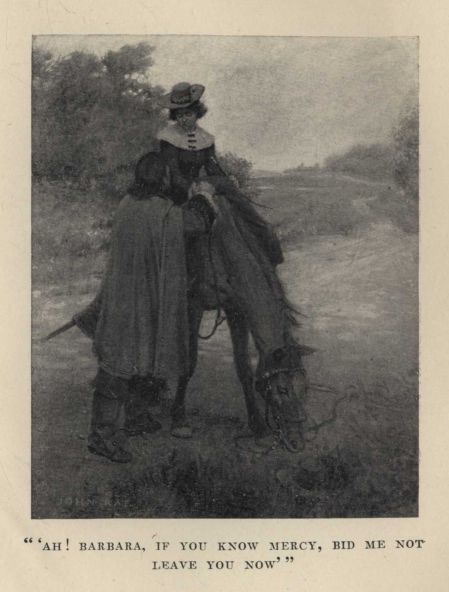
"'AH! BARBARA, IF YOU KNOW MERCY, BID ME NOT LEAVE YOU NOW'"
He paused, then as she sat dumbstricken by the force of his passion, he continued with a sudden bitterness:
"And yet how should I stay, seeing my love is nought to you. Better to leave you now. For in truth, a man must not ask too much of Heaven. But to leave you—to see your face no more! Ah! madame, madame, what is this you have done to me, seeing I cannot leave you now, and yet I dare not stay?"
There was silence. Then Barbara, turning away her face, said slowly:
"Captain Protheroe! I supposed you and Ralph fought concerning the affair on Sedgemoor. I—I knew of no other cause of quarrel betwixt you."
Captain Protheroe raised his head with a quick hope. "Ah?" he questioned breathlessly.
"Yes. And"—she continued hurriedly—"in this quarrel Ralph was in the wrong. I—I do not wish you to leave me."
A moment he paused. Then he answered in a low restrained voice:
"While I can serve you I will remain. But, an you need me no more, I pray you then, in pity, turn away your face and let me go."
But Barbara turned her head and looked at him, and she whispered softly, so softly that he but caught the words ere they died away:
"Nay, sir, but what an I need thee all my days?" And having so spoken again she turned away her head.
The birds' chorus rose loud and triumphant in the human silence that followed, while he took her hands in his and pressed them to his lips.
Then he tried to see her face, but 'twas still turned from him, he could but see one crimson cheek and the curling lashes resting upon it. He sighed softly, but smiled withal.