Front matter (continued 4)
Reading edition
After Cicely's departure Lord Jeffreys exercised his wits sharply upon the subject of his late applicant's visit, and his companions joined in his humour.
But despite the boisterous merriment an air of depression hung over many members of the company. This sudden accusation levelled at one of their comrades, for an affair so trivial in their eyes, and yet adjudged by the chief justice as worthy of death, roused an anxious terror in their hearts that would not be stilled. For if this man indeed be brought to punishment, upon whom might not the next thunderbolt fall; who could be accounted safe? Were they not all equally guilty, and equally open to betrayal? They eyed the judge nervously, and trembled while they laughed.
Only Colonel Kirke made no attempt to hide his preoccupation, though it sprang from another cause. He sat grave, silent, biting his lips in thought, while that strange gleam of ferocity deepened in his eyes.
At length Lord Jeffreys turned to his neighbour, and rallied him good-humouredly.
"Come, Percy," he cried, "you don't drink. Why, what ails you, man? Have you lost your heart to yon fair fool, eh?"
"No, my lord. I' faith, I have clean forgot her."
"But not her story, eh?" asked the judge, glancing at him with a sinister smile, for he was quick to read men's thoughts, and guessed at the anxiety in his companion's thoughts. "Come, about this rebel officer of yours. What of him? Shall we wink at the matter?"
His lordship was no hypocrite; that which he did, justly or unjustly, he made little attempt to hide, and certainly among his boon-companions, the taking of a bribe, or the winking at a fault were subjects for free discussion.
Kirke pushed aside his glass, and leaned across the table, speaking in a low voice:
"This is my affair, my lord. This is a matter for court-martial. Let me try the man."
Jeffreys laughed good-humouredly.
"What! you dog. You want to handle the crowns, eh! Is it a rich prize?"
"There'll be no crowns in this case," said Kirke with a grim smile. "This is a matter for punishment."
"What, colonel! Turned honest, eh! Why, man, if all reports are true you've done the same yourself, a thousand times, tho' certes you've more frequently pocketed the reward than spared the life."
"Maybe. But they have grown restive on the subject at Whitehall of late, damn them! My Lord Sunderland has been pleased to complain. Well, we'll make an example of this one."
"Tut! man. Have your way, court-martial an you will, but never hang the fellow. His friends won't pay for his carcase. There are enough and to spare for hanging; this fellow should yield a goodly profit."
"Years ago, my lord," answered the colonel grimly. "this man and I were in France together. We quarrelled concerning a slip of a girl; he professed to mislike my methods of dealing with her and laid his cane across my cheek in public. When I cried for satisfaction he refused, saying he did not measure swords with a bully. He is a swordsman, curse him; it was useless to brand him as a coward; I had no redress. That was twelve years ago. I feel the stroke of his cane on my cheek again to-night and here at last is a salve to the bruise. I've watched and waited, knowing that my chance would come, and now at last he is in my power. No, my lord, crowns will be of no avail; he shall be tried at sunrise to-morrow, and shot like a dog at noon."
Throughout this speech the colonel's tone had grown ever louder, and as he uttered the last words with a savage ferocity, the door opened, and Captain Protheroe walked into the room.
"Hullo! colonel, another victim?" he exclaimed. "Who is the wretched devil who is to be shovelled out of the world so speedily?"
There was deep silence. Captain Protheroe gazed round in astonishment at the circle of grave faces, all turned eagerly towards him. Only Lord Jeffreys gave a sudden short laugh, as he lay back in his chair and watched the scene. For he loved to watch human comedies, if tragedy lurked behind them.
Then Colonel Kirke spoke:
"Captain Protheroe, you are under arrest. You will give your sword to Captain Harrington, and accompany him at once to the guard-house. I refuse your parole."
The Captain faced the speaker in astonishment.
"I! Arrested! What devil's foolishness is this?" he cried. "On what charge?"
"Set a watch on your words," answered Kirke shortly. "You are charged with connivance at the escape of a noted rebel, Sir Rupert Winslow."
Captain Protheroe started. So there was ground after all for the accusation; it was no imaginary charge, easy to refute; it was a serious affair, an affair he saw well that might cost him dear. He hesitated a moment, then:
"I claim at least to have the matter referred to the General," he said resolutely. Neither Churchill nor Feversham, he knew well, would be severe upon him.
"You are at present under my command, Captain Protheroe," answered Kirke shortly. "You will be tried by me. Captain Harrington, remove your prisoner."
The Colonel had risen to his feet, and for a full minute the two men faced each other in silence. Then Captain Protheroe smiled. He knew his enemy's inveterate hatred, he read the full significance of that glance. And yet he smiled. It was too simple, too obvious. Not a man in that room, he knew well, but had been guilty a dozen times of the same breach of duty as that of which he stood accused, yet they went free, unpunished, while for himself he saw well there would be no mercy. The malice was too palpable, he laughed in his enemy's face.
Not, though it were for his life, would he urge one plea before this man; his pride forbade him to stoop to entreat the favour of one whose vengeance he so utterly despised. Without a word he handed his sword to Captain Harrington, and turned to accompany him from the room.
"Where is he to be lodged, Colonel?" inquired Captain Harrington doubtfully. "In the guard-house?"
Colonel Kirke hesitated.
"No," he muttered to himself. "'Tis not secure enough. The fellow is too devilish popular with the men. I scarce think my lambs would dare to revolt, but yet there might be an escape. I'll not risk it. I must ask you to keep the prisoner for me till to-morrow," he added aloud, turning to the governor of the prison, who was seated among the officers at the lower end of the table.
The governor shrugged his shoulders.
"I' faith, we are full enough," he muttered. "Tho' his lordship has cleared us out a little to-day," he added with a laugh.
"Any hole or corner will serve till morning," persisted the Colonel, "so it be secure."
"Secure enough; I'll answer for that," answered the governor as he scribbled an order for imprisonment.
He tossed the paper to Captain Harrington, an escort was called, and in a few minutes Captain Protheroe was marching through the silent streets to his prison.
He was no coward, yet no man in his inmost heart can jest when he finds himself face to face with a prospect of meeting death. And as he passed by the swinging corpses and trunkless faces hoisted on poles in the market-place, and reflected that in twelve hours he might be even such as they, he was seized with a wild impotent fury against the fate which had brought him to such a helpless pass. Only his soldier's pride held him from throwing himself desperately upon his guards, and making one last, vain, hopeless struggle for freedom.
The distance from the inn to the gaol was not great, and having arrived at their destination, Captain Protheroe was duly handed over to the charge of the head-gaoler, who in the governor's absence consigned him to one of the large sheds situated near the castle.
Then Captain Harrington, having fulfilled his commission, paused to bid his prisoner good-night.
"I am grieved about this, Miles," he said anxiously, for the two had been comrades. "But keep up your heart; the Colonel cannot really mean to treat seriously such an affair. Why, zounds, man, none of us have an over-clean record in that respect. He is bound to take some notice of the accusation, of course, and he bears a grudge against you, we know, but it can't mean more than a night or so in prison."
"Do you think so, Will?" answered the prisoner, pressing his outstretched hand. "No, Kirke and I have met before, we know each other. He's not the man to forgive an injury, and I'll be hanged if I ask him to; tho'," he added with a smile—"there's not a doubt on't I'll be shot if I don't."
"Tut, man, it's never so bad as that. Keep up your spirits. And anything I can do——"
"There are one or two commissions—— But there will be time enough in the morning to speak of them. You'd best return now and report to the colonel, or you will get a lick of the rough side of his tongue yourself, as my Lord Jeffreys hath it. Good-night.—And Will, here's a word of advice from a dying man, beware of women, and it may be you'll live to be drowned after all. Now, my man, I am ready," he added, turning to the gaoler, and with a final nod to his friend, he passed into the shed.
Captain Harrington stood for some minutes in thought. But despite the colonel's threats, he could not believe that he would carry out sentence of death for so trivial a matter, on one of his own officers. So with a shrug and a whistle he turned away, and strode back to the White Hart Inn.
CHAPTER XIV
Captain Protheroe leant against the wall, and gazed round his prison with an expression of deep disgust.
In a corner sat a noisy group of men, seeking as he judged by the dismal light of a flickering oil lamp, to drown their fears in drink. For the rest, the place was silent, and as it seemed to him, deserted, the prevailing darkness being broken only in places where the moonlight filtered through the high windows, and fell in splashes of brilliance upon the floor.
It was in truth a dreary place and one not calculated to raise the spirits of the new occupant, who stared moodily before him, cursing his luck. For he saw no hopeful prospect in the situation and he was by no means resigned to death now, when he was but beginning to realise the full joy of living. Two months ago, he told himself, it had been different; the world had not so much to offer then, indeed he had not known that it held so much. And now, with the new sense of this knowledge of the world's gifts teeming in his brain, to go forth and be shot down like vermin with never a fight for life! A man should not be called upon to endure so much.
And then, with a rush, his thoughts turned to Barbara. He could do nothing for her now. He could not even save himself, far less afford protection to another. He groaned aloud as he pictured her suffering, and again he bitterly cursed his utter helplessness.
Then, as he reviewed the events of the preceding hours, the question flashed across his brain: "Who had betrayed him? Who?" And quick as an answering flash came the reply, though he strove vainly to deny it entrance to his thoughts, "Who, but this girl herself, this girl who led him to the deed, for whose sake he was to die?" For to none but to her had he confessed his interview with Sir Rupert, none but she and himself knew of her appeal to his mercy or of her disclosure to him of her brother's hiding-place. Clear as day the facts lay before him, they would not be denied; she alone in all the world had the knowledge to betray him. And had she not already twice tricked him? Had she not plainly refused his friendship, denied him her trust?
This was but the consummation of her scheme. But that she should have wheedled him to spare this man, and, when danger threatened have betrayed him coolly, hoping thereby to save herself! He raged at the thought, at the black ingratitude of the action. And a woman with eyes as true as heaven, whom he would have trusted even to death! Where then could a man repose his faith, if she were worthless? Better indeed to die, and be out of a world where women could be guilty of such baseness.
Then a softer mood asserted itself. He recalled her face, the strong, proud face with the deep eyes, earnest and sincere behind the mask of mischief. He thought of her look when she had stood against him, sword in hand, to fight for her good name, fearless, resolute, even when driven to a stand with death seemingly staring her in the face. Here was no cowardice, no treachery. And she had risked her safety to give her brother an hour's happiness.
No, it was past belief that such a woman could be guilty of such devil's work. She must be innocent. There might be others—a woman always chattered—-he knew well she had a glib and hasty tongue. Or perchance they forced the story from her, tricked her to the telling of it. No, come what might, he would not believe that she had of set purpose brought him to this pass. And even if she had, if she had in a moment of weakness betrayed her benefactor, bartering his life for hers, even then——
Passionately he drew out the knot of ribbon and pressed it to his lips.
"God bless her!" he murmured tenderly. "Strong or weak, true or faithless, God bless her."
And still with that strange density which at times overclouds the instinct, a thought of the real culprit never crossed his mind.
Again he strove to turn his thoughts back to his own position, to weigh the prospects of release; but with scant ardour. Life had little to offer if he must stand by and see her suffer, and in face of his present disgrace, he realised his helplessness to assist her.
He continued to gaze moodily before him, idly watching a ray of moonlight steal across the floor of the shed. To his surprise he saw it reveal the foot of a woman, and as it climbed to her knee he marked the desperate tension of the clasped white hands that lay thereon:
"Poor soul," he muttered. "There is trouble there."
Higher still crept the beam of light till the whole figure was illumined, and then, as at the drawing aside of a curtain of darkness, the face of Barbara Winslow emerged slowly from the black shadow, and appeared before him bathed in a glory of light.
Barbara! Yes, though at first sight he barely knew her, barely recognised those pallid cheeks, the dropped jaw, the fixed, staring eyes wide with fear, all the agony of her terrified spirit written on her face.
He sprang forward with a cry and crossed the room to her side. She turned to him quickly and seized his outstretched hand, all other feelings submerged in the great terror that held her.
"Oh! I am frightened, I am frightened," she sobbed in utter abandonment. "Indeed I cannot bear it. Sure they cannot truly carry out the sentence? I could not endure it, it would kill me, and I cannot die yet. Help me, help me. Do not let them scourge me. I am so frightened, help me."
What could he do? He held both her hands tightly in his own, and passed his arm round her as though to shield her from all hurt. And she, forgetting all else in the face of this fear which she felt for the first time in her life, crouched against him in a paroxysm of trembling and sobbing.
"Oh! I know I am a base coward, but what can I do? For I was so happy, and life was so good, and now I—I, Barbara Winslow, must be scourged openly in the market-place by the common hangman, month after month, till assuredly I must die of the shame. Think! The troopers will watch and laugh, and I shall be—— Oh! no, no, indeed I cannot bear it; what shall I do!"
He ground his teeth in helpless, desperate rage. Wild vague assertions of help and protection rose to his lips and died away unuttered, for he knew himself powerless. His heart surged with impotent fury, while she sobbed in his arms in the very abandonment of fear and misery, the natural reaction after the proud restraint of the past few days.
But it was only for a little space; the firm clasp of his hands, the pressure of his arm, gave her the sense of human support and strength that she lacked. In a few minutes the cold terror left her, she was herself again save for backward shudderings at the remembrance of the emotions through which she had passed.
Drawing her hands gently from his grasp, she lifted her white, tear-stained face to his with a smile.
"Thank you," she said simply. "I know not what ailed me. 'Twas mighty foolish and yet 'twas terrible enow," she added with a shudder.
He laid his hand on hers again firmly, and she did not withdraw it. For a few minutes they sat in silence.
Presently Barbara's glance wandered to the far end of the shed, where the group of drinkers sat.
"They are to die to-morrow. I would I were a man, and knew no fear," she murmured enviously.
He smiled.
"Think you they know no fear? That is the very height of fear that dare not face the morrow, but seeks forgetfulness thus."
"Could I forget thus?" she asked.
"I would not have thee try, Mistress Barbara: 'tis but a coward's way."
"Yet 'tis but for one night," she cried hurriedly. "And I cannot bear this torture of waiting and thinking. Let me not be a coward again. Let me not think. Ah! when I think I see it all; the troopers and the prison and the post, month after month till—— Ah, no, I will not think. Talk to me—tell me—tell me why you are here," she continued, for the first time filled with curiosity as to the reason of his presence.
His heart leaped gladly at her question.
"Do you not know, madame?"
"Indeed no; it cannot assuredly be that you too are a prisoner?"
"Yes. A prisoner even as yourself, condemned for treason."
"You—a traitor. Impossible!" she exclaimed naïvely.
"I thank you for the compliment, Mistress Barbara," he answered with a smile.
"And the sentence?"
"Imprisonment—until to-morrow," he answered lightly.
"And to-morrow you will be free?" she questioned doubtfully.
"Aye, free from every fetter."
Something in his tone startled her.
"It is not so," she cried quickly. "You are deceiving me."
"Nay, madame. Is not freedom the supreme gift of death?"
"Then you are to die to-morrow?" she asked in a tone full of awe.
"Court-martial at sunrise, shot like a dog at noon. That is my sentence. Come, will you not wish me a pleasant voyage? I confess myself no good sailor, and do heartily trust they have no storms on the Styx."
He spoke lightly, but she turned from him suddenly with a choking sob.
"Oh!" she cried bitterly. "How you must despise me for a true coward."
He laughed tenderly.
"Nay, Mistress Barbara, we be all cowards at heart, I warrant, only some have learned the trick of hiding it. And indeed to one who has faced him many times, death loses somewhat of his grim aspect. Besides—" he continued cheerily, "when a man bethinks him how many of his fellows in past ages have faced death unflinching, it seemeth but a small matter for him to follow in their footsteps. I doubt not we shall meet with gallant company across the bourne."
"And have you no regrets?" she asked wonderingly.
He looked down at her and his face clouded.
"Aye, madame, one." He hesitated, then continued in the strange hurried tones of one who has at last resolved to speak his thoughts, and risk the consequence.
"Men on their death-beds make strange confessions, madame; here is mine. For fifteen years I have asked and expected little of life save to win a name in my profession, and for the rest, to enjoy to the full all the pleasures that the world had to offer. I deemed that I had succeeded fairly in both these, my ambitions, and I was content. But—two months since, on a certain sweet night in July, I met a woman. Not such an one as the courtesans of Whitehall, not such as are they whom a soldier most often meets in his way thro' the world, but such a woman as a man might dream his mother was, such as he would wish to be the mother of his sons. And when I looked into that woman's eyes I understood for the first time that all I have sought and won from life was worthless, and tho' I have drunk deep of the cup of pleasure, yet all my days I have been but as a child playing contentedly in the desert, while the door of an enchanted garden lay unnoticed at my side."
"Were the woman's eyes indeed so beautiful?" asked Barbara softly.
"Madame, they are as the clear depths of the heavens, wherein a man may read all the perfection of life. I have seen her but thrice since first we met, yet one look into her eyes has taught me more of the reality of life, of happiness, of love than I ever dreamed of even in the age of a man's most golden hopes. And so, madame, I cannot die without one regret, the regret that I may not live to deserve the pressure of that woman's hand, nor hope to make myself worthy to feel the touch of her pure lips."
He paused, looking down upon her doubtfully; she did not meet his glance, but he heard her sigh softly, as she gazed before her into the darkness. At length she spoke.
"Then you had been happier had you never seen the woman? Is it not so?"
"Happier! No, Mistress Barbara, is it not better for a man to die, having gazed once upon the glories of the heavens, than to live a thousand thousand years, nor lift his eyes from earth?"
There was silence between them.
Then Barbara rose from her seat.
"I am weary," she said softly. "I think I could sleep now, and I would fain be rested for to-morrow. I must be strong then; they shall not think I fear them. I must rest. But not in there," she added, gazing shudderingly at the dark corner behind the screen. "Not in there, lest I wake."
Near them lay a pile of straw and loose wisps of wool. These he gathered together, and spread his cloak upon them.
"It is not much," he muttered discontentedly; "yet it is better than the bare boards."
"It is perfect," answered Barbara, snuggling down into the warmth of the cloak.
He knelt to draw it more closely round her.
"Good-bye, Mistress Barbara," he said, raising her hand to his lips.
But she, suddenly raising herself upon her elbow, drew his head down towards her and kissed him on the lips.
"Good-night—good-bye—and thank you," she whispered simply.
Then she lay down peacefully, and drew the cloak once more around her.
The moon dipped behind a bank of clouds and the prison was in darkness.
Captain Protheroe rose to his feet, and stood for some time gazing before him, as one half-dazed. Then he recovered himself with a start, his eyes flashed, he looked round quickly, his whole body alert for action.
Die! No surely not now, he could not die now. It was impossible; there must be some way of escape for them both. If he could but think of it!
But the more he thought thereon, recalling all the tales of prison breaking and rescue that he had read or heard of, picturing the security of the shed, the disposition of the sentries, the surer did the knowledge of his utter helplessness overwhelm him, and yet the more persistently did he fight against this knowledge, assuring himself continually that death must be impossible now.
CHAPTER XV
Prudence sat on a stone seat at the bottom of the high-walled garden behind her father's house. Around her fell the soft moonlight, clothing the daisied grass and the shimmering trees in a veil of glory. The air was full of rich scents, remembrances of the dying sweetness of the roses, the noises of the street were hushed, and there rested over all a soft whispering silence, broken occasionally by the rapturous notes of the nightingale, as he poured forth his soul in an ecstasy of love. The scene was redolent of the sweet witchery of love, and Prue with her soft eyes, her glittering hair, and the mischievous dimples deepening in her cheeks, seemed in the moonlight like some fair enchantress weaving the spell of her sweet beauty over all around.
There were no traces on her fair face of the horrible scenes of which but half an hour since she had been a witness, no indication on her smooth brow of the strain of the last two days. She had not forgotten Cicely's misery and how she lay so still, so silent in the room above; but the weight of a sorrow which did not touch her personally lay but lightly upon her young heart, and she had been conscious of a feeling of relief when she left her friend to the tender care of Mistress Lane and crept out into the silent, peaceful garden.
A thorough child of nature, she sat calm and happy, her spirits in harmony with the scene immediately around her, though in the streets without the drying corpses of innocent men waved their limbs weirdly in the breeze, and women, their hearts breaking with despair, sat silent in a grief too deep for tears.
Prudence sat deep in thought. She had an enterprise in view for the furtherance of which she foresaw the necessity of laying resolute siege to the will of Master Robert Wilcox. She would require his co-operation, and as she traced out the lines of her campaign, her eyes glistened brightly, and her lips curved into a roguish smile. For Prue was one to scorn an easy dominion, else had she never given her heart to so resolute a lover as Robert.
So intent was she upon her thoughts that she did not notice the approach of Master Wilcox himself, walking with rapid step down the trim garden path; in fact he had been watching her for some minutes in a lover's rapture, before she raised her eyes and noted his presence. Then he sprang eagerly to her side.
"Ah! Prue; sweetheart," he cried, with outstretched arms. "I hoped I might chance on you here, and yet indeed I scarce dared to hope it."
Prue slipped quickly aside from the proffered embrace. "Good-evening, Master Robert," she answered with a demure assumption of indifference. "And pray what may be your errand to me?"
Robert's hands fell to his side; he stared at her in amazement.
"Why, Prue, my darling," he exclaimed.
Prudence eyed him coldly.
"'Tis a fine evening, Master Robert, and I was enjoying the silence and solitude of the garden. Prithee then—your errand?"
Robert hesitated a moment, then he seated himself upon the bench beside her, and laid his hand on hers.
"Come sweetheart, what is wrong?" he demanded resolutely.
"Nought that I know of," she answered calmly, withdrawing her hand, "saving only that methinks you are somewhat free with your 'sweetheart' and 'darling,' Master Wilcox."
"What! Must I not call thee sweetheart then, my dearest?"
"In truth I had as lief you did not," she answered curtly.
Robert eyed her a minute doubtfully: then he plunged boldly into the subject.
"See here, Prue, what is the matter; for what art thou so angry with me? An it be concerning Janie Medlar, 'tis mere foolishness. I met her down by the river, 'tis true, yet 'twas but by chance, and then I could not, in courtesy, refuse to walk home with her. Now could I? And the rose—she asked for it herself—I swear she did. But no more passed between us, save the merest—er—nothing whatever. 'Tis utter foolishness, Prue."
Prudence smiled to herself; she was learning secrets. But she answered coldly enough:
"I' faith, Master Robert, and what is it to me what passes betwixt you and Mistress Medlar? 'Tis much, indeed, if I am to call her rival—pale-faced chit."
"'Tis not that? Then in Heaven's name, Prue, what is it? What have I done?"
Prue turned and faced him:
"Ah, well said. What hast thou done, Master Robert? What hast thou done all thy life save sort wool and enter ledgers? And yet you would be one to call a maid 'sweetheart' and kiss her on the lips. I tell you, you must seek elsewhere then, Master Robert, I am not for such as you. I will have nought to do with any, save brave men, men proved by action, not swollen with boasts."
Robert groaned aloud.
"Lord, Prue," he muttered; "not that all over again."
"And wherefore not, Master Robert? Has a man nought to do save sit till the apples fall into his lap? Thinkest thou a girl can be wooed by words alone? I tell thee thou art mightily mistaken. If a maid be worthy of love she is worthy of winning, and winning by deeds, not by empty vows and foolish boastings."
"Perchance thou wouldst have me join Kirke's band then, and win thee by such deeds as those in the market-place yonder," muttered Robert angrily.
"Indeed that were better than nothing," answered the girl with a mocking toss of her head. "Better be one of Kirke's Lambs, brutes tho' they be, than a white-livered wadcomber, caring for neither king nor country so he have a full belly and a whole skin."
"Now by Heaven, Prue, this is too bad. 'Tis unfair to taunt me thus when thou knowest I had ridden gladly with the Duke if I had but been given the chance, and that I do but bide here at the work to please thy father, and so clear my way to winning thee."
"Is't verily so?" laughed the girl scornfully. "Truly I marvel what men would do, if they had not women's petticoats to hide behind."
But this was too much for Robert to endure with patience. Though he more than half suspected she was playing with him, for he had watched her smile as she sat on the bench alone, yet he felt that no man should be called upon to endure such mockery; for the sake of future peace he resolved to teach her a lesson.
Roughly dropping the hand which he had taken again to strengthen his plea, he moved to the far end of the bench, and turned an angry shoulder to his tormentor.
"So be it, Mistress Prue," he answered. "An those be your opinions, 'tis useless to talk further on the matter. I am sorry that my actions fail to please thee, but on my honour, I do not see that I am in any wise bound to alter them to suit every whim and fancy of thine. The evening is chill; would you not be wiser to go indoors?"
Prue gasped, and gazed at the sulky shoulder with eyes wide open in astonishment. The affair had taken a sadly different turn from that which she had contemplated. It looked greatly as though this attack upon the fortress would prove a failure, nay more, as though it would turn to a defeat and rout of the attacking party itself, did she not with all speed change her tactics.
Accordingly, with a celerity worthy of a great general, she changed, upon the instant, her whole plan of campaign, abandoned this frontal attack, and devised a more subtle method of overcoming such unexpected resistance.
She tried first the effect of silence; but experience had taught her that Robert was better skilled in the use of that weapon than she herself, and indeed it was a struggle to her to keep silence for five minutes at any time. She abandoned this course after a very short trial.
Then she sighed. Twice, thrice, with the suspicion of a sob in the last sigh, which she felt must sound infinitely pathetic. She looked eagerly for signs of relenting in that stubborn shoulder; Robert was resolute.
The affair was beginning to assume a most serious aspect. If it continued thus much longer, she would be forced to haul down her colours and abandon the siege entirely. And then what would become of her schemes?
No. She must bring all her forces to the attack, and—and—Robert could not see her where she sat.
She rose and stepped quietly into the deep glow of the moonlight, standing full before the gaze of her offended lover.
She stood first with her back towards him, plucking nervously at the petals of a withered rose. Robert looked at the trim, white figure outlined against the darker trees, at the soft curve of the averted cheek. He looked and wavered.
Suddenly she turned and faced him, standing before him in all the charm of her saucy beauty. She shook out her curls till the gold glistened in the moonlight, she turned her eyes full upon him, and she smiled, a smile full of mischievous invitation that lurked in her eyes and curved round her rosy dimpling lips.
It was enough. Robert stared at her for a moment in silence, then he sprang towards her and seized her in his arms.
"Ah, Prue, you witch! You witch!" he cried. "How could I resist thee? Say what you want, sweetheart. I will do it, aye, that I will."
"Wilt thou really promise that, Rob?" she asked, nestling into his arms.
"Aye, sweetheart."
"Anything, Rob?"
"Anything you ask," he answered, gazing into her eyes.
"Then, oh, Rob; help Mistress Winslow to escape."
He stared in astonishment.
"What sayest thou? Prue! Prue! 'Tis impossible, 'Tis madness to dream on't," he cried.
"You promised to do anything I asked," she complained reproachfully, straining against his embrace.
"Aye, sweetheart, so I will, so I will." He pledged himself rashly to keep her in his arms. "But this—— How is't possible? Would you have me break into the castle and bear her out by force?"
"She is not in the castle; she is lodged in one of the temporary sheds," corrected Prue reproachfully.
"Well, 'tis the same thing, sweet. Gaol or shed, 'tis prison enow, and i' faith, I see not how it be possible to fetch her out."
"Pooh! What is the use of thy wits, Rob, if thou canst not get the better of father's old wool-shed."
"Master Lane's shed, sayest thou?"
"Aye, truly, she is there. Dad told me so this morning. The door bolted and barred, sentries in the street without, and many more in the guardhouse opposite. I saw them there last Sunday when I passed. But what of them. You can surely outwit such fudge-heads as they."
"Master Lane's shed," cried Robert again, a strange note of excitement in his voice. "Art certain she is there?"
"Aye, certain, Rob. What then?"
"Prue, who guards the little door in Blind Man's alley?"
Prue looked at him eagerly.
"What door, Rob? I mind it not."
"Yes, thou knowest it. The master's private door at the near end of the shed. They say 'twas put there years ago for old Master Lane, thy grandfather, to enter secretly and count his bales; maybe for the entrance of other sorts of goods,—folks say. For 'tis known he hid arms and ammunition for the king's troops in the last war. It has not been used for years, and on the inside 'tis still hid behind a pile of sacks, I doubt not. But 'tis there."
"Oh, Rob! I had forgot it entirely. And oh, I doubt not they have forgot it too, for I passed thro' Blind Man's alley last Sunday even, and there was no sentry stationed there."
"No, sentry, Prue? And the key hangs on thy father's chain."
His voice was hoarse with excitement, he stared before him in dawning thought.
Prue clasped her hands eagerly.
"Oh, Rob," she whispered. "What shall we do? What shall we do?"
He turned his head slowly and looked down at her.
"Ah! sweetheart, it's madness, madness!"
"Yes, Rob, dear, but—let us be mad. Ah! do, do."
He hesitated, but his inborn love of adventure tempted him as much as her eyes. He yielded to her pleading, and sealed the bargain with a kiss.
Then they sat down on the bench, hand in hand, and proceeded to mature their plan.
"Now, sweetheart, we must think with all our wits."
"It must be to-night, Rob," Prue urged. "They might carry out the sentence to-morrow. It must be to-night."
"To-night be it."
"And what shall we do?"
"There is but the one way that I can think of. Enter the shed by the hidden door, and fetch her out thence."
"Oh, Rob, that sounds so easy," cried Prue, a note of disappointment in her voice.
"Does it indeed, madame?" he laughed. "And what if the door be barred within, or I meet with a sentry, or the other prisoners should betray me, or I cannot find the lady, or she will not come?"
Prue gasped in dismay at this terrible list of possibilities.
"Oh! it is too dangerous, Rob," she urged with a sudden shrinking terror.
"Nay, but we'll e'en try it. For indeed I do not think any such misadventure likely to befall us."
"Then let us set about it at once, Robert."
"Nay, there is much to think on yet. Where shall I hide her when she is free of the prison?"
"Bring her here, Rob, by the garden door. I can hide her in the old attic for a night or so, and they will never dream of seeking in father's house for an escaped rebel, and in a few days Lady Cicely may win her pardon. But I am coming with you, Rob."
"Certes, no. Why, I had as lief have my Lord Jeffreys. No, Prue, I mean it. If I cannot go alone, I go not at all."
"Oh, but Rob. I must do something."
"Ay, i' faith, thou must. 'Tis for thee to get the key."
"The key!"
"Aye, the key of the shed. It hangs, as I said, on Master Lane's chain, tho' he hath doubtless forgot the fact, it has been so seldom used. But I know it well. Now, how wilt thou get it for me?"
"Oh! Rob, I know not, i' faith. How is't possible?"
"Pooh! Where are thy wits, Prue?" he asked teasingly.
"You shall not mock me," she panted. "But in good earnest, Rob, 'tis impossible."
"Come, Prue, no despair. Why, I have seen him hand thee his keys a hundred times."
"Aye, but that was for the cellar, when he fancied a certain wine at supper, or maybe for his bureau in the counting-house, to fetch papers or moneys. Not—not—Rob!"
"Well!"
"Thinkest thou not, perchance that a glass of hot port wine might help my Lady Cicely to sleep."
"Prue! Thou has hit on the very plan. And once the chain is in my hands, the key of the shed is ours. But go to thy father quickly, sweet, or 'twill be too late, and Lady Cicely will fall asleep before her drink be prepared."
"Oh! Rob, I shall laugh when I ask him; I know I shall."
"Not you, Prue. I've too good cause to know your powers of acting a part."
Prue laughed and blushed at this reference to the evening's quarrel. Then she sprang quickly to her feet.
"Well, I must do my best. Do you wait here, Rob, and in ten minutes I'll be with you."
She darted across the grass and disappeared into the shadow of the trees.
Robert awaited her return in a frenzy of impatience. So much depended upon the success of the girl's errand, so many obstacles presented themselves before his mind. For Master Lane might hand her the cellar key alone instead of the chain, though that were never his way. Or Mistress Lane might be with her husband and disapprove of her daughter's request. Or Deb might accompany her sister to the cellar, or Prue herself, in her excitement, might betray the plot. Of the danger, the madness of the undertaking he thought not at all. Once embarked upon the enterprise he was carried along by the excitement of the adventure it promised. Like Prue, he lost sight of other considerations in view of the daring of the attempt.
Presently he saw her coming towards him, her white dress gleaming through the trees, and as he darted to meet her, he heard the jingle of the keys. She had succeeded in her quest.
"Here they are," she whispered, her eyes dancing with triumph. "Take it quickly, I must not keep Dad waiting. He was alone. He gave them without a question. 'The whole cellar full if 'twill aid Lady Cicely,' he said. Is that the one, art sure? Then give me the chain, and go. Here is the key of the garden gate. I will watch. Keep out of danger and be careful. But oh! Rob, is it not fine? You and I to outwit them all, my Lord Jeffreys and the governor, and—and the very law itself."
He laughed aloud, sharing to the full her excitement. Then without further parley he set out on his errand, leaving Prue to her eager watch for his return.
So these two laid their wild plans in the solitude of the peaceful garden, while in the castle near, the prisoners rested quietly, resigned to their fate, and in the brightly lighted room of the White Heart Inn Judge Jeffreys and his comrades feasted and drank till the night air rang with their boisterous revelry.
CHAPTER XVI
Robert Wilcox hastened on his way to the prison with joy in his heart and excitement in his eyes, at thought of the adventure that promised, while in the darkness of the prison Captain Protheroe sat with his head buried in his hands, sunk in the misery of an impotent despair.
No man who has not himself endured it can understand the agony to a man of Captain Protheroe's disposition, of acknowledged helplessness. For he was essentially a man of action, strong, capable, alert for every danger, with a ready wit to cope with every obstacle that rose in his path. He had never yet learned the meaning of failure. And now, when life at last offered him the full cup of his desire; when but four bare walls stood between him and a freedom so rich that beside it his past life seemed but an empty waste; now when his whole being clamoured for action, he could do nothing but sit helpless and inactive, while the hours slipped slowly away and the day drew near when the woman he loved must suffer shame and torture with none to support or comfort her. He knew it was useless to struggle against his fate, but his whole soul cried out against submission. Yet he could do nothing, nothing, but sit rigid, silent, his hands locked together in the fierce misery of impotent revolt.
Suddenly he stirred, every sense on the alert and listening intently. At the farther end of the shed his fellow prisoners lay silent, their sleeping forms dimly visible in the faint light. Close beside him, where a pile of bales and sacks was heaped against the wall of the shed, he seemed to detect the noise of a key turned gently in a rusty lock, followed by the creak of an unused hinge. He waited with bated breath for what should follow. After a pause the hinge creaked again.
Half incredulous, he crept forward to investigate the cause of the unmistakable sounds, and began noiselessly to remove the sacks from that portion of the wall which they concealed. Two he moved easily, but the third resisted his efforts. In vain he pulled, exerting his strength in an obstinate determination to have his way. As he became dimly conscious that the resistance was rather active than passive, it suddenly ceased, and he stumbled backwards, with the sack in his arms.
Like the full moon on an Autumn evening the fiery head and rosy countenance of Master Robert Wilcox rose slowly into view above the top of the piled bales, and peered cautiously into the shed.
For a moment the two stood staring at one another doubtfully. But as Master Robert slowly perceived the captain's uniform, his jaw dropped, and a look of horror and consternation crept into his face.
"Good Lord!" he gasped, and with a sudden swift movement, his head disappeared from view.
But Captain Protheroe was no whit behind him in rapidity of thought or action. Quick as lightning his arm darted over the sacks, and he grasped firmly the tousled hair of the intruder.
"Hist, you fool!" he whispered. "All's well. I'm one of the prisoners myself. Is it a rescue?"
Slowly the face reappeared and stared doubtfully at the speaker, then having subjected him to a critical survey, and being at length assured by the captain's tone and bearing of his good faith, Master Wilcox heaved a sigh of relief, and rubbed the sweat from his forehead.
"Phew! What an escape," he muttered. "I made sure you were one of those damned sentries. Yes, 'tis a rescue, but not for you," he continued curtly.
"Nevertheless, my friend, I purpose to be one of your party," answered Captain Protheroe coolly, "I and a lady who is here with me."
"A lady; what lady is she?"
"What is that to thee?"
"Nought, only 'tis a lady I am here to aid; Mistress Barbara Winslow."
"What! Even so? Why, well met, friend. 'Tis even she of whom I spake. She is sleeping yonder. I will go bring her and we can slip out quietly without rousing the others."
Robert eyed him half-doubtfully.
"Be speedy then. Every minute is danger, for I know not when the sentries will be round."
"True, there's no time to lose."
The two had carried on their conversation in whispers; the other inmates of the shed were undisturbed.
Captain Protheroe now went swiftly to Barbara's side. She was sleeping quietly, her cheek pillowed on her hands. He aroused her gently.
"What is it?" she gasped, in sleepy bewilderment.
"Freedom," he whispered, smiling down at her.
Silently they stole back across the shed, and soon the three stood side by side in the narrow alley outside.
"Come!" cried Rob, seizing Barbara's arm eagerly. "There's not a moment to lose. Come!"
But Barbara was now thoroughly awake. She drew back quickly.
"But the others!" she exclaimed. "Surely you will not leave them behind. They are to die to-morrow."
Captain Protheroe shook his head.
"Mistress Barbara, the risk is too great."
"Oh, but that is rank cowardice," she exclaimed angrily. "You may do as you choose, sir, I shall——"
He laid a restraining hand upon her arm.
"Captain Protheroe," she exclaimed indignantly, eyeing him haughtily.
He smiled at her serenely.
"Yield to reason, Mistress Barbara. You cannot go back."
Barbara turned away angrily, and addressed herself to Rob.
"Cannot you go back?" she asked.
"Not I, madame," was the ready answer. "You are not safe yet."
Barbara sighed, looked at the pair of them contemptuously, and yielded to necessity.
"But you can leave the door open," she urged.
Rob hesitated.
"'Twill be a clue," he muttered, but yielded to her plea. "Now, come, madame, we must wait no longer."
"Where are you going?" she demanded quickly.
"To Master Lane's house," he answered impatiently. "Lady Cicely is there, and——"
But Barbara shook her head obstinately.
"No," she said, "I will not bring trouble upon them. They are loyal folk, and were I discovered there, 'twould bring misfortune to all. Did Master Lane send you to me?"
"No, madame, he knows nought of the venture as yet, but——"
"Then, indeed, I will not go. I will not endanger them, and Cicely. 'Twould be most cruel."
Rob groaned in desperation.
"Lord! These women!" he muttered. "Nay, madame, trust in me and come at once. We may be discovered any moment."
Barbara turned to Captain Protheroe.
"Whither are you going, sir?" she asked abruptly.
"I' faith, I cannot say," he answered doubtfully. "But for you, madame, it were certainly wiser to follow this gentleman, if he can bestow you safely."
"I will not," she answered resolutely.
"We'll all swing for it, an we bide here parleying much longer," began Rob desperately.
He broke off abruptly, for even as he spoke, a window in the wall opposite was flung open, and a man's face peered out into the alley.
Instinctively the three drew back into the shadow. But it was too late. The disturbed burgess had seen the three figures, and in an instant he suspected the truth of the situation.
With an exclamation his head disappeared from view, and a moment later they heard the bolts of a door round the corner of the building shot back and the man rushed into the street shouting:
"The prisoners are escaping! Look to your prisoners."
Captain Protheroe seized Barbara's hand, and they began to run rapidly down the alley. They heard the sentinels running up the street and shouting. They darted round the corner as their pursuers turned into the alley.
Rob had disappeared.
The alley led into a wider street, parallel to that in which the sentries had been posted, at the main entrance to the shed. Down this the fugitives turned, but were met by a knot of men running towards the shouts. Captain Protheroe tightened his grip on Barbara's hand, desperately, and ran straight towards them, waving his free arm in the direction of the prison.
"The prisoners!" he shouted. "They are escaping, look to them."
The ruse succeeded. The men hesitated a moment, staring doubtfully at his uniform, and then proceeded at a run towards the prison, shouting confusedly. On they ran right into the arms of the sentries, who at that moment turned out of the alley.
A few moments of confusion ensued ere the identity of each party was made clear to the other—moments precious to the fugitives, who ran on blindly from street to street, little heeding which way they went.
Barbara stumbled as she ran, and her breath came in sobs. Captain Protheroe's grip upon her wrist was like a vice. Again they turned a corner, and for an instant they stopped dead; for halfway down the street, full in their path, the bright light from an open doorway flared across the road, and in the light stood a group of soldiers eager and alert. They had run into a trap.
Their pursuers behind shouted a warning, the troopers in front wheeled round quickly to face them.
To go back was impossible, to stand still, madness, to run forward into the arms of these expectant troopers, a desperate chance. This time no ruse could avail them.
And then, a few yards on the near side of the lighted doorway, Captain Protheroe espied a dark opening in the line of buildings. He darted towards it and slipped between the black shadows of the houses.
Barbara was spent, but even as they ran into the narrow alley, and as he felt further effort was hopeless, Captain Protheroe noted an open doorway, dimly lighted. It was a desperate chance, his only one. With an effort he dragged Barbara into the house, and shut the door behind him, listening intently, while the girl sank exhausted at his feet. He heard their pursuers turn the corner, pass the door unheeded, and running eagerly on, turn again into the street beyond. Their shouts and footsteps died away in the distance, and all was still.
Captain Protheroe turned and surveyed his surroundings. They were in a narrow, dimly-lighted passage, flanked by a doorway on either side, and leading to a third door at the end. The door on the left was open, and the room to which it gave access, a small parlour, was deserted.
He glanced at Barbara. She raised her head and smiled at him bravely, though her breath still came in shuddering gasps, and her face was white and drawn.
He stooped down, and helped her to her feet, then leading her into the little parlour, laid her, unresisting, on the settle, and closed the door.
"Where are we?" she whispered, looking wonderingly around her.
He shook his head.
Just then a door was heard to open in some distant part of the house. There was a babble of sounds, a shrill voice singing through the verse of a song, followed by a loud burst of boisterous laughter.
Captain Protheroe, with a quick exclamation, crossed to the window of the room, drew aside the heavy curtain, and peered out.
Then he turned with a strange expression in his eyes.
"We have walked into the lion's den, Mistress Barbara," he said. "This is the White Hart Inn."
Barbara started to her feet.
"Oh! let us go, let us go instantly," she cried.
Captain Protheroe stood irresolute.
"I don't know," he said slowly; "it may be we are in the safest place. At least 'tis the last place where they would dream of searching for us."
As he spoke, the door at the end of the passage opened, and they heard a dragging footstep slowly approaching.
Barbara clasped her hands in desperation.
"Lie down!" he whispered sharply. "Lie down, and turn away your face."
The footsteps drew nearer, the door was pushed open, and a girl carrying a dim rushlight entered the room. Her dress was untidy, her hair tousled, her eyes heavy with sleep.
She gave a quick cry at sight of the occupants of the room, and almost dropped her candlestick in her surprise.
"Why, Sue, what ails you?" Captain Protheroe asked cheerily.
The girl stared at him in bewilderment.
"La, Captain Protheroe, sir, eh! but ye frighted me. I took thee for a ghost. What ever be thee here for? Why," she continued with dawning recollection, "I heard tell as how thee wert took prisoner, and in gaol along wi' rebels."
"Arrested, I! What nonsense," he answered coolly; "'twas but a jest of Colonel Kirke's. They don't arrest the king's officers, Sue, my girl. But look you, this lady hath but just recovered from a swoon. There was a disturbance in the streets, and she was thrown down and frightened. I brought her in here to recover, before I take her home."
"Eh, poor thing!" exclaimed Sue, eyeing Barbara pitifully. "The street is no place for the like o' her this time o' night. But you're kindly welcome, sir, and the lady too. We could not give her a bed, sir, I'm afraid; but an she wish to rest on mine——"
"Oh, there's no need to put yourself about, she will be well enow shortly."
"Would you be wishing for supper, sir?" asked in girl sleepily.
"Supper! Good heavens, no. Why it must be near midnight. I'm for my bed presently, and methinks 'tis the place for you now. You look tired to death, my girl."
"Aye. I've been about since five o'clock this morning," she answered, yawning. "Their lordships make a deal of work. But I'm going to my bed now, if you want no more, sir."
"Nothing, thank you, Sue."
"I'm sleeping in yonder," nodding her head across the passage. "Perhaps you'd call, sir, if you want anything." Then she added, hesitating, "We be so full o' guests now, father sleeps on the settle here. But he'll hardly be down yet, he must see their lordships safe to bed first. Good-night to you, sir."
She crossed the passage and disappeared through the doorway opposite.
Captain Protheroe broke the silence which followed:
"If you are rested," he said briskly, "I think we had best be gone."
"Must we go?" she asked lazily.
"The sooner we are free from the houses, the better. The landlord may come here any moment. They are quieter above stairs already."
Then he glanced across the room.
Through the half-closed doors of a cupboard in the corner he espied some dishes of meat—cold bacon, a half eaten pasty, several loaves of bread.
"Fugitives cannot be over and above honest," he muttered with a laugh, as he swept the contents of the cupboard into a cloth, and tucked the bundle under his arm. "We can make the loss good to mine host, some day, perchance, and food we must have. Now, Mistress Barbara, if you are ready."
He stopped with a look of consternation, for even as he spoke, the passage door again opened, and they heard a man's voice calling aloud:
"This way, Master Peters, we can transact our business somewhat more privately here."
The only possible hiding place the room afforded was the space between the high-backed settle and the wall. In an instant the two had stepped back into its shadow, and crouched there, scarce daring to breathe, hoping only that the dim uncertain light might conceal their presence from the two men who a moment later entered the room.
The first was a big, burly farmer, with round, red, solemn face and somewhat wooden cast of countenance. He took up his stand by the table, facing the settle, but with the light between him and the fugitives.
His companion afforded a marked contrast; a small, thin, wiry, sharp-featured man. His pale face was alight with intellect, but his narrow-set blue eyes were hard as steel, and while seeming to pierce a man's inner-most thoughts, yet gave in return no vestige of answering confidence. He was soberly suited in black, and carried in his hand an open letter, and a small bag of gold.
This was no other than Master Stephen Jewars, my Lord Jeffrey's clerk and secretary, one in whom it was commonly averred his lordship trusted more nearly and confided more honestly than in any other living man.
The secretary, laying the letter open upon the table, turned and faced the farmer.
"You are after your time, Master Peters," he began, "I had expected you yestere'en."
"Aye, aye," answered the farmer slowly. "I were in Taunton then, sure enow, but the mare were took bad and I could not leave her."
"Hum," answered the other somewhat sharply. "You should recollect, Master Peters, time is precious."
"Aye, your honour," answered the farmer imperturbably. "But so is hosses."
The secretary started angrily, and eyed the solemn face of his companion doubtfully. Then satisfied by his scrutiny, his lip curled slightly, and he proceeded:
"Well, well, now you are here, I need not detain you. I see by this letter that you successfully carried out your undertaking."
"Aye, aye, sure enough. I took Master Ferguson to——"
"Master Peters," interrupted the other sharply, "you will do well to remember this is a matter requiring much circumspection. We will, therefore, have no names, if you please."
"Why, there be none here to hearken," answered the farmer, in aggrieved surprise.
"There is a saying that walls have ears. You cannot be too careful."
"As your honour pleases," answered the man with a shrug. "I took the man, you know who, safe to Lime right under the noses of the troopers, he lying hid in my cart. He bided three nights in my house, and then I shipped him to France wi' my wife's cousin."
"'Twas well done, Master Peters, and here is the price for your task."
The secretary handed the man the bag of money, and watched him secrete it in his belt. Then he laid his hand on the farmer's arm, and eyeing him steadily with those piercing blue eyes, addressed him in a slow impressive tone.
"And now, Master Peters, there remains but one thing to say to you; a warning. You will remember that this matter is an affair of state, and he who has had aught to do with such affairs does well to keep his eyes blinded, his ears deaf, and above all, his tongue dumb. If by word of yours, spoken be it in anger, in boasting, or in drink—if ever, I say, word of this matter escape you, you will——"
"I'm paid to be quiet; I'm not a man to babble i' other folk's affairs," interrupted the farmer in an aggrieved tone.
"I knew it, otherwise you had not been chosen for the work. Nevertheless, bear my words in mind. The man I serve is all-powerful. He can reward generously, but he never forgets an injury, and he never forgives a foe. Good-night, Master Peters, and remember to bear yourself discreetly."
The secretary let the man out through the door leading into the alley. He returned to the room muttering to himself.
"I doubt the fellow must be disposed of, he knows too much," he said slowly. Then he picked up the letter from the table, and stood for some minutes gazing at it abstractedly, lost in thought.
"Fool! Fool!" he muttered at last. "Madman, to put himself in the power of such a man. Of a surety it must work his ruin in the end. And all to no purpose, since the papers are still lost. And yet, what is't to me? For an he rise, I shall rise with him, and if he fall—his carcase must serve as a stepping-stone, whereby I may rise alone."
Thoughtfully he folded the letter, and placed it in his pouch, then turned again from the room. They heard him go slowly down the passage, a door closed, and all was still once more.
The fugitives emerged cautiously from their hiding-place.
"Ferguson! Ferguson!" muttered Captain Protheroe to himself, as he wrapped his cloak round his companion's shoulders. "Ferguson and Jeffreys! for assuredly 'twas Jeffreys of whom he spoke. Now, what the devil—— But come, Mistress Barbara, we'll away from here, and leave them to brew what plots they will."
Barbara pulled the cloak closely round her, and followed him silently out of the house. He walked quickly down the alley, and turned into the silent street behind the inn. The moon was down, and save for the occasional glimmer of a lamp, the streets were in darkness.
"Where are we going?" asked Barbara, wonderingly.
He shrugged his shoulders.
"We must get clear of the town, first. You will not go to your cousin?" he asked doubtfully.
"No, indeed! I would not risk danger to Cicely. And besides I know not where lies the house."
"Then we throw in our lots together?" he asked, smiling down on her.
"Indeed, sir, I see not what else remains for me," she answered simply, committing herself to his protection with an implicit faith.
Under his breath he prayed Heaven he might be the means of saving her.
The streets were very silent, they passed on unheeded, avoiding the watch by careful detours. Of their former pursuers they heard nothing; and, indeed, these latter had given up the chase in despair.
As for Robert, with the quick wit of one well versed in such adventures, experience culled from many encounters with the watch, when his two companions set off down the alley he had scrambled without more ado through the very window whence the alarm was first given, and biding there quietly till the pursuit had passed, he escaped thence as silently as he had entered, and made the best speed he could back home.
So none hindered the fugitives in their progress, and they hurried on, with hope ever dawning more brightly before them.
Suddenly a man reeled out of a cross-street, and ran straight into Barbara's arms. He started back with a drunken curse, stared stupidly down at her, and then passed on.
But when he had gone a few paces he paused irresolutely, looked back over his shoulder, and then turning, ran unsteadily after them and seized the girl's arm.
"Mistress," he said in a hoarse whisper, "I saw thee in court to-day."
Barbara gave a cry of horror and shrank back, Captain Protheroe clenched his fists, and glanced cautiously up and down the quiet street.
But the man laughed drunkenly.
"Bah!" he cried, "I'll not betray you, my beauty. 'Tis too pretty a face to lie hid in prison, and kissing, not scourging, were meeter for thee. Aye, and so I'd tell my Lord Jeffreys himself. I'll not betray thee. But get you from the town. Taunton streets are not for you. That bonny face is not soon forgotten, my angel."
Captain Protheroe scowled. His fingers itched to be at the man's throat, for though the warning was kindly, the tone was insolent, and the fellow leered at the girl with his bleared eyes. But a disturbance was not to be risked. With a curt nod, and a gently murmured word of thanks from Barbara, they hurried on, leaving the belated traveller leaning up against a wall chuckling over their hasty retreat.
But their progress was doomed, nevertheless, to meet with yet another check that night.
They had turned into a quiet street, on the outskirts of the town, when they were aware of three men coming towards them, carrying amongst them a ladder. Captain Protheroe drew Barbara into the shade of a doorway, and they waited for the party to pass. They stopped, however, before a small house, and laid their burden on the ground; then lighting a small lantern they stooped over the bundle on the ladder, and busied themselves over it for some minutes with muttered curses and ejaculations. There was a silence and a mystery about their proceedings that excited the captain's curiosity, and he craned forward eagerly to watch them.
Presently they rose and rearing the ladder against the house, held it there, while the leader of the three, an old man, small and hunchbacked, clambered up and entered the half-opened casement of a chamber in the upper story. He disappeared for a moment into the room, then returning to the window, proceeded to haul up the bundle by a rope to which it had been fastened.
With a sudden quick movement Captain Protheroe put his hand across Barbara's eyes, that she might not watch them, for he recognised in a moment the thing they were hauling up so eagerly, he understood too well the meaning of that dangling shadow on the wall. A hanged man was a common enough sight in those days, but what meant these silent men, with that helpless body here?
The man in the chamber hauled up the corpse, until the helpless, drooping head was on a level with the window ledge. He secured it there, descended the ladder, and stepped into the middle of the road chuckling and rubbing his hands, to see the effect of his handiwork.
His accomplices stared at him curiously.
"Well, master," growled one, "there he hangs for sure, and we're well paid for the job. But what a murrain a man wants wi' a hanged corpse dangling outside his chamber, is more than my wits can tell."
The hunchback turned slowly and faced the speaker, and his face was as the face of a madman.
"Harkee, my man," he said grimly. "The wench sleeping in yonder chamber is my niece, was my niece, for she's none o' mine now. She was a devil with her whims and tantrums, but for all that, she should have wedded my son, for she hath a pretty fortune of her own. But she would none of him, calling him 'fool' and 'dotard' because, forsooth, he is not so quick in his wits as some. And he my son. But I kept her close, and she should have gone my way in time, when Monmouth's army came to town, and with him this cursed fellow. They met, I scarce knew how, and she drew him on with her devil's eyes. But I kept her close, so I deemed, till at length I learned the fellow had been in secret night after night to visit the girl, thus, by her chamber window. Then we waited for him, I and my son, and fell on him in her room. But he worsted us, two to one though we were, and my son a giant in strength; and he slew my son. He slew my son, and she laughed when she saw him lying dead before her. And he my son. Her lover fled by the window, and I saw him no more. After the battle I sought him high and low until I found him. I brought him to his trial, and saw him hanged for a rogue. But she has heard nought of him as yet. Presently will we rouse her, and see how now she greets this lover of hers."
The man told his story in a cold, even tone, and at the end broke into a sudden savage chuckle; the light from the lantern illumined his face, and his companions shuddered at the sheer brutality of its expression.
But the two eavesdroppers who had heard the story, horror-struck, could endure no more, indeed, Barbara was trembling from head to foot. With one accord they crept from the doorway, fortunately unobserved by the three men, who stood so intently contemplating the horrible spectacle before them, and passed rapidly from the spot, horrified by the experience, and ever pursued by a wild unreasoning terror lest the sleeping girl should wake and come to the window, lest they should hear the greeting she gave her lover's corpse.
And so at length they left the town behind them, and reached the quiet country beyond.
The night lay dark and silent around them. The pure fresh wind blew on their faces, bearing the sweet scent of the woods upon its wings; the trees and hedges shadowed darkly above them, whispering soft answers to the wooing breeze. The air was full of the sweet mysterious noises of the night, when nature murmurs, in those voices which know neither sound nor language, yet speak so clearly to the listening heart.
The wide arch of the clear heavens stretched above them, spreading before their gaze the infinite glories of their star-lit space, teaching alike the infinite littleness and the infinite greatness of man; since though he comprehend so little of what lies around him, yet hath he in his being the breath of that spirit who "or ever the earth and the world was made, is God from everlasting, and shalt be, world without end."
The joy of freedom coursed through their veins, a great peace enfolded their hearts, and the Spirit of God rested upon them as they walked on in silence, side by side, into the darkness of the night.
At length, when they had walked three miles or more, Captain Protheroe stopped and stooping down carefully scanned his companion's face.
"We will go no further now," was the result of his scrutiny. "I fear me we must dispense with a roof for to-night at least. Can you endure a night in the open, think you?" he queried doubtfully.
Barbara smiled, stretching her arms out towards the sky.
"Indeed I can. Three nights in prison have wrought such effect upon me, I could wish never to behold a roof again."
"Good! then follow me. I know of a hiding-place that should shelter us safely for many a day."
He turned abruptly from the road, and helping her through the bordering hedge, struck across several rough fields, until a dark shadow of a wood loomed before them, and in a few minutes more they were enveloped in the blackness of its depths.
"Give me your hand," he said, drawing her nearer to him. "The paths are difficult to follow."
Indeed she could distinguish nothing in the intense darkness, but he walked on unerringly, leading her along a maze of narrow paths, bordered by thick brushwood, and a tangle of undergrowth.
"I played here as a lad," he said in explanation of his ready pilotage. "There is no better way to learn the lie of a country than to roam it as a boy. I verily believe I could go every step of the way with my eyes shut."
Presently he stopped, and turning, looked at her doubtfully.
"We should leave the path here, madame, but I fear 'tis a difficult passage, and scarce fit for you to traverse. Think you——"
Barbara laughed.
"Fear nothing for me. Be sure, sir, a woman can go through most things if she ardently desire to come out at the further end."
So they turned from the path, and plunged into the tangle of brushwood. Despite her boast, Barbara found the difficulties of the way far greater than she had expected, for the darkness was so deep she could distinguish little of what lay around her, and the briars and thorns caught her skirts at every step. Captain Protheroe went before to part the branches for her, where it was possible, or to help her to scramble over the tangle of bushes that barred their way. In spite of her fatigue the girl's spirits had quite recovered their customary buoyancy, and as they struggled forward, she climbing and scrambling, he pulling her on, she shook with laughter.
At length, after ten minutes' tedious struggle, their way was barred by a network of branches and creepers so tightly enlaced that the barricade was clearly not due to nature alone. Captain Protheroe after a few paces to the left, paused, and pushing aside a branch which yielded to his efforts with but slight resistance, he stepped through the opening, and their journey was at an end.
Barbara found herself in a small clearing, a sloping hollow in the ground, enclosed by a ring of trees and a network of branches. The ground was thickly carpeted with moss, she felt the spring of it beneath her feet; the faint sound of running water announced the near neighbourhood of a spring; far overhead, through the thick interlacing leaves she could see the stars.
"This is our camp," said Captain Protheroe, glancing round with a proprietary air of old acquaintanceship. "'Twill be nigh twenty years since my cousins and I first made it. We were Oxenham's men then, an I remember rightly," he continued with a smile, "fighting against the Spaniards in the Neck of Panama. My father had read us the history, and we built our camp according to the fashion therein described. By the look of it, one would say that none had been here since. The forest stretches far, and 'tis an unfrequented place. 'Twill shelter us well for to-night at least, and then we can lay our plans. And now, madame, you must rest."
He turned to one corner of the clearing, where the moss grew thick and soft, and pulling down some branches, together with long fronds of bracken, he built a rough bower to shelter her from the cool breeze, and give her at least a thought of privacy. Then he spread his cloak upon the ground, and rolled the wide cape over a pile of leaves and grass to form a rough pillow.
He eyed his handiwork with an air of dissatisfaction.
"'Tis a poor place," he muttered; "but I can do no more to-night."
Barbara crossed to his side; she looked up at him with a sudden smile, but her eyes were soft and dark with unshed tears.
"For this, for a thousand kindnesses, Captain Protheroe, I must remain forever in your debt."
She held out her hand; he stooped low before her, and pressed it to his lips.
"Madame, I am amply rewarded."
So he answered her, and had she met the look in his eyes she had known that his words were true.
Long after Barbara's tired eyes had closed in sleep, Captain Protheroe lay silent, motionless, lost in thought.
Twelve hours ago he had held rank in the royal army, rich in wealth, in power, in all the prosperity and happiness of a favoured officer. Now he was an outcast from his profession, an exile from his home, a rebel over whose head hung the penalty of death.
Yet he did not blame his fate. For there, beside him, an outlaw as he, helpless save for his protection, was the one woman in the world who throughout his life had awakened the worship of his nature, and though the star of his fortunes hung low and dim on the horizon, yet before him, in the darkness gleamed the rising star of love.
Yes, he was amply repaid.
So these two rested peacefully in the shade of the sheltering leaves, while behind them in Taunton, Prudence and Robert tossed sleepless, in a consternation of wonder and doubt, and Cicely, to whom Prue had confided the whole story, prayed desperately the night through in an agony of newly awakened hope.
CHAPTER XVII
Barbara opened her eyes wonderingly and gazed upwards into a maze of soft shimmering green. She had slept long and soundly on her improvised couch, and some moments passed ere she could collect her thoughts, and solve the mystery of her surroundings. But gradually the events of the previous night took shape from the mist of dreams that clouded her brain, and she awoke to the new day. With a prayer of thankfulness for her safety she sprang from her couch, and stepped out of her bower into the wider enclosure beyond.
But there she paused, with a quick gasp of wonder and delight at the scene which met her eyes.
She was alone in a strange, green world. The ground was carpeted with thick, springy moss. The walls were of green leafy bushes, and intertwining branches festooned with trails of creepers hanging from tree to tree. Far overhead the giants of the forest greeted each other in a close embrace, each tree trunk arching high to meet its neighbour, and all veiled in the delicate shimmer of the ever-moving leaves. Here and there a shaft of green light pierced through the branches and lit up to a brilliant sparkle the emerald dewdrops which lay thickly encrusted on the moss.
"Sure it must be even thus under the sea," murmured Barbara, "except that there, men say, is ever silence, and here is ever sound."
She paused again to hearken with wondering delight to the thousand voices of the forest, the never ceasing whisper of the leaves, the ripple of water, the songs of the birds, clear among them the trill of the robin, even then beginning his winter serenade, all the mysterious sounds heard only in the heart of woodland life.
Close at hand a spring bubbled up and trickled away in a tiny silver stream. Barbara plunged face and hands into the clear, cold water, and the blood went tingling through her veins. She hesitated a moment, glancing round to make sure she was alone. Then with a half defiant toss of her head, she drew off shoes and stockings, and sitting on the soft moss, dabbled her feet in the stream.
The fresh air of the morning blew upon her face. She was gay with freedom, with health, joy, sheer animal happiness. She laughed aloud, and flinging back her head burst into a wild song of life and love which she had heard Rupert sing a score of times, but which she had never until now fully understood.
But as she sang she stopped abruptly and sprang to her feet, crimsoning with blushes, for the bushes where she sat were parted, and Captain Protheroe stepped out and stood before her, on the other side of the tiny stream.
"Good-morning, Mistress Barbara," he cried gaily. "Is it you indeed, or has some nymph of the forest sought haven in our glade?"
Barbara looked down at her bare feet guiltily, and then as her glance travelled slowly up her figure, she gave a sudden gasp of helpless dismay.
The bottom of her skirt hung limply about her, in veritable shreds and tatters; it was covered with green and brown stains and was torn in a score of places. Her bodice was equally dishevelled, one sleeve had been pulled right out of the gathers, and her dainty lawn fichu hung round her neck in a long draggled string.
For a moment she was filled with consternation, then gradually the ridiculous in the situation tickled her humour, and after one minute's pause her face dimpled into mischief and she broke into a merry laugh.
As for Captain Protheroe, he vowed to himself that never before had she looked so lovely. Her cheeks glowed with health and freshness, and her eyes danced, her pretty feet and slender ankles peeped from beneath her skirt, and her face and figure seemed infinitely attractive, a harmonious part of the beauty around her. She was adorable, and he longed to tell her so; aye, more, he longed to tell her of his new-born love, to plead for her mercy, to lay his life, his worship in homage at her feet.
But he dared not speak his thoughts, he dared not let himself be carried away by her beauty, lest losing for a moment his self-restraint, he lose it forever, and destroy at once his honour and the hope of her love.
So with an effort he turned his gaze aside and assumed once more his customary manner of careless raillery.
"Ah! Mistress Barbara," he cried gaily, again glancing at her garments disarranged and travel-stained, "I vow 'tis too bad of me. I knew it was no path of roses we followed last night, but I little dreamed the journey was so severe an one as this betokens. It was indeed careless of me, and yet I knew no other way. I pray your forgiveness."
"Indeed, there is nought to forgive. Is it not ever a path of thorns that leads to Paradise, and methinks e'en Paradise can scarce be more lovely than this."
He flushed with pleasure.
"You like our camp, madame!"
"'Tis perfection. I have never seen aught so lovely. The forest is a new world to me."
"A new world, and you the queen on't."
"A pretty queen i' faith, in rags and tatters. More like a beggar-maid methinks."
"An all beggar-maids were so, madame, one would judge King Cophetua a man of infinite discernment, and wisest choice."
Her eyes danced in recognition of the compliment, but meeting his glance she deemed it wiser to bring him back to earth.
"An I be queen, prithee, fair subject, give me my breakfast, for I am hungry as a trooper."
"'Twill be a somewhat cheerless meal, I fear," he muttered discontentedly; "I have been abroad in search of something better to offer than the cold bacon and pasty we purloined from the inn, but I met with little success. Here are all my spoils."
He unfolded two large leaves filled with wild plums and berries, and together they sat down to the meal. Barbara laughed lightly at the extraordinary collection of viands her companion produced from his bundle, but Captain Protheroe regarded the food scattered about on the ground with a rueful countenance.
"'Tis poor fare indeed, Mistress Barbara. But that foul witch, Misfortune, has driven us forth into the wilderness, and we must needs endure the distresses she showers on us with as bold a heart as we may."
"Fie, fie! sir," answered Barbara gaily, devouring her bread and blackberries with infinite gusto. "Where are your eyes? This is no wilderness, but a sweet enchanted isle. Some gentle enchantress hath led us hither, and now encloses us with a hundred magic spells safely guarded from the malice of our foes."
"And here we shall dwell happily ever after. Runs not the story so? For my part I should be well content," he added softly.
Again Barbara ignored the tenderness in his voice.
"This is no pasty, neither is it mere greasy bacon that you eat," she continued her parable calmly, "though to your eyes so it may appear. 'Tis magic food that our enchantress hath supplied. While this water," she added, stooping with cupped hand to drink from the spring, "sure no ordinary water could have so sweet a taste. 'Tis the nectar of the gods, and whosoever drinks it shall remain forever young."
"I' faith, madame, you are a lesson in contentment. For myself, hard fare is nothing, but I feared for you. I went fishing also this morning, but with ill success, my hand has lost its cunning since boyhood. But you shall have trout for supper, or I will drown in the attempt."
Barbara laughed brightly.
"Tell me of your camp here when you were a boy," she commanded.
So he told her of his boyhood, becoming boy again as he talked. Told of his games, adventures, beliefs, of life in those golden days when the forest had been to him a place of magic, each rock a fortress, each rotting tree-trunk a fearsome beast of prey, each flower-clad glade a dwelling for the fairies. And she listened to all with a sweet eagerness, a ready comprehension, a quick sympathy which led him to another and yet another tale, till his whole boyhood lay open before her like a book, and through the boy she learned to know the man, the man as he really was beneath his veneer of careless gallantry, brave, honest, simple, and chivalrous. For the man who looks back with love to the days of his childhood preserves one treasure in his heart which the world may never sully.
Thus they talked, these two, cut off from all their world. Naturally, openly they talked, disclosing to one another their deepest, purest thoughts, for the spell of the forest was upon them, and for the nonce the man and the woman met face to face, simple and unashamed The sunlight played about them, the leaves danced and whispered, and the air thrilled with the song of the birds.
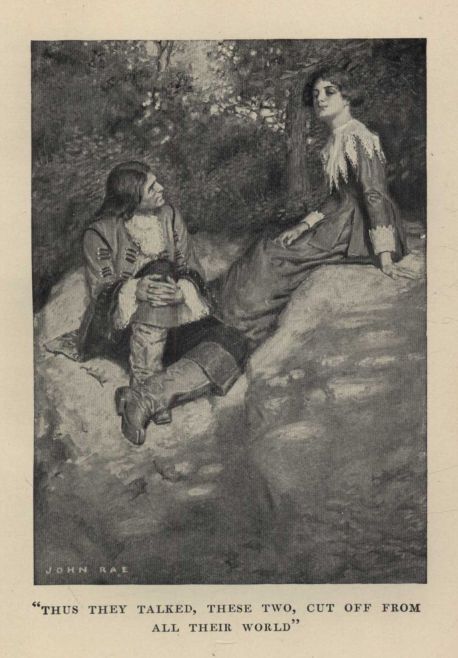
"THUS THEY TALKED, THESE TWO, CUT OFF FROM ALL THEIR WORLD"
"And were there no women in your camp?" asked Barbara at last, smiling.
"Yes, one. We would have appointed her our cook, our slave, as is the manner of lads towards most maids of their age. But not she! How that chit of a maiden ruled us, and how presently we worshipped her! She would sit here, our queen, enthroned and crowned, while we must scour the forest for fruit and flowers, rare gifts for her Majesty. We must wait upon her pleasure, fight for her favours, be in all things her slaves. Young as she was, she knew her power well, she tyrannised over us even then, and we—we loved her for it with all our hearts."
His voice was soft and tender, and a shadow fell on Barbara's heart.
"Where is she now?" she asked, with eager, too eager, Interest.
Again he hesitated, and answered in a cold, slightly restrained voice:
"She hath been, for some years, at the court of his Majesty, King Louis."
Then there fell a silence between them, but no longer the silence of sympathy, for he was lost in recollection, and she in wondering doubt.
Presently he rose abruptly to his feet.
"I think, Mistress Barbara, 'twere well I should go and reconnoitre. I will soon return; but I would fain see, if possible, what our enemies are about. Are you afraid to stay here alone?"
"Afraid?" she asked in astonishment, "why, what should harm me?"
"Yes, 'twas a foolish question to ask you, Mistress Barbara, I might have known the answer," he replied admiringly.
He paused a moment, smiling down at her, turned with a nod, and vanished into the wood.
For some time after his departure Barbara lay still, nestling in the luxurious couch of moss, wrapt in dreams. But the fresh joy of the morning had passed, and her dreams grew less bright.
She remembered now for the first time the helplessness of her position; an outcast, with no shelter save such as Captain Protheroe might provide, no escape save through his contrivance, no protection save his arm; she was utterly dependent upon him.
And then she remembered, with a sudden hot rush of blood to her cheeks, that it was she herself who had brought this about.
For he had not offered to take her with him, rather had he advised her to seek out the Lanes and take shelter with them; but she in her heedlessness had refused his advice, had forced her company upon him. And he could not in courtesy refuse, but was bound by his honour to undertake the task, to provide for her, and protect her, even at the risk of his life.
No, she had thrust herself, unwelcome, upon him, and had now no hope save in him.
So she mused, growing each moment more ashamed, more angry, her pride stinging her afresh at each recollection of his kindness and her dependence on it.
For this dependence, which might once perchance have been a sweet thought to her, was now turned to gall and bitterness by the shadow of another, the aforetime queen of the forest, whose presence seemed to her to haunt the little glade, the girl who had claimed his homage, whom he had loved with all his heart.
For if he loved the girl of whom he spoke so tenderly, then she, Barbara, could be nothing to him, save that perchance her beauty gratified his eyes; her presence was but an aggravation of his distresses, her helplessness a burden, unwelcome as unsought.
Her first impulse, nay, her firm intention was to flee from him at once, relieve him from his forced task, and win or lose her safety for herself. Thus her pride urged her to act.
But more gentle thoughts held sway. For Barbara was practical, and above all things, just. She saw clearly that to leave him now, in secret, would but add to his troubles, since he would without doubt seek her again, nor rest until he found her, fearing for her safety. Further, to urge him to leave her were useless; such a man as he did not lightly relinquish a task he had once taken in hand.
No, clearly she could not escape from the position in which she had thrust herself, her punishment must be to remain with him, dependent on his care. Nor must she accept his kindness grudgingly, but with a free heart, simply, confidently, else her conduct were indeed unjust. For since she had imposed the task upon him, she must not make it bitter by any act of hers.
So she resolved, though it hurt her pride sorely to accept his favours, deeming that she had nought to give in turn. For the Winslows were ever proud folk, giving gift for gift, blow for blow, in fair exchange, and Barbara had by no means consented to give nought and receive all at the hands of any man, save that her wonderful sense of fairness (no such common attribute of her sex), forced her to give his feelings the consideration she felt was but his due.
But for that other woman! The woman who had once sat there, enthroned, accepting his homage, perchance in the very spot where new she lay. She rose abruptly and walked to the far side of the hollow, where she seated herself stiffly on a fallen tree, and glanced distastefully at the soft bank of moss that had lately formed her couch.
Presently she grew restless, and so to escape from the folly of her thoughts, she resolved to make a short voyage of exploration on her own account.
She had no difficulty in discovering the opening in the bushes which enclosed the hollow, and passing through she found herself on a narrow green path leading through the forest. The brambles crept close to her side, and at times even stretched their long arms across her path, but in the clear light of day she had no great difficulty in making her way along a road which in the darkness of the previous night had appeared fraught with almost insuperable difficulty.
She tripped along at a fair pace beneath the towering branches, pausing ever and anon to gaze with wondering delight at some newly opening scene of woodland beauty.
Now she would pass a stretch of bracken, higher than her head, through which the sunlight streamed in a blaze of emerald fire. Anon she came to pause in a grove of beeches, gazing up in awe at the giant branches above her, curving in graceful arches far above her head; or she stooped in delight over some gnarled old tree-stump, alive with feathery ferns and delicately coloured lichens; and once she came to a wide, green bank o'ercovered quite with delicate cobwebs, dew-flecked, shimmering like silken gauze, beneath which swayed the tender lily-plants, like the slender forms of eastern beauties, dancing in their jewelled veils.
It was a world of magic delight, and as she wandered on, she fell again beneath the forest spell, and forgot her cares in the sheer joy of beauty. For the forest has a magic charm for all who will yield to its influence. The song of the sea is restlessness; the teaching of the hills is aspiration, but the spell of the forest is peace.
But suddenly she stopped, with a quick indrawing of the breath, for close beside her, separated only by a leafy screen, she heard a deep, shuddering sigh.
Her first impulse was to flee at once along the road she had come, back to the safe shelter of the hollow. But her curiosity stayed her, and she waited, hand on heart, for what should follow.
Again came the groan, and this time she could distinguish some muttered words.
"My God! I will endure no more. It must end now."
Barbara had been no true woman had she turned back now. But it was perhaps as much pity as curiosity that prompted her to push gently aside the branches, and peer through them at the speaker of these despairing words.
Before her, on a fallen tree sat the dismallest figure of a man she had ever seen. Pale, emaciated, with haggard face half concealed by a tangle of matted hair, and clad in that most melancholy of apparels—soiled and tattered finery. His right arm hung limply at his side, a pistol in the hand. His head was bowed upon his breast, but even as Barbara looked, he raised it, and she marked his desperate glance, his eyes hardened in despair.
As she looked upon his face the beauty of the forest vanished, it showed but as a drear wilderness of thorn and bramble, a fit setting to the desperate figure of the man before her; even so does the sight of a drowned corpse rob the sea of all its glory.