Front matter (continued 2)
Reading edition
"'Tis clear, sir, this is a most unprofitable subject for discussion, seeing we shall never agree. Time must show who is in the right. In the meantime we will conclude the matter thus: If he be here, the worse for him; if he be not here—why, the worse for you. What say you now?"
"Madame, your argument is unanswerable."
"Then hence with argument, hither with supper. Come, captain, we'll sign a truce for the nonce. If I mistake not, you have had a long ride and spare rations this evening. You are well come. I was about to sup when you interrupted me, so while your men search the house, you shall bear me company. You refuse? Why, what fear you? The house is surrounded, not a creature can escape," she continued bitterly, "and you need not fear lest the wine be drugged or the meat poisoned, for I, too, intend to partake of them."
"Ah, madame, those are not the dangers I fear." He shook his head, with a smile.
"What, then?"
"Look in your mirror, Mistress Barbara, perchance you will understand."
Barbara gave a sudden, laugh of pleased amusement.
"Nay, sir, I protest I have no desire to bewitch you," she answered with a bright blush.
"Then, madame, why do you look at me?" asked the captain, and his eyes said more.
Again the dimple deepened and again the lips curved into a smile. Captain Protheroe detected himself watching for that dimple with a quite inexplicable and, considering his errand, inexcusable eagerness.
"Methinks the conversation is astray upon a bye-path," she answered demurely; "let us return to the high-road. I am dying of hunger, and 'tis but dreary to sup alone. Will you not join me?"
As Captain Protheroe had tasted no food since early morning, the offer was too tempting to be refused.
"Madame, you overwhelm me with kindness," he answered.
She led him to the upper end of the hall, where a table was already laid with three covers.
"Do you always sup in company with two empty chairs, madame?" he asked quizzically.
Barbara flushed crimson and hesitated.
"I—I expected friends, sir," she stammered. Then recovering, she darted a bright glance at him and continued. "And you see my expectations have been fulfilled, for are you not come?"
"Does not another lady dwell here with you?" he queried indifferently.
"Yes—my cousin, Lady Cicely Winslow. But she—she is out," stammered Barbara again nervously.
"Ah! so she is sharing the fellow's hiding-place," muttered the captain to himself. "A piece of folly only possible in a couple of lovers."
Throughout the meal Barbara laughed and chatted gaily, evidently exerting all her efforts to entertain her guest. She led him on to tell strange stories of his adventures and his travels, to which she listened with that eager interest and open admiration of his doings, so dear to the heart of man; she made him laugh heartily at her quick jests and saucy answers, and ever and anon as she talked she raised her dark lashes, and turned upon him the full depths of her wonderful eyes.
But Captain Protheroe was not altogether unversed in the ways of women, and though he enjoyed to the full the pleasant companionship of her manner, and drank deep of her beauty, he was in no wise mindful to allow her charms to turn his thoughts from the matter in hand.
And as he watched her carefully, he noted how from time to time she would break off abruptly in the middle of a sentence and listen anxiously to some distant sound in the house, while the smile died from her face, and her eyes widened with fear. She twisted her fingers nervously together as she talked, and her laugh was high and shrill.
"She plays her part admirably," he muttered to himself, "but she should not show her eyes."
"'Tis strange how falsely that base churl Rumour reports," he began, when Barbara paused once to listen anxiously to the movements of the searchers overhead. "Now concerning you, madame, methinks he hath totally misspoken."
"Why, what saith Rumour concerning me?" questioned Barbara with interest.
"In the first place," he continued, eyeing her steadily, "he reports that you are fearless both of men, mice, and devils."
"And what then?" she asked, her eyes flashing proudly.
"Why, I say he is a lying fellow, for I see you are as timid as—as a woman."
"I, sir, timid!" she cried indignantly.
"Aye, madame, you start and tremble at every sound."
"Nay—I assure you—I—I do not so," she stammered, trembling with eagerness. "Why, wherefore should I tremble."
"Nay, I know not, madame. Save as the poet saith—'A guilty conscience——'"
"I thank you for the suggestion, sir," she answered with a faint smile. "I will consult my conscience."
There was a pause, the silence broken only by the distant movements of the searchers.
"Is there a ghost in the room, madame," asked Captain Protheroe suddenly.
Barbara started violently.
"A ghost, sir?" she exclaimed.
"Aye, a ghost. I saw you staring at the wall behind me with so horrified an expression, methought you beheld an apparition at least, peeping over my shoulder."
Barbara dropped her head and bit her lip.
"'Twas but my own thoughts. There is nothing else."
Captain Protheroe wheeled round in his chair, and stared thoughtfully at the full-length portrait of an old Winslow knight in armour which confronted him.
"Now what is there in this same old gentleman (for I trust 'twas not my appearance that had such a horrifying effect upon you), what is there here to terrify you?"
"Nothing, sir, I assure you," repeated Barbara faintly.
"Yet there is certainly a strange look about this portrait," he mused. "There is a glint in his eye that mislikes me. One might almost believe," he continued, turning towards her, "that he hid some secret behind that fixed countenance."
Barbara stared at him a moment with terrified face, then she rose abruptly from the table.
"I—I wish you would leave me, sir," she answered curtly.
"That is a hard saying, madame," he exclaimed in mock astonishment. "Did not yourself bid me to supper?"
"Yes. But I am weary of you and now I bid you go."
He laughed quietly.
"That is easily said, madame, but not so easily answered. I may not——"
He was interrupted by a hurried knock at the outer door.
Barbara gave a slight scream and ran across the hall, but Captain Protheroe was at the door before her.
"Pardon me, madame, I must see to this," he said sternly.
He flung the door wide, standing himself in its shadow, and Peter Drew, the smith, rushed quickly into the hall.
"Ah, Mistress Barbara," he exclaimed breathlessly, not noticing her sign to him to be cautious, "the villain hath escaäped me, and I can't faind no traäce of un anywhere."
"Very much my case, my friend," interrupted the captain, shutting the door quickly, and confronting the astonished smith with a quiet smile. "But what may be the name of this same escaped villain?"
Peter gasped at him stupidly.
"Come, fellow, out with it," cried the captain sharply.
The smith glanced at Barbara and shook his head.
"I don't know," he muttered sulkily.
Captain Protheroe turned to Barbara.
"May I—er—advise you, madame, to order this reluctant henchman of yours to be more speedy in his replies."
"You may tell the captain all you know, Peter," she said after a moment's hesitation. "Methinks 'twill not greatly enlighten him."
"'Tweren't nobbut a certain hawker, your honour. Her ladyship bid me keep un zaäfe till marnin' zo I fastened un oop zafe i' my farge. But when I were awai—er—awai on my biznez thicey marnin' my waife, plague on a meddlezome fingers, zay I, muzt needs oppen door, to zee, forzooth, whai it were zhut, and zo the fellow hath vled."
"Good! Why was this hawker to be thus secured?"
"He had angered me, sir," interrupted Barbara haughtily.
"Ah! summary justice, madame," answered the captain, laughing. "But hardly, methinks, within the measure of the law."
"I care nought for the law."
"So I can well believe. But come, I must know a little more concerning this hawker."
"That you cannot, sir," answered Barbara calmly. "For the simple reason that Peter knows no more, and I, who do know, do not purpose to tell you."
Captain Protheroe hesitated a moment. Then he continued lightly, but eyeing Barbara steadily the while:
"Ah, well! 'Tis of small import. Doubtless it will not be difficult to find the fellow himself and learn all I wish from his own lips."
Barbara's face grew suddenly white.
"Yet another man to search for," she exclaimed lightly, but with a strange hoarseness in her voice. "I' faith, captain, yours is no easy post. It must indeed be a wearisome life to seek and seek for that which like the philosopher's stone, is never to be found."
They were startled by a sudden clamour which arose in a distant part of the building, the clatter of pans and dishes, the angry shouts of the men, and above all the shrill voice of a woman pouring forth a torrent of furious abuse.
"What in the devil's name——" began the captain, striding across the room.
"Oh! 'tis nothing," interrupted Barbara coolly. "Your men have doubtless encountered my waiting-woman, Phoebe. She is somewhat hot and hasty in her humour and—I am sorry for them."
As she spoke the door was flung open and the corporal rushed angrily into the room. He was a miserable sight to behold. His head was saturated with greasy broth which dripped from the ends of his scrubby hair and beard and trickled down his rubicund countenance; he was covered from head to foot with flour and dust, and he held his hand pitiably to his temple where a large bump, the size of an egg, was rapidly rising, to embellish his appearance.
Behind him marched Phoebe, weaponed with a besom, her face blazing with anger, her hair dishevelled, and her sleeves rolled up to her shoulders, showing the brawny arms of this amazon.
At sight of this couple, Barbara fell back into a chair, and laughed till her eyes filled with tears.
"My poor Sir Knight of the Whipcord," she gasped. "What hath befallen thee? Ah me, Phoebe, but thou art a very dragon!"
"A very devil," spluttered the corporal.
"Devil in thy teeth, fellow!" cried the enraged waiting-woman. "Mistress Barbara, what think ye? this fellow hath tramped through every hole and corner of the house; he hath rent the hangings, broken the chiny, forced open the closets, and made the place a very desolation. And then—then he was for trapesing into my kitchen, my kitchen that I had but just redd up, with his great muddy boots, to poke his nose into all my places, because, forsooth, he swears I have a man hid among the pots and pans! A man, indeed! The meddlesome fool! I warrant me 'tis no man, but the victuals that he is in search of."
"Patience, good Phoebe, patience," laughed Barbara. "As thou sayest ever, men are but fools and know no better."
"Humph! Mayhap they knew no better, but they know better now, I warrant. Though it repents me that I wasted the whole of a good basin of broth and a bag of flour i' the teaching of it."
Meanwhile Corporal Crutch, having mopped his brow, and beaten off much of his outer covering of flour, made shift to resume his customary air of pompous dignity.
"This woman, sir," he explained with a wave of the hand in the direction of Phoebe, "withstood us in the doorway of her kitchen, powerfully ammunitioned with pannikins. 'Twas, indeed, a post of some vantage, therefore I deemed it wisdom to lead her off, as you behold, by a feigned retreat, while the men make a flank attack, and secure the position by entering through the window."
On hearing this Phoebe set up a howl of rage, and disappeared speedily in the direction of the kitchen, to oust the intruders from the spot. The sounds of battle which presently arose proved the success of the corporal's manoeuvre.
Captain Protheroe drew the corporal aside.
"Well! You have searched?"
"Aye, sir, every nook and cranny in the place. Not a rat's hole has escaped us. He must be hid somewhere in this room, for there's no other place unsearched."
"'Tis very like, and I think I can put my finger on the place," answered the captain softly.
Barbara looked up.
"Well, captain, if you are satisfied that I have spoken the truth, perhaps you will take your leave, for I protest I am weary of you."
"One moment, madame," he answered, "I will but examine into the secret of this same cross-eyed ancestor of thine, and then you shall be no further troubled."
He turned, as he spoke, towards the picture, but Barbara sprang to her feet with a sharp cry, and darting past him, placed her back against the frame and turned to him full of defiance.
"Nay, sir, that you shall not," she cried resolutely.
Corporal Crutch paused in his search, and gazed at her in open-mouthed astonishment, but Captain Protheroe strode quickly to her side with a sharp frown.
"Come, madame," he began impatiently, "this is sheer folly. We must proceed with our work. I do, indeed, regret the painful business, but by your leave we will not prolong it. Be so good as to show me the secret of the spring."
"I will not."
"Then, madame, we must open it by force."
"You shall not pass me," she cried defiantly. "I will not move aside."
Captain Protheroe swore in desperation.
"Come, Mistress Barbara, be reasonable," he urged. "You know well that resistance is quite useless. I were loth to use violence, but an it must be so, methinks it were possible to move you without much injury to either of us."
Suddenly Barbara began to cry, leaning her head back against the frame and sobbing bitterly. But she did not cover her face with her hands as is the manner of most women.
"Oh, go away, I beseech you," she pleaded, clasping her hands in entreaty, and raising tearful eyes to his face. "Rupert hath done you no injury, suffer him to escape this once, and I will be your debtor forever."
Captain Protheroe stared down at her, wondering vaguely whether her eyes looked more lovely when bright with merriment, or when wide and soft with welling tears, and why he had never before noticed how inviting was a full quivering lip. Then suddenly recollecting the unprofitableness of such considerations, he glanced indignantly at the corporal and swore at him beneath his breath.
"You are making my duty very hard for me, madame," he pleaded gently.
"I—I want to," she sobbed. "Please go away."
"No, Mistress Barbara, I cannot," he answered firmly.
Barbara stopped her sobs and stared at him for a moment in astonishment. Then she suddenly turned on him furiously.
"You will not? You will not?" she cried. "Then have your way. See what lies concealed."
She pressed a small button cunningly hidden amid the carving of the frame, and the portrait slipped back, revealing a large recess in the wall, deep enough to hold three men.
The recess was empty.
The two men stared at each other in utter astonishment, but Barbara flung herself into a chair, clapped her hands, and burst into a paroxysm of laughter.
"Fooled! Fooled!" she cried, pointing at them mockingly. "Was ever man, since the days of Adam, so bravely fooled. Oh! I shall die of laughter," and again the room rang with her merriment.
Captain Protheroe turned to her grimly.
"Pardon my dulness, madame," he said harshly, "and be so kind as to explain what this means."
"Means! Why, marry, it means that I have spoken truly. Rupert is not here, moreover, he never has been. Have I not said so throughout."
"Not here? Impossible! Then these tremblings, entreaties, tears were all——"
"All a comedy, sir, which I trust you enjoyed as greatly as did I. Oh! tell me, sir, should I not make a brave player?" She danced a few steps towards him and dropped a mocking curtsey. "I await your applause, signors," she cried with a saucy laugh.
Captain Protheroe strode the length of the room and swore to himself heartily, but Corporal Crutch was not so easily convinced.
"'Tis false, sir," he cried. "She is fooling us again. Why I saw the fellow enter, myself."
"That you did not, corporal, an I may make so bold as to contradict you," laughed Barbara. "Though I wouldn't deny," she added solemnly, "the possibility of your having seen someone enter."
"Aye, someone hailed by the name of 'Rupert,'" sneered the corporal.
"What's in a name?" quoted Barbara, laughing.
"Whom did he see, then?" demanded Captain Protheroe sharply.
"How should I know?" she retorted cheerfully. "'Twas not I who saw him. Ask the corporal."
"An 'twere not Sir Rupert, 'twas the devil himself in his likeness. I saw him as plain as I see you. He is the very counterpart of yon wench, his sister."
"That is true enough," answered Barbara calmly. "We be so alike that times have been known when we were mistaken for each other. And yet I will swear 'twas not Rupert whom you saw."
"Will you have the goodness to explain the matter, madame?" interrupted the Captain impatiently.
"With all my heart, sir, though 'tis a somewhat lengthy tale. Know then, it commences with a stout corporal but half concealed behind a large laurel bush. Ah, ha! Sir Whipcord, you look guilty! Now this same corporal was a spy and an eavesdropper, and eavesdroppers must not be surprised if at times they overhear that which is intended for their ears. 'Twas so in this case. The corporal, who bore a strange resemblance to this gentleman, overheard a pretty little plot, discussed especially for his edification, he stole and read a cunning little note, written for his eyes alone. Being a gentleman of extraordinary blindness, he walked into the trap as prettily as a bird. The rest was simple. It remained but to send a messenger, whom your soldiers kindly permitted to pass, to inform Rupert of our arrangements. Cicely and I, disguised but in linsey petticoats and woollen hoods ('tis passing strange how dress can make or mar a man) went down to the village this afternoon, and later I—I returned, alone. Perchance—I say perchance, 'twas I whom your corporal saw enter; and yet, sure, how could it be?"
"And your cousin?"
"Cicely? Oh, she is away passing the evening with Rupert, who, thanks to the corporal's kind thoughtfulness, in withdrawing all his men from the roads and the village, was enabled to visit her with perfect safety at a certain house we wot of. But, indeed, the time has passed so quickly while you have been here, that he will by now have returned whence he came, and I fear—I greatly fear you have missed him."
Then at last Corporal Crutch, convinced of the truth of her statement, opened his mouth and commenced to swear; to swear so roundly that Barbara covered her ears, and Captain Protheroe curtly bade him be silent.
"'Tis thine own doing, thou blundering fool," he said angrily. "Wherefore didst not follow the messenger and trap the fellow in his hiding-place?"
"Nay, captain, give me some credit for the business," interposed Barbara cheerily. "'Twas a most excellently conceived plan. And yet," she mused, "I doubt if ever men were more easily fooled."
"And may I ask, madame, what part in the plot this evening's entertainment served?"
"Oh that! Well, I cannot say that was altogether necessary, though I desired to keep you here till Rupert was safe away. But," she added roguishly, "'twas vastly amusing. And besides, methinks you deserved no better treatment after forcing your way thus churlishly into a lone woman's house."
Captain Protheroe turned brusquely on his heel.
"There is nothing further to be gained by remaining here, corporal," he said. "Call up the men and march them back to quarters. And as for this fellow," he added, pointing to the smith, who had watched the scene with deep enjoyment, "keep him safe till morning; we may have need of him."
"And what of the wench, captain? Can't we lay hands on her for aiding and abetting?"
Captain Protheroe scowled.
"Leave me to deal with her, sirrah. I will follow you anon. And harkee. There is a certain hawker wandering in or near the village. Yon fellow can describe him. If we can lay hands on him, I doubt not he can tell us what may prove useful."
Corporal Crutch started guiltily.
"A hawker, captain? Why, I know the fellow. I have him safe under—that is—er—I doubt not I can speedily lay hands on him."
"Do so. See to it to-night, and we may yet catch our hare. Now begone."
The corporal saluted and went out.
Captain Protheroe glanced at Barbara, and he saw that no trace of her triumphant merriment remained.
He turned and walked to the window and stood for some time in silence gazing out into the darkness while the last echoes of the retreating footsteps died away. Then all was still.
CHAPTER VII
Captain Protheroe stood gazing out into the dark night, asking himself savagely why he still waited there, why he did not leave the girl at once and return with his men to the village, preparatory to setting out in pursuit of this man who still escaped them.
It was clearly his duty to go—and yet—— There was still time, nothing could be done until the hawker was discovered, and his secret, whatever it might be, was learned. And in the meantime he could not resist the temptation to remain a little longer, to learn more of this girl who, while she mocked and flouted, yet fascinated him in spite of his anger against her. To punish her a little for the way she had outwitted him, aye, and to watch how she bore the punishment. So while he cursed himself for a fool in so doing, yet he remained.
Barbara sat bolt upright, watching him furtively with eager eyes. Her hands were tightly clenched, and her lips pressed together in anxious thought. "Oh! what shall I do now?" she murmured again and again desperately. "What shall I do? The pedlar hath escaped. I have tried tears, they are useless. Oh, God! help me to play out the game."
At last he turned, and crossing the room seated himself beside her. Leaning forward, his hands clasped between his knees, he eyed her steadily and spoke in a low even voice. "Mistress Barbara, have you ever heard tell of a certain Mistress Alice Lisle?"
Barbara shuddered quickly, and her face grew very pale, but she answered him bravely:
"Aye, sir, she who was beheaded last week at Winchester for harbouring rebels."
"Good. And hast also heard of Mistress Judith Barge, condemned to be flogged for a like act of treason?"
"Indeed, sir, her story likewise is well known to me."
"Ah! so you were forewarned. You did not act in ignorance of the fate awaiting you?"
His face and voice were hard and her heart beat wildly, but she fought the rising fear and answered proudly:
"Captain Protheroe, none but a fool goeth to war without counting the cost. I am no fool, sir."
Suddenly his whole bearing changed, his face softened, and, raising her hand to his lips he said gently:
"Madame, I salute the bravest lady I have ever known."
Barbara flushed crimson.
"Nay, not so, sir," she answered, smiling bravely, "for there is yet a third story I have heard. For I have heard that in these last days it has been everywhere the custom for king's officers stationed in our villages to take up their quarters in the houses of the rebels, driving forth the occupants and taking unto themselves all their goods. Yet Cicely and I have remained here undisturbed. So I knew well, sir, that in playing my part I had to deal with no Kirke or Jeffries but with a gentleman of heart and honour, in whom a woman could place her trust."
"Can so small a matter win a woman's trust?" he asked doubtfully.
For an instant Barbara sat silent, twining her fingers together nervously, and breathing hard. She was preparing for her last great stake.
Then she turned to him. Her eyes betrayed her fear, but her voice was firm:
"Captain Protheroe, my brother lieth hid in the fisherman's hut, three miles eastward along the coast from Watchet. From thence he will escape to-morrow morn in a vessel bound for Holland."
He sprang to his feet and turned on her in sudden anger.
"In Heaven's name, madame, why have you told me this?"
"Ah! sir, because an I had not you would have learned it elsewhere. This mad pedlar who hath escaped me, knows my secret; to-night he will betray it to you. So I prefer to tell you myself and throw myself on your mercy."
"You play high, madame."
"Aye, sir, to lose or to win all."
He turned from her and paced the room angrily. So this was the result of his effort to punish the girl (fool that he was to try it), she flung herself on his mercy and challenged him to betray her confidence. Well, why should he not, seeing the confidence was given unasked. But his pride loathed the thought. He had never yet betrayed a woman's trust; the chivalry of his nature had remained unsoiled by the cynicism and callousness of those among whom he lived, and that chivalry now forbade him to profit by her moment of confidence.
That he, Miles Protheroe, should fall a prey to the fascinations of a woman! He laughed savagely at the thought. And yet that this girl fascinated him he could not deny. Not only by her beauty (he was too much a connoisseur of woman's looks to be deeply moved by them), nor by her gaiety, infectious though it was; no, to him the charm lay chiefly in her manifest courage, for courage was his God, and she seemed the very personification of fearlessness.
So he mused, warring betwixt pride, anger, and tenderness, while Barbara sat still, watching him with a desperate eagerness.
"Are you a soldier only, or a man?" she pleaded. "An ye be the first, go do your work. But oh, an ye be a man, ye cannot sure betray a woman's confidence."
"You have taken an unfair advantage of me, madame, and you know it."
"Aye, sir, 'tis true enough. Think not I feel no shame. But—Rupert is my brother."
Her voice broke piteously over the last words. She was worn out with the terror and excitement of the day, and could scarce keep down her tears. She bit her lips, and her breast heaved with a strangled sob. He drew near and stared down at her gloomily.
"So because you are a woman and this rebel chances to be your brother, my honour must go bail for his life! Do you understand, Mistress Barbara, what you ask of me?"
For an instant she hesitated. Then she raised her head and turned to him proudly:
"Yes, sir, I understand, and—I ask it."
He bowed.
"So be it, madame, your brother is safe from me."
He turned coldly, and taking up his hat, walked to the door.
Barbara followed him timidly.
"Captain Protheroe," she pleaded softly. "Honour may be one of the first virtues, but there is a greater even than Honour,—Charity."
But now his anger mastered him, he would not relent.
"It may be so, madame," he answered curtly. "But in your presence I find the defence of my Honour more than I can well attend to. I bid you good-night."
And turning abruptly he left the house.
Barbara remained gazing after him, her cheek slowly flushing with rage and shame.
"And has not a woman honour too?" she cried at last fiercely. "Am I not dishonoured enough already by this night's work that he must needs fling his taunts in my face? There be women, perchance, who will play with men's honour as lightly as they throw the dice, and he may think it a little thing for me to ask this of him, but oh, were it not for Rupert I had sooner have died than thus have shamed myself."
Flinging herself back into a chair she gnawed her clasped hands, and beat her foot upon the ground in silent fury.
Half an hour later the door opened softly and Cicely stole cautiously into the room, Cicely with dishevelled hair, red eyelids, and her face alight with eagerness and terror.
"Barbara! Barbara!" she cried, coming eagerly forward, on seeing the room unoccupied save by her cousin. "The village is all astir, the troopers are busy looking to their horses, and David Marlow hath heard that on his return to the Inn, the Captain gave orders that they be ready to start on some expedition at three o'clock in the morning. Think you, Barbara, he can have heard even now of Rupert's hiding-place? Or think you they will intercept his return. He left me but half an hour since. Speak, cannot you?"
Barbara looked up slowly, her face very pale. "Aye, he hath heard, I told him myself."
"Barbara! Art thou mad, child?"
"Indeed I verily believe I am," she answered in a dazed voice. Then collecting her thoughts she told her cousin all that had passed in her interview with the captain. "Think you, Cicely," she continued nervously, "after that it were possible that he has betrayed me?"
"Possible!" cried Cicely in a voice of scorn and fury. "Why, thou little fool, 'tis the man's profession to spy and snare and betray us. Oh! Barbara, how could you be so rash, so wicked? Now 'tis too late to save him."
Barbara roused herself.
"Nay, Cicely, I will not believe that of him. I have his promise. He is a hard man, but he will assuredly keep his word; he would never betray my trust."
"Oh, thou art bewitched by his fair words. Nay, speak not to me. I will go pray, 'tis all that is left for me now."
Sobbing bitterly she left the room.
Barbara sat upright in her chair, clenching the arms with her hands and gazing straight before her.
"An he dare to do it?" she murmured under her breath. Then she sprang suddenly to her feet. "He shall not do it," she cried. "I must to the village—there is no other way. And yet,—sure,—nay, I cannot. Bah! I have shamed myself once before him, what matter an I do it once again!"
CHAPTER VIII
Captain Protheroe strode thoughtfully up and down his room at the Inn, puffing furiously at his pipe and staring at the floor.
On his return from his interview with Barbara he had found awaiting him an order to proceed at once to Taunton, and in the yard without he could hear his men still busy with preparations for their early start on the morrow. But though wearied in body with his long day's work the captain felt no inclination for sleep, and, his thoughts still busily occupied with the events of the past few hours, he passed the time pacing his room. His promise once given, he was not the man to waste many regrets upon what was passed, yet as he thought over the affair his brows puckered into a frown, and he ground the stem of his pipe savagely between his teeth. To wink at the escape of a rebel was indeed no great matter in those days. He knew well to what extent corruption and bribery were rife among his fellow officers and how few would hesitate to allow a rebel to slip through their hands could they thereby help to line their pockets. From the Lord Chief Justice downwards the custom was openly practised. Even the Queen's maids of honour, delicate women whose sensibilities were wrung by the death of a beetle, and who would have swooned at the idea of crushing a moth, even they openly trafficked in pardons, and complained bitterly when the life ransoms extracted from the impoverished friends of the prisoners failed to satisfy their demands. But hitherto Captain Protheroe had prided himself upon keeping his fingers clean amid such general corruption, and it enraged him to feel that at last he too had succumbed. Not indeed for a bribe's sake, but because a woman believed him worthy of her trust and his pride would not allow him to betray it.
But was it in truth for that reason alone? Might not it also be because the woman was possessed of a pair of wonderful eyes and knew how to use them?
"Bah!" he muttered angrily, pausing to knock the ashes from his pipe. "How a woman may play the deuce with a man's work!" Then drawing from his pocket a small bow of scarlet ribbon, he gazed at it for a few moments with a strange expression on his face, and with a short laugh flung it from him into a corner of the room and resumed his promenade.
He was interrupted at length by a loud knock at the door, and at his summons Corporal Crutch entered to say that after diligent search he had discovered the missing pedlar, and that the fellow confessed to having certain matters of import to make known to the captain alone. The corporal had no desire that Captain Protheroe should hear of his first interview with Simon, feeling that his customary acuteness had slightly failed him on that occasion, and after a vain attempt to extract some information on his own account from the sulky pedlar, he was at length forced to hand the man over to his superior officer, threatening him first, however, with dire penalties should he breathe a word concerning their previous encounter.
"Bring the fellow in, I will see him," answered the captain, on learning that the pedlar was without.
The order was obeyed and the hawker, glancing furtively from side to side, was pushed rather than ushered into the room.
"Well, my man," Began Captain Protheroe, eyeing him sharply, "what is your business with me?"
"An it please your honour, I have information to sell to your honour concerning the hiding-place of a certain rebel."
"To sell to me!" answered the captain sternly. "It is not for a loyal subject of his Majesty to drive bargains with his officers. We do not buy information, we exact it."
The manner in which these words were uttered caused the hawker to modify his tone.
"May it please your honour," he whimpered, "is there no reward for the arrest of a rebel?"
"If your information be correct, and above all of value (which I greatly doubt), you shall have such money for your services as they deserve. Now for your story, and waste no more of my time."
Thus driven to a corner and moved as much by desire of vengeance as by greed of gold, the hawker related how he had received the letter from Sir Rupert Winslow, and the information it contained.
"Then the ladies know nought of the matter as yet?" enquired the captain.
"Nothing whatever, your honour."
"But this letter—where is it?"
"I—I have mislaid it, sir—but——"
"You are lying to me, knave," interrupted the captain coldly. "By Heaven! an I find you trying to deceive me you shall taste o' the rope's end before an hour is passed."
The hawker cowered before such a prospect, and discovering after much protestation and evasion that the captain evidently knew more of the matter than he had expected, he decided to tell the truth. Thereupon he gave a full account of the transaction, up to the time of his escape from the smithy, omitting only (out of respect for the Corporal's threats) to refer to his interview with that worthy.
Captain Protheroe listened attentively to the narrative, smiling slightly at the complaint of Barbara's treatment. When it was ended he turned coldly on Simon.
"That will do. You can go."
"But the reward, your honour," began the hawker nervously.
The captain eyed him sternly.
"An I had my will with you, fellow, you should to the pillory as a thief and extortioner. But as, in this world, a rogue must be paid for his roguery, take your liberty and deem it meet reward for information which I received an hour since. Be off with you."
The hawker, with a deep, heartfelt curse, shuffled out of the room.
"I would that I had seen her braving the fellow," muttered the captain as he recharged his pipe.
So engrossed was he in his meditations that he paid no heed to a sudden clamour in the yard without, and he sprang to his feet with an oath of astonishment when the door was flung wide open, and the corporal burst violently into the room.
"We have him, captain!" he cried, almost dancing with eagerness, "we have him at last, the very fellow himself. Caught as clean as a bird in a net."
"What means this, sirrah?" interrupted the captain sharply. "Art mad, or drunk; or both together?"
The corporal's face fell. He pulled himself together and saluted in a somewhat crestfallen fashion.
"Your pardon, captain," he continued more calmly. "But an it please you, we have taken Sir Rupert Winslow himself."
It was now Captain Protheroe's turn to betray excitement.
"Taken Sir Rupert Winslow! Why, fellow, 'tis impossible. You are dreaming."
"Dreaming or no," answered the corporal sulkily, "he is without. We spied him skulking round the stables to the back o' the Inn. I doubt not wi' intent to steal a fresh horse. There we ambushed him. He made a fierce resistance, but," with an air of supreme complaisance, "I soon overpowered him."
"The devil take the rash fool!" muttered the captain. "Well, bring him in, corporal. And do you see that the men get to rest, we must be off at daybreak to-morrow. I will see to the security of the prisoner."
The corporal saluted, and a moment later ushered his prisoner into the room.
Captain Protheroe looked up curiously at his entrance, and for some minutes silently surveyed him, until the prisoner, weary of such intent scrutiny, tossed his hat on to the table, and flung himself back into a chair with a half-embarrassed, half-reckless air.
The captain broke the silence.
"This is a strange ending, sir, to so lengthy a chase," he said gravely.
"Ah, well! 'twas bound to end sooner or later, and as well this way as another," he answered with a short laugh. "In truth, 'twas a hole and corner business, and I am weary of it."
"You have been to visit your sister at the Manor House?" queried the captain.
The prisoner looked up haughtily.
"My past movements are my own affairs, sir; you and I are concerned with the present alone."
"I take you, sir," answered the captain quietly. "Moreover, I understand the reason of your presence here, and I honour you for it. It is irregular, of course, but under the circumstances, I cannot refuse to give you every satisfaction."
"Satisfaction!" exclaimed the prisoner in astonishment.
"Aye, sir. You doubtless understand me."
"Not I. I have no personal quarrel with you, that I know of."
"No quarrel! Then am I wrong in supposing you to be the brother of Mistress Barbara Winslow?"
"And what then, sir," demanded the prisoner sharply. "What of her?"
Captain Protheroe shrugged his shoulders.
"Ah! I see I am mistaken," he replied. "I deemed, sir, you had ventured hither in order to seek me and to demand satisfaction for my behaviour towards your sister. But since——"
"Will you have the goodness to explain, sir," interrupted the prisoner fiercely.
The captain smiled calmly.
"Egad! I confess 'twas a somewhat low piece of work. But the wench was so exasperating and withal so pretty. And I give you my word," he added with a cynical laugh, "she showed no over-great reluctance to my kisses."
The prisoner sprang to his feet, his fists clenched, his eyes blazing with passion.
"May Heaven have mercy on you, sir, but 'tis a most dastardly lie."
"Heaven will need have mercy on you my friend, if you give the lie so freely," answered the captain coldly. "But perchance you are willing to fight now, sir, unless"—with a laugh—"you have smaller regard for your sister's reputation than I surmised."
"Now, by Heaven! you shall swallow your words," cried the youth, white with fury.
Captain Protheroe rose.
"I am at your service," he answered coolly. "I have two rapiers handy, there is no time like the present, and as for place, why this chamber will serve as well as anywhere."
The prisoner bowed assent, and after a moment's hesitation flung off his cloak and turned to take his rapier.
"One moment, sir," continued the captain. "Seeing that I am in no manner bound to grant you, my prisoner, this satisfaction, before I indulge you there is one stipulation I would make."
"Name it."
"That the encounter be à entrance." Then seeing his opponent hesitate, he continued:
"Mark me, sir. An the advantage be mine, you shall have your choice of meeting death by my hand presently, or on the gallows some few weeks hence. If, on the other hand, the victory fall to you, you will doubtless use the opportunity to regain your freedom, and since my life must go bail for your safe-keeping, I claim the right to a similar choice. If you refuse these conditions I must withdraw the privilege I would confer."
"Have it as you will." cried the prisoner impatiently.
"Draw then, and defend yourself."
They took their positions and the blades crossed.
After the first few passes a look of surprise crept into Captain Protheroe's eyes as he realised his adversary's skill. He, himself, had studied the art in many countries, and knew that few swordsmen in England were his equal, yet he found this youth no mean opponent. From the outset he felt no doubt of the result—a skilled swordsman soon gauges the extent of his adversary's powers.
As for the prisoner, after the first fierce attack his fury subsided, and he steadied himself to parry with eager watchfulness the captain's point. His eye was quick, his wrist supple, and he was well practised in the art. But he lacked strength. Slowly he was driven backward, backward, across the room, till at length he was fighting with his foot pressed against the wall. Even then he showed no fear, nor relaxed for an instant his resolute defence. Suddenly the captain's wrist seemed to relax its merciless strain and with a quick movement the prisoner had twisted the blade from his grasp and it flew with a clatter among the furniture of the room.
Captain Protheroe clasped his hands behind his back, and fixing his eyes full on his opponent's face waited what should follow.
The prisoner stood for a space staring at him in silence, the expression of his face changing from astonishment to triumph, from triumph to deep dismay. Then he dropped the point of his rapier and turned away.
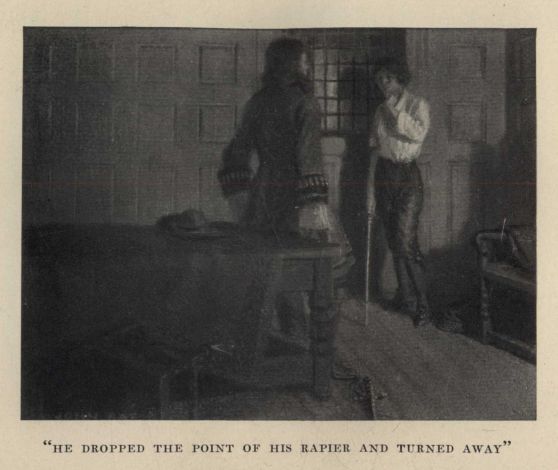
"HE DROPPED THE POINT OF HIS RAPIER AND TURNED AWAY"
"'Tis enough, I am satisfied."
"But pardon me, sir, I am not," answered Captain Protheroe drily. "Methinks you have forgotten my stipulation."
The prisoner bit his lip and answered coldly: "I do not choose to comply with it; nor do I hold with such folly."
"'Tis a pity you did not express that opinion before, sir. Yet there remains no choice for you. I prefer death by the sword to death by the scaffold. I am ready. You will therefore carry out our contract at once, or forfeit all claim to be counted a man of honour."
The prisoner flushed angrily and once more raised his rapier. But meeting the quiet smile and steady gaze of his opponent he dropped the weapon upon the table and turned away.
"You must wait. I cannot kill you now."
"Your reason, sir?"
"I—I am not in a killing humour."
Captain Protheroe's lips twitched, but he answered gravely:
"Then may I beg you, sir, to overcome your humour without delay."
The prisoner breathed quickly and was silent.
Then Captain Protheroe laughed quietly. "Ah, well! from time immemorial women have loved to delay their coup-de-grâce. You but carry out the traditions of your sex, madame."
The prisoner turned to the captain a pair of wide blue eyes filled with horrified amazement.
"Ah! I thought I could not be mistaken, Mistress Barbara," continued the captain, smiling. "Pray be seated, you must be worn out with fatigue."
Barbara sank unresisting into the chair he pushed forward, and drooped her head in silence.
"May I ask, madame, to what cause I owe the honour of this visit?" queried the captain politely.
"Cicely said—we thought——" she began. Then recovering herself she continued firmly. "I had a suspicion that you might play me false, and might even now be about to set out to arrest Rupert."
"Indeed! So you affected this—er—disguise to prevent our departure. Is it so, madame?"
"I knew no other way," muttered Barbara.
"I gave you my word."
"Aye, but I liked not the manner in which you gave it. You—you angered me."
"That is a pity," he answered quietly. Then seating himself on the edge of the table beside her, he eyed her coolly, and continued with a slight drawl. "Ah, well! the resemblance is certainly a strong one. Sir Rupert, methinks, is a trifle broader in the chest, and—there be one or two more details," he added, slowly surveying her figure.
Barbara drooped her head still lower, and flushed angrily at the veiled insolence of his tone.
"You will wonder how I noted the difference," continued the captain. "The fact is, as I was riding home alone, after my visit to the Manor House, I chanced to encounter the real Sir Rupert, and we had some conversation together."
"You met Rupert!" cried Barbara, forgetting all in her astonishment. "Oh! where is he?"
"He should by this well-nigh have reached the coast."
"Alone?"
"Alone, madame."
"So you have kept your promise?" she cried in amazement.
"Yes, Mistress Barbara, strange though it may seem to you, I have. It is a pity you did not trust me, you would have spared yourself the inconvenience of this—masquerade."
The covert sneer in his tone stung her to a sudden anger.
"And why should I trust you?" she cried haughtily. "You are my enemy."
"I was your enemy, madame, but I had believed myself now to have some claim upon your trust and friendship."
"I see not upon what you base such a belief," she answered still in anger.
"Why else, madame, think you, did I set your brother free?"
"I have but your word concerning that transaction," she answered scornfully. "You were alone when you encountered Rupert."
"Certainly. What follows?"
"My brother, Captain Protheroe, hath his sword."
"A sword!" he laughed. "Why so have I, madame."
"Verily, sir," she answered with a mocking laugh, "yonder it lies."
Captain Protheroe, in astonishment, glanced from her face of triumph to the distant corner where lay his discarded rapier.
"Damnation!" he muttered with a short angry laugh. "I had forgot."
"Aye, so I thought, sir," she answered, smiling scornfully. "And my brother is a better swordsman than I. Yet 'twas a prettily conceived story."
"Mistress Barbara, in good truth, I swear——"
"I have already heard more oaths this evening than I am accustomed to," she interrupted. "I will not trouble you to further tax your powers. I wish you good-evening, sir."
She rose to depart, but he stepped quickly before her, and leaned his back against the door.
"A moment, madame, I beg," he said, his voice harsh with anger. "Since it has pleased you to withdraw your trust in me, I see not that I am any longer bound to respect your confidence. 'Tis but an hour since I parted from Sir Rupert. He can yet be overtaken."
Barbara raised a terrified face to his.
"Oh, no! You could not do that," she said.
"And wherefore not?"
"Oh, because—because——" she faltered.
"Well, madame, your reason?" he demanded again harshly.
Barbara flung up her head defiantly, and snatching her rapier from the table raised the point to his breast.
"Because, sir, by your own showing," she replied, facing him boldly, "your life is now mine, to do with as I will. Make one motion towards my brother's undoing, and I swear by Heaven I will run you through as blithely as ever I ran needle into cloth."
For a space they stood thus, she with face alight with excitement, he staring down with astonished admiration into her blazing eyes.
Then he laughed quietly.
"Pardon me, Mistress Barbara," he said, eyeing her coolly. "Your doublet is awry."
Instantly she dropped her rapier, her hands flew to her waist, she looked down in deep consternation. All her newborn resolution had vanished, she was but a woman once more.
"My doublet is not your concern, sir," she muttered.
"Your pardon, madame," he answered pleasantly. "I should in truth have thought a doublet rather my concern than yours; but as you will. If you prefer to wear it thus, of course——"
"I—I knew not exactly how it should be worn," she faltered, glancing doubtfully at her figure. Then recollecting herself she continued angrily. "My dress is my own affair, sir. Why should I not play the Rosalind, an it so please me?"
"No reason whatever, Mistress Barbara," he continued lightly. "I can only rejoice at my good fortune in being present at the performance. By my faith, the dress becomes you wondrous well." And again he submitted her to a critical survey from head to foot.
Her head drooped, her breast heaved, and turning suddenly from him she sank into a chair and burying her face in her outstretched arms upon the table, she burst into bitter sobs.
Captain Protheroe regarded her doubtfully.
"Woman's last weapon?" he queried with a cynical laugh.
The sobs redoubled in force; they shook her whole body.
"Come, come!" he protested roughly, "this is useless, madame. I have already once this evening had the pleasure of seeing your tears; I know their value. Besides, you should bear in mind your character; tears are ill-suited to doublet and hose."
Still she sobbed on, unheeding.
He moved impatiently and hummed a tune which quickly wandered away into incoherence. "I would I knew if it were counterfeit," he muttered.
Still she wept, with quick-drawn breath, and short, gasping, helpless sobs, very terrible to a man's ears.
He took two steps towards her, and then paused. "No," he muttered. "I will not. She hath already duped me twice, I will be hanged if I let her do so again. 'Tis but counterfeit."
He turned from her resolutely and seating himself with his back to her waited stolidly until she should see fit to relinquish this last design.
Minute after minute passed. Soon the sobs died away.
"Ah, good!" he thought with a smile. "So my lady has decided to try another plan."
He waited impatiently for her next move. There was no sound in the room save an occasional sobbing gasp.
At last he could wait no longer, but rising quickly hurried to her side. Her eyes were closed and she lay very still. Then he listened for the regular breathing. There was no doubt of the matter, she was asleep, asleep as peacefully as an infant.
"So it was no counterfeit," he muttered slowly; "she hath sobbed herself to sleep. What a brute she must think me! What a brute I am!"
He stood close beside her gazing down at the graceful yielding figure, at the dark lashes curling on to the flushed, tear-stained cheeks, at the rosy half-opened mouth, at the loose mass of hair framing her perfect face. His breath came fast, his heart beat quickly.
Suddenly he turned from her and hurried from the room, locking the door behind him. Away from the room, away from the Inn, away to the river-bordered meadow behind. And there he paced the night through, puffing unconsciously at an unlighted pipe, until the first rays of dawn softened the sky.
Before he set out he crept once more into the room where Barbara still lay asleep. He paused first to throw a cloak gently over the form of the sleeping girl, then he turned to pick up his sword and collect his papers.
But ere he left the room he hesitated once more, and turning strode into the far corner. Here he knelt down and searched eagerly for a certain knot of scarlet ribbon, which being found, he folded carefully and with a short half-shamed laugh, placed in the pocket of his doublet.
So Captain Protheroe and his men rode from the village. But Barbara slept on peacefully, while the sunbeams stole into the room and played with her dark curls. And there an hour later Phoebe found her, when, in answer to a message sent by the captain ere he left, she came down from the Manor House to search for her missing lady.
CHAPTER IX
It was with many a sigh and much inward misgiving that the Reverend Marmaduke Peters ascended his pulpit steps in the little church of Durford and prepared to deliver his discourse to his flock on the morning of Sunday, September 15, in the year of grace, 1685.
The Reverend Marmaduke was stout and placid in person, kind-hearted and nervously sensitive to a degree; and having as his aim in life the threefold longing to satisfy his superiors, to breed the best poultry in the country-side, and to live at peace with all men, he wondered what cruel humour of fate had placed him in such a hot-bed of rebellion as was the little village of Durford.
A while ago, with sorrow and amazement, he beheld his flock straying wilfully towards the abhorred wilderness of rebellion, but his doubts then lest possibly the rebellion might prove successful, forbade the cautious soul to use what influence he might have had in holding their allegiance firm to the king.
Now, however, when the rebellion had failed, and the rebels had been scattered, the same caution forbade him to display openly the deep sympathy which his kind heart could not but feel for the sufferers, many of whom were personally dear to him.
Truly his was a delicate position, and the ingenuity with which hitherto he had maintained a neutral position, and in both his Sabbath discourses and his week-day intercourse with his flock had succeeded in ignoring the very existence of the rebellion, displayed an amount of thoughtfulness and steady perseverance which would have done justice to a nobler effort.
But the most far-sighted prophet may be o'erthrown by circumstances.
During the few weeks in which Captain Protheroe and his men had occupied the village a severe and inexplicable malady had kept the worthy minister prisoner in his house, and had prevented any untoward collision between himself and these representatives of the Royal cause.
With the withdrawal of the soldiery on the previous Wednesday, however, he had once again recovered full health and strength, and had resumed his duties.
But the week was not out when, to his dismay, six troopers under the command of Corporal Crutch returned, and he received a polite but firm intimation from the corporal that as he himself proposed to attend the service on the morrow, a discourse upon the sinfulness of rebellion would be regarded by the authorities as a satisfactory proof of the preacher's loyalty and submission. The intimation was accompanied by a clear hint that the Reverend Marmaduke's loyalty was regarded in certain quarters as of a questionable quality.
The Reverend Marmaduke was dumbfounded.
In vain did he represent to the corporal that sermons could not be prepared on the instant, that a discourse worthy of such a theme would require days of careful thought and study; in vain did he endeavour by every device in his power to escape the ordeal thus set unexpectedly before him, but escape was impossible; for the worthy corporal, finding himself in a position of unquestioned authority, was once more minded to enjoy it to the full. He could not enter the pulpit himself, but he was resolved to cause such a discourse to be delivered as should bitterly condemn all rebels, and surround with a halo of glory his loyal, law-preserving self. A few judiciously suggested threats concerning the suspected disloyalty of the minister were sufficient; the worthy doctor recognised his helplessness and he submitted.
Not, however, until he ascended his pulpit on the morning of the Sabbath had he fully realised the enormity of the task he had undertaken.
Beneath him stretched row after row of benches, well filled with the parishioners who loved and trusted him, and the majority of whom had sent their best-beloved to aid the rebellion which he was to condemn. To his left sat Corporal Crutch, attended by two troopers, sitting as judges upon the loyalty and fervour of his discourse. While immediately below the pulpit sat "the quality," as represented by Lady Cicely and Mistress Barbara Winslow, and when his glance fell upon the face of the latter, he knew that the ordeal before him was desperate indeed.
He had chosen for his text the words of the psalmist, "Kings with their armies shall flee before Him," hoping that the allegorical allusion to Monmouth as a king might soothe the feelings of those who believed in their hero's title. The delivery of these words, applicable as they were to recent events, instantly aroused the attention of his hearers. The worthy preacher groaned inwardly; would they but sleep or allow their attention to wander, as was ordinarily the custom, all might yet be well; this unwonted interest was but another cruel jest of Fate. Barbara, after a sharp glance in the direction of the corporal, whose presence she had noted with surprise and anxiety, settled herself to follow the discourse with a defiant light in her dark eyes, and even Lady Cicely looked up with unusual interest.
The Reverend Marmaduke mopped his brow, sipped his glass of water, and sighed deeply. Then summoning all his resolution to the task, he plunged into his subject and wandered for some time among the ramifications of the history of the Israelites, until an impatient movement from Corporal Crutch warned him that it was inadvisable longer to delay the application of his text to current topics.
Thereupon he fixed his glance resolutely upon the countenance of the corporal and burst forth into an eloquent reference to the triumph of the supporters of the Lord's Anointed, as represented by the king's troops in the late battle, and the downfall of his enemies.
Presently he became uncomfortably aware that Lady Cicely Winslow was weeping silently into her kerchief, while many of his parishioners at the back of the building were giving vent more noisily to their grief. The faces of the men were dark with anger, and below him the figure of Mistress Barbara grew more and more erect, her head thrown back, her lips pressed tightly together, and her eyes flashing upon him glances of indignation and scorn.
The preacher hastily diverted the flow of his discourse into a cautious condemnation of rebellion in general, but was again driven forward by the threatening glances of the corporal to particularise and condemn more thoroughly.
Now, however, he was interrupted by a sharp fit of coughing from Barbara, loud and aggressive, which ceased when he paused, and when he continued broke out with new vehemence. For full three minutes the struggle continued, till Cicely's whispered entreaties induced Barbara to allow the unfortunate preacher to proceed in peace.
Alas! his nerves were now unstrung, his thoughts hopelessly astray. Desperately he grasped at a last straw and sought to compromise.
Truly, he protested, rebellion is as the sin of witchcraft, and rebels are ever to be abhorred. (This to soothe the corporal.) But had not many rebelled in ignorance, led astray by misrepresentations, by wolves in sheep's clothing, and for such there was not condemnation, but pity.
This appeared to the worthy doctor an excellent position to adopt, and for the remainder of his discourse this position he maintained, endeavouring by appreciative references to the noble supporters of justice on the one hand, and by an attitude of tender consolation towards the rebels on the other, to satisfy both sections of his congregation.
But to Mistress Barbara Winslow such a compromise appeared nothing short of direct insult. Condemnation as a rebel she could endure, but pity as an ignorant fool incapable of judging her own path, she felt was more than any maid should be called upon to accept in silence, and but for Cicely's restraining hand and entreating whispers she would have left the church. In deference to her cousin's feelings she remained, but her indignation was so apparent that the unfortunate pastor could not continue, and bringing his discourse to an abrupt and bewildered conclusion he withdrew from the pulpit.
When Barbara rose to leave the church she was a confirmed rebel. Hitherto she had taken but small interest in the great rising, except in so far as it concerned her brother, and had certainly been no ardent supporter of Monmouth, but the worthy doctor's discourse had aroused in her a keen feeling of anger and opposition.
Now 'tis with a woman as with a stream; endeavour to resist or to direct her course with argument or reason, and the current of her actions will but flow the stronger in the ever-narrowing channel.
Barbara's first impulse was to waylay the Reverend Marmaduke in the churchyard, and there, outside the sacred edifice, pour forth upon his offending head the vials of her wrath. But discretion and a lengthened indulgence in the seclusion afforded by the vestry secured the peace-loving occupant from an encounter not wholly unanticipated. In ignorance of the exact nature of the events which had passed in the churchyard during the interval, but satisfied at last that his congregation had dispersed, he made his way to the safe haven of the rectory.
Disappointed of her intention, Barbara looked round in search of some other victim, but there appeared only the corporal, and she would not demean herself to bandy words with him. Throwing a disdainful glance in his direction, she swept haughtily down the grass-grown path to the lych-gate. Here she was perforce delayed. Her cousin had paused to speak a few words of hope and sympathy to an old woman whose only son lay in Taunton gaol, awaiting his fate, and as she waited Barbara glanced carelessly around her.
On the green near the church she noted a couple of mounted dragoons in charge of four spare troop-horses saddled and bridled, and a third in charge of a rough-looking cart. She noted these preparations for departure with satisfaction, and wondered what had been the reason for such a short and sudden visit.
As the crowd in the churchyard parted, and the corporal, followed by his two attendant troopers, came down the path to the gate, she was soon to be enlightened, however.
The corporal advanced and laying his hand on her shoulder, cried in a voice wherein pompous dignity and elation strove for the mastery:
"Mistress Barbara Winslow, I attaint you as a rebel, and arrest you in the name of his Majesty."
Too much astonished to speak, Barbara was conscious, however, of a murmur of anger and surprise from the crowd of villagers and of Cicely's voice enquiring sharply:
"What is the matter? What means this?"
"There is no call to answer questions," replied the corporal pompously. "But an ye must know, it means that this woman is attainted as a rebel, and I hold a warrant for her arrest, with orders to conduct her instantly to Taunton gaol to await trial."
"But it is impossible! she is no rebel."
"She is known to have sheltered rebels, many have been hanged for less," answered the corporal, with a sinister glance of triumph at his prisoner.
"Yet surely it cannot be as ye say?" cried Cicely helplessly. "Taunton gaol! Why she is a woman, ye cannot. Nay, she is but a child. Oh! 'tis monstrous, monstrous."
"No words, no words," cried the corporal fussily. "You will learn, madame, that in such affairs of state, least said is soonest mended. Now, mistress," he continued roughly, turning to Barbara, "we'd best be moving."
But a growl of anger broke from the still lingering crowd, and Peter Drew, the blacksmith, sprang upon the low wall of the churchyard.
"Hey, lads!" he cried; "they red-cöats be vor taäkin oor young Miztrez to Taunton gaol. Zhall her be taäken, lads? Zhall her go? Hey lads, we be vaive to one. Zhall her go, lads?"
Peter was no orator, but eloquence was not needed. Love for Barbara, that old feudal love for their lord; resentment for the many acts of ill-treatment sustained at the hands of the troopers during their occupation of the village; and lastly, the spirit of revolt against injustice and opposition which lurks secretly in every heart, all combined to rouse his hearers to fury, and it needed no words of the smith to fan the flame.
They greeted Peter's harangue with a wild shout of triumph, and closed in round the corporal and his men with gestures which threatened every moment to develop into a fierce attack.
Barbara's face flushed and her eyes glittered with triumph. Wild projects flashed through her brain. To overpower the half-dozen troopers, then to fortify the Manor House, and hold it against all comers; to rally round her the many secret supporters of the late rebellion, to recall the exiles from Holland, and to succeed in establishing justice and the Protestant Religion, or die fighting for the Cause. Had not other women done as much! These men, she knew, would cheerfully fight to the death for her; the country was still full of malcontents; one failure could not be regarded as the death of the Cause. Hope was high, all things seemed possible. Who shall say what mad dreams passed through her thoughts during those few moments while she stood there, the centre of that enthusiastic mob?
But it was not to be. From out the crowd there pressed forward an old woman, who flung herself trembling at Barbara's feet.
"Eh; Miztress Barbara, dearie," she cried, seizing her hand, "don't-ee, don't-ee, then. A'll swing for it, for zure a wull if a faight. And zee there," pointing with her trembling hand at a tall stalwart fellow, prominent amongst the throng, "thiccy's arl I've left now. Three others have been taäken. If they taäk un I maun die, for zure I maun. Don't-ee, now."
"Vor shaäme, mother," cried the lad referred to. "Would ee have un taäk the young Miztress to Taunton? Vor shaäme."
But the dreams had passed. Barbara's eyes were opened and she recognised the hopelessness of any resistance. She could not, she must not sacrifice these lives.
Gently disengaging herself from the clinging hands of the old crone, she sprang on to the wall at Peter's side and caught his uplifted arm.
"No, no, friends!" she urged; "it won't do. We could not hope for more than a short-lived victory. She is right, there would be vengeance and ye would all swing for it. This fellow saith he hath the Royal Warrant for my arrest, an that be so I must e'en go with him. Be assured they cannot harm me; I have done no wrong. Besides," she added proudly, "I would not have them think me afeared to go. Peter, be silent. Nay, I thank you indeed, but there must be no resistance. Go home quietly. You women, look to your men folk. No harm shall come to you for my sake, and none must think I fear to go."
Thus she stood upon the wall, a bright figure in her dainty muslin gown, smiling down upon them, until with reluctance, and many incoherent mutterings, the crowd, somewhat reassured by her words, slowly dispersed. Then turning she addressed the corporal:
"So that is ended. Now, an you will permit me first to return to the Manor House to collect some necessaries, I am ready to go with you to Taunton."
"I am rejoiced, mistress," he assured her pompously, "that you have decided to submit peaceably to my orders."
"Aye, corporal," answered Barbara, with a smile at his perturbed countenance. "I do not doubt but you are indeed rejoiced. But come, I must to the Manor House, to prepare for the journey. I presume you will allow me so much grace?"
"The escort will accompany you thither."
"I had thought my submission had been proof enough of my good faith, but as you will," answered Barbara carelessly, passing through the gate.
"Barbara, I must with you to Taunton, indeed I must," pleaded Cicely, as she hastened after her cousin. "'Tis monstrous that you should go alone with these men."
"Thou, Cicely? Impossible! What could'st thou do there? Where could'st thou lodge? Not i' the gaol indeed."
"There be many kindly folk in the town who would house me, and they will perchance advise too what 'twere best to do for thee. There is good Mistress Lane, the wool-merchant's wife, I will seek her out. But go with you I must indeed."
"In truth, Cicely," answered Barbara with a quick sigh, "I would fain have thee near, if 'twere only to teach myself the folly of my fears by laughing at thine."
With a tyranny born of his newly acquired importance, Corporal Crutch refused to allow his prisoner more than a few minutes' preparation before her journey to Taunton, but having resigned herself to fate Barbara had no mind to delay, and in less than half an hour after their return to the house the two enforced travellers were ready for departure.
Barbara's resolution was by no means strengthened at sight of the ramshackle cart provided to convey her to Taunton.
"To what low estate our fortunes have fallen!" she muttered with a wry face.
"Rebels cannot expect to be treated like honest folk," remarked the Corporal complacently.
"Set a watch on thy tongue, Master Corporal," retorted she angrily. "I am no rebel till I be proved such, therefore I warn thee 'twere best be more careful of thy words," and turning abruptly from the startled man she took her seat in the cart.
For the first few miles of their journey each of the girls devoted all her efforts to the difficult task of cheering the other. Upon leaving the village and their friends behind them, some sense of the utter helplessness of her position filled Barbara's mind, and she was but a sorry comforter.
But hers was not a nature to sigh long, and soon the fresh air, the bright sunshine, and the interest and amusement she found in watching her escort, had their effect. The result of this reaction from her former depression was a mood of high spirits and brighter hopes.
"In truth, Cicely," she broke out suddenly with a laugh, "we are both fools. At worst 'tis but a matter of a night or two in gaol, where I doubt not I shall meet much good company; an interview with Lord Jeffreys (I would fain see him, they say he is a right handsome man, for all he has such a tongue); then perchance a fine, and so home. Why 'tis not worth a sigh. 'Tis but an adventure, and thou knowest I love such."
"Aye, Barbara, you speak truly," answered her companion, with a desperate attempt at cheerfulness. "They would not dare to harm a woman. I make no doubt these tales of my Lord Jeffreys' punishment and—and of Lady Alice Lisle, are gross exaggerations." This last she added with a tentative air—Cicely longed for corroboration of that statement.
At mention of Lady Lisle Barbara's face fell slightly, but she resolutely dismissed her fears.
"There is not a doubt of it, sweet. Yet even an it were not so, they could prove nought against me. They have no testimony to show that we housed or aided either Rupert or Sir Peter."
"That is so," assented Cicely joyously. "And in justice none could punish us for what is unproven."
"Oh! Cicely, look at yon red-headed trooper, didst ever behold so scarlet a poll?"
"Aye. And mark how he sits his horse. I wager he will be over its head ere he sees Taunton. Note his face when the creature pricks his ears; 'tis a very picture of terror."
"Didst note the corporal as we passed trough the village?" laughed Barbara. "The poor fool feared an ambuscade at every corner, and well-nigh fell from his horse with fright when old Mother Gilkin's pot fell down as we reached her cottage. I hate the fellow, yet I cannot but laugh at his antics."
Thus for a while the two chattered bravely as they clattered and bumped along the rough country roads to Taunton. But as night drew on the sky became overcast with clouds, and a cold wind and drizzling rain added to the discomfort of the journey. Their conversation became more and more desultory, and finally ceased altogether.
Only once again did Barbara break the silence.
"Cis," she asked with some slight hesitation, "thinkest thou that Captain Protheroe knows aught of my arrest?"
"Knows aught!" cried Cicely in astonishment. "Why, Barbara, child, who else hath accused thee?"
"Nay, nay; I will not believe that of him," answered Barbara stoutly.
"Believe what thou wilt, I tell thee it is the truth. Thinkest thou he would tamely endure to be duped as thou hast duped him, without some revenge? Oh! I tell thee as I have ever done, the fellow is to be mistrusted, and to take such revenge on thee were but his nature."
"In truth, Cicely, you do not know him," pleaded Barbara. "He is not—I would trust him."
"Why, Barbara! Hath the man bewitched thee that thou art so ready in his defence?" cried Cicely, looking at her curiously. "What hath he done to win such trust? Or dost thou deem, perchance, that thou hast bewitched him, and so bound him to thy cause? I' faith, coz, I warn thee, trust not too much to the power of thine eyes; all men be not so easily ensnared."
But Barbara answered not, only sighed lightly and stared thoughtfully into the gathering darkness, her eyes wide with wonder and with doubt.
The distance from Durford to Taunton is scarce twelve miles, and 'twas little past noon when they set out on their journey, but the progress of the cart was slow, owing to the bad roads.
A horse, too, cast a shoe, and they must needs stop at the next village to seek a smith. The escort halted more than once for refreshment, and in fine it was night before they reached their destination.
Perhaps the darkness was not without its compensation. At the cross roads were scenes ill-suited to a woman's eyes, traces of that wholesale butchery which for many weeks had devastated the fairest county of the West. Gaunt figures swinging in their chains from the sign-posts, tokens of the merciless punishment meted out to those even suspected of rebellion, had been no cheering welcome to such travellers as they.
When they entered Taunton the streets were almost deserted, and the dwelling houses closed and in darkness, but the windows of the White Hart Inn, the headquarters of the royal troops, blazed with light, and the shouts of laughter and snatches of song from within indicated that the soldiery were holding revelry, heedless alike of the hallowedness of the Sabbath, of the misery of the townsfolk, and of the despair of hundreds of prisoners who lay awaiting their doom in the crowded gaols of the town.
As the cavalcade passed before the Inn an officer lounged into the light of the doorway, and stared carelessly at the passing company. Barbara with a gasp of astonishment half rose to her feet, but Cicely's hand restrained her, and reluctantly she sank down beside her cousin.
The cart passed, leaving Captain Protheroe to continue his inspection of the night all unconscious of whom the vehicle conveyed.
CHAPTER X
"So! Now am I in prison. Well, I had as lief be elsewhere," muttered Barbara when she awoke after her first night in gaol, and proceeded philosophically to take stock of her surroundings, which she had been too weary to notice on the previous night.
She was not confined in the regular gaol of the town; for nigh two months past that had been filled to overflowing. Those arrested within the last few weeks, together with the unfortunates sent on from Exeter in the van of the dread-inspiring Jeffreys, were lodged in convenient sheds and storehouses, situated in various parts of the town; bare, dreary places with little or no suitable accommodation for the wretches herded within their walls, but affording enough shelter in the opinion of the authorities for rebels during the short interval which must elapse before their trial.
The building wherein Barbara awoke was a large wooden shed, originally a storehouse for wool, some few bales of which still remained piled in the corners. A large door closely guarded and windows high in the roof were the only means of egress, and no provision for the accommodation of the inmates had been made beyond a few straw pallet-beds for the women prisoners, roughly screened from the rest of the shed by a dilapidated piece of sacking. Even in the most hopeless moments since her arrest Barbara had calculated on nothing so dismal as this.
She had slept late after the fatigues of the previous day, and when at length she awoke, the other occupants of her corner had already risen, and passed beyond the partition into the shed.
Barbara seated herself on the edge of her bed and stared forlornly at the bare wall opposite.
"Well! Many better women have been in worse plights, there is not a doubt. I must e'en comfort myself with that," was her verdict after musing some minutes upon her situation. "Now let me see. Rupert would say that the duty of every woman under every circumstance is to look her fairest, but there seemeth little scope for that maxim here, and I see not wherein lies the vantage of tending one's looks when here is no mirror to show the result. However, for lack of other advice I'll e'en follow Rupert's."
Having come to this laudable conclusion, Barbara opened her bundle and proceeded to arrange her curls, and make such improvements in her toilet as the scanty means at her disposal allowed. This done she drew aside the partition and stepped into the room beyond.
It was a curious sight that met her eyes. The shed was totally destitute of furniture, unless as such might be designated the few bales of wool and some bundles of straw, used by the prisoners indiscriminately as couch, chair, or table.
The place served as lodging for about fifty prisoners, many of whom had been from two to three weeks in captivity. The majority of them were rough, ignorant peasants, who, having faithfully followed their leaders into a quarrel which they themselves but half comprehended, now awaited their doom with that same half-puzzled, stolid patience and dogged courage which had helped them already to face death on the fatal field of Sedgemoor.
There were some, too, of the yeoman class, some of the richer townsfolk, and here and there a noncomformist divine, but save perhaps in a certain intelligence and eagerness of expression, there was nothing to distinguish the man of learning or station from the poorest peasant. All alike were dirty, ragged, and dishevelled; unshaven, unwashed, with ill-kempt beards and hair. Existence in such a prison, following in many cases upon days of homeless wanderings, had wrought this levelling effect upon them all. Their money, what little they once possessed, was long ago exhausted. They could pay their gaolers for neither books, amusements, nor drink. They talked little; what was there to talk of? For the most part they were plunged in the deepest apathy. They had fought, they had failed; now they awaited what was to come in silence. They showed no fear, no despair, no hope, only a great patience.
Barbara gazed on the scene with the utmost astonishment and indignation. Were these men, indeed, the same wild enthusiasts who a while ago had so eagerly cheered Monmouth through the streets of Taunton? Aye, and not only cheered him, but aided him loyally, leaving work, home, wife, children, and all, that they might follow him and strike a blow for the Cause. Were these indeed those who, armed but with stake or scythe, had made such a gallant stand against the best disciplined troops of the country; those who (men were forced to confess) would but for an accident, undoubtedly have won an unprecedented victory? Could these indeed be the same? She stared with anger and scorn at their silence, their apathy, their unkempt looks. Her ardent young nature had no understanding of this submission to the Inevitable; she had not yet learned that an Inevitable might exist.
Her birth and breeding afforded her no comprehension of the stolid bravery of the peasantry. The farther man is removed from the natural state, the greater the advance he has made in civilisation, so much the more does he deem it necessary to hide his emotions beneath an artificial mask, to seem to be that which he is not. A century later in the massacres in Paris the victims were for the most part nobles and gentlemen; they went to their doom bravely, with a smile in their eyes, a jest upon their lips. In this great Rebellion of the West the victims were the poorest of the peasantry; they faced their doom no less bravely, but they faced it gravely, in silence.
Barbara's family traditions had taught her nothing of this. She had expected her fellow prisoners to be a company of merry dare-devils such as her brother Rupert, or Sir Peter Dare, men who laughed at danger, mocked their gaolers, and turned misfortune, nay, death itself, into a subject for jest. Men, too, who could fight fiercely and endure bravely on occasion, yet would scorn to appear serious in any circumstances (save perchance when discussing the set of a doublet or the colour of a bow), and who looked upon gravity as a sign of cowardice. Such were the rebels she knew, the rebels she had dreamed of, gay, careless, defiant to the end; not such as these, silent, sunk in a helpless submission to their fate. She could not understand. She looked round upon them in indignation, her lips curled in scorn.
But while she stood there surveying the scene she had herself been the subject of observation; presently one of the prisoners approached her and interrupted her meditations.
"What are you doing in this place, my child?" he asked gently.
The speaker was a small, spare man, with bushy white hair and beard, a face seamed and lined with age, yet full of kindliness and humour, with a pair of bright, piercing eyes; a face calculated to win friends or to daunt foes.
Barbara turned to him at once as to an old friend; his voice invited confidence.
"I was arrested but yesterday, sir, on a charge of sheltering rebels, and I am here, as the rest of the company, to await my trial."
"You are very young, but you have a stout heart," he said, smiling kindly.
"Why, sir, I hope so," answered Barbara cheerfully. "I am Barbara Winslow of Durford Manor, and no Winslow yet was ever written coward," she added proudly, with a scornful glance round the shed.
"Noblesse oblige," he quoted, smiling at her sadly. "Ah, child, your strength may seem great, but trust not in it too wholly, lest in the hour of darkness it prove but a broken reed."
Barbara was puzzled. "What mean you, sir? Sure, 'tis not sinful to be brave for a name's sake."
"Nay, I say not that," he answered gently. "There be three qualities that have power to beget a courage unto death—Faith, Love, and Pride. But of these three only the courage born of Faith has never been known to fail. Yet whencesoever it springs, courage is the gift of God and a blessing to man, and as such must be honoured."
Barbara looked at him curiously.
"You are a divine, sir, are you not?"
"Yes, I am indeed a servant of the Lord, though for many years I have been withheld from openly preaching His word. For fifty years I have lived and worked secretly among the miners of the Mendip Hills, and when they marched to support the defender of our religion, I followed to give them the comfort of my words. I thank God that I shall follow them to the end. Ah, child," he continued earnestly, "you cannot understand what it is to be silenced, to be dumb, as 'twere, for twenty-three years; to be torn to pieces 'twixt the burning in my heart to speak the Word, the fear in my breast of meeting the punishment. It is worth a thousand deaths to have had at last this chance of testifying once again to the truth."
Barbara looked at him gravely.
"No," she said, "I do not understand."
His earnestness vanished. He gave a soft resigned sigh and smiled at her, as at a child.
"No, you do not understand; you are young and fearless."
"It should be easy to me to be courageous," she answered lightly. "I have nought to fear. 'Tis for me but some few days in prison, and then perchance a fine. In justice they can do no more."
He smiled at her a trifle sadly.
"Aye, child, as you say, in justice they could do no more."
She looked up at him doubtfully, but forbore to question further the meaning of his words.
"But these folk," she continued, looking round, "have doubtless more to fear."
"There is indeed little hope for them this side the grave," he answered calmly, "save for a speedy and merciful death."
Barbara was startled.
"Surely not so—and yet—I had not thought on't," she muttered. "Verily, sir, if this be true, my scorn was ill-timed, they have courage. They are but rude peasants, with neither pride of birth nor name to strengthen their hearts, yet they await death as calmly as any noble. How comes this?"
"So thou deemest courage a monopoly of gentle folk, eh?" he asked, laughing softly. "Ah, child, thou art young. But indeed," he continued more seriously, "these men have fought in the Lord's cause, there is no fear but He will send them strength to fight their battle bravely to the end."
"How can it be God's cause when it hath failed?" asked Barbara bluntly.
"Failed, child? What mean you?"
"Why, call you not this failure?" she asked, glancing round.
"This! In good sooth, no; this is but the beginning of success, only the times were unripe for rebellion, the leaders were unworthy of the cause. Think you these men will die in vain? In God's name I tell you, no. A cause strengthened by such devotion cannot but succeed; for every drop of blood shed to-day there will spring up seeds of justice and resolution in the hearts of the survivors which shall blossom forth into a mighty power. I shall not see it, but thou mayest, for the day is not far off when justice, toleration and true religion shall once more flourish in this kingdom. Failure! Never! We are but the necessary martyrs, the runners of success. The cause of justice was never yet won save by a path of blood and tears."
His enthusiasm communicated itself to Barbara. Her face glowed with eagerness; at that moment she had resolution to face block or scaffold that she also might die for the Cause.
"Ah!" she cried, "this is the courage of which you spoke, the courage born of Faith."
He bowed his head in assent, and there was silence between them while Barbara pondered on his words. Presently she continued:
"And the third, the courage of Love? What mean you by that?" she asked.
Instantly his face was transfigured by a smile of great tenderness.
"I will show you," he answered gently. "Look."
Barbara followed the direction of his eyes. In a far corner of the shed, apart from the rest of the prisoners, sat a man and a woman. She lay in the circle of his arm, her head dropped back upon his shoulder, and oblivious to all around them they sat gazing in one another's eyes. Pale, ragged and unkempt, as were all the prisoners, yet beautiful in each other's eyes, and transfigured by the light of perfect happiness, by the glory of their love.
"It is their wedding-day," he continued softly. "I married them at seven o'clock this morning."
"But who are they?" asked Barbara in bewilderment.
"He is the son of the squire of Hardon, and an officer in Monmouth's army; she, the daughter of a rich cloth-maker of Taunton, who joined the army and met his death at Sedgemoor. He lodged in her father's house when the army was first quartered here. Later, she was attainted a rebel, and they met again, in prison. See now how mighty is love, that it will even force its way into such a desert as this. They have lived here together for three weeks as in a Paradise, and yesterday, feeling the time of separation draw near, they besought me to join them forever in God's sight, as man and wife. I know not whether I rightly consented, yet who could refuse?"
"And the future?" whispered Barbara eagerly.
He shook his head.
"She has money, the charge against her is but slight, her friends will buy her freedom. But for him, an officer in the rebel army, there can be little doubt—— Is it not wonderful?" he continued softly, as though to himself. "Thus they sit hour by hour. Hopes and fears alike have faded in the great light of their love, and for to-day at least they live as in the Garden of Eden, where there is neither past nor future; nought but the present and themselves."
Barbara gazed silently at the couple, until suddenly a great sense of loneliness overcame her, and her eyes darkened with a mist of tears. She turned to her companion with a pathetic gesture of helplessness.
"Alas! ere I came here I had believed myself so strong, so fearless. And here I find all others are brave, and I but a helpless fool."
There was something bewitching in this sudden confession of weakness, and her companion's face softened for an instant as he looked at her. Then he laughed, and his laughter was wise, for it stung her pride, and recalled her former resolution.
"In truth, this discovery is to be deeply regretted, Mistress Winslow," he answered lightly, "seeing I had hoped to enlist the services of one so stout-hearted in the work of cheering the weary hours of some of our unfortunate comrades."
"My services! Why, what think you I can do?" asked Barbara eagerly. "Wouldest have me clamber on a bale of wool and harangue these men upon the duty and virtue of courage?" she added merrily.
"Nay, that were hardly woman's work. And 'tis not for men your help is needed."
"For whom, then?"
"There is a poor girl, she is scarce more than a child, who was brought hither yesterday with her younger sister. They were among those maids of Taunton who presented to the Duke his banners, and for this innocent action they have been arrested. I think, indeed, there is little fear for them; they have rich friends, people of influence, who can save them at a price. But the poor child is fragile. Terror hath gripped her by the heart, and if she be not roused and cheered 'tis to be feared her brain may give way."
"Take me to her, I will try."
"Come, then. Her sister is beside her, but the poor child is very young and can do but little. It may be that you will be able to cheer her."
Barbara gathered up her dainty skirts and followed her companion. As she passed along she was greeted by many a look of surprise and admiration, but so intent was she upon her errand she scarce noted the interest she aroused.
They found the two ill-fated children—they were both little more—crouched against the wall in the darkest corner of the shed. Near them sat a poor peasant woman weeping bitterly, while a second woman offered rough attempts at comfort. Close beside the latter was a thin, elderly woman, with the severe mouth and narrow forehead of a fanatic, who stared straight before her, muttering rapidly to herself, oblivious to her surroundings. These few, with Barbara and the young bride, were the only female prisoners in the shed.
Barbara paused a moment, surveying the group curiously, then she advanced slowly towards the two sisters. The elder of the two was scarce sixteen, fragile and pale. She crouched beside the wall, her chin sunk on her breast, silent, immovable, but when Barbara, touched her on the shoulder she raised her head suddenly, and displayed a face so frozen with despair and eyes so wild with terror that the girl was horrified. In an instant all other considerations vanished before the great pity and tenderness that filled her heart.
"My poor, poor child," she exclaimed gently, "what have they done to thee? Nay, look not thus, none shall hurt thee, I promise it. See, I will sit thus beside thee. Come, now thou art safe and hast nought to fear."
She sank down beside her, drew the child close and encircled her tenderly with her strong young arms.
The bright face, cheery smile, and gentle voice, all tended to excite confidence, as did also the firm pressure of human touch. The child gazed at her for a few moments in doubt and bewilderment, then suddenly clung to her fiercely and burst into wild tears.
"Oh! they will kill me," she sobbed. "Do not let them. Do not let them take me away."
"No, no, they shall not, I swear they shall not harm thee," answered Barbara soothingly, though with more rashness than conviction. "Only look cheerily, sweetheart, and be brave and all will be well."
"Will you take me home? Prithee, take me home," she begged, sobbing.
"Nay, we must bide here for a day or two, but what of that? It will not harm you, and 'tis for a great cause. Bethink you of the saints, of the martyrs; they suffered even death without fear. Bethink you, childie, how many women have striven and suffered manfully for their cause, and be you courageous and proud to suffer thus little for yours."
"Tell me of those women," whispered the younger child, creeping near to their new-found protector. She was stronger; she did not suffer as did her sister, but her poor puzzled brain could not understand why this imprisonment had befallen them; she grasped eagerly at the reference to martyrs. 'Tis easier to be brave in paths which others have trod before us.