Chapter II · (continued 2)
Reading edition
At Sutton and some other places the same principles are applied,—that is to say, bacterial filtration,—but there is no tank. A metal screen in some measure takes its place, and holds back solid matter from being carried on to the beds. The filtrant is burnt clay, and it is forked over occasionally to let in oxygen. The crude sewage is run over the top of the burnt ballast, where it is left for two or three hours. It is then slowly run off on to a finer filter, where it also stays two hours. Thence the effluent is run into the stream.
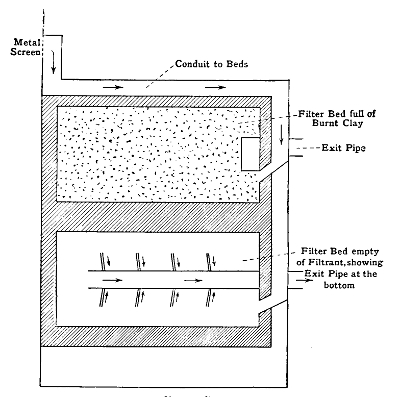
Filter-Beds As Used at Sutton
It must be admitted that the bacterial treatment of sewage, though exhibiting such excellent results where it has been given a fair trial, is still in a probationary stage. It appears to stand on reason. The sludge of previous methods is avoided. The sewage is entirely broken down, and the effluent is a comparatively pure one, yet taking back nitrogen, as nitrate, to the soil. The whole change, indeed, in the opinion of Dr. Dupré, is more effective and radical than in chemical treatment. Further, it has been tested as regards its action upon the pathogenic bacilli—those of tubercle and typhoid—with the result that these infective bacteria have been completely destroyed. It appears that such destruction of infective germs occurs in the tank, and depends in degree upon the rapidity with which sewage is passed through the tank. The cultivation beds also have an inimical effect upon infective bacteria. Hence the final effluent is practically germ-free as regards pathogenic organisms.