THE ATOM IN ENVIRONMENTAL STUDIES
Reading edition
Although his experience with radioactivity has been brief, man probably already knows more about the effects of radiation than he knows about the effects of many other contaminants that alter his environment. Even so, he knows far less than he needs to know to make certain that atomic energy is wisely managed in the future.
There has been neither time nor opportunity, for example, to gather radiation-effects data on more than a few hundred of the 1,500,000 kinds of living organisms inhabiting the earth. Nor is it possible to predict the extent to which life can adjust itself to environmental changes resulting from scarcely perceptible alterations of natural radiological balances. Also undetermined is the relation between environmental changes and the biological exchanges making up the often mentioned, but insufficiently understood, “balance of nature”.
The case of carbon-14 is an example of a permanent man-made modification of the environment. From the early ages of the earth, carbon-14 has been created in the upper atmosphere by the transmutation of nitrogen in cosmic-ray reactions. Carbon itself is an almost universal component of living matter, and the ratio between stable carbon and radioactive carbon is believed to have been unchanged for thousands of years. It is this circumstance that permits the use of carbon-14 as a tool for “dating”, or determining the 21 ages of, fossil remains, prehistoric artifacts, and geologic formations. But carbon-14 also is produced in nuclear fusion, and the testing of thermonuclear devices after 1952 produced an estimated increase of 4% in the amount of carbon-14 on earth. This is enough to disturb the natural equilibrium. Since the half-life[12] of carbon-14 is some 5800 years, the addition will be a factor of environmental consideration for scores of human generations.
Nuclear tests, although not the only sources of man-made radioactivity, have been until now the most significant ones and the only sources touching large areas of the earth. The total product of nuclear testing is small in relation to the natural burden of radioactivity, raising the level of radiation to which all life is subject by a factor of one-tenth or less. But it is the unknown element, the degree to which fallout radioactivity may introduce new influences into the environment, that gives concern.[13]
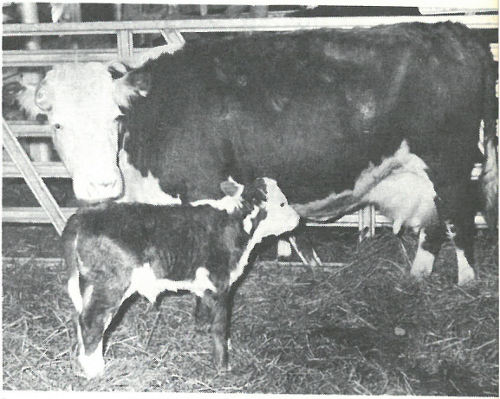
One of the last cows of the herd exposed to fallout by the world’s first atomic detonation in New Mexico in July 1945, photographed in 1964. The calf is her 15th to be born in 15 years. The cow, believed about 20 years old, has been under observation by scientists, who found she suffered little apparent effect, although the fallout caused some hair to turn gray (see light patches on back). Other cows in the herd died natural deaths.
When a nuclear device is detonated, the release of energy is due to the fission of uranium or plutonium atoms or to the fusion of hydrogen atoms. At the instant of fission, some 75 radionuclides, or fission products, are created.
22
From these primary fission products, about 100 other radionuclides may be formed, some existing only for microseconds and others for thousands of years. The radionuclides of significance to biologists are those that exist long enough—no matter how brief the time—to have an impact on a biological system.
Factors of biological transport and concentration of long-lived radionuclides make efforts to assess possible environmental effects particularly difficult. It has been asserted, for example, that probably every living cell formed since the early 1950s contains some of the radionuclides produced by nuclear testing. No one knows the significance of such a condition, if it indeed exists. It is certain only that some of the long-lived radionuclides already placed in the environment will be detectable there for hundreds of years and hence will continue to provide material for biological studies.
Examining Environments
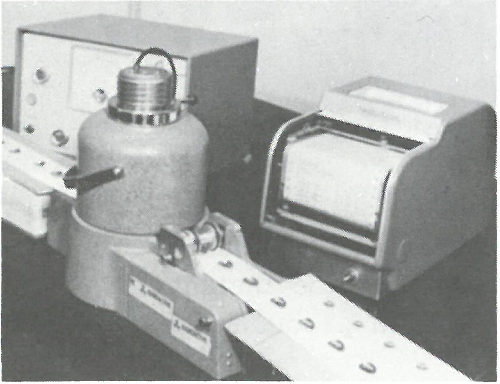
Seeds produced by plants grown in soil of a radioactive waste disposal area pass (in aluminum cups) on moving belt through a radioactivity detector as part of a study of movement of radioisotopes in food chains.
When radioactivity is injected randomly into the atmosphere by a nuclear detonation, biological disposition begins in many ways, each related to the character of the explosion and the environment in which it occurs. Fallout studies thus involve the tracing of mixed fission products in the biosphere and the collection and analysis of thousands of samples of plant and animal tissue, and usually of water and soils, at many successive times. The radiobiologist then attempts to interpret the accumulated evidence of uptake of radionuclides. Some fallout studies may require 23 sampling over large areas of the earth. Other investigations of fallout or of radioisotopes introduced deliberately into controlled field plots may require years of patient observation in small and circumscribed areas.
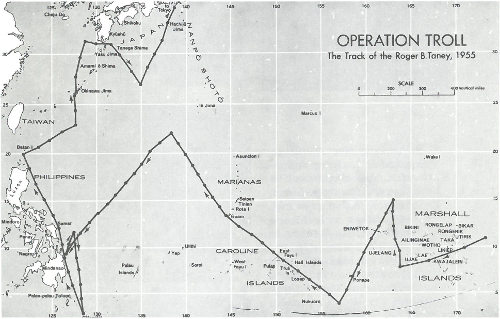
Studies of ocean fallout, for example, have ranged over hundreds of thousands of square miles of open water. The 1955 United States survey of the Western Pacific was conducted by a scientific team aboard a Coast Guard vessel, the Roger B. Taney, in a program called Operation Troll. In 7 weeks the team cruised 17,500 miles, making collections of water and marine organisms at 86 ocean stations on a route extending from the Marshall Islands through the Caroline Islands and the Mariana Islands to the Philippines and finally to Tokyo. The expedition took samples of plankton at depths down to 200 meters and water from the surface down to depths of 600, 800, 1000, and 1200 meters.
Environmental studies at nuclear test sites or in controlled ecosystems involve not only long-term, periodic sampling of plants and animals but also years of detailed examination of soils, meteorological conditions, and other factors.
24
TERRESTRIAL ECOLOGY RESEARCH
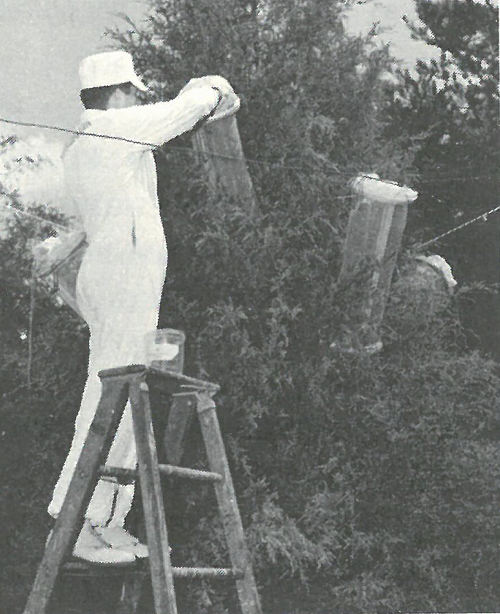
An ecologist inspects cages placed around bagworm infestations of a red cedar tree that had been injected with radioactive cesium-134 to determine uptake of radioactivity in the larvae.
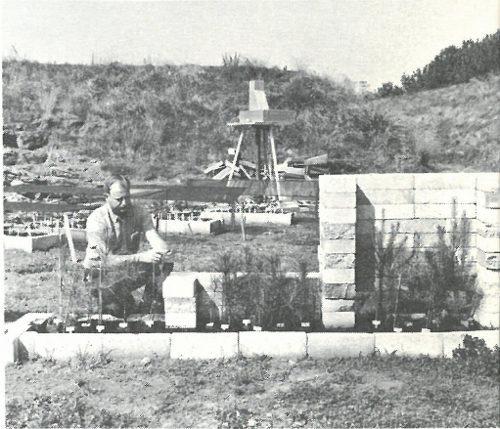
Checking pine seedlings exposed to ionizing radiation from a radioactive source (on tripod) in a controlled ecosystem. Seedlings on left were fully exposed, those in the middle were exposed on their tops only, and those on the right were exposed on their stems only.
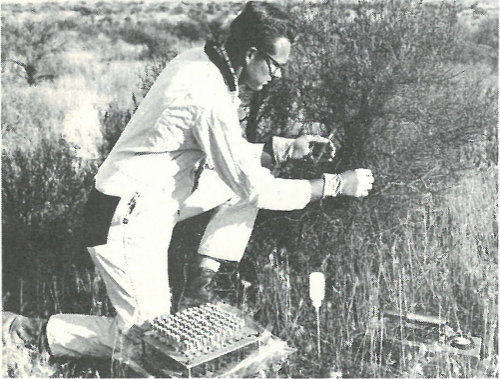
Biologist studying the root distribution of plants by injecting radionuclides into the soil and measuring plant uptake.
25
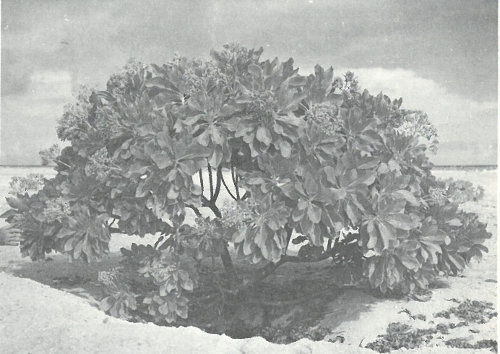
A thriving Messerschmidia plant growing on Rongelap Atoll is studied for growth-rate and root-systems data after the island was accidentally subjected to radioactive fallout.
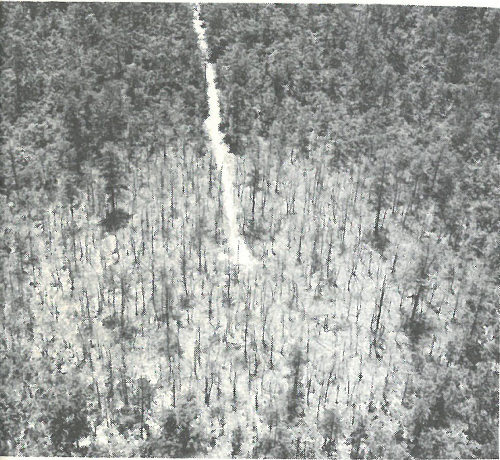
Aerial view of a “Gamma Forest”, where growing trees are exposed to chronic irradiation from a source at the center of the picture. This environmental biology study shows varying sensitivity of various trees. Trees in the center were killed by extremely high doses of radiation for 20 hours a day over a 6-month period.
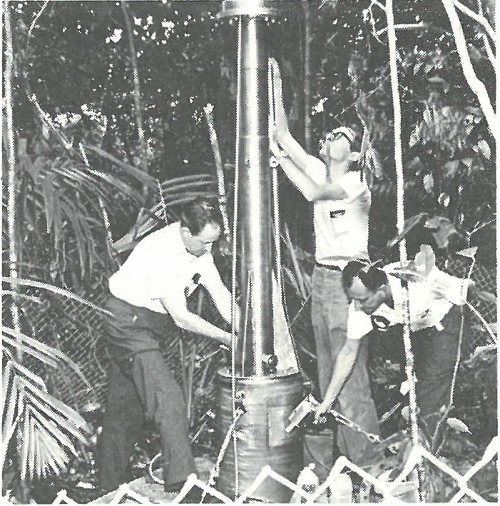
Apparatus containing a strong radiation source being installed by biologists in a semitropical rain forest for terrestrial ecology research.
26
In programs of such scope and duration, the problems of interpretation are great. Broadly, environmental studies give consideration to:
1. The amounts and kinds of radioactivity released to the environment.
2. The rates of uptake by the biological system.
3. The amounts and kinds of radioactivity within the system.
4. The rates of metabolic transfer or elimination.
5. The amounts and kinds of radioactivity concentrated in tissue and acting internally.
6. The time required for biological processes to be completed and for any biological effects to develop.
Biological Inventories
Familiarity with the biological components of an ecosystem is essential to meaningful radiobiological assessment.
Inventories of natural components were not made in the early nuclear test programs because of inadequate realization of the biological potential. Later, they could be made only after radionuclides already had been introduced into the environments.
The survey of the mid-Pacific region before Operation Crossroads represented the earliest effort to examine an environment in detail before a nuclear detonation, but was designed so that it had only inferential value for other long-range biological research. The test surveys were useful, however, in expanding knowledge of specific environments. In addition, it was standard practice to make comparative collections of organisms in regions removed from the test sites to establish base lines, or “controls”, against which to measure radiobiological developments.
The most extensive inventory of an environment—an inventory designed specifically in relation to an anticipated nuclear detonation—was that made between 1959 and 1962, as a preliminary phase of Project Chariot, in the Cape Thompson area of Northwest Alaska. Chariot was a part of the AEC Plowshare Program in which it was proposed to excavate a harbor at the mouth of the Ogotoruk Creek, which empties into the Chukchi Sea. Although the excavation project actually never was undertaken, the “predetonation” 27 environmental investigations involved 3 years of coordinated research into the climatic, marine, coastal, and terrestrial aspects of the region, and detailed studies of the history and the radiological and ecological situations of the human population.
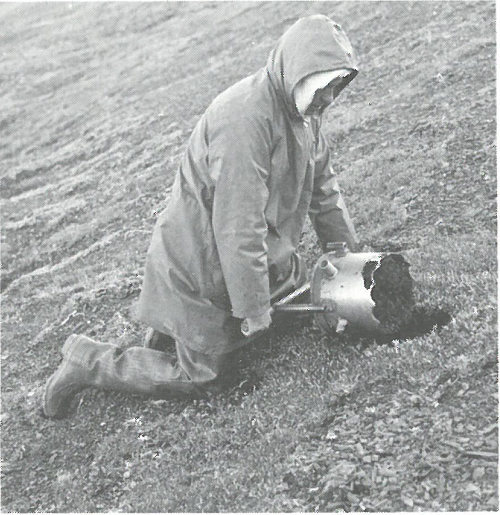
Taking a soil sample for the Project Chariot biological inventory to determine kinds and relative abundance of invertebrates and other soil organisms.
The program was an effort to make a model environmental inventory. Its significance was both in its assessment of the base for determining the “biological cost” of the proposed operation and in the thoroughness of its documentation of the environmental features of a part of the world that previously had been virtually unexplored. It was a prototype for future studies.
Measurements and Interpretations
Determination of the amounts and kinds of radioactivity in a biological sample is a process wholly dependent on instruments, since radiation usually cannot be detected by the senses.
A biological sample is any material of measurable biological significance. A sample of tissue or similar organic material usually is dried or reduced to ash in a muffle furnace before it is examined with a radiation counting device.
Improved instruments now permit the counting of radioactivity at levels so low as to have been imperceptible a few years ago. The samples, placed in lead chambers for 28 maximum shielding from background radiations, are examined by multichannel analyzers capable of recording radiation emissions continuously over long periods of time.
Data-processing techniques have been employed in the handling and interpretation of information from long-range biological sampling and analysis programs. Analog computers have been used experimentally for theoretical projections of results.
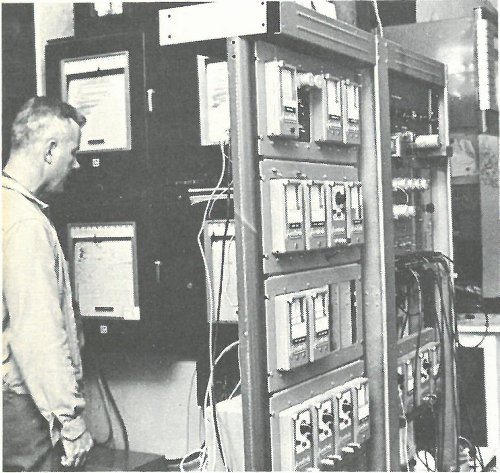
Instruments record radiation, weather, sunlight, and other factors transmitted from remote sensors to this data center established for a long-range terrestrial ecology study program.
Scientists at the AEC’s Oak Ridge National Laboratory, for example, have developed experiments in which an analog computer is programmed to keep a running balance of the net changes—simultaneous gains and losses—of radioactivity in the various compartments of a representative ecosystem. The computer becomes an electronic image of the biosphere, using known or assumed rates of energy transfer and photosynthesis to predict probable radiological results of tracer experiments of environmental contamination.
29