A VIEW IN PERSPECTIVE, 1946-1963
Reading edition
Bikini Atoll, in the Marshall Islands, represents, in miniature, a world that has experienced all the forces, immediate and residual, that can result from nuclear detonation.
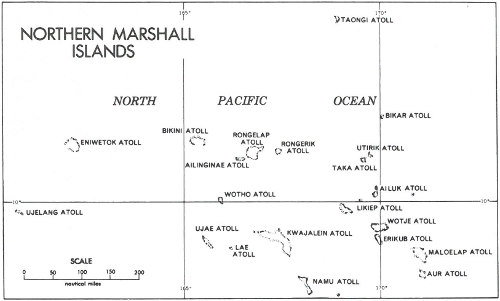
Bikini in 1946 was the scene of the first peacetime tests of atomic weapons. One of these tests involved the detonation of an atomic device under water, in the heart of the atoll’s aquatic circulatory system. Bikini also was used for 5 years, from 1954 through 1958, for the testing of thermonuclear[8] devices. Its islands and reefs were burned by atomic heat, and the waters of its lagoon were contaminated by deposits of radioactive fallout. Thus, for almost a score of years, Bikini, a small outcropping of coral in the mid-Pacific, was identified with the earliest experiments in nuclear explosion.
Through the years of testing and later, Bikini also was the site of repeated biological investigations. Teams of scientists examined Bikini annually from 1946 to 1950 and from 1954 to 1958. Then in 1964, after an interlude of 6 years in which Bikini was undisturbed either by weapons 9 tests or human visitors, scientists went there again to make a comprehensive ecological resurvey.
The scientists found in the Bikini ecosystem, in low but perceptible amounts, residual traces of radioactivity deposited by the tests. On certain islands, craters dug by nuclear explosions still gaped in the reefs. The test islands still bore nuclear scars, and in some areas of the lagoon corals and algae had been killed by silt stirred up by the detonations. But Bikini’s life system clearly was in a process of healing. Large islands were covered by regrowths of vegetation; on some, the masses of morning glory, beach magnolia and pandanus were growing so densely that field parties had extreme difficulty cutting paths through them. Bikini Atoll, scientists believed, needed only clearing and cultivation to make it once again suitable for human habitation.
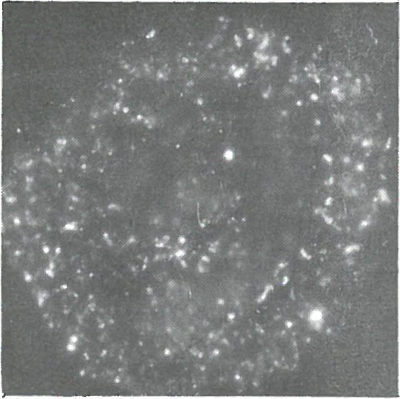
Autoradiograph of a plankton sample collected from a Pacific lagoon a week after a 1952 test.
What, then, may be concluded from the Bikini case? A final answer still cannot be phrased. It is not a conclusion to say that nature and time have permitted recovery, reassuring though such knowledge may be. It becomes important to know the processes of recovery. Meantime, it is helpful to examine the Bikini case in the context of developments during the period from the end of World War II to the signing of the Nuclear Test Ban Treaty of 1963.
The Bikini Tests of 1946
The early period of nuclear testing in the atmosphere was a time that will not be seen again. It was the beginning of an era of unparalleled scientific activity and of worldwide emotional and intellectual adjustment to the knowledge that power of unimaginable magnitude, locked in the nucleus 10 of the atom since the creation of the world, now could be released at will.
When World War II was ended, the impulse to test the new power was irresistible. There was profound curiosity about the revolutionary nature of the new force. There was a perplexed and fearful realization that the release of energy would have to be guarded and controlled. There was the knowledge that nuclear fission produced a miscellany of radioactive products presenting unexplored possibilities of hazard. The word “fallout” was coined to describe the deposition on the earth of radioactive debris from nuclear explosions.
Joint Task Force One
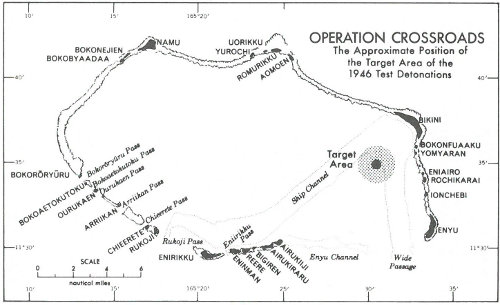
The first peacetime nuclear tests, conducted at Bikini in 1946 in a military-scientific exercise designated Operation Crossroads, were designed to assess the effects of nuclear weapons on naval vessels. The test organization, Joint Task Force One, an adaptation of the wartime joint task force combat concept, was a massive waterborne force including 42,000 members of the armed services, civilian scientists, consultants, and observers.
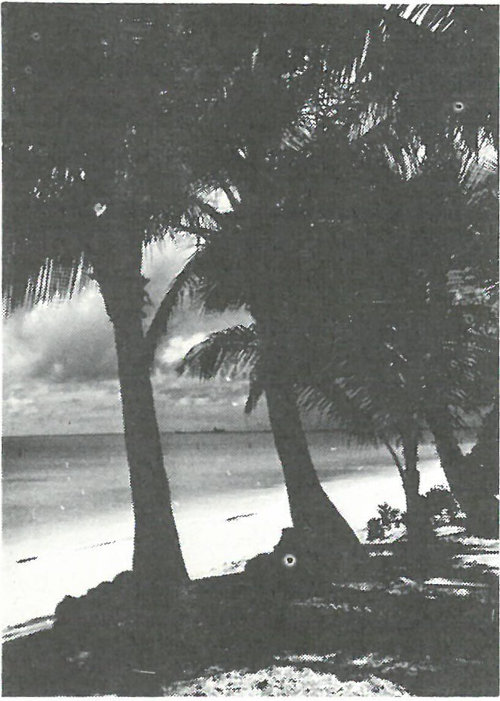
The Bikini Lagoon before testing.
Bikini Atoll was selected for the tests because, among other things, it was remote from heavily populated areas, it offered a protected anchorage, and it had the relatively stable and predictable meteorological and oceanographic conditions considered essential to operations in which the unknowns loomed so large. Three test detonations originally 11 were projected; two ultimately were carried out. The first, Test Able, was an airdrop of an atomic bomb on July 1, 1946, over a test fleet of 70 ships anchored in Bikini Lagoon. The second, Test Baker, was the detonation on July 25 of an atomic device suspended in the lagoon 90 feet below a small target vessel.
Scientific Interests
Although Crossroads was a military program, the mobilization of scientific interests was in many ways of historic proportions. For months before the explosions, oceanographers studied the waters and the structure of the mid-Pacific basin and meteorologists the winds and upper airs. Geologists, zoologists, botanists, and other specialists examined the atoll in detail. Bikini became, as it remains to this day, one of the most thoroughly familiar ocean structures in the world.
There was awareness, even then, of the significance of radioactivity as an element of nuclear effect. The task force made elaborate preparations to assure the safety of personnel and sent to the atoll thousands of radiation-detection instruments. Plans were made to observe the effects of radioactivity on test animals placed on ships of the target fleet.
The Underwater Detonation
The first of the Bikini events, Test Able, the explosion of a bomb dropped from an aircraft over the target fleet, sank a number of major vessels, left others sinking or crippled, contaminated many with radiation, and laid a plume of fallout northward over 12 the rim of the atoll into the waters of the ocean. It was Test Baker, however, the underwater explosion, that would make Bikini the subject of radiobiological investigations for many years.
The Baker test was the first occasion in which nuclear debris was mixed with water and ocean sludge and returned to the area of detonation. The explosive device was of what later would be called nominal size, its force equivalent to 20,000 tons of TNT. The test still is regarded as a classic demonstration of the phenomena of shallow-water atomic explosion.
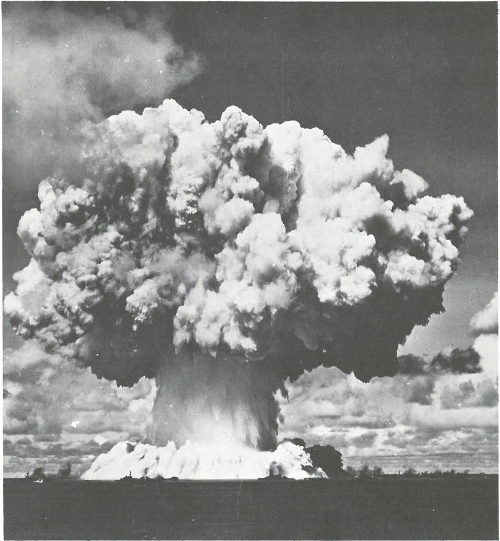
The Baker Test. A cauliflower-shaped cloud, after dumping one million tons of water that had been sucked up by the explosion, rises over the target warships, silhouetted in front of the spreading base surge.
13
At the moment of release, the surface water of the lagoon was first lifted and then penetrated by a lighted bubble that vanished in seconds in a hollow column of water of gigantic dimensions—a column 2000 feet in diameter (its walls 300 feet thick) rising to a height of 6000 feet and containing 1,000,000 tons of water. At the base of the column, foam was churned upward for several hundred feet, and, moving out from the base, as the column sank back into the lagoon, surged a monstrous wave initially more than 80 feet high.
Radioactivity in the water was intense. The immediate total was described as equal to “many hundred tons of radium”. Decay and dilution of radioactive materials quickly reduced the total radioactivity. After 3 days, by which time water contamination had spread over an area of 50 square miles, the dose rate from the water was well within safe limits for persons remaining for brief periods. Yet it was several more days before inspection and scientific parties could spend useful time among the surviving target vessels.
At the bottom of the lagoon, below the point of detonation, Navy divers months later found that the explosion had scooped out thousands of tons of mud and coral sediment, creating a shallow basin half a mile wide. This basin, in the slow settling of returning sludge, became an area from which long-lived radioactivity entered Bikini’s biological system.
First Assessments
In 3 weeks of final work after Test Baker, the Bikini scientific teams took from the islands and the lagoon many hundreds of samples of plants, corals, crabs, fish, plankton, and water. They noted that radioactivity was present in all samples taken from every part of the atoll, which indicated an early uptake of radionuclides by the biota[9] and suggested that there was a continuing circulation of radioactive debris in the water. They took samples of fish in the open ocean outside the atoll and made comparative collections at other atolls. The instruments and techniques for analyzing radioactivity were far from refined, but all available evidence pointed to the need for more particular efforts to examine radiobiological results.
14
The Bikini Resurvey of 1947
A resurvey of Bikini, the first of many, was conducted with heavy radioenvironmental emphasis in July 1947, a year after the Crossroads tests. The scientific expedition was supported by 2 vessels and included 70 scientists and several hundred Navy personnel.
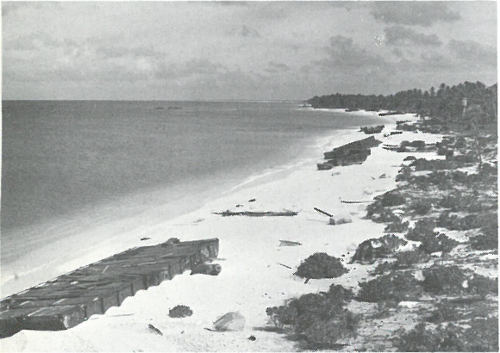
Bikini Beach as it appeared in the years after Operation Crossroads.
The resurvey group, entering an oceanic environment that had been completely undisturbed for nearly a year, established at once that traces of residual radioactivity still were cycling in Bikini’s ecosystem. For 6 weeks the scientists probed every realm of the atoll environment, sampling biota, making inventories of plant and animal communities, and obtaining core samples from the lagoon floor. When the data had been assembled and reviewed and the reports filed, months later, there was consensus that Bikini had produced no evidence that radioactivity, as a separate and identifiable factor, was having any immediate effect on the health of the atoll, and probably no cumulative effect, either.
There were, of course, unknowns. So long as radioactivity remained in the biological cycles there were possibilities of future developments. In 1947 no other place on earth offered an opportunity to observe the natural processes by which radiation contamination is eliminated from an environment. It therefore seemed prudent to compile a longer record, consisting of other, purely radiobiological surveys at Bikini.
15
By 1947 the new U. S. Atomic Energy Commission had taken over from the wartime Manhattan Engineering District the management of the national effort in the field of atomic energy. A primary responsibility of the AEC in that period was to press ahead with nuclear weapons development, but the agency also had specific obligations and interests in the fields of biology and medicine. Meantime, the testing of nuclear weapons had been started at a new proving ground at Eniwetok Atoll, 190 nautical miles west of Bikini.
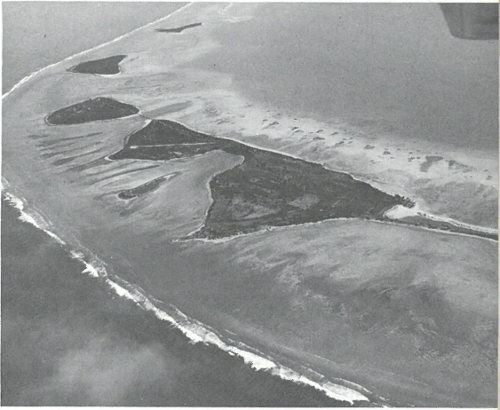
Islands on the rim of Eniwetok Atoll, as they appear today. The marks of man, such as a landing strip, are visible, but regrowth of vegetation is apparent. Note extent of the reef on both sides of islands.
Studies at Nuclear Test Sites, 1948-1958
The first test series at Eniwetok, Operation Sandstone (1948), incorporated no formal radiobiological studies, but radiobiologists visiting Bikini also made surveys at Eniwetok in 1948 and 1949. Then, for a time, world events intervened. The detonation of an atomic device by the U.S.S.R. in 1949 was followed in 1950 by the outbreak of the Korean War, and these events produced a national mood oriented toward national defense. By 1951, because events in the Pacific had interrupted tests there, the Atomic Energy Commission had established a continental test site in Nevada. In that year, too, tests were made at Eniwetok preliminary to the detonation of the first thermonuclear device.
16
After 1951 each of the test programs had its radiobiological component. In the Pacific, radiobiological surveys were associated with Operation Ivy (1952), Operation Castle (1954), Operation Redwing (1956), and Operation Hardtack (1958). A small field station, the Eniwetok Marine Biology Laboratory, was established for use by scientists conducting biological studies. Bikini was incorporated into the Pacific Proving Ground in 1953, and new biological surveys were performed there in connection with the tests of 1954 and later.
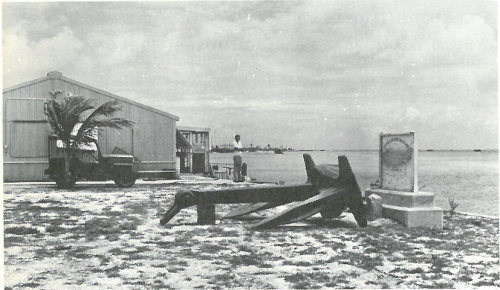
The Eniwetok Marine Biology Laboratory. Monument at right commemorates the battle for Eniwetok in World War II.
In these years, 1951 to 1958, the U.S.S.R. was testing nuclear weapons, as was Great Britain after 1952. Fallout from these contributed to the total of man-made radioactivity potentially available to the environments of the world.
Landmarks
The years between the establishment of the Pacific Proving Ground and the signing of the 1958 nuclear test moratorium were years in which the quest for environmental information could not keep pace with the rapid growth of nuclear capability. But the growth in the field of weapons served to underline the need for information and produced certain landmark developments in environmental research.
The detonation of the first thermonuclear device projected the problem of environmental contamination to the stratosphere and, literally, to every part of the earth. This explosion, 17 Test Mike, largest on earth to that time, was set off on Elujelab Island, on the north rim of Eniwetok Atoll, on November 1, 1952. In the reef where Elujelab had been, the blast left a crater almost a mile in diameter and 200 feet deep. The towering nuclear cloud rose in 15 minutes to a height of 130,000 feet.
Test Mike marked a point of change. Before, fallout from nuclear detonation had been principally local, touching the waters and reefs of an atoll or a desert landscape. After Test Mike, the implications of fallout obviously were global.
A mishap in connection with a 1954 thermonuclear test at Bikini contributed in two important ways to the enlargement of environmental investigations. Fallout from the test, swept off its predicted pattern by unexpected winds at high altitudes, deposited debris on Rongelap, an inhabited atoll east of Bikini, and on fishermen aboard a Japanese vessel operating in the Bikini-Rongelap area. The accident, unfortunate in its consequences at Rongelap and in Japan, had other results of even wider impact. From it came the first international approaches to the problems of ocean contamination and, later, long-term bioenvironmental studies at Rongelap itself.
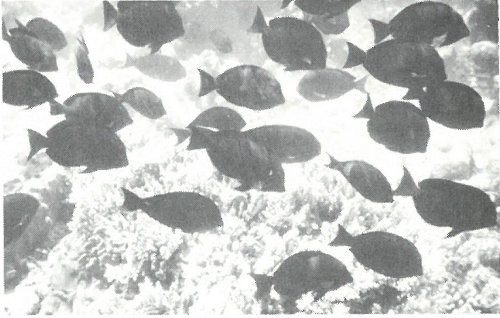
School of surgeonfish off Arji Island, Bikini Atoll, August 1964. Note coral growth on lagoon bottom.
Wide-ranging studies of ocean-borne radioactivity were initiated by the Japanese. The experience of the fishermen produced in Japan a fear of contamination of fisheries resources as a result of the United States tests. One result was the organization, in the summer of 1954, of a government-sponsored ocean survey expedition that cruised from Japan into and through the Bikini-Eniwetok area to determine what amounts of radioactivity were being carried, by water and by aquatic organisms, toward the shores of Japan.
18
The expedition made significant observations of the role of plankton[10] in the biological utilization of ocean fallout. A United States scientific team, following up the Japanese effort, made a similar but far more extensive cruise through the Western Pacific early in 1955 and went on to Japan to discuss its findings with the Japanese. During and after the test series in the Pacific in 1956 and 1958, United States surveys of the ocean were made routinely. Exchanges of information between scientists of Japan and the United States continued.
The Rongelap case produced results of another kind. The Rongelap people were found to have suffered exposure requiring medical attention and continued observation. Evacuated from their atoll because it was not safe, members of the community were given care at other atolls until they could be repatriated in 1957, and received continued medical supervision thereafter.
The bioenvironmental condition of Rongelap was unique. The fallout had made the atoll the only place in the world contaminated on a single occasion by relatively heavy deposition of radioactive debris without also being disturbed by a nuclear explosion. In 1957-1958, after the Rongelapese had been returned to a new village constructed on their atoll, Rongelap was the site of a long and thorough study of the circulation of radionuclides in the terrestrial-aquatic environment.
Before the 1963 Test Ban Treaty
The first break in the pattern of nuclear testing came in 1958, when the nuclear powers agreed to a 1-year test moratorium. The world’s political and emotional climates were changing. For more than 5 years, the United States, which had announced its Atoms-for-Peace Program in December 1953, had been endeavoring to place emphasis on the use of atomic energy for constructive purposes. The Atomic Energy Act of 1954, liberalizing provisions of the 1946 law, contemplated for the first time private development of nuclear power resources and established authority 19 for international activities. In 1957 the Atomic Energy Commission initiated its Plowshare Program for the development of peaceful uses of nuclear explosives.[11]
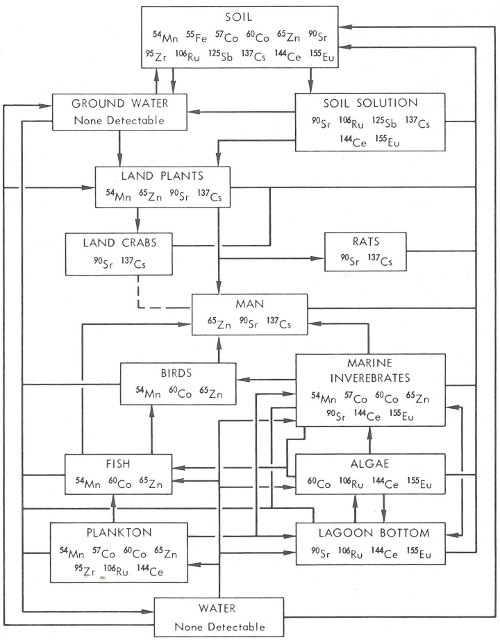
Distribution of fallout radioisotopes on Rongelap Atoll as determined by a survey in 1961. Note the interrelationships of man, plants, animals and the environment.
Amid such changes there was arising, too, a wider apprehension concerning the possible effects of fallout. The United Nations in 1955 appointed a committee of scientific representatives of 15 nations to study the effects of radiation on man. In the United States the National Academy of 20 Sciences published in 1956 the first of its summary reports on the biological effects of atomic radiation.
Nuclear testing was not ended by the 1958 agreement, yet the moratorium—which was renewed annually until 1961, when the U.S.S.R. broke the agreement by initiating a new test series—was significant as an experiment in nuclear restraint. After the United States conducted a final test series near Christmas Island in 1962, new discussions of ways to halt successive rounds of nuclear test programs were held. Finally, in 1963, the Nuclear Test Ban Treaty was signed by most of the nations of the world. The treaty was, among other things, a declaration against worldwide fallout.