ENVIRONMENTS—SINGULAR, YET PARTS OF A WHOLE
Reading edition
Each environment presents its own sets of conditions and unknowns. It is important to appreciate those that are characteristic of water, land, and atmosphere.
Aquatic Systems
The oceans are the basins into which are poured all the nutrients or wastes transported from the land by rivers and winds.
The difficulty of determining the fate of radionuclides in aquatic systems is complicated by chemical and biological differences within the system and by the variety and scope of the circulatory mechanisms. In oceans the sheer immensity of the water volume usually makes observation superficial or fragmentary. Rivers present great differences in flow, and lakes vary in internal dynamics. Above all, an ocean, a river, or a lake is an area of constant physical and biological motion and change. In the ocean the surface waters form a theater of kaleidoscopic, and frequently violent, action. The presence of man-made radioactivity in water has made it possible to follow the disposition of nutrients and wastes in the restless aquatic ecosystem.
Biological Uptake
In a water environment the minerals necessary to life are held in solution or lie in bottom sediments. They become available to animal life after being absorbed by plants, both large floating or rooted plants and tiny floating ones called phytoplankton; because the phytoplankton are found everywhere in the sea, they play a larger role. The phytoplankton concentrate minerals and become food for filter-feeding fish and other creatures, including the smaller zooplankton,[14] which, in turn, are food for other organisms. Thus the minerals enter extremely complex food chains. The cycles of nutrition are completed when fish and plants die and decomposition again makes the minerals available to the phytoplankton.
30
ENVIRONMENTAL RESEARCH
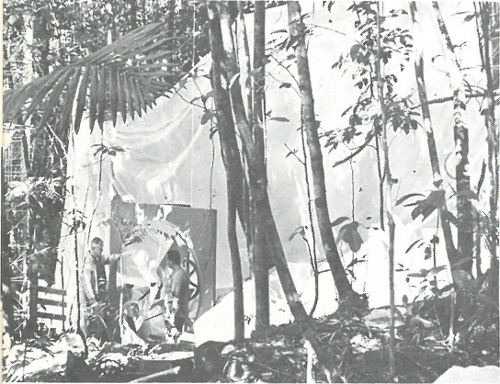
RAIN FOREST. A giant fan pulls air through a plastic-enclosed portion of a Puerto Rico rain forest to study the metabolism rate of trees.
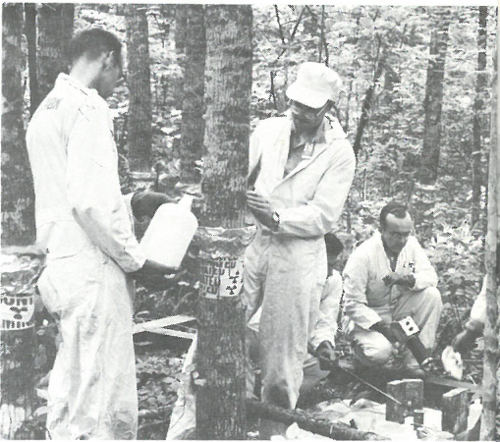
HARDWOOD FOREST. Technicians preparing to tag Tennessee trees with a solution containing a radioactive cesium isotope in the start of a 10-year project. Scientists will study movement of the radioactivity into insects and their predators.
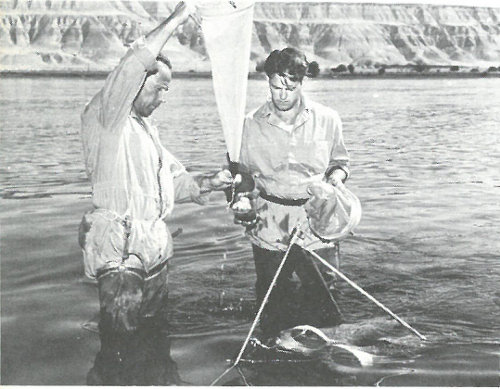
FRESHWATER. Aquatic biologists emptying plankton traps to study concentrations of radioactivity in microscopic organisms in the Columbia River downstream from the Hanford atomic plant in Washington State.
31
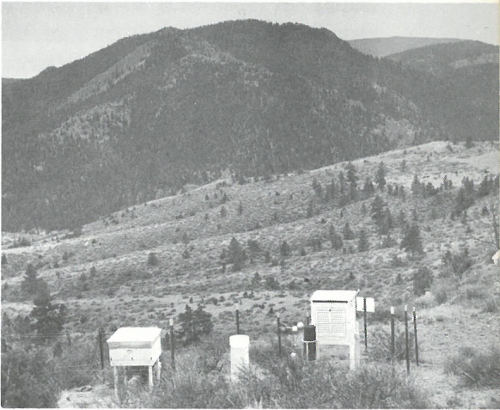
MOUNTAINS. Weather station in a deer-forage area of the Rocky Mountains in Colorado provides environmental data and fallout samples that are correlated with levels of radionuclides found in the deer.
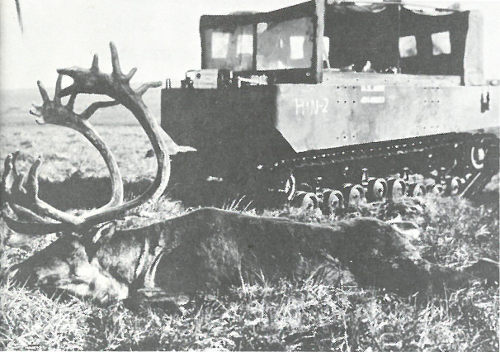
TUNDRA. This caribou was examined in detail as part of a study of transfer of fallout nuclides in food chains from plants to animals to man. Caribou is the principal meat animal of some Alaska Eskimos.
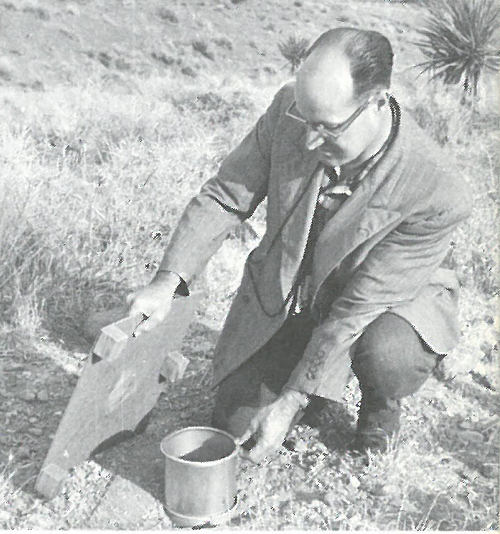
DESERT. Zoologist examines an animal trap as part of a field ecological study of a Nevada nuclear test site.
32
Some radionuclides that are introduced into an aquatic environment enter the food chains exactly as do the stable minerals essential to life, because the radionuclides are merely radioactive forms of the nutrients. Elements such as copper, zinc, and iron are less plentiful in the water environment than hydrogen, carbon, or oxygen, for example, but are concentrated by phytoplankton because they are necessary for life. Such elements are in short supply but in constant demand; thus, when their radioactive forms are deposited in water, they are immediately taken up by aquatic plants and begin to move through the food chains. Fission products such as strontium-90, for which there is little or no metabolic demand, are taken up by aquatic food chains to only a minor extent.
The precise paths of radioelements through aquatic ecosystems are almost unknown. In addition to their movement in food chains, radioelements also may be moved physically from place to place in the tissues of fish or other creatures. Some radionuclides for which there is no biological demand may sink into bottom sediments and remain there until they have lost their radioactivity. Or radioactivity actually may be transported “uphill”, from water to land, as when birds that feed on fish containing radioactivity leave their excretions at nesting areas. The routes and modes of transport seem numberless.
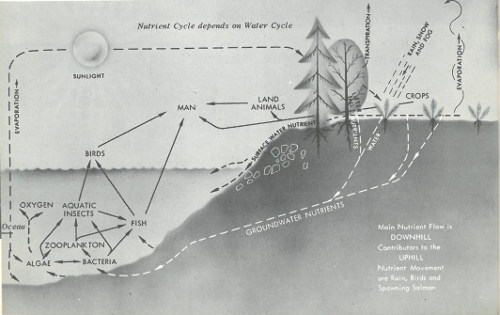
Movement of radioactive elements in a forest-lake ecological system. Most nutrient-flow is “downhill”, but birds, migrating fish, and the evaporation-rainfall cycle may move them “uphill”.
33
The Oceans
The surface waters of the seas, down to depths of 200 meters, are areas of rapid mixing in which temperature, density, and salinity are almost uniform. Below the surface water is a zone in which temperature decreases and density and salinity increase with depth. This zone, known as the thermocline, may reach a depth of 1000 meters. Because density is increasing here, vertical motion is reduced, and exchanges between the surface and the deep waters are impeded. Knowledge of temperature, density, and salinity is important to understanding what happens to radionuclides in the ocean. Physical conditions affect the rates of physical movement of radioactivity in the mixed (surface) layer, the degree to which radionuclides are held at the thermocline, and the processes by which radionuclides pass the thermocline and enter the deep-water cycles and upwellings.
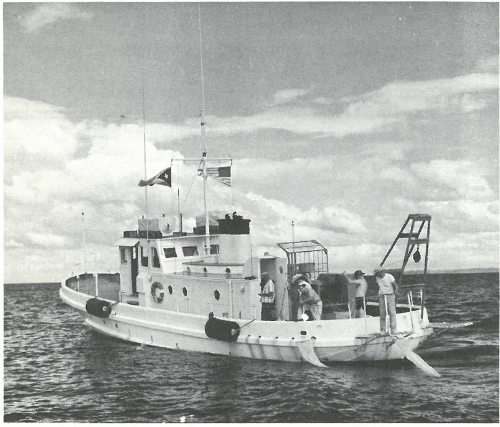
Men aboard the research vessel Shimada pulling in plankton nets during sampling operations at sea.
The surface currents of the ocean are largely wind driven and their patterns generally well known. New concepts 34 of the vertical and horizontal diffusion of substances introduced into the ocean were developed, however, in studies of ocean-borne fallout during and after nuclear tests in the Pacific.
The first of these surveys was conducted near Eniwetok and Bikini. Scientists aboard a Navy vessel sampled water and plankton to depths of 300 meters at some 90 points spread over an area of 78,000 square miles to determine the disposition of early fallout from the nuclear detonations. Some weeks later another expedition voyaged from Eniwetok to Guam and returned, covering an area of 375,000 square miles to follow (by sampling) the mass of water-borne radioactivity resulting from the test and to note the intervening effects of diffusion, dilution, biological uptake, and decay. In 1958 two more surveys were conducted, the first to ascertain the spread and depth—with samplings below the thermocline—of a radioactively tagged water mass immediately following an underwater detonation, and the second to follow the westward drift of the tagged water mass.
Significantly, it was found that plankton immediately take up large amounts of radioactivity. Planktonic forms, in fact, proved to be the most sensitive indicators of the presence of radioactivity in the marine environment. Further, the daily vertical migrations of plankton—down in response to sunlight and up at night—seemed a part of the process by which radionuclides move from the upper waters to the deeps.
The expedition scientists noted that the masses of low-level radioactivity moved in the ocean significantly slower than the surface currents, a circumstance attributable in large measure to biological factors. The distribution of residual radioactivity in the sea a month after the close of a nuclear testing program could be determined by counting radioactivity in plankton samples.
It was established that strontium-90 and cesium-137, important in fallout on land, enter the marine cycles only in minute amounts. Practically no fission products are found in fish. Since strontium-90 is not concentrated strongly by marine organisms, the question of what happens to it in the ocean remains unanswered. Studies have suggested, 35 however, that strontium moves in solution and thus indicates the movement of water. If this is true, strontium-90 may be contained in the deep currents and eventually will be brought again to the surface. Some observers believe this process has begun.
Rivers, Lakes, and Estuaries
The freshwater environment differs from the marine in the greater variety of its minerals, among other things. As sites for radiobiological studies, rivers and lakes present problems of great complexity, but conditions at river mouths or estuaries are even more difficult because of the mixing by tidal action of fresh and salt water.
Rivers vary greatly in character and change radically from season to season because of rainfall and other factors. General understanding of their biological workings is difficult to formulate. But rivers are the routes by which minerals and wastes are transported toward the sea, and estuaries are significant because of the many forms of life that flourish there.
Studies of radioactivity in rivers and estuaries usually have been made in relation to the fate of effluents from nuclear plants. Among the longest and most intensive studies are those near Hanford, Washington. Observations were started in 1943, when the federal government was preparing to build plutonium-producing reactors to be cooled by waters of the Columbia River.
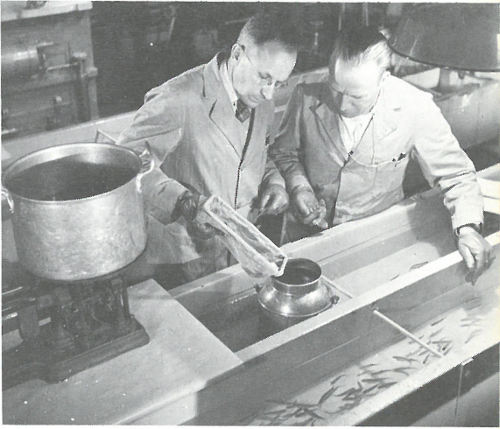
Fisheries biologists studying hatchery fish reared in water containing radioactivity from the Hanford plutonium reactors.
36
For more than two decades, observations have been made of the physical dispersion and biological disposition of low-level effluents in the Columbia. Concentration factors have been established for significant radionuclides in phytoplankton, algae, insects, and fish, and typical patterns of dilution and dispersion have been plotted.
Similar programs, in an entirely different freshwater system, have been conducted over a similar span of years near the Oak Ridge National Laboratory in Tennessee. One area of interest has been the biological disposition of trace amounts of strontium-90 released to the Tennessee River via tributary streams.
Among the few broad estuarial studies yet undertaken is one started in 1961 to plot the dissemination in the lower Columbia River, and in the Pacific Ocean, of radioisotopes transported by the river from the Hanford plant. Radiobiologists are studying biological distribution. Oceanographers are using the trace amounts of effluent radioactivity to verify the patterns of dispersion of river waters in the ocean.
Land
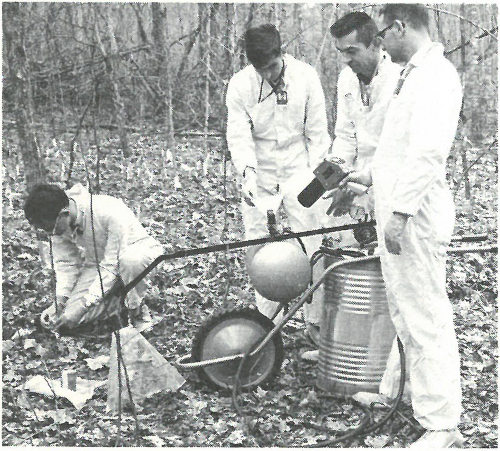
Plant ecologists “tagging” experimental forest plots with radioactive cesium for long-term studies.
Natural radionuclides find their way into plants’ metabolic processes. Man-made radionuclides also are so incorporated—even some, such as uranium or radium, that have no known metabolic role. The man-made nuclides, whether they reach the earth in fallout or by other means, 37 mix with the stable nuclides to which they are chemically related, increasing by small fractions the total amount of each element available to participate in plant growth cycles. Because artificial radionuclides behave so typically, they present, on the one hand, a possible long-term hazard and, on the other, the expectation that their detectability will reveal much about the biological courses of minerals and nutrients.
The disposition of man-made radioactivity on land is determined in part by such factors as topography and the presence or absence of water. Topography may influence the distribution by setting patterns of drainage and exposure of surface soils to wind and rain. Water may affect dilution, or it may leach radionuclides out of surface soils and thus remove them from the level in which plants are rooted. The leaching may carry radionuclides elsewhere, however, possibly causing mild contamination of the water table.
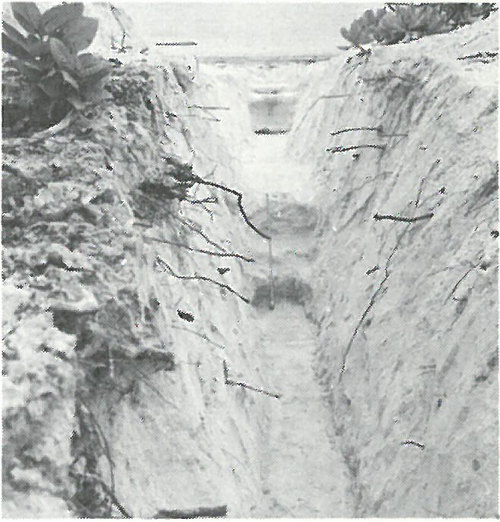
Trench dug on Rongelap Island to expose soil strata and root systems to determine penetration of radionuclides in coral-sand “topsoil”.
Plants take up radionuclides through their roots or through their foliage. But the role of soils is significant. Some radionuclides are bound as ions to clays and thus are withheld in large measure from entry into the plant system. Cesium-137, for example, is held so tightly by soils that uptake through plant roots is slight, and thus a more significant mode of entry of cesium-137 into food chains is by direct deposit on plant leaves. Variables are introduced by the physical configuration of the plant itself, by seasonal differences in plant metabolism, and by the effects of rain and snow. In the case of iodine-131, a short half-life—8 days—virtually precludes the possibility of extensive uptake 38 through plant roots. But the half-life is not too short to prevent grazing cattle from ingesting radioiodine deposited in fallout and thus allow the appearance of radioiodine in milk.
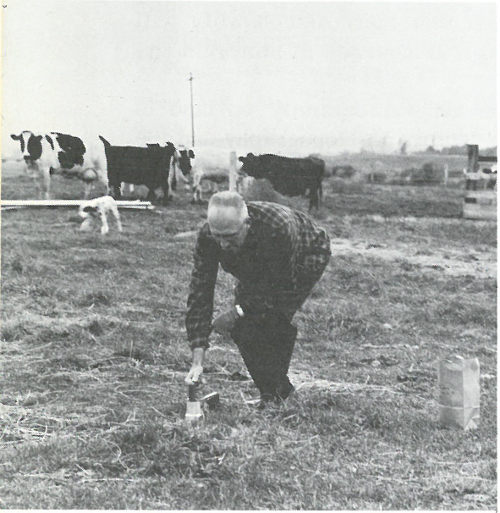
Survey of pasture grasses to determine whether radioactive materials are present. If they are, they could be passed from the grasses to cows and then from the cows’ milk to humans.
Much attention has been devoted to strontium-90 and to its availability to man by deposit on plants and soils. Because strontium bears a close chemical relation to calcium, a unit expressing this relation, the strontium unit (one picocurie[15] [1 × 10-12 curie of strontium-90 per gram of calcium]) is used in following strontium-90 through food chains. Soils, however, present confusing factors. Experiments and fallout observations show that strontium-90 does not penetrate soils deeply. In typical instances it remains in the upper inch or two of the soil surface, where its availability to root systems is as variable as the conditions of mixing, leaching, and plant growth. Experiments have shown that plant uptake of strontium from soils can be reduced by introduction of calcium in available form into the soil.
39
Radiobiological developments on land result from combinations of environmental influences. Studies in the Rocky Mountains show that ecological conditions above the timberline, particularly in areas where snowbanks accumulate, are efficient in concentrating fallout radionuclides. Concentrations thus take place in the snow-packed heights that are the sources of mountain streams flowing to the plains far below.
Atmosphere
The environment of the earth is a product of “weather”—of the transport of moisture, of the actions between winds and oceans, of the cycling of energy through biotic systems. Understanding of biological potentials of atmospheric factors involves understanding of atmospheric motions affecting transport and mixing of contaminants and the processes of deposition of radionuclides from atmosphere to earth.
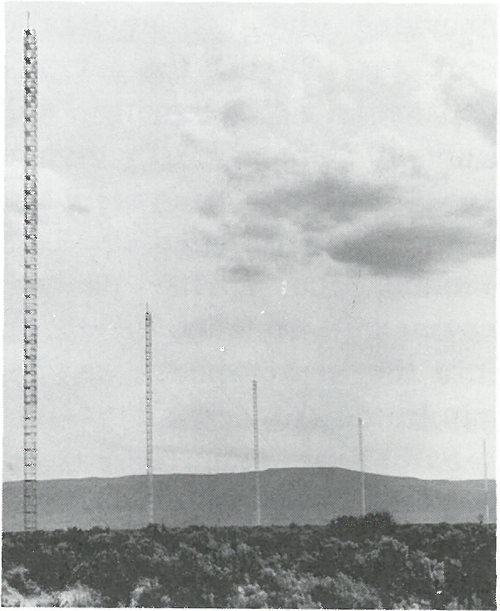
Network of towers on the Atomic Energy Commission reservation near Richland, Washington, used by atmospheric physicists in measuring quantity, concentration, and dilution of radioactive materials in the atmosphere.
At some thousands of feet above the earth’s surface—at 30,000 to 40,000 feet in the middle and polar latitudes and at 50,000 to 60,000 feet in the tropics—there is a level, the tropopause, at which air temperature, rather than decreasing, becomes constant or increases with height. Below this level is the troposphere, the turbulent zone of clouds, rain, and fog. Above it is the stratosphere, where there is no 40 turbulence and only a slow mixing of dry and cloudless air. The stratosphere continues to a height of about 100,000 feet. Investigators have noted the importance of rain or snow in washing fallout particles from the air in the troposphere. There is disagreement on the precise modes of distribution of radioactive materials projected into the stratosphere.
In the detonation of low-yield nuclear devices, fission products are not projected beyond the troposphere, and fallout is washed down in periods of days or weeks. Because winds move principally in east-west directions, tropospheric fallout appears on the earth in bands centered approximately at the latitude of detonation. But when high-yield explosions propel contaminants into the stratosphere, the pattern of subsequent developments is less clear. It once was believed that fallout from the stratosphere was distributed more or less evenly—though over long periods of time—over the surface of the earth. The present view is that fallout debris placed in the stratosphere remains in that hemisphere in which the explosion occurs. This concept is based on an atmospheric circulation theory that air enters the stratosphere at the equator and descends again in temperate and polar latitudes each spring. The theory presumes a much shorter “residence time” of stratospheric air and thus a quicker return of fallout particles to the turbulent troposphere.[16]
The presence of radionuclides in the atmosphere has provided clues to cyclical movements of biological importance. During the period of nuclear tests in the Pacific, observers noted spring “pulses”, or increases, of strontium-90 deposition in the northern hemisphere, a phenomenon difficult to verify or explain satisfactorily while testing was proceeding. Later, when testing had been suspended, the spring peaks reappeared. The observation seemed to support the theory that nuclear debris injected into the stratosphere was descending years later through a gap in the tropopause.
Samplings of nuclear debris by balloon have been under way for several years at altitudes of 100,000 to 150,000 41 feet, and rocket-borne air samplers and other systems have been developed for taking atmospheric samples up to 200,000 feet.
Programs for studying airborne contamination from industrial activities—operated at the more accessible but equally difficult levels of the atmosphere—have been sponsored by the Atomic Energy Commission near the Hanford Plant, Washington, and at the Oak Ridge, Argonne, and Brookhaven National Laboratories in Tennessee, Illinois, and New York. The Hanford studies were started before plutonium production was begun in 1943, and findings on industrial stack-discharge rates established patterns for meteorological programs at other sites.[17]