[pg 213] ORNAMENTS.
Reading edition
PINS.
Having studied the application of shell material to the various utilitarian arts, I turn to the consideration of what may, with more or less propriety, be called the arts of taste.
The skill acquired by the primitive artisan in shaping the homely spoon or the rude celt served a good purpose in the more elegant arts, and opened the way to a new and unique field for the development and display of the remarkable art instincts of these savages. It probably required no great skill and no very extended labor to fashion the various utensils and implements of the outer walls of the univalves or the thin valves of clams and mussels; but to cut out, grind down, and polish the columellæ of the large conchs required a protracted effort and no little mechanical skill. Of the various objects shaped from the columellæ, beads are probably the most important; but a large class of pin-shaped articles naturally come first, as they consist of entire or nearly entire columellæ dressed down to the desired shape.
The use of these objects is still problematical. As they are found in most cases deposited with human remains, they were doubtless highly valued. They must have served a definite purpose in well-established and wide-spread customs, as they are found distributed over a district almost co-extensive with that occupied by other shell vestigia of marine origin.
Let us first study the process of manufacture. A considerable number of the larger species of marine univalves have been brought into requisition. Various species of Busycon, Strombus, and Fasciolaria offer almost equal facilities; the former, however, seems to have been decidedly the favorite, the Busycon perversum having furnished at least three-fourths of the columns used. This result may be attributed, however, to the fact that, for reasons already mentioned, the perversum was so universally employed for vessels, the axes extracted from these being then ready for further manipulation. The outer case of the shell being somewhat fragile it is probable that the sea has very frequently broken it away, leaving the dismantled columella to be washed ashore in a shape convenient for manufacture or for inland trade. If the demand for these objects was very great, it is to be presumed that on shores where they abound these shells were broken open and the columns extracted for purposes of traffic. The State of Tennessee is found to be the great store-house of these as well as other ancient objects of shell. This is probably owing to two causes: first, that far inland, where they were difficult to procure, and very costly, they were highly esteemed, [pg 214] and hence consecrated to the use of the dead; and, second, the conditions under which they were buried had much to do with preserving them from rapid decay, while on the coast or when exposed to the atmosphere they soon disappeared.
An interesting series of specimens illustrating the various stages of manufacture of articles from the columella is presented in Plate XXIX. In Fig. 1 a section of a Busycon perversum is given. The position of the columella and its relations to the exterior parts may be clearly seen. The reverse whorl of the spire will be noticed, and the consequent sinistral character of the groove. Fig. 2 illustrates the extracted columella in its untrimmed state. A similar specimen is shown in Fig. 3, Plate XXXI. It was obtained from the site of an old Indian lodge on the island of Martha's Vineyard. This, with a number of smaller specimens, may be seen in the National Museum. They show no signs of use, and were probably destined for manufacture into pins or beads.
Columellæ in this state are very frequently found in the mounds and graves of the interior States; a majority probably belong to the Busycons, but a considerable number are derived from the Strombidæ. A few specimens of large size may be seen in the national collection.
Fig. 3 represents a roughly dressed pin, of a type peculiar to the Pacific coast.
Fig. 4 illustrates a completed pin of the form most common in the middle Mississippi province.
Fig. 5 shows a rather rare form of pin, pointed at both ends. Bone pins of this form are quite common.
Fig. 6 represents a nearly symmetrical cylinder.
Fig. 7 illustrates the manner of dividing the cylinders into sections for beads.
PL. XXIX—MANUFACTURE OF IMPLEMENTS AND ORNAMENTS.
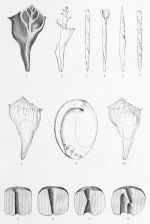
1. Section of Busycon perversum. 2. Roughly trimmed columella. 3. Headless pin, western form. 4. Tennessee form. 5. Pin pointed at both ends. 6. (Omitted.) 7. Manner of cutting into beads. 8. Derivation of a celt from Busycon. 9. Derivation of ornaments from Haliotis. 10. Derivation of ornaments from Busycon. 11. Bead with cylindrical, countersunk perforation. 12. Bead with conical perforation. 13. Bead with bi-conical perforation. 14. Bead imperfectly perforated.
In 1881 some very important additions to the National Museum were made, from the mounds of Tennessee. These include a great wealth of objects in shell. From the McMahan mound at Sevierville, Tenn., there are a dozen shell pins, all made from the Busycon perversum. The entire specimens range from three to six inches in length; two are fragmentary, having lost their points by decay. In shape these objects are quite uniform, being, however, as a rule, more slender in the shaft than the average pin. The heads range from one-half to one inch in length, and are generally less than one inch in diameter. They are somewhat varied in shape, some being cylindrical, others being conical above. The shaft is pretty evenly rounded, but is seldom symmetrical or straight. It is rarely above one-half an inch in diameter, and tapers gradually to a more or less rounded point. The groove of the canal shows distinctly in all the heads, and may often be traced far down the shaft. In a number of cases the surface retains the fine polish of the newly-finished object, but it is usually somewhat weathered, and frequently discolored or chalky. These specimens were found in the mounds along with deposits of human remains, and generally in close proximity to the head; this fact suggests their use as ornaments for the hair.
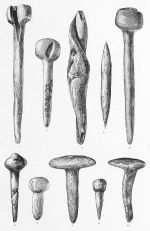
[pg 215]Two illustrations are given in Plate XXX. Fig. 1 represents a fine example, six and a quarter inches in length. The head is deeply grooved, and is apparently cut from the middle part of the columella, the shaft being formed from the spine-like basal point. The spiral canal, which is clearly defined, makes but one revolution in the entire length of the pin. In Fig. 5 a somewhat similar specimen is represented. Two fine specimens come from a mound on Fain's Island, Tennessee River. The larger one is made from the columella of some heavy shell, probably the Strombus gigas. The head is cylindrical, and the shaft large, but imperfect. The smaller is a little more than two inches in length, the head being small and conical, and the point more than usually blunt. Another specimen was obtained from a mound at Taylor's Bend, near Dandridge, Tenn. The head is almost spherical, and the point broken off; the whole surface is new looking and highly polished. A number of bone pins pointed at both ends were obtained from Fain's Island, besides many perforators and other well-made implements of bone.
Prof. C. C. Jones describes[55] a number of shell pins without mentioning localities, stating, however, that such pins have been obtained from a mound on the Chattahoochie River, below Columbus, Ga. He publishes illustrations of two varieties. One, of the ordinary type, is five and a half inches in length, one inch of that distance being occupied by the head, which is an inch and a quarter in diameter. The shank is an inch and a half in circumference, and, while tapering somewhat, is quite blunt at the point. The other is of somewhat rare occurrence, being pointed at both ends. An example of this variety is given in Fig. 4, Plate XXX. They are usually small and short, seldom exceeding three inches in length.
In the national collection there are ten fine pins, obtained by C. L. Stratton from a mound on the French Broad River, fifteen miles above Knoxville, Tenn. Four only are made from the Busycon perversum. The largest specimen has a very large, cylindrical head, with an extremely deep groove. The shaft has been at least five inches long, and is nearly one-half an inch in diameter. Another fine specimen is five inches long, very slender, and nearly symmetrical. A small, almost headless pin, not quite one and a half inches in length, is peculiar in having a longitudinal perforation. It has probably been strung as a bead. A fourth specimen is five and three-quarters inches in length. The head is well rounded above, and the shaft tapers gradually to a slender symmetrical point. The other specimens from the same locality are in an advanced stage of decay, the points being entirely destroyed.
The Peabody Museum contains a large number of very fine specimens of this class. The most important of these were obtained from the Brakebill, Lick Creek, and Turner mounds of Tennessee, by the Rev. E. O. Dunning. The largest of these is upward of six inches in length. An unusually symmetrical and well-preserved specimen from the Lick [pg 216] Creek mound is nearly seven inches in length. One specimen only in this collection differs from the type already described; this has been made from a dextral-whorled shell; the head is somewhat spherical, but is unusual in having an umbonate projection at the top. It is illustrated in Fig. 6, Plate XXX.
Another small pin, which is about one and one-half inches in length, has a poorly defined head, and would seem useless for the purposes ordinarily suggested for the larger specimens.
A recent collection from Pikeville, Tenn., includes a number of specimens made from the spike-like base of the Busycon perversum. They are roughly finished, and taper to a point at both ends. The larger ones are six inches in length and nearly one inch in diameter. All are perforated longitudinally. This perforation is neatly made and about one-eighth of an inch in diameter. In one specimen which has been broken open two perforations may be seen running almost parallel with each other, as if they had been bored from opposite ends and had failed to meet. The length of these perforations is quite remarkable, and it is difficult to understand how, with the primitive tools at the disposal of these people, a uniform diameter could be given throughout. One of these objects is shown in Fig. 3, Plate XXX.
Other States besides Tennessee have furnished a limited number of shell pins. Their occurrence in a mound near Columbus, Ga., has already been mentioned.
The national collection contains a fine specimen from Macon, Ga., collected by J. C. Plant. The Peabody Museum has a number from mounds on the Saint Francis River, Ark. One of these is illustrated in Fig. 8, Plate XXX. They differ from the pins heretofore described, being in all cases unsymmetrical. The shaft is flat and somewhat curved, and joins the mushroom-shaped head near one edge. This results from the peculiar shape of the portion of the shell from which the pin is derived, the head being cut from the peripheral ridge and the shaft from the body below or the shoulder above. Two specimens of this class have recently been obtained from a mound at Osceola, Ark. A profile view of one is shown in Fig. 10, Plate XXX.
A pin of this class, from a burial mound at Black Hammock, Fla., is described and illustrated by Professor Wyman.[56] From the fact of its being perforated at the point, he regards it as a pendant ornament. He states that it is cut from the suture, where a whorl joins the preceding one. In this respect it resembles the specimens from Arkansas. It is made from a Busycon perversum.
In the National Museum we have two specimens from Florida. One of these, from Pensacola, is illustrated in Fig. 2, Plate XXX, and is of the ordinary form. The other is a short, broad-headed specimen, illustrated in Fig. 7, Plate XXX.
In the Peabody Museum are two small specimens of the ordinary type, [pg 217] from a mound near Jamestown, Va. One of these, a small, pointed variety, is given in Fig. 9, Plate XXX.
PL. XXX—PINS—EASTERN FORMS.
In Volume VI of Schoolcraft's Indian Tribes, a pin, probably of shell, is shown in a plate illustrating relics from South Carolina.
A few localities have furnished bone, stone, and clay pins similar to these in shape. Specimens of the latter may be found both in the National and Peabody museums. They were probably intended as stoppers for bottle-shaped earthen vessels. Bone pins are generally headless, and have in most cases been intended as implements for perforating and for sewing. Mr. Schumacher found a pin-like object of bone on the island of San Clemente, Cal. It resembles the shell pins pretty closely, having a somewhat spherical head. It is figured by Professor Putnam in a recent work.[57]
As already stated, the exact uses to which these pins were applied by the mound-building tribes are unknown; various uses have been suggested by archæologists. The favorite idea seems to be that they were hair-pins, used by the savages to dress and ornament the hair. It would seem that many of them are too clumsy for such use, although when new they must have been very pretty objects. The shorter and headless varieties would certainly be quite useless. Similar objects of bone or ivory, often tastefully carved, are used by the natives of Alaska for scratching the head, although it seems improbable that this should have been their most important function.
Professor Dall suggests that some of the shell pins may have been used as were the "blood-pins" of the Indians of the northwest coast. When game is killed by an arrow or bullet, the pin is inserted in the wound, and the skin drawn and stitched over the flat head, so that the much valued blood may be prevented from escaping. A small, very tastefully carved specimen of these pins is given in Plate XXXI, Fig. 4. It was obtained from the Indians of Oregon. A similar specimen comes from San Miguel Island, Cal.
It is possible that they may have served some purpose in the arts or games of the ancient peoples; yet when we come to consider the very great importance given to ornaments by all barbarians, we return naturally to the view that they were probably designed for personal decoration.
From the Pacific coast we have shell pins of a very different type. They also are made from the columellæ of large marine univalves, and were probably used as ornaments, doubtless to a great extent as pendants. These objects have been obtained in great numbers from the ancient graves of the California coast, at Santa Barbara, at Dos Pueblos, and on the neighboring islands of Santa Clara, Santa Catalina, San Clemente, and Santa Rosa. Professor Dall is of the opinion that the shell mostly used is the Purpura crispata, the smaller specimens probably being derived from the Mitra maura.
[pg 218] Such a very concise description of these objects is given by Prof. F. W. Putnam in a recent paper that I beg leave to quote it here, omitting his references to figures: "A columella was ground down to the required size and shape, and made into a pendant by boring a hole through the larger end. In order to make this pendant still more attractive, the spiral groove is filled with asphaltum, or a mixture of that material and a red pigment. Sometimes the spiral groove was so nearly, or even wholly, obliterated in the process of grinding the columella into shape as to make it necessary to enlarge or even recut the groove in order to make a place for the much-loved asphaltum." Another form, made from another shell, is described, the whorls of which are "loose and open, so that a natural tube exists throughout the length of the spire; at the same time the spiral groove in the central portion is very narrow; consequently it has to be artificially enlarged for the insertion of the asphaltum, which thus winds spirally about the shell. As the natural orifice at the large end of the shell seems to have been too large for properly adjusting and confining the ornament as desired, this difficulty was overcome by inserting a small shell of Dentalium, or by making a little plug of shell, which is carefully fitted and bored."[58]
The national collection contains upward of fifty of these pins, which come from ancient graves at Santa Barbara and Dos Pueblos, Cal., and from the islands of Santa Cruz and San Miguel. These vary in length from one to five inches, the well-finished specimens seldom reaching one half an inch in diameter. At the upper end they round off somewhat abruptly to an obtuse point, but taper to a sharp point at the lower end, something like a cigar. Two fine examples are shown in Figs. 1 and 2, Plate XXXI. All show the spiral groove, and nearly all have portions of the asphaltum remaining. The columellæ from which they are made may be to some extent naturally perforated, but are certainly not sufficiently so to permit the ready passage of a cord. The points are seldom sharp, and are often broken off. A bit of Dentalium inserted into the perforation and set with asphaltum helps to enforce the point and to guard against further breakage. The larger specimens are seldom perforated transversely at either end, while the smaller ones are almost always perforated at the larger end, which is slightly flattened. A good example is shown in Fig. 5, Plate XXXI.
A peculiar bulb-pointed specimen is illustrated in Fig. 6, Plate XXXI. The bulb is made from the upper end of the columella. There are six of these pins in the collection.
The consideration of these pins leads naturally to the presentation of other classes of objects manufactured from the columellæ of marine univalves among which beads are the most numerous and important.
PL. XXXI—PINS—PACIFIC COAST FORMS.
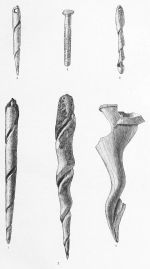
1. Shell pin from San Miguel Island. 2. Shell pin from Dos Pueblos, Cal. 3. An untrimmed columella. 4. Bone pin from Oregon. 5. Shell pin from San Miguel Island. 6. Shell pin from San Miguel Island.
(1/1)
[pg 219] BEADS.
I shall not attempt within the limits of this paper to give more than an outline of this important division of my subject.
The use of beads seems to have been almost universal with peoples of all times and of all grades of culture, and the custom of wearing them is a relic of barbarism that promises to be carried a long way into the future. All suitable natural objects have been brought into requisition—animal, vegetable, and mineral. Shells from the sea, precious stones from the mountains, and fruits from the forest have been utilized; and claws of birds, teeth of animals, and even the nails of the human hand have been worked into ornaments to gratify the barbaric vanity of the "untutored savage." The flinty substance of the shells of mollusks has been a favorite material at all times and with all peoples. Especially is this true of the shell-loving natives of North America, among whom shell beads have been in use far back into the prehistoric ages, and who to-day, from Oregon to Florida, burden themselves to discomfort with multiple strings of their favorite ornament; and this, too, without reference to their value as money or their service as charms. On the necks of brawny and unkempt savages I have seen necklaces made of the highly glazed Oliva, or of the iridescent nacre of the pearly Haliotis, that would not shame a regal wardrobe, and have marveled at the untaught appreciation of beauty displayed.
Beads made of shell may have three divisions based upon derivation, and three based upon function.
First, they consist of all smaller varieties of natural shells, pierced for suspension, or only slightly altered, to add to beauty or convenience; second, they are made of the shells of bivalves and the outer walls of univalves; or, third, of the columellæ of the larger univalves cut to the desired sizes, and shaped and polished to suit the savage taste.
As to function, they may be classed as personal ornaments, as money, and as material for mnemonic records.
PERFORATED SHELLS.
Under this head I shall examine briefly the manner of piercing or altering the smaller varieties of shells preparatory to stringing. The multitudes of perforated shells exhumed from the graves of our ancient tribes afford a fruitful field of study, and our large collections of more recent specimens serve to illustrate the manner in which they were employed.
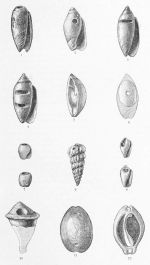
In Plate XXXII illustrations are given showing the various methods of manipulation and perforation. In North America the Marginella, the Oliva, and the Cyprea seem to lead in importance.
Fig. 1 represents an Oliva, the apex of which has been broken away and the rough edge ground down, producing a passage for a thread, which may be introduced through the natural aperture below. This is [pg 220] a common method of perforation in many widely separated districts, and with a considerable variety of shells. The specimen figured is from a mound in Cocke County, Tenn. It is an Oliva literata from the Atlantic coast.
Fig. 2 shows a very usual method of treating small univalves. The most prominent part of the lower whorl is ground down until the wall is quite thin, and a small round hole is then drilled through it. The specimen illustrated is a large Olivella biplicata, obtained from the island of Santa Rosa, Cal.
Figs. 3 and 4 illustrate specimens from Mexico. Some thin-bladed implement, probably of stone, has been used to saw a slit or notch in the first convolution of the shell near the inner lip. Fig. 3 has one of these perforations, and Fig. 4 has two. The shell is the Oliva literata, from the Atlantic coast.
Fig. 5 is simply one-half of an Olivella biplicata with the interior parts extracted. It is made by cutting the shell longitudinally and drilling a central perforation. The specimen figured is from San Miguel Island, Cal.
Fig. 6 illustrates the manner of breaking out a disk preparatory to making a bead. This disk, when perforated, is frequently used by the Indians of the Pacific coast without additional finish.
Fig. 7 shows two examples of beads made from small specimens of the Olivella biplicata; both extremities are ground off, leaving a rather clumsy cylinder. The originals are from graves on the island of Santa Rosa. Such beads are frequently worn at the present time.
One of the specimens shown in Fig. 8 is from a grave in Monroe County, New York, and the other is from a mound in Perry County, Ohio. The shell is the Marginella conoidalis, which has a wide distribution in the ancient burial-places of the Atlantic slope. In making the perforation the shoulder is often ground so deeply as to expose the entire length of the interior spiral.
Fig. 9 represents a perforated Cerrithidea sacrata, from Santa Rosa Island, Cal. The method of perforating employed is a usual one with small shells of this form. Similar specimens come from many parts of the United States. Beads of this and the preceding variety are said to have constituted the original wampum of the Atlantic seaboard.
Fig. 10 illustrates a rude bead made from the spire of a univalve, probably a small specimen of Busycon perversum. Most of the body of the shell has been removed and a perforation made near the border. Three of these specimens were found in a burial mound at Murphysboro, Ill.
Fig. 11 illustrates a perforated Cyprea from the Pacific coast. This is a recent specimen, which illustrates an ancient as well as a modern method of perforation.
Fig. 12 shows a rather peculiar method of treating Cyprea shells by [pg 221] the tribes of the Pacific coast and the Pacific islands. The prominent part of the back is cut or ground away, and the columella is partially or wholly removed, a passage the full size of the natural aperture being thus secured. This is also an ancient as well as a modern method of treatment.
PL. XXXII—PERFORATED SHELL BEADS.
(1/1)
Small bivalve shells are prepared for stringing by drilling one or more holes in the center or near the margin, according to the manner in which they are to be strung. Such beads have been in almost universal use by primitive peoples, both ancient and modern.
Shells with natural perforations, such as the Fissurellas and Dentalia, are extensively employed by the west coast peoples, and foreign varieties of the latter have been largely imported by Europeans, and from very early times have been used by the tribes of all sections. The natural perforation of the Fissurella is often artificially enlarged, and additional perforations are made near the margin. Examples may be seen in Plate XLIX.
I shall include under the head of beads all small objects having a central or nearly central perforation, made for the purpose of stringing them in numbers. In shape, they range from straw-like cylinders, three, four, and even five inches long, with longitudinal perforations, to thin, button-like disks, two or more inches in diameter. In general the cylinders are made from the columellæ of univalves, and the disks from the outer walls of the same, or from the shells of bivalves. Of course, there are forms that fall under no classification, such as disks with perforations parallel with the faces, or cylindrical forms with transverse perforations, while many small, pendant-like objects, of varied shapes, are strung with the beads, and might be classed with them; but these are exceptions, and can be described along with the classified objects most nearly resembling them.
The grinding down and the perforating of natural shells is easily accomplished, so that any savage could afford to decorate his person with this jewelry in profusion. But the class of beads illustrated in Plates XXXIII, XXXIV, and XXXV could not have been made without the expenditure of much time and labor, and doubtless owe their existence, in a measure, to mercenary motives. As they were made from the walls or columellæ of massive shells, they must have been broken or cut out, ground smooth about the edges, and perforated; this, too, with most primitive tools.
DISCOIDAL BEADS.
In shape discoidal beads range from the concavo-convex sections of the curved walls of the shell to totally artificial outlines, in such forms as doubly-convex disks, cylinders, and spheroids. In size the disks vary from very minute forms, one-tenth of an inch in diameter and one-thirtieth of an inch in thickness, to two inches in diameter and nearly one-half an inch in thickness. The thickness of the finished beads is [pg 222] governed in a great measure by the thickness of the shell from which they are manufactured.
The Venus mercenaria of the Atlantic coast and the heavier Unios of the Mississippi Valley give a general thickness of from one-eighth to three-eighths of an inch, while others, such as the heavy clams of the Pacific, are very much thicker. The walls of univalves, especially near the base, are often extremely heavy, while the smaller varieties of shells furnish specimens of wafer-like thinness.
In Plate XXXIII a series of beads of this class is given, beginning with the smaller disks and ending with those of large, though not the largest, size.
In Fig. 1 I present two views of a minute disk, obtained, with many others of similar shape and size, from a mound on Lick Creek, Tenn. The perforations in these specimens, as well as in most of those that follow, are bi-conical, and sufficiently irregular in form to indicate that they are hand-made. Beads of this general appearance have been found in a multitude of graves and mounds, distributed over a large part of North as well as of South America. A vast majority of these beads are doubtless of aboriginal make, as they are found in the oldest mounds.
Fig. 2 represents a minute form from Santa Cruz Island, Cal. The peripheral surface is ornamented with a net-work of incised lines.
Fig. 3 illustrates a small cylindrical bead, with large perforation, from a mound near Prairie du Chien, Wis. It was found, with a number of others, near the neck of the skeleton of a child.
Fig. 4 represents a small spheroidal bead from the great mound near Sevierville, Tenn.; it is neatly made and well preserved.
Figs. 5 and 6 illustrate specimens of roughly finished concavo-convex disks, much used by both ancient and modern tribes of California, Arizona, and New Mexico.
I essayed at one time to purchase a long necklace of these homely ornaments from a Navajo Indian in Arizona, but soon discovered that it was beyond my reach, as my best mule was hardly considered a fair exchange for it. These beads are made from the Oliva chiefly, but to some extent from small bivalves.
This bead is not common in the mounds of the Mississippi Valley, but is used by many modern savages. It seems to be the form called, by the Indians of Virginia, "roenoke," which, according to Beverly, is made of the cockle-shell, broken into small bits, with rough edges, and drilled through in the same manner as beads.
Fig. 7 represents a smoothly cut bead of medium size, said to have been obtained from a grave at Lynn, Mass. It has been cut from the curved wall of some large univalve, and is very similar to modern specimens in use over a greater part of the United States.
Fig. 8 belongs to a necklace brought from the northwest coast, and is very much like the specimen shown in Fig. 7.
Fig. 9 is a well-made specimen from Sevierville, Tenn. The sides are [pg 223] ground perfectly flat and the edges are well rounded. The shell is very compact, and well preserved, and bears a close resemblance to bone or ivory.
Fig. 10 represents a thin, fragile disk, from a mound in Southern Illinois. It is made of a Unio, and separates into thin sheets or flakes, like mica.
Figs. 11 and 12 illustrate two compact, nearly symmetrical specimens from a mound at Paint Rock Ferry, Tenn.
Fig. 13 is from the same locality, and is hemispherical in shape.
Fig. 14 represents a button-like disk, with large conical perforation, from a mound at Paint Rock Ferry, Tenn. It has probably been made from the wall of a large marine univalve.
The fine specimen shown in Fig. 15 comes from a mound in Cocke County, Tenn., and is unusually well preserved. It is very compact, having the appearance of ivory, and has probably been made from the basal portion of a large univalve. The perforation is extremely large, and is conical, having been bored entirely from one side.
Figs. 16 and 17 represent two fine specimens from California. They are nearly symmetrical, the faces being flat or slightly convex. The smaller one has been coated with some dark substance—the result, probably, of decay—which has broken away in places, exposing the chalky shell. The edges are ornamented with shallow lines or notches. Such disks, when used as ornaments, probably formed the central piece of a necklace, or were fixed singly to the hair, ears, or costume. As long as these larger specimens retained the color and iridescence of the original shell, they were extremely handsome ornaments, but in their present chalky and discolored state they are not prepossessing objects.
This plate will serve as a sort of key for reference in the study of beads of this class, as the specimens are typical.
PL. XXXIII—DISCOIDAL BEADS.
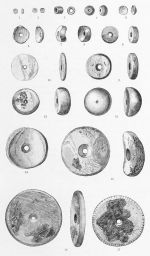
(1/1)
MASSIVE BEADS.
Beads made from the columellæ of univalves have generally a number of distinguishing characteristics. They are large and massive, and rarely symmetrical in outline, being sections of roughly dressed columns. They are somewhat cylindrical, and often retain the spiral groove as well as other portions of the natural surface. In cases where the form is entirely artificial they may be distinguished by the sinuous character of the foliation. The perforation is nearly always with the axis of the bead, and is in most cases bi-conical. In Plate XXIX a series of cuts is given which illustrates the various methods of perforation and shows very distinctly the differences between the rude work of savages and the mechanically perfect work of modern manufacturers. Beads of this class are more decidedly aboriginal in character than those of any other group, and are without doubt of very ancient origin. They are widely distributed, and have been found in graves and mounds covering an area [pg 224] outlined by Massachusetts, Canada West, Minnesota, Missouri, and the Gulf and Atlantic coasts.
Figs. 1, 6, 7, 11, and 14 of Plate XXXIV represent typical specimens of this class. In every case they are considerably altered by decay, rarely retaining any of the original polish. All come from ancient burial mounds, some of the interments of which probably antedate, while others post-date, the coming of the whites.
The bead shown in Fig. 1 is made from the columella of a Busycon perversum. It is a rude, tapering cylinder, with rounded ends and deep spiral groove. The perforation is bi-conical and somewhat irregular. This, with many similar beads, made of both dextral and sinistral shells, was associated with human remains in the great mound at Sevierville, Tenn.
The bead illustrated in Fig. 6 has been made from the column of some dextral whorled shell. It was obtained from a mound on Lick Creek, East Tenn. It is a typical specimen of average size, and illustrates very well the large collection of this class of relics made by Dr. Troost.
Fig. 7 was obtained from a mound at Franklin, Tenn. It is cut from the columella of a Busycon perversum, and is of the usual form, being a heavy, short cylinder, rounded at the ends until it is somewhat globular. The perforation is very large, and has been made almost entirely from one end. The surface is much weathered, the firmer laminæ being distinctly relieved. Other specimens from the same locality are much smaller.
Fig. 11 is from a grave in an ancient cemetery at Swanton, Vt., and is similar to the preceding, having been cut, however, if correctly represented, from a dextral whorled shell. The cut is copied from a paper by G. H. Perkins.[59]
Fig. 14 illustrates a very large specimen of these beads from the Lick Creek Mound, East Tenn. The surface is encrusted, stained, and decayed. It has been made from the broad beak of a Strombus or dextral whorled Busycon. The perforation is symmetrical and bi-conical. Specimens upwards of two inches in length and one and one-fourth in width come from the same place. The larger perforations are three-eighths of an inch in diameter at the ends and quite small in the middle.
Fig. 12 represents a large bead of symmetrical outline, made from the columella of a Busycon perversum. The shape is artificial, with the exception of a small portion of the spiral canal. The surface retains much of the original polish, but exfoliation has commenced on one side.
The perforation is about three-sixteenths of an inch in diameter at the ends and one-sixteenth in the middle. There is a slight offset where the perforations meet. It is from a burial mound at Harrisburg, Ark.
The bead shown in Fig. 9 is one of a large number obtained from a [pg 225] mound at East St. Louis, Ill. It is a symmetrical, well-polished cylinder. The small portion of the spiral groove which remains indicates that it is derived from a Busycon perversum. The perforation is neatly made and doubly conical in shape. The symmetry, finish, and fine condition of this bead lead to the suspicion that it may be of recent manufacture. Its form is by no means a common one among ancient mound relics.
The bead represented in Fig. 10 is described and illustrated by Squier and Davis.[60] This, with many similar specimens, was taken from a mound in the Ohio Valley. It is made from the columella of some marine univalve, and is well wrought and symmetrical.
Fig. 5 is a flattish, highly polished bead from Monroe County, New York. The material, which resembles ivory, may have been obtained from the tusk of some animal. It is slightly concave on one side and convex on the other. The perforation is neatly made and of uniform diameter throughout.
In Fig. 4 I present a bead of unusual shape; it is made from the basal portion of some heavy univalve. The axis and perforation are at right angles to the plane of lamination. The middle portion of the bead has been excavated, producing a form resembling a labret or lip-block, in common use by many tribes. It is from a mound on French Broad River, Tenn. We have a bead of similar shape, but which has a lateral perforation, from a mound at Nashville, Tenn.
Fig. 2 illustrates a spheroidal bead obtained from an ancient grave on Santa Rosa Island, Cal. The form is unusually symmetrical and the perforation neatly made, being small, doubly conical, and slightly countersunk at one end. The surface is smooth and retains a little of the original purplish hue of the shell, probably a Hennites giganteus. Others of the same shape from this locality exhibit like characteristics. A few similar specimens come from San Miguel Island.
Another large specimen from this locality is shown in Fig. 8. It is somewhat flat, and is quite wide in the middle portion, tapering rapidly towards the ends. The perforation is small and regular. The lines of foliation are distinctly marked, but are not sufficiently characteristic to indicate the part of the shell from which the bead is derived.
Pearls.—Two of the most remarkable beads in the national collection are illustrated in Figs. 3 and 13. The latter is an enormous pearl, probably derived from the Haliotis Californianus. It is somewhat pear-shaped, the base being rounded and the apex a little bent. The transverse section is subtriangular. Having been buried for an unknown period in the soil or sand, it has suffered greatly from decay, and has probably lost considerably by exfoliation. The thin, chalky lamellæ come away readily in concentric scales, exposing the iridescent nacre beneath. The perforation is about one-sixteenth of an inch in diameter, and seems to pass through a natural cavity in the interior of the pearl. The smaller specimen given in Fig. 3 is in many respects, similar to the [pg 226] large one. Another, of about the same size as Fig. 3 bears quite a marked resemblance to a lima bean, and is pierced laterally, giving a button like appearance.
These specimens were obtained from graves on San Miguel Island, by Stephen Bowers.
PL. XXXIV—MASSIVE BEADS AND PEARLS.
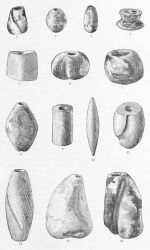
(1/1)
TUBULAR BEADS.
In Plate XXXV I have arranged a number of cylindrical beads, together with a few others of unclassified form.
Figs. 1 and 2 illustrate the most common form of the ancient wampum, the white example being made from the columella of a small univalve, and the dark one from the purple portion of a Venus mercenaria. The specimens represented belong to the celebrated "Penn belt," preserved in the rooms of the Historical Society of Pennsylvania.
It is not known positively that beads of this particular shape were employed in pre-Columbian times; but it is certainly one of the earliest historical forms, and one which has been manufactured extensively by the Indians as well as by the whites. They may be found both in very old and in very recent graves, in widely separated parts of the United States and British America, and have always formed an important part of the stock of the Indian trader.
Figs. 3 and 4 represent a very large class of Pacific coast forms. These are from the island of San Miguel. They are simple white cylinders, with somewhat irregular bi-conical perforations. Many examples may be found which taper slightly toward the ends. They are coated with a rusty-looking deposit, which breaks away easily, exposing the chalky substance of the shell. They range from one-half to three inches in length, and from one-eighth to three-eighths in diameter. They are probably made from the thick valves of the Pachydesma crassatelloides or the Amiantis callosa. They were probably used as beads for the neck and as pendant ornaments for the ears. The longer specimens may have been worn in the nose. It is also said that beads of this class were used as money.
Fig. 5 illustrates a very long, tubular bead found at Piscataway, Md. It has been made from the columella of some large univalve. It is four and a half inches long and one-fourth of an inch in diameter. The surface is smooth, but a little uneven, and the ends taper slightly. The perforation which has apparently been made from both ends, as there is an offset near the middle, is quite regular, though slightly enlarged near the ends.
A large number of beads of the class illustrated in Fig. 6, Plate XXXV, were obtained from the ancient graves of San Miguel Island, Cal. They have been made from one of the large bivalve shells of the Pacific coast, probably the Pachydesma crassatelloides. The curvature of the bead is the result of the natural curve of the valve from which it is fashioned. The larger specimens are nearly five inches in length. In the middle portion they are three-eighths of an inch in diameter. They taper gradually towards the ends to the size of the perforation, [pg 227] which averages about one-sixteenth of an inch. The curvature of the bead is so great that there has been much difficulty in making the perforations from opposite ends meet, and none of the larger specimens will permit the passage of a wire, although the perforations lap considerably and water passes through quite freely. It will be observed that the surface of these objects is coated with a dark, rough film, which, when broken away, exposes the natural shell. Such beads may have been used as nose ornaments, but more probably formed parts of some composite ornament for the neck or ear.
Fig. 7 represents a bone nose ornament obtained from the Pai-Ute Indians by Professor Powell. Its shape is not unlike that of the curved bead just described.
The large rude bead given in Fig. 8 is made from the thick lip or rim of the Haliotis Californianus. This, with a number of similar specimens, was obtained from an ancient grave at Dos Pueblos, Cal. The perforations are all large and symmetrical. In one case the hole has been reduced at the ends by inserting small bits of shell, through which minute passages have been made.
In Figs. 9 and 10 I give two illustrations of a bead of rather remarkable form. A large number of similar specimens have been brought from Dos Pueblos, La Patera, and the islands of San Miguel and Santa Cruz. They are made from the hinge of the Hennites giganteus, a large bivalve, having a delicate purplish tinge. The shape results from the form of the hinge; the curve is the natural curve of the shell; and the notch near the middle of the convex side is the natural pit, often somewhat altered by art to add to the appearance or to assist in completing the perforation. The holes are generally very small, and have been made with much difficulty, owing to the curvature of the bead. Where by accident the perforation has become enlarged at the end, it has been bushed by setting in a small piece of shell. The specimen figured is perforated near the end for suspension, no longitudinal perforation having been attempted.
Fig. 11 shows one of these beads in an unfinished state, the portion of the hinge used being roughly broken out and slightly rounded. We have in the national collection specimens of this class in all stages of manufacture. Professor Haldeman has described and illustrated a number of similar beads. He describes the rounded notch near the middle as artificial, and considers it a device to help out the perforation or facilitate the stringing. Professor Putnam, in the same work,[61] states that the "notches were subsequently filled with asphaltum even with the surface of the shell."
The curved bead illustrated in Fig. 12 is made from a Dentalium indianorum (?) by removing the conical point. These shells, either entire or in sections, are much used by the Indians of the northwest, both as ornaments and as a medium of exchange.
PL. XXXV—BEADS.
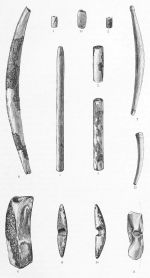
1, 2. Beads from the Penn Belt. 3, 4. Pacific coast forms. 5. Bead from Maryland. 6. A Pacific coast form. 7. A Pai-Ute nose ornament (bone). 8. Bead made from a Haliotis. 9, 10, 11. Beads made from hinge of Hennites. 12. Bead made from a Dentalium. 13. Bead from mound, Tenn.
(1/1)
[pg 228] RUNTEES.
In Plate XXXVI I present a number of illustrations of a class of relics which have occasionally been mentioned in literature, and which are represented to some extent in our collections. As these objects resemble beads rather more closely than pendants, I shall refer to them in this place, although Mr. Schoolcraft considers them badges of honor or rank, and treats them as gorgets. He describes them as consisting of a "circular piece of flat shell, from one and a half to two inches in diameter, quartered with double lines, having the devices of dots between them. This kind was doubly perforated in the plane of the circle."[62]
In "Notes on the Iroquois," by the same author, we have a much fuller description. He says that "this article is generally found in the form of an exact circle, rarely a little ovate. It has been ground down and repolished, apparently, from the conch. Its diameter varies from three-fourths of an inch to two inches; thickness, two-tenths in the center, thinning out a little towards the edges. It is doubly perforated. It is figured on the face and its reverse, with two parallel latitudinal and two longitudinal lines crossing in its center, and dividing the area into four equal parts. Its circumference is marked with an inner circle, corresponding in width to the cardinal parallels. Each division of the circle thus quartered has five circles, with a central dot. The latitudinal and longitudinal bands or fillets have each four similar circles and dots, and one in its center, making thirty-seven. The number of these circles varies, however, on various specimens. In the one figured there are fifty-two."[63]
Figs. 1 and 2 are copied from Plate 25 of Schoolcraft. The smaller was obtained from an ancient grave at Upper Sandusky, Ohio, and the larger from an Indian cemetery at Onondaga, N. Y. Others have been found at Jamesville, Lafayette, and Manlius, in the latter State. The Indians, according to Mr. Schoolcraft, have no traditions respecting this class of objects, and we are quite in the dark as to their significance or the manner in which they were used.
Mr. W. M. Beauchamp, of Baldwinsville, N. Y., has very kindly sent me sketches of two of these objects. The originals were obtained from an ancient village site at Pompey, N. Y. One is almost a duplicate of the smaller specimen copied from Schoolcraft, but the other, which is illustrated in Fig. 4, Plate XXXVI, presents some novel features. The central portion of the face is occupied by a rosette-like design, which consists of six sharply oval figures that radiate from the center like the spokes of a wheel. These rays are ornamented with a series of oblique lines, arranged in couplets. The margin is encircled by a narrow band, similarly figured. Mr. Beauchamp expresses the opinion that these specimens are of European origin.
The specimen shown in Fig. 3 belongs to a necklace now in the [pg 229] national collection. This necklace was obtained from the Indians of New Mexico by Lieutenant Whipple, and consists of three of these shell ornaments, together with about fifty small porcelain beads. The shell beads are strung at regular intervals. The specimen illustrated is ornamented with a design in minute conical pits, arranged precisely as are the circlets in the crosses and encircling bands of the New York and Ohio specimens. The edges and surfaces are much worn by use. The substance of the shell is well preserved, and has an ivory-like appearance although in the specimen shown in the cut the lamination of the shell is distinctly seen. The perforations in these three specimens are quite symmetrical, and suggest the use of machinery. The method of perforation is identical in all these specimens, and will be readily understood by reference to the two sections given in Figs. 5 and 6. All of these specimens are nearly circular; but the regularity of the outline is in some cases marred by shallow notches produced by wear at the perforations. This wear has been accelerated by the abrasion of the small beads with which the disks have probably been strung.
It will be noticed that there is quite a close resemblance between these objects and the "runtees" of the early writers. Beverly gives an illustration of an Indian boy who is described as wearing a necklace of these "runtees," which "are made of the Conch Shell, as the Peak is, only the Shape is flat and like a Cheese, and drill'd Edge-ways."[64] A portion of this illustration is copied in Fig. 5, Plate XXXVI. It will be seen by reference to this cut that the manner of stringing corresponds with the method in which the objects under consideration would have to be strung.
PL. XXXVI—RUNTEES.
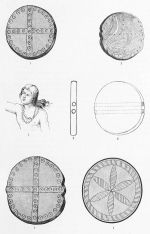
1. New York. 2. New York. 3. Arizona. 4. New York. 5, 6. Sections. 7. Manner of wearing.
(1/1)
It is probable that the signification of the designs engraved upon these ornaments will remain forever a matter of conjecture. It cannot be affirmed that the cross, which occurs on the faces of most of the specimens, has any particular significance, although it may represent the points of the compass. That it may have some emblematic meaning is, however, not impossible. I have counted the number of circlets on all of the specimens with which I am acquainted. The result is shown in the following table:
In the cross.
Longitudinal arm.Transverse arm.In the circle, exclusive of cross.Total.
No. 1 (Fig. 1)1092341
No. 2 (Fig. 3)10122748
No. 3 (Fig. 2)1192343
No. 4[A]992037
No. 5[A]12112951
No. 6[B]992037
The central circlet having been counted with each arm of the cross, the total number of circlets in each specimen will be one less than the sum of the three columns.
[pg 230]These circlets may be numerals. The design may be significant of some rank, the badge of a secret order, or the totem of a clan. The general arrangement of the figures upon the face of these disks suggests an incipient calendar.
These beads are doubtless American in origin, as nothing of a similar form, so far as I can learn, occurs in European countries. The fact that they are found in widely separated localities indicates that they were probably used in trade since the advent of the whites. This is possibly some form of bead held in high esteem by tribes of the Atlantic coast when first encountered by the whites who have taken up its manufacture for purposes of trade.
BEADS AS ORNAMENTS.
I have already spoken casually of the use of beads for personal ornament, but it will probably be better to enlarge a little upon the subject at this point.
Beads are generally found in the graves of ancient peoples in a loose or disconnected state, the strings on which they were secured having long since decayed. We cannot, therefore, with certainty, restore the ancient necklaces and other composite ornaments; but we can form some idea of their character by a study of the objects of which they were made and the positions held by these objects at the period of exhumation. Much can also be learned by a study of the ornaments of modern peoples in similar stages of culture.
As a rule, the combinations in the pendant ornaments of the ancient American seem to have been quite simple. Being without glass, and practically without metals, they had few of the resources of the modern savage. Their tastes were simple and congruous, not having been disturbed by the debasing influence of foreign innovation, which is the cause of so much that is tawdry and incongruous in the art of modern barbarians.
A curious example of a modern necklace is given by Professor Haldeman,[65] who had in his possession an Abyssinian necklace "composed of European beads, cowries (Cyprea shell), a triangular plate of glass, two small copper coins, small spheric brass buttons, cornelian, date-seeds, numerous cloves pierced through the sides, a fragment of wood, a bit of cane, and an Arab phylactery."
Something can be learned of the practices of the ancient Americans in the use of beads and pendant ornaments generally, by a study of the remains of their paintings and sculptures—such, for instance, as may be found in the Goldsborough manuscripts or the superb lithographs of Waldeck, examples of which are given in Plate XLV.
In a number of cases necklaces of the mound-builders have been found upon the necks of skeletons, just as they were placed at the time of burial.
[pg 231] Captain Atwater in describing the contents of a mound at Marietta, Ohio, makes the statement that on the breast of a skeleton "lay a stone ornament, with two perforations, one near each end, through which passed a string, by means of which it was suspended around the wearer's neck. On the string, which was made of sinew, and very much injured by time, were placed a great many beads made of ivory or bone."[66]
A similar necklace is described by Mr. Matson, in the Ohio Centennial Report, p. 127. It was found on the skeleton of a little girl, and was so made as to be larger in the center of the neck in front, tapering almost to a point at the middle of the back. On page 129 of the same volume much more varied uses of bead ornaments are suggested. Mr. Matson describes four skeletons, on each of which shell beads were found. In three cases they had been placed about the neck only; in the fourth, nearly thirty yards of beads had been used. There were four strands about the neck, crossing over on the breast and back and passing down between the legs. Strings passed down the legs to the feet, and were also found along the arms and around the wrists.
The arrangement of the various parts of a necklace or string of pendants is found to be much alike the world over, consisting of a strand of beads, small toward the ends and increasing in size toward the middle, where a central bead or pendant of peculiar form or unusual size is placed.
The practices of modern barbarians in the employment of beads as ornaments are extremely varied. They are employed in dressing the hair, in head-dresses and plumes, and pendants to these; as pendants to the hair, ears, nose, and lips; as necklaces and bracelets; as belts for the waist and sashes to be thrown across the shoulders; and as anklets and pendent ornaments to all parts of the costume.
Father Rasles, writing of the Abnaki Indians of Canada in 1723, says: "If you wish to see him in all his finery, you will find he has no other ornaments but beads; these are a kind of shell or stone, which they form into the shape of little grains, some white and others black, which they string together in such a way as to represent different showy figures with great exactness. It is with these beads that our Indians bind up and plait their hair on their ears and behind; they make of them pendants for the ears, collars, garters, large sashes of five or six inches in breadth, and on these kinds of ornaments they pride themselves much more than a European would on all his gold and jewelry."[67]
It is related of the New England Indians that more than a hundred years ago, they "hung strings of money about their necks and wrists, as also upon the necks and wrists of their wives and children. They also curiously make girdles, of one, two, three, four, and five inches thickness, and more, of this money; which, sometimes, to the value of ten pounds or more, they wear about their middle, and as a [pg 232] scarf about their shoulders and breasts. Yea, the princes make rich caps and aprons, or small breeches of these beads, thus curiously strung into many forms and figures; their black and white finely mixed together."[68]
It is further recorded that the New England Indians "wore ear-rings and nose-jewels; bracelets on their arms and legs, rings on their fingers, necklaces made of highly polished shells found in their rivers and on their coasts. The females tied up their hair behind, worked bands round their heads and ornamented them with shells and feathers, and wore strings of beads round several parts of their bodies. Round their moccasins they had shells and turkey spurs, to tinkle like little bells as they walked."[69]
The Indian women of the New Netherlands also gave great attention to personal decoration. One writer states that they ornamented the lower border of their skirts "with great art, and nestle the same with strips, which are tastefully decorated with wampum. The wampum with which one of these skirts is ornamented is frequently worth from one to three hundred guilders. * * * Their head-dress forms a handsome and lively appearance. Around their necks they wear various ornaments, which are also decorated with wampum. Those they esteem as highly as our ladies do their pearl necklaces. They also wear bead hand-bands, or bracelets, curiously wrought, and interwoven with wampum. Their breasts appear about half covered with an elegantly wrought dress. They wear beautiful girdles, ornamented with their favorite wampum, and costly ornaments in their ears."[70]
Smith states, in writing of Powhatan, that he found him "reclining proudly upon a Bedstead a foote high, upon tenne or twelve Mattes, richly hung with manie Chaynes of great Pearles, about his necke, and covered with a great Couvering of Rahaughcums,"[71] and the young women who surrounded him wore "a great Chaine of white Beades over their shoulders."[72]
The following is from Wood, whose quaint and graphic descriptions of the New England Indians are always interesting: "But a Sagamore with a Humberd in his eare for a pendant, a black hawk on his occiput for his plume, Mowhackees for his gold chaine, a good store of Wampompeage begirting his loynes, his bow in his hand, his quiver at his back, with six naked Indian spatterlashes at his heels for his guard, thinkes himselfe little inferior to the great Cham; he will not stick to say he is all one with King Charles. Hee thinkes hee can blow down Castles with his breath and conquer kingdomes with his conceit."[73]
Du Pratz, in speaking of the Louisiana Indians, says: "The women's ear-rings are made of the center part of a large shell called bingo, which [pg 233] is about the thickness of one's little finger, and there is a hole in the ear about that size for holding it."[74]
Lewis and Clark found the Shoshone Indians of the Upper Missouri using shells of the pearl oyster to decorate the collars of their fur tippets. The children wore beads around their necks; grown persons suspended them in little bunches from the ears, and the collars of the men were formed either of sea-shells from the southwest or from twisted grass with porcupine quills.[75]
Among the Carrier Indians of the Northwest both sexes perforate their noses, and from them the men often suspend an ornament consisting of a piece of an oyster shell or a small piece of brass or copper. The women, particularly those who are young, run a wooden pin through their noses, upon each end of which they fix a kind of shell bead, which is about an inch and a half long, and nearly the size of the stem of a common clay pipe. These beads they obtain from their neighbors, the At-e-nâs, who purchase them from another tribe that is said to take them from the sea-shore, where they are reported to be found in plenty.
It is also stated of the same Indians that "the young women and girls wear a parcel of European beads, strung together and tied to a lock of hair directly behind each ear. The men have a sort of collar of the shell beads already mentioned, which they wind about their heads or throw around their necks."[76]
The absurd extreme to which this passion for ornament is carried is well illustrated by an example given by Swan, who, speaking of the tribes north of the Columbia River, says that "some of these girls I have seen with the whole rim of their ears bored full of holes, into each of which would be inserted a string of these shells that reached to the floor, and the whole weighing so heavy that, to save their ears from being pulled off, they were obliged to wear a band across the top of the head."[77]
When, however, beads are found in the graves in quantity, by thousands or tens of thousands, we shall probably have to attribute to them other than ornamental uses.
Captain Tom, of the Nishinam tribe of California, according to Powers,[78] had nearly a half bushel of shell beads and trinkets. One string of these, worn by his wife on special occasions, contained sixteen hundred pieces; but these treasures were hoarded because of their value as money rather than as ornaments.
The wampum belts used by many of the tribes of Indians are known to contain enormous numbers of beads. One of the historical belts kept by the Onondagas among their treasures contains nearly ten thousand beads. The famous belt of William Penn has about three thousand.
[pg 234]Sir John Lubbock, in his "Prehistoric Times," expresses surprise at the great number of beads sometimes found, instancing the Grave Creek mound of Virginia, which contained between three and four thousand. This number will, however, appear very insignificant when compared with a collection such as the costume of the great King Philip could have furnished.
Drake relates that Philip had a coat "made all of wampampeag," which, when in need of money, he "cuts to pieces, and distributes it plentifully among the Nipmoog sachems and others, as well to the eastward as southward, and all round about."[79] By adding to this store of beads the contents of two belts, one of which was nine inches in breadth, and so long that when placed upon the shoulders it reached to the ankles, we conclude that the greatest collection ever taken from a prehistoric mound could not compare for a moment with the treasure of this one historic chieftain.
A great deal of art is shown in the stringing and mounting of beads. The simplest form is a single strand, a twisted string of vegetable fiber, a strip of buckskin, or a bit of sinew being passed through the perforations. Again, rows of strands are placed side by side and fastened at intervals in such a manner as to keep them approximately parallel, or the beads when long are put on equidistant cross strands, the longitudinal strands serving to keep them in place; they are also woven into the fabric by being mounted upon one of the strands before twisting. It is also a very usual practice to sew them on strips of cloth or buckskin, patterns being produced by using beads of different colors. The manner of stringing in the manufacture of belts will be given in detail under Mnemonic Uses of Beads.
BEADS AS CURRENCY.
It will probably be impossible to prove that the prehistoric peoples of North America employed a medium of exchange in a manner corresponding to our use of money. It is a well-known fact, however, that a currency of shell beads was in general use throughout the Atlantic coast region very early in the historic period.
Of all objects within the reach of savage peoples, shells, either in their natural forms or in fragments artificially fashioned for convenience of use, are the best adapted for such a purpose.
In examining the contents of ancient cemeteries and mounds where all objects of value were to some extent deposited, we find no other relics that could have been conveniently used for such a purpose.
It is not probable that objects subject to rapid decay, such as wood, fruits, and seeds, could ever have come into general use for money, although such objects are employed to some extent by savages in different parts of the world. The unlimited supply or easy manufacture of these objects would be against their use for this purpose, whereas the difficulty of shaping and perforating the flinty substance of shells would prevent such a plentiful production as to destroy the standard of value.
[pg 235]Objects and substances having a fairly uniform value, resulting from their utilitarian attributes, have been employed by primitive peoples as standards of value; as, for instance, cattle, in ancient Rome; salt, in Assyria; tin, in Britain, and cocoa, in Mexico. But such mediums of exchange are local in use. With these articles this function is only accidental. The utilization of shells for money would naturally originate from the trade arising from their use as utensils and ornaments in districts remote from the source of supply. Yielding in the worked state a limited supply, and at the same time filling a constant demand, they formed a natural currency, their universal employment for purposes of ornament giving them a fixed and uniform value. They have undoubtedly been greatly prized by the ancient peoples, but on the part of the open-handed savage they were probably valued more as personal ornaments than as a means of gratifying avaricious propensities.
Lewis H. Morgan, who had access to all the sources of information on the subject, says that "wampum has frequently been called the money of the Indian; but there is no sufficient reason for supposing that they ever made it an exclusive currency, or a currency in any sense, more than silver or other ornaments. All personal ornaments, and most other articles of personal property, passed from hand to hand at a fixed value; but they appear to have had no common standard of value until they found it in our currency. If wampum had been their currency it would have had a settled value, to which all other articles would have been referred. There is no doubt that it came nearer to a currency than any other species of property among them, because its uses were so general, and its transit from hand to hand so easy, that everyone could be said to need it." Yet he admits that "the use of wampum reaches back to a remote period upon this continent"; and further, that it was an original Indian notion which prevailed among the Iriquois as early at least as the formation of the League. He goes on to state that "the primitive wampum of the Iriquois consisted of strings of a small fresh-water spiral shell called in the Seneca dialect Ote ko-á, the name of which has been bestowed upon the modern wampum."[80]
Loskiel says that "before the Europeans came to North America, the Indians used to make strings of wampom chiefly of small pieces of wood of equal size, stained either black or white. Few were made of muscle, which were esteemed very valuable and difficult to make; for, not having proper tools, they spent much time in finishing them, and yet their work had a clumsy appearance."[81]
Hutchinson is of the opinion that "the Indians resident northeastward of the province of New York had originally no knowledge of this sort of money or medium of trade."[82]
The great body of our historical evidence goes to show, however, that [pg 236] a currency of shell was in use among the Atlantic coast tribes when first encountered by the Europeans. Thomas Morton, in speaking of the Indians of New England as far back as 1630, says that "they have a kinde of beads in steede of money to buy withal such things as they want, which they call wampampeak; and it is of two sorts, the one is white and the other is a violet coloure. These are made of the shells of fishe; the white with them is as silver with us, the other as our gould, and for these beads they buy and sell, not only amongst themselves, but even with us. We have used to sell them any of our commodities for this wampampeak, because we know we can have beaver again from them for it: and these beads are current in all parts of New England, from one end of the coast to the other, and although some have endeavoured by example to have the like made, of the same kinde of shels, yet none has ever, as yet, obtained to any perfection in the composure of them, but the Savages have found a great difference to be in the one and the other; and have knowne the counterfett beads from those of their owne making and doe slight them."[83]
According to Roger Williams also, the Indians of New England, as far back as his observations extend, were engaged in the manufacture of shell money as a well-established industry. It seems altogether impossible that such a custom should have been successfully introduced by the English, as the Indian is well known to be averse to anything like labor excepting in his traditional occupations of war and the chase, and if the whites had introduced it, would certainly have looked to them for a supply by means of trade in skins and game rather than apply himself to a new and strange art. Roger Williams says that "they that live upon the Sea side generally make of it, and as many as they will. The Indians bring downe all their sorts of Furs, which they take in the countrey, both to the Indians and to the English for this Indian Money: this Money the English, French and Dutch, trade to the Indians, six hundred miles in severall ports (north and south from New England) for their Furres, and whatsoever they stand in need of from them." Their methods were also aboriginal, another indication that the art was not of European introduction; and Williams states that "before ever they had awle blades from Europe, they made shift to bore their shell money with stones."[84]
That wampum was also manufactured farther south we learn from Lindström, who is writing of the Indians of New Sweden: "Their money is made of shells, white, black, and red, worked into beads, and neatly turned and smoothed; one person, however, cannot make more in a day than the value of six or eight stivers. When these beads are worn out, so that they cannot be strung neatly, and even on one thread, they no longer consider them good. Their way of stringing them is to rub the whole thread full of them on their noses; if they find it slides [pg 237] smooth and even, like glass beads, then they are considered good, otherwise they break and throw them away."[85]
Although Beverly did not write until the beginning of the eighteenth century, his statements are probably based upon accurate information. Speaking of the Virginia Indians, he says that they "had nothing which they reckoned riches before the English went among them, except Peak, Roenoke, and such-like trifles made out of the Cunk Shell. These past with them instead of Gold and Silver, and serv'd them both for Money and Ornament. It was the English alone that taught them first to put a value on their Skins and Furs, and to make a Trade of them."[86]
From Lawson, who wrote in 1714, but whose statements deserve consideration, we also learn that the money of the Carolina Indians is "all made of shells which are found on the coast of Carolina, which are very large and hard so that they are very difficult to cut. Some English smiths have tried to drill this sort of shell-money, and thereby thought to get an advantage; but it proved so hard that nothing could be gained."[87]
Speaking of its use and value in New York, he remarks that "an Englishman could not afford to make so much of this wampum for five or ten times the value; for it is made out of a vast great shell, of which that country affords plenty; where it is ground smaller than the small end of a tobacco pipe, or a large wheat straw." * * * "This the Indians grind on stones and other things until they make it current, but the drilling is the most difficult to the Englishman, which the Indians manage with a nail stuck in a cane or reed. Thus they roll it continually on their thighs with their right hand, holding the bit of shell with their left; so, in time, they drill a hole quite through it which is a very tedious work; but especially in making their ronoak, four of which will scarce make one length of wampum. The Indians are a people that never value their time, so that they can afford to make them, and never need to fear the English will take the trade out of their hands. This is the money with which you may buy skins, furs, slaves, or anything the Indians have; it being their mammon (as our money is to us) that entices and persuades them to do anything, and part with everything they possess, except their children for slaves. As for their wives, they are often sold and their daughters violated for it. With this they buy off murders; and whatsoever a man can do that is ill, this wampum will quit him of and make him, in their opinion, good and virtuous, though never so black before."[88]
Adair confirms the statements made by these writers, and adds emphasis to the fact that the shell beads had, among the Cherokees and other southern Indians, a fixed value as currency. "With these they [pg 238] bought and sold at a stated current rate, without the least variation for circumstances either of time or place; and now they will hear nothing patiently of loss or gain, or allow us to heighten the price of our goods, be our reasons ever so strong, or though the exigencies and changes of time may require it."[89]
We find plentiful evidence in the stories of the early Spanish adventurers that beads made from sea shells were held in high esteem by the Indians of the south, but, so far as I am aware, there is no statement indicating that they formed a well-regulated medium of exchange.
In regard to the manufacture of wampum by the whites, the following quotations will be instructive:
"Many people at Albany make the wampum of the Indians, which is their ornament and their money, by grinding some kinds of shells and muscles; this is a considerable profit to the inhabitants."[90]
"Besides the Europeans, many of the native Indians come annually down to the sea shore, in order to catch clams, proceeding with them afterwards in the manner I have just described. The shells of these clams are used by the Indians as money, and make what they call their wampum: they likewise serve their women as an ornament, when they intend to appear in full dress. These wampums are properly made of the purple parts of the shells, which the Indians value more than the white parts. A traveller, who goes to trade with the Indians, and is well stocked with them, may become a considerable gainer; but if he take gold coin, or bullion, he will undoubtedly be a loser; for the Indians, who live farther up the country, put little or no value upon these metals which we reckon so precious, as I have frequently observed in the course of my travels. The Indians formerly made their own wampums, though not without a deal of trouble: but at present the Europeans employ themselves that way; especially the inhabitants of Albany, who get a considerable profit by it. In the sequel I intend to relate the manner of making wampum."[91]
"The article was highly prized as an ornament, and as such constituted an article of trafic between the sea-coast and the interior tribes. * * *
"The old wampum was made by hand, and was an exceedingly rude article. After the discovery, the Dutch introduced the lathe in its manufacture, polished and perforated it with exactness, and soon had the monopoly of the trade. The principal place of its manufacture was at Hackensak, in New Jersey. The principal deposit of sea shells was Long Island, where the extensive shell banks left by the Indians, on which it is difficult to find a whole shell, show the immense quantities that were manufactured."[92]
The name wampum is often applied to shell beads indiscriminately, [pg 239] but frequently has a more restricted significance, referring to the small cylindrical varieties used in strings and belts. It was known first in New England as wampumpeag, wampompeage, peag, wompam and wampum; the Dutch of New Sweden knew it as seawan, sewant, and seawant, while on the Virginia coast, it was called peak, a roughly made discoidal variety being known as ronoak or roenoke, and heavy flattish beads pierced edgeways were called runtees. It is probable that all of these names are American in origin, although there is some difference of opinion as to their derivation. Loskiel says that wampom is an Iroquois word meaning muscle, but according to Morgan, who is probably the best modern authority on this subject, the word wampum is not Iroquois in origin but Algonkin, as it was first known in New England as wampumpeage.
Roger Williams, speaking of the money of the New England Indians, probably the Narragansetts (Algonkin), says that "their white they call Wompam (which signifies white); their black Suckanhock (Sácki, signifying black)." In another place he gives the word wompi for white. Wood mentions two varieties of beads known in New England wampompeage and mowhackees. The latter is probably derived from mowêsu, which, according to Williams, also signifies black.
It would seem that we have but little evidence of the ancient use of shell money amongst the tribes of the Mississippi Valley or the Pacific coast; yet we are not without proofs that it came into use at a very early date throughout the entire West, and even today the custom is by no means obsolete. The ancient burial places of the Pacific coast are found to contain large quantities of beads precisely similar to those now used as money by the coast tribes.
Lewis and Clark, speaking of traffic among the Indians of the Columbia River, state that shell beads are held in very high esteem by these people, and that to procure them they will "sacrifice their last article of clothing or their last mouthful of food. Independently of their fondness for them as an ornament these beads are the medium of trade by which they obtain from the Indians still higher up the river, robes, skins, chappeled bread, bear grass."[93]
The Dentalium shell has always been the favorite currency of the peoples of the Northwest and is highly valued, especially by the inland tribes. It is frequently found in ancient graves at great distances from the sea-shore. A few specimens have been found in burial places in the Ohio Valley, but we have no means of determining the source from which they were derived. As the modern use of this currency has but little archæologic interest, I will not enlarge upon the subject here. For further information the reader is referred to the following authors: J. K. Lord, The Naturalist in British Columbia, Vol. II, pp. 20 to 26; R. E. C. Stearns in the American Naturalist, Vol. III, No. 1, and in proceedings of the California Academy of Sciences, Vol. V, Part II, p. 113; W. H. Pratt in proceedings of the Davenport Academy of Natural [pg 240] Sciences, Vol. II, Part I, p. 38; and Stephen Powers in Vol. 3, Contributions to North American Ethnology, pp. 21, 24, 30.
MNEMONIC USE OF BEADS.
One of the most remarkable customs practiced by the American Indians is found in the mnemonic use of wampum. This custom had in it a germ of great promise, one which must in time have become a powerful agent in the evolution of art and learning. It was a nucleus about which all the elements of culture could arrange themselves. I shall not at present undertake to divest the custom of adventitious features such as have been introduced by contact with European influence. Yet there is no reason to fear that any of the important or essential features have been derived from outside sources. It is not possible from any known records to demonstrate the great antiquity of this use of wampum. It does not seem probable, however, that a custom so unique and so wide-spread could have grown up within the historic period; nor is it probable that a practice foreign to the genius of tradition-loving races could have become so well established and so dear to their hearts in a few generations.
Mnemonic records are known to have come into use among many nations at a very early stage of culture. Picture writing as developed in the north is but another form of mnemonic record, a fact, a thought, a verse of a song being associated with an ideographic design, more or less suggestive of the subject. The Peruvians had their quipus, in which the record was made by associating things to be remembered with knots made in cords of different colors, each combination having a fixed association. The Mexicans had gone further and had achieved a system of picture writing that was very unique and curious, in which a phonetic element had already made its appearance, while the Mayas could boast the discovery of a true phonetic system with an alphabet of twenty-seven sounds.
The mnemonic use of wampum is one which, I imagine, might readily develop from the practice of gift giving and the exchange of tokens of friendship, such mementos being preserved for future reference as reminders of promises of assistance or protection. In time the use of such mementos would develop into a system capable of recording affairs of varied and complicated nature; particular facts or features of treaties would be assigned to particular objects, or portions of objects. With this much accomplished, but one step was necessary to the attainment of a hieroglyphic system—the permanent association of a single object or sign with a particular idea.
The wampum records of the Iroquois were generally in the form of belts, the beads being strung or woven into patterns formed by the use of different colors. By association simply they were made to record history, laws, treaties, and speeches—a fact, a law, a stipulation, or a declaration being "talked into" a particular part or pattern of the design with which it was ever afterwards associated, thus giving additional [pg 241] permanency to tradition and bringing it one step further forward in the direction of written records. Such records were, of course, quite useless without the agency of an interpreter. Among the Iroquois, according to Morgan, one of the Onondaga sachems was made hereditary "keeper of wampum," whose duty it was to be thoroughly versed in its interpretation. But knowledge of the contents of these records was not confined to the keeper, or even to the sachems. At a certain season each year the belts were taken from the treasure-house and exposed to the whole tribe, while the history and import of each was publicly recited. This custom is kept up to the present day. It is recorded by Ruttenber that among the Mohicans a certain sachem had charge of the bag of peace which contained the wampum belts and strings used in establishing peace and friendship with the different nations.[94]
Aside from records wampum was used in the form of strings and belts for a variety of purposes; some of them were probably mnemonic, others only partially so, being based either upon its association with the name of some chief or clan, or upon a semi-sacred character resulting from its important uses. It was employed in summoning councils, and the messenger who journeyed from tribe to tribe found in it a well recognized passport. When a council was called it was presented by the delegates from the various tribes as their credentials; it was used in the ceremony of opening and closing councils, as was also the calumet; it assisted in solemnizing oaths and in absolving from them; white, it was a messenger of peace; black, it threatened war, and covered with clay, it expressed grief. "White wampum was the Iroquois emblem of purity and faith, it was hung around the neck of the white dog before it was burned; it was used before the periodical religious festivals for the confession of sins, no confession being regarded as sincere unless recorded with white wampum; further than this, it was the customary offering in condonation of murder, although the purple was sometimes employed. Six strings was the value of a life, or the quantity sent in condonation, for the wampum was rather sent as a regretful confession of the crime, with a petition for forgiveness, than as the actual price of blood."[95] We readily recognize the influence of the Christian missionary in a number of these symbolic uses of wampum.
The literature of wampum would fill a volume, but I forbear presenting more than will give an outline of the subject, confining myself to such quotations as will serve to show clearly the extent and importance of this ancient custom and its attendant practices.
The method of handling the belts of wampum in the presence of ceremonial assemblies is extremely interesting, and cannot be better presented than in the words of eye-witnesses.
[pg 242]The following is quoted from Brice, who is describing a council held in the Muskingum Valley in 1764:
"An Indian council, on solemn occasions, was always opened with preliminary forms, sufficiently wearisome and tedious, but made indispensable by immemorial custom, for this people are as much bound by their conventional usages as the most artificial children of civilization. The forms were varied, to some extent, according to the imagination of the speaker, but in all essential respects they were closely similar throughout the tribes of the Algonkin and Iroquois lineage.
"They run somewhat as follows, each sentence being pronounced with great solemnity, and confirmed by the delivery of a wampum belt: 'Brothers, with this belt I open your ears that you may hear; I remove grief and sorrow from your hearts; I draw from your feet the thorns that pierced them as you journeyed thither; I clean the seats of the council-house, that you may sit at ease; I wash your head and body, that your spirits may be refreshed; I condole with you on the loss of the friends who have died since we last met; I wipe out any blood which may have been spilt between us.' This ceremony, which, by the delivery of so many belts of wampum, entailed no small expense, was never used except on the most important occasions; and at the councils with Colonel Bouquet the angry warriors seem wholly to have dispensed with it. * * * And his memory was refreshed by belts of wampum, which he delivered after every clause in his harangue, as a pledge of the sincerity and truth of his words.
"These belts were carefully preserved by the hearers as a substitute for written records, a use for which they were the better adapted, as they were often worked in hieroglyphics expressing the meaning they were designed to preserve. Thus at a treaty of peace the principal belt often bore the figure of an Indian and a white man holding a chain between them."[96]
From an account of a council held by the Five Nations at Onondaga nearly two hundred years ago, to which the governor of Canada sent four representatives, I make the following extract: "During the course of the proceedings Cannehoot, a Seneca sachem, presented a proposed treaty between the Wagunhas and the Senecas, speaking as follows: 'We come to join the two bodies into one. * * * We come to learn wisdom of the Senecas (giving a belt). We by this belt wipe away the tears from the eyes of your friends, whose relations have been killed in the war. We likewise wipe the paint from your soldiers' faces (giving a second belt). We throw aside the ax which Yonondio put into our hands by this third belt.' A red marble sun is presented—a pipe made of red marble. 'Yonondio is drunk; we wash our hands clean from his actions (giving a fourth belt). * * * We have twelve of your nation prisoners; they shall be brought home in the spring (giving a belt to confirm the promise). We will bring your prisoners home when the strawberries [pg 243] shall be in blossom, at which time we intend to visit Corlear (the governor of New York), and see the place where wampum is made.'
"The belts were accepted by the Five Nations, and their acceptance was a ratification of the treaty. A large belt was also given to the messengers from Albany as their share. A wampum belt sent from Albany was, in the same manner, hung up and afterwards divided."[97]
This indicates a most extravagant use of belts; but since it is probable that as many were received in return this was a matter of little importance. The great profusion of wampum used in some of the later treaties is a matter of surprise. In a council held between four Indian ambassadors from New England and the French thirty-six fine large belts were given by the ambassadors to thank them that their people had not been treated with hostility.[98]
"The appendix to the second volume of Proud's History of Pennsylvania contains the journals of Frederick Christian Post, who was sent by Governor Denny, in 1758, to make a treaty with the Alleghany Indians; and in delivering the governor's answer to the chiefs, on his second visit in the same year, after proposing to them to unite in a treaty of peace which had lately been concluded with the Indians at Easton, and producing sundry belts, one of which was marked with figures representing the English and the Indians delivering the peace-belt to one of the commissioners, he proceeds to say: 'Brethren on the Ohio, if you take the belts we just now gave you, as we do not doubt you will, then by this belt'—producing another and using their figurative style of speech—'I make a road for you, and invite you to come to Philadelphia, to your first old council-fire, which we rekindle up again, and remove disputes, and renew the first old treaties of friendship. This is a clear and open road for you; therefore, fear nothing, and come to us with as many as can be of the Delawares, Shawanese, or the Six Nations; we will be glad to see you; we desire all tribes and nations of Indians who are in alliance with you may come.' Whereupon a large white belt, with the figure of a man at each end and streaks of black representing the road from the Ohio to Philadelphia, was then given to them."[99]
Lafitau, whose statements are considered unusually trustworthy, as they were based chiefly on personal observation of the Indian tribes of Canada, gives the following very instructive account of the mnemonic use of wampum:
"All affairs are conducted by means of branches [strings] and necklaces [belts] of porcelain [wampum] which with them take the place of compacts, written agreements, and contracts. * * * The shell, which is used for affairs of state, is worked into little cylinders of a quarter of an inch in length and large in proportion. They are distributed in two ways, in strings and in belts. The strings are composed [pg 244] of cylinders threaded without order one after another, like the beads of a rosary; the beads are usually quite white, and are used for affairs of little consequence, or as a preparation for other more considerable presents.[100]
"The belts are large bands, in which little white and purple cylinders are disposed in rows, and tied down with small thongs of leather, which makes a very neat fabric. The length and size and color are proportioned to the importance of the affair. The usual belts are of eleven rows of a hundred and eighty beads each.
"The 'fisk,' or public treasure, consists principally of these belts, which, as I have said, with them, take the place of contracts, of public acts, and of annals or registers. For the savages, having no writing or letters, and therefore finding themselves soon forgetting the transactions that occur among them from time to time, supply this deficiency by making for themselves a local memory by means of words which they attach to these belts, of which each one refers to some particular affair, or some circumstance, which it represents while it exists.
"They are so much consecrated to this use that besides the name Gaïonni, which is their name for the kind of belts most used, they bestow that of Garihona, which means a transaction; that of Gaouenda, voice or word, and of Gaianderenfera, which means grandeur or nobility; because all the affairs dignified by these belts are the endowment and province of the agoïanders or nobles. It is they who furnish them; and it is among them that they are redivided when presents are made to the village, and when replies to the belts of their ambassadors are sent.
"The agoïanders and the ancients have, besides this, the custom of looking over them often together, and of dividing among themselves the care of noting certain ones, which are particularly assigned to them; so that in this way they do not forget anything.
"Their wampum would soon be exhausted if it did not circulate; but in almost all affairs, either within or without, the law requires a reply, word for word, that is to say, for one belt one must give another, to be of about the same value, observing, however, a slight difference in the number of beads, which must be proportioned to the rank of the persons or nations with which they treat.
"They do not believe that any transaction can be concluded without these belts. Whatever proposition is made to them, or reply given them, by word of mouth alone, the affair falls through, they say, and they let it fall through very effectually, as though there had been no question about it. Europeans little informed or little concerned about their usages have slightly inconvenienced them on this point in retaining their belts without giving them a similar response. To avoid the inconvenience which might arise from this they acquired the style of giving only a small quantity, excusing themselves on the plea that their [pg 245] wampum was exhausted; and they supplied the rest with packages of deer-skin, in return for which they were given trinkets of small value, so that transactions between the Europeans and them have become a sort of trade.