[pg 213] ORNAMENTS. (continued 2)
Reading edition
"Although all the savage nations of America make various kinds of ornaments of shells, I believe that it is only those of North America who employ them in transactions. I cannot even affirm that all of these do."[101]
A very complete account of wampum is given by Loskiel, from whose work the following extract is made:
"Four or six strings joined in one breadth, and fastened to each other with fine thread, make a belt of wampom, being about three or four inches wide, and three feet long, containing, perhaps, four, eight, or twelve fathom of wampom, in proportion to its required length and breadth. This is determined by the importance of the subject which these belts are intended either to explain or confirm, or by the dignity of the persons to whom they are to be delivered. Everything of moment transacted at solemn councils, either between the Indians themselves or with Europeans, is ratified and made valid by strings and belts of wampom. Formerly, they used to give sanction to their treaties by delivering a wing of some large bird; and this custom still prevails among the more western nations, in transacting business with the Delawares. But the Delawares themselves, the Iroquois, and the nations in league with them, are now sufficiently provided with handsome and well-wrought strings and belts of wampom. Upon the delivery of a string, a long speech may be made and much said upon the subject under consideration, but when a belt is given few words are spoken; but they must be words of great importance, frequently requiring an explanation. Whenever the speaker has pronounced some important sentence, he delivers a string of wampom, adding, 'I give this string of wampom as a confirmation of what I have spoken'; but the chief subject of his discourse he confirms with a belt. The answers given to a speech thus delivered must also be confirmed by strings and belts of wampom, of the same size and number as those received. Neither the colour nor the other qualities of wampom are a matter of indifference, but have an immediate reference to those things which they are meant to confirm. The brown or deep violet, called black by the Indians, always means something of severe or doubtful import; but the white is the colour of peace. Thus, if a string or belt of wampom is intended to confirm a warning against evil, or an earnest reproof, it is delivered in black. When a nation is called upon to go to war, or war declared against it, the belt is black, or marked with red, called by them, the colour of blood, having in the middle the figure of an hatchet in white wampom. * * * They refer to them as public records, carefully preserving them in a chest made for that purpose. At certain seasons they meet to study their meaning, and to renew the ideas of which they were an emblem [pg 246] or confirmation. On such occasions they sit down around the chest, take out one string or belt after the other, handing it about to every person present, and that they may all comprehend its meaning, repeat the words pronounced on its delivery in their whole convention. By these means they are enabled to remember the promises reciprocally made by the different parties; and it is their custom to admit even the young boys, who are related to the chiefs, to their assemblies; they become early acquainted with all the affairs of the State; thus the contents of their documents are transmitted to posterity, and cannot be easily forgotten."[102]
It is to be presumed that if a treaty or a promise were broken, the belt would be released from its office and in the same form, or worked into another, could again be used. Otherwise the records, if properly kept, would in time become extremely cumbersome.
The repudiation of a treaty and of the wampum which accompanied it is recorded by Brice. It was at a council held at Miami, in 1790, between Mr. Gamelin and a number of tribes. Mr. Gamelin in beginning his speech presented each nation with strings of wampum, but "the Indians were displeased with the treaty, and after consultation returned the wampum, saying: 'From all quarters we receive speeches from the Americans and not one is alike. We suppose that they intend to deceive us. Then take back your branches of wampum.' The Pottawatomies were better pleased with the speeches and accepted the wampum."[103]
Another good example which illustrates the manner of canceling treaties, confirmed by wampum, is given by Mr. Gilpin:
"When Washington, then but a youth of twenty-one, was intrusted by the colonial governor of Virginia with a mission to the western wilds of Pennsylvania, where the French from Canada were then penetrating and had already established, as was believed, four posts within our limits and were seeking to unite the natives in alliance against us, * * * he found that such an alliance had indeed been formed. He found that they had exchanged with the French, as its symbol, a wampum belt on which four houses were rudely embroidered—the representations of the posts which were to be defended, even at the risk of war. Influenced by his remonstrances, the Indian sachems consented to withdraw from the alliance; but they declared that the belt of wampum must be returned before the agreement could be abolished; and one of the sachems repaired to the French commander in order to restore to him the token of the warlike compact, and to proclaim the intention of the red men to take no part in the impending struggle."[104]
Heckewelder relates that "it once happened that war messengers endeavored to persuade and compel a nation to accept the belt by laying it on the shoulders or thigh of the chief, who, however, after shaking it [pg 247] off without touching it with his hands, afterwards, with a stick, threw it after them, as if he threw a snake or toad out of his way."[105]
It is remarkable that other objects were not more frequently used for mnemonic records. We can only explain the partiality shown to wampum on the supposition that the idea of value was not entirely lost sight of and that importance was attached to a record which in itself merited preservation. Yet instances of the use of other objects are often met with. Parkman states that "the figures on wampum belts of the Iroquois were for the most part simply mnemonic. So also were those carved in wooden tables, or painted on bark or skin, to preserve in memory the songs of war, hunting, or magic."[106]
At one of the councils at Onondaga in 1690, a treaty was pledged and recorded in wampum by all the contracting parties but the New England colonies, which sent a wooden model of a fish as a token of their adherence to the terms of the treaty.[107]
Hunter, speaking of the manners and customs of the Osages, states that "they use significant emblems, such as the wing of the swan and wild goose, wampum, and pipes, in overtures for peace, while arrows, war clubs, and black and red painting, are used as indications or declarations of war. Any article, such as a skin painted black, or the wing of a raven, represents the death of friends, and when colored or striped with red, that of enemies. Amongst the Canada Indians when peace was conceded, a reddened hatchet was buried as a symbol of the oblivion of all past hostility between the contracting parties. A mutual exchange of neck ornaments sealed the treaty after its terms were debated and determined. But all was not yet over, for the chiefs on each side proffered and accepted presents of rare articles, such as calumets of peace, embroidered deer skins, &c. This kind of ceremonial barter being terminated to their mutual satisfaction, or otherwise, the conference broke up."[108]
Gumilla says that the Oronoco Indians ratify their treaties with sticks which they give reciprocally,[109] and the Araucanians, according to Molina, carry in their hands, when they conclude a peace, the branches of a tree, regarded as sacred by them, which they present to each other.[110]
I have already enumerated the various kinds of beads and shown the sources from which they were derived and the uses to which they were applied. I have yet to describe the manner in which they are strung or combined in strings and belts.
The beads chosen as most convenient for stringing or weaving into fabrics were small cylinders from one-eighth to one-quarter of an inch in diameter, and from one-quarter to one-half an inch in length. White strings or belts were sufficient for the expression of simple ideas or the [pg 248] association of simple facts, but the combinations of colors in patterns rendered it possible to record much more complicated affairs. In belts used for mnemonic purposes the colors were generally arranged without reference to the character of the facts or thoughts to be intrusted to them, but in a few cases the figures are ideographic, and are significant of the event to be memorized. Strings cannot be utilized in this way.
Wampum in strings.—From Mr. Beauchamp's notes I have compiled the following brief account of the use of strings of wampum among the modern Iroquois. Six strings of purple beads united in a cluster represent the six nations. When the tribes meet the strands are arranged in a circle, which signifies that the council is opened. The Onondagas are represented by seven strings, which contain a few white beads; the Cayugas by six strands, all purple, and the Tuscaroras by seven strands, nearly all purple. The Mohawks have six strings, on which there are two purple beads to one white. These are illustrated in Fig. 2, Plate XLIV. There are four strings in the Oneida cluster; these contain two purple to one white bead. The Senecas have four strings, with two purple beads to one white. The three nations which were brothers are represented by similar clusters.
When a new chief is installed the address delivered on the occasion is "talked into" ten very long strings of white wampum. Three strings, mostly white, represent the name of the new chief. One of these clusters is shown in Fig. 1, Plate XLIV.[111] When a chief dies he is mourned on ten strings of black wampum. If he has merely lost his office, six short strings are used.
According to Mr. Beauchamp, possession of beads gives authority, and they are also used as credentials, or, as the Indians express it, "Chief's wampum all same as your letter." Such of these strings as remain in existence are still in use among the Iroquois, and are considered very precious by them, being made of antique hand-made beads.
In the literature relating to our Indian tribes we find occasional reference to the use of strings of wampum in ways that indicate that they were invested with certain protective and authoritative qualities, doubtless from their association with the name of some chief, clan, or tribe.
It is recorded that on one occasion Logan, the Mingo chief, saved a captive white from torture by rushing through the circle of Indians and throwing a string of wampum about the prisoner's neck. Through the virtue of this string he was enabled to lead him away and adopt him into his family.
A somewhat different use is mentioned by Pike, to whom a Chippewa chief made a speech, during which he presented his pipe to Mr. Pike to bear to the Sioux. Attached to the pipe were seven strings of wampum, which signified that authority was given by seven chiefs of the Chippewa to conclude peace or make war.[112]
Wampum belts.—In the manufacture of belts a great deal of skill and [pg 249] taste have been shown. The large figured varieties were intricate in design and extremely pleasing in color. Belts of wampum beads were probably used simply as a part of the costume long before they became the vehicles of tradition, and beads were doubtless used in other parts of the costume in a similar manner. It is said that in New England they were made by the women; in later times it is probable that the whites engaged to some extent in their manufacture.
Mr. Morgan gives such a good account of the details of belt making that I beg leave to quote him in full:
"In making a belt no particular pattern was followed; sometimes they are of the width of three fingers and three feet long, in other instances as wide as the hand and over three feet in length; sometimes they are all of one color, in others variegated, and in still others woven with the figures of men to symbolize, by their attitudes, the objects or events they were designed to commemorate. The most common width was three fingers, or the width of seven beads, the length ranging from two to six feet. In belt making, which is a simple process, eight strands or cords of bark thread are first twisted, from filaments of slippery elm, of the requisite length and size; after which they are passed through a strip of deer-skin to separate them at equal distances from each other in parallel lines. A piece of splint is then sprung in the form of a bow, to which each end of the several strings is secured, and by which all of them are held in tension, like warp threads in a weaving machine. Seven beads, these making the intended width of the belt, are then run upon a thread by means of a needle, and are passed under the cords at right angles, so as to bring one bead lengthwise between each cord and the one next in position. The thread is then passed back again along the upper side of the cords and again through each of the beads; so that each bead is held firmly in its place by means of two threads, one passing under and one above the cords. This process is continued until the belt reaches its intended length, when the ends of the cords are tied, the end of the belt covered and afterward trimmed with ribbons. In ancient times both the cords and the thread were of sinew."[113]
In another place Mr. Morgan states that belts were also made by covering one side of a deer-skin belt with beads, probably by sewing them on;[114] a method which is everywhere common in the use of glass beads in modern work, but is not noticed in any of the mnemonic belts now extant. It is a remarkable as well as a lamentable fact that none of the great collections of the country can boast the possession of a wampum belt. Considering their importance in our early history, and the great numbers that at one time must have been in existence, this is rather extraordinary. I have taken considerable pains to collect accurate representations of a number of examples of the ancient belts for [pg 250] this work, and am only sorry that I am unable to present them in color—the only method by which they can be adequately shown. As those which have come to my notice represent but a few localities, I shall insert descriptions of a number from regions as remote as possible. There is, however, great uniformity in design and method of construction; the result, probably, of their international character. From Heckewelder I quote the following:
"Their belts of wampum are of different dimensions, both as to the length and breadth. White and black wampum are the kinds they use; the former denoting that which is good, as peace, friendship, good-will, &c.; the latter the reverse; yet occasionally the black also is made use of on peace errands, when the white cannot be procured; but previous to its being produced for such purpose, it must be daubed all over with chalk, white clay, or anything which changes the color from black to white. * * * A black belt with the mark of a hatchet made on it with red paint is a war belt, which, when sent to a nation, together with a twist or roll of tobacco, is an invitation to join in a war. * * * Roads from one friendly nation to another are generally marked on the belt by one or two rows of white wampum interwoven in the black, and running through the middle, and from end to end. It means that they are on good terms, and keep up a friendly intercourse with each other."[115]
A belt accepted by the Indians of Western Pennsylvania from the French in a treaty which secured to the latter four forts within English territory had embroidered upon it four houses, pictographic representations of the forts.
Another example of the belts used in Pennsylvania, upwards of a century ago, is described in Beatty's Journal. The Delawares, in explaining to Beatty a former treaty with Sir William Johnson, "showed a large belt of wampum of friendship which Sir William Johnson had given them. On each edge of this were several rows of black wampum, and in the middle were several rows of white wampum. In the middle of the belt was a figure of a diamond, in white wampum, which they called the council fire. The white streak they called the path from him to them and them to him."[116]
Loskiel states that "the Indian women are very dexterous in weaving the strings of wampom into belts, and marking them with different figures, perfectly agreeing with the different subjects contained in the speech. These figures are marked with white wampom upon black, and with black upon the white belts. For example, in a belt of peace, they very dexterously represent, in black wampom, two hands joined. The belt of peace is white, a fathom long and a hand's breadth."[117]
In Plate XXXVII I present a fac-simile reproduction of a plate from the well known work of Lafitau,[118] in which we have a graphic yet [pg 251] highly conventional representation of a council or treaty in which wampum belts were used. It is probably drawn from description and is far from truthful in detail. The more important facts are, however, very clearly presented. No information is given either of the people or the locality. The scene is laid in the middle of a broad featureless plain, the monotony of which is broken by three highly conventionalized trees. The parties to the treaty are ranged in two rows, placed, face to face. The chief who speaks stands at the farther end holding a belt in his right hand. Three other belts lie upon the mat at his feet, while a fifth is shown on a large scale in the foreground. The patterns can not be clearly made out, but in a general way resemble very closely the designs woven into the belts of the Iroquois.
PL. XXXVII—USE OF WAMPUM BELTS IN INDIAN COUNCIL.
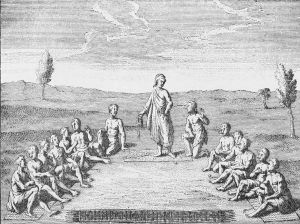
Facsimile of a plate in Lafitau.
The small belt shown in Fig. 1. Plate XXXVIII, is probably one of the most recent examples. The cut is copied from Plate 1 of the Fifth Annual Report of the Regents of the University of New York on the condition of the State Cabinet of Natural History, p. 72. The beads of which it is composed formerly belonged to the celebrated Mohawk chief, Joseph Brant. They were afterwards purchased from his daughter by Mr. Morgan. In 1850 they were taken to Tonawanda, in the State of New York, and made into this belt. The trimmings are apparently of ribbons, and the symmetry and uniformity of the whole work give it a new look not noticeable in the other specimens. The design consists of a row of dark diamond-shaped figures upon a white ground. It is now preserved in the State Cabinet of Natural History at Albany.
A belt of unusual form is shown in Fig. 2, Plate XXXVIII. It was kindly lent by Mrs. E. A. Smith, of Jersey City, by whom it was obtained from the Mohawks. It is 26 inches (251 beads) in length and in width varies from three inches (11 beads) at one end to about one inch (5 beads) at the other. It is bifurcated at the wide end, five rows having been omitted from the middle of the belt for about one-third of the length. Near the middle of the belt one row of beads is dropped from each side. Between this and the smaller end at nearly equal intervals it is twice depleted in a like manner. The beads are quite irregular in shape and size, but rather new looking and are strung in the usual manner, the longitudinal strings being buckskin and the transverse small cords of vegetable fiber. The ends and edges are all neatly finished by wrapping the marginal strings with a thin fillet of buckskin. The figures are in white beads upon a ground of purple. The form of this belt indicates that it has been adapted to some particular use, the placing of cords at the corners and shoulders suggesting its attachment in a fixed position to some part of the person or costume.
PL. XXXVIII—WAMPUM BELTS.
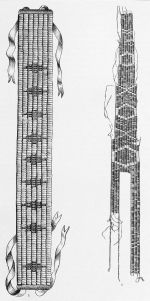
1. Mohawk Belt. 2. Mohawk Belt.
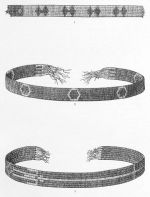
In Plates XXXIX, XL, XLI and XLII, I present a series of illustrations of the wampum belts belonging to the Onondagas. They are preserved as a most precious treasure by these people at their agency in Onondaga County, New York. The drawings were made by Mr. Trill from a series of minute photographs made from the original [pg 252] belts by General J. S. Clark, of Auburn, New York. These were obtained for me by the Rev. W. M. Beauchamp, of Baldwinsville, New York, who has also very kindly furnished many of the facts embodied in the following descriptions.[119]
These belts are made in the usual manner, and present a great variety of shapes, sizes, and designs. Their full history has never been obtained by the whites, and it is not probable that the Indians themselves have preserved a very full account of their origin and significance. They are all ancient, and, judging by their appearance, must date far back in the history of the League. Many of them are quite fragmentary, and fears are entertained that they will gradually fall to pieces and be lost. It is to be hoped that measures will be taken to have them preserved at least in the form of accurate chromo-lithographs. Mr. Beauchamp states that they are yearly wasting away, as a little wampum is annually cast into the fire at the burning of the "white dog," and these belts are the source of supply.
The small belt presented in Fig. 1, Plate XXXIX, is somewhat fragmentary, an unknown number of beads having been lost from the ends. It is seven rows wide and at present two hundred beads long. The design consists of a series of five double diamonds worked in dark wampum upon white. At one end a few rows of an additional figure remain, and at the other a small white cross is worked upon a ground of dark beads. The number of figures may be significant of the number of parties to a treaty.
Fig. 2 represents a well preserved belt, seven rows in width and about three hundred and twenty in length. The ground is of dark wampum, on which are worked five hexagonal figures of white wampum. For a short space at the ends alternate rows are white. As was suggested in regard to the preceding belt, the figures in this may represent the parties to a treaty.
The belt shown in Fig. 3 differs from the others in being pictographic. It is also quite perfect, although the character of the beads indicates considerable age. It is seven rows in width and three hundred and fifty beads in length. The figures are white, on a dark ground, and consist of a cross near one end, connected by a single row of beads with the head of the figure of a man toward the other end. Beneath the feet of the elementary man the figure of a diamond is worked. The cross is probably significant of the mission of the man who comes from a long distance to the lodge or council of the red man. This is probably a French belt.
PL. XXXIX—WAMPUM BELTS BELONGING TO THE ONONDAGAS.
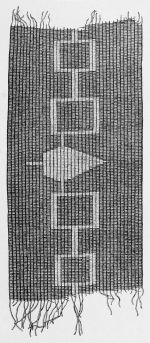
The remnant of a very handsome belt is shown in Plate XL. Considerable wampum has been lost from both ends, but the design appears to be nearly perfect, and consists of a trowel or heart-shaped figure in the center with two rectangular figures on the right and two on the left. These are in white upon a dark ground. Mr. Beauchamp states that it [pg 253] is said to be very old, and is thought to represent the formation of the Iroquois league and to signify "one heart for all the nations." He doubts its great antiquity as the beads are too regular for hand-made cylinders. The belt is thirty-eight rows wide and about two hundred beads in length.
PL. XL—WAMPUM BELT BELONGING TO THE ONONDAGAS.
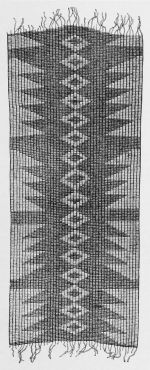
The large elaborately figured belt shown in Plate XLI is almost perfect. The lateral margins are white; a broad notched band of dark wampum occupies the middle of this belt; through this from end to end runs a chain of white diamonds, sixteen in number, which may represent States or nations. It is forty-five rows wide and two hundred and forty beads long.
PL. XLI—WAMPUM BELT BELONGING TO THE ONONDAGAS.
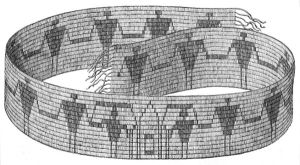
The magnificent belt shown in Plate XLII, is probably the finest example in existence. It is fifteen rows wide and six hundred and fifty in length, making the enormous total of nine thousand seven hundred and fifty beads. Mr. Beauchamp believes that this belt, or one like it, has been described as representing the formation of the League. From Webster's[120] statement, that it was "made by George Washington," he surmises that it is a belt memorizing a covenant between the Indians and the government. In the center is a house which has three gables and three compartments. Next the house on either side are two pictographic men, who appear to stand beneath protecting arms which pass over their heads, connect with the house, and grasp the hands of the first personages immediately on the right and left. In all there are fifteen figures of men, two being connected with the house; of the others, six stand on the right and seven on the left of the central group. It is suggested by Mr. Beauchamp that these figures may represent the thirteen colonies.
PL. XLII—WAMPUM BELT BELONGING TO THE ONONDAGAS.
Six other belts are shown in the photographs procured by General Price. One of them is thirteen rows wide and two hundred and fifty beads in length. The light ground is decorated with groups of triple chevrons. This belt is somewhat fragmentary. Another is forty-nine rows wide, being the widest example known. The original length cannot be determined, but at present it is two hundred and forty beads in length, and hence contains about twelve thousand beads. The pattern is simple, consisting of a dark ground notched at the edges with triangular figures of white. As the four remaining belts of this fine collection have no features of especial interest, they need not be described here.
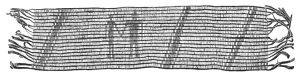
The remarkable belt shown in Plate XLIII has an extremely interesting, although a somewhat incomplete, history attached to it. It is believed to be the original belt delivered by the Leni-Lenape sachems to William Penn at the celebrated treaty under the elm tree at Shackamaxon in 1682. Although there is no documentary evidence to show that this identical belt was delivered on that occasion, it is conceded on all hands that it came into the possession of the great founder of Pennsylvania [pg 254] at some one of his treaties with the tribes that occupied the province ceded to him. Up to the year 1857 this belt remained in the keeping of the Penn family. In March, 1857, it was presented to the Pennsylvania Historical Society by Granville John Penn, a great grandson of William Penn. Mr. Penn, in his speech on this occasion,[121] states that there can be no doubt that this is the identical belt used at the treaty, and presents his views in the following language: "In the first place, its dimensions are greater than of those used on more ordinary occasions, of which we have one still in our possession—this belt being composed of eighteen strings of wampum—which is a proof that it was the record of some very important negotiation. In the next place, in the center of the belt, which is of white wampum, are delineated in dark-colored beads, in a rude but graphic style, two figures—that of an Indian grasping with the hand of friendship the hand of a man evidently intended to be represented in the European costume, wearing a hat; which can only be interpreted as having reference to the treaty of peace and friendship which was then concluded between William Penn and the Indians, and recorded by them in their own simple but descriptive mode of expressing their meaning, by the employment of hieroglyphics. Then the fact of its having been preserved in the family of the founder from that period to the present time, having descended through three generations, gives an authenticity to the document which leaves no doubt of its genuineness; and as the chain and medal which were presented by the Parliament to his father, the admiral, for his naval services, have descended amongst the family archives unaccompanied by any written document, but is recorded on the journals of the House of Commons, equal authenticity may be claimed for the wampum belt confirmatory of the treaty made by his son with the Indians; which event is recorded on the page of history, though, like the older relic, it has been unaccompanied in its descent by any document in writing."
PL. XLIII—THE PENN BELT.
(1/4)
It will be seen, by reference to the accompanying illustration, that beside the two figures of men there are three oblique bands of dark wampum, one on the left and two on the right. The one next the central group on the right is somewhat broken, and consists of two long bands and one short one. It is probable that these bands were used to record, by association, some important features of the treaty in which the belt was used. The beads are strung upon cords made of sinew or vegetable fibre, while the longitudinal fillets are of buckskin. This belt may be seen at the rooms of the Historical Society of Pennsylvania.
PL. XLIV—STRINGS OF WAMPUM.
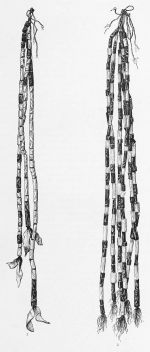
1. Name of New Chief. 2. "Mohawk."
[pg 255] PENDANTS.
It would probably be vain to attempt to determine how pendant ornaments first came into use, whether from some utilitarian practice or through some superstitious notion. It matters not, however, whether the first pendant was an implement, a utensil, or a fetichitic talisman; it has developed by slow stages into an ornament upon which has been lavished the best efforts of culture and skill. The simple gorget of shell suspended upon the naked breast of the preadamite is the prototype of many a costly jewel and many a princely decoration. With the American savage it was a guardian spirit, invested with the mystery and the power of the sea, and among the more cultured tribes became in time the receptacle of the most ambitious efforts of a phenomenal art. The important place the gorget has taken in ornament and as a means of displaying personal aggrandizement has made it a most powerful agent in the evolution of the arts of taste.
As a rule the larger and more important pendants are employed as gorgets, but vast numbers of the smaller specimens are strung with beads at intervals along the strings, attached as auxiliary pendants to the larger gorgets, suspended from the nose, ears, and wrists, or form tinkling borders to head-dresses and garments. These pendants consist either of entire shells, or of parts of shells, pierced or grooved to facilitate suspension. The purely artificial forms are infinitely varied. The character of the shell, however, has much to do with the form of the finished ornaments, deciding their thickness and often their outline. In size they range from extremely minute forms to plates six or more inches in diameter. The perforations, in position and number, are greatly varied, but as a rule the larger discoidal pendants will be found to have two marginal perforations for suspension.
These nicely-polished shell-disks afforded tempting tablets for the primitive artist, and retain many specimens of his work as an engraver. The engraved specimens, however, should be treated separately, according to the class of design which they contain. Plain pendants need but a brief notice, and may be treated together as one group, with such subdivisions only as may be suggested by their form, their derivation, or their geographical distribution.
Plain pendants.—It will be unnecessary to cite authorities to show that our ancient peoples were fond of pendant ornaments, and wore them without stint, but to illustrate the manner in which they were used and the methods of combining them with other articles of jewelry in necklaces, bracelets, &c., I shall refer briefly to the literature of the period of American discovery.
The inhabitants of Mexico are said to have been very simple in the matter of dress, but displayed much vanity in their profuse employment of personal ornament. Besides feathers and jewels, with which [pg 256] they adorned their clothes, they wore pendants to the ears, nose, and lips, as well as necklaces, bracelets, and anklets. The ear ornaments of the poor were shells, pieces of crystal, amber, and other brilliant stones, but the rich wore pearls, emeralds, amethysts, or other gems, set in gold.[122] The priestly personages so graphically delineated in the ancient Aztec manuscripts are as a rule loaded down with pendant ornaments. In traveling north along the west coast of Mexico the Friar Niza encountered Indians who wore many large shells of mother of pearl about their necks, and farther up toward Cibola the inhabitants wore pearl shells upon their foreheads;[123] and Cabeça de Vaca when among the pueblos of New Mexico noticed beads and corals that came from the "South Sea." Ornaments made from marine shells are found in many of the ancient ruins to-day. They are also highly valued by the modern Indians of this region.
In the earliest accounts of the Indians of the Atlantic coast we find frequent mention of the use of pendants and gorgets, and the manner of wearing them as ornaments. Beverly, after having described beads made of a shell resembling the English buglas, says that they also make "runtees" of the same shell, and grind them as smooth as peak. "These are either large like an oval Bead, drill'd the length of the Oval, or else they are circular and flat, almost an Inch over, and one Third of an Inch thick, and drill'd edgeways. Of this Shell they also make round Tablets of about four Inches Diameter, which they polish as smooth as the other, and sometimes they etch or grave thereon Circles, Stars, a half Moon, or any other Figure suitable to their Fancy. These they wear instead of Medals before or behind their Neck, and use the Peak, Runtees, and Pipes for Coronets, Bracelets, Belts, or long Strings hanging down before the Breast, or else they lace their Garments with them, and adorn their Tomahawks, and every other thing that they value."[124] The "Pipes" here spoken of were probably long, heavy cylindrical beads.
In referring to this class of ornaments, Lafitau says: "The collars which the savages sometimes wear around the neck are about a foot in diameter, and are not different from those which one now sees on some antiques, on the necks of statues of barbarians. The northern savages wear on the breast a plate of hollow shell, as long as the hand, which has the same effect as that which was called Bulla among the Romans."[125]
Wood, speaking of the Indians of Northern New England, in 1634, says: "Although they be thus poore, yet is there in them the sparkes of naturall pride, which appeares in their longing desire after many kinds of ornaments, wearing pendants in their eares, as formes of birds, beasts, and fishes carved out of bone, shels, and stone, with long bracelets [pg 257] of their curious wampompeag and mowhackees, which they put about their necks and loynes."[126]
Kalm says of the Indians of Lorette, near Quebec, Canada, that "round their necks they have a string of violet wampums, with little white wampums between them. These wampums are small, of the figure of oblong pearls, and made of the shells which the English call clams. At the end of the wampum strings many of the Indians wear a large French silver coin, with the king's effigy, on their breasts; others have a large shell on the breast, of a fine white colour, which they value very high, and is very dear; others, again, have no ornament at all round the neck."[127]
Pendants of metal and medals of European manufacture soon replaced in a great measure the primitive gorgets of shell; and early in the history of the tribes a heterogeneous collection of native beads, silver crosses, and traders' medals, ornamented the breasts of the simple savages.
In studying the habits and customs of our native peoples we look with a great deal of interest upon the earliest historical records, but generally find it prudent to remember that the "personal equation" was unusually large in those days, and in studying the illustrations given in the works of early writers we must make due allowance for the well-known tendency to exaggerate as well as for the fact that the artist has more frequently drawn from descriptions than from sketches made on the spot.
In Plate XLV two examples are given which seem to me to be trustworthy, as they agree with the descriptions given, and are in a general way characteristic of the American aborigines. Fig. 1 is reproduced, original size, from Plate 2, Volume II, of Lafitau, and shows a broad necklace ornamented with figures that resemble arrow heads. From this, by means of a cord, is suspended a large circular disk with concave front, which undoubtedly represents a shell gorget. In front of this and suspended from the necklace are two long strands of beads of various sizes and shapes, which give completeness to a very tasteful ornament. In the same plate is a pretty fair drawing of a native in costume. He is represented wearing a necklace similar to the one just described. An enlarged drawing of this ornament is given in Fig. 2. In Fig. 3 I reproduce a necklace from a plate in De Bry, which consists of a string of beads with two large disks that look more like metal than shell. A similar ornament is shown in Fig. 4, but with figured disks and secondary pendants. It is copied from the Codex of the Vatican. A common form of necklace among the ancient Aztecs consisted of small univalve shells suspended from a string. One of these, with other pendants, is shown in Fig. 5. It is also copied from the Vatican Codex. Others of a much more complex nature may be found [pg 258] in the same manuscript. Of even greater interest are the beautiful necklaces, with their pendants, found in the sculptures of Mexico and Yucatan.[128] Three of these are shown in Figs. 6, 7, and 8. One has a disk with human features engraved upon it, another has a cross with equal arms, and another a T-shaped cross. All have more or less auxiliary ornamentation. In Fig. 9 I present a bracelet of beads and pendants from Peru which illustrates one of the simpler uses of pendants. I have not learned whether the parts of this ornament were originally arranged as given in the cut or not; the original stringing may have been somewhat different. The beads are mostly of shell, and are of a variety of colors, white, red, yellow, and gray. The discoidal and cylindrical forms are both represented. The former range from one-eighth to three-eighths of an inch in diameter; the latter are one-eighth of an inch in thickness and three-eighths in length. The larger pendants, made of whitish shell, are carved to represent some life form, probably a bird; a large perforation near the upper end passes through the head, two oblique notches with deep lines at the sides, define the wings, and a series of notches at the wide end represent the tail. Two smaller pendants are still simpler in form, while another, with two nearly central perforations and notched edges, resembles a button.
PL. XLV—ANCIENT PENDANTS.
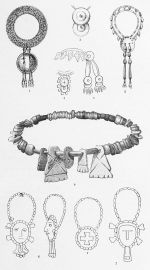
1, 2. Necklaces, from Lafitau. 3. From De Bry. 4, 5. From Mexican Paintings. 6, 7, 8. From ancient sculptures. 9. Bracelet from a Peruvian grave.
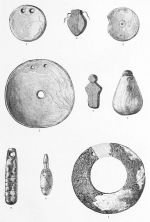
Eastern forms.—The great number of elaborately carved and engraved gorgets of shell found among the antiquities of the Atlantic slope, all of which need careful descriptions, so overshadow the simple forms illustrated in Plate XLVI, that only a brief description of the latter need be given. Rudeness of workmanship and simplicity of form do not in any sense imply greater antiquity or a less advanced state of art. The simpler forms of plain pendants constituted the every-day jewelry of the average people and, like beads, were probably used freely by all who desired to do so. Many forms are found—circular, oval, rectangular, triangular, pear-shaped, and annular. The more ordinary forms are found in mounds and graves in all parts of the country; other forms are more restricted geographically, and probably exhibit features peculiar to the works of a particular clan, tribe, or group of tribes. Even these simple forms may have possessed some totemic or mystic significance; it is not impossible that the plainer disks may have had significant figures painted upon them. Such of the forms as are found to have definite geographic limits become of considerable interest to the archæologist. In method of manufacture they do not differ from the most ordinary implements or beads, the margins being trimmed, the surfaces polished and the perforations made in a precisely similar manner.
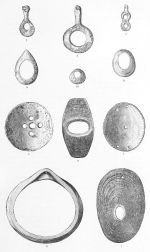
In Plate XLVI I present a number of plain circular disks. The larger specimens are often as much as four or even five inches in diameter and the smaller fraternize with beads, as I have shown in Plate XLV. Figs. 1 and 2 are from a mound at Paint Rock Ferry, Tenn. They are neat, moderately thin, concavo-convex disks, with smooth surfaces [pg 259] and rounded edges. The first has two perforations at the upper edge, while the other has similarly placed but much smaller ones, besides a small central perforation surrounded by an incised circle. The national collection contains similar specimens from most of the Atlantic States; they differ from the larger discoidal beads only in the method of perforation. A typical specimen of this class, four and a half inches in diameter, is shown in Fig. 3. It was associated with the remains of a number of children in a mound in Hardin County, Ohio. Disks of this class were usually suspended upon the breast with the concave side out. That many of the specimens described were suspended in this way is indicated by the character of the abrasion produced by the cords. On the concave side the cord of suspension has worn deep grooves between the perforations, and on the opposite or convex side similar grooves extend obliquely upward from the holes toward the margin of the disk, indicating the passage of the cord upward and outward around the neck of the wearer.
A large white disk, similar to the one just described, was obtained from a grave at Accotink, Va. It is five inches in diameter and has one central and three marginal perforations. It is made from a Busycon perversum, and is neatly shaped and well polished.
A fine specimen two inches in diameter was obtained from a mound on the French Broad River, Tenn., and, with many other similar specimens, is now in the national collection.
The central perforation is often very much enlarged. A number of specimens, recently sent to the National Museum, from a mound in Auglaize County, Ohio, show several stages of this enlargement. One specimen five inches across has a perforation nearly one inch in diameter, while in another the perforation is enlarged until the disk has become a ring. These gorgets show evidences of long use, the surfaces and edges being worn and the perforations much extended in the manner described above. They have been derived from the Busycon perversum.
In Fig. 4 I illustrate an annular gorget from a mound in Alexander County, Ill. It was found associated with ornaments of copper by the side of a human skull, and is hence supposed to have been an ear ornament. It is fragmentary and has suffered greatly from decay, the surface being mostly covered with a dark film of decomposed shell substance, which when broken away, exposes the chalky surface of the shell. These shell rings, so far as I can learn, have been found in the States of Ohio and Illinois only.
Rectangular pendants are much more rare. The national collection contains one rude specimen from Texas. It is about two inches wide by two and a half long, and is made from the base of some large dextral-whorled shell. A similar but much more finished specimen comes from Georgia, and is preserved in the New York Natural History Museum.
[pg 260] A large keystone-shaped gorget with rounded corners was obtained from an ancient burial place at Beverly, Canada. It is illustrated in Plate L, Fig. 1.
The small pendant shown in Fig. 5 is given by Schoolcraft in "Notes on the Iroquois." It represents rudely the human figure, and is ornamented with eight perpendicular and four or five transverse dots. It was found on the site of an old fort near Jamesville, N. Y. In the same work Mr. Schoolcraft illustrates another small pendant, which is reproduced in Fig. 6. The body is heart-shaped, the perforation being made through a rectangular projection at the upper end. It was found at Onondaga, N. Y.
The small pendant presented in Fig. 7 is from West Bloomfield, N. Y. It has been suspended by means of a shallow groove near the upper end. It is made from the basal point of a dextral-whorled shell.
The handsome little pendant shown in Fig. 8 was found with similar specimens in Monroe County, New York—probably on some ancient village site. It is well preserved and has been made from the columella of a dextral-whorled shell. An ornamental design, consisting of lines and dots, is engraved upon the face. A small, deeply countersunk perforation has been made near the upper end. These objects have apparently been strung with beads, as the perforations show evidence of such abrasion as beads would produce. Many of the New York specimens have a new look, and their form suggests the possibility of civilized influence. They are certainly more recent than the western and southern specimens.
A small cylindrical pendant is illustrated in Fig. 9. A large, neat perforation has been made at the upper end, and the middle portion of the body is ornamented by a series of encircling grooves. This specimen has been made from a large Unio and was obtained from a mound in Union County, Ky.
PL. XLVI—PENDANT ORNAMENTS—EASTERN FORMS.
Western forms.—In variety of form the plain pendants of the California coast excel all others. Specimens from the graves are generally well preserved, not having lost their original iridescence, although so much decayed as to suffer considerably from exfoliation.
As indicated by the present well preserved condition of these shell ornaments, they are probably not of very ancient date; indeed it is highly probable that many of them are post-Columbian.
Cabrillo visited the island of Santa Rosa in 1542 and found a numerous and thriving people. In 1816 only a small remnant of the inhabitants remained, and these were removed to the main-land by Catholic priests. Their destruction is attributed to both war and famine. The history of the other islands is doubtless somewhat similar.
Articles made from shell are found to resemble each other very closely, whether from the islands or the main-land. All probably belong to the same time, and although the peoples of the islands are said to have spoken a different language from those of the main-land, their arts were [pg 261] apparently pretty much the same. They do not differ, as far as works in shell are concerned, from the modern tribes of the main-land. There is also a noticeable resemblance between the art of the ancient California Islanders and that of the present inhabitants of the great Pacific archipelagoes.
The record of many of the specimens obtained from these islands seems to be very incomplete, scarcely more being known than the fact that they were obtained from the ancient graves. Since, however, they are almost exclusively ornaments belonging probably to a single period, detailed accounts of their methods of occurrence would not add greatly to their value.
In previous chapters vessels, hooks, and beads made of the Haliotis have been described, and the high estimation in which they are everywhere held briefly noted. The variety of ways in which this shell is utilized is indeed remarkable and the multitude of forms into which it is worked for ornament is a matter of surprise. All are neatly and effectively worked, and evince no little skill and taste on the part of the makers.
The Haliotis is not the only shell used, but it has no rival in point of beauty. Bivalve shells are utilized to a considerable extent, many tasteful things being made from the Fissurella, the Mytilus, the Pachydesma, and the Pecten. The perforations are generally neatly made and are more numerous than in similar eastern specimens; besides those for suspension there are frequently many others for the attachment of secondary pendants and for fastening to the costume. Many specimens are ornamented with edgings of notches and crossed lines but very few have been found on which significant characters have been engraved, and we look in vain for parallels to the curious designs characteristic of the gorgets of the mound-builders.
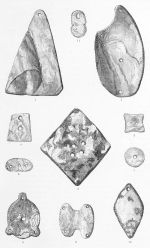
A glance at the numerous examples given in Plates XLVII, XLVIII, and XLIX will give a good idea of the multiplicity of forms into which these ornaments are wrought.
A rather remarkable group of pendants is represented by Fig. 1. They are characterized by a deep scallop at the left, with a long curved hook-like projection above. They take their form from the shape of the lip of the Haliotis, from which they are made—the hook being the upper point of the outer lip where it joins the body, and the scallop the line of the suture. The body of the ornament is formed from the lip of the shell. In size they vary to some extent with the shells from which they are derived. The body is at times quite oval and again slender and hooked like the blade of a sickle. The perforations are generally very numerous, a fact that indicates their use as central pieces for composite pendants. It is apparent that the wearers thought more of the exquisite coloring of these ornaments than of the outline or surface finish. This is only one of many instances that prove the innate and universal appreciation of beauty of color by savage peoples. [pg 262]
In Fig. 2 a fine example of the subtriangular or keystone-shaped pendants is presented. The edges are very neatly cut and the corners slightly rounded. The back is ground smooth, but on the front the original surface of the shell is preserved, the colors being extremely rich and brilliant. A single perforation has been drilled near the upper end. It is made from a Haliotis rufescens, and was obtained from the island of Santa Rosa.
The handsome specimen shown in Fig. 3 was obtained from a grave on the island of San Miguel. It has suffered much from decay. There are four neatly made perforations near the center. It has apparently been cut from the same shell as the preceding.
Fig. 4 is a small keystone-shaped specimen having two perforations.
Fig. 5 represents a small, delicate specimen of rectangular shape, having two minute perforations. This, as well as the preceding, was obtained from a grave on the island of San Miguel.
Fig. 6 illustrates a small oval, wafer-like specimen, the edges of which have been ornamented with a series of crossed lines. It has three neat perforations on the line of the longer axis. It is from the island of Santa Cruz.
Fig. 7 represents a small button-like disk with a central perforation; the margin is ornamented with a series of radiating lines. It was obtained from Santa Barbara.
A pendant of very peculiar form is shown in Fig. 8. The oval body has three marginal projections, all of which are perforated; there is also a perforation near the center. The surface retains a heavy coating of some dark substance, which gives the ornament much the appearance of corroded metal. It was obtained from San Miguel Island.
In a number of cases advantage has been taken of the natural perforations of the shell, both to give variety to the outline of small pendants and to save the labor of making artificial perforations. A very handsome little specimen is shown in Fig. 9. The two indentations above and below represent two of the natural perforations of the shell; artificial perforations are made in each of the four corners or wings. It was also obtained from the island of San Miguel.
Fig. 10 represents a leaf-shaped pendant with notched edges and a single perforation. It comes from the island of Santa Cruz.
PL. XLVII—PLAIN PENDANTS—PACIFIC COAST FORMS.
(1/1)
The examples given are typical of the very large class of ornaments derived from the Haliotidæ. The striking specimens shown in Plate XLVIII are, with one exception, made from shells of this class. The two sickle-shaped pendants illustrated in Figs. 1 and 2 are made from the broadened inner lip of the Haliotis californianus (?). In one a single perforation has been made near the upper end; in the other there are two, one near each end. The faces have been neatly dressed and the corners ornamented with minute notches. They are from graves on Santa Cruz Island. Two exquisite specimens, also from Santa Cruz Island, are presented in Figs. 3 and 4. They have been cut from the body of a [pg 263] Haliotis splendens (?), and finished with much care. Two perforations have been made near the upper margin, which is arched or curved while the lower is nearly straight. The edges are neatly notched. Although somewhat altered by exposure these objects are still very pretty.
A very neat, well preserved little pendant is shown in Fig. 5. The specimen presented in Fig. 6 is peculiar in having a series of five perforations, one near the middle and the others near the ends. The example given in Fig. 7 has two perforations, one at each end. These are all made from species of the Haliotis.
The specimen presented in Fig. 8 is made from the lip of a Cyprea spadicea with very little change except the carefully made perforation. It is from the island of San Miguel. The idea of beautifying ornaments made from the Haliotis and other shells by notching the edges may have been suggested by the natural notches characteristic of the Cypreas.
PL. XLVIII—PENDANT ORNAMENTS OF THE PACIFIC COAST.
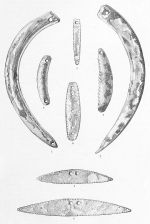
1–7. Pendants made of the Haliotis. (1/1) 8. Pendant made of a Cyprea. (1/1)
Figs. 1, 2, and 3, Plate XLIX, illustrate a group of small, delicate, ladle-shaped pendants. The perforation for suspension is at the upper end of the handle and the body has an oval or circular perforation, which is often so enlarged as to leave only a narrow ring, like the rim of an eyeglass. The specimen shown in Fig. 3 has two lobes, with a large perforation or opening in each. In one instance the handle is quite wide at the upper end and ornamented by two deep lateral notches. The edges of these specimens are nearly always adorned with notches or crossed lines. All are fashioned from the Haliotis, and although considerably stained are still well enough preserved to show the pearly lusters of that shell.
Circular and oval disks are also numerous and vary much in finish; some have a great number of perforations or indentations, and nearly all are neatly notched around the margins. Examples are given in Figs. 4 and 5.
The national collection contains a number of rings and pieces of rings made from the valves of a large clam, probably a Pectunculus, one example of which is shewn in Fig. 6. The convex back of the shell is ground off until a marginal ring only remains. A perforation is made near the angle of the beak. The shell is from the California coast, but the rings were collected mostly if not entirely from Arizona and New Mexico. It is not impossible that the tribes of the interior procured these articles from white traders, as they are known to have secured other shell ornaments in this way.
The natives of the California coast were not slow in taking advantage of natural forms to aid their art or to save labor. The shells of the Fissurellidæ as well as of the Haliotidæ have been in great favor. They have been used as beads and pendants in their natural state or the natural perforations have been enlarged until only a ring has been left, or the margin and sides have been ground down until nothing of the original form or surface remained. Two of these forms are shown in Figs. 7 [pg 264] and 8. They are from graves on San Miguel Island, and are made from the Lucupina crenulata; others come from Santa Cruz Island; and probably also from the adjoining islands as well as from the main-land. Rings are also made from other shells. Examples made from the Acmæa mitra and Cyprea spadicea are shown in Figs. 9, 10, and 11. They come from San Miguel.
PL. XLIX—PLAIN PENDANTS—PACIFIC COAST FORMS.
(1/1)
PERFORATED PLATES.
We find that pendant gorgets grade imperceptibly into another group of objects, the use or significance of which have not be fully determined. These objects are more frequently made of stone or copper, but good examples in shell have been found. As a rule they take the form of thin oblong plates which exhibit great variety of outline. The perforations are peculiar, and have not been designed for ordinary suspension, but are placed near the middle of the specimen as if for fixing it to the person or costume by means of cords. Many theories have been advanced in attempting to determine their use. They have been classed as gorgets, badges of authority, shuttles, armor plates, wrist protectors, and as implements for sizing sinews and twisting cords.
Objects of this class in stone have been frequently illustrated and described. They are made of many varieties of stone, some of which seem to have been selected on account of their beauty. They have been neatly shaped and often well-polished. The edges are occasionally notched and the surfaces ornamented with patterns of incised lines. The perforations vary from one to four, the greater number of specimens, however, having only two. In the early days of mound exploration objects of this class were even greater enigmas, if possible, than they are to-day. Even the material of which a number of them were formed remained for a long time undetermined. Schoolcraft has published an illustration of a large specimen from the Grave Creek Mound, Va. This drawing is reproduced in Fig. 3, Plate L. The original was six inches long, one and three-tenths inches wide, and three-tenths of an inch in thickness. He expresses the opinion that it was one of those ancient badges of authority formerly in such general use among the Indians.[129]
Another specimen, very much like the last in size and shape, but made of shell, supposed at the time of discovery to be ivory, was found associated with human remains in the Grave Creek Mound. It is described by Mr. Tomlinson in the American Pioneer,[130] and the cut given in Plate L, Fig. 4, is copied from that work.
A remarkable specimen of this class is given in Fig. 5. It is made [pg 265] from the body of a large Busycon perversum, and is nine and a half inches long by three inches in width at the widest part. The concave surface has been highly polished, but is now somewhat roughened by weathering; the back has been slightly ground to take off the rougher ridges of growth; the edges are even and rounded and in many places quite thin. The peculiarity of its shape is such as to give it very much the appearance of the sole of a sandal. The perforations are three in number, one being near the middle and the others near the broader end, about one and a half inches apart; they are very neatly made and are slightly bi-conical and a little countersunk. There appears to be no evidence whatever of abrasion by use. It was found associated with human remains in a mound at Sharpsburg, Mercer County, Ohio. A similar specimen from the same locality is nearly nine inches in length, and lacks but a little of three and a half inches in width. As in the specimen illustrated, one perforation is placed near the middle and two others near the broader end. This specimen is highly polished on the broader part of the back, and is evenly smoothed on the concave side. It bears evidence of considerable use, and the two holes are much worn by a string or cord, which, passing from one hole to the other on the concave side of the plate, gradually worked a deep groove between them. On the back or convex side, the perforations show no evidence of wear. The central perforation is not worn on either side. The letter of Mr. Whitney, transmitting this relic to the National Museum, states that there were in the mound "about ten pairs of the shell sandals of different sizes, and made to fit the right and left feet." From the latter remark I should infer that some were made from dextral and others from sinistral shells; the two described are made from the Busycon perversum.
An extremely fine specimen, much like the preceding, was exhumed from an ancient mound in Hardin County, Ohio. It was found on the head of a skeleton which occupied a sitting posture near the center of the mound. It is nine inches in length by three and one-half inches in width, and in shape resembles the sole of a moccasin, being somewhat broader and less pointed than the specimen presented in Fig. 5. It had been placed upon the skull with the wider end toward the back, but whether laid there as a burial offering simply or as constituting a part of the head-dress of the dead savage we have no means of determining. The perforations are three in number, and are placed similarly to those in the specimen illustrated in Fig. 5. Two other skeletons had similar plates associated with them, which differed from the one described in size only, the smaller one being less than six inches in length. Lithographs of two of these specimens are given by Mr. Matson, in whose very excellent report they were first described.[131]
The gorget presented in Fig. 1 of this plate is copied from Schoolcraft.[132] It was taken, along with many other interesting relics, from [pg 266] one of the ossuaries at Beverly, Canada West. It is formed from some large sea shell, and is three inches in width by three and three-fourths inches in length. Its perforations are four in number, and are so placed as to be conveniently used either for suspension by a single cord or for fixing firmly by means of two or more cords. It seems to hold a middle place between pendants proper and the pierced tablets under consideration.[133]
The unique specimen given in Fig. 2 is from Cedar Keys, Florida, but whether from a grave or a shell-heap I am at present unable to state. In its perforations, which are large and doubly conical, it resembles very closely the typical tablet of stone. The outline is peculiar; being rounded at the top, it grows broader toward the base like a celt, and terminates at the outer corners in well-rounded points, the edge between being ornamented with a series of notches or teeth. It has been cut from the wall of a Busycon perversum, and is sharply curved. The surface is roughened by time, but there is no evidence of wear by use either in the perforations or in the notches at the base.
PL. L—PERFORATED PLATES.
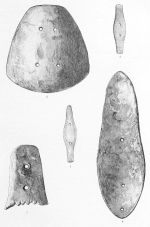
1. Ornament from Beverly, C. W. 2. Ornament from Florida. 3, 4. Objects from the Grave Creek Mound, Va. 5. Perforated plate from Ohio.
In studying these remarkable specimens the fact that they so seldom show marks of use presents itself for explanation. Dr. Charles Rau, whose opinions in such matters are always worthy of consideration, remarks "that at first sight one might be inclined to consider them as objects of ornament, or as badges of distinction; but this view is not corroborated by the appearance of the perforations, which exhibit no trace of that peculiar abrasion produced by constant suspension. The classification of the tablets as 'gorgets,' therefore, appears to be erroneous."[134]
The same argument could, however, be brought with equal force against their use for any of the other purposes suggested. The perforations, if not used for suspension or attachment, would be subject to wear from any other use to which they could be put. But, as we have already seen, one of the specimens in shell exhibits well-defined evidence of wear, and that of such a character as to indicate the passage of a cord between the perforations in a position that would produce abrasion between the holes on the concave side of the plate, but would leave the back entirely unworn. This peculiar result could only be produced by attachment in a fixed position, concave side out, to some object perforated like the plate, the cord passing directly through both. The perforations of pendants necessarily show wear on both sides; a like result would follow from the use of these plates in any of the other ways mentioned. Those made of shell could not, on account of their warped [pg 267] shape, be used for shuttles; besides, they show no evidence of marginal wear, such as would result from this use. The fact, too, that the material had to be brought from the distant sea-shore would seem to render it too rare and precious to be employed in the ordinary arts when wood, stone, and bone would serve the purpose as well. Owing to the carelessness or negligence of collectors we have but little information in regard to their relation to the human remains with which they were deposited. Such facts as we have, however, tend, I believe, to show that they were used for personal decoration. Again, the material of which they are formed is, on account of its beauty, especially adapted for ornament, and for this use it has been almost exclusively reserved by peoples as distant from the sea as were the ancient peoples of the Ohio Valley.
ENGRAVED GORGETS.
It has already been suggested that the simpler forms of pendants with plain surfaces may have had particular significance to their possessors, as insignia, amulets, or symbols, or that they may have received painted designs of such a character as to give significance to them. For ornament the natural or plainly polished surface of the shell possessed sufficient beauty to satisfy the most fastidious taste—a beauty that could hardly be enhanced by the addition of painted or incised figures. But we find that many of the larger gorgets obtained from the mounds and graves of a large district have designs of a most interesting nature engraved upon them, which are so remarkable in conception and execution as to command our admiration. Such is the character of these designs that we are at once impressed with the idea that they are not products of the idle fancy, neither is it possible that they had no higher office than the gratification of barbarian vanity. I have given much time to their examination, and, day by day, have become more strongly impressed with the belief that no single design is without its significance, and that their production was a serious art which dealt with matters closely interwoven with the history, mythology and polity of a people gradually developing a civilization of their own.
Although these objects were worn as personal ornaments they probably had specialized uses as insignia, amulets, or symbols.
As insignia, they were badges of office or distinction. The devices engraved upon them were derived from many sources and were probably sometimes supplemented by numeral records representing enemies killed, prisoners taken, or other deeds accomplished.
As amulets, they were invested with protective or remedial attributes and contained mystic devices derived from dreams, visions, and many other sources.
[pg 268] As symbols they possessed, in most cases, a religious character, and were generally used as totems of clans. They were inscribed with characters derived chiefly from mythologic sources. A few examples contain geometric designs which may have been time-symbols, or they may have indicated the order of ceremonial exercises.
That these objects should be classed under one of these heads and not as simple ornaments engraved with intricate designs for embellishment alone is apparent when we consider the serious character of the work, the great amount of labor and patience shown, the frequent recurrence of the same design, the wide distribution of particular forms, the preservation of the idea in all cases, no matter what shortcomings occur in execution or detail, and the apparent absence of all lines, dots, and figures not essential to the presentation of the conception.
In describing these gorgets I have arranged them in groups distinguished by the designs engraved upon them.[135] They are presented in the following order:
The Cross,
The Scalloped Disk,
The Bird,
The Spider,
The Serpent,
The Human Face,
The Human Figure: and to these I append The Frog, which is found in Arizona only, and although carved in shell does not appear to have been used as a pendant, as no perforations are visible.
Within the United States ancient tablets containing engraved designs are apparently confined to the Atlantic slope, and are not found to any extent beyond the limits of the district occupied by the stone-grave peoples. Early explorers along the Atlantic coast mention the use of engraved gorgets by a number of tribes. Modern examples may be found occasionally among the Indians of the northwest coast as well as upon the islands of the central Pacific.
THE CROSS.
The discoverers and early explorers of the New World were filled with surprise when they beheld their own sacred emblem, the cross, mingling with the pagan devices of the western barbarian. Writers have speculated in vain—the mystery yet remains unsolved. Attempts to connect the use of the cross by prehistoric Americans with its use in the East have signally failed, and we are compelled to look on its occurrence here as one of those strange coincidences so often found in the practices of peoples totally foreign to each other.
If written history does not establish beyond a doubt the fact that the cross had a place in our aboriginal symbolism, we have but to turn [pg 269] to the pages of the great archæologic record, where we find that it occupies a place in ancient American art so intimately interwoven with conceptions peculiar to the continent that it cannot be separated from them. It is found associated with other prehistoric remains throughout nearly the entire length and breadth of America.
I have the pleasure of presenting a few new examples of this emblem, obtained from the district at one time occupied by the mound-builders. The examples are carved in shell or engraved upon disks of shell which have been employed as pendant gorgets. In the study of these particular relics, one important fact in recent history must be kept constantly in mind. The first explorers were accompanied by Christian zealots, who spared no effort to root out the native superstitions and introduce a foreign religion, of which the cross was the all-important symbol. This emblem was generally accepted by the savages as the only tangible feature of a new system of belief that was filled with subtleties too profound for their comprehension. As a result, the cross was at once introduced into the regalia of the natives; at first probably in a European form and material attached to a string of beads in precisely the manner that they had been accustomed to suspend their own trinkets and gorgets; but soon, no doubt, delineated or carved by their own hands upon tablets of stone and copper and shell, in the place of their own peculiar conceptions. From the time of La Salle down to the extinction of the savage in the middle Mississippi province, the cross was kept constantly before him, and its presence may thus be accounted for in such remains as post-date the advent of the whites. Year after year articles of European manufacture are being discovered in the most unexpected places, and we shall find it impossible to assign any single example of these crosses to a prehistoric period, with the assurance that our statements will not some day be challenged. It is certainly unfortunate that the American origin of any work of art resembling European forms must rest forever under a cloud of suspicion. As long as a doubt exists in regard to the origin of a relic, it is useless to employ it in a discussion where important deductions are to be made. At the same time it should not be forgotten that the cross was undoubtedly used as a symbol by the prehistoric nations of the South, and consequently that it was probably also known in the North. A great majority of the relics associated with it in ancient mounds and burial places are undoubtedly aboriginal. In the case of the shell gorgets, the tablets themselves belong to an American type, and are highly characteristic of the art of the Mississippi Valley. A majority of the designs engraved upon them are also characteristic of the same district.
We find at rare intervals designs that are characteristically foreign; these, whether Mexican or European, are objects of special interest and merit the closest possible examination. That the design under consideration, as well as every other engraved upon these tablets, is symbolic or otherwise significant, I do not for a moment doubt; but the [pg 270] probabilities as to the European or American origin of the symbol of the cross found in this region are pretty evenly balanced. In its delineation there is certainly nothing to indicate its origin. By reference to Plate LIII it will be seen that in all the examples given it is a simple and symmetrical cross, which might be duplicated a thousand times in the religious art of any country. A study of the designs associated with the cross in these gorgets is instructive, but does not lead to any definite result. In one case the cross is inscribed upon the back of a great spider; in another it is surrounded by a rectangular framework of lines, looped at the corners, and guarded by four mysterious birds, while in others it is without attendant characters; but the workmanship is purely aboriginal. I have not seen a single example of engraving upon shell that suggested a foreign hand, or a design, with the exception of this one, that could claim a European derivation.
Some very ingenious theories have been elaborated in attempting to account for the presence of the cross among American symbols. Brinton believes that the great importance attached to the points of the compass—the four quarters of the heavens—by savage peoples has given rise to the sign of the cross. With others the cross is a phallic symbol, derived, by some obscure process of evolution, from the veneration accorded to the reciprocal principle in nature. It is also frequently associated with sun-worship, and is recognized as a symbol of the sun—the four arms being remaining rays left after a gradual process of elimination. Whatever is finally determined in reference to the origin of the cross as a religious symbol in America will probably result from the exhaustive study of the history, language, and art of the ancient peoples, combined with a thorough knowledge of the religious conceptions of modern tribes, and when these sources of information are all exhausted it is probable that the writer who asserts more than a probability will overreach his proofs.
Such delineations of the cross as we find embodied in ancient aboriginal art represent only the final stages of its evolution, and it is not to be expected that its origin can be traced through them. In one instance, however, a direct derivation from nature is suggested. The ancient Mexican pictographic manuscripts abound in representations of trees, conventionalized in such a manner as to resemble crosses; these apparently take an important part in the scenes depicted. By a comparison of these curious trees with the remarkable cross in the Palenque tablet, I have been led to the belief that they must have a common significance and origin. The analogies are indeed remarkable. The tree-cross in the paintings is often the central figure of a group in which priests offer sacrifice, or engage in some similar religious rite. The cross holds the same relation in the Palenque group. The branches of these cross-shaped trees terminate in clusters of symbolic fruit, and the arms of the cross are loaded down with symbols which, although highly conventionalized, have not yet entirely lost their vegetable [pg 271] character. The most remarkable feature, however, is not that the crosses resemble each other in these respects, but that they perform like functions in giving support to a symbolic bird which is perched upon the summit. This bird appears to be the important feature of the group, and to it, or the deity which it represents, the homage or sacrifice is offered. These analogies go still farther; the bases of the cross in the tablet and of the crosses in the paintings are made to rest upon a highly conventionalized figure of some mythical creature. A consideration of these facts seems to me to lead to the conclusion that the myths represented in all of these groups are identical, and that the cross and cross-like trees have a common origin. Whether that origin is in the tree on the one hand or in a cross otherwise evolved on the other I shall not attempt to say.
The gorget presented in Fig. 1, Plate LI, belongs to the collection of Mr. F. M. Perrine, and was obtained from a mound in Union County, Ill. It is a little more than three inches in diameter and has been ground down to a uniform thickness of about one-twelfth of an inch. The surfaces are smooth and the margin carefully rounded and polished. Near the upper edge are two perforations for suspension. The cord used passed between the holes on the concave side, wearing a shallow groove. On the convex side, or back, the cord marks extend upward and outward, indicating the usual method of suspension about the neck. The cross which occupies the center of the concave face of the disk, is quite simple. It is partially inclosed on one side by a semicircular line, and at present has no other definition than that given by four triangular perforations which separate the arms. The face of the cross is ornamented with six carelessly drawn incised lines, which interlace in the center, as shown in the cut—three extending along the arm to the right and three passing down the lower arm to the inclosing line. I have not been able to learn anything of the character of the interments with which this specimen was associated.
Fig. 2 of the same plate represents a large shell cross, the encircling rim of which has been broken away. The perforations are still intact. The cross is quite plain. This specimen is very much decayed, and came to the National Museum inside of a skull obtained from a grave at Charleston, Mo. Beyond this there is no record of the specimen.
PL. LI—SHELL GORGETS—THE CROSS.
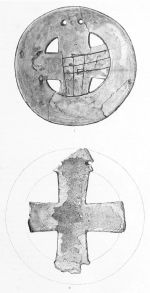
1. From a mound, Union County, Ill. 2. From Charleston, Mo.
(1/1)
In Fig. 1, Plate LII, I present a large fragment of a circular shell ornament, on the convex surface of which a very curious ornamental design has been engraved. The design, inclosed by a circle, represents a cross such as would be formed by two rectangular tablets or slips, slit longitudinally and interlaced at right angles to each other. Between the arms of the cross in the spaces inclosed by the circular border line are four annular nodes, having small conical depressions in the center. These nodes have been relieved by cutting away portions of the shell around them. In the center of the cross is another small node or ring similarly relieved. The lines are neat and deeply incised. [pg 272] The edge of the shell has been broken away nearly all around. The accompanying cut represents the ornament natural size—one and a half inches in diameter and one-sixteenth of an inch in thickness. It was obtained from a mound on Fain's Island, Tennessee.
The small gorget presented in Fig. 2, Plate LII, is of inferior workmanship and the lines and dots seem to have a somewhat haphazard arrangement. The cross, which may or may not be significant, consists of two shallow irregular grooves which cross each other at right angles near the center of the disk and terminate near the border. There are indications of an irregular, somewhat broken, concentric line near the margin. A number of shallow conical pits have been drilled at rather irregular intervals over most of the surface. One pair of perforations seems to have been broken away and others drilled, one of the latter has also been broken out. A triangular fragment is lost from the lower margin of the disk. This specimen was obtained from a mound on Lick Creek, East Tennessee, by Mr. Dunning.
The gorget shown in Fig. 3 contains a typical example of the cross of the mound-builder. The cut was made from a pencil sketch and is probably not quite accurate in detail. The border of the disk is plain, with the exception of the usual perforations at the top. The cross is inclosed in a carelessly drawn circle, and the spaces between the arms, which in other crosses are entirely cut out, or are filled with rays or other figures, are here decorated with a pattern of crossed lines. The lines which define the arms of the cross intersect in the middle of the disk. The square figure thus produced in the center contains a device that is probably significant. A doubly-curved or S-shaped incised line, widened at the ends, extends obliquely across the square from the right upper to the left lower corner. This figure appears to be an elementary or unfinished form of the device found in the center of many of the more elaborate disks. Intersected by a similar line it would form a cross like that upon the back of one of the spiders shown in Plate LXI, or somewhat more evenly curved, it would resemble the involuted figure in the center of the circular disks given in Plate LIV. This specimen was obtained from a mound on Lick Creek, Tenn., and is now in the Peabody Museum.
In Fig. 4 a large copper disk from an Ohio mound is represented. The specimen is eight inches in diameter, is very thin, and has suffered greatly from corrosion. A symmetrical cross, the arms of which are five inches in length, has been cut out of the center. Two concentric lines have been impressed in the plate, one near the margin and the other touching the ends of the cross. It is now in the Natural History Museum at New York.
PL. LII—THE CROSS OF THE MOUND-BUILDERS.
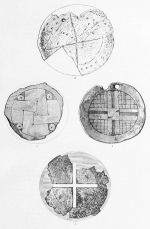
1. Shell gorget, Fain's Island, Tenn. 2. Shell gorget, Lick Creek, Tenn. 3. Shell gorget, Lick Creek, Tenn. 4. Copper plate, Ohio.
In Plate LIII I present a large number of crosses, most of which have been obtained from the mounds, or from ancient graves, within the district occupied by the mound-builders. Eight are engraved upon shell gorgets (illustrations of which are given in the accompanying [pg 273] plates), one is cut in stone, three are painted upon pottery, and four are executed in copper. With two exceptions they are inclosed in circles, and are hence symmetrical Greek crosses, the ends being rounded to conform to the circle; the remaining two (Figs. 14 and 15) represent forms of the Latin cross, and resemble the crosses attached to the rosaries of the Catholic priesthood. A silver cross similar to the last given was obtained from a mound in Ohio.
The plate itself is instructive, and may be presented without further remark.
PL. LIII—THE CROSS.
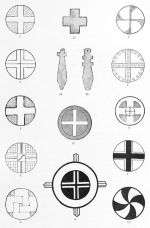
SCALLOPED DISKS.
In making a hasty classification of the many engraved gorgets, I have found it convenient to place in one group a numerous and somewhat extraordinary class of designs which have been engraved upon scalloped disks. Like the cross, the symbol here represented is one that cannot with certainty be referred to an original. The general shape of the disks is such as to suggest to most minds a likeness to the sun, the scallops being suggestive of the rays. As this orb is known to be an object of first importance in the economy of life—the source of light and heat—it is naturally an object of veneration among many primitive peoples. It is well known that the barbarian tribes of Mexico and South America had well-developed systems of sun-worship, and that they employed symbols of many forms, some of which still retained a likeness to the original, while others had assumed the garb of animals or fanciful creatures. These facts being known, it seems natural that such a symbol as the one under consideration should be referred to the great original which it suggests.
The well-known fact that the district from which these gorgets come, was, at the time of discovery by the whites, inhabited by a race of sun-worshipers—the Natchez—gives to this assumption a shadow of confirmation. So far as I am aware, however, no one has ventured a positive opinion in regard to their significance, but such suggestions as have been made incline toward the view indicated above. I feel the great necessity of caution in such matters, and while combating the idea that the designs are ornamental or fanciful only, I am far from attributing to them any deeply mysterious significance. They may in some way or other indicate political or religious station, or they may even be cosmogenic, but the probabilities are much greater that they are time symbols. Before venturing further, however, it will be well to describe one of these disks, a typical example of which is presented in Plate LIV.
The specimen chosen as a type of these rosette-like disks was obtained from a mound near Nashville, Tenn., by Professor Powell. It was found near the head of a skeleton, which was much decayed, and had been so disturbed by recent movements of the soil as to render it difficult to determine its original position. The shell used is apparently a large specimen of the Busycon perversum, although the lines [pg 274] of growth are not sufficiently well preserved to permit a positive determination of the species. The substance of the shell is well preserved; the surface was once highly polished, but is now pitted and discolored by age. The design is engraved on the concave surface as usual, and the lines are accurately drawn and clearly cut. The various concentric circles are drawn with geometric accuracy around a minute shallow pit as a center. These circles divide the surface into five parts—a small circle at the center surrounded by four zones of unequal width. The central circle is three-eighths of an inch in diameter, and is surrounded by a zone one-half an inch in width, which contains a rosette of three involuted lines; these begin on the circumference of the inner circle in three small equidistant perforations, and sweep outward to the second circle, making upwards of half a revolution. These lines are somewhat wider and more deeply engraved than the other lines of the design. In many specimens they are so deeply cut in the middle part of the curve as to penetrate the disk, producing crescent-shaped perforations. The second zone is one-fourth of an inch in width, and in this, as in all other specimens, is quite plain. The third zone is one-half an inch in width, and exhibits some very interesting features. Placed at almost equal intervals we find six circular figures, each of which incloses a circlet and a small central pit; the spaces between the circular figures are thickly dotted with minute conical pits, somewhat irregularly placed; the number of dots in each space varies from thirty-six to forty, which gives a total of about two hundred and thirty.
The outer zone is subdivided into thirteen compartments, in each of which a nearly circular figure or boss has been carved, the outer edges of which form the scalloped outline of the gorget. Two medium sized perforations for suspension have been made near the inner margin of one of the bosses next the dotted zone; these show slight indications of abrasion by the cord of suspension. These perforations, as well as the three near the center, have been bored mainly from the convex side of the disk. Whatever may be the meaning of this design, we cannot fail to recognize the important fact that it is significant—that an idea is expressed. Were the design ornamental, we should expect variation in the parts or details of different specimens resulting from difference of taste in the designers; if simply copied from an original example for sale or trade to the inhabitants we might expect a certain number of exact reproductions; but in such a case, when variations did occur, they would hardly be found to follow uniform or fixed lines; there would also be variation in the relation of the parts of the conception as well as in the number of particular parts; the zones would not follow each other in exactly the same order; particular figures would not be confined to particular zones; the rays of the volute would not always have a sinistral turn, or the form of the tablet be always circular and scalloped. It cannot be supposed that of the whole number of these objects at one time in use, more than a small number have been rescued from decay, [pg 275] and these have been obtained from widely scattered localities and doubtless represent centuries of time, yet no variants appear to indicate a leading up to or a divergence from the one particular type. A design of purely ornamental character, even if executed by the same hand, could not, in the nature of things, exhibit the uniformity in variation here shown. Fancy, unfettered by ideas of a fixed nature, such as those pertaining to religious or sociologic customs, would vary with the locality, the day, the year, or the life. I have examined upwards of thirty of these scalloped disks, the majority of which are made of shell. I shall not attempt to describe each specimen, but shall call attention to such important variations from the type as may be noticed.
PL. LIV—SCALLOPED SHELL DISK.
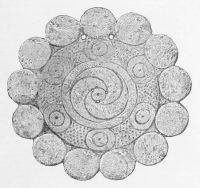
Nashville, Tenn. (1/1)
In Fig. 1, Plate LV, we have a well-preserved disk which has four involute lines, the others having three only; these lines are deeply cut and, for about one-third of their length, penetrate the shell, producing four crescent-shaped perforations. The circles in the third or dotted zone are neatly made and evenly spaced, and inclose circlets and conical pits. The dots in the intervening spaces are closely and irregularly placed, and in number range from forty to forty-five, giving a total of about three hundred and forty. Other features are as usual. The specimen was obtained from a stone grave in Kane's Field, near Nashville, Tenn., and is now in the Peabody Museum.
It is possible that the specimen presented in Fig. 2, Plate LV, should not be placed in this group; but as there are many points of resemblance to the type, it may be described here. At first sight it appears that one of the outer zones is lacking, but it will be seen that through some unknown cause the two have been merged together, alternating bosses of the outer line being carried across both zones. The whole design has been carelessly laid out and rudely engraved. The lines of the involute are arranged in four groups of two each and occupy an unusually wide belt. There are near the margin two sets of perforations for suspension. The specimen was obtained from the Brakebill mound, near Knoxville, Tenn., and is in an advanced stage of decay.
PL. LV—SHELL DISKS.
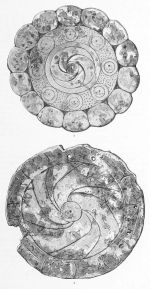
1. From a mound near Nashville. (1/1) 2. From the Brakebill Mound. (1/1)
Tennessee.
In Plate LVI, Fig. 4, I present a small specimen, which has the appearance of being unfinished. The zones are all defined, but, with the exception of the outer, which has thirteen bosses, are quite plain. The lines are deeply but rudely cut. It was obtained from a stone grave at Oldtown, Tenn., and is now in the Peabody Museum.
Besides the type specimen already presented, there may be seen in the National Museum two very good examples, from a mound near Franklin, Tenn. The smaller is about three inches in diameter and is nearly circular; it has suffered much from decay, but nearly all the design can be made out. The lines of the involute penetrate the disk producing short crescent-shaped perforations; the circles in the dotted zone are seven in number and inclose the usual circlets and conical pits; the dots in the intervening spaces are too obscure to be counted. The specimen [pg 276] has sixteen marginal scallops. The larger specimen is somewhat fragmentary, portions being broken away from opposite sides. It is nearly four and a half inches in diameter, and the design has been drawn and engraved with more than ordinary precision. The central circle incloses a perforated circlet, and the involute lines are long and shallow. The dotted zone has seven circles with inclosed circlets and pits. The outer zone contains fifteen oval figures.