VII. THE TURKISH ATROCITIES IN ARMENIA.
Reading edition
THE BEGINNING.
Turkish atrocities in Armenia are no new thing; they have gone on for centuries, and left but a fraction of the population it once had. But let us disregard old history, and come to the subject of to-day. Practically that begins with Hamid II, the present Sultan. He began his persecutions nearly twenty years ago, but on a small scale. He has continually devised new methods of getting rid of the Armenians without responsibility; finally he hit on the plan of arming the Kurds and letting them loose with full power to do their worst. When I was in Constantinople he summoned the Kurdish chiefs, hundreds of them—I have seen them with my own eyes—entertained them in the palace, armed them with modern rifles, and sent them to Armenia on their mission. The pretense under which he did it was worthy of him: he called them the “Hamidieh Cavalry,” and pretended that they were a sort of mounted police, who were to keep order and protect the Armenians. This was exactly as though a regiment of red Indians should be armed and sent to Oregon to protect the inhabitants, and called, say, the Presidential Guard, and the Armenians knew well what they were for. But the European travelers and newspaper correspondents took it all seriously, and talked of his “civilizing the Kurds,” etc. Now these were only the chiefs; each chief had a large following of tribesmen, so that about 30,000 Kurds in all were given arms and ordered to go to work exterminating the Armenians. This work began in 1891, but on a small scale, and in a very crafty way, so that it should not have the appearance of a premeditated massacre; then it was stopped till about sixteen months ago, when they were encouraged to begin again, publicly, and with full swing. It was decided to begin in Sassoun, a district far from the sea, with no roads and a sparse population; if successful in escaping report there, he could carry out the massacre through all Armenia, for which “reforms” were asked and promised. He ordered Zekii Pasha to have his soldiers ready, and meantime to have the “Hamidieh Cavalry” the Kurdish chiefs and tribesmen, ready to attack and kill all the Armenians in Sassoun. This city lies between Moosh and Bitlis, in a mountainous country, and the Sassounites are a brave people, as much so as the Zeitoonlis are. The district had about sixty villages and towns, and about 20,000 people sixteen months ago, but it has none now. The regular soldiers and the armed Kurds surrounded the district from all sides, and in about a month had slaughtered the entire population. It was reported that Zekii Pasha carried on his breast an order from the Sultan as follows: “Whoever spares man, woman, or child is disloyal.” After he had finished his task, he received great rewards from the Sultan, and is now one of his most esteemed commanders.
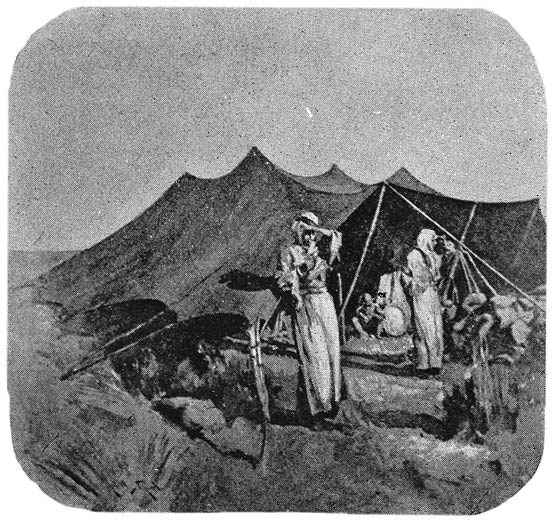
KURDISH HOME.
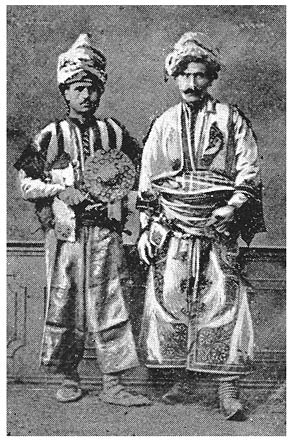
KURD CHIEFS.
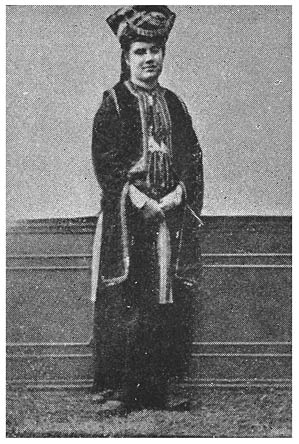
KURD WOMAN.
Zekii Pasha is said to have had 40,000 Kurds and regular soldiers under his command when he began the massacre. The people of Sassoun, knowing that they were doomed, fought desperately. They repulsed the Kurds several times, and killed many of them; but finally the regular soldiers took part, pretending to come in aid of the Armenians, and overbore them, killing all without quarter. The Sultan’s order was to spare neither man, woman, nor child; but as the men met the enemy first, they were killed first. When the women’s turn came, the Turks and Kurds abused all they could get hold of, and then told them that if they would deny Christ and accept Mohammed and become their wives, they should live; but if they refused, every one of them, according to the Sultan’s order, should be killed. “Now,” said they, “choose between Islam and death.” These noble Armenian Christian women said:—“We are Christians, we can never deny Christ. Jesus Christ is our Saviour. He came down from Heaven and died on the cross for us. For that dying and loving Christ we are Christians; we are ready to die for Him who died for us.” And they added further, “We are no better than our husbands were; you killed them, kill us too.” Then the horrible butchery began on those defenseless women. Thousands of them were slaughtered, and thousands ran to different churches, hoping that perhaps they might find protection in some way in those holy walls, or hoping that God in his great mercy might shelter them. But the ferocious Kurds and Turkish soldiers pursued them, sword in hand, violated them, even in the churches, and cut their throats there until the floors were streaming with blood. Then they poured kerosene on the buildings and burned them.
They went to one village and killed every man; the women of course, knowing their fate was soon to be worse than their husbands’. One of the leading women, named Shaheg, perceiving that the Turks and Kurds were getting ready to seize and ravish them, called the other women and said, “Sisters, our husbands are killed, and you know what is in store for us and our children. Don’t let us fall into the hands of these savage beasts; we have to die anyway, and can die easier, and without being defiled first, and perhaps tortured. Let us go to the precipice and jump off.” So saying, she took her baby on her arm, ran to the rock, and threw herself over; the others followed her, and thus all were killed. The Turks captured many boys and girls, six, or eight, or ten years of age, held them by an arm or foot, and hacked them to pieces with their swords. Sometimes they stood the boys in a row and shot them, to see how many could be killed by a single bullet. They wrenched babies from their mothers’ arms, cut their throats while the mothers shrieked and pleaded, and boiling them in kettles, forced the mothers to eat the flesh. They cut open women about to become mothers, tore out the unborn babes, and marched triumphantly with the ghastly trophies on their spears—something almost surpassing the savagery of the Apache Indian. Even their worst horrors they made worse yet by the way they did them; they took a gloating delight in doubling the cruelty or the shame by making it torture others too. The husband was forced to look on while his wife was violated, and she in turn while he was mutilated, tortured, and murdered; the father while his daughters, even little girls of ten or twelve, were deflowered and their throats cut, the son while his parents had every form of shame and torture inflicted on them, and were killed before him, or saw him killed first. They tortured their victims like Indians or Inquisitors, in every fashion of lingering death and torment that makes the heart sicken and the blood run cold to read of. Crucifying head downward, and pouring boiling water or ice-cold water on them, leaving them so till death came; flaying alive; cutting off arms, feet, nose, ears, and other members, and leaving them to die; thrusting red-hot wires into and through their bodies. They pulled out the eyes of several Christian pastors, said, “Now dance for us,” poured kerosene on them and burned them to death. They put a Bible and a cross before others, and ordered them to first spit and then trample on both, and deny Christ; on their refusal they were butchered. The handsomest girls and young matrons were not murdered, but worse; each one was kept as a spoil of some Turk or Kurd, who carried her to his house, and made a slave and concubine of her. Many hundreds of them are there to this day, enduring the awful fate of having been dragged from happy and virtuous homes, seen their husbands, or parents, or brothers, or all of them horribly murdered, and passing their lives each in doing menial labor and serving the lust of a brutal master, and all the other men he lets have their will of her, without hope, or comfort, or decency, and a long life of shame and misery yet to look forward to. This is another specimen of Mohammedan purity, and it all happens because the Armenians are Christians. If my readers think I am exaggerating, I refer them to the consular reports. All this was done by the barbarians con amore, with relish and delight. They boasted of it, they plumed themselves on it, they praised the Sultan for ordering them to do it, and he praised them for doing it, and decorated all the officers.
The condition of those who were murdered out-right was much better than that of those who were imprisoned and tortured. The following was written by an Armenian from one of the prisons:—
“Our condition in prison passes description. Only he who sees can understand it. Most of the occupants of every room are Christians, but many are Moslems. Life would be a shade more tolerable if the subject race were not compelled thus to associate with the dominant race, whose temper, tastes, and habits are so different. Into one small room twenty persons are crowded. Except for a few Moslems, not a single person has room enough on the bare floor to stretch out and lie down. For fully sixteen hours in the night, the doors of the rooms are all locked. In one of these small rooms, sometimes twenty cigarettes are smoking at once. Out of the small amount of food which reaches us, instead of eating themselves, the Christians are obliged to feed the Moslems confined there. Moslem oppression continues, even here; it is a tyranny within a tyranny. In every room there are a few Aghas or principal Moslems, and every Christian must contribute money to their lordships. Those who withhold such contributions are not allowed to sit down.
“Among the inmates of the prison are twenty or thirty rowdies and bullies, under whom the Christians must serve as menial slaves. There is no respect, no pity. The horrible blasphemies cannot be described. There is no book, no Bible, no work, no sleep. Every man is covered with the swarming vermin with which the unwashed rooms of the prison teem. To clean ourselves is impossible. Now and then the rumor sweeps through the prison that we are all to be put to death, and all our hearts melt like water.
“The terrible darkness of the night, the curses and stripes inflicted from time to time, cause us to live in the valley of the shadow of death. It is a living grave, a visible hell, a world without God. Out of this throng of prisoners more than a hundred are in daily suffering from the gnawing of hunger, and from nakedness, but there is no one to pity. Many praying men are tempted to cease praying, many are tempted to change over to the Moslem faith. In truth, all of us are dumb; what to say we know not. We are wearied of the long silence; our eyes are strained with watching, our bones ache, our prayers are despised by the revilers. Night is not night, and day is not day. Our grief is our food, our sleep is weeping, for how long a time must we cry? O Lord, wilt Thou hide Thyself forever? How long will Thy anger burn like fire? And yet some of us are saying: ‘Though He slay me, yet will I trust in Him.’
“When will the Christian statesmen and philanthropists of the world find a way to cleanse these Augean stables all over Turkey? Long centuries cry out for redress. Within a month the following incidents have occurred: A Christian confined in this prison was ordered to receive 400 stripes. After 300 had been inflicted he cried out that he could endure no more or he must die. An officer then presented to him a paper with the names of fifty Christians in the city who were accused therein of sedition. In his great agony he signed it, and this is to be used to incriminate others, wholly regardless of their guilt or innocence. The other victim of unendurable stripes was an old man. When he could endure no more of this inhuman treatment, he also was asked to sign a paper implicating others indiscriminately.
“Can any one living in a free country for a moment understand what it is to live under such a government? There is a great flourish just at present over the reforms that are being instituted in certain parts of this land. No resident of this country can have confidence in the superficial operations. What will you do with a land where lying is the simplest of mental exercises, and where no one was ever known to blush over it if exposed?”
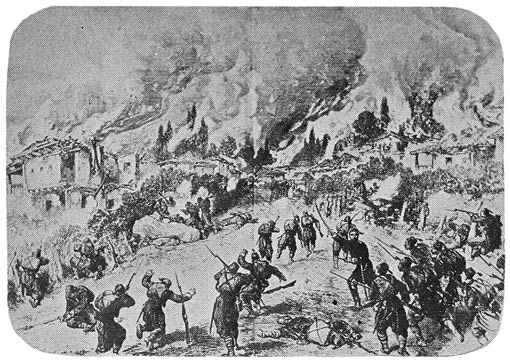
MASSACRE AT SASSOUN.
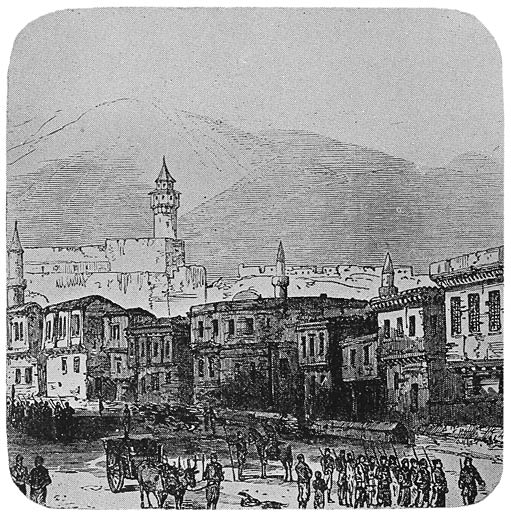
ERZEROUM DURING MASSACRE.
I give here the testimony of a gentleman from Sassoun who escaped the atrocities. He is an Armenian from Sassoun, and my personal friend. I quote this from a little pamphlet, entitled “Facts About Armenia.”
The Massacre of 1894.
“The Armenians of Sassoun were fully aware of the hostile intention of the government, but they could not imagine it to be one of utter extermination.
“The Porte had prepared its plans, Sassoun was doomed. The Kurds were to come in much greater number, the government was to furnish them provision and ammunition, and the regular army was to second them in case of need.
“The various tribes received invitations to take part in the great expedition, and the chiefs, with their men, arrived one after the other. The total number of the Kurds who took part in the campaign may be estimated at 30,000. The Armenians believed in the beginning that they had to do only with the Kurds. They found out later that an Ottoman regular army, with provisions, rifles, cannons, and kerosene oil, was standing at the back of the Kurds.
“The plan was to destroy first Shenig, Semal, Guelliegoozan, Aliantz, etc., and then to proceed toward Dalvorig. The Kurds, notwithstanding their immense number, proved to be unequal to the task. The Armenians held their own, and the Kurds got worsted. After a two weeks’ fight between Kurd and Armenian, the regular army entered into an active campaign. Mountain pieces began to thunder. The Armenians, having nearly exhausted their ammunition, took to flight. Kurd and Turk pursued them, and massacred men, women, and children. The houses were searched and then set on fire. From certain villages groups of men, tax receipts in their hands, went to the camp and asked to be protected, but were slaughtered.
“A great number of villages outside of the Dalvorig district, which had in no wise been concerned in the conflicts of the previous years, were also attacked, to the unspeakable horror of the populations. The troops climbed up even the Mount Antok, where a multitude of fugitives had taken refuge, and massacred them. A number of women and girls were taken to the church of Guelliegoozan, and after being frightfully abused, were tortured to death.
“When the work of destruction was nearly accomplished in the other districts, some of the Kurdish armies were set on Dalvorig. The people defended themselves against the overwhelming number of the barbarians, but after four or five days they saw other tribes and regular Turkish troops marching on them from every side, and they took to flight, but were overtaken and massacred. The scene was most horrible. The enemy took a special delight in butchering the Dalvorig people. An immense crowd of Turkish and Kurdish soldiery fell upon the villages, busily searching the houses and rooting out hidden treasures, and then setting fire to the village. While the troops were so occupied, a number of the fugitives fled wildly to get out of the district, and tried to hide themselves in caves, between rocks, or among bushes. Three days after the complete destruction of Dalvorig villages, the Kurds and the regular soldiers divided among themselves the result of the plunder, and the Kurds returned to their own mountains.”
As my use of English is defective, I take the liberty here of quoting from a long letter by E. J. Dillon to the Contemporary Review, January, 1896.
Dr. Dillon is an Englishman who was the special correspondent of the London “Daily Telegraph,” a most accurate and conscientious reporter, who writes as an eye-witness:
“If a detailed description were possible of the horrors which our exclusive attention to our own mistaken interests let loose upon Turkish Armenians, there is not a man within the kingdom of Great Britain whose heart-strings would not be touched and thrilled by the gruesome stories of which it would be composed.
“During all those seventeen years, written law, traditional custom, the fundamental maxims of human and divine justice were suspended in favor of a Mohammedan saturnalia. The Christians, by whose toil and thrift the empire was held together, were despoiled, beggared, chained, beaten, and banished or butchered. First their movable wealth was seized, then their landed property was confiscated, next the absolute necessaries of life were wrested from them, and finally honor, liberty, and life were taken with as little ado as if these Christian men and women were wasps or mosquitoes. Thousands of Armenians were thrown into prison by governors like Tahsin Pasha and Bahri Pasha, and tortured and terrorized till they delivered up the savings of a lifetime, and the support of the helpless families, to ruffianly parasites. Whole villages were attacked in broad daylight by the Imperial Kurdish cavalry without pretext or warning, the male inhabitants turned adrift or killed, and their wives and daughters transformed into instruments to glut the foul lusts of these bestial murderers. In a few years the provinces were decimated, Aloghkerd, for instance, being almost entirely ‘purged’ of Armenians. Over 20,000 woe-stricken wretches, once healthy and well-to-do, fled to Russia or Persia in rags and misery, deformed, diseased, or dying; on the way they were seized over and over again by the soldiers of the Sultan, who deprived them of the little money they possessed, nay, of the clothes they were wearing, outraged the married women in the presence of their sons and daughters, deflowered the tender girls before the eyes of their mothers and brothers, and then drove them over the frontier to starve and die. Those who remained for a time behind were no better off. Kurdish brigands lifted the last cows and goats of the peasants, carried away their carpets and their valuables, raped their daughters and dishonored their wives. Turkish tax-gatherers followed these, gleaning what the brigands had left, and, lest anything should escape their avarice, bound the men, flogged them till their bodies were a bloody, mangled mass, cicatrized the wounds with red-hot ramrods, plucked out their beards hair by hair, tore the flesh from their limbs with pincers, and often, even then, dissatisfied with the financial results of their exertions, hung the men whom they had thus beggared and maltreated from the rafters of the room, and kept them there to witness with burning shame, impotent rage, and incipient madness, the dishonoring of their wives and the deflowering of their daughters, some of whom died miserably during the hellish outrage.
“In accordance with the plan of extermination, which has been carried out with such signal success during these long years of Turkish vigor and English sluggishness, all those Armenians who possessed money, or money’s worth were for a time allowed to purchase immunity from prison, and from all that prison life in Asia Minor implies. But as soon as terror and summary confiscation took the place of slow and elaborate extortion, the gloomy dungeons of Erzeroum, Erzinghan, Marsovan, Hassankaleh, and Van were filled, till there was no place to sit down, and scarcely sufficient standing room. And this means more than English people can realize, or any person believe who has not actually witnessed it. It would have been a torture for Turkish troopers and Kurdish brigands, but it was worse than death to the educated school-masters, missionaries, priests, and physicians who were immured in these noisome hotbeds of infection, and forced to sleep night after night standing on their feet, leaning against the foul, reeking corner of the wall which all the prisoners were compelled to use as.… The very worst class of Tartar and Kurdish criminals were turned in here to make these hell-chambers more unbearable to the Christians. And the experiment was everywhere successful. Human hatred and diabolical spite, combined with the most disgusting sights, and sounds, and stenches, with their gnawing hunger and their putrid food, their parching thirst and the slimy water, fit only for sewers, rendered their agony maddening. Yet these were not criminals nor alleged criminals, but upright Christian men, who were never even accused of an infraction of the law. No man who has not seen these prisons with his own eyes, and heard these prisoners with his own ears, can be expected to conceive, much less realize, the sufferings inflicted and endured. The loathsome diseases, whose terrible ravages were freely displayed; the still more loathsome vices, which were continually and openly practiced; the horrible blasphemies, revolting obscenities, and ribald jests which alternated with cries of pain, songs of vice, and prayers to the unseen God, made these prisons, in some respects, nearly as bad as the Black Hole of Calcutta, and in others infinitely worse. In one corner of this foul fever-nest a man might be heard moaning and groaning with the pain of a shattered arm or leg; in another, a youth is convulsed with the death spasms of cholera or poison; in the center, a knot of Turks, whose dull eyes are fired with bestial lust, surround a Christian boy, who pleads for mercy with heart-harrowing voice while the human fiends actually outrage him to death.
“Into these prisons venerable old ministers of religion were dragged from their churches, teachers from their schools, missionaries from their meeting-houses, merchants, physicians, and peasants from their firesides. Those among them who refused to denounce their friends, or consent to some atrocious crime, were subjected to horrible agonies. Many a one, for instance, was put into a sentry-box bristling with sharp spikes, and forced to stand there motionless, without food or drink, for twenty-four and even thirty-six hours, was revived with stripes whenever he fell fainting to the prickly floor, and was carried out unconscious at the end. It was thus that hundreds of Armenian Christians, whose names and histories are on record, suffered for refusing to sign addresses to the Sultan accusing their neighbors and relatives of high treason. It was thus that Azo was treated by his judges, the Turkish officials, Talib Effendi, Captain Reshid, and Captain Hadji Fehim Agha, for declining to swear away the lives of the best men of his village. A whole night was spent in torturing him. He was first bastinadoed in a room close to which his female relatives and friends were shut up so that they could hear his cries. Then he was stripped naked, two poles extending from his armpits to his feet were placed on each side of his body and tied tightly. His arms were next stretched out horizontally and poles arranged to support his hands. This living cross was then bound to a pillar, and the flogging began. The whips left livid traces behind. The wretched man was unable to make the slightest movement to ease his pain. His features alone, hideously distorted, revealed the anguish he endured. The louder he cried, the more heavily fell the whip. Over and over again he entreated his tormentors to put him out of pain, saying, ‘If you want my death, kill me with a bullet, but for God’s sake don’t torture me like this!’ His head alone being free, he at last, maddened by excruciating pain, endeavored to dash out his brains against the pillar, hoping in this way to end his agony. But this consummation was hindered by the police. They questioned him again; but in spite of his condition, Azo replied as before: ‘I cannot defile my soul with the blood of innocent people. I am a Christian.’ Enraged at this obstinacy, Talib Effendi, the Turkish official, ordered the application of other and more effective tortures. Pincers were fetched to pull out his teeth, but, Azo remaining firm, this method was not long persisted in. Then Talib commanded his servants to pluck out the prisoner’s moustachios by the roots, one hair at a time. This order the gendarmes executed, with roars of infernal laughter. But this treatment proving equally ineffectual, Talib instructed the men to cauterize the unfortunate victim’s body. A spit was heated in the fire. Azo’s arms were freed from their supports, and two brawny policemen approached, one on each side and seized him. Meanwhile another gendarme held to the middle of the wretched man’s hands the glowing spit. While his flesh was thus burning, the victim shouted out in agony, ‘For the love of God kill me at once!’
“Nights were passed in such hellish orgies and days in inventing new tortures or refining upon the old; with an ingenuity which reveals unimagined strata of malignity in the human heart. The results throw the most sickening horrors of the Middle Ages into the shade. Some of them cannot be described, nor even hinted at. The shock to people’s sensibilities would be too terrible. And yet they were not merely described to, but endured by men of education and refinement, whose sensibilities were as delicate as ours.
“And when the prisons in which these and analogous doings were carried on had no more room for new-comers, some of the least obnoxious of its actual inmates were released for a bribe, or, in case of poverty, were expeditiously poisoned off.
“In the homes of these wretched people the fiendish fanatics were equally active and equally successful. Family life was poisoned at its very source. Rape and dishonor, with nameless accompaniments, menaced almost every girl and woman in the land. They could not stir out of their houses in broad daylight to visit the bazaars, or to work in the fields, nor even lie down at night in their own homes, without fearing the fall of that Damocles’ sword ever suspended over their heads. Tender youth, childhood itself, was no guarantee. Children were often married at the age of eleven, even ten, in the vain hope of lessening this danger. But the protection of a husband proved unavailing; it merely meant one murder more, and one ‘Christian dog’ less. A bride would be married in church yesterday, and her body would be devoured by the beasts and birds of prey to-morrow,—a band of ruffians, often officials, having within the intervening forty-eight hours seized her and outraged her to death. Others would be abducted, and, having for weeks been subjected to the loathsome lusts of lawless Kurds, would end by abjuring their God and embracing Islam; not from any vulgar motive of gain, but to escape the burning shame of returning home as pariahs and lepers, to be shunned by those near and dear to them forever. Little girls of five and six were frequently forced to be present during these horrible scenes of lust, and they, too, were often sacrificed before the eyes of their mothers, who would have gladly, madly accepted death, ay, and damnation, to save their tender offspring from the corroding poison.
“One of the abducted young women who, having been outraged by the son of the Deputy-Governor of Khnouss, Hussein Bey, returned, a pariah, and is now alone in the world, lately appealed to her English sisters for such aid as a heathen would give to a brute, and she besought it in the name of our common God. Lucine Mussegh—this is the name of that outraged young woman whose Protestant education gave her, as she thought, a special claim to act as the spokeswoman of Armenian mothers and daughters—Lucine Mussegh besought, last March, the women of England to obtain for the women of Armenia the ‘privilege’ of living a pure and chaste life! This was the boon which she craved—but did not, could not obtain. The interests of ‘higher politics,’ the civilizing missions of the Christian powers, are, it seems, incompatible with it! ‘For the love of the God whom we worship in common,’ wrote this outraged, but still hopeful, Armenian lady, ‘help us, Christian sisters! Help us before it is too late, and take the thanks of the mothers, the wives, the sisters, and the daughters of my people, and with them the gratitude of one for whom, in spite of her youth, death would come as a happy release.’
“Neither the Christian sisters nor the Christian brethren in England have seen their way to comply with this strange request. But it may perhaps interest Lucine Mussegh to learn that the six great powers of Europe are quite unanimous, and are manfully resolved, come what will, to shield His Majesty the Sultan from harm, to support his rule, and to guarantee his kingdom from disintegration. These are objects worthy of the attention of the great powers; as for the privilege of leading pure and chaste lives—they cannot be importuned about such private matters.
“In due time they began. Over 60,000 Armenians have been butchered, and the massacres are not quite ended yet. In Trebizond, Erzeroum, Erzinghan, Hassankalek, and numberless other places the Christians were crushed like grapes during the vintage. The frantic mob, seething and surging in the streets of the cities, swept down upon the defenseless Armenians, plundered their shops, gutted their houses, then joked and jested with the terrified victims, as cats play with mice. As rapid, whirling motion produces apparent rest, so the wild frenzy of those fierce fanatical crowds resulted in a condition of seeming calmness, composure, and gentleness which, taken in connection with the unutterable brutality of their acts, was of a nature to freeze men’s blood with horror. In many cases they almost caressed their victims, and actually encouraged them to hope, while preparing the instruments of slaughter.”
After the horrible scenes at Sassoun, and other places, the Armenian protests shamed the European powers, who signed the treaty of Berlin, to send a commission and investigate the atrocities. It found the stories quite true, laid the facts before the Sultan—and that was the end of it. The Armenians asked, “Since you admit the truth of these things, why do you not punish the criminals, stop the outrages, and compel the payment of indemnity to those who were outraged and who lost their dear ones and their property?” The powers were deaf to all this. Then the Armenians prepared an appeal (several months ago) and carried it to the Sublime Porte, asking it to do them justice. As soon as the Sultan heard of this, he ordered his soldiers to fire on them if they presented it. The appeal was presented, and before the eyes of the European Ambassadors in Constantinople, the brave soldiers of the kind-hearted Sultan butchered about 3,000 Armenian Christians, several thousand were imprisoned, and several hundred were murdered in the Central Prison. Then the cold, wise, and considerate European powers began to move very slowly, not for the sake of the Armenians, but for their own, their citizens in Constantinople and elsewhere.
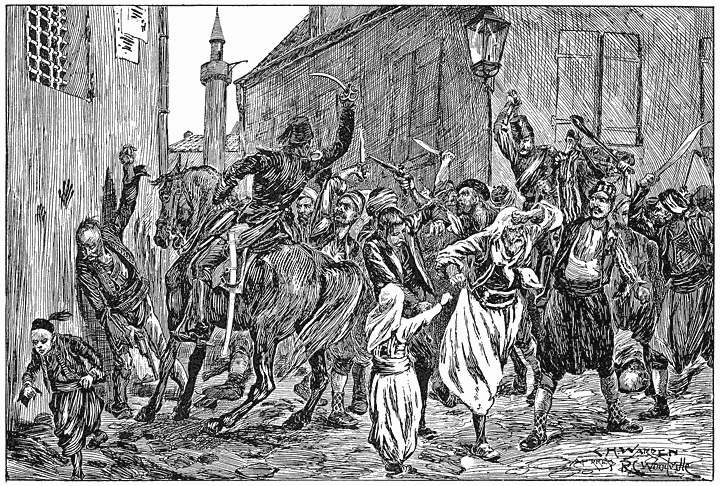
MASSACRE OF ARMENIANS IN STAMBOUL.
They ordered the Sultan to reform Armenia, brought their fleets to the Dardanelles near Constantinople to overawe him, prepared a scheme of reform for Armenia, and made huge threats to the Sultan if he did not accept it. But he knew that this pretended concert of the powers for Armenian reform was a mere trick and sham, as I have persistently asserted all along in the face of my hopeful European and American friends; in fact, the Russian government at this very time was secretly urging him to stand firm and refuse to accept the reforms. He did so, broached a scheme of his own as a substitute, and the powers accepted it as such; and then the whole thing was dropped, the Sultan did nothing whatever about it, as he had never intended to. The European countries were hoodwinked, and the Armenian massacres and conflagrations, plundering and deflowering, went on at a greater pace than ever. Then the powers dropped the Armenian question, and took up that of gunboats in the Bosphorus, to protect their citizens against a rising in Constantinople; that they forced the Sultan to permit, because their own interests were concerned in it,—which shows that they could have forced him to stop exterminating the Armenians if they had cared. All joined in this except Germany; the German Emperor is the Sultan’s friend, and backs him up. So now Germany, Russia, and the Sultan are hand in hand, leagued to prevent any of the miserable victims of his tyranny from escaping his clutches, and the Sultan has the best possible encouragement to go on killing the Armenians. The German Emperor says, “Better that Armenians be killed than have a war in Europe and lose the lives of some of my soldiers.” The Czar says, “Time must be given to the Sultan to reform his country.” Lord Salisbury says, “The Sultan has promised, and we must wait and see what he will do.” And the Sultan, cursing every Emperor and lord of them all as a set of Christian hogs, orders the soldiers and the Kurds to go on with the good work in Armenia. And when we come to America, the Monroe doctrine obliges it to quarrel over Venezuela, and not only refuse help itself, but give Lord Salisbury a good excuse to give none either.
Such is the situation; the massacres are going on in Armenia and the Armenians in despair are crying, “O Lord, how long, how long!”
Mass meetings are good as far as they go; raising money and sending it to relieve the Armenians is good as far as it goes; the Red Cross Society is good as far as it goes; there are no objections to any of them; they are all noble and Christian. But, reader, don’t you think all these good movements with good motives will hurt the Armenian cause, as there is nothing to aid that cause directly? All these mass-meetings merely irritate the Sultan into carrying on the murders more strenuously, since there is no force back of them. Don’t you think the Armenian question being discussed in the United States Congress, and resolutions made without any action, will hurt the Armenians more than anything else? If you can’t tread down the Sultan, don’t stir him up. Miss Clara Barton, that noble woman, is in Armenia to help the Armenians. The Red Cross Society is there and is feeding the Armenians. I thank her, every Armenian thanks her. But do you think that that will relieve the situation? Spring has come, and what now? Will the Armenians have any crops? Did they, or could they sow any seed? Is there any farmer left alive? Has any farmer, if he is alive, any oxen or horses? If he has, will he dare go to his field, sow, reap, and thresh? Reader, consider all these things, and reconsider them, and I am sure you will come to the same conclusion I did many years ago, that Turkey does not need a Red Cross Society, but a Red Cross crusade, not like the medieval crusades, but a Protestant American crusade in the nineteenth century. Let me illustrate this Armenian question by the following parable:—
Suppose a lamb is torn by a wolf, and the wolf lies in wait to finish it. You go to the lamb with a bundle of grass in your hand, pat it and say, “Here, poor lamb, I pity you, I give you grass; take it and eat it.” Then you leave the lamb and go away. Do you think you have helped the lamb? As soon as you have gone, the wolf will come and tear the lamb to pieces. If you are going to help the lamb, you must kill the wolf, else no matter how much grass you give the wounded lamb, it will do it no good. You will do no good by sending Red Cross societies to Armenia to feed the Armenians if you have not the power or the will to keep the wild beasts off. You will feed them, and then the wolves will kill them.
HARPOOT AND ITS VICINITY.
This is one of the most important Armenian districts, because the Armenians outnumber the Mohammedans there; in the city the Turks are the more numerous, but there are many Armenian towns and villages which make up. The district has about 150,000 people, most of them Armenians, and about 40,000 were killed in the recent massacre. Harpoot is built on three hills, and has a commanding view. Here is located a great American missionary institution, the Euphrates College; it has three departments, the college, the Theological Seminary, and the Girls’ Seminary. There were twelve buildings, eight of which were burned in the outrages, a loss of $100,000.
Almost all the outlying villages were burned, and the movables carried off. Women were made prey, boys and girls were kidnapped; the horrors can never be described. I give here a few words from a private letter, written by a Mohammedan Turk to his brother in this country. I have the letter in my possession, written in the Turkish language. He says:—
“My dear brother:
“All the Christian villages which belong to Harpoot district, we plundered and destroyed, and killed the inhabitants. We killed them both with our swords and with our rifles. The bullets of our rifles poured upon them like rain; none of them are left, neither any dwelling was left, we burnt all their houses. We thank God that not a single Mohammedan was killed. Everywhere throughout Armenia the Christians were punished in the same manner.”
Another testimony from another Mohammedan, an officer; he says nearly 40,000 were killed in Harpoot province, February 26, 1896:—
“A petition in behalf of the Armenians was given to the powers in the hope of improving their condition. An imperial firman was issued for carrying out the reforms suggested by the powers. On this account the Turkish population was much excited, and thought that an Armenian principality was to be established, and they began to show great hostility to the poor Armenians, who had been obedient to them and with whom they had lived in peace for more than 600 years. To the anger of the people were added the permission and help of the government; and so, before the reforms were undertaken, the whole Turkish population was aroused, with the evil intent of obliterating the Armenian name; and so the Turks of the province, joining with the neighboring Kurdish tribes by the thousand, armed with weapons which are allowed only to the army, and with the help and under the guidance of Turkish officials, in an open manner, in the daytime, attacked the Armenian houses, shops, stores, monasteries, churches, schools, and committed the fearful atrocities set forth in the accompanying table. They killed bishops, priests, teachers, and common people with every kind of torture, and they showed special spite toward ecclesiastics by treating their bodies with extra indignity, and in many cases they did not allow their bodies to be buried. Some they burned, and some they gave as food to dogs and wild beasts.
“They plundered churches and monasteries, and they took all the property of the common people, their flocks and herds, their ornaments and their money, their house furnishings and their food, and even the clothing of the men and women in their flight. Then after plundering them, they burned many houses, churches, monasteries, schools, and markets, sometimes using petroleum, which they had brought with them to hasten the burning; large stone churches which would not burn they ruined in other ways.
“Priests, laymen, women, and even small children were made Moslems by force. They put white turbans on the men and circumcised them in a cruel manner. They cut the hair of the women in bangs, like that of Moslem women, and made them go through the Mohammedan prayers. Married women and girls were defiled, against the sacred law, and some were married by force, and are still detained in Turkish houses. Especially in Palu, Severek, Malatia, Arabkir, and Choonkoosh, many women and girls were taken to the soldiers’ barracks and dishonored. Many, to escape, threw themselves into the Euphrates, or committed suicide in other ways.
“It is clear that the majority of those killed in Harpoot, Severek, Husenik, Malatia, and Arabkir were killed by the soldiers, and also that the schools and churches of the missionaries and Gregorians in the upper quarter of Harpoot City, together with the houses, were set on fire by cannon balls.
“It is impossible to state the amount of the pecuniary loss. The single city of Egin has given 1,200 (some say 1,500) Turkish pounds as a ransom.
“These events have occurred for the reasons I have mentioned. I wish to show by this statement, which I have written from love to humanity, that the Armenians gave no occasion for these attacks.”
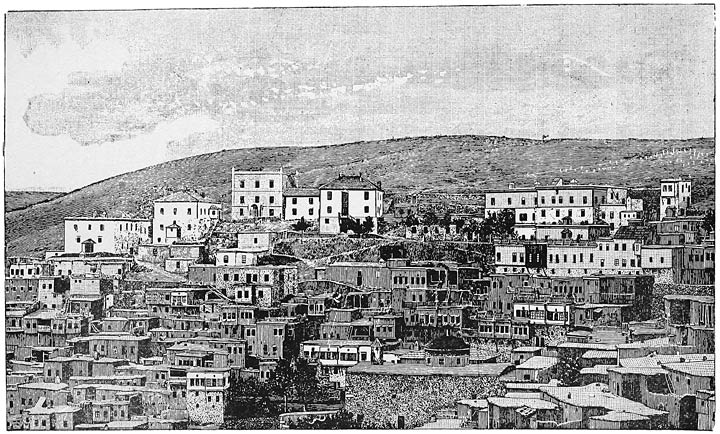
A PORTION OF HARPOOT.
15,000 Armenians killed in this city and vicinity.
The Turk, whose document is thus translated, figures that the total deaths in the province of Harpoot during the scenes, have been 39,334; the wounded 8,000; houses burned, 28,562; and that the number of the destitutes is 94,870.
“In a letter just received (Jan. 18, 1896) from the Rev. H. N. Barnum, D.D., of Harpoot, Eastern Turkey, where the property of the American Board was burned, he says that reports have been secured from 176 villages in the vicinity of Harpoot. These villages contained 15,400 houses belonging to Christians. Of this number 7,054 have been burned, and 15,845 persons are reported killed. Dr. Barnum adds: ‘The reality, I fear, will prove to be much greater.’ ”
A letter from an Armenian named Kallajian, written from Husenik, a town about three miles from Harpoot, addressed to his brother in this country, says:
“Sunday, November 11, the government came to our town, Husenik, and asked the Armenians to give up their arms, and they surrendered all they had; and in the evening asked them to take the church bell down. They also obeyed, and by night the Turkish soldiers surrounded the town until the morning, and in the morning early they sounded the bugle. When they sounded the bugle, about 25,000 Kurds made an attack on the town, and plundered all the houses, killing 700 men, women, and children, besides the wounded. When the attack was made, we left our house, with two of our neighbors’ families and many others from our town, about thirty in all. One little boy, my nephew, I carried on my shoulders, and the other was carried by its mother, and we ran up the hill toward Harpoot. The bullets were showering upon us by hundreds, and father fell. He was shot once in the head and once in the belly, and stabbed with a sword through his chin. When we reached the top of the hill, about twenty Kurds came down from Harpoot, and took all our clothes and money, and left us naked; and a little after, a band of Turks came down and made so much trouble for us that I am unable to describe it. They took us to the city, and we finally succeeded in getting to the house of Sadukh Effendi, formerly of our town, but now living in the city. We went to his house, and this kind man kept us there for two days in his house, and on Tuesday evening he took us to our own town, and as we came near to our house I found that father was dead under a tree. We went to the house; we saw that our house was open and stripped of everything, and father’s trunk was broken open, and his papers were soaked in kerosene and set on fire, and twenty-five houses were destroyed on our street. We are hungry and in destitute condition; help us if you can. Our little nephew says: ‘O Jesus, keep us afar from such trouble.’ ”
There are other letters also from Harpoot, but this is enough to show the nature of the scenes there.
PALOO AND WHAT HAPPENED THERE.
Paloo is one of the oldest cities in Armenia. It had 15,000 population, 5,000 Armenians and 10,000 Mohammedans, and there were over forty Armenian villages in the district around. About 5,000 Christians were killed during the recent massacre.
Personal Letters From Paloo.
December 15, 1895.
“Paloo is in a miserable condition. All the houses and shops have been robbed. About 2,000 persons have perished, and few have survived this great ruin; but we thank God all our family is in safety. Just to-day I received a letter from our home; they write: ‘We are alive, but hungry.’ They have no bread to eat, and no clothes to wear; our only hope is God. If the country is soon reformed we can get our living, but if not we shall all perish. Turks, Kurds, and soldiers united, plundered, robbed, and burned the houses of Paloo and the neighboring villages. You can guess very well who has given the order.”
A personal letter received by the Armenian Relief Association, in this city, under date of Paloo, Armenia, November 24, presents an awful picture of the horrors to which the people there are subjected. The letter is in part as follows:—
“On November 3, the Turks of the town armed themselves, attacked the stores, plundered their contents, and killed those who attempted to defend themselves. A few days later the Turks left the town, joined a band of 10,000 Kurds, and began a general assault upon the surrounding villages, pillaging and burning the houses, and killing all the men. They poured kerosene oil on all the stored grain and set it on fire, and mixed the flour with filth, so that it could not be used. The beautiful women were delivered to the Kurds, who committed the most indescribable outrages. Many were carried off to slavery, and forced to accept Mohammedanism.
“In Habab Village, where the people defended themselves for six days, the government soldiers were called to the aid of the Kurds, and the united forces overpowered the village and burned all except fifteen of their three hundred houses.
“All of the forty-one Armenian villages around Paloo are in ashes, the fields laid waste, and the inhabitants massacred. Nothing is left but death and desolation.
“On November 11, 10,000 armed Kurds fell upon the city of Paloo. They plundered the houses, even pulling down the walls with hooks to discover anything valuable that might be hidden. All the large houses were burned. Ten of the wealthy Armenians, who have always cared for the poor, and sheltered the distressed, are left without a pair of shoes or a blanket, 1,732 men were butchered in cold blood, and of the 10,000 population, two hundred men only are left, saved on condition that they serve the Turks as slaves.
“More than 5,000 women and children are left without any means of living. They are begging from door to door for even a meagre pittance of bran, which is all that is left, and every day death claims more and more of the victims by starvation. All of the more beautiful women have been taken by the Kurds. The Armenian youths who have been forced to accept Mohammedanism are also forced to take Turkish wives to prove their sincerity.
“All of my relations, save two, have been killed in my presence. Our priests have all been butchered, except one, who was forced to accept Islamism. Our churches have been turned into mosques, where the remaining women and old men are compelled to go and be taught Islam by the Mohammedan priest.”
But here is another letter, from an Armenian mother to her son in this country, which brings us still closer to the actual horrors, for this woman was herself a victim—turned at a blow from a comfortable matron to a naked beggar, in winter, among the ruins of her village, her own friends killed, herself foully abused. Read this, and then talk, if you dare, about “exaggerated accounts”!
“December 12, 1895.
“My Dear Son:—
“We received your letter dated November 14th, which we read with great pleasure. You asked for information about us, as to how we are, etc. Except your father, we are all still alive, with our relatives, and long to see you very much. It is very hard to describe with the pen all the misfortunes that we have undergone. They cannot be told; but since you are very eager to know, I will try to write it down for you very briefly. My dear son, on Tuesday, November 28th, they took by force the oxen that are used for ploughing the fields. Until the evening of that day they gathered all the oxen for ploughing from Paloo and the neighboring Armenian villages, and took them for themselves, and gave us notice that they should attack the village. Wednesday morning all the people of the surrounding Turkish villages gathered round about our village, and our village was besieged until about noontime. From ten to fifteen persons were killed up to that time from our side, and the village was surrounded by more than twenty-two thousand Turks and Kurds, who bear arms. It was impossible for us to protect our village. We applied to the government, there was no government to hear us; despair reigned in the hearts of all. They fought until evening, and before they had reached us, we, all the villagers, left everything, even not taking bread for one meal with us, went to the monastery and left the village to the Turks. We passed the night in the monastery, hungry and thirsty; the number of the killed reached to thirty by morning. Then we learned that it was not safe, even in the monastery, although they had plundered it two or three times. Thursday, by noontime, the monastery was full of villagers. At noon there was a blow on the door of the monastery. Ravenous Turks, Zazes, and others were besieging the building. Until evening they beat at the iron door to break it; fifteen persons were at it, but it was impossible for them to open it. Within, the shrieks and the cries of the people reached up to heaven. Men, in order to save their lives, dressed themselves in women’s clothes, and covered their heads. Your brother wrapped his moustaches so thickly that he should not be known, as the Turks were after him by name. About 3 p. m., when the Turks saw that it was not possible for them to open the gate of the monastery, they broke in one of the stones in the wall, and the plunderers entered.… I cannot describe here the sufferings of the people.… Within one hour they robbed and violated a population of 1,500 people, five times each woman, married or maiden, and then left the monastery. The villagers, every one to save her or his life, left everything, property, cattle, merchandise, and provisions, and fled, the man leaving his wife, the wife her child, the son his mother, the brother his sister, and they dispersed in the adjoining mountains, plains, valleys, and hills, with only their under-garments on, as the Turks and Kurds had stripped them of everything else. Friday morning the number of the killed had reached about fifty. Your father was shot on the plain of Sacrat, but the wound was not dangerous. For three days the people gathered in Sacrat, hungry and thirsty; from Sacrat they were given over to the Zazes, to take them to the city.… I can not write down here all the things we endured at the hands of the Zazes.… Finally, after we had suffered unmentionable cruelties, being twice plundered in the city and violated, three brides and maidens were carried away as slaves by the Kurds, more than one hundred persons were martyred, among whom were two priests, and the rest were forced to accept Mohammedanism, and after that the massacre ceased. For twenty days we remained in the city, naked, hungry, and thirsty, also hopeless. The city was rescued from the massacre after having suffered the loss of six hundred houses, together with all the property of the shops and stores, and the total sum of the martyred being 2,000. Our village was given over to be burned for twenty days successively. Out of two hundred houses, there are hardly thirty left sound; the rest are all razed to the ground.… The rest of this story will follow by next mail. I wanted to tell you a little about our hard situation. Saved with only our undergarments, hungry and thirsty, our whole family came back from the city, among the ruins. I, your mother, had to go begging wholly naked and barefoot to the familiar Kurd neighbors. I had only one shirt, which I made into a bag to put the things in which I begged from the Kurds. For fifty days I have provided thus for the family; after this I commit it to your care; you know best what to do. We have not got even a head covering; nothing to carry the water home in from the fountain. It is the month of December, and you know well it is the first month of the winter; we have two and a half months yet before coming to the spring. We are all of us very, very, hungry. Those Turks who were so friendly before have turned now not to know us, they don’t even give a penny. We have no hope from anywhere else; if you do not come to our help, we shall perish! perish! perish! We, with all the villagers shall die. Behold the description of our misery. Read this to all the villagers that are there with you, and notify them that all of you must be the helpers and deliverers of our people, especially to us who are all helpless and on the verge of starvation. Send us help. I remain
“Your affectionate mother.”
MALATIA AND ITS HARDSHIPS.
Malatia is located about midway between Marash and Harpoot, a little distance from the Euphrates river. More fruit is raised in and about there than in any other section of Armenia. The assortment is large, but the apples and pears are especially fine, perhaps better than those of any part of the world. It has about 20,000 population, two-thirds being Mohammedans, and one-third Armenians. The private letters which have been received from there do not state, and cannot state how many Armenians have been killed during the period of the present persecutions, and it is not likely there ever will be any correct estimate of them. The region has suffered immensely, and letters from there reveal a most distressing condition of affairs. The people were plundered and violated in every conceivable way until there was nothing more for the time being for the fiends to wreak their cruelty upon.
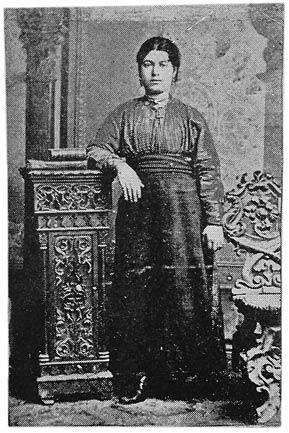
ARMENIAN PEASANT GIRL.
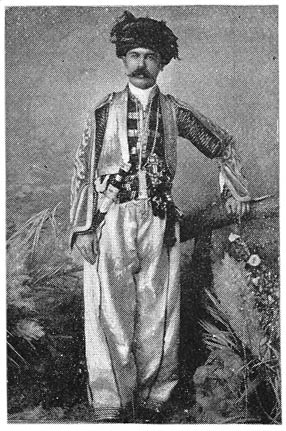
MOUSA BEG. Kurd chief.
Mousa Beg was specially rewarded for his outrageous and brutal treatment of this girl. He killed her father by thrusting red-hot wires into his body.
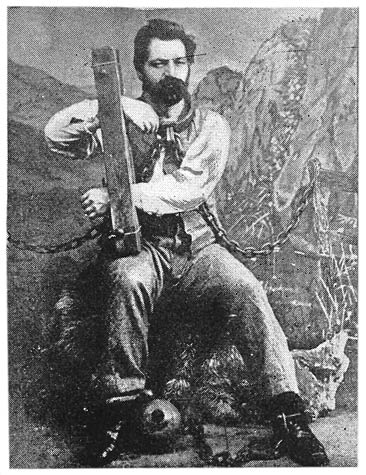
REV. PROF. THOUMAIAN (The Armenian Christian Exile).
Condemned to Death by The Mohammedan Turks, and Rescued by the Intervention of the British Government
Letters from Malatia.
Malatia, Dec. 22, 1895.
My Very Dear Son:—
We greet you with the fondest greeting, and it is the desire of our hearts that the good Lord should enable us to see each other again in this mortal flesh. In regard to ourselves, as to how we were, and what we are doing. We are all alive yet with our whole family, no loss of persons from among us. Don’t mourn for us. Others are mourning for their loved ones. Though in truth the grief and mourning of others belong to us also because we are all Armenians, one flesh and blood, and we all belong to the same nation.
I did not go to bring up the bride of our neighbor’s with the rest, so I was at home when the massacre began. You remember that there was a well in that quarter. The Turks killed the bridegroom, his brother, the priest, together with sixty-five other men, and threw them into that well. In another house they burned seventy-five men, and in still another forty-five men. Finally, I am unable to describe with my pen all that passed in those days and hours.
May the Lord preserve your dear lives, and give you peace and happiness. Your father.
Another Letter.
Malatia, Dec. 22, 1895.
My Dear Friend:—
I received your very kind letter about a week ago, for which I thank you very much, and I read it with great pleasure. But we do not get the boys’ letters regularly. It is nearly two months since the disaster occurred, and in that time I have received but one letter. The other day an Armenian handed me a letter that was torn into nearly a hundred pieces. I put all the pieces together and read it. It was also from the boys, and I read and was very glad. Now I will try to give you a little information about us. The first Monday I did not go to the market, for from Saturday I got somehow suspicious that there was something impending over the city, and I did not let father go either. My brother was to accompany those who were going to bring up a bride for my brother’s partner in business. While my brother was at the wedding house, they sent him on an errand to go and get a few policemen to accompany them as protection in bringing the bride. Just at the moment when my brother was on his way to the station-house, he sees there was confusion in the market; then he drops the matter of bringing a policeman, but goes to the market and closes the shop, and then turns towards home in a hurry. While on his way, some men fired at him several times, but fortunately he was not hurt. He comes as far as to one of our neighbors, and there drops down exhausted. They came and brought me the news that he was there. Then I plucked up all the courage I could, and went and brought him home. An hour or so after, the Turks came and besieged that same quarter and killed about thirty persons. On Tuesday, very early in the morning, we left everything, house, property, and goods, and just to save our lives we fled to the new church, and I don’t know what became of the rest. We remained there in the church until Friday; after that we came out of the church, being a little assured of safety, and have been living on the provision that the government allowed us, but that also ceased a few days since. When we came back home again we did not find a single thing; they had swept off everything. We brought a matting from some place, and six of us sleep in one bed. Some sleep on hay. May you never have to endure such hardships. This incident seems worse than the earthquake or the cholera, or the fire. May the good Lord preserve us from things worse than these. Our life is not worth the living. We don’t know the exact number of the killed. Malatia is altogether a ruin. It is a worse ruin than the city of Anni, and even worse than Sassoun. It is beyond conception, one cannot keep account of it. May the Lord write it down in his own account book, so that he should take the account in the day of judgment.
Please excuse all my shortcomings, because I am out of myself. Our love to all the friends over there.
Yours truly,
P.S. Please tell the boys to know the value of money, and not waste neither their time nor their money in vain. For we have no one to look for but to God in heaven, and after Him to them on earth. For the value of a son is known in the time of adversity, when he helps his elders or parents. Let them not yet send any money, for there are no brokers left where we can change it.
THE CITY OF SIVAS AND THE ATROCITIES.
Sivas is the seat of the vilayet or province of Sivas. The Governor-General of that province resides there. The population is about 30,000; one-third are Christian Armenians, and there are many Armenian Christian towns and villages round about, so that, if the Armenians are not more numerous than the Mohammedans, they equal them in number. Sivas is a missionary station, and during the atrocities, the Protestant Armenian pastor also was killed. His name was Garabet-Kilitjiam, one of the most gifted ministers of the gospel, my personal friend and successor. After I resigned my pastorate at Talas, Cesarea, he succeeded me. He was offered the choice of accepting Mohammedanism, but refused it, and then he was martyred.
In the city and province of Sivas during the recent atrocities about 10,000 Armenians were killed, and many villages and towns were plundered and destroyed.
The following is a press dispatch:—
London, Nov. 16, 1895.—The representative of the United Press at Constantinople reports, under the date of November 15th, that at six o’clock, on the evening of November 14th, M. A. Jewett, United States consul at Sivas, sent a telegram to United States Minister Terrell informing him that in the disturbances which had taken place at Sivas, eight hundred Armenians and ten Turks had been killed, and that, according to official reports, a large body of Kurds were then approaching the town. Mr. Jewett gave no details of the disorders, but the discrepancy in the figures shows that the Turkish allegations that the Armenians were the aggressors are absolutely untrue, and that the Armenians were deliberately massacred.
From a private letter from Sivas, Nov. 21, 1895.
“The air was full of wild rumors—but we could get at nothing that seemed to have any substantial truthful basis. Dr. Jewett—our consul—was on the alert. He interviewed the Governor-General,—and asked for protection for us, for the U.S.A. vice-consul, for our schools, and for the American Consulate. These were cheerfully promised, and the next day, Tuesday, November 12th, at midday, like a cyclone, Sivas was smitten, as I wrote you last week. Mr. P. and I had steadfastly refused to believe that such violence could take place in our city, and we were totally unprepared for the shock. Our walls had been taken down,—that is, our front wall had been,—a distance of 125 feet. Our girls’ school-building had been cut off seven and a half feet on the southwest corner, and both our schools and our dwellings were in an entirely unprotected state. The day of the terrible disaster, the city water was cut off from our street, and for several days the heat was unusual for this time of the year. The dead were buried on Thursday, under the direction of the government, in the Armenian graveyard, a priest of the Gregorian faith being present to offer a prayer.
“Our good native pastor was in the market to attend to the interests of his people, when, at a given signal, a tribe of mountaineers, known as Karsluks suddenly fell upon the Armenians with clubs, and were soon followed by Circassians and local Mussulmen, with knives and pistols; quickly and lastly the police force and regular soldiers joined in with their Martini rifles. It was a combined onslaught of four other races against the Armenians. It has been declared that the Armenians were in armed revolt against the government, and this was done to put down the revolution. When the attack was made against them, we fail to find that there was any armed resistance, so far as we can learn. If the Armenians were premeditating an armed attack upon the Mussulmen, we never could find it out, but that proves nothing here or there, as missionaries are well known not to sympathize with revolutionists.
“Badveli Garabed died a martyr; his life being offered him three times if he would deny Christ. He bore noble testimony before many witnesses, then fell in their presence, sealing his faith and testimony with his blood.
“Yours affectionately,”
Further Information about Sivas by the Missionaries who wrote to their friends Nov. 12, 1895.
“The cyclone which struck on the 12th reached Marsovan on the 15th. Don’t be deceived by any of the silly government statements which attribute all these massacres to the Armenians. It was a deliberate plan on the part of the government to punish the Armenians. The Sultan was irritated because he was forced to give them reforms, so he has had 7,000 Armenians killed to show his power since he signed the scheme of reform.
“The killing was permitted to go on here all last week; forty-six were killed Saturday, November 16; sixteen on Sunday, and many more on the following day. The total number killed is about 1,200 Armenians and ten Turks.
“It is a fact that the Kaimakam of Gurun telegraphed to the Vali at Sivas, saying in effect that there is not an Armenian left at Gurun. The Armenians at Sivas made no resistance, but at Gurun they tried to defend themselves from the butchery, and suffered the worse for it.
“In order to have an excuse for attacking the Armenians at Sivas, the government smashed the windows of Turkish shops and charged it to the Armenians. Food is scarce, and everything was carried off from the Armenian shops. There will be terrible suffering all over this country.”
Another letter from Sivas, according to the Constantinople correspondent, gives many details which all go to show that the whole movement against the Armenians is directly traceable to the head of the Turkish government, who proclaimed that his great desire was to keep always in view, “The safeguard of the rights of the people, and the maintenance of public confidence.”
“What cruel mockery; Trebizond, Erzeroum, Bitlis, Marash, Harpoot and how many more towns rise up and point the finger of everlasting scorn and indignation to fix on Abdul Hamid Khan the stigma of everlasting infamy! The deliberate murder of thousands of innocent and industrious men, the exposure of ten times that number of women and children and aged persons to absolute degradation and destitution, will justify the name of Kanukiar—the Bloodletter—which has been applied to the head authority of the Empire.”
The Riot in Sivas.
“Last week, Monday, November 11, was one of the loveliest days Sivas ever had. Although there were many rumors of trouble afloat, we could get at nothing which seemed to have any greater foundation than the fear that something might happen.
“I went unattended to the boys’ school. On my way to school that afternoon, I met a group of excited soldiers. They said nothing to me, but their strangely excited manner impressed me as being out of the usual order. When I began my class work, the boys, instead of answering my questions, broke forth with inquiries. They wanted to know if the soldiers were going to shoot them, and if they were going to be killed. That was the rumor afloat. I hushed them up as best I could, and told them it was not right to speak of such things. I succeeded in quieting the children, but went home full of anxiety.
“The next day, Tuesday, a large gang of Turkish workmen gathered in our street to continue the public work of building up some walls which had been torn down at the Vali’s orders, for the purpose of widening the street. Armenian carpenters were employed on our building. Nothing out of the ordinary occurred until the workmen’s ‘bread time,’ about 11 o’clock, was finished.
“Then all the Osmanli (Turkish) gang suddenly raised a hue and cry; each one grabbed a pick or club, anything he could lay his hands on, and a wild rush was made for the market-place. The air was filled with yells of the furious men, who rushed along madly.
“The Protestant pastor remained at home on the day before, but on Tuesday was in a shop when the signal for the raid was given. A perfect cyclone of marauders rushed in and clubbed the unsuspecting men in the stores to death before they could offer any resistance. After the outbreak there was not a single Armenian place of business left in the market.
“No list of the dead was made out, and none could be. The victims were all buried in an immense trench in the Armenian burying-ground two days afterwards. There were between seven and eight hundred bodies thus buried.”
MARSOVAN AND THE ATROCITIES THERE.
Marsovan has 25,000 population, 10,000 being Armenians, and the remainder Mohammedans. Marsovan is one of the greatest stations of the American missionaries. Anatolia College is there; a theological seminary for young men; and a seminary for girls. The writer was the pastor of the Evangelical Armenian church there till he was banished, for the reasons stated in the sketch of him. After this the Turks burned the girls’ school; they tried to burn the boys’ college building also, but did not succeed. Finally they several times massacred the Armenian Christians, and forced many to accept Mohammedanism.
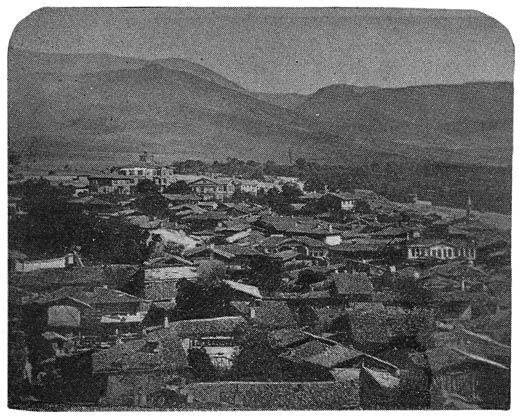
MARSOVAN. (3000 Armenians Killed Here.)
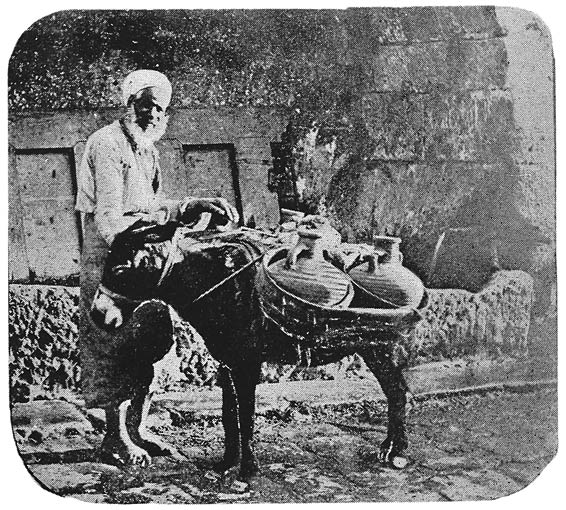
WATER PEDDLER.
I have not been able to get exact information about the number of the martyred Christians in Marsovan, but it is believed that in that missionary station about 1,000 were massacred altogether. The richest men among the congregation were murdered, and so thoroughly plundered that their children are left wholly destitute; and the lives of the missionaries are in danger.
CESAREA (KAISERIEH).
The writer is well acquainted with this city, as he was the pastor at Talas, only three miles away, for years. It has about 50,000 population, one-third being Christians; a few hundred Greeks only, but more than 15,000 Armenians. The richest and ablest Armenians live in that city, or in Constantinople, and came from there; its people are the leaders of the Armenian nation, both in business and intellect. For the story of its foundation, see “The Haigazian Dynasty,” under King Aram. It is a typical Armenian city; and has several great Armenian churches, with flourishing schools. There is a beautiful evangelical church also, and it is a great missionary station, with several American missionaries, and several missionary schools, both for boys and for girls.
The Rev. Dr. Avedis Yeretzian, one of the greatest of scholars, teachers, and preachers, and my personal friend, was martyred in that city during the recent atrocities. He was shot dead in his own house by a Mohammedan mob, then his wife was shot, then his son, and the remainder of his children were captured by the mob. About 3,000 Armenians were killed and wounded there, besides the loss of property. The Mohammedan population of the city is very savage; side by side in the same city, the Christians are rich, refined, intelligent, and the Mohammedans poor, lazy, sensual, and cruel. I give here two letters from Cesarea.
A Private Letter from a Girl.
Cesarea, Turkey, Dec. 31, 1895.
My Dear Brother:—
Before the massacre, everybody was in fear; several families would gather in one house to protect themselves, and all the Armenian stores were closed for twenty days; but as the government guaranteed that there would be no danger, and told everybody to attend to their business, and open their shops, they did so. It was the 16th of November, on Saturday, that all opened their shops again, and the transaction of business commenced in full force. At 2 p. m., at the doors of the market, bugles sounded, and several hundred bashi-bazook [irregular soldiers] were at the doors of the bazaar, every one of them having in his hands stilettos, swords, yataghans, guns, revolvers, hammers, axes, hatchets, sickles, poniards, daggers, and heavy sticks with twenty or thirty nails fastened to them. Then they blew horns, the signal to start the massacre. Cries were heard, “First kill, cut, and butcher the Giavours; the property already belongs to us; cut, cut, kill, don’t care for plundering at present.” Then they rushed into the market and slaughtered all they met. Oh! you can imagine what became of those who fell into the hands of those brutes. Alas! alas! how unspeakable! They butchered them like cattle; cut their heads off like onions. Some tried to run, but could not, others tried to escape, but were brought back and killed. The bazaar was full of dead bodies. People hid themselves among the goods, and in the cellars, and were saved; ten or fifteen days after, people were found there in a starving condition, not having dared to come out. They killed in Avsharaghus factory thirty-eight men; in Kayanjilar everybody was slain. After the massacre was over, the governor, Ferick Pasha, sent soldiers around, and they discovered many people hiding, and took them back to the government house (seray), examined their pockets for revolvers and knives, and not finding any, the governor sent them to their homes.
They plundered the bazaar of all its goods, and then, oh, my Lord! they rushed upon the houses and upon the women’s Turkish baths.… I cannot describe this; when I think of it, my whole body trembles. The people in the baths were killed and wounded, and they carried away the young girls; every one was killed that they came in contact with. The houses were plundered of all their contents, and buildings were torn down, and houses full of people were burned. Oh, how terrible! What I say you cannot imagine to be so; you may think it is a dream, because your eyes have not seen nor your ears heard the screams, wailings, weeping, shrieks, and groaning; that even our forefathers have not heard, but of which our ears are full day and night. My brother was in the bazaar, but fortunately he had occupied a private room, where he was safe.
Some of the kidnapped girls were brought back by the government, but most of them were wounded, and half dead from fright. Thank God, we are safe, but we are not better than those girls. We are in Mr. Wingate’s house, where many lives were saved. He carried beds and clothing to the people, who were stripped of all. A few Mussulmans also protected in their homes some Armenians; for example, James Imuroglov, Gojaki Ogloo.
Yeretzian Avedis Effendi’s house is ruined, himself, his son, and wife are killed, and the rest, five of them, are carried away. Our block and their block is ruined. They butchered Avjinury, Yuzukji, Dirnhitza and carried away her three daughters, but later on brought two of them back. I mentioned them, as you know. They also butchered Yuzikji Apraham and his wife Gaga Haji, Gemerlkli Ohanness, Mustaamelji Gobra, Terrzi Artin, Erzurumli, servant boy. Avedis Ago and his daughter were carried away. Gussi Hamimon’s mother is low. Oh, pity the intolerable many, many, I cannot write by my pen, or describe with my tongue the terrible sufferings. O Lord, have mercy upon us! To my knowledge there were five hundred killed, six hundred wounded; many are dying from their wounds and fright. Eight hundred houses are plundered, and the tenants flocked to the churches. I cannot write one hundredth part of what happened.
We are lost, lost, ruined, no work, no business, every one of us looking for safety. Happy, happy be you that are in America and have nothing to fear. They say to me, you ought to be with your brother in America now. If the way was opened, everybody would like to go.
If you are not in good circumstances there, you must feel satisfied and give the thanks to God always. We also have to thank God that we are still living. It is one month now that we have not been able to go out in the streets. O Lord, help us, Oh! what shall we come to? Oh, my dear brother, if you can help us in any way please do so; make lectures, get some help; everybody is dying of hunger. I cannot write any longer; we leave all to your conscience. I do not write this letter only to you, but to all. Do whatever you can for us, we are in a terrible condition. I thank you, my brother, for the money that you sent to me, thank you very much.
We send our best regards to every one of you. I wrote this letter with the tears in my eyes. We beg of you to write us good letters. Vaham, the little boy, is in good health. We are all well including
Your sister,
Letter from Cesarea.
Cesarea, Nov. 20, 1895.—While the Armenians were engaged in their business, as usual, the Turkish mob fell upon them, killing 600 defenseless men and wounding 1,000 more. The mob divided into four parts. The first part plundered the stores, the second looted the houses, the third secured the maidens and young brides, while the fourth, fiends incarnate, attacked the public baths. These human devils killed six naked women in the presence of the others, snatching their babies from their arms and bayoneting the mothers. The shrieks and agonizing cries of these poor creatures made no impression upon the minds of the savage Turks, who laughed at their death agonies. They then took some of the young girls, who were with their mothers at the bath, and dragged them naked, by their feet, through the streets, followed by a jeering and hooting mob.
The Turks who attacked the houses then killed them and fired the houses. The cries of the women, mingled with the hoarse shouts of the Turks, can never be forgotten. The men who survived the sword were discovered, taken to the magistrate and searched, but no arms were found in their possession, not even a knife. When released, and allowed to return to their homes, they were confronted by a most ghastly picture. Some found their wives dead, others horribly mutilated; daughters were bleeding. My hand almost fails me to write the awful particulars. It took three or four days to remove the bodies of the dead with forty carts. Add to this the want, the desolation. Oh, my God, for how long, how long! Where are those Christian powers who saved African slaves? Where are those Christians who advocated brotherly love and mercy, sending their missionaries to teach us? Are they deaf to our piercing cry?
AINTAB AND ITS HORRORS.
The writer is well acquainted with Aintab, and some of his best friends live there, if they have not been killed. It has about 40,000 population, one-third of it being Armenian. There are great scholars among them. Central Turkey College is there. It is an American college, but most of the professors are native Armenians, graduates of Yale College. There is also a woman’s American College and a hospital. The Evangelical Armenians are the strongest; they have three large churches. They are considered to be the richest Evangelical Armenians in Turkey. But hundreds of them were killed, wounded and plundered; in all about 4,000 of the Armenian population were killed.
A Letter from Aintab, November 23, 1895.
Aintab has had its baptism of blood and fire, and we sit in grief among ruins. We had been hoping that the many things which seemed to combine for our security would save our city from the fury of the storm which is desolating so many places about us. Our Christian community is large (about one-fourth of the whole population), and the Christians, as a class, are exceptionally intelligent and influential; the leading Moslems of the city are intelligent and able men, and have shown themselves to a degree tolerant and even friendly to Christians; the governor has seemed disposed, beyond most Turkish officials, to respect the rights of Christians. There is a considerable number of foreign residents sure to be witnesses of any violence done to Christians. The college and hospital have for years commanded a powerful influence in the city; the hospital especially has the good-will of all classes; the college, its students and teachers were no doubt regarded by many with much suspicion on account of the latent antagonisms inevitably existing between progressive and conservative ideas, but personal relations were, so far as I know, always friendly. Another thing in our favor has been the fact that the Christians of Aintab have given very little countenance to the ultra-revolutionists, who have no doubt provoked trouble in some places. Relying upon all these things, we had for nearly three weeks been hearing reports of fighting and massacre at Zeitoon, Marash, and Oorfa, and other places, with comparatively little anxiety for ourselves. It is true we were frequently hearing of fearful threats and warnings of what the Moslems were preparing to do in Aintab, but we had got hardened to that sort of thing, and regarded it as largely the invention of cowardly roughs to terrify those whom they did not dare attack. The most alarming thing in the situation was that the government was disarming the Christians, and at the same time giving out rifles and ammunition to Moslems. This, however, was attributed to an exaggerated fear of a Christian rising, of which they profess to have information.
Meantime the Moslems liable to military service were called out and equipped and hurried off toward Zeitoon, where it was reported that the Christians were in rebellion. This, no doubt, was the occasion of intense irritation, and both the soldiers and their friends were saying, “If we must fight Christians we will begin with those close at hand.” Under these circumstances the native Christians became very anxious, and made such preparations for defense as circumstances permitted, at the same time keeping as quiet as possible, and avoiding all controversy and altercations with the Moslems. The government increased the police force in the city, and held a considerable force of troops at the barracks near the town, and the governor and principal men seemed to be making much effort to quiet the people. Several considerable tumults had occurred and been promptly suppressed without bloodshed; so day after day dragged on, each hour increasing the hope that we should tide over the crisis.
Saturday morning, November 16, more than three weeks after the first riot in Marash, at about half past seven, just as we were rising from breakfast, our people came in with white faces saying, “The day of judgment has come in the city.” We hastened to the door, and sure enough the mob was at work; all the west and south part of the city seemed to be in an uproar; crowds of people rushing in every direction, roofs covered with excited men, women, and children; the strange mingling of cries of fear, anger, and defiance, with occasional gun and pistol shots, made an exhibition of the most fearful tumult and confusion.
Already troops were hurrying forward, and soon a company of some sixty soldiers were stationed in front of the Girls’ Seminary, with pickets out to cover the approaches to the hospital and college. Dr. Shepherd and Mr. Sanders mounted their horses and hastened to the hospital and seminary, where they remained until the rioting ceased. The college is about half a mile west of the seminary and hospital, and commands a full view of these buildings, and of the whole west end of the city, where most of the rioting occurred.
What we, who were looking on, saw from this point was the narrow streets densely crowded with intensely excited people, now and then a rush made upon some house or gate, the rally of defenders on the roofs, among whom women were often foremost, using stones, clubs, and sometimes guns and pistols as best they could. Sometimes the attack is beaten off, and the assailants withdraw to organize a new assault, sometimes a gate or wall is broken down, and then the noise of conflict subsides and the work of massacre and plunder begins. Later on, long lines of people moving off to their homes laden with plunder, and later still the flames and smoke rising from the burning houses.
What we heard was the indescribable roar of the mob, pierced by the sharp reports of pistols and guns, with now and then shrieks of agony and fear, and shouts of defiance or command, and over all, and most horrible of all, the loud shrill “Zullghat,” (wedding cry) very like the cry of our northern loons prolonged and sharpened, raised by Turkish women crowded on their roofs and cheering on their men to attack. The massacre and pillage began in the markets, and in those parts of the city where Christians’ houses, surrounded by Moslem neighbors, offered easy points of attack; these places having been looted, the mob moved on towards what are known as the Christian quarters of the town. There the resistance became more obstinate; in two of these quarters the old street gates were still in use, by shutting which, the district enclosed becomes a small fortified community capable of making a strong resistance to an organized mob. The assailants were at last beaten off and arrested.
Under such general conditions the storm of mob violence raged on without much abatement till the middle of the afternoon, when the tumult gradually subsided, and night at last brought quiet, except in the vicinity of burning houses, where the uproar went on till near midnight. By morning, arrangements seemed to have been made which gave us hope that order would be maintained; the guard for our mission premises had been increased, and the soldiers posted at intervals around the Christian quarters of the city. Very early in the morning of the 17th, crowds, evidently eager to share the plunder, were seen hurrying towards the city from every direction. The soldiers met and turned them back, and even beat some of them and chased them off. They soon returned, however, increased in numbers, and being joined by friends from the city, became very turbulent. About noon we saw through our glass an officer, apparently a captain, ride forward into a mob, and address them at some length; we could not hear what he said, but immediately, without any show of opposition from any one, the whole crowd came pell-mell with the soldiers into the city. This was at the southwest corner of the town, and immediately under our eyes. At the same time much the same thing was occurring at the northwest corner; then for an hour chaos was let loose again, and the horrors of the previous day were repeated, only that this time the Christians were prepared, and, being in a strong position, were generally able to beat off their assailants. At one point of the line of defense were a few Moslem houses, and we were delighted to learn that the men heartily and bravely joined in the defense with their neighbors; the gallantry of this act was somewhat marred, however, by the demand which they made the next day for a large sum of money for their service; these men actually demanded and received about $5 apiece for this neighborly help.
When it became apparent that the mob could not force their way into the places held by the besieged, the soldiers, perhaps having received new orders, resumed a show of activity, fired a few shots into the air, and drove the mob out of the city and dispersed them; this is the last serious fighting that has occurred up to the present time, though local tumults have broken out frequently, several houses have been pillaged and burned, and two Christians at least were shot while being conducted through the streets by soldiers. Strict military rule is now established, and special care is taken to safeguard the lives of property of foreigners. We are kept under very close restriction, and not allowed to visit the city except for special objects, and then under a strong guard. The amount of damage we can only estimate; as nearly as we can judge, the figures will be about 200 killed, 400 wounded, nearly all the Christian shops and 250 houses pillaged, and a considerable number burned. Some 1,000 men who in the first panic took refuge in khans and mosques are still held as prisoners, for purposes which we can only surmise.
P.S. Dec. 17. Quiet has for the most part been maintained under strict military rule. No Christian can yet venture out without armed escort, and there are not wanting signs that there is waiting and even expectation of another signal from above. The government, however, seems to be trying to restore order and confidence. We are glad to say that we have heard of no cases of special violence or abuse offered to women.
The above-named prisoners have been gradually released, till now there are only some six of the principal Christians still in confinement. The number of killed just now must be set down at over 400; the butchery in the markets where the first attacks began far exceeded our belief. A great number of bodies were thrown together into some distilleries, and these buildings set on fire and burned to the ground, thus removing for a time much of the terrible evidence of the extent of the massacre. The attack being made in the morning and beginning in the markets, it happened that the killed are about wholly from the “bread-winners” among the Christians. As a result, there are now in Aintab more than 4,000 people dependent on charity for daily bread, and most of those to whom they would naturally look for aid are utterly impoverished; the outlook for the winter is simply appalling. We appeal for aid speedily in the name of humanity.
THE CITY OF BIRIJIK AND THE ATROCITIES.
The city of Birijik is on the shores of the Euphrates; it has a beautiful appearance from the other side of the river. The Mohammedan population there are very wild and ignorant.
The Massacre at Birijik (Province of Aleppo).
Birijik had about 300 Christian houses, or say about 1,000 souls, in the midst of the Mussulman population of about 9,000 souls. After the massacre at Oorfa on the 27th of October, 1895, the authorities at Birijik told the Armenians that the Muslims were afraid of them, and that therefore they (the Armenians) must surrender to the government any arms that they possessed. This was done, the most rigid search being instituted to assure the authorities that nothing whatever in the way of arms remained in the hands of the Armenians. This disarmament caused no little anxiety to the Armenians, since the Muslim population was very generally armed, and was constantly adding to its arms. In fact, during the months of November and December the Christians have kept within their houses because the danger of appearing upon the streets was very great.
Troops were called out by the government to protect the people. Since the soldiers had come to protect the Christians, the Christians were required to furnish animals for them to carry their goods. Then they were required to furnish them beds and carpets to make them more comfortable. Finally they were required to furnish the soldiers with food, and they were reduced to a state bordering on destitution by these increasing demands.
The end came on the first of January, 1896, when the news of the massacre of several thousands of Christians at Oorfa by the soldiers appointed to guard them incited the troops at Birijik to imitate this crime. The assault on the Christian houses commenced at about nine o’clock in the morning and continued until night-fall. The soldiers were aided by the Muslims of the city in the terrible work. The object at first seemed to be mainly plunder, but after the plunder had been secured the soldiers seemed to make a systematic search for men, to kill those who were unwilling to accept Mohammedanism. The cruelty used to force men to become Muslims was terrible. In one case the soldiers found some twenty people, men, women, and children, who had taken refuge in a sort of cave. They dragged them out and killed all the men and boys, because they would not become Muslims. After cutting down one old man who had thus refused, they put live coals upon his body, and as he was writhing in torture, they held a Bible before him, and asked him mockingly to read them some of the promises in which he had trusted. Others were thrown into the river while still alive, after having been cruelly wounded. The women and children of this party were loaded up like goods upon the backs of porters and carried off to the houses of Muslims. Christian girls were eagerly sought after, and much quarreling occurred over the question of their division among their captors. Every Christian house except two, claimed to be owned by Turks, was plundered. Ninety-six men are known to have been killed, or about half of the adult Christian men. The others have become Mussulmans to save their lives, so that there is not a single Christian left in Birijik to-day. The Armenian Church has been made into a mosque, and the Protestant Church into a Medresse Seminary.—[Dr. Dillon.
Oorfa and Its Atrocities.
Oorfa, the old Ur of the Chaldees, where Abraham, the old patriarch of the Bible, was born, was called Edessa in the time of Christ. I have told the story of King Abgar and his conversion in the historical part of this book. It had about 50,000 population, about 20,000 of whom were Armenians before the massacres. Out of that number 8,000 were slaughtered, according to Mr. Fitzmaurice, the British vice-consul who returned from Oorfa to Constantinople on March 21. The Evangelical Armenian pastor, the Rev. Hagop Abuhayatian, was also martyred. I knew him personally. He was educated in Germany, a man of great ability; a great scholar, and a great and forcible preacher.
A Letter from Oorfa, Jan. 28, 1896.
Dear Friend:—
Your only remaining brother sends you a letter, but no letters can begin to explain the sad state of this city. The massacre of Dec. 28 and 29 has left all homes except Catholics and Syrians entirety empty of any comforts. Many families have not one bed even; all cooking utensils, clothing, bedding, carpets, etc., were taken. Most have a little zakhere left, though some have not that. We are feeding about 175 of the most needy, and more will come to us every week. The loss by death is between 4,000 and 5,000. Our pastor, the Rev. Hagop Abouhayatian, Dr. Kivorc, and brother Harotoun, Sarkis Varjebed Chubukian and brother and son, Garabed Roumian, Habbourjou Avedis and brother Sarkis, old sexton Garabed and other sexton Bogos, Majar Kivorc and brother Bogos and Berber Monofa and two sons, Eskejiyan Marderos, Zarman Roomian’s three eons, are some of the dead. In all, our Protestant dead are 115. Some of our people perished in the Gregorian Church, where 1,500 or 2,000 went for refuge Saturday night, and on Sunday were murdered or burned, very few escaping. It was the most awful of all the terrible events of those two days.