VII. THE TURKISH ATROCITIES IN ARMENIA. (continued 2)
Reading edition
Thank God, two hundred and forty were saved by coming to me; sixty of them were men. I could not keep the men in my house or yard, because it was forbidden by the guards, but I hid them elsewhere, and fed them for three or four days. The government carefully protected me, and killed as many of my friends as possible. We have our house and all the schoolrooms full of the wounded and the most forlorn.
Our Oorfa redeefs leave to-morrow; we have new soldiers now for guard of the city, and Christians especially. Oorfa redeefs have been poor guards, and but for them the awful work would not have been accomplished. The pastor of Severek, the Rev. Marderos, was killed. The Rev. Vartan remains alive in Adayaman. Both in Severek and Adayaman the number of the killed was very great. In Birijik about two hundred were killed, and all remaining have become Moslems; they have been circumcised.
In Aintab about three hundred were killed, 847 shops plundered and 417 houses.
During our first disturbance, six to seven hundred shops here were plundered, and about 175 houses. Then the Christians used arms to defend themselves. Since then all arms have been taken by the government from the Christians, and the leaders were forced to sign a paper stating the city as “in peace and harmony, thanks to the rulers,” etc.; twenty-five signed it, and now almost all of these have been killed. Our pastor signed for Protestants.
Only two of the Gregorian priests remain, and they are wounded. The bishop is alive, but feeble, and does not work publicly now. Their state is very sad. We desire your prayers, and the aid of all who can give us help by money at this time.
Sincerely your friend,
P.S. Your brother asks you to send a letter to him by me.
DIARBEKIR AND ITS STORY.
Diarbekir (see the historical part for its foundation) has about 40,000 population. Nearly half of them are Christians, but not all of them are Armenians. There are Chaldeans also. The Armenian population numbered about 12,000, of which 5,000 were killed during the recent atrocities.
A Letter from Diarbekir, Nov. 20, 1895.
My Dear Sir:—
After salutation, I offer my thanks to God that after great dangers and tribulation we have reached the present time. God’s will be done. How can I describe the horrors in our city to you? Can any pen or any language tell them? No, but I shall try to write at least a very short description of them. But who knows if this letter will reach you, because of the letters we write, very few reach you, and very few of your letters reach us, since the government has control of the mail, and it is the government that persecutes us. Our age is a peculiar age. God look at our misery and save us.
How happy were those who were martyred on Nov. 1, and have gone to their reward. The atrocities which happened here on November 1, 2, 3, cannot be matched in the history of the civilized world. I do not think they can be in that of heathen lands, where the people are barbarous.
When I write these lines to you, I hardly know what I am writing; the darkness of Egypt covers all around me. The former millionaires in the city have nothing and are begging bread. Nov. 1 was a black day for the Armenians. Many were separated from their loved ones, even parents from their children. Many merchants and rich people were so thoroughly plundered and stripped that they are literally left naked and hungry, and numbers have been put to unspeakable tortures by the Turks and Kurds. Nov. 1 was Friday; it was about noon when the Mohammedans came out from their mosques. The native Turks, the Kurds who were brought from outside, and the soldiers all united, swords, pistols, guns, axes, and clubs in their hands, fell upon the Armenians in the market place or business place, cut them to pieces, and plundered what they had. If they had been all killed by bullets it would have been a sudden death, and easier. But they cut them to pieces bit by bit with their axes, and made holes in the bodies with their swords.
When they were killing the Armenians, they were repeating the following words, “Bring testimony to prophet Mohammed. Our Sultan ordered us to kill these heathen dogs, the Armenians.” The governor of the city, and all other officials, with the commander of the soldiers, during the time of the atrocities were sitting near the great mosque, and while listening to the cries and screams of the martyred Armenians, they were laughing and joking with great pleasure, and ordering the soldiers to carry the most valuable things to their houses.
After they had killed everybody, and plundered everything in the business place, they turned to the residences where Armenians lived, and began to burn and kill. Some of the soldiers went to the tops of the minarets or high towers, and began to shoot the Armenians from there. What a pitiful scene was the condition of the Armenian ladies, who were running from house to house, from street to street, and were shot dead, and their children left orphans. During the three days’ massacre 4,000 Armenians were killed, and the burning of the houses and stores continued twenty-four hours. From the gate of the mosque to the place where they make saddles, and from the twin caravansary to the new caravansary, from Sheik Uatad to Melik Ahmed, all the buildings, 1,400 stores, were burnt and turned to ashes. There are other stores also which were not burnt, but everything was taken from them. The stores where goldsmiths worked every article is taken from.
When the Armenians go among the ruins to see if they can find any article, they are forbidden; and if some one manages to find anything, the Mohammedans take it from him, cursing him, and calling him a heathen dog at the same time.
When we come to the residences near your house, from the house of Darakji to the covered place of Sheytan aglou, all are destroyed; from Alo-Pasha bath to the Jemil Pasha Palace, all destroyed. But the church of the Patrees is not destroyed. St. Sarkis’s church was plundered and afterwards burned. Before the church was burnt, they killed the priests, and unspeakable violations took place in the church. In that quarter half of the population were killed, and the other half, who survive, are naked, barefooted, hungry, and are begging bread.
Now the government pretends to give bread to the hungry, but nothing is given, and those who have a little give to the others who have nothing; but after a few days nothing will be left to eat. Thank the Lord, the Kurds went out of the city. But it is twenty days now since the massacre took place, and nobody dares to go out to the streets.
We have no stores, no money, nothing to eat. Though my personal house was not robbed, but I have ten orphans whose fathers and mothers were killed; I am taking care of them. We have a little; we shall eat that, and see what the Lord will provide.
From the Rev. Dr. Tomy’s house to the church of the Evangelical people all the houses were burned. Hovhanness’s loss is about $1,000. Those who hid themselves in Konsol Khan and in the church of the Patrees escaped death. But every one who escaped was left hungry and thirsty from twelve to fifteen days in their places of confinement, because they were afraid of going out.
All the suburban towns and villages were totally destroyed. In Sevorag both the Armenian church and the Evangelical Armenian church were destroyed, and only from fifty to one hundred persons were left alive. The monastery of Argen was destroyed, and the teachers and all the inmates were killed.
They burnt the church of Ali-Punar and killed the priest. From that place only five or ten persons were left alive. Your brother at Kitibel with all his family are killed, and both the churches are burned. They forced the ministers to accept the Mohammedan religion; on refusal all three were killed, the Rev. Abosh, the Rev. Khidershap, and the priest. All who were left alive at Kitibel are only about forty persons. Afram’s brother Kisho with all his family were killed. At Renjil nobody is left. At Kara Bash only fifty persons are left alive. The village of Satou is entirely out of existence. In all this province all the towns and villages are destroyed, and the people are killed, except the village of Haziro, which is not destroyed, and the reason is that a Turk, Sevdim Beg, did not permit the Kurds and the Turks to destroy it.
What will become of us hereafter we do not know. We are still in danger, but we trust first in God, then in such friends as you. My personal damage is $5,000 and now is the time to show us sympathy and help us.
If you cannot do it yourself personally, can you not tell the people of the United States of America to help us and relieve our suffering?
Sincerely yours,
TREBIZOND AND ITS ATROCITIES.
Trebizond is built on the shores of the Black Sea, and is a part of Armenia. The population is estimated at 40,000; only 10,000 are Christians; perhaps about half of them are Armenians, and nearly half of the Armenians were killed and wounded during the recent savageries. Mr. Chelton, who was going to Armenia to organize consulates, was in Trebizond, saw the massacre of Christians, and reported to the government at Washington:—
“Trebizond, Oct. 9, 1895.—Many Armenians were killed here in conflicts yesterday with Turks. No attempt was made to stop the massacre of the Armenians. The Turks were armed, and the number of troops present here is small. It is even stated that soldiers took part in the slaughter, and in the pillage which accompanied it.”
“London, Oct. 17, 1895.—The ‘Daily News’ publishes a dispatch from Constantinople giving a description by an eye-witness of the rioting at Trebizond. He says that four separate Moslem mobs surrounded the Armenian quarters at eleven o’clock on the morning of Oct. 8, and then began to pillage the shops. Being opposed, they fired on the Armenians, and soon a general massacre began.
“Soldiers joined the mob in firing on the Armenians and in pillaging the shops and houses. The scene continued until 4 o’clock in the afternoon, when nothing was left to pillage and nobody remained to be killed. The mob then began to disperse. The better class of Turks did their best to protect the lives of the Armenians. They sheltered the women and children and many men in their houses. The mob attacked only the orthodox Armenians, leaving Catholics alone.”
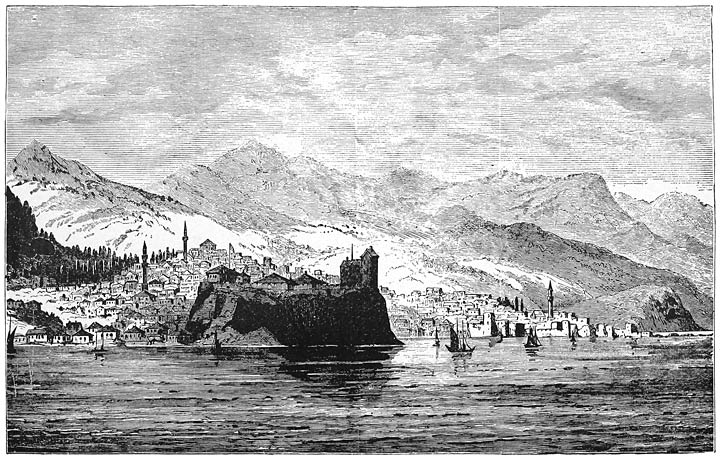
TREBIZOND, THE SCENE OF A GREAT ARMENIAN MASSACRE.
An Armenian Massacre. Money Cabled to London by the Local Relief Association, Dec. 31, 1895.
“Recent letters telling of the massacres in various Armenian cities contain information that helps to explain many points in the awful outbreak of so-called Mohammedan fanaticism. A letter from Trebizond says:—
“ ‘Bahri Pasha, governor of Van, started to come to Constantinople, and it was learned that he was bringing with him four of the fairest young maidens of Sassoun, who had been spared in the massacre, to make an acceptable present of them to his Sultan. This aroused the Armenian people of Trebizond to a frenzy, and it was impossible to restrain the young men, the more daring of whom fired upon Bahri Pasha, wounding him. But he carried out his mission to Constantinople, and was honored with the highest decoration and appointed governor of Adana.
“ ‘Afterward the pasha of Trebizond, calling twelve of the leading men of the city, demanded that they should hand over the young men who attacked the governor, and gave them just a few hours in which to carry out his orders. The next day they answered him that the government had no means of finding the men out.
“ ‘When the mails had arrived, and the people went toward the postoffice, the trumpet was sounded three times, and both the soldiers and the mob rushed upon the people. It is impossible to describe the horror of the scene—the roar of the murderers, like that of wild beasts, the shrieks of the women in the houses from whose arms their husbands and sons were torn and murdered before their eyes, and universal tumult, added to the sighs and groans of the dying. And this we know is only one, and not even the most terrible of the massacres.’ ”
BAIBURT.
“Constantinople, Oct. 28, 1895.—Another massacre of Armenians, accompanied by the outraging of women, is reported to have occurred recently in the districts of Baiburt, between Erzeroum and Trebizond. According to the news received here, a mob of about 500 Mussulmans and Lazes, the greater majority of whom were armed with Martini-Henry rifles, made an attack upon the Armenians inhabiting several villages of that vicinity, and set fire to their houses and schools. As the Armenians fled in terror from their dwellings they were shot down as they ran, and a number of men and women who were captured by the rioters, it is added, were fastened to stakes and burned alive.
“The Armenian women who fell into the hands of the mob, it is asserted, were outraged and brutally mutilated. It is also stated that the churches were desecrated and pillaged, the cattle, and all the portable property of any value belonging to the Armenians being carried off by the marauders. During the disturbance 150 Armenians are reported to have been killed. The surviving villages applied for protection to the governor of Baiburt, who, after hearing their complaint, sent three policemen to the scene of the massacre after the slaughter was ended.
“The Turkish officials, it is claimed, know the ringleaders of the outbreak in the Baiburt district; but apparently no steps have been taken to arrest them.”
Another Letter from Baiburt.
“The Armenian bishop’s vicar was killed, the teachers in the schools and many other men and women were massacred. Women jumped into open wells to escape worse deaths; the villages round about were laid waste.
“Following this was the Erzinghan massacre. On Friday, the 25th of October, 1895, the Moslems finished their noon hour of prayer by pouring out of the mosques and attacking the Armenians in the market, who, taken by surprise, were shot and cut down to the number of 500; their shops being all plundered.”
(Signed) An American Missionary.
ERZEROUM.
This is a large city, almost on the boundary line between Russia and Turkey, in Turkish Armenia. It has about 60,000 people, one-third of whom are Armenians. Several times since the last Turko-Russian war the Christian Armenians have been massacred there by the Turks and the regular soldiers, and during the recent atrocities also there were massacred, and in all about 3,000 Armenians were killed.
Letter from Erzeroum.
“Nov. 27, 1895.—The massacre evidently was pre-arranged. It began all over the city at the same moment. The bugle was sounded, and the soldiers began. They first said, “No harm to women or children,” but they soon passed those bounds. A soldier who was on guard says the order was given by the Porte. We made ready for defense, but it soon appeared that the soldiers had cut off the rabble from our section, for no mob passed our street. A few men tried to open the door, but three well-directed shots from our balcony sent them off.
“The soldiers at the head of our street, apparently to guard it, broke open three or four houses within a stone’s throw of us, and carried off everything they found. We saw loads of plunder carried away by soldiers. A large number of women engaged in the same work. The affair began shortly after noon and continued about six hours. One Armenian was called to the door by an officer, who professed to be friendly, and was cut down in cold blood. Others were cruelly murdered. The death roll must be towards 300, if not more. Between fifty and sixty wounded are in the hospital.
“Two hundred were gathered in the Armenian cemetery, some horribly mutilated. There must be many wounded in the different houses. The pillaged houses are to be counted by the hundred. No house attacked was left until it was emptied of every movable thing. The next day we went to an Armenian home. In the middle of a small room (the kitchen), lying side by side on a mat, were the bodies of two young women, almost naked, a light covering thrown over their heads. At the other side of the room a grief-stricken woman was trying to make bread from a little flour that had been left. She had to borrow utensils to do it. She left her work, came forward and removed the covering from the bodies. They were those of young women developing into motherhood. The head and face of one was covered with blood, and she was also badly wounded in the hand. The other had a bullet wound through the abdomen from the right side. A companion of these two had been carried off, and was lying dead in another house. Their lives were sacrificed in defense of honor.
“We passed through the ruins to other rooms. Boxes and furniture were in splinters, windows smashed, walls ploughed with bullets. The floor was covered with big patches of blood. The bodies lying in the cemeteries are simply wrecks of human beings. The majority have bullet wounds. Nearly all have bayonet, sword and dagger wounds, some badly mutilated. Two or three were skinned, and some were burned with kerosene. A great many women are missing. Very many dead have been disposed of by the Turks. Hundreds have nothing to eat, and no means of getting anything. The villages of the plain have suffered awfully. No definite news has come; only the news that columns of smoke tell.”
MARASH.
The writer became acquainted with many noble Armenians here during his three years in the Theological Seminary, and almost all his friends were killed. Among them were the Rev. Sdepan Jirnazian, a noble Christian minister,—when I was a little boy he was my pastor in the suburbs of Antioch;—Bedros Iskiyan, an American citizen, butchered before his wife and children; Garabed Popalian, another noble man, and the richest among the Armenian Evangelical people; Dr. Kevork Gulizian; Khacher Bayramian and his family; Garabed Salibian, in whose house I used to take my meals. A private letter says that about half the Armenians were killed by the Turks. Marash had about 35,000 population; about 15,000 were Armenians, of whom about 7,000 were killed. It has four Evangelical Armenian churches there, a theological seminary, and a ladies’ college. The local governor led the regular soldiers to plunder and kill the people.
Letter from Marash.
London, Nov. 28, 1895.—The correspondent of the United Press in Constantinople telegraphs, under date of November 27, that a second terrible massacre has occurred in Marash, and that the houses there have been pillaged without regard to who their occupants might be. It is reported that thousands of persons were killed and many hundred wounded. The American Theological Seminary was plundered and burned, and two of the students in that institution were shot, one being fatally wounded. The hotels and boarding houses also were plundered. The Christians at Marash, and in that vicinity, thousands of whom are destitute, have appealed for aid.
The following letter, under date of November 25, has been received here:
“I will report the events of the 18th in this city. At 7 a. m., almost simultaneously the firing of Martini rifles was heard all over the city, with conflagrations in three Christian quarters.
“We understood the meaning of it. Soldiers began firing against two Christian houses, and their inmates fled into missionary houses, and soon the soldiers were looting their buildings, followed by a mob, who smashed doors and windows, and carried away property.
“Towards noon a squad of soldiers approached the missionary grounds, and it was thought that a guard had been sent in behalf of the missionaries. They entered the grounds of the seminary and academy boarding department. Two seminary students, who had concealed themselves in a cave, were discovered, and one of them fatally shot, while the other was badly wounded.
“The soldiers looted the missionary academy boarding department of all the students’ clothing and bedding, and a part of the year’s provisions in store. Other soldiers joined and looted the seminary. They repeatedly went to an Armenian house near by, but did not force it.
“Three-quarters of that terrible day the missionaries were left to any chance fate that might befall them. They had been informed by a Moslem of a purpose to burn the Girls’ College that day, and a note had been sent to the local governor asking for a special guard. He replied that the barracks near by were charged to care for them. It was soldiers in relays from that very place that were wrecking everything.
“In the afternoon four or five soldiers entered the seminary, and soon after, fire broke out in the rear. As the flames wrapped the building, a trustworthy captain with thirty soldiers appeared at the gate, and the missionaries were assured of safety. The soldiers still continue with the missionaries. We cannot estimate the loss of life. Leaders of society have been struck down everywhere, two missionary academy teachers among them.”
AKHISAR.
The valley of the Sakaria (the ancient Sangarius), is, through a part of its course, followed by the Anatolia line of railway. At a spot ninety miles from Constantinople, where the valley broadens out into a considerable plain, is the station and town of Akhisar. This town was, until the tenth of this month, the center of a considerable trade. The plain is dotted with vineyards, olive orchards, mulberry gardens, fields of cotton, wheat, etc. The town consists of about 160 houses of immigrants from Bulgaria, Bosnia, and Rumelia (who, having been concerned in the celebrated Bulgarian massacres, found refuge in Turkish territory), and sixty houses of Armenians.
A Letter Oct. 15, 1895.
Thursday, Oct. 10 (a bright, beautiful day), was market day. Numbers of people from the surrounding villages had come with the fruits of their various industries. The market place consisted of sixty-three permanent shops, and about 150 temporary places of trade, where traders from the surrounding country exposed their wares for sale. The market was almost exclusively in the hands of Armenians, 200 of the shops and trading places being in their hands. Rumors of danger were afloat, but the Armenians anticipated no attack on market-day. They had no arms, or means of defense, and had taken no precautions. They soon began to notice, however, that their Mussulman neighbors had mysterious whisperings among themselves, and that some of them were searching, as with official authority, the persons of Armenian young men, who were supposed to have knives or revolvers about them. Those searching at last found a young Armenian, a seller of calico, who had a knife in his possession. At once they fell upon him, but he escaped in the crowd that gathered, and the Mussulmans turned upon the Armenians, saying, “We must kill them all. Let him who loves his religion join and help.” With knives and clubs the work was carried on, the Armenians fleeing, or hiding themselves in or about their shops. Turkish officials encouraged the killers. A herald was sent through the market calling, “Let the Moslems go to the government house.” They did go, and immediately returned with rifles and revolvers. Then the slaughter increased in madness. The piteous entreaties of the threatened, the shrieks of the wounded, the groans of the dying, the shouts of the killers, and the hysterical cries of some of the Christians, who, to save their lives were calling out with desperate energy the Mohammedan formula of faith, rose to the deaf heavens. Ten-year-old Turkish boys, as though hunting rats, rushed into holes and corners, and discovering the hiding-places of the merchants and traders, called to their fathers and big brothers, “Here is a Giavour!” and while that one was being dispatched they rushed off to ferret out another. For four hours the slaughter continued. Ropes were attached to the feet of the corpses, which were dragged like the carcasses of dogs through the streets to dry wells, into which they were thrown. An old man, aged 75, was tumbled in alive, and left to die among the dead bodies of his friends. The money and watches of the merchants were secured by the ruffians. The notes of hand and account books were torn into shreds (the killers were debtors to the merchants), and the shops were looted. Not so much as a pin or needle was left in the 200 shops. Then the cry was raised, “To the houses!” to complete the destruction of the Christian inhabitants.
Twenty-nine bodies were afterward recovered for burial; thirty-three persons (some of whom afterward died), were found to be wounded, and about forty are still missing. The lieutenant-governor arrived that night on the scene, and sent an official report (by telegram) to Constantinople, to the effect that a row had occurred between Turks and Armenians, in which three Armenians had been killed and two wounded, but that order had been restored! Efforts were made to cover the matter up. Christians were imprisoned for talking about the massacre, or for sending the news to friends. A prominent man, well-known throughout the country, wished to let his circle of friends know that he was still alive, and was permitted to advertise that he had met with an accident, but was quite well.
Great patches of dried blood in the shops presented the appearance of places used for the slaughter of sheep. Groups of people were standing before the houses, statue-like, bewildered and hopeless, while other groups were wailing over the news of the corpses of friends, just recovered from the wells. I saw one of the mutilated corpses, and have seen it night and day since.
An American Missionary.
The above missionary also says not only common people, but also officers of high rank, made free threats of massacre, and ostentatiously sharpened their swords and cleaned their weapons in the presence of their Armenian neighbors. Great care was taken by the authorities to deprive the Armenians of arms; but the Mussulmans were allowed to carry arms freely. The Constantinople demonstration and consequent massacre aggravated the situation. It was pitiable to see the fear that held the Armenians as in a nightmare, and to hear the threats and observe the bearing of the Turks.
A soldier, passing the door of a Christian house and observing a young woman sitting on the door-step, ground his teeth and called out to her, “You may sit there four days more, and then I will have you on the point of this bayonet.” The girl fled in terror into the house.
ZEITOON.
Zeitoon is fifteen miles from Marash. The Zeitoonlis are the bravest of all the Armenians; there are about 15,000 in the city, and no Mohammedans, save a dozen or two Turkish families, and they talk the Armenian language. Until about thirty years ago Zeitoon was a free city; but they were conquered by craft, and became tributary to Turkey. The Sultan garrisoned the place to keep them down, and the troops committed every sort of iniquity. Finally, about two years ago, the Sultan sent physicians there to poison the Armenian boys. These assassins professed to have come to vaccinate the boys; every boy who was vaccinated died. Then the Zeitoonlis revolted, captured the barracks from the soldiers, took all the guns, cannon, and ammunition, and sent the soldiers away. This action enraged the Sultan, and he sent some 20,000 regular soldiers and 30,000 bashi-bazooks to punish them; but they were repulsed with heavy loss by the Zeitoonlis. It has been reported that during the battle between the Zeitoonlis and Turks about 15,000 of the latter were killed. Finally the Sultan lost hope of conquering them, and asked the European powers to use their good offices to restore peace in Zeitoon, and the consuls of the different powers induced them to resume peaceful work by guaranteeing that the Zeitoonlis shall not be molested. But who believes a word of it? We know, with horrible clearness, of how much value the powers’ “guarantee” is; they say there is no obligation but to keep count of the massacres.
A Few statements from Zeitoon.
“Turkish mendacity is again asserting itself. A few days ago the Sublime Porte set afloat the official report that Zeitoon has fallen, after hard fighting, in which 2,500 Armenians were said to have been killed as against 250 Turks. Now these official reports turn out to have been official lies. News from independent sources shows that Zeitoon has not yet fallen; that its gallant defenders are still holding out their own. To Armenians who understand Ottoman tactics, the alacrity with which Abdul Hamid sent abroad the news of the supposed victory of his troops is a sign of misfortunes and reverses. The Turks control the avenues of communication at Marash, and it is not surprising that they attempt to win victories upon telegraphic despatches—but not at Zeitoon.
“The Armenians at Zeitoon are rebels against organized assassination, plunder, and arson. They have been unwilling to submit meekly to Turkish outrages, and are determined to defend their lives, their homes, and their property. They have vanquished Turkish armies before, and strewn the ground with thousands of Turkish carcasses. They need fear nothing but the lack of supplies. Will not Christian nations intervene to save a valiant people who are defending their homes and their liberties, and who cannot be conquered by force of arms, yet who may be compelled to surrender to inexorable hunger?—[Tigram H. Suni, Dec. 31.
“London, Feb. 3.—A dispatch from Constantinople to the ‘Daily News’ says: ‘Reports from Turkish sources believed to be fairly accurate state that it is believed that the Zeitoonlis are still holding out. The Turks have made seven different attacks upon the town, but all have failed, and their losses are reported to amount to 10,000. It is alleged that 50,000 troops will be needed to capture Zeitoon.
“‘It is believed that the Zeitoonlis number from 15,000 to 20,000, well armed, and provisioned for a year. There is a doubtful report that 4,000 Russian Armenians crossed the Persian frontier, and defeated the Turks at Siz, eighteen hours from Zeitoon, and have joined the Zeitoonlis.’”
MISCELLANEOUS
In the province of Aleppo, the village of Chizek, the Armenian priest was killed for refusing to become a Mohammedan.
In the province of Erzeroum and the district of Erzinghan, six separate attacks for pillage have been made upon the village of Zimara, and great pressure is being used to force the people of the village to become Mohammedans.
At the village of Gazma the houses have been pillaged, and numbers of the people have become Mohammedans to save their lives.
In the province of Bitlis a considerable number of Armenians at Sert have been forced to become Mohammedans. In the district of Shirvan, out of twenty-two Armenian villages, the inhabitants of four entire villages have become Mohammedans to save their lives. The priests also accepted Mohammedanism, and the churches have been changed into mosques. At a little village at which the inhabitants could not disperse over the mountains a considerable number were killed, and the survivors accepted Mohammedanism. This village is called Kourine. In the district of Chilain, returns from six villages have come in which show a considerable number of persons killed for refusing to accept Islamism.
In the province of Van the stuffed skin of the superior of the monastery of Khizan was still hanging from a tree in front of the monastery three weeks after the massacre took place; that is, at the date of the last news from there, Nov. 27. At Kharkotz in this province three priests accepted Mohammedanism, and were paraded through the streets in the dress of Mohammedan ulema in order to influence the people to follow their example.
In the province of Harpoot in many of the smaller villages, where the people have been supposed by the Turks to be mere peasants, without ideas of their own, the offer of Islamism has not been made, but the people seized without ceremony and circumcised by force, and are considered now as Mohammedans. At Haboosi, in this province, the Christian dead were left unburied in the streets for the dogs to eat. The Armenian church and the Protestant chapel and parsonage were burned.
At Peri, in the same province, 450 Christians were made Mohammedans by threats of death.
At Aivos in the same province, all the buildings were destroyed. The Armenian priest was forced to give the call to prayer, and was then shot for refusing to become a Moslem.
At Garmuri the Christians accepted Mohammedanism at the edge of the sword, and have been circumcised. The Protestant chapel and parsonage were burned, and the Armenian church has been seized and made into a mosque.
At Hokh the Armenian church and Protestant chapel and parsonage were burned.
At Houilu in the province of Harpoot, 266 out of 300 Christian houses were burned, among them the fine new Protestant church. Two priests were killed. Many of the people succeeded in escaping from the village. The rest have been forced to declare themselves Mohammedans.
The events above mentioned took place in the main between Nov. 6 and Nov. 20. But the process of forced conversion and the murder of individuals who refuse to accept Mohammedanism was still going on as lately as the 20th of December, when the Turkish government was assuring the European Ambassadors that all is quiet in Asiatic Turkey, and that all that is necessary to complete the work of pacification is for Turkey to be let alone.
The nature of the pacification which may be expected if Turkey is left free to carry out its schemes for these provinces may be judged from the following list of educated and influential Protestant ministers, who have been put to death for refusing to embrace Mohammedanism. In every case the offer of life on these terms was made; in several cases time was allowed for consideration of the proposal; and in each case faith in Jesus Christ was the sole crime charged against the victim.
1. Rev. Krikor, pastor at Ichme, killed Nov. 6, 1895.
2. Rev. Krikor Tamzarien.
3. Rev. Boghos Atlasian, killed Nov. 13.
4. Rev. Mardiros Siraganian, of Arabkir, killed Nov. 13.
5. Rev. Garabed Kilijjian of Sivas, killed Nov. 12.
6. Rev. Mr. Stepan, of the Anglican Church at Marash, killed Nov. 18.
7. The preacher of the village of Hajin, killed at Marash Nov. 18.
8. Rev. Krikor Baghdasarian, retired preacher at Harpoot, Nov. 18.
9. Retired preacher at Divrik, killed Nov. 8.
10. Rev. Garabed Resseian, pastor at Cherwouk, Nov. 5.
11. Rev. Metean Minasian, pastor at Sherik, Nov.
12. Pastor at Cutteroul, Nov. 6.
13. Preacher at Cutteroul, Nov. 6.
14. Rev. Sarkis Narkashjian, pastor at Chounkoush, Nov. 14.
15. The pastor of the church at Severek, November.
16. The pastor of the church at Adiyaman.
17. Rev. Hohannes Hachadorian, pastor at Kilisse, Nov. 7.
18. The preacher at Karabesh, near Diarbekir, Nov. 7.
19. Rev. Mardiros Tarzian, pastor at Keserik, near Harpoot, November.
TELEGRAMS FROM HAJIN (ARMENIA).
To the English Consul at Aleppo, and to the English Ambassador of Constantinople.
All the suburban towns of Hajin where Christians live were plundered by Mohammedans, and some of the Christians were killed. The people of Hajin and we are in danger; immediate help is needed.—Nov. 5, 1895.
To the American Minister at Constantinople.
The Christian villages of Hajin were totally plundered by the Mohammedans. About two thousand, naked and hungry, ran away and came to Hajin. Both the Christian people at Hajin and we are in danger; immediate help is needed.—Nov. 5, 1895.
Extracts From a Hajin Letter.
My Dear Sir:— Nov. 25, 1895.
The situation is growing worse here. All the suburban Christian villages were plundered by Mohammedans. Some of the villages which were plundered were as follows:—Shar-Dere, Roumlou, Kokooun, and Dash-olouk. All of them are left naked and hungry. Came here to our city, and we are taking care of them. And the government never punished any of the plunderers. They were encouraged, and surrounded our city, and nobody can go out of the city, and if this continues so, we shall have a famine soon, and die in the city. The government does not protect us, but helps the plunderers, and we are continually threatened to be killed. Our only hope is in God.
Another Extract From a Letter of an Armenian.
Nov. 25, 1895.
My Dear Uncle:—
If you ask our condition, thank God that we are alive. But beside life we have nothing, no comfort, no happiness, no property, no church, no religion, all are taken from us. Though we are alive, many of our number were killed, and those who survive are wandering here and there, naked and hungry, and are dying in that manner.
God is angry, and exceedingly angry to us. Perhaps he will hear your prayers; pray for us, or else all of us shall perish. I can never describe the horrible situation in which we are put.
Yours truly,
From Hadish Village, Armenia.
My Dear Friend:— Dec. 2, 1895.
In great sorrow and in despair I am compelled to write to you a few lines to inform you of our most miserable condition.
The Turks and Kurds came to our village, plundered everything we had, killed more than 600 persons, violated the women and girls, tortured the pregnant women, and now we who survive have nothing to live on. Naked, hungry, cold, hopeless, we are crying bitterly. I write these few lines; perhaps you can inform the Christian world and they may help us and relieve our sufferings.
Yours truly,
There are many other cities, towns, and villages in Armenia, where thousands of people were tortured and killed, their houses burned and plundered, their children kidnapped, the women violated. But there is no space to put all here in this book. I am sure the reader will be satisfied with reading this long chapter of Armenian horrors, and the letters on the atrocities from different reliable sources.
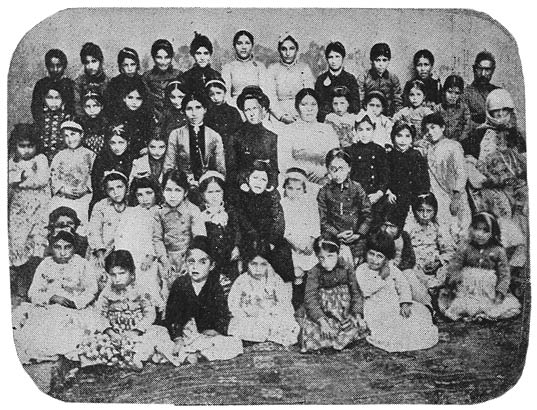
GROUP OF ARMENIAN CHILDREN.
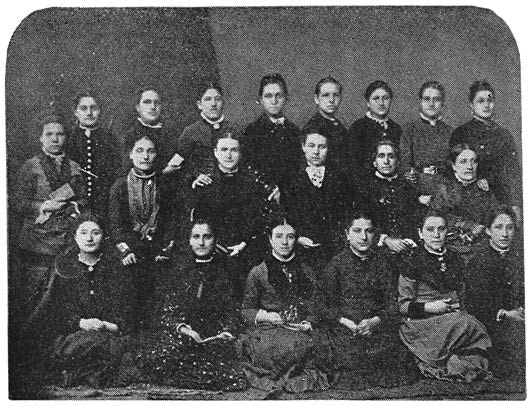
GROUP OF YOUNG ARMENIAN WOMEN.
To sum up, during these frightful scenes in Armenia more than 100,000 Armenians were killed, and half a million left without food, homes, or clothing; they are dying in heaps; and there is no hope of getting any help from Armenia itself, even when the spring comes, for those who would have supported them are killed, and most of the destitute are women and children. Everything, even to clothes, is taken from them, the head of the family is killed, and they are left hopeless and in despair. How long can the Red Cross Society help them? How long can the American people help them? Not very long; when spring comes they will say, “We have done all we could for the Armenians; let them take care of themselves.” But will they stop to think how the Armenians can take care of themselves? Have they oxen and horses to plough? No. Is there any man left to support his wife and children? No. Suppose here and there an Armenian is left (I mean in the country places, not in the cities), dare he go out to his field and work? No. Were any of those who plundered and killed punished? No. What guarantee can we have, then, that those who survive will not be killed or plundered in their turn? None. Will the European powers who signed the Berlin Treaty give any assurance to the Armenians that they will be protected hereafter? No. Is the Sultan a better man since the massacre? No. Are the Turks and Kurds better people since the atrocities? No. They are worse than ever before, because they have a freer hand, and all their passions are roused to greater strength. Well, then, if these are all facts, what is the use of feeding people a few weeks merely to keep them alive for another massacre that will finish the rest of them?
O reader, do not be cheated. The Armenians need practical aid, not deceptive aid. I mean the Armenians must be liberated from the cruel Sultan; if not, no aid is given to the Armenians. Because the future will be worse than ever before.
Thus far I have continually assumed and tried to prove that the Sultan of Turkey deliberately ordered all these atrocities committed. But perhaps you will doubt the statement of a native; you will think I am prejudiced. Therefore I will give you American testimonies from reliable sources. Please read the following from the “Review of Reviews”:—
THE MASSACRES IN TURKEY.
From Oct. 1, 1895, to Jan. 1, 1896.
Certain persons in Europe and America, misled by statements of the Turkish government, have ascribed the dreadful massacres which have taken place in Asia Minor to sudden and spontaneous outbreaks of Moslem fanaticism, caused by a revolutionary attitude among the Armenians themselves. The truth is that these massacres, while sudden, have taken place according to a deliberate and preconcerted plan. According to the statement of many persons, French, English, Canadian, American, Turk, Kurd and Armenian,—persons trustworthy and intelligent, who were in the places where the massacres occurred, and who were eye-witnesses of the horrible scenes,—the outbreaks were under careful direction in regard to place, time, nationality of the victims and of the perpetrators, were prompted by a common motive, and their true character has been systematically concealed by Turkish official reports. The following paper is based upon full accounts of the massacres, written on the ground by the parties above referred to. Their names, for obvious reasons, cannot be made public.
I. In Regard to Place.
With only four exceptions of consequence, the massacres have been confined to the territory of the six provinces where reforms were to be instituted. When a band of two thousand Kurdish and Circassian raiders approached the boundary between the provinces of Sivas and Angora, they were turned back by the officials, who told them that they had no authority to pass beyond the province of Sivas. The only large places where outrages occurred outside of the six provinces are Trebizond, Marash, Aintab, and Cesarea, in all of which the Moslems were excited by the nearness of the scenes of massacre, and by the reports of the plunder which other Moslems were securing.
II. In Regard to Time.
The massacre in Trebizond occurred just as the Sultan, after six months of refusal, was about to consent to the scheme of reforms, as if to warn the powers that in case they persisted, the mine was already laid for the destruction of the Armenians. In fact, the massacre of the Armenians is Turkey’s real reply to the demands of Europe that she reform. From Trebizond the wave of murder and robbery swept on through almost every city, and town, and village in the six provinces where relief was promised to the Armenians. When the news of the first massacre reached Constantinople, a high Turkish official remarked to one of the Ambassadors that massacre was like the small-pox; they must all have it, but they wouldn’t need it the second time.
III. The Nationality of the Victims.
They were exclusively Armenians. In Trebizond there is a large Greek population, but neither there nor elsewhere have the Greeks been molested. Special care has also been taken to avoid injury to the subjects of foreign nations, with the idea of escaping foreign complications and the payment of indemnities. The only marked exceptions were in Marash, where three school buildings belonging to the American Mission were looted, and one building was burned; and in Harpoot, where the school buildings and houses belonging to the American Mission were plundered and eight buildings were burned, the total losses exceeding $100,000, for which no indemnity has yet been paid.
IV. The Method of Killing and Pillaging.
The method in the cities has been to kill within a limited period the largest number of Armenians,—especially men of business, capacity, and intelligence,—and to beggar their families by robbing them, as far as possible, of their property. Hence, in almost every place the massacres have been perpetrated during the business hours, when the Armenians could be caught in their shops. In almost every place, the Moslems made a sudden and simultaneous attack just after their noonday prayer. The surprised and unarmed Armenians made little or no resistance, and where, as at Diarbekir and Gurun, they undertook to defend themselves, they suffered the more. The killing was done with guns, revolvers, swords, clubs, pick-axes, and every conceivable weapon, and many of the dead were horribly mangled. The shops and houses were absolutely gutted.
Upon hundreds of villages the Turks and Kurds came down like the hordes of Tamerlane, robbed the helpless peasants of their flocks and herds, stripped them of their very clothing, and carried away their bedding, cooking utensils, and even the little stores of provisions which they had with infinite care and toil laid up for the severities of a rigorous winter. Worst of all is the bitter cry that comes from every quarter that the Moslems carried off hundreds of Christian women and children.
The number killed in the massacres thus far is estimated at fifty thousand, which includes the majority of the well-to-do, capable, intelligent Armenians in the six provinces that were to have been reformed. The property plundered or destroyed is estimated at $40,000,000. Not less than three hundred and fifty thousand wretched survivors, most of whom are women and children, are in danger of perishing by starvation and exposure unless foreign aid is promptly sent and allowed to reach them.
V. The Perpetrators.
They were the resident Moslem population, reinforced by Kurds, Circassians, and in several cases by the Sultan’s soldiers and officers, who began the dreadful work at the sound of a bugle, and desisted when the bugle signaled to them to stop. This was notoriously true in Erzeroum. In Harpoot, also, the soldiers took a prominent, part, firing on the buildings of the American Mission with Martini-Henry rifles and Krupp cannon. A shell from one of the cannon burst in the house of the American Missionary, Dr. Barnum. In most places the killing was by the Turks, while the Kurds and Circassians were intent on plunder, and generally killed only to strike terror or when they met with resistance. It is an utter mistake to suppose, as some have, that the local authorities could not have suppressed the “fanatical” Moslem mobs and restrained the Kurds. The fact is that the authorities, after looking on while the massacres were in progress, did generally intervene and stop the slaughter as soon as the limited period during which the Moslems were allowed to kill and rob had expired.
At Marsovan the limit of time was four hours. In several places the slaughter and pillage continued from noon till sundown, or later. At Sivas they continued for a whole day. In every place the carnage stopped as soon as the authorities made an earnest effort, and had it not been for their intervention after the set time of one, two, or three days, the entire Armenian population might have been exterminated.
VI. The Motive of the Turks.
This is apparent to the superficial observer. The scheme of reforms devolved civil officers, judgeships, and police participation on Mohammedans and non-Mohammedans in the six provinces proportionately. This, while simple justice, was a bitter pill to the Mohammedans, who had ruled the Christians with a rod of iron for five hundred years. All that was needed to make the scheme of reforms inoperative was to alter the proportion of Christians to Mohammedans. This policy was at once relentlessly and thoroughly executed. The number of the Armenians has been diminished, first by killing at a single blow those most capable of taking a part in any scheme of reconstruction, and secondly by compelling the survivors to die of starvation, exposure, and sickness, or to become Moslems.
It is the very essence of Mohammedanism that the “ghiavour” has no right to live, save in subjection. The abortive scheme of Europe insisting on the rights of Armenians as men, has enraged the Moslems against them. The arrogant and non-progressive Turks know that in a fair and equal race the Christians will outstrip them in every department of business and industry, and they see in any fair scheme of reforms the handwriting on the wall for themselves. If the scheme of reforms had applied to regions where Greeks predominate, the latter would have been killed and robbed as readily as the Armenians have been. Are the Greek massacres of 1822 forgotten, when 50,000 were killed, or the slaughter of 12,000 Maronites and Syrians in 1860, and of 15,000 Bulgarians in 1876?
VII. Turkish Official Reports.
The refinement of cruelty appears in this, that the Turkish government has attempted to cover up its hideous policy by the most colossal lying and hypocrisy. It is true that on Sept. 30, 1895, some hot-headed young Armenians, contrary to the entreaties of the Armenian patriarch and the orders of the police, attempted to take a well-worded petition to the Grand Vezir, according to a time-honored custom. It is also true that the oppressed mountaineers of Zeitoon drove out a small garrison of Turkish soldiers, whom, however, they treated with humanity; it is likewise true that in various places individual Armenians, in despair, have advocated violent methods. But the universal testimony of impartial foreign eye-witnesses is that, with the above exceptions, the Armenians have given no provocation, and that almost, if not quite, all the telegrams purporting to come from the provincial authorities accusing the Armenians with provoking the massacres, are sheer fabrications of names and dates. If the Armenians made attacks, where are the Turkish dead?
And the dreadful alternative of Islam or death was offered by those who have dazzled and deceived Europe with Hatti Shereps and Hatti Humayouns, promulgating civil equality and religious liberty for their Christian subjects.
Strangest of all, he who is the head of all authority in Turkey, and responsible above any and all others for the cold-blooded massacres and plundering of the past two months, wrote a letter to Lord Salisbury, and pledged his word of honor that the scheme of reforms should be carried out to the letter, at the very moment when he was directing the massacres. And the six great Christian powers of Europe, as well as the United States, still treat this man with infinite courtesy and deference; their representatives still dine at his tables, and some of them still receive his decorations.
VIII. The Solution.
If the Armenians are to be left as they are, it is a pity that Europe ever mentioned them in the treaty of Berlin or subsequently; and to intrust reforms in behalf of the Armenians to those who have devoted two months’ time to killing and robbing them is simply to abandon the Armenians to destruction, and to put the seal of Europe to the bloody work. The only way to reform Eastern Turkey is by forcible foreign intervention—not the threat of it, but the intervention itself.
The position and power of Russia give her a unique call to this work. Should she enter on it at once, the whole civilized world would approve her course.
Russia should have as free a hand in Kurdistan as England has insisted on having in Egypt. By frankly admitting this, England would gain in the respect and sympathy of the world, and strengthen her own position.
INFERENCES FROM THE ARMENIAN ATROCITIES.
First: That devotion to Christ is not lessened but increased. Many people think the spirit of unbelief and indifferentism has spread so widely that in this nineteenth century people will no longer die for Christ. But out of 100,000 Armenians massacred, 90,000 were actually martyred because they would not deny Christ. In all lands, Christians praise the old martyrs, the church fathers: let them know that there are as noble church sons and daughters to-day in Armenia as there were church fathers anywhere in the early centuries. Thus these hideous scenes ought to awaken a true Christian spirit both in this country and in Europe.
Second: That it was a religious persecution. Though the false and cruel Sultan gave a political color to it, his universal order was to offer the Armenians the choice of Mohammedanism or death. This is proved by the fact that the leading gospel ministers were specially chosen for martyrdom. And some of the Armenian priests, after having been converted by force, to escape unbearable tortures, were led through the streets, followed by great crowds, as a warning to the remaining Armenians that they must follow the same road. When some of them did it, the Turks forced them to take arms and kill their brothers and sisters for refusing to accept Mohammedanism. To speak of the massacres as political affairs is doing injustice to the cause of Christ.
Third: That whatever a man sows, he shall reap the same. The Sultan and the Turks are sowing,—they are killing, and thousands of the Christians are converted by force to Mohammedanism; but the time is coming when more Mohammedans will be killed than Armenians have been, and thousands, and even millions of the Mohammedans will be converted to Christianity, and the blood of the Armenian martyrs will be the means of their salvation through Jesus Christ. The time is coming when out of this great persecution a great and happy freedom will proceed. Out of this great darkness a very bright light shall shine.
Fourth: Some of the Turks helped and saved the Armenians. Certainly these were secret converts to Christianity, but their lives being in danger, they cannot confess Christ publicly. All they can do for the present is to help the needy Christians and save them from murder. Another class of Turks who helped is those who were themselves getting a living out of the Armenians. The Armenians gave them employment, and if their employers were killed, how could they get a living? Still another class protected the Armenians, because if the Armenian houses were burned, their houses also would be burned; and they asked and got money from the Armenians as a reward for having saved them. It is a mistake to think that there are good Mohammedans, who, from a good Mohammedan motive helped the Armenians. There cannot be a good Mohammedan motive towards a Christian; if there is a good motive, it is not a Mohammedan motive.
Fifth: That the time has come when American and European Christians should trust no longer in the promises of the Sultan and the European governments, but as Christian people must use something more than “moral principle” before all the Armenians and American missionaries are killed. Moral influence is very good as far as it goes; being a Christian minister, I also believe in it. But as far as the Turks are concerned it can do nothing, because they do not know what morals are, or what moral character is. All the Turks are morally corrupt. They know only two things; one is the sword, the other is moral corruption. They came and captured that country by the sword, and they must go by the sword; there is no other way. Europe tried the experiment century after century, but could find no other way. Moral advice, wise counsel have never moved the Turks, and will never move them hereafter. Europe and a part of Armenia were taken from them by the sword, and the only way Armenia and the Armenians can be saved is by using the sword. When Christ comes again He will never yield; He will never be crucified, but he will judge and condemn. The time has come when Christians have suffered enough; they must unite and remove that great curse, the Mohammedan power, and make free that happy and beautiful Bible Land, Armenia and Palestine.
Reader, you cannot go and visit to-day the places where man was created, where Noah’s ark rested. You cannot go in safety to visit the places where Christ was born and walked. Why? Simply because a corrupt Mohammedan power wills there, and will not permit you. Is it not a shame to mighty Christian nations and powers that this is so? Will not the Christian nations be aroused with great indignation and give the last blow to such a cruel Mohammedan tyranny?
Sixth: That Turkey is a mere barbarism; it is not to be considered or treated as a nation, for it is not one in any sense. International law cannot be applied to Turkey. The Sultan must be considered as a brigand, a mere lawless oppressor, and the Turks as mere murderers, and dealt with accordingly. The powers must give up the farce of treating the Sultan as a national sovereign, who speaks for his people, and may govern, therefore, much as he pleases. As Mr. W. W. Howard says, “The blackest spot in the round world is the heart of the Sultan of Turkey.”
A Farewell Letter from a Prominent Armenian. March 24, 1896.
“We are evidently a doomed people. A hundred thousand of us have been butchered, and more than a million of us are in extreme suffering from hunger, and cold, and nakedness. Multitudes beyond the reach of foreign aid must inevitably perish before spring. As to the rest of us, our supplies of food and money are rapidly diminishing. We can prosecute no business, we are not at liberty to earn our daily bread, and for even the most fortunate, the future has only the prospect of starvation a little later than our poor brethren.
“We hear the announcement that order and peace are being restored, but to us these are empty words. The terrible and wholesale massacre at Oorfa and Birijik occurred long subsequent to the most solemn and emphatic assurances that nothing more of the kind was to be apprehended,—long after the commission sent out from Constantinople to carry the message of peace and reform to Armenia had reached its field of labor.
“Massacres are not now so frequent as they were a few months ago, but the attitude of relentless hostility on the part of the government towards us, the ferocious aspect of our Moslem neighbors, has not a whit improved. They seem to be eagerly watching for an opportune moment in which to finish their bloody work, and rid themselves forever of this troublesome demand for reform.
“May we not then rightfully offer our farewell message to our fellow men?
“First—To our Moslem fellow countrymen:
“We desire to express our deepest gratitude to those of you who have sympathized with and helped us in these days of calamity and bloodshed. Towards those who have robbed and massacred us, and plundered and burned our houses, we have chiefly feelings of compassion. You have perhaps done these terrible things in what has seemed to you the service of your religion and government.
“Second—To our Sultan—most dread and potent sovereign:
“Apparently you have been persuaded that we are a rebellious people deserving only utter and speedy extermination. For such as you, this work of destruction is no doubt an easy one, the more so as we have had neither the means nor the disposition to resist it.
“Third—To the European powers:
“We have not been an importunate nor a turbulent people. We did not incite the Crimean War, nor any of the subsequent wars which have stricken this empire. It is not of our will that we were begotten to a new political life by the treaty of 1856. Our complaints and appeals have been based solely on the sentiment of humanity and the common rights of man. It was you who arranged the “scheme of reforms,” and urged it upon our Sultan till he was irritated to the extent that he seems to have adopted the plan of ridding himself finally of this annoyance by exterminating us as a people; and now, while he is relentlessly carrying out this plan, you are standing by as spectators and witnesses of this bloody work.
“We wonder if sympathy and the brotherhood of man and chivalry are wholly things of the past, or are the material and political interests dividing you so great that the massacre of the whole people is a secondary thing? In either case “We who are about to die salute you.”
“Fourth—To the Christians of America:
“Although we have cherished strong prejudice against your mission work among us, recent events have proved that our Protestant brethren are one with us, and have shared fully our anxieties and our perils. You have labored through them to promote among us the peace and prosperity of the gospel. It is not your fault that one result of their teaching and example has been to excite our masters against us. The Turkish government dreads and dislikes nothing so much as the ideas of progress which you have sent us.”