III. THE ARMENIAN DYNASTIES.
Reading edition
According to the histories written by native historians from the old Armenian records.
1. THE HAIGAZIAN DYNASTY.
This dynasty began 2350 years before Christ, and ended in the time of Alexander the Great, 328 B.C. No other recorded dynasty has so long an unbroken succession.
2. THE ARSHAGOONIAN DYNASTY.
This dynasty began 150 years B.C. and ended 428 A.D.
3. THE PAKRADOONIAN DYNASTY.
This dynasty began 885 A.D. and ended 1045 A.D.
4. THE RUPENIAN DYNASTY.
This dynasty began 1080 A.D. and ended 1375 A.D.
I shall try to show the condition of the Armenians under the rule of these different dynasties.
1. THE HAIGAZIAN DYNASTY.
As already mentioned, Haig was the founder of the Armenian kingdom. He can scarcely be called a king, because in his time there was not a great Armenian nation; it was rather a tribe, and Haig was chief or governor. His position was like that of Abraham; what would now be called a sheikh; and like Abraham, he was a worshiper of the true God.
Haig went from the highlands of Armenia to the plains of Shinar to help build the Tower of Babel. During the progress of the work, Belus, a warlike giant, descended from Ham, assumed to direct the enterprise; Haig would not submit to this, and so returned to his own country. When the undertaking failed, all the tribes became scattered. To wreak vengeance on Haig, Belus resolved to go to Armenia, kill him in fight, and reign over his land. When he reached Armenia with his men on his errand, Haig went with a force to meet him; a great battle took place and Haig was victorious, killing Belus and saving his country from being overwhelmed by the Hamites. His spirit was inherited by his posterity, though recent irresistible force and refusal of permission to bear arms may seem to make them submissive. They have battled stoutly against awful odds and with insufficient means for liberty and for freedom of thought and conscience; and millions have lost their lives for those principles; if they could now have arms and help, they would fight and die again for them.
After the repulse of this Hamitic invasion, the Armenians increased so rapidly that Haig became a real king and took that title, thus actually founding the Armenian Kingship. They were free, lived long lives, and married only one wife each,—all favorable conditions for growth of population,—it need not be pointed out how slavery and polygamy check national growth. And they kept their faith in the one true God, as their ancestor Noah did.
Haig’s son Armen succeeded his father, and greatly enlarged the kingdom. He subdued a large district northeast of Mt. Ararat and built cities and towns there. It is most likely the name Armenia comes from him. Some recent foreign writers have the impudence to say that there was no such king, but that his name was made up to account for that of Armenia; but the same records which tell us of Haig, tell us of his son. After Armen we find his son Armaiss, who built the city of Armavir.
I will not enumerate all the names of the dynasty; it would only be a tedious catalogue without profit. I will only mention the most noted ones, and those most interesting from their relations with the Jews or the heathen nations.
One of the notable kings is Aram, the seventh in succession, and the greatest of Armenian conquerors. He raised and drilled an army of 50,000 men, whose efficiency and his own military skill and energy are proved by his invading and conquering Media. He then invaded Assyria and conquered a part of that country. Next he marched westward and subjugated some of the eastern portion of Asia Minor inhabited by the Greeks,—the later Cappadocia, along the Halys or Kizil-Irmak. Aram named this district the Hayasdan, translated by the Romans as “Armenia Minor”; which, oddly enough, in later times became Greater Armenia or Armenia Proper. Aram set over this province a governor named Mishag, with instructions to compel the Greeks to speak Armenian. Mishag built a city which exists in Cappadocia (Karamania) to-day, frightfully familiar from recent events. He called it by his own name; the Greeks mispronounced it as Mazag; the Roman emperors afterwards named it Caesarea, which the Turks corrupted into Kayseri, and several thousand Armenians were massacred there some months ago, which will be described further on. The richest and most enterprising Armenians in the Turkish Empire are from Kayseri, and it is a leading missionary station of the American Board. The writer preached there and in that vicinity for four years.
The enormous growth of the Armenian Kingdom under Aram, and its conquest of part of Assyria, excited the alarm of the Assyrian king, Ninos. Not feeling strong enough to engage in open warfare with him, he thought to compass his destruction by winning his friendship and then putting him out of the way, and, as a first step, sent him a costly jeweled crown. The intrigue failed, however, and Aram lived to a great age, reigning fifty years.
Aram was succeeded by his son Ara, called “Ara the Beautiful.” The fame of his beauty went abroad through the world; the Assyrian queen Semiramis was so enchanted by the sight of his person that she fell madly in love and proposed marriage to him, but he refused her. This military Amazon was not to be balked so. She resolved to marry him by force, and came with a great army to Armenia to capture the prize; but he was killed in the war, and she took possession of the country, with which she was so charmed that she decided to remain; she removed the capital of the enlarged Assyrian Kingdom to the lovely shores of Lake Van, erecting a palace there for herself, and building on the eastern side a city named “Shamiramaguerd” (built by Semiramis). Many years later, a king of the Haigazian Dynasty whose name was Van rebuilt it and called it after himself. This was the present city of Van, another great center of the American Board and of Turkish horrors.
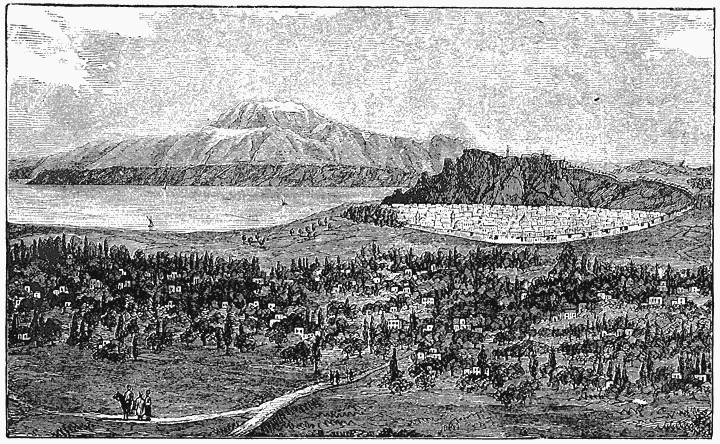
LAKE VAN AND CITY OF VAN.
The next great interesting event was in 710 B.C. when Sennacherib of Assyria was assassinated by his two sons, Adramelich and Sharezer, who escaped into Armenia. The king of Armenia at this time was Sgayorti, which means “son of a giant.” He received the sons of Sennacherib with great kindness; they married Armenian women, and remained in the country till their death. Their descendants were great Armenian princes, bearing the titles Prince Arziroonian and Prince Kinoonian.
Armenia comes to view again in connection with Biblical history in the capture of Jerusalem by Nebuchadnezzar, 600 B.C., and the deportation of the Judean people; the Armenian king, Hurachia, was one of his allies in the siege, and on returning to Armenia carried with him a Hebrew prince named Shampad. This was a very intelligent man, and made himself greatly loved and esteemed by the Armenians; a sort of Daniel or Joseph. He, too, married an Armenian noblewoman, and his descendants became the very foremost of the noble families and ecclesiastical functionaries of the country, crowning the kings on occasion. They were called Pakradoonian Princes, and at last one of them founded the third dynasty of Armenian kings, the Pakradoonian. Though the nation is Aryan, there is noble Hebrew (Semitic) blood mixed with it.
Perhaps the most interesting part of the Haigazian Dynasty comes just before the end; the time of Dikran or Tigranes I. In him both wisdom and valor were combined to an eminent degree. As soon as he succeeded his father, Yerevant, he instituted great reforms to improve the state of the country. He not only enlarged it by conquest, but he greatly improved public education and morals, removed obstructions to international commerce, introduced navigation on the lakes and rivers, encouraged cultivation; trade flourished, every acre of ground was tilled, the country was alive with energy and hope. This vigor and prosperity aroused the envy of Ashdahag, King of Media; he resolved to kill Dikran, and to throw him off his guard married his sister, Princess Dikranoohi. A plot to murder Dikran was then set on foot; the princess learned of it, warned her brother, whom she loved, and ran away. Dikran collected an army, made a rapid march to Media, surprised and slew Ashdahag, and brought back a vast amount of spoils in captives and goods. He built a fine city on the banks of the Tigris, and called it Dikranagerd, the city of Dikran; it was afterwards the residence of the sister who had saved his life. It is now called by the Turks Diarbekr, and was the scene of a frightful massacre a few months since. The most important political achievement of his life was assisting Cyrus in the capture of Babylon 538 B.C.; the two monarchs were very friendly, and Dikran’s Armenian army was a chief factor in the conquest. In Jeremiah’s prophecy of the capture, about a century before it occurred, he mentions the Armenian Kingdom as one of the actors: “The Kingdoms of Ararat, Minni, and Ashchenaz.” (Jer. li. 27.)
After Dikran’s death his son Vahakn succeeded him; he was considered a god by the people, and worshiped as such through a monument after his death. Thus far the people had mostly worshiped the one true God, but from this time they relapsed into heathenism for a while on account of the influences pressing on them from outside. The last king of the Haigazian Dynasty was Vahe. When Alexander the Great invaded Persia, Vahe went to Darius’ help with 40,000 infantry and 7,000 cavalry; but Alexander conquered first Darius and then Vahe (328 B.C.), and annexed both Persia and Armenia. Thus came to an end the first Armenian dynasty, after an existence of 1922 years.
ARSHAGOONIAN OR ARSACID DYNASTY.
This dynasty began not far from 150 B.C.,—close to the time when Carthage was utterly destroyed, and Greece was finally subjugated; it ended 428 A.D., about half a century before the extinction of the Western Roman Empire, and about the time Genseric and his Vandals conquered Africa. It is by far the most famous of the Armenian royal houses; for it embraces the very heart of the classic times with which all educated people are familiar, it brings us perpetually in contact with the most brilliant and best-known of classic names, it is sprinkled itself with names towering up familiar and powerful, even among the Greek and Roman magnates; and, in spite of political ups and downs, it covers a time of immense expansion for the Armenian people, of a firmly rooted growth in numbers, wealth, and consciousness of national unity, which has enabled the nation to survive and keep its united being through many centuries of dismemberment, impoverishment, massacre, and attempts at outright extermination again and again. More than all, it covers the time of Jesus Christ, and the conversion of Armenia to his religion, first of all the nations of the earth, as by its history and traditions it ought to have been.
During the time between the disappearance of the line of Haig and the rise of the line of Arshag, Armenia was not by any means wholly without kings of its own; but it was mostly a dependency.
Alexander the Great, after his conquest, put a native governor named Mihran over it; but on Alexander’s death, five years later (323 B.C.), his generals partitioned the Macedonian Empire among themselves, and Armenia fell to Neoptolemus. His government was at once so oppressive, and so contemptuous of native feeling (he and his court were Greeks, and despised all Asiatics), that the people rose and drove him out in 317, under the lead of one Arduat (Ardvates), who remained their king for thirty-three years; but he left no successor, and Armenia was conquered by and became part of the great Syrian Empire founded by Seleucus. It remained so in the main for about three quarters of a century, though the eastern part (Kurdistan), fell under the Parthian kings. Armenia was never a very quiet province, however, and its revolts against the Syrian satraps kept it much of the time in a half-anarchic state. About 210 B.C. Antiochus the Great quelled one of these uprisings, and divided the country into Greater and Lesser Armenia (whose boundaries I have described), putting a separate deputy over each. But after his crushing defeat by the Romans at Magnesia in 189 B.C., and having to buy peace by giving up everything beyond the Halys, each governor proclaimed his province an independent kingdom. Zadriades (Zadreh), in Lesser Armenia founded a family which kept their hold for almost exactly a century, when Tigranes II once more united the two Armenias. Artaxias (Ardashes), in Greater Armenia was powerful as long as he lived, and sheltered Hannibal at his court when the Romans had set a price on the head of their great foe; but about the middle of the century his family was dispossessed by Mithridates of Parthia, who conquered the country. The family name of this Parthian house was Arshag, rendered by the Greeks Arsakes, spelled by the Romans Arsaces. Mithridates made Greater Armenia a kingdom for his brother Wagh-arshag (Val-arsaces), whose family remained in succession to the throne, though sometimes eclipsed for long periods from actual occupation of it, for six hundred years. The new king had the great hereditary ability both in war and statesmanship which characterized the whole Arsacid line, and the Mithridates in particular, and its great knowledge of men. He knew an able man when he saw him, and liked to raise him up; he promoted industry and built cities; he reformed the system of laws and their administration as well.
The new line did not escape the usual fate of Eastern dynasties, of having disputes over the succession, in which their neighbors interfered. In 94 B.C., Dikran or Tigranes II (great-grandson of Wagh-Arshag), owed his possession of the throne of Greater Armenia to his third cousin, Mithridates II (the Great), of Parthia, who exacted seventy Armenian valleys as the price; probably part of Kurdistan. Tigranes, however, paid no more blood-money to anybody when once on the throne. On the contrary, he began at once to overrun and annex the neighboring states. He first conquered Lesser Armenia, and made it one with its sister again; then part of Syria, so long the mistress of his own state; then, in a series of wars with the weak successors of Mithridates, he half destroyed the Parthian Empire itself, not only recovering the seventy valleys he had paid for his throne, but conquering Media, and annexing Mesopotamia and Adiabene. After these conquests he called himself “King of Kings” (that is, emperor, king with other kings under him), which title the Parthian kings had claimed theretofore. He would probably have ended by mastering and restoring the unity of the old Seleucid Kingdom in its widest extent, the whole heart of Western Asia, had he not in an evil hour been induced by that reckless old fighter, his father-in-law, Mithridates of Pontus, to join him in war against the Romans. Tigranes’ own son had quarreled with him, and taken refuge with the King of Parthia, whose daughter he married; and now offered to guide his father-in-law into Armenia if he would invade it as the ally of the Romans. This was done, and Tigranes the elder had to fly to the mountains; but the Parthian king grew tired of the siege of rock castles, and went home, leaving his son-in-law to carry on operations with part of the army. The great Armenian king at once broke loose and annihilated the forces of his son, who fled to Pompey, just invading Armenia with the Roman army. Even the great Tigranes was no match for Rome, and had to surrender. Pompey was not harsh with him, but left him Armenia (except Sophene and Gordyene, which were made into a kingdom for his son), and his Parthian conquests; even going so far as to send a Roman division to wrest these from the Parthian king, who had re-conquered them on Tigranes’ defeat, and restore them to the latter. On the departure of Pompey the Parthian once more reclaimed them, but a compromise was finally made. Phraates of Parthia, however, resumed once more the title of “King of Kings.” Tigranes remained the ally of the Romans till his death in 55 B.C.; a reign of thirty-nine years, on the whole of great glory and usefulness.
He was succeeded by his son, Artavasdes (Ardvash) II, who inherited that most dreadful of legacies, a place between the hammer and the anvil. For the next quarter of a century the Romans, and the steadily growing and consolidating power of the Parthian Empire were alternately irresistible in Eastern Anatolia; it was impossible to avoid taking sides, for neutrality meant invasion by one party or the other; and whichever side he took he was sure to be punished for as soon as the other came uppermost. If Artavasdes had been as dexterous as Alexius Comnenus himself, he could hardly have escaped ruin; that he kept his throne for over twenty years is proof that he was not unworthy of his father. First came the invasion of Parthia by Crassus; Artavasdes, faithful to his father’s Roman allegiance; asked him to make the invasion by way of Armenia, and offered to help him. Crassus refused, but the Parthian king, Orodes, invaded Armenia; however, he made peace, and betrothed his eldest son, Pacorus, to Artavasdes’ daughter, just before news was brought him of the annihilation of Crassus’ army, guaranteed by Crassus’ severed head and hand. The civil wars at Rome for years to come broke the Roman power, and the Parthians (with the good-will of the inhabitants, who detested the Roman proconsuls), swept westward, compelled submission or alliance from all the countries to the Taurus, and even annexed all Syria for a time, just as seven centuries later the Syrians, from hate of the Byzantine governors, gave up their cities to the Saracens. But the Roman power once more rallied; the Parthians were driven out of Syria, and Pacorus was killed; the aged Orodes, under whom the Parthian Empire proper reached its pinnacle, died, leaving the throne to one of those jealous murderous despots so familiar in Eastern history, who made a general slaughter of his brothers, and even murdered his son, to remove any possible leader of a revolt, and Artavasdes once more returned to the Roman alliance. In the year 36 A.D., Mark Antony undertook the task Crassus had so terribly failed in seventeen years before, of striking at the heart of Parthia; but this time the invasion was by way of Armenia. It was almost as frightful a disaster as the former; a third of the army of 100,000 men was destroyed by the enemy, 8,000 died of cold and storm in the Armenian mountains, the wounded died in enormous numbers; but that Artavasdes let the army winter in his country it would have perished as completely as Crassus’ did. In spite of this, the Romans, wanting a scapegoat, laid the whole blame on Artavasdes, without a shadow of reason that can be shown. It was the last time for a century and a half that the Romans attacked Parthia. In default of that plunder, they resolved to have Armenia, and a couple of years later, in the year 33 A.D., they seized Artavasdes by treachery, and occupied the country. The Parthians at once took up the cause of his son, Artaxes, and made war on the Romans to seat him on the throne; and when the Roman troops were withdrawn to help Antony’s cause, which was lost in the battle of Actium, the Parthians overran Armenia, and killed all the Romans in the country, and made their candidate king as Artaxes II. This was in 30 B.C., and in the same year his father, Artavasdes, who had been carried to Alexandria by Antony, was beheaded by Cleopatra. But the very next year the worthless tyrant Phraates of Parthia was driven from the throne by a rebellion, and Artaxes made peace with Rome.
The history of Artavasdes’ reign is in essence the history of the next four centuries, save that the results were incomparably worse. We have been dealing with a time at least of steady, single-handed government, of able rulers either inside or outside, of some sort of ability to keep the civil structure of the country from breaking to pieces; but even that disappears over long periods in the early centuries of the Roman Empire. One great secret of Armenia’s misery during these ages of woe—indeed, to a large extent during all the ages since—lies in the fact that she is a borderland; a buffer between great states, and indeed between great natural divisions of climate and society. She is the boundary between semi-tropic Central Asia and temperate Eastern Europe, touching the land of the fig and the silk-worm on the one side, and that of the apple and the mountain goat on the other; between Scythian steppes and Syrian deserts. In these earlier ages she was fought for between east, west, and south,—Parthia, Rome, and a Syro-Egyptian power of some sort; in these days divided between east, west, and north,—Persia the successor of Parthia, Turkey the successor of Rome, while the southern power is ages dead, and a great northern power, Russia, has grown up in the steppes. Had Armenia been smaller, or more level, she would have perished without a struggle, perhaps rather would never have existed; but her territory is so large and so defensible that her history could have been predicted,—final dismemberment between great states surrounding her, yet not without ages of desperate struggle. She was not large enough to be permanently the seat of empire; she was far too large for either rival to let pass wholly into the hands of the other—so she was pulled to pieces. But she wanted to control her own destiny, and made a long and heroic fight before being dismembered.
To write the history of the next few centuries would tire out all my readers, and would not do any good; it was a long duel between Rome and Persia for the ownership of Armenia, in which the prosperity and happiness of their unhappy foot-ball nearly perished. Almost the whole foreign policy of Parthia was to control, or to have a paramount influence in Armenia; almost the whole foreign policy of Rome in the East was to do the same thing. For nearly a century following Artavasdes’ deposition, though the Romans professed to govern the country and the Parthians sometimes held it, and both sides repeatedly put kings on its throne, it was actually in a state of pure anarchy. Every great family, seeing it must depend on its own strength for preservation, extended its rule over as wide a district as would submit; nearly two hundred houses acted with perfect independence of each other, and of the nominal government, and some of them established principalities of considerable size. After this, though the country was for century after century just the same shuttlecock between the rival states, the feudal anarchy was somewhat reduced, the turbulent nobility better held in check, but it was impossible that there should be really firm and orderly government when a king could not be secure of his throne for a year on one side or the other, and dared not render his powerful subjects disaffected by making them obey the laws. We may be sure that the government was really an oligarchy under the forms of a monarchy, and even the title “King of Armenia” during this period must not be taken to mean too much. There were sometimes separate kings of Upper and Lower Armenia, one under Roman, and one under Parthian influence; the independent princes often made head against both, and outlying principalities, like those of Osrhoene and Gordyene probably got hold of more or less Armenian territory in the melee. No king of Armenia after Tigranes ever held sway over all of old Armenia for any length of time, if at all. But any king who got an acknowledged position at all was invariably an Arshagoonian; the people considered that line the only rightful kings. Artavasdes III, whom the Romans seated in power just before the birth of Christ; Tigranes IV, who expelled him by Parthian aid the year of Christ’s birth; Vonones, a deposed Parthian king, who got himself chosen king as the Roman favorite in 16 A.D., but was persuaded by Tiberius to retire; Arsaces, son of the king of Parthia, assassinated by the king of Iberia whose brother was the Roman candidate, about the time of the crucifixion; Ervand, who made himself master of the land after a fashion, in 58; Dertad (Tiridates), set up by the Parthians in 52, and acknowledged by the Romans in 66; Exedarus (Eshdir?) son of the Parthian king, given the throne with Roman consent about 100, pulled down by his uncle in 114, resulting in the conquest of the country by Trajan; Sohaemus, set up by the Romans about 150, dethroned by the Parthians in 162 in favor of another Arsacid, restored by the Romans in 164; and the other fleeting monarchs of this long nightmare were all of the same line of Arshag, which in Armenia survived for over two centuries its brother line in Parthia, the last of whom, Ardvan (Artabanus), was slain in battle in 224 by Ardashir (Artaxerxes), first of the Sassanian house, and founder of the Persian Empire. But I must go back a little.
The most important event in the history of any nation is its conversion to Christianity, and therefore we wish to know when the Armenians first came to believe in Christ, and how it came about. Of course it did not come all at once; but it came very early, and the story of the first converts is very curious. According to the Armenian church history, and also the great Christian father Eusebius, it came through King Abgar or Apkar (Abgarus), the fifteenth king of the little kingdom of Osrhoene, in northern Mesopotamia, whose capital was the flourishing city of Edessa, now Oorfa; it lay next the southern border of Armenia.
The church history gives the following account:
“The origin of Christianity in Armenia dates from the time of its king Abgar, who reigned at the beginning of the Christian era; he had his seat of government in the city of Edessa, and was tributary to the Romans.
“Herod Antipas, the tetrarch of Judea, was hostile to king Abgar, but was unable to injure him except by exciting the Romans against him. He therefore accused him falsely, to the Emperor Tiberius, of rebellious projects. King Abgar, on being made acquainted with this accusation, hastened to send messengers to the Roman general Marinus, then governor of Syria, Phoenicia, and Palestine, for the purpose of vindicating himself. During their stay in Palestine these messengers—among whom was Anane, Abgar’s confidant—hearing of the wonders that were wrought by our Saviour, determined to visit Jerusalem, in order to gratify their curiosity.
“When, therefore, their mission was concluded, they proceeded thither and were filled with wonder at witnessing the miracles performed by Jesus our Lord.
“On returning to Armenia they related all the particulars to their master. Abgar, after having listened to their narrative, became satisfied that Jesus was the son of God, and immediately wrote to him as follows:
“ ‘Abgar, son of Arsham, to Jesus, the great healer, who has appeared in the country of Judea at the city of Jerusalem—greeting Lord,—I have heard that thou dost not heal by medicines but only through the Word; that thou makest the blind to see, the lame to walk; that thou cleansest the lepers and makest the deaf to hear; that thou castest out devils, raiseth the dead, and healest through the word only. No sooner had the great miracles that thou performest been related to me, than I reflected, and now believe that thou art God and the son of God, descended from heaven to perform these acts of beneficence. For this reason I have written thee this letter, to pray thee to come to me, that I may adore thee and be healed of my sickness by thee, according to my faith in thy power. Moreover, I have heard that the Jews murmur against thee, and seek to slay thee. I pray thee, therefore, come to me; I have a good little city, which is enough for both of us, and there we can peaceably live together.’ ”
The messengers sent with the letter were instructed to offer sacrifices for the King at the temple in Jerusalem; and one of them was a painter, who was to make a portrait of the Saviour, that if he would not come, the king might at least have his features. Jesus received the letter joyfully,—as it was the day of his triumphal entry into Jerusalem, the messengers did not venture to approach him, and it was taken to him by the apostles Philip and Andrew,—and dictated the following answer to the apostle Thomas:
“Blessed be he who believes in me without having seen me; for thus it is written of me: Those who see me shall not believe in me; and those who do not see me, they shall believe and be saved. Inasmuch as you have written to me to go to you, know that it is necessary I should fulfill here all for which I have been sent. And when I shall have done so, I shall ascend to Him who sent me; and then I will send you one of my disciples, who shall remove your pain, and shall give life to you and those around you.”
The painter could not execute his order on account of the multitude; the Saviour at last noticed him, and causing him to approach, passed a handkerchief over his face and miraculously imprinted on it a perfect likeness of his countenance, and then gave it to him, and bade him take it to his master as a reward for his faith. The king received the letter and portrait with great joy, and put them in safe custody, and awaited the fulfillment of our Lord’s promise.
After the Ascension, Thomas, the disciple, sent Thaddeus, one of the seventy, to Abgar, as our Lord had directed. Thaddeus went to Tobias, a prince of the Pakradoonian tribe, and consequently a Jew by blood, who received the apostle into his house, and became a believer. Thaddeus then began to perform many miracles upon sick people, and his fame being spread throughout the city, reached King Abgar, who sent for Prince Tobias and desired him to bring the apostle to him. This was done, and Thaddeus healed the king in his sickness, and instructed him in the faith. He did likewise to all the people of the city, and baptized them, together with the king and his court. All the temples dedicated to idols were shut up, and a large church was built. Thaddeus then created a bishop to rule the new congregation, selecting a silk-mercer, the king’s cap-maker, for that office, and giving him the name of Adde. It is related that upon the principal gate of Edessa was the statue of a Greek idol, which all who entered the city were obliged to reverence. King Abgar ordered this to be taken away, and placed in its stead the sacred portrait of our Lord, with this inscription: “Christ God, he who hopes in thee is not deceived in his hope;” at the same time ordering all those who entered the city to give it divine honor. This conversion of King Abgar and of the Edessians took place in the thirtieth year of the Vulgar Era, or in the thirty-third year after the birth of Christ.
Shortly after, Thaddeus, desiring to spread the light of the Gospel in other parts of the country, went to Inner Armenia to visit Sanadrug, who then resided in the province of Shavarshan or Ardaz. Sanadrug soon became a Christian and was baptized, together with his daughter Santukht, and a great number of the chiefs and common people. Here Thaddeus also consecrated a bishop, named Zachariah, and then proceeded to Upper Armenia; but finding the people there unwilling to listen to his preaching, he left them and went to the country of the Aghuans.
Abgar, in his zeal for the faith he had just embraced, wrote to the Emperor Tiberius in favor of Christ, informing him how the Jews unjustly crucified him, exhorting him at the same time to believe and command others to adore the Saviour. Many letters passed between the two monarchs on the subject of his divine mission. He also wrote to Ardashes, king of Persia, and to his son Nerseh, the young king of Assyria, exhorting them to become believers in Christ. However, before he received replies to these, he died, in the third year of his conversion to Christianity.
His death seemed at first to have undone all his work. His son Anane apostatized and tried to make his people do the same; he reopened the heathen temples, resumed the public worship of the idols, and ordered the sacred handkerchief removed from the city gate. Adde the bishop walled up the latter. The king ordered the bishop to make a diadem for him as he had for his father; the bishop refused to make one for a head that would not bow to Christ, and the king had the bishop’s feet cut off while he was preaching, causing his death,—the first Christian martyr on record. By a just retribution, the savage king met his own death by a marble pillar in his palace falling on him and breaking his legs.
Meantime Abgar’s nephew, Sanadrug, had set up his standard in Shavarshan or Ardaz, proclaiming himself king of Armenia,—one of the countless chieftains who took advantage of Armenian anarchy to carve out principalities for themselves. On the death of Anane he marched to Edessa, claiming it as his own inheritance. The people admitted him on his oath not to harm them; but once inside he massacred all the males of the house of Abgar. He spared his aunt, Queen Helena, Abgar’s widow, who became widely famed as a Christian philanthropist, and was buried with great pomp before one of the gates of Jerusalem, where a splendid mausoleum was erected over her remains. He himself had apostatized, and ordered all his people to do likewise; but most of them refused to obey, and Thaddeus, hearing of it at Caesarea, in Cappadocia, started for Edessa to reconvert him. On his way he fell in with a Roman embassy to Sanadrug, composed of five patricians headed by one Chrysos; he converted and baptized them all, conferred priest’s orders on Chrysos, and they gave up all their property and became preachers of Christ. They were known as followers of Chrysos, and all eventually obtained the crown of martyrdom.
On the news of these conversions, Sanadrug invited Thaddeus to Shavarshan; on his arrival he put him to death, and with him his own daughter, Santukht, who would not give up her faith in Christ. At her death various miracles were wrought, which caused many conversions to Christianity; among them a notable chief, who was baptized with all his family, was renamed Samuel, and was put to death by the king’s order.
A princess named Zarmantukht also became a convert, with all her household, two hundred people in all; the whole of them suffered martyrdom in consequence.
Dr. Philip Schaff says: “It is now impossible to decide how much truth there may be in the somewhat mythical stories of correspondence between Christ and Abgarus, and the missionary activity and martyrdom of Thaddeus, Bartholomew, Simon of Cana, and Judas Lebbeus. But it is certain that Christianity was introduced very early in Armenia.” I, however, consider what I have told to be true.
After this time, Christianity spread in Armenia as it did in other parts of the Greek Empire; rapidly in the cities, where intelligence was quick, and new ideas were welcomed; slowly in the country districts, where people did not readily change. Its first result everywhere was not so much to make people believe in it as to make them disbelieve in Paganism; for every person who actually came to believe in Christ, there were fifty who ceased to believe in Jupiter, or Bel, or Thoth, Venus or Astarte. There would be a flourishing Christian church in a great city when most of the people did not have any faith in any religion. But everybody who had a family came gradually to think very well of a religion that gave them the power to teach children righteousness, and enforce it by the command of God; and the respectable classes became more and more Christian. But the fact that till two or three centuries after Christ there was no general attempt on the part of the pagan governments to put down the Christians by persecution, shows that not till then did they become so numerous as to frighten the governments for fear they would before long have a majority; persecution means fear. The governments let the Christians pretty much alone, except for little fits of anger now and then, till they were afraid the growth of the sect would overthrow themselves or bring on civil war. The Christians had become well established in Armenia within a century or so after the death of Christ; but it was over a century and a half before they seemed an imminent menace to the ruling class. Then a furious persecution began, about the same time as that of Diocletian in the Roman Empire, and indeed, part of the same movement. Diocletian had set the persecuting King Tiridates on his throne, and Tiridates had passed his life from boyhood almost to old age in the Roman service, and had the same ideas as the pagan Roman upper classes. Yet in the providence of God this same Tiridates made Christianity supreme in Armenia, fifteen years before Constantine made it supreme in the Roman Empire, thus making Armenia the first Christian nation.
Gregory the Illuminator and King Dertad.
In the continual struggle between Rome and Parthia for the control of Armenia, the Parthian kings had one great advantage; they were Arsacids, and could put their sons or brothers on the Armenian throne with the good-will of the people, thus strengthening their dynastic position without much cost in military force. Often, too, the Armenian kingship was obtained by Parthian princes, who fled after a family quarrel, or after deposition or other misfortune. One of these Armenian kings was Chosroes, who reigned in the time of Ardashir, the first king of Persia, before spoken of. It is not certain just who he was; some say a brother of Ardvan, the last king of Parthia; some say the son of Ardvan, who fled after his father’s death. Anyway, he was a mortal enemy of Ardashir, and was at first supported by the Romans. Ardashir invaded Armenia, but was beaten later. Chosroes quarreled with the Romans, who withdrew their support, and assailed him, but he defeated them; and when Ardashir again invaded the country, Chosroes again drove him back. The old days of Tigranes seemed to have returned, and Armenia to be on the road again to unity and independence; and Chosroes was called the Great. Ardashir was furious at being baffled, and is said to have offered his daughter’s hand and a share in the kingdom to any one of his leading nobles who would assassinate Chosroes. An Arsacid named Anag accepted the offer, though he had a wife already, and went with his family to Armenia, pretending to be in flight from Persian troops. Chosroes gave him a military escort into the province of Ardaz, where he lived for a time in the very place St. Thaddeus’ bones were deposited. Later on, Anag removed to Vagharshabad (the present city of Etchmiazin, where the Armenian Catholicos resides), Chosroes’ royal city. Here Anag seizing his opportunity, stabbed Chosroes to the heart. In his flight he was drowned in trying to cross the Aras, and his family were massacred by the soldiery.
Ardashir had gotten rid of his unconquerable enemy, and without having to pay the stipulated price. He at once entered Armenia and put to death every member of Chosroes’ family save a boy and a girl, Tiridates and Chosrovitukht, who were somehow smuggled away, and the old game of Perso-Roman foot-ball over Armenia went on as before. Tiridates entered the Roman army, when grown up, and became distinguished there, evidently inheriting his father’s military ability; and remained in the Roman service certainly to the age of over 45, and perhaps till over 50. That the Romans waited all this time before using him as a candidate for the Armenian throne seems strange; but the reason probably is that the early years of his manhood fell in a time when Rome was weak and Persia strong. The great Shahpur, Ardashir’s son, reigned in Persia till about 272; the imbecile Gallienus of Rome reigned from 260 till 268, and was succeeded by a crowd of emperors able indeed, but too short-lived to carry out any steady policy, or drive the Persians out of their strong places. The first emperor who found himself in a position to restore the Roman power in the East was Diocletian, who came to the Roman throne in 284, and it is significant that he made Tiridates king of Armenia only two years later. As Diocletian was a soldier of fortune, probably he had known and respected Tiridates long before. Anyway, in 286 Rome once more had her turn in Armenian affairs, and with one short interval, kept absolute control of the country for over half a century.
Now there had been born in Armenia about 257 a child who had early been taken to Caesarea by Christian relatives, baptized, named Gregory, and reared in the Christian faith. On reaching maturity he married a Christian girl by whom he had two sons; but after three years they separated by mutual consent. The wife entered a convent. Gregory, hearing of Tiridates’ renown in the Roman army, went and obtained service near the prince’s person, to be able to have influence with him if he ever regained his kingdom. They became fast friends. When Tiridates was proclaimed king, he went first to Erija, in the province of Egueghatz, where was a temple of Anahid (Diana), whom the Armenians worshiped as guardian goddess of the country; and making offerings to her of garlands and crowns, asked Gregory to join him in his idolatry. Gregory refused to worship anything but the one God. Tiridates ordered him imprisoned for a while, thinking the loathsome dungeon of that time would change his resolution; finding him still firm, he had him tortured in a dozen frightful ways, and at last taken to the fortress of Ardashad and thrown into a deep pit, where criminals were left to starve. There Gregory remained fourteen years, supported all that time by the charity of a pious Christian woman. After about ten years of reign, Tiridates was driven from his throne by Persians, and once more became a wanderer; but two years later he was reinstated by the Romans, and finished his life on the throne. In gratitude for this second restoration, he had daily offerings made to the heathen gods all over his kingdom; and on being told that the Christians refused to comply, ordered all recusants to be tortured, and their property confiscated.
About this time Diocletian determined to find and marry the handsomest woman in his empire, and sent officers all over in search of noted beauties. One party, hearing that a nun named Ripsime was very beautiful, entered her convent by force, had a portrait made of her, and carried it to the emperor. Diocletian was enchanted with it, and ordered preparations made for the nuptials; but the abbess, Kayane, to save the nun from sin, and the community from danger, broke up the convent, and the inmates with several priests—seventy in all—went to the East, and scattered themselves in different localities. Ripsime and Kayane, with thirty-five companions, reached Ardashad in Armenia, and took refuge in a building among the vineyards, where wine vats were stored. Diocletian had search made for his flown bird, and, hearing that her company had gone to Armenia, commanded Tiridates to send her back to him unless he wished to keep her for his own wife. Tiridates had her hunted out, and the officers bringing a report of her extraordinary beauty, so great that people flocked to admire her, he ordered her brought to him, intending to marry her. Kayane exhorted her not to deny Christ for the sake of earthly honors, and she refused to go. She was carried by force, however, and the king undertook to gain a husband’s rights at once; but the virgin, strengthened by divine power, resisted him successfully. Tiridates then had the Abbess Kayane brought to him to overcome the girl’s scruples; but instead, she once more exhorted Ripsime to keep herself pure in spite of all offered grandeur. The king once more endeavored to deflower the maiden, and was once more beaten; and Ripsime, opening the doors and passing out through the astonished guards, walked out of the city, to her companions in the vineyard, went to a high place, and knelt down in prayer. The incensed Tiridates sent a body of guards to put her to death by the most dreadful tortures, which was done, and her body cut into small pieces. Her companions gathered to bury her remains, and were at once butchered by the soldiery, as well as a sick one, who had stayed behind in the wine press. The bodies of the thirty-four martyrs were thrown into the fields as food for the beasts of prey. The next day Tiridates had Kayane and two other companions put to death. These events occurred on the 5th and 6th of October, 301.
Shortly after, God visited the king and many of his household with a dreadful disease for his persecution of the saints. They ran around like mad people or demoniacs. While they were in this state, the king’s virgin sister Chosrovitukht had a divine revelation that she should go to Ardashad and release Gregory from the pit, and he would heal them all. As he had been thrown there fourteen years ago, and was believed to be long dead, no attention was paid to it; but the next day it was repeated five times with threats, and a chief named Oda was sent, who brought him back alive, to their great amazement and joy. They prostrated themselves before him and asked forgiveness, but he told them to worship only their Creator. Then he demanded to be shown the bodies of the holy martyrs lately just slain for belief in Christ; they were found after nine days and nights untouched, and he gathered them up and put them into the wine press, where he also established himself. First he ordered the king and all the people to fast five days, and commended them to the mercy of God; and after that for sixty consecutive days he preached the word of God, instructing them in all the mysteries of the Christian religion. On the sixty-sixth day they again besought him to heal them, but first he made them build three chapels for the relics of the martyrs, each in a separate coffin, wall in the place where he had seen a vision of the Son of God coming down from heaven, and erect a crucifix before which the people should prostrate themselves. Finally, seeing that they all believed in the true God, St. Gregory bade them kneel down and pray to Him for healing; he himself prayed for them at the same time, and a miraculous cure was at once effected on all the sufferers.
This done, Gregory and Tiridates set about exterminating idolatry; they smashed the idols and demolished the temples, the new converts joyfully assisting them. The work of conversion went on rapidly, under the wonderful preaching of the Saint, and the zeal of the king; all the people converted were baptized by immersion. In eight years the majority of the Armenian nation, many millions in number, had become Christians. That religion was made the State creed of Armenia in 310, while the Council of Nice, which did the same work for Rome, was not held till 325.
Gregory deserves every credit for this magnificent work; but I cannot help wishing he had been less zealous in destroying the pagan literature, which is a very great loss to the world. However, Christianity is worth it, if we could not have it at a less price.
Schools, as well as churches and benevolent institutions, were organized in great numbers under Christian auspices during the next two or three centuries, and a brilliant band of scholars and preachers went out from them, the equals of any in their age, and perhaps in any age. I will give sketches of some of the principal figures, but first let me briefly tell the history of Armenia during that period.
The rivalry between Rome and Persia grew fiercer than ever with the introduction of Christianity, for now religious hate was added to political ambition; and on the side of Persia the Armenian difficulties were doubled, for a considerable part of the Armenians were still Zoroastrians, and sympathized with the Persians against their own government, while many of the Persians had become Christian, and opposed their pagan rulers. Thus the Persians felt that they had a civil war on their hands as well as foreign wars, and persecuted their Christians horribly. On the other hand, they had the help of the pagan part of the Armenians in invading or controlling that state; still again, the Armenian Christians now favored the Romans much more strongly than they had before, because Rome was now Christian; while on top of all were the great barons, almost independent of the nominal kings, and who favored neither party but wanted their feudal independence. Yet the Roman control of the kingship, for what it was worth, lasted without a break for over half a century after the victory of Christianity, and over three-quarters of a century from the accession of Tiridates; which was due largely to the great ability of the Roman emperors Diocletian and Constantine, and the excellent administration and military organization they left, which saved the eastern provinces from Persia for over a quarter of a century after Constantine’s death. Shahpur II, of Persia, won many victories, but he could not hold even the places he captured, and he gained no territory till the death of “Julian the Apostate” in his Persian campaign of 363. His weak and frightened successor Jovian surrendered a great section of the Eastern Roman territory, and still more disgracefully agreed that the Romans should not help their ally Arshag (Arsaces), king of Armenia, against Shahpur. Armenia was at once invaded, but she felt her national existence at stake, and fought with desperation. Though Shahpur had the help of two apostate Armenian princes, Merujan and Vahan, and other native traitors, who ravaged the country and fought their king because he was a Christian, Arshag held out four years, aided by his heroic though unprincipled wife Parantzem, and his able chief commander Vashag. Vagharshabad, Ardashad, Ervandshad, and many other cities were taken and destroyed; finally Arshag and Vashag were captured. Arshag’s eyes were put out, and he was thrown into a Persian dungeon in Ecbatana; Vashag was flayed alive, and his skin stuffed and set near the king. Queen Parantzem still refused to surrender, and with 11,000 soldiers and 6,000 fugitive women held the fortress of Ardis fourteen months, till nearly all of them were dead from hunger or disease; then she opened the gates herself. Instead of honoring her, Shahpur, who was a worthy predecessor of the Turks, had her violated on a public platform by his soldiers, and then impaled (368). Meantime, her and Ashag’s son, Bab (Papa), had escaped to Constantinople and asked the help of the co-Emperor Valens. That emperor hated to break the treaty, and involve Rome in a new eastern war; but he could not suffer Persia to be strengthened by the possession of all Armenia, and the Roman statesmen had determined to end the long struggle over Armenia by dividing it between Persia and themselves. Bab was secretly helped by the Romans; he kept up a guerrilla warfare in the mountains, and a large part of the Armenian people were prepared to welcome him back to his rightful throne. The Romans tried to keep within the letter of their treaty by not letting him assume the title of king. The Persians considered his support by Greek troops a breach of the treaty, none the less, and Valens alternately aided and disavowed him. The matter was not mended by the worthless character of Bab himself, who murdered his best friends on the least suspicion, and had the incredible baseness to hold a secret correspondence with Shahpur, the worse than murderer of his parents. Finally the Romans, convinced that he must be under their watch if they were to have any security of him, tolled him down to Cilicia, and prevented him from returning by guards of soldiers. He made his escape, and professed his allegiance to the Romans as before; but Valens resolved to be rid of him, and had him murdered by Count Trajan, the Roman commander in the East.
Meantime a powerful Roman army under Count Trajan, and the chief Persian host, had actually camped opposite each other on the borders of Armenia (371); but neither side wanted a general war just then,—Rome must have her hands free for the Goths, and Persia hers for the Mongols. Finally, in 379, Shahpur died, and there was an instant and entire change in Persian policy toward Rome, and even toward Christianity for a while. His brother and successor, Ardashir, was an old man, and reigned but four years; his successor, Shahpur III, at once sent embassies to Rome, and made a treaty of peace (384). Finally, on the succession of Bahram IV (Kirman Shah), in 390, that monarch arranged a treaty of partition with Theodosius, the Roman emperor, by which Armenia ceased to exist. The western portion became a Roman province; the then reigning sovereign, Arshag IV, was made governor to keep the people contented. The eastern, and much the larger section, was annexed to Persia, under the name of Persarmenia; and to please the people, an Arsacid, Chosroes IV, was made governor, and the dynasty was continued in its rule over the Armenians till after the great Perso-Roman war of 421–2, and the persecution of Christians by Persia, which was the pretext of it. The persecution and the war led to a movement for Armenian independence; after it was over, Bahram V of Persia (Gor, the Wild Ass, “the mighty hunter”) put a new vassal, Ardashes IV, into the governorship; but the great Armenian barons would not give up the struggle, and this last of the Arshagoonian dynasty was removed in 428 and Persian governors substituted.
Thus ended the rule of the line of Arshag. It was a mighty race, and swarms with brilliant names; but in Persia it was justly displaced by one of better public policy, and in Armenia the position of the country was fatal to it.
THE INTERREGNUM.
Prominent Men; Literature; The Church and the Clergy.
From the time of the partition to the succession of the Pakradoonian dynasty there was not in name an Armenian kingdom; but it must not be supposed that there was not an Armenian nation. No matter how its neighbor nations changed, that country was always called Armenia, and the people held to their Armenian ways and feelings. The national feeling was as strong as before, and above all the feeling of church unity was very intense. No one will ever understand Armenian history, or indeed any Oriental history at all, who does not realize that religious questions come first, and political questions second. The Armenian church was, it is true, a Christian church; but it was the Armenian Christian church, not the Greek church, and the Syrian and African churches had their separate creeds and preferences, and the Greek church, which was the official church of the Greek Empire, was always trying to root out their “heresies” and make them Greek. That was one reason why the Mohammedans conquered those countries so easily. The Africans would rather be ruled by the Mohammedans than by the Greek church, the Syrians were angry because the Greek church wanted to take away their own church and give them the Greek. But the Armenians would not take either the Greek or the Mohammedan or the Zoroastrian; they wanted their own. So they were persecuted terribly by the Greek Christians and the Persian fire-worshipers alike. Just as before the partition, each country invaded the other’s part of Armenia whenever they got into war; and whichever won, the Armenians were the losers. When the Greeks won, they tortured the Armenians; when the Persians won, they tortured the Armenians; later, when the Mohammedans won, they also tortured the Armenians. The mediaeval history of Armenia is that of a battle-ground between contending races—Greeks, Persians, Scythians, Arabs, Seljuk Turks, Ottoman Turks, Mongols, and so on. Millions of its people were slain; millions died of famine and disease; millions of its women were forced to embrace Mohammedanism and become the wives and mothers of Mohammedans,—half the blood of those who are called Turks at this day is Armenian; millions of its boys were forced into the Turkish service, so that many of the best-known names in Turkish history, and in the Turkey of to-day, are Armenian names. Yet through all these calamities and decimations Armenia has kept its national life and national religion.
From 390 to 640 the history of both sections of Armenia is little more than an account of religious persecutions and their results; the persecutors on the one side were Christians, and on the other side Zoroastrians, but the results to the Armenians were much the same. The Persian atrocities, however, were on the larger scale, and the outcome was a chronic state of revolt, which will be alluded to in the sketch of Vartan the defender. But the rise of the Saracen power changed Armenia’s greatest foe from the Persian to the Arab, from the fire-worshipers to the Mohammedans. Persia was invaded by the forces of the caliph Omar in 634, and about 640–2 the decisive battle of Nehavend annihilated the last great Persian army, though scattered places held out much longer. The Armenian highlands at once resumed their independence, and their chiefs, with those of the western section belonging to the Byzantine Empire, fought for their own hand in lack of a true national chief whom all could look up to, but allied themselves mainly with the Greek power against the barbarians; and for two entire centuries, and more, Armenia was a furious and bloody battle-ground between Greeks and Saracens, while internally in a state of feudal anarchy. Then a prince of the family of Pakrad or Bagrat (well-known to students of the last century’s history in the form of Bagration), of Jewish descent, as has already been mentioned, which had obtained power over the central and northern parts of Armenia, was recognized by the caliph as an independent monarch; and thus founded the Pakradoonian dynasty, which lasted till Armenia’s independence was once more extinguished by the Byzantine Empire,—a crime almost immediately punished by the overwhelming of Asia Minor by the Seljuk Turks.
PROMINENT MEN OF THE PERIOD.
Nierses The Great.
This was the great creator of Armenian scholarship. He was a descendant of St. Gregory; studied in the Greek schools of Caesarea during boyhood; later in those of Constantinople, where he became famous for learning, married a Greek princess of a distinguished house, and on his return to Armenia was made pontiff. (All the clergy were married then, as the Greek priests are now.) He founded over 2,000 schools, and benevolent institutions, as well as great numbers of churches, was a powerful and persuasive preacher, and a considerable writer, part of the Church history being his. From these schools went forth a very brilliant band of scholars, preachers and orators, the equals of any in the world.
It was during his pontificate that the affairs of Arshag and Bab took place, and he was intimately connected with them till his death at the hands of the latter. Previous to the desertion of Armenia by the Romans in 363, they had quarreled with Arshag, and sent an army to punish him; but on Nierses’ intercession with Valens it was recalled, and the Saint obtained high favor with the emperor. Arshag’s conduct, however, grew too bad for endurance; he had his father and a relative named Kuenel (or Gnel) killed, and married Kuenel’s wife, Parantzem (who afterwards met such a horrible fate), though his own wife, Olympias, was still alive. Nierses, finding admonition of no avail, quitted Vagharshabad and went into a convent. But Arshag, getting into fresh difficulties with the emperor and his own rebellious vassals, besought the saint to assist him once more, and once more Nierses complied. He first pacified the turbulent nobility; then interceded with the Roman commander to such effect that the general withdrew his army and went to Constantinople to justify himself to the emperor, taking a letter to him from Arshag, and hostages for the latter’s loyalty, and also inducing Nierses to accompany him. But Valens was enraged at the withdrawal, would neither read the letter nor see the saint, and ordered the hostages killed and Nierses banished. The former sentence was revoked on the general’s intercession, but Nierses was shipped for his place of exile; on the way a storm wrecked the vessel on a desert island, but he and the crew were saved. It was winter, and they could find no food but the roots of trees, but in a short time the sea miraculously cast abundance of fish on shore, and for eight months they never suffered for sustenance. At the end of that time the saint was set free.
After the restoration of Bab to the land, though not the acknowledged throne of his fathers, Nierses convened an assembly of Armenian princes and ecclesiastical heads, with the king, and swore them all to mutual concord and good behavior, to unite the land against the Persians; but Bab, like so many Eastern potentates and indeed his father, cared for nothing but to indulge his own passions, and would have sold his country to Shahpur if he could have got his price. Nierses in vain tried to turn him from his evil ways; Bab merely hated him for it, and finally had him poisoned, in the village of Khakh in the province of Eghueghiatz. Nierses had been pontiff eight years, but they were crowded with labors of immense variety and usefulness. He left one son (Isaac), who eventually became pontiff also.
Sahag and Mesrob.
Isaac was educated at Constantinople like his father, and had at first no thought of being a great churchman, but only of leading the life of a noble. He was always, however, of a very pure and lofty character, a marked contrast to the proud and dissolute nobility around him; and after the early death of his wife, devoted himself to religious seclusion, into which he was followed by sixty disciples. In 389, a few years after his father’s death, he was called out to fill the pontificate, once more vacant. This was the year before the partition of Armenia; but even after that, though the country was divided, the church was not. The Armenian Church was still one, with a single head; but the appointment of that head was of such immense political importance that, as the king had before claimed the deciding voice in it, so now each power insisted on being satisfied,—no easy matter. Some of the nobles who opposed Chosroes of Persarmenia now complained to the king of Persia that the appointment of the new pontiff had been made without his consent, in order to foment a rebellion, and make Armenia independent again; and the king deposed Isaac. Shortly after, however, a new king reinstated him; and a new vassal king being put in Chosroes’ place, and the country more quiet, St. Isaac began to repair the churches, which had fallen into decay,—rebuilding that of St. Ripsime, destroyed by Shahpur, in the course of which he discovered St. Gregory’s urn sealed with his cross-engraven signet.
About this time St. Mesrob began to be famous for sanctity. He was a scholar well versed in Greek, Syrian, and Persian, as well as his native tongue; had been secretary to St. Nierses, and after his death remained at court under the patronage of a prince named Aravan, where he became chancellor. Finally he became wearied of earthly glory and court corruptions, and entered a convent, whither many disciples were attracted by his learning and sanctity. Hearing of St. Isaac’s beneficent deeds, however, he left the convent and attached himself to him; and under his authority preached and taught in all parts of the province. We are told that by the aid of the chief of Koghten he extirpated a diabolic heathen sect in that province. But his fame is chiefly as having begun with Isaac the Golden Age of Armenian literature; I shall speak of this a little later.
Barouyr or Broyerios.
We must not judge the ability and reputation of men in their own ages solely by the familiarity of their names to us; those that have come down to us are a mere handful, and not by any means always the greatest of their time. Much depends on chance—the preservation of certain works, and the loss of others, or certain men happening to do something dramatic. Great orators are especially likely to be forgotten; they leave no written works of their own, and not being in political life, the common histories do not mention them. The name of Barouyr is wholly unknown to this age; but we have the testimony of a contemporary writer, Eunapius of Sardis,—not a countryman of his, and therefore free from all suspicion of patriotic brag, and most unlikely to make out an Armenian greater than he was,—that he was the most wonderful orator of his time, famous all over the Roman world, and greatly admired even by the emperors. He was one of those men to whom all languages seem alike to come by nature, and his oratory was as easy and as perfect in one as in the other; in Latin or Greek as in his national Armenian. The only comparison I can give in modern times is Louis Kossuth. That Barouyr has not the fame of Cicero or Demosthenes, Kossuth or Gladstone, is probably because under the circumstances of the time he could not engage in political life; military service or high birth were about the only avenues to that. I will quote in substance what Eunapius says of this brilliant orator, whom he probably knew all about, as our boys know Gladstone,—for he was born in 347, and Barouyr was certainly alive in the time of the Emperor Julian, who came to the throne in 361:—
Barouyr lived to be ninety, and was beautiful even in old age, having the vigor of youth in his looks. He was eight feet high. When a boy he left Armenia and went to Antioch, the first seat of the Christians, and entered the school of oratory under the celebrated Albianos, where he shortly became the foremost pupil. Thence he went to Athens and studied under Julian, the greatest of the teachers of oratory there,—supporting himself by working meantime, as he was very poor; in no long time he was recognized as the leading orator of Athens, and taught the art to the Athenians. The other teachers were so angry that they bribed the governor to banish him; but on the governor’s removal some time after, he was permitted to return. The new governor instituted an oratorical competition; whoever could deliver the best extempore oration on a subject to be given out on the spot, should receive great honors. Barouyr took part on condition that the auditors should take careful notes, and should not cheer; but they were so fascinated that they broke both conditions, listening in rapture and applauding repeatedly. The governor offered him his chair, and honored him as the greatest orator in Athens. Later, the Emperor Constans was so struck with his wisdom and oratorical power that he called him first to Gaul and then to Rome, where he delivered his greatest orations, and the Romans erected a bronze monument in his honor, inscribed “Regina Rerum Romae, Regi Eloquentiae” (Rome Queen of Affairs, to the King of Eloquence). From Rome he returned to Athens, and taught there many years with great repute, up to the time of the Emperor Julian, who honored him, and spoke as follows of him: “Barouyr was a flowing river of oratory, and in power and persuasiveness of speech was like Pericles.” And I must add that with all this he was a thorough Christian man,—not a priest, but a great Christian layman and teacher.
Vartan, Defender of the Faith.
Vartan Mamigonian is the most esteemed and beloved name in Armenian history. Tiridates founded the Christian kingdom; but when the religion was in danger of extermination throughout Persian Armenia at the hands of the fire-worshipers, Vartan saved it, and died for it, a faithful servant of God and his Saviour. It was said of him that he was an honest, modest, wise, brave, true, pure, childlike, and Christ-like Christian commander, a great soldier of the Cross. He was a lamb in nature, but when he came to defend his religion he was a lion. As a little boy he was so full of grace that the Pontiff Sahag adopted him as his son; and through this companionship of the aged ecclesiastic and the religious boy, the latter developed into a great spiritual light. In 421 he went to Constantinople with St. Mesrob, and was much loved and esteemed by the emperor (Theodosius II) and the court; then to Persia, where the king honored him and gave him the title of prince.
In 439 Yazdegerd II of Persia succeeded his father, Bahram V, the destroyer of the Arsacid dynasty, and began a furious persecution of both Jews and Christians, which lasted a dozen years, and ended in a complete victory for religious freedom. The king, like James I of England, fancied himself a great theologian, and could always be victorious in a debate by killing his opponent. One specimen will suffice. He called a convocation of Armenian priests and noblemen, and commanded them to embrace fire-worship on pain of death. “Your Christ cannot save you,” said he, “for He is crucified and dead.” “Oh my gracious king,” replied a young nobleman, “why did you not read further about Christ? He was indeed crucified, but rose again, ascended to Heaven, and is living now and our Saviour.” The king in a rage had his head struck off.
Finally in 450 the people of Persian Armenia rose in revolt, and determined to fight for their religion. Vartan took command of them, and showed himself the ablest commander of his time. For a year he held at bay the overwhelming forces of the Persian Empire, and was victorious in every battle, even to the last,—a striking parallel to Judas Maccabaeus in historical position, as well as military ability. Finally the forces were arrayed for battle on the banks of the Dughmood river, in the plains of Avarayr, near the present city of Van. Vartan had 66,000 men, the Persians several times as many. Vartan prayed to God for help, and to Christ for his own salvation; then he made a speech to his soldiers, in substance as follows:—“Soldiers, as Christians we are averse from fighting; but to defend the Christian religion and our own freedom we have to fight. Surely our lives are not as valuable as Christ’s, and if he was willing to die on the cross for us, we ought to be willing to die in battle for him.” Then, with his troops, he crossed the river, fell on the enemy’s center, and scattered the huge army in rout, killing 3,544 men besides nine great princes, and losing 1,036 of his own; but alas! one of these was himself, dying from a mortal wound not long after. Nevertheless, he had won the victory he was striving for. Yazdegerd saw it was impossible to conquer the Armenians in a war for religion, and granted entire liberty to the Christians to believe and preach as they pleased.
ARMENIAN LITERATURE.
Fifth Century.
The Armenian schools and universities and their outpour of great scholars and writers have already been spoken of, but of course Armenian youths, eager for the best of the world’s learning, did not confine themselves to their own country; they studied in Constantinople, Athens, Antioch, Alexandria, and wherever great teachers were located. All were zealous Christians, and the books they have left behind were Christian literature, not works of mere enjoyment. A very rich and valuable literature it is, too, in my judgment the most so of any single body that exists; though much of it has perished in the recent destruction of everything Christian the Turks can reach. My readers will not credit my opinion of it, because most of it has never been translated, but that makes it all the more valuable now, it has so much that is new to add to the stores of the world. It is not necessary to give them all, but to point out the chief writers.
The fifth century is called the Golden Age of Armenian literature. First in point of time as well as importance comes the Armenian Bible. The furious opposition of the Church in the Middle Ages to letting the people have the Bible to read in their own tongues seems perfectly ridiculous, when we remember that in the early Christian church every people had it in their own language, and it was thought to be the greatest work for a heathen people that could be done, to translate the Bible for them. It was not thought needful then to keep the word of God in a strange tongue, so that the people could neither read it for themselves nor understand it when it was read to them.
There were probably some books of popular tales and songs in Armenia before the fifth century, for we are told that there was an Armenian alphabet to write them in as early as the second, but if so they have all perished, and the alphabet was doubtless a poor and meager one. Armenian scholars and writers read Greek or Latin books, and occasionally Hebrew or Syriac ones, and wrote in Greek or Latin themselves; if it was necessary to write Armenian, as in letters, they made the Greek, Syriac, or Persian characters, which of course were insufficient to give the Armenian sounds. They would have got along with this, however, if it had not been for the eagerness of Christian enthusiasm which made them wish to give the Bible to Armenia; it was to spread the word of God, not to write books, that they were anxious. St. Mesrob set to work and invented a very perfect alphabet of thirty-six letters, to which two have been added since. According to one of his disciples, having vainly sought help from the learned, he prayed to God, and received the new alphabet in a vision. This was about 405. He and Sahag the Pontiff at once began to translate the New Testament and the Book of Proverbs from a poor Greek version, the best they had, with the assistance of two pupils, John of Eghueghiatz and Joseph of Baghin. This was finished in 406. Many years later (seemingly about the time Persian Armenia was made a satrapy), they undertook the translation of the Old Testament; but as the Persians had destroyed all the Greek MSS., it was necessary to use a Syriac version. The same two assistants aided them; but being sent to the Council of Ephesus in 431, they brought back copies of the Greek Septuagint, and the old translation was at once dropped, and a new one put under way. But all found their knowledge of Greek too imperfect to rely on, and the pupils were sent to Alexandria and Athens to complete their education; on their return they seem to have brought a new Alexandrian version, and corrections were made from that, and the work completed, most likely about 435.
The Bible completed, they turned to other labors. The Saints Sahag and Mesrob are said to have written six hundred books themselves, all in Christian theology and instruction; and the pupils from the schools St. Nierses and themselves had founded—the chief of their own were at Noravank, Ayri, and Vochkhoroz—wrote great numbers besides. The first original work of Sahag was one on Pastoral Theology, setting forth that the Church of Christ is the Bride of Christ, and the ministers must therefore be holy, pure, and obedient. He wrote many epistles to kings and emperors, all of whom reverenced and were greatly influenced by him. He wrote a large part of the Armenian Church History, composed many hymns, and translated many commentaries and theological works from the Greek.
Fortunately during this period the government of Armenia was very good, with the exception of one period of two years or so; even after its partition, for close on forty years it had practically self-government in internal affairs, and for another decade the Christians enjoyed full rights of worship. Bahram IV of Persia (389–399), who helped divide it, was a monarch who loved peace above all things, both with foreign countries and his own people; his successor, Yazdegerd I (399–420), went even further, employed the Catholicos or Pontiff on embassies to Constantinople, and as mediator with his own brother, and made his son, Shahpur, governor of Persian Armenia, continuing the Arsacid dynasty. He was murdered by his nobles, instigated by the Zoroastrian priests, for being too tolerant to the Christians, and his successor Bahram V, who got the throne by favor of the rebellious elements, tried to please them by persecuting the Christians; this involved him in a war with Rome, as I have said, and after a couple of years he made peace and gave toleration again. The turning of Persian Armenia into a satrapy in 428 I have already told; but no fresh persecution was undertaken till that of Yazdegerd II, in 439, ending in Vartan’s revolt just detailed. Shahpur of Armenia was a prince of great wisdom, generosity, and public spirit; he patronized men of learning, founded schools, made large grants from the treasury for scholarship, and sent scholars to all the great seats of learning to teach and acquire the languages, literature, and history of other nations, after which they wrote and translated hundreds of volumes. Among them were Tavit, Khosrov, Mampre, and Zazar; a great historian, Eghishe (Elisaeus), author of the Life of Vartan; and a great philosopher, Yeznic. These are only a few out of scores worthy of mention.
Dr. Philip Schaff says:—“In spite of the unfavorable state of political and social affairs in Armenia during this epoch, more than six hundred Greek and Syrian works were translated within the first forty years after the translation of the Bible; and as in many cases the original works have perished, while the translations have been preserved, the great importance of this whole literary activity is apparent. Among works which in this way have come down to us are several books by Philo-Alexandrinus, on Providence, on reason, commentaries, etc.; the Chronicle of Eusebius, nearly complete; the epistles of Ignatius, translated from a Syrian version; fifteen Homilies by Severianus; the exegetical writings of Ephraim Syrus, previously completely unknown, on the historical books of the Old Testament, the synoptical gospels, the parables of Jesus, and the fourteen Pauline epistles; the Hexahemeron of Basil the Great; the Catechesis of Cyril of Jerusalem; several homilies by Chrysostom, etc. The period, however, was not characterized by translations only. Several of the disciples of Mesrob and Sahak left original works. Esnik wrote four books against heretics, printed at Venice in 1826, and translated into French by Le Vailliant de Florival, Paris, 1853. A biography of Mesrob by Koriun, homilies by Mambres, and various writings by the Philosopher David, have been published; and the works of Moses Chorenensis, published in Venice in 1842, and again in 1864, have acquired a wide celebrity; his history of Armenia has been translated into Latin, French, Italian, and Russian.”
Sixth Century.
The leading authors in this century are Abraham Mamigonian, who wrote on the Council of Ephesus; and Bedross Sounian, who wrote on the Life of Christ. There are, however, many others of merit.
Seventh Century.
By far the greatest name in this century, and indeed the best-known and most important name in Armenian literature altogether, is the writer who calls himself Movses Khorentzi, well known to all historical scholars as Moses of Chorene, author of the History of Armenia. For more than a thousand years, up to this century, indeed, this was practically the only source of Armenian history to the world; the other writers were inaccessible. And it is still very valuable, though not in just the way it was once thought to be. It preserves a vast amount of Armenian tradition, stories and ballads, and real history, which have perished except for this work; but he seems not to have had the Greek and Latin histories to draw from, and makes a great many mistakes. He gives a life of himself, and says he is writing in the fifth century, and knew Sahag and Mesrob when he was young; but he really lived in the seventh, and wrote history about the year 640. But still he is a great writer, and one of Armenia’s literary lights; and we do not need to claim for him anything more than he deserves.
Besides Movses, the chief authors were Gomidas, Yezr, Matossagha, Krikoradour, Hovhannes, Vertanes, and Anania. They wrote chiefly religious books; but Anania Shiragatzi is the author of a valuable work on astronomy.
Eighth Century.
The leading authors were: Hovhan Imassdasser, Sdepannoss Sounetzi, and Levont Yeretz. They wrote hymns, books on oratory, etc.
Ninth Century.
Zakaria Shabooh, Tooma, Kourken, etc.
Tenth Century.
The chief authors were Anania, Khasrov, and Krikor Naregatzi. The latter wrote a prayer book in ninety-five chapters, which one of the missionaries of the American Board thinks the best in the world. He says that only Beecher was able to offer such prayers as Krikor Naregatzi.
Eleventh Century.
The leading writers were Hovhannes, Krikor, and Aristagues. In this century some of the best commentaries were written on the Bible.
Twelfth Century.
Leading authors: Nerses Shinorhali is the foremost of Armenian poets, and a thoroughly converted and consecrated man of God. His hymns were intensely spiritual, and the Armenians still chant them in their churches. They are worthy to be translated into English. Nerses Lampronatzi, the greatest scholar ever born in Armenia, was a distinguished commentator on the Old Testament, and wrote many other books. Another is Yeremia.
Again I quote from the Schaff-Herzog Encyclopaedia:—“Another nourishing period falls in the twelfth century, during the Rubenian dynasty. Nerses Klagensis and Nerses Lambronensis belong to this period; also Ignatius, whose commentary to the Gospel of St. Luke appeared in Constantinople in 1735 and 1824; Sargis Shnorhali, whose commentary on the Catholic Epistles was published in Constantinople in 1743, and again in 1826; Matthew of Edessa, whose history, comprising the period from 952 to 1132, and continued by Gregory the Priest to 1163, contains many interesting notices concerning the Crusaders; Samuel Aniensis, the chronologist; Michael Syrus, whose history has been edited with a French translation by V. Langlois, Paris, 1864; Mekhitar Kosh, of whom a hundred and ninety fables appeared at Venice, 1780 and 1812. A most powerful impulse the Armenian literature received in the eighteenth century by the foundation of the Mekhitarist monastery in Venice, from whose press the treasures of the Armenian literature were spread over Europe, and new works, explaining and completing the old, were added. The Armenian liturgy was published in 1826, the breviary in 1845, the ritual in 1831.”
Thirteenth Century.
Leading authors:— Krikor Sguevratzi, Kevork Sguevratzi, Mukhitar Anetzi, Vanagan Vartabed, Vartan Vartabed, etc. They wrote histories, commentaries, etc. As the Armenian dynasties ended in the fourteenth century, I will reserve my notes on the later literature till towards the end of the book.
The peculiar value of the Armenian literature is not realized as it should be, by European and American scholars; the language is well worth learning for what it can give the student. Not alone is the original work that comes from the first Christian nation specially valuable for its bearing on primitive Christianity, but the Armenian scholars translated great numbers of works from other languages, and these translations are preserved in Armenian monasteries when the originals have been irretrievably lost in the wars, and burnings, and devastations of other countries. Six hundred volumes of this old literature are known to exist now, two hundred in Europe, and four hundred in different places in Armenia.
THE ARMENIAN CHURCH.
The first thing to remember about this is, that it is an independent and separate body as much as the Greek or the Roman Catholic church, and older than either of them. I often hear such expressions as “the Armenian Catholic Church,” and many people think it simply a “branch” of the great Eastern or Greek Church. It would be just as sensible to consider the Greek a branch of the Armenian Church. Each of them represents a form of church organization and body of doctrine which best satisfied the representatives of certain races or nations; the advantage of the Greek was that that race—or at least its speech and thought—happened to be dominant in the Roman Empire at the time when Christianity won the battle, and so had the official backing of the empire, and was able to outgrow and crush down the others. It was not any truer, any more the real Church of Christ, than the Syrian or African or Armenian; it was not the earliest, for the very first Christian churches sprang from the Jews; it was not even the earliest great national church body, for the Armenian church has that distinction. It had the most soldiers back of it to put down its opponents, that is all. I have already told the story of the foundation of the Armenian church by St. Gregory and Tiridates. That church has its own head—the Catholicos or Pontiff, who is no more a subordinate of either the Pope or the Greek Patriarch than the Grand Llama is, or Dr. Parkhurst—and its own self-subsistent being.
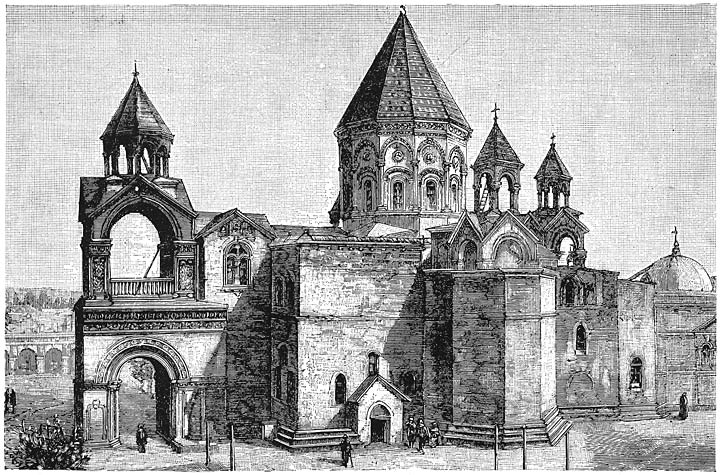
ST. MARY’S IN ATCHMIATZIN.
The oldest church edifice in the world.
As to the differences between them, in the first place the Armenian is a purely Trinitarian. There is no room for Unitarianism within its lines. When Gregory the Illuminator was preaching his sermons on the hills and plains of Armenia, he laid the foundation of the national church in the Trinity. His first sermon was on the Trinity; his last sermon was on the Trinity. In all his sermons he asserted the Trinity,—the Father, the Son, and the Holy Ghost. Jesus Christ being a perfect Man and a perfect God; in his person we see God in man and man in God; a perfect Emmanuel, God with us. We see in him that man can be united with God. The only possible way of salvation is through Jesus Christ. He is the Saviour of the world and none else, and whosoever believeth in Him shall be saved. This is the belief and the only belief of the Armenian Church. Its members repeat the Apostolic Creed and the Lord’s Prayer every day in their churches. I say every day because Armenians go to church every day,—twice, morning and evening, and three times on Sunday.
Secondly, the Armenian has never been a persecuting church, and every other one of the great Christian churches has been. The Armenian church, as befits the first and most Christ-like of all the bodies that professed Christ before Luther’s time, has always been the broadest, the most inclusive, the most untechnical of churches. It fellowships with all other churches. It demands only that men shall profess and believe in Christ, and live Christian lives; not that one shall belong to its own church body. Its canons are conversion and regeneration, purity, holiness, being born again from the Holy Spirit and becoming Christ-like. It holds that Christianity is brotherhood through Jesus Christ, and gives no warrant for oppression or persecution, curses or anathemas. I need hardly say that it is alone in this of the older churches. The others hold that no one can be saved outside of their own bodies; hence they fulminate anathemas against all others, and have the anathemas read in their churches, and they persecute others to compel them to join themselves, or rid the world of a possible danger that their own members may be tolled outside. The Greek Church, where it has full power, will not even allow people of other creeds to come into its country; for example, in Croatia a Protestant is not allowed to live there at all, and the people said in the Hungarian Diet that “intolerance was the most precious of their rights.” The Russian Greek Church will not permit a Protestant missionary in Russia. Where the Roman Catholic power is complete, it is just as intolerant. The Armenian church has been repeatedly persecuted by both, and has always protested against the principle of it, as well as against the pretensions of the Popes to universal sway. It is fairly entitled to be called the first Protestant Church.
That the Armenian contention is for freedom of will, freedom of conscience, freedom of worship, and political freedom, is the cause of their being hated both by the Mohammedans and by their so-called Christian neighbors; but it ought to be also a reason why Americans, who believe in these things themselves, should sympathize with us. If the Armenians would accept Mohammedanism, would the Turks persecute them? No. If they would accept Roman Catholicism would the Turks persecute them? No, for the Catholic states would not permit it. If they would accept the Greek Church, would the Turks persecute them? No, for Russia would not permit it. But as they are an independent church the others are interested in persecuting them, and nobody is interested in defending them. If there is any help to come to them it will not be from the old churches of Europe, but from Protestant Anglo-Saxons helping their spiritual brethren, the Anglo-Saxons of the East; and it will be found, when the great battle comes, that the Slavonic, Greek, and Catholic churches will be on the side of the Mohammedans against the Armenian Christians. But that battle will come, and the victory will be on the side of freedom and righteousness.
As to theological questions, the Armenian Church fathers did not pay much attention to them. Not because they were not able, but because they were too able, and very far-sighted. They knew well that such questions can never be solved, no matter how many centuries pass away, no matter how great scholars the world produces; therefore they would not enter into the debate. And so every Armenian scholar has his own theology. I confess that the Armenian Church has not a theology, or an especial official doctrine; and this is a very fortunate thing for the Armenians. They care more for righteousness of life than for particular beliefs about the way of getting it. When there was a great controversy in the Council of Chalcedon, 451 A.D., about the nature of Christ, Armenians did not care about it. Some of the great theologians said Christ had two natures; some said he had only one nature; the Armenian bishops would not give any opinion. They believe in Christ as their Saviour, that is the essential thing; but whether He has two natures or one nature is not essential. Then came the controversy about the Holy Spirit. Whence does the Holy Spirit proceed? Some say from the Father and the Son, some simply from the Father. When the question came before the Armenian bishops they replied that they did not care whence He proceeds. They know that they need the Holy Spirit for guidance in spiritual life, for regeneration; they know that the Holy Spirit is one of the persons in the Trinity; and that is enough for them.
Now I would ask, do the theologians of the nineteenth century agree on such questions, or any other theological question? Are the theologians of the coming centuries going to agree on them? I leave this to the scholars of Europe and America. I simply state that I studied in three different theological seminaries in America; first in Oberlin, in 1880; second in Union Theological Seminary, New York, in 1881; and finally I was graduated from the Chicago Theological Seminary. But I never saw a theologian who could agree with any other, and have no hope ever to see any such. President Fairchild of Oberlin differed from Professor Shedd of New York, and Professor Boardman of Chicago did not agree with either of them; and I never agreed with any of them, and as an Armenian I have my own theology. So every reader of this book will see that the Armenian scholars had the best judgment, far-sightedness, and common sense of those in any or all the communions. Instead of theological controversies, they preached the gospel and reached the masses, for the Kingdom of Christ.
THE ARMENIAN CLERGY.
The Armenian clergy are divided into three classes: the pastor, the preacher, and the presiding bishop. The pastor is called Yeretz, the preacher is called Vartabed, and the presiding bishop is called Yebisgobos (Episcopus). The presiding bishop ordains the preacher and the teacher. The Armenians believe in apostolic succession, and they believe in immersion. Baptism can be administered both to grown people and to children, if they are the children of members of the church; but always by immersion, and in the name of the Father, the Son, and of the Holy Ghost. If you unite the present Episcopal church with the Baptist, you will make an Armenian church. All the clergy of the Armenian church, bishops, preachers, and teachers, were married in the early centuries. Gregory the Illuminator, the first bishop of Armenia, was married. His sons were bishops, and were married. There was no church law whatever against marriage of the clergy. At present the bishop and the preacher, or the Yebisgobos and the Vartabed, cannot marry, but the pastor or Yeretz must be married. No Armenian pastor can be ordained if he is not married.