Volume 2 — ARGENTINE ORNITHOLOGY. (continued 4)
Reading edition
There are also anatomical differences between the two birds; the pale-plumaged species having an ordinary trachea, while A. rosea has a very curiously-formed trachea, unlike that of any other bird, which has been described by Garrod as follows:—
“The trachea is simple, straight, of uniform calibre, and peculiarly short, extending only two thirds down the length of the neck, where the uncomplicated syrinx is situated and the bifurcation of the bronchi occurs. The usual pair of muscles, one on each side, runs to this syrinx from above, and ceases there. The bronchi are fusiformly dilated at their commencement, where the rings which encircle them are not complete, a membrane taking their place in that portion of each tube which is contiguous to its opposite neighbour. Each bronchus, lower down, is composed of complete cartilaginous rings.”
Trachea of Ajaja rosea.—a. Trachea. b. Syrinx. d. Œsophagus. e. Cervical muscles. r.b. Right bronchus. l.b. Left bronchus. (From P. Z. S. 1875, p. 300.)
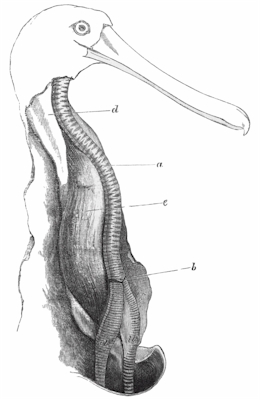
The woodcut of this curious structure is here reproduced by the kind permission of the Zoological Society. It is much to be wished that some one living in the Argentine Republic would devote himself to the further investigation of the history of this interesting bird, and settle the question whether there is more than one species of Argentine Spoonbill.
To conclude, I may mention that the pet bird my friend kept was of the pale-plumaged species, and never lost the feathers from its head, nor did it acquire any of the characteristic marks of P. ajaja.
Fam. XXXVIII. PHŒNICOPTERIDÆ, or FLAMINGOES.
The very peculiar and isolated type of Flamingo is found in both the Old and New Worlds, and is, no doubt, of great antiquity. In the Neotropical Region three species of Flamingo are now known to occur, one of which is well known in the Argentine Provinces. Of the other two (Phœnicopterus andinus and P. jamesi6), which inhabit the Andes of Chili and Bolivia, one has also been ascertained to occur within the northern frontiers of the Argentine Republic. Both these last-named species belong to the three-toed section of the genus (Phœnicoparra). In P. ignipalliatus the hind toe is present.
332. PHŒNICOPTERUS IGNIPALLIATUS, Geoffr. et d’Orb.
(ARGENTINE FLAMINGO.)
Phœnicopterus ignipalliatus, Burm. La-Plata Reise, ii. p. 512 (Mendoza, Paraná, Rosario, Buenos Ayres); Scl. et Salv. Nomencl. p. 127; iid, P. Z. S. 1868, p. 145 (Buenos Ayres); Scl. P. Z. S. 1872, p. 549 (Rio Negro); Durnford, Ibis, 1877, p. 41, et 1878, p. 400 (Patagonia); Gibson, Ibis, 1880, p. 156 (Buenos Ayres); Barrows, Auk, 1884, p. 272 (Pampas).
Description.—Hind toe present. Plumage rosy red; wing-coverts crimson; wing-feathers black; bill pale yellowish red, apical half black; feet dark violet-grey: whole length 39·0 inches, wing 15·0, tarsus 11·0. Female similar, but smaller.
Hab. Southern portions of South America.
The Argentine Flamingo inhabits the whole of the Argentine country, down to the Rio Negro in the south, where I found it very abundant. The residents told me of a breeding-place there—a shallow salt-lake—which, however, had been abandoned by the birds before my visit. The nest there, as in other regions, was a small pillar of mud raised a foot or eighteen inches above the surface of the water, and with a slight hollow on the top; and I was assured by people who had watched them on their nests that the incubating bird invariably sits with the hind part of the body projecting from the nest, and the long legs dangling down in the water, and not tucked up under the bird.
On the Rio Negro I found the birds most abundant in winter, which surprised me, for that there is a movement of Flamingoes to the north in the autumn I am quite sure, having often seen them passing overhead in a northerly direction in the migrating-season. I have also found the young birds, in the grey plumage, at this season in the marshes near to Buenos Ayres city, hundreds of miles from any known breeding-place. Probably the birds in the interior of the country, where the cold is far more intense than on the sea-coast, go north before winter, while those in the district bordering on the Atlantic have become stationary.
The Flamingo has a curious way of feeding: it immerses the beak, and by means of a rapid continuous movement of the mandibles passes a current of water through the mouth, where the minutest insects and particles of floating matter are arrested by the teeth. The stomach is small, and is usually found to contain a pulpy mass of greenish-coloured stuff, mixed with minute particles of quartz. Yet on so scanty a fare this large bird not only supports itself, but becomes excessively fat. I spent half a winter in Patagonia at a house built on the borders of a small lake, and regularly every night a small flock of Flamingoes came to feed in the water about 200 yards from the back of the house. I used to open the window to listen to them, and the noise made by their beaks was continuous and resembled the sound produced by wringing out a wet cloth. They feed a great deal by day, but much more, I think, by night.
Where they are never persecuted they are tame birds, and when a flock is fired into and one bird killed, the other birds, though apparently much astonished, do not fly away. They are silent birds, but not actually dumb, having a low hoarse cry, uttered sometimes at the moment of taking flight; also another cry which I have only heard from a wounded bird, resembling the gobbling of a turkey-cock, only shriller. They are almost invariably seen standing in the water, even when not feeding, and even seem to sleep there; on land they have a very singular appearance, their immense height, in proportion to their bulk, giving them an appearance amongst birds something like that of the giraffe amongst mammals. To the lakes and water-courses in the midst of the grey scenery of Patagonia they seem to give a strange glory, while standing motionless, their tall rose-coloured forms mirrored in the dark water, but chiefly when they rise and pass in a long crimson train or phalanx, flying low over the surface.
333. PHŒNICOPTERUS ANDINUS, Philippi.
(ANDEAN FLAMINGO.)
Phœnicopterus andinus, Phillipi, Reise d. d. Wüste Atacama, p. 164, tt. iv., v.; Scl. et Salv. Nomencl. p. 127; Scl. P. Z. S. 1886, p. 399; Burm. P. Z. S. 1872, p. 364 (Cordilleras of N.-West).
Description.—Hind toe absent. Plumage rosy white; lower neck and breast carmine; wings scarlet, with the tips of the quills black; bill at the base yellowish stained with red; apical half black; feet yellow: whole length 35·0 inches, wing 16·0, tarsus 9·0. Female similar, but smaller.
Hab. Andes of Bolivia and Northern Chili.
The Andean Flamingo, which is at once distinguishable from P. ignipalliatus by the complete absence of the hind toe, is stated by Dr. Burmeister, on the authority of Herr Schickendantz, to be found on the north-western frontiers of the Argentine Republic, on the lagunes of the eastern valleys between the Cordilleras and the adjacent mountains.
Order X. ANSERES.
Fam. XXXIX. PALAMEDEIDÆ, or SCREAMERS.
This singular Neotropical form is even more isolated than the Flamingo and more difficult to place satisfactorily in a linear series. It seems, however, that it is best arranged near the Anatidæ, as first suggested by Mr. Parker7, and that it may with least inconvenience be constituted an aberrant family of the Order Anseres.
Besides the typical form Palamedea (with one species found in Amazonia and the interior of Brazil) the present family contains only one other genus—Chauna—in which the head carries a feather-crest instead of the long horny wattle of Palamedea. One species of Chauna is met with in Argentina, the only other known species (C. derbiana) being confined to Colombia and Venezuela.
334. CHAUNA CHAVARIA (Linn.).
(CRESTED SCREAMER.)
Palamedea chavaria, Burm. La-Plata Reise, ii. p. 506 (Paraná). Chauna chavaria, Scl. et Salv. Nomencl. p. 128; iid. P. Z. S. 1868, p. 145 (Buenos Ayres); Durnford, Ibis, 1878, p. 63 (Buenos Ayres); Gibson, Ibis, 1880, p. 165 (Buenos Ayres); Barrows, Auk, 1884, p. 272 (Entrerios).
Description.—Slaty grey, blacker on the back; chin, neck, and cheeks whitish; a naked ring round the neck; nape crested; belly whitish; feet red: whole length 32·0 inches, wing 19·0, tail 8·0. Female similar.
Hab. Southern Brazil, Paraguay, and La Plata.
This majestic bird, called Chajá in the vernacular, is common throughout the Plata district, in marshes and on the open level country abounding in water and succulent grasses, and ranges south to the neighbourhood of Bahia Blanca. It is most abundant on the pampas south of Buenos Ayres city, and on that vast expanse of perfectly level, green country the bird is seen at its best; it is there an important feature in the landscape; its vocal performances are doubly impressive on account of the profound silence of nature, and its singularity—the contrast between its aerial habit and ponderous structure—strikes one more forcibly where the view is so unobstructed and the atmosphere so pure.
The Crested Screamer, like most of the larger birds and mammals in every part of the globe to which European emigration is attracted, is probably doomed to rapid extermination. My observations of the bird, in that portion of the pampas where it is most abundant, date back some years, to a time when the inhabitants were few and mainly of Spanish race, never the destroyers of bird-life. The conditions had become extremely favourable to this species. It is partially aquatic in its habits; and in desert places is usually found in marshes, wading in the shallow water, and occasionally swimming to feed on the seeds and succulent leaves of water-loving plants. After the old giant grasses of the pampas had been eaten up by the cattle, and the sweet grasses of Europe had taken their place, the Screamers took kindly to that new food, preferring the clovers, and seemed as terrestrial in their feeding-habits as Upland Geese. Their food was abundant, and they were never persecuted by the natives. Their flesh is very dark, is coarse-grained but good to eat, with a flavour resembling that of wild duck, and there is a great deal of meat on a bird with a body larger than that of a Swan. Yet no person ever thought of killing or eating the Chajá; and the birds were permitted to increase to a marvellous extent. It was a common thing a few years ago in the dry season to see them congregated in thousands; and so little afraid of man were they that I have often ridden through large scattered flocks without making the birds take wing.
A curious thing about the Screamer is that it pairs for life, and yet is one of the most social of birds. But if a large flock is closely looked at, the birds are invariably seen methodically ranged in pairs. Another curious thing is that, notwithstanding the formidable weapons they possess (each wing being armed with two large spurs), they are extremely pacific in temper. I have never been able to detect even the slightest approach to a quarrel among them; yet it is hard to believe that they do not fight sometimes, since weapons of offence are usually found correlated with the disposition to use them. Captive birds, however, can be made to fight; and I have known Gauchos take them for the pleasure of witnessing their battles. They are very easily tamed, and in that state seem to show greater docility and intelligence than any of our domestic birds; and become so attached to their home that it is quite safe to allow them to fly about at will. They associate, but do not quarrel, with the poultry. They are quick to distinguish strangers from the people of the house, showing considerable suspicion of them, and sometimes raising a loud alarm at a stranger’s approach. Towards dogs and cats they are often unfriendly; and when breeding it is dangerous for a strange person to approach the nest, as they will sometimes attack him with the greatest fury.
The Screamer is a very heavy bird, and rises from the ground laboriously, the wings, as in the case of the Swan, making a loud noise. Nevertheless, it loves soaring, and will rise in an immense spiral until it wholly disappears from sight in the zenith, even in the brightest weather; and considering its great bulk and dark colour, the height it ultimately attains must be very great. On sunny windless days, especially in winter and spring, they often spend hours at a time in these sublime aerial exercises, slowly floating round and round in vast circles, and singing at intervals. How so heavy and comparatively short-winged a bird can sustain itself for such long periods in the thin upper air to which it rises has not yet been explained.
The voice is very powerful. When disturbed, or when the nest is approached, both birds utter at intervals a loud alarm-cry, resembling in sound the anger-cry of the Peacock, but twice as loud. At other times its voice is exercised in a kind of singing performance, in which male and female join, and which produces the effect of harmony. The male begins, the female takes up her part, and then with marvellous strength and spirit they pour forth a torrent of strangely-contrasted sounds—some bassoon-like in their depth and volume, some like drumbeats, and others, long, clear, and ringing. It is the loudest animal-sound of the pampas, and its jubilant martial character strongly affects the mind in that silent melancholy wilderness.
The Screamers sing all the year round, at all hours, both on the ground and when soaring; when in pairs the two birds invariably sing together, and when in flocks they sing in concert. At night they are heard about nine o’clock in the evening, and again just before dawn. It is not unusual, however, to hear them singing at other hours.
The nest is a large fabric placed among the low rushes and water-lilies, and is sometimes seen floating on the water, away from its moorings. The eggs are five, pointed at one end, pure white, and in size like the eggs of the domestic goose. The young are clothed in yellow down like goslings, and follow the parents about from the date of hatching.
Fam. XL. ANATIDÆ, or DUCKS.
The Anatidæ or Waterfowl are a well-known family of universal distribution over the earth’s surface. As shown in an article published in the Zoological Society’s ‘Proceedings’ for 18768, upwards of 60 species of this group of birds are found in the Neotropical Region, and of these about 22 occur in the Argentine Republic. Amongst the Argentine species are some of the finest and most ornamental of the whole family, such as the Black-necked Swan, the Ashy-headed Goose, and the Chiloe Wigeon—all well known from their introduction and acclimatization in Europe.
It may be remarked that nearly all the Argentine members of this family belong to Antarctic forms, and are specifically different from those met with in North America.
335. BERNICLA MELANOPTERA (Eyton).
(ANDEAN GOOSE.)
Chloëphaga melanoptera, Burm. La-Plata Reise, ii. p. 513 (Cordilleras). Bernicla melanoptera, Burm. P. Z. S. 1872, p. 365; Scl. et Salv. P. Z. S. 1876, p. 362; iid. Nomencl. p. 128.
Description.—White; wing-feathers black; scapulars and tail greenish black; greater wing-coverts externally purplish, forming a speculum; smaller wing-coverts white; anterior scapulars spotted with brown, posterior scapulars brown with a greenish tinge: whole length 30·0 inches, wing 17·5, tail 6·5. Female similar, but smaller.
Hab. Andes of Peru, Bolivia, and Northern Chili.
Dr. Burmeister met with this fine Goose on the Rio Blanco in the province of San Juan, within the confines of the Argentine Republic. It is an inhabitant of the high Andes of Peru and Bolivia, and is also found throughout the central provinces of Chili, descending to the plains in the winter. Its native name is “Piuquen,” and it is said to be so abundant on a lagoon near the Portello Pass between Mendoza and Santiago that the spot is called “Valle de los Piuquenes.”
336. BERNICLA DISPAR, Ph. et Landb.
(BARRED UPLAND GOOSE.)
Bernicla dispar, Burmeister, P. Z. S. 1872, p. 366 (Sierra Tinta, Rio Negro). Bernicla antarctica, Burm. La-Plata Reise, ii. p. 514 (err.). Chloephaga dispar, Scl. P. Z. S. 1867, p. 334 (Chili). Bernicla magellanica, Scl. P. Z. S. 1872, p. 549 (Rio Negro); Durnf. Ibis, 1878, p. 400 (Chupat). Chloephaga magellanica, Barrows, Auk, 1884, p. 273 (Carhué).
Description.—White; neck behind and body beneath banded with black; primaries, greater wing-coverts, tertiaries, and scapulars cinereous; rump and tail-feathers ashy black; bill black; feet dark plumbeous: whole length 26·0 inches, wing 16·0, tail 5·5. Female: head and neck cinnamon-brown; abdomen similar, passing into white on the crissum, and altogether barred with black; upper back also barred; rump and tail-feathers brownish black.
Hab. Chili and Argentina.
This bird is a northern form of the well-known “Upland Goose” of the Falkland Islands and Southern Patagonia, from which it differs in the male being completely barred across with black on the lower surface. It was first described by Philippi and Landbeck from Chilian specimens, and in 1872 recognized by Dr. Burmeister as found near the Sierra Tandil and on the Rio Negro.
In April and May this Goose migrates northwards, along the eastern coast, as far as the pampas of Buenos Ayres, the migration ending about one hundred and fifty miles south of Buenos Ayres city. Further south they are at this season of the year excessively abundant in suitable localities. Their great camping-grounds are the valleys of the rivers Negro and Colorado, where they are often so numerous as to denude the low grounds of the tender winter clovers and grasses, and to cause serious loss to the sheep-breeders. They also visit the cultivated fields to devour the young wheat, and are intelligent enough to distinguish between a real human enemy and the ragged men of straw, miscalled scarecrows, set up by the farmers to frighten them. While committing their depredations they are exceedingly wary and difficult to shoot, but at night, when they congregate by the water-side, they give the sportsman a better chance. I have succeeded in killing as many as five at a shot by stalking them under cover of the darkness; and a more deliciously flavoured game-bird than this Goose I have never tasted.
They are social birds, always going in large flocks, and are very loquacious, the female having a deep honking note, while the male responds with a clear whistling, like the Sanderling’s note etherialized.
337. BERNICLA POLIOCEPHALA, Gray.
(ASHY-HEADED GOOSE.)
Bernicla poliocephala, Scl. et Salv. P. Z. S. 1876, p. 366; Burmeister, P. Z. S. 1872, p. 366 (Bahia Blanca); Scl. P. Z. S. 1872, p. 549 (Rio Negro); Durnford, Ibis, 1878, p. 400 (Centr. Patagonia). Chloephaga poliocephala, Scl. et Salv. Nomencl. p. 128.
Description.—Head, neck, and scapulars greyish plumbeous; breast and upper back chestnut, banded across with black; abdomen, under wing-coverts, and bend of the wing white; primaries black; secondaries white; greater wing-coverts black, edged with shining green and tipped with white; lower back and tail black; flanks banded with white and black; crissum chestnut; bill black; feet on the outside yellow, on the inner side brownish black: whole length 24·0 inches, wing 13·5, tail 5·0. Female similar.
Hab. Patagonia, Southern Chili, and Southern Argentina.
This Patagonian Goose migrates northwards in winter, and appears on the Rio Negro and in the Buenos-Ayrean pampas in May, usually in small flocks, but sometimes as many as one or two hundred are seen together. The extreme limit of their winter migration appears to be about sixty miles south of Buenos Ayres city, on the plains near the river Sanborombon; probably they have before now been driven from this locality by the Duck-shooters, but it was formerly their favourite rendezvous, where they collected in large numbers, though further north scarcely one was ever seen.
Durnford tells us that this Goose is resident on Lake Colguape in the territory of Chupat, and breeds there abundantly.
338. CYGNUS NIGRICOLLIS, Gm.
(BLACK-NECKED SWAN.)
[Plate XVIII.]
CYGNUS NIGRICOLLIS.
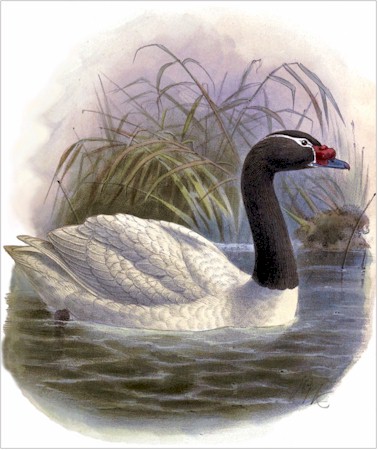
Cygnus nigricollis, Burm. La-Plata Reise, ii. p. 512 (Paraná); Scl. et Salv. Nomencl. p. 129; iid. P. Z. S. 1876, p. 370; Durnford, Ibis, 1877, p. 191 (Buenos Ayres), et 1878, p. 400 (Centr. Patagonia); Gibson, Ibis, 1880, p. 33 (Buenos Ayres); Barrows, Auk, 1884, p. 273 (Entrerios).
Description.—White; head and neck black; postocular streak and chin white; lores naked; bill plumbeous; cere red; feet pale carneous: whole length 48·0 inches, wing 17·5, tail 5·5. Female similar.
Hab. Argentina, Chili, and Patagonia.
To my perhaps partial mind this species is preeminent for beauty among the Swans, although it is considerably smaller than the bird of the Old World, and does not, it must be admitted, comport itself so majestically. In questions of this kind it is natural for every one to be somewhat biassed in favour of the things of his own country; but it will be readily admitted by all, I think, that the black-necked bird is one of three species greatly surpassing all others of this genus in beauty—the other two being, of course, the domesticated Swan of Europe and the Australian Black Swan (perhaps the most graceful bird on the globe).
This Swan is very abundant on the pampas of Buenos Ayres and in Patagonia, and ranges south to the Magellan Straits and the Falklands. As a rule they are seen in small flocks, but sometimes as many as two or three hundred congregate together. They are heavy birds and rise with difficulty, and fly rapidly and with great violence, like all heavy-bodied short-winged species; but in no other very large bird with which I am acquainted do the wings produce so loud a rushing sound. In quiet places the beating of their wings can be heard distinctly when the birds are no longer in sight, although, owing to their large size, the eye can follow them very far. Gauchos sometimes capture them by suddenly charging down the wind upon them, uttering loud shouts which greatly terrify the birds, and when they attempt to rise with the wind they only flap along the ground and are easily knocked over. A Gaucho of my acquaintance one day caught three out of a flock of six in this way; but a very strong wind favoured him, and the birds were at some distance from the water, and allowed him to come near before making the sudden charge. As a rule, they are seen on the water, and when on land they keep very close to the margin.
According to Mr. Gibson, who has observed their breeding-habits, they begin to nest in July—just after the winter solstice. The nest is always placed among thick rushes growing in deep water, and the Swan invariably swims to and from her nest. It is built up from the bottom of the swamp, sometimes through four or five feet of water, and rises a foot and a half above the surface. The top of the nest measures about two feet across, with a slight hollow for the eggs, which are cream-coloured and have a smooth glossy shell. The number varies from three to five, and on one occasion six were found. Mr. Gibson has seen the parent bird swimming from the nest with the young on her back.
Our figure of this species (Plate XVIII.) is taken from the specimen now living in the Zoological Society’s Gardens.
339. COSCOROBA CANDIDA (Vieill.).
(COSCOROBA SWAN.)
Cygnus coscoroba, Burm. La-Plata Reise, ii. p. 512 (Paraná); Scl. et Salv. Nomencl. p. 129; iid. P. Z. S. 1876, p. 371; Durnford, Ibis, 1877, p. 191 (Buenos Ayres), et 1878, p. 400 (Centr. Patagonia); Gibson, Ibis, 1880, p. 36 (Buenos Ayres). Coscoroba Candida, Reichenb. Nat. Syst. p. x.
Description.—White; tips of the primaries black; bill coral-red; feet dull red: whole length 40·0 inches, wing 17·5, tail 5·8. Female similar.
Hab. Patagonia, Chili, Argentina, and Paraguay.
This Swan is considerably smaller than the black-necked species, and also inferior in beauty on account of its shorter neck. It is, nevertheless, a very handsome bird, being entirely of a pure white colour except the tips of the primaries, which are black. The beak and legs are bright rosy red. In its habits, language, and flight it also differs much from Cygnus nigricollis, and the country people call it Ganso (Goose), probably on account of its goose-like habit of sometimes feeding away from the water, or because its flesh has the flavour of Wild Goose. As a rule they go in small parties of five or six individuals, but sometimes flocks numbering two or three hundred are seen in the cold season. Their migrations are very irregular, and sometimes they are excessively abundant in a district one year and absent from it the next. When disturbed they utter a loud musical trumpeting cry, in three notes, the last with a falling inflection; and their wings being much longer proportionately than in the black-necked species, they rise with greater ease and have a much freer and an almost soundless flight.
Concerning their breeding-habits, Mr. Gibson observes that the nest is usually placed on the ground at some distance from the water. It is about a foot and a half high, made of mud and rushes; the hollow, which is rather deep, is lined with dry grass.
The eggs are eight or nine in number; smooth, white, and rounder than those of Cygnus nigricollis.
340. DENDROCYGNA FULVA (Gm.).
(FULVOUS TREE-DUCK.)
Dendrocygna fulva, Burm. La-Plata Reise, ii. p. 514 (Paraná); id. P. Z. S. 1872, p. 367; Scl. et. Salv. Nomencl. p. 129; iid. P. Z. S. 1869, p. 635 (Buenos Ayres), et 1876, p. 372; Durnford, Ibis, 1878, p. 63 (Buenos Ayres); White, P. Z. S. 1882, p. 625 (Buenos Ayres).
Description.—Chestnut-red, top of head darker, with black line down the nape; back black, on the upper portion banded with chestnut; wings and tail black; lesser wing-coverts dark chestnut; upper tail-coverts white; flank-plumes elongated, chestnut, banded with black and white; bill and feet black: whole length 18·0 inches, wing 8·5, tail 2·0. Female similar.
Hab. Mexico and South America.
This Duck, the well-known Pato silvon (Whistling Duck) of the eastern Argentine country, is found abundantly along the Plata and the great streams flowing into it, and northwards to Paraguay. Along this great waterway it is to some extent a migratory species, appearing in spring in Buenos Ayres in very large numbers, to breed in the littoral marshes and also on the pampas. They migrate principally by night, and do not fly in long trains and phalanxes like other Ducks, but in a cloud; and when they migrate in spring and autumn the shrill confused clangour of their many voices is heard from the darkness overhead by dwellers in the Argentine capital; for the Ducks, following the eastern shore of the sea-like river, pass over that city on their journey. Northwards this Duck extends to Central Brazil; from the northern half of the southern continent and from Central America it is absent, but it reappears in Mexico. Commenting on these facts Messrs. Sclater and Salvin write:—“Singular as this distribution is, it is still more remarkable when we consider that there appear to exist no tangible grounds for separating the American bird from that called D. major by Jerdon, which ranges throughout the peninsula of India and is also found in Madagascar!”
The Whistling Duck, in its chestnut and fulvous plumage, is a handsome bird and somewhat singular in appearance, especially when seen in a large body on the ground. When out of the water they crowd close together, and when disturbed stand up craning their necks, looking strangely tall on their long blue legs. While thus watching an intruder they are silent, and the sudden ringing chorus of whistling voices into which they burst at the moment of rising has a curious effect.
So extremely social are these Ducks that even when breeding they keep together in large flocks. The nest is made of stems and leaves, on the water among the reeds and aquatic plants; and sometimes large numbers of nests are found close together, as in a gullery. The eggs are pure white, and each bird lays, I believe, ten or twelve, but I am not sure about the exact number; and I have so frequently found from twenty to thirty eggs in a nest that I am pretty sure that it is a common thing for two or three females to occupy one nest.
341. DENDROCYGNA VIDUATA (Linn.).
(WHITE-FACED TREE-DUCK.)
Dendrocygna viduata, Burm. La-Plata Reise, ii. p. 515 (Tucuman); id. P. Z. S. 1872, p. 367; Scl. et Salv. P. Z. S. 1869, p. 160 (Buenos Ayres), et 1876, p. 376; Durnford, Ibis, 1878, p. 64 (Buenos Ayres).
Description.—Face and spot on the throat white; nape, neck in front, middle of abdomen, tail, rump, and wings black; hind neck chestnut; middle of back and scapulars brown, the feathers margined with ochraceous; wing-coverts olivaceous black; flanks banded with black and white; bill and feet black: whole length 17·0 inches, wing 9·0, tail 2·5. Female similar.
Hab. South America.
This Tree-Duck resembles that last described in size, form, and maroon-red plumage, but is of a darker tint, and may also be easily distinguished, even at a long distance, by its white face contrasted with the velvety black of the head and neck. Compared with Dendrocygna fulva it is a rare species, being usually found in pairs in the Plata district, although sometimes as many as half a dozen are seen together. When taking wing it also whistles, but differently from the allied species, having three long clear whistling notes, not unlike the three-syllabled cry of the Sandpiper, only the notes are more prolonged. Of its breeding-habits I know nothing.
342. SARCIDIORNIS CARUNCULATA (Licht.).
(CRESTED DUCK.)
Sarcidiornis regia, Burm. La-Plata Reise, ii. p. 513 (Tucuman); id. P. Z. S. 1872, p. 365. Sarcidiornis carunculata, Scl. et Salv. P. Z. S. 1876, p. 377; Sclater, P. Z. S. 1876, p. 695, pl. lxviii.
Description.—Head and neck white, spotted with black, hind neck almost black; base of neck and body beneath white; flanks black; back and wings black; secondaries glossed with bronze, the scapulars with purple; lower back grey; tail brown; bill, with caruncle on the culmen, and feet black: whole length 30·0 inches, wing 15·0, tail 6·0. Female similar, but rather smaller.
Hab. Brazil, Paraguay, and northern confines of Argentina.
Dr. Burmeister met with this Duck in the province of Tucuman, and it probably occurs also in other places on the northern frontiers of the Republic.
343. CAIRINA MOSCHATA (Linn.).
(MUSCOVY DUCK.)
Cairina moschata, Burm. La-Plata Reise, ii. p. 514 (Paraná, Santa Fé, Tucuman); id. P. Z. S. 1872, p. 367; Scl. et Salv. Nomencl. p. 120; iid. P. Z. S. 1876, p. 378; White, P. Z. S. 1882, p. 625 (Salta).
Description.—Whole head and neck and body beneath brownish black; belly closely banded with narrow white lines; back greenish purple, with the feathers edged with black; scapulars and elongated tertials and tail bright shining green; secondaries edged with metallic blue; primaries black; upper and under wing-coverts and axillary plumes white; flanks slightly tinged with green; bill with caruncles red; feet black: whole length 29·0 inches, wing 15·0, tail 7·5. Female similar, but smaller.
Hab. Central and South America.
Everyone is familiar with this species in its domestic state, called in the Argentine country Pato creollo (Creole Duck); but the wild bird, called Pato real, is little known, although a few stragglers are seen as far south as Buenos Ayres, where I have met with eight or nine examples. Concerning the distribution and habits of this species Messrs. Sclater and Salvin write:—“The Muscovy Duck, so well known in a domestic state nearly all over the world, is a native of the hottest portion of tropical America. It is usually found in lowland swampy districts; and where there are extensive forests it not unfrequently abounds. During the day the birds remain in the forest-swamps; but towards evening numbers may be seen sitting on the lower boughs of trees standing on the margin of a clearing.
“Its extreme northern limit seems to be N. W. Mexico. Its southern range extends to the upper Paraná and Tucuman. It is not uncommon in Paraguay, according to Azara, although not found on the La Plata. It is to be seen usually in pairs or singly, but also in flocks of twenty or thirty. It always roosts in trees, usually resorting to the same trees night after night. The nest, in which from ten to fourteen eggs are deposited, is made in a hole or fork of a large tree at some elevation from the ground. It seeks its food not only in the rivers, but on moonlight nights resorts to the maize and corn-fields, and also plucks up the roots of mandioca.
“The native habitat of the Muscovy Duck was known to some of the earliest writers. The date of its introduction as a domesticated species into Europe and elsewhere does not appear to have been recorded, but doubtless dates back to soon after the Spanish conquests in America.”
344. HETERONETTA MELANOCEPHALA (Vieill.).
(BLACK-HEADED DUCK.)
Heteronetta melanocephala, Scl. et Salv. P. Z. S. 1876, p. 382. Anas melanocephala, Scl. et Salv. Nomencl. p. 129; Durnford, Ibis, 1878, p. 64 (Buenos Ayres).
Description.—Above deep blackish brown, minutely vermiculated with rufous; head and neck black; narrow terminal band on the secondaries white; beneath dirty white, on the upper breast, flanks, and crissum freckled with rufous; bill blackish, with a basal spot on each side flesh-colour; feet horny brown: whole length 14·5 inches, wing 6·3, tail 2·3. Female similar, but head like the back; cheeks brown, freckled with black, and throat and superciliary stripe whitish.
Hab. Southern Brazil, Paraguay, Argentina, and Chili.
This small, obscurely coloured Duck extends from Southern Brazil over the pampas of Buenos Ayres into Chili. Near Buenos Ayres it is scarce. Durnford shot a pair in September 1876, in the reed-beds of Alvear, about twenty miles to the north-west of the city.
345. QUERQUEDULA CYANOPTERA (Vieill.).
(BLUE-WINGED TEAL.)
Anas cyanoptera, Burm. La-Plata Reise, ii. p. 516 (Mendoza, Paraná). Querquedula cyanoptera, Scl. et Salv. Nomencl. p. 129; iid. P. Z. S. 1869, p. 160 (Buenos Ayres), et 1876, p. 384; Durnford, Ibis, 1877, p. 191 (Buenos Ayres), et 1878, p. 400 (Patagonia); White, P. Z. S. 1882, p. 625 (Catamarca); Barrows, Auk, 1884, p. 273 (Pampas). Pterocyanea cyanoptera, Burm. P. Z. S. 1872, p. 368.
Description.—General plumage red; top of head black; middle of back and scapularies streaked with black; lesser wing-coverts blue; wing-speculum green, margined above with white; primary wing-feathers black, secondaries flammulated with white and buff; bill black; feet yellow: whole length 18·0 inches, wing 7·6, tail 3·0. Female: above blackish, feathers margined with whitish: beneath dirty white, variegated with brown; throat white, with blackish freckles.
Hab. North and South America.
This Teal has an exceedingly wide distribution in America, being found from California in the northern continent down to the Straits of Magellan and the Falkland Islands in the south. Its fine, strongly contrasted colours give it a very handsome appearance—the wings being clear grey-blue, the body deep maroon-red, the feet vivid yellow, beak black, and iris gold-colour. On the pampas it is common, and almost invariably seen in pairs at all seasons. Many of the Teals are quarrelsome in disposition; but this species, I think, exceeds them all in pugnacity, and when two pairs come together the males almost invariably begin fighting.
346. QUERQUEDULA FLAVIROSTRIS (Vieill.).
(YELLOW-BILLED TEAL.)
Anas flavirostris, Burm. La-Plata Reise, ii. p. 516 (Mendoza). Querquedula flavirostris, Scl. et Salv. Nomencl. p. 129; iid. P. Z. S. 1868, p. 146 (Buenos Ayres), et 1876, p. 386; Durnford, Ibis, 1877, p. 191 (Buenos Ayres), et 1878, p. 401 (Patagonia); White, P. Z. S. 1883, p. 42 (Cordova); Burm. P. Z. S. 1872, p. 367.
Description.—Above pale slaty brown; whole head barred across with narrow blackish bands; middle of back rufescent, with the centres of the feathers black and narrowly margined with brownish ochraceous; rump paler; a broad wing-speculum black, with a margin of ochraceous above and below, and a bronzy-green blotch in the centre; wing-feathers slaty, margins of secondaries on each side pale rufous; abdomen whitish, breast and belly distinctly spotted with black; bill yellow; culmen and tip black; feet horn-colour: whole length 15·0 inches, wing 7·5, tail 7·5. Female similar.
Hab. Argentina, Chili, and Patagonia.
In the southern part of the Argentine Republic this is one of the commonest species, and is almost invariably found in every marsh, stream, and pool of water on the pampas. It is resident, and usually goes in flocks of from a dozen to thirty individuals. It has a rapid flight, and is restless, lively, and extremely pugnacious in its habits. When a flock is on the water the birds are perpetually quarrelling. They are also highly inquisitive, and I have often shot them by first showing myself to the flock, and then standing or sitting still, when they would soon come wheeling about, flying in very close order. They quack and chatter in a variety of tones, and the male has also a clear whistling note in the love-season.
The nest of this Duck is always made at a distance from the water, sometimes as far as one or two miles. It consists of a slight hollow in the ground under a thistle-bush or tussock of long grass, and is lined with dry grass and a great deal of down, which is increased in quantity during incubation. The eggs are reddish cream-colour, and five is the usual number laid; but I have also found nests with six and seven.
347. QUERQUEDULA VERSICOLOR (Vieill.).
(GREY TEAL.)
Querquedula versicolor, Scl. et Salv. Nomencl. p. 129; iid. P. Z. S. 1868, p. 146 (Buenos Ayres), et 1876, p. 388; Durnford, Ibis, 1877, p. 191 (Buenos Ayres), et 1878, p. 401 (Patagonia); Barrows, Auk, 1884, p. 274 (Entrerios). Anas maculirostris, Burm. La-Plata Reise, ii. p. 516 (Mendoza). Querquedula maculirostris, Burm. P. Z. S. 1872, p. 367.
Description.—Above grey, with narrow black cross bands, which are more numerous and narrower on the rump; top of head smoky brown, sides of head and throat white; abdomen whitish, tinged with ochraceous and spotted with black on the breast, more whitish and with numerous cross bands on the belly; wings externally greyish brown; speculum purplish green, margined, with white above and below, also with a subterminal black band; flanks distinctly barred across with black and white; bill black, with an orange blotch each side at the base of the mandible; feet hazel: whole length 16·5 inches, wing 7·6, tail 3·4. Female similar, but colour duller and wing-speculum not so bright.
Hab. Paraguay, Argentina, Patagonia, and Chili.
This prettily variegated blue-grey Teal with its strongly marked bill is perhaps the most abundant of the genus in the Argentine Republic, especially in the southern portion. It is resident, and unites in much larger flocks than any other bird of this group in the country. Its note when disturbed or flying is very peculiar, resembling in sound the muffled stridulating of the mole-cricket. Durnford found it common and breeding at Baradero.
348. QUERQUEDULA TORQUATA (Vieill.).
(RING-NECKED TEAL.)
Querquedula torquata, Scl. et Salv. Nomencl. p. 129; iid. P. Z. S. 1869, p. 635 (Buenos Ayres), et 1876, p. 389; Burm. P. Z. S. 1872, p. 367 (Paraná).
Description.—Above earthy brown; head above and neck, which expands into a half-collar, together with the lesser wing-coverts, lower back, and tail above, black; scapulars pure chestnut; wings brownish black, with a large white blotch on the coverts of the secondaries, which are themselves bronzy green: beneath, sides of head and throat dirty white streaked with brown; breast tinged with rosy red and sparingly spotted with black; belly and flanks white, very narrowly barred with grey; crissum black, with a white blotch on each side: whole length 14·0 inches, wing 7·2, tail 2·7. Female: brown; superciliaries and stripe on each side of the head with the throat and sides of the neck white: beneath white, banded across with brown; wings and tail black; secondaries bronzy green; wings with a white blotch as in the male; bill reddish; feet brown.
Hab. Paraguay and Argentina.
This beautiful Duck, for our first knowledge of which we are indebted to Azara, is rather scarce in collections. Azara described the two somewhat dissimilar sexes under different names, the male being his Pato collar negro, and the female his Pato ceja blanca.
In the neighbourhood of Buenos Ayres the Ring-necked Teal is strictly migratory, and in the month of October appears in small flocks in the marshes along the river; but in the interior of the country it is seldom met with. They are extremely active birds, constantly flying about from place to place both by day and night; and in the love-season, when they alight in a pool of water, the males immediately engage in a spirited combat. While flying they utter a peculiar jarring sound, and occasionally a quacking note, rapidly repeated and sounding like a strange laugh; but on the water, especially in the evening, the male emits a long inflected note, plaintive and exquisitely pure in sound—a more melodious note it would be difficult to find even among the songsters.
349. QUERQUEDULA BRASILIENSIS (Gm.).
(BRAZILIAN TEAL.)
Anas brasiliensis, Burm. La-Plata Reise, ii. p. 517 (Paraná, Tucuman). Querquedula brasiliensis, Scl. et Salv. Nomencl. p. 129; iid. P. Z. S. 1869, p. 635 (Buenos Ayres), et 1876, p. 390; Durnford, Ibis, 1877, p. 192, et 1878, p. 64 (Buenos Ayres); Barrows, Auk, 1884, p. 273 (Entrerios); Burm. P. Z. S. 1872, p. 368.
Description.—Above brown; head more rufous; lower back, tail, and lesser wing-coverts black; wings brownish black; outer webs of the inner primaries and the secondaries shining bronzy green; broad tips of the outer secondaries white, divided from the green colour by a black band: beneath paler, washed on the breast with rusty red; throat whitish; belly slightly banded with brown; bill blackish; feet red: whole length 15·5 inches, wing 7·0, tail 3·3.
Hab. South America.
This richly coloured Teal, which is widely extended in South America from Guiana down to the Straits of Magellan, is usually met with in pairs near Buenos Ayres, although as many as five or six are sometimes seen together. In habits it is a tree duck, preferring water-courses in the neighbourhood of woods, and is frequently seen perched on horizontal branches. The flight is slow and with the wings very much depressed, as in a duck about to alight on the water; and the beautiful blue, green, and white speculum is thus rendered very conspicuous. The note of the male in the love-season is a long plaintive whistle, singularly pure and sweet in sound, and heard usually in the evening.
It is a rather curious coincidence that the vernacular name of this Teal in La Plata should be Pato Portugues, which means, as things are understood in that region, Brazilian Duck.
350. DAFILA SPINICAUDA (Vieill.).
(BROWN PINTAIL.)
Anas spinicauda, Burm. La-Plata Reise, ii. p. 515 (Paraná). Anas oxyura, Burm. ibid. (Mendoza). Dafila spinicauda, Scl. P. Z. S. 1870, p. 666, pl. xxxviii.; Scl. et Salv. Nomencl. p. 130; iid. P. Z. S. 1868, p. 146 (Buenos Ayres), 1869, p. 157, et 1876, p. 392; Durnford, Ibis, 1878, p. 64 (Buenos Ayres) et p. 401 (Patagonia); White, P. Z. S. 1883, p. 42 (Buenos Ayres); Barrows, Auk, 1884, p. 274 (Entrerios).
Description.—Above brown; feathers black in the centre and margined with brown; head above bright rufous spotted with black; wings brown, with a large speculum of bronzy black, distinctly margined above and below with buff: beneath, throat dirty white, sparingly spotted with black; breast, flanks, and crissum tinged with rufous, the feathers with black centres; belly white, in the lower portion slightly varied with brown; bill black, at the base yellow; feet plumbeous: whole length 19·0 inches, wing 9·7, tail 5·5. Female similar.
Hab. Southern Brazil, Peru, Paraguay, Argentina, Chili, and Patagonia.
The Brown Pintail is the commonest Duck in the Argentine Republic, and unites in the largest flocks. It is also, according to Philippi and Landbeck, the commonest species in Chili. It ranges from South Brazil and Peru to the Magellan Straits and the Falklands; but is probably most abundant in the Plata district and in North Patagonia. In the autumn it sometimes visits the pampas in immense numbers, to feed on the seed of the giant thistle (Carduus mariana); and on these occasions I have known as many as sixty killed at one shot. The birds, however, soon become wary when feeding on the open plains in large flocks, and it then becomes impossible to approach them without a trained horse. The Ducks pay no attention to horses and cattle browsing near them; and the trained animal, with the gunner concealing his gun and person behind it, feeds quietly along, and gradually approaches the flock until within range. In the valley of the Rio Negro, in Patagonia, the Pintails sometimes cause serious damage to the farmers, coming up in clouds from the river by night to devour the ripe grain.
In favourable seasons the Pintail is a resident; but like the marsh-gulls, pigeons, the American golden plover, and all birds that live and move in immense bodies, it travels often and far in search of food or water. A season of scarcity will quickly cause them to disappear from the pampas; and sometimes, after an absence of several months, a day’s rain will end with the familiar sound of their cry and the sight of their long trains winging their way across the darkening heavens.
Their nest is made on the ground, under the grass or thistles, at a distance from the water, and is plentifully lined with down plucked from the bosom of the sitting bird. The eggs are seven or eight in number and of a deep cream-colour.
351. DAFILA BAHAMENSIS (Linn.).
(BAHAMA PINTAIL.)
Anas bahamensis, Burm. La-Plata Reise, ii. p. 515 (Rio Uruguay). Dafila bahamensis, Scl. et Salv. Nomencl. p. 130; iid. P. Z. S. 1868, p. 146 (Buenos Ayres), et 1876, p. 393; Durnford, Ibis, 1877, p. 192 (Buenos Ayres); Barrows, Auk, 1884, p. 274 (Carhué, Pampas); Burm. P. Z. S. 1872, p. 367.
Description.—Above reddish, brown; feathers with their centres blackish; lower back blackish; upper tail-coverts and tail fawn-colour; wings dark slaty black; broad speculum bronzy green, margined above and below by a fawn-coloured band, the lower band with an interior black margin; edgings of the external secondaries fawn-colour: beneath brownish fawn-colour, entirely covered with obsolete black spots; throat and cheeks and front neck pure white; bill black, with a red spot at the base on each side; feet brown: whole length 18·0 inches, wing 8·4, tail 5·0. Female similar.
Hab. South America.
The Bahama Duck, as it is commonly called, though it is very doubtful whether it really occurs in the Bahama Islands, is found throughout South America from British Guiana to Patagonia; and Burmeister says that it is spread over the whole of Brazil, and that it is nearly the commonest species of Duck in that country.
On the pampas of Buenos Ayres this Duck is not a common bird. It is usually seen in pairs, or, on rare occasions, three or four together.
352. MARECA SIBILATRIX (Poepp.).
(CHILOE WIGEON.)
Anas chiloënsis, Burm. La-Plata Reise, ii. p. 517 (Mendoza). Mareca chiloensis, Scl. et Salv. P. Z. S. 1869, p. 635 (Buenos Ayres); iid. Nomencl. p. 130. Mareca sibilatrix, Scl. et Salv. P. Z. S. 1876, p. 395; Durnford, Ibis, 1877, p. 41 (Chupat), p. 192 (Buenos Ayres), et 1878, p. 401 (Central Patagonia); Barrows, Auk, 1884, p. 274 (Bahia Blanca).
Description.—Above black, on the neck barred across with white; feathers of the back and scapularies margined with white; head above and cheeks pure white; nape and back of the neck shining greenish purple; wings brown, lesser wing-coverts white; secondaries velvety black, white at the base: beneath white, throat and fore neck blackish; upper breast black, with narrow white cross bands; flanks stained with rusty rufous; bill and feet black: whole length 20·0 inches, wing 10·3, tail 4·3. Female similar, but not so bright in colour.
Hab. Paraguay, Argentina, Chili, and Patagonia.
The Chiloe Wigeon, as this Duck has been usually called since its introduction and acclimatization in England, is the only species of the genus found in South America, and is most abundant on the pampas, where it is called by the country people Pato picaso or Pato overo (piebald duck), or Chiriví from its cry. It is a very handsome bird; the upper plumage variegated with black, white, and grey; forehead, speculum, and under surface white; head and neck dark glossy green. It is resident, and is usually seen in small flocks of from a dozen to twenty birds, but sometimes as many as one or two hundred congregate together. They are wary and loquacious, strong on the wing, and frequently engage in a peculiar kind of aerial pastime. A small flock will rise to a vast height, often until they seem mere specks on the sky, or disappear from sight altogether; and at that great altitude they continue hovering or flying, sometimes keeping very nearly in the same place for an hour or more, alternately separating and closing, and every time they close they slap each other on the wing so smartly that the sound may be heard distinctly even when the birds are no longer visible. While flying or swimming about they constantly utter their far-sounding cry—three or four long, clear, whistling notes, followed by another uttered with great emphasis and concluding with a kind of flourish.
The nest is made amongst the rushes in the marshes, and the eggs are pure white and eight or nine in number.
353. SPATULA PLATALEA (Vieill.).
(RED SHOVELLER.)
Anas platalea, Burm. La-Plata Reise, ii. p. 517 (Paraná, Buenos Ayres). Spatula platalea, Scl. et Salv. P. Z. S. 1868, p. 143 (Buenos Ayres), et 1876, p. 396; iid. Nomencl. p. 130; Durnford, Ibis, 1877, p. 41 (Chupat), et 1878, p. 65 (Buenos Ayres) et p. 401 (Central Patagonia); Barrows, Auk, 1884, p. 274 (Carhué, Pampas); Burm. P. Z. S. 1872, p. 368.
Description.—Above and beneath reddish, with round black spots; head and neck lighter and spots smaller; lower back blackish, barred with rufous, rump black; wings brownish black; lesser coverts blue; middle coverts white; secondaries bronzy black; outer secondaries and scapulars with white shaft-stripes; crissum black; tail brown, lateral rectrices edged with white; bill dark, feet yellow: whole length 20·0 inches, wing 8·0, tail 4·5. Female: above blackish brown, edged with rufous; lesser wing-coverts bluish; beneath buffy rufous, varied and spotted with blackish except on the throat.
Hab. Argentina, Patagonia, and Chili.
There is but one Shoveller Duck in South America, the present species, which is confined to the southern part of the continent, from Paraguay to Patagonia, and is familiar to sportsmen in the Plata as the Red Duck, or Espatula. It is seldom met with in flocks of more than twenty or thirty individuals, and a large number of birds appear to pair for life, as they are usually seen in pairs at all seasons of the year. In the autumn and winter months I have sometimes observed small flocks composed of males only, but these were perhaps young birds not yet paired. They feed in shallow water, where by plunging the head down they can reach the mud at the bottom; and when several are seen thus engaged, all with their heads and necks immersed, they look curiously like headless ducks floating on the water. When disturbed or flying the male emits a low sputtering sound, and this is its only language. They are resident and the least wary of ducks; never engage, like other species, in real or mock combats; and their flight is rapid and violent, the wings beating quickly.
354. METOPIANA PEPOSACA (Vieill.).
(ROSY-BILLED DUCK.)
Anas peposaca, Burm. La-Plata Reise, ii. p. 518 (Rio Paraná). Metopiana peposaca, Scl. et Salv. P. Z. S. 1868, p. 146 (Buenos Ayres), et 1876, p. 398; iid. Nomencl. p. 130; Durnford, Ibis, 1877, p. 192 (Buenos Ayres); White, P. Z. S. 1882, p. 625 (Buenos Ayres); Barrows, Auk, 1884, p. 274; Scl. P. Z. S. 1870, p. 666, pl. xxxvii.
Description.—Above black, very finely striated with white on the back; back of head and neck with a purplish tinge; secondaries of wings white with black ends, and covered with the black coverts, having a white speculum; primaries greyish white, the four outer ones on their outer webs and all on their extremities black; whole belly minutely vermiculated with grey and white; crissum white; bill rosy red, enlarged at the base; feet yellowish: whole length 19·0 inches, wing 9·4, tail 2·8. Female. Above brown, bend of wing and speculum white; beneath white, breast and flanks brownish; bill dark; feet horn-colour.
Hab. Paraguay, Argentina, Chili, and Patagonia.
The Rosy-billed Duck, usually called “Black Duck” in the Plata, inhabits the Argentine country from Paraguay to Patagonia, and also occurs in Uruguay and Chili, but does not extend to Brazil.
A peculiar interest attaches to this species owing to the fact that it is the only freshwater Duck in the subfamily Fuligulinæ, in which it is classed. With the exception of the Loggerhead Duck (Tachyeres cinereus), found in the Falklands and the Magellan Straits, all the other sea-ducks of this division inhabit North and Central America; so that the Rosy-bill appears to have separated itself widely from its nearest relations geographically as well as in habits. In appearance it is a fine bird, the black plumage being frosted on the upper parts with white in a very delicate manner, while the rosy bill and large carmine caruncle and golden red iris contrast beautifully with the glossy purple head and neck. The speculum is white, the legs bright yellow. The plumage of the female is brown.
In marshy places on the pampas the Rosy-billed Duck is very abundant, and they sometimes congregate in very large flocks. They obtain their food from floating weeds in the water, and are never seen, like the Pintails and other kinds, feeding on the dry land. They rise heavily, the wings being comparatively small, and have a rapid, straight, violent flight; they are nevertheless able to perform long journeys and travel in long lines and at a considerable elevation. Their only language is a deep, hoarse, prolonged, raven-like note, uttered by the male in the love-season. The nest is made on swampy ground near the water, of dry rushes, and is, for a duck, a deep well-made structure; the eggs are oval in form, cream-coloured, and twelve in number.
355. ERISMATURA FERRUGINEA, Eyton.
(RUSTY LAKE-DUCK.)
Erismatura ferruginea, Scl. et Salv. Nomencl. p. 131; iid. P. Z. S. 1876, p. 404; Sclater, P. Z. S. 1872, p. 549 (Rio Negro); Burmeister, P. Z. S. 1872, p. 368 (Buenos Ayres); Durnford, Ibis, 1877, p. 42 (Chupat), p. 192 (Buenos Ayres), et 1878, p. 401 (Central Patagonia).
Description.—Above chestnut-red, whole head and neck black; wings and tail brown: beneath dirty white, sprinkled with brown; breast and flanks chestnut; bill bluish; feet brown: whole length 16·0 inches, wing 5·5, tail 3·8.
Hab. Central Peru, Chili, and Argentina.
This Lake-Duck ranges from Central Peru and the north Argentine provinces to Patagonia in the south, but is in no place a very common bird. It inhabits interior lakes and streams, living almost as much in the water as a Grebe, which in habits it resembles, remaining motionless when disturbed, but gradually sinking lower in the water, and diving, when only the head and neck are visible above the surface.
356. NOMONYX DOMINICUS (Linn.).
(WHITE-WINGED LAKE-DUCK.)
Erismatura dominica, Scl. et Salv. Nomencl. p. 131; Lee, Ibis, 1873, p. 137 (Entrerios); Barrows, Auk, 1884, p. 274 (Pampas). Nomonyx dominicus, Baird, Brew., et Ridgw. Water-B. N. A. ii. 109.
Description.—Above ferruginous; top of head black; superciliaries and band beneath the eye with chin and cheeks whitish, with black freckles; wings brown, with a large white patch on the secondaries; tail black; abdomen dirty white, sprinkled with rufous; axillaries pure white; bill bluish; feet black: whole length 13·0 inches, wing 5·5, tail 3·8. Female: brownish black, back spotted with buffy; sides of head and body beneath ochraceous, with black cross bands.
Hab. West Indies and South America.
This Lake-Duck, which has an extensive range over the northern part of South America, was obtained by Mr. Lee in Entrerios, and by Mr. Barrows in the streams of the Pampas. Mr. Barrows found it associated with Rolland’s Grebe, Coots, and Gallinules, usually in small parties of from three to six individuals.
Order XI. COLUMBÆ.
Fam. XLI. COLUMBIDÆ, or PIGEONS.
The great and useful Order of Pigeons is generally diffused over the earth’s surface, although most abundant within the tropics, and not met with in high Arctic or Antarctic latitudes. In the Neotropical Region from 60 to 70 species are found, and among these, although none of them can rival the Fruit-Pigeons of the Eastern Tropics, are some of remarkable beauty and grace. These brilliantly-coloured species are, however, mostly from the northern portion of the Neotropical Region. The Columbæ of the Argentine Republic are in general modestly clad and fewer in number, only eight Pigeons being as yet included in the Argentine Ornis.
357. COLUMBA PICAZURO, Temm.
(PICAZURO PIGEON.)
Patagiœnas maculosa, Burm. La-Plata Reise, ii. p. 496 (Mendoza, Cordova, Tucuman). Columba picazuro, Scl. et Salv. Nomencl. p. 132; iid. P. Z. S. 1868, p. 143 (Buenos Ayres); Durnford, Ibis, 1877, p. 193 (Buenos Ayres); Gibson, Ibis, 1880, p. 6 (Buenos Ayres); Barrows, Auk, 1884, p. 274 (Entrerios).
Description.—Above pale brown; head and neck vinous; back of neck with white cross bands which are edged with black; lower back and tail plumbeous; wings plumbeous, larger coverts broadly edged with white: beneath pale vinaceous; flanks and crissum plumbeous: whole length 14·0 inches, wing 8·0, tail 4·5. Female similar.
Hab. S.E. Brazil, Paraguay, and Argentina.
The Picazuro or common Wood-Pigeon of the Argentine Republic is of about the size of the domestic Pigeon, but has longer wings, and differs greatly in colour and markings. In summer it inhabits woods, and is seen in pairs or small parties, but in winter unites in flocks of from twenty to one or two hundred individuals, and roams much over the open country. It is a wary bird, and when feeding walks on the ground in a slow and somewhat stately manner. In spring, its song resounds in the woods, and, when heard for the first time, fills the listener with wonder, so strangely human-like in tone are its long mournful notes. The notes are five, the last one long with a falling inflection, and profoundly sorrowful. The nest is a platform structure, frequently placed on a broad horizontal branch; the eggs are two, and closely resemble those of the common Rock-Pigeon of Europe.
358. COLUMBA MACULOSA, Temm.
(SPOT-WINGED PIGEON.)
Columba maculosa, Scl. et Salv. Nomencl. p. 132; Sclater, P. Z. S. 1872, p. 545 (Rio Negro); Durnford, Ibis, 1877, p. 42 (Chupat), et 1878, p. 401 (Centr. Patagonia); White, P. Z. S. 1882, p. 626 (Catamarca); Barrows, Auk, 1884, p. 274 (Entrerios).
Description.—Above pale vinaceous brown, profusely spotted on the back and wings with white apical spots; lower back and tail plumbeous; wings and tail slaty black, the former with narrow whitish margins: beneath plumbeous, with a strong vinaceous tinge; bill black; feet yellow: whole length 13·0 inches, wing 8·5, tail 4·5. Female similar.
Hab. Peru, Bolivia, Western Argentina, and Patagonia.
This Pigeon has a general resemblance to the Picazuro, but may be at once distinguished by its spotted back and wings. It ranges from South Peru through Bolivia and Western Argentina into Patagonia, where it appears to be a resident. In winter, the valley of the Rio Negro is visited by it in immense flocks, which are a great plague to the farmers, as they descend in clouds on the fields, and devour the wheat before it has time to sprout. While watching crowds of these birds feeding on the ground, I noticed that their manner was in striking contrast to that of the C. picazuro, which has slow and dignified motions; for it hurried about, and snatched up its food with such rapidity that the most animated motions of other birds that feed in flocks on the ground seemed languid by comparison. This excessively lively habit is, no doubt, directly caused by the conditions of life; the sterile soil and scanty vegetation of the region it inhabits require in a species going in large bodies, and subsisting exclusively on fallen seed, a greater activity than is necessary in the rich fertile region further north.
Its song is composed of notes equal in length and number to that of the Picazuro, but its voice is exceedingly hoarse, like that of the European Wood-Pigeon.
The great body of these birds retire, on the approach of summer, from the Rio Negro valley, a few only remaining to breed. Their nesting-habits and eggs are like those of the Picazuro.
359. ZENAIDA MACULATA (Vieill.).
(SPOTTED DOVE.)
Zenaida maculata, Burm. La-Plata Reise, ii. p. 497; Scl. et Salv. Nomencl. p. 132; iid. P. Z. S. 1868, p. 143 (Buenos Ayres); Durnford, Ibis, 1877, p. 193 (Buenos Ayres); Gibson, Ibis, 1880, p. 8 (Buenos Ayres); White, P. Z. S. 1882, p. 626 (Catamarca); Barrows, Auk, 1884, p. 275 (Entrerios).
Description.—Above pale brown; nape plumbeous; outer wing-coverts and scapularies with a few black spots; wings dark grey, with fine white margins; tail plumbeous, broadly ended with white, and crossed by a subapical black band; middle rectrices like the back: beneath pale vinaceous, brighter on the breast, and whiter on the throat; bill black; feet yellow: whole length 9·0 inches, wing 5·5, tail 3·5. Female similar.
Hab. South America, from the Amazons to Chili and Buenos Ayres.
This is the commonest species of the Pigeon tribe in the Argentine country, and is known to every one as the Torcasa, probably a corruption of Tortola, Turtle-Dove. In autumn they often congregate in very large flocks, and are sometimes observed migrating, flock succeeding flock, all travelling in a northerly direction, and continuing to pass for several consecutive days. But these autumnal migrations are not witnessed every year, nor have I seen any return-migration in spring; while the usual autumn and winter movements are very irregular, and apparently depend altogether on the supply of food. When the giant thistle has covered the plains in summer incredible numbers of Torcasas appear later in the season, and usually spend the winter on the plains, congregating every evening in countless myriads wherever there are trees enough to form a suitable roosting-place.
On bright warm days in August, the sweet and sorrowful sob-like song of this Dove, composed of five notes, is heard from every grove—a pleasing, soft, murmuring sound, which causes one to experience by anticipation the languid summer feeling in his veins.
The nest, as in other Pigeons, is a simple platform of slender sticks; the eggs are oval, white, and two in number. The birds appear to breed by preference near a human habitation, and do so probably for the sake of the protection afforded them; for the Chimango and other birds of prey destroy their eggs and young to a large extent.
One summer a Torcasa laid an egg in the nest of one of my Pigeons, built on the large horizontal branch of a tree at some distance from the dove-cote. The egg was hatched, and the young bird feared by its foster-parents; and when able to fly it took up its abode along with the other Pigeons. The following spring it began to separate itself from its companions, and would fly to the porch, and sit there cooing by the hour every day. At length it went away to the plantation, having, I believe, found a mate, and we saw no more of it.
360. METRIOPELIA MELANOPTERA (Mol.).
(BLACK-WINGED DOVE.)
Metriopelia melanoptera, Burm. La-Plata Reise, ii. p. 496 (Cordilleras); Scl. et Salv. Nomencl. p. 132.
Description.—Above pale brown; wings and tail black; bend of wing white; wing-coverts like the back: beneath pale vinaceous; bill and feet black: whole length 8·0 inches, wing 5·0, tail 3·5. Female similar.
Hab. Andes of South America.
This Dove is widely diffused in Western South America from Ecuador to Chili. Dr. Burmeister tells us that it is found in the high valleys of the Cordilleras on the Argentine side, from 6000 to 12,000 feet in altitude, and along with Phrygilus fruticeti is one of the birds seen at the greatest altitudes by the traveller over the passes of the Andes. One of Dr. Burmeister’s specimens is in the collection of Messrs. Salvin and Godman.
361. METRIOPELIA AYMARA (Knip et Prév.).
(AYMARA DOVE.)
Metriopelia aymara, Scl. et Salv. Nomencl. p. 132. Columbina aurisquamata, Leybold, Leopoldina, viii. p. 53 (1873).
Description.—Above pale brown; wings and tail black; wing-coverts like the back; some of the middle coverts with bright golden apical spots: beneath pale vinaceous; throat whitish; middle of belly and crissum pale cinnamomeous; bill black; feet yellow: whole length 7·0 inches, wing 4·5, tail 2·5. Female similar.
Hab. Peru, Bolivia, and N.W. Argentina.
Dr. Leybold’s collector obtained examples of this Dove in 1863, at Los Paramillos, a rocky district near Uspallata, on the Argentine slope of the Chilian Andes. Some of these specimens are in the collection of Messrs. Salvin and Godman.
The species is easily recognizable by the bright golden wing-spots.
362. COLUMBULA PICUI (Temm.).
(PICUI DOVE.)
Columbula picui, Burm. La-Plata Reise, ii. p. 496 (Mendoza, Paraná, Tucuman); Scl. et Salv. Nomencl. p. 133; iid. P. Z. S. 1868, p. 143 (Buenos Ayres); Durnford, Ibis, 1877, p. 193 (Buenos Ayres); Gibson, Ibis, 1880, p. 7 (Buenos Ayres); Barrows, Auk, 1884, p. 275 (Entrerios).
Description.—Above brownish cinereous; head and neck plumbeous; wing-feathers black; coverts and outer secondaries like the back, but bordered with white on their outer edges, and with a band of bright blue across the tips of the lesser coverts; tail white, middle rectrices like the back, lateral rectrices more or less bordered with cinereous on the outer web, except the outer pair, which are pure white: beneath pale vinaceous; throat, lower belly, and crissum white; under wing-coverts black; bill black; feet yellow: whole length 6·5 inches, wing 3·5, tail 2·0. Female similar, but duller; above nearly uniform brown.
Hab. Brazil, Paraguay, Argentina, and Chili.
This species, the smallest of our Doves, is common everywhere in the Plata district, where it is called Tortolita (Little Turtle-Dove), Azara’s name Picui not being known to our countrymen.
It is usually seen with its mate, for many individuals seem to pair for life; but sometimes a dozen or twenty individuals unite in one flock. It is resident, comes a great deal about houses, and is familiar with man, and lively in its habits. It sings a great deal in summer, and even on warm days in winter; but its tones are wanting in the wild pathos which gives a charm to the melody of some of our larger species, the song consisting of a succession of long, rather loud, and somewhat monotonous notes, pleasant to hear, like most bird-music, but nothing more.
The nest is the usual slight structure of sticks; the eggs two, oval, and white. They breed twice, and sometimes three times, in one season, the last brood being hatched as late as April or even May.
363. CHAMÆPELIA TALPACOTI (Temm.).
(TALPACOTI DOVE.)
Chamæpelia talpacoti, Scl. et Salv. Nomencl. p. 133; White, P. Z. S. 1882, p. 626 (Salta).
Description.—Above deep reddish vinaceous; head plumbeous; wings black; coverts and outer secondaries like the back, but the latter spotted with elongated black bands on the outer webs; tail black, tipped with vinaceous; middle rectrices like the back: beneath similar, but not so dark, and whitish on the throat; bill black; feet yellow: whole length 6·5 inches, wing 3·5, tail 2·5. Female similar, but much duller and more brownish.
Hab. Brazil, Paraguay, and Northern Argentina.
The Talpacoti or Chocolate Dove is an inhabitant of Brazil, Bolivia, and Paraguay. In Argentina it occurs only on the northern frontiers, and was met with by White at Oran, in the province of Salta, in the month of November:—“These pretty chocolate-coloured Doves,” he tells us, “fly in pairs, and at this date were found constructing their nests in the orange-groves. They are sometimes seen on the ground busily in quest of seeds, but are very wild and not at all common.”
White also obtained specimens of this Dove at Concepcion in Misiones.
364. ENGYPTILA CHALCAUCHENIA (Scl. et Salv.).
(SOLITARY PIGEON.)
Peristera frontalis, Burm. La-Plata Reise, ii. p. 497 (Paraná, Tucuman). Leptoptila megalura, White, P. Z. S. 1882, p. 626 (Salta) (?). Leptoptila chalcauchenia, Scl. et Salv. P. Z. S. 1869, p. 633; iid. Nomencl. p. 133; Salvin, Ibis, 1880, p. 363 (Salta); Barrows, Auk, 1884, p. 275 (Entrerios).
Description.—Above greyish brown; head and nape plumbeous; back of neck with the feathers edged with iridescent bronzy green; tail blackish, broadly tipped with white; central rectrices like the back: beneath pale vinaceous; middle of throat, belly, and crissum white; under surface of wings bright chestnut; bill black; feet yellowish: whole length 10·0 inches, wing 5·7, tail 4·8. Female similar.
Hab. Argentine Republic.
This Dove, which is a southern form of a widely distributed group of species of the genus Engyptila, formerly called Leptoptila, inhabits the woods of the Plata district, and never, like other Pigeons, seeks the open country to feed. It is solitary, although, where many birds live in close proximity, three or four may be sometimes seen in company. It spends a great deal of time on the ground, where it walks about under the trees rather briskly, searching for seeds and berries. Their song is a single uninflected and rather melodious note, which the bird repeats at short intervals, especially in the evening during the warm season. Where the birds are abundant the wood, just before sunset, becomes vocal with their curious far-sounding notes; and as this evening song is heard as long as the genial weather lasts, it is probably not related to the sexual instinct. The nest is a simple platform; the eggs are two and white, but more spherical in shape than those of most other Pigeons.
Order XII. GALLINÆ.
Fam. XLII. CRACIDÆ, or CURASSOWS.
Of the great Order of Gallinaceous Birds, so useful to mankind, two forms only are found in South America—the Toothed Partridges (Odontophorinæ) and the Curassows (Cracidæ). No member of the former group has as yet been ascertained to occur in Argentina; and of the Curassow family (one of the most characteristic types of Neotropical forest-life) only four species are with certainty known to be found within our limits out of a total of some fifty known species. But the Cracidæ are essentially tree-birds, and can only be looked for in forest-countries.
365. CRAX SCLATERI, G. R. Gray.
(SCLATER’S CURASSOW.)
Crax alector, Burm. La-Plata Reise, ii. p. 500. Crax sclateri, Gray, List of Gallinæ, p. 14 (1867); Scl. Trans. Zool. Soc. ix. p. 28, pls. xliv. & xlv.; Burm. P. Z. S. 1871, p. 702.
Description.—Black; lower belly and tips of tail-feathers white; lores naked; cere and bill yellow; feet flesh-colour: whole length 32·0 inches, wing 14·0, tail 14·0. Female: above black, with buffy cross bars; crest white, barred with black: beneath, throat black, breast more or less barred with black; abdomen ochraceous; tail black, with buffy-white bars and tips.
Hab. Paraguay and N. Argentina.
Azara described both sexes of this Curassow under the name of “El Mitu” (Apunt. iii. p. 83), but, along with other authors, confounded it with the Crested Curassow of Guiana (Crax alector). In Paraguay it is said to be numerous, but in Argentina only occurs on the northern and eastern frontiers (in Tucuman and Misiones), where it frequents the forests.
366. PENELOPE OBSCURA, Temm.
(DARK GUAN.)
Penelope obscura, Scl. et Salv. Nomencl. p. 136; iid. P. Z. S. 1870, p. 525; Barrows, Auk, 1884, p. 275 (Entrerios). Penelope boliviana, Burm. P. Z. S. 1871, p. 701 (Tucuman)? Penelope pileata, White, P. Z. S. 1882, p. 627 (Catamarca)?
Description.—Dark bronzy green; lower back and abdomen chocolate-brown; feathers of upper back, wing-coverts, and body beneath down to the middle of the belly margined with white; feathers of front part of head edged with silvery white: whole length 25·0 inches, wing 11·5, tail 12·0. Female similar.
Hab. Paraguay, Northern Argentina, and Bolivia.
This Guan was first made known to us as an inhabitant of Paraguay by Azara, who described it in his ‘Apuntamientos’9 under the name of “El Yacúhú” or “Pavo del Monte” (Wood-Turkey) of the Spaniards. The examination of skins of it obtained by Capt. J. T. Page, of the U.S. Navy, during his expedition up the Rio Paraguay and Rio Vermejo, enabled Messrs. Salvin and Sclater to make this identification.
In Entrerios, Mr. Barrows tells us, this species is limited to the borders and islands of the River Uruguay, where in heavy growths of timber it is not uncommon, though rarely seen. Here it builds a large nest in the trees and lays white eggs.
It is probable that the Guan of Tucuman called by Dr. Burmeister Penelope boliviana and that of Catamarca referred by White to P. pileata likewise belong to this species.
367. PIPILE CUMANENSIS (Jacq.).
(WHITE-HEADED GUAN.)
Penelope pipile, Burm. La-Plata Reise, ii. p. 499 (Tucuman). Pipile cumanensis, Scl. et Salv. P. Z. S. 1870, p. 529; Burm. P. Z. S. 1871, p. 702 (Tucuman).
Description.—Bronzy black; whole top of the head white, with narrow black shaft-stripes; wing-coverts and breast-feathers edged with white; a large blotch on the wing white; naked cheeks and throat-caruncle blue: whole length 27·0 inches, wing 13·0, tail 11·0. Female similar.
Hab. South America from Venezuela to Northern Argentina.
Dr. Burmeister tells us that this Guan, which is widely extended in South America, occurs in the forests of Tucuman.
368. ORTALIS CANICOLLIS, Wagl.
(HOARY-NECKED GUAN.)
Penelope canicollis, Burm. La-Plata Reise, ii, p. 499. Ortalida canicollis, Scl. et Salv. P. Z. S. 1870, p. 534; iid. Nomencl. p. 136; Burm. P. Z. S. 1871, p. 701. Ortalis canicollis, Salvin, Ibis, 1880, p. 303 (Tucuman). Ortalida guttata, White, P. Z. S. 1882, p. 627 (Salta)?
Description.—Above bronzy brown; top of head cinereous: beneath more ochraceous; throat and breast washed with bronzy; neck and breast slightly spotted with greyish; under wing-coverts, flanks, and crissum chestnut; tail bronzy green, five outer rectrices broadly tipped with chestnut; bill yellowish; feet pale hazel: whole length 22·0 inches, wing 9·8, tail 10·3. Female similar.
Hab. Paraguay and Northern Argentina.
For our first knowledge of this Guan we are also indebted to Azara, who described it in his ‘Apuntamientos’ (iii. p. 77) under the name Yacú caraguata, as found in the forests of Paraguay. Thence it extends into the wooded districts of the northern provinces of the Argentine Republic, where it was obtained by Dr. Burmeister in Tucuman and by Capt. Page’s expedition on the Rio Paraná and Rio Vermejo. It is probable also that the Guan met with by White near Salta, and referred by him to O. guttata, was really of the present species.
Order XIV. GERANOMORPHÆ.
Fam. XLIII. RALLIDÆ, or RAILS.
The Rallidæ are well represented in the Argentine Republic, eight Rails and Crakes, two Waterhens, and three Coots being met with within its limits, and it is highly probable that the list will be further augmented as discovery advances.
The presence of three species of Coots, all apparently in abundance, is a somewhat special peculiarity of the Argentine Ornis. Most of the other Argentine Rallidæ have an extended range.
369. RALLUS MACULATUS, Bodd.
(SPOTTED RAIL.)
[Plate XIX.]
RALLUS MACULATUS.
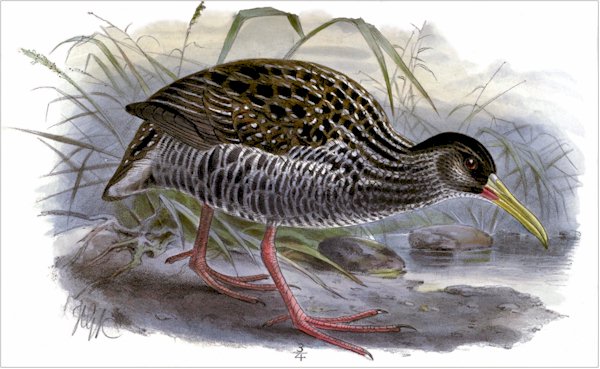
Rallus maculatus, Scl. et Salv. Nomencl. p. 139; iid. P. Z. S. 1868, p. 444; Durnford, Ibis, 1878, p. 65 (Buenos Ayres); Barrows, Auk, 1884, p. 276 (Entrerios); Withington, Ibis, 1888, p. 471 (Lomas de Zamora).
Description.—Above blackish; back and wings dark olive-brown, spotted all over with white: beneath barred across with white and black; chin and crissum white; bill yellow, with a bright red spot at the base; feet pale brown: whole length 11·0 inches, wing 5·2, tail 2·0. Female similar.
Hab. South America.
The Spotted Rail, which has a wide distribution in South America, occurs as far south as Buenos Ayres. Our figure is taken from an example of this species obtained by Mr. F. Withington in September 1885 in the Lomas de Zamora. Concerning its nesting-habits he sends the following note:—“It breeds amongst the reeds, and its nest is placed about 18 inches from the water. To reach it the birds collect a heap of reeds, grass, and other materials, and alongside form an inclined platform that answers the purpose of a staircase, by which the birds ascend or descend with ease. The usual clutch of eggs is seven, but I have taken fifteen from one nest, all good. These, of course, could not have been laid by one bird.”
370. RALLUS ANTARCTICUS, King.
(ANTARCTIC RAIL.)
Rallus antarcticus, Scl. et Salv. Nomencl. p. 139; iid. P. Z. S. 1868, p. 445; iid. Ex. Orn. t. lxxxii. p. 163; Barrows, Auk, 1884, p. 276 (Carhué); Withington, Ibis, 1888, p. 471 (Lomas de Zamora).
Description.—Above brown, striped with black; wing-coverts rufous; remiges blackish: beneath plumbeous; flanks and under wing-coverts black, barred across with white: whole length 8·0 inches, wing 3·7, tail 1·5. Female similar.
Hab. Chili, Argentine Republic, and Patagonia.
This Rail is a small southern representative of the well-known Virginian Rail of the U.S. It is stated to be “rather common” at Carhué by Mr. Barrows, and Mr. Withington has recently sent us specimens from the Lomas de Zamora.
371. RALLUS RHYTIRHYNCHUS, Vieill.
(BLACK RAIL.)
Aramides rhytirhynchus, Burm. La-Plata Reise, ii. p. 504 (Paraná). Rallus rythyrhynchus, Scl. et Salv. Nomencl. p. 139; iid. P. Z. S. 1868, p. 145 (Buenos Ayres) et p. 446; Hudson, P. Z. S. 1870, p. 104 (Buenos Ayres); Durnford, Ibis, 1878, p. 65 (Buenos Ayres); White, P. Z. S. 1883, p. 42 (Cordova); Barrows, Auk, 1884, p. 276 (Entrerios). Rallus nigricans, Durnford, Ibis, 1877, p. 193.
Description.—Above greenish brown; beneath plumbeous; bill incurved, greenish, with a blood-red basal spot; feet red: whole length 12·0 inches, wing 5·4, tail 2·8. Female similar.
Hab. Southern Brazil, Peru, Paraguay, Argentina, Chili, and Patagonia.
This Rail differs from the other species in its beak, which is very long and curved, as in the Painted Snipe (Rhynchæa), and has three strongly contrasted colours—dark green, bright blue, and scarlet at the base. The blue and red tints become very vivid in the love-season. Without being anywhere abundant, the Black Rail is found throughout the Plata Region in every place where reeds and rushes grow. In the marshes along the Plata they are met with quite as frequently in winter as in summer; this fact surprised me greatly, since I know this species to be migratory, their unmistakable cries being heard overhead every night in spring and autumn, when they are performing their distant journeys. Probably all the birds frequenting the inland marshes on the south-western pampas migrate north in winter, and all those inhabiting the Plata marshes and the Atlantic sea-board, where there is abundant shelter and a higher temperature, remain all the year. On the Rio Negro of Patagonia I found the Black Rail a resident, but the winter of that district is singularly mild; moreover, the wide expanse of waterless country lying between the Rio Negro and the moist pampa region would make an annual migration from the former place difficult to such a feeble flier. Of this instinct we know at least that it is hereditary; and it becomes hard to believe that from every one of the reed-beds distributed over the vast country inhabited by this species a little contingent of migrants is drawn away annually to winter elsewhere, leaving a larger number behind. Such a difference of habit cannot exist among individuals of a species in one locality; but differences in the migratory as in other instincts, great as this, are found in races inhabiting widely separated districts.
It is difficult to flush the Black Rail; it rises in a weak fluttering manner, the legs dangling down, and, after flying thirty or forty yards, drops again into the reeds. Its language is curious: when alarmed, the bird repeats, at short intervals, a note almost painful from its excessive sharpness, and utters it standing on a low branch or other elevation, but well masked by reeds and bushes, and incessantly bobbing its head, jerking its tail, and briskly turning from side to side. It has, at such times, a very interesting appearance, while the long beak, brilliant with the nuptial colouring, the bright-red eye and vermilion legs, admirably contrasting with the fine deep slate plumage, give it considerable claims to beauty. At other times it has a hollow call-note with a puzzling ventriloquism in the sound, which is sometimes repeated at short intervals for an hour. While uttering it the bird stands, as usual, on a slight eminence, but drawn up in a listless attitude and without any of its nods and jerks and other frisky gestures. It has also a kind of song, which sounds not unlike the braying of a donkey; hence the vernacular name Burrito (little ass) by which the bird is known in the Plata. This song is heard both day and night, and is a confused performance, uttered without pause, and composed of several long shrill notes, modulated and mingled with others, hollow and booming. These notes can be heard a thousand yards away; but, far or near, they always sound remote.
372. RALLUS NIGRICANS, Vieill.
(PLUMBEOUS RAIL.)
Aramides nigricans, Burm. La-Plata Reise, ii. p. 504. Rallus nigricans, Scl. et Salv. P. Z. S. 1868, p. 446; iid. Nomencl. p. 139.
Description.—Above olivaceous brown; front, side of the head, and body beneath plumbeous; throat whitish; lower belly, thighs, and tail blackish; bill straight, uniform dark greenish: whole length 10·0 inches, wing 5·3, tail 2·8. Female similar.
Hab. South Brazil, Paraguay, and Northern Argentina.
This Rail is said by Dr. Burmeister to occur near Buenos Ayres, but the bird taken for this species by Durnford (Ibis, 1877, p. 193; 1878, p. 66) appears to have been R. rhytirhynchus.
373. ARAMIDES YPECAHA (Vieill.).
(YPECAHA RAIL.)
Aramides gigas, Burm. La-Plata Reise, ii. p. 504 (Paraná). Aramides ypecaha, Scl. et Salv. Nomencl. p. 139; iid. P. Z. S. 1868, pp. 144, 448; Hudson, P. Z. S. 1876, p. 105 (Buenos Ayres); Durnford, Ibis, 1877, p. 194 (Buenos Ayres); Barrows, Auk, 1884, p. 276 (Entrerios).
Description.—Above olive-green; neck red; front cinereous; rump and tail black: beneath, throat white, breast and neck cinereous; abdomen rosy red, lower belly and thighs grey; flanks and crissum black; under wing-coverts rufous, with black cross bars; bill yellow; feet red: whole length 19·0 inches, wing 8·5, tail 3·3. Female similar.
Hab. Brazil, Paraguay, and Argentina.
“Ypecaha” is the Guarani name, preserved by Azara, of this highly interesting species; by the Spanish it is called “Gallineta,” from its supposed resemblance to a fowl. Without any brilliant tints, there is yet something so pleasing to the eye in the various hues of its plumage—light brown and drab colour, grey, buff, and black—all these colours so harmoniously disposed, the effect heightened by the long straight yellow beak, golden-red eye, and vermilion legs, that I do not know a handsomer waterfowl.
These Rails are found as far south as the thirty-fifth parallel of latitude, and are abundant along the marshy borders of the Plata, frequenting the vast reed-beds and forests of water-loving Erythrina crista-galli. Where they are never persecuted they are bold pugnacious birds, coming out of the reeds by day and attacking the domestic poultry about the houses and even in the streets of the villages situated on the borders of their marshy haunts. But when compelled to place man on the list of their enemies, it is a difficult matter to get a sight of one; for, like all birds that rise laboriously, they are vigilant to excess, and keep themselves so well concealed that the sportsman may pass through their haunts every day of the year, and the Ypecaha still be to him no more than a “wandering voice.” But even persecution does not entirely obliterate a certain inquisitive boldness which characterizes them. Usually they roam singly in quest of food, but have reunions in the evening and occasionally during the day, especially in gloomy weather. On misty days they often wander to a distance from the covert, walking with an easy, somewhat stately grace, jerking the tail at every stride, and running with a velocity no man can equal. Where there are woods they usually fly, when disturbed, into a tree; and it is in connexion with this habit that the Ypecaha sometimes makes a curious mistake in places where it has not been much shot at. One day, while pushing my way through a dense growth of rushes, I saw two Ypecahas not fifteen yards from me, on the horizontal branch of a tree, to which they had evidently flown for safety. I was anxious to secure them, but surprised at their temerity; and wishing to find out its cause, I approached them still nearer, and then stood for some time observing them. It was easy to see that they fancied themselves quite safe from me while off the ground. In the most unconcerned manner they continued strutting up and down along the branch, jerking their tails, and turning about this way and that, as if to tantalize their baffled enemy by ostentatiously displaying their graces.
When surprised on the open ground the Ypecaha lies close, like a Tinamou, refusing to rise until almost trodden upon. It springs up with a loud-sounding whirr, rushes violently through the air till, gaining the reeds, it glides a few yards and then drops: its flight is thus precisely like that of the Tinamou, and is more sounding and violent than that of the Grouse or Partridge. On spying an intruder it immediately utters a powerful cry, in strength and intonation not unlike that of the Pea-fowl. This note of alarm is answered by other birds at a distance as they hastily advance to the spot where the warning was sounded. The cry is repeated at irregular intervals, first on one side, then on the other, as the birds change their position to dog the intruder’s steps and inspect him from the reeds. I have surprised parties of them in an open space, and shot one or more; but no sooner had the survivors gained their refuge than they turned about to watch and follow me, sounding their powerful alarm the whole time. I have frequently been followed half a mile through the rushes by them, and by lying close and mimicking their cries have always succeeded in drawing them about me.
But the Ypecaha’s loudest notes of alarm are weak compared with the cries he utters at other times, when, untroubled with a strange presence, he pours out his soul in screams and shrieks that amaze the listener with their unparalleled power. These screams, in all their changes and modulations, have a resemblance to the human voice, but of the human voice exerted to its utmost pitch, and expressive of agony, frenzy, and despair. A long piercing shriek, astonishing for its strength and vehemence, is succeeded by a lower note, as if in the first one the creature had well-nigh exhausted itself. The double scream is repeated several times; then follow other sounds, resembling, as they rise and fall, half-suppressed cries of pain and moans of anguish. Suddenly the unearthly shrieks are renewed in all their power. This is kept up for some time, several birds screaming in concert; it is renewed at intervals throughout the day, and again at set of sun, when the woods and marshes resound with the extravagant uproar. I have said that several birds unite in screaming; this is invariably the case. I have enjoyed the rare pleasure of witnessing the birds at such times; and the screams then seem a fit accompaniment to their disordered gestures and motions.
A dozen or twenty birds have their place of reunion on a small area of smooth clean ground surrounded by reeds; and by lying well concealed and exercising some patience, one is enabled to watch their proceedings. First one bird is heard to utter a loud metallic-sounding note, three times repeated, and somewhat like the call of the Guinea-fowl. It issues from the reeds, and is a note of invitation quickly responded to by other birds on every hand as they all hurriedly repair to the customary spot. In a few moments, and almost simultaneously, the birds appear, emerging from the reeds and running into the open space, where they all immediately whirl about and begin the exhibition.
Whilst screaming they rush from side to side as if possessed with frenzy, the wings spread and agitated, the beak wide open and raised vertically. I never observed them fight or manifest anger towards each other during these performances; and, knowing the pugnacious spirit of the Ypecahas, and how ready they are to seek a quarrel with birds of other species, this at first surprised me, for I was then under the mistaken impression that these gatherings were in some way related to the sexual instinct.
Whilst watching them I also remarked another circumstance. When concealing myself amongst the rushes I have been compelled to place myself so disadvantageously, owing to the wet ground, that any single bird straying accidentally into the open space would have discovered my presence immediately; yet the birds have entered and finished their performance without seeing me, so carried away are they by the emotion that possesses them during these moments. But no sooner has the wild chorus ended than, aware of my presence, they have fled precipitately into the reeds.
We frequently speak of our familiarity with the habits of the species we have long and carefully observed in a state of nature; yet the knowledge so gained must necessarily be exceedingly imperfect, for with many shy vigilant birds it is next to impossible to see them without being seen; and no bird, conscious of being watched, will act unconstrainedly any more than a human being with clouded reputation will comport himself naturally with the eyes of a detective on him. While we are observing the bird, the bird watches us: of all its curious doings when we are out of its sight and mind we see nothing. The only way to learn the habits of a species like the Ypecaha—wary, intelligent, and passing its life behind a screen of rushes—is to domesticate it; for although in this state some instincts are blunted and others remain in abeyance, they are not obliterated. It might surprise some that I speak of the Ypecaha as an intelligent bird, since it is a member of the “stupid family,” as Professor Parker has called the Rails; but in spite of the very profound admiration I feel for that illustrious anatomist, I believe he is wrong about these birds: there is, to my mind, very much more stupidity in the Auserine and Limicoline families, while the Ypecaha has always seemed to me a singularly intelligent bird.
Fortunately Azara was able to give an account of one of these birds in a domestic state, which shows that it makes a very sprightly and entertaining, although a mischievous pet. It was taken young and allowed to run about at liberty with the poultry at the house of a village doctor in Paraguay. When full-grown it was very domineering, and became the tyrant of the poultry-yard. Occasionally a cock had the courage to face it, and then a singular combat would ensue: the Ypecaha, moving with astonishing rapidity, putting its head low down, would charge, and, thrusting its head between the cock’s legs, fling him instantly on his back, then rain a shower of blows on his breast before he could rise. It was fond of eggs, and always knew when a hen went off to lay, cautiously following her to the nest and then concealing itself at some distance to wait. As soon as the egg was dropped it would run, pick it up with its beak, and carry it away to a safe distance, and then, breaking a hole in the shell at one end, suck out the contents without spilling a drop. Sometimes, when the hen remained too long on the nest, it would lose its temper and, driving her off, pursue her with the greatest animosity about the grounds, administering correction with its sharp beak. Not satisfied with devouring all the eggs laid by the doctor’s fowls, it visited all the neighbours’ houses, doing so much damage that at length the poor doctor, afraid perhaps that his practice would suffer, had the troublesome bird put to death.
This Ypecaha would never allow any one to touch it, but it would come into the house and search through all the rooms for thimbles, scissors, and other small metal objects, and these it would carry away to conceal them among the weeds or else bury them in the mud. It was also a good mouser, and after killing a mouse with a blow from its beak would swallow it entire.
374. PORZANA LEUCOPYRRHA (Vieill.).
(RED-AND-WHITE CRAKE.)
Corethrura leucopyrrha, Burm. La-Plata Reise, ii. p. 505 (Tucuman). Porzana leucopyrrha, Scl. et Salv. Nomencl. p. 140; iid. P. Z. S. 1868, p. 454; iid. Ex. Orn. pl. lvi. p. 111.
Description.—Brownish olive, head reddish; wings, tail, and hind back darker: beneath white; sides of the head and of the neck and breast chestnut-red; flanks barred with white and black; crissum black in the middle, white on each side; bill olivaceous; feet yellowish: whole length 6·75 inches, wing 3·1, tail 1·9. Female similar.
Hab. S. Brazil, Paraguay, and N. Argentina.
This Crake is an inhabitant of Southern Brazil and Paraguay, but also occurs in the Northern Provinces of the Argentine Republic, where it was met with by Dr. Burmeister in Tucuman.
375. PORZANA SALINASI (Philippi).
(SPOT-WINGED CRAKE.)
Rallus salinasi, Philippi, Wiegm. Arch. 1857, pt. i. p. 262 (Chili); Burm. Ibis, 1888, p. 285. Porzana spiloptera, Durnford, Ibis, 1877, p. 194, pl. iii. (Buenos Ayres).
Description.—Above olive-brown with black markings; wings with white cross bands; front, sides of head, and body beneath plumbeous; flanks dark grey, with transverse bars of white; under tail-coverts barred with black and white; beak dark horn-colour; feet rather lighter: whole length 5·5 inches.
Hab. Chili and Argentina.
In 1876 Durnford obtained a specimen of this Crake from the river-scrub near Belgrano in the province of Buenos Ayres, and described and figured it in ‘The Ibis’ under the MS. name “spiloptera,” which had been given by Dr. Burmeister to an example of the same bird in the Buenos Ayres Museum.
Dr. Burmeister has, however, recently ascertained that the appellation which he proposed for this species must give way to that of salinasi, under which title it was described in 1857 by Dr. Philippi of Santiago.
Porzana salinasi, as we must therefore call it, is most nearly allied to P. spilonota of the Galapagos (cf. Scl. et Salv. P. Z. S. 1868, p. 456), but has the wings more distinctly striped, and the back olive-brown, with black markings, and not of a uniform ferruginous.
376. PORZANA NOTATA (Gould).
(MARKED CRAKE.)
Zapornia notata, Gould, Zool. Voy. Beagle, iii. p. 132, pl. xlviii. (La Plata). Porzana notata, Scl. et Salv. Nomencl. p. 140; iid. P. Z. S. 1868, p. 456; Sclater, P. Z. S. 1876, p. 255.