Volume 2 — ARGENTINE ORNITHOLOGY. (continued 2)
Reading edition
The natives say that this species cannot be taught to speak; and it is certain that the few individuals I have seen tame were unable to articulate.
Doubtless these Parrots were originally stray colonists from the tropics, although now resident in so cold a country as Patagonia. When viewed closely, one would also imagine that they must at one time have been brilliant-plumaged birds; but either natural selection, or the direct effect of a bleak climate, has given a sombre shade to their colours—green, blue, yellow, and crimson; and when seen flying at a distance, or in cloudy weather, they look as dark as crows.
277. CONURUS ACUTICAUDATUS (Vieill.).
(SHARP-TAILED PARROT.)
Conurus acuticaudatus, Scl. et Salv. Nomencl. p. 111; White, P. Z. S. 1882, p. 621 (Catamarca). Conurus fugax, Burm. La-Plata Reise, ii. p. 441. Conurus glaucifrons Leybold, Leopoldina, Heft viii. p. 52 (1873).
Description.—Above and beneath green; top of head and cheeks bluish; inner margins of wing-feathers yellowish grey; inner webs of tail-feathers at their bases red; upper mandible pale whitish, lower black: whole length 13·0 inches, wing 7·5, tail 7·0. Female similar.
Hab. Bolivia, Paraguay, and N. Argentina.
White obtained specimens of this Parrot near Andalgala in Catamarca in September 1880. He tells us that it is not very abundant in that district, and flies very swiftly in flocks of seven or eight, screeching continually when on the wing.
278. CONURUS MITRATUS, Tsch.
(RED-HEADED PARROT.)
Conurus mitratus, Tsch. Faun. Per., Av. p. 272, t. xxvi. f. 2; Scl. et Salv. Nomencl. p. 112. Conurus hilaris, Burm. La-Plata Reise, ii. p. 442 (Tucuman); id. Wiegm. Arch. 1879, pt. i. p. 100; id. P. Z. S. 1878, p. 75.
Description.—Bright green; front and sides of head red: beneath rather paler; under wing-coverts green; lower surface of tail yellowish; in some specimens with irregular patches of red on the neck and breast; bill pale; feet brown: whole length 14·0 inches, wing 8·0, tail 7·0.
Hab. Peru, Bolivia, and Northern Argentina.
Dr. Burmeister met with this Parrot near Tucuman, where he found it “very common, especially in winter.” At first he made a new species of it, but afterwards recognized its identity with Conurus mitratus of Tschudi.
Dr. Burmeister has kindly sent two specimens of this bird to Sclater, for his collection. Sclater has also examples of the same species procured by Schulz near Cordova, and in Bolivia by Bridges.
279. CONURUS MOLINÆ, Mass. et Souanc.
(MOLINA’S PARROT.)
[Plate XIV.]
CONURUS MOLINÆ.
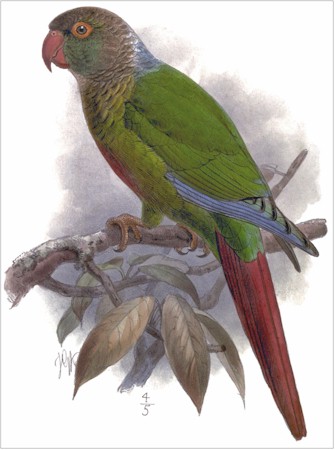
Conurus molinæ, Scl. et Salv. Nomencl. p. 112; White, P. Z. S. 1882, p. 621 (Salta).
Description.—Above green; crown brown; nape bluish; cheeks green; wings edged with blue; tail coppery red: beneath green, breast and sides of neck whity brown, with dark cross bars; middle of belly dull red: whole length 9·5 inches, wing 5·0, tail 5·3. Female similar.
Hab. Bolivia, S. Brazil, and N. Argentina.
White met with this Parrot in the dense forests of Campo Colorado near Oran, where it is found in flocks of about twenty, “their flight being limited, for the most part, to the clear aisles beneath the branches.” White’s specimen in Sclater’s collection, from which our figure (Plate XIV.) is taken, agrees with others of the species obtained by Natterer in Mato Grosso.
280. BOLBORHYNCHUS MONACHUS (Bodd.).
(GREEN PARRAKEET.)
Conurus murinus, Burm. La-Plata Reise, ii. p. 441; Darwin, Zool. Beagle, iii. p. 112 (Paraná). Bolborhynchus monachus, Scl. et Salv. Nomencl. p. 113; Durnford, Ibis, 1877, p. 186 (Buenos Ayres); Gibson, Ibis, 1880, p. 3 (Buenos Ayres); White, P. Z. S. 1882, p. 621 (Catamarca, Santiago del Estero); Barrows, Auk, 1884, p. 28 (Entrerios); Burm. P. Z. S. 1878, p. 77.
Description.—Green; front grey, with paler margins to the feathers; wings blackish, with slight bluish edgings: beneath grey, with lighter margins to the breast-feathers; under wing-coverts, flanks, and crissum pale green; bill whitish: whole length 11·0 inches, wing 5·5, tail 5·3. Female similar.
Hab. Paraguay, Uruguay, and Argentina.
The Common Green Parrakeet, called Cotorra or Catita in the vernacular, is a well-known resident species in the Argentine Republic. It is a lively restless bird, shrill-voiced, and exceedingly vociferous, living and breeding in large communities, and though it cannot learn to speak so distinctly as some of the larger Parrots, it is impossible to observe its habits without being convinced that it shares in the intelligence of the highly-favoured order to which it belongs.
In Buenos Ayres it was formerly very much more numerous than it is now; but it is exceedingly tenacious of its breeding-places, and there are some few favoured localities where it still exists in large colonies, in spite of the cruel persecution all birds easily killed are subjected to in a country where laws relating to such matters are little regarded, and where the agricultural population is chiefly Italian. At Mr. Gibson’s residence near Cape San Antonio, on the Atlantic coast, there is still a large colony of these birds inhabiting the Tala woods (Celtis tala), and I take the following facts from one of his papers on the ornithology of the district.
He describes the woods as being full of their nests, with their bright-coloured talkative denizens and their noisy chatter all day long drowning every other sound. They are extremely sociable and breed in communities. When a person enters the wood their subdued chatter suddenly ceases, and during the ominous silence a hundred pairs of black beady eyes survey the intruder from the nests and branches; and then follows a whirring of wings and an outburst of screams that spreads the alarm throughout the woods. The nests are frequented all the year, and it is rare to find a large one unattended by some of the birds any time during the day. In summer and autumn they feed principally on the thistle; first the flower is cut up and pulled to pieces for the sake of the green kernel, and later they eat the fallen seed on the ground. Their flight is rapid, with quick flutters of the wings, which seem never to be raised to the level of the body. They pay no regard to a Polyborus or Milvago, but mob any other bird of prey appearing in the woods, all the Parrakeets rising in a crowd and hovering about it with angry screams.
The nests are suspended from the extremities of the branches, to which they are firmly woven. New nests consist of only two chambers, the porch and the nest proper, and are inhabited by a single pair of birds. Successive nests are added, until some of them come to weigh a quarter of a ton, and contain material enough to fill a large cart. Thorny twigs, firmly interwoven, form the only material, and there is no lining in the breeding-chamber, even in the breeding-season. Some old forest trees have seven or eight of these huge structures suspended from the branches, while the ground underneath is covered with twigs and remains of fallen nests. The entrance to the chamber is generally underneath, or if at the side is protected by an overhanging eave to prevent the intrusion of opossums. These entrances lead into the porch or outer chamber, and the latter communicates with the breeding-chamber. The breeding-chambers are not connected with each other, and each set is used by one pair of birds.
The number of pairs does not exceed a dozen, even with the largest nests. Repairs are carried on all the year round, but new nests are only added at the approach of spring. Opossums are frequently found in one of the higher chambers, when the entrance has been made too high, but though they take up their abode there they cannot reach the other chambers, and the Parrakeets refuse to go away. A species of Teal (probably Querquedula brasiliensis) also sometimes occupies and breeds in their chambers, and in one case Mr. Gibson found an opossum domiciled in an upper chamber, Parrakeets occupying all the others except one, in which a Teal was sitting on eggs.
The breeding-season begins about November 1, and as many as seven or eight eggs are laid; these are dull white, very thin-shelled, elongated, and have the greatest diameter exactly equidistant from the two ends.
Mr. Barrows speaks as follows of this species in Entrerios:—“An abundant and familiar bird in the neighbourhood of Concepcion through the entire year. It is commonly seen in flocks of twenty and upwards, visiting grain-fields, gardens, &c., and sometimes, if I was correctly informed, it has appeared in flocks of tens of thousands, completely stripping the grain-fields. They nest in communities, many pairs uniting in the building of a large common nest or mass of nests. I only saw these nests on two occasions, and had no opportunity of examining their structure. They were placed on high trees, and appeared from below to be simply irregular masses, six or eight feet in diameter, formed of small sticks and twigs. Where the nests are abundant the natives destroy the young by hundreds, and the ‘squabs’ when nearly grown are said to be very fine eating. The young are easily tamed, and may be taught to articulate a few simple words.”
281. BOLBORHYNCHUS AYMARA (d’Orb.).
(AYMARA PARRAKEET.)
[Plate XV.]
BOLBORHYNCHUS AYMARA.
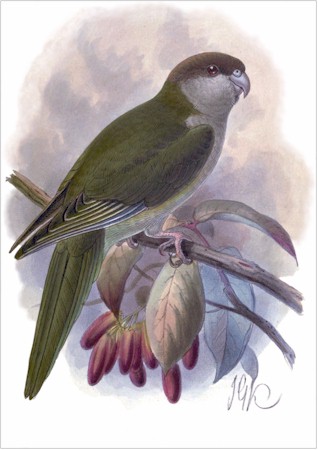
Conurus aymara, Burm. La-Plata Reise, ii. p. 442 (Mendoza). Bolborhynchus aymara, Scl. et Salv. Nomencl. p. 113; White, P. Z. S. 1883, p. 40 (Cordova). Conurus brunniceps, Burm. Journ. f. Orn. 1860, p. 243.
Description.—Above green; head earthy brown: beneath pale grey, nearly white on the sides of the head; under wing-coverts, flanks, lower belly, and crissum pale green; under surface of wings and tail blackish; beak whitish: whole length 7·0 inches, wing 3·9, tail 4·0. Female similar.
Hab. Bolivia and N. Argentina.
Prof. Burmeister found this Parrakeet not uncommon on the borders of the sierra near Mendoza. White met with it near Cosquin in the province of Cordova, in flocks on the mountain-tops, about 3500 feet above the sea-level. He says it is called “Catita de las sierras,” and that it never descends to the valleys. Its flight is very swift, and is accompanied by a sort of chirping.
The figure (Plate XV.) is taken from a specimen in Sclater’s collection, obtained by Buckley in Bolivia.
282. BOLBORHYNCHUS RUBRIROSTRIS (Burm.).
(RED-BILLED PARRAKEET.)
Conurus rubrirostris, Burm. La-Plata Reise, ii. p. 442; id. P. Z. S. 1878, p. 77. Bolborhynchus rubrirostris, Scl. et Salv. Nomencl. p. 113.
Description.—Uniform green; wing-feathers blackish, edged with blue; bill rosy red: whole length 7·0 inches, wing 5·0, tail 2·8.
Hab. Argentina.
Prof. Burmeister discovered this little Parrot, of which we have never seen specimens, in the ravines of the Sierra of Uspallata, and also met with it in the Sierra of Cordova. It lives in small flocks, which fly away screaming when approached.
283. CHRYSOTIS VINACEA (Max.).
(VINACEOUS AMAZON.)
Chrysotis vinacea, Scl. et Salv. Nomencl. p. 113; White, P. Z. S. 1882, p. 621 (Misiones).
Description.—Above green, feathers of neck and back edged with blackish; front, lores, and wing-spot scarlet; beneath paler, throat and breast vinaceous, feathers edged with blackish; bend of wing and base of tail-feathers scarlet: whole length 14·0 inches, wing 7·2, tail 4·7. Female similar.
Hab. S. Brazil, Paraguay, and N. Argentina.
This Parrot, which is enumerated by Azara among the birds of Paraguay, was also found by White in the adjoining district of Misiones in the Argentine Republic. White gives us the following notes on its habits:—“Both in Concepcion and San Javier these Parrots are found in incredible numbers feeding in the orange-groves which cover and enclose the extensive Jesuit ruins of those parts of Misiones. They seem to be very voracious, as they feed all day long; and the inhabitants shoot them for food; but they are not easily scared, for on hearing a shot they only fly up in clouds to descend again, meanwhile making the air resound with their shrill cries. They can be taught to talk tolerably well if taken young.”
284. CHRYSOTIS ÆSTIVA (Linn.).
(BLUE-FRONTED AMAZON.)
Chrysotis æstiva, Scl. et Salv. Nomencl. p. 114; Salvin, Ibis, 1880, p. 361 (Salta). Psittacus amazonicus, Burm. La-Plata Reise, ii. p. 443 (?). Chrysotis amazonica, White, P. Z. S. 1882, p. 621 (?).
Description.—Above green, feathers edged with blackish; crown yellow; front blue; wing-patch scarlet: beneath green, cheeks and throat yellow; bend of wings and inner base of tail scarlet: whole length 15·0 inches, wing 8·5, tail 5·0. Female similar.
Hab. Brazil, Paraguay, and N. Argentina.
Durnford obtained a specimen of this Parrot near Salta in the province of Oran, which has been identified by Mr. Salvin. It is probable that the birds referred to C. amazonica by Prof. Burmeister and White may belong to this same species.
285. PIONUS MAXIMILIANI (Kuhl).
(PRINCE MAXIMILIAN’S PARROT.)
Pionus maximiliani, Scl. et Salv. Nomencl. p. 114; White, P. Z. S. 1882, p. 622 (Salta).
Description.—Dark green; lores blackish; feathers of nape dirty white margined with green; front and cheeks bluish: beneath dusky green, crissum scarlet: whole length 9·0 inches, wing 6·5, tail 3·2. Female similar.
Hab. Brazil and N. Argentina.
White obtained a single specimen of this Parrot in the dense forests of the Rio Vermejo, near Oran, in November 1880.
Order VI. STRIGES.
About 40 different species of the nocturnal birds of prey are known to occur in the Neotropical Region. Six of them have been recorded as being found more or less frequently within the limits of the Argentine Republic. Of these, the Burrowing-Owl (Pholeoptynx cunicularia) is one of the most characteristic inhabitants of the Argentine Pampas, while two others, the Barn-Owl and the Short-eared Owl, are very widely diffused species, also well known in England.
Fam. XXX. STRIGIDÆ, or BARN-OWLS.
286. STRIX FLAMMEA, Linn.
(COMMON BARN-OWL.)
Strix flammea, Scl. et Salv. Nomencl. p. 116; Durnford, Ibis, 1877, p. 187 (Buenos Ayres); White, P. Z. S. 1882, p. 622 (Misiones); Withington, Ibis, 1888, p. 468 (Lomas de Zamora); Sharpe, Cat. B. ii. p. 291. Aluco flammeus, Barrows, Auk, 1884, p. 29 (Entrerios). Strix perlata, Burm. La-Plata Reise, ii. p. 440; Döring, Exp. al Rio Negro, p. 49.
Description.—Above orange-brown, marbled with ashy and white, and dotted with black spots with central white points; wings and tail crossed by four or five blackish bands; face silvery white, with a posterior and inferior border of orange-brown and black: beneath white, more or less suffused with tawny, except on the lower belly, and dotted with distinct rounded black spots; bill yellowish; tarsus feathered; toes slightly bristled; claws long and sharp: whole length 15·0 inches, wing 12·5, tail 5·0. Female similar.
Hab. Old and New Worlds.
This widely distributed species is found throughout South America; and in its habits and sepulchral voice, as well as in its pretty reddish buff, grey, and white plumage, is identical with the European bird. D’Orbigny expressed astonishment that this Owl, which is never seen in uninhabited places, invariably appears to keep company with man wherever a settlement is formed, even in the most lonely and isolated spots. Probably it is much more numerous than most people imagine, sheltering itself everywhere in caverns and hollow trees, so that it is always present, and ready to take early advantage of the commodious church-tower or other large building raised by man. On the level pampas, where there are no hills or suitable hiding-places, it is rarely seen: it is exclusively a town bird.
Nothing more need be said of the habits of a species so well known, and about which there is so much recorded in general works of Natural History.
Fam. XXXI. BUBONIDÆ, or OWLS.
287. ASIO BRACHYOTUS (Forst.).
(SHORT-EARED OWL.)
Otus palustris, Darwin, Zool. Beagle, iii. p. 33. Otus brachyotus, Scl. et Salv. Nomencl. p. 116; Burm. La-Plata Reise, ii. p. 439 (Rosario); Hudson, P. Z. S. 1870, p. 800 (Buenos Ayres); Durnford, Ibis, 1877, p. 186 (Buenos Ayres), et 1878, p. 396 (Patagonia). Asio brachyotus, Gibson, Ibis, 1879, p. 423 (Buenos Ayres); White, P. Z. S. 1882, p. 622 (Buenos Ayres); Withington, Ibis, 1888, p. 468 (Lomas de Zamora). Asio accipitrinus, Sharpe, Cat. B. ii. p. 234.
Description.—Above streaked and variegated with fulvous and blackish brown; face whitish, with a large central blotch of blackish round the eye; wings pale tawny white, with several irregular broad blackish cross bars; tail whitish, with four or five broad black cross bands: beneath as above, but much whiter on the belly, which is only slightly streaked, and without markings on the crissum and thighs; bill black; tarsi and toes densely feathered: whole length 15·0 inches, wing 13·0, tail 6·0. Female similar, but rather larger.
Hab. Old and New Worlds.
The Short-eared Owl is found throughout the Argentine country, where it is commonly called Lechuzon (big Owl) in the vernacular. Like the species last described—the Barn-Owl—it has an exceedingly wide range. It is found throughout the continent of Europe; it also inhabits Asia and Africa, many of the Pacific Islands, and both Americas, from Canada down to the Straits of Magellan. Such a very wide distribution would seem to indicate that it possesses some advantage over its congeners, and is (as an Owl) more perfect than others. It is rather more diurnal in its habits than most Owls, and differs structurally from other members of its order in having a much smaller head. It is also usually said to be a weak flier; but this I am sure is a great mistake, for it seems to me the strongest flier amongst Owls, and very migratory in its habits, or, at any rate, very much given to wandering. Probably its very extensive distribution is due in some measure to a greater adaptability than is possessed by most species; also to its better sight in the daytime, and to its wandering disposition, which enables it to escape a threatened famine, and to seize on unoccupied or favourable ground.
The bird loves an open country, and sits by day on the ground concealed amongst the herbage or tall grass. An hour before sunset it quits its hiding-place, and is seen perched on a bush or tall stalk, or sailing about a few feet above the ground with a singularly slow, heron-like flight; and at intervals while flying it smites its wings together under its breast in a quick sudden manner. It is not at all shy, the intrusion of a man or dog in the field it frequents only having the effect of exciting its indignation. An imitation of its cry will attract all the individuals within hearing about a person, and any loud unusual sound, like the report of a gun, produces the same effect. When alarmed or angry it utters a loud hiss, and at times a shrill laugh-like cry. It also has a dismal scream, not often heard; and at twilight hoots, this part of its vocal performance sounding not unlike the distant baying of a mastiff or a bloodhound. It breeds on the ground, clearing a circular spot, and sometimes, but not often, lining it with a scanty bed of dry grass. The eggs are three or four, white, and nearly spherical.
The Short-eared Owl was formerly common everywhere on the pampas, where the coarse indigenous grasses afforded the shelter and conditions best suited to it. When in time this old rough vegetation gave place to the soft perishable grasses and clovers, accidentally introduced by European settlers, the Owl disappeared from the country, like the large Tinamou (Rhynchotis rufescens), the Red-bellied Finch (Embernagra platensis), and various other species; for the smooth level plains afforded it no shelter. Now, however, with the spread of cultivation, it has reappeared, and is once more becoming a common bird in the more thickly-settled districts.
288. BUBO VIRGINIANUS (Gm.).
(VIRGINIAN OWL.)
Bubo virginianus, Scl. et Salv. Nomencl. p. 116; Scl. P. Z. S. 1872, p. 549 (Rio Negro); White, P. Z. S. 1883, p. 433 (Cordova); Barrows, Auk, 1884, p. 29 (Gualeguaychú). Bubo crassirostris, Burm. La-Plata Reise, ii. p. 439 (Mendoza). Bubo magellanicus, d’Orb. Voy. Ois. p. 137; Salv. Ibis, 1880, p. 361 (Salta); Sharpe, Cat. B. ii. p. 29.
Description.—Above dull tawny buff, more or less densely mottled with blackish brown; ear-tufts long, blackish, mixed with tawny buff; wings tawny buff, with about seven blackish cross bands; tail tawny buff, tipped with whitish, and with about seven blackish cross bands: beneath dull ochraceous buff, with dusky brown cross lines; throat-collar whitish: whole length 19·5 inches, wing 14·5, tail 8·5. Female similar, but rather larger.
Hab. North and South America.
This bird, eagle-like in its dimensions, and the largest of our Owls, is found throughout both Americas, though some authors, relying on certain trivial variations in size and colour, have separated the southern from the northern form, and called it Bubo magellanicus. In the Argentine Republic it is well known by its Indian name “Ñacurutú”; also in Paraguay according to Azara, who says:—“It pronounces its own name in tones which scare such as pass by night through the deep woods, which are its palaces.”
The habits of the Virginian Owl are too well known to need to be rewritten in this place: the ornithologists of North America have supplied several biographies of it, that by Audubon being specially familiar.
289. SCOPS BRASILIANUS (Gm.).
(CHOLIBA OWL.)
Scops brasilianus, Scl. et Salv. Nomencl. p. 117; White, P. Z. S. 1883, p. 41 (Cordova); Barrows, Auk, 1884, p. 29 (Entrerios); Sharpe, Cat. B. ii. p. 108.
Description.—Above brown, vermiculated with darker brown, and spotted and streaked more or less distinctly with black; neck-collar lighter; wings dark brown, regularly barred across with sandy rufous; tail dark brown, with about ten regular cross bars of sandy rufous: beneath dirty white, washed with buff, densely crossed with narrow zigzag lines of blackish brown: whole length 9·5 inches, wing 6·2, tail 3·7. Female similar, but rather larger.
Hab. South America.
Azara and d’Orbigny have described the habits of this Owl, which is common in Paraguay and in the Argentine State of Corrientes, the name for it in both countries being Choliba. It is a bird of the woods, strictly nocturnal, lives in pairs, and spends the day in a thick-foliaged tree, the male and female sitting close together. At night it comes a great deal about houses, where it diligently explores every corner in search of cockroaches and other vermin, and in this way commends itself to the country people, who esteem it highly, and often keep it tame in their homes. Its hoot, described as sounding like tururú-tú-tú, is not unpleasant to the ear, and is a familiar sound to all who traverse the woody paths by night. It breeds in deep woods, and lays three white eggs in a hollow tree without any nest.
Barrows found it common in Corrientes along the wooded water-courses, and says it has a soft tremulous cry. He tells us there are two varieties of it in colour, red and grey, and gives Caburé as the native name.
290. SPEOTYTO CUNICULARIA (Mol.).
(BURROWING-OWL.)
Athene cunicularia, Darwin, Zool. Beagle, iii. p. 31. Noctua cunicularia, Burm. La-Plata Reise, ii. p. 440; Durnford, Ibis, 1877, p. 38, et 1878, p. 397 (Patagonia). Pholeoptynx cunicularia, Scl. et Salv. Nomencl. p. 117; Hudson, P. Z. S. 1874, p. 308 (Buenos Ayres); Durnford, Ibis, 1877, p. 186 (Buenos Ayres); Gibson, Ibis, 1879, p. 423 (Buenos Ayres); White, P. Z. S. 1882, p. 622 (Catamarca, Misiones). Speotyto cunicularia, Sharpe, Cat. B. ii. p. 142; Barrows, Auk, 1884, p. 30 (Entrerios); Withington, Ibis, 1888, p. 469 (Lomas de Zamora).
Description.—Above dark sandy brown, with large oval spots of white and smaller spots and freckles of pale brown; wings and tail dark brown, with broad whitish cross bars; facial disk greyish brown, surrounded by white: beneath white, sides of breast marked with broad bars of brown, which become fainter on the belly; lower belly, thighs, and crissum pure white; tarsi feathered; toes slightly bristled: whole length 10·0 inches, wing 7·5, tail 3·5. Female similar, but rather larger.
Hab. North and South America.
The Burrowing-Owl is abundant everywhere on the pampas of Buenos Ayres and avoids woods, but not districts abounding in scattered trees and bushes. It sees much better than most Owls by day, and never affects concealment nor appears confused by diurnal sounds and the glare of noon. It stares fixedly—“with insolence,” Azara says—at a passer-by, following him with the eyes, the round head turning about as on a pivot. If closely approached it drops its body or bobs in a curious fashion, emitting a brief scream, followed by three abrupt ejaculations; and if made to fly goes only fifteen or twenty yards away, and alights again with face towards the intruder; and no sooner does it alight than it repeats the odd gesture and scream, standing stiff and erect, and appearing beyond measure astonished at the intrusion. By day it flies near the surface with wings continuously flapping, and invariably before alighting glides upwards for some distance and comes down very abruptly. It frequently runs rapidly on the ground, and is incapable of sustaining flight long. Gaucho boys pursue these birds for sport on horseback, taking them after a chase of fifteen or twenty minutes. They live in pairs all the year, and sit by day at the mouth of their burrow or on the Vizcacha’s mound, the two birds so close together as to be almost touching; when alarmed they both fly away, but sometimes the male only, the female diving into the burrow. On the pampas it may be more from necessity than choice that they always sit on the ground, as they are usually seen perched on the summits of bushes where such abound, as in Patagonia.
These are the commonest traits of the Burrowing-Owl in the settled districts, where it is excessively numerous and has become familiar with man; but in the regions hunted over by the Indians it is a scarce bird and has different habits. Shy of approach as a persecuted game fowl, it rises to a considerable height in the air when the approaching traveller is yet far off, and flies often beyond sight before descending again to the earth. This wildness of disposition is, without doubt, due to the active animosity of the pampas-tribes, who have all the ancient wide-spread superstitions regarding the Owl. Sister of the Evil Spirit is one of their names for it; they hunt it to death whenever they can, and when travelling will not stop to rest or encamp on a spot where an Owl has been spied. Where the country is settled by Europeans the bird has dropped its wary habits and become extremely tame. They are tenacious of the spot they live in, and are not easily driven out by cultivation. When the fields are ploughed up they make their kennels on their borders, or at the roadsides, and sit all day perched on the posts of the fences.
Occasionally they are seen preying by day, especially when anything passes near them, offering the chance of an easy capture. I have often amused myself by throwing bits of hard clay near one as it sat beside its kennel; for the bird will immediately give chase, only discovering its mistake when the object is firmly clutched in its talons. When there are young to be fed, they are almost as active by day as by night. On hot November days multitudes of a large species of Scarabæus appear, and the bulky bodies and noisy bungling flights of these beetles invite the Owls to pursuit, and on every side they are seen pursuing, and striking down the beetles, and tumbling upon them in the grass. Owls have a peculiar manner of taking their prey: they grapple it so tightly in their talons that they totter and strive to steady themselves by throwing out their wings, and, sometimes losing their balance, fall prostrate and flutter on the ground. If the animal captured be small they proceed after a while to dispatch it with the beak; if large they usually rise laboriously from the ground and fly to some distance with it, thus giving time for the wounds inflicted by the claws to do their work.
At sunset the Owls begin to hoot; a short followed by a long note is repeated many times with an interval of a second of silence. There is nothing dreary or solemn in this performance; the voice is rather soft and sorrowful, somewhat resembling the lowest notes of the flute in sound. In spring they hoot a great deal, many individuals responding to each other.
In the evening they are often seen hovering at a height of forty feet above the surface, and continuing to do so fully a minute or longer without altering their position. They do not drop the whole distance at once on their prey, but descend vertically, tumbling and fluttering as if wounded, to within ten yards of the earth, and then, after hovering a few seconds more, glide obliquely on to it. They prey on every living creature not too large to be overcome by them. Sometimes when a mouse is caught they tear off the head, tail, and feet, devouring only the body. The hind quarters of toads and frogs are almost invariably rejected; and inasmuch as these are the most fleshy and succulent parts, this is a strange and unaccountable habit. They make an easy conquest of a snake eighteen inches long, and kill it by dealing it blows with the beak, hopping briskly about it all the time, apparently to guard themselves with their wings. They prey largely on the common Coronella anomala, but I have never seen one attacking a venomous species. When they have young many individuals become destructive to poultry, coming about the houses and carrying off the chickens and ducklings by day. In seasons of plenty they destroy far more prey than they can devour; but in severe winters they come, apparently starving, about the houses, and will then stoop to carry off any dead animal food, though old and dried up as a piece of parchment. This I have often seen them do.
Though the Owls are always on familiar terms with the Vizcachas (Lagostomus trichodactylus) and occasionally breed in one of their disused burrows, as a rule they excavate a breeding-place for themselves. The kennel they make is crooked, and varies in length from four to twelve feet. The nest is placed at the extremity, and is composed of wool or dry grass, often exclusively of dry horse-dung. The eggs are usually five in number, white, and nearly spherical; the number, however, varies, and I have frequently found six or seven eggs in a nest. After the female has begun laying the birds continue carrying in dry horse-dung, until the floor of the burrow and a space before it is thickly carpeted with this material. The following spring the loose earth and rubbish is cleared out, for the same hole may serve them two or three years. It is always untidy, but mostly so during the breeding-season, when prey is very abundant, the floor and ground about the entrance being often littered with excrements, green beetle-shells, pellets of hair and bones, feathers of birds, hind quarters of frogs in all stages of decay, great hairy spiders (Mygale), remains of half-eaten snakes, and other unpleasant creatures that they subsist on. But all this carrion about the little Owl’s disordered house reminds one forcibly of the important part the bird plays in the economy of nature. The young birds ascend to the entrance of the burrow to bask in the sun, and receive the food their parents bring; when approached they become irritated, snapping with their beaks, and retreat reluctantly into the hole; and for some weeks after leaving it they make it a refuge from danger. Old and young birds sometimes live together for four or five months. I believe that nine-tenths of the Owls on the pampas make their own burrows, but as they occasionally take possession of the forsaken holes of mammals to breed in, it is probable that they would always observe this last habit, if suitable holes abounded, as on the North-American prairies inhabited by the marmot. Probably our Burrowing-Owl originally acquired the habit of breeding in the ground in the open level regions it frequented; and when this habit (favourable as it must have been in such unsheltered situations) had become ineradicable, a want of suitable burrows would lead it to clean out such old ones as had become choked up with rubbish, to deepen such as were too shallow, and ultimately to excavate for itself. The mining instinct varies greatly in strength, even on the pampas. Some pairs, long mated, only begin to dig when the breeding-season is already on them; others make their burrows as early as April—that is six months before the breeding-season. Generally both birds work, one standing by and regarding operations with an aspect of grave interest, and taking its place in the pit when the other retires; but sometimes the female has no assistance from her partner, and the burrow then is very short. Some pairs work expeditiously and their kennel is deep and neatly made; others go about their task in a perfunctory manner, and begin, only to abandon, perhaps half a dozen burrows, and then rest two or three weeks from their unprofitable labours. But whether industrious or indolent, by September they all have their burrows made. I can only account for Azara’s unfortunate statement, repeated since by scores of compilers, that the Owl never constructs its own habitations, by assuming that a century ago, when he lived and the country was still very sparsely settled, this Owl had not yet become so abundant or laid aside the wary habit the aborigines had taught it, so that he did not become very familiar with its habits.
291. GLAUCIDIUM NANUM (King).
(PYGMY OWL.)
Glaucidium nanum, Scl. et Salv. Nomencl. p. 117; Burm. La-Plata Reise, ii. p. 441; Scl. P. Z. S. 1872, p. 549 (Rio Negro); White, P. Z. S. 1883, p. 41 (Cordova); Döring, Exp. al Rio Negro, p. 49 (Rio Negro); Sharpe, Cat. B. ii. p. 190.
Description.—Above dull reddish brown, mottled with concealed spots and bars of ochraceous buff; scapulars with an ashy tinge; head more rufous and longitudinally streaked; whitish collar on the hind neck; wings dark brown, banded with rufous; tail dark brown, with about ten rufous bars, and tipped with whitish; cheeks and chin pure white, the latter divided by a dark brown throat-band from the white fore neck; abdomen white, streaked with dark brown: whole length 8·0 inches, wing 3·8, tail 2·9. Female similar, but rather larger.
Hab. La Plata, Patagonia, and Chili.
This diminutive Owl, which barely reaches eight inches in length, and is light brown and grey in colour, was discovered by Captain King in 1827 in the neighbourhood of the Straits of Magellan. I met with it on the Rio Negro in Patagonia, but saw very little of it. It struck me that, like the Burrowing-Owl, it is not very strictly nocturnal, for I observed it in the daytime perched in exposed situations.
In 1882 White met with it in Cosquin, in Cordova, and made the following important note on its habits:—“It causes the naturalist much amusement to watch the habits of this pretty little Owl, that, perched perfectly motionless on a branch, utters such a sirenic cry as to attract little birds in great numbers. They are observed to cluster round it, all the while fluttering and in great excitement, charmed by some fascination. After waiting a while the Owl suddenly pounces upon the nearest for its victim.”
I also observed little birds mobbing it, when it perched in a conspicuous place in the daytime, as they always mob small birds of prey, but was not so fortunate as to hear the “sirenic cry” with which the Cordova bird fascinates its victims. One has heard this yarn of a “sirenic cry” before, of other species, for it is a very common myth. That an Owl should now be fitted with the old melodious cap seems strange; and Mr. White is in error when he says that this habit in our bird “causes the naturalist much amusement.”
Order VII. ACCIPITRES.
Fam. XXXII. FALCONIDÆ, or FALCONS.
The diurnal birds of prey of the family Falconidæ found in the Neotropical Region number about 110 species, of which 22 are at present known to occur within the limits of the present work. It is probable, however, that many additional species of this group will be hereafter added to the Argentine list.
As is usually the case with the Accipitres, most of the species have an extensive distribution.
292. CIRCUS CINEREUS (Vieill.).
(CINEREOUS HARRIER.)
Circus cinereus, Sharpe, Cat. B. i. p. 56; Scl. et Salv. P. Z. S. 1868, p. 143 (Buenos Ayres); iid. Nomencl. p. 118; Burm. La-Plata Reise, ii. p. 439 (Mendoza); Scl. P. Z. S. 1872, p. 536 (Rio Negro); Durnford, Ibis, 1877, p. 38 (Patagonia) et p. 187 (Buenos Ayres), et 1878, p. 397 (Patagonia); Gibson, Ibis, 1879, p. 411 (Buenos Ayres); Barrows, Auk, 1884, p. 30 (Bahia Blanca); Withington, Ibis, 1888, p. 469 (Lomas de Zamora).
Description.—Above bluish grey, with darker mottlings; wing-coverts with obsolete whitish edgings; primaries blackish; tail grey, with four black cross bands, and tipped with white: beneath, throat and neck like the back; abdomen thickly banded with white and rufous bars; under wing-coverts white; bill black; feet yellow; nails black: whole length 18·0 inches, wing 12·0, tail 8·2. Female: rather larger; above dark brown, with lighter brown spots and edgings; throat and fore neck like the back; wings beneath with black cross bands.
Hab. Southern portion of South America.
This Harrier is found throughout the Argentine Republic, and is also common in Patagonia and the Falkland Islands. On the pampas it is, I think, the most common bird of prey, after the excessively abundant Milvago chimango. Like the Chimango, it also prefers an open unwooded country, and resembles that bird not a little in its general appearance, and when in the brown stage of plumage may be easily mistaken for it. In the Falklands it has even acquired the Carrion Hawk’s habits, for Darwin distinctly saw one feeding on a carcass there, very much to his surprise. On the pampas I have always found it a diligent bird-hunter, and its usual mode of proceeding is to drive up the bird from the grass and to pursue and strike it down with its claws. Mr. Gibson’s account of its habits agrees with mine, and he says that “it will raise any small bird time after time, should the latter endeavour to conceal itself in the grass, preferring, as it would seem, to strike it on the wing.” He further says:—“Its flight is low and rather rapid, while if its quarry should double it loses no ground, for it turns something in the manner of a Tumbler Pigeon, going rapidly head over heels in the most eccentric and amusing fashion.”
Probably this Harrier has a partial migration, as a great many are always seen travelling across the pampas in the autumn and spring; many individuals, however, remain all winter.
The nest is made on the ground among long grass, or in reed-beds in marshy places, and the eggs are white blotched with dark red.
293. CIRCUS MACROPTERUS, Vieill.
(LONG-WINGED HARRIER.)
Circus macropterus, Scl. et Salv. Nomencl. p. 118; iid. P. Z. S. 1868, p. 143 (Buenos Ayres); Döring, Exp. al Rio Negro, p. 50 (Rio Colorado). Buteo macropterus, d’Orb. Voy., Ois. p. 112 (Buenos Ayres). Circus maculosus, Sharpe, Cat. B. i. p. 62. Circus megaspilus, Gould, Zool. Voy. Beagle, iii. p. 29 (Uruguay).
Description.—Above black; frontal band, superciliaries, and upper tail-coverts white; edge of facial ruff spotted with white; wing- and tail-feathers grey, with black cross bands: beneath white, chest and throat black, with some white streaks; under wing-coverts white, with narrow blackish cross bands: whole length 20·0 inches, wing 17·0, tail 10·0. Female similar, but larger.
Hab. South America.
This Harrier is also found in the Republic, but is not so common as the former species.
294. ASTURINA PUCHERANI, Verr.
(PUCHERAN’S HAWK.)
Asturina pucherani, Scl. et Salv. Ex. Orn. pl. 89, p. 177; iid. Nomencl. p. 118; iid. P. Z. S. 1869, p. 634 (Buenos Ayres); Durnford, Ibis, 1877, p. 187 (Buenos Ayres); Barrows, Auk, 1884, p. 30 (Entrerios); Withington, Ibis, 1888, p. 469 (Lomas de Zamora); Sharpe, Cat. B. i. p. 205.
Description.—Above dark brown; upper tail-coverts fulvous barred with brown; wings deep chestnut, barred and broadly tipped with black; tail fulvous, with four blackish cross bands: beneath, abdomen pale ochraceous, barred across with rufous; throat blackish, with slight white stripes; breast ochraceous, with narrow black shaft-stripes; thighs ochraceous, narrowly barred with orange-rufous; bill black; feet dark yellow: whole length 18·0 inches, wing 11·0, tail 8·2. Female similar, but rather larger.
Hab. South Brazil, Paraguay, and Argentina.
This brown-plumaged, short-winged, and exceedingly vociferous Hawk is common in the woods along the shores of the Plata and its tributaries, and is never found far removed from water. It perches on the summit of a tree, and sits there motionless for hours at a time, and at intervals utters singularly long loud cries, which become more frequent and piercing when the bird is disturbed, as by the approach of a person. Its flight is rapid and irregular, the short blunt wings beating unceasingly, while the bird pours out a succession of loud vehement broken screams.
Mr. Barrows observed it on the Lower Uruguay, and writes:—“It feeds largely if not exclusively on fish, nearly every specimen having their remains (and nothing else) in their stomachs.” It would be very interesting to learn how it captures its prey.
295. BUTEO SWAINSONI, Bp.
(SWAINSON’S BUZZARD.)
[Plate XVI.]
BUTEO SWAINSONI.
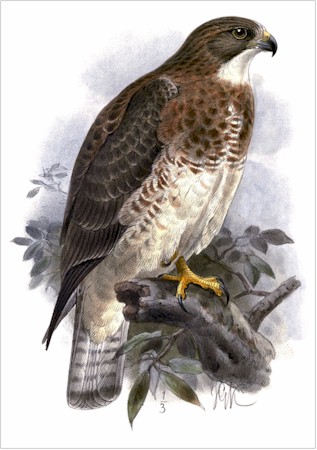
Buteo swainsoni, Scl. et Salv. Nomencl. p. 118; Withington, Ibis, 1888, p. 469 (Lomas de Zamora); Baird, Brew., et Ridgw. N. A. B. iii. p. 263. Buteo obsoletus, Sharpe, Cat. B. i. p. 184. Buteo albicaudatus, Scl. et Salv. P. Z. S. 1869, p. 634 (Buenos Ayres).
Description.—Above blackish brown; scapulars slightly variegated with rufous; upper tail-coverts white, tinged with rufous; tail dark greyish brown, crossed by several ill-defined blackish bars: beneath white or pale ochraceous; a broad band covering the whole breast reddish brown; bill black; feet yellow; claws black: whole length 20·0 inches, wing 15·0, tail 8·5. Female similar, but larger.
Hab. North and South America.
The figure given herewith (Plate XVI.) represents a fine adult female specimen of this Buzzard, obtained by Mr. Frank Withington at Lomas de Zamora, on the 4th of February, 1886, and now in Sclater’s collection.
Swainson’s Buzzard is a North-American species, which has only recently been ascertained to occur in the southern part of the Western Hemisphere. Full details concerning it are given in the standard work on “North-American Land-birds,” to which we have referred above. Messrs. Baird, Brewer, and Ridgway divide the species into two subspecies, “swainsoni” and “oxypterus” to the latter of which they refer the southern specimens, but they acknowledge that it is “difficult to express points of absolute difference” between these subspecies.
It appears from what these authorities say (l. c. p. 268) that a young specimen procured by Hudson at Conchitas in 1860, and referred by Messrs. Salvin and Sclater with doubt to B. albicaudatus, really belongs to B. swainsoni. A second undoubtedly Argentine example is that procured by Mr. Withington and now figured.
Like other Buzzards, B. swainsoni varies much in plumage, and occasionally assumes a melanistic form, under which it was described and figured by Sclater in 1858 as Buteo fuliginosus (cf. P. Z. S. 1858, p. 356, and Trans. Zool. Soc. vol. iv. p. 267, pl. lxii.). Mr. Gurney is of opinion that d’Orbigny’s Buteo unicolor is also referable to this form of B. swainsoni (cf. Ibis, 1889, p. 134).
A well-known writer on North-American birds (Capt. C. E. Bendire) gives the following account of the nesting of Buteo swainsoni in Arizona:—
“This species is by far the commonest Hawk in the vicinity of Fort Huachuca, and a resident throughout the year. Lieutenant Benson found not less than forty-one of their nests containing eggs between May 14 and June 18, 1887. These were all placed in low mesquite trees and bushes, from 3 to 15 feet from the ground. Only six of these nests contained three eggs each, twenty-one nests contained two eggs, the remaining fourteen but a single egg. Many of the latter were undoubtedly laid by birds that had been robbed before, especially where the same nest was used again, which was frequently the case, and a few were uncompleted sets. Two eggs is the usual number laid by these birds, in Arizona at least. The nests were bulky platforms, composed of sticks of various sizes, with but a slight depression in the centre, and sparingly lined with a few bunches of dried grass. Lieutenant Benson writes me that after the Arkansas King-birds (Tyrannus verticalis, Say) began to build he invariably found one of their nests in any tree that contained a Swainson’s Hawk’s nest. In one case, a pair of these birds had placed their nest directly under, and but 8 or 9 inches from that of the Hawk. A pair of White-rumped Shrikes (Lanius ludovicianns excubitoroides) built also immediately below one of these Hawk’s nests.
“When not closely looked at, many of the eggs of Swainson’s Hawk appear to be unspotted, but on careful examination there are in reality but very few that are immaculate. Out of a series of sixty-nine specimens sent by Lieutenant Benson there are but three unspotted ones. The ground-colour of these eggs when fresh is a very distinct greenish white, which in course of time fades into a dull yellowish white, even if the eggs are not exposed to light. They are more or less heavily spotted and blotched, varying in colour from burnt-umber to tawny olive, and in some of the lighter coloured specimens from a French grey to a drab-grey. Their shape ranges from a short ovate to an oval, and they average about 2·23 by 1·71 inches in length and width.”
296. BUTEO ALBICAUDATUS (Vieill.).
(WHITE-TAILED BUZZARD.)
Buteo albicaudatus, Durnford, Ibis, 1877, p. 187 (Buenos Ayres); Döring, Exp. al Rio Negro, p. 51 (Rio Negro); Withington, Ibis, 1888, p. 469 (Lomas de Zamora). Tachytriorchis albicaudatus, Sharpe, Cat. B. i. p. 162. Buteo pterocles, Scl. et Salv. Nomencl. p. 119; Barrows, Auk, 1884, p. 109 (Gualeguaychú); White, P. Z. S. 1882, p. 622 (Buenos Ayres).
Description.—Above greyish black, scapulars and upper wing-coverts ferruginous; rump and tail white, the latter with a broad black subapical band, and with slight narrow transverse slaty bars: beneath, throat black, abdomen white, flanks more or less barred with brown; bill black; feet dirty yellow: whole length 21·0 inches, wing 18·0, tail 8·0. Female similar, but rather larger.
Hab. Southern and Central America.
This Buzzard does not breed on the pampas, where I have observed it, but appears there in the spring and autumn, irregularly, when migrating, and in flocks which travel in a loitering, desultory manner. The flocks usually number from thirty or forty to a hundred birds, but sometimes many more. I have seen flocks which must have numbered from one to two thousand birds. When flying the flock is very much scattered, and does not advance in a straight line, but the birds move in wide circles at a great height in the air, so that a person on horseback travelling at a canter can keep directly under them for two or three hours. On the ground one of these large flocks will sometimes occupy an area of half a square league, so widely apart do the birds keep. I have dissected a great many and found nothing but coleopterous insects in their stomachs; and indeed they would not be able to keep in such large companies when travelling if they required a nobler prey.
At the end of one summer a flock numbering about two hundred birds appeared at an estancia near my home, and though very much disturbed they remained for about three months, roosting at night on the plantation trees, and passing the day scattered about the adjacent plain, feeding on grasshoppers and beetles. This flock left when the weather turned cold; but at another estancia a flock appeared later in the season and remained all winter. The birds became so reduced in flesh that after every cold rain or severe frost numbers were found dead under the trees where they roosted; and in that way most of them perished before the return of spring.
297. BUTEO ERYTHRONOTUS (King).
(RED-BACKED BUZZARD.)
Buteo erythronotus, Sharpe, Cat. B. i. p. 172; Scl. et Salv. Nomencl. p. 119; Scl. P. Z. S. 1872, p. 536 (Rio Negro); Durnford, Ibis, 1877, p. 38, et 1878, p. 397 (Patagonia); Salvin, Ibis, 1880, p. 362 (Salta); Barrows, Auk, 1884, p. 109 (Azul); Withington, Ibis, 1888, p. 469 (Lomas de Zamora). Buteo tricolor, Burm. La-Plata Reise, ii. p. 436 (Mendoza and Tucuman).
Description.—Above slaty blue; wing-feathers slaty, with narrow transverse bars of black; upper tail-coverts and tail white, the latter with a broad black subapical band and numerous narrow grey cross bars: beneath white, with slight grey cross bars on the belly; bill black; feet dirty yellow: whole length 25 inches, wing 18·5, tail 10·0. Female similar, but back deep chestnut.
Hab. Southern portion of South America.
This is a fine bird—the king of South-American Buzzards. In the adult female the three colours of the plumage are strongly contrasted; the back being rusty rufous, the rest of the upper parts grey, the whole under surface pure white. It is occasionally met with in the northern provinces of the Argentine Republic, but is most common in Patagonia; and it has been said that in that region it takes the place of the nearly allied Buteo albicaudatus of Brazil. In habits, however, the two species are as different as it is possible for two raptores to be; for while the northern bird has a cowardly spirit, is, to some extent, gregarious, and feeds largely on insects, the Patagonian species has the preying habits of the Eagle, and lives exclusively, I believe, or nearly so, on cavies and other small mammals. When Captain King first discovered it in 1827, he described it as “a small beautiful Eagle.” In Patagonia it is very abundant, and usually seen perched on the summit of a bush, its broad snowy-white bosom conspicuous to the eye at a great distance—one of the most familiar features in the monotonous landscape of that grey country. The English colonists on the Chupat, Durnford says, call it the “white horse,” owing to its conspicuous white colour often deceiving them when they are out searching for strayed horses in the hills. It is a wary bird, and when approached has the habit of rising up in widening circles to a vast height in the air. When sailing about in quest of prey it usually maintains a height of fifty or sixty yards above the surface. The stomachs of all the individuals I have examined contained nothing but the remains of cavies (Cavia australis).
The nest is built on the top of a thorn bush, and is a large structure of sticks, lined with grass, fur, dry dung, and other materials. “The eggs are greyish white in colour, blotched and marked, principally towards the large end, with two shades of umber-brown” (Gould).
298. ANTENOR UNICINCTUS (Temm.).
(ONE-BANDED BUZZARD.)
Asturina unicincta, Burm. La-Plata Reise, ii. p. 436 (Mendoza). Urubitinga unicincta, Scl. et Salv. Nomencl. p. 119; Gibson, Ibis, 1879, p. 411 (Buenos Ayres); Salvin, Ibis, 1880, p. 362 (Salta); Withington, Ibis, 1888, p. 469 (Lomas de Zamora). Antenor unicinctus, Ridgw. N. A. B. iii. p. 249 (1874). Erythrocnema unicincta, Sharpe, Cat. B. i. p. 85.
Description.—Above black, upper wing-coverts chestnut; upper tail-coverts white; tail black, concealed base and tip white: beneath black; thighs deep ferruginous; crissum white: whole length 23·0 inches, wing 14·5, tail 9·5. Female similar, but larger.
Hab. North and South America.
This is the Common Buzzard of the Plata region. It differs from the species previously described in its greater length of wing, and in the habit of flying near the ground when in search of prey; resembling in this respect a Harrier, only its flight is slower and more loitering. It prefers an open country, but on the pampas, like all large Hawks, it meets with great persecution from the ever-vigilant, fierce-tempered Spur-winged Lapwing. I once saw one of these Buzzards, while being so persecuted, make a conquest which greatly surprised me. It was sailing over the plain, about twenty feet from the surface, harried by several Lapwings, when suddenly, just as one Lapwing swept downwards past it in the usual way, apparently missing the head of the Hawk with its sharp wing-spurs by a hair’s breadth, the Buzzard struck at and seized it in its claws and bore it to the ground. The screams of the captive and its fellows quickly brought to the spot a cloud of two or three hundred Lapwings, all hovering and screaming their loudest. I ran to the spot to aid in the rescue, when seeing me coming the Buzzard rose heavily from the ground, still carrying the Plover, and flew away beyond reach.
299. HETEROSPIZIAS MERIDIONALIS (Lath.).
(BROWN BUZZARD.)
Urubitinga meridionalis, Scl. et Salv. Nomencl. p. 119; iid. P. Z. S. 1869, p. 634 (Buenos Ayres); Salvin, Ibis, 1880, p. 362 (Salta). Heterospizias meridionalis, Sharpe, Cat. B. i. p. 160; Barrows, Auk, 1884, p. 109 (Entrerios). Asturina rutilans, Burm. La-Plata Reise, ii. p. 436 (Tucuman).
Description.—Above slaty grey, passing into ferruginous rufous on the head, and blackish on the lower tail-coverts; wing-feathers chestnut, with narrow transverse black bars and long black ends; tail black, with a broad median white band and white tip: beneath clear ferruginous red, with narrow transverse black bars; bill black, yellow at the base; feet yellowish brown: whole length 20·0 inches, wing 16·5, tail 8·3. Female similar, but larger.
Hab. South America.
This Buzzard inhabits the northern portion of the Argentine Republic, and is also found in the woods and marshes along the Plata basin, ranging south to Buenos Ayres. The wings are larger and the flight slower than in the last species. The plumage is nearly of a uniform dark brown.
At Concepcion, in Entrerios, Mr. Barrows tells us it is not unfrequently seen in cold weather. In July 1880, during an almost unprecedented rise of the river, it was quite abundant. The stomach of a gorged female examined contained only young grasshoppers.
300. GERANOAËTUS MELANOLEUCUS (Vieill.).
(CHILIAN EAGLE.)
Haliaëtus melanoleucus, Burm. La-Plata Reise, ii. p. 435 (Paraná, Tucuman, Pampas). Geranoaëtus melanoleucus, Scl. et Salv. Nomencl. p. 119; Hudson, P. Z. S. 1872, p. 536 (Rio Negro); Durnford, Ibis, 1877, p. 38, et 1878, p. 397 (Patagonia); Gibson, Ibis, 1879, p. 409 (Buenos Ayres); Barrows, Auk, 1884, p. 110 (Entrerios and Ventana). Buteo melanoleucus, Sharpe, Cat. B. i. p. 168.
Description.—Above black, wings grey, with narrow transverse black bars; tail black: beneath, throat grey; breast black, with slight round whitish spots; abdomen white, faintly barred across with grey; bill plumbeous; feet yellow, claws black: whole length 26·0 inches, wing 19·0, tail 10·5. Female similar, but larger.
Hab. Whole southern half of South America, and western portion of northern half.
The Grey or Chilian Eagle, like most diurnal birds of prey, undergoes many changes of colour, the plumage at different periods having its brown, black, and grey stages: in the old birds it is a uniform clear grey, and the under surface white. Throughout the Argentine country this is the commonest Eagle, and I found it very abundant in Patagonia. D’Orbigny describes it with his usual prolixity—pardonably so in this case, however, the bird being one of the very few species with which he appears to have become familiar from personal observation. He says that it is a wary bird; pairs for life, the male and female never being found far apart; and that it soars in circles with a flight resembling that of a Vulture, and that the form of its broad blunt wings increases its resemblance to that bird. Cavies and small mammals are its usual prey; and in the autumn and winter, when the Pigeons congregate in large numbers, it follows their movements. During the Pigeon-season, he has counted as many as thirty Eagles in the course of a three leagues’ ride; and he has frequently seen an Eagle swoop down into a cloud of Pigeons, and invariably reappear with one struggling in its talons. It is seldom found far from the shores of the sea or of some large river; and on the Atlantic coast, in Patagonia, it soars above the sands at ebb-tide, looking out for stranded fish, carcases of seals, and other animal food left by the retiring waters, and quarrels with Condors and Vultures over the refuse, even when it is quite putrid. It acts as a weather prognostic, and before a storm is seen to rise in circles to a vast height in the air, uttering piercing screams, which may be heard after it has quite disappeared from sight.
The nest of this species is usually built on the ledge of an inaccessible rock or precipice, but not unfrequently on a tree. Mr. Gibson describes one, which he found on the top of a thorn-tree, as a structure of large sticks three feet in diameter, the hollow cushioned with dry grass. It contained two eggs, dull white, marked with pale reddish blotches.
Mr. Gibson compares its cry to a “wild human laugh,” and also writes:—“Its whereabouts may often be detected by an attendant flock of Caranchos (Polyborus tharus), particularly in the case of a young bird. As soon as it rises from the ground or from a tree, these begin to persecute it, ascending spirally also, and making dashes at it, while the Eagle only turns its head watchfully from side to side, the mere action being sufficient to avert the threatened collision.”
Gay, in his ‘Natural History of Chili,’ describes the affectionate and amusing habits of an Eagle of this species which he had tamed. It took great delight in playing with his hand, and would seize and pretend to bite one of his fingers, but really with as much tenderness as a playful dog displays when pretending to bite its master. It used also to amuse itself by picking up a pebble in its beak, and with a jerk of its head toss it up in the air, then seize it in its claws when it fell, after which it would repeat the performance.
301. HARPYHALIAËTUS CORONATUS (Vieill.).
(CROWNED HARPY.)
Harpyhaliaëtus coronatus, Scl. et Salv. Nomencl. p. 119; Hudson, P. Z. S. 1872, p. 536 (Rio Negro); Sharpe, Cat. B. i. p. 221.
Description.—Above ashy brown, with a long occipital crest of darker feathers; wings grey with blackish tips; tail black, with a broad white median band and white tip: beneath paler ashy brown, thighs blackish: whole length 33 inches, wing 22·0, tail 13·5. Female similar, but larger.
Hab. South America.
I met with this fine Eagle on the Rio Negro, in Patagonia, where d’Orbigny also found it; the entire Argentine Territory comes, however, within its range. Having merely seen it perched on the tall willows fringing the Rio Negro, or soaring in wide circles far up in the sky, I cannot venture to speak of its habits, while the account of them which d’Orbigny built up is not worth quoting, for he does not say how he got his information. One of his statements would, if true, be very important indeed. He says that his attention was drawn to a very curious fact concerning the Crowned Harpy, which was, that this bird preys chiefly on the skunk—an animal, he very truly adds, with so pestilential an odour that even the most carnivorous of mammals are put to flight by it; that it is the only bird of prey that kills the skunk, and that it does so by precipitating itself from a vast height upon its quarry, which it then quickly despatches. It would not matter at all whether the Eagle dropped from a great or a moderate height, for in either case the skunk would receive its enemy with the usual pestilent discharge. D’Orbigny’s account is, however, pure conjecture, and though he does not tell us what led him to form such a conclusion, I have no doubt that it was because the Eagle or Eagles he obtained had the skunk-smell on their plumage. Most of the Eagles I shot in Patagonia, including about a dozen Chilian Eagles, smelt of skunk, the smell being in most cases old and faint. Of two Crowned Harpies obtained, only one smelt of skunk. This only shows that in Patagonia Eagles attack the skunk, which is not strange, considering that it is of a suitable size and conspicuously marked; that it goes about fearlessly in the daytime and is the most abundant animal, the small cavy excepted, in that sterile country. But whether the Eagles succeed in their attacks on it is a very different matter. The probability is that when an Eagle, incited by the pangs of hunger, commits so great a mistake as to attack a skunk, the pestilent fluid, which has the same terribly burning and nauseating effects on the lower animals as on man, very quickly makes it abandon the contest. It is certain that pumas make the same mistake as the Eagles do, for in some that are caught the fur smells strongly of skunk. It might be said that the fact that many Eagles smell of skunk serves to show that they do feed on them, for otherwise they would learn by experience to avoid so dangerous an animal, and the smell of a first encounter would soon wear off. I do not think that hungry birds of prey, in a barren country like Patagonia, would learn from one repulse, or even from several, the fruitlessness and danger of such attacks; while the smell is so marvellously persistent that one or two such attacks a year on the part of each Eagle would be enough to account for the smell on so many birds. If skunks could be easily conquered by Eagles, they would not be so numerous or so neglectful of their safety as we find them.
A fine example of this bird was brought alive from the Argentine Republic to England by Mr. E. W. Goodlake in 1863, and lived for several years in the Zoological Society’s Gardens.
302. GERANOSPIZIAS CÆRULESCENS (Vieill.).
(GREY CRANE-HAWK.)
Geranospiza cærulescens, Scl. et Salv. Nomencl. p. 121; White, P. Z. S. 1882, p. 623 (Salta). Geranospizias cærulescens, Sharpe, Cat. B. i. p. 81.
Description.—Above plumbeous, nape and upper tail-coverts slightly mottled with white; wing-feathers black, with a large white spot on the inner webs of the primaries; tail black, with two broad ochraceous white bars and white tip: beneath plumbeous, abdomen and under wing-coverts with irregular white cross bands; bill plumbeous; feet yellow: whole length 16·5 inches, wing 9·5, tail 8·0. Female similar, but not so distinctly coloured, and larger.
Hab. South America.
White obtained an example of this species at Campo Colorado, near Oran, and another on the Upper Uruguay.
303. FALCO PEREGRINUS, Linn.
(PEREGRINE FALCON.)
Falco peregrinus, Scl. et Salv. Nomencl. p. 121; Withington, Ibis, 1888, p. 470. Falco communis, Sharpe, Cat. B. i. p. 376.
Description.—Above plumbeous, lighter on the rump, more or less distinctly barred with blackish; head and cheeks blackish: beneath white, tinged with cinnamomeous, abdomen and thighs sparingly traversed by narrow black cross bands; under surface of wings white, regularly banded with ashy black; bill plumbeous; cere yellow; feet yellow, nails black: whole length 20 inches, wing 14·0, tail 6·7. Female similar, but larger.
Hab. Old and New Worlds.
The Peregrine Falcon is found throughout the Argentine Republic, but is nowhere numerous, and is not migratory; nor is it “essentially a duck-hawk,” as in India according to Dr. Anderson, for, it preys chiefly on land birds. It is solitary, and each bird possesses a favourite resting-place or home, where it spends several hours every day, and also roosts at night. Where there are trees it has its chosen site where it may always be found at noon; but on the open treeless pampas a mound of earth or the bleached skull of a horse or cow serves it for a perch, and here for months the bird may be found every day on its stand. It sits upright and motionless, springs suddenly into the air when taking flight, and flies in a straight line, and with a velocity which few birds can equal. Its appearance always causes great consternation amongst other birds, for even the Spur-winged Lapwing, the spirited persecutor of all other Hawks, flies screaming with terror from it. It prefers attacking moderately large birds, striking them on the wing, after which it stoops to pick them up. While out riding one day, I saw a Peregrine sweep down from a great height and strike a Burrowing-Owl to the earth, the Owl having risen up before me. It then picked it up and flew away with it in its talons.
The Peregrine possesses one very curious habit. When a plover, pigeon, or duck is killed, it eats the skin and flesh of the head and neck, picking the vertebræ clean of the flesh down to the breast-bone, and also eating the eyes, but leaving the body untouched. I have found scores of dead birds with head and neck picked clean in this way; and once I watched for some months a Peregrine which had established itself near my home, where it made havoc among the Pigeons; and I frequently marked the spot to which it carried its prey, and on going to the place always found that the Pigeon’s head and neck only had been stripped of flesh. The Burrowing-Owl has an analogous habit, for it invariably rejects the hind quarters of the toads and frogs which it captures.
At the approach of the warm season the Peregrines are often seen in twos and threes violently pursuing each other at a great height in the air, and uttering shrill piercing screams, which can be heard distinctly after the birds have disappeared from sight.
304. FALCO FUSCO-CÆRULESCENS, Vieill.
(ORANGE-CHESTED HOBBY.)
Falco femoralis, Burm. La-Plata Reise, ii. p. 437 (Pampas). Hypotriorchis femoralis, Scl. et Salv. Nomencl. p. 121; iid. P. Z. S. 1868, p. 143 (Buenos Ayres); Hudson, P. Z. S. 1872, p. 536 (Rio Negro); Durnford, Ibis, 1877, p. 187, (Buenos Ayres), et 1878, p. 398 (Patagonia); Salvin, Ibis, 1880, p. 362 (Salta); Gibson, Ibis, 1879, p. 412 (Buenos Ayres); White, P. Z. S. 1883, p. 41 (Cordova); Withington, Ibis, 1888, p. 470 (Lomas de Zamora). Falco fusco-cærulescens, Sharpe, Cat. B. p. 400.
Description.—Above dull slaty blackish, rump variegated with white; superciliaries lengthened and joined behind on the nape rufous: beneath, throat and breast pale cinnamomeous with black shaft-stripes on the breast; broad band across the belly black, with slight white transverse lines; lower belly and thighs clear cinnamomeous; wings and tail blackish with transverse white bars; bill yellow with black tip; feet orange, claws black: whole length 13·5 inches, wing 10·0, tail 7·0. Female similar, but larger.
Hab. Central and South America.
The Orange-chested Hobby is found throughout South and Central America, but the form met with here differs, to some extent, in habits from its representatives of the hotter region. It is a Patagonian bird, the most common Falcon in that country, and is migratory, wintering in the southern and central Argentine provinces. In its winter home it is solitary, and fond of hovering about farm-houses, where it sits on a tree or post and looks out for its prey. Compared with the Peregrine it has a very poor spirit, and I have often watched it give chase to a bird, and just when it seemed about to grasp its prey, give up the pursuit and slink ingloriously away. It never boldly and openly attacks any bird, except of the smallest species, and prefers to perch on an elevation from which it can dart down suddenly and take its prey by surprise.
The nest is a slovenly structure of sticks on a thorny bush or tree. The eggs, which I have not seen, Darwin describes as follows:—“Surface rough with white projecting points; colour nearly uniform dirty wood-brown; general appearance as if it had been rubbed in brown mud.”
305. TINNUNCULUS CINNAMOMINUS (Sw.).
(CINNAMOMEOUS KESTREL.)
Falco sparverius, Burm. La-Plata Reise, ii. p. 437 (Mendoza, Tucuman); Barrows, Auk, 1884, p. 110 (Entrerios). Tinnunculus sparverius, Darwin, Zool. ‘Beagle,’ iii. p. 29 (Rio Negro); Scl et Salv. Nomencl. p. 121; iid. P. Z. S. 1868, p. 143 (Buenos Ayres); Hudson, P. Z. S. 1872, p. 536 (Rio Negro); Durnford, Ibis, 1877, p. 39 (Chupat), p. 188 (Buenos Ayres), et 1878, p. 398 (Centr. Patagonia); Gibson, Ibis, 1879, p. 412 (Buenos Ayres). Cerchneis cinnamomina, Sharpe, Cat. B. i. p. 439. Tinnunculus cinnamominus, Withington, Ibis, 1888, p. 470 (Lomas de Zamora).
Description.—Above cinnamon-red, with irregular black cross bands on the back; head bluish grey; front and sides of head white; nape and stripes on the sides of the neck black; wings bluish grey with black central spots; remiges black, with numerous white cross bars on the inner webs; tail cinnamon-red, with a broad subterminal black band and white tip: beneath white, with buffy tinge and irregular oval black spots: whole length 10·5 inches, wing 7·7, tail 5·0. Female similar, but rather larger; upper surface regularly barred across; beneath buffy white with brown shaft-stripes; tail with numerous cross bars.
Hab. South America.
The habits of this little Falcon closely resemble those of Falco fusco-cærulescens, and like that bird it is common in Patagonia and migrates north in winter. Many individuals, however, do not migrate, as I found when residing at the Rio Negro, where some pairs remained at the breeding-place all the year. Many pairs are also found resident and breeding in other parts of the Argentine country, but it is common only in Patagonia.
It nests in holes in cliffs and also on trees, and sometimes builds its own nest on the large nest of a Dendrocolaptine bird or of a Parroquet. It lays four eggs, large for the size of the bird, oval in shape, and white in colour, thickly blotched with dull red.
The preying habits of the Little Kestrel are similar to those of the Orange-chested Hobby; it haunts farm-houses and plantations, and spends a great deal of time perched on some elevation watching for its prey, and making sudden dashes to capture it by surprise. But though not bold when seeking its food, it frequently makes violent unprovoked attacks on species very much larger than itself, either from ill-temper or in a frolicsome spirit, which is more probable.
Thus I have seen one drive up a flock of Glossy Ibises and pursue them some distance, striking and buffeting them with the greatest energy. I saw another pounce down from its perch, where it had been sitting for some time, on a female skunk quietly seated at the entrance of her burrow, with her three half-grown young frolicking around her. I was watching them with intense interest, for they were leaping over their parent’s tail, and playing like kittens with it, when the Hawk dashed down, and after striking at them quickly three or four times, as they tumbled pell-mell into their kennel, flew quietly away, apparently well satisfied with its achievement.
306. ELANUS LEUCURUS (Vieill.).
(WHITE-TAILED KITE.)
Elanus leucurus, Scl. et Salv. Nomencl. p. 121; iid. P. Z. S. 1869, p. 160 (Buenos Ayres); Durnford, Ibis, 1877, p. 188 (Buenos Ayres); White, P. Z. S. 1882, p. 623 (Buenos Ayres); Barrows, Auk, 1884, p. 111 (Entrerios); Döring, Exp. al Rio Negro, p. 50 (Pampas); Sharpe, Cat. B. i. p. 339; Withington, Ibis, 1888, p. 470 (Lomas de Zamora).
Description.—Above grey; lesser wing-coverts and scapulars black; tail white, two central rectrices grey: beneath white; bill black; feet yellow; claws yellow: whole length 14·5 inches, wing 11·0, tail 7·0. Female similar, but rather larger.
Hab. Central and South America.
This interesting Hawk is found throughout the Argentine Republic, but is nowhere numerous. It also inhabits Chili, where, Gay says, it is called Bailarin (dancer) on account of its aerial performances. It is a handsome bird, with large ruby-red irides, and when seen at a distance its snow-white plumage and buoyant flight give it a striking resemblance to a gull. Its wing-power is indeed marvellous. It delights to soar, like the Martins, during a high wind, and will spend hours in this sport, rising and falling alternately, and at times, seeming to abandon itself to the fury of the gale, is blown away like thistle-down, until, suddenly recovering itself, it shoots back to its original position. Where there are tall poplar trees these birds amuse themselves by perching on the topmost slender twigs, balancing themselves with outspread wings, each bird on a separate tree, until the tree-tops are swept by the wind from under them, when they often remain poised almost motionless in the air, until the twigs return to their feet.
When looking out for prey, this Kite usually maintains a height of sixty or seventy feet above the ground, and in its actions strikingly resembles a fishing gull, frequently remaining poised in the air with body motionless and wings rapidly vibrating for fully half a minute at a stretch, after which it flies on or dashes down upon its prey.
The nest is placed on the topmost twigs of a tall tree, and is round and neatly built of sticks, rather deep, and lined with dry grass. The eggs are eight in number, nearly spherical, the ground-colour creamy white, densely marked with longitudinal blotches or strips of a fine rich red, almost like coagulated blood in hue. There is, however, great variety in the shades of the red, also in the disposition of the markings, these in some eggs being confluent, so that the whole shell is red. The shell is polished and exceedingly fragile, a rare thing in the eggs of a raptor.
An approach to the nest is always greeted by the birds with long distressful cries, and this cry is also muttered in the love-season, when the males often fight and pursue each other in the air. The old and young birds sometimes live together until the following spring.
307. ROSTRHAMUS SOCIABILIS (Vieill.).
(SOCIABLE MARSH-HAWK.)
Rostrhamus sociabilis, Scl. et Salv. Nomencl. p. 121; iid. P. Z. S. 1869, p. 160 (Buenos Ayres); Durnford, Ibis, 1877, p. 188 (Buenos Ayres); Gibson, Ibis, 1879, p. 413 (Buenos Ayres); Withington, Ibis, 1888, p. 470 (Lomas de Zamora). Rostrhamus leucopygus, Sharpe, Cat. B. i. p. 328. Rostrhamus hamatus, Burm. La-Plata Reise, ii. p. 435 (Rio Paraná).
Description.—Blackish slate-colour; head and wing-feathers black; rump white; tail white, with a broad band occupying the apical half, but leaving the tail end greyish; bill orange, apical half black; feet orange-brown, claws black: whole length 17·0 inches, wings 13·0, tail 7·5. Female similar, but rather larger.
Hab. South America.
This Hawk in size and manner of flight resembles a Buzzard, but in its habits and the form of its slender and very sharply hooked beak it differs widely from that bird. The name of Sociable Marsh-Hawk, which Azara gave to this species, is very appropriate, for they invariably live in flocks of from twenty to a hundred individuals, and migrate and even breed in company. In Buenos Ayres they appear in September and resort to marshes and streams abounding in large water-snails (Ampullaria), on which they feed exclusively. Each bird has a favourite perch or spot of ground to which it carries every snail it captures, and after skilfully extracting the animal with its curiously modified beak, it drops the shell on the mound. When disturbed or persecuted by other birds they utter a peculiar cry, resembling the shrill neighing of a horse. In disposition they are most peaceable, and where they are abundant all other birds soon discover that they are not as other Hawks are and pay no attention to them. When soaring, which is their favourite pastime, the flight is singularly slow, the bird frequently remaining motionless for long intervals in one place; but the expanded tail is all the time twisted about in the most singular manner, moved from side to side, and turned up until its edge is nearly at a right angle with the plane of the body. These tail-movements appear to enable it to remain stationary in the air without the rapid vibratory wing-motions practised by Elanus leucurus and other hovering birds; and I should think that the vertebræ of the tail must have been somewhat modified by such a habit.
Concerning its breeding-habits Mr. Gibson writes:—“In the year 1873 I was so fortunate as to find a breeding colony in one of our largest and deepest swamps. There were probably twenty or thirty nests, placed a few yards apart, in the deepest and most lonely part of the whole ‘cañadon.’ They were slightly built platforms, supported on the rushes and two or three feet above the water, with the cup-shaped hollow lined with pieces of grass and water-rush. The eggs never exceeded three in a nest; the ground-colour generally bluish white, blotched and clouded very irregularly with dull red-brown, the rufous tint sometimes being replaced with ash-grey.”
308. SPIZIAPTERYX CIRCUMCINCTUS (Kaup).
(SPOT-WINGED FALCON.)
Falco circumcinctus, Scl. Ibis, 1862, p. 23, pl. ii. Spiziapteryx circumcinctus, Scl. et Salv. Nomencl. p. 122; White, P. Z. S. 1882, p. 623 (Catamarca); Sharpe, Cat. B. i. p. 371. Falco punctipennis, Burm. J. f. O. 1860, p. 242. Hemiiërax circumcinctus, Burm. La-Plata Reise, ii. p. 438.
Description.—Above brown, with black shaft-stripes; head black, with brown stripes and white superciliaries, which join round the nape, forming an ill-defined nuchal band; rump pure white; wings black, with white oval spots on the outer and white bars on the inner webs; tail black, all the lateral rectrices crossed by five or six broad white bars: beneath white, breast regularly striped with narrow black shaft stripes; bill plumbeous, lower mandible yellow, except at the tip; feet greenish, nails black: whole length 11 inches, wing 6·5, tail 5·0. Female similar, but rather larger.
Hab. Argentina.
This small Hawk is sometimes met with in the woods of La Plata, near the river; it is rare, but owing to its curious violent flight, with the short blunt wings rapidly beating all the time, it is very conspicuous in the air and well known to the natives, who call it Rey de los Pajaros (King of the Birds), and entertain a very high opinion of its courage and strength. I have never seen it taking its prey, and do not believe that it ever attempts to capture anything in the air, its short blunt wings and peculiar manner of flight being unsuited for such a purpose. Probably it captures birds by a sudden dash when they mob it on its perch; and I do not know any raptor more persistently run after and mobbed by small birds. I once watched one for upwards of an hour as it sat on a tree attended by a large flock of Guira Cuckoos, all excitedly screaming and bent on dislodging it from its position. So long as they kept away five or six feet from it the Hawk remained motionless, only hissing and snapping occasionally as a warning; but whenever a Cuckoo ventured a little nearer and into the charmed circle, it would make a sudden rapid dash and buffet the intruder violently back to a proper distance, returning afterwards to its own stand.
309. MILVAGO CHIMANGO (Vieill.).
(CHIMANGO CARRION-HAWK.)
Milvago chimango, Scl. et Salv. Nomencl. p. 122; Durnford, Ibis, 1877, p. 40 (Chupat), et p. 188 (Buenos Ayres), et 1878, p. 398 (Centr. Patagonia); Gibson, Ibis, 1879, p. 420 (Buenos Ayres); Barrows, Auk, 1884, p. 111 (Entrerios); Withington, Ibis, 1888, p. 470 (Lomas de Zamora). Ibycter chimango, Sharpe, Cat. B. i. p. 41. Milvago pezoporus, Burm. La-Plata Reise, ii. p. 434 (La Plata).
Description.—Above reddish brown, with ashy edgings to the feathers; rump greyish white; greater wing-coverts white, with slight brown cross bars; primaries dark brown, externally at their bases freckled with grey; inner webs at their bases white; tail greyish white, with numerous freckles and narrow bands of brownish grey: beneath grey, deeply tinged with rufous on the throat and breast; crissum nearly white; under wing-coverts deep rufous; bill pale yellowish; feet olive: whole length 15·0 inches, wing 11·0, tail 6·5. Female similar.
Hab. Southern half of South America.
Azara says of the Carancho (Polyborus tharus):—“All methods of subsistence are known to this bird: it pries into, understands, and takes advantage of everything.” These words apply better to the Chimango, which has probably the largest bill of fare of any bird, and has grafted on to its own peculiar manner of life the habits of twenty diverse species. By turns it is a falcon, a vulture, an insect-eater, and a vegetable-eater. On the same day you will see one bird in violent hawk-like pursuit of its living prey, with all the instincts of rapine hot within it, and another less ambitious individual engaged in laboriously tearing at an old cast-off shoe, uttering mournful notes the while, but probably more concerned at the tenacity of the material than at its indigestibility.
A species so cosmopolitan in its tastes might have had a whole volume to itself in England; being only a poor foreigner, it has had no more than a few unfriendly paragraphs bestowed upon it. For it happens to be a member of that South-American subfamily of which even grave naturalists have spoken slightingly, calling them vile, cowardly, contemptible birds; and the Chimango is nearly least of them all—a sort of poor relation and hanger on of a family already looked upon as bankrupt and disreputable. Despite this evil reputation, few species are more deserving of careful study; for throughout an extensive portion of South America it is the commonest bird we know; and when we consider how closely connected are the lives of all living creatures by means of their interlacing relations, so that the predominance of any one kind, however innocuous, necessarily causes the modification, or extinction even, of surrounding species, we are better able to appreciate the importance of this despised fowl in the natural polity. Add to this its protean habits, and then, however poor a creature our bird may seem, and deserving of strange-sounding epithets from an ethical point of view, I do not know where the naturalist will find a more interesting one.
The Chimango has not an engaging appearance. In size and figure it much resembles the Hen-harrier, and the plumage is uniformly of a light sandy brown colour; the shanks are slender, claws weak, and beak so slightly hooked that it seems like the merest apology of the Falcon’s tearing weapon. It has an easy loitering flight, and when on the wing does not appear to have an object in view, like the Hawk, but wanders and prowls about here and there, and when it spies another bird it flies after him to see if he has food in his eye. When one finds something to eat the others try to deprive him of it, pursuing him with great determination all over the place; if the foremost pursuer flags, a fresh bird takes its place, until the object of so much contention—perhaps after all only a bit of skin or bone—is dropped to the ground, to be instantly snatched up by some bird in the tail of the chase; and he in turn becomes the pursued of all the others. This continues till one grows tired and leaves off watching them without seeing the result. They are loquacious and sociable, frequently congregating in loose companies of thirty or forty individuals, when they spend several hours every day in spirited exercises, soaring about like Martins, performing endless evolutions, and joining in aerial mock battles. When tired of these pastimes they all settle down again, to remain for an hour or so perched on the topmost boughs of trees or other elevations; and at intervals one bird utters a very long leisurely chant, with a falling inflection, followed by a series of short notes, all the other birds joining in chorus and uttering short notes in time with those of their soloist or precentor. The nest is built on trees or rushes in swamps, or on the ground amongst grass and thistles. The eggs are three or four in number, nearly spherical, blotched with deep red on a white or creamy ground; sometimes the whole egg is marbled with red; but there are endless varieties. It is easy to find the nest, and becomes easier when there are young birds, for the parent when out foraging invariably returns to her young uttering long mournful notes, so that one has only to listen and mark the spot where it alights. After visiting a nest I have always found the young birds soon disappear, and as the old birds vanish also I believe that the Chimango removes its young when the nest has been discovered—a rare habit with birds.
Chimangos abound most in settled districts, but a prospect of food will quickly bring numbers together even in the most solitary places. On the desert pampas, where hunters, Indian and European, have a great fancy for burning the dead grass, the moment the smoke of a distant fire is seen there the Chimangos fly to follow the conflagration. They are, at such times, strangely animated, dashing through clouds of smoke, feasting amongst the hot ashes on roasted cavies and other small mammals, and boldly pursuing the scorched fugitives from the flames.
At all times and in all places the Chimango is ever ready to pounce on the weak, the sickly, and the wounded. In other regions of the globe these doomed ones fall into the clutches of the true bird of prey; but the salutary office of executioner is so effectually performed by the Chimango and his congeners where these false Hawks abound, that the true Hawks have a much keener struggle to exist here. This circumstance has possibly served to make them swifter of wing, keener of sight, and bolder in attack than elsewhere. I have seen a Buzzard, which is not considered the bravest of the Hawks, turn quick as lightning on a Cayenne Lapwing, which was pursuing it, and grappling it bear it down to the ground and despatch it in a moment, though a hundred other Lapwings were uttering piercing screams above it. Yet this Plover is a large, powerful, fierce-tempered bird, and armed with sharp spurs on its wings. This is but one of numberless instances I have witnessed of the extreme strength and daring of our Hawks.
When shooting birds to preserve I used to keep an anxious eye on the movements of the Chimangos flying about, for I have had some fine specimens carried off or mutilated by these omnipresent robbers. One winter day I came across a fine Myiotheretes rufiventris, a pretty and graceful Tyrant-bird, rather larger than the Common Thrush, with a chocolate and silver-grey plumage. It was rare in that place, and, anxious to secure it, I fired a very long shot, for it was extremely shy. It rose up high in the air and flew off apparently unconcerned. What, then, was my surprise to see a Chimango start off in pursuit of it! Springing on to my horse, I followed, and before going half a mile noticed the Tyrant-bird beginning to show signs of distress. After avoiding several blows aimed by the Chimango, it flew down and plunged into a cardoon bush. There I captured it, and when skinning it to preserve found that one small shot had lodged in the fleshy portion of the breast. It was a very slight wound, yet the Chimango with its trained sight had noticed something wrong with the bird from the moment it flew off, apparently in its usual free buoyant manner.
On another occasion I was defrauded of a more valuable specimen than the Tyrant-bird. It was on the east coast of Patagonia, when one morning, while seated on an elevation, watching the waves dashing themselves on the shore, I perceived a shining white object tossing about at some distance from land. Successive waves brought it nearer, till at last it was caught up and flung far out on to the shingle, fifty yards from where I sat; and instantly, before the cloud of spray had vanished, a Chimango dashed down upon it. I jumped up and ran down as fast as I could, and found my white object to be a Penguin, apparently just killed by some accident out at sea, and in splendid plumage; but, alas! in that moment the vile Chimango had stripped off and devoured the skin from its head, so that as a specimen it was hopelessly ruined.
As a rule, strong healthy birds despise the Chimango; they feed in his company; his sudden appearance causes no alarm, and they do not take the trouble to persecute him; but when they have eggs or young he is not to be trusted. He is not easily turned from a nest he has once discovered. I have seen him carry off a young Tyrant-bird (Milvulus tyrannus), in the face of such an attack from the parent birds that one would have imagined not even an Eagle could have weathered such a tempest. Curiously enough, like one of the boldest of our small Hawks (Tinnunculus cinnamominus), they sometimes attack birds so much too strong and big for them that they must know the assault will produce more annoyance than harm. I was once watching a flock of Coots feeding on a grassy bank, when a passing Chimango paused in its flight, and, after hovering over them a few moments, dashed down upon them with such impetuosity that several birds were thrown to the ground by the quick successive blows of its wings. There they lay on their backs, kicking, apparently too much terrified to get up, while the Chimango deliberately eyed them for some moments, then quietly flew away, leaving them to dash into the water and cool their fright. Attacks like these are possibly made in a sportive spirit, for the Milvago is a playful bird, and, as with many other species, bird and mammal, its play always takes the form of attack.
Its inefficient weapons compel it to be more timid than the Hawk, but there are many exceptions, and in every locality individual birds are found distinguished by their temerity. Almost any shepherd can say that his flock is subject to the persecutions of at least one pair of lamb-killing birds of this species. They prowl about the flock, and watch till a small lamb is found sleeping at some distance from its dam, rush upon it, and, clinging to its head, eat away its nose and tongue. The shepherd is then obliged to kill the lamb; but I have seen many lambs that have been permitted to survive the mutilation, and which have grown to strong, healthy sheep, though with greatly disfigured faces. One more instance I will give of the boldness of a bird of which Azara, greatly mistaken, says that it might possibly have courage enough to attack a mouse, though he doubts it. Close to my house, when I was a boy, a pair of these birds had their nest near a narrow path leading through a thicket of giant thistles, and every time I traversed this path the male bird, which, contrary to the rule with birds of prey, is larger and bolder than the female, would rise high above me, then dashing down, strike my horse a violent blow on the forehead with its wings. This action it would repeat till I was out of the path. I thought it very strange the bird never struck my head; but I presently discovered that it had an excellent reason for what it did. The gauchos ride by preference on horses never properly tamed, and one neighbour informed me that he was obliged every day to make a circuit of half a mile round the thistles, as the horses he rode became quite unmanageable in the path, they had been so terrified with the attacks of this Chimango.
Where the intelligence of the bird appears to be really at fault is in its habit of attacking a sore-backed horse, tempted thereto by the sight of a raw spot, and apparently not understanding that the flesh it wishes to devour is an inseparable part of the whole animal. Darwin has noticed this curious blunder of the bird; and I have often seen a chafed saddle-horse wildly scouring the plain closely pursued by a hungry Chimango determined to dine on a portion of him.
In the hot season, when marshes and lagoons are drying up, the Chimango is seen associating with Ibises and other waders, standing knee-deep in the water and watching for tadpoles, frogs, and other aquatic prey. He also wades after a very different kind of food. At the bottom of pools, collected on clayey soil after a summer shower, an edible fungus grows of a dull greenish colour and resembling gelatine. He has found out that this fungus is good for food, though I never saw any other creature eating it. In cultivated districts he follows the plough in company with the black-headed gulls, Molothri, Guira cuckoos, and tyrant-birds, and clumsily gleans amongst the fresh-turned mould for worms and larvæ. He also attends the pigs when they are rooting on the plain to share any succulent treasure-trove turned up by their snouts; for he is not a bird that allows dignity to stand between him and his dinner. In the autumn, on damp, sultry days, the red ants, that make small conical mounds on the pampas, are everywhere seen swarming. Rising high in the air they form a little cloud or column, and hang suspended for hours over the same spot. On such days the Milvagos fare sumptuously on little insects, and under each cloud of winged ants several of them are to be seen in company with a few Flycatchers, or other diminutive species, briskly running about to pick up the falling manna, their enjoyment undisturbed by any sense of incongruity.
Before everything, however, the Chimango is a vulture, and is to be found at every solitary rancho sharing with dogs and poultry the offal and waste meat thrown out on the dust-heap; or, after the flock has gone to pasture, tearing at the eyes and tongue of a dead lamb in the sheepfold. When the hide has been stripped from a dead horse or cow on the plains, the Chimango is always first on the scene. While feeding on a carcass it incessantly utters a soliloquy of the most lamentable notes, as if protesting against the hard necessity of having to put up with such carrion fare—long, querulous cries, resembling the piteous whines of a shivering puppy chained up in a bleak backyard and all its wants neglected, but infinitely more doleful in character. The gauchos have a saying comparing a man who grumbles at good fortune to the Chimango crying on a carcass; an extremely expressive saying to those who have listened to the distressful wailings of the bird over its meat. In winter a carcass attracts a great concourse of the Black-backed Gulls; for with the cold weather these vultures of the sea abandon their breeding-places on the Atlantic shores to wander in search of food over the vast inland pampas. The dead beast is quickly surrounded by a host of them, and the poor Chimango crowded out. One at least, however, is usually to be seen perched on the carcass tearing at the flesh, and at intervals with outstretched neck and ruffled up plumage uttering a succession of its strange wailing cries, reminding one of a public orator mounted on a rostrum and addressing harrowing appeals to a crowd of attentive listeners. When the carcass has been finally abandoned by foxes, armadillos, gulls, and caracaras, the Chimango still clings sorrowfully to it, eking out a miserable existence by tearing at a fringe of gristle and whetting his hungry beak on the bones.