Volume 2 — ARGENTINE ORNITHOLOGY. (continued 3)
Reading edition
Though an inordinate lover of carrion, a wise instinct has taught it that this aliment is unsuited to the tender stomachs of its fledglings; these it feeds almost exclusively on the young of small birds. In November the Chimangos are seen incessantly beating over the cardoon bushes, after the manner of Hen-harriers; for at this season in the cardoons breeds the Synallaxis hudsoni. This bird, sometimes called Téru-réru del campo by the natives, is excessively shy and mouse-like in its habits, seldom showing itself, and by means of strong legs and a long, slender, wedge-like body is able too glide swiftly as a snake through and under the grass. In summer one hears its long melancholy trilling call-note from a cardoon bush, but if approached it drops to the ground and vanishes. Under the densest part of the cardoon bush it scoops out a little circular hollow in the soil, and constructs over it a dome of woven grass and thorns, leaving only a very small aperture: it lines the floor with dry horse-dung, and lays five buff-coloured eggs. So admirably is the nest concealed that I have searched every day for it through a whole breeding-season without being rewarded with a single find. Yet they are easily found by the Chimango. In the course of a single day I have examined five or six broods of young Chimangos, and by pressing a finger in their distended crops, made them disgorge their food, and found in every instance that they had been fed on nothing but the young of the Téru-réru. I was simply amazed at this wholesale destruction of the young of a species so secret in its nesting-habits; for no eye, even of a Hawk, can pierce through the leafage of a cardoon bush, ending near the surface in an accumulated mass of the dead and decaying portions of the plant. The explanation of the Chimango’s success is to be found in the loquacious habit of the fledglings it preys on, a habit common in the young of Dendrocolaptine species. The intervals between the visits of the parent birds with food they spend in conversing together in their high-pitched tones. If a person approaches the solid fabric of the Ovenbird (Furnarius rufus), when there are young in it, he will hear shrill laughter-like notes and little choruses, like those uttered by the old birds, only feebler; but in the case of that species no harm can result from the loquacity of the young, since the castle they inhabit is impregnable. Hovering over the cardoons, the Chimango listens for the stridulous laughter of the fledglings, and when he hears it the thorny covering is quickly pierced and the dome broken into.
Facts like this bring before us with startling vividness the struggle for existence, showing what great issues in the life of a species may depend on matters so trivial, seemingly, that to the uninformed mind they appear like the merest dust in the balance, which is not regarded. And how tremendous and pitiless is that searching law of the survival of the fittest in its operations when we see a species like this Synallaxis, in the fashioning and perfecting of which nature seems to have exhausted all her art, so exquisitely is it adapted in its structure, coloration, and habits to the one great object of concealment, yet apparently doomed to destruction through this one petty oversight—the irrepressible garrulity of the fledglings in their nest! It is, however, no oversight at all; since the law of natural selection is not prophetic in its action, and only preserves such variations as are beneficial in existing circumstances, without anticipating changes in the conditions. The settlement of the country has, no doubt, caused a great increase of Chimangos, and in some indirect way probably has served to quicken their intelligence; thus a change in the conditions which have moulded this Synallaxis brings a danger to it from an unexpected quarter. The situation of the nest exposes it, one would imagine, to attacks from snakes and small mammals, from bird-killing spiders, beetles, and crickets, yet these subtle ground foes have missed it, while the baby-laughter of the little ones in their cradle has called down an unlooked-for destroyer from above. It might be answered that this must be a very numerous species, otherwise the Chimango could not have acquired the habit of finding the nests; that when they become rarer the pursuit will be given over, after which the balance will readjust itself. But in numbers there is safety, especially for a feeble hunted species, unable from its peculiar structure to vary its manner of life. To such, the remark made by Darwin, that “rarity is the precursor to extinction,” applies with peculiar force.
310. POLYBORUS THARUS (Mol.).
(CARANCHO CARRION-HAWK.)
Polyborus vulgaris, Burm. La-Plata Reise, ii. p. 434 (La Plata); Durnford, Ibis, 1877, p. 40 (Chupat). Polyborus tharus, Scl. et Salv. Nomencl. p. 123; Durnford, Ibis, 1877, p. 188 (Buenos Ayres), et 1878, p. 398 (Centr. Patagonia); Gibson, Ibis, 1879, p. 415 (Buenos Ayres); White, P. Z. S. 1883, p. 41 (Cordova); Barrows, Auk, 1884, p. 111 (Entrerios); Sharpe, Cat. B. i. p. 31. Polyborus brasiliensis, Darwin, Zool. Beagle, iii. p. 9.
Description.—Above dark brown with whitish mottlings; head blackish; wings and tail greyish white, with numerous greyish-brown cross bars and blackish tips: beneath dark brown, varied with white; throat and sides of head fulvous white; bill yellow, bluish at the base; cere orange; feet brown; claws black: whole length 20 inches, wing 15·5, tail 9·0. Female similar.
Hab. South America.
This bird, which combines the raptorial instincts of the Eagle with the base carrion-feeding propensities of the Vulture, has already had so many biographers that it might seem superfluous to speak again at any great length of it; only it happens to be one of those very versatile species about which there is always something fresh to be said; and, besides, I do not altogether agree with the very ignoble character usually ascribed to it by travellers. It is, however, probable that it varies greatly in disposition and habits in different districts. In Patagonia I was surprised at its dejected appearance and skulking cowardly manner, so unlike the bird I had been accustomed to see on the pampas. I shot several, and they were all in a miserably poor condition and apparently half-starved. It struck me that in that cold sterile country, where prey is scarce, the Carancho is altogether out of place; for it there has to compete with Eagles and Vultures in large numbers; and these, it is almost needless to say, are, in their separate lines, stronger than the composite and less specialized Carancho. In Patagonia he is truly a “miserable bird,” with a very frail hold on existence. How different on that illimitable grassy ocean further north, where he is the lord of the feathered race, for Eagles and Vultures, that require mountains and trees to breed and roost on, do not come there to set him aside; there the conditions are suited to him and have served to develop in him a wonderfully bold and savage spirit. When seen perched on a conical ant-hill, standing erect above the tall plumy grass, he has a fine, even a noble, appearance; but when flying he is not handsome, the wings being very bluntly rounded at the extremities and the flight low and ungraceful. The plumage is blackish in the adult, brown in the young. The sides of the head and breast are creamy white, the latter transversely marked with black spots. The crown is adorned with a crest or top-knot. The beak is much larger than in Eagles and Vultures, and of a dull blue colour; the cere and legs are bright yellow.
The species ranges throughout South America, and from Paraguay northwards is called everywhere, I believe, “Caracara.” South of Paraguay the Spanish name is “Carancho,” possibly a corruption of “Keanché,” the Puelche name for the allied Milvago chimango, in imitation of its peevish cry. The Indian name for the Carancho in these regions is Trarú (from its harsh cry), misspelt tharú by Molina.
The Caranchos pair for life, and may therefore be called social birds; they also often live and hunt in families of the parent and young birds until the following spring; and at all times several individuals will readily combine to attack their prey, but they never live or move about in flocks. Each couple has its own home or resting-place, which they will continue to use for an indefinite time, roosting on the same branch and occupying the same nest year after year; while at all times the two birds are seen constantly together and seem very much attached. Azara relates that he once saw a male pounce down on a frog, and carrying it to a tree call his mate to him and make her a present of it. It was not a very magnificent present, but the action seems to show that the bird possesses some commendable qualities which are seldom seen in the raptorial family.
In uninhabited places I have always found the Caranchos just as abundant as in the settled districts; and after a deer has been pulled down by the dogs I have seen as many as seventy or eighty birds congregate to feed on its flesh within half an hour, although not one had been previously visible. D’Orbigny describes the bird as a parasite on man, savage and civilized, following him everywhere to feed on the leavings when he slays wild or domestic animals, and as being scarcely able to exist without him. No doubt the bird does follow man greatly to its advantage, but this is only in very thinly settled and purely pastoral and hunting districts, where a large proportion of the flesh of every animal slain is given to the fowls of the air. Where the population increases the Carancho quickly meets with the fate of all large species which are regarded as prejudicial.
Without doubt it is a carrion-eater, but only, I believe, when it cannot get fresh provisions; for when famished it will eat anything rather than study its dignity and suffer hunger like the nobler Eagle. I have frequently seen one or two or three of them together on the ground under a column of winged ants, eagerly feasting on the falling insects. To eat putrid meat it must be very hungry indeed; it is, however, amazingly fond of freshly-killed flesh, and when a cow is slaughtered at an estancia-house the Carancho quickly appears on the scene to claim his share, and catching up the first thing he can lift he carries it off before the dogs can deprive him of it. When he has risen to a height of five or six yards in the air he drops the meat from his beak and dexterously catches it in his claws without pausing or swerving in his flight. It is singular that the bird seems quite incapable of lifting anything from the ground with the claws, the beak being invariably used, even when the prey is an animal which it might seem dangerous to lift in this way. I once saw one of these birds swoop down on a rat from a distance of about forty feet, and rise with its struggling and squealing prey to a height of twenty feet, then drop it from its beak and gracefully catch it in its talons. Yet when it pursues and overtakes a bird in the air it invariably uses the claws in the same way as other Hawks. This I have frequently observed, and I give the two following anecdotes to show that even birds which one would imagine to be quite safe from the Carancho are on some occasions attacked by it.
While walking in a waste field near my home one day I came on a Pigeon feeding, and at once recognized it as one which had only began to fly about a week before; for although a large number of Pigeons were kept, this bird happened to be of the purest unspotted white, and for a long time I had been endeavouring to preserve and increase the pure white individuals, but with very little success, for the Peregrines invariably singled them out for attack. A Carancho was circling about at some distance overhead, and while I stood still to watch and admire my Pigeon it stooped to within twenty yards of the surface and remained hovering over my head. Presently the Pigeon became alarmed and flew away, whereupon the Hawk gave chase—a very vain chase I imagined it would prove. It lasted for about half a minute, the Pigeon rushing wildly round in wide circles, now mounting aloft and now plunging downwards close to the surface, the Carancho hotly following all the time. At length, evidently in great terror, the hunted bird flew down, alighting within a yard and a half of my feet. I stooped to take hold of it, when, becoming frightened at my action, it flew straight up and was seized in the talons of its pursuer close to my face and carried away.
In the next case the bird attacked was the Spur-winged Lapwing, the irreconcilable enemy of the Carancho and its bold and persistent persecutor. The very sight of this Hawk rouses the Lapwings to a frenzy of excitement, and springing aloft they hasten to meet it in mid-air screaming loudly, and continue to harry it until it leaves their ground, after which they return, and, ranged in triplets, perform their triumphal dances, accompanied with loud drumming notes. But if their hated foe alights on the ground, or on some elevation near them, they hover about him, and first one, then another, rushes down with the greatest violence, and gliding near him turns the bend of its wing so that the spur appears almost to graze his head. While one bird is descending, others are rising upwards to renew their charges; and this persecution continues until they drive him away, or become exhausted with their fruitless efforts. The Carancho, however, takes little notice of his tormentors; only when the Plover comes very close, evidently bent on piercing his skull with its sharp weapon, he quickly dodges his head, after which he resumes his indifferent demeanour until the rush of the succeeding bird takes place.
While out riding one day a Carancho flew past me attended by about thirty Lapwings, combined to hunt him from their ground, for it was near the breeding-season, when their jealous irascible temper is most excited. All at once, just as a Lapwing swept close by and then passed on before it, the Hawk quickened its flight in the most wonderful manner and was seen in hot pursuit of its tormentor. The angry hectoring cries of the Lapwings instantly changed to piercing screams of terror, which in a very short time brought a crowd numbering between two and three hundred birds to the rescue. Now, I thought, the hunted bird will escape, for it twisted and turned rapidly about, trying to lose itself amongst its fellows, all hovering in a compact cloud about it and screaming their loudest. But the Carancho was not to be shaken off; he was never more than a yard behind his quarry, and I was near enough to distinguish the piteous screams of the chased Lapwing amidst all the tumult, as of a bird already captive. At the end of about a minute it was seized in the Carancho’s talons, and, still violently screaming, borne away. The cloud of Lapwings followed for some distance, but presently they all returned to the fatal spot where the contest had taken place; and for an hour afterwards they continued soaring about in separate bodies, screaming all the time with an unusual note in their voices as of fear or grief, and holding excited conclaves on the ground, too all appearance as greatly disturbed in their minds as an equal number of highly emotional human beings would be in the event of a similar disaster overtaking them.
It is not often, however, that the Carancho ventures singly to attack adult and vigorous birds, except Tinamous; they prey by preference on the young or ailing, on small lambs and pigs left at a distance by their dams; and they also frequently attack and kill old and weakly sheep. Where anything is wrong with bird or beast they are very quick to detect it, and will follow a sportsman to pick up the wounded birds, intelligently keeping at a safe distance themselves. I once shot a Flamingo in the grey stage of plumage and had some trouble to cross the stream, on the opposite side of which the bird, wounded very slightly, was rapidly stalking away. In three or four minutes I was over and found my Flamingo endeavouring to defend itself against the assaults of a Carancho which had marked it for its own, and was striking it on the neck and breast in the most vigorous and determined way, sometimes from above, at other times alighting on the ground before it and springing up to strike like a game-cock. A spot of blood on the plumage of the wounded bird, which had only one wing slightly damaged, had been sufficient to call down the attack; for to the Carancho a spot of blood, a drooping wing, or any irregularity in the gait, quickly tells its tale.
When several of these birds combine they are very bold. A friend told me that while voyaging on the Paraná river a Black-necked Swan flew past him hotly pursued by three Caranchos; and I also witnessed an attack by four birds on a widely different species. I was standing on the bank of a stream on the pampas watching a great concourse of birds of several kinds on the opposite shore, where the carcass of a horse, from which the hide had been stripped, lay at the edge of the water. One or two hundred Hooded Gulls and about a dozen Chimangos were gathered about the carcass, and close to them a very large flock of Glossy Ibises were wading about in the water, while amongst these, standing motionless in the water, was one solitary White Egret. Presently four Caranchos appeared, two adults and two young birds in brown plumage, and alighted on the ground near the carcass. The young birds advanced at once and began tearing at the flesh; while the two old birds stayed where they had alighted, as if disinclined to feed on half-putrid meat. Presently one of them sprung into the air and made a dash at the birds in the water, and instantly all the birds in the place rose into the air screaming loudly, the two young brown Caranchos only remaining on the ground. For a few moments I was in ignorance of the meaning of all this turmoil, when, suddenly, out of the confused black and white cloud of birds the Egret appeared, mounting vertically upwards with vigorous measured strokes. A moment later and first one, then the other, Carancho also emerged from the cloud, evidently pursuing the Egret, and only then the two brown birds sprung into the air and joined in the chase. For some minutes I watched the four birds toiling upwards with a wild zigzag flight, while the Egret, still rising vertically, seemed to leave them hopelessly far behind. But before long they reached and passed it, and each bird as he did so would turn and rush downwards, striking at the Egret with his claws, and while one descended the others were rising, bird following bird with the greatest regularity. In this way they continued toiling upwards until the Egret appeared a mere white speck in the sky, about which the four hateful black spots were still revolving. I had watched them from the first with the greatest excitement, and now began to fear that they would pass from sight and leave me in ignorance of the result; but at length they began to descend, and then it looked as if the Egret had lost all hope, for it was dropping very rapidly, while the four birds were all close to it striking at it every three or four seconds. The descent for the last half of the distance was exceedingly rapid, and the birds would have come down almost at the very spot they started from, which was about forty yards from where I stood, but the Egret was driven aside, and sloping rapidly down struck the earth at a distance of two hundred and fifty yards from the starting point. Scarcely had it touched the ground before the hungry quartette were tearing it with their beaks. They were all equally hungry no doubt, and perhaps the old birds were even hungrier than their young; and I am quite sure that if the flesh of the dead horse had not been so far advanced towards putrefaction they would not have attempted the conquest of the Egret.
I have so frequently seen a pure white bird singled out for attack in this way, that it has always been a great subject of wonder to me how the two common species of snow-white Herons in South America are able to maintain their existence; for their whiteness exceeds that of other white Waterfowl, while, compared with Swans, Storks, and the Wood-Ibis, they are small and feeble. I am sure that if these four Caranchos had attacked a Glossy Ibis they would have found it an easier conquest; yet they singled out the Egret, purely, I believe, on account of its shining white conspicuous plumage.
This wing-contest was a very splendid spectacle, and I was very glad that I had witnessed it, although it ended badly for the poor Egret; but in another case of a combined attack by Caranchos there was nothing to admire except the intelligence displayed by the birds in combining, and much to cause the mind to revolt against the blindly destructive ferocity exhibited by Nature in the instincts of her creatures. This scene was witnessed by a beloved old Gaucho friend of mine, a born naturalist, who related it to me. It was in summer, and he was riding in a narrow bridle-path on a plain covered with a dense growth of giant thistles, nine or ten feet high, when he noticed some distance ahead several Caranchos hovering over one spot; and at once conjectured that some large animal had fallen there, or that a traveller had been thrown from his horse and was lying injured amongst the thistles. On reaching the spot, he found an open space of ground about forty yards in diameter, surrounded by the dense wall of close-growing thistles, and over this place the birds were flying, while several others were stationed near, apparently waiting for something to happen. The attraction was a large male Rhea squatting on the ground, and sheltering with its extended wings a brood of young birds. My friend was not able to count them, but there were not fewer than twenty-five or thirty young birds, small tender things, only a day or so out of the shell. As soon as he rode into the open space of ground, the old Ostrich sprung up, and with lowered head, clattering beak, and broad wings spread out like sails, rushed at him; his horse was greatly terrified, and tried to plunge into the dense mass of thistles, so that he had the greatest difficulty in keeping his seat. Presently the Ostrich left him, and casting his eyes round he was astonished to see that all the young Ostriches were running about, scattered over the ground, while the Caranchos were pursuing, knocking down, and killing them. Meanwhile the old Ostrich was frantically rushing about trying to save them; but the Caranchos, when driven from one bird they were attacking, would merely rise a few yards and drop on the next one a dozen yards off; and as there were about fifteen Caranchos all engaged in the same way, the slaughter was proceeding at a great rate. My friend, who had been vainly struggling to get the better of his horse, was then forced to leave the place, and did not therefore see the end of the tragedy in which he had acted an involuntary part; but before going he saw that at least half the young birds were dead, and that these were all torn and bleeding on the small of the neck just behind the head, while in some cases the head had been completely wrenched off.
The Gauchos, when snaring Partridges (Tinamous), frequently bribe the Caranchos to assist them. The snarer has a long slender cane with a small noose at the extremity, and when he sights a Partridge he gallops round it in circles until the bird crouches close in the grass; then the circles are narrowed and the pace slackened, while he extends the cane, and lowers it gradually over the bewildered bird until the small noose is dropped over its head and it is caught. Many Partridges are not disposed to sit still to be taken in this open barefaced way; but if the snarer keeps a Carancho hovering about by throwing him an occasional gizzard, the wariest Partridge is so stricken with fear that it will sit still and allow itself to be caught.
In the love-season the male Caranchos are frequently seen fighting; and sometimes, when the battle is carried on at a great height in the air, the combatants are seen clasped together and falling swiftly towards the earth; but in all the contests I have witnessed the birds have not been so blinded with passion as to fall the whole distance before separating. Besides these single combats, in which unpaired or jealous males engage in the love-season, there are at all times occasional dissensions amongst them, the cause of which it would be difficult to determine. Here again, as often in hunting, the birds combine to punish an offender, and in some cases the punishment is death.
Their cry is exceedingly loud and harsh, a short abrupt note, like cruk, repeated twice; after which, if the bird is violently agitated, as when wounded or fighting, it throws its head backwards until the crown rests on the back, and rocks it from side to side, accompanying the action with a prolonged piercing cry of great power. This singular gesture of the Carancho, unique among birds, seems to express very forcibly a raging spirit, or, perhaps, rage mingled with despair.
The nest is built in a variety of situations: on trees, where there are any, but on the treeless pampas, where the Carancho is most at home, it is made on the ground, sometimes among the tall grass, while a very favourite site is a small islet or mound of earth rising well out of the water. When a suitable place has been found, the birds will continue to use the same nest for many consecutive years. It is a very large slovenly structure of sticks, mixed with bones, pieces of skin, dry dung, and any portable object the bird may find to increase the bulk of his dwelling. The eggs are three or four, usually the last number, slightly oval, and varying greatly in colour and markings, some having irregular dark red blotches on a cream-coloured ground, while others are entirely of a deep brownish red, with a few black marks and blotches.
Fam. XXXIII. CATHARTIDÆ, or CONDORS.
The American Vultures, or Condors as it is better to call them, are now universally admitted to be quite distinct from the rest of the Accipitres and to constitute a family apart. They differ from the Falconidæ in having the hind toe inserted at a higher level than the others, and in the nostrils being pervious, owing to the absence of the bony septum, besides in other important characters2.
The Cathartidæ are few in number, only some six or seven species being accurately known. Of these, three occur within the limits of the Argentine Republic.
311. CATHARTES AURA (Linn.).
(TURKEY-VULTURE.)
Cathartes aura, Scl. et Salv. Nomencl. p. 123; White, P. Z. S. 1882, p. 624 (Misiones); Burm. La-Plata Reise, ii. p. 433 (Mendoza, Catamarca, Tucuman). Œnops aura, Sharpe, Cat. B. i. p. 25. Rhinogryphus aura, Baird, Brew., et Ridgw. N. A. B. iii. p. 344.
Description.—Plumage black, the feathers above edged more or less with dull brown; head and neck bare, bright red in life: whole length 30·0 inches, wing 21·5, tail 11·5. Female similar.
Hab. Temperate and Tropical America, and south to Chili and the Falkland Islands.
In Argentina the Turkey-Vulture appears only to occur in the northern and western provinces. Dr. Burmeister noticed it occasionally in Mendoza, Catamarca, and Tucuman. In Misiones, White found it abundant at Concepcion. I met with it in Patagonia, but it is by no means common there, and is only seen singly or in pairs.
312. CATHARTES ATRATUS (Bartram).
(BLACK VULTURE.)
Cathartes fœtans, Burm. La-Plata, Reise, ii. p. 433 (Mendoza, Tucuman). Cathartes atratus, Darwin, Zool. Beagle, iii. p. 7 (Rio Negro); Scl. et Salv. Nomencl. p. 123; Sclater, P. Z. S. 1872, p. 536 (Rio Negro); Barrows, Auk, 1884, p. 113 (Pampas). Catharista atrata, Baird, Brew., et Ridgw. N. A. B. iii. p. 351.
Description.—Plumage black; head bare, black: whole length 25·0 inches, wing 17·5, tail 8·5. Female similar.
Hab. Eastern U.S., and Central and Southern America to Chili and the Rio Negro of Patagonia.
According to Dr. Burmeister the Black Vulture is found throughout the Argentine Pampas, but is commoner in the east and north. It is known as the “Gallinazo” at Mendoza, and “Cuervo” in Tucuman. Mr. Barrows tells us that he did not see it during his residence at Concepcion, but was told of its former abundance in times of drought, when dead sheep were numerous. It was, however, met with by him in small numbers during his excursion through the Sierras of the Pampas south of Buenos Ayres.
On the Rio Negro of Patagonia I found these Vultures abundant, especially near the settlement of El Carmen, where, attracted by the refuse of the cattle-slaughtering establishments, they congregated in immense numbers, and were sometimes seen crowded together in thousands on the trees, where they roosted. Darwin observed them at the same place, and has described their soaring habits at considerable length.
The following account of the nesting-habits of this species is given by Mr. John J. Dalgleish (Proc. Roy. Phys. Soc. Edinb. vi. p. 237):—“The eggs seldom, if ever, exceed two in number, and are usually laid in a hollow tree or on the ground. Their average weight is about a pound. They are slightly larger than those of the Turkey-Buzzard, although the latter is a bigger bird. The ground-colour is of a yellowish white, with blotches of dark reddish brown, and smaller markings of a lilac shade. These markings are generally more numerous at the larger end.”
313. SARCORHAMPHUS GRYPHUS (Linn.).
(GREAT CONDOR.)
Sarcorhamphus gryphus, Darwin, Zool. Beagle, iii. p. 1 (Rio Negro); Scl. et Salv. Nomencl. p. 123; Burm. La-Plata Reise, ii. p. 433 (Cordova); Durnford, Ibis, 1877, p. 40 (Chupat), et 1878, p. 398 (Central Patagonia).
Description.—General plumage glossy black; greater wing-coverts margined with ashy; neck-ruff white; head, neck, and centre of chest bare; head, with a large caruncle, black; throat wattled; chest with a pendent wattle: whole length 38·0 inches, wing 29·0, tail 14·0. Female similar, but without the wattles on the head and neck.
Hab. Andes of South America, and adjacent ranges in La Plata.
Dr. Burmeister tells us that he has seen the Condor in the Sierras of Cordova and Aconquija, though it is more prevalent in the districts of the Western Cordillera.
In the territory of Chupat, Durnford met with it at Ninfas Point in November, and tells us that when the colonists are hunting in the neighbourhood of the sea-coast the Condor is the first of the bird-scavengers to make its appearance after game has been killed.
During his subsequent excursion to the Sengel river in the interior, the Condor was commonly observed throughout the journey wherever the rocks were high and steep. Several pairs were noticed nesting on Nov. 16th, but the nests could not be reached.
My own experience of the Condor is restricted in seeing one individual, flying above the sea-shore, south of the Rio Negro.
Order VIII. STEGANOPODES.
Fam. XXXIV. PHALACROCORACIDÆ, or CORMORANTS.
The only family of the Steganopodes that can at present be inserted in the Argentine list is that of the Cormorants, though doubtless other forms of this Order (Sula, Phaethon, and Fregata) will be hereafter found to occur on the coast with more or less frequency.
One Cormorant only has yet been positively determined as occurring within the Argentina area.
314. PHALACROCORAX BRASILIANUS (Gm.).
(BRAZILIAN CORMORANT.)
Phalacrocorax brasilianus, Scl. et Salv. Nomencl. p. 124; iid. P. Z. S. 1868, p. 146 (Buenos Ayres); Durnford, Ibis, 1877, p. 188 (Buenos Ayres), et 1878, p. 399 (Patagonia); White, P. Z. S. 1882, p. 624 (Buenos Ayres); Barrows, Auk, 1884, p. 270 (Entrerios). Haliæus brasilianus, Burm. Syst. Ueb. iii. p. 460; id. La-Plata Reise, ii. p. 520 (Rio Paraná).
Description.—Black; feathers edged with metallic green; bill and naked skin of the face yellow: whole length 30·0 inches, wing 12·0, tail 6·0. Female similar. Young brown; chin and cheeks whitish; neck greyish, with the tips of the feathers black; breast white, with blackish-brown mottlings; belly black.
Hab. Sea-coasts and inland waters of Central and South America.
This appears to be the only Cormorant met with on the coasts and inland waters of South America north of Buenos Ayres; but two other species are found in Southern Chili and Patagonia, which may probably likewise occur in the southern provinces of the Republic3.
Azara tells us that this Cormorant is not uncommon in Paraguay, and Mr. Barrows found it an “abundant resident” at Concepcion in Entrerios.
In the vicinity of Buenos Ayres several well-known authorities have met with it, and Durnford found it common and resident in Chupat.
The name of Brazilian Cormorant, which naturalists have bestowed on this species, is certainly inappropriate and misleading, since the bird is very abundant in La Plata, where the native name for it is Viguá; and it is also very common in the Patagonian rivers. It is always seen swimming, sinking its heavy body lower and lower down in the water when approached, until only the slanting snake-like head and neck are visible; or else sitting on the bank, or on a dead projecting branch, erect, and with raised beak, and never moving from its statuesque attitude until forced to fly. It always rises reluctantly and with great labour, and has a straight rapid flight, the wings beating incessantly. By day it is a silent bird, but when many individuals congregate to roost on the branches of a dead tree overhanging the water they keep up a concert of deep, harsh, powerful notes all night long, which would cause any person not acquainted with their language to imagine that numerous pigs or peccaries were moving about with incessant gruntings in his neighbourhood.
Order IX. HERODIONES.
Fam. XXXV. ARDEIDÆ, or HERONS.
About thirty different species of the fish-eating family Ardeidæ occur within the limits of the Neotropical Region. Of these, eight or nine are found in greater or less abundance in the provinces of the Argentine Republic. Five of these species are widely distributed in North and South America; the others are restricted to the southern portions of the New World.
315. ARDEA COCOI, Linn.
(COCOI HERON.)
Ardea cocoi, Burm. La-Plata Reise, ii. p. 508 (Paraná, Tucuman, Cordova); Scl. et Salv. Nomencl. p. 125; Hudson, P. Z. S. 1875, p. 625 (Buenos Ayres); Durnford, Ibis, 1877, p. 189 (Buenos Ayres), et 1878, p. 399 (Patagonia); Gibson, Ibis, 1880, p. 158 (Buenos Ayres); White, P. Z. S. 1883, p. 41 (Cordova); Barrows, Auk, 1884, p. 271 (Entrerios).
Description.—Above grey; head above, wings, and tail plumbeous black; beneath white, neck and sides of belly striped with black: whole length 36·0 inches, wing 18·0, tail 7·0. Female similar.
Hab. North and South America.
In size, form, and colour the Cocoi closely resembles the Common Heron of Europe; in flight, language, and feeding-habits the two species are identical, albeit inhabiting regions so widely separated. In the southern part of South America it is not seen associating with its fellows, nor does it breed in heronries; but this may be owing to the circumstance that in the temperature countries it is very thinly distributed, and it is highly probable, I think, that in the hotter regions, where it is more abundant, its habits may not appear so unsocial. Though they are always seen fishing singly, they pair for life, and male and female are never found far apart, but haunt the same stream or marsh all the year round. Azara says that in Paraguay, where it is very scarce, it goes in pairs and breeds on trees. On the pampas it makes its solitary nest amongst the rushes, and lays three blue eggs.
The following general remarks on the Heron apply chiefly to the Ardea cocoi, and to some extent also to other species of the Heron family.
I have observed Herons a great deal, and think that there is much to be said in support of Buffon’s opinion that they are wretched, indigent birds, condemned by the imperfection of their organs for a perpetual struggle with misery and want.
Much as the different species vary in size, from the Ardea cocoi to the diminutive Variegated Heron of Azara (Ardetta involucris), no bigger than a Snipe, there is yet much sameness in their conformation, language, flight, nesting and other habits. They possess a snake-like head and neck, and a sharp taper beak, with which they transfix their prey as with a dart—also the serrate claw, about which so much has been said, and which has been regarded as an instance of pure adaptation. A curious circumstance has come under my observation regarding Herons. Birds in poor condition are very much infested with vermin; whether the vermin are the cause or effect of the poor condition, I do not know; but such is the fact. Now in this region (the Argentine Republic) Herons are generally very poor, a good-conditioned bird being a very rare exception; a majority of individuals are much emaciated and infested with intestinal worms; yet I have never found a bird infested with lice, though the Heron would seem a fit subject for them, and in the course of my rambles I have picked up many individuals apparently perishing from inanition. I do not wish to insinuate a belief that this immunity from vermin is due to the pectinated claw; for though the bird does scratch and clean itself with the claw, it could never rid the entire plumage from vermin by this organ, which is as ill adapted for such a purpose as for “giving a firmer hold on its slippery prey.”
The Spoonbill has also the serration, and is, unlike the Heron, an active vigorous bird and usually fat; yet it is much troubled with parasites, and I have found birds too weak to fly and literally swarming with them.
I merely wish to call the attention of ornithologists to the fact that in the region where I have observed Herons they are exempt in a remarkable degree from external parasites.
Much has also been said about certain patches of dense, clammy, yellowish down under the loose plumage of Herons. These curious appendages may be just as useless to the bird as the tuft of hair on its breast is to the Turkey-cock; but there are more probabilities the other way, and it may yet be discovered that they are very necessary to its well-being. Perhaps these clammy feathers contain a secretion fatal to the vermin by which birds of sedentary habits are so much afflicted, and from which Herons appear to be so strangely free. They may even be the seat of that mysterious phosphorescent light which some one has affirmed emanates from the Heron’s breast when it fishes in the dark, and which serves to attract the fish, or to render them visible to the bird. Naturalists have, I believe, dismissed the subject of this light as a mere fable without any foundation of fact; but real facts regarding habits of animals have not unfrequently been so treated. Mr. Bartlett’s interesting observations on the Flamingoes in the Society’s Gardens show that the ancient story of the Pelican feeding its young on its own blood is perhaps only a slightly embellished account of a common habit of the bird.
I have not observed Herons fishing by night very closely, but there is one fact which inclines me to believe it probable that some species might possess the light-emitting power in question. I am convinced that the Ardea cocoi sees as well by day as other diurnal species; the streams on the level pampas are so muddy that a fish two inches below the surface is invisible to the human eye, yet in these thick waters the Herons fish by night and by day. If the eye is adapted to see well with the bright sun shining, how can it see at night and in such unfavourable circumstances without some such extraneous aid to vision as the attributed luminosity?
Herons, of all birds, have the slowest flight; but though incapable of progressing rapidly when flying horizontally, when pursued by a Hawk the Heron performs with marvellous ease and grace an aerial feat unequalled by any other bird, namely, that of rising vertically to an amazing height in the air. The swift vertical flight with which the pursued ascends until it becomes a mere speck in the blue zenith, the hurried zigzag flight of the pursuer, rising every minute above its prey, only to be left below again by a single flap of the Heron’s wings, forms a sight of such grace, beauty, and power, as to fill the mind of the spectator with delight and astonishment.
When the enemy comes to close quarters, the Heron instinctively throws itself belly up to repel the assault with its long, crooked, cutting claws. Raptorial species possess a similar habit; and the analogous correlation of habit and structure in genera so widely separated is very curious. The Falcon uses its feet to strike, lacerate, and grasp its prey; the Heron to anchor itself firmly to its perch; but for weapons of defence they are equally well adapted, and are employed in precisely the same manner. The Heron, with its great length of neck and legs, its lean unballasted body, large wings, and superabundance of plumage, is the least suited of birds to perch high; yet the structure of the feet renders it perfectly safe for the bird to do so. Thus the Heron is enabled to sit on a smooth enamelled rush or on the summit of a tree, and doze securely in a wind that, were its feet formed like those of other Waders, would blow it away like a bundle of dead feathers.
Another characteristic of Herons is that they carry the neck, when flying, folded in the form of the letter S. At other times the bird also carries the neck this way; and it is, indeed, in all long-necked species the figure the neck assumes when the bird reposes or is in the act of watching something below it; and the Heron’s life is almost a perpetual watch. Apropos of this manner of carrying the neck, so natural to the bird, is it not the cause of the extreme wariness observable in Herons? Herons are, I think, everywhere of a shy disposition; with us they are the wildest of water-fowl, yet there is no reason for their being so, since they are never persecuted.
Birds ever fly reluctantly from danger; and all species possessing the advantage of a long neck, such as the Swan, Flamingo, Stork, Spoonbill, &c., will continue with their necks stretched to their utmost capacity watching an intruder for an hour at a time rather than fly away. But in the Herons it must be only by a great effort that the neck can be wholly unbent; for even if the neck cut out from a dead bird be forcibly straightened and then released, it flies back like a piece of india-rubber to its original shape. Therefore the effort to straighten the neck, invariably the first expression of alarm and curiosity, must be a painful one; and to keep it for any length of time in that position is probably as insupportable to the bird as to keep the arm straightened vertically would be to a man. Thus the Heron flies at the first sight of an intruder, whilst the persecuted Duck, Swan, or other fowl continues motionless, watching with outstretched neck, participating in the alarm certainly, but not enduring actual physical pain.
Doubtless in many cases habits react upon and modify the structure of parts; and in this instance the modified structure has apparently reacted on and modified the habits. In seeking for and taking food, the body is required to perform certain definite motions and assume repeatedly the same attitudes; this is most frequently the case in birds of aquatic habits. A facility for assuming at all times, and an involuntary falling into, these peculiar attitudes and gestures appears to become hereditary; and the species in which they are the most noticeable seem incapable of throwing the habit or manner off, even when placed in situations where it is useless or even detrimental. Tringæ rapidly peck and probe the mud as they advance; Plovers peck and run, peck and run again. Now I have noticed scores of times that these birds cannot possibly lay aside this habit of pecking as they advance; for even a wounded Plover running from his pursuer over dry barren ground goes through the form of eating by pausing for a moment every yard or so, pecking the ground, then running on again.
The Paraguay Snipe, and probably other true Snipes, possesses the singular habit of striking its beak on the ground when taking flight. In this instance has not the probing motion, performed instinctively as the bird moves, been utilized to assist it in rising?
Grebes on land walk erect like Penguins and have a slow awkward gait; and whenever they wish to accelerate their progress they throw themselves forward on the breast and strike out the feet as in swimming.
The Glossy Ibis feeds in shallow water, thrusting its great sickle beak into the weeds at the bottom at every step. When walking on land it observes these motions, and seems incapable of progressing without plunging its beak downwards into imaginary water at every stride.
The Spoonbill wades up to its knees and advances with beak always immersed, and swaying itself from side to side, so that at each lateral movement of the body the beak describes a great semicircle in the water; a flock of these birds feeding reminds one of a line of mowers mowing grass. On dry ground the Spoonbill seems unable to walk directly forward like other birds, but stoops, keeping the body in a horizontal position, and, turning from side to side, sweeps the air with its beak, as if still feeding in the water.
In the foregoing instances (and I could greatly multiply them), in which certain gestures and movements accompany progressive motion, it is difficult to see how the structure can be in any way modified by them; but the preying attitude of the Heron, the waiting motionless in perpetual readiness to strike, has doubtless given the neck its very peculiar form.
Two interesting traits of the Heron (and they have a necessary connexion) are its tireless watchfulness and its insatiable voracity; for these characters have not, I think, been exaggerated even by the most sensational of ornithologists.
In birds of other genera, repletion is invariably followed by a period of listless inactivity during which no food is taken or required. But the Heron digests his food so rapidly that, however much he devours, he is always ready to gorge again; consequently he is not benefited by what he eats, and appears in the same state of semi-starvation when food is abundant as in times of scarcity. An old naturalist has suggested, as a reason for this, that the Heron, from its peculiar manner of taking its prey, requires fair weather to fish—that during spells of bad weather, when it is compelled to suffer the pangs of famine inactive, it contracts a meagre consumptive habit of body, which subsequent plenty cannot remove. A pretty theory, but it will not hold water; for in this region spells of bad weather are brief and infrequent; moreover, all other species that feed at the same table with the Heron, from the little flitting Kingfisher to the towering Flamingo, become excessively fat at certain seasons, and are at all times so healthy and vigorous that, compared with them, the Heron is the mere ghost of a bird. In no extraneous circumstances, but in the organization of the bird itself, must be sought the cause of its anomalous condition; it does not appear to possess the fat-elaborating power, for at no season is any fat found on its dry starved flesh; consequently there is no provision for a rainy day, and the misery of the bird (if it is miserable) consists in its perpetual, never-satisfied craving for food.
316. ARDEA EGRETTA (Gm.).
(WHITE EGRET.)
Ardea egretta, Scl. et Salv. Nomencl. p. 125; Durnford, Ibis, 1877, p. 189 (Buenos Ayres), et 1878, p. 399 (Centr. Patagonia); Gibson, Ibis, 1880, p. 156 (Buenos Ayres); White, P. Z. S. 1882, p. 624 (Salta); Barrows, Auk, 1884, p. 271 (Entrerios, Pampas). Ardea leuce, Burm. Syst. Ueb. iii. p. 416; id. La-Plata Reise, ii. p. 509. Herodias egretta, Baird, Brew., et Ridgw. Water-B. N. A. i. p. 23.
Description.—White above and beneath; bill yellow; legs black; head not crested; side-plumes lengthened and decomposed: whole length 35·0 inches, wing 15·0, tail 6·0. Female similar, but rather smaller.
Hab. North and South America.
The White Egret inhabits America from Nova Scotia to Patagonia, and is everywhere common, so that its breeding and other habits are very well known. On the pampas, owing to the absence of forests, its nesting-habits have been modified, for there it makes its nest amongst the reeds; as do also other species which elsewhere in America, North and South, build on trees. The following interesting account of a heronry on the pampas is from a paper by Mr. Gibson:—
“In November of 1873 I found a large breeding-colony of Ardea egretta, A. candidissima, and Nycticorax obscurus in the heart of a lonely swamp. The rushes were thick, but had been broken down by the birds in a patch some fifty yards in diameter. There were from 300 to 400 nests, as well as I could judge; of these three fourths were of A. egretta, and the remainder, with the exception of two or three dozen of N. obscurus, belonged to A. candidissima. Those of the first-mentioned species were slight platforms, placed on the tops of broken rushes, at a height of from two to three feet above the water, and barely a yard apart.
“The nests of A. candidissima were built up from the water to the height of a foot or a foot and a half, with a hollow on the top for the eggs; they were very compactly put together, of small dry twigs of a water-plant. A good many were distributed amongst those of A. egretta; but the majority were close together, at one side of the colony, where the reeds were taller and less broken.
“The nests of N. obscurus much resembled the latter in construction and material; but very few were interspersed amongst those of the other two species, being retired to the side opposite A. candidissima, on the borders of some channels of clear water; there they were placed amongst the high reeds, and a few yards apart from each other.
“The larger Egrets remained standing on their nests till I was within twenty yards of them, and alighted again when I had passed. In this position they looked much larger than when flying. The smaller Egrets first flew up onto the reeds above the nests, and then immediately took to flight, not returning; while N. obscurus rose and sailed away, uttering a deep squawk, squawk, long before one came near the nest.
“At one side of the colony a nest of Ciconia maguari, with two full-grown young, seemed like the reigning house of the place.
“It certainly was one of the finest ornithological sights I ever saw: all around a wilderness of dark green rushes, rising above my head as I sat on horseback; the cloud of graceful snow-white birds perched everywhere, or reflected in the water as they flew to and fro overhead; and the hundreds of blue eggs exposed to the bright sunlight.
“A. egretta and A. candidissima lay four eggs each, though the former rarely hatches out more than three. N. obscurus lays and hatches out three. The eggs of all three species are of the same shade of light blue.”
317. ARDEA CANDIDISSIMA, Gm.
(SNOWY EGRET.)
Ardea candidissima, Scl. et Salv. Nomencl. p. 125; Durnford, Ibis, 1877, p. 189 (Buenos Ayres); Gibson, Ibis, 1880, p. 158 (Buenos Ayres); Barrows, Auk, 1884, p. 271 (Entrerios). Garzetta candidissima, Baird, Brew., et Ridgw. Water-B. N. A. i. p. 28. Ardea nivea, Burm. La-Plata Reise, ii. p. 509.
Description.—White above and beneath; adult with a long occipital crest of decomposed feathers and dorsal plumes lengthened; lores and toes yellow; bill black, yellow at base; legs black, behind yellowish at the lower part: whole length 24·0 inches, wing 9·5, tail 4·0. Female similar.
Hab. North and South America.
The Snowy Egret is common on the pampas, and throughout all the warm portions of North and South America; but does not range so far south as Ardea egretta. It is a very pretty bird in its dazzling white plumage, and is more active and social in its habits than most Herons, being usually seen in small flocks, and often associates with Ibises and other aquatic species. An account of its breeding-habits has already been given.
318. ARDEA CÆRULEA, Linn.
(BLUE HERON.)
Ardea cærulea, Burm. La-Plata Reise, ii. p. 509. Florida cærulea, Baird, Brew., et Ridgw. Water-B. N. A. i. p. 43.
Description.—Dark bluish plumbeous; head and neck purplish chestnut; bill blue, blackish at the end; feet black: whole length 20·0 inches, wing 9·0, tail 3·6. Female similar.
Hab. North and South America.
This well-known North-American Heron extends far to the south. Natterer obtained examples at several places in the province of Sao Paolo, Brazil. Dr. Burmeister tells us that he met with it on the Rio Negro, and also near Mercedes in the Argentine Republic.
319. ARDEA SIBILATRIX, Temm.
(WHISTLING HERON.)
Ardea sibilatrix, Temm. Pl. Col. 271; Scl. et Salv. Nomencl. p. 125; iid. P. Z. S. 1869, p. 634 (Buenos Ayres); White, P. Z. S. 1882, p. 624 (Salta); Barrows, Auk, 1884, p. 271 (Entrerios).
Description.—Above grey; cap, occipital crest, and wing-feathers greyish black; large patch behind the eye rufous; upper wing-coverts rufous, striped with grey: beneath white, breast tinged with yellowish; bill reddish, tip black; feet black: whole length 22·0 inches, wing 11·5, tail 4·5, tarsus 3·4. Female similar.
Hab. South America.
This is a beautiful bird, with plumage as soft as down to the touch. Its colours are clear blue-grey and pale yellow, the under surface being nearly white. In some specimens that I have obtained the rump and tail-coverts had a pure primrose hue. There is a chestnut mark on the side of the head; the eye is white, and the legs dark green in life.
Azara named this Heron “Flauta del Sol” (flute of the sun), a translation of the Indian term Curahí-remimbí, derived from the popular belief that its whistling notes, which have a melodious and melancholy sound, prophesy changes in the weather.
It comes as far south as Buenos Ayres, but is only a summer visitor there, and very scarce. Having seen but little of it myself, I can only repeat Azara’s words concerning it. He says it is common in Paraguay, going in pairs or families, and perches and roosts on trees, and when flying flaps its wings more rapidly than other Herons. It makes its nest on a tree, and lays two clear blue eggs.
On the Lower Uruguay, Mr. Barrows likewise found this species “not common.” It was only seen a few times in November. “Though most resembling the Night-Heron they were active by day, and when disturbed flew rapidly away from the streams and swamps towards the dry woods and hills.”
320. BUTORIDES CYANURUS (Vieill.).
(LITTLE BLUE HERON.)
Butorides cyanurus, Scl. et Salv. Nomencl. p. 125; iid. P. Z. S. 1868, p. 145 (Buenos Ayres); Durnford, Ibis, 1878, p. 62 (Buenos Ayres); Barrows, Auk, 1884, p. 271 (Entrerios). Butorides striata, Baird, Brew., et Ridgw. Water-B. N. A. i. p. 50.
Description.—Glaucous grey; beneath ashy; crown crested, black, with greenish gloss; neck beneath with a band of ferruginous spots, more or less mixed with black; wings greenish cinereous; wing-coverts edged with whitish; bill dusky green, feet ashy yellowish: whole length 14·0 inches, wing 6·5, tail 2·5. Female similar.
Hab. South America.
The Little Blue Heron, though widely distributed, is not anywhere a common bird. I have always seen them singly, for it loves a hermit-life, and the feeding-ground it prefers is a spot on the borders of a marshy stream shut in and overshadowed on all sides by trees and tall rushes. There the bird sits silent and solitary on a projecting root or dead branch; or stands motionless and knee-deep in the water, intent on the small fry it feeds on. For whole months it will be found every day in the same place. When intruded on in its haunt it erects the feathers of its head and neck, looking strangely alarmed or angry, and flies away uttering a powerful harsh grating cry.
Its nesting-habits I do not know; but Mr. Barrows says that it undoubtedly breeds near Concepcion on the Lower Uruguay, where it is abundant in spring and summer.
321. ARDETTA INVOLUCRIS (Vieill.).
(VARIEGATED HERON.)
[Plate XVII.]
ARDETTA INVOLUCRIS.
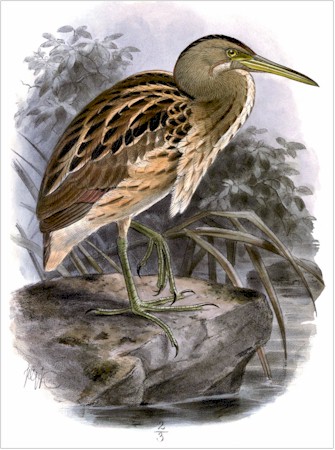
Ardetta involucris, Scl. et Salv. Nomencl. p. 125; iid. P. Z. S. 1869, p. 634; Hudson, P. Z. S. 1875, p. 624 (Buenos Ayres); Durnford, Ibis, 1877, p. 189, et 1878, p. 62 (Buenos Ayres); Gibson, Ibis, 1880, p. 159 (Buenos Ayres); Barrows, Auk, 1884, p. 271 (Entrerios).
Description.—Above pale fulvous; narrow stripe on the nape black; front, stripe on the back of the neck, bend of wing, and outer secondaries chestnut-red; back striped with black; wing-feathers dark cinereous with red tips: beneath paler, nearly white on the belly; neck, breast, and flanks with brown stripes, darker in the centres; bill yellow; feet brown: whole length 13·0 inches, wing 5·0, tail 1·5.
Hab. Paraguay and Argentina.
The Variegated Heron is the least of the family to which it belongs, its body being no bigger than that of the Common Snipe; but in structure it is like other Herons, except that its legs are a trifle shorter in proportion to its size and its wings very much shorter than in other species. The under plumage is dull yellow in colour, while all the other parts are variegated with marks of fuscous and various shades of brown and yellow. The body is extremely slim, and the lower portion of the neck covered with thick plumage, giving that part a deceptively massive appearance. The perching faculty, possessed in so eminent a degree by all Herons, probably attains its greatest perfection in this species, and is combined with locomotion in a unique and wonderful manner. It inhabits beds of rushes growing in rather deep water; very seldom, and probably only accidentally, does it visit the shore, and only when driven up does it rise above the rushes; for its flight, unlike that of its congeners, is extremely feeble. The rushes it lives amongst rise, smooth as a polished pipe-stem, vertically from water too deep for the bird to wade in; yet it goes up to the summit and down to the surface, moving freely and briskly about amongst them, or runs in a straight line through them almost as rapidly as a Plover can run over the bare level ground. Unless I myself had been a witness of this feat, I could scarcely have credited it; for how does it manage to grasp the smooth vertical stems quickly and firmly enough to progress so rapidly without ever slipping down through them?
The Variegated Heron is a silent solitary bird, found everywhere in the marshes along the Plata, as also in the reed-beds scattered over the pampas. It breeds amongst the rushes, and lays from three to five spherical eggs, of a rich lively green and beautiful beyond comparison. The nest is a slight platform structure about a foot above the water, and so small that there is barely space enough on it for the eggs, which are large for the bird. When one looks down on them they cover and hide the slight nest, and being green like the surrounding rushes they are not easy to detect.
When driven up the bird flies eighty or a hundred yards away, and drops again amongst the rushes; it is difficult to flush it a second time, and a third time it is impossible. A curious circumstance is that where it finally settles it can never be found. As I could never succeed in getting specimens when I wanted them, I once employed some Gaucho boys, who had dogs trained to hunt young Ducks, to try for this little Heron. They procured several specimens, and said that without the aid of their dogs they could never succeed in finding a bird, though they always marked the exact spot where it alighted. This I attributed to the slender figure it makes, and to the colour of the plumage so closely assimilating to that of the dead yellow and brown-spotted rushes always found amongst the green ones; but I did not know for many years that the bird possessed a marvellous instinct that made its peculiar conformation and imitative colour far more advantageous than they could be of themselves.
One day in November 1870, when out shooting, I noticed a Variegated Heron stealing off quickly through a bed of rushes thirty or forty yards from me; he was a foot or so above the ground, and went so rapidly that he appeared to glide through the rushes without touching them. I fired, but afterwards ascertained that in my hurry I missed my aim. The bird, however, disappeared at the report; and thinking I had killed him, I went to the spot.
It was a small isolated bed of rushes I had seen him in; the mud below and for some distance round was quite bare and hard, so that it would have been impossible for the bird to escape without being perceived; and yet, dead or alive, he was not to be found. After vainly searching and researching through the rushes for a quarter of an hour I gave over the quest in great disgust and bewilderment, and, after reloading, was just turning to go, when, behold! there stood my Heron on a reed, no more than eight inches from, and on a level with, my knees. He was perched, the body erect, and the point of the tail touching the reed grasped by its feet; the long slender tapering neck was held stiff, straight and vertically; and the head and beak, instead of being carried obliquely, were also pointing up. There was not, from his feet to the tip of his beak, a perceptible curve or inequality, but the whole was the figure (the exact counterpart) of a straight tapering rush: the loose plumage arranged to fill inequalities, and the wings pressed into the hollow sides, made it impossible to see where the body ended and the neck began, or to distinguish head from neck or beak from head. This was, of course, a front view; and the entire under surface of the bird was thus displayed, all of a uniform dull yellow, like that of a faded rush. I regarded the bird wonderingly for some time; but not the least motion did it make. I thought it was wounded or paralyzed with fear, and, placing my hand on the point of its beak, forced the head down till it touched the back; when I withdrew my hand, up flew the head, like a steel spring, to its first position. I repeated the experiment many times with the same result, the very eyes of the bird appearing all the time rigid and unwinking like those of a creature in a fit. What wonder that it is so difficult, almost impossible, to discover the bird in such an attitude! But how happened it that while repeatedly walking round the bird through the rushes I had not caught sight of the striped back and the broad dark-coloured sides? I asked myself this question, and stepped round to get a side view, when, mirabile dictu, I could still see nothing but the rush-like front of the bird! His motions on the perch, as he turned slowly or quickly round, still keeping the edge of the blade-like body before me, corresponded so exactly with my own that I almost doubted that I had moved at all. No sooner had I seen the finishing part of this marvellous instinct of self-preservation (this last act making the whole complete), than such a degree of delight and admiration possessed me as I have never before experienced during my researches, much as I have conversed with wild animals in the wilderness, and many and perfect as are the instances of adaptation I have witnessed. I could not finish admiring, and thought that never had anything so beautiful fallen in my way before; for even the sublime cloud-seeking instinct of the White Egret and the typical Herons seemed less admirable than this; and for some time I continued experimenting, pressing down the bird’s head and trying to bend him by main force into some other position; but the strange rigidity remained unrelaxed, the fixed attitude unchanged. I also found, as I walked round him, that, as soon as I got to the opposite side and he could no longer twist himself on his perch, he whirled his body with great rapidity the other way, instantly presenting the same front as before.
Finally I plucked him forcibly from the rush and perched him on my hand, upon which he flew away; but he flew only fifty or sixty yards off, and dropped into the dry grass. Here he again put in practice the same instinct so ably that I groped about for ten or twelve minutes before refinding him, and was astonished that a creature to all appearance so weak and frail should have strength and endurance sufficient to keep its body rigid and in one attitude for so long a time.
Our figure of this species (Plate XVII.) is taken from a skin in Sclater’s collection, which was procured by Mr. F. Withington in the Lomas de Zamora in 1883.
322. TIGRISOMA MARMORATUM (Vieill.).
(MARBLED TIGER-BITTERN.)
Garza jaspeada, Azara, Apunt. iii. p. 100. Ardea marmorata, Vieill. Nouv. Dict. xiv. p. 415. Tigrisoma marmoratum, Berl. J. f. O. 1887, p. 30. Tigrisoma fasciatum, Salvin, Ibis, 1880, p. 363 (Salta)? Tigrisoma brasiliense, White, P. Z. S. 1882, p. 624 (Corrientes)?
Description.—Above greenish grey, finely crossed by narrow fulvous vermiculations; head and neck uniform rusty red: beneath greyish fulvous; breast flammulated with white; flanks and under wing-coverts black with white cross bars: whole length 18·0 inches, wing 10·5, tail 4·0.
Hab. Paraguay and N. Argentina.
Graf v. Berlepsch has recently shown that the Tiger-Bittern of Paraguay differs from Tigrisoma brasiliense (which it generally resembles in plumage) in having the base of the lower mandible partly feathered as in T. fasciatum. It is probable that the Argentine Tiger-Bittern belongs to the same form, but we have not yet met with adult specimens of it. It occurs in the northern provinces of the Republic, and was obtained by White in Corrientes, and by Durnford in Salta.
323. NYCTICORAX OBSCURUS, Bp.
(DARK NIGHT-HERON.)
Nycticorax obscurus, Scl. et Salv. Nomencl. p. 126; Durnford, Ibis, 1878, p. 03 (Buenos Ayres), et p. 399 (Patagonia); Gibson, Ibis, 1880, p. 158 (Buenos Ayres). Ardea gardeni, Burm. La-Plata Reise, ii. p. 508 (Paraná). Nycticorax gardeni, White, P. Z. S. 1882, p. 624 (Buenos Ayres and Salta); Barrows, Auk, 1884, p. 271 (Entrerios).
Description.—Above cinereous; front white; head, nape, and scapulars greenish black; elongated nuchal plumes white: beneath paler, whitish on throat and middle of belly; bill black; feet flesh-colour: whole length 26·0 inches, wing 12·0, tail 4·8, tarsus 3·2. Female similar.
Hab. Southern half of South America.
In the Argentine Republic the Night-Heron lives in communities, and passes the hours of daylight perched inactive on large trees or in marshes on the rushes, and when disturbed by day they rise up with heavy flappings and a loud qua-qua cry. At sunset they quit their retreat, to ascend a stream or seek some distant feeding-ground, and travel with a slow flight, bird succeeding bird at long intervals, and uttering their far-sounding, hoarse, barking night-cry.
Where the flock lives amongst the rushes, in places where there are no trees, the birds, by breaking down the rushes across each other, construct false nests or platforms to perch on. These platforms are placed close together, usually where the rushes are thickest, and serve the birds for an entire winter.
The breeding-habits of the Night-Heron have already been described in the account of the Ardea egretta.
In the Falkland Islands, where Captain Abbott discovered a heronry (cf. Ibis, 1861, p. 157), their breeding-habits are the same as on the pampas.
Fam. XXXVI. CICONIIDÆ, or STORKS.
The Storks constitute a small but well-defined family of the Order Herodiones, allied to the Ardeidæ, but distinguished by the elevated hallux, their non-pectinated middle claw, and the absence of powder-down patches in the plumage. They are divisible into two sub-families—the true Storks, and the Wood-Ibises (Tantalinæ). Two of the former group and one of the latter occur within our limits, and two of these three species range throughout tropical America up to the Southern United States.
324. MYCTERIA AMERICANA, Linn.
(THE JABIRU.)
Mycteria americana, Baird, Brew., et Ridgw. Water-B. N. A. i. p. 79; Scl. et Salv. Nomencl. p. 126; Berl. J. f. O. 1887, p. 32 (Paraguay).
Description.—Plumage white; bill, naked head, and neck and feet black; naked crop in life red: whole length 54·0 inches, wing 26·0, tail 9·5, tarsus 11·5. Female similar.
Hab. Texas and Central and South America to La Plata.
This is a majestic bird, the largest of the American Storks; it stands five feet high, and the wings have a spread of nearly eight feet. The entire plumage is pure white, the head and six inches of the neck covered with a naked black skin; from the black part extend two scarlet bands, the skin being glossy and exceedingly loose, and run narrowing down to the chest. When the bird is wounded or enraged, this loose red skin is said to swell out like a bladder, changing to an intensely fiery scarlet hue. The name “Jabiru” is doubtless due to this circumstance, for Azara (who gives the Guarani name of the Stork as Aiaiai) says that the Indian word Yabirú signifies blown out with wind.
The Jabiru is but rarely found near Buenos Ayres, but occurs more frequently in Misiones, and in other districts on the northern frontiers of the Republic. It nests on high trees, as has been recorded by Brown4, and is said to lay “blue-green” eggs.
325. EUXENURA MAGUARI (Gm.).
(MAGUARI STORK.)
Ciconia maguari, Burm. La-Plata Reise, ii. p. 509 (Tucuman); Scl. et Salv. Nomencl. p. 126; Durnford, Ibis, 1877, p. 189 (Buenos Ayres), et 1878, p. 399 (Centr. Patagonia); Gibson, Ibis, 1880, p. 153 (Buenos Ayres); Barrows, Auk, 1884, p. 271 (Entrerios). Euxenura maguari, Baird, Brew., et Ridgw. Water-B. N. A. i. p. 77.
Description.—Plumage white; wings and upper tail-coverts black; naked lores and feet red; bill horn-colour, yellowish at the base: whole length 40·0 inches, wing 20·0, tail 8·0. Female similar.
Hab. South America.
The Maguari Stork is a well-known bird on the pampas, breeding in the marshes, and also wading for its food in the shallow water; but it is not nearly so aquatic in its habits as the Jabiru, and after the breeding-season is over it is seen everywhere on the dry plains. Here these birds prey on mice, snakes, and toads, but also frequently visit the cultivated fields in quest of food. When mice or frogs are exceptionally abundant on the pampas, the Storks often appear in large numbers, and at such times I have seen them congregating by hundreds in the evening beside the water; but in the daytime they scatter over the feeding-ground, where they are seen stalking along, intent on their prey, with majestic Crane-like strides. To rise they give three long jumps before committing themselves to the air, and like all heavy fliers make a loud noise with their wings. They are never seen to alight on trees, like the Jabiru, and are absolutely dumb, unless the clattering they make with the bill when angry can be called a language.
The laying-time is about the middle of August, and the nest is built up amongst the rushes, rising about two feet above the surface of the water. The eggs are rather long, three or four in number, and of a chalky white.
Mr. Gibson, of Buenos Ayres, furnishes the following lively account of a young Maguari:—“One, which I took on October 5, was about the size of a domestic fowl, in down, and, with the exception of the white tail, entirely black. It soon became very tame, and used to wander all over the premises, looking for food, or watching any work that was going on. Rats were swallowed whole; and the way it would gulp down a pound or two of raw meat would have horrified an English housekeeper. Snakes it seized by the nape of the neck, and passed them transversely through its bill by a succession of rapid and powerful nips, repeating the operation two or three times before being satisfied that life was totally extinct. It used often to do the same thing with dry sticks (in order not to forget the way, I suppose); while on one occasion it swallowed a piece of hard cowhide, a foot long, and consequently could not bend its neck for twenty-four hours after—till the hide softened, in fact. The story also went that ‘Byles, the lawyer’ (as he was called), mistook the tail of one of the pet lambs for a snake, and actually had it down his throat, but was ‘brought up’ by the body of the lamb! Byles inspired a wholesome respect in all the dogs and cats, but was very peaceable as a rule. One of our men had played some trick on him, however; and the result was that Byles generally went for him on every possible occasion, his long legs covering the ground like those of an Ostrich, while he produced a demoniacal row with his bill. It was amusing to see his victim dodging him all over the place, or sometimes, in desperation, turning on him with a stick; but Byles evaded every blow by jumping eight feet into the air, coming down on the other side of his enemy and there repeating his war dance; while he always threatened (though his threats were never fulfilled) to make personal and pointed remarks with his formidable bill.
“Shortly after his capture feathers began to appear; and the following is a description of the bird at the age of about two months:—Tail-feathers white, remainder of plumage glossy green-black; bill black; legs and feet grey. Spots and patches of white began to appear on head, back, and wings; these gradually extended, until, by the end of May, the adult plumage was all acquired. Then my interest in Byles ceased, and latterly he strayed away to his native swamps.”
326. TANTALUS LOCULATOR, Linn.
(THE WOOD-IBIS.)
Tantalus loculator, Burm. La-Plata Reise, ii. p. 510 (Rio Paraná); Scl. et Salv. Nomencl. p. 126; Barrows, Auk, 1884, p. 272 (Entrerios); Baird, Brew., et Ridgw. Water-B. N. A. i. p. 81.
Description.—Plumage white, greater wing-coverts and wing- and tail-feathers black with bronzy reflexions; head and upper half of neck naked, dusky; vertex covered with a horny plate; bill yellowish brown; sides of head purplish; feet bluish: whole length 44·0 inches, wing 17·0, tail 6·0. Female similar.
Hab. North and South America.
Most people in the Plata region are familiar with this bird of the marshes, its lofty stork-like figure and white plumage making it a very conspicuous object.
On the pampas it is not uncommon in summer and autumn, and goes in flocks of a dozen or twenty. The birds are usually seen standing motionless in groups or scattered about in spiritless attitudes, apparently dozing away the time. On the wing it appears to better advantage, having a singularly calm stately flight; on a warm still day they are often seen soaring in circles very far up in the sky.
I have never heard of this bird nesting on the pampas, and am inclined to think that it only breeds in forest-regions, and visits the marshes in the treeless districts after the young have flown.
Its habits in North America, where it is called the “Wood-Ibis,” are tolerably well known, and in the ornithological works of that country it is described as “a hermit standing listless and alone on the topmost limb of some tall decayed cypress, its neck drawn in upon its shoulders, and its enormous bill resting like a scythe upon its breast.”
It there nests on tall trees, sometimes in company with Egrets, and lays three white eggs.
Fam. XXXVII. PLATALEIDÆ, or IBISES.
The Spoonbills and Ibises constitute a homogeneous family of Herodiones, which have a wide distribution over the earth’s surface, although mostly prevalent within intertropical limits. They fall naturally into two groups—the Ibises, distinguished by their elongated, compressed, and sickle-shaped bills; and the Spoonbills, at once known by the peculiar form of the same organ, which is much expanded at its termination. Of about twenty-five known species of Ibises, the Neotropical Region possesses eight or nine, and of these four occur in Argentina. Of the Spoonbills only one is Neotropical, and that is met with throughout the southern portion of South America.
327. PLEGADIS GUARAUNA (Linn.).
(WHITE-FACED IBIS.)
Plegadis guarauna, Baird, Brew., et Ridgw. Water-B. N. A. i. p. 97. Falcinellus guarauna, Elliot, P. Z. S. 1877, p. 505. Ibis falcinellus, Hudson, P. Z. S. 1870, p. 799 (Buenos Ayres). Falcinellus igneus, Durnford, Ibis, 1877, p. 189 (Buenos Ayres). Plegadis falcinellus, Gibson, Ibis, 1880, p. 155 (Buenos Ayres); Barrows, Auk, 1884, p. 272 (Entrerios). Ibis chalcoptera, Burm. La-Plata Reise, ii. p. 511 (Paraná, Mendoza).
Description.—Head, neck, and under surface purplish chestnut, with a white band round the base of the bill; back with metallic reflexions; wings and tail bright green, with bronzy reflexions; band across upper wing-coverts chestnut; bill reddish grey; feet brown: whole length 22·0 inches, wing 9·0, tail 3·0. Female similar.
Hab. Central and South America.
This form of the well-known “Glossy Ibis” of Europe is one of our most abundant waterfowl on the pampas, and appears in spring in flocks; but as their movements are somewhat irregular and many individuals remain with us through the winter, their migrations probably do not extend very far. In summer they are found beside every marsh and watercourse, briskly wading about in the shallow water and plunging their long curved beaks downwards at every step. When taking wing they invariably utter a loud ha ha ha, resembling hearty human laughter, but somewhat nasal in sound. They frequently leave the marshy places and are seen scattered about the grassy plains, feeding like land-birds; and on the pampas they often congregate about the carcass of a dead horse or cow, to feed on the larvæ of the flesh-fly in company with the Milvago and the Hooded Gull.
Their flight is singularly graceful; and during migration the flocks are seen to follow each other in rapid succession, each flock being usually composed of from fifty to a hundred individuals, sometimes of a much larger number. It is most interesting to watch them at such times, now soaring high in the air, displaying the deep chestnut hue of their breasts, then descending with a graceful curve towards the earth, as if to exhibit the dark metallic green and purple reflexions of their upper plumage. The flock is meanwhile continually changing its form or disposition, as if at the signal of a leader. One moment it spreads out in a long straight line; suddenly the birds scatter in disorder, or throw themselves together like a cloud of Starlings; as suddenly they again reform to continue their journey in the figure of a phalanx, half-moon, or triangle. The fanciful notion can scarcely fail to suggest itself to the spectator that the birds go through these unnecessary evolutions intelligently in order to attain a greater proficiency in them by practice, or, perhaps, merely to make a display of their aerial accomplishments. The Glossy Ibis has another remarkable habit when on the wing. At times the flock appears as if suddenly seized with frenzy or panic, every bird rushing wildly away from its fellows, and descending with a violent zigzag flight; in a few moments the mad fit leaves them, they rise again, reassemble in the air, and resume their journey.
328. THERISTICUS CAUDATUS (Bodd.).
(BLACK-FACED IBIS.)
Theristicus melanops, Darwin, Zool. Beagle, iii. p. 128 (Patagonia). Geronticus melanopis, Scl. P. Z. S. 1871, p. 261. Theristicus melanopis, Scl. et Salv. Nomencl. p. 127; Durnford, Ibis, 1877, p. 190 (Buenos Ayres), et 1878, p. 400 (Patagonia); Barrows, Auk, 1884, p. 272 (Azul). Theristicus caudatus, Elliot, P. Z. S. 1877, p. 498. Ibis albicollis, Burm. La-Plata Reise, ii. p. 510 (Paraná, Mendoza, Tucuman).
Description.—Sides of throat, and lores bare, skin black; top of head and lower part of neck in front reddish chestnut; neck white, a narrow line of feathers running up the centre of the throat to the chin; back and wings greyish brown, with green reflexions, feathers edged with light brown or whitish; tertials and outer webs of secondaries for two thirds of their length white, remainder dark green; primaries dark green; rump and upper tail-coverts light bronzy green; tail dark bronze-green; underparts brownish black, with green reflexions: whole length 33·0 inches, wing 16·25, tail 9·75, bill along culmen 7·0, tarsus 3·5. Female similar.
Hab. Antarctic South America.
This very fine Ibis, called Mandurria ó curucáu by Azara and Vanduria de Invierno (winter Vanduria) in the vernacular, is one of the most interesting winter visitors from Patagonia to the pampas of Buenos Ayres. It is found in Chili, and has even been obtained as far north as Peru. On the east side of the continent it is most abundant (during the cold season) about latitude 37° or 38°. Its summer home and breeding-ground appears to be in the extreme south of the continent, its eggs having been obtained in the Straits of Magellan by Darwin, and recently by Dr. Cunningham, who only says of it that it is a shy and wary bird, that goes in flocks of from four to eight, and has a cry resembling qua-qua, qua-qua. But he might just as well have spelt it quack-quack, since qua-qua fails to give the faintest idea of the series of hard abrupt notes of extraordinary power the bird utters, usually when on the wing, which sound like blows of a powerful hammer on a metal plate. On the pampas this Ibis appears in May, frequents dry grassy situations, and goes in flocks of a dozen to forty or fifty individuals. They walk rapidly, stooping very much, and probing the ground with their long slender curved beaks, and appear to subsist principally on the larvæ of the large, horned beetle, with which their stomachs are usually found filled. So intent are they on seeking their food that the members of a flock often scatter in all directions and wander quite out of sight of each other; when this happens they occasionally utter loud vehement cries, as if to call their companions, or to inform each other of their whereabouts. Frequently one is seen to lift up its wings as if to fly, and, stretching them up vertically, to remain for fifteen or twenty seconds in this curious attitude. At sunset they all rise up clamouring, and direct their flight to the nearest watercourse, and often on their way thither go through a strange and interesting performance. The flock suddenly precipitates itself downwards with a violence wonderful to see, each bird rushing this way and that as if striving to outvie its fellows in every wild fantastic motion of which they are capable. In this manner they rise and descend again and again, sometimes massed together, then scattered wide apart in all directions. This exercise they keep up for some time, and while it lasts they make the air resound for miles around with their loud percussive screams.
In Patagonia I first observed this Ibis roosting on tall trees; and, according to Azara, it possesses the same habit in Paraguay. He says that all the flocks within a circuit of some leagues resort to one spot to sleep, and prefer tall dead trees bordering on the water, and if there is only one suitable tree all the birds crowd on to it, and in the morning scatter, each family or pair flying away to spend the day in its customary feeding-ground.
The egg obtained by Dr. Cunningham at Elizabeth Island is thus described by Prof. Newton (Ibis, 1870, p. 502)5:—“Dull surface of a pale greenish white with engrained blotches (mostly small) of neutral tint, and some few blotches, spots, and specks of dull deep brown; towards the larger end some hair-like streaks of a lighter shade of the same, and so far having an Ibidine or Plataleine character.”
329. HARPIPRION CÆRULESCENS (Vieill.).
(PLUMBEOUS IBIS.)
Harpiprion cærulescens, Scl. et Salv. Nomencl. p. 127; Gibson, Ibis, 1880, p. 159 (Buenos Ayres). Molybdophanes cærulescens, Elliot, P. Z. S. 1877, p. 503. Ibis plumbea, Burm. La-Plata Reise, ii. p. 510 (Entrerios). Ibis cærulescens, Scl. et Salv. P. Z. S. 1869, p. 635 (Buenos Ayres).
Description.—A white bar commencing above and behind the eye covers the forehead; top of head and lengthened nuchal crest dark brown, with a slight greenish tinge; throat and neck covered with long narrow feathers, light brown, in certain lights having a pinkish tinge; upper parts pale bronzy green; wings like the back, in some lights the feathers have a silvery gloss; primaries deep blue, greenish towards the edges of the outer webs; tail dark green; entire underparts brownish grey, with light pink reflexions in certain lights; bill black; feet yellow: whole length 33·0 inches, wing 15·5, tail 7·5, bill 6·5. Female similar.
Hab. South-east Brazil and Argentina.
This noble Ibis ranges from Brazil, south of the Amazons, to the pampas of Buenos Ayres. It is a bird of the marshes, nowhere abundant, and yet is exceedingly well known to most people in the Argentine country: it would be difficult indeed to overlook a species possessing so peculiar and powerful a voice. In the vernacular it is called Vanduria, with the addition of aplomado, or barroso, or de las lagunas, to distinguish it from the Winter Vanduria. The word is also frequently spelt Manduria or Banduria, but it does not come from Bandada (flock), as Mr. Barrows imagines when he gives this vernacular name to the Glossy Ibis; but from the Spanish stringed instrument called Vanduria. Possibly the instrument is obsolete now; not so the word, however, and it is sometimes used by the poets, instead of “harp” or “lyre,” to symbolize poetic inspiration. Thus Iriarte:—
“Atencion! que la vanduria he templado.”
If one could get a banjo with brass strings so big that it could be heard a mile and a half away, a dozen strokes dealt in swift succession on one string would produce a sound resembling the call of this Ibis—a voice of the desolate marshes, which competes in power with the outrageous human-like shrieks of the Ypecaha Rail, the long resounding wails of the Crazy Widow or Courlan, and the morning song of the Crested Screamer.
The Vanduria is usually seen singly or in pairs, and sometimes, but rarely, in small companies of half a dozen birds. In its habits it is like a Tantalus, wading in the shallow water of the marshes, and devouring eels, frogs, fish, &c. After examining the well-filled stomachs of a few individuals, one is strongly tempted to believe that the beautiful long beak of this Ibis has “forgotten its cunning” as a probe. At intervals in the daytime it utters, standing on the ground, its resonant metallic cry. It is wary and has a strong easy flight, and is a great wanderer, but I am not able to say whether it possesses a regular migration or not.
The celebrated naturalist Natterer procured specimens of this Ibis in the lagoons of Caiçara, in the Brazilian Province of Matogrosso, in September and November, 1825, but it is not mentioned by general writers on the birds of S.E. Brazil.
330. PHIMOSUS INFUSCATUS (Licht.).
(WHISPERING IBIS.)
Ibis infuscata, Burm. La-Plata Reise, ii. p. 511 (Rio Paraná). Phimosus infuscatus, Scl. et Salv. Nomencl. p. 127; Durnford, Ibis, 1878, p. 63 (Buenos Ayres); Salv. Ibis, 1880, p. 363 (Salta); Elliot, P. Z. S. 1877, p. 495.
Description.—Plumage dark bronzy green, glossed with purple; fore part and sides of head and neck naked, red; bill and feet red: whole length 24·0 inches, wing 11·5, tail 6·0, bill 5·2. Female similar.
Hab. South America from Colombia south to Argentina.
Of this Ibis, which ranges from Colombia to the Argentine Republic, a few individuals come as far south as the pampas of Buenos Ayres.
The fore part of the head and throat being unfeathered, suggested to Azara the name of Afeytado, or “shaved,” but about its habits he has nothing to say, nor does he mention its peculiar voice, or, perhaps it would be more correct to say, its want of voice; for it seems quite silent unless one comes near to it and listens very intently, when he will be able to hear little sigh-like puffs of sound as the bird flies away. It seems strange that this member of a loquacious loud-voiced family should be reduced to speak, as it were, in whispers!
On two or three occasions I have seen as many as half a dozen individuals together; at other times I have seen one or two associating with the Glossy Ibis.
Azara’s name “Shaved” Ibis seems well enough in Spanish, just as his “Throat-cut” for a Starling with a scarlet throat does not strike one as at all shocking in that language; but for an English name I fancy that “Whispering Ibis,” from the whisper-like sound the bird emits, would be more suitable, or, at all events, better sounding.
It is possible that two races of this Ibis exist on the South-American continent; for in Brazil and further north it is said to have a loud cry, uttered when taking wing, as in the case of the Glossy Ibis; and one of its native names in the tropics—curri-curri—is said to be an imitation of its usual note.
331. AJAJA ROSEA, Reichenb.
(ROSEATE SPOONBILL.)
Platalea ajaja, Burm. La-Plata Reise, ii. p. 511; Scl. et Salv. P. Z. S. 1868, p. 145; iid. Nomencl. p. 127; Hudson, P. Z. S. 1876, p. 15 (Buenos Ayres); Durnford, Ibis, 1877, p. 190 (Buenos Ayres); Gibson, Ibis, 1880, p. 156 (Buenos Ayres); Barrows, Auk, 1884, p. 272 (Entrerios, Bahia Blanca). Ajaja rosea, Baird, Brew., et Ridgw. Water-B. N. A. i. p. 102.
Description.—Head bare; neck, back, and breast white; tail orange-buff, with the shafts deep pink and inner webs stained with pink; rest of plumage pale rose-pink; lesser wing-coverts and upper and lower tail-coverts intense carmine; neck with a tuft of twisted plumes, light carmine; sides of breast pale creamy buff; bill yellowish grey; head greenish, space round the eye and gular sac orange; feet pale pink: whole length 30·0 inches, wing 15·0, tail 5·0. Female similar. Young with the head completely feathered.
Hab. North and South America.
The Roseate Spoonbill is found in both Americas and ranges south to the Straits of Magellan, but in Patagonia it is, I think, rare, for on the Rio Negro I did not meet with it. On the pampas it is abundant, and I have been told that it breeds in the marshes there, but I have never been able to find a nest. It is usually seen in small flocks of from half a dozen to twenty individuals, which all feed near together, wading up to their knees and sweeping their long flat beaks from side to side as they advance. An English acquaintance of mine kept one of these birds as a pet on his estancia for seven years. It was very docile, and would spend the day roaming about the grounds, associating with the poultry, but invariably presented itself in the dining-room at meal-time, where it would take its station at one end of the table, and dexterously catch in its beak any morsel thrown to it.
I believe that more than one species of Spoonbill inhabits South America, and that the common Spoonbill of the pampas is a distinct species from the well-known Ajaja. Some remarks of mine on this subject were printed in the ‘Proceedings of the Zoological Society of London’ about nine years ago; but I find that I am alone amongst ornithologists in this belief; I can, therefore, only repeat here what I have said before, and leave the question for time to decide.
The general belief is that the pale-plumaged birds, with feathered heads and black eyes (the Roseate Spoonbill having crimson eyes), and without the bright wing-spots, the tuft on the breast, horny excrescences on the beak, and other marks, are only immature birds. Now, for one bird with all these characteristic marks of the true Platalea ajaja, which has a yellow tail, we meet on the pampas with not less than two to three hundred examples of the pale-plumaged bird without any traces of such marks and with a rose-coloured tail; and the disparity in number between mature and immature birds of one species could not well be so great as that. I have shot one immature specimen of the true Ajaja—so immature that it seemed not long out of the nest; but the head was bare of feathers, and it had the knobs on the upper mandible, only they were so soft that they could be indented with the nail of the finger. Azara also mentions an immature bird which he obtained, but he does not say that the head was feathered; and even this negative evidence goes a great way, since it would have been very unlike him to see a Spoonbill with a feathered head and otherwise unlike Ajaja rosea, and not describe it as a distinct species.