THE VALUE OF LAND IN ARGENTINA.
Reading edition
When one goes to a foreign country, and more especially when he intends to settle there with the idea of making a fortune, he naturally turns his attention to the value of the land, as from this he draws his views of the prosperity of the country. Now, twenty-five years ago the Argentine had comparatively very few railways; consequently, the lands at any long distance from Buenos Aires (the capital) were at a very low value. The province of Buenos Aires, the largest in the country, has always been the most populated, and its lands have always commanded the highest prices, and these have risen tremendously, but not so much of late years in proportion as land in the northern provinces. During the years 1885, 1886, 1887, and 1888, there was a great boom in land. Foreigners were pouring in, bringing capital; great confidence was put by foreign capitalists in the country, several railways had run out new branches, new railways were built, new banks were opened, and a very large extent of land was opened up and cultivated, and put under wheat and linseed, harvests were good and money was flowing into the country. Then came a very bad year, 1889; the harvest was practically lost owing to the heavy and continuous rains which fell from December till July with hardly a clear day. This, together with a bad government and the revolution of 1890, created a great panic and a tremendous slump in all land, from which it took a long time to recover. Where people had bought camps and mortgaged them, which was the general thing to do in those days, the mortgagees foreclosed, and, when the camps were auctioned off, they did not fetch half what the properties had been bought for in the first instance, some four or five years previously. This, naturally, had a serious effect on the credit, soundness, and finances of the country, but really, the crisis was not felt until some three or four years after, and it was 1896 and 1897 which were very serious years for the country.
To give one an idea of the value of land in four or five of the principal provinces of the country, I must begin with the Queen Province, as it is called, viz., Buenos Aires. In 1885, property in the city centre was worth 2s. 6d. to 3s. 6d. a yard, whereas to-day it has been sold up to £200 sterling per yard, while suburban lots of 20 yards by 60 yards realised £5 and to-day are fetching £150, and camp lands have risen from £10,000, to £100,000 the square league. Of course this is within a radius of 30 to 50 leagues of the city; lands away to the south and west may yet be bought at £10,000, and, still further south towards Neuquen and the far Pampa, at £2,000 per square league. The province of Buenos Aires is not considered good for alfalfa growing, but has good natural grass camps.
The province of Santa Fé is a large province, extending from the northern boundary of the province of Buenos Aires to Santiago del Estero, and contains what is known as the Gran Chaco. The southern portion of this province is largely dedicated to the production of wheat, linseed, and maize, for which it is admirably adapted. There are also large estancias carrying vast herds of cattle, sheep, and horses, while the northern portion has vast forests of very fine and valuable timber.
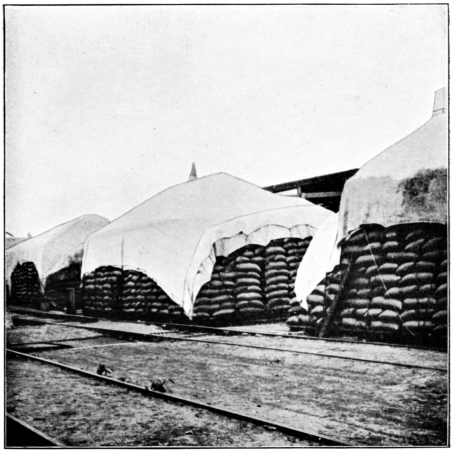
Wheat ready for Loading at Station on Central Argentine Railway.
The first part of this province to be developed was the country around Rosario, the large port on the River Parana, where ocean-going steamers call. This, together with good railway accommodation in all directions combined with excellent land in the district, facilitates the cultivation of cereals on a very large scale. Property in Rosario itself is very valuable, and from £30 to £50 a yard is a common figure. In the immediate district of Rosario land is rarely sold in large areas, but may be calculated at £20 an acre, whilst 40 leagues further north it is to-day worth £50,000 a league. I know of one estancia of one league which was bought in 1885 for £2,000, resold, after being sown down in alfalfa and divided into paddocks, without further improvements, at £12,000 (this was in 1903), and again sold in 1909, certainly with further improvements as regards watering arrangements and more paddocks, house, and sheds, etc., in fact, a fair model estancia in good working order, for £60,000. Land on the south-west of Rosario, and about 40 leagues distant, has in the twenty-five years risen from £2,000 a league to £40,000 a league. This is for virgin camp, and to-day in these districts the average price can be stated at from £30,000 to £40,000 per league, yet 300 miles further north land—good land—can be had at from £4,000 to £6,000 per league.
The next province, Cordoba, is one of the most hilly in the country, and has been one of the most developed during latter years. Some twenty years ago this was almost considered a desert, where one was told nothing would grow and cattle could not live. To-day it is one of the most prosperous; wheat and linseed are great products here, while alfalfa, when carefully treated, that is, not overstocked, lives for ever on account of the sandy soil, and water being so near the surface. These lands twenty years ago were valued at about £500 to £600 per league, while to-day it is difficult to acquire land under cultivation or alfalfa at less than £30,000 per league. In the Northern part of this province are very valuable stone quarries.
Another province that is advancing very fast is that of San Luis. Here, again, it has been found that alfalfa is at home, and thrives splendidly. This, again, is a very sandy soil, and consequently is much sought after, but this land has not yet touched the value of that in the provinces already mentioned; it will not stand so much cropping, and will not carry the same amount of stock, but still the average price for virgin camp is from £5,000 to £10,000 per league. In this province there is a very large extent of very poor land, covered with a small shrub, which is not worth more than £2,000 a league.
Mendoza is a more northerly province, and mostly dedicated to the grape and wine industry, while a lot of fruit is also exported from there. Wine is made in very large quantities, and a lot of very good quality. The value of land varies very much. The greater portion is worth at present very little. The great point is to get the water concessions for irrigating; without irrigation the land is useless. A good vineyard in its prime, with good irrigation rights, is worth as much as from £40 to £50 per acre, while the ordinary camp land is at about 7s. per acre.