MY FRIEND THE AXEMAN.
Reading edition
Eighty square leagues of dense forest. One is inclined to feel a trifle small and overcome when this fraction of Mother Earth is put into one's hands (metaphorically), with orders to know all about it and to be able to answer all questions as to what is going on in it.
The work is like most other occupations: not quite so romantic as it sounds at first, but as interesting as one cares to make it.
One's main employment can best be illustrated by a leaf out of a mental diary.
Fulano de Tal, axeman, wants credit for provisions at the almacen or general store—Has he sufficient wood cut to warrant it? It is the Mayor-domo's business to find out.
With this end in view, he rides along "The Mangy" watercourse till he comes to the lowland of "The Blind Cow." The barking of half a dozen mongrel curs leads him into the edge of the forest, and he comes upon the residence of Fulano de Tal. The man has perhaps recently moved to this spot, and has not had time or energy to build himself a "rancho," and therefore the homestead consists of about four yards of canvas stretched across the branch of a tree like the roof of a tent.
Beneath this is a "New Home" sewing machine, a Brummagem bedstead, and a small trunk, made burglar-proof by innumerable bands and fastenings of bright tin, or even gilt wall-paper. Scattered around are the little Fulanos, in costumes varying from nothing to very little.
Their mother ceases her cooking operations, wipes her hands on the nearest child's head, and invites the visitor to dismount.
He answers that he is looking for her husband, and she directs him with a sweep of the hand which covers a quadrant of the compass and includes several square leagues of thick forest. Taking a likely track, however, he soon hears the ring of axe-strokes, and finds his man patiently chipping away at a felled tree, which is rapidly taking the form of a baulk, with the sides as smooth as if sawn.
His horse is tied up near, and he takes the Mayor-domo through his "corte," showing him the wood prepared for the carters. Give him a chance and he will count every log twice (most likely he has already plastered mud over the marks which show the rotten patch in the wood, and is wondering whether he has cleared the black sufficiently off a piece of "campana" to persuade a reasonable man that it is really fresh wood).
It is part of the inspector's stock in trade to know these and a myriad other tricks, too numerous to take separately.
The typical axeman in the Santa Fé Chaco is more genuinely "childlike" than, and quite as "bland" as, the famous Celestial. He never quite grows up; he will spend his last dollar on a mouth-organ when he is forty, and give a wild war-whoop of delight as a stack of newly piled sleepers falls crashing to the ground.
He loves sweets and the bright clothes which he wears with childish dignity on feast-days and holidays.
His amour propre is tremendous, and influences his code of honour to a great extent. The first ten commandments he will break most cheerfully, but the eleventh—"Thou shalt not be found out"—he respects to the best of his power.
Stealing, for instance, he regards as a pastime, but call him a thief and you must be prepared for trouble. A perfect instance of this can be quoted in the case of an estanciero who found a peon wearing one of his shirts.
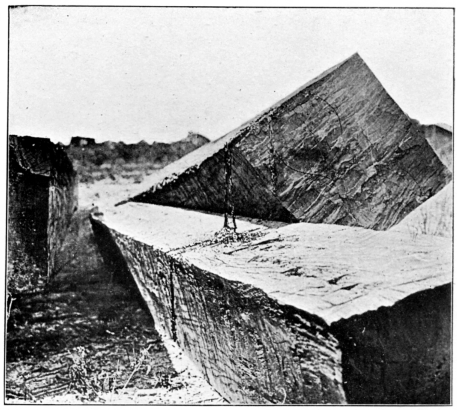
Square Quebracho Logs worked by the Axeman, showing Resin oozing therefrom.
"You are wearing my shirt," said the master. "No, Señor; I bought it in the store." "But you stole it from me," insisted the estanciero, pointing to the tab at the front, where his name was written in marking ink; "there is my name on it."
The man, being quite illiterate, had not reckoned on such damning evidence, but he recovered himself and replied with dignity: "Very well, Señor; if it is yours, take it; but don't call me a thief."
Honesty is with them, admittedly, a matter of degree. A man will always say if questioned about some small deficiency, "Do you think I would swindle you for a matter of two dollars?" or "Do you think I would risk my credit with the Company for the sake of one calf?" To be honest in a case where a larger profit is involved is a height of integrity to which he does not even pretend. "I am going to be frank with you"—that is an expression which puts the wise man on his guard, for it is generally followed by a cascade of lies.
Business must be done on a completely different basis to that which obtains in England. To return to our friend Fulano, for instance: he wishes perhaps to ask for an increase of fifty cents per ton on his wood, and introduces the subject by a short conversation about the points of his horse, passing on to the bad state of the bullocks and enlarging on the chance of a rainy winter. You have just decided that he has nothing more to say and are preparing to leave him, when he makes his request with as much circumlocution as possible. To have come straight to the point would have been contrary to all his ideas of correct procedure.
I have heard two natives make one another's acquaintance with a bout of verbal sparring which an Englishman would obviate by a single sentence, such as "Good morning; Mr. Brown, I believe?" "Yes," the other would answer, and the business would be entered upon immediately.
The Spanish blood, however, calls for some such dialogue as the following, which is taken from real life.
A.—"Good day."
B.—"Good day."
A.—"How are you, Señor?"
B.—"Very well, thank you, Señor; how are you?"
A.—"Very well, thank you."
B.—"I am glad."
A.—"Equally."
B.—"Don't mention it."
A.—"I am speaking to Mr. Juan Sosa?"
B.—"At your service."
A.—"At yours."
B.—"Equally."
A.—"It gives me great pleasure to know you."
B.—"Equally."
They are flowery always, whether in greeting, praise, commendation, or in denunciation.
In illustration of the last point, I once heard a cartman give vent to a quite Olympic challenge.
His cart had stuck in a deep rut up to the axles, and he commenced operations by addressing his bullocks with tender words and soft names swiftly followed by lurid curses. This proving useless, he invoked higher powers, and called on his pet saints by name—"Help me, San Pedro, San Geronimo, Santa Lucia, San Juan." Still no result:—
Then his patience failed entirely—"If you won't help me, San Pedro," he shouted, "come down and I'll fight you;" "Come down, San Juan, and I'll take you both on together."
Still no reply.
Taking his hat off he placed it on the ground, made the motion of clawing his guardians from the skies and placing them in his hat.
"Stay there, San Geronimo; Stay there, San Juan; Stay there, San Marco."
When his hat was full enough for his satisfaction he leapt into the air, came down on it with both feet, and continued to dance on it for about three minutes.
Thus, for a real or imagined slight, the streak of black blood will show up and convert a friend into a relentless enemy.
It is not surprising when one considers the lack of civilising influences which ought to be exerted from the top downwards, but which have no root in the highest power they know, which is the arm of the law. It might be interesting to note a few proofs of the corruption which exists among those who wield the local weapons of justice—among the commissaries, police, and justices of the peace.
The Chief of Police of——, for instance, a town of only about 7,000 inhabitants, refused £2,000 a year for the local gambling rights.
Again, a gardener, whom I knew, was put in jail for being drunk and disorderly. On going to the place some time later I found the man still imprisoned. "Why," I asked, "for such a small offence"? "We found," was the answer, "that when sober he was such a good workman that we could not spare him from the job of cleaning the stables."
On the other hand, a friend of mine was dissatisfied with the policeman he had, and sent the sergeant into the township to exchange him for another. The man returned with a particularly villainous-looking specimen, and when asked where he had got him, explained that the Chief of Police had told him to look among the prisoners for a suitable man, give him a uniform and take him.
"I thought this was the best of them; but they all wanted to come," he concluded ingenuously.
Another commissary in the north of this country flattered himself on his revolver-shooting, and used to perform the feat of shooting the hat off a man's head without hurting him. He was in the local bar one day when a peon entered with a brand new white hat; it was an opportunity not to be missed. Crack—and the man fell with a bullet through his temple instead of his hat.
Did the Comisário stand stricken with remorse, or burst into self-reproach? No. He moved the body with the toe of his boot and remarked: "Carramba, I am getting a very poor shot nowadays."
A story which was told me in the province of Rio Negro, and which was well vouched for, contained serio-comic elements of which I believe the perpetrator, whom I knew personally, quite capable.
An old man who owned a considerable quantity of land, died intestate. A man who lived with him, Garcia by name, had no idea of letting the property go to distant unknown relations, and concocted the following plot (obviously with the connivance of the neighbouring Justice of the Peace, who was a friend of his).
The law allows that a sane man "in articulo mortis," and past the power of speech, may make statements by signs: so when the Justice was summoned to the house, Garcia told him that the man was not yet dead, and wished to make his will.
Garcia seated himself at the foot of the bed, while the Justice at the side addressed questions to the deceased on the following lines:—
"Do you wish me to record your last will and testament?"
The corpse nodded.
"Do you wish your property to pass into your cousins' hands?"
The head moved from side to side.
"Do you intend to make Garcia your sole legatee?"
The deceased nodded several times.
Two witnesses were brought, and the business was settled with commendable promptitude.
I think it was Garcia himself who explained, some time afterwards, that as the dead man wore a full beard and whiskers, it was easy enough to hide the strings passing from his ears and chin to the foot of the bed under the coverings.
In this connection I have since heard that one of the legal ceremonies in a coroner's inquest in Central America is to solemnly ask the deceased who killed him.
To return to the point, however; if such things exist among those in the highest positions of trust it is not surprising to find wholesale chicanery among the lower orders; that they realise their shortcomings is evidenced by the fact that if they wish to impress you with the truth of a statement, they add "palabra de Ingles," i.e., "on the word of an Englishman."
Their Indian descent is answerable for a great deal, the white and black blood being so mixed that it is almost impossible to note the dividing line. Their dusky ancestors were blessed with an extremely limited intelligence, only being able to count up to four. The following incidents were related to me by an old estanciero. He once saw a trainload of Indian prisoners who had had oranges given them throwing the skins against the windows and showing great surprise when they fell inside.
In another instance a woman came with her daughter to place her in domestic service at the estancia, and as the mother did all the talking, the estanciero's wife asked if the daughter could speak Spanish.
"Oh, yes," answered the mother, "but she is barefoot, and would not presume to talk Spanish unless she had shoes on."
This same girl at first insisted on turning up the carpet whenever she entered a room and walking along the boards at the side.
I fear that I have given a black character to the people I work among, but there are lights as well as shades, and I have had many a weary hour's ride wiled away by the philosophy and anecdotes of some peon or small contractor, without mentioning the enjoyment of that hospitality which is a characteristic of the nation.
Beside a camp fire, under the stars, while the maté pot passes from hand to hand, or when huddled under a horse cloth with the rain dousing the last embers, I have found the Correntino, or Santa Fecino, a cheery and uncomplaining companion, who compares well with the recently arrived Englishman, who, under the same circumstances, is generally sleepy or bad tempered.
Treat him well and he will treat you well, but if it is necessary to chasten him for his soul's good, keep your hand a little nearer to your revolver than his is to his knife.