"THE TACURU."
Reading edition
"THE TACURU."
PATRON SAINT: GEORGE WASHINGTON.
No. 1.
Saturday, March 26th, 1910.
When we consider the already overstocked journalistic world, and remember the innumerable papers and magazines which greet one at every street corner and nestle in every armchair, we feel that an apology is due to our readers (if any) for our temerity in swelling the overflow of periodicals, but let us assure you our reasons for putting another paper on the market are purely altruistic. It is no idea of mere gain, or even a desire for notoriety that urges us to issue "The Tacuru"; we have undertaken this responsibility because we know that the world would be the loser did we refuse to give to the public the highly scientific impressions formed by an extraordinarily intelligent party of pilgrims during a unique journey into the wild uncultivated northern lands of the Argentine, especially as some of the most intellectual (the superlative adverb is well chosen) members of the band have promised to give their scientific views on the lands through which we shall pass daily. Though this expedition is only advertised to last a fortnight, yet we have no intention of closing our paper at the end of that time, for we are certain that once the public have been educated to appreciate the high-class literature and useful information which it will be the aim of "The Tacuru" to supply, we shall have created a demand and interest which not even Halley's comet can rival, and we shall endeavour to satisfy that demand daily. Our only fear was that lest the world should be kept waiting for the publication of our paper, for though everything was in readiness yesterday for an early start to-day, the elements seemed inclined to delay us, and when rain had fallen steadily nearly all day, The Instigator of the trip was seen to clench his jaw yesterday afternoon, as he remarked "We cannot start till Monday." This fiat caused dire consternation; the idea of waiting for two days when all those carts were packed ready for our immediate outset, filled the party with annoyance, and had it not been for the fact that The Instigator is a man not to be trifled with, it is possible remonstrances might have been raised. But, fortunately, each member of the party only possessed the angelic variety of temper, so no expostulations were made, and peace was maintained. This unequalled patience under trials was rewarded, and great was the joy of the party when at 8 p.m. it was found that the rain had ceased, and the moon shone forth in such a way as to influence The Instigator to rescind his decision and declare an early start for to-day.
Rumour has it that The Jehu and his aide-de-camp and Our Hostess sat up till 12.30 a.m., finally arranging "places in the carriages, food supplies, blankets required," and all the innumerable details which made for the party's comfort.
Before we publish the impressions, contributed by one member of the band, on to-day's trip, we think our readers might appreciate a slight character sketch of each of our "Staff." There are nine Pilgrims.
FIRST: The Instigator. Well, he's right when you know him, but you do want to know him first. What possessed him to suggest that we should trek away north, goodness only knows, unless he was fired by a desire to imitate the Cook-Peary journeys, or it may have been the celebrated "Cristobal Cocktails" which inspired him to do great deeds.
We hear that coming out from England he earned a reputation on board ship as an auctioneer, and once even sold a live lord for a few shillings to the highest lady bidder. As a camp man he is a marvel, never seen on horseback, but generally discovered on his hands and knees fudging about with a thing he calls a pocket microscope, and occasionally going off into hysterics over some clod of earth, a leaf, or some weird microbes which he says are feeding on the alfalfa roots. Talking of feeding, The Instigator can eat anything, his motto is "tout jour"; he has the digestion of an ostrich, and says "it is just as well to make a good meal while you are about it, for you never know when and where you will get the next." His best friends cannot say he is musical (save when others are trying to sleep); but he has a favourite song, and it is that old music-hall classic entitled "Do, do, be always on the do." However, he is a very good fellow, and notwithstanding that square jaw of his, which seems to hint at the possibility of "a man of wrath" existing in that silent thoughtful being, he is kindness itself to all, and never fails to do his share of work as it comes along.
SECOND: Our Guest. The Wild Man discovered this rara avis in a railway carriage, babbling for "Kwilmez Beer," so he was brought along, and he had not been long at the Estancia before he was running first favourite in the Popularity Stakes. He was always ready for anything, and it must have been his desire to acquire knowledge which induced him to come with the party. The Saint has undertaken to explain to him how colonists thrive on the 8 per cent. system, and to teach him how many grains of maize make "ocho." We doubt whether she will succeed in the latter attempt, for we fancy Our Guest will never leave eight grains of maize uneaten; he is a wonder for that delicacy, and feeds on it constantly, and we hear rumours that he intends to take some maize cobs home with him to his native country, and proposes to feed his "team" on it.
THIRD: The Delineator. This is a misnomer, he really should be called "The Photographer," but that sounds so common, and his views are so uncommon that we called him The Delineator instead; besides, he always travels about with maps and charts (his own, or someone else's) and when appealed to as to what course we should take, replies in a cold, hard voice, "North by North, just as she goes." Like the rest of the party, he has never travelled quite the road we are going now, but the prospect of collecting a few new varieties of butterflies, moths, insects, and plants caused his eyes to light up with a wild gleam when he heard of the trip, and the yarns he spins of things unseen by the ordinary sober mortal are ever a joy to the listener, and make them whisper, se non è vero è ben trovato.
FOURTH: The Jehu. There is but one name for a man who handles his four-in-hand over tree-trunks, tacurus, and tussocks, as our coacher does. He drives as not even his namesake drove; in rain, in sunshine, in light, in darkness, over smooth ground or rough, he guides his steeds with consummate skill and care, which is wonderful to see. After a more than usually big bump he turns to his passengers with a cheery "All aboard?"; then gives his attention once more to the animals of which he is so fond, and in which he takes such pride. His knowledge of the horses he drives is marvellous. The Jehu is a man of great perception and information, and has a pleasant knack of being able to convey his knowledge to others. He and The Instigator have great arguments together which interest all listeners by day, but the discussions are not followed with quite so much delight by those who are privileged to hear them at night, when they often degenerate into a snoring competition.
FIFTH: The Wild Man—had been driven south by stress of weather and strikes. We should like to say something nice about him, for he always carries revolvers, knives, and cameras, but we fear that our kindest remarks may be misunderstood by one so unused to a quiet civilisation with no revolutions, so we refrain from all personal comments. This product of a land of luxuriant vegetation has a quaint penchant for collecting matchboxes (filled), old boots, deer horns, and any odd things lying about the camp belonging to himself or other people; still he is always cheerful and content, never grumbles, and can give valuable information respecting the ways of the natives who look upon him as a man and a brother.
SIXTH: The Chaperon—has his uses. It will be his business to see that we are housed, clothed, and fed. The horses and peons will also be under his care, and if anyone wants to grumble about anything The Chaperon is the person to abuse. Tent-erecting is what he considers himself to be very good at; but rumour has it that his best accomplishment is hairdressing (ladies or gentlemen, English or foreign styles). His resources know no bounds; he has been seen to fasten up a pair of leggings with bits of stick. His powers of annexation, both mentally and materially, are indeed marvellous. He prefers to make his bed on the bricks or the cold, hard ground, and then enlarges on the comfort thereof; he generally takes his food standing up, and is always on the spot ready for any emergency when required.
SEVENTH: The Saint—is a lady who will give away anything in her possession, save chicken or eggs. Just now she is making donations of pipes, tobacco, handkerchiefs (her own or The Instigator's), and good advice on matrimony. She is a person of importance, and is very keen on collecting knowledge which she is always ready to impart to others; unfortunately, some of her efforts to improve humanity have not been absolutely successful, but she is never discouraged, and takes up the next case on the list with equal enthusiasm. Most of us have to thank her for some good thing or other. She will do her best to keep every member of the party up to the mark, physically and mentally. Her accomplishments are numerous.
EIGHTH: My Lady—is a general favourite; she will look after the lot of us in her own gracious fashion. Everyone goes to her for advice, sympathy, or help, which she is always ready to give. Even without her tea-basket she would be an absolute necessity for the social success of the trip, for, as the advertisements say of patent sweepers and the Encyclopaedia Britannica, "no party is complete without" her, so every one was glad to hear that she had agreed to accompany the northern pioneers. Those favoured ones who have seen her "on the boards," whisper that her histrionic genius is marvellous; we, who are not among the fortunate number, can only say that if her acting equals her talent for giving (when required) a really concise, lucid description of anything, it must indeed be wonderful. Her quotations, too, are so ready and apt, though occasionally they remind us, by their vagueness, of her namesake and favourite book.
NINTH: The Kid. Why she is brought along, nobody will ever know. It may have been as a "contrapeso" ("an addition of meat or fish of inferior quality, thrown in to complete the weight," vide Arturo Cuyas' Dictionary), but we think she came with the sheep. Anyhow, it was not until the first part of the journey had been accomplished that she was discovered bleating in the corner of one of the coaches. We had a meeting to decide whether she should come on with us or not, and arranged to put her on the job of tidying up for the trip; but her hopeless incompetence and ready impertinence to her superior officers, necessitated instant dismissal without a character. However, as she is really not worth the trouble of sending back, we locked up the tea tin, and let her continue the journey on the condition that she will not talk too much, awake or asleep. With any luck, we may yet lose her somewhere in the wilds.
The one disappointment expressed by all the party was that Our Hostess decided not to accompany us on the trip, but to await our return at Cristobal.
We started out from the estancia house as soon as the ladies' luggage could be brought downstairs, and we should like to remark, in passing, that it was a very affecting sight to see Our Guest, The Delineator, and The Wild Man lifting and carrying heavy boxes and baggage (with no thought of gain) out to the peons, who, under the able direction of The Chaperon, loaded them scientifically on to one of the four carts, which, when ready, were sent on ahead with the nine peons who had been told off for the trip. Cameras appeared from every available corner as we prepared to move, and many invaluable photos of the start of the caravan must have been secured by those who gave us such a hearty send-off. When at last Our Hostess had put in the final cushion and rug, and provided us with biscuits and bull's-eyes, and was satisfied that even she could do nothing more for our comfort, we parted from her with great regret, promising that she should receive numerous marconigrams concerning our welfare, and our travels en route. First went off the four-in-hand driven by The Jehu, who had four members of the party in his care; he was followed by The Chaperon, who drove a pair, and looked after the rest of the explorers.
There is an old saying, "Give a dog a bad name and you may as well hang him." The truth of this saying has never been better exemplified than in the case of the Chaco, which long held the reputation of being good for nothing. Rumour had it that the northern land was useless; life was impossible there for the white man; indeed, it was supposed that cattle even could not live there on account of the mosquitoes and garrapata; and Indians were said to be as thick as flies, and equally disturbing.
The Santa Fé Land Company has been one of the pioneers who steadily fought down these reports, and by showing what good cattle could be bred there, and what crops grown, has gradually opened up the possibilities of the northern lands to colonists and investors. Slowly but surely workers came north, first in fear and dread, but later with confidence, and now the cry is "They come, and still they come." Before we had gone far on our journey we had an opportunity of conversing with one lately arrived colonist. A wonderful crop of maize attracted our notice, and we stopped to speak to the great, jolly, strong-framed Italian who had grown it. He has moved up from the south with his wife and family, and his fellow-workmen. They started ploughing, and though it was late in the season, he was persuaded to try a catch-crop of maize, with the result that he has to-day banked $5,000, when he never expected to secure a chance harvest. And so sure is he that the land will repay all labour and time expended upon it that he is anxious to take up a league and colonize it with his fellow-countrymen.
It is the same story all through the northern lands; anyone with pluck, adaptability and grit can do what this man has done: indeed hard work and perseverance will as amply reward the labourer in the northern lands as they have done in the south. The sight of this great crop of valuable maize, on land which a few months before was a mere waste, brings the words of the Psalmist forcibly to one's thoughts, for surely of no country could it more truly be said than of the Argentine, "Dwell in the land, and be doing good, and, verily, thou shalt be fed"; and perhaps there are few countries in which there are less openings for the man whose mind is not set towards "doing good": the Argentine has little room for the shirker.
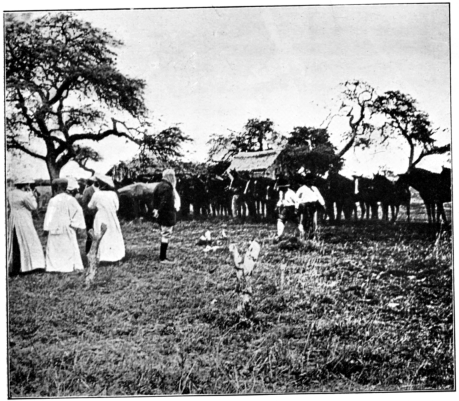
Horses awaiting Inspection.
The rain of yesterday relieved us from the trials of dust on our journey, but it also made the going very heavy, and instead of travelling for the usual two hours before relieving horses, we were obliged to make an early stop for a change. This is always an interesting sight, for the animals are so well trained. Our total number is 87, and when a halt is called, these animals are all lined up in a row, generally against a wire fence. At the word of command they range themselves, backed close against the fence in a long line with their heads outwards. Packed tightly together they await the inspection of their master, who chooses the animals he requires, and as they are standing thus they allow themselves to be haltered up and led quietly away from the line to be harnessed. Their training is wonderful, but it is really amusing to watch the expression of the horses as they stand in a row while the selection takes place, they seem to be saying "Please, sir, not I this time." Where no wire fence is available, the peons stretch a rope or lasso out, and the horses will line up against that in the same manner. During our first change of horses, unexpected excitement occurred. The Saint perceived a plaid horse—at least this is what she called it, and we believed it to be German for piebald horse—from which a peon had dismounted. This horse must have reminded her of the circus-riders of her childhood (or possibly her action was owing to temporary aberration); anyhow, without a word of warning, she leapt astride the native saddle and gave a short display of how it should be done. However, fortunately from her point of view, though disappointingly from that of the spectators, the piebald animal had not been trained to circus tricks, and only quietly ambled along for a few yards, during which time the cameras came into full play. After The Saint had been persuaded to dismount, and the horses were harnessed up, an onward move was made, and it was not long before we met our host for the day. He had ridden to the furthest outposts of his section to join us, and under his guidance we were conducted to two or three spots, where The Instigator inspected rodeos of animals in his charge.
We arrived at the Section house of Polvareda about midday, and found that our host had prepared an alarmingly sumptuous repast for his influx of visitors: as course followed course, roast ducks dodged the turkey, and were pursued by plum pudding, etc., we began to wonder if our host thought that meal would have to last us for the fortnight of our trip. But we discovered that he came from the West of England, and had not forgotten the ideas of hospitality current in that part of the world. Rumour had it that he himself had been seen carrying about pails of scalded milk at 4 a.m. This proceeding explains the delicious Devonshire cream and butter we are enjoying.
The afternoon was spent in driving or riding round the section to inspect various windmills, more groups of cattle, wells, fencing, and new alfalfa, etc. Our host, as we were driving round, took the opportunity for giving us a short, successful exhibition of buck-jumping with his steed, whether willingly or not, neither he nor history mentions. At eventide, another excellent repast was provided, and The Saint was so impressed by the catering and culinary skill of our host, that she decided to inaugurate a prize to be won by the bachelor estanciero who shall provide the best meals for the hungry nomads during the trip; certainly our host for to-day has put the standard very high for the other competitors. A short telephonic communication was held during dinner with Our Hostess at Cristobal, and "All's well" was reported on both sides.
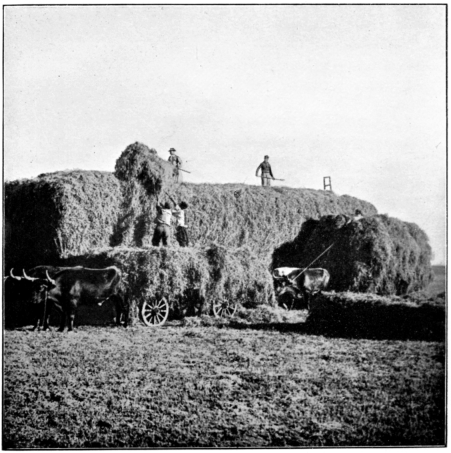
Stacking Alfalfa.
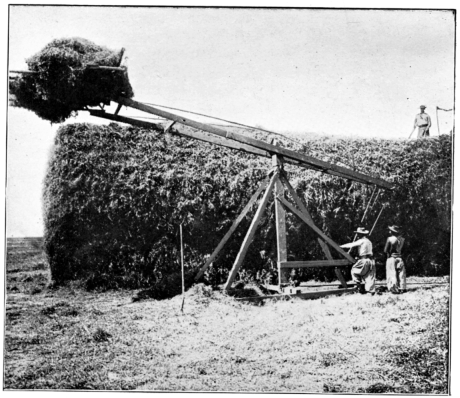
Alfalfa Elevator at Work.
"THE TACURU."
No. 2.
Sunday, March 27th, 1910.
The party did not sit up late last night; they had a short talk on the verandah for the sake of digestion, and then all retired to bed, but alas! not to rest. Foolishly they had imagined that mosquitoes were things of the past, and no nets were put up, with the result that one and all soon learnt that for fresh blood and newcomers there was a plethora of these little demons waiting with their irritating song, sting, and bite: from some of the party we learn complaints of other songs, more human, and more nasal, and it is believed that it was Our Guest who was heard at midnight to be murmuring the chorus of a favourite song, viz., "Hush, boys! No noise! Silence ebryting! Listen, and you'll hear de little angels sing." At least it says "angels" in the song, but the word Our Guest used sounded like "demons," but probably he was dreaming of the "ping" of bullets and the roar of battle as the snores resounded through the room, or, one might almost say, through the house. Very early this morning there were cries for The Chaperon: he was wanted to tell the time; he was wanted to bring water for ablutions; he was wanted to tell us when breakfast would be ready; he was wanted to give advice or remedies for mosquito bites, and, in general, for a short space of time, he justified his existence. When at last the members of the party had collected themselves from all sorts of odd corners, coffee (with the addition of bacon and eggs, and several other things) was served, and the interval, before the order "All aboard" was issued, was chiefly occupied in observing and discussing the effects of our first night's experience of bichos. Our Guest, after due deliberation, laid down some useful rules for future guidance, the chief being, "Never be without a Mosquitero": his face and head were literally enlarged on this point, and he assured us that a mosquito's proboscis is an impressive point. Apparently The Kid, too, would have liked to give her views on mosquitoes and their ways, but her uninteresting remarks were cut short by The Wild Man's order of "kennel up," and, given a bottle of cana, she seemed quite happy. Our Guest seemed to have an impression, also, that someone had blundered. He knew someone had slumbered (some had not), and plaintively he begged that he might be allowed in future to sleep at one estancia further ahead of the rest of the party.
Most of the nomads had had some slapping acquaintance with mosquitoes during the night, and the showing of bites, swellings, lumps, etc., only ended when The Jehu ordered the bugle to be sounded for an onward move. We were well under way before half the lamentations had been entered in the station complaint book.
Bidding adieu to Polvareda, where the green fields of alfalfa show the march of progress, we pushed forward, but as we left we were unable to decide whether it was a desire to escape observation (and, perhaps, the too-effusive thanks of the lady members of the party), or a violent toothache, which caused our host to conceal himself in a huge blanket wrapped around his head as we left, but we fear it was toothache that necessitated the extra wrappings.
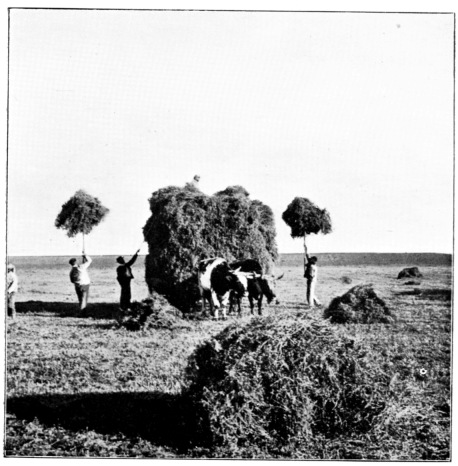
The Green Fields of Alfalfa.
We had not gone far on our journey before we crossed the bridge over Las Conchas. The manager of the next section met us soon afterwards, and we inspected the cattle on his domains. On our way from Polvareda to Michelot we passed the emporium of the Universal Provider of the North, in other words, "the stores," where most of the necessities and many of the luxuries of life can be obtained. The Saint can never resist the desire of a bargain, and others of the party were anxious to see all that the stores contained, so we made a halt and inundated the building, where everything was extraordinarily neat and clean, shelves piled high with bales of bright-coloured cottons, cloths, and handkerchiefs; hats hanging in long lines, brilliant saddle-cloths, pipes, knives, tobacco, axes, leather goods and harness, every variety of tinned foods, barrels of flour, sugar, etc., all arranged with precision, and showing cleanliness and method at every turn. Some men were sitting on the benches, smoking and drinking and chatting together, for apparently "the stores" constitutes the local rendezvous and news agency for miles around.
The Saint at once made purchases, for no place is stamped on her memory unless she has spent money there. She wanted to make the whole party presents of hats, handkerchiefs, or pipes, but she was restrained, and ultimately satisfied her generosity by choosing the best saddle-cloth the establishment could supply, and one or two hats. We went into the living-rooms of the storekeeper, and found the same attractive neatness there. A gramophone occupied a side table, and skins and pictures were hanging on the walls. The storekeeper's wife and her sister were attractive Englishwomen; there were two or three children running about, but none of them could speak anything but their father's native language. After this inspection we drove on, and we are glad to be able to register the fact that Our Guest for once acted up to the first part of the old adage, "Earn sixpence a day and live up to it." The Jehu's coach had stayed behind for a while, to allow The Instigator to observe and note a great many things which were no business of his at all, and the peons had likewise remained, but The Saint, having fulfilled her mission of purchasing whenever possible, was content, and anxious to get on to the Section house for a rest before her afternoon ride, so The Chaperon drove on with his coach, and we are assured, on what we consider good authority, that when Our Guest perceived a closed gate in the way, and no peon at hand, he leapt from the carriage (perhaps "flew" would be a better word) and opened that gate. Possibly he had been fired with ambition to earn money while inspecting those crimson and blue handkerchiefs at the stores, for we know he appreciates "colours"; but, whatever his motive, he did open that gate, and let it be recorded to the honour of his fellow-passengers that his action was not allowed to pass unappreciated or unrewarded. When all the party were collected at Michelot estancia house, lunch was served on the verandah by a dour-looking Oriental, who apparently combined the duties of cook and parlourmaid in his own somewhat yellow person, and very well he performed his task, but as he went silently about his business of serving this large party, which he did with a slow precision and apparent utter disregard of his master's orders, he reminded us irresistibly of the soi-disant American definition of "Life," and we began to wonder whether it were not a Chinaman who summed up existence in the words, "After all, Life is only one d——d thing after another."
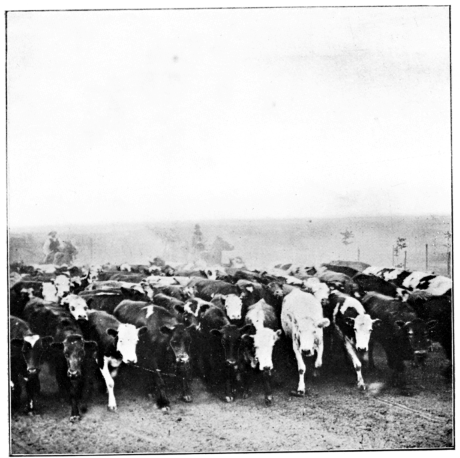
Herd of Cattle.
A short siesta followed lunch, and after an early tea everyone mounted horses or carriages and went forth to see the sights of the Section—everyone, that is to say, save The Chaperon, who had other work to do; he it was who discovered and averted what might have been a disaster. Some members of the party were quite content as long as they were given three cups of tea, others fancied cocktails, and some babbled for cocoa. It was suddenly found that the supply of this last useful article was running short. The Kid not being a cocoa-drinker, casually suggested filling up the tin with tannin extract or dust; she said "it looked the same and nobody need smell it," but The Chaperon declined to resort to subterfuges and rode off to the stores to supply a deficiency caused by his own lack of attention.
At Michelot, as at Polvareda, great progress has been made of late years, alfalfa laid down, fences and wells made, and the cattle are improving yearly. Our last sight, before the inspection for the day was finished, was a wonderful rodeo of 3,000 cattle, which we viewed from the vantage point of the banks of a newly made reservoir. It was a striking picture, which will not easily be erased from the memory of those who saw it. The cattle, with their long continuous lowing, were rounded up below us, and away on the horizon the sun was setting with the glory one never sees better elsewhere than over a plain, leaving, as it rapidly sank from sight, marvellous shades of gold and crimson on the fantastically shaped clouds. Save for the animals and their drivers just around us, the whole vast space seemed so still and empty, yet on every hand were traces of man's labour and skill, conquering a tract of land which was almost valueless a few short years back.
On our return to the house we found dinner for us on the verandah. This was a delightfully cool method of taking food, but rather apt to attract beasties, and although the philosophers and friends of the party arranged the lights to keep away insects as much as possible, and succeeded in their efforts, some members of the party preferred to take no risks and dined with veils wrapped around their heads, only leaving their mouths available. The Wild Man caused some excitement before we sat down to dinner by introducing us to a beast he called a "railway insect." It certainly strongly resembled a railway train, with its green light on its head, red at the tail, and luminous yellow lights all over its caterpillar-like body; it was a most interesting discovery, and the Wild Man went up in everyone's estimation for a few minutes. The Oriental again served us with silent steadiness. It was suggested that one of our "boys" should assist him in the task of waiting on the party of twelve, but notwithstanding the fact that he had been told he might kick round any boy he chose to make an assistant, he waived aside all outside help with the words "no good," and continued on his way imperturbably.
The Instigator, with The Delineator and The Jehu, had a long discussion after dinner on various Argentine subjects too deep for the ordinary mortal, though The Wild Man and The Chaperon seemed to be trying to take an intelligent interest in the conversation. Our Guest sat silent, looked sad, and on being offered a penny for his thoughts, he murmured that he was wondering whether he would be allowed any sleep to-night. Doubtless he felt wearied, because, as it is Sunday, The Chaperon had been allowed to take a half-day off for his own amusements, and Our Guest, perhaps stimulated by his financial success of the morning, offered to fulfil the duties of chaperon during his absence; but we regret to say that we cannot candidly advise Our Guest to take up chaperoning as a means of livelihood, for though willing and tactful, he lacks the long training and apprenticeship necessary for continual service in this arduous work.
The ladies seemed happier, for they had noted the mosquito nets over each bed in their room, and they looked forward to a peaceful night. We had our usual communication with Our Hostess over the telephone before retiring, and received and gave satisfactory reports from both sides.
A correspondent wishes to know if any of our readers can name the author of these lines:—
"Heaven gives sleep to the bad, in order that the good may be undisturbed." He would also like to know if this generally accepted quotation is quite correct, or whether the "un" is a misprint. Replies to "O.G.," c/o THE TACURU.
Owing to the innumerable applications which we have received for advertising space in our widely circulated periodical, we have decided to open our columns to advertisements at the rate of 50 cents per line, applications to be sent to "The Advertisement Editor," THE TACURU Offices, c/o The Jehu, First Coach. All orders must be prepaid.
ADVERTISEMENTS.
WANTED.—Bricklayers who can build straight.—Apply Manager, Michelot.
RIDING TAUGHT by a lady, side-saddle or astride; fees go to Charity.—Apply "T.S.," c/o TACURU Offices.
BOOT CLEANING undertaken in best style. Gents', per pair, $1; Ladies', per pair, for the asking.—Orders received by "T.C.," Offices of this Paper.
"THE TACURU."
No. 3.
Monday, March 28th, 1910.
Owing to the care with which the mosquito nets had been put up, there were few complaints of bites when the party assembled for breakfast, but the conversation chiefly degenerated into an argument on phonetics. The different rooms held various views on the harmonizing of sounds. Had it been a glee competition we should undoubtedly have given the award to the verandah party. Sleeping on the bricks seems to bring out the sweetness of a treble voice as nothing else can do. The Saint and My Lady both remarked that they were very fond of music, but they could not appreciate being awakened from their beauty sleeps, by the announcement in a raucous voice of "No, thank you." They do not wish for a moment to imply that The Kid was not perfectly justified in refusing whatever she did refuse, but they would like her in future to confine her conversations to the daytime if possible, and to leave their nights in peace. It was a happy thought on the part of The Jehu to suggest a picnic at the Waters Meet to-day, before our forward move on to Los Moyes, and after breakfast we started out. First we went to inspect the site where the new house is to be built, then on to the pretty little monte near by, where some picturesque photographs were taken of the cavalcade of riders. We paused in this tiny monte, for it is an intensely interesting spot from a botanical point of view, and with care and attention should be so for some years to come. In an extraordinary small compass this wood contains more varied specimens of trees than one would ordinarily see in a day's journey. So on to Waters Meet. Here one is afforded an opportunity for studying the watershed of this portion of Argentina. Three rivers meet here, the Concha, the Calchaqui, and the Northern Salado. The latter is the only perennial river in that region; it rises in the snowy peaks of the Andes, in the province of Salta, miles away, and it is not to be wondered at, that, though it is a slow-moving river and meanders through the Gran Chaco, in the times of floods its swollen waters overflow their banks and flood immense tracts of land. Thomas Page, an American Admiral, in the year 1855, navigated this river from its junction with the Parana to the spot where we were to-day, but when he went up it there was so little water in the river that he had to give up the idea of continuing his pioneer task of exploration. It had been his intention to open up the river for trade, and there is no reason why this should not be done at some future date. The Calchaqui goes under different names at various places. It rises on the great swamps on the North-East of the Santa Fé Land Company's territory, and flows through a chain of lakes and cañadas until it runs into the huge laguna "Del Palmar," and thence along what used to be the Eastern boundary of the Santa Fé Land Company's lands, until it joins the Salado.
The Calchaqui must drain at least 150,000 acres of land, and the Rio Concha has a watershed of about 60 or 70 thousand acres. It is not known what the area of the watershed of the Salado is, but it must be immense; therefore it can be understood that the meeting-place of the waters of these three rivers is an interesting spot geographically, and we were all glad to have seen it. On our arrival at the Water Meet we had our first introduction to the native "asado," and we all hoped it would not be the last. The peons collected (apparently from nowhere), in less time than it takes to write about, sticks and odds and ends for a fire, over the ashes of which they broiled the meat, holding it over the heat on long skewers of wood. The meat was brought to us cooked, still on these skewers, and each one cut off, or had cut off for them by The Jehu, the portion he or she preferred, and a very hearty and merry meal was made by all. The resulting silence of repletion was only broken by a murmur from The Saint of "My heart is full," which sentiment, anatomically amended, was echoed by all.
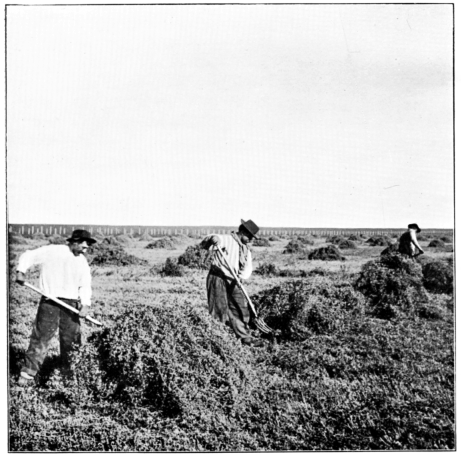
Expanse of Alfalfa.
When active exertion was once more possible everyone repaired to the banks of the Waters Meet, and a spot being found where there were no dead fish lying about, the ladies (under the tutorship of Our Guest and The Jehu) indulged in a little rifle-shooting at bottles. We fear that we cannot record any marvellous marksmanship on their part, for the bottles were still bobbing about on the water when the ladies' party retraced their steps to the "camp." A cup of tea was suggested before the returning drive, and it was thought possible (though not probable) that The Kid might be useful on this occasion. However any hopes in this direction were speedily dispelled when (after a great deal of noise and talk) she appeared with a thick black liquid, which proved absolutely undrinkable. True it was poured from a tea-pot, but anything less like "tea" as one usually meets it at 5 o'clock, could scarcely be imagined, and the air seemed full of the unspoken query, "Has everyone a use in this world?" The drive back to the estancia house was as pleasant as that of the morning, and there we found the Chinaman (who, owing to the strenuous exertions of The Chaperon, now appeared with considerably less hair, and obviously a more swollen head), had gauged correctly the incompetency of The Kid, in the brewing of his native beverage, and consequently had prepared a beverage which might pass for tea, and was enjoyed by all. After this refreshment a move was made, the luggage had gone on, and the party followed in their two coaches. We now began to approach a more pleasing country, and drove through little montes of scrub and trees, with a few bright-coloured verbena and cacti growing near the ground, making a brave show, and that larger optunia, the prickly pear, with its silver grey appearance and the bright crimson of its fruit showed up occasionally against the low trees. Altogether, the land had a more homelike and less expansive appearance, as it was broken up by these little groups of trees. It was a glorious drive. We were favoured with another exquisite sunset which shed weird and beautiful light over this strangely quiet and empty country. As the four-horse char-à-banc had started some minutes ahead of the more modest two-horse vehicle, it was to be supposed that it would reach the destination, Los Moyes, first, and we hear that there was some consternation expressed by the party of the smaller coach when, on their arrival they found that nothing had been heard, or seen, of the more ambitious vehicle. However, The Chaperon on being appealed to, impassively murmured "They're all right," and started to give orders for unloading, and putting up beds and generally arranging matters as if the section house belonged to him, and this callousness on his part, we are told, calmed the others sufficiently to allow of their enjoying the remnants of the sunset, undisturbed by any thoughts of the horrible fates which might (but were not likely to) have overtaken their companions.
Certainly Los Moyes section house is most prettily situated, with an expanse of alfalfa beyond the little front garden, and trees in the distance opening to show a glimpse of the smallest lake. There are three of these lakes not far from the house, and fishing is carried on, by means of spearing, in their waters. Long after the last trace of sunset had faded from the sky, The Jehu appeared with his coach, and a rush was made by the hosts of Los Moyes, and their earlier arrivals, to ascertain the cause of this delay. All anxiety was quickly allayed by one glance at the face of The Instigator. He was exuberant with joy. The rest of the occupants of the coach seemed rather less excited, and more weary, as they explained that The Instigator had sighted in the far offing a steam plough, and despite murmurs of "the dinner waits and we are tired" from The Delineator and The Wild Man, he insisted on investigating that plough, in fact on trying it himself, and it was with difficulty he was persuaded to return to the coach, and continue the drive home. We believe the credit for this latter achievement is due to The Delineator, who, with tact worthy of a diplomat, suggested that if an early return to the ploughing were made next morning, photos could be obtained of the machine and its work. This bait was successful, and The Instigator was gently enticed away with promises of "to-morrow."
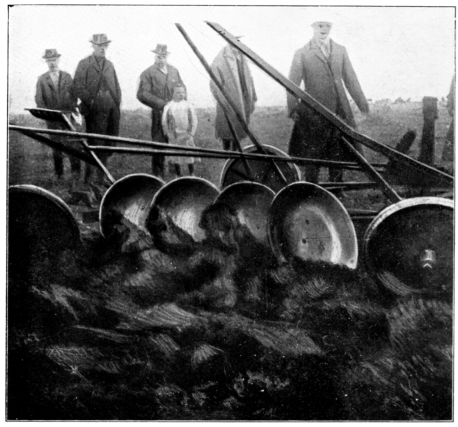
Disc-Plough at Work.
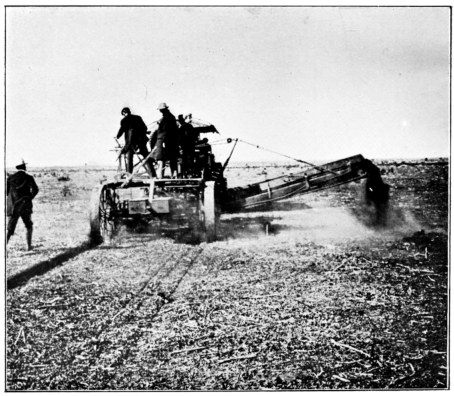
Roadmaker and Railroad Builder.
After everyone was assured that everyone else was safe, The Instigator came back from his Elysium, dreamily to finish the quotation of The Delineator and The Wild Man with "Said Gilpin, So am I," and we all sat down to dinner, during which meal much merriment was caused by a difference of opinion between The Saint and her host on "dogs and species of dogs." Our enemies, the mosquitoes, were not so virulent as usual to-night, perhaps owing to the eucalyptus trees which are growing near the house; anyhow the party could venture to sit out after dinner on the verandah, which was already covered with beds for the accommodation of some of the party. Thus, with an audience seated on chairs and beds, The Instigator talked of the plough and of its marvellous work in opening up hitherto unused tracts of land. Want of labour has retarded development considerably, and until quite recently the northern camps were very much handicapped by the lack of labourers, and of men with brains to guide the labour. Not only was there a deficiency of men, but often so many of the working bullocks were drafted off to the forests for timber haulage, that it left a sparseness of them for agricultural purposes. The remedy, however, presented itself by the utilisation of the traction engine. The breaking-up of fresh lands has always been the trouble facing the colonist.
In dry weather it is almost impossible to get the plough, drawn by horse or bullock, into the ground, and the drought so punishes the working animals that often when rain comes they are too weak for their work, and the colonist is unable to take the best advantage of the season, but mechanical ploughing obviates all this, and gives him the virgin land in such a condition that with the means at hand he is able to cultivate an area sufficiently large to ensure him success.
As we sat thus on the verandah in the moonlight, plans were made for the following day. It was decided that a visit to the plough should occupy the morning, and a row on the lake, or ride round it, the afternoon, before proceeding to Lucero. Fishing was spoken of, but we could not manage everything in the short time we had at our disposal at Los Moyes, so we found that probably the fishing would have to be given up. Thus, in the security of the possession of clear consciences and mosquito nets, the party retired to rest.
Prepaid advertisements received at the office of this paper before 6 p.m. will be inserted in the next day's issue.
"M.L." writes in answer to "O.G." that the quotation he gives is from the writing of the Persian poet Sâdi. The quotation is quite correct, for though Sâdi travelled for a great number of years in Europe, Asia, and Africa, he never travelled with the present Company in the Argentine, therefore he did not realise that the sleep of the bad could disturb the good. Modern thought is inclined to differ from his views.
ADVERTISEMENTS.
LOST.—Two rubber sponges and two blankets. When finished with, please return to the Manager, Michelot.
£10 REWARD.—Lost, one pearl-drop ear-ring; may be under the carpet. Finder will be rewarded as above, on returning same to "T.S.," Offices of this Paper.
"THE TACURU."
No. 4.
Tuesday, March 29th, 1910.
This morning, alas! did not fulfil the promise of last night's sunset, for a drizzling rain was falling when the party collected for breakfast, and we were afraid that not only would the fishing expedition be impossible, but also that the ploughing inspection might have to be postponed, and all were anxious, after the enthusiasm of The Instigator, to see that engine at work. Our host had sent some men out in the early morning to secure fish for our delectation, but they were unable to spear more than one, and this large aquatic animal was now hanging up under the verandah, causing a great deal of interest to the various curious members of the band; needless to say, The Instigator was busy divesting the fish of scales, examining them under his ubiquitous microscope, and insisting on everyone observing the marvels of Nature shown in this manner. We think that this was the psychological moment when the rest of the party began to appreciate the powers of that microscope, and insinuations were made to the owner that it would be a pity to take such a beautiful pocket instrument back to Europe, in case any accident should happen to the boat during the voyage, and the microscope be lost.
The Delineator and The Wild Man appeared to be the chief favourites for the prize, and knowing the acquisitive propensities of The Chaperon, all were surprised to note his passiveness during the competition; however, he explained his inertia by saying that his sleep had been disturbed by visions for which no microscope was needed. He offered to sketch what he had seen, but could give no more definite description in words than "figures on the blind" and "streaming hair," so he was left alone to recover his nerve. The Jehu then pointed out that his prophecy had proved correct, and the misty rain had blown off, leaving a clear sky and fine weather, so a start was made en masse for the scene of the ploughing operations. A slight lameness on the part of one of the steeds made it necessary for the smaller coach to return for change of animals after a few hundred yards. The Wild Man occupied the few minutes of this delay to the best possible advantage. The owner of the house and chattels was away, and The Wild Man, stimulated by The Chaperon made a very productive tour of the rooms and verandah, resulting in great satisfaction to himself.
When the coach was ready with fresh horses, and The Wild Man had satisfied himself that nothing of value had escaped his observation, another move forward was made, and on arriving at the ground the smaller party found that the occupants of the first coach were already on the plough, having ousted the colonists for the time being. This plough was working on rough virgin ground, turning over more land in one hour than two men and four horses can do in England in a whole day. Each member of the party took their turn on the plough, and enjoyed the pleasure derived from turning over the untouched soil, and of feeling that they were helping to start the development of Nature's truest source of wealth. The engine was drawing twenty disc-ploughs, and could plough twenty-eight to thirty acres of land a day, week in and week out.
Until recent years land in the Argentine Republic has been ploughed in small areas by animal labour, the farmer or colonist often employing the members of his family to assist him, and thus saving expense. Owing, however, to the immense harvests and the vast tracts of country awaiting development, it has become necessary to work on a much bigger scale, and to bring in the aid of machinery. In some places the ordinary form of steam plough has presented many practical disadvantages. They are heavy and unwieldy, and apt to sink in soft ground, from which they are extricated with difficulty. This is likely to cause damage, or more serious accidents, through explosion. Further, they require a constant train of water-carts and fuel wagons, and a staff of at least six persons to work them. At the spot where this engine was working the latter objections were obviated, as both wood and water were plentiful. In general, these difficulties are largely overcome by the adoption of the naphtha motor engine, which has been brought to a state of considerable perfection in Great Britain and the United States. It can be employed not only for ploughing and threshing, but also for traction, excavation, and embankment work, etc. An engine and plough will break up one hectarea of camp per hour, and some of these machines with two relays of workmen will break 108 hectareas per week. In a month of only twenty-three working days they will break up a league of camp.
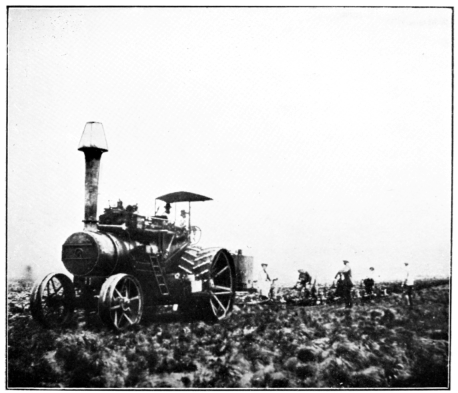
Ploughing Virgin Camp.
The price of naphtha is gradually decreasing in the Argentine Republic, and the oil wells of the country will probably make the cost of fuel even less by-and-by than it is to-day.
Areas of fertile camp, which have hitherto lain fallow, owing to their being intersected by canadas, and difficult to get at, can now be treated by the motor plough, with the result that their value will rapidly rise. In an actual case near the Central Cordoba Railway, people are to-day offering $118 per hectarea for land which was bought two years ago for $25 per hectarea, but during the two years it has been thoroughly ploughed and drained by mechanical means.
In nearly all the northern lands small trees grow irregularly all over the camp, and in order to plough the land these trees must be dug up. Machines are manufactured in the United States to deal with land containing tree roots. They perform the double operation of cutting roots under ground and ploughing up the surface, but they have not yet been introduced into the Argentine in large numbers. Other machines dig holes for fence posts at the rate of fifty holes per hour, and they can be so accurately gauged that the posts may be firmly fixed without expending much labour in ramming.
The naphtha engine is likewise used with great advantage for traction purposes. A striking instance of this is to be found at Rio Gallegos, where many naphtha engines are engaged in the work of carrying wool over a track of more than 300 kilometres, a feat which would be quite impossible with animal labour, owing to the rocky and broken condition of the roads.
As the Santa Fé Land Company owns a great diversity of land, they have used both the steam traction and the naphtha engines, and time will show which machine is to be recommended.
It is a pity that the agricultural implement importers of Buenos Aires should have recently formed themselves into a ring to lift prices, because their doing so will certainly tend to lessen the progress which agriculture is making in the Argentine. These combinations, however, will not deter the Company from continuing its "march of progress," but it comes hard on the colonist, who, after all, is the chief factor in building up the fortunes of the great importing houses of Buenos Aires.
One of the greatest competitors of the British-built traction engine is the Hart-Parr oil engine, a splendid agricultural tool, which is invaluable where ordinary fuel is not easily procurable.
It was with great difficulty The Instigator could be persuaded to leave the plough, and at one time his enthusiasm (and the engine) carried him out of sight, and those remaining at the starting-point grew speculative as to whether he would return before dark. However, a recommencement of drizzling rain apparently cooled his ardour, and restored him to the party. The nomads gladly turned their thoughts and coaches towards the section house, realising as they went the sweet truth of the words, "The ploughman homeward plods his weary way." Lunch awaited them, and the fish of the morning appeared in a more pleasant guise, to be enjoyed by all. After lunch, the rain showing no signs of clearing off, the party had to give up all idea of the lake proper, but watched one form in front of the house instead, and wondered how it would be negotiated when the time came for an onward move. So they sat on chairs, baggage and benches under the verandah, and tried to keep awake, while observing the steady downpour. One member of the party at last gave up the struggle against the inevitable, and sank gracefully into the arms of Morpheus, represented by the bags of biscuits and other impedimenta. A photo was secured of him as he lay half concealed amongst the portmanteaux, packages and "pan." We refrain from publishing it, because the chief feature of the picture is in the boots of the sleeper. (We trust no weak humour is intended in the preceding paragraph?—EDITOR.)
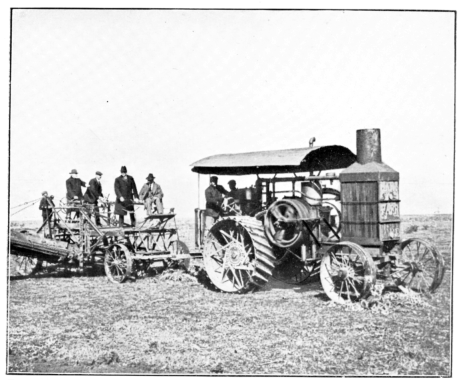
Hart-Parr Engine, drawing Roadmaker.
A slight diversion was caused by a repacking of some goods after lunch. It seems that the bottles, with contents (a most important item), had been forgotten, and The Wild Man was approached with a request that the bottles might be transported to Lucero in his bag; of course, he cheerily acquiesced, but as the whole of the contents of his bag had to be turned out to pack the bottles scientifically, and as that bag happened to be the same receptacle in which The Wild Man had secreted the various articles collected during his tour of appreciation this morning, developments were interesting to all, save to the man who had laboured under the delusion that several horns and other articles which appeared from the bag, were still in his own possession. However, probably remembering The Wild Man's character (vide page 205), he said nothing, but calmly looked on as his goods were repacked and removed from his sight for ever. All honour to such unselfishness.
After a cup of tea and farewells, the ladies were transferred to the coaches in a highly skilled manner, and a damp drive to Lucero followed. One sheet of drizzling rain surrounded us all through the journey, and none were sorry when, after a side slip or two, the coaches drew up (not before it was quite dark) outside the estancia house. A change into dry garments was very welcome, and there was to be noticed for the first time since the start of the Tacuruers, a dull air of respectability over the party, as they collected for their evening meal.
Shirt fronts and pretty frocks appeared once more, for here we had a lady presiding over the table. Still the old proverb proved true "Fine feathers do not make fine birds," and some members of the party did not live up to their costumes. It may have been the good dinner, or the genial glow of a fire that upset their behaviour, but the fact remains that there were two or three unusual occurrences during the course of a merry meal. The Kid was observed to be burying her face in a spoonful of jelly, and others seemed to be performing a sort of a general post during the repast. However, all ended well, and after coffee various home pets were introduced by our hostess, who is a devoted lover of animals. A nutria appeared and some friendly dogs, and we heard of tame foxes and diminutive ponies to be seen next day. It was a great regret to everyone that The Delineator did not put in an appearance for dinner; he pleaded headache and retired to bed early, perhaps in the hope of getting some sleep before The Instigator came to share the room.
ADVERTISEMENTS.
HARD CASE NO. 1.—"T.K." writes to inquire the proper procedure under the following circumstances:—"A lady receives a plate of jelly at dinner, the gentleman on her right at once takes up her spoon and commences to feed her with the jelly." What should she do? And if she allows herself to be fed, is it etiquette, this year, for the gentleman on her left to give her a slight push, which results in her nose meeting the jelly in the spoon? We offer the problems to our readers, and a prize will be awarded for the best solution sent in.
LOST.—One pair deer's horns, nicely coloured. If this advertisement meets the eye of T.W.M. the owner would be very glad to have the horns returned to Michelot, but does not wish to make a point of it.
FOUND.—The reward of £10 for lost ear-ring is withdrawn; owner found lost property herself, and has paid for her advertisement.
"THE TACURU."
No. 5.
Wednesday, March 30th, 1910.
Much to everyone's relief The Delineator appeared at breakfast looking himself again; he replied to the enquiries showered upon him that his indisposition could be explained in the words used by Herbert Spencer, when he defined life as "The continuous adjustment of internal relations to external relations." The Delineator said that that formula, when one considered the various cookings, including the Oriental style we had lately sampled, exactly described the cause of his passing illness, from which he was now happily recovered.
The morning was bright, and nothing but the drying mud remained to remind us of the rains of yesterday. At breakfast some strange tales were told of a frightened nutria which generally slept peacefully under a wardrobe in the dressing-room; but last night the room had another occupant, whose sleep was not so peaceful as that of the nutria, and at the first sound of a snore the poor animal was so scared that it leapt from its usual bed and rushed round the room till it found a way of escape, through the window, to a more restful soot.
Cattle-dipping was to be the sight of the morning, and as soon as the out-door menagerie was explored, under the guidance of our hostess, who has a wonderful knack with all animals, the coach and cavalcade of riders set forth to the scene of operations. Here we found a large number of animals ready to be dipped. This process is necessary to clean the animals from the garrapata. This is a tick which has been, and still is, the terror of the north. It is the means of transmitting to cattle the disease known as "Texas Fever." The rough native cattle do not suffer badly from this fever, but any newly imported fine stock from the south generally succumb to it.
Time after time wealthy men who realized the menace this pest was to the north have attempted to fight it, but their efforts have not been successful. Often their loss has been immense, sometimes as many as 95% of the total animals brought into the neighbourhood from the Province of Buenos Aires have died.
Undoubtedly these constant failures helped to give the northern district a bad name, but the experiments with the animals should have been carried on by means of acclimatisation. Animals for the north should be carefully handled, and with constant vigilance, adapted to their surroundings. These are the principles on which the Santa Fé Land Company have been working, and they confidently predict that before long they will be selling pedigree bulls with tick on them. When this is an accomplished fact, another great barrier to the progress of the north will have been broken down.
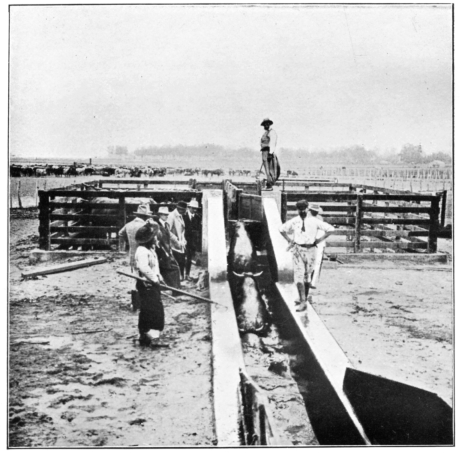
Cattle leaving Dip.
The cattle tick has two phases in its life.
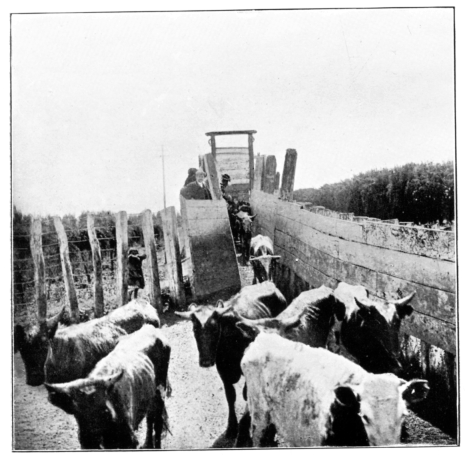
After establishing itself on the animal, the tick becomes a blood sucker, and at certain seasons animals running wild over unbroken camps, become literally covered with these bichos; consequently the cattle fall back in condition, and the mortality amongst them mounts up to an appallingly large percentage. To obviate this the dip is used, and has come into general use. The animals are collected from afar, and brought into the corral (a strong enclosure), from which there is a wooden passage, having many contrivances useful for marking, branding, and dehorning cattle, all of which are used in their due season; but for dipping purposes this passage terminates in a precipitous slope, and the animals are gently forced along it from the corral to plunge suddenly into a prepared bath of a strong solution, which kills every tick; so it follows, that if the animal has been totally submerged, it is absolutely free from the parasite. The object of dipping is to kill all kinds of insects and parasites which trouble the bovine race; especially so the common Louse (the Dermatodectis Bovis) which is the scab producer. The worst pest is, however, the cattle tick or Garrapata, and known under the scientific name of Boophilus Annulatus.
This latter is the harbinger of the microbe of Texas Fever or Tristeza, as it is known in the Argentine.
The remedies that are principally employed are of a tarry basis and prepared so as to be easily mixed with water, usually in the proportion of 1 to 100.
The amount of mixture used is 2.60 litres, and the cost works out at 10 cents. per head.
The greatest number of animals that the Santa Fé Land Company have been able to put through the dip in a day is 6,700, working from 6 a.m. to 5 p.m.
Animals certainly are frightened the first time they take this bath, but very soon they find the comfort of its effect, and come to like and enjoy it. The cattle we saw dipped to-day had mostly been through the process several times before, and walked calmly down the passage, seeming to enjoy their scramble through the dip. On emerging from the dip, the animals stand in a small corral on the other side, and are kept there for a while to allow the liquor to drain off their hides, and find its way back to the tank.
Some of the younger animals seemed scared at the first plunge, and though a very great point is made of the fact that they must all be collected and driven into the corral and down the passage, with the utmost gentleness, some of them grew so disturbed at the unusual proceeding, that they leapt on to the animal in front instead of sliding down the dip as the older animals do. However, there are always plenty of men under the superintendence of the mayor-domo to see that no harm comes to any animal, and though in the early days of dips, broken legs were not unusual occurrences, nowadays there are very seldom any accidents, though thousands of animals may be dipped in a few hours. One man holds a curious sort of wide blunt prong, with which he presses the heads of any animals, who have not been totally immersed, under the liquid as they pass him, thus ensuring the destruction of all parasites.
After this inspection The Instigator and company were taken on to see land which was being broken by bullocks, and thence to the Rio Salado, (which we are hoping to negotiate much further north to-morrow), and returned in time for lunch. After a short pause for rest and a cup of tea, the party, this time with their host and hostess, set off for various windmills, earth tanks, etc., which were of recent erection, and were to be reviewed by The Instigator. Everything he saw seemed to give satisfaction, and a weary but happy band returned to the house for dinner, in the course of which some native dishes were introduced to us.
Another lovely sunset favoured us this evening as we drove homewards, and we hear that My Lady and The Wild Man almost came to a serious quarrel over the shapes of various beautifully tinted clouds. One said a certain cloud resembled a bear, the other said it was exactly like a pork pie "shot" with a diamond tiara, and the matter was still under bitter discussion long after the cloud in question had faded away into a nebulous mist. The evening was calm and still, and we all sat outside after coffee, discussing the unknown journey of to-morrow, and the perils that might befall us on our way across the camps. The Instigator talked emphatically, and quite unnecessarily, of "an early start is imperative," till we all grew tired of his insistence and retired to bed, where some of the party wondered under what circumstances they would be sleeping to-morrow.
CORRESPONDENCE.
LUCERO, March 30th, 1910. DEAR SIR,
May I use the valuable medium of your paper for the purpose of announcing that anyone who wishes to accompany the explorers on the excursion, under the guidance of The Jehu and myself to the wild north, must be ready, decently clothed and fed, with a supply of patience and drinkables in their personal luggage, not later than 6 a.m., to-morrow, March 31st, 1910.
I am, Yours, etc., THE INSTIGATOR.
P.S.—While taking suitable precautions for the safety and happiness of those who entrust themselves to our care, we wish it to be understood that we cannot hold ourselves responsible for any loss of wearing apparel or other goods, temper, meals, or rest, caused by rain, mosquitoes, frogs, snakes, overeating, or the incompatibility of other passengers, or from any cause whatsoever.—T.I.
To the Editor of "The Tacuru."
March 30th, 1910.
SIR,
We should be glad to know if anything can be done to stop the public nuisance in the shape of the amalgamation of two members of the party, who are obviously descended from some long ago Christy Minstrels. We believe that, taken separately, one at a time, at long intervals, the aforesaid members can be tolerated for a few minutes (personally, we find them nauseating to a degree, under the most favourable circumstances), but together, when they attempt to be bright and amusing, and fancy they have a sense of humour and intelligent wit, they are absolutely impossible. They might have been useful (say in 1500) as the final torture decreed by the Inquisition, but in this year of grace of 1910, they are unwarrantable, and we shall be grateful if immediate steps can be taken for their separation, if not for their entire suppression. We are, Dear Sir, still suffering from violent headaches, caused by being shut up in the same coach for three hours with these imbeciles.
Yours truly,
T.D. and M.L.
HARD CASE No. 1.
The prize of five cents has been awarded to a correspondent O.G. (who is requested to forward his real name and address as soon as possible) for the best solution to the Hard Case we published yesterday. He says that in those circumstances the lady should undoubtedly allow herself to be fed, and should do all in her power by opening her mouth widely, and turning her head slightly in the direction of the gentleman on her right, to assist him in his self-imposed task, and thus to avoid giving him the impression that he had committed an unusual social solecism in commencing to feed her.
Numerous correspondents have sent in solutions, but we consider the above the best. Several answers have also been sent to the second part of the question, and all agree that the gentleman on the left had no shadow of excuse for causing the lady's nose to rest in the jelly. Such a proceeding is totally without precedent in the highest circles.
"THE TACURU."
No. 6.
Thursday, March 31st, 1910.
THE LARGEST CIRCULATION OF ANY DAILY PAPER PUBLISHED ON THIS TRIP.
Everyone was astir early this morning, remembering The Instigator's final warning last night of the necessity for an early start, but, on assembling for breakfast at 7 a.m., The Instigator himself was missed. His hawk-like eye (we apologise to Our Guest) had noticed some Galpon, or drinking trough, or something, which he must, of course, investigate before leaving Lucero, and dragging off The Delineator and The Jehu, he quite forgot breakfast and the "early start," as he fussed over his new-found interest, and it was not until he was captured forcibly by a search party that his companions were allowed to come in to breakfast—after the rest of the party had finished. Much to everyone's delight the morning was bright and fine, and all promised favourably for the excursion into the unknown.
While waiting for the start, considerable interest was caused by the home-building operations of some birds, who were constructing a nest under the eaves of the outbuilding, and manipulating the mud for its construction in a most clever manner. One bird flew off to get some mud while the other energetically fashioned the last piece into shape in the nest, then, when the first returned, the second bird flew off to get her contribution of clay; so the moulding of that nest grew apace while we watched its progress.
Before we set out a pleading message came (and it was not the first, either) from those left at headquarters, begging us to give up our exploration scheme, and, in view of weather reports, to return in peace to the civilisation of San Cristobal; but needless to say, nothing daunted, The Instigator still kept to his determination to see all there was to be seen, and the more people try to dissuade him from a thing, once he has decided to do it, the more fixed becomes his intention to do that thing. So, expostulations were useless, the final preparations and farewells were made, a last communication held with Our Hostess at Cristobal, before our passing into the wilds, and the Tacuru coaches with their freight of precious humans, and still more precious food and drink, started off from their pleasant rest at Lucero. Someone was heard to murmur as the coaches drove off—
"Then hey! for boot and horse, lad, And round the world away; The Instigator must have his tour, lad, And never will give way!"
But this puerile parody met with the indifference it deserved, and, accompanied by the Section Manager, we commenced our journey, travelling for some hours over the land which is in his charge. "Monte," too, seemed to consider that his presence as a guide and friend would be necessary to the party, and came along with us; he is a "wild" dog of the deerhound type, who was taken as a tiny puppy from a litter found in a wood near Los Moyes, and has ever since been devoted to his captors. There is a calm air of disinterested abstraction about "Monte" which is very satisfying, and he is undoubtedly a philosopher. One of the two Indian guides we picked up during the day's journey also had a dog, but it was of a very different appearance and character to "Monte." "Monte" looked on mankind in general as needing his care and supervision, while the little black smooth-haired terrier felt "the great passion" for one alone. His master was evidently his god, and if he lost sight of "master" for two minutes it was really touching to hear his cries, almost like those of a child, as he tried to trace his master through the shallow water which we sometimes crossed.
His yelps as he splashed along, nose to the ground, almost voiced the sentiment:—
"Rank and wealth I pass unheeding, Never giving them their due; For my heart and soul are needing, Nothing in the world but "YOU!"
And he and his "YOU" were never very far apart.
In a country where kindness to animals is not considered necessary, and is very rarely found, this example of devotion between dog and man was all the more noticeable and appreciated. Needless to say, as soon as The Saint observed it she wanted to "give the man a present," and was only restrained from doing so because she had nothing suitable for presentation in her luggage, or in that of The Instigator.
About one o'clock we came to the banks of the Salado, concerning the crossing of which river we had heard so much. We had been told it was impossible and impassable; that the rains had swollen the river too much for a safe passage; that at the best of times the banks were too steep and slippery for carts to negotiate, and that all idea of crossing had better be given up. The Instigator and The Jehu merely smiled when they heard of these difficulties, but some members of the party had wondered how the traversing of that river was to be accomplished, and they were agreeably surprised, on reaching the spot chosen for crossing, to find that a tenant had built a narrow "tajamar," or earth bank, across the river, which at this place was not very wide. Everyone dismounted, the horses were taken out, and all hands were in request to pull the vehicles across. First went the coaches, then the luggage carts were dragged over. To illustrate the difficulties of the proceedings we publish one of the many photos taken, during the crossing of the tajamar. Our Guest was one of the first to help in the conveyance of these carts. Apparently, since the gate-opening episode, he has "learnt the wisdom early to discern true beauty in utility," for he is always to the fore when work is to be done, and in this case his athletic training proved the truth of the Yankee expression that "It's muscle that tells." The Delineator and The Wild Man, as usual, when real hard work presents itself, "thought the party would like photographs of it," and, armed with their cameras, retired to safe distances, where the work could not possibly interfere with them or they with it, and took photos of the progress of the carts. We cannot complain, however, of their action (or inaction, rather), for the resulting pictures make a good memorial of the crossing of the Salado by the "Tacuruers." The ladies rushed to assist when they saw that photos were being taken, but, as the carts were well over the danger line by the time the ladies were at the ropes, we have no pictured record of their deeds, which, we may note, were really quite valueless at this point.
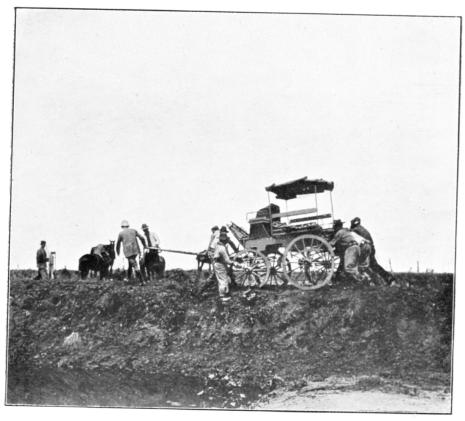
Crossing the Salado.
The Effect of a Long Drought.
Once the horses, carts, and luggage were safely across the tajamar the more serious business of cocktails and lunch was thought of, and, in an incredibly short time, the usual asado of meat, brought from Lucero, was under discussion.
The unfortunate sheep who were still spared were let out for a short run.
The Kid, too, was set free in the hopes that she might possibly prove useful now, but, judging from her attitude during the preparations for lunch, we should say those hopes would not be fulfilled.
As we rest after our arduous crossing of the Salado, our thoughts are inclined to wander to the awful tragedy enacted here in the year 1904. It was a disastrous year for many of the northern camp men. There was an appalling drought of long continuation, for which all the northern camps were totally unprepared; the river over which we have just passed became the concentration spot for all that is most terrible at such times. It is not exaggerating the case when we say that 15,000 animals (some of them having travelled south for 100 miles or more), forced by instinct, and guided by wire fences, came to drink from the foul, polluted chain of water-holes which then represented this river. One can imagine the horror and distress of it all—not a blade of grass for miles, where to-day the vegetation is luxuriant, and not a drop of water in this river on whose banks we are resting, only a few mud-holes in which hundreds of decaying carcases were embedded. This is what the cattle found after their long journey south, through which they were daily growing weaker. It is not surprising to hear that, at one place alone on the river-bed, over 3,000 hides were taken off dead animals, and, probably, it is well within the mark to say that at least another 1,000 were lost. Well may we wonder, "Why this terrible suffering and loss?" And the answer comes back, "Human negligence." It was the want of wells which caused all this misery; cattle will bear drought for a long time, but the actual want of water maddens them and causes the death of thousands. If the northern camps are to be colonised and are to become prosperous, the first necessity is the obtaining of a supply of good water; second in importance only to the water supply is the fencing of the camps, by which means a control over the cattle is established; refined camps, better grasses, and alfalfa, will all follow in due course; and anyone who has studied these northern lands would have no hesitation in predicting that these camps will, in time, prove just as profitable as any in the vast Republic of Argentina, and this is saying a good deal, as those who have travelled over the rich southern camps will realise. But, for his own sake, and for the sake of the cattle in his care, let it be the first business of the estanciero to provide good and sufficient wells, so that the terrible history of 1904 may never be repeated.
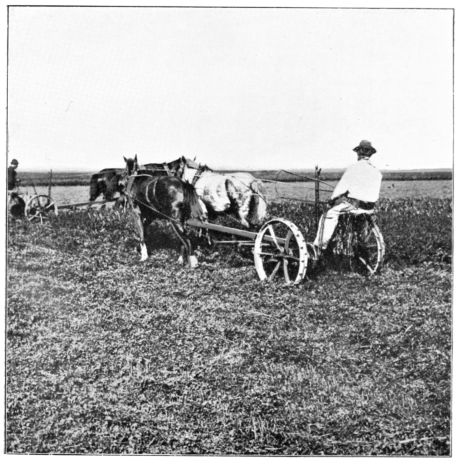
Refined Camps.
However, the scene is different to-day, with a pleasant sunshine, the crisp air sweeping over the uncultivated camp of natural grasses, and plenty of water in the river; but we cannot linger, so, after the pipe of peace for some, and a short siesta for others, "the all-aboard" bugle was sounded, horses were put in, carts packed once more, and, after a farewell to our host—who was returning to the section house—we went on ahead into the wilder regions, and had a pleasant, though rather short, drive for two or three hours before The Jehu called a halt. He explained that we should require at least an hour for the unloading and erection of the tents, tables, etc., before dusk; therefore, as the sun was only a hand's breadth from the horizon (roughly speaking, an hour before setting), we must dismount. He had chosen a pleasant spot for the camp of the night, not far from a small ranch, and here the coaches halted. Of course the luggage carts could not come up until some time later, as their loads were so much heavier, and My Lady became even more popular than usual when she suggested that the wait should be beguiled with a cup of tea, and produced her tea-basket from the coach; true, we found that there was no tea, but My Lady had plenty of cocoa. Water was obtained from the house near by, and a very welcome cup of cocoa handed round, accompanied by an unexpected slice of cake which apparently appeared from nowhere, and which disappeared equally effectively, for it was decidedly useful fodder and appreciated as such by all.
We discovered here that our friend "Monte" had declined to go back after lunch with his present master to Lucero, but had chosen to accompany his past master on this expedition. His presence was an agreeable surprise. He was found surveying the party with his calm scrutiny, and apparently he approved of our spot for camping, also of the cake.
As The Chaperon could find no work to do before the carts arrived, he, for once, relaxed from his terrible strain of usefulness, and tided over the tedious hour by trying to "throw the knife" in the most approved cowboy manner. As each member of the party had had their "tea" (he was practising with the knife which was used for the carving of the cake—and anything else, when needed), no one objected to this harmless amusement on his part, provided he did not pitch the knife on to their toes; and, after long exercise, with the help of The Wild Man, who is an adept at these tricks, The Chaperon at last succeeded in "throwing the knife" to his satisfaction, and others' terror. A sigh of relief escaped the lips of those who were dodging the knife when they saw the luggage-carts looming in the distance. They at once drew the attention of The Chaperon to the approach of the carts, and were rejoiced to see him return the weapon to its sheath (in his leggings), and stiffen into the attitude of action once more.
No sooner were the carts on the spot than every member of the party was at work, or pretending to be so. Poles were taken off the carts, luggage uncovered, canvas was everywhere, yells for "the mallet" alternated with the resounding blows struck, with the same, by the strong men of the band, tent-pegs bristled all over the ground, everyone wanted the hammer at the same time, and apparent chaos reigned for half an hour; then, behold! as by magic, the din ceased, two tents had been securely erected, floored with canvas, the luggage was placed under another covering of canvas, a table, with plates, knives, forks, etc., was ready in an open space, camp-stools stood around it, beds, blankets, sheets and pillows galore were in each tent, and the smell of roasting meat in the distance rose pleasantly upon the air. The place looked as if the party had been accustomed to camp there regularly once a week, so well was everything arranged. Nothing had been forgotten which could add comfort, for all hands had been working hard, and each peon, too, had done his share; in fact, the sight would have rejoiced the soul of the most ardent, red-tied Socialist, for surely never did a community carry out more thoroughly the principle of "each one working for the happiness of others." True, there was no trade union to limit their exertions, but that was an omission for which we may be thankful.
As the dusk quickly deepened, the peons gathered round their fire, over which the meat was cooking, a little distance from the camp site; the lamps were lit and hung from poles, and the party looked with satisfaction on their handiwork. It would have made an interesting, and not unpicturesque illustration, if one could have obtained a photo of the "Primera Vista" camp that evening.
But it was at this time, just when all seemed smiling and happy, that the travellers were to go through their first real trial, for here the discovery was made of a serious loss. It was spoken of in whispers at first, but gradually the whispers increased to a murmur as the loss became generally known; yet neither man nor woman quailed, and none could have told from their outward bearing the bitter struggle they were inwardly facing. A cynical traveller once said, after noting the innumerable number of statues in the land, "South America has evidently produced a phenomenal number of heroes," but we are inclined to think their tale has not been told if those who bore their trouble so bravely that night are to be "unhonoured and unsung." Think what it meant, you who may read this, in years to come, in civilised places, comfortably seated in your armchairs, conveniently near the cellaret, and,—honour our brave! They had at least two days to face (with no prospect of obtaining supplies anywhere) and they discovered, here, that the case of whisky was lost, left behind, vanished—they knew not what, only that it had disappeared!
Theirs not to reason why, Theirs not to moan or sigh, E'en though their throats were dry, Noble "Tacuruers"!
True, the comforting thought that they still had a bottle and a-half of the precious drink with them may have helped them to keep their spirits up with the hope of pouring spirits down, but a bottle and a-half is not much amongst so many thirsty souls for three days, and, we repeat, that great courage and bravery was shown by the equanimity with which the party bore the news of their loss.
A minor loss was that the dinner napkins were not forthcoming, but that surprised no one, for they were in the charge of The Kid, and, of course, she had forgotten them at Lucero. We believe she said something about their being "left to be washed" there, but no one listened to her, and we used glass cloths instead.
At our first camp evening meal everyone did justice to the goods that The Chaperon provided. Coffee was not forgotten, and, after their dinner, the more musical members of the band tried to sing—it kept the mosquitoes off—and when "a catch" was attempted even the bicho colorado was cowed into silence. We had looked forward to hearing the guitar played by one of the peons here. He had brought his instrument with him, but, unfortunately, had dropped a large packing case upon it, which did not improve its tone, and this accident prevented our hearing the national dances played on a guitar in the open camp as we had hoped to do.
Weary with the exertions of the day the party turned their thoughts and steps early towards those tents where rows of little bedsteads, each with its mosquito net above, looked so attractively inviting, and before long lights were out and peace reigned as far as possible.
"Thus done the Vales to bed they creep, By whispering winds soon lulled asleep."
Guards were set and they, with Monte, were left to protect the horses and camp through the night.
CORRESPONDENCE.
March 31st, 1910.
SIR,
I feel that, as I am in a measure responsible for the presence of the two people to whom your correspondents of yesterday object, I should like to apologise, through the medium of your paper, for the inconvenience these two people have caused, and to assure your correspondents that steps shall be taken to prevent a repetition of the annoyance. The fact is, that both of them are so rarely out of Bedlam at the same time that I had not realised the necessity for keeping them apart, nor the danger of their amalgamation, but they shall be kept in separate coaches in future, and I can only express my sincere regret for the mischief and trouble they have caused.
I am,
Yours, etc.,
THE INSTIGATOR.
A correspondent writes to know if any of our readers can solve the following problem for her:—"'A' starts on a seven days' journey with eighty-seven horses, he loses two, one of which he finds next day, and at the end of the week has 110 horses." The enquirer has searched through her "Hamblin Smith" but can find no honest method of solution.
ADVERTISEMENTS.
EXPERT GUIDE.—Anyone requiring a really good guide, thoroughly conversant with the Chaco, ways of wild Indians and animals, please apply "T.W.M.," Offices of this paper. Good shot, can cook and sew, able to point out all the beauties of nature, animal and vegetable. Terms moderate. Inspires confidence in the most timid ladies by his winning smile.
LOST.—One tin of gingerbread biscuits (Huntley & Palmer). No reward is offered, as they will probably be eaten by the time this advertisement is in print. If anyone would return the tin, as a recuerdo, to Lucero, advertiser would be obliged.
LOST.—Lucero. Several good horses.
Several correspondents have written to know whether it is not a menace to the rest of the community for one member of the band to sleep promiscuously on the bricks, or anywhere else handy, at night. Two or three say they have tripped over him in the dark and consider it would be a safeguard if anyone preferring to spend the night in this way were compelled by law to burn an anchor or other light. They are quite willing to believe that the offender had had at least one "starboard light" at some period of that night, but that light had lost its power of illumination at the time our correspondents tripped over the prostrate figure, and they wish to suggest that in future, people sleeping out should use some means to safeguard unwary passers-by. (We give the complaint the publicity it deserves and trust steps will be taken to right the matter.—ED.)
"THE TACURU."
No. 7.
Friday, April 1st, 1910.
ADVERTISE IN "THE TACURU"—THIS ENSURES YOUR WANTS BEING KNOWN IN EVERY COACH.
We fancy that most of the party were awake to see the dawn this morning: it may have been that they only saw the first streaks of light between the openings of their tent as they lay in bed trying to soothe the itching of the mosquito bites, but we think that few were asleep as the sun rose gloriously from the mists on the horizon. It was a strange sight, the sudden flooding with bright sunlight of that rough camp land, which scarcely owned a tree or shrub. It may be the primitive barbarian lying dormant in all of us though hidden under generations of civilization, which makes us feel a close communion with Nature when we see her in these great uncultivated wastes; but, whatever the causes of the sympathy, these pictures, of wild untouched Nature, leave an impression and a longing more deep than any experience gained in years of civil life; none will ever regret having seen that sunrise on the plain, though all regretted the cause of their wakefulness this morning.
Of course The Chaperon was up and clothed (he always seemed to be) and ready to get basins of water, looking-glasses, shaving materials and all luxuries for the others. The ladies were heard to enquire why he did not bring them early tea and hot water, but, on the whole, he combined the duties of valet and maid fairly efficiently.
Rumour has it that The Chaperon had given instructions that he was to be called by the guard an hour before dawn, so, in the dark, he was awakened by hoarse whispers of his name and gentle shakings. After he arose it occurred to him that it felt more like the middle of the night than the morning, and he enquired of the peon what time it was, the answer coming in soft Spanish, "Can't say, the cocks have not crowed yet!!!" On investigation The Chaperon found it was scarcely 4 a.m., so spent the remaining two hours sitting round the camp fire with the peons, alternately dozing and sucking maté. We believe he heard some expert opinions on the subject of the "roncadors" of the camp during his vigil. At any rate he had full opportunity for proving the reality of Ruskin's words, "There is no solemnity so deep to a right-thinking creature as that of dawn." At the same time he was heard to murmur something to the effect that he would prefer a little less of the "deep solemnity" and a little more of "deep slumber" another morning.
Scarcely were the toilets, and the packing of personal luggage, accomplished, before a request was made that the mosquito nets and beds might be removed for loading, and, as we emerged from the various tents, the breakfast-table greeted us ready laden with tea (from the kettle), sardines, jam, peons' biscuits, etc. True, the only milk procurable was some condensed milk, which had "gone solid," there were not enough knives to go round, and a few other irregularities, but no little items of that sort ever disturbed the temper of The Tacuruers; they simply remarked with the other "Autocrat of the Breakfast Table," "Difficulties are Nature's challenges to you," and used one spoon for all their cups, tore off lumps of bread with their fingers (when they could get hold of a loaf), and used the same plate and knife for jam and sardines alike, and enjoyed their early meal.
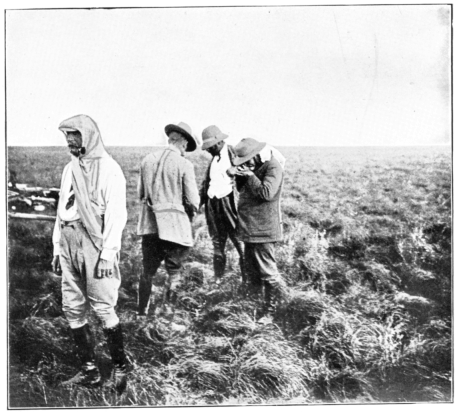
"Rich black alluvial Soil."
There was one subject that did cause sore feeling, and that was mosquitoes. We had thought we knew all about them, we were proud with the conceit of nets, ammonia, and veils, but our pride had a fall. Comparatively speaking, we had only known mosquitoes theoretically before (though that knowledge was bad enough); last night we learnt of them practically, none of us had thought of tucking in our nets, and mosquitoes seemed to swarm up under each net before we had been in bed for half an hour. Little peace did anyone get through those long night hours, and, though a voice came from one of the tents about 2 a.m., remarking clearly above the intermittent snores, "Oh! how lovely," few echoed the sentiment, and the speaker assured us this morning that she was only dreaming, and that her words did not refer to insects of any kind, neither were they made in connection with the upheaval caused by "Monte" at one period of the night. He had taken up his quarters at one end of the ladies' tent, but was disturbed from his beauty sleep by the sudden barking of a dog outside the other end of the tent. This, of course, must be seen to; it was his duty, so, leaping up, he rushed through the tent, lifting up each one of the low beds, and their occupants, as he passed under them on his way to quell the outside noise. The ladies forbore to scream, though they thought of earthquakes, but settled down again to their occupation of trying to kill mosquitoes, quietly, in the dark, and to snatch moments of slumber occasionally.
After breakfast, Our Guest was rather unkindly "put on" by The Instigator to dig holes, to ascertain how deep the rich, black, alluvial soil reached; the ladies energetically washed up the breakfast things, which occupation resulted in The Kid once more, and this time finally, being given notice to leave, without a character, owing to general incompetence, impertinence, and lack of ability to wash out tea-cloths.
By 7 a.m. the coaches and carts were ready, horses rounded up, the "Primera Vista" camp was struck, and the march onward recommenced. But not before The Chaperon had pointed out a terror that "might have been." After breakfast he approached us with a stick held at arm's length, on which hung a dead, slimy-looking, grey snake, about 4 feet long. He explained that this reptile had crawled over the neck of one of the peons as he lay on the grass last night. This had happened before we went to bed, and we felt grateful to The Chaperon for having saved us from another horror last night by keeping the fact, and snake, to himself until we were leaving that camp.