PROGRESSION IN OR THROUGH THE AIR.
Reading edition
The atmosphere, because of its great tenuity, mobility, and comparative imponderability, presents little resistance to bodies passing through it at low velocities. If, however, the speed be greatly accelerated, the passage of even an ordinary cane is sensibly impeded.
This comes of the action and reaction of matter, the resistance experienced varying according to the density of the atmosphere and the shape, extent, and velocity of the body acting upon it. While, therefore, scarcely any impediment is offered to the progress of an animal in motion, it is often exceedingly difficult to compress the air with sufficient rapidity and energy to convert it into a suitable fulcrum for securing the onward impetus. This arises from the fact that bodies moving in the air experience the minimum of resistance and occasion the maximum of displacement. Another and very obvious difficulty is traceable to the great disparity in the weight of air as compared with any known solid, this in the case of water being nearly as 1000 to 1. According to the density of the medium so is its buoying or sustaining power.
The Wing a Lever of the Third Order.—To meet the peculiarities stated above, the insect, bat, and bird are furnished with extensive surfaces in the shape of pinions or wings, which they can apply with singular velocity and power, as levers of the third order (fig. 3, p. 20),61 at various angles, or by alternate slow and sudden movements, to obtain the necessary degree of resistance and non-resistance. Although the third order of lever is particularly inefficient when the fulcrum is rigid and immobile, it possesses singular advantages when these conditions are reversed, i.e. when the fulcrum, as happens with the air, is elastic and yielding. In this case a very slight movement at the root of the pinion, or that end of the lever directed towards the body, is succeeded by an immense sweep of the extremity of the wing, where its elevating and propelling power is greatest. This arrangement insures that the large quantity of air necessary for propulsion and support shall be compressed under the most favourable conditions.
It follows from this that those insects and birds are endowed with the greatest powers of flight whose wings are the longest. The dragon-fly and albatross furnish examples. The former on some occasions dashes along with amazing velocity and wheels with incredible rapidity; at other times it suddenly checks its headlong career and hovers or fixes itself in the air after the manner of the kestrel and humming-birds. The flight of the albatross is also remarkable. This magnificent bird, I am informed on reliable authority, sails about with apparent unconcern for hours together, and rarely deigns to flap its enormous pinions, which stream from its body like ribbons to the extent, in some cases, of seven feet on either side.
The manner in which the wing levers the body upwards and forwards in flight is shown at fig. 52.
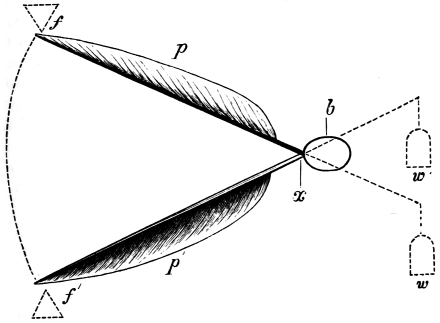
Fig. 52.
In this fig. f f´ represent the moveable fulcra furnished by the air; p p´ the power residing in the wing, and b the body to be flown. In order to make the problem of flight more intelligible, I have prolonged the lever formed by the wing beyond the body (b), and have applied to the root of the wing so extended the weight w w´. x represents the universal joint by which the wing is attached to the body. When the wing ascends, as shown at p, the air (= fulcrum f) resists its upward passage, and forces the body (b), or its representative (w), slightly downwards. When the wing descends, as shown at p´, the air (= fulcrum f´) resists its downward passage, and forces the body (b), or its representative (w´), slightly upwards. From this it follows, that when the wing rises the body falls, and vice versâ; the wing describing the arc of a large circle (f f´), the body (b), or the weights representing it (w w´) describing the arc of a much smaller circle. The body, therefore, as well as the wing, rises and falls in flight. When the wing descends it elevates the body, the wing being active and the body passive; when the body descends it elevates the wing, the body being active and the wing passive. The elevator muscles, and the reaction of the air on the under surface of the wing, contribute to its elevation. It is in this manner that weight forms a factor in flight, the wing and the weight of the body reciprocating and mutually assisting and relieving each other. This is an argument for employing four wings in artificial flight, the wings being so arranged that the two which are up shall always by their fall mechanically elevate the two which are down. Such an arrangement is calculated greatly to conserve the driving power, and, as a consequence, to reduce the weight. It is the upper or dorsal surface of the wing which more especially operates upon the air during the up stroke, and the under or ventral surface which operates during the down stroke. The wing, which at the beginning of the down stroke has its surfaces and margins (anterior and posterior) arranged in nearly the same plane with the horizon,62 rotates upon its anterior margin as an axis during its descent and causes its under surface to make a gradually increasing angle with the horizon, the posterior margin (fig. 53, c) in this movement descending beneath the anterior one. A similar but opposite rotation takes place during the up stroke. The rotation referred to causes the wing to twist on its long axis screw-fashion, and to describe a figure-of-8 track in space, one-half of the figure being described during the ascent of the wing, the other half during its descent. The twisting of the wing and the figure-of-8 track described by it when made to vibrate, are represented at fig. 53. The rotation of the wing on its long axis as it ascends and descends causes the under surface of the wing to act as a kite, both during the up and down strokes, provided always the body bearing the wing is in forward motion. But the upper surface of the wing, as has been explained, acts when the wing is being elevated, so that both the upper and under surfaces of the wing are efficient during the up stroke. When the wing ascends, the upper surface impinges against the air; the under surface impinging at the same time from its being carried obliquely forward, after the manner of a kite, by the body, which is in motion. During the down stroke, the under surface only acts. The wing is consequently effective both during its ascent and descent, its slip being nominal in amount. The wing acts as a kite, both when it ascends and descends. It acts more as a propeller than an elevator during its ascent; and more as an elevator than a propeller during its descent. It is, however, effective both in an upward and downward direction. The efficiency of the wing is greatly increased by the fact that when it ascends it draws a current of air up after it, which current being met by the wing during its descent, greatly augments the power of the down stroke. In like manner, when the wing descends it draws a current of air down after it, which being met by the wing during its ascent, greatly augments the power of the up stroke. These induced currents are to the wing what a stiff autumn breeze is to the boy’s kite. The wing is endowed with this very remarkable property, that it creates the current on which it rises and progresses. It literally flies on a whirlwind of its own forming.
These remarks apply more especially to the wings of bats and birds, and those insects whose wings are made to vibrate in a more or less vertical direction. The action of the wing is readily imitated, as a reference to fig. 53 will show.
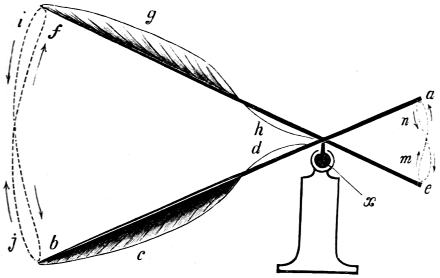
Fig. 53.
If, for example, I take a tapering elastic reed, as represented at a b, and supply it with a flexible elastic sail (c d), and a ball-and-socket joint (x), I have only to seize the reed at a and cause it to oscillate upon x to elicit all the wing movements. By depressing the root of the reed in the direction n e, the wing flies up as a kite in the direction j f. During the upward movement the wing flies upwards and forwards, and describes a double curve. By elevating the root of the reed in the direction m a, the wing flies down as a kite in the direction i b. During the downward movement the wing flies downwards and forwards, and describes a double curve. These curves, when united, form a waved track, which represents progressive flight. During the rise and fall of the wing a large amount of tractile force is evolved, and if the wings and the body of the flying creature are inclined slightly upwards, kite-fashion, as they invariably are in ordinary flight, the whole mass of necessity moves upwards and forwards. To this there is no exception. A sheet of paper or a card will float along if its anterior margin is slightly raised, and if it be projected with sufficient velocity. The wings of all flying creatures when made to vibrate, twist and untwist, the posterior thin margin of each wing twisting round the anterior thick one, like the blade of a screw. The artificial wing represented at fig. 53 (p. 107) does the same, c d twisting round a b, and g h round e f. The natural and artificial wings, when elevated and depressed, describe a figure-of-8 track in space when the bodies to which they are attached are stationary. When the bodies advance, the figure-of-8 is opened out to form first a looped and then a waved track. I have shown how those insects, bats, and birds which flap their wings in a more or less vertical direction evolve tractile or propelling power, and how this, operating on properly constructed inclined surfaces, results in flight. I wish now to show that flight may also be produced by a very oblique and almost horizontal stroke of the wing, as in some insects, e.g. the wasp, blue-bottle, and other flies. In those insects the wing is made to vibrate with a figure-of-8 sculling motion in a very oblique direction, and with immense energy. This form of flight differs in no respect from the other, unless in the direction of the stroke, and can be readily imitated, as a reference to fig. 54 will show.
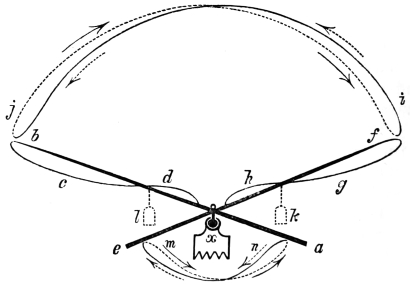
Fig. 54.
In this figure (54) the conditions represented at fig. 53 (p. 107) are exactly reproduced, the only difference being that in the present figure the wing is applied to the air in a more or less horizontal direction, whereas in fig. 53 it is applied in a more or less vertical direction. The letters in both figures are the same. The insects whose wings tack upon the air in a more or less horizontal direction, have an extensive range, each wing describing nearly half a circle, these half circles corresponding to the area of support. The body of the insect is consequently the centre of a circle of motion. It corresponds to x of the present figure (fig. 54). When the wing is seized by the hand at a, and the root made to travel in the direction n e, the body of the wing travels in the direction j f. While so travelling, it flies upwards in a double curve, kite-fashion, and elevates the weight l. When it reaches the point f, it reverses suddenly to prepare for a return stroke, which is produced by causing the root of the wing to travel in the direction m a, the body and tip travelling in the direction i b. During the reverse stroke, the wing flies upwards in a double curve, kite-fashion, and elevates the weight k. The more rapidly these movements are repeated, the more powerful the wing becomes, and the greater the weight it elevates. This follows because of the reciprocating action of the wing,—the wing, as already explained, always drawing a current of air after it during the one stroke, which is met and utilized by it during the next stroke. The reciprocating action of the wing here referred to is analogous in all respects to that observed in the flippers of the seal, sea-bear, walrus, and turtle; the swimming wing of the penguin; and the tail of the whale, dugong, manatee, porpoise, and fish. If the muscles of the insect were made to act at the points a e, the body of the insect would be elevated as at k l, by the reciprocating action of the wings. The amount of tractile power developed in the arrangement represented at fig. 53 (p. 107), can be readily ascertained by fixing a spring or a weight acting over a pulley to the anterior margin (a b or e f) of the wing; weights acting over pulleys being attached to the root of the wing (a or e).
The amount of elevating power developed in the arrangement represented at fig. 54, can also be estimated by causing weights acting over pulleys to operate upon the root of the wing (a or e), and watching how far the weights (k or l) are raised. In these calculations allowance is of course to be made for friction. The object of the two sets of experiments described and figured, is to show that the wing can exert a tractile power either in a nearly horizontal direction or in a nearly vertical one, flight being produced in both cases. I wish now to show that a body not supplied with wings or inclined surfaces will, if left to itself, fall vertically downwards; whereas, if it be furnished with wings, its vertical fall is converted into oblique downward flight. These are very interesting points. Experiment has shown me that a wing when made to vibrate vertically produces horizontal traction; when made to vibrate horizontally, vertical traction; the vertical fall of a body armed with wings producing oblique traction. The descent of weights can also be made to propel the wings either in a vertical or horizontal direction; the vibration of the wings upon the air in natural flight causing the weights (body of flying creature) to move forward. This shows the very important part performed by weight in all kinds of flight.
Weight necessary to Flight.—However paradoxical it may seem, a certain amount of weight is indispensable in flight.
In the first place, it gives peculiar efficacy and energy to the up stroke, by acting upon the inclined planes formed by the wings in the direction of the plane of progression. The power and the weight may thus be said to reciprocate, the two sitting, as it were, side by side, and blending their peculiar influences to produce a common result.
Secondly, it adds momentum,—a heavy body, when once fairly under weigh, meeting with little resistance from the air, through which it sweeps like a heavy pendulum.
Thirdly, the mere act of rotating the wings on and off the wind during extension and flexion, with a slight downward stroke, apparently represents the entire exertion on the part of the volant animal, the rest being performed by weight alone.
This last circumstance is deserving of attention, the more especially as it seems to constitute the principal difference between a living flying thing and an aërial machine. If a flying-machine was constructed in accordance with the principles which we behold in nature, the weight and the propelling power of the machine would be made to act upon the sustaining and propelling surfaces, whatever shape they assumed, and these in turn would be made to operate upon the air, and vice versâ. In the aërial machine, as far as yet devised, there is no sympathy between the weight to be elevated and the lifting power, whilst in natural flight the wings and the weight of the flying creature act in concert and reciprocate; the wings elevating the body the one instant, the body by its fall elevating the wings the next. When the wings elevate the body they are active, the body being passive. When the body elevates the wings it is active, the wings being passive. The force residing in the wings, and the force residing in the body (weight is a force when launched in space and free to fall in a vertical direction) cause the mass of the volant animal to oscillate vertically on either side of an imaginary line—this line corresponding to the path of the insect, bat, or bird in the air. While the wings and body act and react upon each other, the wings, body, and air likewise act and react upon each other. In the flight of insects, bats, and birds, weight is to be regarded as an independent moving power, this being made to act upon the oblique surfaces presented by the wings in conjunction with the power expended by the animal—the latter being, by this arrangement, conserved to a remarkable extent. Weight, assisted by the elastic ligaments or springs, which recover all wings in flexion, is to be regarded as the mechanical expedient resorted to by nature in supplementing the efforts of all flying things.63 Without this, flight would be of short duration, laboured, and uncertain, and the almost miraculous journeys at present performed by the denizens of the air impossible.
Weight contributes to Horizontal Flight.—That the weight of the body plays an important part in the production of flight may be proved by a very simple experiment.
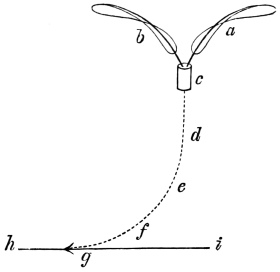
Fig. 55.
If I take two primary feathers and fix them in an ordinary cork, as represented at fig. 55, and allow the apparatus to drop from a height, I find the cork does not fall vertically downwards, but downwards and forwards in a curve. This follows, because the feathers a, b are twisted flexible inclined planes, which arch in an upward direction. They are in fact true wings in the sense that an insect wing in one piece is a true wing. (Compare a, b, c of fig. 55, with g, g´, s of fig. 82, p. 158.) When dragged downwards by the cork (c), which would, if left to itself, fall vertically, they have what is virtually a down stroke communicated to them. Under these circumstances a struggle ensues between the cork tending to fall vertically and the feathers tending to travel in an upward direction, and, as a consequence, the apparatus describes the curve d e f g before reaching the earth h, i. This is due to the action and reaction of the feathers and air upon each other, and to the influence which gravity exerts upon the cork. The forward travel of the cork and feathers, as compared with the space through which they fall, is very great. Thus, in some instances, I found they advanced as much as a yard and a half in a descent of three yards. Here, then, is an example of flight produced by purely mechanical appliances. The winged seeds fly in precisely the same manner. The seeds of the plane-tree have, e.g. two wings which exactly resemble the wings employed for flying; thus they taper from the root towards the tip, and from the anterior margin towards the posterior margin, the margins being twisted and disposed in different planes to form true screws. This arrangement prevents the seed from falling rapidly or vertically, and if a breeze is blowing it is wafted to a considerable distance before it reaches the ground. Nature is uniform and consistent throughout. She employs the same principle, and very nearly the same means, for flying a heavy, solid seed which she employs for flying an insect, a bat, or a bird.
When artificial wings constructed on the plan of natural ones, with stiff roots, tapering semi-rigid anterior margins, and thin yielding posterior margins, are allowed to drop from a height, they describe double curves in falling, the roots of the wings reaching the ground first. This circumstance proves the greater buoying power of the tips of the wings as compared with the roots. I might refer to many other experiments made in this direction, but these are sufficient to show that weight, when acting upon wings, or, what is the same thing, upon elastic twisted inclined planes, must be regarded as an independent moving power. But for this circumstance flight would be at once the most awkward and laborious form of locomotion, whereas in reality it is incomparably the easiest and most graceful. The power which rapidly vibrating wings have in sustaining a body which tends to fall vertically downwards, is much greater than one would naturally imagine, from the fact that the body, which is always beginning to fall, is never permitted actually to do so. Thus, when it has fallen sufficiently far to assist in elevating the wings, it is at once elevated by the vigorous descent of those organs. The body consequently never acquires the downward momentum which it would do if permitted to fall through a considerable space uninterruptedly. It is easy to restrain even a heavy body when beginning to fall, while it is next to impossible to check its progress when it is once fairly launched in space and travelling rapidly in a downward direction.
Weight, Momentum, and Power, to a certain extent, synonymous in Flight.—When a bird rises it has little or no momentum, so that if it comes in contact with a solid resisting surface it does not injure itself. When, however, it has acquired all the momentum of which it is capable, and is in full and rapid flight, such contact results in destruction. My friend Mr. A. D. Bartlett informed me of an instance where a wild duck terminated its career by coming violently in contact with one of the glasses of the Eddystone Lighthouse. The glass, which was fully an inch in thickness, was completely smashed. Advantage is taken of this circumstance in killing sea-birds, a bait being placed on a board and set afloat with a view to breaking the neck of the bird when it stoops to seize the carrion. The additional power due to momentum in heavy bodies in motion is well illustrated in the start and progress of steamboats. In these the slip, as it is technically called, decreases as the speed of the vessel increases; the strength of a man, if applied by a hawser attached to the stern of a moderate-sized vessel, being sufficient to retard, and, in some instances prevent, its starting. In such a case the power of the engine is almost entirely devoted to “slip” or in giving motion to the fluid in which the screw or paddle is immersed. It is consequently not the power residing in the paddle or screw which is cumulative, but the momentum inhering in the mass. In the bird, the momentum, alias weight, is made to act upon the inclined planes formed by the wings, these adroitly converting it into sustaining and propelling power. It is to this circumstance, more than any other, that the prolonged flight of birds is mainly due, the inertia or dead weight of the trunk aiding and abetting the action of the wings, and so relieving the excess of exertion which would necessarily devolve on the bird. It is thus that the power which in living structures resides in the mass is conserved, and the mass itself turned to account. But for this reciprocity, no bird could retain its position in the air for more than a few minutes at a time. This is proved by the comparatively brief upward flight of the lark and the hovering of the hawk when hunting. In both these cases the body is exclusively sustained by the action of the wings, the weight of the trunk taking no part in it; in other words, the weight of the body does not contribute to flight by adding its momentum and the impulse which momentum begets. In the flight of the albatross, on the other hand, the momentum acquired by the moving mass does the principal portion of the work, the wings for the most part being simply rotated on and off the wind to supply the proper angles necessary for the inertia or mass to operate upon. It appears to me that in this blending of active and passive power the mystery of flight is concealed, and that no arrangement will succeed in producing flight artificially which does not recognise and apply the principle here pointed out.
Air-cells in Insects and Birds not necessary to Flight.—The boasted levity of insects, bats, and birds, concerning which so much has been written by authors in their attempts to explain flight, is delusive in the highest degree.
Insects, bats, and birds are as heavy, bulk for bulk, as most other living creatures, and flight can be performed perfectly by animals which have neither air-sacs nor hollow bones; air-sacs being found in animals never designed to fly. Those who subscribe to the heated-air theory are of opinion that the air contained in the cavities of insects and birds is so much lighter than the surrounding atmosphere, that it must of necessity contribute materially to flight. I may mention, however, that the quantity of air imprisoned is, to begin with, so infinitesimally small, and the difference in weight which it experiences by increase of temperature so inappreciable, that it ought not to be taken into account by any one endeavouring to solve the difficult and important problem of flight. The Montgolfier or fire-balloons were constructed on the heated-air principle; but as these have no analogue in nature, and are apparently incapable of improvement, they are mentioned here rather to expose what I regard a false theory than as tending to elucidate the true principles of flight.
When we have said that cylinders and hollow chambers increase the area of the insect and bird, and that an insect and bird so constructed is stronger, weight for weight, than one composed of solid matter, we may dismiss the subject; flight being, as I shall endeavour to show by-and-by, not so much a question of levity as one of weight and power intelligently directed, upon properly constructed flying surfaces.
The bodies of insects, bats, and birds are constructed on strictly mechanical principles,—lightness, strength, and durability of frame being combined with power, rapidity, and precision of action. The cylindrical method of construction is in them carried to an extreme, the bodies and legs of insects displaying numerous unoccupied spaces, while the muscles and solid parts are tunnelled by innumerable air-tubes, which communicate with the surrounding medium by a series of apertures termed spiracles.
A somewhat similar disposition of parts is met with in birds, these being in many cases furnished not only with hollow bones, but also (especially the aquatic ones) with a liberal supply of air-sacs. They are likewise provided with a dense covering of feathers or down, which adds greatly to their bulk without materially increasing their weight. Their bodies, moreover, in not a few instances, particularly in birds of prey, are more or less flattened. The air-sacs are well seen in the swan, goose, and duck; and I have on several occasions minutely examined them with a view to determine their extent and function. In two of the specimens which I injected, the material employed had found its way not only into those usually described, but also into others which ramify in the substance of the muscles, particularly the pectorals. No satisfactory explanation of the purpose served by these air-sacs has, I regret to say, been yet tendered. According to Sappey,64 who has devoted a large share of attention to the subject, they consist of a membrane which is neither serous nor mucous, but partly the one and partly the other; and as blood-vessels in considerable numbers, as my preparations show, ramify in their substance, and they are in many cases covered with muscular fibres which confer on them a rhythmic movement, some recent observers (Mr. Drosier65 of Cambridge, for example) have endeavoured to prove that they are adjuncts of the lungs, and therefore assist in aërating the blood. This opinion was advocated by John Hunter as early as 1774,66 and is probably correct, since the temperature of birds is higher than that of any other class of animals, and because they are obliged occasionally to make great muscular exertions both in swimming and flying. Others have viewed the air-sacs in connexion with the hollow bones frequently, though not always, found in birds,67 and have come to look upon the heated air which they contain as being more or less essential to flight. That the air-cells have absolutely nothing to do with flight is proved by the fact that some excellent fliers (take the bats, e.g.) are destitute of them, while birds such as the ostrich and apteryx, which are incapable of flying, are provided with them. Analogous air-sacs, moreover, are met with in animals never intended to fly; and of these I may instance the great air-sac occupying the cervical and axillary regions of the orang-outang, the float or swimming-bladder in fishes, and the pouch communicating with the trachea of the emu.68
The same may be said of the hollow bones,—some really admirable fliers, as the swifts, martins, and snipes, having their bones filled with marrow, while those of the wingless running birds alluded to have air. Furthermore and finally, a living bird weighing 10 lbs. weighs the same when dead, plus a very few grains; and all know what effect a few grains of heated air would have in raising a weight of 10 lbs. from the ground.
How Balancing is effected in Flight, the Sound produced by the Wing, etc.—The manner in which insects, bats, and birds balance themselves in the air has hitherto, and with reason, been regarded a mystery, for it is difficult to understand how they maintain their equilibrium when the wings are beneath their bodies. Figs. 67 and 68, p. 141, throw considerable light on the subject in the case of the insect. In those figures the space (a, g) mapped out by the wing during its vibrations is entirely occupied by it; i.e. the wing (such is its speed) is in every portion of the space at nearly the same instant, the space representing what is practically a solid basis of support. As, moreover, the wing is jointed to the upper part of the body (thorax) by a universal joint, which admits of every variety of motion, the insect is always suspended (very much as a compass set upon gimbals is suspended); the wings, when on a level with the body, vibrating in such a manner as to occupy a circular area (vide r d b f of fig. 56, p. 120), in the centre of which the body (a e c) is placed. The wings, when vibrating above and beneath the body occupy a conical area; the apex of the cone being directed upwards when the wings are below the body, and downwards when they are above the body. Those points are well seen in the bird at figs. 82 and 83, p. 158. In fig. 82 the inverted cone formed by the wings when above the body is represented, and in fig. 83 that formed by the wings when below the body is given. In these figures it will be observed that the body, from the insertion of the roots of the wings into its upper portion, is always suspended, and this, of course, is equivalent to suspending the centre of gravity. In the bird and bat, where the stroke is delivered more vertically than in the insect, the basis of support is increased by the tip of the wing folding inwards and backwards in a more or less horizontal direction at the end of the down stroke; and outwards and forwards at the end of the up stroke. This is accompanied by the rotation of the outer portion of the wing upon the wrist as a centre, the tip of the wing, because of the ever varying position of the wrist, describing an ellipse. In insects whose wings are broad and large (butterfly), and which are driven at a comparatively low speed, the balancing power is diminished. In insects whose wings, on the contrary, are long and narrow (blow-fly), and which are driven at a high speed, the balancing power is increased. It is the same with short and long winged birds, so that the function of balancing is in some measure due to the form of the wing, and the speed with which it is driven; the long wing and the wing vibrated with great energy increasing the capacity for balancing. When the body is light and the wings very ample (butterfly and heron), the reaction elicited by the ascent and descent of the wing displaces the body to a marked extent. When, on the other hand, the wings are small and the body large, the reaction produced by the vibration of the wing is scarcely perceptible. Apart, however, from the shape and dimensions of the wing, and the rapidity with which it is urged, it must never be overlooked that all wings (as has been pointed out) are attached to the bodies of the animals bearing them by some form of universal joint, and in such a manner that the bodies, whatever the position of the wings, are accurately balanced, and swim about in a more or less horizontal position, like a compass set upon gimbals. To such an extent is this true, that the position of the wing is a matter of indifference. Thus the pinion may be above, beneath, or on a level with the body; or it may be directed forwards, backwards, or at right angles to the body. In either case the body is balanced mechanically and without effort. To prove this point I made an artificial wing and body, and united the one to the other by a universal joint. I found, as I had anticipated, that in whatever position the wing was placed, whether above, beneath, or on a level with the body, or on either side of it, the body almost instantly attained a position of rest. The body was, in fact, equally suspended and balanced from all points.
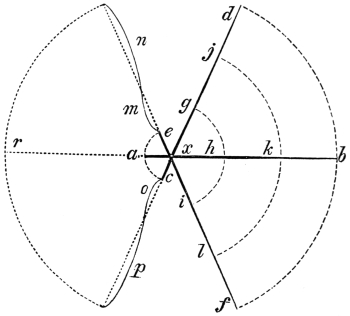
Fig. 56.69
Rapidity of Wing Movements partly accounted for.—Much surprise has been expressed at the enormous rapidity with which some wings are made to vibrate. The wing of the insect is, as a rule, very long and narrow. As a consequence, a comparatively slow and very limited movement at the root confers great range and immense speed at the tip; the speed of each portion of the wing increasing as the root of the wing is receded from. This is explained on a principle well understood in mechanics, viz. that when a rod hinged at one end is made to move in a circle, the tip or free end of the rod describes a much wider circle in a given time than a portion of the rod nearer the hinge. This principle is illustrated at fig. 56. Thus if a b of fig. 56 be made to represent the rod hinged at x, it travels through the space d b f in the same time it travels through j k l; and through j k l in the same time it travels through g h i; and through g h i in the same time it travels through e a c, which is the area occupied by the thorax of the insect. If, however, the part of the rod b travels through the space d b f in the same time that the part a travels through the space e a c, it follows of necessity that the portion of the rod marked a moves very much slower than that marked b. The muscles of the insect are applied at the point a, as short levers (the point referred to corresponding to the thorax of the insect), so that a comparatively slow and limited movement at the root of the wing produces the marvellous speed observed at the tip; the tip and body of the wing being those portions which occasion the blur or impression produced on the eye by the rapidly oscillating pinion (figs. 64, 65, and 66, p. 139), But for this mode of augmenting the speed originally inaugurated by the muscular system, it is difficult to comprehend how the wings could be driven at the velocity attributed to them. The wing of the blow-fly is said to make 300 strokes per second, i.e. 18,000 per minute. Now it appears to me that muscles to contract at the rate of 18,000 times in the minute would be exhausted in a very few seconds, a state of matters which would render the continuous flight of insects impossible. (The heart contracts only between sixty and seventy times in a minute.) I am, therefore, disposed to believe that the number of contractions made by the thoracic muscles of insects has been greatly overstated; the high speed at which the wing is made to vibrate being due less to the separate and sudden contractions of the muscles at its root than to the fact that the speed of the different parts of the wing is increased in a direct ratio as the several parts are removed from the driving point, as already explained. Speed is certainly a matter of great importance in wing movements, as the elevating and propelling power of the pinion depends to a great extent upon the rapidity with which it is urged. Speed, however, may be produced in two ways—either by a series of separate and opposite movements, such as is witnessed in the action of a piston, or by a series of separate and opposite movements acting upon an instrument so designed, that a movement applied at one part increases in rapidity as the point of contact is receded from, as happens in the wing. In the piston movement the motion is uniform, or nearly so; all parts of the piston travelling at very much the same speed. In the wing movements, on the contrary, the motion is gradually accelerated towards the tip of the pinion, where the pinion is most effective as an elevator, and decreased towards the root, where it is least effective—an arrangement calculated to reduce the number of muscular contractions, while it contributes to the actual power of the wing. This hypothesis, it will be observed, guarantees to the wing a very high speed, with comparatively few reversals and comparatively few muscular contractions.
In the bat and bird the wings do not vibrate with the same rapidity as in the insect, and this is accounted for by the circumstance, that in them the muscles do not act exclusively at the root of the wing. In the bat and bird the muscles run along the wing towards the tip for the purpose of flexing or folding the wing prior to the up stroke, and for opening out and expanding it prior to the down stroke.
As the wing must be folded or flexed and opened out or expanded every time the wing rises and falls, and as the muscles producing flexion and extension are long muscles with long tendons, which act at long distances as long levers, and comparatively slowly, it follows that the great short muscles (pectorals, etc.) situated at the root of the wing must act slowly likewise, as the muscles of the thorax and wing of necessity act together to produce one pulsation or vibration of the wing. What the wing of the bat and bird loses in speed it gains in power, the muscles of the bat and bird’s wing acting directly upon the points to be moved, and under the most favourable conditions. In the insect, on the contrary, the muscles act indirectly, and consequently at a disadvantage. If the pectorals only moved, they would act as short levers, and confer on the wing of the bat and bird the rapidity peculiar to the wing of the insect.
The tones emitted by the bird’s wing would in this case be heightened. The swan in flying produces a loud whistling sound, and the pheasant, partridge, and grouse a sharp whirring noise like the stone of a knife-grinder.
It is a mistake to suppose, as many do, that the tone or note produced by the wing during its vibrations is a true indication of the number of beats made by it in any given time. This will be at once understood when I state, that a long wing will produce a higher note than a shorter one driven at the same speed and having the same superficial area, from the fact that the tip and body of the long wing will move through a greater space in a given time than the tip and body of the shorter wing. This is occasioned by all wings being jointed at their roots, the sweep made by the different parts of the wing in a given time being longer or shorter in proportion to the length of the pinion. It ought, moreover, not to be overlooked, that in insects the notes produced are not always referable to the action of the wings, these, in many cases, being traceable to movements induced in the legs and other parts of the body.
It is a curious circumstance, that if portions be removed from the posterior margins of the wings of a buzzing insect, such as the wasp, bee, blue-bottle fly, etc., the note produced by the vibration of the pinions is raised in pitch. This is explained by the fact, that an insect whose wings are curtailed requires to drive them at a much higher speed in order to sustain itself in the air. That the velocity at which the wing is urged is instrumental in causing the sound, is proved by the fact, that in slow-flying insects and birds no note is produced; whereas in those which urge the wing at a high speed, a note is elicited which corresponds within certain limits to the number of vibrations and the form of the wing. It is the posterior or thin flexible margin of the wing which is more especially engaged in producing the sound; and if this be removed, or if this portion of the wing, as is the case in the bat and owl, be constructed of very soft materials, the character of the note is altered. An artificial wing, if properly constructed and impelled at a sufficiently high speed, emits a drumming noise which closely resembles the note produced by the vibration of short-winged, heavy-bodied birds, all which goes to prove that sound is a concomitant of rapidly vibrating wings.
The Wing area Variable and in Excess.—The travelling-surfaces of insects, bats, and birds greatly exceed those of fishes and swimming animals; the travelling-surfaces of swimming animals being greatly in excess of those of animals which walk and run. The wing area of insects, bats, and birds varies very considerably, flight being possible within a comparatively wide range. Thus there are light-bodied and large-winged insects and birds—as the butterfly (fig. 57) and heron (fig. 60, p. 126); and others whose bodies are comparatively heavy, while their wings are insignificantly small—as the sphinx moth and Goliath beetle (fig. 58) among insects, and the grebe, quail, and partridge (fig. 59, p. 126) among birds.
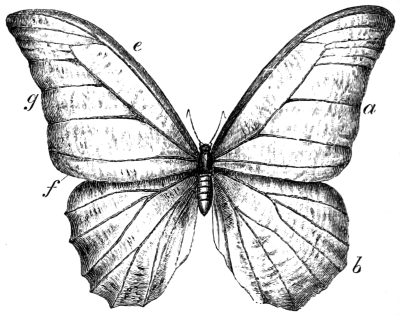
Fig. 57.—Shows a butterfly with comparatively very large wings. The nervures are seen to great advantage in this specimen; and the enormous expanse of the pinions readily explains the irregular flight of the insect on the principle of recoil. a Anterior wing. b Posterior wing. e Anterior margin of wing. f Ditto posterior margin. g Ditto outer margin. Compare with beetle, fig. 58.—Original.
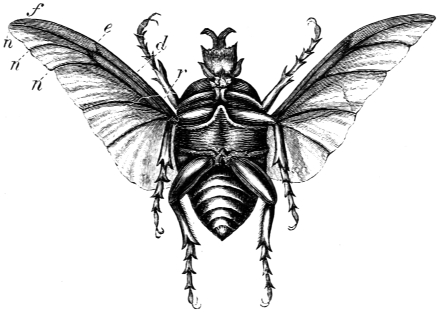
Fig. 58.—Under-surface of large beetle (Goliathus micans), with deeply concave and comparatively small wings (compare with butterfly, fig. 57), shows that the nervures (r, d, e, f, n, n, n) of the wings of the beetle are arranged along the anterior margins and throughout the substance of the wings generally, very much as the bones of the arm, forearm, and hand, are in the wings of the bat, to which they bear a very marked resemblance, both in their shape and mode of action. The wings are folded upon themselves at the point e during repose. Compare letters of this figure with similar letters of fig. 17, p. 36.—Original.
The apparent inconsistencies in the dimensions of the body and wings are readily explained by the greater muscular development of the heavy-bodied short-winged insects and birds, and the increased power and rapidity with which the wings in them are made to oscillate. In large-winged animals the movements are slow; in small-winged ones comparatively very rapid. This shows that flight may be attained by a heavy, powerful animal with comparatively small wings, as well as by a lighter one with enormously enlarged wings. While there is apparently no fixed relation between the area of the wings and the animal to be raised, there is, unless in the case of sailing birds,70 an unvarying relation between the weight of the animal, the area of its wings, and the number of oscillations made by them in a given time. The problem of flight thus resolves itself into one of weight, power, velocity, and small surfaces; versus buoyancy, debility, diminished speed, and extensive surfaces,—weight in either case being a sine quâ non. In order to utilize the air as a means of transit, the body in motion, whether it moves in virtue of the life it possesses, or because of a force superadded, must be heavier than the air. It must tread and rise upon the air as a swimmer upon the water, or as a kite upon the wind. It must act against gravity, and elevate and carry itself forward at the expense of the air, and by virtue of the force which resides in it. If it were rescued from the law of gravity on the one hand, and bereft of independent movement on the other, it would float about uncontrolled and uncontrollable, as happens in the ordinary gas-balloon.
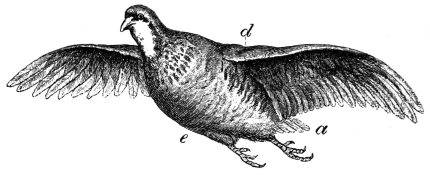
Fig. 59.—The Red-legged Partridge (Perdix rubra) with wings fully extended as in rapid flight, shows deeply concave form of the wings, how the primary and secondary feathers overlap and support each other during extension, and how the anterior or thick margins of the wings are directed upwards and forwards, and the posterior or thin ones downwards and backwards. The wings in the partridge are wielded with immense velocity and power. This is necessary because of their small size as compared with the great dimensions and weight of the body.
If a horizontal line be drawn across the feet (a, e) to represent the horizon, and another from the tip of the tail (a) to the root of the wing (d), the angle at which the wing strikes the air is given. The body and wings when taken together form a kite. The wings in the partridge are rounded and broad. Compare with heron, fig. 60.—Original.
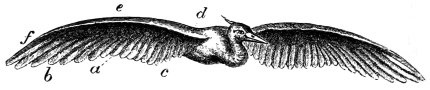
Fig. 60.—The Grey Heron (Ardea cinerea) in full flight. In the heron the wings are deeply concave, and unusually large as compared with the size of the bird. The result is that the wings are moved very leisurely, with a slow, heavy, and almost solemn beat. The heron figured weighed under 3 lbs.; and the expanse of wing was considerably greater than that of a wild goose which weighed over 9 lbs. Flight is consequently more a question of power and weight than of buoyancy and surface. d, e, f Anterior thick strong margin of right wing. c, a, b Posterior thin flexible margin, composed of primary (b), secondary (a), and tertiary (c) feathers. Compare with partridge, fig. 59.—Original.
That no fixed relation exists between the area of the wings and the size and weight of the body, is evident on comparing the dimensions of the wings and bodies of the several orders of insects, bats, and birds. If such comparison be made, it will be found that the pinions in some instances diminish while the bodies increase, and the converse. No practical good can therefore accrue to aërostation from elaborate measurements of the wings and trunks of any flying thing; neither can any rule be laid down as to the extent of surface required for sustaining a given weight in the air. The wing area is, as a rule, considerably in excess of what is actually required for the purposes of flight. This is proved in two ways. First, by the fact that bats can carry their young without inconvenience, and birds elevate surprising quantities of fish, game, carrion, etc. I had in my possession at one time a tame barn-door owl which could lift a piece of meat a quarter of its own weight, after fasting four-and-twenty hours; and an eagle, as is well known, can carry a moderate-sized lamb with facility.
The excess of wing area is proved, secondly, by the fact that a large proportion of the wings of most volant animals may be removed without destroying the power of flight. I instituted a series of experiments on the wings of the fly, dragon-fly, butterfly, sparrow, etc., with a view to determining this point in 1867. The following are the results obtained:—
Blue-bottle Fly.—Experiment 1. Detached posterior or thin half of each wing in its long axis. Flight perfect.
Exp. 2. Detached posterior two-thirds of either wing in its long axis. Flight still perfect. I confess I was not prepared for this result.
Exp. 3. Detached one-third of anterior or thick margin of either pinion obliquely. Flight imperfect.
Exp. 4. Detached one-half of anterior or thick margin of either pinion obliquely. The power of flight completely destroyed. From experiments 3 and 4 it would seem that the anterior margin of the wing, which contains the principal nervures, and which is the most rigid portion of the pinion, cannot be mutilated with impunity.
Exp. 5. Removed one-third from the extremity of either wing transversely, i.e. in the direction of the short axis of the pinion. Flight perfect.
Exp. 6. Removed one-half from either wing transversely, as in experiment 5. Flight very slightly (if at all) impaired.
Exp. 7. Divided either pinion in the direction of its long axis into three equal parts, the anterior nervures being contained in the anterior portion. Flight perfect.
Exp. 8. Notched two-thirds of either pinion obliquely from behind. Flight perfect.
Exp. 9. Notched anterior third of either pinion transversely. The power of flight destroyed. Here, as in experiment 4, the mutilation of the anterior margin was followed by loss of function.
Exp. 10. Detached posterior two-thirds of right wing in its long axis, the left wing being untouched. Flight perfect. I expected that this experiment would result in loss of balancing-power; but this was not the case.
Exp. 11. Detached half of right wing transversely, the left one being normal. The insect flew irregularly, and came to the ground about a yard from where I stood. I seized it and detached the corresponding half of the left wing, after which it flew away, as in experiment 6.
Dragon-Fly.—Exp. 12. In the dragon-fly either the first or second pair of wings may be removed without destroying the power of flight. The insect generally flies most steadily when the posterior pair of wings are detached, as it can balance better; but in either case flight is perfect, and in no degree laboured.
Exp. 13. Removed one-third from the posterior margin of the first and second pairs of wings. Flight in no wise impaired.
If more than a third of each wing is cut away from the posterior or thin margin, the insect can still fly, but with effort.
Experiment 13 shows that the posterior or thin flexible margins of the wings may be dispensed with in flight. They are more especially engaged in propelling. Compare with experiments 1 and 2.
Exp. 14. The extremities or tips of the first and second pair of wings may be detached to the extent of one-third, without diminishing the power of flight. Compare with experiments 5 and 6.
If the mutilation be carried further, flight is laboured, and in some cases destroyed.
Exp. 15. When the front edges of the first and second pairs of wings are notched or when they are removed, flight is completely destroyed. Compare with experiments 3, 4, and 9.
This shows that a certain degree of stiffness is required for the front edges of the wings, the front edges indirectly supporting the back edges. It is, moreover, on the front edges of the wings that the pressure falls in flight, and by these edges the major portions of the wings are attached to the body. The principal movements of the wings are communicated to these edges.
Butterfly.—Exp. 16. Removed posterior halves of the first pair of wings of white butterfly. Flight perfect.
Exp. 17. Removed posterior halves of first and second pairs of wings. Flight not strong but still perfect. If additional portions of the posterior wings were removed, the insect could still fly, but with great effort, and came to the ground at no great distance.
Exp. 18. When the tips (outer sixth) of the first and second pairs of wings were cut away, flight was in no wise impaired. When more was detached the insect could not fly.
Exp. 19. Removed the posterior wings of the brown butterfly. Flight unimpaired.
Exp. 20. Removed in addition a small portion (one-sixth) from the tips of the anterior wings. Flight still perfect, as the insect flew upwards of ten yards.
Exp. 21. Removed in addition a portion (one-eighth) of the posterior margins of anterior wings. The insect flew imperfectly, and came to the ground about a yard from the point where it commenced its flight.
House Sparrow.—The sparrow is a heavy small-winged bird, requiring, one would imagine, all its wing area. This, however, is not the case, as the annexed experiments show.
Exp. 22. Detached the half of the secondary feathers of either pinion in the direction of the long axis of the wing, the primaries being left intact. Flight as perfect as before the mutilation took place. In this experiment, one wing was operated upon before the other, in order to test the balancing-power. The bird flew perfectly, either with one or with both wings cut.
Exp. 23. Detached the half of the secondary feathers and a fourth of the primary ones of either pinion in the long axis of the wing. Flight in no wise impaired. The bird, in this instance, flew upwards of 30 yards, and, having risen a considerable height, dropped into a neighbouring tree.
Exp. 24. Detached nearly the half of the primary feathers in the long axis of either pinion, the secondaries being left intact. When one wing only was operated upon, flight was perfect; when both were tampered with, it was still perfect, but slightly laboured.
Exp. 25. Detached rather more than a third of both primary and secondary feathers of either pinion in the long axis of the wing. In this case the bird flew with evident exertion, but was able, notwithstanding, to attain a very considerable altitude.
From experiments 1, 2, 7, 8, 10, 13, 16, 22, 23, 24, and 25, it would appear that great liberties may be taken with the posterior or thin margin of the wing, and the dimensions of the wing in this direction materially reduced, without destroying, or even vitiating in a marked degree, the powers of flight. This is no doubt owing to the fact indicated by Sir George Cayley, and fully explained by Mr. Wenham, that in all wings, particularly long narrow ones, the elevating power is transferred to the anterior or front margin. These experiments prove that the upward bending of the posterior margins of the wings during the down stroke is not necessary to flight.
Exp. 26. Removed alternate primary and secondary feathers from either wing, beginning with the first primary. The bird flew upwards of fifty yards with very slight effort, rose above an adjoining fence, and wheeled over it a second time to settle on a tree in the vicinity. When one wing only was operated upon, it flew irregularly and in a lopsided manner.
Exp. 27. Removed alternate primary and secondary feathers from either wing, beginning with the second primary. Flight, from all I could determine, perfect. When one wing only was cut, flight was irregular or lopsided, as in experiment 26.
From experiments 26 and 27, as well as experiments 7 and 8, it would seem that the wing does not of necessity require to present an unbroken or continuous surface to the air, such as is witnessed in the pinion of the bat, and that the feathers, when present, may be separated from each other without destroying the utility of the pinion. In the raven and many other birds the extremities of the first four or five primaries divaricate in a marked manner. A similar condition is met with in the Alucita hexadactyla, where the delicate feathery-looking processes composing the wing are widely removed from each other. The wing, however, ceteris paribus, is strongest when the feathers are not separated from each other, and when they overlap, as then they are arranged so as mutually to support each other.
Exp. 28. Removed half of the primary feathers from either wing transversely, i.e. in the direction of the short axis of the wing. Flight very slightly, if at all, impaired when only one wing was operated upon. When both were cut, the bird flew heavily, and came to the ground at no very great distance. This mutilation was not followed by the same result in experiments 6 and 11. On the whole, I am inclined to believe that the area of the wing can be curtailed with least injury in the direction of its long axis, by removing successive portions from its posterior margin.
Exp. 29. The carpal or wrist-joint of either pinion rendered immobile by lashing the wings to slender reeds, the elbow-joints being left free. The bird, on leaving the hand, fluttered its wings vigorously, but after a brief flight came heavily to the ground, thus showing that a certain degree of twisting and folding, or flexing of the wings, is necessary to the flight of the bird, and that, however the superficies and shape of the pinions may be altered, the movements thereof must not be interfered with. I tied up the wings of a pigeon in the same manner, with a precisely similar result.
The birds operated upon were, I may observe, caught in a net, and the experiments made within a few minutes from the time of capture.
Some of my readers will probably infer from the foregoing, that the figure-of-8 curves formed along the anterior and posterior margins of the pinions are not necessary to flight, since the tips and posterior margins of the wings may be removed, without destroying it. To such I reply, that the wings are flexible, elastic, and composed of a congeries of curved surfaces, and that so long as a portion of them remains, they form, or tend to form, figure-of-8 curves in every direction.
Captain F. W. Hutton, in a recent paper “On the Flight of Birds” (Ibis, April 1872), refers to some of the experiments detailed above, and endeavours to frame a theory of flight, which differs in some respects from my own. His remarks are singularly inappropriate, and illustrate in a forcible manner the old adage, “A little knowledge is a dangerous thing.” If Captain Hutton had taken the trouble to look into my memoir “On the Physiology of Wings,” communicated to the Royal Society of Edinburgh, on the 2d of August 1870,71 fifteen months before his own paper was written, there is reason to believe he would have arrived at very different conclusions. Assuredly he would not have ventured to make the rash statements he has made, the more especially as he attempts to controvert my views, which are based upon anatomical research and experiment, without making any dissections or experiments of his own.
The Wing area decreases as the Size and Weight of the Volant Animal increases.—While, as explained in the last section, no definite relation exists between the weight of a flying animal and the size of its flying surfaces, there being, as stated, heavy bodied and small-winged insects, bats, and birds, and the converse; and while, as I have shown by experiment, flight is possible within a wide range, the wings being, as a rule, in excess of what are required for the purposes of flight; still it appears, from the researches of M. de Lucy, that there is a general law, to the effect that the larger the volant animal the smaller by comparison are its flying surfaces. The existence of such a law is very encouraging as far as artificial flight is concerned, for it shows that the flying surfaces of a large, heavy, powerful flying machine will be comparatively small, and consequently comparatively compact and strong. This is a point of very considerable importance, as the object desiderated in a flying machine is elevating capacity.
M. de Lucy has tabulated his results, which I subjoin:72—
INSECTS.BIRDS.
Names.Referred to the kilogramme = 2lbs. 8oz. 3dwt. 2gr. Avoird. = 2lbs. 3oz. 4·428dr.Names.Referred to the kilogramme.
sq. yds.ft.in.sq. yds.ft.in.
Gnat, 11 892Swallow,111041/2
Dragon-fly (small), 7 256Sparrow,051421/2
Coccinella (Lady-bird), 51387Turtle-dove,041001/2
Dragon-fly (common), 5 289Pigeon,02113
Tipula, or Daddy-long-legs, 3 511Stork,0220
Bee, 1 2741/2Vulture,01116
Meat-fly, 1 3541/2Crane of Australia,00139
Drone (blue), 1 220
Cockchafer, 1 250
Lucanus} Stag beetle (female), 1 1391/2
cervus} Stag-beetle (male), 0 833
Rhinoceros-beetle, 0 61221/2
“It is easy, by aid of this table, to follow the order, always decreasing, of the surfaces, in proportion as the winged animal increases in size and weight. Thus, in comparing the insects with one another, we find that the gnat, which weighs 460 times less than the stag-beetle, has fourteen times more of surface. The lady-bird weighs 150 times less than the stag-beetle, and possesses five times more of surface. It is the same with the birds. The sparrow weighs about ten times less than the pigeon, and has twice as much surface. The pigeon weighs about eight times less than the stork, and has twice as much surface. The sparrow weighs 339 times less than the Australian crane, and possesses seven times more surface. If now we compare the insects and the birds, the gradation will become even much more striking. The gnat, for example, weighs 97,000 times less than the pigeon, and has forty times more surface; it weighs 3,000,000 times less than the crane of Australia, and possesses 149 times more of surface than this latter, the weight of which is about 9 kilogrammes 500 grammes (25 lbs. 5 oz. 9 dwt. troy, 20 lbs. 15 oz. 2 1/4 dr. avoirdupois).
“The Australian crane is the heaviest bird that I have weighed. It is that which has the smallest amount of surface, for, referred to the kilogramme, it does not give us a surface of more than 899 square centimetres (139 square inches), that is to say about an eleventh part of a square metre. But every one knows that these grallatorial animals are excellent birds of flight. Of all travelling birds they undertake the longest and most remote journeys. They are, in addition, the eagle excepted, the birds which elevate themselves the highest, and the flight of which is the longest maintained.”73
Strictly in accordance with the foregoing, are my own measurements of the gannet and heron. The following details of weight, measurement, etc., of the gannet were supplied by an adult specimen which I dissected during the winter of 1869. Entire weight, 7 lbs. (minus 3 ounces); length of body from tip of bill to tip of tail, three feet four inches; head and neck, one foot three inches; tail, twelve inches; trunk, thirteen inches; girth of trunk, eighteen inches; expanse of wing from tip to tip across body, six feet; widest portion of wing across primary feathers, six inches; across secondaries, seven inches; across tertiaries, eight inches. Each wing, when carefully measured and squared, gave an area of 19 1/2 square inches. The wings of the gannet, therefore, furnish a supporting area of three feet three inches square. As the bird weighs close upon 7 lbs., this gives something like thirteen square inches of wing for every 36 1/3 ounces of body, i.e. one foot one square inch of wing for every 2 lbs. 4 1/3 oz. of body.
The heron, a specimen of which I dissected at the same time, gave a very different result, as the subjoined particulars will show. Weight of body, 3 lbs. 3 ounces; length of body from tip of bill to tip of tail, three feet four inches; head and neck, two feet; tail, seven inches; trunk, nine inches; girth of body, twelve inches; expanse of wing from tip to tip across the body, five feet nine inches; widest portion of wing across primary and tertiary feathers, eleven inches; across secondary feathers, twelve inches.
Each wing, when carefully measured and squared, gave an area of twenty-six square inches. The wings of the heron, consequently, furnish a supporting area of four feet four inches square. As the bird only weighs 3 lbs. 3 ounces, this gives something like twenty-six square inches of wing for every 25 1/2 ounces of bird, or one foot 5 1/4 inches square for every 1 lb. 1 ounce of body.
In the gannet there is only one foot one square inch of wing for every 2 lbs. 4 1/3 ounces of body. The gannet has, consequently, less than half of the wing area of the heron. The gannet’s wings are, however, long narrow wings (those of the heron are broad), which extend transversely across the body; and these are found to be the most powerful—the wings of the albatross—which measure fourteen feet from tip to tip (and only one foot across), elevating 18 lbs. without difficulty. If the wings of the gannet, which have a superficial area of three feet three inches square, are capable of elevating 7 lbs., while the wings of the heron, which have a superficial area of four feet four inches, can only elevate 3 lbs., it is evident (seeing the wings of both are twisted levers, and formed upon a common type) that the gannet’s wings must be vibrated with greater energy than the heron’s wings; and this is actually the case. The heron’s wings, as I have ascertained from observation, make 60 down and 60 up strokes every minute; whereas the wings of the gannet, when the bird is flying in a straight line to or from its fishing-ground, make close upon 150 up and 150 down strokes during the same period. The wings of the divers, and other short-winged, heavy-bodied birds, are urged at a much higher speed, so that comparatively small wings can be made to elevate a comparatively heavy body, if the speed only be increased sufficiently.74 Flight, therefore, as already indicated, is a question of power, speed, and small surfaces versus weight. Elaborate measurements of wing, area, and minute calculations of speed, can consequently only determine the minimum of wing for elevating the maximum of weight—flight being attainable within a comparatively wide range.
Wings, their Form, etc.; all Wings Screws, structurally and functionally.—Wings vary considerably as to their general contour; some being falcated or scythe-like, some oblong, some rounded or circular, some lanceolate, and some linear.75
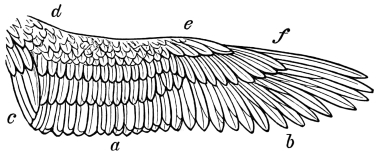
Fig. 61.—Right wing of the Kestrel, drawn from the specimen, while being held against the light. Shows how the primary (b), secondary (a), and tertiary (c) feathers overlap and buttress or support each other in every direction. Each set of feathers has its coverts and subcoverts, the wing being conical from within outwards, and from before backwards. d, e, f Anterior or thick margin of wing. b, a, c Posterior or thin margin. The wing of the kestrel is intermediate as regards form, it being neither rounded as in the partridge (fig. 96, p. 176), nor ribbon-shaped as in the albatross (fig. 62), nor pointed as in the swallow. The feathers of the kestrel’s wing are unusually symmetrical and strong. Compare with figs. 92, 94, and 96, pp. 174, 175, and 176.—Original.
All wings are constructed upon a common type. They are in every instance carefully graduated, the wing tapering from the root towards the tip, and from the anterior margin in the direction of the posterior margin. They are of a generally triangular form, and twisted upon themselves in the direction of their length, to form a helix or screw. They are convex above and concave below, and more or less flexible and elastic throughout, the elasticity being greatest at the tip and along the posterior margin. They are also moveable in all their parts. Figs. 61, 62, 63 (p. 138), 59 and 60 (p. 126), 96 and 97 (p. 176), represent typical bird wings; figs. 17 (p. 36), 94 and 95 (p. 175), typical bat wings; and figs. 57 and 58 (p. 125), 89 and 90 (p. 171), 91 (p. 172), 92 and 93 (p. 174), typical insect wings.
In all the wings which I have examined, whether in the insect, bat, or bird, the wing is recovered, flexed, or drawn towards the body by the action of elastic ligaments, these structures, by their mere contraction, causing the wing, when fully extended and presenting its maximum of surface, to resume its position of rest and plane of least resistance. The principal effort required in flight is, therefore, made during extension, and at the beginning of the down stroke. The elastic ligaments are variously formed, and the amount of contraction which they undergo is in all cases accurately adapted to the size and form of the wing, and the rapidity with which it is worked; the contraction being greatest in the short-winged and heavy-bodied insects and birds, and least in the light-bodied and ample-winged ones, particularly such as skim or glide. The mechanical action of the elastic ligaments, I need scarcely remark, insures an additional period of repose to the wing at each stroke; and this is a point of some importance, as showing that the lengthened and laborious flights of insects and birds are not without their stated intervals of rest.
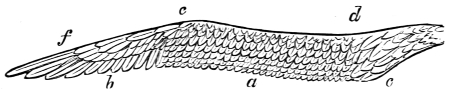
Fig. 62.—Left wing of the albatross. d, e, f Anterior or thick margin of pinion. b, a, c Posterior or thin margin, composed of the primary (b), secondary (a), and tertiary (c) feathers. In this wing the first primary is the longest, the primary coverts and subcoverts being unusually long and strong. The secondary coverts and subcoverts occupy the body of the wing (e, d), and are so numerous as effectually to prevent any escape of air between them during the return or up stroke. This wing, which I have in my possession, measures over six feet in length.—Original.
All wings are furnished at their roots with some form of universal joint which enables them to move not only in an upward, downward, forward, or backward direction, but also at various intermediate degrees of obliquity. All wings obtain their leverage by presenting oblique surfaces to the air, the degree of obliquity gradually increasing in a direction from behind forwards and downwards during extension and the down stroke, and gradually decreasing in an opposite direction during flexion and the up stroke.
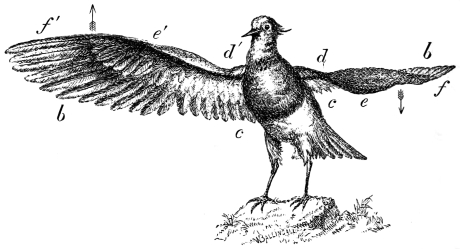
Fig. 63.—The Lapwing, or Green Plover (Vanellus cristatus, Meyer), with one wing (c b, d´ e´ f´) fully extended, and forming a long lever; the other (d e f, c b) being in a flexed condition and forming a short lever. In the extended wing the anterior or thick margin (d´ e´ f´) is directed upwards and forwards (vide arrow), the posterior or thin margin (c, b) downwards and backwards. The reverse of this happens during flexion, the anterior or thick margin (d, e, f) being directed downwards and forwards (vide arrow), the posterior or thin margin (c b) bearing the rowing-feathers upwards and backwards. The wings therefore twist in opposite directions during extension and flexion; and this is a point of the utmost importance in the action of all wings, as it enables the volant animal to rotate the wings on and off the air, and to present at one time (in extension) resisting, kite-like surfaces, and at another (in flexion) knife-like and comparatively non-resisting surfaces. It rarely happens in flight that the wing (d e f, c b) is so fully flexed as in the figure. As a consequence, the under surface of the wing is, as a rule, inclined upwards and forwards, even in flexion, so that it acts as a kite in extension and flexion, and during the up and down strokes.—Original.
In the insect the oblique surfaces are due to the conformation of the shoulder-joint, this being furnished with a system of check-ligaments, and with horny prominences or stops, set, as nearly as may be, at right angles to each other. The check-ligaments and horny prominences are so arranged that when the wing is made to vibrate, it is also made to rotate in the direction of its length, in the manner explained.
In the bat and bird the oblique surfaces are produced by the spiral configuration of the articular surfaces of the bones of the wing, and by the rotation of the bones of the arm, forearm, and hand, upon their long axes. The reaction of the air also assists in the production of the oblique surfaces.
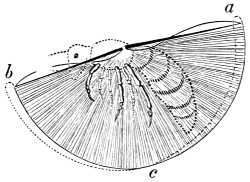
Fig. 64.
Fig. 64 shows left wing (a, b) of wasp in the act of twisting upon itself, the tip of the wing describing a figure-of-8 track (a, c, b). From nature.—Original.
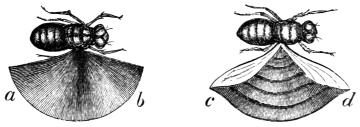
Fig. 65. Fig. 66.
Figs. 65 and 66 show right wing of blue-bottle fly rotating on its anterior margin, and twisting to form double or figure-of-8 curves (a b, c d). From nature.—Original.
That the wing twists upon itself structurally, not only in the insect, but also in the bat and bird, any one may readily satisfy himself by a careful examination; and that it twists upon itself during its action I have had the most convincing and repeated proofs (figs. 64, 65, and 66). The twisting in question is most marked in the posterior or thin margin of the wing, the anterior and thicker margin performing more the part of an axis. As a result of this arrangement, the anterior or thick margin cuts into the air quietly, and as it were by stealth, the posterior one producing on all occasions a violent commotion, especially perceptible if a flame be exposed behind the vibrating wing. Indeed, it is a matter for surprise that the spiral conformation of the pinion, and its spiral mode of action, should have eluded observation so long; and I shall be pardoned for dilating upon the subject when I state my conviction that it forms the fundamental and distinguishing feature in flight, and must be taken into account by all who seek to solve this most involved and interesting problem by artificial means. The importance of the twisted configuration or screw-like form of the wing cannot be over-estimated. That this shape is intimately associated with flight is apparent from the fact that the rowing feathers of the wing of the bird are every one of them distinctly spiral in their nature; in fact, one entire rowing feather is equivalent—morphologically and physiologically—to one entire insect wing. In the wing of the martin, where the bones of the pinion are short and in some respects rudimentary, the primary and secondary feathers are greatly developed, and banked up in such a manner that the wing as a whole presents the same curves as those displayed by the insect’s wing, or by the wing of the eagle where the bones, muscles, and feathers have attained a maximum development. The conformation of the wing is such that it presents a waved appearance in every direction—the waves running longitudinally, transversely, and obliquely. The greater portion of the pinion may consequently be removed without materially affecting either its form or its functions. This is proved by making sections in various directions, and by finding, as has been already shown, that in some instances as much as two-thirds of the wing may be lopped off without visibly impairing the power of flight. The spiral nature of the pinion is most readily recognised when the wing is seen from behind and from beneath, and when it is foreshortened. It is also well marked in some of the long-winged oceanic birds when viewed from before (figs. 82 and 83, p. 158), and cannot escape detection under any circumstances, if sought for,—the wing being essentially composed of a congeries of curves, remarkable alike for their apparent simplicity and the subtlety of their detail.
The Wing during its action reverses its Planes, and describes a Figure-of-8 track in space.—The twisting or rotating of the wing on its long axis is particularly observable during extension and flexion in the bat and bird, and likewise in the insect, especially the beetle, cockroach, and such as fold their wings during repose. In these in extreme flexion the anterior or thick margin of the wing is directed downwards, and the posterior or thin one upwards. In the act of extension, the margins, in virtue of the wing rotating upon its long axis, reverse their positions, the anterior or thick margins describing a spiral course from below upwards, the posterior or thin margin describing a similar but opposite course from above downwards. These conditions, I need scarcely observe, are reversed during flexion. The movements of the margins during flexion and extension may be represented with a considerable degree of accuracy by a figure-of-8 laid horizontally.
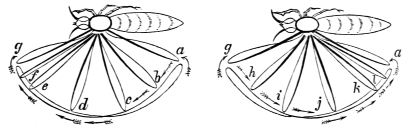
Fig. 67. Fig. 68.

Fig. 69. Fig. 70.
Figs. 67, 68, 69, and 70 show the area mapped out by the left wing of the wasp when the insect is fixed and the wing made to vibrate. These figures illustrate the various angles made by the wing as it hastens to and fro, how the wing reverses and reciprocates, and how it twists upon itself and describes a figure-of-8 track in space. Figs. 67 and 69 represent the forward or down stroke; figs. 68 and 70 the backward or up stroke. The terms forward and back stroke are here employed with reference to the head of the insect.—Original.
In the bat and bird the wing, when it ascends and descends, describes a nearly vertical figure-of-8. In the insect, the wing, from the more oblique direction of the stroke, describes a nearly horizontal figure-of-8. In either case the wing reciprocates, and, as a rule, reverses its planes. The down and up strokes, as will be seen from this account, cross each other, as shown more particularly at figs. 67, 68, 69, and 70.
In the wasp the wing commences the down or forward stroke at a of figs. 67 and 69, and makes an angle of something like 45° with the horizon (x x´). At b (figs. 67 and 69) the angle is slightly diminished, partly because of a rotation of the wing along its anterior margin (long axis of wing), partly from increased speed, and partly from the posterior margin of the wing yielding to a greater or less extent.
At c the angle is still more diminished from the same causes.
At d the wing is slowed slightly, preparatory to reversing, and the angle made with the horizon (x) increased.
At e the angle, for the same reason, is still more increased; while at f the wing is at right angles to the horizon. It is, in fact, in the act of reversing.
At g the wing is reversed, and the up or back stroke commenced.
The angle made at g is, consequently, the same as that made at a (45°), with this difference, that the anterior margin and outer portion of the wing, instead of being directed forwards, with reference to the head of the insect, are now directed backwards.
During the up or backward stroke all the phenomena are reversed, as shown at g h i j k l of figs. 68 and 70 (p. 141); the only difference being that the angles made by the wing with the horizon are somewhat less than during the down or forward stroke—a circumstance which facilitates the forward travel of the body, while it enables the wing during the back stroke still to afford a considerable amount of support. This arrangement permits the wing to travel backwards while the body is travelling forwards; the diminution of the angles made by the wing in the back stroke giving very much the same result as if the wing were striking in the direction of the travel of the body. The slight upward inclination of the wing during the back stroke permits the body to fall downwards and forwards to a slight extent at this peculiar juncture, the fall of the body, as has been already explained, contributing to the elevation of the wing.
The pinion acts as a helix or screw in a more or less horizontal direction from behind forwards, and from before backwards; but it likewise acts as a screw in a nearly vertical direction. If the wing of the larger domestic fly be viewed during its vibrations from above, it will be found that the blur or impression produced on the eye by its action is more or less concave (fig. 66, p. 139). This is due to the fact that the wing is spiral in its nature, and because during its action it twists upon itself in such a manner as to describe a double curve,—the one curve being directed upwards, the other downwards. The double curve referred to is particularly evident in the flight of birds from the greater size of their wings. The wing, both when at rest and in motion, may not inaptly be compared to the blade of an ordinary screw propeller as employed in navigation. Thus the general outline of the wing corresponds closely with the outline of the blade of the propeller, and the track described by the wing in space is twisted upon itself propeller fashion. The great velocity with which the wing is driven converts the impression or blur into what is equivalent to a solid for the time being, in the same way that the spokes of a wheel in violent motion, as is well understood, completely occupy the space contained within the rim or circumference of the wheel (figs. 64, 65, and 66, p. 139).
The figure-of-8 action of the wing explains how an insect, bat, or bird, may fix itself in the air, the backward and forward reciprocating action of the pinion affording support, but no propulsion. In these instances, the backward and forward strokes are made to counterbalance each other.
The Wing, when advancing with the Body, describes a Looped and Waved Track.—Although the figure-of-8 represents with considerable fidelity the twisting of the wing upon its long axis during extension and flexion, and during the down and up strokes when the volant animal is playing its wings before an object, or still better, when it is artificially fixed, it is otherwise when it is free and progressing rapidly. In this case the wing, in virtue of its being carried forward by the body in motion, describes first a looped and then a waved track. This looped and waved track made by the wing of the insect is represented at figs. 71 and 72, and that made by the wing of the bat and bird at fig. 73, p. 144.
Fig. 71.
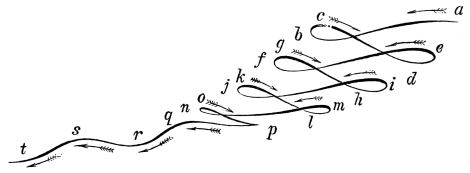
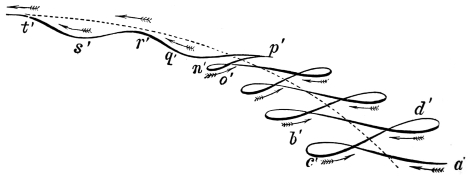
Fig. 72.

Fig. 73.
The loops made by the wing of the insect, owing to the more oblique stroke, are more horizontal than those made by the wing of the bat and bird. The principle is, however, in both cases the same, the loops ultimately terminating in a waved track. The impulse is communicated to the insect wing at the heavy parts of the loops a b c d e f g h i j k l m n of fig. 71; the waved tracks being indicated at p q r s t of the same figure. The recoil obtained from the air is represented at corresponding letters of fig. 72, the body of the insect being carried along the curve indicated by the dotted line. The impulse is communicated to the wing of the bat and bird at the heavy part of the loops a b c d e f g h i j k l m n o of fig. 73, the waved track being indicated at p s t u v w of this figure. When the horizontal speed attained is high, the wing is successively and rapidly brought into contact with innumerable columns of undisturbed air. It, consequently, is a matter of indifference whether the wing is carried at a high speed against undisturbed air, or whether it operates upon air travelling at a high speed (as, e.g. the artificial currents produced by the rapidly reciprocating action of the wing). The result is the same in both cases, inasmuch as a certain quantity of air is worked up under the wing, and the necessary degree of support and progression extracted from it. It is, therefore, quite correct to state, that as the horizontal speed of the body increases, the reciprocating action of the wing decreases; and vice versâ. In fact the reciprocating and non-reciprocating action of the wing in such cases is purely a matter of speed. If the travel of the wing is greater than the horizontal travel of the body, then the figure-of-8 and the reciprocating power of the wing will be more or less perfectly developed, according to circumstances. If, however, the horizontal travel of the body is greater than that of the wing, then it follows that no figure-of-8 will be described by the wing; that the wing will not reciprocate to any marked extent; and that the organ will describe a waved track, the curves of which will become less and less abrupt, i.e. longer and longer in proportion to the speed attained. The more vertical direction of the loops formed by the wing of the bat and bird will readily be understood by referring to figs. 74 and 75 (p. 145), which represent the wing of the bird making the down and up strokes, and in the act of being extended and flexed. (Compare with figs. 64, 65, and 66, p. 139; and figs. 67, 68, 69, and 70, p. 141.)
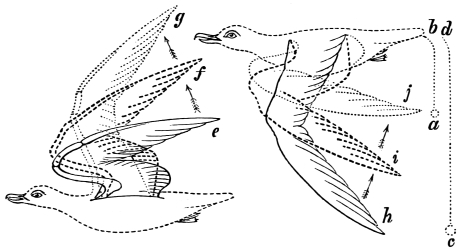
Fig. 74. Fig. 75.
Figs. 74 and 75 show the more or less perpendicular direction of the stroke of the wing in the flight of the bird (gull)—how the wing is gradually extended as it is elevated (e f g of fig. 74)—how it descends as a long lever until it assumes the position indicated by h of fig. 75—how it is flexed towards the termination of the down stroke, as shown at h i j of fig. 75, to convert it into a short lever (a b), and prepare it for making the up stroke. The difference in the length of the wing during flexion and extension is indicated by the short and long levers a b and c d of fig. 75. The sudden conversion of the wing from a long into a short lever at the end of the down stroke is of great importance, as it robs the wing of its momentum, and prepares it for reversing its movements. Compare with figs. 82 and 83, p. 158.—Original.
The down and up strokes are compound movements,—the termination of the down stroke embracing the beginning of the up stroke; the termination of the up stroke including the beginning of the down stroke. This is necessary in order that the down and up strokes may glide into each other in such a manner as to prevent jerking and unnecessary retardation.
The Margins of the Wing thrown into opposite Curves during Extension and Flexion.—The anterior or thick margin of the wing, and the posterior or thin one, form different curves, similar in all respects to those made by the body of the fish in swimming (see fig. 32, p. 68). These curves may, for the sake of clearness, be divided into axillary and distal curves, the former occurring towards the root of the wing, the latter towards its extremity. The curves (axillary and distal) found on the anterior margin of the wing are always the converse of those met with on the posterior margin, i.e. if the convexity of the anterior axillary curve be directed downwards, that of the posterior axillary curve is directed upwards, and so of the anterior and posterior distal curves. The two curves (axillary and distal), occurring on the anterior margin of the wing, are likewise antagonistic, the convexity of the axillary curve being always directed downwards, when the convexity of the distal one is directed upwards, and vice versâ. The same holds true of the axillary and distal curves occurring on the posterior margin of the wing. The anterior axillary and distal curves completely reverse themselves during the acts of extension and flexion, and so of the posterior axillary and distal curves (figs. 76, 77, and 78). This antagonism in the axillary and distal curves found on the anterior and posterior margins of the wing is referable in the bat and bird to changes induced in the bones of the wing in the acts of flexion and extension. In the insect it is due to a twisting which occurs at the root of the wing and to the reaction of the air.
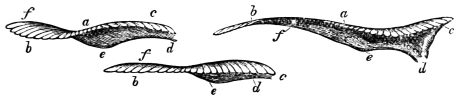
Fig. 76. Fig. 77. Fig. 78.
Fig. 76.—Curves seen on the anterior (d e f) and posterior (c a b) margin in the wing of the bird in flexion.—Original.
Fig. 77.—Curves seen on the anterior margin (d e f) of the wing in semi-extension. In this case the curves on the posterior margin (b c) are obliterated.—Original.
Fig. 78.—Curves seen on the anterior (d e f) and posterior (c a b) margin of the wing in extension. The curves of this fig. are the converse of those seen at fig. 76. Compare these figs. with fig. 79 and fig. 32, p. 68.—Original.
The Tip of the Bat and Bird’s Wing describes an Ellipse.—The movements of the wrist are always the converse of those occurring at the elbow-joint. Thus in the bird, during extension, the elbow and bones of the forearm are elevated, and describe one side of an ellipse, while the wrist and bones of the hand are depressed, and describe the side of another and opposite ellipse. These movements are reversed during flexion, the elbow being depressed and carried backwards, while the wrist is elevated and carried forwards (fig. 79).
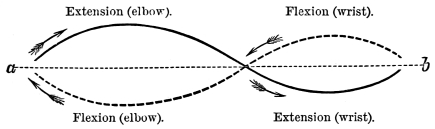
Fig. 79.—(a b) Line along which the wing travels during extension and flexion. The body of the fish in swimming describes similar curves to those described by the wing in flying.—(Vide fig. 32, p. 68.)
The Wing capable of Change of Form in all its Parts.—From this description it follows that when the different portions of the anterior margin are elevated, corresponding portions of the posterior margin are depressed; the different parts of the wing moving in opposite directions, and playing, as it were, at cross purposes for a common good; the object being to rotate or screw the wing down upon the wind at a gradually increasing angle during extension, and to rotate it in an opposite direction and withdraw it at a gradually decreasing angle during flexion. It also happens that the axillary and distal curves co-ordinate each other and bite alternately, the distal curve posteriorly seizing the air in extreme extension with its concave surface (while the axillary curve relieves itself by presenting its convex surface); the axillary curve, on the other hand, biting during flexion with its concave surface (while the distal one relieves itself by presenting its convex one). The wing may therefore be regarded as exercising a fourfold function, the pinion in the bat and bird being made to move from within outwards, and from above downwards in the down stroke, during extension; and from without inwards, and from below upwards, in the up stroke, during flexion.
The Wing during its Vibration produces a Cross Pulsation.—The oscillation of the wing on two separate axes—the one running parallel with the body of the bird, the other at right angles to it (fig. 80, a b, c d)—is well worthy of attention, as showing that the wing attacks the air, on which it operates in every direction, and at almost the same moment, viz. from within outwards, and from above downwards, during the down stroke; and from without inwards, and from below upwards, during the up stroke. As a corollary to the foregoing, the wing may be said to agitate the air in two principal directions, viz. from within outwards and downwards, or the converse; and from behind forwards, or the converse; the agitation in question producing two powerful pulsations, a vertical and a horizontal. The wing when it ascends and descends produces artificial currents which increase its elevating and propelling power. The power of the wing is further augmented by similar currents developed during its extension and flexion. The movement of one part of the wing contributes to the movement of every other part in continuous and uninterrupted succession. As the curves of the wing glide into each other when the wing is in motion, so the one pulsation merges into the other by a series of intermediate and lesser pulsations.
The vertical and horizontal pulsations occasioned by the wing in action may be fitly represented by wave-tracks running at right angles to each other, the vertical wave-track being the more distinct.
Compound Rotation of the Wing.—To work the tip and posterior margin of the wing independently and yet simultaneously, two axes are necessary, one axis (the short axis) corresponding to the root of the wing and running across it; the second (the long axis) corresponding to the anterior margin of the wing, and running in the direction of its length. The long and short axes render the movements of the wing eccentric in character. In the wing of the bird the movements of the primary or rowing feathers are also eccentric, the shaft of each feather being placed nearer the anterior than the posterior margin; an arrangement which enables the feathers to open up and separate during flexion and the up stroke, and approximate and close during extension and the down one.
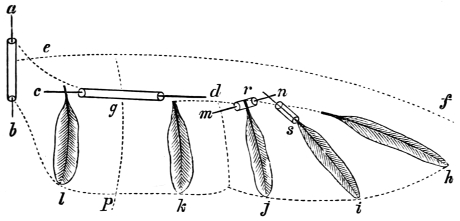
Fig. 80.
These points are illustrated at fig. 80, where a b represents the short axis (root of wing) with a radius e f; c d representing the long axis (anterior margin of wing) with a radius g p.
Fig. 80 also shows that, in the wing of the bird, the individual, primary, secondary, and tertiary feathers have each what is equivalent to a long and a short axis. Thus the primary, secondary, and tertiary feathers marked h, i, j, k, l are capable of rotating on their long axes (r s), and upon their short axes (m n). The feathers rotate upon their long axes in a direction from below upwards during the down stroke, to make the wing impervious to air; and from above downwards during the up stroke, to enable the air to pass through it. The primary, secondary, and tertiary feathers have thus a distinctly valvular action.76 The feathers rotate upon their short axes (m n) during the descent and ascent of the wing, the tip of the feathers rising slightly during the descent of the pinion, and falling during its ascent. The same movement virtually takes place in the posterior margin of the wing of the insect and bat.