PROGRESSION IN OR THROUGH THE AIR. (continued 3)
Reading edition
The goose, duck (fig. 107, p. 204), pigeon (fig. 106, p. 203) and crow, are intermediate both as regards the form of the wing and the rapidity with which it is moved.
The heron (fig. 60, p. 126) and humming-bird furnish extreme examples in another direction,—the heron having a large wing with a leisurely movement, the humming-bird a comparatively large wing with a greatly accelerated one.
But I need not multiply examples; suffice it to say that flight may be attained within certain limits by every size and form of wing, if the number of its oscillations be increased in proportion to the weight to be raised.
Reasons why the effective Stroke should be delivered downwards and forwards.—The wings of all birds, whatever their form, act by alternately presenting oblique and comparatively non-oblique surfaces to the air,—the mere extension of the pinion, as has been shown, causing the primary, secondary, and tertiary feathers to roll down till they make an angle of 30° or so with the horizon, in order to prepare it for giving the effective stroke, which is delivered, with great rapidity and energy, in a downward and forward direction. I repeat, “downwards and forwards;” for a careful examination of the relations of the wing in the dead bird, and a close observation of its action in the living one, supplemented by a large number of experiments with natural and artificial wings, have fully convinced me that the stroke is invariably delivered in this direction.94 If the wing did not strike downwards and forwards, it would act at a manifest disadvantage:—
1st. Because it would present the back or convex surface of the wing to the air—a convex surface dispersing or dissipating the air, while a concave surface gathers it together or focuses it.
2d. In order to strike backwards effectually, the concavity of the wing would also require to be turned backwards; and this would involve the depression of the anterior or thick margin of the pinion, and the elevation of the posterior or thin one, during the down stroke, which never happens.
3d. The strain to which the pinion is subjected in flight would, if the wing struck backwards, fall, not on the anterior or strong margin of the pinion formed by the bones and muscles, but on the posterior or weak margin formed by the tips of the primary, secondary, and tertiary feathers—which is not in accordance with the structure of the parts.
4th. The feathers of the wing, instead of being closed, as they necessarily are, by a downward and forward movement, would be inevitably opened, and the integrity of the wing impaired by a downward and backward movement.
5th. The disposition of the articular surfaces of the wing (particularly that of the shoulder-joint) is such as to facilitate the downward and forward movement, while it in a great measure prevents the downward and backward one.
6th and lastly. If the wing did in reality strike downwards and backwards, a result the converse of that desired would most assuredly be produced, as an oblique surface which smites the air in a downward and backward direction (if left to itself) tends to depress the body bearing it. This is proved by the action upon the air of free inclined planes, arranged in the form of a screw.
The Wing acts as an Elevator, Propeller, and Sustainer, both during extension and flexion.—The wing, as has been explained, is recovered or drawn off the wind principally by the contraction of the elastic ligaments extending between the joints, so that the pinion during flexion enjoys a certain degree of repose. The time occupied in recovering is not lost so long as the wing makes an angle with the horizon and the bird is in motion, it being a matter of indifference whether the wing acts on the air, or the air on the wing, so long as the body bearing the latter is under weigh; and this is the chief reason why the albatross, which is a very heavy bird,95 can sail about for such incredible periods without flapping the wings at all. Captain Hutton thus graphically describes the sailing of this magnificent bird:—“The flight of the albatross is truly majestic, as with outstretched motionless wings he sails over the surface of the sea—now rising high in air, now with a bold sweep, and wings inclined at an angle with the horizon, descending until the tip of the lower one all but touches the crest of the waves as he skims over them.”96
Birds of Flight divisible into four kinds:—
1st. Such as have heavy bodies and short wings with a rapid movement (fig. 59, p. 126).
2d. Such as have light bodies and large wings with a leisurely movement (fig. 60, p. 126; fig. 103, p. 186).
3d. Such as have heavy bodies and long narrow wings with a decidedly slow movement (fig. 105, p. 200).
4th. Such as are intermediate with regard to the size of body, the dimensions of the wing, and the energy with which it is driven (fig. 102, p. 183; fig. 106, p. 203; fig. 107, p. 204).
They may be subdivided into those which float, skim, or glide, and those which fly in a straight line and irregularly.
The pheasant, partridge (fig. 59, p. 126), grouse, and quail, furnish good examples of the heavy-bodied, short-winged birds. In these the wing is rounded and deeply concave. It is, moreover, wielded with immense velocity and power.
The heron (fig. 60, p. 126), sea-mew (fig. 103, p. 186), lapwing (fig. 63, p. 138), and owl (fig. 104), supply examples of the second class, where the wing, as compared with the body, is very ample, and where consequently it is moved more leisurely and less energetically.
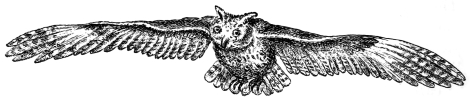
Fig. 104.—The Cape Barn-Owl (Strix capensis, Smith), as seen in full flight, hunting. The under surface of the wings and body are inclined slightly upwards, and act upon the air after the manner of a kite. (Compare with fig. 59, p. 126, and fig. 102, p. 183.)—Original.
The albatross (fig. 105, p. 200) and pelican afford instances of the third class, embracing the heavy-bodied, long-winged birds.
The duck (fig. 107, p. 204), pigeon (fig. 106, p. 203), crow and thrush, are intermediate, both as regards the size of the wing and the rapidity with which it is made to oscillate. These constitute the fourth class.
The albatross (fig. 105, p. 200), swallow, eagle, and hawk, provide instances of sailing or gliding birds, where the wing is ample, elongated, and more or less pointed, and where advantage is taken of the weight of the body and the shape of the pinion to utilize the air as a supporting medium. In these the pinion acts as a long lever,97 and is wielded with great precision and power, particularly at the shoulder.
The Flight of the Albatross compared to the Movements of a Compass set upon Gimbals.—A careful examination of the movements in skimming birds has led me to conclude that by a judicious twisting or screw-like action of the wings at the shoulder, in which the pinions are alternately advanced towards and withdrawn from the head in a manner analogous to what occurs at the loins in skating without lifting the feet, birds of this order can not only maintain the motion which they secure by a few energetic flappings, but, if necessary, actually increase it, and that without either bending the wing or beating the air.
The forward and backward screwing action of the pinion referred to, in no way interferes, I may remark, with the rotation of the wing on its long axis, the pinion being advanced and screwed down upon the wind, and retracted and unscrewed alternately. As the movements described enable the sailing bird to tilt its body from before backwards, or the converse, and from side to side or laterally, it may be represented as oscillating on one of two centres, as shown at fig. 105; the one corresponding with the long axis of the body (fig. 105, a b), the other with the long axis of the wings (c d). Between these two extremes every variety of sailing and gliding motion which is possible in the mariner’s compass when set upon gimbals may be performed; so that a skimming or sailing bird may be said to possess perfect command over itself and over the element in which it moves.
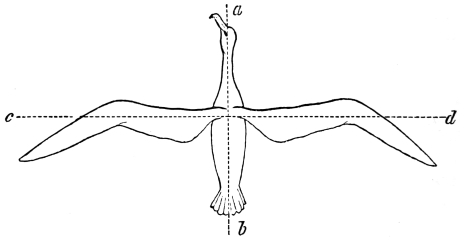
Fig. 105.
Captain Hutton makes the following remarkable statement regarding the albatross:—“I have sometimes watched narrowly one of these birds sailing and wheeling about in all directions for more than an hour, without seeing the slightest movement of the wings, and have never witnessed anything to equal the ease and grace of this bird as he sweeps past, often within a few yards, every part of his body perfectly motionless except the head and eye, which turn slowly and seem to take notice of everything.”98
“Tranquil its spirit seem’d and floated slow; Even in its very motion there was rest.”99
As an antithesis to the apparently lifeless wings of the albatross, the ceaseless activity of those of the humming-bird may be adduced. In those delicate and exquisitely beautiful birds, the wings, according to Mr. Gould, move so rapidly when the bird is poised before an object, that it is impossible for the eye to follow each stroke, and a hazy circle of indistinctness on each side of the bird is all that is perceptible. When the humming-bird flies in a horizontal direction, it occasionally proceeds with such velocity as altogether to elude observation.
The regular and irregular in Flight.—The coot, diver, duck, and goose fly with great regularity in nearly a straight line, and with immense speed; they rarely if ever skim or glide, their wings being too small for this purpose. The woodpecker, magpie, fieldfare and sparrow, supply examples of what may be termed the “irregular” in flight. These, as is well known, fly in curves of greater or less magnitude, by giving a few vigorous strokes and then desisting, the effect of which is to project them along a series of parabolic curves. The snipe and woodcock are irregular in another respect, their flight being sudden, jerky, and from side to side.
Mode of ascending, descending, turning, etc.—All birds which do not, like the swallow and humming-birds, drop from a height, raise themselves at first by a vigorous leap, in which they incline their bodies in an upward direction, the height thus attained enabling them to extend and depress their wings without injury to the feathers. By a few sweeping strokes delivered downwards and forwards, in which the wings are made nearly to meet above and below the body, they lever themselves upwards and forwards, and in a surprisingly short time acquire that degree of momentum which greatly assists them in their future career. In rising from the ground, as may readily be seen in the crow, pigeon, and kingfisher (fig. 102, p. 183), the tail is expanded and the neck stretched out, so that the body is converted into an inclined plane, and acts mechanically as a kite. The centre of gravity and the position of the body are changed at the will of the bird by movements in the neck, feet, and tail, and by increasing or decreasing the angles which the under surface of the wings makes with the horizon. When a bird wishes to fly in a horizontal direction, it causes the under surface of its wings to make a slight forward angle with the horizon. When it wishes to ascend, the angle is increased. When it wishes to descend, it causes the under surface of the wings to make a slight backward angle with the horizon. When a bird flies up, its wings strike downwards and forwards. When it flies down, its wings strike downwards and backwards. When a sufficient altitude has been attained, the length of the downward stroke is generally curtailed, the mere extension and flexion of the wing, assisted by the weight of the body, in such instances sufficing. This is especially the case if the bird is advancing against a slight breeze, the effort required under such circumstances being nominal in amount. That little power is expended is proved by the endless gyrations of rooks and other birds; these being continued for hours together. In birds which glide or skim, it has appeared to me that the wing is recovered much more quickly, and the down stroke delivered more slowly, than in ordinary flight—in fact, that the rapidity with which the wing acts in an upward and downward direction is, in some instances, reversed; and this is what we should naturally expect when we recollect that in gliding, the wings require to be, for the most part, in the expanded condition. If this observation be correct, it follows that birds have the power of modifying the duration of the up and down strokes at pleasure. Although the wing of the bird usually strikes the air at an angle which varies from 15° to 30°, the angle may be increased to such an extent as to subvert the position of the bird. The tumbler pigeon, e.g. can, by slewing its wings forwards and suddenly throwing back its head, turn a somersault. When birds are fairly on the wing they have the air, unless when that is greatly agitated by a storm, completely under control. This arises from their greater specific gravity, and because they are possessed of independent motion. If they want to turn, they have simply to tilt their bodies laterally, as a railway carriage would be tilted in taking a curve,100 or to increase the number of beats given by the one wing as compared with the other; or to keep the one wing extended while the other is partially flexed. The neck, feet, and tail may or may not contribute to this result. If the bird wishes to rise, it tilts its entire body (the neck and tail participating) in an upward direction (fig. 59, p. 126; fig. 102, p. 183); or it rises principally by the action of the wings and by muscular efforts, as happens in the lark. The bird can in this manner likewise retain its position in the air, as may be observed in the hawk when hovering above its prey. If the bird desires to descend, it may reverse the direction of the inclined plane formed by the body and wings, and plunge head foremost with extended pinions (fig. 106); or it may flex the wings, and so accelerate its pace; or it may raise its wings and drop parachute-fashion (fig. 55, p. 112; g, g of fig. 82, p. 158); or it may even fly in a downward direction—a few sudden strokes, a more or less abrupt curve, and a certain degree of horizontal movement being in either case necessary to break the fall previous to alighting (fig. 107, below). Birds which fish on the wing, as the osprey and gannet, precipitate themselves from incredible heights, and drop into the water with the velocity of a meteorite—the momentum which they acquire during their descent materially aiding them in their subaqueous flight. They emerge from the water and are again upon the wing before the eddies occasioned by their precipitous descent have well subsided, in some cases rising apparently without effort, and in others running along and beating the surface of the water for a brief period with their pinions and feet.
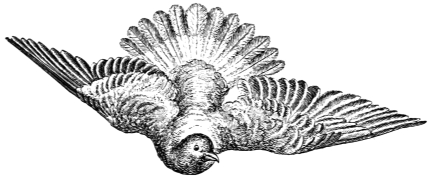
Fig. 106.—The Pigeon (Treron bicincta, Jerdon), flying downwards and turning prior to alighting. The pigeon expands its tail both in ascending and descending.—Original.
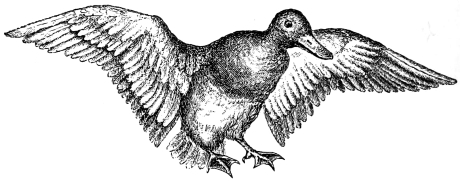
Fig. 107.—The Red-headed Pochard (Fuligula ferina, Linn.) in the act of dropping upon the water; the head and body being inclined upwards and forwards, the feet expanded, and the wings delivering vigorous short strokes in a downward and forward direction.—Original.
The Flight of Birds referable to Muscular Exertion and Weight.—The various movements involved in ascending, descending, wheeling, gliding, and progressing horizontally, are all the result of muscular power and weight, properly directed and acting upon appropriate surfaces—that apparent buoyancy in birds which we so highly esteem, arising not from superior lightness, but from their possessing that degree of solidity which enables them to subjugate the air,—weight and independent motion, i.e. motion associated with animal life, or what is equivalent thereto, being the two things indispensable in successful aërial progression. The weight in insects and birds is in great measure owing to their greatly developed muscular system, this being in that delicate state of tonicity which enables them to act through its instrumentality with marvellous dexterity and power, and to expend or reserve their energies, which they can do with the utmost exactitude, in their apparently interminable flights.
Lifting-capacity of Birds.—The muscular power in birds is usually greatly in excess, particularly in birds of prey, as, e.g. the condors, eagles, hawks, and owls. The eagles are remarkable in this respect—these having been known to carry off young deer, lambs, rabbits, hares, and, it is averred, even young children. Many of the fishing birds, as the pelicans and herons, can likewise carry considerable loads of fish;101 and even the smaller birds, as the records of spring show, are capable of transporting comparatively large twigs for building purposes. I myself have seen an owl, which weighed a little over 10 ounces, lift 2 1/2 ounces, or a quarter of its own weight, without effort, after having fasted twenty-four hours; and a friend informs me that a short time ago a splendid osprey was shot at Littlehampton, on the coast of Sussex, with a fish 5 lbs. weight in its mouth.
There are many points in the history and economy of birds which crave our sympathy while they elicit our admiration. Their indubitable courage and miraculous powers of flight invest them with a superior dignity, and secure for their order almost a duality of existence. The swallow, tiny and inconsiderable as it may appear, can traverse 1000 miles at a single journey; and the albatross, despising compass and landmark, trusts himself boldly for weeks together to the mercy or fury of the mighty ocean. The huge condor of the Andes lifts himself by his sovereign will to a height where no sound is heard, save the airy tread of his vast pinions, and, from an unseen point, surveys in solitary grandeur the wide range of plain and pasture-land;102 while the bald eagle, nothing daunted by the din and indescribable confusion of the queen of waterfalls, the stupendous Niagara, sits composedly on his giddy perch, until inclination or desire prompts him to plunge into or soar above the drenching mists which, shapeless and ubiquitous, perpetually rise from the hissing waters of the nether caldron.
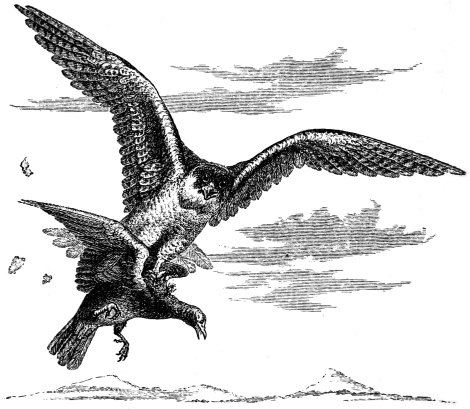
Fig. 108.—Hawk and quarry.—After The Graphic.
AËRONAUTICS
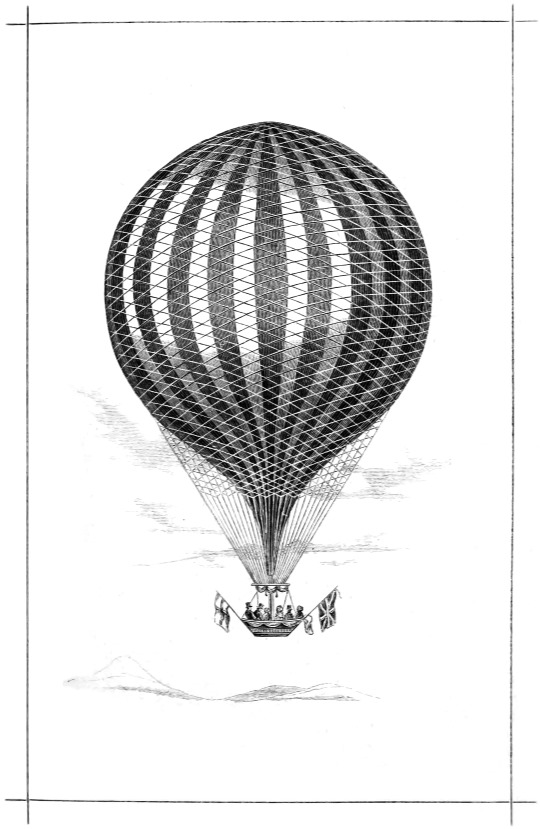
The Vauxhall Balloon of Mr. Green.