PROGRESSION IN OR THROUGH THE AIR. (continued 2)
Reading edition
The Wing vibrates unequally with reference to a given Line.—The wing, during its vibration, descends further below the body than it rises above it. This is necessary for elevating purposes. In like manner the posterior margin of the wing (whatever the position of the organ) descends further below the anterior margin than it ascends above it. This is requisite for elevating and propelling purposes; the under surface of the wing being always presented at a certain upward angle to the horizon, and acting as a true kite (figs. 82 and 83, p. 158. Compare with fig. 116, p. 231). If the wing oscillated equally above and beneath the body, and if the posterior margin of the wing vibrated equally above and below the line formed by the anterior margin, much of its elevating and propelling power would be sacrificed. The tail of the fish oscillates on either side of a given line, but it is otherwise with the wing of a flying animal. The fish is of nearly the same specific gravity as the water, so that the tail may be said only to propel. The flying animal, on the other hand, is very much heavier than the air, so that the wing requires both to propel and elevate. The wing, to be effective as an elevating organ, must consequently be vibrated rather below than above the centre of gravity; at all events, the intensity of the vibration should occur rather below that point. In making this statement, it is necessary to bear in mind that the centre of gravity is ever varying, the body rising and falling in a series of curves as the wings ascend and descend.
To elevate and propel, the posterior margin of the wing must rotate round the anterior one; the posterior margin being, as a rule, always on a lower level than the anterior one. By the oblique and more vigorous play of the wings under rather than above the body, each wing expends its entire energy in pushing the body upwards and forwards. It is necessary that the wings descend further than they ascend; that the wings be convex on their upper surfaces, and concave on their under ones; and that the concave or biting surfaces be brought more violently in contact with the air during the down stroke than the convex ones during the up stroke. The greater range of the wing below than above the body, and of the posterior margin below than above a given line, may be readily made out by watching the flight of the larger birds. It is well seen in the upward flight of the lark. In the hovering of the kestrel over its quarry, and the hovering of the gull over garbage which it is about to pick up, the wings play above and on a level with the body rather than below it; but these are exceptional movements for special purposes, and as they are only continued for a few seconds at a time, do not affect the accuracy of the general statement.
Points wherein the Screws formed by the Wings differ from those employed in navigation.—1. In the blade of the ordinary screw the integral parts are rigid and unyielding, whereas, in the blade of the screw formed by the wing, they are mobile and plastic (figs. 93, 95, 97, pp. 174, 175, 176). This is a curious and interesting point, the more especially as it does not seem to be either appreciated or understood. The mobility and plasticity of the wing is necessary, because of the tenuity of the air, and because the pinion is an elevating and sustaining organ, as well as a propelling one.
2. The vanes of the ordinary two-bladed screw are short, and have a comparatively limited range, the range corresponding to their area of revolution. The wings, on the other hand, are long, and have a comparatively wide range; and during their elevation and depression rush through an extensive space, the slightest movement at the root or short axis of the wing being followed by a gigantic up or down stroke at the other (fig. 56, p. 120; figs. 64, 65, and 66, p. 139; figs. 82 and 83, p. 158). As a consequence, the wings as a rule act upon successive and undisturbed strata of air. The advantage gained by this arrangement in a thin medium like the air, where the quantity of air to be compressed is necessarily great, is simply incalculable.
3. In the ordinary screw the blades follow each other in rapid succession, so that they travel over nearly the same space, and operate upon nearly the same particles (whether water or air), in nearly the same interval of time. The limited range at their disposal is consequently not utilized, the action of the two blades being confined, as it were, to the same plane, and the blades being made to precede or follow each other in such a manner as necessitates the work being virtually performed only by one of them. This is particularly the case when the motion of the screw is rapid and the mass propelled is in the act of being set in motion, i.e. before it has acquired momentum. In this instance a large percentage of the moving or driving power is inevitably consumed in slip, from the fact of the blades of the screw operating on nearly the same particles of matter. The wings, on the other hand, do not follow each other, but have a distinct reciprocating motion, i.e. they dart first in one direction, and then in another and opposite direction, in such a manner that they make during the one stroke the current on which they rise and progress the next. The blades formed by the wings and the blur or impression produced on the eye by the blades when made to vibrate rapidly are widely separated,—the one blade and its blur being situated on the right side of the body and corresponding to the right wing, the other on the left and corresponding to the left wing. The right wing traverses and completely occupies the right half of a circle, and compresses all the air contained within this space; the left wing occupying and working up all the air in the left and remaining half. The range or sweep of the two wings, when urged to their extreme limits, corresponds as nearly as may be to one entire circle77 (fig. 56, p. 120). By separating the blades of the screw, and causing them to reciprocate, a double result is produced, since the blades always act upon independent columns of air, and in no instance overlap or double upon each other. The advantages possessed by this arrangement are particularly evident when the motion is rapid. If the screw employed in navigation be driven beyond a certain speed, it cuts out the water contained within its blades; the blades and the water revolving as a solid mass. Under these circumstances, the propelling power of the screw is diminished rather than increased. It is quite otherwise with the screws formed by the wings; these, because of their reciprocating movements, becoming more and more effective in proportion as the speed is increased. As there seems to be no limit to the velocity with which the wings may be driven, and as increased velocity necessarily results in increased elevating, propelling, and sustaining power, we have here a striking example of the manner in which nature triumphs over art even in her most ingenious, skilful, and successful creations.
4. The vanes or blades of the screw, as commonly constructed, are fixed at a given angle, and consequently always strike at the same degree of obliquity. The speed, moreover, with which the blades are driven, is, as nearly as may be, uniform. In this arrangement power is lost, the two vanes striking after each other in the same manner, in the same direction, and almost at precisely the same moment,—no provision being made for increasing the angle, and the propelling power, at one stage of the stroke, and reducing it at another, to diminish the amount of slip incidental to the arrangement. The wings, on the other hand, are driven at a varying speed, and made to attack the air at a great variety of angles; the angles which the pinions make with the horizon being gradually increased by the wings being made to rotate on their long axes during the down stroke, to increase the elevating and propelling power, and gradually decreased during the up stroke, to reduce the resistance occasioned by the wings during their ascent. The latter movement increases the sustaining area by placing the wings in a more horizontal position. It follows from this arrangement that every particle of air within the wide range of the wings is separately influenced by them, both during their ascent and descent,—the elevating, propelling, and sustaining power being by this means increased to a maximum, while the slip or waftage is reduced to a minimum. These results are further secured by the undulatory or waved track described by the wing during the down and up strokes. It is a somewhat remarkable circumstance that the wing, when not actually engaged as a propeller and elevator, acts as a sustainer after the manner of a parachute. This it can readily do, alike from its form and the mode of its application, the double curve or spiral into which it is thrown in action enabling it to lay hold of the air with avidity, in whatever direction it is urged. I say “in whatever direction,” because, even when it is being recovered or drawn off the wind during the back stroke, it is climbing a gradient which arches above the body to be elevated, and so prevents it from falling. It is difficult to conceive a more admirable, simple, or effective arrangement, or one which would more thoroughly economize power. Indeed, a study of the spiral configuration of the wing, and its spiral, flail-like, lashing movements, involves some of the most profound problems in mathematics,—the curves formed by the pinion as a pinion anatomically, and by the pinion in action, or physiologically, being exceedingly elegant and infinitely varied; these running into each other, and merging and blending, to consummate the triple function of elevating, propelling, and sustaining.
Other differences might be pointed out; but the foregoing embrace the more fundamental and striking. Enough, moreover, has probably been said to show that it is to wing-structures and wing-movements the aëronaut must direct his attention, if he would learn “the way of an eagle in the air,” and if he would rise upon the whirlwind in accordance with natural laws.
The Wing at all times thoroughly under control.—The wing is moveable in all parts, and can be wielded intelligently even to its extremity; a circumstance which enables the insect, bat, and bird to rise upon the air and tread it as a master—to subjugate it in fact. The wing, no doubt, abstracts an upward and onward recoil from the air, but in doing this it exercises a selective and controlling power; it seizes one current, evades another, and creates a third; it feels and paws the air as a quadruped would feel and paw a treacherous yielding surface. It is not difficult to comprehend why this should be so. If the flying creature is living, endowed with volition, and capable of directing its own course, it is surely more reasonable to suppose that it transmits to its travelling surfaces the peculiar movements necessary to progression, than that those movements should be the result of impact from fortuitous currents which it has no means of regulating. That the bird, e.g. requires to control the wing, and that the wing requires to be in a condition to obey the behests of the will of the bird, is pretty evident from the fact that most of our domestic fowls can fly for considerable distances when they are young and when their wings are flexible; whereas when they are old and the wings stiff, they either do not fly at all or only for short distances, and with great difficulty. This is particularly the case with tame swans. This remark also holds true of the steamer or race-horse duck (Anas brachyptera), the younger specimens of which only are volant. In older birds the wings become too rigid and the bodies too heavy for flight. Who that has watched a sea-mew struggling bravely with the storm, could doubt for an instant that the wings and feathers of the wings are under control? The whole bird is an embodiment of animation and power. The intelligent active eye, the easy, graceful, oscillation of the head and neck, the folding or partial folding of one or both wings, nay more, the slight tremor or quiver of the individual feathers of parts of the wings so rapid, that only an experienced eye can detect it, all confirm the belief that the living wing has not only the power of directing, controlling, and utilizing natural currents, but of creating and utilizing artificial ones. But for this power, what would enable the bat and bird to rise and fly in a calm, or steer their course in a gale? It is erroneous to suppose that anything is left to chance where living organisms are concerned, or that animals endowed with volition and travelling surfaces should be denied the privilege of controlling the movements of those surfaces quite independently of the medium on which they are destined to operate. I will never forget the gratification afforded me on one occasion at Carlow (Ireland) by the flight of a pair of magnificent swans. The birds flew towards and past me, my attention having been roused by a peculiarly loud whistling noise made by their wings. They flew about fifteen yards from the ground, and as their pinions were urged not much faster than those of the heron,78 I had abundant leisure for studying their movements. The sight was very imposing, and as novel as it was grand. I had seen nothing before, and certainly have seen nothing since that could convey a more elevated conception of the prowess and guiding power which birds may exert. What particularly struck me was the perfect command they seemed to have over themselves and the medium they navigated. They had their wings and bodies visibly under control, and the air was attacked in a manner and with an energy which left little doubt in my mind that it played quite a subordinate part in the great problem before me. The necks of the birds were stretched out, and their bodies to a great extent rigid. They advanced with a steady, stately motion, and swept past with a vigour and force which greatly impressed, and to a certain extent overawed, me. Their flight was what one could imagine that of a flying machine constructed in accordance with natural laws would be.79
The Natural Wing, when elevated and depressed, must move forwards.—It is a condition of natural wings, and of artificial wings constructed on the principle of living wings, that when forcibly elevated or depressed, even in a strictly vertical direction, they inevitably dart forward. This is well shown in fig. 81.
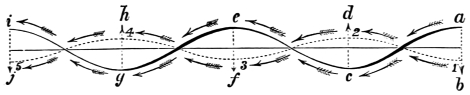
Fig. 81.
If, for example, the wing is suddenly depressed in a vertical direction, as represented at a b, it at once darts downwards and forwards in a curve to c, thus converting the vertical down stroke into a down oblique forward stroke. If, again, the wing be suddenly elevated in a strictly vertical direction, as at c d, the wing as certainly darts upwards and forwards in a curve to e, thus converting the vertical up stroke into an upward oblique forward stroke. The same thing happens when the wing is depressed from e to f, and elevated from g to h. In both cases the wing describes a waved track, as shown at e g, g i, which clearly proves that the wing strikes downwards and forwards during the down stroke, and upwards and forwards during the up stroke. The wing, in fact, is always advancing; its under surface attacking the air like a boy’s kite. If, on the other hand, the wing be forcibly depressed, as indicated by the heavy waved line a c, and left to itself, it will as surely rise again and describe a waved track, as shown at c e. This it does by rotating on its long axis, and in virtue of its flexibility and elasticity, aided by the recoil obtained from the air. In other words, it is not necessary to elevate the wing forcibly in the direction c d to obtain the upward and forward movement c e. One single impulse communicated at a causes the wing to travel to e, and a second impulse communicated at e causes it to travel to i. It follows from this that a series of vigorous down impulses would, if a certain interval were allowed to elapse between them, beget a corresponding series of up impulses, in accordance with the law of action and reaction; the wing and the air under these circumstances being alternately active and passive. I say if a certain interval were allowed to elapse between every two down strokes, but this is practically impossible, as the wing is driven with such velocity that there is positively no time to waste in waiting for the purely mechanical ascent of the wing. That the ascent of the pinion is not, and ought not to be entirely due to the reaction of the air, is proved by the fact that in flying creatures (certainly in the bat and bird) there are distinct elevator muscles and elastic ligaments delegated to the performance of this function. The reaction of the air is therefore only one of the forces employed in elevating the wing; the others, as I shall show presently, are vital and vito-mechanical in their nature. The falling downwards and forwards of the body when the wings are ascending also contribute to this result.
Fig. 82.
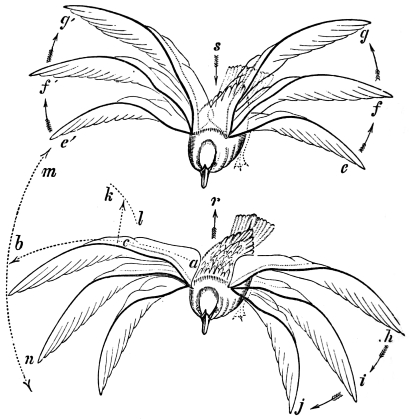
Fig. 83.
Figs. 82 and 83 show that when the wings are elevated (e, f, g of fig. 82) the body falls (s of fig. 82); and that when the wings are depressed (h, i, j of fig. 83) the body is elevated (r of fig. 83). Fig. 82 shows that the wings are elevated as short levers (e) until towards the termination of the up stroke, when they are gradually expanded (f, g) to prepare them for making the down stroke. Fig. 83 shows that the wings descend as long levers (h) until towards the termination of the down stroke, when they are gradually folded or flexed (i, j), to rob them of their momentum and prepare them for making the up stroke. Compare with figs. 74 and 75, p. 145. By this means the air beneath the wings is vigorously seized during the down stroke, while that above it is avoided during the up stroke. The concavo-convex form of the wings and the forward travel of the body contribute to this result. The wings, it will be observed, act as a parachute both during the up and down strokes. Compare with fig. 55, p. 112. Fig. 83 shows, in addition, the compound rotation of the wing, how it rotates upon a as a centre, with a radius m b n, and upon a c b as a centre, with a radius k l. Compare with fig. 80, p. 149.—Original.
The Wing ascends when the Body descends, and vice versâ.—As the body of the insect, bat, and bird falls forwards in a curve when the wing ascends, and is elevated in a curve when the wing descends, it follows that the trunk of the animal is urged along a waved line, as represented at 1, 2, 3, 4, 5 of fig. 81, p. 157; the waved line a c e g i of the same figure giving the track made by the wing. I have distinctly seen the alternate rise and fall of the body and wing when watching the flight of the gull from the stern of a steam-boat.
The direction of the stroke in the insect, as has been already explained, is much more horizontal than in the bat or bird (compare figs. 82 and 83 with figs. 64, 65, and 66, p. 139). In either case, however, the down stroke must be delivered in a more or less forward direction. This is necessary for support and propulsion. A horizontal to-and-fro movement will elevate, and an up-and-down vertical movement propel, but an oblique forward motion is requisite for progressive flight.
In all wings, whatever their position during the intervals of rest, and whether in one piece or in many, this feature is to be observed in flight. The wings are slewed downwards and forwards, i.e. they are carried more or less in the direction of the head during their descent, and reversed or carried in an opposite direction during their ascent. In stating that the wings are carried away from the head during the back stroke, I wish it to be understood that they do not therefore necessarily travel backwards in space when the insect is flying forwards. On the contrary, the wings, as a rule, move forward in curves, both during the down and up strokes. The fact is, that the wings at their roots are hinged and geared to the trunk so loosely, that the body is free to oscillate in a forward or backward direction, or in an up, down, or oblique direction. As a consequence of this freedom of movement, and as a consequence likewise of the speed at which the insect is travelling, the wings during the back stroke are for the most part actually travelling forwards. This is accounted for by the fact, that the body falls downwards and forwards in a curve during the up or return stroke of the wings, and because the horizontal speed attained by the body is as a rule so much greater than that attained by the wings, that the latter are never allowed time to travel backward, the lesser movement being as it were swallowed up by the greater. For a similar reason, the passenger of a steam-ship may travel rapidly in the direction of the stern of the vessel, and yet be carried forward in space,—the ship sailing much quicker than he can walk. While the wing is descending, it is rotating upon its root as a centre (short axis). It is also, and this is a most important point, rotating upon its anterior margin (long axis), in such a manner as to cause the several parts of the wing to assume various angles of inclination with the horizon.
Figs. 84 and 85 supply the necessary illustration.
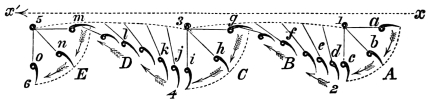
Fig. 84.
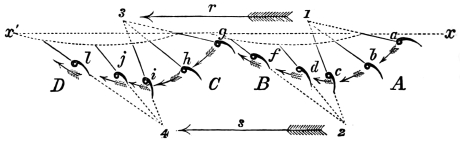
Fig. 85.
In flexion, as a rule, the under surface of the wing (fig. 84 a) is arranged in the same plane with the body, both being in a line with or making a slight angle with the horizon (x x).80 When the wing is made to descend, it gradually, in virtue of its simultaneously rotating upon its long and short axes, makes a certain angle with the horizon as represented at b. The angle is increased at the termination of the down stroke as shown at c, so that the wing, particularly its posterior margin, during its descent (A), is screwed or crushed down upon the air with its concave or biting surface directed forwards and towards the earth. The same phenomena are indicated at a b c of fig. 85, but in this figure the wing is represented as travelling more decidedly forwards during its descent, and this is characteristic of the down stroke of the insect’s wing—the stroke in the insect being delivered in a very oblique and more or less horizontal direction (figs. 64, 65, and 66, p. 139; fig. 71, p. 144). The forward travel of the wing during its descent has the effect of diminishing the angles made by the under surface of the wing with the horizon. Compare b c d of fig. 85 with the same letters of fig. 84. At fig. 88 (p. 166) the angles for a similar reason are still further diminished. This figure (88) gives a very accurate idea of the kite-like action of the wing both during its descent and ascent.
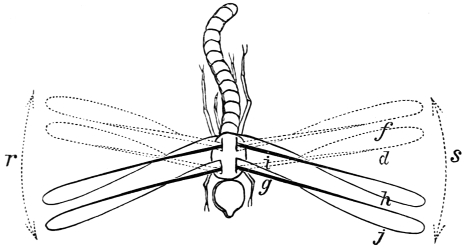
Fig. 86.
The downward screwing of the posterior margin of the wing during the down stroke is well seen in the dragon-fly, represented at fig. 86, p. 161.
Here the arrows r s indicate the range of the wing. At the beginning of the down stroke the upper or dorsal surface of the wing (i d f) is inclined slightly upwards and forwards. As the wing descends the posterior margin (i f) twists and rotates round the anterior margin (i d), and greatly increases the angle of inclination as seen at i j, g h. This rotation of the posterior margin (i j) round the anterior margin (g h) has the effect of causing the different portions of the under surface of the wing to assume various angles of inclination with the horizon, the wing attacking the air like a boy’s kite. The angles are greatest towards the root of the wing and least towards the tip. They accommodate themselves to the speed at which the different parts of the wing travel—a small angle with a high speed giving the same amount of buoying power as a larger angle with a diminished speed. The screwing of the under surface of the wing (particularly the posterior margin) in a downward direction during the down stroke is necessary to insure the necessary upward recoil; the wing being made to swing downwards and forwards pendulum fashion, for the purpose of elevating the body, which it does by acting upon the air as a long lever, and after the manner of a kite. During the down stroke the wing is active, the air passive. In other words, the wing is depressed by a purely vital act.
The down stroke is readily explained, and its results upon the body obvious. The real difficulty begins with the up or return stroke. If the wing was simply to travel in an upward and backward direction from c to a of fig. 84, p. 160, it is evident that it would experience much resistance from the superimposed air, and thus the advantages secured by the descent of the wing would be lost. What really happens is this. The wing does not travel upwards and backwards in the direction c b a of fig. 84 (the body, be it remembered, is advancing) but upwards and forwards in the direction c d e f g. This is brought about in the following manner. The wing is at right angles to the horizon (x x´) at c. It is therefore caught by the air at the point (2) because of the more or less horizontal travel of the body; the elastic ligaments and other structures combined with the resistance experienced from the air rotating the posterior or thin margin of the pinion in an upward direction, as shown at d e f g and d f g of figs. 84 and 85, p. 160. The wing by this partly vital and partly mechanical arrangement is rotated off the wind in such a manner as to keep its dorsal or non-biting surface directed upwards, while its concave or biting surface is directed downwards. The wing, in short, has its planes so arranged, and its angles so adjusted to the speed at which it is travelling, that it darts up a gradient like a true kite, as shown at c d e f g of figs. 84 and 85, p. 160, or g h i of fig. 88, p. 166. The wing consequently elevates and propels during its ascent as well as during its descent. It is, in fact, a kite during both the down and up strokes. The ascent of the wing is greatly assisted by the forward travel, and downward and forward fall of the body. This view will be readily understood by supposing, what is really the case, that the wing is more or less fixed by the air in space at the point indicated by 2 of figs. 84 and 85, p. 160; the body, the instant the wing is fixed, falling downwards and forwards in a curve, which, of course, is equivalent to placing the wing above, and, so to speak, behind the volant animal—in other words, to elevating the wing preparatory to a second down stroke, as seen at g of the figures referred to (figs. 84 and 85). The ascent and descent of the wing is always very much greater than that of the body, from the fact of the pinion acting as a long lever. The peculiarity of the wing consists in its being a flexible lever which acts upon yielding fulcra (the air), the body participating in, and to a certain extent perpetuating, the movements originally produced by the pinion. The part which the body performs in flight is indicated at fig. 87. At a the body is depressed, the wing being elevated and ready to make the down stroke at b. The wing descends in the direction c d, but the moment it begins to descend the body moves upwards and forwards (see arrows) in a curved line to e. As the wing is attached to the body the wing is made gradually to assume the position f. The body (e), it will be observed, is now on a higher level than the wing (f); the under surface of the latter being so adjusted that it strikes upwards and forwards as a kite. It is thus that the wing sustains and propels during the up stroke. The body (e) now falls downwards and forwards in a curved line to g, and in doing this it elevates or assists in elevating the wing to j. The pinion is a second time depressed in the direction k l, which has the effect of forcing the body along a waved track and in an upward direction until it reaches the point m. The ascent of the body and the descent of the wing take place simultaneously (m n). The body and wing, are alternately above and beneath a given line x x´.
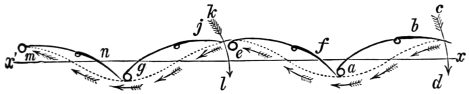
Fig. 87.
A careful study of figs. 84, 85, 86, and 87, pp. 160, 161, and 163, shows the great importance of the twisted configuration and curves peculiar to the natural wing. If the wing was not curved in every direction it could not be rolled on and off the wind during the down and up strokes, as seen more particularly at fig. 87, p. 163. This, however, is a vital point in progressive flight. The wing (b) is rolled on to the wind in the direction b a, its under concave or biting surface being crushed hard down with the effect of elevating the body to e. The body falls to g, and the wing (f) is rolled off the wind in the direction f j, and elevated until it assumes the position j. The elevation of the wing is effected partly by the fall of the body, partly by the action of the elevator muscles and elastic ligaments, and partly by the reaction of the air, operating on its under or concave biting surface. The wing is therefore to a certain extent resting during the up stroke.
The concavo-convex form of the wing is admirably adapted for the purposes of flight. In fact, the power which the wing possesses of always keeping its concave or under surface directed downwards and forwards enables it to seize the air at every stage of both the up and down strokes so as to supply a persistent buoyancy. The action of the natural wing is accompanied by remarkably little slip—the elasticity of the organ, the resiliency of the air, and the shortening and elongating of the elastic ligaments and muscles all co-operating and reciprocating in such a manner that the descent of the wing elevates the body; the descent of the body, aided by the reaction of the air and the shortening of the elastic ligaments and muscles, elevating the wing. The wing during the up stroke arches above the body after the manner of a parachute, and prevents the body from falling. The sympathy which exists between the parts of a flying animal and the air on which it depends for support and progress is consequently of the most intimate character.
The up stroke (B, D of figs. 84 and 85, p. 160), as will be seen from the foregoing account, is a compound movement due in some measure to recoil or resistance on the part of the air; to the shortening of the muscles, elastic ligaments, and other vital structures; to the elasticity of the wing; and to the falling of the body in a downward and forward direction. The wing may be regarded as rotating during the down stroke upon 1 of figs. 84 and 85, p. 160, which may be taken to represent the long and short axes of the wing; and during the up stroke upon 2, which may be taken to represent the yielding fulcrum furnished by the air. A second pulsation is indicated by the numbers 3 and 4 of the same figures (84, 85).
The Wing acts upon yielding Fulcra.—The chief peculiarity of the wing, as has been stated, consists in its being a twisted flexible lever specially constructed to act upon yielding fulcra (the air). The points of contact of the wing with the air are represented at a b c d e f g h i j k l respectively of figs. 84 and 85, p. 160; and the imaginary points of rotation of the wing upon its long and short axes at 1, 2, 3, and 4 of the same figures. The assumed points of rotation advance from 1 to 3 and from 2 to 4 (vide arrows marked r and s, fig. 85); these constituting the steps or pulsations of the wing. The actual points of rotation correspond to the little loops a b c d f g h i j l of fig. 85. The wing descends at A and C, and ascends at B and D.
The Wing acts as a true Kite both during the Down and Up Strokes.—If, as I have endeavoured to explain, the wing, even when elevated and depressed in a strictly vertical direction, inevitably and invariably darts forward, it follows as a that the wing, as already partly explained, flies forward as a true kite, both during the down and up strokes, as shown at c d e f g h i j k l m of fig. 88; and that its under concave or biting surface, in virtue of the forward travel communicated to it by the body in motion, is closely applied to the air, both during its ascent and descent—a fact hitherto overlooked, but one of considerable importance, as showing how the wing furnishes a persistent buoyancy, alike when it rises and falls.

Fig. 88.
In fig. 88 the greater impulse communicated during the down stroke is indicated by the double dotted lines. The angle made by the wing with the horizon (a b) is constantly varying, as a comparison of c with d, d with e, e with f, f with g, g with h, and h with i will show; these letters having reference to supposed transverse sections of the wing. This figure also shows that the convex or non-biting surface of the wing is always directed upwards, so as to avoid unnecessary resistance on the part of the air to the wing during its ascent; whereas the concave or biting surface is always directed downwards, so as to enable the wing to contend successfully with gravity.
Where the Kite formed by the Wing differs from the Boy’s Kite.—The natural kite formed by the wing differs from the artificial kite only in this, that the former is capable of being moved in all its parts, and is more or less flexible and elastic, the latter being comparatively rigid. The flexibility and elasticity of the kite formed by the natural wing is rendered necessary by the fact that the wing is articulated or hinged at its root; its different parts travelling at various degrees of speed in proportion as they are removed from the axis of rotation. Thus the tip of the wing travels through a much greater space in a given time than a portion nearer the root. If the wing was not flexible and elastic, it would be impossible to reverse it at the end of the up and down strokes, so as to produce a continuous vibration. The wing is also practically hinged along its anterior margin, so that the posterior margin of the wing travels through a greater space in a given time than a portion nearer the anterior margin (fig. 80, p. 149). The compound rotation of the wing is greatly facilitated by the wing being flexible and elastic. This causes the pinion to twist upon its long axis during its vibration, as already stated. The twisting is partly a vital, and partly a mechanical act; that is, it is occasioned in part by the action of the muscles, in part by the reaction of the air, and in part by the greater momentum acquired by the tip and posterior margin of the wing, as compared with the root and anterior margin; the speed acquired by the tip and posterior margin causing them to reverse always subsequently to the root and anterior margin, which has the effect of throwing the anterior and posterior margins of the wing into figure-of-8 curves. It is in this way that the posterior margin of the outer portion of the wing is made to incline forwards at the end of the down stroke, when the anterior margin is inclined backwards; the posterior margin of the outer portion of the wing being made to incline backwards at the end of the up stroke, when a corresponding portion of the anterior margin is inclined forwards (figs. 69 and 70, g, a, p. 141; fig. 86, j, f, p. 161).
The Angles formed by the Wing during its Vibrations.—Not the least interesting feature of the compound rotation of the wing—of the varying degrees of speed attained by its different parts—and of the twisting or plaiting of the posterior margin around the anterior,—is the great variety of kite-like surfaces developed upon its dorsal and ventral aspects. Thus the tip of the wing forms a kite which is inclined upwards, forwards, and outwards, while the root forms a kite which is inclined upwards, forwards, and inwards. The angles made by the tip and outer portions of the wing with the horizon are less than those made by the body or central part of the wing, and those made by the body or central part less than those made by the root and inner portions. The angle of inclination peculiar to any portion of the wing increases as the speed peculiar to said portion decreases, and vice versâ. The wing is consequently mechanically perfect; the angles made by its several parts with the horizon being accurately adjusted to the speed attained by its different portions during its travel to and fro. From this it follows that the air set in motion by one part of the wing is seized upon and utilized by another; the inner and anterior portions of the wing supplying, as it were, currents for the outer and posterior portions. This results from the wing always forcing the air outwards and backwards. These statements admit of direct proof, and I have frequently satisfied myself of their exactitude by experiments made with natural and artificial wings.
In the bat and bird, the twisting of the wing upon its long axis is more of a vital and less of a mechanical act than in the insect; the muscles which regulate the vibration of the pinion in the former (bat and bird), extending quite to the tip of the wing (fig. 95, p. 175; figs. 82 and 83, p. 158).
The Body and Wings move in opposite Curves.—I have stated that the wing advances in a waved line, as shown at a c e g i of fig. 81, p. 157; and similar remarks are to be made of the body as indicated at 1, 2, 3, 4, 5 of that figure. Thus, when the wing descends in the curved line a c, it elevates the body in a corresponding but minor curved line, as at 1, 2; when, on the other hand, the wing ascends in the curved line c e, the body descends in a corresponding but smaller curved line (2, 3), and so on ad infinitum. The undulations made by the body are so trifling when compared with those made by the wing, that they are apt to be overlooked. They are, however, deserving of attention, as they exercise an important influence on the undulations made by the wing; the body and wing swinging forward alternately, the one rising when the other is falling, and vice versâ. Flight may be regarded as the resultant of three forces:—the muscular and elastic force, residing in the wing, which causes the pinion to act as a true kite, both during the down and up strokes; the weight of the body, which becomes a force the instant the trunk is lifted from the ground, from its tendency to fall downwards and forwards; and the recoil obtained from the air by the rapid action of the wing. These three forces may be said to be active and passive by turns.
When a bird rises from the ground it runs for a short distance, or throws its body into the air by a sudden leap, the wings being simultaneously elevated. When the body is fairly off the ground, the wings are made to descend with great vigour, and by their action to continue the upward impulse secured by the preliminary run or leap. The body then falls in a curve downwards and forwards; the wings, partly by the fall of the body, partly by the reaction of the air on their under surface, and partly by the shortening of the elevator muscles and elastic ligaments, being placed above and to some extent behind the bird—in other words, elevated. The second down stroke is now given, and the wings again elevated as explained, and so on in endless succession; the body falling when the wings are being elevated, and vice versâ, (fig. 81, p. 157). When a long-winged oceanic bird rises from the sea, it uses the tips of its wings as levers for forcing the body up; the points of the pinions suffering no injury from being brought violently in contact with the water. A bird cannot be said to be flying until the trunk is swinging forward in space and taking part in the movement. The hawk, when fixed in the air over its quarry, is simply supporting itself. To fly, in the proper acceptation of the term, implies to support and propel. This constitutes the difference between a bird and a balloon. The bird can elevate and carry itself forward, the balloon can simply elevate itself, and must rise and fall in a straight line in the absence of currents. When the gannet throws itself from a cliff, the inertia of the trunk at once comes into play, and relieves the bird from those herculean exertions required to raise it from the water when it is once fairly settled thereon. A swallow dropping from the eaves of a house, or a bat from a tower, afford illustrations of the same principle. Many insects launch themselves into space prior to flight. Some, however, do not. Thus the blow-fly can rise from a level surface when its legs are removed. This is accounted for by the greater amplitude and more horizontal play of the insect’s wing as compared with that of the bat and bird, and likewise by the remarkable reciprocating power which the insect wing possesses when the body of the insect is not moving forwards (figs. 67, 68, 69, and 70 p. 141). When a beetle attempts to fly from the hand, it extends its front legs and flexes the back ones, and tilts its head and thorax upwards, so as exactly to resemble a horse in the act of rising from the ground. This preliminary over, whirr go its wings with immense velocity, and in an almost horizontal direction, the body being inclined more or less vertically. The insect rises very slowly, and often requires to make several attempts before it succeeds in launching itself into the air. I could never detect any pressure communicated to the hand when the insect was leaving it, from which I infer that it does not leap into the air. The bees, I am disposed to believe, also rise without anything in the form of a leap or spring. I have often watched them leaving the petals of flowers, and they always appeared to me to elevate themselves by the steady play of their wings, which was the more necessary, as the surface from which they rose was in many cases a yielding surface.
The Wings of Insects, Bats, and Birds.
Elytra or Wing-cases, Membranous Wings—their shape and uses.—The wings of insects consist either of one or two pairs. When two pairs are present, they are divided into an anterior or upper pair, and a posterior or under pair. In some instances the anterior pair are greatly modified, and present a corneous condition. When so modified, they cover the under wings when the insect is reposing, and have from this circumstance been named elytra, from the Greek ἔλυτρον, a sheath. The anterior wings are dense, rigid, and opaque in the beetles (fig. 89, r); solid in one part and membranaceous in another in the water-bugs (fig. 90, r); more or less membranous throughout in the grasshoppers; and completely membranous in the dragon-flies (fig. 91, e e, p. 172). The superior or upper wings are inclined at a certain angle when extended, and are indirectly connected with flight in the beetles, water-bugs, and grasshoppers. They are actively engaged in this function in the dragon-flies and butterflies. The elytra or anterior wings are frequently employed as sustainers or gliders in flight,81 the posterior wings acting more particularly as elevators and propellers. In such cases the elytra are twisted upon themselves after the manner of wings.
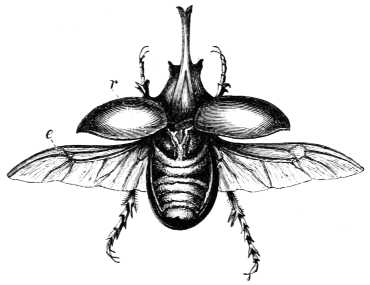
Fig. 89.
Fig. 89.—The Centaur Beetle (Augusoma centaurus), seen from above. Shows elytra (r) and membranous wings (e) in the extended state. The nervures are arranged and jointed in such a manner that the membranous wings can be folded (e) transversely across the back beneath the elytra during repose. When so folded, the anterior or thick margins of the membranous wings are directed outwards and slightly downwards, the posterior or thin margins inwards and slightly upwards. During extension the positions of the margins are reversed by the wings twisting and rotating upon their long axes, the anterior margins, as in bats and birds, being directed upwards and forwards, and making a very decided angle with the horizon. The wings in the beetles are insignificantly small when compared with the area of the body. They are, moreover, finely twisted upon themselves, and possess great power as propellers and elevators.—Original.
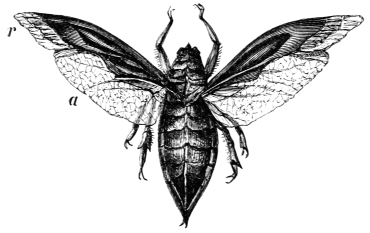
Fig. 90.
Fig. 90.—The Water-Bug (Genus belostoma). In this insect the superior wings (elytra or wing covers r) are semi-membranous. They are geared to the membranous or under wings (a) by a hook, the two acting together in flight. When so geared the upper and under wings are delicately curved and twisted. They moreover taper from within outwards, and from before backwards.—Original.
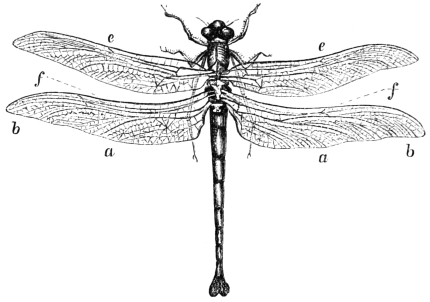
Fig. 91.—The Dragon-fly (Petalura gigantea). In this insect the wings are finely curved and delicately transparent, the nervures being most strongly developed at the roots of the wings and along the anterior margins (e e, f f), and least so at the tips (b b), and along the posterior margins (a a). The anterior pair (e e) are analogous in every respect to the posterior (f f). Both make a certain angle with the horizon, the anterior pair (e e), which are principally used as elevators, making a smaller angle than the posterior pair (f f), which are used as drivers. The wings of the dragon-fly make the proper angles for flight even in repose, so that the insect can take to wing instantly. The insect flies with astonishing velocity.—Original.
The wings of insects present different degrees of opacity—those of the moths and butterflies being non-transparent; those of the dragon-flies, bees, and common flies presenting a delicate, filmy, gossamer-like appearance. The wings in every case are composed of a duplicature of the integument or investing membrane, and are strengthened in various directions by a system of hollow, horny tubes, known to entomologists as the neuræ or nervures. The nervures taper towards the extremity of the wing, and are strongest towards its root and anterior margin, where they supply the place of the arm in bats and birds. They are variously arranged. In the beetles they pursue a somewhat longitudinal course, and are jointed to admit of the wing being folded up transversely beneath the elytra.82 In the locusts the nervures diverge from a common centre, after the manner of a fan, so that by their aid the wing is crushed up or expanded as required; whilst in the dragon-fly, where no folding is requisite, they form an exquisitely reticulated structure. The nervures, it may be remarked, are strongest in the beetles, where the body is heavy and the wing small. They decrease in thickness as those conditions are reversed, and entirely disappear in the minute chalcis and psilus.83 The function of the nervures is not ascertained; but as they contain spiral vessels which apparently communicate with the tracheæ of the trunk, some have regarded them as being connected with the respiratory system; whilst others have looked upon them as the receptacles of a subtle fluid, which the insect can introduce and withdraw at pleasure to obtain the requisite degree of expansion and tension in the wing. Neither hypothesis is satisfactory, as respiration and flight can be performed in their absence. They appear to me, when present, rather to act as mechanical stays or stretchers, in virtue of their rigidity and elasticity alone,—their arrangement being such that they admit of the wing being folded in various directions, if necessary, during flexion, and give it the requisite degree of firmness during extension. They are, therefore, in every respect analogous to the skeleton of the wing in the bat and bird. In those wings which, during the period of repose, are folded up beneath the elytra, the mere extension of the wing in the dead insect, where no injection of fluid can occur, causes the nervures to fall into position, and the membranous portions of the wing to unfurl or roll out precisely as in the living insect, and as happens in the bat and bird. This result is obtained by the spiral arrangement of the nervures at the root of the wing; the anterior nervure occupying a higher position than that further back, as in the leaves of a fan. The spiral arrangement occurring at the root extends also to the margins, so that wings which fold up or close, as well as those which do not, are twisted upon themselves, and present a certain degree of convexity on their superior or upper surface, and a corresponding concavity on their inferior or under surface; their free edges supplying those fine curves which act with such efficacy upon the air, in obtaining the maximum of resistance and the minimum of displacement; or what is the same thing, the maximum of support with the minimum of slip (figs. 92 and 93).
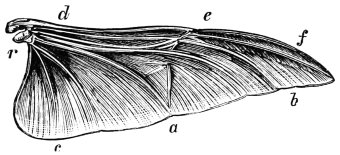
Fig. 92.
Fig. 92.—Right wing of Beetle (Goliathus micans), dorsal surface. This wing somewhat resembles the kestrel’s (fig. 61, p. 136) in shape. It has an anterior thick margin, d e f, and a posterior thin one, b a c. Strong nervures run along the anterior margin (d) until they reach the joint (e), where the wing folds upon itself during repose. Here the nervures split up and divaricate and gradually become smaller and smaller until they reach the extremity of the wing (f) and the posterior or thin margin (b); other nervures radiate in graceful curves from the root of the wing. These also become finer as they reach the posterior or thin margin (c a). r, Root of the wing with its complex compound joint. The wing of the beetle bears a certain analogy to that of the bat, the nervures running along the anterior margin (d) of the wing, resembling the humerus and forearm of the bat (fig. 94, d, p. 175), the joint of the beetle’s wing (e) corresponding to the carpal or wrist-joint of the bat’s wing (fig. 94, e), the terminal or distal nervures of the beetle (f b) to the phalanges of the bat (fig. 94, f b). The parts marked f b may in both instances be likened to the primary feathers of the bird, that marked a to the secondary feathers, and c to the tertiary feathers. In the wings of the beetle and bat no air can possibly escape through them during the return or up stroke.—Original.
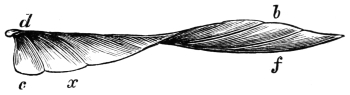
Fig. 93.
Fig. 93.—Right wing of the Beetle (Goliathus micans), as seen from behind and from beneath. When so viewed, the anterior or thick margin (d f) and the posterior or thin margin (b x c) are arranged in different planes, and form a true helix or screw. Compare with figs. 95 and 97.—Original.
The wings of insects can be made to oscillate within given areas anteriorly, posteriorly, or centrally with regard to the plane of the body; or in intermediate positions with regard to it and a perpendicular line. The wing or wings of the one side can likewise be made to move independently of those of the opposite side, so that the centre of gravity, which, in insects, bats, and birds, is suspended, is not disturbed in the endless evolutions involved in ascending, descending, and wheeling. The centre of gravity varies in insects according to the shape of the body, the length and shape of the limbs and antennæ, and the position, shape, and size of the pinions. It is corrected in some by curving the body, in others by bending or straightening the limbs and antennæ, but principally in all by the judicious play of the wings themselves.
The wing of the bat and bird, like that of the insect, is concavo-convex, and more or less twisted upon itself (figs. 94, 95, 96, and 97).
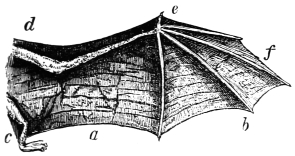
Fig. 94.
Fig. 94.—Right wing of the Bat (Phyllorhina gracilis), dorsal surface. d e f, Anterior or thick margin of the wing, supported by the bones of the arm, forearm, and hand (first and second phalanges); c a b, posterior or thin margin, supported by the remaining phalanges, by the side of the body, and by the foot.—Original.
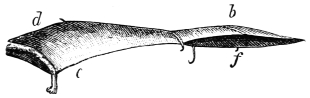
Fig. 95.
Fig. 95.—Right wing of the Bat (Phyllorhina gracilis), as seen from behind and from beneath. When so regarded, the anterior or thick margin (d f) of the wing displays different curves from those seen on the posterior or thin margin (b c); the anterior and posterior margins being arranged in different planes, as in the blade of a screw propeller.—Original.
The twisting is in a great measure owing to the manner in which the bones of the wing are twisted upon themselves, and the spiral nature of their articular surfaces; the long axes of the joints always intersecting each other at nearly right angles. As a result of this disposition of the articular surfaces, the wing is shot out or extended, and retracted or flexed in a variable plane, the bones of the wing rotating in the direction of their length during either movement. This secondary action, or the revolving of the component bones upon their own axes, is of the greatest importance in the movements of the wing, as it communicates to the hand and forearm, and consequently to the membrane or feathers which they bear, the precise angles necessary for flight. It, in fact, insures that the wing, and the curtain, sail, or fringe of the wing shall be screwed into and down upon the air in extension, and unscrewed or withdrawn from it during flexion. The wing of the bat and bird may therefore be compared to a huge gimlet or auger, the axis of the gimlet representing the bones of the wing; the flanges or spiral thread of the gimlet the frenum or sail (figs. 95 and 97).
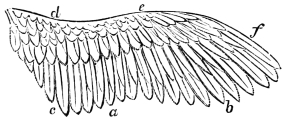
Fig. 96.
Fig. 96.—Right wing of the Red-legged Partridge (Perdix rubra), dorsal aspect. Shows extreme example of short rounded wing; contrast with the wing of the albatross (fig. 62, p. 137), which furnishes an extreme example of the long ribbon-shaped wing; d e f, anterior margin; b a c, posterior ditto, consisting of primary (b), secondary (a), and tertiary (c) feathers, with their respective coverts and subcoverts; the whole overlapping and mutually supporting each other. This wing, like the kestrel’s (fig. 61, p. 136), was drawn from a specimen held against the light, the object being to display the mutual relation of the feathers to each other, and how the feathers overlap.—Original.
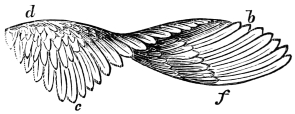
Fig. 97.
Fig. 97.—Right wing of Red-legged Partridge (Perdix rubra), seen from behind and from beneath, as in the beetle (fig. 93) and bat (fig. 95). The same lettering and explanation does for all three.—Original.
The Wings of Bats.
The Bones of the Wing of the Bat—the spiral configuration of their articular surfaces.—The bones of the arm and hand are especially deserving of attention. The humerus (fig. 17, r, p. 36) is short and powerful, and twisted upon itself to the extent of something less than a quarter of a turn. As a consequence, the long axis of the shoulder-joint is nearly at right angles to that of the elbow-joint. Similar remarks may be made regarding the radius (the principal bone of the forearm) (d), and the second and third metacarpal bones with their phalanges (e f), all of which are greatly elongated, and give strength and rigidity to the anterior or thick margin of the wing. The articular surfaces of the bones alluded to, as well as of the other bones of the hand, are spirally disposed with reference to each other, the long axes of the joints intersecting at nearly right angles. The object of this arrangement is particularly evident when the wing of the living bat, or of one recently dead, is extended and flexed as in flight.
In the flexed state the wing is greatly reduced in size, its under surface being nearly parallel with the plane of progression. When the wing is fully extended its under surface makes a certain angle with the horizon, the wing being then in a position to give the down stroke, which is delivered downwards and forwards, as in the insect. When extension takes place the elbow-joint is depressed and carried forwards, the wrist elevated and carried backwards, the metacarpo-phalangeal joints lowered and inclined forwards, and the distal phalangeal joints slightly raised and carried backwards. The movement of the bat’s wing in extension is consequently a spiral one, the spiral running alternately from below upwards and forwards, and from above downwards and backwards (compare with fig. 79, p. 147). As the bones of the arm, forearm, and hand rotate on their axes during the extensile act, it follows that the posterior or thin margin of the wing is rotated in a downward direction (the anterior or thick one being rotated in an opposite direction) until the wing makes an angle of something like 30° with the horizon, which, as I have already endeavoured to show, is the greatest angle made by the wing in flight. The action of the bat’s wing at the shoulder is particularly free, partly because the shoulder-joint is universal in its nature, and partly because the scapula participates in the movements of this region. The freedom of action referred to enables the bat not only to rotate and twist its wing as a whole, with a view to diminishing and increasing the angle which its under surface makes with the horizon, but to elevate and depress the wing, and move it in a forward and backward direction. The rotatory or twisting movement of the wing is an essential feature in flight, as it enables the bat (and this holds true also of the insect and bird) to balance itself with the utmost exactitude, and to change its position and centre of gravity with marvellous dexterity. The movements of the shoulder-joint are restrained within certain limits by a system of check-ligaments, and by the coracoid and acromian processes of the scapula. The wing is recovered or flexed by the action of elastic ligaments which extend between the shoulder, elbow, and wrist. Certain elastic and fibrous structures situated between the fingers and in the substance of the wing generally take part in flexion. The bat flies with great ease and for lengthened periods. Its flight is remarkable for its softness, in which respect it surpasses the owl and the other nocturnal birds. The action of the wing of the bat, and the movements of its component bones, are essentially the same as in the bird.
The Wings of Birds.
The Bones of the Wing of the Bird—their Articular Surfaces, Movements, etc.—The humerus, or arm-bone of the wing, is supported by three of the trunk-bones, viz. the scapula or shoulder-blade, the clavicle or collar-bone, also called the furculum,84 and the coracoid bone,—these three converging to form a point d’appui, or centre of support for the head of the humerus, which is received in facettes or depressions situated on the scapula and coracoid. In order that the wing may have an almost unlimited range of motion, and be wielded after the manner of a flail, it is articulated to the trunk by a somewhat lax universal joint, which permits vertical, horizontal, and intermediate movements.85 The long axis of the joint is directed vertically; the joint itself somewhat backwards. It is otherwise with the elbow-joint, which is turned forwards, and has its long axis directed horizontally, from the fact that the humerus is twisted upon itself to the extent of nearly a quarter of a turn. The elbow-joint is decidedly spiral in its nature, its long axis intersecting that of the shoulder-joint at nearly right angles. The humerus articulates at the elbow with two bones, the radius and the ulna, the former of which is pushed from the humerus, while the other is drawn towards it during extension, the reverse occurring during flexion. Both bones, moreover, while those movements are taking place, revolve to a greater or less extent upon their own axes. The bones of the forearm articulate at the wrist with the carpal bones, which being spirally arranged, and placed obliquely between them and the metacarpal bones, transmit the motions to the latter in a curved direction. The long axis of the wrist-joint is, as nearly as may be, at right angles to that of the elbow-joint, and more or less parallel with that of the shoulder. The metacarpal or hand-bones, and the phalanges or finger-bones are more or less fused together, the better to support the great primary feathers, on the efficiency of which flight mainly depends. They are articulated to each other by double hinge-joints, the long axes of which are nearly at right angles to each other.
As a result of this disposition of the articular surfaces, the wing is shot out or extended and retracted or flexed in a variable plane, the bones composing the wing, particularly those of the forearm, rotating on their axes during either movement.
This secondary action, or the revolving of the component bones upon their own axes, is of the greatest importance in the movements of the wing, as it communicates to the hand and forearm, and consequently to the primary and secondary feathers which they bear, the precise angles necessary for flight; it in fact insures that the wing, and the curtain or fringe of the wing which the primary and secondary feathers form, shall be screwed into and down upon the air in extension, and unscrewed or withdrawn from it during flexion. The wing of the bird may therefore be compared to a huge gimlet or auger; the axis of the gimlet representing the bones of the wing, the flanges or spiral thread of the gimlet the primary and secondary feathers (fig. 63, p. 138, and fig. 97, p. 176).
Traces of Design in the Wing of the Bird—the arrangement of the Primary, Secondary, and Tertiary Feathers, etc.—There are few things in nature more admirably constructed than the wing of the bird, and perhaps none where design can be more readily traced. Its great strength and extreme lightness, the manner in which it closes up or folds during flexion, and opens out or expands during extension, as well as the manner in which the feathers are strung together and overlap each other in divers directions to produce at one time a solid resisting surface, and at another an interrupted and comparatively non-resisting one, present a degree of fitness to which the mind must necessarily revert with pleasure. If the feathers of the wing only are contemplated, they may be conveniently divided into three sets of three each (on both sides of the wing)—an upper or dorsal set (fig. 61, d, e, f, p. 136), a lower or ventral set (c, a, b), and one which is intermediate. This division is intended to refer the feathers to the bones of the arm, forearm, and hand, but is more or less arbitrary in its nature. The lower set or tier consists of the primary (b), secondary (a), and tertiary (c) feathers, strung together by fibrous structures in such a way that they move in an outward or inward direction, or turn upon their axes, at precisely the same instant of time,—the middle and upper sets of feathers, which overlap the primary, secondary, and tertiary ones, constituting what are called the “coverts” and “sub-coverts.” The primary or rowing feathers are the longest and strongest (b), the secondaries (a) next, and the tertiaries third (c). The tertiaries, however, are occasionally longer than the secondaries. The tertiary, secondary, and primary feathers increase in strength from within outwards, i.e. from the body towards the extremity of the wing, and so of the several sets of wing-coverts. This arrangement is necessary, because the strain on the feathers during flight increases in proportion to their distance from the trunk.
Fig. 98.
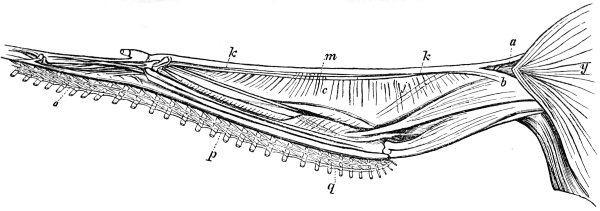

Fig. 99. Fig. 100. Fig. 101.
Figs. 98, 99, 100, and 101 show the muscles and elastic ligaments, and the arrangement of the primary and secondary feathers on the ventral aspects of the wing of the crested crane. The wing is in the extended condition.
y (fig. 98), Great pectoral muscle which depresses the wing.
a b, Voluntary muscular fibres terminating in elastic band k. This band splits up into two portions (k, m). A somewhat similar band is seen at j. These three bands are united to, and act in conjunction with, the great fibro-elastic web c, to flex the forearm on the arm. The fibro-elastic web is more or less under the influence of the voluntary muscles (a, b).
o, p, q, Musculo-fibro-elastic ligament, which envelopes the roots of the primary and secondary feathers, and forms a symmetrical network of great strength and beauty, its component parts being arranged in such a manner as to envelope the root of each individual feather. The network in question supports the feathers, and limits their peculiar valvular action. It is enlarged at figs. 99 and 101, and consists of three longitudinal bands, r s, t u, v w. Between these bands two oblique bands, g and h, run; the oblique bands occurring between every two feathers. The marginal longitudinal band (v, w) splits up into two processes, one of which curves round the root of each feather (x) in a direction from right to left (c, b, a), the other in a direction from left to right (d, e, f). These processes are also seen at m, n of fig. 100.—Original.
The manner in which the roots of the primary, secondary, and tertiary feathers are geared to each other in order to rotate in one direction in flexion, and in another and opposite direction in extension, is shown at figs. 98, 99, 100, and 101, p. 181. In flexion the feathers open up and permit the air to pass between them. In extension they flap together and render the wing as air-tight as that of either the insect or bat. The primary, secondary, and tertiary feathers have consequently a valvular action.
The Wing of the Bird not always opened up to the same extent in the Up Stroke.—The elaborate arrangements and adaptations for increasing the area of the wing, and making it impervious to air during the down stroke, and for decreasing the area and opening up the wing during the up stroke, although necessary to the flight of the heavy-bodied, short-winged birds, as the grouse, partridge, and pheasant, are by no means indispensable to the flight of the long-winged oceanic birds, unless when in the act of rising from a level surface; neither do the short-winged heavy birds require to fold and open up the wing during the up stroke to the same extent in all cases, less folding and opening up being required when the birds fly against a breeze, and when they have got fairly under weigh. All the oceanic birds, even the albatross, require to fold and flap their wings vigorously when they rise from the surface of the water. When, however, they have acquired a certain degree of momentum, and are travelling at a tolerable horizontal speed, they can in a great measure dispense with the opening up of the wing during the up stroke—nay, more, they can in many instances dispense even with flapping. This is particularly the case with the albatross, which (if a tolerably stiff breeze be blowing) can sail about for an hour at a time without once flapping its wings. In this case the wing is wielded in one piece like the insect wing, the bird simply screwing and unscrewing the pinion on and off the wind, and exercising a restraining influence—the breeze doing the principal part of the work. In the bat the wing is jointed as in the bird, and folded during the up stroke. As, however, the bat’s wing, as has been already stated, is covered by a continuous and more or less elastic membrane, it follows that it cannot be opened up to admit of the air passing through it during the up stroke. Flight in the bat is therefore secured by alternately diminishing and increasing the area of the wing during the up and down strokes—the wing rotating upon its root and along its anterior margin, and presenting a variety of kite-like surfaces, during its ascent and descent, precisely as in the bird (fig. 80, p. 149, and fig. 83, p. 158).
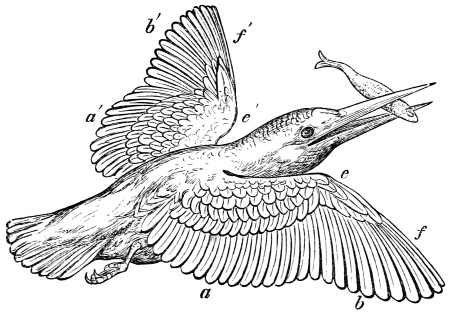
Fig. 102.—Shows the upward inclination of the body and the flexed condition of the wings (a b, e f; a´ b´, e´ f´) in the flight of the kingfisher. The body and wings when taken together form a kite. Compare with fig. 59, p. 126, where the wings are fully extended.
Flexion of the Wing necessary to the Flight of Birds.—Considerable diversity of opinion exists as to whether birds do or do not flex their wings in flight. The discrepancy is owing to the great difficulty experienced in analysing animal movements, particularly when, as in the case of the wings, they are consecutive and rapid. My own opinion is, that the wings are flexed in flight, but that all wings are not flexed to the same extent, and that what holds true of one wing does not necessarily hold true of another. To see the flexing of the wing properly, the observer should be either immediately above the bird or directly beneath it. If the bird be diminishing from before, behind, or from the side, the up and down strokes of the pinion distract the attention and complicate the movement to such an extent as to render the observation of little value. In watching rooks proceeding leisurely against a slight breeze, I have over and over again satisfied myself that the wings are flexed during the up stroke, the mere extension and flexion, with very little of a down stroke, in such instances sufficing for propulsion. I have also observed it in the pigeon in full flight, and likewise in the starling, sparrow, and kingfisher (fig. 102, p. 183).
It occurs principally at the wrist-joint, and gives to the wing the peculiar quiver or tremor so apparent in rapid flight, and in young birds at feeding-time. The object to be attained is manifest. By the flexing of the wing in flight, the “remiges,” or rowing feathers, are opened up or thrown out of position, and the air permitted to escape—advantage being thus taken of the peculiar action of the individual feathers and the higher degree of differentiation perceptible in the wing of the bird as compared with that of the bat and insect.
In order to corroborate the above opinion, I extended the wings of several birds as in rapid flight, and fixed them in the outspread position by lashing them to light unyielding reeds. In these experiments the shoulder and elbow-joints were left quite free—the wrist or carpal and the metacarpal joints only being bound. I took care, moreover, to interfere as little as possible with the action of the elastic ligament or alar membrane which, in ordinary circumstances, recovers or flexes the wing, the reeds being attached for the most part to the primary and secondary feathers. When the wings of a pigeon were so tied up, the bird could not rise, although it made vigorous efforts to do so. When dropped from the hand, it fell violently upon the ground, notwithstanding the strenuous exertions which it made with its pinions to save itself. When thrown into the air, it fluttered energetically in its endeavours to reach the dove-cot, which was close at hand; in every instance, however, it fell, more or less heavily, the distance attained varying with the altitude to which it was projected.
Thinking that probably the novelty of the situation and the strangeness of the appliances confused the bird, I allowed it to walk about and to rest without removing the reeds. I repeated the experiment at intervals, but with no better results. The same phenomena, I may remark, were witnessed in the sparrow; so that I think there can be no doubt that a certain degree of flexion in the wings is indispensable to the flight of all birds—the amount varying according to the length and form of the pinions, and being greatest in the short broad-winged birds, as the partridge and kingfisher, less in those whose wings are moderately long and narrow, as the gulls, and many of the oceanic birds, and least in the heavy-bodied long and narrow-winged sailing or gliding birds, the best example of which is the albatross. The degree of flexion, moreover, varies according as the bird is rising, falling, or progressing in a horizontal direction, it being greatest in the two former, and least in the latter.
It is true that in insects, unless perhaps in those which fold or close the wing during repose, no flexion of the pinion takes place in flight; but this is no argument against this mode of diminishing the wing-area during the up stroke where the joints exist; and it is more than probable that when joints are present they are added to augment the power of the wing during its active state, i.e. during flight, quite as much as to assist in arranging the pinion on the back or side of the body when the wing is passive and the animal is reposing. The flexion of the wing is most obvious when the bird is exerting itself, and may be detected in birds which skim or glide when they are rising, or when they are vigorously flapping their wings to secure the impetus necessary to the gliding movement. It is less marked at the elbow-joint than at the wrist; and it may be stated generally that, as flexion decreases, the twisting flail-like movement of the wing at the shoulder increases, and vice versâ,—the great difference between sailing birds and those which do not sail amounting to this, that in the sailing birds the wing is worked from the shoulder by being alternately rolled on and off the wind, as in insects; whereas, in birds which do not glide, the spiral movement travels along the arm as in bats, and manifests itself during flexion and extension in the bending of the joints and in the rotation of the bones of the wing on their axes. The spiral conformation of the pinions, to which allusion has been so frequently made, is best seen in the heavy-bodied birds, as the turkey, capercailzie, pheasant, and partridge; and here also the concavo-convex form of the wing is most perceptible. In the light-bodied, ample-winged birds, the amount of twisting is diminished, and, as a result, the wing is more or less flattened, as in the sea-gull (fig. 103).
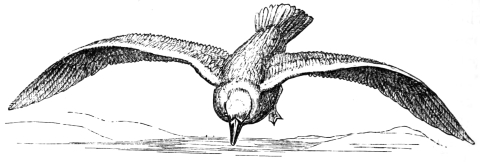
Fig. 103.—Shows the twisted levers or screws formed by the wings of the gull. Compare with fig. 53, p. 107; with figs. 76, 77, and 78, p. 147, and with figs. 82 and 83, p. 158.—-Original.
Consideration of the Forces which propel the Wings of Insects.—In the thorax of insects the muscles are arranged in two principal sets in the form of a cross—i.e. there is a powerful vertical set which runs from above downwards, and a powerful antero-posterior set which runs from before backwards. There are likewise a few slender muscles which proceed in a more or less oblique direction. The antero-posterior and vertical sets of muscles are quite distinct, as are likewise the oblique muscles. Portions, however, of the vertical and oblique muscles terminate at the root of the wing in jelly-looking points which greatly resemble rudimentary tendons, so that I am inclined to believe that the vertical and oblique muscles exercise a direct influence on the movements of the wing. The shortening of the antero-posterior set of muscles (indirectly assisted by the oblique ones) elevates the dorsum of the thorax by causing its anterior extremity to approach its posterior extremity, and by causing the thorax to bulge out or expand laterally. This change in the thorax necessitates the descent of the wing. The shortening of the vertical set (aided by the oblique ones) has a precisely opposite effect, and necessitates its ascent. While the wing is ascending and descending the oblique muscles cause it to rotate on its long axis, the bipartite division of the wing at its root, the spiral configuration of the joint, and the arrangement of the elastic and other structures which connect the pinion with the body, together with the resistance it experiences from the air, conferring on it the various angles which characterize the down and up strokes. The wing may therefore be said to be depressed by the shortening of the antero-posterior set of muscles, aided by the oblique muscles, and elevated by the shortening of the vertical and oblique muscles, aided by the elastic ligaments, and the reaction of the air. If we adopt this view we have a perfect physiological explanation of the phenomenon, as we have a complete circle or cycle of motion, the antero-posterior set of muscles shortening when the vertical set of muscles are elongating, and vice versâ. This, I may add, is in conformity with all other muscular arrangements, where we have what are usually denominated extensors and flexors, pronators and supinators, abductors and adductors, etc., but which, as I have already explained (pp. 24 to 34), are simply the two halves of a circle of muscle and of motion, an arrangement for securing diametrically opposite movements in the travelling surfaces of all animals.
Chabrier’s account, which I subjoin, virtually supports this hypothesis:—
“It is generally through the intervention of the proper motions of the dorsum, which are very considerable during flight, that the wings or the elytra are moved equally and simultaneously. Thus, when it is elevated, it carries with it the internal side of the base of the wings with which it is articulated, from which ensues the depression of the external side of the wing; and when it approaches the sternal portion of the trunk, the contrary takes place. During the depression of the wings, the dorsum is curved from before backwards, or in such a manner that its anterior extremity is brought nearer to its posterior, that its middle is elevated, and its lateral portions removed further from each other. The reverse takes place in the elevation of the wings; the anterior extremity of the dorsum being removed to a greater distance from the posterior, its middle being depressed, and its sides brought nearer to each other. Thus its bending in one direction produces a diminution of its curve in the direction normally opposed to it; and by the alternations of this motion, assisted by other means, the body is alternately compressed and dilated, and the wings are raised and depressed by turns.”86
In the libellulæ or dragon-flies, the muscles are inserted into the roots of the wings as in the bat and bird, the only difference being that in the latter the muscles creep along the wings to their extremities.
In all the wings which I have examined, whether in the insect, bat, or bird, the wings are recovered, flexed, or drawn towards the body by the action of elastic ligaments, these structures, by their mere contraction, causing the wings, when fully extended and presenting their maximum of surface, to resume their position of rest, and plane of least resistance. The principal effort required in flight would therefore seem to be made during extension and the down stroke. The elastic ligaments are variously formed, and the amount of contraction which they undergo is in all cases accurately adapted to the size and form of the wings, and the rapidity with which they are worked—the contraction being greatest in the short-winged and heavy-bodied insects and birds, and least in the light-bodied and ample-winged ones, particularly in such as skim or glide. The mechanical action of the elastic ligaments, I need scarcely remark, insures a certain period of repose to the wings at each stroke, and this is a point of some importance, as showing that the lengthened and laborious flights of insects and birds are not without their stated intervals of rest.
Speed attained by Insects.—Many instances might be quoted of the marvellous powers of flight possessed by insects as a class. The male of the silkworm-moth (Attacus Paphia) is stated to travel more than 100 miles a day;87 and an anonymous writer in Nicholson’s Journal88 calculates that the common house-fly (Musca domestica), in ordinary flight, makes 600 strokes per second, and advances twenty-five feet, but that the rate of speed, if the insect be alarmed, may be increased six or seven fold, so that under certain circumstances it can outstrip the fleetest racehorse. Every one when riding on a warm summer day must have been struck with the cloud of flies which buzz about his horse’s ears even when the animal is urged to its fastest paces; and it is no uncommon thing to see a bee or a wasp endeavouring to get in at the window of a railway car in full motion. If a small insect like a fly can outstrip a racehorse, an insect as large as a horse would travel very much faster than a cannon-ball. Leeuwenhoek relates a most exciting chase which he once beheld in a menagerie about 100 feet long between a swallow and a dragon-fly (Mordella). The insect flew with incredible speed, and wheeled with such address, that the swallow, notwithstanding its utmost efforts, completely failed to overtake and capture it.89
Consideration of the Forces which propel the Wings of Bats and Birds.—The muscular system of birds has been so frequently and faithfully described, that I need not refer to it further than to say that there are muscles which by their action are capable of elevating and depressing the wings, and of causing them to move in a forward and backward direction, and obliquely. They can also extend or straighten and bend, or flex the wings, and cause them to rotate in the direction of their length during the down and up strokes. The muscles principally concerned in the elevation of the wings are the smaller pectoral or breast muscles (pectorales minor); those chiefly engaged in depressing the wings are the larger pectorals (pectorales major). The pectoral muscles correspond to the fleshy mass found on the breast-bone or sternum, which in flying birds is boat-shaped, and furnished with a keel. These muscles are sometimes so powerful and heavy that they outweigh all the other muscles of the body. The power of the bird is thus concentrated for the purpose of moving the wings and conferring steadiness upon the volant mass. In birds of strong flight the keel is very large, in order to afford ample attachments for the muscles delegated to move the wings. In birds which cannot fly, as the members of the ostrich family, the breast-bone or sternum has no keel.90
The remarks made regarding the muscles of birds, apply with very slight modifications to the muscles of bats. The muscles of bats and birds, particularly those of the wings, are geared to, and act in concert with, elastic ligaments or membranes, to be described presently.
Lax condition of the Shoulder-Joint in Bats, Birds, etc.—The great laxity of the shoulder-joint in bats and birds, readily admits of their bodies falling downwards and forwards during the up stroke. This joint, as has been already stated, admits of movement in every direction, so that the body of the bat or bird is like a compass set upon gimbals, i.e. it swings and oscillates, and is equally balanced, whatever the position of the wings. The movements of the shoulder-joint in the bird, bat, and insect are restrained within certain limits by a system of check ligaments and prominences; but in each case the range of motion is very great, the wings being permitted to swing forwards, backwards, upwards, downwards, or at any degree of obliquity. They are also permitted to rotate along their anterior margin, or to twist in the direction of their length to the extent of nearly a quarter of a turn. This great freedom of movement at the shoulder-joint enables the insect, bat, and bird to rotate and balance upon two centres—the one running in the direction of the length of the body, the other at right angles or across the body, i.e. in the direction of the length of the wings.
In the bird the head of the humerus is convex and somewhat oval (not round), the long axis of the oval being directed from above downwards, i.e. from the dorsal towards the ventral aspect of the bird. The humerus can, therefore, glide up and down in the facettes occurring on the articular ends of the coracoid and scapular bones with great facility, much in the same way that the head of the radius glides upon the distal end of the humerus. But the humerus has another motion; it moves like a hinge from before backwards, and vice versâ. The axis of the latter movement is almost at right angles to that of the former. As, however, the shoulder-joint is connected by long ligaments to the body, and can be drawn away from it to the extent of one-eighth of an inch or more, it follows that a third and twisting movement can be performed, the twisting admitting of rotation to the extent of something like a quarter of a turn. In raising and extending the wing preparatory to the downward stroke two opposite movements are required, viz. one from before backwards, and another from below upwards. As, however, the axes of these movements are at nearly right angles to each other, a spiral or twisting movement is necessary to run the one into the other—to turn the corner, in fact.
From what has been stated it will be evident that the movements of the wing, particularly at the root, are remarkably free, and very varied. A directing and restraining, as well as a propelling force, is therefore necessary.
The guiding force is to be found in the voluntary muscles which connect the wing with the body in the insect, and which in the bat and bird, in addition to connecting the wing with the body, extend along the pinion even to its tip. It is also to be found in the musculo-elastic and other ligaments, seen to advantage in the bird.
The Wing flexed and partly elevated by the Action of Elastic Ligaments—the Nature and Position of such Ligaments in the Pheasant, Snipe, Crested Crane, Swan, etc.—When the wing is drawn away from the body of the bird by the hand the posterior margin of the pinion formed by the primary, secondary, and tertiary feathers rolls down to make a variety of inclined surfaces with the horizon (c b, of fig. 63, p. 138). When, however, the hand is withdrawn, even in the dead bird, the wing instantly folds up; and in doing so reduces the amount of inclination in the several surfaces referred to (c b, d e f of the same figure). The wing is folded by the action of certain elastic ligaments, which are put upon the stretch in extension, and which recover their original form and position in flexion (fig. 98, c, p. 181). This simple experiment shows that the various inclined surfaces requisite for flight are produced by the mere acts of extension and flexion in the dead bird. It is not, however, to be inferred from this circumstance that flight can be produced without voluntary movements any more than ordinary walking. The muscles, bones, ligaments, feathers, etc., are so adjusted with reference to each other that if the wing is moved at all, it must move in the proper direction—an arrangement which enables the bird to fly without thinking, just as we can walk without thinking. There cannot, however, be a doubt that the bird has the power of controlling its wings both during the down and up strokes; for how otherwise could it steer and direct its course with such precision in obtaining its food? how fix its wings on a level with or above its body for skimming purposes? how fly in a curve? how fly with, against, or across a breeze? how project itself from a rock directly into space, or how elevate itself from a level surface by the laboured action of its wings?
The wing of the bird is elevated to a certain extent in flight by the reaction of the air upon its under surface; but it is also elevated by muscular action—by the contraction of the elastic ligaments, and by the body falling downwards and forwards in a curve.
That muscular action is necessary is proved by the fact that the pinion is supplied with distinct elevator muscles.91 It is further proved by this, that the bird can, and always does, elevate its wings prior to flight, quite independently of the air. When the bird is fairly launched in space the elevator muscles are assisted by the tendency which the body has to fall downwards and forwards: by the reaction of the air; and by the contraction of the elastic ligaments. The air and the elastic ligaments contribute to the elevation of the wing, but both are obviously under control—they, in fact, form links in a chain of motion which at once begins and terminates in the muscular system.
That the elastic ligaments are subsidiary and to a certain extent under the control of the muscular system in the same sense that the air is, is evident from the fact that voluntary muscular fibres run into the ligaments in question at various points (a, b of fig. 98, p. 181). The ligaments and muscular fibres act in conjunction, and fold or flex the forearm on the arm. There are others which flex the hand upon the forearm. Others draw the wing towards the body.
The elastic ligaments, while occupying a similar position in the wings of all birds, are variously constructed and variously combined with voluntary muscles in the several species.
The Elastic Ligaments more highly differentiated in Wings which vibrate rapidly.—The elastic ligaments of the swan are more complicated and more liberally supplied with voluntary muscle than those of the crane, and this is no doubt owing to the fact that the wings of the swan are driven at a much higher speed than those of the crane. In the snipe the wings are made to vibrate very much more rapidly than in the swan, and, as a consequence, we find that the fibro-elastic bands are not only greatly increased, but they are also geared to a much greater number of voluntary muscles, all which seems to prove that the musculo-elastic apparatus employed for recovering or flexing the wing towards the end of the down stroke, becomes more and more highly differentiated in proportion to the rapidity with which the wing is moved.92 The reason for this is obvious. If the wing is to be worked at a higher speed, it must, as a consequence, be more rapidly flexed and extended. The rapidity with which the wing of the bird is extended and flexed is in some instances exceedingly great; so great, in fact, that it escapes the eye of the ordinary observer. The speed with which the wing darts in and out in flexion and extension would be quite inexplicable, but for a knowledge of the fact that the different portions of the pinion form angles with each other, these angles being instantly increased or diminished by the slightest quiver of the muscular and fibro-elastic systems. If we take into account the fact that the wing of the bird is recovered or flexed by the combined action of voluntary muscles and elastic ligaments; that it is elevated to a considerable extent by voluntary muscular effort; and that it is extended and depressed entirely by muscular exertion, we shall have difficulty in avoiding the conclusion that the wing is thoroughly under the control of the muscular system, not only in flexion and extension, but also throughout the entire down and up strokes.
An arrangement in every respect analogous to that described in the bird is found in the wing of the bat, the covering or web of the wing in this instance forming the principal elastic ligament (fig. 17, p. 36).
Power of the Wing—to what owing.—The shape and power of the pinion depend upon one of three circumstances—to wit, the length of the humerus,93 the length of the cubitus or forearm, and the length of the primary feathers. In the swallow the humerus, and in the humming-bird the cubitus, is very short, the primaries being very long; whereas in the albatross the humerus or arm-bone is long and the primaries short. When one of these conditions is fulfilled, the pinion is usually greatly elongated and scythe-like (fig. 62, p. 137)—an arrangement which enables the bird to keep on the wing for immense periods with comparatively little exertion, and to wheel, turn, and glide about with exceeding ease and grace. When the wing is truncated and rounded (fig. 96, p. 176), a form of pinion usually associated with a heavy body, as in the grouse, quail, diver, and grebe, the muscular exertion required, and the rapidity with which the wing moves are very great; those birds, from a want of facility in turning, flying either in a straight line or making large curves. They, moreover, rise with difficulty, and alight clumsily and somewhat suddenly. Their flight, however, is perfect while it lasts.