Chapter IV
Reading edition
THE BRONZE AGE AND THE VOYAGE OF PYTHEAS
A Copper Age preceded the Bronze Age in certain countries, but has not been proved to have existed in Britain.
Those who have learned to realize the extreme slowness with which material culture was evolved in its earlier stages would be disposed to doubt whether the first metallic implements were made of bronze, and to ask whether, at all events in some part of the world, the Neolithic must not have merged into a Copper Age. It is easy to imagine that the accidental melting of a piece of copper ore may have suggested the possibility of fashioning the metal into tools; and that inventive cutlers took impressions of stone axes in clay, and found that they could make from them copper axes which were not liable to break:477 but one can hardly believe that simultaneously the discovery should have been made that the softness and bluntness of copper could be remedied by mixing with it a small proportion of tin. It is indeed not inconceivable that bronze was the first metal which was ever manufactured; for near the surface copper ores often contain tin oxide; and it has been proved that by smelting such ores bronze can be produced.478 But of course only experiment could have shown that tools made of this metal were better than copper. The Egyptians were acquainted with the use of copper long before they began to manufacture bronze;479 and in many parts of the British Isles as well as of the Continent copper implements have been discovered which belonged to prehistoric times.480 But such discoveries do not necessarily prove the existence of a Copper Age: they may often be accounted for by the supposition that tin, which is far less widely distributed than copper, was temporarily wanting. In many cases implements of copper and of bronze have been met with in intimate association; and sometimes copper implements of advanced type with primitive bronze.481 When, on the other hand, copper implements are repeatedly found in deposits which are known to be older than the oldest bronze in the districts in which they occur, the conclusion is irresistible that they were used there before bronze was manufactured.482 There was certainly a Copper Age in Mesopotamia, Egypt, and Cyprus; and probably also in Hungary, Northern Italy, Spain, and Ireland, with which, in ancient times, Spain was closely connected, and in which copper celts were unmistakably modelled upon those of stone: but for Britain the evidence is not sufficient.483 We must assume then provisionally that in our island the metal which was first used for cutting-tools was bronze.
Bronze implements used for many centuries in Europe before the Iron Age.
Certain metallurgists, however, maintain that a Bronze Age, properly so called, may never have existed; and that iron may have been manufactured during and even before the period to which the bronze tools that are exhibited in museums belong. Iron was undoubtedly known to the Egyptians at a very remote date, perhaps as early as bronze.484 Primitive methods of extracting iron from its ore, which are still practised in India and Africa, require far less skill than the manufacture of bronze: the metallurgists argue that since iron is rapidly oxidized by air and moisture, the iron tools which they assume to have been made in the so-called Bronze Age must have perished in the conditions to which most of the bronze tools that have been discovered were exposed; and they insist that iron tools have actually been found in association with objects of the early Bronze and even of the late Neolithic Age.485
The inconsistency of these arguments is self-evident; and if their authors had known the rudiments of archaeology, they would never have published them.486 Hundreds of iron weapons have been recovered from the Thames: a competent archaeologist has affirmed that there was not one which could not with certainty be attributed to some period later than the Bronze Age; and since numerous articles of stone and bronze have been found in the same bed, he reasonably concludes that if iron implements had been used in the Bronze Age, some few at least must have come to light.487 Nor is there any reason to suppose that if iron tools had been laid in graves of the Bronze Age, they would necessarily have perished beyond recognition; for in the famous Tyrolese cemetery of Hallstatt, and in many other deposits that, like it, belonged to the transitional period when bronze and iron were simultaneously used, the iron objects, oxidized though they are, retain their distinctive forms.488 Yet in the numerous British barrows of the Bronze Age, and in the hoards of the same period that have been unearthed in England, Scotland, and Wales, not a trace of iron has ever been found.489 Nothing then can be more certain than that in Britain, as in the rest of Europe, the Iron Age was preceded by a long period during which the only metals used were copper and bronze.490
Where did the European bronze culture originate?
Every antiquary knows that bronze did not reach this country until long after it was first used in Southern Europe, and that it was common in Egypt many centuries before; but in what part of the world it was first manufactured remains an unsettled question.491 The oldest piece of bronze that has yet been dated was found at Mêdûm in Egypt, and is supposed to have been cast about three thousand seven hundred years before the birth of Christ. But the metal may have been worked even earlier in other lands; for a bronze statuette and a bronze vase, which were made twenty-five centuries before our era, have been obtained from Mesopotamia; and the craft must have passed through many stages before such objects could have been produced. Yet it would be rash to infer that either the Babylonians or the Egyptians invented bronze; for neither in Egypt nor in Babylonia is there any tin. Some archaeologist who shall explore the virgin fields of the Far East may one day be able to prove that bronze was worked by the Chinese, in whose country both copper and tin abound, earlier than by any other people; but even so it will still remain doubtful whether the art was not independently discovered elsewhere. There is no evidence that the bronze culture of Mexico and Peru did not originate in America;492 and although it was once believed that all the tribes of Europe ultimately derived their knowledge of the metal from Asia,493 there are many who now maintain that it is impossible to detect in European deposits of the Bronze Age the slightest trace of Oriental origin.494
Origin and affinities of the bronze culture of Britain.
But whatever may have been the case in Southern lands, there is no doubt that the knowledge of bronze came to this country from abroad. The old theory that it was a result of Phoenician commerce with Britain has long been abandoned;495 and British bronze implements are so different from those of Norway and Sweden, Denmark, and Hungary that it cannot have been derived from any of those countries.496 German influence was felt at a comparatively late period;497 but from first to last the British bronze culture was closely connected with that of Gaul, and through Gaul with that of Italy.498
Period of its commencement.
The period when bronze first appeared in Britain can only be approximately fixed. It is certain that in the south-eastern districts iron tools began to be used not later than the fourth century before the Christian era.499 The final period of the British Bronze Age is marked by the discovery of bronze-founders’ hoards, all of which contain tools or fragments of tools which are known as socketed celts, or other socketed instruments which were contemporary with them. These hoards are so numerous and so widely diffused, and the objects of which they are composed are so varied in form, that the time during which they were deposited cannot, in the opinion of experts, have been less than four or five hundred years. But before the first socketed celt was cast the bronze culture passed through earlier stages, during which the flat celts that resembled those of stone were being used, and then gradually giving way to improved forms, which in their turn were succeeded by later developments. The veteran archaeologist who has handled and examined almost every specimen of these numerous varieties has arrived at the conclusion that the British Bronze Age must have begun at the latest between 1400 and 1200 B.C.;500 and while no one would now contend for a later date, there are some who maintain that bronze was first used in Britain twenty centuries before the Christian era.501
Physical characters of the late neolithic and early bronze-using invaders of Britain.
After the Bronze Age set in, as before the close of the preceding period, bands of invaders, wholly different in physical type from the neolithic aborigines, landed successively through long ages upon our eastern and southern shores. They came from the Netherlands, from Denmark and its islands, perhaps also from Scandinavia and from Gaul. They must not, however, be identified either with the invaders who introduced the Celtic language into Gaul or with any Celtic-speaking people. There is no evidence, and it is in the last degree improbable, that any Celtic tribe had appeared in Gaul at the time when the alien immigrants began to settle in Britain, or that Celtic had then taken shape as a branch of the Indo-European language. Those immigrants have often been described as a tall, stalwart, round-headed race; but the evidence of sepulchral remains shows that they sprang from various stocks. Those of the type which is commonly regarded as specially characteristic of the Bronze Age were taller and much more powerfully built than the aborigines: their skulls were comparatively short and round; they had massive jaws, strongly marked features, enormously prominent brow ridges and retreating foreheads; and their countenances must have been stern, forbidding, and sometimes almost brutal. Similar skulls, which have much in common with the primitive Neanderthal type,502 have been exhumed from neolithic tombs in Denmark and the Danish island of Falster. But the skeletons which have been found in some of the oldest Scottish cists belonged to men whose average height, although they were sturdy and thickset, was barely five feet three inches, and whose skulls, shorter and rounder than the others, as well as their milder features, proved that they were an offshoot of the so-called Alpine race of Central Europe, of which there were numerous representatives in Gaul. Again there were tall men with skulls of an intermediate type; while others, who combined harsh features and projecting brows with narrow heads, and whose stature was often great, would seem to have been the offspring of intermarriage between the older and the newer inhabitants. Not a single skeleton of the characteristic British round-barrow type is known to have been discovered on French soil: the round-headed inhabitants of Gaul were as conspicuously short as those of Britain were generally tall; nor, excluding the Britons of the Alpine stock, was there any physical resemblance between the two peoples. The British invaders of the Alpine stock, judging from the pottery which was found with their skeletons, came for the most part, as we shall afterwards see, not from Gaul but from the valley of the Rhine. Moreover, the round-headed people of Gaul settled there first early in the Neolithic Age, before a Celtic word was spoken; and although their descendants formed the substratum of the Gallic population who, in Caesar’s time, called themselves Celts, that name was introduced by conquerors of a wholly different stock. Probably a Celtic invasion of Britain took place before the British Iron Age began: but the remains of such invaders are not recognizable in any British graves.503
Their social organization.
Each of the invading clans was doubtless ruled by a chief; for many of the burial mounds which they erected were intended for the great alone, and could only have been constructed by the organized labour of many hands.504 They must have respected family ties; for women and even babies were interred with scrupulous care; and more than one barrow was reared for the reception of a single child.505 Yet infants have so often been found buried along with women that one can only conclude that infanticide was as prevalent in ancient as in modern Britain.506 Only the children were slain because their mothers could no longer nurse them, not because they desired to rid themselves of trouble.
Character and results of the invasions: the invaders poor in bronze weapons.
In Wiltshire and other parts of Southern Britain the old population would seem to have been largely dispossessed or subdued; but the skeletons found in the barrows of Derbyshire and Staffordshire, of Yorkshire and the other northern counties, indicate that there the immigrants mingled more or less peacefully with the people whom they came among.507 Fighting no doubt took place everywhere; but the notion that bronze weapons gave the first invaders victory is disproved by the fact that in the earlier part of the era bronze was both costly and rare.508 If chieftains had bronze, their clansmen were still armed with old-fashioned weapons; and until the new age was far advanced, the neolithic tribes, in so far as they were conquered, must have yielded to superior numbers, superior skill, or superior strength. Probably in certain districts they were never conquered, and never permitted the intruders to dwell among them. Among a vast number of stone implements that have been found lying on the moors west of Rochdale and Ashton-under-Lyne bronze was searched for in vain;509 and one may provisionally infer that these hillmen were protected by the strength of their territory.
Evidence of finds as to the settlements of the invaders.
Bronze implements or other relics of the Bronze Age have been found in almost every county of England, Wales, and Scotland, and in some of the adjoining islands;510 but their distribution appears to imply that, as might have been inferred from the geographical features, some districts were far more densely populated than others. The lands which the new comers selected were mainly those which were already occupied by the neolithic inhabitants. The relics are most abundant in those which are now most sparsely peopled, but which were then sought after because, even when the soil was poor, it was dry, well-watered, and comparatively open. The moors of Derbyshire, Yorkshire and other Northumbrian counties, Devonshire and Cornwall; the bracing uplands of East Anglia; the downs of Kent, Surrey, Sussex, Berkshire, Hampshire, Dorsetshire, and Wiltshire; and the wolds of Lincolnshire,—these were the tracts which the immigrants occupied in the greatest numbers. The Midlands, on the other hand, would seem to have attracted comparatively few: Durham, for some unexplained reason, was generally avoided;511 while the northern and north-western tracts of Scotland were almost entirely neglected.512 The Yorkshire Wolds afford an interesting example of the motives which determined the choice of abode. Their scanty vegetation could not have tempted a people who depended for their subsistence mainly upon their flocks and herds; yet the numerous barrows with which they are studded and the flint implements which have been picked up in thousands from their surface prove that they were as thickly peopled as any other part of Britain. The reason was that they were unencumbered by the forests which could only have been cleared by arduous labour; their climate was healthy; and, above all, they were so completely isolated by the wooded valley of the Derwent, the swamps of Holderness, the broad estuary of the Humber, and the morasses which then covered the plain of York, that their occupants were secure from all attack.513
In certain parts of England the routes by which invaders advanced may be traced by the sites at which bronze implements have been found. In Worcestershire, for example, these spots have been mapped along the line of the Avon from Warwickshire to the Severn, and again in the valley of the latter river, where it was apparently crossed by ancient trackways. The implements in these two counties belong to comparatively late periods.514
The settlements must often have been desperately resisted, more and more as time passed and unoccupied lands became rare. But it would be a mistake to assume that the struggle was always between aboriginal communities and round-headed invaders. There must have been much intermingling between the old population and the new: gradually the use of bronze weapons must have spread to neolithic clans or to those who could obtain them by barter or theft; and by the time when the Bronze Age was far advanced tribes of mingled stock must often have presented a united front to enemies from over sea. Even when the invaders had slowly made their way from the Channel to the far north, and from the German Ocean to the Irish Sea, hunger or the lust of booty would often lead to intertribal raids. Gradually weapons were improved; and we shall presently endeavour to trace their evolution. Even to the very end of the period, however, not only the rank and file but the wealthiest chief, who had a complete set of bronze implements and weapons, and who could afford to decorate the handle of his blade with ivory, amber, or gold, to wear gold buttons on his clothing, sometimes even to adorn his charger with a gold peytrel, shot arrows tipped with flint. Flint arrow-heads, leaf-shaped and barbed, have been found by thousands in deposits of the Bronze Age, but in this island never one of bronze. Even when daggers had given place to swords and bronze spears were common, battle-axes were made not of bronze but of stone.515
Stone implements used long after the introduction of bronze.
Stone implements indeed, such as were in use in the Neolithic Age, have been found so often in the graves of chieftains associated with those of bronze that we may be sure that, at least in the earlier part of the Bronze Age, even the wealthier classes could not afford to discard the older material; while among the needy population of the Yorkshire Wolds many barrows contained no implements except those of flint or bone.516 Bronze saws have very rarely been found in this country, although they were common enough in Southern Europe;517 and since all our bronze gouges are comparatively late,518 it may be inferred that during the earlier Bronze Age these tools were everywhere still made of flint. In the west of Scotland, at all events, metal tools were apparently unknown until long after the first round-headed people landed, and probably until long after bronze had begun to be used in Southern Britain.519 We may indeed be sure that the Stone Age continued for centuries later in remote parts of the country; and perhaps in certain islands bronze may have remained unknown.
Hill-forts.
When a clan had succeeded in establishing itself, it had to provide for its protection against cattle-lifters and slave-hunters; and gradually and by immense labour great strongholds were constructed on suitable sites. Comparatively rare in the south-east, they are conspicuous on nearly all the hilly districts of England, Wales, and Scotland;520 but it is in the western and south-western counties that they most abound. Devonshire and the adjacent parts of Somersetshire contain not less than eighty; and almost every spur on Salisbury Plain is fortified.521 The multiplicity of these camps bears witness not only to density of population and constant warfare, but also to the utter disunion which existed at the time when they were constructed. Supposing that the majority of the forts in Dorsetshire, for instance, were built in the Late Celtic Period, we should have to conclude that the Durotriges, who then inhabited that district, were merely a loose aggregate of scores of clans, ever ready to prey upon one another; for if the forts had been destined only to repel the attacks of some other tribe, they would hardly have been so numerous and so widely scattered. It is true that the Gallic Morini in Caesar’s time had not become welded into one state, and that the Kentish clans were under four petty kings; but in the period when the older earthworks were thrown up it would seem that far less progress had been made towards union. But even supposing that most of the prehistoric forts were later than the Bronze Age, their purpose accorded with the methods of primitive warfare. A chain of modern fortresses impedes an invader because, while they remain uncaptured, he cannot pass between them without exposing his line of communication. But in ancient times, when one tribe attacked another, it had no communications to guard: the invaders carried their food with them, and when it was spent trusted for support to the enemy’s country.522 If a tribe had desired merely to protect its frontier, it would not have erected hill-forts but a continuous entrenchment.
Amongst those which were occupied in the Bronze Age or before may be mentioned Badbury Rings in Dorsetshire;523 the stone fort on Whit-Tor in Dartmoor524 and another in the Rhonddha valley in Glamorganshire;525 Small Down camp near Evercreech in Somersetshire;526 the fort of Carn Brea in Cornwall;527 the series of entrenchments which mark the spurs of the hills that command the valley of the Esk from Guisborough to Whitby;528 those which line the western border of Worcestershire;529 Oldbury, some three miles east of Sevenoaks;530 Hollingbury on the Sussex Downs;531 Lutcombe Castle on the Berkshire Downs, overlooking the Vale of White Horse;532 and the greatest of all—the Maiden Castle, whose stupendous ramparts are the pride of Dorchester.533 But it is probable that the greater number may ultimately be referred to the Age of Bronze.534
The form, construction, and materials of British forts are naturally diverse. In Cornwall, Devonshire, Wales, and other places they were of course built largely or wholly of stone, the masonry being always uncemented: elsewhere they were true earthworks. Leaving out of sight the question of their date, they may be grouped in three classes.535 The first comprises those that were erected on promontories or other heights which on one or more sides were fortified by precipice, river, or sea. Such was the fort of Carl’s Wark in Derbyshire, which, on three sides, rises almost sheer above the swamps of Hathersage Moor. On the west, where the ground slopes towards the plain, a huge earthen rampart, faced with dry masonry, afforded secure protection; and the slopes below the eastern and southern sides are strewn with great stones which must have fallen from the walls above.536 The ‘cliff-castles’ on the coasts of Kirkcudbright and of Wales and on the headlands between the Land’s End and Cape Cornwall belong to the same group.537 In the second class the entrenchments, traced upon commanding sites, which, however, were nowhere so steep as to dispense with artificial aid, followed the tactical line of defence which the nature of the hill indicated. Most of the heights on which they stand are covered with soil so thin that they never could have been thickly wooded, and if trees had encumbered their sides they would have been cut down; for the object of the engineers was to leave no ‘dead ground’ on which an assailant could conceal himself. If he felt strong enough to lead his clansmen to the assault, he knew that they could not avoid being exposed from the moment when they penetrated within the range of a bow or a sling. General Pitt-Rivers, who did so much to illuminate the study of prehistoric fortifications, was never weary of calling attention to the skill with which they had been designed. Once only, when he was exploring the camp at Seaford, he thought that he could detect evidence of neglect. As he stood upon the rampart he noticed that an advancing force would be able to conceal itself for a while. Presently, however, it flashed across his mind that time had done its work upon rampart and ditch; and soon excavation proved that the latter had lost by silting seven feet of its original depth. The general saw with delight that the designer had been as vigilant as any of his contemporaries. The rampart in ancient times must have been at least five feet higher; and then the garrison who manned it would have been able instantly to detect the first enemy who ventured within range. ‘How carefully,’ he wrote, ‘the defenders economized their interior space, drawing their rampart just far enough down the hill to obtain a command of view, but not one yard further.’538
In certain cases, however, the hill was so extensive that if the tactical line of defence had been slavishly followed, the defenders would have been too few. Then the chief engineer modified the accepted principle. Selecting a spot at which he might safely abandon the natural line, he made his sappers build a cross rampart at right angles to it straight across the hill-top until it joined the works on the further side. An example of this device may be seen in the camp of Puttenham in Surrey.539
Among the more famous strongholds of the second class are Cissbury on the South Downs, which, as we have seen, was almost certainly erected in the Neolithic Age,540 Badbury Rings, and the Maiden Castle. This noble fortress must surely have deserved its modern name. No British force could ever have taken it: no other country can show its match. Three lines of ramparts defend the northern and four the southern side: gaining the summit of the road from Weymouth, you see them outlined against the sky; and as you mount the hill-side, they rise, one behind another, like veritable cliffs. Worn by the rains of five-and-twenty centuries or more, they still stand sixty feet541 above their fosses; and their entrances, on the east and the west, are guarded by overlapping works so intricate that if a column had succeeded in forcing its way across the abatis, it would have found itself helplessly winding in and out as through a labyrinth, pounded on either flank and enfiladed by stones and arrows discharged at point-blank range.
The strongholds of the third class were erected on lower hills or on high ground little elevated above the surrounding country, and therefore depended less for their protection upon natural features.542 Those that have been explored belong to the Late Celtic Period.543 It may be doubted, however, whether such forts were generally later than those whose sites were more commanding; for the inhabitants of every district could only choose the best positions which they could find.544 Cherbury camp indeed, about four miles south-east of Fyfield in Berkshire, was built on a lowland plain.
Some of the Gallic forts which Caesar saw, and of our own, were in his time inhabited by large industrial communities; but although many of the British strongholds which belonged to the Bronze Age contain the foundations of huts and broken pottery,545 it is doubtful whether they had more than a few occupants except in time of war.546
Every explorer who has tried to imagine the conditions of life in ancient British forts has noticed that many of them have no apparent source from which water can be obtained. It has indeed been suggested that where there was neither a spring nor running water within reach the garrison had recourse to dew-ponds, which are still used for watering cattle on the Hampshire downs.547 But even these reservoirs were generally lacking. Pitt-Rivers, however, argued that in the chalk districts many sites which are now remote from water may have possessed springs. At the village of Woodcuts in Cranborne Chase, after cleaning out a Roman well, one hundred and eighty-eight feet deep, he found no water, but the iron-work of a bucket.548 But even where there was no spring it is easy to understand how the garrison supplied themselves. None of these camps was ever subjected to a prolonged siege. No army can undertake such an operation unless it can ensure a continuous supply of food; and to do this requires forethought and organization of which barbarous clans are incapable. Again and again the Gauls with whom Caesar contended, whose civilization was far more advanced than that of the Britons of the Bronze Age, were obliged to abandon movements that might otherwise have succeeded, simply because their commissariat had been neglected.549 When ancient Britons were obliged to take refuge in their stronghold, they knew that the danger would pass if they could hold out for a little while. Women and children who failed to reach the entrenchment in time were doubtless slain or enslaved. But otherwise the worst that was to be dreaded was the loss of crops or stock and the destruction of dwellings. We may suppose that while the cattle were being driven into the fort the women carried up in vessels of skin or earthenware as much water as would suffice for a few days. Such was the practice of the Maoris at a recent time.550
Primitive metallurgy.
In spite of war industrial arts were making progress, which was stimulated by war itself. Copper was abundant in Cornwall, Cardiganshire and Anglesey, and near Llandudno: tin was to be had near the surface in Cornwall,551 and perhaps first attracted attention where it was associated with gold; native smiths began to copy the tools which were brought from abroad; and insular forms were gradually evolved. Among the immigrants there must have been some who were acquainted with metallurgy; and just as the modern coach-builder finds himself obliged to manufacture motor-cars, so, we may be sure, the more enterprising cutlers who had hitherto made stone implements gradually learned to produce tools of copper or bronze. The metals were of course not at first procured by mining. Copper would be obtained from boulders or from lumps of ore on hill-sides, and tin from the gravel beds of streams. The methods, which have been recorded by modern observers, of primitive communities are probably much the same as those of the Britons of the Bronze Age. The original furnaces differed hardly at all from the fires at which food was cooked. The fire was kindled within a fire-place of large stones, underneath which was a pit. The wind, rushing through the crevices of the stones, created a draught, which may have been forced by some rude bellows. After the embers and the slag had been raked away the molten metal in the pit was watched until it was on the point of becoming solid, when the copper cakes were snatched out and broken into the lumps of which specimens have been found in bronze-founders’ hoards. For the smelting of tin a method may have been adopted which was still practised in Germany in the Middle Ages. A trench was filled with brushwood, above which logs were piled; and as soon as the fuel was aglow the ore was pitched on to the fire until a sufficient amount had accumulated. Then the embers were raked away, and the molten tin ladled out.552 It is worthy of remark that all the Scottish bronze implements which had been analysed up to the year 1880 contained lead;553 and one may perhaps infer that the tin which was exported from Cornwall to Scotland was not pure.
Bronze Implements:—celts.
Many bronze implements were reproductions, more or less modified, of neolithic models. Stone celts, knives, daggers, spear-heads, awls, chisels, gouges, sickles, and saws have their successors in bronze. Gradually, however, new forms were developed or invented. Bronze was of course at first reserved for weapons; and knives or knife-daggers probably preceded all others, because the metal was originally too scarce and expensive to be used for those which required a large expenditure of material.554 Flat axes, resembling more or less closely the polished neolithic celts, were, however, manufactured early in the Bronze Age. After some time the sides of the narrow part of the celt, above the cutting edge, were hammered upwards,—probably in order to steady the blade against a lateral strain; and thus by insensible gradations the flat was transformed into the flanged celt; while a projection, commonly called a stop-ridge, was cast on the narrow part of the blade with the object of preventing it from being forced too far into its wooden haft. As the flanges became more marked, they were first confined to the upper part of the tool, and afterwards developed into wings which were hammered inwards so as to form a kind of rudimentary socket.555 Celts of this form are called palstaves,—a word of Icelandic origin, which denotes a spade. In palstaves of another kind the part between the wings and above the stop-ridge was cast thinner than the rest, so that a groove appeared into which the haft could be securely fitted; and a loop was often added at one side to enable the attachment to be secured by bands of twine.556 The final improvement was to cast the blade with a socket for the reception of the handle: but palstaves remained in use down to the very end of the Bronze Age;557 while in some socketed celts the wings survive as mere ornaments upon the sides.558 Like palstaves nearly all socketed celts are looped on one side, and a few on both.559 Naturally the socket was not limited to celts, but applied also to knives,560 chisels,561 gouges,562 and other tools. Socketed knives, however, are very rare in Scotland; and on the Continent, except in Northern France, they are almost unknown.563 On the other hand the patterns of our socketed chisels and gouges appear to have been derived from some foreign source.564
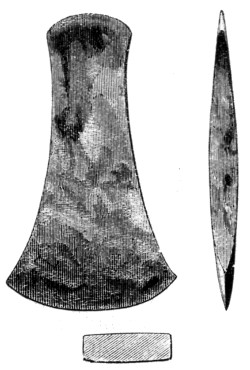
Fig. 18. ½
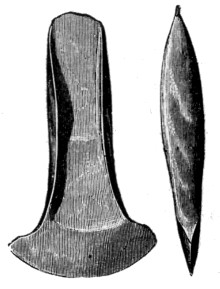
Fig. 19. ½
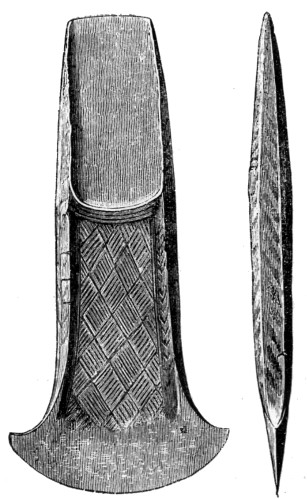
Fig. 20. ½
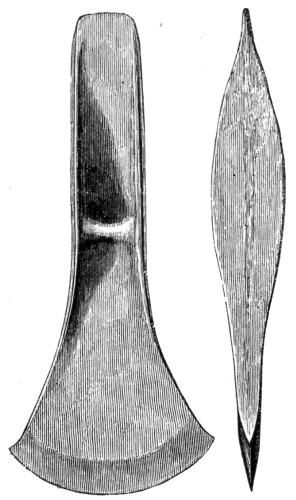
Fig. 21. ½
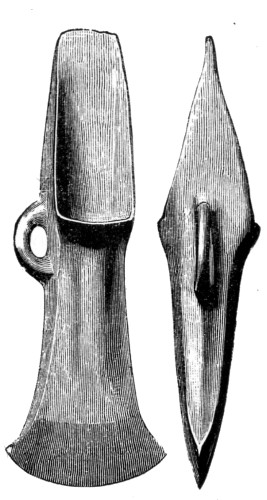
Fig. 22. ½
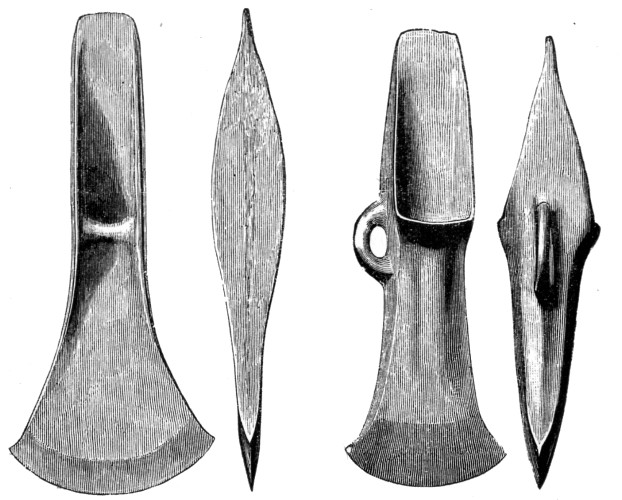
Fig. 23. ½
The earliest British celts were copied not from stone models but from foreign ones of bronze;565 and our winged celts and palstaves resemble certain French specimens so closely that they too were probably modelled in the first instance upon the latter.566 The socket also was invented by some ingenious foreign cutler;567 for palstaves with the wings bent over are rare in this country, whereas socketed celts with ornamental wings are common.568 Socketed celts were apparently never widely diffused in Northern Britain; and of course even in the south they did not altogether displace palstaves.569 Even after they began to be manufactured here the output was supplemented by importation from Gaul: a certain type, the blades of which, instead of expanding, are long and narrow, and the sockets almost square, occurs frequently in North-Western France and our southern counties, but very seldom in the north.570
Bronze celts in general, like those of stone, were doubtless used for various purposes—as hoes, hatchets, and possibly battle-axes—and some, which are very narrow or very small, as chisels.571 Palstaves were sometimes used, as their name would suggest, in the construction of earthworks.572
Sickles.
Sickles probably originated in Southern Europe. The few early specimens that have been found here have their closest analogies in France and Denmark; but, for some unknown reason, socketed sickles are almost peculiar to the British Isles.573

Fig. 24. ½
The Arreton Down hoard.
A hoard was found early in the eighteenth century on Arreton Down, near Newport in the Isle of Wight, which helped to illustrate the evolution of bronze weapons. Daggers, which differed from knives principally in size, though they began to be manufactured later, were originally hafted with rivets; but afterwards they were cast with tangs or shanks, which were let into the handle, and fastened by a single rivet.574 The Arreton Down hoard contained nine tanged blades, which closely resemble daggers but may have been spear-heads. Many similar blades have been found since, but hardly any outside the British Isles.575
Halberds.
From daggers were derived a class of weapons very rare in this country, called halberds, which in Scandinavia and Northern Germany have been found mounted as battle-axes. Heavier and broader than their prototypes, they were often made of nearly pure copper, which rendered them less brittle and more suitable for dealing heavy blows.576
Shields, swords, spears.
Swords, shields, and, with certain exceptions, spears and javelins were not manufactured until the latest period of the Bronze Age. Swords and spear-heads required great skill in casting: shields were so thin that they could not be cast at all, but were wrought by the hammer.577 Even at the close of the Bronze Age they were probably unobtainable except by the rich, while the rank and file doubtless still made shift with bucklers of wicker-work, wood or leather. The shields of the Bronze Age were invariably circular. Nearly all were ornamented over their whole surface with concentric rings, of which one example has as many as thirty, separated by circles of small studs; and this ornamentation is peculiarly British. One curious shield, found in the Fen country, is adorned with serpentine lines, which may have been intended to represent snakes.578
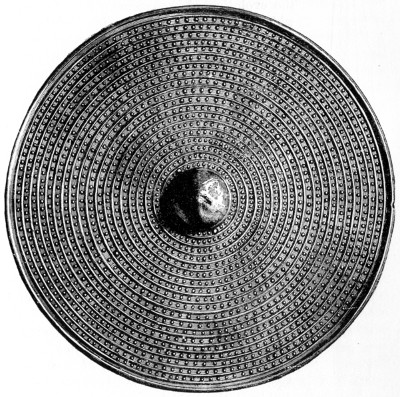
Fig. 25. ⅙
British bronze swords, like those of the Continent, from which they were copied, are commonly of a type which is called leaf-shaped, the blade tapering gently inwards from the hilt, then gradually expanding until, at about one-third of the distance, measured from the point, it attains its greatest width. They, as well as certain rapier-shaped swords, were intended for stabbing, not striking. Their length was generally about two feet, but varied between sixteen and thirty inches. Their sheaths were as a rule made of wood or leather, which, however, were often tipped with bronze; and many of these tips or chapes have been found in the Thames and elsewhere without the scabbards, which had perished.579

Fig. 26. ¼
The spears of the earlier Bronze Age were identical with neolithic flint weapons. Probably the earliest bronze spear-heads were some of the larger blades that have been found in Wiltshire barrows, which are commonly described as knives or daggers.580 Others were derived from the tanged blades of the Arreton Down type, if, indeed, the latter were not themselves spear-heads. A curious and unique specimen, which was found in the Thames at Taplow, and is now in the British Museum, is ornamented with gold studs on the bottom of the blade, which are merely survivals of the rivets that attached to its haft the dagger from which it had been evolved.581 Spear-heads of this kind, which are invariably provided either with a pair of holes in the blade or a pair of loops below it, intended to secure its attachment to the shaft,582 are extremely rare on the Continent, and appear to have been invented in Ireland, whence they spread in the course of trade to Britain.583 Another form of spear-head, which originated in the British Isles and has never been found elsewhere, was barbed, and seems to have been used for hunting rather than in war.584 The commonest, however, is the continental leaf-shaped type, some specimens of which have analogies in Gaul and the Swiss lake-dwellings.585 The smaller weapons of the spear-head class were doubtless javelins.586
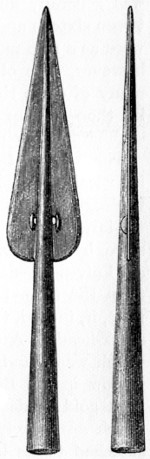
Fig. 27. ½
Moulds.
Many of the moulds in which weapons and implements were cast have been preserved. Open moulds sufficed for flat axes; but the more difficult operations of casting palstaves and socketed celts required that the moulds should be made in halves. All the open ones that remain were of stone; many others, however, were doubtless formed of more perishable materials, such as clay or compact sand. Bronze moulds were also used; but the only specimens which have been found were for palstaves, socketed celts, and gouges. There is a bronze mould in the British Museum that was itself cast in a mould of clay, formed round a model palstave, and attached to it by string, which was of course reproduced in the metal. Leaden celts have once or twice been met with, which of course would have been useless as cutting tools; and it is probable that they were intended simply for making moulds of clay or sand. Bronze moulds were costly, and would soon wear out. It has been suggested therefore that, just as a printer uses in his press not his original wood-block but an electrotype copy, so the bronze-founder generally reserved his bronze moulds for making leaden models from which any number of clay moulds could be formed.587 Sockets were produced by means of clay cores, which were inserted in the moulds. Socketed celts have so often been found in hoards with the cores remaining in them that we may reasonably conclude that they were bartered by the bronze-founders in this state, and that, as in the Neolithic Age, the purchasers finished them with their own hands.588 The hammers and anvils which were used in the final stage of manufacture were commonly stone, though a few light bronze hammers have been unearthed; and the decoration was applied by means of punches.589
Decoration of weapons.
The patterns with which weapons were decorated are worth noticing even by those to whom archaeology for its own sake makes no appeal. Daggers and flat or slightly flanged celts were incised with rectilinear figures and chevrons only:590 winged celts, palstaves, socketed celts, and spear-heads have similar designs in a few instances,591 but for the most part they are ornamented with concentric circles. The significance of these facts will become apparent when we come to deal with certain chronological questions relating to the Bronze Age.592
Hoards.
What we know of the metal-work of this period has been learned mainly from buried hoards which were never recovered by their owners, and of which more than a hundred have been unearthed in Great Britain from Cornwall to Sutherland.593 These hoards were of three kinds.594 Some, consisting entirely of newly-made articles, belong to traders. Others, which comprise damaged or broken goods, and include moulds and often cakes of copper, represent the stock-in-trade of bronze-founders, who tramped over the country-side, and were ready to cast implements or ornaments of the latest fashion and to melt and recast old ones for anybody who could give them what they wanted in exchange. The tools in these collections were for the most part broken intentionally to make them more portable and ready for the crucible.595 Other hoards again, which frequently comprise ornaments, alone or associated with implements, were the property of persons who were not in the trade. Hoards were of course buried when robbers were about or when some marauding clan appeared. By far the greater number belong to the latest period of the Bronze Age,596 which shows that in earlier times the craft had not been specialized, or that people who could afford to buy bronze implements were so few that no travelling dealer could make a fair profit. Those who then possessed bronze tools must have made them for themselves unless there happened to be a skilled craftsman near who could earn a living by working for his neighbours.
The great improvement of tools and weapons would lead us to look for traces of corresponding progress in every department of material culture.
Pasturage.
Pasturage of course continued to be the mainstay of the mass of the population; and although there were probably few households which did not subsist partly upon the chase, the remains of funeral feasts in barrows and the refuse heaps of dwellings show that game was eaten much less than the flesh of domestic animals. It has been said that sheep were not introduced into Britain before the Roman conquest; but excavation has proved that they were bred by the bronze-using inhabitants of Dorsetshire.597 Besides the small cattle that were common in the Neolithic Age large oxen were reared, at all events on Cranborne Chase and the Yorkshire Wolds; and, as in the Neolithic Age and doubtless for the same reason, animals were commonly slaughtered before they had reached maturity.598 Although bronze fish-hooks, almost identical in form with our own hooks of steel, abounded in the Swiss lake-dwellings, and were present in more than one of the hoards that have been unearthed in France, only a single specimen has yet come to light in the British Isles: but it need not be inferred that the Britons had no taste for fish; for they probably caught trout and salmon with nets or spears.599
The growth of population was indeed making it difficult for men to provide for their families; and they were constrained to toil harder in order to avoid starvation. Under Agriculture. this pressure agriculture began to flourish; and wheat was grown at least as far north as Yorkshire.600 Armed with bronze axes, the husbandmen were better able to clear forests and to bring new land under cultivation; and at harvest time, when they reaped their reward, then, we may be sure, the clansmen gathered, and sacrificed to their god, and held high festival.601 Their labours are attested not only by numerous stone mullers and by the sickles that have been already mentioned, one of which was found even in Aberdeenshire, but also, as we have already seen, by the teeth of the skeletons in the barrows.602 Oxen were probably used in ploughing.603 Horses, which were very small, were domesticated, and in certain parts of the country eaten,604 but they were not common; and, although the rock-carvings of Scandinavia and the bridle-bits and wooden wheels that have been found on the sites of Swiss lake-dwellings show that in the Bronze Age men had learned to ride and drive,605 similar evidence is wanting in Britain. Looped bronze plates, however, have been found in a hoard at Abergele, which are supposed to have been a jingling ornament, attached to harness; and some small bells, found at Dowris in Ireland, resemble those which occasionally form a part of modern horse-trappings.606 Oxen indeed, if not horses, must have been required for hauling timber even in neolithic times when clearings had to be made; and the wagons which conveyed tin to the coast when Pytheas visited Cornwall607 had probably been in use long before his time.
Signs of amelioration in the conditions of life.
Certain facts seem to indicate that the conditions of life in the Bronze Age were becoming more favourable to longevity, and in particular that women were better off than before. Famines indeed must still have occurred; for of course there were bad harvests from time to time, and cattle then, as now, were liable to disease, and doubtless often perished in hard winters. But the disparity in stature between men and women was far less than it had been in the Neolithic Age;608 and Thurnam estimated the average age of the people of the round barrows whose skeletons he had examined at fifty-five, eight years more than that of the aboriginals.609 It has been affirmed that even the primitive Aryans often put old people to death;610 but skeletons have been exhumed in Britain which showed signs of extreme age.611
Dwellings.
One might be inclined to suppose that this amelioration was partly due to improved housing; but such evidence as exists tends to show that the habitations of the Bronze Age, although, owing to improved tools, they may have been better built, were designed on much the same lines as those of the preceding epoch. Pit-dwellings, like those which have been already described,612 were still constructed in districts where stone was not obtainable. Very few, as we have seen, can be even approximately dated; but some which have been excavated at Hitcham in Buckinghamshire and in the fort of Eggardun on the Dorsetshire downs contained pottery which made it safe to assign them to the Bronze Age.613 It may be that some of the Scottish subterranean dwellings which are known as weems belong to the same period, for a bronze sword was found in one at Monzie in Perthshire;614 and perhaps a few of the so-called Picts’ houses and of the beehive huts in Cornwall and North Britain, which will be described hereafter, were built before iron was there used.
Lake-dwellings.
It is, as we have seen,615 very doubtful whether any of the lake-dwellings of Britain were older than the Bronze Age; and it cannot be positively affirmed that any were as old. One at Barton Mere in Suffolk, if it really was a lake-dwelling,616 probably belonged to that time, although the only implement found in it was a spear-head;617 but the evidence for the date assigned to the well-known settlement at Holderness is considerably stronger. It has been argued that since both stone and bronze implements were found there, the site must have been occupied before the Iron Age, because, although in a time of transition the old material may persist by the side of the new, implements of two earlier periods would hardly survive into a third.618
Hut-circles.
There is, however, one class of dwellings numerous examples of which have been proved to have existed in the Bronze Age, if not before. The best-known groups of hut-circles are those of Anglesey, Dartmoor, Cornwall, and Northumberland. Sportsmen who have shot snipe in Anglesey must have noticed low mounds dotting the rough wastes which are common in the island. Buried beneath these hillocks lie the foundations of huts which were built in prehistoric times. Most of them are clustered in tiny hamlets of five or six; but at Ty Mawr on the southern slopes of the Holyhead Mountain, sheltered from the cold winds by a precipitous cliff and fortified against attack from below, was a considerable village, comprising more than fifty huts. On a clear day the villagers could discern the Wicklow Mountains; and the triple head of Snowdon, haunted, as they surely believed, by some divinity, closed their southward view. The lower walls of the huts, which alone remain, are about three feet thick, and enclose spaces of from fifteen to twenty feet in diameter, partitioned in one instance by upright stones. The entrance, defined by two pillars, invariably faces the south-west. Stones, blackened by fire and doubtless used for cooking, were found within, and also mullers for grinding corn, and the broken shells of the limpets and periwinkles on which the occupants partly lived. Some of the huts, however, appear to have been simply workshops. They were littered with broken quartz from a neighbouring copper lode: the fire-places, of which each contained two, one having a chimney in the thickness of the wall, were strewn with slag; and mortars and mullers abounded, which had been used not for grinding corn but for breaking stone.619 Possibly the huts may have been roofed with converging stones, laid one above another in the beehive fashion; but some in Northumberland and Devonshire contain central cavities, like those of neolithic pit-dwellings, in which poles for supporting a roof of boughs thatched with turf were apparently fixed.620 Hut-circles everywhere present the same general features; but of course there are numerous varieties of size and construction. Nearly all the huts were round; but a few in East Cornwall are oval;621 and while most of the hamlets were enclosed by walls, some apparently did not need protection,622 or were situated near a fort in which the villagers could take refuge. Grimspound on Dartmoor, the typical example of a fortified village, was apparently the stronghold of the people whose huts were scattered on the slopes hard by; and the dwellings which it enclosed may have been occupied in time of peace only by caretakers.623 Some hamlets were encircled by non-defensive walls, which appear to be the remains of cattle-pens; while in others each pen was connected with its own hut, the walls forming a complex whole.624 Many huts contain cooking-holes, lined with stones, in some of which traces of charcoal are found:625 others had cooking-stones but no holes:626 occasionally the kitchen was in the open air outside the dwelling;627 and in a circle on Whit-Tor, where no provision for cooking was discernible, there seemed to be evidence that the hut had been simply the workshop of a flint implement maker.628 Many of the dwellings on Dartmoor apparently consisted of only one room; while others, like the single specimen on Ty Mawr, contained partitions.629 Some huts were paved, while others had no visible means of excluding damp.630 The large size of many of the Dartmoor circles has led antiquaries to believe that they could not have carried roofs sufficiently strong to withstand the snows and storms of winter, and were only occupied in the summer by herdsmen;631 but in most parts of England huts must have been inhabited throughout the winter, whose roofs were constructed of nothing more substantial than woodwork overlaid with sods or bracken. It is remarkable that not a single bronze implement, weapon, or ornament has ever been found in a hut-circle on Dartmoor, although sufficient pottery of the Bronze Age type remained to attest their age.632 Probably, like the people who dwelt on the Yorkshire Wolds, the inhabitants were poor and backward; for the extreme scarcity of spindle-whorls and the abundance of the flint scrapers used for leather-dressing that lay scattered in their abodes seem to show that they were commonly clad in skins.633
Inhabited camps.
On the borders of Wiltshire and Dorsetshire, and doubtless also in other parts of Britain, small communities erected earthworks for permanent occupation, which differed in size, situation, and mode of construction from the great hill-forts, but were nevertheless adapted to some extent for defence. A considerable number of small entrenchments, approximately square in outline, are scattered over the downs in these two counties; and three of them—Martin Down Camp, South Lodge Camp, and Handley Hill Camp—have been thoroughly excavated. The results left it doubtful whether the last-named had not been constructed in Roman times;634 but the other two belonged unmistakably to the Bronze Age. Martin Down Camp covered about two acres; and South Lodge Camp only three-quarters of an acre. The ramparts, which were very low, were probably strengthened by stockades. Both camps were situated not on the summits of hills but in sheltered nooks, and were probably used as enclosures for cattle; but an abundance of broken pottery, animal bones, and burnt cooking flints proved that they had also been inhabited by man.635
But the evidence for describing the domestic life of our Bronze Age is insignificant in comparison with that which is afforded by the Swiss lake-dwellings. The most remarkable British habitation of that time, indeed almost the only one which can rival those of Switzerland in the richness of its remains, is not a hut, not even an artificial shelter of the poorest kind. In 1859 some quarrymen were removing limestone from a ravine formed by the Stanhope Burn, a tributary of the Wear, when they discovered the now The Heathery Burn Cave. far-famed Heathery Burn Cave. Antiquaries hurried to the spot; and when a layer of stalagmite had been removed relics began to be found. During thirteen years exploration went on; and finally, besides the bones of the family who had occupied the cave, those of the animals on which they had fed, and the shells of mussels, cockles, and limpets, a vast number of tools, weapons, utensils, and ornaments were collected, which belonged to the closing period of the Bronze Age. A pair of bronze tongs, unique in Britain, and one-half of a mould for casting socketed celts showed that they had been independent of bronze founders; and their outfit comprised two swords, seven spear-heads, nineteen socketed axes, two chisels, three gouges, two socketed knives, a tanged knife, a razor, two implements of deer’s horn, three bone knives, a stone spindle-whorl and some flint flakes, fifteen bronze and four bone pins, a bronze cauldron, a gold bracelet, numerous penannular bronze bracelets, including one which was so small that it must have been worn by a little girl, eight large bronze bangles evidently intended to be worn on the upper arm, six bronze disks, whetstones, buttons, and other articles too numerous to mention. Indeed the only bronze objects of any importance which are not represented in the collection are daggers, hammers, sickles, and shields.636 The cauldron, which is shaped like a truncated cone with the broad end uppermost, belongs to a class of vessels which were not made before the close of the Bronze Age, and are exceedingly rare in England, but not uncommon in Scotland and Ireland. It closely resembles one which was dredged up from the bed of the Thames near Battersea, and which may be seen in the British Museum; and perhaps it may have come in the course of trade from Etruria, where the type originated.637 It had been used for cooking, and was associated with numerous fragments of earthenware. The domestic pottery of the Bronze Age, like the sepulchral vessels, was made by hand,638 and, unlike them, was fitted to endure rough usage; but while the collection obtained from the cave and nearly all the other examples that have been found are unornamented, the table ware of Dartmoor hardly differs from that which came from the barrows of the same district and is as elaborately decorated.639 It is also remarkable that many kinds of household utensils—bowls and jars, pans and pannikins, cooking pots, pots for boiling water or meal, pipkins, cups, and strainers—have been discovered in barrows. Some, which were entire, had apparently been deposited instead of regular sepulchral vessels; but many were in fragments, and may have been used in funeral feasts.640
The exploration of the Heathery Burn Cave not only illustrates the life of the Bronze Age; it also shows that even in districts far remote from the Continent the use of bronze was not confined to a conquering people but spread to the descendants of the older population. The skeletons in the cave were wholly different from the types which are associated with the round barrows, and closely resembled those which have been recovered from the beds of rivers in England and Ireland.641
But what is most remarkable is the contrast between the wealth of these cave-dwellers and the discomfort in which they lived. Here was a family well armed, equipped with the best tools of the time, owning flocks and herds, possessing land which they cultivated, and rich enough to load their women with ornaments, yet content to live in a dark damp cavern traversed by a stream, which one night rose in flood and drowned them in their sleep. It has been suggested that they had huts in the neighbourhood, and only resorted to the cave on extraordinary occasions.642 What could have induced them to live in it even for a day is difficult to conceive; but that they inhabited it, if not permanently, at least for long periods, is proved by the abundance of pottery as well as by the heaps of refuse which represented the remains of a long succession of meals.643
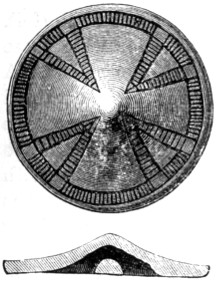
Fig. 28.
Dress.
The spindle-whorls of stone, bone, and baked clay which have been found in this cave, in barrows,644 hut-circles, and elsewhere, and hardly differ from those which, a few years ago, were commonly used in Scottish villages and in many parts of the Continent,645 are not the only relics that bear witness to the development of dress during the Bronze Age. The deer-horn implements which belonged to the cave-dwellers and exactly resemble others that were obtained from the sites of Swiss lake-dwellings, were probably used in weaving.646 Bone tweezers from barrows in Wiltshire and Dorsetshire and bronze tweezers from Anglesey were perhaps designed for drawing thread through holes in leather: but they may also have been used for extracting superfluous hairs;647 and the numerous razors648 that have come to light, some of which have no parallel in any foreign country, show that Britons, even in the furthest north, shaved their beards many centuries before Caesar noticed the custom.649 Leathern garments, as we have seen, were largely worn:650 indeed the remains of a stitched leathern dress have been recovered from a barrow in Northumberland;651 but more interesting are pieces of the woollen and linen clothes in which the dead were sometimes buried.652 Nor was the apparel of the Bronze Age devoid of ornament, or fastened merely with thorns, like that of the Germans of a far later period Pins and buttons. whom Tacitus653 described. Pins of bone or bronze, some certainly worn with dresses, others perhaps in the hair, were not uncommon; and we have seen how large a store was possessed by a single family.654 Even the indigent people of the Yorkshire Wolds wore buttons not only of stone, bone, and wood, but of jet, some of which were beautifully ornamented with the pattern of a Maltese cross.655 During the earlier part of the Bronze Age buttons were pierced on the under side with V-shaped holes, which enabled them to be sewn on to the dress—a device which, on the Continent, was inherited from the Stone Age; and, as far as can be judged from the skeletons with which they are associated, they were used only by men. At a later time the perforation was apparently superseded by a raised loop, which is found on buttons of bronze.656 In Wiltshire and Norfolk chiefs actually adorned their tunics with buttons of gold.657 Ivory buttons and ivory pins have been unearthed in Wiltshire; and amber buttons were among the ornaments not only of that rich district but of Norfolk and even of Yorkshire and Dorsetshire.658 Nor were these costly materials used only for personal adornment. A Weapons mounted with gold or amber. bronze dagger with an ivory handle has been obtained from a barrow near Bere Regis in Dorsetshire:659 an archer’s wrist-guard or bracer of bone, found at Kellythorpe in the East Riding, was decorated with bronze studs, plated with gold:660 a barrow on Hammeldon Down in Devonshire has yielded a dagger hilt of red amber inlaid with pins of gold;661 and from a barrow near Normanton in South Wiltshire Hoare obtained a dagger with a wooden handle exquisitely inlaid in a chevron pattern with thousands of golden rivets, each smaller than the smallest pin. ‘It could not,’ he wrote, ‘be surpassed (if, indeed, equalled) by the most able workman of modern times.’662 With such a weapon hanging at his side and his dress glittering with gold or amber studs, a British chieftain must have made a splendid show. But some were not content with such display. Early in the last century a cairn was opened at Mold in Flintshire, which was said by the peasants of the country-side to be haunted by a ghost in golden armour. Three hundred loads of stones were carted away; and then appeared a skeleton, accompanied by three hundred amber beads that had once formed a necklace, and a golden peytrel, mounted on a copper plate, with which the owner had decorated his horse’s breast.663 This interment indeed belonged to the very latest period of the Bronze Age; but much earlier was the barrow of Upton Lovel in South Wiltshire, which contained along with personal ornaments Ornaments. of gold an amber necklace of a thousand beads that had been worn not by a woman but by a man.664
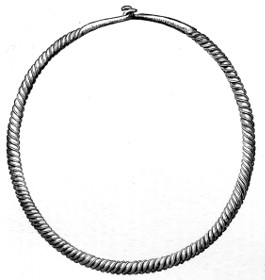
Fig. 29. ½
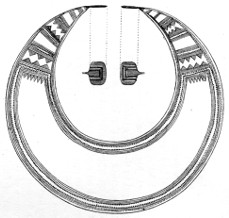
Fig. 30. ⅓
But although necklets and bracelets and other ornaments were commonly worn by knights and Druids in Gaul, their use in this country seems to have been generally restricted to women; and, whatever the reason may have been, the women of Britain, then as now, wore less jewellery than those of foreign countries.665 Still, many specimens, most of which belonged to late periods, are to be seen in the museums which illustrate the culture of the Bronze Age; but for the most part they were either imported or fashioned after foreign designs.666 Bronze ornaments are comparatively rare667 although, as we have seen, the family who lived in the Heathery Burn Cave possessed many, and their armlets are absolutely unique.668 In Scotland as well as in the wealthier parts of England women displayed gold torques of various patterns, some plain, others penannular, which resembled large bangles, others again funicular, of twisted ribbon-like form, or wrought with a pattern like the thread of a screw;669 while gold bracelets in equal variety clasped their wrists; and an ivory armlet has been found in a Wiltshire barrow.670 In 1863 a ploughman, guiding his team at Mountfield in Sussex, turned up a hoard of gold ornaments weighing eleven pounds.671 A hoard buried in Elginshire contained no less than three dozen gold armlets, belonging to the latest period of the Scottish Bronze Age; and an armlet of twisted wires, made to encircle the arm in four coils, which was considered the finest specimen of the goldsmith’s art of this period ever found in Scotland, was cut up and melted down by an Edinburgh jeweller.672 The most interesting, however, of all the Scottish gold ornaments are the crescent-shaped lunettes, worn round the neck, which were of Irish origin, and of which only four English specimens are known.673 They would seem to be of early date; for two were found in association with a flat celt.674 Rings were extremely rare;675 and ear-rings have only been met with in Derbyshire, the East Riding of Yorkshire, and the north of Scotland.676 A pair which was found in a grave in Morayshire can only be described as hideous. They were made of gold, in shape like an open shell or pod, five inches and a half long, and suspended at right angles to the hook.677 Perhaps the most beautiful and characteristic ornaments of the Bronze Age were the jet necklaces, which were very common in Scotland and comparatively rare in Southern Britain, though they were worn in Northumberland, Derbyshire, Staffordshire, and on the Yorkshire Wolds. They generally consisted of flat plates, adorned with chevron or lozenge patterns, and strung together by bugle-shaped beads.678 A similar necklace of quadrangular amber tablets, connected by beads of the same material, formed part of the treasures of a chieftain’s wife in Wiltshire, and was deposited in one of the barrows at Lake, near Stonehenge.679 Amber was indeed the most fashionable of all ornaments in this region, where it was worn sometimes alone, sometimes in combination with jet and with blue or green glass beads. In full dress, with one of these necklaces hanging over her bosom, gold bracelets on her arms, a pair of gold disks, bearing devices like a Greek cross, on her dress, and pins of bronze, which shone like gold, in her hair, a Wiltshire dame must have surpassed even her husband in splendour.680
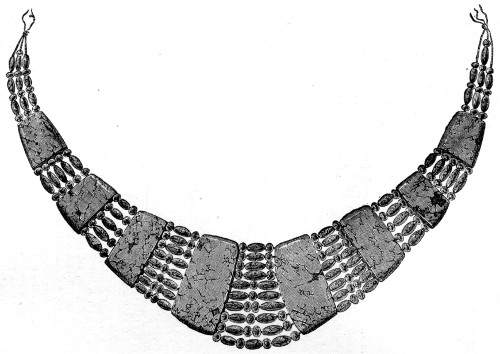
Fig. 31. ½
Those who could not afford such costly ornaments were not always obliged to content themselves with perforated boars’ teeth or bone beads; for, incredible as it may appear, sham jewellery was in vogue even in the Bronze Age. Not many years ago three penannular rings, picked up by a ploughman near Forfar, were found to consist of bronze coated with gold leaf.681
Distribution of wealth: sources of gold, ivory, and amber.
While these things help us to realize the circumstances of the people who wore them, they also throw light upon the distribution of wealth, and supplement the information which we have already obtained from implements and weapons about internal trade and foreign commerce. Possibly some difference of burial customs may account for the comparative abundance of gold ornaments in Scotland and the almost entire absence of trinkets of any kind in Cornwall; but the evidence is generally accepted which seems to point to the conclusion that the inhabitants of Wiltshire—especially of Salisbury Plain—were richer than those of any other part of Southern Britain. The most expensive ornaments—amber, gold, ivory, and glass—have been found there in considerable numbers; and all of them must have been imported, directly or indirectly, in some cases from abroad. The glass beads, which, strictly speaking, were made of vitreous paste, perhaps came from the Mediterranean; and a blue one of real glass with yellow spirals, taken from a Ross-shire barrow, had its counterparts in the cemetery of Hallstatt.682 Where the ivory was procured is doubtful: objects of this material, apparently made from the fossilized tusks of a mammoth, lay among the relics in the Paviland Cave in Glamorganshire;683 but most of the mammoth tusks in this country are too decomposed to be susceptible of manufacture.684 Gold has been obtained from most of the alluvial gravels in the West of England that have been worked for tin;685 but many of the English and perhaps all the Scottish gold ornaments were made of gold that had been won in Ireland, which has been justly called the El Dorado of the ancient world. Many gold ornaments in Denmark are of Irish origin; and the leading archaeologist of Scandinavia affirms that the metal-workers of his own country and of France imported Irish gold.686 Amber has been washed ashore at Deal and on other parts of the east coast; and the necklaces of Wiltshire may perhaps have been generally of British material as well as of British workmanship:687 but those of Ireland were probably made from amber that had come from Scandinavia,688 and may have been taken in exchange for gold. In the time of Augustus amber was one of the British imports;689 and, although at least one necklace found its way even to Orkney,690 its rarity in Scotland and in the northern counties of England suggests that it was imported even in the Bronze Age.691 Indeed, since amber was so much commoner in Wiltshire than elsewhere, it would seem probable that it came generally from abroad.692
Why was Wiltshire exceptionally rich in ornaments?
But why was it so abundant in Wiltshire? Why are gold, amber, and ivory rare even in the other southern counties, and wholly absent in Derbyshire, where round barrows are so numerous?693 Why was the wealth of Wiltshire, so far as it can be estimated from the evidence of the graves, almost entirely concentrated in the south, and especially in the district round Stonehenge?694 The modern population of South Wiltshire is very scanty: Salisbury Plain is barren; and the only soil at all fertile is in the valleys of the Wiley and the Avon.695 One would have expected to find that the wealthiest part of Britain was the south-east; and that in the prehistoric period, as in the time of Caesar, the richest of all was Kent. Yet Kent has yielded very few glass beads or gold ornaments of the Bronze Age, and not one of amber or ivory. Doubtless there were once many barrows in the south-eastern counties which have been rifled or ploughed down; but jewellery was not deposited only in barrows; and so many bronze tools and weapons have been found in this region that the scarcity of barrows will not account for the rarity of ornaments. No explanation, so far as I know, has ever been offered; and I offer one with diffidence. First, it is not certain, and indeed improbable, that more than a small proportion of the riches that have been unearthed from the sepulchres of South Wiltshire belonged to families who had lived in the neighbourhood. The prodigious abundance of barrows around Stonehenge can only be explained by supposing that the bodies of chieftains, of their wives and children, were brought from distant parts to be buried there, as to a hallowed spot. Secondly, it is conceivable that the clans which, early in the Bronze Age, settled in South Wiltshire were numerically stronger, better organized, or better armed than their neighbours, and that much of their wealth may have been obtained by plunder.
British trade and the spiral.
Another indication of ancient British trade appears in the geographical distribution of the spiral. This form of decoration, which was common in Egyptian and Aegean art, travelled along the route of the amber trade by the Danube valley and Hungary to Scandinavia, and ultimately reached the British Isles, where, however, it occurs only on stone balls,696 the stones of cists, and megalithic monuments, of which the most conspicuous example is New Grange in the county Meath. The spiral is not found on objects of the Bronze Age in Spain, nor in France except on the dolmen of Gavr’ Inis in Brittany and in a grave in the department of the Aube: in the British Isles it is confined to Scotland, Cumberland, Lancashire, and Northumberland, the north of Ireland,697 and Merionethshire (which may have owed its solitary specimen to Irish influence); and, moreover, in the British Isles and Scandinavia spirals are connected by the same device.698 Scandinavia therefore was undoubtedly the source from which the spiral reached Britain.699
Comparative backwardness of culture in Britain.
Yet while the reader who has been accustomed to suppose that the Britons even of Caesar’s time were mere savages may be astonished to learn that already in the Bronze Age there was commercial intercourse between Britain and the Continent, he must beware of assuming that his forefathers were on a level with the inhabitants of Central and Southern Europe. Our country has long been the geographical centre of the civilized world: in ancient times it was outside the pale. Regular trade did not exist except with Northern Gaul and, probably towards the end of the age, with Massilia and Phoenician Spain:700 such articles of commerce as found their way to Britain from Central Europe were flotsam and jetsam. Long after swords had come into use abroad the Briton’s chief weapon was still a stout dagger: bronze was used here for centuries after iron had been adopted in more fortunate lands; and the glass beads of which the women of Wiltshire were so proud would have been scorned by foreign ladies who compared them with their own.701 Moreover, even in bronze our workmanship never reached the pitch of excellence which the artificers of the north, in their prolonged Bronze Age, were able to attain. Just as the neolithic cutlers of Britain were inferior to those of Denmark, so there is nothing in our museums which can vie with the astonishing splendour of the decorated palstaves and shields, the trumpets and vessels of the Scandinavian region.
The information obtainable from graves.
But we shall be better able to understand the relations that existed between our country and the Continent in the Bronze Age when we have studied the graves, the objects other than weapons, implements, and ornaments that have been found within them, and the rude stone monuments with which they were often associated.
Round barrows, cairns, and sepulchral circles.
We have seen that round barrows were already being erected before the Bronze Age began, and that they were used not only by the round-headed invaders but also by the older population.702 After the close of the Neolithic Age no more long barrows were constructed,703 although some of those which existed were still used even under the Roman occupation;704 nor were the dead buried, except perhaps in certain Cornish cairns,705 in chambers which were intended to be opened from time to time. Thenceforward the graves were cists, commonly made of four stones set on edge, which were closed by a fifth once for all after the corpse or burnt bones had been laid within them;706 or, where no stones could be obtained, holes scooped in the chalk,707 and sometimes even hollowed trunks of trees or real coffins.708 Occasionally, however, the body, burnt or unburnt, was laid upon the ground without anything to protect it from the superincumbent mass.709 When a tumulus was erected, whether it was an earthen barrow or a cairn, its form was usually round and occasionally oval. The change involved degeneration.710 Galleries were no longer required. The chambered cairns of the north gave way to structureless heaps of stone: the chambered long barrows of England with their portals, entrance-passages, and graceful exterior curves were succeeded by mere mounds.711
What would first impress an ordinary wayfarer is the vast number of the round barrows compared with the rarity of those of the older form. The mounds clustered in the immediate neighbourhood of Stonehenge many times outnumber all the long barrows in Britain. Three hundred still exist in an area of twelve square miles; and from one spot hard by the great stones Stukeley counted a hundred and twenty-eight.712 Again, while the long barrows almost always stand on conspicuous hills, round barrows are sometimes placed on low ground.713 In certain maritime districts, for instance Cornwall and Brittany, it has been noticed that the monuments of the dead are most thickly strewn in the extreme west, as if the builders had desired that the spirits of those who had gone before them might look upon the setting sun.714
The material, it need hardly be said, varied according to the resources of the district. In Scotland, Wales, and Cornwall cairns are almost universal, some being of gigantic size. In 1876 a cairn in Fifeshire was opened; and after more than a thousand cartloads of stones had been removed, a solitary cist appeared, containing one interment.715 Sometimes, however, mounds of various kinds coexist in the same region: thus in Devonshire we find round barrows, cairns, and small central cairns covered by round barrows.716 In other counties again barrows made of earth, of chalk, and of earth and chalk mixed may be seen close together.717 Curiously enough many barrows on the Yorkshire Wolds were constructed of clay which had been fetched from distant places.718
Round barrows range in diameter from twenty to one hundred and fifty feet; and while some are even now twenty-four feet high, others barely rise above the level of the surrounding ground.719 Those of the oldest form, which, however, continued to be erected contemporaneously with others of later types, have some resemblance to a shallow inverted bowl. More than three-fourths of the Wiltshire barrows belong to this variety, which is also prevalent in Yorkshire and almost invariable in Derbyshire, Dorsetshire, Somersetshire and the Orkney Islands.720 These mounds are occasionally surrounded by shallow ditches, in which cases they represent a transition to the form which is called bell-shaped.721 Barrows of the latter kind, which stand on a flat area surrounded by a ditch, but not by a bank, and are larger, steeper, and more conical than those of the primitive form, are far more numerous in Wiltshire, and especially round Stonehenge, than elsewhere; although a few exist in other parts of Southern England, and some of the so-called bowl barrows in the East Riding can hardly be distinguished from them.722 Latest of all were the disk-shaped barrows,—small mounds standing alone, in pairs, or in groups of three, within a circle defined by a ditch, which is fenced on its outer side by a bank. Occasionally the enclosure contains no mound at all, but only a grave dug out of the chalk; on the other hand, in one instance the whole area within the ditch is covered by a low mound. Disk barrows are commonest near Stonehenge, and outside Wiltshire they are hardly to be found except in the adjoining corner of Dorsetshire, on the Cotswold Hills, in Sussex, and, though rarely, in Derbyshire. As they contained ornaments more frequently than the other kinds, it has been supposed that they were specially devoted to the interment of women;723 but we may accept the explanation that, like the barrows, the ornaments for the most part were comparatively late.
The significance of the ditches and banks has puzzled many antiquaries. There are barrows close to one another, some of which are surrounded by ditches, while others have none; while in districts in which stone is abundant there are barrows enclosed by or enclosing small circles of stones, and others which have neither one nor the other.724 Perhaps the barrows enclosed by circles are comparatively late, and the stones may sometimes have been intended, wholly or in part, to give form and symmetry to the mound; for in Derbyshire, where the barrows of the Bronze Age are really cairns, a structural improvement was made by building up the whole mound of concentric rings of stones.725 Again in Wiltshire ditches and banks are invariably complete;726 whereas on the Yorkshire Wolds banks and ditches or circles of stones are generally incomplete; and this characteristic, which belonged, as we have seen, to certain long barrows,727 is repeated not only in megalithic circles in the British Isles and in India, but also in rings which are carved on rocks and on the covering stones of cists.728 It has been suggested that the banks and stone circles were intended to bar the exit of the dreaded spirits of the dead;729 but if this was the purpose of the builders, why did they leave the barrier imperfect? It is possible that their motive was not superstitious but utilitarian: the break may simply have been a causeway intended to give access to the barrow.730
Round barrows and cairns, like long barrows, are commonly supposed to have been erected only as memorials of chiefs, their relatives, and perhaps their honoured retainers;731 for, it is said, no humble family would have had the needful command of labour: but considering that in Wiltshire, where there are more long barrows than in all the rest of Britain, round barrows are thirty-four times as numerous,732 it is difficult to accept this opinion. Many of the round barrows are small; and it is surely probable that the poorer clansmen sometimes voluntarily gave their services to provide respected members of their own class with a distinctive monument. Barrows and cairns, however, are not the only sepulchres in which interments of the Bronze Age have been discovered. A cave at Gop, near Rhyl, which had been used as a dwelling, contained a sepulchral vault;733 and Rains Cave in the same county was used alternately as a dwelling and a cemetery.734 Many graves also exist over which no mound was erected.735 Thus on Handley Down in Dorsetshire no less than fifty-two interments of cremated bones were found in holes dug out of the chalk on the western side of a barrow. They were evidently later than the funeral in the barrow itself, and were doubtless the remains of the descendants or connexions of the chief who had been buried there.736 In Scotland numerous cemeteries, most of which were on knolls or sandhills, were unmarked by any external sign;737 and at Elton, near Beverley, in the East Riding, more than seventy bodies were interred without a barrow.738 It has been supposed that such graves belonged to the poor and lowly; and doubtless where they occur in large numbers and are almost or entirely devoid of accompanying relics the assumption is justified.739 In certain cases also, where one or two large barrows are associated with groups of tiny mounds, the latter were devoted to the humbler members of the tribe. Two of the Scottish cemeteries, however, contained gold armlets, others beautifully ornamented bronze blades;740 and three of the only four graves in which Pitt-Rivers found the sepulchral vessels which are known as drinking-cups lacked any memorial.741 These may have been the graves of men of rank; and so may the simple stone cists, in which relics have been found that would seem to have belonged to persons of some wealth;742 for while every cist that has been observed in Devonshire either is or was once covered by a mound,743 there are many in Northumberland, as in Scotland, which were left without any monument.744
Perhaps the most curious of all the burial grounds of the Bronze Age is one which has been lately explored at Bleasdale in Lancashire, and which may be compared with the wooden chamber in the neolithic Wor Barrow on Cranborne Chase.745 Here, on a moorland knoll surrounded by an amphitheatre of hills, is a circle made not of stones but of wooden logs closely planted in a trench, and containing a smaller circle, which consists of a bank with a ditch on its inner side. Within this ditch is a low mound, concealing another circle of logs, in the centre of which were found two sepulchral urns. The ditch is floored with poles, which may perhaps have been trodden by worshippers who walked in ceremonial procession around the grave; for the bottom of a ditch surrounding a barrow near Blandford, which was opened towards the end of the last century, was worn into a smooth track by human feet.746
Hardly less remarkable is a circle near Port Erin in the Isle of Man, formed of eighteen cists, in six separate sets, each composed of three arranged in the shape of the letter T, two being placed end to end along the circumference, while the third extended outwards at right angles.747
In Britain, as in other countries, cenotaphs were erected in honour of the dead whose remains could not be found. Barrows have been opened within which, after the most careful scrutiny, not the faintest indication could be detected of any burial, although in one there was an empty urn and in another a small stone pavement, enclosed by a miniature stone circle and resting upon burnt earth, which suggested that an ideal cremation had been performed.748 It seems possible that Silbury Hill was a monument of this sort. This stupendous earthwork, which commands the Bath road, six miles west of Marlborough, is one hundred and thirty-five feet high and covers about five acres. The cost of its erection at the present day would be not less than twenty thousand pounds.749 In 1777 a shaft was sunk from the top to the bottom; and in 1849 a tunnel was driven from the side to the centre. No trace of burial was found:750 but even primary interments were not always made at the centre of a barrow; and the labour of proving, if it could be proved, that Silbury Hill was not erected over a grave would be out of all proportion with the result. At all events its purpose was connected with sepulchral usage. Recent excavations in the meadow west and north of the hill are believed to have shown that it was originally surrounded by a trench, which was filled with water; and a local antiquary has suggested that the mound was an artificial stronghold!751 But what clan would have undertaken this herculean labour in a district where every hill was suitable for defence, and of what use would the mound have been for such a purpose?
Chronology of the barrows.
The chronology of the barrows is somewhat perplexing. There is hardly a single absolutely certain instance in which a socketed celt, a sword, or a socketed spear-head has been found in a barrow, associated with an interment;752 and most antiquaries infer that the round barrows generally belong to the earliest period of the Bronze Age.753 It would follow that during not less than four or five centuries the practice of raising mounds over graves was discontinued, and one could only wonder how it came to be revived at the beginning of the Iron Age. It has indeed been argued that the absence of swords is no proof that they were not used when barrows were being erected, but merely shows that it was not customary to bury costly weapons which were not habitually worn.754 It seems difficult, however, to explain why a distinction should have been drawn between swords and socketed celts, on the one hand, and knives, daggers, and awls, which were often buried, on the other.755 Some may accept the suggestion that in the later period of the Bronze Age, when cremation had presumably become general, the practice of burying weapons or ornaments had ceased;756 but in the Early Iron Age it was not uncommon.757 It would seem, moreover, that in one or two instances socketed weapons were laid with the dead;758 and Dr. Arthur Evans, pointing out that an amber necklace, found in one of the barrows near Stonehenge, is identical in form and arrangement with the amber necklaces of Hallstatt, boldly affirms that the disk-shaped barrows of Wiltshire belong to the end of the Bronze Age.759 Be this, however, as it may, it is morally certain that some of the glass beads which abounded in the graves of South Wiltshire were contemporary with socketed weapons; and a competent antiquary, who has diligently examined their associations, concludes that they belonged to the eighth and seventh centuries before the Christian era.760 Moreover, an earthenware vessel of the kind which are called incense-cups, found in a barrow at Bulford, near Amesbury, was ornamented with concentric circles;761 and, as we have seen,762 this form of decoration, which is common on the covering stones of cists in Scotland and in the north of England,763 is also characteristic of socketed celts and unknown on implements of earlier date. The number of celts which have been found in barrows is so small that it would be premature to lay stress upon the fact that only one belonged to the socketed type;764 and there may have been some reason, of which we are ignorant, for the absence of spear-heads and swords. In Gaul, at all events, relics belonging to every phase of the bronze culture have been exhumed from burial mounds.765
Cremation and inhumation.
In the Bronze Age, as in the period of the long barrows, both cremation and inhumation were practised in Britain. In Cleveland and on the coast between Scarborough and Whitby cremation was almost invariable:766 in Northumberland nearly twice as common as inhumation.767 In Derbyshire,768 on the other hand, inhumation interments are slightly commoner than those by cremation; and on the Yorkshire Wolds more than three times as numerous.769 In Wiltshire and Dorsetshire inhumation is as rare as cremation on the Wolds; and in Gloucestershire, Devonshire, Cornwall, Merioneth, Carnarvon, and Denbigh cremation is practically universal.770 In Devonshire interments by inhumation have been found, but never in barrows.771 In Scotland the numbers are about equal.772
Archaeologists generally hold that cremation was not practised in the Bronze Age until a comparatively late date,—probably not before 1000 B.C.; and this view seems at first sight to be supported by the facts that it was unknown in Scandinavia in the earlier period;773 that cinerary urns were not the earliest of the sepulchral vessels; and that drinking-cups, which were in use before any of the others, although they continued to be used after cinerary urns had been introduced,774 are generally found with unburnt skeletons, and have never been found with the cremation interments in Cleveland.775 On the other hand, in Brittany in the centuries which immediately followed the introduction of metallurgy cremation was almost invariable;776 burnt bones, as we shall presently see, were often buried without urns; and since cremation was not uncommon in the Neolithic Age, the custom probably persisted into the Bronze Age independently of its introduction by immigrants who possessed weapons of bronze. Indeed, unless cremation existed from the very beginning of the Round Barrow period, it seems impossible to account for the fact that in the sepulchres of certain districts not a single instance of inhumation has ever been observed. Before the inhabitants of Bute emerged from their Stone Age they practised both cremation and inhumation; and there is no evidence that the latter was earlier than the former.777 Not infrequently both in Scotland and in many parts of England skeletons and burnt bones reposed under the same cairn, in the same barrow, within the same stone circle, even in the same cist; and in some cases they were buried at the same time.778 A cairn has been opened at Greenhill in Fifeshire, in which four different modes of sepulture had been practised: cremated remains had been laid in the earth, and beneath a stone slab; an unburnt body had been buried in a cist, and another lowered into a pit.779 In some barrows one unburnt body has been found accompanied by several deposits of burnt bones; and it has been inferred that, even after cremation had become general, the bodies of chieftains were very rarely burned, although those of their wives and retainers were.780 It is possible that this distinction may sometimes and in some places have been maintained; but obviously it was very unusual. For otherwise we should be compelled to suppose that in Cleveland and in those western districts in which cremation was universal no chiefs were buried in barrows at all, although it is universally admitted that it was in their honour that barrows were erected. And if the presence of an unburnt body surrounded by urns is a sign that wife and dependents were sacrificed in honour of the dead chief, what conclusion is to be based upon the association of nine skeletons with a single cremated interment?781 On the Yorkshire Wolds the question as to which method should be adopted had nothing to do either with rank or sex or age;782 and one may reasonably suppose that it was often settled simply by individual preference. Moreover, the expense of cremation was far greater than that of inhumation;783 and it is not improbable that long after the former had become prevalent among the wealthy the poor were generally obliged to content themselves with the latter.
Inhumation was accompanied by many varieties of usage. Most of the Wiltshire barrows contained only one interment, though in a few—evidently family tombs—there were two or even more.784 Those of the Yorkshire Wolds, on the other hand, generally contained several, two or three having sometimes been laid in one grave; and where one only was found the barrow was of the conical kind which is common in Wiltshire.785 In the Scottish cists also, single burial is the rule, though occasionally husband and wife were interred together, and sometimes a father with his child.786 The same variety has been noticed in connexion with cremation: a group of eight barrows in Lincolnshire contained one urn each, while inside a barrow in Dorsetshire was found a cairn which covered nearly fifty interments.787 When a mound was erected, the primary interment was generally made in the centre.788 The body was almost always laid in the crouched position. In Wiltshire this custom was absolutely, and on the Yorkshire Wolds almost, universal: the same posture indeed was commonly adopted there even when the body was cremated.789 In Dorsetshire, on the other hand, the extended position appears to have been occasionally met with.790 When secondary interments have been found, they were generally on the surface of the barrow or just outside it, and were covered with fresh material.791 There is a barrow on Lord’s Down in Dorsetshire, formed of alternate layers of mould and chalk, which represent no less than five successive interments, each of which was covered by a new tumulus.792 Almost invariably on the Wolds secondary interments were made on the southern or eastern side of the mound, doubtless in order that the dead might face the sun; and this fancy underlies the prejudice, which still exists, against burying on the northern side of a churchyard.793 Probably the same purpose is discernible in the orientation of the skeletons. Generally in Wiltshire they were laid with their heads towards the north so that they looked southwards;794 and although in Yorkshire and elsewhere the head has been found directed to almost every point of the compass, yet, as a general rule, it was so laid as to face the sun: thus when it pointed westward or to the north or south of west, the body was commonly laid upon its right side; when to the east or the adjacent points, upon the left.795
It is probable that bodies were generally interred either in the clothes which had been worn in life or in a winding-sheet; for at Kelleythorpe in the East Riding a linen cloth was underlying a skeleton: bones have been found in divers parts of Britain with fragments of woollen or leathern fabrics clinging to them; and buttons in their natural positions on the breast-bone.796 In one instance Hoare found a skeleton in a disk-barrow near Amesbury, lying on the ground, without cist, grave, or coffin, beneath a heap of stones, and quaintly suggested that the dead man had suffered the doom of Achan.797 Occasionally, however, corpses were not buried entire; but, as in the Stone Age, the bones were disjointed and interred separately.798