Chapter IV · (continued 2)
Reading edition
When the dead were cremated the customs which governed the disposal of primary and secondary interments remained the same: indeed in the Lord’s Down barrow the latter comprised both skeletons and burnt bones. The mound was sometimes raised over the funeral pile; but more commonly the ashes were brought to the place of interment.799 Although they were often enclosed in urns, this custom was by no means universal. In the disk-shaped barrows of Wiltshire, in which cremation was almost invariable, urns were very rare: the remains had generally been wrapped in a skin or a linen cloth.800 In Dorsetshire, on the other hand, except in the north-eastern corner, the customs of which closely resembled those of Wiltshire, urns were used three times out of four;801 while some barrows have been opened which contained both urns enclosing burnt bones and burnt bones without any urn.802 Occasionally an urn has been found which, instead of containing the bones, was surrounded by them.803 Sometimes the urn was placed upright; but much oftener, at least in Wiltshire, it was inverted;804 and occasionally one urn was inverted as a cover over another.805 In more than one instance a custom described by Homer had found its way to Britain: the urn which contained the ashes of Patroclus was wrapped in a cloth;806 and in a barrow in Cambridgeshire, as well as in six of those which Hoare opened, the same ritual was observed.807 In several Scottish graves tiny urns, containing the remains of infants, were placed inside vessels of ordinary size;808 and it is remarkable that in a few instances empty cinerary urns have been found in association with unburnt bodies.809 Why urns were sometimes broken into fragments before they were placed in the grave it would be vain to guess.810
Sepulchral pottery.
The urns and drinking-cups which have been so often mentioned were not the only kinds of sepulchral pottery. Besides them were bowls which have been called food-vessels and incense-cups. The custom of placing vessels in graves was not, however, universal: both in Wiltshire and in Yorkshire the majority of interments were without them.811 All four kinds are worth studying, not only as illustrative of funeral customs, but also because they throw light upon the origin of the round-headed invaders and upon the intercourse which subsisted in the Bronze Age between Britain and other lands.812
Like the domestic pottery of the same period and of the modern inhabitants of the Hebrides, they were generally made by women: the markings, produced by the impression of finger-tips and finger-nails, with which they were often ornamented, were the work of small hands.813 The potter’s wheel, which, more than two thousand years before the Christian era, was used in Hissarlik, the town on whose site Troy was afterwards built, was as yet hardly known in Britain,814 and the British pottery of the Bronze Age was baked at open fires.815
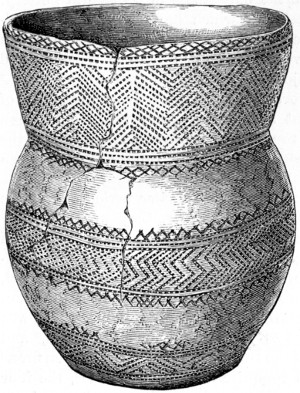
Fig. 32. ½
Although they all comprise numerous varieties, the four groups are so distinct that an observant eye, after an hour spent in a well-stored museum, or even after studying the illustrations alone, would be able, in almost every instance, to assign this or that specimen to its proper class. Drinking-cups are generally about seven or eight inches high, and fall under three principal types. That which is apparently the earliest and, in Southern Britain, by far the commonest, is globular in its lower part, and rises from the waist into a high brim with straight sides. In cups of the second class an oval body passes into a brim which curves outward. The third kind, almost all the examples of which belong to Northumberland and Scotland, and which, from its accompaniments, would seem to have been the latest, is also somewhat oval in the lower part, and has a very low and more or less straight brim. A few high-brimmed cups have handles, and are not unlike modern tankards. Drinking-cups in general are the handsomest and the most skilfully baked of all the British sepulchral vessels; but in course of time their forms gradually deteriorated, for each generation had inferior models to copy.816
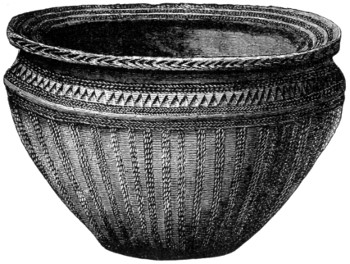
Fig. 33. ½
Food-vessels, which range between three and eight inches in height, are very diversified in form, and, unlike drinking-cups, vary greatly in quality. They commonly resemble a large cup or bowl with a narrow bottom, and sometimes they are slightly contracted towards the mouth. Many of them have knobs round the neck, which are sometimes perforated, so that they might have been suspended by a cord; and those which have no perforations are doubtless mere survivals.817
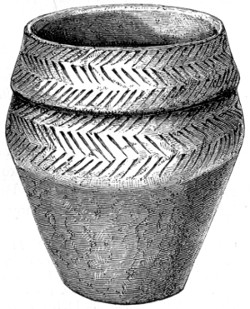
Fig. 34. ½
Cinerary urns, which were certainly introduced later than food-vessels or drinking-cups, are as a rule much larger, although one or two have been found which were as small as the smallest incense-cup. Many of them are more than two feet high. The commonest form resembles a double truncated cone with the base in the centre, the upper being much the smaller of the two; but some urns are cylindrical, barrel-shaped, or even like flower-pots; while a few, which are peculiar to central Dorsetshire, are nearly globular, and, except for the scantiness of their ornament, not unlike certain drinking-cups.818
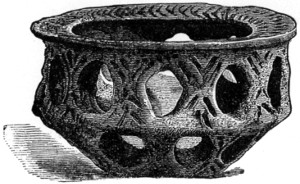
Fig. 35. ½
Incense-cups are the smallest, perhaps the latest of all sepulchral vessels, and the most various in form. Some contract from the centre towards the top and the bottom; others expand, others again contract from the bottom to the top. A few resemble saucers in shape; and many are perforated with oval, lozenge-shaped, or vertical holes, one example having as many as twenty-seven.819
Drinking-cups have been found on the Continent not only in Germany, Gelderland, and Denmark, from which countries, it should seem, they were introduced into Britain, but also in Spain, Portugal, Brittany, and the Channel Islands.820 On the Continent they all belong to the Neolithic Age; and this fact alone is sufficient to show that the people who brought them into Britain had no bronze implements.821 Moreover, although they continued in use in this country during a considerable part of the Bronze Age, they have rarely been found with bronze.822 Only two specimens have been obtained in Ireland,823 an additional indication of the erroneousness of the theory which identifies the earliest round-headed invaders who introduced drinking-cups into Britain with the Goidelic Celts. Like food-vessels, drinking-cups were receptacles for solid food or perhaps some kind of porridge; for remains which have been proved by analysis to be animal or vegetable have been found in both.824
Food-vessels are unknown outside the British Isles, and are frequent in Ireland,825 while hardly a single specimen has been found in any of the numerous barrows of Wiltshire or Dorsetshire.826 Like drinking-cups, they accompany skeletons far more frequently than burnt bones;827 and they were obviously invented after drinking-cups had been some time in use, though, as it would seem, while incense-cups were still unknown.828
Incense-cups, like food-vessels, are common in Ireland as well as in Britain: a few have been found in the Channel Islands; but on the Continent they do not exist. They, too, are rare in Dorsetshire and the western counties,829 although cremation was even more prevalent there than in Wiltshire, where they are numerous, and although they have hardly ever been found except with cremated remains.830 It is remarkable that they were often deposited inside the urn and among the burnt bones.831 The purpose for which they were designed has been a subject of much controversy. It is difficult to believe that they were really censers, for incense was probably not obtainable in Britain, though amber, which has occasionally been used as incense, may possibly have been burned in them. The numerous holes with which so many of them are pierced, and which would have stimulated combustion, might suggest that they were intended to carry the sacred fire from which the funeral pile was to be lighted; but as many specimens contain no holes it is impossible to acquiesce in this explanation.832
All these vessels were ornamented with the geometrical decoration characteristic of the Bronze Age, which consists for the most part of combinations of straight lines, arranged in almost infinite variety—chevrons, zigzags, lozenges, and the herring-bone pattern—as well as dots and what have been called oblong punch marks, and, in a few cases, crosses, curves, and even circles. The patterns were impressed upon the clay while it was still wet by a pointed implement of bone or wood, by cords, and occasionally, as we have seen, by finger-nails or finger-tips. Some of them may have been imitated from basket-work or from the plaited straw or grass with which the fragile vessels were protected; for Pitt-Rivers found on his estate a fragment of fine basket-work over which clay had been plastered on both sides. As a general rule drinking-cups and food-vessels are far more profusely ornamented than the other kinds, both being in many cases covered with decoration.833 Except perhaps in the case of drinking-cups, it is doubtful whether any useful conclusion can be drawn from the patterns; for, although the oblong punch marks are apparently peculiar to the British Isles,834 chevrons of divers kinds have been found in nearly every country of Europe, as well as Africa, Madagascar, Siberia, Ceylon, the Philippine Islands, and North Australia.835 Indeed one form of chevron ornament—the so-called diaper pattern—appears not only on French neolithic pottery and on urns from a chambered cairn in Orkney, but also on a palaeolithic implement from Brassempouy;836 and the rude hand-made bowls out of which the modern Hebrideans eat their porridge are still ornamented, as they were three thousand years ago, with straight lines made with a pointed stick or with impressions of a thumb-nail.837 On the other hand, as chevron patterns characterized the Bronze Age throughout Europe, although they occurred both earlier and later, further research may ultimately show that they had a common origin.838 The supposition that concentric circles—a form of ornament which, as we have seen, is also characteristic of the shields of the Bronze Age—were generally symbolical of sun-worship,839 is hardly likely to be proved. Probably in some cases they had this or some other religious meaning: but in others they may have been purely decorative; and they are to be seen on the churingas or sacred stones of the Aruntas of Central Australia,840 who, it need hardly be said, do not worship the sun. More interesting are the few vessels which bear incised designs inlaid with white earth, and resemble, though in a ruder style, pottery from the lake-dwellings of Switzerland and Austria and from Hissarlik.841 It is conceivable that this kind of decoration may have arisen independently in the different lands in which it has been observed: but the most sceptical would hardly deny the evidence of indirect connexion with the Aegean which has been furnished by the famous chalk The ‘drums’ of Folkton Wold and their significance. ‘drums’ of Folkton Wold. Associated with the body of a child in a trench which partially surrounded the barrow were three solid drum-shaped cylinders of chalk, decorated not only with familiar geometrical designs, but also with concentric circles, which in one case seemed to be degenerate spirals, figures called ‘double horse-shoes’, which occur at New Grange and at Gavr’ Inis in Brittany, and quaint representations of the eyes and eyebrows of the human face, closely resembling the so-called owl-heads which Schliemann found on vases at Hissarlik. Similar faces are sculptured on standing stones and the walls of sepulchral grottoes in the departments of the Marne, the Gard, and the Tarn, and incised on Spanish pottery of the early Bronze Age; and probably it was by way of Spain that this Mediterranean influence found its way to a remote Yorkshire moor.842
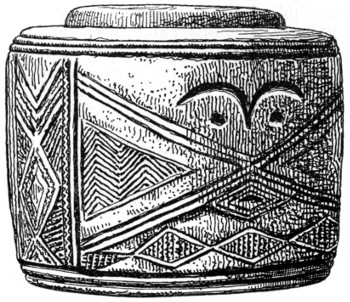
Fig. 36. ⅔
Sepulchral evidence as to religion.
We have already examined the evidence which the articles deposited in graves afford as to the wealth and social condition of the people who were buried there. They also suggest problems connected with their religious faith. The custom of depositing implements, weapons, or ornaments with the dead was the exception rather than the rule. Less than one-fourth of the interments in the Yorkshire Wolds were associated with any article whatever; and even in South Wiltshire barely two-thirds. In Derbyshire and Scotland relics were comparatively frequent, but by no means universal; in Cornwall almost entirely absent.843 When we find that daggers were often placed in the hands of corpses844 and that nearly all the flint tools on the Wolds were brand-new,845 we may be disposed to reject the theory that the motive of those who deposited them was simple affection or superstitious dread of using what had belonged to the living; but when, on the other hand, we remember that so many of the dead were left destitute, we ask ourselves whether the articles that were placed in graves were really intended to be used in a future state.846 But it is a mistake to expect either uniformity of custom or rigid consistency. Different tribes and different individuals may well have had different beliefs; and it is not likely that belief was always translated into action. Articles that belonged to the living have sometimes been buried from mere motives of affection or from a wish to get rid of that which was associated with the idea of death; sometimes from a vague desire to please or to avoid the displeasure of the dead.847 Often, however, as we learn not only from historians, such as Caesar848 and Tacitus,849 but also from the evidence that has been collected respecting the customs of savage tribes, objects have been deposited with the dead in the full expectation that their souls would be of use to the souls of their owners in another life;850 and when not inanimate objects only but wives, slaves, and animals have been sacrificed, it may be safely assumed that this was the motive. Nor is the belief absolutely extinct even in civilized lands. Less than half a century ago the widow of an Ulster farmer killed his horse, and, in reply to a remonstrance, asked, ‘Would you have my man go about on foot in the next world?’851 All these motives may have worked in the Bronze Age. We have seen that offerings of food were placed in food-vessels and drinking-cups; and they may sometimes have been laid beside the dead even when no vessels contained them. The bones of domestic animals, deer, and wild boars which have been found in scores of barrows, and most of which had been pounded for the extraction of the marrow, were doubtless in many cases the remains of the food upon which the survivors had feasted, but perhaps also of food offered to the dead.852 It is possible too that the burnt bones which are sometimes mixed with cremated human bones may be the remains of animals sacrificed at the funeral, and may represent the custom, described by Homer853 and Caesar,854 of slaying animals of which the dead had been fond and burning them on the funeral pile;855 and when we are told that the skulls of oxen were carefully interred in several barrows and that a horse was buried near the summit of a barrow in Wiltshire above a cremated interment,856 we are tempted to accept a similar explanation. We can understand why implements and weapons were often placed inside urns along with the burnt bones;857 but it would be vain to ask why a cow’s tooth was frequently placed in juxtaposition with a corpse;858 and who would venture to account for the presence of the burnt bones of a fox inside an urn in a barrow on Ridgeway Hill in Dorsetshire, of the skeleton of a mole and the bones of mice in an urn in Glamorganshire, or of the skeleton of a hog in a cist in a Staffordshire barrow?859 We can only suppose that these mysterious deposits had some religious meaning.
But whether animals were sacrificed or not, there can hardly be a doubt of the prevalence of human sacrifice. It has been pointed out that several bodies were frequently interred in one barrow at the same time; that in some cases a man and a woman were laid in one grave or in adjoining graves of the same date; and that in a barrow overlooking the valley of the Derwent a woman was buried with a man whose head her hands clasped, while his legs were above hers and his right hand upon her hip; and of these facts one finds it difficult to suggest any explanation save that of sacrifice or of suicide.860 The innumerable potsherds which lay scattered in many barrows when they were first opened, and the minute flint chips with which cinerary urns were sometimes crammed861 remind one of the words in Hamlet:—
For charitable prayers Shards, flints, and pebbles should be thrown on her,
though we should be mistaken if we supposed that in the Bronze Age such offerings were made in the spirit which animated the ‘churlish priest’ who grudged decent burial to Ophelia.862
A distinguished archaeologist has argued that not only in Greece and the Eastern Mediterranean but also in Gaul and Britain inhumation and cremation were associated with different conceptions of a future life; the ghost of the body which was interred being regarded as tenanting the grave, whereas, when cremation was practised, the soul was supposed to take flight to Hades or to some far land, though it could not enter the confines until the body which it had quitted was duly burned.863 But whatever the Mycenaeans and the Greeks may have believed, there is no reason to suppose that in the West cremation was attended with any such doctrinal change. We have seen that both in the Neolithic Age and after, cremation and inhumation were practised contemporaneously and sometimes even in the same grave;864 and recent excavations have shown that in the caves of Mentone, even in the Old Stone Age, the two modes of sepulture were in use.865 If the Celts of the Early Iron Age believed that ‘on the burning of the body the soul departed to a distant region’, there is no proof that their belief was different when they laid the body in the grave; and who will maintain that the religious ideas of the Gauls were revolutionized when in the second century before Christ cremation once more became the rule, or that among the Britons of Caesar’s time cremation and inhumation, which had each their votaries, were the outward signs of religious beliefs that were utterly unlike?866
Engraved stones.
We may perhaps hope to find other clues to the religious ideas of the Bronze Age in megalithic monuments and in the engraved stones which have been already mentioned.867 There are certain designs upon the latter of which the meaning is evident. The figure of an axe graven on a cist at Kilmartin in Argyllshire has many analogues on dolmens in the Morbihan and on the walls of artificial sepulchral grottoes in the department of the Marne; and, as the axe in the Mycenaean Age was a symbol of Zeus, we may suppose that such engravings represented a widespread cult of one of the most fruitful of human inventions, which originated in neolithic times, and survived in the manufacture of miniature celts to serve as pendants and, still later, in the use of stone celts as amulets.868 The most common devices, however, are small circular depressions, called cup-markings, and concentric circles; while occasionally groups of concentric circles are united by grooves. Cup and ring markings are found on the stones of cists, on standing stones, on boulders, and on rocks in most parts of Scotland, in Carnarvonshire and Merionethshire, in Northumberland, Cumberland, Westmorland, Lancashire, Yorkshire, Man, Derbyshire, Staffordshire, Dorsetshire, and Cornwall, and likewise in Ireland, France, Germany, Switzerland, Portugal, Scandinavia, Asia, Africa, and America.869 Natural cup-markings have been noticed on the covering-stones of certain dolmens;870 and it may be that such stones were deemed lucky and that, when they could not be obtained, they were imitated; but of those which are artificial the significance remains unknown.871 The rings may perhaps in some instances be symbolical of sun-worship, for on the cairn of Lough Crew in Ireland and in Scandinavia a few have rays;872 and since we find them on the covering-stones of cists, while in Australia similar designs, drawn on rocks, are magical or sacred,873 it would seem probable that they had some religious meaning.874 Sun-worship undoubtedly prevailed Sun-worship. in certain parts of the British Isles. A few years ago there was found in Zeeland a gold-plated bronze disk, engraved with concentric circles and mounted on a miniature car with the model of a horse attached, which was recognized by all archaeologists as a votive object, connected with the worship of the sun. Similar disks, two of which are ornamented with a cruciform pattern—a well-known solar symbol—have been exhumed in Ireland, and a fragment of one in a barrow near Bath.875 Besides the spirals which have been already mentioned, the most remarkable of all the rock-carvings is a swastika on a rock near Ilkley, identical with one which has been discovered in Sweden, not far north of Gothenburg: the oldest known examples of this mystical figure come from the second city that was built upon the site of Troy.876
Stone circles and other megalithic monuments.
We have seen that many barrows and cairns were immediately surrounded by, or enclosed, rings of standing stones which were part of the sepulchral structure. It is now time to consider the larger stone circles and other megalithic monuments which have occasioned voluminous controversies. They were not invented in the Bronze Age; for, as we have seen,877 some of the long barrows were surrounded by peristaliths: the famous circle of Callernish in the island of Lewis contains a chambered cairn, from which it is structurally distinct;878 and some of our circles which are apparently non-sepulchral may have been set up in transitional times. But the development of the circle, which can be traced most clearly in Scotland, was gradual. In the chambered cairns and chambered long barrows the peristalith as a rule was merely an adjunct: in many unchambered cairns and round barrows the stone setting is still a subordinate part of the whole; but, gradually separating itself, it became the leading feature of the monument, while the central cairn or barrow frequently disappeared, and was replaced by a simple cist.879 By similar stages the encircling trenches and banks in Wiltshire and Oxfordshire became distinct from the small disk barrows which they contained.880
Stone circles are to be seen in the northern counties of England, in Derbyshire and Staffordshire, Shropshire and Cheshire, Oxfordshire, Gloucestershire, Wiltshire, Dorsetshire, Devonshire, Somersetshire, and Cornwall; and also in Glamorganshire, Orkney, the islands of Arran and Lewis, Argyllshire, Perthshire, Inverness-shire, Banffshire, Aberdeenshire, and Kincardineshire.881 Menhirs, or isolated standing stones, and stone rows are found in this island only on Dartmoor, in Cornwall, Northumberland, Scotland, and Wales.882
In form as well as in size British stone circles present numerous varieties.883 It would, however, be useless, at all events until circles of every kind had been excavated, to attempt to account for their distinctive features; and it is significant that, although various districts have types of their own, there are examples of divers kinds in close proximity.884 Many were simple rings. Some consisted of concentric rings; and here and there small circles, each of which was outside the others, were enclosed within a greater. Sometimes the stones were set up in close proximity; sometimes in open order.885 Among circles of the latter kind Stonehenge, Avebury, and Callernish were approached by stone avenues,886 the existence of which has been tentatively explained by the supposition that originally the spaces between the stones of the circle were filled by walls intended to keep out beasts.887 A few circles are surrounded by ditches, which were spanned by causeways; others by both ditches and banks; and it is noteworthy that at Avebury the ditch lies within the bank, while at Stonehenge in the same county it surrounds it.888 In many circles of Banffshire, Kincardineshire, and Aberdeenshire, there is a recumbent stone, placed intentionally in that position,—a feature which appears to be elsewhere unknown:889 a few in Aberdeenshire have a solitary pillar in the centre;890 while Stonehenge, the Rollright Stones in the Cotswold Hills, and some Scottish circles are distinguished by a similar stone which stands outside.891
The imaginative Stukeley, whose teaching is still echoed in many handbooks, regarded stone circles as Druidical temples; and although nearly every modern antiquary feels bound to ridicule this theory, none can prove that it does not contain a kernel of truth. Druids presided at all religious ceremonies;892 and it would be rash to deny that in stone circles religion had any part. The foremost archaeologist of France has virtually sanctioned the discredited theory;893 and if there is any truth in the view, which still has respectable advocates, that some circles were solar temples, Druids may well have directed the worshippers. It has been contended that many circles were orientated to the place of the midsummer sunrise, and that the presence of the solitary outlying stones would be inexplicable unless they were set up as pointers. These monoliths, however, are very rare: some are in positions which cannot be reconciled with any theory of sun-worship; and when they are absent and there is no avenue, it is clearly impossible to prove that the circle was orientated at all.894 It is true that the existence of an interment within a circle no more proves that it was not a temple than the graves in Poets’ Corner prove that Westminster Abbey is not a church: but the most enthusiastic advocates are forced to admit that many circles show no trace of orientation, and the evidence upon which they rely is sometimes of the flimsiest kind.895 The one statement which can be positively made about the object of stone circles is that very many of them were erected in honour of the dead. Many enclose cairns or barrows: many others contained human remains, almost always cremated, in cists.896 Stone circles are associated with sepulchres not only in Britain but in Scandinavia, Northern Germany, France, Spain, Italy, North Africa, Syria, and India, indeed in every country in which they exist.897 It is true that in many English circles evidence of such association is lacking;898 but we may doubt whether in any case its absence has been absolutely proved; and if the excavations had been directed by an antiquary as wealthy and as diligent as Pitt-Rivers, it might have been forthcoming.899 But supposing that there are circles in which no burial ever took place, it does not follow that they were unconnected with sepulchral usage: like the empty barrows which, as we have seen, are cenotaphs, they may have been erected in honour of brave men who had fallen in battle or of some chief whose body could not be recovered. Nor are circles the only megalithic monuments the object of which was sepulchral. The menhirs of France are often grouped with dolmens and burial mounds;900 and there is not a single stone row or avenue on Dartmoor which is not associated with cairns, barrows, or cists.901 One, which is more than two miles long—longer than any in Brittany—links a circle to a cairn, and was perhaps designed to perpetuate the memory of two ancestors who had done great deeds.902
Perhaps among the many superstitions about these monuments which have survived into modern times there are some that recall the purpose for which they were designed. When Camden wrote, the Rollright Stones were still regarded as petrified men; and it has been suggested that the belief pointed to a time when popular imagination ‘transferred to the stone that marked the resting-place of the departed something of his very material being’.903
Stonehenge.
But of all the megalithic circles of our island one only is familiar, even by name, to us all. Stonehenge is the most famous and in its artlessness the most artistic of all rude stone monuments. Even those who have never visited it are acquainted with its form; and the imagination of Turner has caught the spirit of the scene. The grandeur of Stonehenge does not depend upon size: in its best days it bore much the same relation to Avebury as the Sainte Chapelle to the cathedral of Notre Dame; but, weather-worn and mutilated, with many of its stones fallen and others gone, it impresses all who are sensitive to nobility of design as the creation of a master mind. When the work was finished, if indeed it was not left incomplete, the outer circle probably formed a continuous architrave, all the stones supporting imposts, whose ends were wrought into bosses that rested in hollows prepared for their reception. Within was an incomplete circle of smaller stones, which in their turn surrounded five great trilithons, disposed in the form of a horse-shoe, of which two only remain. They have analogues in Tripoli and in Syria; but in this island they are unique.904 On their inner side was a similar group of lesser stones; and within this choir lies a vast block, which is known as the Altar Stone.905 From the north-eastern point of the trench that surrounds the rampart an avenue, flanked on either side by a bank and a shallow ditch, may still be traced for some four hundred yards; and on it stands the huge pillar called the Friar’s Heel.
A portion of the area of Stonehenge has recently been excavated; and more than a hundred of the rude tools have been recovered with which the stones were dressed. It was proved that the great sandstone boulders, commonly called sarsens, had been roughly trimmed where they were found on Salisbury Plain; for the fragments that were found by the excavators were very few.906 After they had been carried to the place where they now stand907 they were dressed with a skill which shows how far superior the masons were to those who had set up the rough blocks of Avebury. Each pillar was gradually uplifted by levers until it could slide down the sloping rim of the pit which the workers with their deer-horn picks had excavated, and of which the other three walls were vertical: then it was hoisted by ropes till it stood upright, and finally secured by a packing of smaller stones which supported it below. It is thus that megaliths are commonly erected in Japan to this day.908 How the huge imposts were elevated is somewhat doubtful. The Khasis shove theirs up an earthen bank.909 In Japan the stone is raised at one end by wooden levers, logs being inserted beneath it: the other end is raised by the same means; and thus by slow degrees the proper level is attained, when the stone is forced on to its supports.910 Once it was thought that the ‘blue-stones’ of which the inner circle is composed had been fetched from Cornwall or Dartmoor,911 or oversea from Ireland; but the geologist who was consulted after the excavation inferred from the vast number of angular chips which were discovered within the small area of operations that the stones had been not only dressed but also chipped into shape by the site of Stonehenge; and one can hardly believe that if it had been necessary to carry them from afar, the builders would not have reduced their weight by rough-hewing them where they were found.912
Stonehenge has a literature of its own which comprises nearly a thousand works. It has been assigned to the Neolithic Age, to the Bronze Age, to the era of Roman dominion, and to a time when the Saxons had been long settled in Wessex. Many years ago Pitt-Rivers pointed out the only way in which these controversies could be closed; but unfortunately the recent excavation was confined to a small area. It only proved that the use of copper was not unknown in Wiltshire when the stones were set up; for on one of the sarsens, seven feet below the surface, was found a stain produced by contact either with copper or bronze. Deer-horn picks were commonly used in the Bronze Age, and bronze tools are useless for working stone; therefore the stone implements which the excavations brought to light leave the question of date unsettled. The absence of bronze implements is of course no proof that the monument belonged to the Stone Age; not a single article of bronze was found in twenty-four barrows of Rushmore in South Wiltshire, every one of which was erected when bronze was common.913 Moreover, with hardly an exception, every primary interment that has been found within a megalithic circle in Britain was made in the Age of Bronze.914 All antiquaries agree that of all the British circles Stonehenge was the most elaborate; and the natural conclusion is that it was one of the latest of them all. Two barrows are encroached upon and partially surrounded by the rampart, which must therefore be of later date; and chippings of both sarsens and blue-stones were found by Hoare in one of the surrounding barrows along with a bronze dagger and a bronze pin. On the other hand this discovery proves that Stonehenge existed before the period of the barrows, not one of which is later than the Bronze Age, came to an end.
Nevertheless a distinguished astronomer, who has been a President of the British Association, recently assigned a date to Stonehenge with which these facts are irreconcilable; and although his theory was demolished by a brother astronomer, he has not hesitated to republish it. Stonehenge, he insists, was originally built a thousand years before the trilithons were added; and the trilithons represent a reconstruction and a re-dedication, which took place about sixteen hundred and eighty years before the birth of Christ. His chronological argument rests upon the assumption that Stonehenge was a temple, consecrated, at its hypothetical second dedication, to the cult of the solstitial sun. Remarking that the avenue extends in the general direction of the sunrise at the summer solstice, he attempted to determine its azimuth. Unhappily the bearing was not everywhere the same. He took the mean, and found that it nearly coincided with a line drawn from the principal bench mark of the Ordnance Survey on Sidbury Hill, the site of an ancient fort, to the centre of Stonehenge. Although there was no evidence that the erection of Stonehenge had the remotest connexion with Sidbury Hill, although the hill itself is not visible from Stonehenge, he found it convenient to discard his own calculation of the azimuth of the avenue and to adopt instead the bearing of the bench mark. Then, making the further assumption that the sun-worshippers adopted as the moment of sunrise the time when the upper tip of the sun first appeared above Sidbury Hill—a phenomenon which is very rare—he ascertained from the rate of change in the obliquity of the ecliptic that it would have been there visible about sixteen hundred and eighty years before the Christian era; or perhaps two centuries earlier or later. Nor did his assumptions end here. Although the Alexandrian astronomer who constructed the Julian calendar miscalculated the date of the summer solstice, he assumed that sixteen centuries earlier the barbarous inhabitants of a northern island could tell it exactly; and he assumed that, in order to observe the sunrise, they stood at the exact point within the circle at which it was convenient to him to place them.915
But such laborious puerilities will not trouble the unlearned wayfarer who feels the enchantment of the past. For him it is enough that Stonehenge was the work of men who felt the majesty of death, and for whom no toil was too great that could do honour to the dead. Chronology has little interest for him: whether Stonehenge was built to hallow the vast necropolis in which it stands, or the dead were brought from afar to lie beneath its shadow, he knows that the three hundred barrows and the great monument are indissolubly connected. The moment when he descried the grey weather-beaten stones on the lonely Wiltshire upland will not fade from his mind. Above the south horizon appeared the slender spire of Salisbury; and the work of the Middle Age and of the Age of Bronze awakened emotions of the same kind: for both were erected in obedience to the thought that man cannot live by bread alone. It may be that those who set up the circle thought differently from the believers who thronged it in later times: the cult of ancestors, the worship of the sun, the adoration of the Celtic deity who was the counterpart of Zeus may have called successive generations of pilgrims to the holy place. Passing beneath the trilithons and among the prostrate stones, one thinks of all that has been done and suffered since mason and digger worked side by side to execute the nameless architect’s design. Time-honoured even when the Roman first landed on our shore, Stonehenge was standing in all its glory when the Greek explorer came who first made known our island to the civilized world.
The voyage of Pytheas.
It was about the time when the conquests of Alexander the Great were revealing the far east to the eager curiosity of the Greeks that Pytheas set forth from Massilia on the peaceful voyage which was to bring Northern Europe within their ken. Such knowledge of Gaul and Britain as had already reached the Mediterranean was of the vaguest kind.916 It has indeed been argued that the Greek word for tin, cassiteros, which occurs in Homer, was of Celtic origin, and was learned by the Greeks from traders who as early as the ninth century before the Christian era procured tin from Cornwall.917 If this conjecture were accepted, it would suggest that the existence of an island somewhere in the far northern ocean was at that time known to a few dwellers in the south. It has also been supposed that the lines in the Odyssey which describe the country of the Laestrygones, where the summer nights were short, were founded upon stories told by sailors who had seen the British Isles;918 but the passage seems more applicable to Scandinavia, which, owing to the amber trade, was from an early period of the Bronze Age connected with South-Eastern Europe. The knowledge that tin was to be got from Cornwall must, however, have reached the Mediterranean at a remote epoch through the ties that connected Britain with Gaul. Himilco, the Carthaginian admiral who, more than a century before the birth of Pytheas, sailed into the English Channel, perhaps undertook his voyage for the purpose of opening up trade with Cornwall at a time when the tin mines of Galicia were nearly exhausted; but it is unlikely that his report, upon which the poem of Festus Avienus was ultimately based, was originally known except to his own government.919 In the time of Pytheas, however, there was a regular overland trade in tin between Cornwall and Massilia, and doubtless also a seaborne trade between Cornwall and the Carthaginian port of Cadiz.920
Pytheas was a great man. As an explorer he was the forerunner of Columbus; and it is not easy for us, who live in an age when hardly any part of the earth’s surface, except the polar regions, remains untrodden, to conceive the animation with which his narrative was discussed by his Greek contemporaries and by the geographers of a later time.921 His scientific eminence is attested by the use which was made of his writings by Eratosthenes, the Alexandrian geographer and poet, and by Hipparchus, the greatest astronomer of the ancient world.922 With a gnomon which he erected in his native town he obtained an estimate of its latitude which erred by no more than a few seconds;923 the observations which he made in the Atlantic enabled him to announce that the height of the tides had a definite relation to the moon’s age;924 he determined with some approach to accuracy the configuration both of Gaul and Britain;925 and at four stations in or near our island he took observations of the altitude of the sun at noon, from which Hipparchus calculated their respective latitudes.926 Unfortunately the work ‘On the Ocean’, which he based on the diary of his voyage,927 has perished. All that we know of it is contained in a few fragments, quoted with more or less accuracy by the astronomer Geminus, who was contemporary with Caesar, by Strabo, Diodorus Siculus, Pliny, and other writers.928 Strabo, influenced by the unimaginative mind of Polybius, was bitterly hostile;929 and his treatise on geography taught many generations of readers to regard Pytheas as a romancer.
It has been supposed that the Government of Massilia, jealous of the commercial predominance of the Carthaginians, and hoping to wrest from them a share of the trade in tin, employed Pytheas as their agent. But the Massiliots already received a constant supply of tin directly from the British mines; and it is hardly credible that they could have expected to profit by importing it oversea round Spain instead of overland.930 Nor indeed could they have expected the Carthaginians, who were all-powerful at sea, to allow their vessels to penetrate into waters which they jealously policed. Polybius, who was affluent, sneeringly remarked that a private individual, in poor circumstances, could not have travelled such distances as Pytheas claimed to have done.931 It is no longer necessary to prove that Pytheas’s travels were real; but, supposing that he could not afford to pay his own expenses, we can only conclude that the Massilian Government, or perhaps a syndicate of merchants, were sufficiently public-spirited to spend money on scientific aims. For although it would seem probable from his having extended his voyage to the amber districts that his object was partly commercial, the fact that he sailed far away from the trade routes, and spent a large part of his time in collecting ethnographical information and making astronomical and geographical observations shows that his own purpose was the advancement of science. It is unnecessary to refute the quaint suggestion that poverty compelled him to work his passage on board a Carthaginian merchantman:932 Carthaginian ship-owners would hardly have permitted a captain to circumnavigate Britain in order to gratify the whim of an alien scientist in the forecastle. If anything that relates to the voyage of Pytheas is certain, it is that he was free to direct the movements of the vessel as he pleased.933
The outward voyage, even before he first saw the British coast, was full of interest. After passing Cape Finisterre, he steered eastward along the northern coast of Spain, and found that, owing to the set of the current and the prevailing westerly winds, the rate of sailing was much more rapid than along the southern side of the Peninsula.934 He touched at Corbilo, a port on the estuary of the Loire, where British tin was unshipped; noted the great bend which the Breton coast makes towards the north-west; and found in the peninsula the same tribe of Osismii whom Caesar encountered nearly three centuries later in his campaign against the Veneti. Having visited Uxisama, the modern Ushant, he struck thence along the course followed by the Phoenicians, and in twenty-four hours crossed the western arm of the Channel and landed near Belerium, the Land’s End.935 He conversed freely with the inhabitants, doubtless through the medium of an interpreter, and found them friendly and comparatively civilized. They told him that the tin was cast into ingots, shaped like ankle-bones, two of which would form a suitable load for a pack-horse, and conveyed to an island off the Cornish coast, called Ictis, which was accessible at low tide to their wagons. There Ictis. it was shipped and carried to Corbilo; and thence it was transported on horseback to the mouth of the Rhone. The whereabouts of Ictis has long been a subject of dispute. It has been identified with St. Michael’s Mount, with the Isle of Wight, and even with the Isle of Thanet. This guess has, however, been discarded,936 and no longer needs refutation. It has recently been shown that a natural causeway, formed by a limestone reef, connected in prehistoric times the coast off Lymington with Yarmouth. But this does not prove that Ictis was the Isle of Wight; nor does the fact, on which much stress has been laid, that coins of a certain type are common to Brittany, the Channel Islands, and the south-western districts of Britain. Doubtless much traffic passed by way of the Channel Islands, but not necessarily that which Pytheas described; and the Dumnonii, who produced the tin, never struck coins at all.937 We are told that in those days St. Michael’s Mount was an isolated rock begirt by a swampy wood; and that the voyage from Cornwall to the mouth of the Loire would have been too long and dangerous for ancient seamen to attempt. The former argument, in so far as it leans upon tradition, was demolished forty years ago; the legend that St. Michael’s Mount was ‘The Hoar Rock in the Wood’ was based upon a mediaeval story which confounded St. Michael’s Mount with Mont St. Michel. It is true that the eminent geologist who has proved the former existence of a causeway between the Isle of Wight and the mainland has attempted to reinforce tradition by science; but his calculations, which assume that alluvium was dispersed by marine action at a constant rate, seem hardly less liable to error than the discredited estimates of the antiquity of man which were based upon assumptions regarding the rate of deposition of stalagmite in caves.938 Nor would any one who knows that long before the time of Pytheas men were not afraid to sail from Norway to Ireland, that the distance between Rome and Sardinia is greater than the greatest breadth of the English Channel, and that before the invention of the compass Irish monks made the voyage to Iceland, believe that the Phoenicians or the Veneti in their stout ships were too timid to cross from Cornwall to the Loire. It is not credible that shrewd merchants would have submitted to pay the heavy additional price which would have been exacted if the tin had been conveyed two hundred miles by land before it was shipped, and then to saddle themselves with the cost of conveying it by sea from the Isle of Wight to the Loire,—a voyage much longer and not less dangerous than the direct route from Cornwall. St. Michael’s Mount is the one island off the south coast of Britain between the Land’s End and the Isle of Wight which corresponds with Diodorus’s description; it is opposite the only part of the Cornish coast where wagons could have descended to the shore; and Pengelly, Lyell, and Ussher testify that its main features have persisted unchanged for more than two thousand years.939
As far as the Land’s End the route of Pytheas is evident: thenceforward all becomes obscure. We know that he circumnavigated Britain; for he mentioned the South Foreland and alluded to the northern extremity of Scotland, and he attempted to estimate the circumference of the island.940 We know that he explored the amber coast, and some conjecture that he sailed to ‘far-off Thule’; but it is safe to prophesy that on the details of his itinerary agreement will never be reached. He accurately indicated the position of Ireland, which Eratosthenes, guided by his observations, placed west of Britain, but which, Strabo notwithstanding insisted, was the most northerly of all inhabited lands.941 It would seem that he landed more than once; for he had much to tell of the manners and customs of the Britons. He was especially struck by the gloominess of the climate; the corn, he remarked, was not threshed on open threshing-floors on account of the heavy rains and the lack of sunshine, but the ears were cut off, carried into barns, and there ground; and he learned that the grain was not merely used for food, but also for brewing a kind of beer. In the far northern districts he observed that domestic animals were few, that the fruits of more favoured lands were not to be seen, and that the only cereal was oats.942 According to Pliny,943 he stated that the tide rose in one place to the prodigious height of eighty cubits, or about one hundred and twenty feet. It has been supposed that this passage refers to the race of the current through the Pentland Firth;944 but more probably Pytheas had seen the tidal wave in the Bristol Channel, which actually rises sixty feet;945 and it must remain doubtful whether he exaggerated its volume or Pliny misrepresented his meaning.
‘Ultima Thule.’
The voyage which Pytheas made to the amber coast has no place in the history of Britain; but we cannot but be interested in his account of Thule, which he called the most northerly of the British Isles.946 It is doubtful, however, whether he even saw it.947 He says that it was six days’ sail from Britain;948 but this statement may have been made upon the authority of natives949 who had conversed with Scandinavian mariners on their way to or from Ireland. His description of the manners and customs of the northern peoples, of their agriculture, their domestic animals, and their food is reproduced by Strabo in a paragraph so vague that one cannot be sure whether it was intended to refer only to Britain, or to Thule as well.950 Strabo, if he had any clear notion on the subject, must have applied it to Britain, for Thule was in his eyes a mythical land;951 but if Pytheas was thinking of Thule, his account may have been based upon hearsay. He described it as situated on or near the Arctic Circle,952 and since he called it an island, his description, if he sailed thither himself, can only refer to Iceland: but Iceland, when the Northmen took possession of it, was found uninhabited except by a few monks;953 and it may be that he simply drew his own conclusions from the reports of Britons who told him that in Thule there was one night every year on which the sun never set.954 Again, when he said that Thule was near the frozen ocean,955 he may only have reported what he had heard; though it is unlikely that the natives of North Britain would have made a statement so misleading about any of the Shetlands, which were within a few hours’ sail of their own land. But perhaps we may find a clue in a well-known passage in Geminus’s Elements of Astronomy.956 ‘The natives,’ said Pytheas, according to this extract, ‘pointed out to us the sleeping-place of the sun; for in these parts the nights were very short, in some only two, in others three hours long, so that the sun re-appeared soon after it had set.’ Even in the Shetlands the duration of the shortest night is about five hours; but Cosmas Indicopleustes,957 a traveller and geographer of the sixth century, affirms that the natives explained ‘the sleeping-place of the sun’ as the place where for twenty-four hours there was unbroken darkness. We may well conceive how Pytheas stood talking to Shetlanders or to people who lived near Cape Wrath, while they pointed in the direction of Norway, in the remoter parts of which, as they had learned from Norwegian sailors, was to be seen the midnight sun, and at midwinter there was for twenty-four hours continuous night. But Pytheas would not have told this tale if he had himself watched the sun above the horizon throughout the midsummer night; nor would he have placed Thule on the Arctic Circle if he had not believed that such a spectacle was there to be seen. For the Romans of the Empire Thule, as the northernmost of the British Isles, was Mainland, which Agricola visited.958 But on the whole it seems most probable that Pytheas described it from hearsay;959 that he was misled into believing it to be in the British archipelago; and that the Thule to which his informants pointed was the Scandinavian peninsula.960
Pytheas and the ethnology of Britain.
But, apart from the deeds of Pytheas himself, perhaps the most interesting information which we owe to the fragmentary record of his voyage relates to the ethnology of Britain. He learned that it was called the Pretanic Island. Before his time the Gauls for the most part had come to change the original sound qu into p; whereas certain tribes of Western Gaul961 as well as all those Celtic-speaking inhabitants of the British Isles from whose dialect Gaelic, Irish, and Manx have been evolved retained it, though the latter afterwards modified it into c. On the other hand, wherever the Indo-European tongue from which Celtic was an offshoot had the sound of p, most of the Celtic-speaking tribes both of Britain and Gaul had let it disappear. The word Pretanic therefore implied the existence of an earlier word Qrtanic; and supposing that Pytheas, as some believe, heard Pretanic only in Gaul, it might be argued that Qrtanic was still the British pronunciation. If so, none of the tribes who had changed qu into p, from whose dialect Welsh, Cornish, and Breton descended, and who are commonly called Brythons, had yet invaded Britain. But if, as seems much more probable, Pytheas derived his information from Britons, the Brythons were already predominant at all events in those parts of Britain in which he conversed with them. Indeed, as we shall afterwards see,962 it is morally certain that Brythonic tribes had been settled here at least half a century before he came.
The subject of the ethnology of the Celtic-speaking tribes of Britain is extremely difficult; and on nearly every important point Celtic philologists differ widely among themselves. It is almost an article of faith that the earlier Celtic invaders were Goidels, or tribes who had not changed qu into p; but there are some who maintain that neither in the time of Pytheas nor even in that of Caesar were there any Goidels in Britain; and that those who were settled in Wales in the third century of our era were all of Irish origin. No direct evidence indeed can be adduced for the common view; but it is hard to conceive that the earliest Celtic immigrants, unless they set out from Spain or from North-Western Gaul, should have passed by Britain in order to settle in Ireland. Even those who admit the priority of the Goidels in Britain are not of one mind. While the foremost Celtic scholar of this country maintains that when Celts first reached Britain the distinction between the Goidelic and Brythonic dialects already existed, the foremost Celtic scholar of France insists that at that time the Celtic language was everywhere the same: according to him none of the Celts had then changed qu into p: that change was made later by Celtic conquerors of Gaul, some of whose descendants afterwards colonized Britain; and the people with whom Pytheas conversed were not, strictly speaking, Goidels, but simply Celts who spoke a language from which the Goidelic dialects—Gaelic, Manx, and Irish—were subsequently evolved.
On its chronological no less than on its ethnological side the Celtic question is involved in obscurity. History, archaeology, and physical anthropology can give the philologists little aid. The slender historical evidence does not warrant us in assigning the earliest Celtic invasion of Britain to a period more than six or seven centuries before the Christian era. Philologists who, a few years ago, acquiesced in this date, now put it back three centuries or more without troubling themselves to give a reason. The Hallstatt period of culture, which, in its earlier stage, coincided on the Continent with the transition from the use of bronze to that of iron, is believed to have lasted in Gaul from about 800 to about 400 B.C. As it is all but entirely unrepresented in this country by iron weapons, one might perhaps argue that Celts invaded Britain before iron implements of Hallstatt type began to be common in Gaul; but this date gives us no help, for it certainly was not earlier than the sixth century before Christ.963 Assuming that Goidelic and Brythonic were distinct dialects before the Celts invaded Britain, there is no evidence that the Goidelic invaders (if they existed) were physically different from their Brythonic kinsmen; and if they were, the fact would throw no light upon the Goidelic invasion. For, as we have seen, even if the period of the round barrows lasted to the end of the Bronze Age, cremation, which destroys evidence of physical type, was then in vogue. Therefore we must rest satisfied with the probability that at some time after the earlier period of the British Bronze Age tribes began to invade Britain who spoke a language from which the Gaelic that we know was descended; and with the certainty that when Pytheas landed on our shore he found Brythons already in possession.964
The passing of the Bronze Age.
The coming of Pytheas marks the beginning of a new era. Bronze and even stone implements were still used in the north and probably even in the greater part of Southern Britain.965 But the Bronze Age, properly so called, had passed away: the Early Iron Age had begun.