PART III.
Reading edition
THIRTEENTH CENTURY.
The authorities which throughout the last division of our inquiry have served us as guides—seals, vellum-paintings, metal-chasings, ivory-carvings, and the writings of chroniclers and poets—are still available to us: but in the thirteenth century a new and most valuable source of information is offered by the numerous knightly effigies which are found in cathedral and chantry, in wayside chapel and lofty monastery. These sepulchral figures, of the proportions of life, are of especial value to the student of military costume, permitting him to follow his inquiry into the minutest detail. Not a belt nor a lace, not a buckle nor a strap, but he can trace the exact form and assign the particular purpose of it. Whether the effigy be a statue or "a brass," he finds in it abundant material for furthering his inquiry; and while from the illuminations of cotemporary manuscripts he obtains precise information on the point of colour, in the effigy he sees the exact moulding of each knightly adjunct, and the smallest pattern that adorns the smallest ornament of the knightly equipment. The military brasses of this century are but few; but the statues, in stone, in wood, or in Purbeck marble, are scattered through our English counties in surprising numbers. The value of these national memorials is beginning to be understood: the crumbling figure is no longer permitted to perish in the open churchyard, to lie in fragments among the rubbish of the belfry corner, to form the ridiculous ornament of the churchwarden's grotto or the squire's glyptotheck. With pious care it is restored to the sacred fane from which it had been abstracted; it again becomes part of the chancel or chantry beneath whose pavement lie the bones of him of whom church, chantry, and statue are alike the monuments. But from the very consideration which has been newly accorded to these memorials, has arisen a fresh danger: it has, in some cases, been thought expedient to submit them to a so-called restoration. They have been patched up with Roman cement, eked out with supplementary limbs, plastered over with mock Purbeck marble. The mistakes that have been committed in costume, equipment, and art-treatment, are more fit for the pages of a jest-book than those of a sober treatise; and it is scarcely necessary to say that, for any purpose of the historian, the archæologist, or even in the more narrow view of ancestral portraiture, the statue has become, under such a treatment, utterly valueless. Yet our task is so simple. We have only to preserve. Inheritors of the finest series of national ancestral memorials that Europe can boast, let us at least transmit to after-days, in all their integrity, the admirable works that have come down to us through the troubles and turmoils of seven centuries[265].
Throughout the thirteenth century the feudal and mercenary troops continued to be employed together. But towards the middle of this period, the Italian cities, combating for their liberties, began to levy their men-at-arms from the non-noble class as well as from the knightly; a force which, under the name of Conduttitij Soldati, obtained in the next age a very wide celebrity.
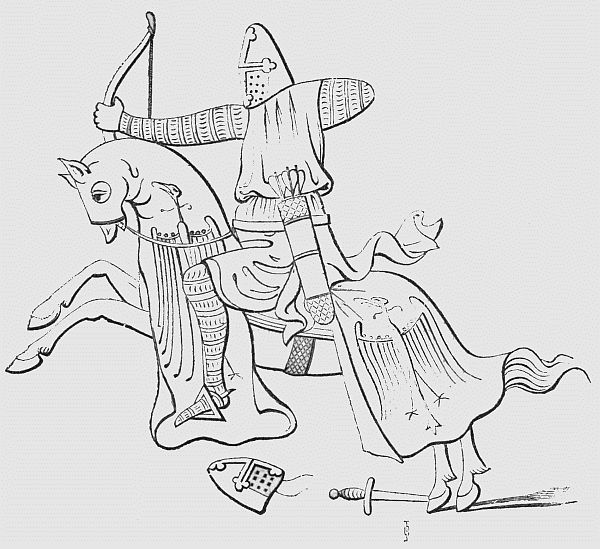
No. 47.
Besides the mounted men-at-arms or heavy cavalry, there were light-horse troops formed by the mounted archers and cross-bowmen, and the esquires attending upon the knights. The example here given is from Roy. MS. 20, D. 1, fol. 127, a work of the close of the thirteenth century[266].
The foot-troops or Sergents de pied consisted principally of archers, cross-bowmen and spearmen. There were also the Sergens d'armes or heavy-armed body-guard, Coustillers, Slingers, Bidaux, and Brigands or Ribauds; to which may be added the varlets or pages, who followed their knightly masters into the field, now fighting lustily in the mêlée, now bearing off the wounded body of their lord to some place of solace and safety. Clientes and Satellites were general names given to the inferior troops of the feudal and communal levy, including both horse and foot. There was nothing approaching to a uniform costume for the soldiery, though occasionally we find a leader seeking to identify his men by some addition to their dress, as a cross, a scarf, or other similar token. In 1264, Simon de Montford "ordered his troops to fasten white crosses on their breasts and backs, above their armour, in order that they might be known by their enemies, and to shew that they were fighting for justice[267]." In this case, however, the motive seems to have been, less the desire of a mark of recognition among friends, than the assumption, so common in warlike undertakings, of a holy motive for manslaughter. In the following passage from Guiart relating to the battle of Mons-en-Puelle, the object is more distinctly that of friendly recognition:—
"Pour estre au ferrir reconnuz, Vilains, courtois, larges et chiches, Sont de laz blans et de ceintures Escharpés sur leurs armures. Neis li ribaut les ont mises, Faites de leurs propres chemises."—Vers 11,059.
Of the Man-at-arms and his barded charger we obtain an admirable definition from the Chronicon Colmariense under the year 1298: "Armati reputabantur qui galeas ferreas in capitibus habebant, et qui wambasia, id est, tunicam spissam ex lino et stuppa, vel veteribus pannis consutam, et desuper camisiam ferream, id est, vestem ex circulis ferreis contextam, per quæ nulla sagitta poterat hominem vulnerare. Ex his Armatis centum inermes mille lædi potuerunt: habebant et multos qui habebant dextrarios, id est, equos magnos, qui inter equos communes quasi Bucephalus Alexandri, inter alios eminebat. Hi equi cooperti fuerunt coopertoriis ferreis, id est, veste ex circulis ferreis, contexta. Assessores dextrariorum habebant loricas ferreas: habebant et caligas, manipulos ferreos, et in capitibus galeas ferreas splendidas et ornatas, et alia multa quæ me tæduit enarrare." The armour of these sturdy warriors we shall presently examine piece by piece.
The Sergens à pied (Servientes) included the mass of the troops beneath the knightly dignity. Guillaume Guiart arms them with the lance and crossbow:—
"——bon serjanz i a A arbaletes et a lances." Chronique Métrique, 2e. partie, vers 8567.
And the same weapons are assigned to those levied by the ordonnance of Philip of France in 1303: "Et seront armés les sergens de pie de pourpoint et de hauberjons, gamboison, de bacinez et de lances: Et des six, il y en aura deux arbalestriers[268]."
The Sergens d'armes, (Servientes Armorum,) whose establishment in the twelfth century we have already observed, (page 100,) continued to form the royal body-guard throughout the present age. In 1214 they especially distinguished themselves at the battle of Bovines, as we find recorded by the monument (before noticed) in the church of St. Catherine. The inscription of the monument, though itself not earlier than the beginning of the fifteenth century, probably relates very exactly the circumstances of their victory, and of the foundation of the church. It is as follows:—"A la priere des Sergens darmes Monsr. Saint Loys fonda ceste Eglise et y mist la premiere pierre: Et fu pour la joie de la vittoire qui fu au Pont de Bouines lan Mil. cc et xiiii. Les Sergens darmes pour le temps gardoient ledit pont et vouerent que se Dieu leur donnoit vittoire ils fonderoient une eglise en lonneur de Madame Sainte Katherine. Et ainsi fu il." A statute of Philippe le Bel in 1285 limits the number of these guards attending the court to thirty: "Item, Sergens d'armes, trente, lesquels seront à Cour sans plus." From the same statute we learn that one of their weapons at this time was the crossbow: "Ils porteront toujours leurs carquois pleins de carreaux."
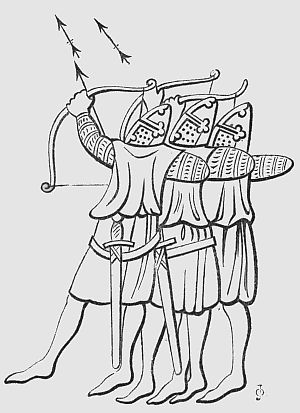
No. 48.
The Archer was becoming every day of more importance in the field; and if the bow was an efficient arm in battle, it was still more so in sieges, and the defence of strongholds and mountain-passes. From various Statutes of Arms we find that a portion of the military tenants are ordered to be provided with the longbow and arrows. The Statute of Winchester, in 1285, directs that each man "a quaraunte soudeesz de terre e de plus jeqs a cent souz, eit en sa mesun espe, ark, setes e cutel.... E tuz lez autres qui aver pount, eient arcs e setes hors de forestes, e dedenz forestes arcs e piles." Compare the statute of the 36th year of Henry III., printed in the Additamenta of the History of Matthew Paris[269]. The costume of the ordinary archer, defended only by his chapel de fer, appears to be depicted in our woodcut, No. 50, from Harleian MS. 4751, fol. 8, written at the commencement of this century. That the English occasionally mixed their bowmen with the cavalry, we have the express testimony of Matthew Paris: "Viri autem sagittarii gentis Anglorum equitibus permixti." In many illuminations of this time they appear fully armed in hauberk and helm, as in the miniature here given from Royal MS. 20, D. 1, fol. 307. See also our woodcut, No. 82, a group from the Painted Chamber of the palace at Westminster, where the archer wears a hauberk and coif of chain-mail. These examples of heavy-armed bowmen are fully borne out by written testimony. We have already observed Richard Cœur-de-Lion plying his arrows under the walls of Lincoln, (p. 157); and Otto Morena has, "Ipse Imperator optime sciens sagittare, multos de Cremensibus interfecit." (p. 58.) For further pictorial examples of archers of this century, see Royal MS. 2, B. vi. fol. 10; and 20, D. i. ff. 60, 87, 150 and 285.
By a curious volume of "Proverbs" of the thirteenth century, printed from a manuscript of that date in the Vie privée des François[270], we learn that "the best archers are in Anjou." Other proverbial celebrities of this manuscript are: Chevaliers de Champagne, Ecuyers de Bourgogne, Sergens de Hainaut, Champions d'Eu, Ribauds de Troyes.
The provision of an equipped archer to attend the king in his wars, is the frequent sergeantry for lands at this time; and the particulars attached to the service occasionally partake of that whimsicality found in other tenures of the period. It is curious also to trace the changes which these charters undergo in a small lapse of years, as they come under the inspection of the jurors appointed to enforce their engagements. Thus, the service for the manor of Faintree, in Shropshire, in 1211, is "a foot-soldier, with a bow and arrows, for the king's army in Wales." In 1274 the soldier is bound to stay with the host only "till he has shot away his arrows." In 1284 the archer has "to attend the king in his Welsh wars, with a bow, three arrows, and a 'terpolus[271].'" This terpolus, or tribulus, was probably an "archer's stake," not the mere small iron caltrop, of which the provision of one only by each archer would be of little use in impeding a charge of cavalry. The duty of the bowman who had only to stay in the field till he had shot away three arrows was sufficiently easy; but on other occasions the archer did not escape so lightly. The manor of Chetton, co. Salop, supplies in 1283 an archer for the king's host in Wales, who is to take with him a flitch of bacon, and to remain with the army till he has eaten it all up[272].
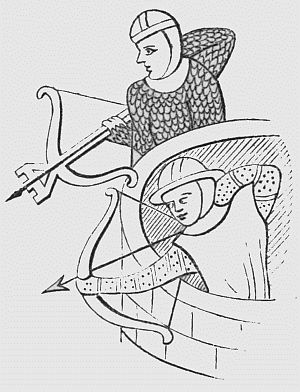
No. 49.
The Cross-bowman was an essential component of the host during all this period. He was in the van of battle. "Balistarii semper præibant," says Matthew Paris[273]; and there is scarcely a conflict mentioned by this chronicler in which the arbalester does not play a conspicuous part. In the battle near Damietta, in 1237, "more than a hundred knights of the Temple fell, and three hundred cross-bowmen (arcubalistarii), not including some other seculars, and a large number of foot-soldiers[274]." The Emperor Frederic in 1239, giving an account of his Italian campaign to the king of England, writes: "After we had by our knights and cross-bowmen reduced all the province of Liguria[275]," &c. In 1242 the Count de la Marche, refusing to do homage to Amphulse, the brother of the French king, "swelling with anger and with loud threats, accompanied by his wife Isabella and surrounded by a body of soldiers, broke through the midst of the Poictevin cross-bowmen, and having set fire to the house in which he had dwelt, suddenly mounted a horse and took to flight[276]." St. Louis, marching to meet the English in Poitou, had an army in which there were "about four thousand knights splendidly armed to the teeth, besides numbers of others, who came from all directions, flocking to the army, like rivers flowing into the sea; and the number of retainers and cross-bowmen was said to be about twenty thousand[277]." The opposing forces of the English king consisted of "sixteen hundred knights, twenty thousand foot-soldiers, and seven hundred arbalesters."
The Cross-bowmen were of several kinds, some mounted, some on foot. The mounted balistarii in King John's time were those possessing one horse, those having two horses (ad duos equos[278]), and others having three horses[279]. In 1205 the king sends to the sheriff of Salop, "Peter, a balister of three horses, and nine two-horse balisters," who are to be paid 10s. 4d. per day (the whole ten). The usual pay at this time was: to the cross-bowman with two horses, 15d. per diem; with one horse, 7½d. per day; and to the foot-balister, 3d. per day.
The quarrels for the crossbows were carried after the army in carts. Thus Guillaume Guiart:—
"Arbaletriers vont quarriaux prendre, A pointes agues et netes, Qui la furent en trois charrettes Venues par mesire Oudart."—Année 1303, p. 291.
The bows themselves, with other weapons and defences, were also carted after the host, and termed the "artillery" of the expedition:—
"Artillerie est le charroi Qui par duc, par comte ou par roi Ou par aucun seigneur de terre Est charchié (chargé) de quarriaux en guerre, D'arbaletes, de dars, de lances, Et de targes d'une semblance."—Guiart, an. 1304.
Notwithstanding the services rendered in the front of the battle by the cross-bowmen, and the other foot-troops; whose post was the more perilous from their being but slightly provided with defensive equipment; the knightly body of their own party made no scruple to ride them down whenever they stood in the way of the glory or ambition of the equestrian order. At Courtray in 1302, the French foot having gallantly repulsed the Flemings, Messire de Valepayelle cried to the Count of Artois,—
"Sire, cil vilain tant feront Que l'onneur en emporteront."—Guiart, pt. ii. v. 6132.
And forthwith the men-at-arms
"Parmi les pietons se flatissent, Qu'a force de destriers entr'ouvrent: Des leurs meismes le champ queuvrent, Et merveilleux nombre en estraignent."
This is confirmed by the Grandes Chroniques: "Nos gens de pie savancent, si auront la victoire et nous ny aurons point d'onneur[280]." All our readers will remember the similar fate of the Genoese cross-bowmen at Cressy: "Or tôt, tuez toute cette ribaudaille, qui nous empêche la voie sans raison[281]."
The arbalester sometimes appears in heavy armour, as in our woodcuts, Nos. 49 and 50. And Matthew Paris has: "Arcubalistarii circiter sexaginta loricati[282]." The provision of quarrels for each cross-bowman of the communal force was fifty, as we learn from the charter of Theobald, count of Champagne in 1220: "Chascuns de la Commune de Vitré qui aura vaillant xx. livres, aura aubeleste en son ostel et quarriaux l." The office of "Master of the Arbalesters" became one of the chief dignities of the French army, and was conferred only on persons of the highest rank. Thibaut de Monleart held this charge under Saint Louis, and in the Milice Françoise of Père Daniel will be found a complete list of the "Maîtres des Arbalêtriers de France" till the days of Francis I., when the office ceased[283]. The little window in city or castle wall, through which the bolts of the crossbow were discharged, was called arbalestena. For other pictures of the cross-bowman of the thirteenth century than those given in our woodcuts, Nos. 49 and 50, see Add. MS. 15,268, fol. 122, and Roy. MS. 20, D. 1, fol. 361b.
The Coustiller, employed, as we have seen, at Bovines in 1214, continues in request throughout this century; and will be found again in the pages of Froissart, taking part in the battles of the succeeding age.
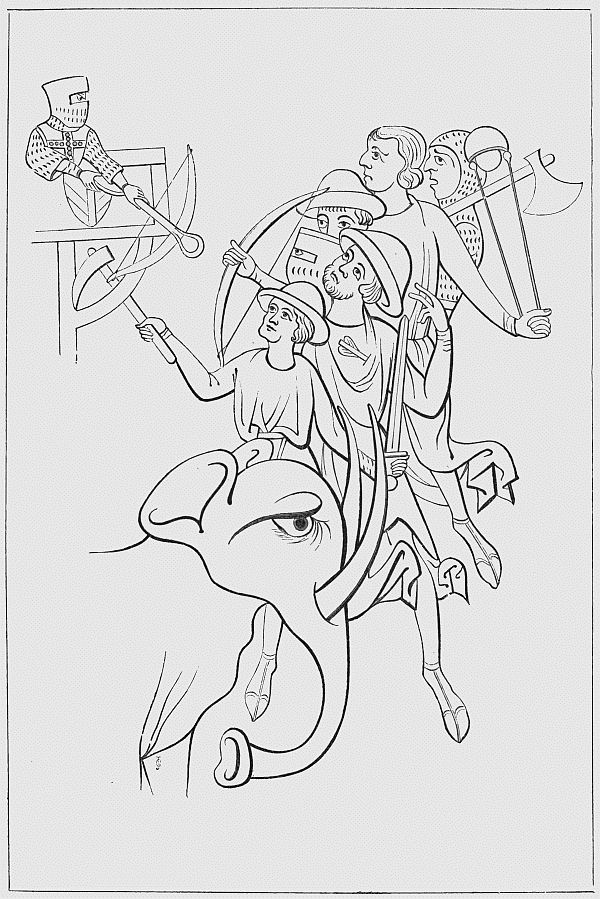
Plate L.
The Slinger is still of occasional occurrence. In this very curious group from Harl. MS. 4751, fol. 8, a work of the early part of the thirteenth century, the slinger appears without any defensive armour, and his weapon differs in no particular from the sling of Anglo-Saxon times, as shewn in our woodcut, No. 12. Besides the ancient Cord Sling, there appears in the manuscripts of this century a variety of the arm, the Staff Sling. It seems to have been in vogue for naval warfare, or in the conflicts of siege operations. The example here engraved is from Strutt's Horda, vol. i. plate 31; the authority being a MS. of Matthew Paris of this century, preserved in the library of Benet College, Cambridge. Other examples of the Staff Sling are given in Strutt's Sports, bk. i. chap. 2.
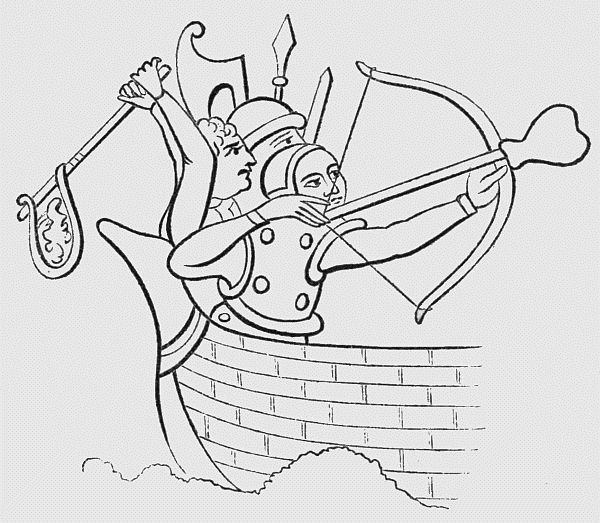
No. 51.
The Bideaux (bibaldi) were foot-troops fighting without defensive armour, whose usual weapons were a spear, javelins and a coutel. Guiart exactly describes them:—
"De Navarre et devers Espaingne Reviennent Bidaux a granz routes. En guerre par accoustumance Portent deux darz et une lance, Et un coutel a la ceinture: D'autres armures n'ont cure."—Pt. ii. verse 10,518.
The Ribaux or Brigans were the humblest of the troops, and by their extreme poverty were driven to acts of depredation which eventually made their very name synonymous with marauder. They carried such weapons as they could obtain:—
"Li uns une pilete[284] porte, L'autre croc ou macue torte.
L'un tient une epee sans feurre, L'autre un maillet, l'autre une hache."—Guiart, v. 6635.
They are not only without armour, but their equipment altogether is in a very tattered condition:—
"Et Ribaldorum nihilominus agmen inerme, Qui nunquam dubitant in quævis ire pericla." Philippidos, lib. iii.
"Leurs robes ne sont mie neuves, Ainz semble tant sont empirées Que chiens les aient déciriées."—Guiart, v. 6640.
Matthew Paris names them with but little honour: "Ribaldi et viles personæ[285]." They were, however, by no means useless members of the host. Thus, when Philippe Auguste appeared before Tours in 1189: "Dum Rex circumquaque immunita civitatis consideraret, Ribaldi ipsius, qui primos impetus in expugnandis munitionibus facere consueverunt, eo vidente, in ipsam civitatem impetum fecerunt," &c.[286]
They were made to assist in carrying the baggage of the army: "Inermes Ribaldos et alios, qui solent sequi exercitum propter onera deportanda[287]." And, being unprovided with defensive armour, whenever they obtained any booty, the "soudoyers," who were better equipped than they, attacked them and appropriated their prizes:—
"Mais li Soudoiers de Biaugiers, Qui d'armes ne sont mie nuz, De ce qu'ils portent les desrobent."—Guiart, v. 10,826.
The Roi des Ribauds was an officer appointed to restrain the excesses of the Ribaldi, and is mentioned in many documents of France from the time of Philip Augustus to that of Charles VI. At the battle of Bovines in 1214, Roger de Wafalia is named in the list of prisoners as falling to the share of the King of the Ribauds: "Rogerus de Wafalia. Hunc habuit Rex Ribaldorum, quia dicebat se esse servientem."
The names Clientes and Satellites were employed, as we have before mentioned, to indicate generally the inferior troops, whether horse or foot. At the battle of Bovines, the Clientes are a mounted corps, armed with sword and spear:—
"——Et quos Medardicus abbas[288] Miserat immensâ claros probitate Clientes Terdenos decies quorum exultabat in armis Quilibet altus equo gladioque horrebat et hastâ." Guil. le Breton.
In the following passage, the Clientes seem to be foot-troops. It is from the History of Dauphiny, where, in 1283, Humbert promises to assist the Archbishop and Chapter of Vienne: "contra omnes homines, suis propriis sumptibus et expensis, cum centum hominibus armatis in equis, et cum tercentis balistariis, et septingentis clientibus cum lanceis."
Satellites appear at Bovines, both mounted and on foot. The horse seem to have formed a light corps, and were employed to begin the combat. They are looked upon, however, with much contempt by the opponent knights; who, disdaining to advance against an ignoble foe, receive the charge without quitting their post. "Præmisit," says Rigord, "idem Electus[289], de consilio Comitis S. Pauli, cl. Satellites in equis ad inchoandum bellum, ea intentione ut prædicti milites egregii invenerint hostes aliquantulum motos et turbatos. Indignati sunt Flandrenses ... quod non a Militibus sed a Satellibus primo invadebantur: nec se moverent de loco quo stabant, sed eos ibidem expectantes acriter receperunt," &c. These troops, we are told, were from the valley of Soissons, and combated both on foot and on horseback. "Erant Satellites illi probissimi, de valle Suessionensi, nec minus pugnabant sine equis quam in equis."
Not only were Spies in use, but, what somewhat disturbs one's confidence in the exalted simplicity of these times, it had already been discovered that the fair sex might be employed with advantage in this office. The heroic Edward I., in his campaign against the Welsh in 1281, gives a shilling to a "certain female spy" for her services: "Cuidam spiatrici, de dono, xij. denarii[290]." And again, a pound to another of these useful ladies, "to buy her a house:" "Cuidam spiatrici, ad unam domum sibi emendam, de dono, xx. s.[291]"
From the various Statutes of Arms of this century we learn very exactly the equipment of the military tenants. Three of these statutes for England have been preserved: that of 1252, in the Additamenta of the Historia Major of Matthew Paris, and printed in Rymer's Fœdera; that forming part of the Statute of Winchester in 1285, printed by the Record Commission in vol. i. of the "Statutes of the Realm;" and that of 1298, printed in the new edition of the Fœdera, vol. i. p. 901. The Scottish enactments will be found in Skene's Regiam Majestatem, and the French in the Collection des Ordonnances.
The Assize of 1252, 36 of Hen. III., closely resembles that of 1285; but in the first the equipment is of six varieties, while in the second there are seven classes of armed men. To avoid repetition, we shall give the earliest of these statutes in the text, and add the readings relating to the armour from the Statute of Winchester in a note.
The Sheriffs, with two knights elected for that purpose, are to go round the hundreds, cities, &c., and call before them the "cives, burgenses, liberè tenentes, villanos et alios, ætatis quindecim annorum usque ad ætatem sexaginta annorum; et eosdem faciant omnes jurare ad arma, secundùm quantitatem terrarum et catallorum[292] suorum; scilicet: Ad quindecim libratas terræ, unam loricam, capellum ferreum, gladium, cultellum et equum[293]: Ad decem libratas terræ, unum habergetum[294], capellum ferreum, gladium et cultellum: Ad centum solidatas terræ, unum purpunctum, capellum ferreum, gladium, lanceam et cultellum[295]: Ad quadraginta solidatas terræ et eo amplius usque ad centum solidatas terræ, gladium, arcum, sagittas et cultellum[296]. Qui minus habent quam xl. solidatas terræ, jurati sint ad falces, gisarmas, cultellos et alia arma minuta[297].
"Ad catalla sexaginta marcarum, unam loricam, capellum ferreum, gladium, cultellum et equum[298]: Ad catalla xl. marcarum, unum haubercum, capellum ferreum, gladium et cultellum: Ad catalla xx. marcarum, unum purpunctum, capellum ferreum, gladium et cultellum: Ad catalla novem marcarum, gladium, cultellum, arcum et sagittas: Ad catalla xl. solidarum et eo amplius usque ad decem marcas, falces, gisarmas, et alia arma minuta[299].
"Omnes enim alii qui possunt habere arcus et sagittas extra forestam, habeant: qui verò in forestâ, habeant arcus et pilatos[300]."
View of arms is to be taken by the mayors, bailiffs and provosts of the cities and towns[301]. Constables to be appointed to command the force. Tournaments and behourds forbidden:—"Clamare faciant Vicecomites, &c. quod nulli conveniant ad turniandum vel burdandum, nec ad alias quascunque aventuras." And none to appear armed except those specially appointed.
The distinction between the kinds of arrow to be used within and without the forest bounds, is curious, and not altogether clear at this distance from the days of archery. The fatal power of the barbed shaft upon the king's deer is indeed evident enough, but the comparatively innocuous character of the piled arrow is not so plain. The usage, however, is well attested by numerous instances. In the Statute of arms of William the Lion, king of Scotland, we have: "Et omnes alii, qui habere poterunt, habeant arcum et sagittas extra forestam: infra forestam, arcum et pyle[302]." And by an agreement made in 1246 between Roger de Quinci, earl of Winchester, and Roger de Somery, touching certain rights of chace in Bradgate Park, co. Leicester, it is stipulated "quod Forestarii sui non portabunt in bosco prædicti Rogeri de Somery et hæredum suorum sagittas barbatas sed pilettas[303]."
Shakespere, who illustrates everything, has a passage bearing on this subject among the rest. Under the greenwood tree of the forest of Arden, the Duke, in "As you like it," addresses his companions:—
"Come, shall we go and kill us venison? And yet it irks me, the poor dappled fools (Being native burghers of this desert city) Should, in their own confines, with forked heads Have their round haunches gored."—Act ii. Sc. 1.
And the fatal effects of the forked head are familiar to us all in the case of the
"——poor sequester'd stag, That from the hunter's aim had ta'en a hurt,"
coming to languish away its life
"On the extremest verge of the swift brook."
The feudal levy of the Ban and Arrière-ban was of course much influenced by the pressure of the occasion requiring their armament. In 1205 King John, in a Council held at Winchester, called upon every tenth knight in the realm to accompany him into Poitou, at the expense of the other nine; and if, during his absence, the country should be invaded, every man capable of bearing arms was to join in its defence, under pain of forfeiting any lands he might hold; or, if not a landowner, of becoming, with all his posterity, a slave for ever, and paying a yearly poll-tax of four-pence. Each knight was to receive two shillings per day[304]. This expedition did not, however, leave our shores.
When Philip of France was preparing to attack King John in 1213, the English monarch summoned all his "liberos homines et servientes, vel quicunque sint," to aid him under pain of culvertage[305].
In 1264, when the Earl of Leicester mustered his forces on Barham Downs to resist the threatened invasion of Queen Eleanor, the military tenants were ordered, under pain of felony, to bring into the field not only the force specified in their tenures, but all the horsemen and infantry in their power: every township was compelled to send eight, six, or four footmen well armed with lances, bows, swords, cross-bows, and axes, who should serve forty days at the expense of the township; and the cities and burghs received orders to furnish as many horsemen and footmen as the Sheriff should appoint[306].
The Pay assigned to troops who, having contributed the stipulated service for their holdings or assessments, were required to render further assistance to the king in his wars, we discover in the Roll of Expenses of King Edward I. at Ruddlan Castle in Wales, in 1281-2. From this curious document, which is printed in full in the sixteenth volume of the Archæologia, we find:—
The Pay of Per Diem. In modern money.
A knight 12 Pence 15 shillings
An esquire 12 Pence 15 shillings
An archer 2 Pence 2s. 6d.
A cross-bowman 2 Pence 2s. 6d.
A captain-of-twenty (bowmen) 4 Pence 5s. 0d.
A constable (of 100 bowmen) 6 Pence 7s. 6d.
"Saturday the fifth day of January, paid to the Lord Engolrane, serving with the Lord John de Deynile and his four Esquires, for their wages from the first day of April to the fourth day of June, for lxv. days xix. li. x. s.
"To the same, for the pay of his fifth Esquire, for xxiv. days: xxiv. s.
"To the said five Esquires, for their pay, for fifteen days following the fourth of June lxxv. s."
"Paid to Geoffry le Chamberlin, for the wages of twelve cross-bowmen (balistariorum) and thirteen archers (sagittariorum) for xxiv. days, each Cross-bowman receiving by the day iv. d., and each Archer ij. d. vii. li. viii. s."
Here the arbalester gets double the wages of the archer, but in the following and other instances, his pay is the same.
"To Guillemin and his comrade, Cross-bowmen, for their wages, for twenty-one days, at ij. d. by the day xxi. s."
On one occasion, Guillemin and his companion receive sixpence per day: but this is altogether an unusual sum.
The archers were divided into bands of twenties, and over each was placed a Captain. To every hundred bowmen, with their captains, was appointed a Constable.
"To Master R. Giffard, for the wages of one Constable of foot, receiving vi. d. per day, and of fifty-three Archers, with two Captains of Twenties, for three days xxix. s.
"To Robert Giffard, —— for the wages of forty-three Captains of Twenties, each receiving iv. d. per day," &c.
There were also Constables of Cavalry, perhaps commanding mounted archers, and their pay is set down at twelve pence per day. Occasionally the constables have a command of two hundred men, and sometimes it sinks as low as fifty. The ordinary number, however, is a hundred.
Of the Armed Town-Watch in England we obtain some particulars from the "Breve Regis" of the 36th Hen. III. "Henry, king, &c. to such or such a sheriff, greeting. Be it known to you that, for the maintenance of our peace, it has been provided in our Council, that watch shall be kept in every city, borough and town of your county, from Ascension Day to the Feast of St. Michael; to wit: that in every city, six armed men (armis munitos) shall watch at every gate: in every borough, twelve men: in every town (in singulis villis integris) six men, or at least four, likewise furnished with arms, according to the number of the inhabitants. They shall watch continually throughout the night from sunset to sunrise; so that all strangers seeking to pass through, may be detained till morning. And then, if he be a loyal man (fidelis), he shall be set at liberty; if a suspected person (suspectus), he shall be delivered over to the Sheriff, to be by him kept in a place of safety. But if it happen that strangers of this latter sort refuse to allow themselves to be stopped, then the aforesaid Guards shall raise the hue against them on all sides, and shall follow them with all the inhabitants of the place (cum tota villata) and places adjacent, raising the hue and cry 'de villa in villam' until they be taken[307]," &c. The manner of the hue and cry is set down in the "Articuli[308]." "Pursuit by hue and cry to be made according to the ancient and proper form, so that those who neglect to follow the cry may be taken as accomplices of the evil-doers, and delivered to the Sheriff. Moreover, in every town, four or six men, according to the number of the inhabitants, shall be appointed to make the hue and cry with promptitude and perseverance, and to pursue evil-doers, if any should appear, with bows and arrows and other light weapons (et aliis levibus armis); which weapons ought to be provided for the custody of the whole town, and to remain for the use of the aforesaid town. And besides the foregoing, there shall be provided out of each hundred, two free and loyal men of most influence, to be over them, and to see that the watch be duly made, as well as the pursuits aforesaid."
Compare the regulations for the Watch of the city of Paris, contained in an ordinance of Saint Louis in 1254; printed in the Collection des Ordonnances.
The feudal constitution of armies was necessarily modified in different countries by the nature of the territory, the habits of the people, and the wealth of the state. In Germany, where the class of nobles was more restricted than in France and England, the foot-troops were at an early period regarded with consideration. In hilly countries, where the breed of horses was of a small stature, a light-armed cavalry was the most available force. While, in the fastnesses of mountains, the pikes and halberds of a sturdy infantry compensated for the want of horses and the poverty of a rugged territory.
The Scottish army in 1244, Matthew Paris[309] tells us, was "very numerous and powerful, consisting of a thousand armed knights, well mounted, although not on Spanish or Italian, or other costly horses, and well protected by armour of steel or linen; and about a hundred thousand foot-soldiers, who were all of one mind, and who, having made confession, and been encouraged by the consoling assurance of their preachers, that the cause in which they were engaged was a just one and for their country's good, had very little fear of death." In 1298 Wallace contending against Edward I. in person, formed his pikemen, who were the strength of his army, into four circular bodies[310], connected together by a number of archers from the Forest of Selkirk. Before them he planted a defence of palisades: behind them, the cavalry was stationed. In front of all was a morass, dividing them from the English. The latter, having passed the night on the bare heath, in the morning advanced to the attack. Their first division, commanded by the Earl Marshal, from its ignorance of the ground, soon became entangled in the morass. The second, led by the Bishop of Durham, wheeled round the swamp and came in sight of the Scottish cavalry, when the prelate ordered his men to await the arrival of the other bodies. "To thy mass, bishop!" exclaimed one of his knights, and rushed on the enemy. They gave way at the first charge; the bowmen were trampled under foot, but the four bodies of pikemen opposed on all sides an impenetrable front. The bravest resistance, however, could not restore the fortune of the day. Edward advanced his archers, supporting them with his military engines, an opening was made in each circle, the men-at-arms dashed in among the disordered pikemen, and the battle was won[311]. This conflict, fought near Falkirk, on the 22nd of July, 1298, affords one of innumerable instances, shewing that little reliance can be placed in the numbers of the slain given by even cotemporary writers. Trivet reports the loss of the Scotch at twenty thousand; Matthew of Westminster raises it to forty thousand.
The Welsh, keeping up their hostilities to their Norman invaders, reserved their aggressive operations till the wet and stormy season of the year, when the land was unfit for the manœuvres of a heavy-armed cavalry, and the gloomy days favourable for the sudden onslaught of mountain warriors. "Videntes tempus hyemale madidum sibi competere," says Matthew Paris[312].
The rich cities of Italy, as we have seen, began about the middle of this century to employ stipendiary men-at-arms; and it seems probable that the first of these knightly soldiers were those of the equestrian class who, from political disgust or family feuds, had become refugees in the territory of their new masters. The good wages and the booty obtained by these gentle mercenaries induced others of a more humble class to take up the trade, and under skilful leaders (the well-known Condottieri) they obtained fame, fortune and honours.
The Basques were at this time among the most prominent of the mercenary troops, acting as a light corps, for which their mountain-life rendered them very apt. They were the Swiss of the thirteenth century.
Among our northern neighbours we obtain a glimpse of the Frieslanders, through the means of the indefatigable Matthew Paris. "These Frieslanders," he says, "are a rude and untamable people: they inhabit a northern country, are well skilled in naval warfare, and fight with great vigour and courage on the ice. It is of the cold regions of these people, and their neighbours the Sarmatians, that Juvenal says, 'One had better fly hence, beyond the Sarmatians and the icy ocean,' &c. The Frieslanders, therefore, having laid ambuscades among the rush-beds along the sea-coast, (in their war with William of Holland,) as well as along the country, which is marshy—and the winter season was coming on—went in pursuit of the said William, armed with javelins, which they call gaveloches, in the use of which they are very expert, and with Danish axes and pikes, and clad in linen dresses covered with light armour. On reaching a certain marsh they met with William, helmeted, and wearing armour, and mounted on a large war-horse covered with mail. But, as he rode along, the ice broke, although it was more than half a foot thick, and the horse sank up to his flank, becoming fixed in the mud of the marsh. The trammelled rider dug his sharp spurs into the animal's sides to a great depth, and the noble, fiery beast struggled to rise and free himself, but without success. Crushed and bruised, he only sank the deeper for his efforts, and at length by his struggles he threw his rider among the rough slippery fragments of ice. The Frieslanders then rushed on William, who had no one to help him from his position, all his companions having fled, to avoid a similar disaster; and attacking him on all sides with their javelins, despite his cries for mercy, pierced his body through and through, which was already stiffened with wet and cold. He offered his murderers an immense sum of money for ransom of his life, but these inhuman men, shewing no mercy, cut him to pieces. And thus, just as he had a taste of empire, was the Flower of Chivalry, William, king of Germany and count of Holland, the creature and pupil of the Pope, hurled, at the will of his enemies, from the pinnacle of his high dignity to the depths of confusion and ruin[313]."
Clerics are still found participating the dangers and glories of the battle-field; not alone as councillors or leaders, but sturdily wielding the deadly mace, and clad in hauberk and helm, like the lay vassals and men-at-arms around them. We have already seen the Bishop of Durham leading a division of the English at the battle of Falkirk. At the great battle of Bovines, in 1214, the French army was commanded by Guerin, bishop-elect of Senlis; and there too, armed to the teeth, and plying the cleric weapon, the mace, contended that bishop of Beauvais, whom we have, on a former occasion, seen the prisoner of Richard Cœur-de-Lion. At the siege of Milan, in 1238, "the bishop-elect of Valentia, who knew more of temporal than spiritual arms, hastened with the knights whom the counts of Toulouse and Provence had sent to assist the emperor[314]." In 1239 the Emperor Frederic, writing to the king of England, complains of the Pope becoming a general and his monks men-at-arms, to wrest from him his crown of empire. "He hath openly declared himself the leader and chief of the war against us and the empire, making the cause of the Milanese and other faithless traitors his own, and openly turning their business to suit his own interests. Moreover, he appointed as his lieutenants over the Milanese, or rather the papal, army, the before-mentioned Gregory de Monte Longo and brother Leo, a minister of the Minorite order, who not only girded on the sword and clad themselves in armour, presenting the false appearance of soldiers; but also, continuing their office of preaching, absolved from their sins the Milanese and others, when they insulted our person or those of our followers[315]." Father John of Gatesden boldly throws aside alb and chasuble to don the knightly hauberk and chausses in good earnest. "Anno Domini 1245, King Henry passed Christmas at London, and observed the solemnities of that festival in the company of many of his nobles. At that place, on Christmas-day, he conferred the honour of knighthood on John de Gatesden, a clerk, who had enjoyed several rich benefices; but who, as was proper, now resigned them all[316]." In the contest for the empire in 1248, the army raised against Conrad by the legate, "was commanded by the archbishops of Mayence, Metz, Lorraine and Strasburg, and consisted of innumerable bands from their provinces and from Friesland, Gothland, Russia, Dacia, and from the provinces of Germany and those adjoining who had received the cross[317]," &c. For it was part of the papal tactics to invest the soldiers who fought in the quarrels of the Holy See with the sacred dignity of Crusaders. In the revolt of the Scots under Bruce in 1306, among the prisoners captured by the English were the Abbot of Scone and the Bishops of St. Andrew's and Glasgow, all taken in complete armour[318].
The leading principle in the Tactics of this century was, with the exceptions already noticed, to compose the strength of the army of the knightly order. It was the knight who fought in the terrible mêlée of the battle-field: it was the knight who scaled the walls of the besieged fortress; who directed the discharge of perrier and mangonel; who filled the towers of assault by the city walls; who defended those walls from outward attack; and who, in sea-fights, manned the ships of war, and with pike and javelin contended against other men-at-arms battling in the adverse fleet. The remainder of the troops were looked upon as mere accessories, engines useful to clear the way for the "achievement" of the equestrian order.
The men-at-arms marched to the field of battle in squadrons so dense that, as a cotemporary writer records, "a glove thrown into the midst of them would not have reached the ground."
"Chacun conroi lente aleure S'en va joint comme en quarreure, Si bien que s'un gant preissiez Et entr'eux haut le gétissiez, Il paroit qu'à son asseoir Ne duste mie tost cheoir."—Guiart, 2 par., v. 11,494.
They charged, however, in single line—en haie—the onset of the first rank being supported by the successive charges of those behind. The ancient formation of the wedge (cuneus) was not, however, altogether abandoned, whether for horse or foot. The particular manner in which the German cavalry composed the wedge, beginning with a front of seven men, and increasing each rank by one additional soldier, as far as to half the depth of the formation, is very clearly shewn by Fronsperger[319]. "Wie wohl bey den Alten gebraeuchlich gewesen das sie ihre Schlachtordnung (fur die Reisigen) gespitzt oder in Dreyangel gemacht haben, also das etwan im ersten Glied sieben Mann, im andern acht, im dritten neun, im vierten zehn; also fort an bis auf den halben Theil der Ordnung und Hauffen, darnach seien si durchaus geviert gemacht worden." In 1302, a body of Flemish infantry adopted a similar formation in acting against the French. "Les François virent une très grande bataille des Flamands, qui contint bien huit mil hommes; et avoient ordonné leur bataille en guise d'un escu, la pointe devant, et s'estoient entrelaciez l'un en l'autre, si que on me les peut percier[320]."
Of the circular formation we have already seen an example among the Scotch at the battle of Selkirk. Guiart furnishes another:—
"Renaut, jadis quens de Bouloingne, Qui mort ne mehaing ne resoingne, Tant est plain de grant hardement, Ot fait dès le commencement De serjanz plains de grant prouece Une closture en réondèce, Ou, en reposant, s'aaisoit Toutes les fois qu'il li plaisoit; Et r'issoit de leanz souvent Quant il avoit pris air ou vent."—Sub an. 1214.
The entire army was usually formed into three "battles:" sometimes into four; and occasionally the whole force was gathered into one body. In 1249 the Imperialists, fighting against the Bolognese, distributed their troops into three corps, while the latter formed four[321]. And in 1266, Manfred, in a battle with Charles d'Anjou, ranged his cavalry in three bodies, while his adversary divided his army into four parts[322].
In front of all were placed the various "gyns" of the host; the mangonels, trebuchets, perdriaux, &c., serving in some degree the purpose of gunnery in our own day.
"Près du roi devant la banière Metent François trois Perdriaus, Jetans pierres aus enniaus Entre Flamens grosses et males, Joignant d'eus rot deux Espringoles, Que garçons au tirer avancent." Guiart.—2e. Par., v. 11,573.
At the battle of Mons-en-Puelle, in 1304, three espringoles were placed in battery before the French army, of which the force was so great that the quarrels discharged from them are said to have pierced four or five ranks of the enemy in succession.
"Li garrot, empené d'arain, Quatre ou cinq en percent tout outre."—G. Guiart.
The Archers and Cross-bowmen were usually placed at the wings, the infantry of the communal levy in the centre, and behind these the mounted men-at-arms.
"Cil d'armes se rangent derrières."—Guiart, Année 1303.
Archers were sometimes intermixed with the cavalry. Thus, in the 23rd of Edward I., the Earl of Warwick fighting against the Welsh, the latter "placed their men-at-arms fronting the earl's army: they were furnished with very long spears, which, being set on the ground, had their points suddenly turned towards the earl and his company, in order to break the force of the English cavalry. But the earl had well provided against them; for between every two horsemen he had placed an archer, so that, by their missile weapons, those who held the lances were put to the rout[323]." We have already seen bodies of archers interspersed with other troops in the conflict between Edward and Wallace in 1298[324].
To defend themselves from the attack of cavalry, the army occasionally formed a barrier of carts and wagons.
"De chars et de charettes vuides, Qu'à grant diligence ont atruites, Ont entr'eus trois rengies faites, En tel sens et par ordre commune Que le derrière de chacune Est mis, si com nous estimons, A l'autre entre les deus limons." Guiart, 2e. partie, v. 11,108.
The more usual entrenchment was the ancient one of a ditch and palissaded bank.
Stratagems were still greatly in vogue, and some of them are of so dramatic a character that they tell rather of the jongleur than of the sober historian. Others, with enough of the marvellous, are less out of the bounds of probability. In 1250, Matthew Paris informs us, the Saracens gained a victory over a body of Crusaders, whom they slew. Desiring to obtain possession of Damietta, which was in the hands of the Christians, "a strong body of them, about equal in number to the Crusaders they had slain, treacherously putting on the armour, and carrying the shields and standards of the Christians who had fallen, set out thus disguised towards Damietta; in order that, having the appearance of French troops, they might gain admission into the city, and, as soon as admitted, might kill all they found therein. When they approached the walls, the Christians on guard looked forth from the ramparts and towers, and at first thought they were Christians, exultingly bearing spoils and trophies: but the nearer they approached, the more unlike Frenchmen they seemed: for they marched hurriedly and in disordered crowds, and sloped their shields irregularly, more after the manner of Saracens than of French. And when they reached the extremities of the fortifications and approached the gates of the city, they were clearly seen to be Saracens by their black and bearded faces. But who can fully relate the heartfelt grief of the Christians when they saw the enemies of the faith giving vent to their pride and derision, clad in the armour, and bearing the standards and painted devices which were so well known to them[325]."
The device of equipping several soldiers in similar arms to the leader of the host, seems also to have been in use. At the siege of Viterbo in 1243, Matthew Paris tells us, "One illustrious soldier on the Emperor's side, and adorned with his special arms, (armis ipsius specialibus decoratus,) miserably expired, to the great grief of the Emperor, being pierced by the quarrel of a crossbow. His enemies raised a shout of joy, thinking they had slain the Emperor himself; but the Emperor, preceded by his trumpeters, advanced; and, though not without difficulty, disengaged his army from the fury of their opponents, who had suddenly pressed forward to crush them[326]."
The influence of the stars, the power of lucky and unlucky days over the issue of battle, were still occasionally acknowledged; not alone by the rude leaders of a company of men-at-arms, but by the commanders of armies, by crowned dignitaries. The Emperor Frederic II. had a firm faith in the predictions of astrologers; he never undertook a march until the fortunate moment for departure had been fixed by those skilled in divination; and when, in 1239, he was about to advance against Treviso, his march was suddenly arrested by an eclipse of the sun[327].
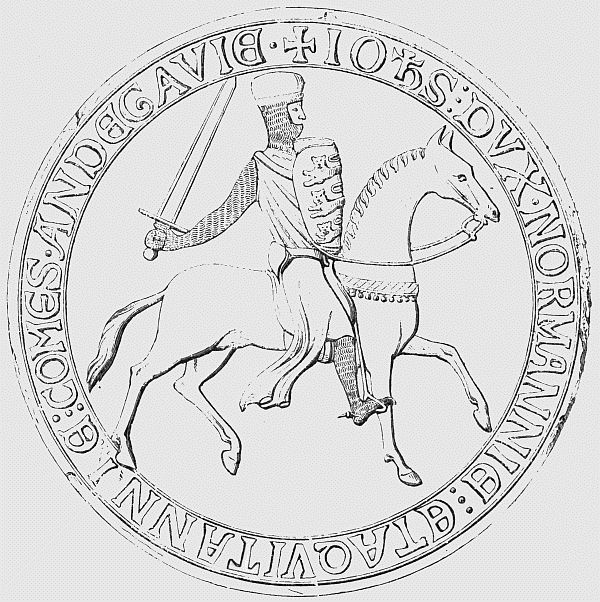
GREAT SEAL OF KING JOHN.
No. 52.
The usual Body-armour of the knightly order was, in the early part of the thirteenth century, of interlinked chain-mail; but, in the second half of the century, portions of plate appear, in the form of shoulder-pieces, elbow-pieces, and knee-pieces. The chain-mail was of hammered iron, the art of wire-drawing not being found till about the middle of the next age. Other materials were occasionally employed for defensive purposes: leather, quilting, scale and jazerant-work, and, at the close of the century, a kind of armour which has been named Banded-mail, but of which the structure has not been exactly ascertained. There can be little doubt that, among the more humble troops, the Coustillers and the Ribauds, every kind of defensive material was in use which these men could obtain: a pectoral and a helmet of some sort were almost indispensable, to protect them from the downward flight of the arrows, which played so principal a part, whether in the field or the siege. The knights themselves, indeed, did not attempt a uniform costume: on the contrary, it is often made a reproach to them, that each endeavoured to outvie the other in the magnificence of his apparel. On rare occasions we find a band of cavaliers who exhibit the marvel of a similar equipment. When Richard, earl of Gloucester, visited the Pope, in 1250, "he travelled through the kingdom of France accompanied by the Countess, his wife, and his eldest son, Henry, with a numerous suite, and attended by a large retinue, in great pomp, consisting of forty knights equipped in new accoutrements, all alike, and mounted on beautiful horses, bearing new harness, glittering with gold, and with five wagons and fifty sumpter-horses; so that he presented a wonderful and honourable show to the sight of the astonished French beholders[328]."
The usual series of knightly garments was the tunic, the gambeson, the hauberk, the chausses, the chausson, and the surcoat. With these are found various accessories: the ailettes, coudières, poleyns, and greaves.
The Tunic has already been seen in the first seal of Richard I., and other monuments. It again appears in this curious group, part of a martyrdom of Thomas à Becket, from Harl. MS. 5102, fol. 32, a work of the beginning of the thirteenth century (overleaf.) It is found also in our woodcut No. 63, from Add. MS. 17,687, an example of the close of the century.
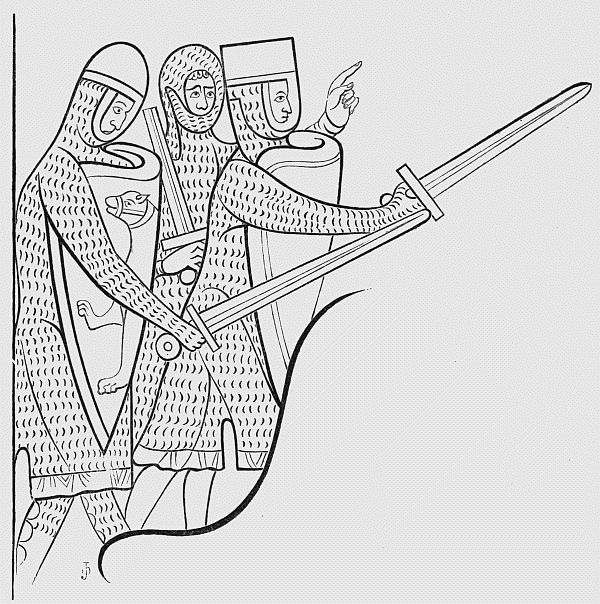
No. 53.
The Gambeson, that quilted garment which we have seen was worn as an additional defence beneath the hauberk of chain-mail, is in view in the monumental effigy from Haseley church, Oxfordshire, (woodcut 46,) a figure seemingly of the middle of this century. It is again very clearly shewn in our woodcut No. 59, an effigy in Ash church, near Sandwich. In both these examples the vertical lines of quilting are plainly expressed by the sculptor. Ducange, in his Observations on the History of St. Louis, cites an account of the year 1268, which includes "Expensæ pro cendatis et bourra ad Gambesones[329]." These might, however, have been the Gambesons that formed of themselves the body-armour of the soldier. It is very clearly distinguished as a horseman's garment in a passage of the Statutes of Frejus, in 1235; where also we see the gambeson alone accorded to the foot-fighter: "Militem sine equo armato intelligimus armatum auspergoto et propuncto (with hauberk and gambeson) et scuto: peditem armatum intelligimus armatum scuto et propuncto seu aspergoto." The Chronicon Colmariense, under the year 1298, is still more explicit: "Armati reputabantur qui galeas ferreas in capitibus habebant, et qui wambasia, id est, tunicam spissam ex lino et stuppa, vel veteribus pannis consutam, et desuper camisiam ferream."
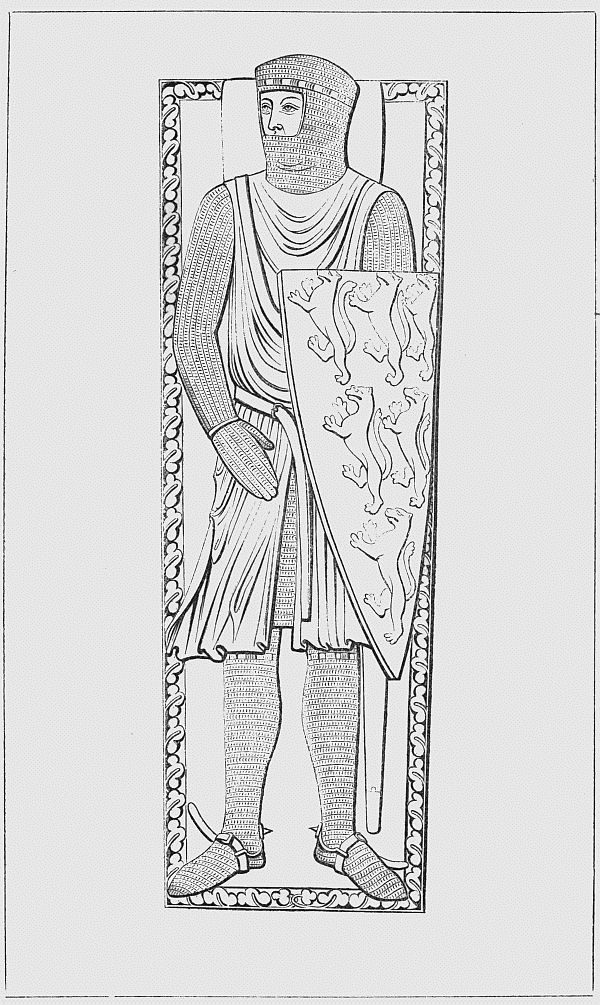
Plate LIV.
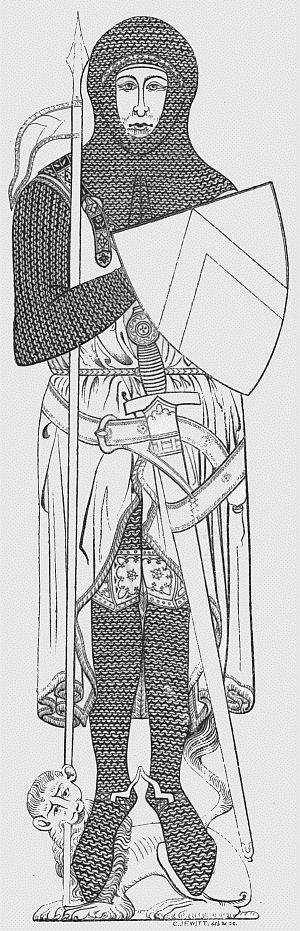
The Hauberk of chain-mail, in the beginning of the thirteenth century, was made with continuous coif and gloves, the coif somewhat flattened at the top of the head, and the gloves not divided into fingers; it descended nearly to the knees, and at the face-opening left little more than the eyes and nose of the knight in view. A striking example of the last-named arrangement is afforded by the figure here engraved, the sculptured effigy of William Longespée, at Salisbury, c. 1227. See also the seal of King John, p. 228, and the woodcut, No. 53, from Harl. MS. 5102. The sleeve of the hauberk is sometimes secured at the wrist by a lace or strap; as in the figure of Longespée, in the brass of Sir Roger de Trumpington, c. 1289, (woodcut 73,) and the effigy at Norton, Durham, of the end of the century (woodcut 70). In order to liberate the hand occasionally from its fingerless glove, an aperture was left in the centre of the palm. This is clearly shewn in our woodcuts, No. 80 and 62; the first from the Lives of the Offas, Cotton MS., Nero, D. i.; and the other from Roy. MS. 2, A. xxii. The glove turned off and hanging from the wrist may be seen in Plate 17 of Hefner's Trachten, and in the sculptured effigy of a knight in Bingham church, Nottinghamshire. In the second half of the century the gloves of the hauberk were divided for the fingers; from which we may suppose that the armour-smith had by this time improved his art by making his mail-web more flexible and more delicate. Early examples occur in the sculptured effigies of knights at Rampton, Cambridgeshire, and Danbury, Essex; the former figured in Stothard's Monuments, Plate 20; the latter in Strutt's Dress and Habits, Plates 45 and 46. Instances both of the undivided and the fingered glove will be found among our engravings. Occasionally the sleeves of the hauberk terminate at the wrist, as those of the archers in cuts 47 and 48; in these instances obviously for the greater freedom in handling the bow. Where the lancer's hauberk is thus fashioned, the hand has the supplementary defence of a gauntlet. Gauntlets of scalework occur in a knightly brass, c. 1280, engraved by Waller, Part x., and Boutell[330], p. 113. To the elbows of the hauberk were sometimes affixed, but rarely in this century, plates of metal called coudières. An effigy in Salisbury Cathedral, circa 1260, (Stothard, Pl. xxx.,) offers a good example. There is another, a knight of the Clinton family, in the church of Coleshill, Warwickshire. The hauberk was subject to a further variety: it was made with or without a Collar. Matthew Paris tells us that in a hastilude "at the abbey of Wallenden" in 1252, the lance of Roger de Lemburn entered beneath the helm of his antagonist and pierced his throat, for he was uncovered in that part of his body, and without a collar (carens collario). Ducange cites an analogous passage: "Venitque ictus inter cassidem et collarium, dejecitque caput ejus multum a corpore[331]." The hauberk without collar may be seen in the figures of Largesse and Debonnaireté in the pictures of the Painted Chamber (Vet. Mon., vol. vi.)
The Continuous Coif was in the early part of the century nearly flat at the top; in the second half the round-topped coif was more usual. The flattened form is well shewn in the statue of Longespée (woodcut, No. 54), and in those of De l'Isle and De Braci, (Stothard, Plates xix. and xx.) The rounded crown occurs frequently in our woodcuts. The coif was drawn over the head by means of an opening in the side, and was then fastened by a lace, a buckle, or a tie. The manner in which the lace, passing through alternate groups of the links farming the coif, is made to secure the loose to the fixed part of the cap, is excellently shewn in the figures of Longespée and the so-called Duke of Normandy in Gloucester Cathedral, (Stothard, Plate xxii.) A good example of the fastening by strap and buckle is furnished by the fragment of an effigy found at Exeter, engraved in the Archæological Journal, vol. ix. p. 188. The coif adjusted by a tie is seen in our woodcut, No. 62. The side-piece hanging free is shewn in a knightly statue of this century in the Abbey Church of Pershore, Worcestershire, engraved in the Journal of the Archæological Association, vol. iv. p. 319. The coif is sometimes encircled by a fillet. See our woodcuts, No. 46, 59, and 63. The circles are of gold-colour in figures of the Painted Chamber (Pl. xxx.): in the effigy of William de Valence the band is richly jewelled, (Stothard, Pl. xliv.)
Many examples shew that the warrior often went to battle without any kind of helmet over the coif of chain-mail; though it is probable that some additional defence, whether of plate or of quilted-work, was in this case worn beneath it. The regular and compact form of the crown in many ancient examples favours this belief; and a modern instance from the East helps to confirm it. A suit of Birman armour in the Tower of London has a skull-cap of plate which is quite hidden from view by the outer armour of the head. In the effigy at Bingham, Notts., already mentioned, the upper part of the coif is so large that it almost gives the notion of a turban being worn beneath. The coif used in battle without any further defence over it, may be seen in our engravings, No. 80 and 82.
On other occasions, the mail-coif had the additional armament of a helmet of some kind. This may be better considered in our general notice of helmets.
No. 55.
The Hood of Chain-mail appears to have been designed as an improvement on the Continuous Coif by rendering unnecessary the side-opening and the lacing about the face. But the hood had this great disadvantage; that, as it lay on the shoulders of the knight, it permitted the lance of the adversary to pass beneath it and deal a deadly thrust on the unguarded neck. This fact is of constant occurrence, as well in the chronicles as in the pictures of the times. The hood, like the coif, is both flat-topped and round. The flattened hood is seen in the effigy of De l'Isle, (Stothard, Pl. xx.) The round appears in the brasses of Sir John D'Aubernoun (woodcut, No. 55), and Sir Roger de Trumpington (Waller, Pt. iv., and our woodcut, No. 73): in the statues of De Vere, Crouchback, and Shurland, figured by Stothard; and in our engravings, No. 59 and 63. A simple lace, passing across the forehead and tying behind, bound the hood firmly to the head. The manner of this may be seen on comparing the brass of Sir John D'Aubernoun and the statue of Sir Robert Shurland. Both hood and coif appear occasionally to have been slipped over the head and suffered to rest on the shoulders. Compare the effigy in the Temple Church (Stothard, Pl. xxxviii.), Hefner's plate 27, and our woodcuts No. 56 and 70. The hood is sometimes shewn as made of a cloth-like material, (cloth, leather, or pourpointerie?) as in the front figure of our engraving, No. 68, from a MS. in the library of Metz. Its colour is brown, while the banded mail in this drawing is iron-colour. (Hefner, Pl. lxxvii.) Plain and enriched fillets, which we have seen were worn over the mail-coif, appear also upon the hood. The plain circle occurs in the Gosberton effigy (Stothard, Pl. xxxvii.), and in our woodcuts, No. 59 and 63. Enriched examples are found in the sculptures of De Vere and Crouchback (Stothard, Pl. xxxvi. and xlii.).
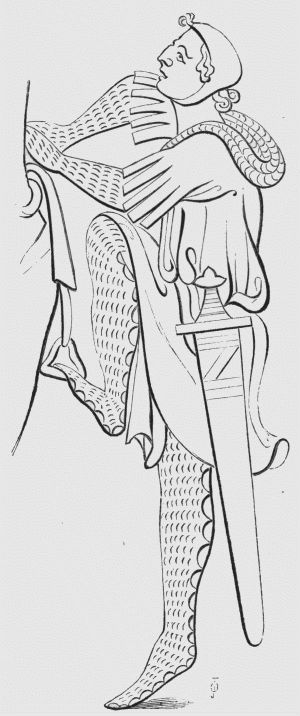
No. 56.
Beneath the head-defence of chain-mail was worn a coif of softer material, to mitigate the roughness of the iron-cloth; and perhaps also to assist in protecting the head by being made of quilted-work. See our woodcut, No. 56, from a miniature given by Willemin (Monumens Inédits, j. Pl. cii.) Compare also Painted Chamber, Pl. xxxv., and Willemin, j. Pl. cxliii.
Besides the Hauberk already described, which however forms in a great majority of instances the body-armour of the knights of this time, we have several varieties of defensive equipment. The Haubergeon is still mentioned, and seems to imply, not alone the smaller hauberk of chain-mail, but sometimes a garment of inferior defence and different material. There is also a chain-mail hauberk made with sleeves which reach but little below the elbows. A good example occurs on folio 9 of Roy. MS. 12, F. xiii.; a Bestiarium. See also the figures of Virtues in Plates xxxviii. and xxxix. of the Painted Chamber.
The Gambeson or Pourpoint, or Gambesiata Lorica, as it is called in a will of the year 1286, frequently appears as forming of itself the coat of fence. It is thus noticed in the Statute of Winchester, already quoted; where, while the first class of tenants are prescribed a "hauber, chapel de feer," &c., the third class are to have "parpoint, chapel de feer, espe e cutel." Compare also the Statute of Arms of 1252. In the eighth of Edward I. we read that "Rogerus de Wanstede tenet dimid. serjantiam ibidem per servitium inveniendi unum Valectum per octo dies, sumptibus propriis, cum praepuncto, capella ferrea et lancea, custodire castrum de Portsmut tempore guerrae[332]." In the "Ordonnances sur le Commerce et les Métiers," the duties of the pourpointers of Paris at the close of this century are very exactly defined. "Se l'on fait cotes gamboisiees, que elles soient couchees deuement sur neufves estoffes, et pointees, enfermees, faites a deux fois, bien et nettement emplies, de bonnes estoffes, soient de coton ou dautres estoffes[333]." Again: "Item que nul doresenavant ne puist faire cote gamboisiee ou il n'ait trois livres de coton tout net, si elles ne sont faites en fremes, et au dessous soient faites entremains, et que il y ait un ply de vieil linge emprez l'endroit de demie aulne et demy quartier devant et autant derriere." From these enactments we see that the counterpointers of the thirteenth century were but too apt to construct their armours of unstable materials, and to stuff them with a niggard hand.
The Cuirie (Cuirena) was, as its name implies, originally a defence of leather: it was also made of cloth. It covered the body alone, requiring the addition of Brachières to complete the coat. Thus, in the Roll of Purchases made for the Windsor tournament in the sixth year of Edward I., we have: "De Milon̄. le Cuireur͂ (Milo the Currier) xxxiij. quiret͂, p'c pec̄ iij. s." Each took two ells of the cloth called Carda in its construction: "It͂ pro qualibet quirett͂ ij. uln̄ card." The sleeves appear to have been of pourpointerie: "It͂ pro xxxviij. par͂ brach͂, x. bukerann̄[334]."
An account cited by Ducange, of the date 1239, has:—"Pro hernesio suo, videlicet baccis et cuireniis suis affecturis ix. lib. v. sol. Item pro tribus baccis et tribus cuirenis ad eosdem, iv. lib. iv. sol." See the glossarists under Baca. Guiart also mentions the cuirie:—
"Hyaumes, haubers, tacles, cuiries, Fondent par les grans cops et fraingnent." Année 1268.
The Cargan seems to have been a collar or tippet of chain-mail. It occurs as part of a footman's armour in the Statutes of Frejus, A.D. 1233: "Peditem armatum intelligimus armatum scuto et propuncto, seu auspergoto, et cofa seu capello ferreo, et cargan, vel sine cargan," &c. The glossarists derive this and the cognate word, carcannum, from καρκίνος, genus vinculi; and, if this derivation is the true one, a gorget of chain-mail may be fairly inferred.
Other materials for armour than those mentioned above appear during the thirteenth century; but, before noticing these, it may be well to take a glance at the remaining parts of the knightly suit as they occur in the usual monuments of the time; then to examine the appendages which are attached to the body-armour, as the ailettes; after which we will notice the exceptional materials employed for defensive purposes; and lastly, those portions of the warrior's equipment which have not been included in the above scheme of investigation.
The Chausses, in the early part of the thirteenth century were entirely of chain-mail, covering the whole leg; as shewn in our woodcuts, No. 46, 52, and 54. Sometimes they were tightened below the knee with a lace, as in the two Salisbury effigies (Stothard, Plates xvii. and xxx., and our woodcut, No. 54.) A variety of this defence was laid on the front part of the leg, and then laced up behind. See woodcut, No. 53, from Harl. MS. 5102, fol. 32, a book of the early part of the century; and our numbers 56 and 62, towards the close of this period. Compare also Plates xxxiii. of Hefner, Plate liv. of Strutt's Horda, and folio 10 of Roy. MS. 12, F. xiii.
To the chausses, whether of chain-mail or of banded-mail, are sometimes added Poleyns (or knee-pieces) of plate. It is often, however, difficult to determine whether the poleyns are fixed to the chausses or the chausson, from the upper edge of them being covered by the hauberk. A good example of the chausses armed with the knee-piece is offered by the knightly statue in Salisbury Cathedral (Stothard, Pl. xxx.), circa 1260. See also our woodcuts, No. 75 and 77: the first from Add. MS. 11,639, fol. 520; the latter from a glass-painting in the north transept of Oxford Cathedral. A German example given by Hefner (Pt. i. Pl. lxxvii.), from a manuscript illuminated at Metz c. 1280, is copied in our woodcut, No. 68. Poleyns are named in the Wardrobe Account of 28 Ed. I. (1300): "factura diversorum armorum, vexillorum, et penocellorum, pro Domino Edwardo filio Regis, et Johanne de Lancastria, jamberis, poleyns, platis, uno capello ferri, una cresta cum clavis argenti pro eodem capello," &c.
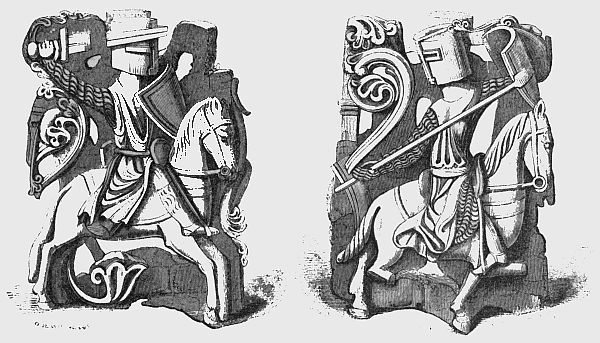
No. 57.
Towards the close of the thirteenth century the Chausses are most commonly accompanied with a Chausson of leather or quilted-work, the purpose of which was probably to obviate the inconvenience of the long chausses of metal in riding. It is found plain, gamboised in vertical lines, and sometimes richly diapered. The plain chausson is well shewn in Stothard's Plates xxii. and xxvi., effigies at Gloucester and in the Temple Church, London. The gamboised chausson is seen in this drawing of an ivory chess-piece preserved in the Ashmolean Museum. See also the effigy of a De Vere at Hatfield Broadoak, (Stothard, Pl. xxxvi.) An excellent example of the pourpointed chausson worked in a rich diaper is offered by the brass of De Bures, 1302 (Waller, Pt. 2, and Boutell's "Brasses and Slabs"). A curious variety of the chausson and chausses is found in the figure of a knight from Roy. MS. 2, A. xxii. fol. 219, given in our woodcut, No. 62; the chausson here being of chain-mail, while the chausses appear to be of rivetted plates. A chausson of chain-mail again appears in our cut, No. 86, from the Painted Chamber. To the chausson were usually attached knee-pieces of some rigid material: metal, cuir bouilli, or a mixture of both. See our woodcuts, Nos. 59 and 63; an effigy in Ash Church near Sandwich, and an illumination from a German manuscript, Add. MS. 17,687, both of the end of this century. Compare also the effigy at Gosberton (Stothard, Pl. xxxvii.), and those of De Vere and De Bures cited above. Among the embellishments of these poleyns are sometimes found little shields of arms; as in our woodcut, No. 70, the effigy of an unknown knight in Norton Church, Durham, c. 1300[335], and in the statue of Brian Fitz Alan, in Bedale Church, Yorkshire, engraved in Hollis's Effigies, Pt. 4, and in Blore's Monuments.
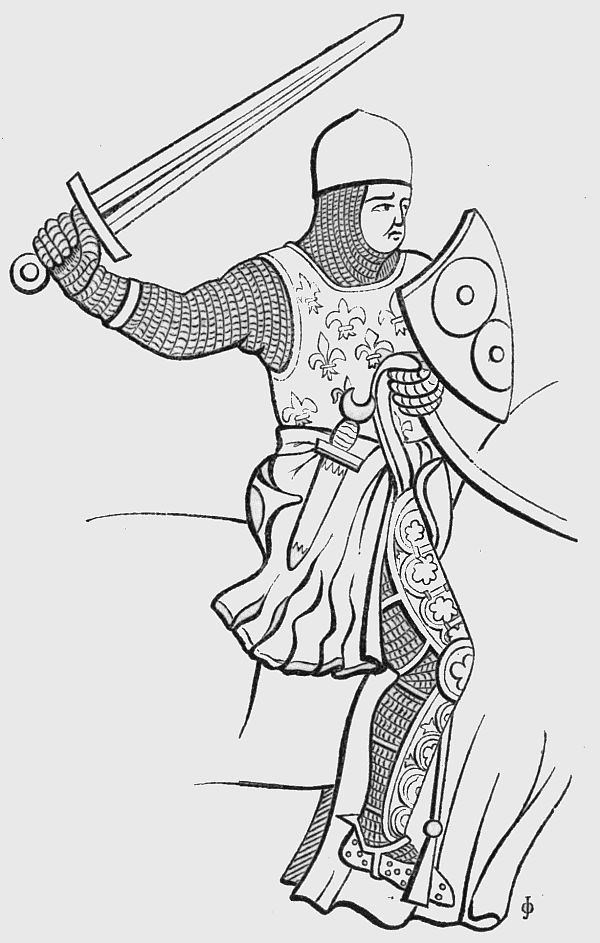
No. 58.
At the close of this century first appear the Greaves, of metal or cuir bouilli, covering the front of the leg from the knee to the instep. They were probably of German introduction, for their Latin name was Bainbergæ, from the German Beinbergen; and it seems likely that the Germans may have copied them from the examples of classic times with which they had become familiar during their wars in Italy. In the south of Europe, the greaves were already become of a highly ornamental character, as we may see from this sculpture of Gulielmus Balnis, 1289, from a bas-relief in the Annunziata Convent at Florence[336]; while in England they do not once appear among our monumental effigies or on our royal seals. Nor can a single example be found among the pictures that adorned the royal palace of Westminster. They are seen, however, among the illustrations of a manuscript of Matthew Paris' Lives of the two Offas, (Cott. MS., Nero, D. 1,) a work usually assigned to the thirteenth century, but perhaps not earlier than the next age. Our woodcut, No. 80, has an example from this manuscript, folio 7. On comparing the two engravings given by us, it will be seen that, while the vellum picture shews the defence below the knee only, the Italian figure has it both below and above. The abundance of ornament in the latter specimen seems to imply a moulded material—cuir bouilli? Antique examples, however, found at Pompeii and elsewhere, are of metal, highly ornamented with chasing and embossed-work. The name Bainberg occurs in several ancient documents. In the Lex Ripuaria we have: "Bainbergas bonas pro VI. sol. tribuat." And in the will of St. Everard, duke of Frejus: "Bruniam unam, helmum 1. et manicam 1. ad ipsam opus, bemberga II." &c. And again: "Bruniam unam cum halsberga et manicam unam, bemivergas duas." The word in the last passage being probably an error for beinbergas.
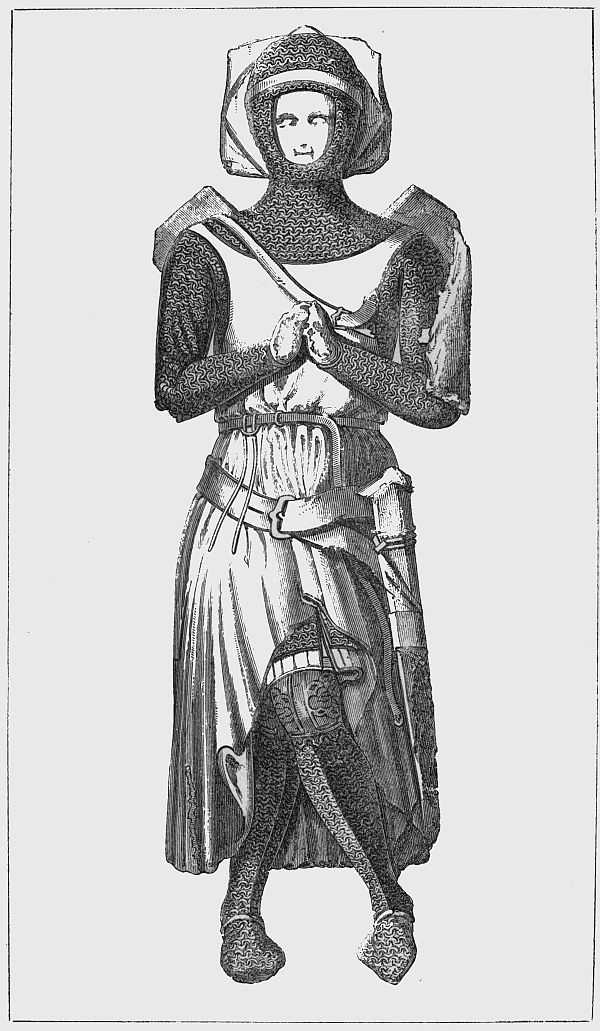
Plate LIX.
In the last quarter of the thirteenth century appear those curious appendages to the knightly suit, the Ailettes. But they do not occur in any frequency till the beginning of the fourteenth century. We shall, therefore, in noticing this novelty, refer to some examples of the later period. From their name, ailettes, Fr.; alette, Ital.; and alettæ in the Latin of the period, they appear to have been a French or Italian invention. An early notice of them is in the Roll of Purchases for the Windsor Tournament in 1278, where they are made of leather covered with the kind of cloth called Carda. "De eodem (Milo the Currier) xxxviij. par͂ alect͂ cor͂ p'c̄ par͂. viij. d." "It͂ pro xxxviij. par͂ alett͂ s͂. pro q̊ par͂ dī uln̄ card. s͂. xix. uln̄." They were fastened with silk laces, supplied by "Richard Paternoster." "D Ricõ pat͂ nr͂ viij. Duoden̄ laqueorum serīc pro alett͂ p'̄c duoden̄ viij. d.[337]" Sir Roger de Trumpington was one of the thirty-eight knights engaged in this tournament, and it is remarkable that his monumental brass furnishes one of the earliest and best pictorial examples of the ailette that has come down to us. (See our woodcut, No. 73.) There is one instance of it, and only one, in the pictures of the Painted Chamber, Pl. xxxv. It is ensigned with a bird. In monumental statues it is very rare. The figure here given is from a knightly tomb in the Church of Ash-by-Sandwich, seemingly of the close of this century[338]. The ailettes appear behind the shoulders, rising from the slab beneath, about the eighth of an inch. They have been quadrangular, the outer corners having become broken by accident: there is no trace of any fastening, and no remain of colour. The other monumental statues in England exhibiting the ailette are those of a Pembridge in Clehongre Church, Herefordshire (figured, with details, in Hollis's Effigies, Pt. 5), and the so-called Crusader at Great Tew, Oxfordshire. The Clehongre figure is especially curious as shewing the ailette fastened by its "laqueus," which appears on the outside. In Switzerland there is the statue of Rudolf von Thierstein, at Basle: the ailettes here are square, and fixed on the side of the figure. (Hefner, Pt. 2, Pl. xli.) Our English monumental brasses furnish several examples. See those of Septvans and Buslingthorpe, given by Waller, and the Gorleston brass, Plate li. of Stothard. The curious painted windows at Tewkesbury, figured in full by Carter (Sculpture and Painting), and in part by Shaw (Dress and Decorations), afford the best illustration contributed by pictured glass. Good examples are found in the ivory carvings and seals of the period. The seals of Edward the Third, as duke and as king, are well-known instances; and the ivory casket engraved by Carter, Plates cxiii. and cxiv., offers a singular variety of this accessory. Illuminated manuscripts furnish abundant examples. See, for instance, Roy. MSS., 14, E. iii. and 2, B. vii., and Add. MS. 10,292. The Louterell Psalter has a good specimen, copied in Carter's work named above, and in the Vetusta Monumenta. French monumental examples, we learn from M. Allou, are very scarce: "L'accessoire qui nous occupe est fort rare dans les monuments français. Nous en trouvons des exemples dans les dessins qui nous ont été communiqués par M. Achille Deville, des pierres sépulchrales de Robert Duplessis, 1322, de Robert d'Estouteville, 1331, et de Jean de Lorraine, Duc de Brabant, 1341[339]."
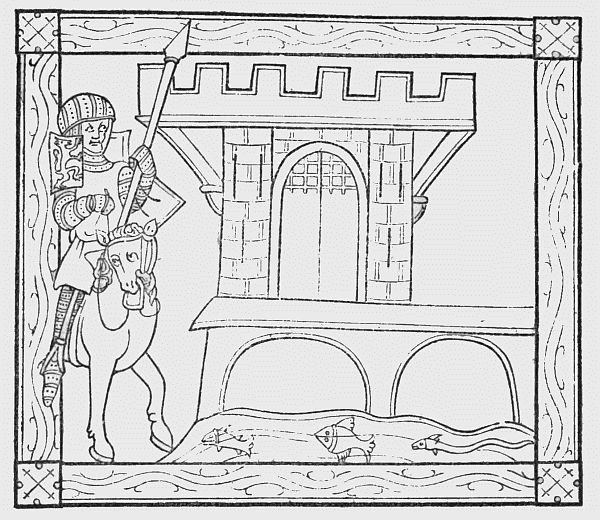
No. 60.
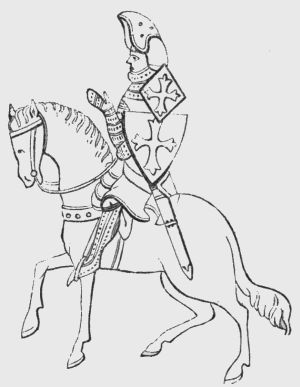
No. 61.
The forms of the ailette are various: the most frequent is the quadrangular, as in the Ash Church effigy given above, and in this example from Add. MS. 10,293, fol. 58; a book dated in 1316. The round form occurs on the ivory casket engraved in vol. 4 of the Journal of the Archæological Association, and in Plates cxiii. and cxiv. of Carter's Sculpture and Painting. The pentagonal is seen in an illumination of Sloane MS. 3,983, engraved as the frontispiece to Strutt's Dress and Habits; the cruciform, in the figure of a knight from Roy. MS., 2, A. xxii. fol. 219 (our woodcut, No. 62). And on folio 94vo. of Roy. MS., 14, E. iij. is an example, the only one ever observed by the writer, of a lozenge-formed ailette. It is clear, from the Cross on the shield having the same position as the other, that the ailette is not a square one worn awry.
The size of this appendage differs greatly in different monuments. In the round example of the ivory casket, cited above, it is scarcely larger than the palm of the hand: while, in an illumination of Roy. MS., 20, D. 1, fol. 18vo, it is little less than the ordinary shield of the period. Its position is generally behind the shoulder, or at the side of it: sometimes it appears in front: but too strict an interpretation must not be given to the rude memorials of these times.
The use of the ailette has somewhat perplexed antiquarian writers. The French archæologists of the present day confess that it is "difficile d'en expliquer l'usage[340]." Some writers have considered it as a simply defensive provision: others look upon it as an ensign, to indicate to his followers the place of a leader in the field. Against the supposition that it was merely armorial, may be urged that in many cases it has no heraldic bearing at all: sometimes it has a cross only, sometimes a diaper pattern, and sometimes it is quite blank. See examples of all these varieties in the Tewkesbury glass paintings, the Gorleston brass (Stothard, Pl. li.), and the Buslingthorpe brass (Waller, Pt. 10). In vellum pictures it is often seen worn by knights in the tilt; where the heraldic bearings already exhibited on the shield, crest, and surcoat of the rider, and on the caparisons of the horse, would to no useful purpose be repeated on the ailette. In the case of the Clehongre example, quoted above, the outside knotting of the lace does not seem consistent with the display of armorial distinctions on the wing beneath. In Germany they are called Tartschen (Hefner: Trachten, Pt. 2, Pl. xli.), and their purpose of shields seems most in accordance with the numerous ancient evidences in which they appear. The knights, indeed, not content with their panoply of steel, seem in the course of the middle-ages to have fortified themselves with a complete outwork of shields. Thus we have the ailettes, the shield proper, the garde-bras, or elbow-shield, the shoulder-shield, the Beinschiene, or shield for the legs, the vamplate on the lance, and the steel front of the saddle, which was in fact but another shield for the defence of the knight's body. Referring once more to the Clehongre effigy, it will be observed that, while the "défaut de la cuirasse" (where the arm joins the body) is strengthened in front with a steel roundel, this assailable point is covered at the back of the arm with the ailette. See the Details on Hollis's third plate of this monument. The analogy between these defences and those curious upright pieces of steel on the shoulders, so frequent in the armours of the sixteenth century, will at once be recognised.
Ailettes of a superb construction appear in the Inventory of the effects of Piers Gaveston in 1313: "Item, autres divers garnementz des armes le dit Pieres, ovek les alettes garniz et frettez de perles[341]." They are named also in the Inventory of the goods of Umfrey de Bohun in 1322: "iiij peire de alettes des armes le Counte de Hereford[342]."
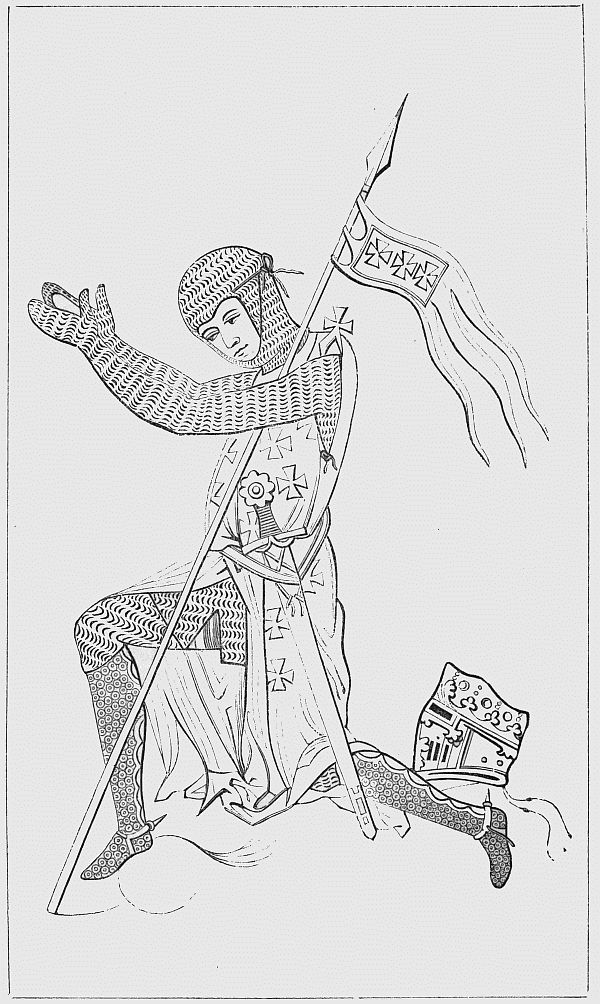
Plate LXII.
Besides the defences of chain-mail, which, as we have seen, formed the usual armour of the knights of the thirteenth century, there were other materials occasionally employed for the warrior's habit. Scale-work still appears, though in but few monuments; and it seems to have been used for small portions only of the equipment. See the brass figured by Waller, Part x., and Boutell, page 113.
In this singular figure of a knight from Roy. MS. 2, A. xxii. fol. 219, the leg-defences are composed of a kind of Bezanted Armour: small roundels of metal, placed contiguously, appear to be rivetted to a fabric of cloth or to leather: forming a garment very similar to the "penny plate armour" of the sixteenth century. In the original drawing, the chausses are shaded with blue: but, singularly enough, the chausson is shaded with red, though it seems clearly to be intended for chain-mail. The date of the figure appears to be about the close of the thirteenth century. As a curious illustration of bezanted armour, the late Mr. Hudson Turner told the writer of these pages that he had seen in an ancient record an account of a hauberk of Edward III., studded with gold florins; though, with the usual caution of the antiquarian discoverer, he withheld the name and locality of the document.
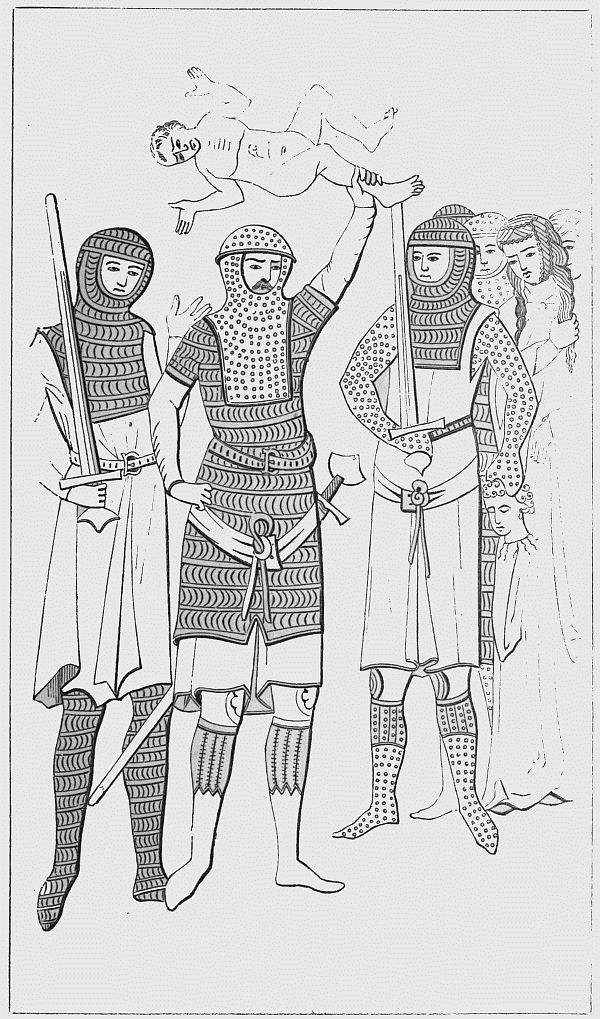
Plate LXIII.
In the engraving given overleaf, from Add. MS. 17,687, a German illumination of the end of this century, we have an example of Studded armour. Garments presenting an exterior sprinkled with studs are of frequent occurrence in the next age, and we shall therefore freely use the memorials of that time in illustration of our subject; and indeed we may gather some valuable evidences from existing armours of Eastern manufacture. Many a mystery of middle-age lore may be unravelled by an attentive examination of Oriental productions. As the surface only of the military studded garments is presented to our view in ancient monuments, we can seldom determine with exactness their construction: but, from the comparison of various examples, it seems probable that there were not less than four or five varieties of this kind of apparel. First, we have quilted-work, in which the studs appear to be used for holding together the component parts of the fabric. We have already noticed an example of the kind in our preceding division (woodcut, No. 37). The engraving now before us seems to represent a similar armour: the spots are coloured of a red-brown on a ground of light grey. In the fine manuscript of Meliadus, Add. MS. 12,228, not only parts of the knightly suit, but the saddles of the horses, are seeded with studs; which seems distinctly to imply a quilted covering. See also the effigies engraved by Stothard, (Plates lx. and lxiii.) And in the Tower collection will be found Chinese armour of modern date, formed of a quilted garment sprinkled with metal studs. The next kind of Studded armour is that of which a real specimen of the fourteenth century was found by Dr. Hefner in the excavations of the old Castle of Tannenberg in Germany: a relic which throws the clearest light on the costume of many a knightly effigy of that period. The defence is thus contrived: strips of metal, like hooping, are placed horizontally across the body, the upper edge of each splint being perforated for rivets. These strips slightly overlap each other: a piece of velvet, or other material of a similar kind, is then laid over the whole, and by rows of rivets fastened to the iron splints beneath. The velvet being of a rich hue, and the rivet-heads gilt or silvered, the garment presents exactly the appearance of those knightly suits in which spots of gold or silver are seen studding the whole superficies of a dress of crimson or other brilliant tincture. The relic in question is figured and minutely described in the admirable tract on the results of the find by Doctors Hefner and Wolf: "Die Burg Tannenberg und ihre Ausgrabungen." The Stapelton brass, of which there is a facsimile in the Craven Ord Collection in the British Museum, and an engraving in Stothard's work, and the brass at Aveley in Essex (Waller, Pt. 1), seem to exhibit the armour in question. Foreign examples occur in the figures of Conrad von Saunsheim and those in Bamberg Cathedral, given by Hefner in Part II. of the Trachten. The jazerant coats of the fifteenth century, of which several real specimens yet remain to us, are of a very similar construction. A third kind of Stud-work seems to differ from the articulated sort described above, in its basis being uniform and rigid, while the surface exhibits the same features, of a coloured ground-work spangled with bosses of gold or silver. See Stothard's Plates lxxvi. and xciii. A fourth variety appears to be described in this passage of the Inventory of the effects of Piers Gaveston: "Item, en un autre coffre une peire de plates enclouez et garniz d'argent, od quatre cheynes d'argent, coverz dun drap de velvet vermail besaunte d'or[343]." Here we have a garment of velvet spotted with gold, covering an armour nailed with silver: clearly, therefore, differing from the preceding kinds, where the rivets unite the component materials into one vestment. A further item of the Inventory seems to shew still more clearly that the velvet coat (whether bezanted or not) was distinct from the iron defence: "Item, deux cotes de velvet pur plates coverir." Finally, another kind of studded military garment, of which we trace the existence through the examples of Modern Asia, consisted of several thicknesses of pliable stuff, held together by rivets with bossed heads which appear on the surface. In the Museum of the United Service Institution may be seen a Chinese armour constructed after this method, but having the coat lined at the breast with a few plates of iron about the size of playing-cards. In other examples, the studs are not rivetted, but only sewn down upon the garment.
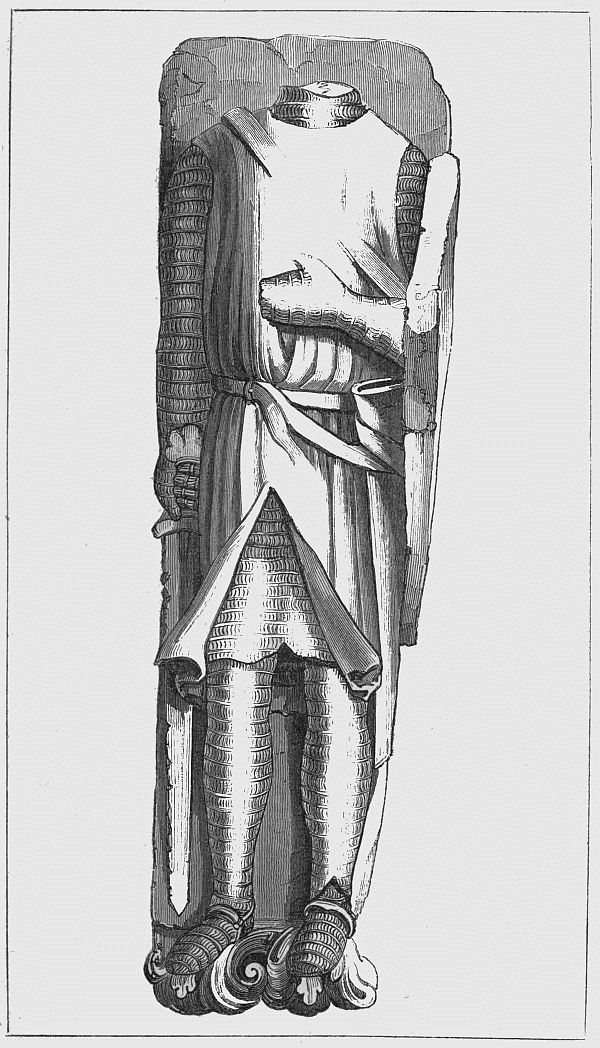
Plate LXIV.
Towards the close of the thirteenth century we find an armour offering a new appearance, to which has been given the name of Banded Mail. Notwithstanding much careful consideration, its exact structure has not yet been discovered, though the representations of it are very abundant. For a whole century, manuscript illuminations, monumental brasses, painted windows, royal and baronial seals, metal chasings and sculptures of various kinds, afford us an infinity of examples; in none of which has hitherto been detected the exact evidence either of its material or its construction. Monumental sculptures, from their large size and the careful finish of their details, might have been expected to solve a problem which they only perplex. The effigy[344] here engraved, of a knight of the De Sulney family, exhibits the warrior armed from head to foot in a suit of banded-mail; and in the following woodcut we have given a portion of the armour of this figure, of its real size. The profile view has been copied with particular care, in the hope that it might be of use in determining the structure of this very singular defence. By many writers this fabric has been described as pourpointerie; by others it has been considered as only a conventional mode of representing the ordinary chain-mail. Mr. Kerrich, whose opinions will always be received with, the greatest respect, speaking of the rows of little arcs used to express the latter defence, says: "When there are lines between the rows, whether two or only one, I conceive it means still but the same thing[345]." M. Pottier, in the text to Willemin's Monuments Inédits, does not distinguish the so-called banded-mail from the other, but names it simply "armure de mailles[346]." But it seems difficult to believe that the common chain-mail could be intended, so widely different are the two modes of representation, whether in sculpture or in painting. Observe, for instance, the details—especially the portion in profile—from the effigy at Newton Solney. And in the following subject from the Romance of Meliadus, (Add. MS. 12,228, f. 79,) there seems no assignable reason for marking one figure so differently from the rest, unless the armour itself were of a distinct kind[347].
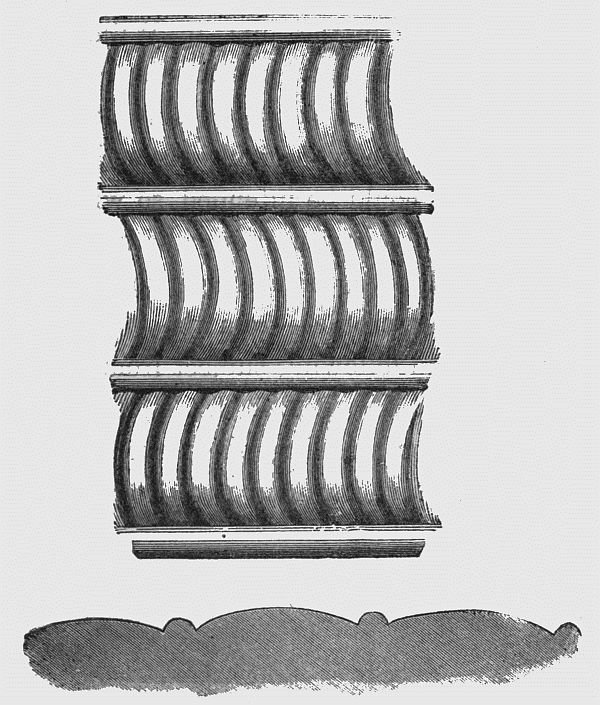
No. 65.
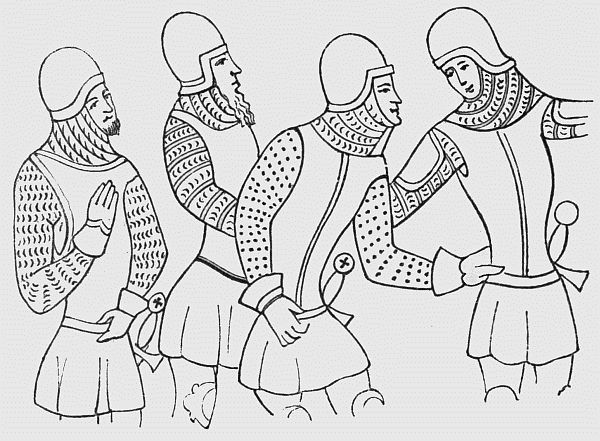
No. 66.
That the banded defences under consideration were of pourpointing is still more unlikely; for a gamboised garment, whether of velvet, silk, cloth, or whatever material, would, in painted representations, exhibit those various colours which are so lavishly displayed in the other portions of the knightly attire. Yet a careful examination of many hundred figures in illuminated manuscripts has failed in detecting a single instance of positive colour on banded-mail, except such as may be referred to the metals. Green, scarlet, crimson, diaper or ray, never appear. But gold or a golden tincture, silver or white, and grey of various shades, occur continually. And all these seem to indicate a fabric in which metal plays at least a conspicuous part. The examples among vellum-paintings, in which the banding is tinted grey or left white, are so numerous that one can scarcely open a manuscript of the period without finding them. Instances of it in silver may be seen in Cotton MSS., Vitellius, A. xiii., and Nero, D. vi.; in Roy. MS. 20, D. i., and Add. MS. 12,228. On folio 217vo. of the last-named book will be found the figure of a knight whose banded-mail is gilt. The same kind of armour, in gold colour, appears in the windows of Beer Ferrers Church, Devonshire, and of Fulborn Church, Cambridgeshire. See Lysons' Devonshire, p. 326, and Kerrich Collections, Add. MS. 6,730, fol. 61, for faithful copies of these examples. If from the foregoing evidences we derive the belief that the basis of this fabric was metal, from a monument figured in the superb work of Count Bastard, Peintures des Manuscrits, &c., we gather that the lines of arcs were rings; for the fillet that binds the coif round the temples is clearly passed through alternate groups of rings, exactly as in the ordinary mail-hood. The figure is from a French Bible of the beginning of the fourteenth century, and occurs in the seventh number of the Peintures. In fairness we must admit that this example is not altogether inadmissible as an evidence in favour of the theory of common chain-mail. And on that side may be ranged the very curious figure of Offa the First, given in our woodcut, No. 80, from the "Lives of the Two Offas," by Matthew Paris (Cott. MS., Nero, D. i. fol. 7); where the upper part of the warrior's coif is of "banded-mail," while the lower portion is marked in the manner usually adopted to express the ordinary chain-mail.
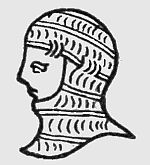
No. 67.
Different from all these is the interpretation offered by M. de Vigne in his Recueil de Costumes du Moyen-Age. On Plate lvi. of that work, the author has given a series of sketches, shewing the supposed construction of various ancient armours. The banded mail is represented as formed of rows of overlapping rings, sewn down on leather or other similar material, "avec les coutures couvertes de petites bandes de cuir." Von Leber, in his sketch of medieval armour, has the same notion: "Vom 13. his nach Anfang des 14. Jahrh. der lederstreifige Ringharnisch als unschöne und unbequeme Ritterhülle[348]." This interpretation, however, is at variance with those ancient monuments where the inside of the defence exhibits the ring-work as well as the exterior. See our print of the De Sulney effigy. A more improbable garment, to say the least of it, than a hauberk of leather, faced with mail and lined with mail, can scarcely be conceived. Other examples of the hauberk, shewing the banding on the inside, are furnished by the brass of De Creke (Waller, Pt. viii.; Boutell, p. 39), a brass at Minster, Isle of Sheppey (Stothard, Pl. liv.; Boutell, p. 42), in the effigy of Sir John D'Aubernoun (Stothard, Pl. lx.), and the brass at Ghent, figured in the Archæological Journal, vol. vii. p. 287.
Sometimes the knight's horse is barded with banded-mail, as in the figure from a manuscript in the Library of Cambrai, given by De Vigne in his Recueil de Costumes, vol. ii., plate viii. In Roy. MS. 20, D. i. fol. 330, a work of about the close of the thirteenth century, are elephants with similar caparisons: on their backs are castles, full of fighting men.
We have already noticed that four sculptured effigies with banded-mail have been observed in England. The Tewkesbury figure is given by Stothard; an example further curious from the hauberk being sculptured as ordinary chain-mail, while the camail alone is of the banded work. In the "Memoirs," p. 125, Stothard, writing of this camail to Mr. Kerrich, says: "Amongst other curious things I have met with, is a figure which has some remarkable points about it; but, for the discovery of these, I devoted a whole day in clearing away a thick coating of whitewash which concealed them. The mail attached to the helmet was of that kind so frequently represented in drawings, and which you have had doubts whether it was not another way of representing that sort we are already acquainted with. I am sorry that I know no more of its construction now than before I met with it." The effigy at Dodford, near Weedon, is engraved in Baker's Northamptonshire, vol. i. p. 360. The knight has hauberk, chausses and coif of banded-mail, with poleyns, coutes and cervellière of plate. The figure at Tollard Royal, Wilts, has not been engraved; but from some memorandums kindly furnished by a friend, it appears that this knight is habited in hauberk, chausses and coif of banded-mail, with a skull-cap of plate.
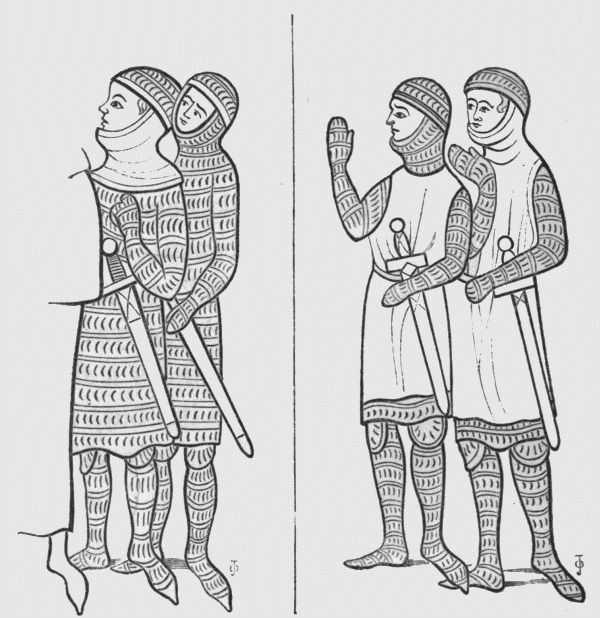
No. 68.
Compare also the effigy of gilded metal in Westminster Abbey, of William de Valence, who died in 1296 (Stothard, Pl. xliv.). In the following figures, from a German manuscript of about 1280, copied from Hefner's Trachten, it will be observed that each knight differs from his fellow in the manner of his equipment, though the staple defence of all is the banded-mail. Other examples of this kind of armour will be found in our woodcuts, No. 47, 48, 63, 72 and 77. At last, we can establish no definite conclusion. Our proofs are but of a negative character. Yet it is always something, to have determined what a thing is not. It seems pretty clear, then, from the absence of varied colours which we have remarked, that the Banded-mail is not pourpointerie of any kind. And, from the presence of the ring-work on the inside of the armour as well as the outside, it appears not to be of the construction suggested by the German and Belgian antiquaries. If meant for ordinary chain-mail, it must be confessed that the medieval artists never hit upon a mode of expressing this material so little resembling the original. It is to the further examination of ancient evidences, or to the discovery of monuments hitherto unobserved, that we must look for a satisfactory solution of this knightly mystery.
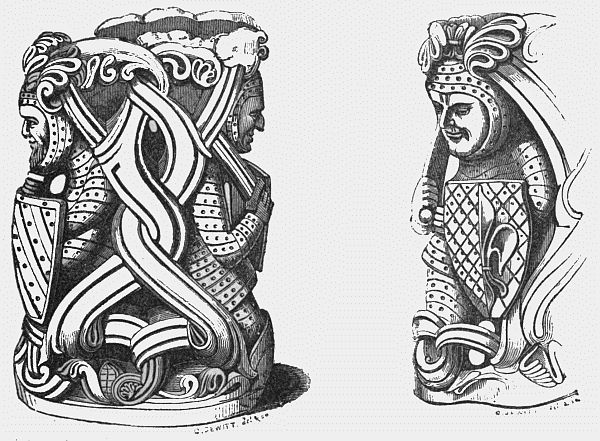
No. 69.
In addition to the various armours already noticed, we find in the thirteenth century the defence expressed by cross-lines which we have remarked in the earlier periods. Good examples occur on folio 9 of Roy. MS. 12, F. xiii., and in Laing's Scottish Seals, Plate iv.
And in a chess-piece of the early part of this century, the markings of the armour are made in a very peculiar manner: by rows of drilled holes divided by lines. (Woodcut 69.) This seems to be the device of a rude artist to express the ordinary chain-mail. The example was first brought into prominent notice in the pages of the Archæological Journal, vol. iii. p. 241.
Occasionally, but very rarely, the chain-mail was indicated in monumental statues by merely painting the links on a flat surface. The effigy of a De l'Isle in Rampton Church, Cambridgeshire, engraved by Stothard, Plate xxi., affords a good instance of this method.
A further singularity of the period is that the chain-mail sometimes presents a surface of a hue which does not appear consistent with a defence of steel. The effigy of Longuespée at Salisbury (woodcut No. 54) has the armour painted brown. The centre figure in our woodcut No. 53 wears a hauberk which is marked with buff on a white ground, the other hauberks being blue. The knight on woodcut No. 62 has a chausson shaded with red. And in Harl. MSS. 1,526 and 1,527 are many figures in which the chain-mail markings appear on a bright red ground. It seems probable, however, that such variations may be charged on the caprice of the artists; as in the colourings of the Bayeux tapestry, where the near legs of the horses are made blue, while the off legs are yellow.
Among the knightly effigies in the Temple Church, London, is a figure which seems to require an especial notice; the armour being of a fashion not elsewhere remarked. It consists of a back and breast-piece, each in a single part, united at the sides by straps. The sculpture being in stone, without any painting preserved, it is of course impossible to ascertain the material which the artist desired to represent. It may have been leather (the cuirie, of which we have already noted the existence); but there seems no good reason why it should not have been iron: and if so, it is perhaps the earliest example of a body-armour formed of a "pair of plates large[349]" that Europe has to offer. The effigy in question lies at the south-east corner of the group in the Round Church.