PART II.
Reading edition
FROM THE NORMAN CONQUEST OF ENGLAND TO THE END OF THE TWELFTH CENTURY.
For the period now to be examined, namely, from about the year 1066 to the close of the twelfth century, our chief evidences are still the illuminations of manuscripts, the writings of chroniclers and poets, tapestry-pictures, ivory carvings and metal chasings. The valuable testimonies of the graves are lost to us; but a new source of information is opened to our inquiries in the royal and baronial seals, which from the second half of the eleventh century appear in great abundance wherever the feudal system is in vogue. Among these various evidences, there are two which, for our particular purpose, are especially valuable,—the Bayeux tapestry and the Chronicle of Robert Wace. There seems to be no reasonable doubt of this tapestry having been embroidered at the close of the eleventh century; and whoever has carefully examined it, will be at once convinced that it was wrought, not by courtly ladies, but by the ruder hands of the ordinary tapestry-workers. Curious analogy is found in the decorations of subsellæ of a somewhat later date[152]. The especial value of the Chronicle of the Dukes of Normandy is in the minuteness with which Wace delights to describe the incidents of knightly achievement. Taking his crude facts from William of Jumièges and Dudo of St. Quentin, he fills up their outlines with unwearying elaboration. Not content with drily noting the gathering of a host or the issue of an onslaught, he tells us how the levies came into the camp "by twos, and by threes, and by fours, and by fives," and with what weapons they contended, the material of their staves, and the length and breadth of their blades. He himself lived so near the time of which he writes, and the changes in the interval were so few, that his descriptions have, in most instances, the exactness of those of an eye-witness. The incidents of Duke William's Conquest of England he learns from the lips of his own father, who lived probably in the eleventh century:—
"—— jo oï dire à mon pere: Bien m'en sovint, maiz varlet ere." Roman de Rou, l. 11564.
We must still, however, keep in view that Wace, like all writers and illuminators of the middle-ages, does not hesitate to fill up his pictures from the scenes around him; so that, while we concede him a large measure of authority, especially for the events near his own time, we must on some occasions withhold our confidence, when his testimony is not in accordance with evidence which is strictly cotemporary.
With the feudal system was introduced a scheme of military rank which was altogether distinct from social position. Esquire, knight, and banneret had no necessary connection with prince, baron, or private person. The heir of a crown might be but an esquire; a fortunate soldier often became a knight. The esquire was the aspirant to knightly honours, and patiently served his apprenticeship to arms in the court of his prince or the hall of some neighbouring baron. At the age of twenty-one he was eligible to knighthood: he became, if he had property enough to support the dignity, a knight-bachelor: "s'il a bien de quoi maintenir l'estat de chevalerie; car aultrement ne lui est honneur, et vault mieulx estre bon escuyer que ung poure chevalier[153]." In the field, the knight's contingent was led under a Pennon, a flag that differed from the square Banner of the banneret in being pointed at the fly. The dignity of the Knight Banneret required a retinue of at least fifty men-at-arms with their followers, so that it could only be enjoyed by the rich. The chronicles of the middle-ages are full of examples in which the knight who has distinguished himself on the field of battle declines this dignity on the plea of inadequate funds. When accepted, the Pennon of the knight was often at once converted on the spot into a Banner; as in the instance recorded by Olivier de la Marche:—"Si bailla le Roi d'Armes (de la Toison d'Or) un couteau au Duc (de Bourgogne), et prit le pennon en ses mains, et le bon Duc, sans oster le gantelet de la main senestre, fit un tour autour de sa main de la queue du pennon, et de l'autre main coupa ledit pennon et demeura quarré; et la Banniere faite[154]." Froissart offers several similar instances.
The feudal Levy was conducted on the very simple principle, that they who held the land should defend the land, and contribute to the king's army in proportion to the extent of their holdings. Those who could not serve in person, as clerics and ladies, were bound to furnish substitutes. The various contingents due from the vassals were carefully recorded in rolls; and in the Milice Française of Père Daniel is preserved a curious note of such a roll, of the time of Philippe Auguste, in which the contributors to the host are arranged in the following order: archbishops, bishops, abbots, dukes, earls, barons, castellans, vavassors, knights-banneret, and knights[155]. The usual time of service at this period was forty days: any further attendance was voluntary, and was probably much dependent on the prospect of booty.
That knight and esquire were not necessarily of gentle blood, might be proved by numerous ancient evidences: one or two may suffice. Matthew Paris, under the year 1250, tells us that the king "gave a charter of the liberty of warren in the land of Saint Alban's to a certain knight named Geoffry, although not descended from noble or knightly ancestors." This knight had obtained the privilege "from having married the sister of the king's clerk, John Maunsell." The "lady's name was Clarissa, and she was the daughter of a country priest, but exalted herself in her pride above her station, to the derision of all." Froissart, in the fourteenth century, gives us the history of Jacques le Gris, the bosom-friend of the Earl of Alençon,—"qui n'étoit pas de trop haute affaire, mais un écuyer de basse lignée qui s'étoit avancé, ainsi que fortune en avance plusieurs; et quand ils sont tous élevés et ils cuident être au plus sûr, fortune les retourne en la boue et les met plus has que elle ne les a eus de commencement[156]."
In fact, numerous exceptional cases might be adduced on almost every point of knightly usage, and to chronicle the whole would be a labour of many pages. A detail of such usages (the education of the varlets, the probation of the knights, the ceremonies of investiture, and the institutions of the various brotherhoods) is by no means within the province of this work. A large amount of information on these points will be found in the Mémoires sur l'ancienne Chevalerie of St. Palaye, and in the various works of Ducange; from whose pages numerous references will lead the more critical investigator to a wide range of valuable authorities. An able sketch of the Feudal System, as it existed in Italy, appears in the first volume of Sismondi's Républiques Italiennes au Moyen-âge, p. 80, sq.
Besides the feudal troops already noticed, there was a more general levy, when any pressing danger menaced the state. Thus, in 1124, Louis le Gros met the threatened invasion of the Emperor Henry V. by raising an army of more than 200,000 men[157]. And under Philippe le Bel, we have an ordinance calling upon all his subjects, "noble and non-noble, of whatsoever condition they be, between the ages of eighteen and sixty," to be ready to take the field. A similar provision was found in England. The Posse Comitatûs, which was under the command of the sheriffs of the various counties, included every freeman capable of bearing arms between the ages of fifteen and sixty. In 1181, Henry II. fixed an assize of arms, by which all his subjects, being freemen, were bound to be in readiness for the defence of the realm, "Whosoever holds one knight's fee shall have a coat-of-fence (loricam), a helmet (cassidem), a shield, and a lance; and every knight as many coats, helmets, shields, and lances, as he shall have knights' fees in his domain. Every free layman, having in rent or chattels the value of sixteen marks, shall have a coat-of-fence, helmet, shield and lance. Every free layman having in chattels ten marks, shall have a haubergeon (halbergellum), iron cap and lance (capelet ferri et lanceam). All burgesses and the whole community of freemen shall have each a 'wambais,' iron cap, and lance. On the death of any one having these arms, they shall remain to his heir. Any one having more arms than required by this assize, shall sell or give them, or so alienate them, that they may be employed in the king's service. No Jew shall have in his custody any coat-of-fence or haubergeon (loricam vel halbergellum), but shall sell it or give it, or in other manner so dispose of it that it shall remain to the king's use. No man shall carry arms out of the kingdom, or sell arms to be so carried. None but a freeman to be admitted to take the oath of arms (et præcepit rex, quod nullus reciperetur ad sacramentum armorum nisi liber homo[158])." In this curious document it will be remarked that the old national weapon, the axe, is altogether omitted; and the bow, which afterwards became so effective an arm among the infantry of this country, is equally unnoticed. The extensive levy indicated in these passages was clearly that of the so-called Arrière-ban, the Milice des Communes, or Communitates Parochiarum; troops who marched under the banners of their respective parishes. For in an ordinance of Charles VI. of France, in 1411, we find the ban and arrière-ban very exactly defined:—"Mandons et convoquons par devant nous, tous noz hommes et vassaulx tenant de nous, tant en fiefs qu'en arrière-fiefs: et aussi des gens des bonnes villes de notre royaume qui out accoustumé d'eulx armer par forme et manière de arrière-ban[159]."
As the vassals were not always disposed to exchange hawk and hound for lance and destrier, and as kings found themselves but ill-served by barons who had become almost as powerful as themselves, a plan was devised, by which both were relieved from this embarrassment of feudal relations. The vassal compounded by a money-payment called Scutage for the service due to his lord; and the lord, with the proceeds of this shield-tax, obtained the aid of foreign soldiery. Henry II. in England, and Philip Augustus in France, employed these mercenaries, who were called Coterelli, Rutarii, Bascli, and Brabantiones, names derived from their condition or country[160]. William the Conqueror, Wace tells us, had mercenary troops mixed with his feudal followers:—
"De mainte terre out soldéiers: Cels por terre, cels por déniers."—Rom. de Rou, l. 13797.
Again:—
"Dunc vindrent soldéirs à lui: Et uns è uns, è dui è dui, E quatre è quatre, è cinc è sis, E set è wit, è nof è dis: E li Dus toz les reteneit: Mult lor donout è prameteit.
Alquanz soldées demandoent, Livreisuns è duns covetoent."—Line 11544.
Besides the troops enumerated above, the King's Body-guard became a corps of some celebrity at the close of the twelfth century. Philip Augustus is said to have instituted this corps in the Holy Land, to protect his person from the machinations of the Old Man of the Mountain; and in imitation of his ally, Richard of England embodied a similar force. The Servientes armorum, Sergens d'armes, or Sergens à maces, were armed cap-à-pie, and besides their distinctive weapon, the mace, carried a bow and arrows[161], and of course a sword. In the fourteenth century they had a lance[162]. In the beginning of the fifteenth century, as we learn from the curious incised stones[163] formerly placed in the church of their brotherhood, St. Catherine-du-val, at Paris, and now preserved in the Church of St. Denis, the sergens d'armes were still clad in complete armour, their weapons being a mace and sword. The number of these guards at their first institution is not clear, but in the time of Louis VI. of France they were reduced to a hundred. It must be borne in mind that the name of serviens or sergent, as applied to military persons, had a much wider signification than this of a body-guard. It often included all beneath the dignity of a knight.
The Archers in the army of William the Conqueror fulfilled those duties of preliminary fight which at a later period fell to the lot of the musquetiers, and in our own day have passed to the cannonier. The Norman bowmen are the first of the invading troops to set foot on English soil:—
"Li archiers sunt primiers iessuz: El terrain sunt primiers venuz. Dunc a chescun son arc tendu, Couire et archaiz el lez pendu. Tuit furent rez è tuit tondu, De cors dras furent tuit vestu."—Rom. de Rou, l. 11626.
These shaven and shorn, short-coated archers, with their quivers hung at their side, are exactly reproduced in the Bayeux tapestry (Plates xiii., xv., and xvi.):—
"La gent à pié fu bien armée: Chescun porta arc et espée. Sor lor testes orent chapels, A lor piez liez lor panels. Alquanz unt bones coiriés, K'il unt à lor ventre liés. Plusors orent vestu gambais, Couires orent ceinz et archais.
Cil a pié aloient avant Serréement, lors ars portant."—Line 12805.
From this curious passage it appears that the archers of William were not a particular and distinctly organized corps, but that all the foot were armed with the bow. The caps and boots are clearly portrayed in the Bayeux tapestry; and from this valuable monument we obtain an exact confirmation of the statement of Wace, that some of the archers were clad in armour. See Plate xiii. We must observe also, that the advantage of a close formation was thoroughly appreciated at this day. The serried order of the foot noted above was also adopted by the cavalry:—
"Cil à cheval è cil à pié Tindrent lor eire è lor compas, Serréement lor petit pas, Ke l'un l'altre ne trespassout, Ne n'aprismout ne n'esloignout. Tuit aloent serréement, E tuit aloent fièrement."—Line 12825.
In Plate xiii. of the Bayeux tapestry, we find an archer who carries his quiver, not "el lez pendu," but slung at his back, so that the arrows present themselves at the right shoulder. In Plate xvi. we have a mounted archer joining a group of knights in the chase of the discomfited Saxons; from which we may venture to infer, that on the rout of an enemy it was the practice of such bowmen as could obtain horses, to act with the cavalry in the pursuit of the flying foe.
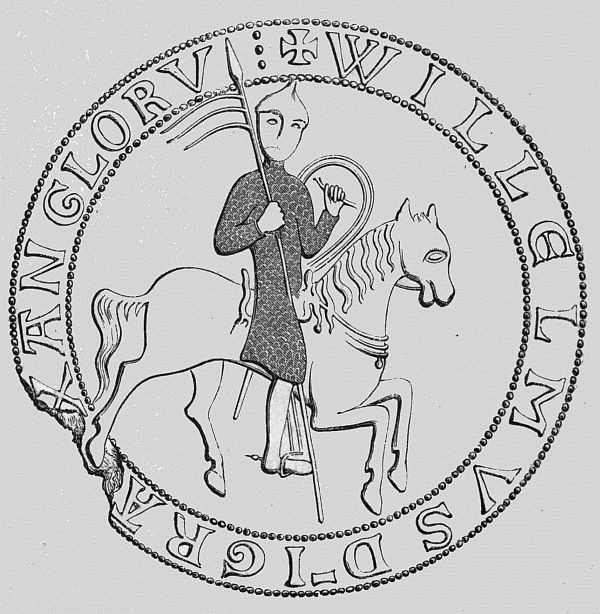
GREAT SEAL OF WILLIAM RUFUS.
No. 26.
If the Norman archers were for the most part clad in "cors dras," the horsemen were fully furnished in the choicest military equipment of the day:—
"Dunc issirent li Chevalier, Tuit armé è tuit haubergié[164]: Escu al col, healme lacié: Ensemble vindrent al gravier[165], Chescun armé sor son destrier. Tuit orent ceintes les espées, El plain vindrent lances levées. Li Barunz orent gonfanons, Li chevaliers orent penons."—Rom. de Rou, l. 11639. "Chevaliers ont haubers è branz, Chauces de fer, helmes luizanz, Escuz as cols, as mains lor lances."—Line 12813.
In the south, military science was already so far advanced that a Code for the discipline of troops had been established. The rules laid down by the Emperor Frederic for the control of his army in Italy in 1158, have been preserved by Radevicus of Frisinga[166], and are given by Sismondi[167].
Wherever the feudal system had taken root, a similar arming and similar tactics prevailed. The military
"Chevals quistrent et armes à la guise franchoise, Quer lor semblout è plus riche è plus cortoise."
But in the border-nations of Europe, where the old liberties of Celt and Teuton still lingered, the fashions of war were very different. In Ireland, in Scotland, in Wales, and in the Scandinavian North, the heroes were by no means clad in the pattern of the Bayeux tapestry. From Giraldus Cambrensis we learn that the Irish in the twelfth century wore no body-armour. In riding they used neither saddle nor spur. Their shields were circular, and painted red. Helmets they had none. Their weapons were a short spear, javelins, and an axe. The axes, which they had derived from the Norwegians and Ostmen, were excellently well steeled. "They make use of but one hand when they strike with the axe, extending the thumb along the handle to direct the blow; from which neither the helmet can defend the head, nor the iron folds of the armour the body; whence it has happened in our time that the whole thigh of a soldier, though cased in well-tempered armour, hath been lopped off by a single blow, the limb falling on one side of the horse, and the expiring body on the other. They are also expert beyond all other nations in casting stones in battle, when other weapons fail them, to the great detriment of their enemies[168]." The bow not being in use among the Irish of this time, and consequently there being nothing to oppose to the distant attack of the Norman archers, the havoc made by these latter troops was terrific; so that Giraldus, in his chapter, "Qualiter Hibernica gens sit expugnanda," recommends that in all attacks upon them, bowmen should be mixed with the heavy-armed force.
The Welsh also retained their old mode of warfare:—
"Gens Wallensis habet hoc naturale per omnes Indigenas, primis proprium quod servat ab annis,"
says Guillaume le Breton. "They are lightly armed," writes Giraldus Cambrensis, "so that their agility may not be impeded; they are clad in haubergeons (loricis minoribus), have a handful of arrows, long lances, helmets, and shields, but rarely appear with iron greaves (ocreis ferreis). Fleet and generous steeds, which their country produces, bear their leaders to battle, but the greater part of the people are obliged to march on foot over marshes and uneven ground. Those who are mounted, according to opportunity of time and place, both for the retreat and advance, easily become infantry. Those of the foot-soldiers who have not bare feet, wear shoes made of raw hide, sewn up in a barbarous fashion. The people of Gwentland are more accustomed to war, more famous for valour, and more expert in archery, than those of any other part of Wales. The following examples prove the truth of this assertion. In the last assault of Abergavenny Castle, which happened in our days, two soldiers passing over a bridge to a tower built on a mound of earth, in order to take the Welsh in the rear, their archers, who perceived them, discharged their arrows, penetrating an oaken gate which was four fingers thick: in memory of which deed, the arrows are still preserved sticking in the gate, with their iron piles seen on the other side.... Their bows are made of wild elm, unpolished, rude, and uncouth, but strong; not calculated to shoot an arrow to a great distance, but to inflict very severe wounds in closer fight[169]." Guillaume le Breton, in describing the Welsh troops who accompanied Richard Cœur-de-Lion into France, deprives them of defensive armour altogether:—
"Nec soleis plantas, caligis nec crura gravantur: Frigus docta pati, nulli oneratur ab armis, Nec munit thorace latus, nec casside frontem[170]."
But he allows them a greater variety of weapons on this occasion than is found in the account of Giraldus:—
"Clavam cum jaculo, venabula, gesa, bipennem, Arcum cum pharetris, nodosaque tela vel hastam."
The gesa of this passage is the often-mentioned guisarme. The nodosa tela is not so clear, but may have been a dart with a ball at the end; the object of which ball was to arrest the javelin when, sliding through the hand, it had inflicted its wound, so that it might be employed afresh. Such weapons were used by the ancient Egyptians[171], and are still employed in the manner mentioned above by the Nubians and Ababdeh.
Hoveden, describing the battle of Lincoln in 1141, and the disposition of the Earl of Chester's army, says: "On the flank, there was a great multitude of Welshmen, better provided with daring than with arms."
In Scotland, two leading influences were at work. The highlanders adhered to their old habits and their old arms with a pertinacity which has not been extinguished even in our own day. The round shield ornamented with knot-work subsisted to the field of Culloden, and the dagger with its hilt of the same pattern, is still in vogue. But in the south of Scotland the fashions of France and of England had made great inroads; especially advanced by the crowds of discontented nobles of Saxon and of Norman blood, who sought in the court of the Scottish king solace for their misfortunes, or revenge for their wrongs. Thus in the seal of Alexander I. (1107-1124,) we find that monarch wearing the hauberk with tunic and the nasal helmet, and armed with lance and kite-shield, exactly as seen in the monuments of his more southern cotemporaries. This equipment, however, was only found among the leaders of their hosts, and even they did not always think fit to adopt the new fashion. Thus, at the battle of the Standard, in 1138, the Earl of Strathearne exclaims:—"I wear no armour, yet they who do will not advance beyond me this day."
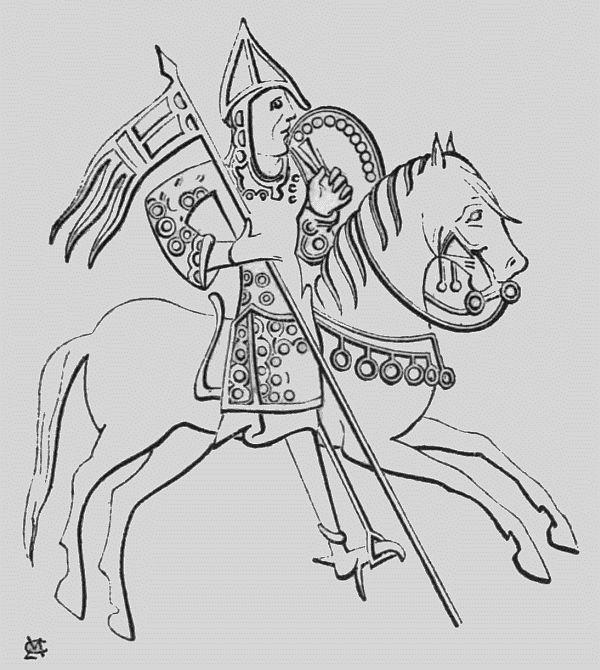
FROM THE GREAT SEAL OF ALEXANDER I., KING OF SCOTLAND.
No. 27.
This Battle of the Standard, so called from the Carrocium, or Car-standard, which was brought into the field by the English, affords us a good insight into the warfare of the Scots of this day. Let us remember, however, that it is an English chronicler who records the fight. Roger of Hoveden tells us that the bishop[172] who accompanied the English army, addressing the troops previous to the engagement, said of the Scots: "They know not how to arm themselves for battle; whereas you, during the time of peace, prepare yourselves for war, in order that in battle you may not experience the doubtful contingencies of warfare.... But now, the enemy advancing in disorder, warns me to close my address, and rushing on with a straggling front, gives me great reason for gladness." At the end of his speech, "all the troops of the English answered, 'Amen, Amen.'"
"At the same instant the Scots raised the shout of their country, and the cries of 'Albany, Albany!' ascended to the heavens. But the cries were soon drowned in the dreadful crash and the loud din of the blows. When the ranks of the Men of Lothian, who had obtained from the king of Scotland, though reluctantly on his part, the glory of striking the first blow, hurling their darts and presenting their lances of extraordinary length, bore down upon the English knights encased in armour, striking, as it were, against a wall of iron, they found them impenetrable. The archers of King Stephen, mingling among the cavalry, poured their arrows like a cloud upon them, piercing those who were not protected by armour. Meanwhile the whole of the Normans and English stood in one dense phalanx around the standard, perfectly immoveable. The chief commander of the Men of Lothian fell slain, on which the whole of his men took to flight. On seeing this, the main body of the Scots, which was contending with the greatest valour in another part of the field, was alarmed and fled. Next, the king's troop, which King David had formed of several clans, as soon as it perceived this, began to drop off: at first, man by man, afterwards in bodies; the king standing firm, and being at last left almost alone. The king's friends seeing this, forced him to mount his horse and take to flight. But Henry, his valiant son, not heeding the example of his men, but solely intent on glory and valour, bravely charged the enemy's line, and shook it by the wondrous vigour of his onset. For his troop was the only one mounted on horseback, and consisted of English and Normans who formed a part of his father's household. His horsemen, however, were not long able to continue their attacks against soldiers on foot, cased in armour, and standing immoveable in close and dense ranks; but, with their lances broken, and their horses wounded, were compelled to fly. Rumour says that many thousands of the Scots were slain on that field, besides those who, being taken in the woods and standing corn, were put to death. Accordingly, the English and Normans happily gained the victory, and with a very small effusion of blood." The standard which gave to this battle of Cuton Moor its popular name, was formed of a mast placed on a car, having at its summit a silver pix containing the Host, and beneath, three banners, those of St. Peter, St. John of Beverley, and St. Wilfrid of Ripon.
The equipment of the Scandinavian heroes in the twelfth century has come down to us in several cotemporary writings. The author of the Speculum Regale, an Icelandic chronicle of this period, instructs his son in his military duties: when combating on foot, he is to wear his heavy armour, namely, a byrnie, or thick panzar[173] (thungann pannzara), a strong shield (skiold) or buckler (buklara), and a heavy sword. For naval actions the best weapons are long spears, and for defence, panzars made of soft and well-dyed linen cloth, together with good helmets (hialmar), pendant steel caps (hangandi stálhufur), and broad shields[174]. The directions for a knight's equipment are more minute: Let the horseman use this dress: first, hose made of soft and well-prepared linen cloth, which should reach to the breeches-belt (broka-belltis); then, above them, good mail-hose (bryn-hosur), of such a height that they may be fastened with a double string. Next, let him put on a good pair of breeches (bryn-brækur), made of strong linen; on which must be fastened knee-caps made of thick iron and fixed with strong nails. The upper part of the body should first be clothed in a soft linen panzar (blautann panzara), which should reach to the middle of the thigh; over this a good breast-defence (briost biorg), of iron, extending from the bosom to the breeches belt; above that a good byrnie, and over all a good panzar of the same length as the tunic, but without sleeves. Let him have two swords,—one girded round him, the other hung at his saddle-bow; and a good dagger (bryn-knif). He must have a good helm, made of tried steel, and provided with all defence for the face (met allri andlitz biaurg); and a good and thick shield suspended from his neck, especially furnished with a strong handle. Lastly, let him have a good and sharp spear of tried steel furnished with a strong shaft[175]. It will be remarked that the body is here clothed in four different garments, one over the other; which appear to be the tunic, reaching to mid-thigh; the breast-defence of iron (whether formed in a single piece, or of several smaller plates, does not appear); the hauberk of the chain-mail, and the gambeson, a quilted coat, made in this instance without sleeves. Besides the weapons named above, the axe was still in favour among the Northern warriors. By the ancient laws of Helsingia, every youth on attaining the age of eighteen, was bound to furnish himself with five kinds of warlike equipment: a sword, an axe, a helmet (jernhatt), a shield, and a byrnie or a gambeson. A spirited passage of Giraldus Cambrensis brings the Norwegian troops vividly before us. Describing their attack upon Dublin, about 1172, he has: "A navibus igitur certatim erumpentibus, duce Johanne, agnomine the wode, quod Latine sonat insano vel vehementi, viri bellicosi Danico more undique ferro vestiti, alii loricis longis, alii laminis ferreis arte consutis, clipeis quoque rotundis et rubris, circulariter ferro munitis, homines tam animis ferrei quàm armis, ordinatis turmis, ad portam orientalem muros invadunt." The round painted shields edged with metal will bring to remembrance the similar defences of the Anglo-Saxons; and in the laminated cuirass we see another instance of the jazerant armour worn by Charlemagne. In King Sverrer's Saga, written towards the close of the twelfth century, by the abbot of Thingore in Iceland, and others, from the narrative of the king himself, we have a curious passage: "Sverrer was habited in a good byrnie, above it a strong gambeson (panzara), and over all a red surcote (raudan hiup[176]). With these he had a wide steel hat (vida stálhufu), similar to those worn by the Germans; and beneath it a mail cap (brynkollu), and a 'panzara-hufu.' By his side hung a sword, and a spear was in his hand[177]." From this description it seems clear that those singular broad-rimmed helmets found occasionally in monuments of the twelfth, thirteenth, and fourteenth centuries, and more frequently in later times; of which examples occur among the sculptures of the tomb of Aymer de Valence, in Westminster Abbey, and on the great seal of Henry III., king of Spain; were introduced into the north and west of Europe through Germany; the Germans, on their part, probably deriving them from the Italians; to whom this form of headpiece had come down from the well-known petasus of classic times. The panzara-hufu was probably a quilted coif worn under the steel hat. Compare Willemin, vol. i., Plate cxliii.; and see our woodcut, No. 56.
The Prussians in the twelfth century differ but little in their appearance from the Anglo-Saxon warrior of the preceding age. They wear the tunic, reaching to the knees, and belted at the waist; but, in lieu of leg-bands, have tight hose. They have spears little exceeding their own height, and the shield they carry is a mean between the kite and the pear-shape. We derive these particulars from the curious figures of the bronze doors of Gnesen Cathedral, given by Mr. Nesbitt in the ninth volume of the Archæological Journal, (p. 345); the subject represented being the Legend of Saint Adalbert. Hartknoch (De Rebus Prussicis) tells us that the arms of the Prussians were clubs, swords, arrows, spears and shields, and their dress consisted of a short tunic of linen or undyed woollen cloth, tight linen chausses reaching to the heels, and shoes of raw hide or bark.
Throughout the period which we are now investigating, the Clergy not unfrequently appear in knightly equipment at siege and battle. But in order to avoid an infringement of the letter of the canons, which forbade them to stain their hands with human blood, they armed themselves with the mace or bâton. At the battle of Hastings, Odo, bishop of Bayeux,—
"Un haubergeon aveit vestu De sor une chemise blanche: Lé fut li cors, juste la manche. Sor un cheval tot blanc séeit: Tote la gent le congnoisseit: Un baston teneit en son poing."—Rom. de Rou, l. 13254.
In the disorders of Stephen's reign, the prelates appear to have been still more frequently trespassers on the canons of the Church; for the author of the Gesta Stephani exclaims, "The bishops, the bishops themselves, I blush to say it,—not all of them, but many, bound in iron, and completely furnished with arms, were accustomed to mount war-horses with the perverters of their country, to participate in their prey." Everyone will remember the answer attributed to Richard Cœur-de-Lion, who, when the pope required him to release from captivity his spiritual "son," the bishop of Beauvais, sent back the hauberk in which the prelate had been taken, adding, in the words of the history of Joseph: "This have we found: know now whether it be thy son's coat or no." The monk of St. Edmund's, Jocelin of Brakelond, tells us under the year 1193: "Our abbot, who was styled 'the Magnanimous Abbot,' went to the siege of Windsor, where he appeared in armour, with other abbots of England, having his own banner, and retaining many knights at heavy charges; being more remarkable there for his counsel than for his piety. But we cloister-folks thought this act rather dangerous, fearing the consequence, that some future abbot might be compelled to attend in person on any warlike expedition."
On other occasions, however, the clergy fulfilled in the field duties more in harmony with their peaceful calling,—attending the wounded or consoling the dying. At the battle of Hastings, the Norman priests gathered together on a hillock, where, during the contest, they offered up prayers for their companions:—
"Li proveire è li ordené En som un tertre sunt monté, Por Dex préier è por orer."—Wace, l. 13081.
And frequent injunctions forbade these holy men from joining in military exploits. Among the decrees of the synod of Westminster, promulgated in 1175, we read: "Whoever would appear to belong to the clergy, let them not take up arms, nor yet go about in armour. If they despise this injunction, let them be mulcted with the loss of their proper rank[178]."
The tactics of this period are pretty clearly exemplified by the proceedings of Duke William at the field of Hastings. The army was divided into three corps:—
"Normanz orent treiz cumpaignies, Por assaillir en treiz parties."
The hired troops were placed in the first division, to bear the brunt of the fight:—
"Li Boilogneiz é li Pohiers[179] Aureiz, è toz mes soldéiers."
The second consisted of the Poitevins and Bretons,
"E del Maine toz li Barons."
The third corps was the largest:—
"E poiz li tiers ki plus grant tint."
And this, led by William himself, appears to have held the position of a reserve:—
"E jo, od totes mes granz genz, Et od amiz et od parenz, Me cumbatrai par la grant presse, U la bataille iert plus engresse[180]."
The battle was opened by the archers:—
"Cil a piè aloient avant Serréement, lor ars portant."
The charge of the horse, as is well known, was preceded by the feat of Taillefer, to whom the duke had accorded the privilege of striking the first blow. The charge of the knights was at this time, and long after, made in a single line, or en haie, as it was called; the attack in squadrons being a much later practice. The Normans acted against their opponents as well by the weight of the horse as by dint of weapons. One knight—
"Assalt Engleiz o grant vigor Od la petrine du destrier: En fist maint li jor tresbuchier, Et od l'espée, al redrecier, Véissiez bien Baron aidier."—Line 13491.
Another—
"——un Engleis ad encuntré, Od li cheval l'a si hurté, Ke mult tost l'a acraventé, Et od li piez tot défolé[181]."—Line 13544.
Spare horses and arms are provided for distinguished leaders:—
"Li Dus fist chevals demander: Plusors en fist très li[182] mener. Chescun out à l'arçon devant Une espée bone pendant. E cil ki li chevals menerent Lances acérées porterent."—Line 12699.
In the crusades, the European knights occasionally, though very rarely, contended on foot; and the Princess Anna Comnena remarks that the French men-at-arms, so terrible on horseback, are little dangerous when dismounted[183].
To disorder the enemy's ranks by a simulated flight appears to have been a favourite stratagem of the Normans. Duke William Sans-peur used this device against the Germans before Rouen:—
"Li Normanz par voisdie[184] s'en alerent fuiant, Por fere desevrer cels ki vindrent devant; Et Alemanz desrengent, si vont esperonant: As portes de Roen la vindrent randonant[185]." Wace, l. 3972.
The similar incident of the battle of Hastings is in the recollection of all:—
"Normanz aperchurent è virent Ke Engleiz si se desfendirent E si sunt fort por els desfendre, Peti poeint sor els prendre: Privéement unt cunseillié, Et entrels unt aparaillié, Ke des Engleiz s'esluignereient, E de fuir semblant fereient."—Line 13311.
Another device of Duke William on this eventful day was to assail the English by a downward flight of arrows, for he had found that the shields of his opponents had secured them from the effects of a direct attack: "Docuit etiam dux Willielmus viros sagittarios ut non in hostem directe, sed in aëra sursum sagittas emitterent cuneum hostilem sagittis cæcarent: quod Anglis magno fuit detrimento[186]."
War-cries were still in vogue, and saintly relics and emblems were regarded with a veneration commensurate with the power of the Church and the confiding credulity of the soldiery. The sacred symbol of the Cross is seen constantly on the shields of the knights; and one of the barons of Rufus, on departing for the Crusades, tells the king that his shield, his helmet, his saddle, and his horses, shall all be marked with this holy device[187]. It was even found useful to enrol mock-saints in the armies contending against the enemies of the faith. Thus, in the contest between the Saracens in Sicily and Count Roger, about the year 1070, Saint George mounted on a white horse is seen to issue from the Christian ranks, and head the onslaught on the unbelievers:—"Apparuit quidem eques splendidus in armis, equo albo insidens, album vexillum in summitate hastilis alligatum ferens, et desuper, splendidem crucem et quasi a nostrâ acie progrediens. Quo viso nostri hilariores effecti Deum Sanctumque Georgium ingeminando ipsum præcedentem promptissimè sunt secuti[188]." It is perhaps unnecessary to say that the narrator of this incident gives it in implicit belief of the saintly character of the splendid knight.
Not saints alone, but necromancers were occasionally attached to military expeditions. Such an auxiliary, according to Wace, accompanied Duke William in his expedition to England:—
"Un clers esteit al Duc venuz Ainz ke de Some fust méuz: D'Astronomie, ço diseit, E de nigromancie saveit: Por devinéor se teneit, De plusurs choses sortisseit."—Line 11673.
Having predicted a safe voyage to William, and the prediction having been fulfilled, the duke remembered him of his nigromancien, and desired that search might be made for this learned clerk. But the poor fellow had himself been drowned in the passage:—
"En mer esteit, ço dist, néiez, Et en un nef perilliez."
On which the duke wisely remarks:—
"Malement devina de mei, Ki ne sout deviner de sei."
Adding:—
"Fol est ki se fie en devin, Ki d'altrui ovre set la fin, E terme ne set de sa vie: D'altrui prend garde è sei s'oblie."
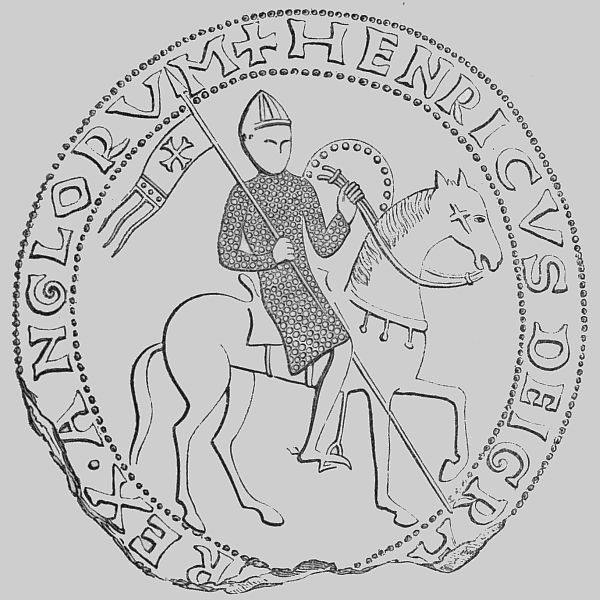
GREAT SEAL OF KING HENRY THE FIRST.
No. 28.
In examining the body-armour of the period under review, though we find some change in the adaptations of the old fabrics,—of the quilted-work, of the interlinked chain-mail, of the scale and jazerant,—there appears to be only one piece which is entirely new,—the so-called Plastron de fer, a breastplate that was worn beneath the gambeson or other armour that formed a general covering for the body. In a preceding passage from the Speculum Regale, we have read of a breast-defence of iron, extending from the throat to the waist, which may have been the breastplate in question. But a passage of Guillaume le Breton more exactly defines this contrivance. In the encounter between Richard Cœur-de-Lion (then earl of Poitou), and Guillaume des Barres:—
"Utraque per clipeos ad corpora fraxinus ibat, Gambesumque audax forat et thoraca trilicem Disjicit: ardenti nimium prorumpere tandem Vix obstat ferro fabricata patena recocto, Qua bene munierat pectus sibi cautus uterque." Philippidos, lib. iii.
A further evidence of this additional arming of the breast may be derived from the present practice of the East, where quilted coats-of-fence have a lining of iron plates at that part only. In the museum of the United Service Institution may be seen Chinese armours of this construction.
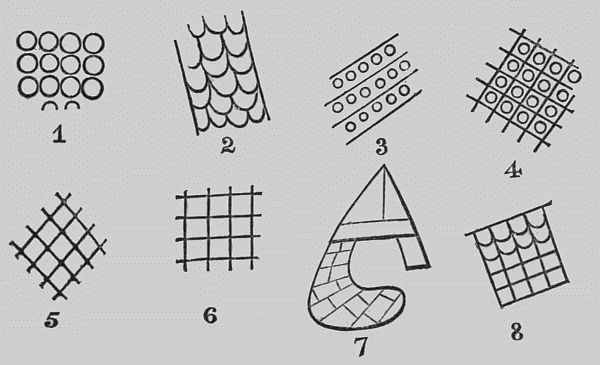
No. 29.
Though from written testimonies we learn that the fabrics already enumerated were in use, and that the materials of the defences were iron, leather, horn, and various kinds of quilting, it is by no means easy to identify these structures in the pictorial monuments of the day. Nothing perhaps can more strongly mark this fact, than the diversity of interpretation that has been given to the armours in the Bayeux tapestry by some of the latest and most critical investigators of the subject. Von Leber sees in them a contrivance of leather and metal bosses: "ein Lederwamms mit aufgenähten Metallscheiben oder Metallbukeln[189]." M. Allou attires the warrior in a "vêtement particulier formé d'anneaux ou de mailles de fer, ou bien de petites pièces de même métal assemblées à la manière des tuiles ou des écailles de poisson[190]." In the Bulletin Monumental of the Société Française, vol. xi., page 519, we have: "On croit distinguer, d'après l'indication de la broderie, des disques en métal appliqués sur une jaque de cuir." Mr. Kerrich[191] considers the coats marked with rounds as chain-mail. M. de Caumont has remarked that "in the Bayeux tapestry some of the figures are in chain-mail, and others in a kind of armour composed apparently of metallic discs sewn to a leathern jaque[192]." In the following we have collected the various modes of indicating the armour in this tapestry, and it must be confessed that to appropriate each is no easy task. It is indeed rather from a comparison with numerous other monuments, than from the testimony of these examples alone, that one is able to form any opinion as to the fabrics intended; and even at last the conclusion must be doubtful, and may be erroneous. From analogous representations of various dates, however, it seems likely that the figures 1 and 2 are intended for interlinked chain-mail; Nos. 3 and 4 for jazerant-work (armour formed of small plates fastened by rivets to a garment of cloth or canvas); Nos. 5 and 6 appear to be plain quilted defences; No. 7 seems only a rude attempt to represent the quilted coif; No. 8 is one of many examples where different markings are used on the same garment. In some instances, the markings copied above are so strangely intermixed in the same dress, that one is led to doubt if, in any case, each differing pattern is intended to represent a different kind of armour.
If from the tapestries we turn to the seals of this period, we shall find a similar difficulty in appropriating the armours represented. The modes of marking the defences are four. One of these is a sort of honeycomb-work, formed by a number of small, shallow, circular apertures, leaving a raised line running round their edges, so as to give a reticulated appearance to the surface. See woodcuts 42 and 43. This texture seems to represent interlinked chain-mail. A second mode consists of a series of lines crossing each other, so as to form a trellis-work of lozenges.
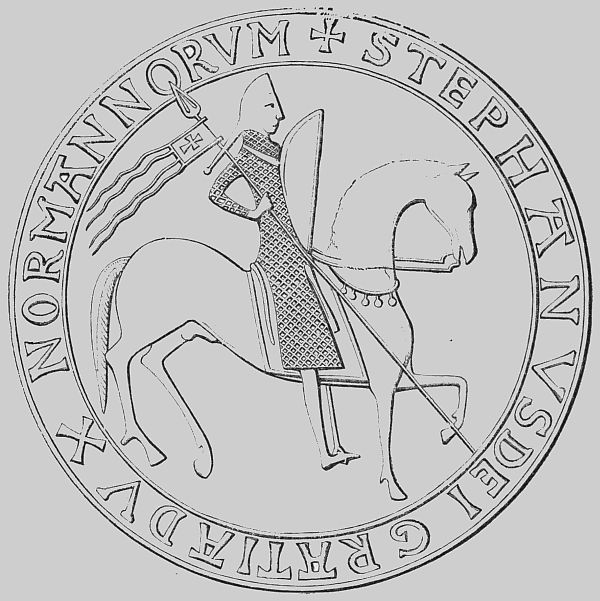
GREAT SEAL OF KING STEPHEN.
No. 30.
The great seal of King Stephen here given affords an instance of this method. Compare also woodcut No. 41. This, if not another conventional mode of representing interlinked chain-mail, may be intended for quilted armour. A third kind of engraving presents a number of raised half-circles covering the surface of the hauberk. See woodcut No. 26. This, though often described as scale-armour, seems to be no more than the ordinary chain-mail, the difficulty of representing which threw the middle-age artists upon a variety of expedients to obtain a satisfactory result. In the fourth method, lines of half-circles placed contiguously cover the whole exterior of the garment; and that this is another mode of indicating chain-mail is clearly proved by the similar work found on monuments of all kinds, even to the sixteenth century. See woodcut No. 1, fig. 1.
From this glimpse at the seals and tapestries, (and the illuminated manuscripts of the period contribute similar testimony,) we may gather that the artists of this day had no uniform method of depicting the knightly harness; so that, instead of endeavouring to find a different kind of armour for every varying pattern of the limners, we should rather regard the varied patterns of the limners as so many rude attempts to represent a few armours. In the following sketch we have collected some of the methods in use at various times to indicate the ordinary interlinked chain-mail.
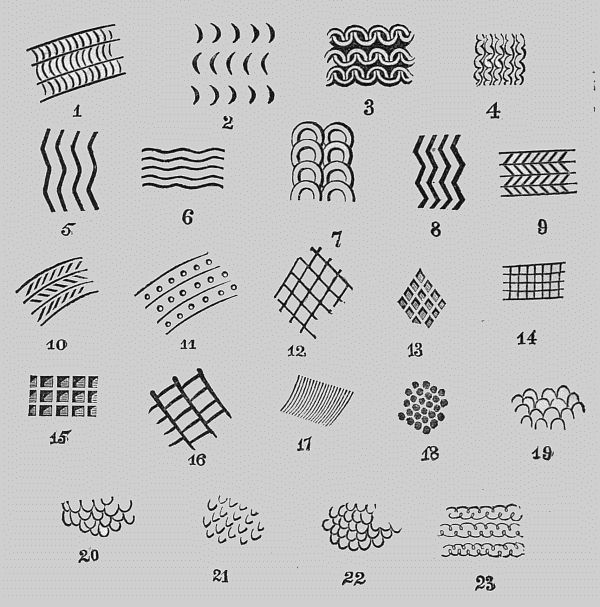
No. 31.
Figure 1 is the most usual, and is found from the twelfth century to the sixteenth. See woodcut No. 1, the seal of King Richard I. Late examples occur in the brass of Sir William Molineux, 1548[193]; in the sculptured effigy of Sir Giles Daubeny in Westminster Abbey; and in the statue of Sir Humfrey Bradburne, on his monument in Ashborne Church, Derbyshire, 1581. Fig. 2 is seen on our woodcuts 32, 37, and 53, from manuscript miniatures: it occurs in sculpture among the effigies of the Temple Church, London. Fig. 3 is of frequent appearance. See woodcut No. 59. The most ancient monumental brass extant, that of Sir John D'Aubernoun, (woodcut 55,) also exhibits this mode of indicating the armour. Fig. 4 occurs in the brass of Sir Richard de Buslingthorpe, c. 1280, figured by Waller, Part x. Fig. 5 is from one of the effigies in the Temple Church: the lines are undulating channels in the stone. Fig. 6 is from the sculptured effigy of Rudolf von Thierstein, at Basle: engraved in Hefner's Costumes, part ii., Plate xli. Fig. 7 occurs on the monumental statue of Sir Walter Arden, in Aston Church, Warwickshire[194]. Fig. 8 is found in early woodcuts: as in the Morte d'Arthur, printed by Wynkyn de Worde in 1498. Fig. 9: an early example of this marking occurs in Willemin's Monuments Inédits, vol. i., Plate 30; a late one (sixteenth century) in the incised slab of a Bagot, in the church of Blithfield, Staffordshire. Fig. 10: a variety of the foregoing. See Hefner's Trachten, part i., Plate lxv., and part ii., Plate xxxiv. Fig. 11: from an ivory chess-piece of the thirteenth century: woodcut No. 69. The lines are incised, the rounds are punctured. Fig. 12 is a very frequent pattern. It appears in the Bayeux tapestry, in manuscript miniatures, and in ivory carvings. See the chess-piece engraved in Archæologia, xxiv. 238, from the Isle of Lewis; and compare the figures of that very curious Asiatic roll in the Museum of the Royal Asiatic Society. Fig. 13: this trellis-work is common in seals of the twelfth century. See our woodcuts No. 30 and 41. The lozenges are slightly sunk, the fillets in relief. Fig. 14: found in the Bayeux tapestry; in the Bible de St. Martial of the Imperial Library of Paris, twelfth century; and in Add. MS., 15,277, of the fifteenth century, where the mailing is expressed throughout in this manner. The Asiatic roll named above has it also. Fig. 15: from the statuette of "Sir de la Tremouille," 1514, in the collection at Goodrich Court. The figure is of steel, and the squares appear to have been formed by a punch. Fig. 16: from the sculptured effigy of a Berkeley in Bristol Cathedral. The markings are channels in the stone. Fig. 17: from Roy. MS., 14, E. iv. The mailing in this volume is expressed by close, fine lines: the manuscript is of the fifteenth century. Fig. 18: the honeycomb-work found on early seals. The great seal of King Stephen (woodcut 42) affords a good example. The rounds are depressed, the edges have a reticulated appearance. Figs. 19 and 20: from the illuminations of a Sanscrit MS. in the British Museum, (Add. MSS., 15,295-7.) These very curious volumes abound in armed figures, which are large, and carefully finished. Fig. 21: from Egerton MS., No. 809, twelfth century; and Add. MS. 15,268, of the thirteenth century. Fig. 22: from Harleian MS., 2803. This differs but little from fig. 20; but fig. 20 has more of the scale form, while this is rather of ring-work. Fig. 23 is a marking found in early etchings, and very well represents the texture of chain-mail.
As we have already seen, the Body-armours which may most safely be assigned to early Norman times are chain-mail, quilted-work, jazerant, scale, and a small proportion of plate used as an additional protection to the breast: the materials, iron, leather, and horn, with wool, tow, or cotton for quilting pourpointed defences. The ordinary series of body-garments worn by the knight are the Tunic, the Gambeson and the Hauberk. The Surcoat, though found in some rare instances at the close of the twelfth century, does not become a characteristic part of the knightly equipment till the thirteenth century.
The Tunic appearing from beneath the hauberk may be seen in the seals of Alexander I. of Scotland, and of Richard I. of England, (cuts 1 and 27,) and in the accompanying group from Harleian Roll, Y. 6, the "Life of Saint Guthlac," a work of the close of the twelfth century. Compare also woodcuts 34, 35, and 40. We have already had written notice of this garment in the "blautann panzara" of the Speculum Regale. Wace gives it also to Bishop Odo, for the field of Hastings:—
"Un haubergeon aveit vestu De sor une chemise-blanche."
No. 32.
The Gambeson (or Wambasium[195],) was a quilted garment, used either alone, or with other armour. This defence is as early as the Ancient Egyptians, and figured examples of it may be seen in Sir Gardner Wilkinson's work, Plate iii., and cut 46, (ed. 1837). From a curious passage of the Chronicon Colmariense we learn that it was stuffed with wool, tow, or old rags:—"Armati reputabantur qui galeas ferreas in capitibus habebant, et qui wambasia, id est, tunicam spissam ex lino et stuppa, vel veteribus pannis consutam, et desuper camisiam ferream, id est vestem ex circulis ferreis contextam." An ancient authority quoted by Adelung has also: "vestimenti genus, quod de coactili ad mensuram et tutelam pectoris humani conficitur, de mollibus lanis," &c.
As the sole armour of the soldier, the gambeson is mentioned both by Wace and Guillaume le Breton. The former tells us, in his description of the troops of Duke William preparing for the fight:—
"Plusors orent vestu gambais."—Rom. de Rou, l. 12811.
The latter says:—
"Pectora tot coriis, tot gambesonibus armant."—Philipp., lib. ii.
These were probably foot-troops; but a document of the next century shews us that horsemen were sometimes armed in the wambais only. In 1285, land in Rewenhall, Essex, is held by Eustace de Ho, "per serjantiam inveniendi unum hominem equitem cum uno gambesone in exercitu Dom. Regis, cum contigerit ipsum ire in Wallia, sumptibus suis propriis per xl. dies[196]." It seems likely that many of these quilted coats-of-fence were reinforced by plates of iron over the breast, as in the pourpointed armours of the East in the present day. As an additional reason for considering the defences of gamboised work to be those indicated by the cross-lines of the ancient vellum-pictures, we may mention that the garments thus marked are occasionally tinted in various colours. Thus, the figures in a Massacre of the Innocents, in Cotton MS., Caligula, A. vii., are painted with red, blue, green, and buff; and another in Count Bastard's work, from a French manuscript of the twelfth century, has the garment marked with stripes of red[197]. The "Aketon" appears to be but another name for the gambeson.
No. 33.
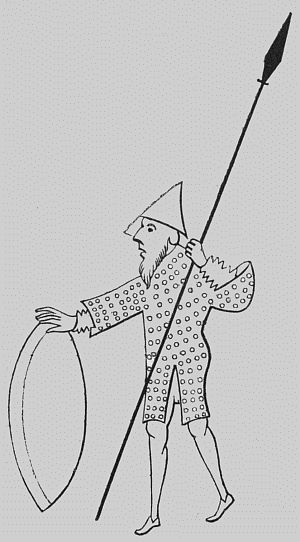
The Hauberk was the chief knightly defence. It reached to the knees; the skirt sometimes opening in front, sometimes at the sides. The sleeves usually terminated at the elbow, but occasionally extended to the wrist. Sometimes the hauberk reached as high as the neck only, but more generally it was continued so as to form a coif, leaving only the face of the knight exposed to view. In many examples in the Bayeux tapestry, it is furnished with a kind of pectoral, the construction of which has not been ascertained: in other cases, the whole surface is of a uniform structure. In this rude but curious little figure from Harleian MS., 603[198], a work of the close of the eleventh century, probably executed in France, we have a good example of the hauberk of the period, with its short sleeves, and the skirts open in front for convenience of riding. This is exactly the hauberk of the Bayeux tapestry, though more clearly depicted here than in the needle-work of the tapestry. The rounds on the surface appear to be a conventional mode of representing chain-mail. The figure is that of Goliath, to whom therefore has been given the long beard and round target of the pagan Northmen. He wears, however, the conical nasal helmet of the knightly order.
In this example, from Cottonian MS., Nero, C. iv. fol. 13, written in France, about 1125, we have a curious instance of the hauberk with lateral openings at the skirt. It is remarkable also for the manner in which the sword is carried partially beneath the hauberk; a contrivance seen also in the Bayeux tapestry, (Plate vi.,) and of which analogous examples will be found throughout the middle-ages. In the figure before us, it will be observed that the defence is continued over the head as a coif or hood, and is surmounted by the usual conical nasal helmet, or "Casque Normand." The subject of which this forms part, is the Massacre of the Innocents. The stigma of a moustache is therefore added, in the same spirit as the beard was given to Goliath in the preceding example.
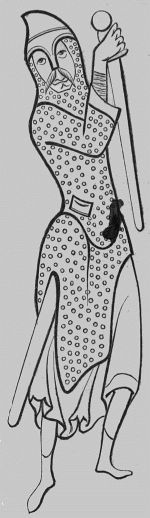
No. 34.
The continuous Coif to the hauberk is seen constantly in the Bayeux tapestry, (Stothard, Plates x. to xiii.). It occurs also on many of the seals of the twelfth century, (see our cuts, No. 27, 43 and 44;) and in vellum-paintings of this time, (see cuts 32, 34, 37 and 38). The hood of mail made separately from the hauberk does not appear till the thirteenth century. The short sleeves of this garment are seen in our woodcuts 25, 32 and 38. Examples of the long-sleeved hauberk occur in cuts 28, 37, 42 and 43.
The Haubergeon, as the name indicates, was a smaller hauberk; though it does not appear by the pictorial monuments of the middle ages in what it especially differed from the latter defence. While Duke William, preparing for the battle of Hastings,—
"Sun boen haubert fist demander;"
Bishop Odo—
"Un haubergeon aveit vestu."
The Duke was armed with lance and sword; the Prelate—
"Un baston teneit en son poing."
All which seems to shew that Odo was equipped as a light-armed fighter. And perhaps we may gather from the prominent notice accorded to his "white tunic," that it was the shortness of the haubergeon which caused that garment to be so particularly remarked. In documents of the thirteenth century, the haubergeon is distinguished from the hauberk and gambeson, taking its place between them. Thus the Statute of Arms of 1252 directs every man, according to the rate of his lands and chattels, to provide himself with the lorica, or with the habergetum, or with the perpunctum. And the Statute of Winchester, in 1285, makes the same distinction. From Guillaume Guiart we learn that this garment was of mail:—
"Armez de cotes a leurs tailles, Et de bons hauberjons a mailles."—Sub an. 1304.
And the Teloneum S. Audomari has: "Lorica, iv. denar.; Lorica minor, quæ vulgo Halsbergol dicitur, ii. den."
Body-armour of Leather is found throughout the middle ages. According to Wace, some of the Norman soldiers in the Conqueror's train had defences of this material fastened to their breasts:—
"Alquanz unt bones coiriés, K'il unt à lor ventre liés."—Line 12,809.
And Guillaume le Breton in the "Philippidos" has,—
"Pectora tot coriis, tot gambesonibus armant;"—
while a passage cited by Ducange shews us that, sometimes at least, this cuirass was of leather boiled in oil; a material much in vogue in the middle-ages, under the name of "cuir boulli:"—
"Cuirie ot bonne, qui fust de cuir boilly."
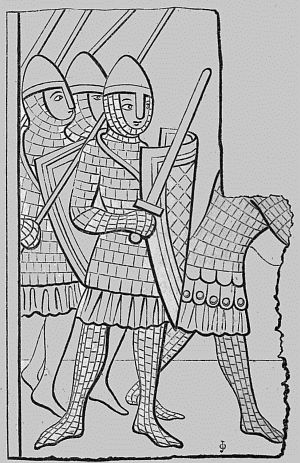
No. 35.
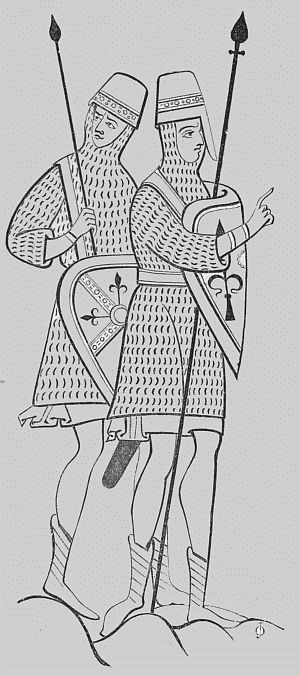
A good example of the Scale-armour worn occasionally about the close of the eleventh century is afforded in the following group, given by Hefner[199] from a vellum-painting in his possession. The armour in the original is silvered, and the pendent scales of the foremost figure are ornamented with bosses of gold. The tunics are white, shaded with blue. The Princess Anna Comnena tells us that some of the French knights at this period were clothed in scale-armour[200].
The material of the scale-armour is occasionally Horn. In the twelfth century, the Emperor Henry V. clothed a body of his troops in an impenetrable scale-armour of horn: "So trug im Jahre 1115 eine Schaar im Heere Heinrichs V. undurchdringliche Harnische von Horn[201]." And in the poem of "Wigalois," written about the close of the twelfth century, we have a curious description of this horn-mail worn over the hauberk and richly adorned with gold and precious stones:—
"Ein brunne het er an geleit Uber einen wizzen halsperch. Daz was heidenischez werch Von breiten blechen hurnin; Mit golde waren geleit dar in Rubin, und manec edel stein Der glast da wider einander schein Saffire und berillen."
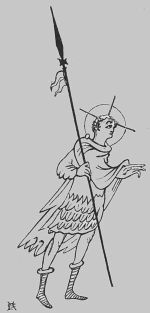
No. 36.
The accompanying little figure from Harleian MS., No. 603, fol. 13vo., appears to wear a defence of scale-work, but of what material it is difficult to say. The original is a pen-drawing only: the manuscript, of the close of the eleventh century. The figure is further curious for the mantle fastened at the right shoulder by a fibula.
From the monuments of this time, it does not appear that leg-defences were general. In the Bayeux tapestry they are accorded only to the most distinguished personages: in these cases, they are generally marked with rounds, as the hauberks are, probably indicating chain-mail. In this tapestry, three other modes of clothing the leg are seen: in some figures the crossing lines forming lozenges are found, which we have assumed to be pourpointerie; in others appear the fasciæ, or winding bands, which we have already observed among the Anglo-Saxons: and in many, the chausses are merely represented of a single colour, as red, blue, or yellow; which does not seem to imply armour of any kind. Wace makes mention of iron chausses:—
"Chevaliers ont haubers è branz, Chauces de fer, helmes luizanz."—Line 12,813.
They are seen in the great seals of Richard the First, (cut 1,) and in other monuments of the twelfth century. In this curious group of David and Goliath, from a German manuscript in the British Museum, dated 1148[202], we have a singular example of studded chausses: the chain-work of the hauberk being marked in rows of half-circles, and coloured grey in the original, the chausses marked in rounds, and silvered, it becomes clear that the latter garment is of a different construction from the coat. From its being elastic, as shewn at the foot, it probably was a defence of pourpointerie, the bossed rivets being for the purpose of keeping the quilting in its place.
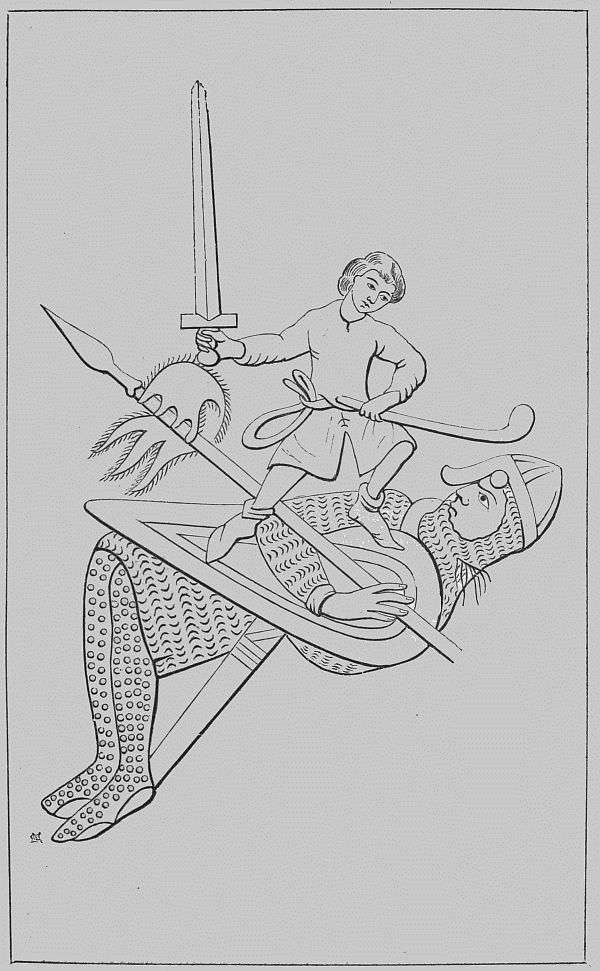
Plate XXXVII.
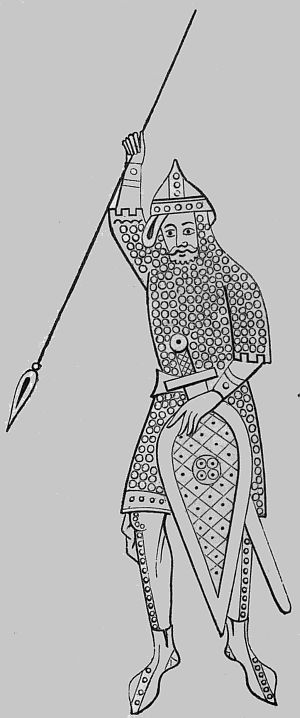
No. 38.
Such defences are frequently seen in monuments of the fourteenth century, and real armour of this fabric will be found among the Eastern examples in the Tower collection and the United Service Museum. Where the chausses are not of a defensive construction, the warrior has commonly short boots, similar to those seen on the figure of David in the foregoing woodcut. In the following example they are of a more ornamental character than usual; and the chausses in this figure are also of a peculiar fashion. The subject is from Harl. MS. 2803, written about 1170, and represents Goliath. The short boot occurs likewise on the seals of William the Conqueror and of Alexander I. of Scotland, (cuts 25 and 27). See also examples from illuminated manuscripts in our engravings 32, 34 and 36. At the close of the eleventh century, the fashion of the boots ran into an excess which much disturbed the equanimity of churchmen and chroniclers. "Then," says Malmesbury, under the reign of William Rufus, "was there flowing hair and extravagant dress; and then was invented the fashion of shoes with curved points." (Bk. iv. c. 1.) This device is said to have originated with Fulk, earl of Anjou, who sought thus to hide a deformity of his feet. Ordericus Vitalis, who gives us the information, adds, that the fashion soon spread, and the shoemakers made their wares with points like a scorpion's tail: "unde sutores in calceamentis quasi caudas scorpionum, quas vulgo Pigacias appellant, faciunt." This not being enough, a fellow of the court of Rufus,—"Robertus quidam nebulo in curia Rufi Regis,"—filling the peak with tow, twisted it round in the form of a ram's horn; a fancy much approved by the courtiers, who distinguished the inventor of the fashion with the surname of Cornardus. (Eccl. Hist., lib. viii.)
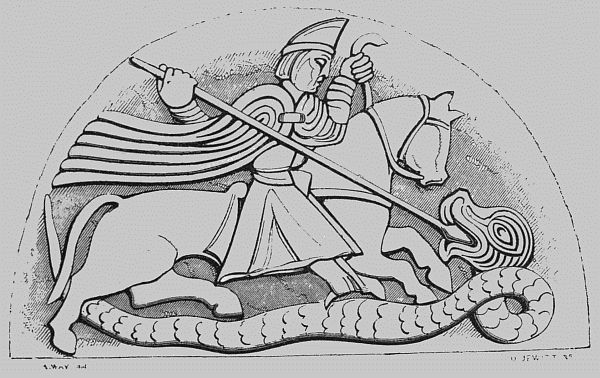
No. 39.
Examples of the Mantle worn over the armour are somewhat rare. The two following illustrations, from monuments of the twelfth century, exhibit this arrangement. The first is from a sculptured doorway of Ruardean Church, in Gloucestershire, and represents St. George. The cloak is here fastened by a fibula in front. The second subject is from an enamel preserved at the Louvre. The patriarch Abraham, armed as a knight, with hauberk and nasal helmet, has his mantle fastened at the right shoulder. Another subject from this enamel is engraved in the Revue Archéologique, vol. vi., page 99: Heraclius slaying Cosroes. "Eraclius Rex" is armed exactly like the figure of Abraham before us, and though engaged in the decollation of the infidel monarch, still retains the flowing and capacious mantle. See also, for the cloak of this period, our woodcut No. 36, and "Glossary of Architecture," vol. ii., Plate lxxiii.
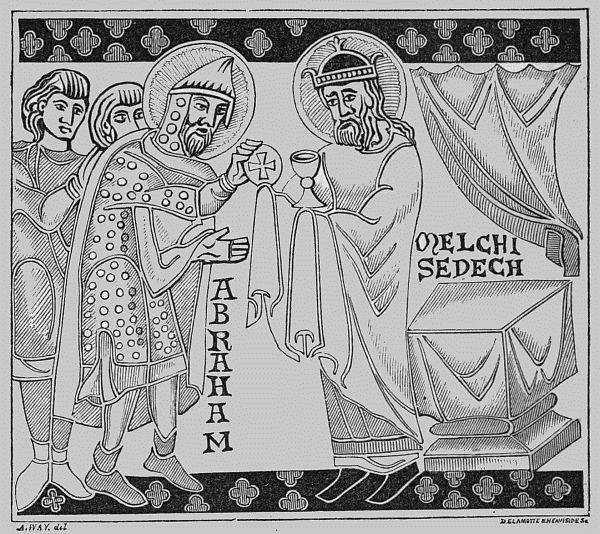
No. 40.
The characteristic Helmet of this time is the conical nasal helmet, of which we have seen examples in the close of the former period. The face-guard, or nasal, was a revival from classic days. Good examples, of Greek art, appear among the figures on the tympana of the temple of Minerva at Ægina; careful casts of which have been placed in the collection at Sydenham. The nasal helmet is found, not alone in the eleventh and twelfth centuries, but occasionally in every century down to the seventeenth. In the Bayeux tapestry it is almost universal, the nasal being much broader than that of Greek times, the crown conical, and not much raised above the head. In some cases tasselled cords appear at the back of the head-piece (see Plate xi. of the tapestry), which may have served to fasten it to the coif below; but the chief fastening of the casque was by means of laces meeting under the chin. See the seal of William the Conqueror (woodcut 25), and the excellent example in the Kerrich Collections, from a sculpture at Modena (Add. MSS., 6728, fol. 17). The round and flat-topped helmets of the twelfth century have also the nasal. Of the first an instance occurs in the seal of Patrick Dunbar, earl of March, engraved in Laing's "Scottish Seals." The second appears in the figures of the Harleian Roll, Y. 6, (woodcut 32). In seals, it is often very difficult to tell whether a nasal has existed or not, from the melting of the wax, and from this defence following so closely the line of the face. In some rare instances, a sort of peak is used instead of the nasal, not descending below the eyebrows. See Plate 65 of Hefner's "Costumes;" and compare the figure on folio 9 of Cotton. MS., Tiber., C. vi., an example of Anglo-Saxon times. To the nasal helmet, cheek-pieces and a neck-defence were occasionally added. These pieces are also found on Greek examples, and appear, too, in modern Eastern armour; as may be seen in the helmet of Tippoo Saib, preserved in the India House Museum. The casque with neck-piece appears in the Bayeux tapestry (see Plate ix.), and on the seal of Stephen de Curzun, (Cotton Charter, V. 49). The nasal helmet with neck-guard and cheek-defences occurs among the chess-pieces found in the Isle of Lewis, and now in the British Museum.
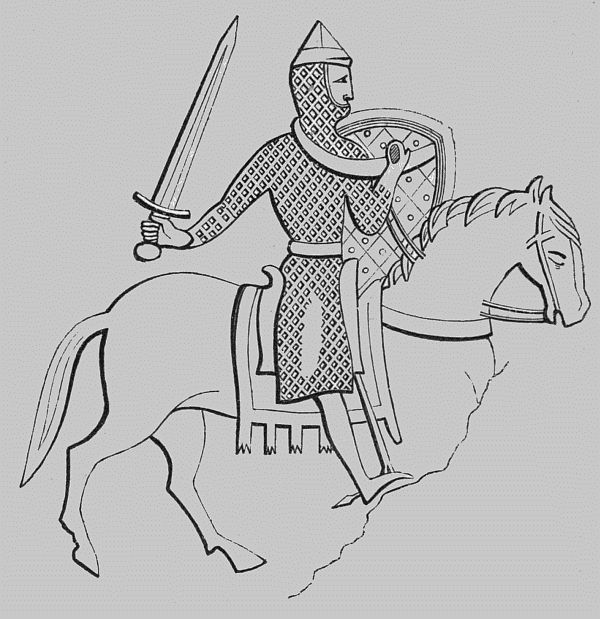
No. 41.
The helmets not having nasals are chiefly conical, round and flat-topped. The old combed form of Anglo-Saxon times occurs in Harl. MS. 603, fol. 13vo., a book of the close of the eleventh century. The Phrygian form appears in Harl. MS. 2800, fol. 21 of vol. ii., a work of the close of the twelfth century. The conical casque is found in the annexed seal of Conan, duke of Britanny, circa 1165: from Harl. Chart., 48, G. 40. The round-topped helmet is seen on the first seal of Richard I., (woodcut 1, fig. 1,) and in many examples in Cotton MS., Titus, D. xvi. The cylindrical or flat-topped helmet appears to have come into fashion towards the close of the twelfth century. In its earliest form it resembled that on the second seal of Richard I., (woodcut 1, fig. 2,) and the similar examples figured in Stothard's Monuments, Plate xxiv., and Surtees' Durham, vol. i. p. 24, and vol. ii. p. 139. In all these examples the casque is of one piece, having two horizontal clefts for vision, and being strengthened by bands crossing each other over the face and on the top. The Durham examples are without ornament, but the helmet of Richard has a fan-crest, ensigned in its lower portion with a lion. The seal of Baldwin, earl of Flanders, circa 1191, badly engraved by Vredius, offers another early example of the flat-topped knightly helm. The cylindrical casque common in the next century differs from this in having a grated ventail; by which a better supply of air could always be obtained by the warrior, and a still more abundant provision occasionally acquired by opening the ventaglia, which to this end was constructed with hinges at the side. Some varieties of the casque worn during the twelfth century may be seen in the Archæologia, vol. xxiv., copied by Sir Frederic Madden from the Isle of Lewis chess-pieces in the British Museum. Among these will be remarked the "Iron Hat," with its round crown and flat rim, of which we have already traced the descent from the petasus of classic times[203]. Sometimes the helmets are surmounted with a kind of knop or button; as in the picture given by Silvestre from a Latin Horace in the Paris Library[204]; in the seal of William the Conqueror, in the Bayeux tapestry, and in the Spanish manuscript of the year 1109 in the British Museum, (Add. MS. 11,695, fol. 194).
The fan-crest represented in the seal of Richard I. is a very early instance of a fashion which came into more favour towards the close of the thirteenth century. Fan-crests, as we have seen, were in use among the Ancient Egyptians, Assyrians, Greeks, Romans, and again among the Anglo-Saxons. But they do not appear during the rule of the Norman kings in England till the end of the thirteenth century; except in this single instance of Richard's seal. It may perhaps be doubted if the monarch ever wore such a decoration: an embellishment, perhaps, added by the seal-engraver from some monument of classic times. This seems the more likely from the fact that, in classic examples, the union of a fan-crest with a casque adorned on its sides with an animal form, is of constant occurrence. Among a thousand examples that might be cited, we may quote, as a readily accessible authority, Montfaucon's Antiquité Expliquée, vol. i., Plate xlii. At a later period of the middle-ages, this combination is again found: the helmet on the seal of Reinald, Graf von Geldern in 1343, has a striking resemblance to that of Richard: a lion is figured on the part surmounting the crown of the head, and over that again is placed the fan-crest. A copy of this monument may be seen in the useful series of "Ancient Seals" in the collection at Sydenham. Early examples of the casque ornamented with a heraldic device on its surface are offered by the enamelled tablet at Le Mans, attributed to Geoffry of Anjou, (Stothard, Plate ii.,) and the effigy of "Johan le Botiler," circa 1300, engraved in our woodcut No. 74.
The Shields of this period are chiefly the kite-shaped, the triangular, and the round. The first two are sometimes flat, and sometimes bowed; the round are flat or convex. The kite-shield is of most frequent occurrence during the earlier part of the period under examination, the triangular during the latter. As the round target was most convenient for the foot-fighter, so the kite-shield, broad in its upper part, so as to cover the body of the warrior, and narrow where the leg only required to be defended, and where the position of the knight on his horse necessitated a tapering form, seems to have been most in favour with the horseman. The bowed kite-shield is very distinctly shewn in many cotemporary monuments: in Cotton MS., Titus, D. xvi., of the close of the eleventh century; in the curious pyx from the collection of the late T. Crofton Croker, Esq., engraved in the "Gentleman's Magazine" for 1833; in Harl. MS., 2895, fol. 82; in the enamelled figure attributed to Geoffry of Anjou; and in the seals of King Stephen, (woodcuts 30 and 42). The Princess Anna Comnena, at the close of the eleventh century, tells us that the shields of the French crusading knights were of this fashion:—"For defence they bear an impenetrable shield, not of a round, but of an oblong shape; broad at the upper part and terminating in a point. The surface is not flat, but convex, so as to embrace the person of the wearer; an umbo of shining brass is in the middle; and the exterior face is of metal so highly polished by frequent rubbing as to dazzle the eyes of the beholder[205]."
The flat kite-shield is not always to be identified in the drawings of the time, because the shadeless outlines of the limners may pass for either flat or bowed surfaces. But that some at least of those in the Bayeux tapestry were flat, seems clear from the soldiers using them as trays on which to set the cups and dishes of their "Prandium." (See Plate xi.) Ivory carvings also shew the flat kite-shield: the Isle of Lewis chessmen afford good examples.
As we have seen from the above passage of Anna Comnena, the old Northern fashion of the boss or umbo was still occasionally retained; but such an adjunct to a horseman's target seems rather for ornament than use. The bossed kite-shield occurs in the enamel of Geoffrey Plantagenet; in the pyx named above; and in Harl. MS. 2895, fol. 82.
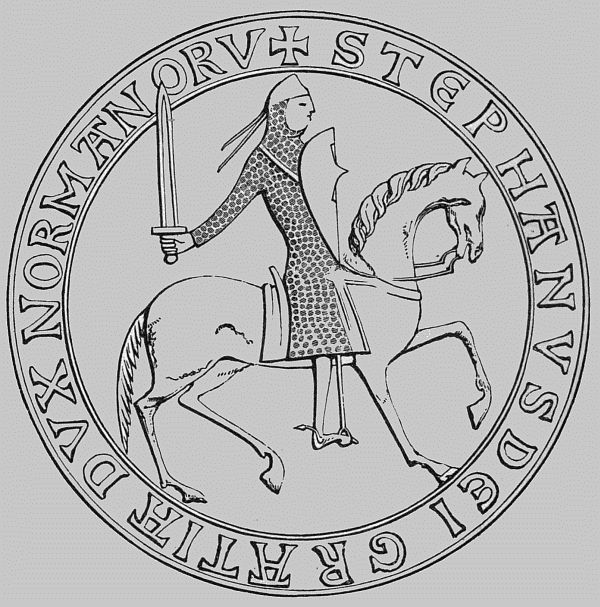
GREAT SEAL OF KING STEPHEN.
No. 42.
In lieu of the convex boss, the shield has sometimes a projecting spike; as in the great seal of King Stephen, here given; and in the first seal of Richard I. It occurs also in the seals of William de Romara (temp. Hen. I.), in the office of the Duchy of Lancaster, and of a Curzun (Cotton Charter, V. 49).
About the middle of the twelfth century appears the triangular shield,—a form obtained by reducing the arched top of the kite to a straight, or nearly straight, line. This variety also was either bowed or flat; and though the earliest examples are as tall as the kite-shields of the eleventh century, the triangular target soon became much reduced in its height. The form of this defence, both the flat and the bowed kind, may be seen in the seals of Henry II. and Richard I. (cuts 1 and 44), the figures from Hefner's Trachten, (cut 35), and those from Harleian Roll, Y. 6 (cut 32).
The round shield is of more rare appearance. It occurs in Harl. MS. 603, of the close of the eleventh century; in the Spanish MS. of 1109, already cited; and in the Psalter of Eadwine, circa 1150. Though the circular target does not often appear in miniature paintings, it is probable that it was in frequent use among the foot troops.
The kite and triangular shields were provided with straps for attachment to the arm and for suspension round the neck. The first were called enarmes:—
"Por la crieme des dous gisarmes, L'escu leva par les enarmes." Wace, Rom. de Rou, l. 13,450.
"Li Dus vit sa gent resortir: Par les enarmes prinst l'escu."—Idem, l. 13,880.
There was some variety in their arrangement, but the object was always to attach the shield to the fore-arm: the round target of the Anglo-Saxons, on the contrary, was held at arm's-length by a bar grasped by the hand. Examples of the enarmes of this period may be found in Plate v. of the Bayeux tapestry. See also the seal of Henry II., (woodcut 43). The guige or strap for suspension has already been described, as to its purpose, in our first division. It is represented in our woodcuts 32, 35, 42 and 43. By aid of the guige, the shield, when not in use, could be carried at the back. An example, of the close of the twelfth century, is offered by a vellum-painting of Harl. MS. 2800, vol. ii. fol. 21. It is also seen in the very curious carved church-door from Iceland, figured at page 103 of Mr. Worsaae's "Copenhagen Museum."
The Devices upon the Shields in the earlier part of the period under examination are devotional or fanciful. In the second half of the twelfth century, heraldic bearings that became hereditary, began to appear. The earlier shield-paintings consist of crosses, rounds or bezants, dragons, interlacing bands, flat tints bordered with a different hue, or simple flat tints; with some varieties which the pencil only can explain with clearness. Numerous examples of these in all their diversity will be found in the Bayeux tapestry, in Sir Frederic Madden's paper on the Isle of Lewis chessmen, (Archæol., vol. xxiv.) and among the plates of Shaw's "Dresses and Decorations."
The two seals of Richard the First very exactly mark the growth of the science of heraldry. In the earliest, the monarch's shield is ensigned with the symbol of valour, a lion. (See woodcut, No. 1). But it is a rampant lion, and as the bowed shield presents only one half of its surface to view, it has been conjectured that the complete device would consist of two lions combatant. This device, whether of one or two lions, has passed away, among the serpents and knot-work of the earlier time; but the bearing on Richard's second seal, three lions passant gardant, retains its place in the royal escutcheon to the present day. In this second seal of Richard (see woodcut, No. 1, fig. 2), the lion passant appears also on the helmet of the monarch. Another example of the repetition of a royal device is afforded by the seal of Alexander II. of Scotland (circa 1214), where the lion rampant figured on the shield is repeated on the saddle. (Cotton Charters, xix. 2.)
The shields were often highly decorated with painting, and even, if we may interpret literally the evidences of chroniclers, with inlaid jewels. Examples of richly ornamented shields of the twelfth century may be seen in Shaw's "Dresses and Decorations," and in Harl. MS. 2895, fol. 82. Robert of Aix, in the eleventh century, writing of the first crusade, tells us that the European knights carried shields "auro et gemmis inserti variisque coloribus depicti."
On board ship, the knights arranged their shields along the side of the vessel, so as to form a kind of bulwark. This is very clearly shewn in Plates ii. and x. of the Bayeux tapestry.
And when at length the knight fell in battle, his kite-shield served him for a bier. The nephew of the emperor Otho having been slain before Rouen, the Germans—
"O li cors se trahistrent el chief d'une valée; Sor un escu l'ont miz, la teste desarmée." Roman de Rou, l. 4024.
As we have learned from a preceding passage, the "shaven and shorn" knights of the Conqueror's time had, in the reign of his successor, fallen into disrepute as models of fashion. Long hair came into vogue, called down the anathemas of the Church, suffered a temporary discredit, and again rose into favour. Malmesbury has a curious sketch of this fluctuation of fashion. In the twenty-ninth regnal year of Henry I., he tells us, "a circumstance occurred in England which may seem surprising to our long-haired gallants, who, forgetting what they were born, transform themselves into the fashion of females, by the length of their locks. A certain English knight, who prided himself on the luxuriancy of his tresses, being stung by conscience on the subject, seemed to feel in a dream as though some person strangled him with his ringlets. Awaking in a fright, he immediately cut off all his superfluous hair. The example spread throughout England; and, as recent punishment is apt to affect the mind, almost all military men allowed their hair to be cropped in a proper manner without reluctance. But this decency was not of long continuance; for scarcely had a year expired, before all who thought themselves courtly relapsed into their former vice, vying with women in the length of their locks, and whenever they were defective, supplying their place with false tresses[206]." In 1102, at a council held in London by Archbishop Anselm, it was enacted that those who had long hair should be cropped, so as to shew part of the ear and the eyes. Compare also the well-known passage of Ordericus Vitalis, where he tells us how Bishop Serlo, preaching before Henry I. and his court, inveighed so successfully against the iniquity of long locks, that his audience saw the folly of their ways; and the prelate, seizing the favourable moment, produced a pair of scissors from his sleeve (de manticâ forcipes), and cropped the king and many of his courtiers with his own hand[207].
From Wace and the Bayeux tapestry we have found that the Beard was not worn by the Normans at the time of the Conquest, though in fashion among the Anglo-Saxons:—
"Li Normant * * * N'unt mie barbe ne guernons, Co dist Heraut, com nos avons."—Line 12,252.
And the Normans continued their custom till the second half of the twelfth century. The monumental effigy of Henry II. at Fontevraud represents him without either beard or moustache. "The beard," says Stothard[208], "is painted, and pencilled like a miniature, to represent its being close shaven." Among the English, however, the beard was often retained, and became a sort of protest against the new dynasty[209]. In 1196 William Longbeard, "le dernier des Saxons," as he is named by M. Thierry, became conspicuous from his opposition to the Norman rule, the inveteracy of which was manifested to the world by the excessive length of his beard[210]. At this time, however, a beard and moustache of moderate dimensions were in vogue among both races. The effigy of Richard I. at Fontevraud and that of King John at Worcester offer good examples of this change of fashion.
The weapons in use among the knightly order were the lance, the sword, the mace, and, towards the middle of the twelfth century, the axe. The shaft of the Lance was of uniform thickness throughout, the swell at the grip being a much later invention. The material was usually ash or pine. Wace, in the Roman de Rou, has:—
"Mult i véissiez colps è de fer è d'achier, Mainte hante[211] de sap è de fresne bruissier[212]."—Line 4639.
Guillaume le Breton, describing the combat of Richard I. and Guillaume des Barres, says:—
"Utraque per clypeos ad corpora fraxinus ibat."
And Albertus Aquensis, speaking of the French, tells us: "Hastæ fraxineæ in manibus eorum ferro acutissimo præfixæ sunt, quasi grandes perticæ." The heads of the lance were commonly of the leaf-form or the lozenge; more rarely barbed. All three appear in the Bayeux tapestry, and are found in many monuments throughout the twelfth century. Lance-flags (or streamers) of two, three, four, and of five points are found at the close of the eleventh and during the twelfth centuries. See Harleian MS. 603, the Bayeux tapestry, and our woodcuts, Nos. 1, 27, 28, 30 and 37. A curious Eastern example of the use of the lance-flag is found in the wall-painting of the Ajunta caves, a work referred to the first century of our era. A fine copy of this interesting monument has been placed in the Museum of the East India House. The spear was also a weapon of the inferior troops:—
"Archiers trovent vilainz, dont la terre est planiere, Ki porte arc è ki hache, ki grant lance geldiere." Rom. de Rou, l. 4680.
Geldon was a name often given to the foot soldiery: "Et ceciderunt de Israël triginta millia peditum:" 1. Kings iv. 10. "Kar il i chaïrent trente milie de gelde."
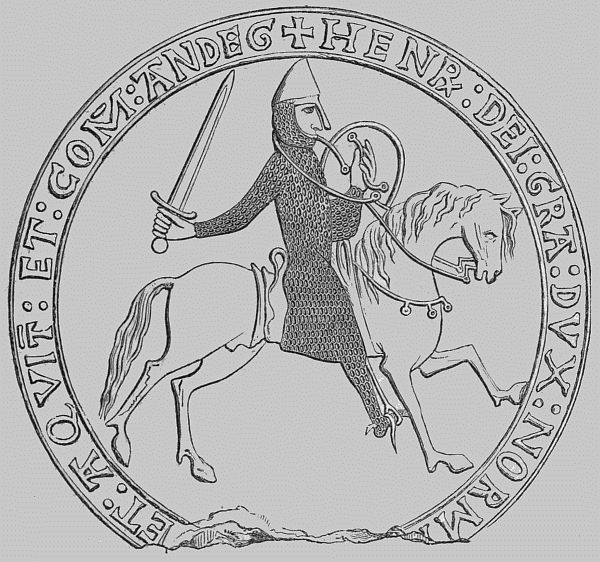
GREAT SEAL OF KING HENRY II.
No. 43.
The Sword was of the old form: straight, broad, two-edged, and pointed. The cross-piece was generally straight: in other cases, curved towards the blade. Examples of the latter fashion occur in the great seal of King Henry II., here given; in Harl. MS. 603, passim; and in Cotton MS., Titus, D. xvi. See also our woodcut, No. 41. The pommel was round, hemispherical, square, lozenge, trefoiled or cinquefoiled. All these forms may be seen in Harl. MS., 603, Titus, D. xvi., the Bayeux tapestry, Addit. MS. 11,695, and the effigy of Henry II., figured by Stothard. This effigy also shews very clearly the Belt with its buckle, by which the sword was fastened round the waist. Compare also the second plate of the Bayeux tapestry, where the form of this short belt is very distinctly exhibited. We have already noticed that the sword was sometimes worn with its handle projecting through a cleft in the hauberk, the scabbard being fixed beneath the hauberk. See cut 34, and Bayeux tapestry, Plate vi. As in our own day, swords attributed to ancient heroes had an especial value, and became the most cherished gifts of kings and nobles. Thus, when Richard Cœur-de-Lion was on his way to the Holy Land, "the king of Sicily sent to him many presents of great value, consisting of gold and silver, of horses and cloth of silk. But the king of England would receive nothing from him, except a little ring, which he accepted as a token of their mutual esteem. On the other hand, King Richard gave to King Tancred that most excellent sword which the Britons call Caliburn, and which had been the sword of Arthur, once the valiant king of England[213]."
The Sword of William the Conqueror became the feudal instrument by which the Umfrevilles held the lordship of Riddesdale, in Northumberland:—"In the tenth year of William the Conqueror, Robert de Umfranvil, knight, obtained from that king a grant of the Lordship, Valley and Forest of Riddesdale, by the service of defending that part of the country for ever from Enemies and Wolves, with that Sword which King William had by his side when he entered Northumberland[214]."
From a very curious drawing in the Psalter of Eadwine, written at Canterbury in the middle of the twelfth century, and now preserved in the library of Trinity College, Cambridge, we learn the exact manner in which the soldiery of this day furbished and ground their swords. The implement for furbishing is in the form of an ordinary axe-head, fixed in the centre of a rod or staff, which is held by both hands. This curious subject has been engraved by Mr. Westwood in his Palæographia Sacra.
The Mace does not often appear in the pictorial monuments of the period. It is, however, seen in the Bayeux tapestry, in the hands of both armies. The heads are quatrefoil, or of a heart-shape. What Wace calls the "gibet" is considered to be the mace, and it is carried at the right-hand side of the knight, to be used when the lance had been broken:
"Endementrez ke il versa, Sa lance chaï è froissa, Et il a le gibet seisi, Ki a sun destre bras pendi."—Rom. de Rou, 1. 13,456.
It was also the usual arm of Churchmen when they went to battle; who sought thus to avoid the denunciation against those "who smite with the sword." Under the name of clava, it is mentioned by Guillaume le Breton:—
"Nunc contus, nunc clava caput, nunc vero bipennis Excerebrat."—Philippidos, p. 213.
The Axe, which in the Bayeux tapestry is never seen in the hands of the Norman knights, appears in the twelfth century to have come into favour among them, for even the kings of this race are said to have contended with it. Thus Hoveden, describing the valour of Stephen at the battle of Lincoln, in 1141, says:—"Then was seen the might of the king, equal to a thunderbolt, slaying some with his immense battle-axe, and striking down others. Then arose the shouts afresh, all rushing against him, and he against all. At length, through the number of the blows, the king's battle-axe was broken asunder. Instantly, with his right hand, drawing his sword, he marvellously waged the combat until the sword also was broken. On seeing this, William de Kahamnes, a most powerful knight, rushed upon the king, and seizing him by the helmet, cried with loud voice, 'Hither, all of you, come hither! I have taken the King.'"
In the quotation from the Philippidos, above, we have seen that the double-axe, the bipennis, was also in use at this time. Like the mace, it is of rare occurrence in the pictures of the day, but several representations of it will be found in Harleian MS. 603, a Latin Psalter of the close of the eleventh century, probably written in France.
Among the weapons in use by the common soldiery are the cultellus, the guisarme, the pike, the bisacuta, the javelin, the sling, the long-bow, the cross-bow, (at the close of the twelfth century,) and some others in which fire was the offensive agent. The Cultellus, or coustel, was a short sword or long dagger, well calculated for use of the foot-troops, rushing upon the knights who had been unhorsed in the charge of the cavalry; and equally well adapted for close fight of foot against foot. A statute of William, king of Scotland, (1165-1214,) shews the identity of the coustel and dagger: "Habeat equum, habergeon, capitium e ferro, et cultellum qui dicitur dagger[215]." In the fourteenth century, Knighton has: "Cultellos, quos daggerios vulgariter dicunt, in powchiis impositis[216]." And Walsingham, in the fifteenth century, writes: "Mox extracto cultello, quem dagger vulgo dicimus, ictum militi minabatur[217]." The cultellus, like the sica of classic times, not only became the weapon of the depredator, but gave its name to that class; as we see from a statute of the Count of Toulouse in 1152: "Si quis aliquem hominem malum, quem Cultellarium dicimus, cum cultellis euntem nocte causa furandi occiderit, nullum damnum patiatur propter hoc." The Guisarme, which we have already noticed in the previous chapter, was still in favour in the twelfth century, and is frequently mentioned by the writers of this period. A striking passage of the Philippidos brings before us a rich group of the weapons of this day:—
"Nunc contus, nunc clava caput, nunc vero bipennis Excerebrat: sed nec bisacuta, sudisve vel hasta Otia vel gladius ducit."—Page 213.
The contus and the sudis of these lines are pikes, of which the particular difference from each other would be a vain enquiry for our times. The clava (mace) and bipennis have been already noticed. The Bisacuta appears to have been an arm of the pick kind. Père Daniel cites from a French poet who lived in 1376, these lines:—
"Trop bien faisoit la besaguë Qui est par les deux becs aguë."—Mil. Franç., i. 433.
The phrase, deux becs, seems to indicate a form of the kind we have mentioned, and the exact structure of the weapon is perhaps presented to us in the well-known brass of Bishop Wyvil, at Salisbury[218]. A letter remissory of the fourteenth century appears to confirm this view: "Le dit Hue d'un gran martel qu'il portoit, appellé besague, getta au dit Colart," &c. The head of the martel-d'armes was constantly, on one or both sides, of this pick or beak form. The besague was also a carpenter's tool. Thus Wace, on the invasion of England by the Normans, tells us:—
"Li charpentiers, ki emprès vindrent, Granz coignies en lor mains tindrent: Doloères è besaguës Orent à lor costez pendues."—Line 11,650.
The Sling of this time may be seen, though rudely drawn, in the group from Add. MS. 14,789, copied in our woodcut No. 37. Compare also cuts 12 and 50. The Javelin is found at the close of the eleventh century; in the hands of the English in the Bayeux tapestry, and in the French manuscript, Harl. 603, fol. 60. In the twelfth century it seems to have fallen into discredit among these nations, though probably employed to a much later period by the Spaniards[219], with whom it was always a favourite weapon, and by those races who had retained the rough fashions and the heroic traditions of their Old-Northern ancestry.
The Long-bow was of the most simple construction: it appears frequently in the Bayeux tapestry, (Plates xiii., xv. and xvi.;) in the cotemporary manuscript, Harleian 603, and in many monuments of the twelfth century. The arrows are usually barbed. A curious variety of the arrow is seen in the Spanish codex, Addit. MSS. 11,695, written in 1109. This missile, which is frequently represented in the volume, has three pairs of barbs, fixed at a little distance from each other along the shaft; a cruel contrivance, which does not seem to have reached other nations of Europe, and, we may hope, was not long in vogue within the Pyrennees. Already in the twelfth century the English began to evince that skill in archery which afterwards gave them such celebrity. At the siege of Messina by Cœur-de-Lion, as we learn from Richard of Devizes, the Sicilians were forced to leave their walls unmanned, "because no one could look out of doors, but he would have an arrow in his eye before he could shut it." The king himself did not disdain occasionally to use the bow. When before the castle of Nottingham, which had been seized by "Earl John," the monarch, says Roger of Hoveden, "took up his quarters near the castle, so that the archers therein pierced the king's men at his very feet. The king, incensed at this, put on his armour, and commanded his troops to make an assault upon the castle; on which a sharp conflict took place, and many fell on both sides. The king himself slew one knight with an arrow, and having at last prevailed, drove back his enemies into the castle, took some outworks which had been thrown up without the gates, and destroyed the outer gates by fire[220]."
The practice of archery was encouraged and protected by statute. Among the enactments of Henry I. of England, it was provided, that if any one in practising with arrows or with darts should by accident slay another, it was not to be visited against him as a crime[221].
The Quivers, as represented in the Bayeux tapestry, are without covers; but on folio 25 of Harl. MS. 603, is a drawing of a quiver having a cap attached by cords, so that when the quiver is in use, the cap remains suspended by the strings. The dress of the archers has been already noticed.
The Cross-bow does not appear to have been recognised as a military weapon before the close of the twelfth century. The term balista, by which it is described in monkish annals and other writings, is indeed found at an earlier period; but there is great doubt whether this earlier balista meant a hand-weapon, or one of those "gyns" derived from classic times. The later use of the arm seems confirmed by the fact that it is not found in pictorial representations till about 1200. There appears to have been an attempt to introduce it at the beginning of this century, but it was prohibited by papal decree as unfit for Christian warfare. A council in 1139, under Innocent II., has: "Artem illam mortiferam et Deo odibilem balistariorum et sagittariorum adversus Christianos et Catholicos exerceri de cetero sub anathemate prohibemus[222]." This denunciation was renewed under Innocent III.; but by this time Richard Cœur-de-Lion and Philippe Auguste had sanctioned the use of the arm, and the cross-bow was triumphant. Both Guillaume le Breton and Guiart place the introduction of the weapon at the close of the twelfth century; and both tell us that Richard was the first to adopt it, and that Philip followed his example. Describing the siege of the castle of Boves, Brito says[223]:—
"Francigenis nostris illis ignota diebus Res erat omnino quid balistarius arcus Quid balista foret, nec habebat in agmine toto Rex, quemquam sciret armis qui talibus uti."
And again, writing of the death of Richard I., he makes Atropos speak thus[224]:—
"Hac volo, non alia Richardum morte perire. Ut qui Francigenis balistæ primitus usum Tradidit, ipse sui rem primitus experiatur, Quamque alios docuit, in se vim sentiat artis."
Guiart has this similar passage:—
"Ainsi fina par le quarrel[225], Qu' Anglois tindrent à deshonneste, Li roís Richart, qui d'arbaleste Aporta premier l'us en France. De son art ot mal chevance."—Chron. Métr., l. 2644.
The form of the arbalest of this time may be seen in our woodcut, No. 50. It was bent by placing the foot in the loop or "stirrup" at the extremity, and then drawing the cord upwards with the hands. At a later period, the bow was made much stronger, and of steel, then requiring mechanical contrivances to bend it. The arrow of the cross-bow was shorter and stouter than that of the long-bow. As may be seen in our woodcut, No. 50, it was feathered; a particular which is noticed in the Roman de Garin:—
"Volent piles plusque pluie par prés, Et les saiettes et carriax empennés."
This name of Carriaux (quadrelli or quarrels) was given to these missiles from the four-sided (or pyramidal) form of the head. Thus Guillaume le Breton, speaking of the death of Richard the First:—
"——Quadratæ cuspidis una Pendet arundo."
From an ordinance of Theobald, count of Champagne, in the next century (1256), we learn that the provision of quarrels for a cross-bow was fifty: "Chascun de la commune dou Neufchastel qui aura vaillant xx. livres, aura arbaleste en son hostel et quarraus jusqu'à cinquante." The arrow of the arbalest is sometimes called vireton, from the French virer, on account of its rotary flight. Compare the classical verutum, a javelin which owed its name to a similar property. Though the English appear to have used the cross-bow from near the close of the twelfth to the end of the thirteenth century, in the succeeding age the long-bow obtained a signal triumph over its rival.
In the hands of a stout soldiery, indeed, the long-bow is a much superior weapon; for a dozen arrows may be discharged while the arbalester is winding up his instrument and fixing a single quarrel: and the long-bow being a vertical arm, permits a close array, which cannot be attained with the horizontal cross-bow: again, the long-bow is a weapon of very light carriage, while its rival, with its thick bow of steel and its apparatus for bending, is both ponderous and unwieldy: the size of the quarrels also permitted only eighteen of them to be brought by each man into the field, ("et auront trousses empanées et cirées de dix-huit traits du moins:" Ordinance of Charles VII. of France), while the English archer carried "twenty-four Scotchmen under his belt." "Les arbalestriers Gennevois," says Froissart, "commencèrent à traire, et ces archers d'Angleterre firent voler ces sagettes de grand' façon, qui entrèrent et descendirent si ouniement sur ces Gennevois que ce sembloit neige. Les Gennevois, qui n'avoient pas appris à trouver tels archers que sont ceux d'Angleterre, quand ils sentirent ces sagettes qui leur perçoient bras, têtes et banlèvre, furent tantôt desconfits[226]." But to handle the long-bow thus effectively, required a race strong in sinew and practised in their art: to wind up and discharge a cross-bow was the feat of a boy.