PART III. (continued 2)
Reading edition
About the beginning of the thirteenth century arose the use of the military Surcoat. The first English monarch who, on his Great Seal, appears in this garment, is King John: 1199-1216. (See our woodcut, No. 52.) The seal of the dauphin Louis, the rival of John, (appended to Harleian Charter, 43, B. 37, dated 1216,) has it also. The earliest Scottish king who wears the surcoat is Alexander the Second: 1214-1249: a fine impression of his seal is attached to Cotton Charter, xix. 2. Imaginative writers have affirmed that this garment was first used by the Crusaders, in order to mitigate the discomfort of the metal hauberk, "so apt to get heated under a Syrian sun." Cotemporary authority, however, expressly tells us that its purpose was to defend the armour from the wet:—
"Then sex or atte[350] on assente Hase armut hom and furthe wente
With scharpe weppun and schene, Gay gownus of grene, To hold thayre armur clene And were[351] hitte fro the wete." The Avowynge of King Arther, stanza 39.
The Surcoat was of two principal kinds: the sleeveless and the sleeved. The latter is not found till the second half of the century.
The Sleeveless Surcoat occurs of various lengths: sometimes scarcely covering the hauberk, sometimes reaching to the heels. Both the short and the long are seen throughout the century. The long appear on the royal seals noticed above. And on the seal of De Quinci, circa 1250 (woodcut, No. 87); on the sculpture from Haseley, c. 1250 (cut, No. 46); on the brass of D'Aubernoun, 1277 (No. 55); on that of De Trumpington, 1289 (No. 73); on the effigies at Ash and Norton, of the close of the century (Nos. 59 and 70); and on the statues of De Vere and Crouchback (Stothard, Plates xxxvi. and xlii.).
The shorter Surcoat occurs on the effigy of Longuespée, d. 1226 (woodcut, No. 54); the knight at Whitworth, c. 1250 (Stothard, Pl. xxiv.); the figures from the Painted Chamber and the "Lives of the Two Offas" (woodcuts, Nos. 80 and 86); the knight at Florence, 1289 (cut No. 58); De Valence, in Westminster Abbey (Stothard, Pl. xliv.); and our engravings, Nos. 47, 56, 63, 64 and 68: the last-named examples being of the close of the century.
The Surcoat is either of a uniform tint, or diapered, or heraldically pictured. Probably, in some early sculptured effigies, the surcoat, now plain, had armorial devices expressed by painting, which time has obliterated. The armorial surcoat was a necessary result of the visored helm; for when the visor was closed, it was no longer possible to distinguish king from subject, leader from stranger, comrade from foe. A similar inconvenience had already been found in the nasal helmet. At the field of Hastings, Duke William was obliged to remove the bar from his face, in order to convince his followers that he was still alive. The figure of Longuespée at Salisbury, c. 1226, still exhibits a portion of the heraldic decoration of the surcoat. And it is again found on the statue of De l'Isle at Rampton, circa 1250 (Stothard, Pl. xx.). The pictures of the Painted Chamber offer many examples. (See our woodcut, No. 86.) See also our engravings, Nos. 58 and 62. The effigy of William de Valence in Westminster Abbey, circa 1296, offers a curious variety of this garment: it is powdered with escutcheons, on each of which are the bearings of his house. A similar arrangement is seen in one of the figures of the Painted Chamber (Plate vi.)
The knightly surcoat of this time was slit up in front and behind, for convenience of riding. A singular deviation from this fashion of the garment is found in a figure in the Cathedral of Constance, c. 1220; where from the front part a portion passes under the arms, overlaps the part hanging from the shoulders behind, and then fastens at the back. See Hefner's work, Pl. iv. of Pt. i.
Occasionally the surcoat has an ornamental edge of fringe; as in the brasses of D'Aubernoun, 1277, and De Bures, 1302 (woodcut, No. 55, and Waller, Pt. ii.). In some cases, as in the Temple Church figure engraved by Stothard, Pl. xv., the garment has a rigid appearance across the shoulders, which has been taken to indicate a strengthening of the surcoat at that part. But the same treatment is seen in the enamelled effigy at St. Denis, of John, son of St. Louis; where the garment forms part of a civil dress (Willemin, vol. i., Pl. xci., and Guilhermy's Monuments of St. Denis, p. 164). The Surcoat sometimes hangs loose, as in our woodcut, No. 86; but usually it is girt at the waist by a cord or strap. The cord is seen in the brasses of Sir John D'Aubernoun and Sir Roger de Trumpington; the strap, with its long pendent end, in the effigies at Ash Church, Norton Church, and St. Bride's (our woodcuts, Nos. 55, 73, 59, 70 and 74). The group from Add. MS. 17,687 furnishes some further examples (cut, No. 63). Rarely, the surcote is made with a "fente" at the throat, and fastened with a fibula. An effigy in the Temple Church exhibits this arrangement. (Hollis, Pt. ii.)
The Sleeved Surcoat, as we have already noticed, did not come into use till the second half of the thirteenth century. It is frequent in the pictures of the Painted Chamber. A good example is offered by the effigy at Norton, Durham (our woodcut, No. 70); and very similar are found in the statue of Lord Fitz Alan at Bedale, Yorkshire, (engraved by Hollis, Pt. iv., and in Blore's Monuments,) and the Temple sculpture (Stothard, Pl. xxxviii.). The knightly figure on our woodcut No. 56 presents a variety, in the sleeves being "slittered." Those of the Shurland effigy (Stothard, Pl. xli.) are divided under the arm and fastened by ties.
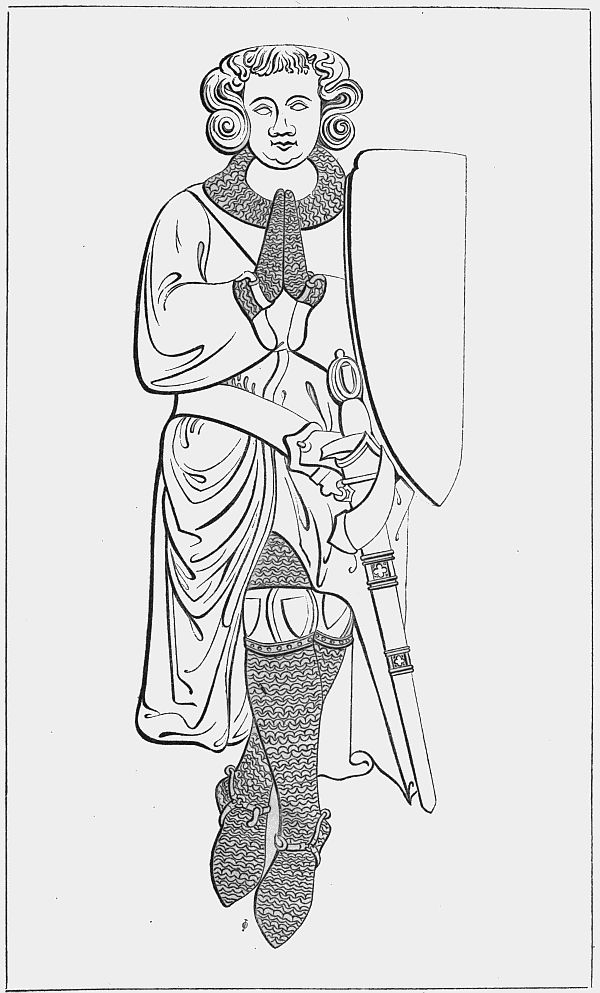
Plate LXX.
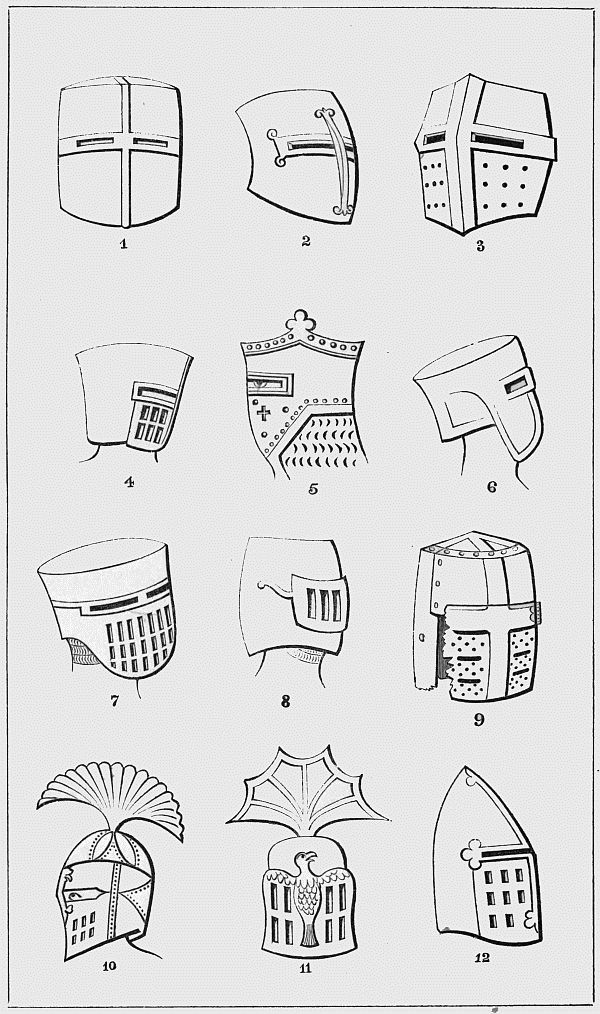
Plate LXXI.
The Helmets of the thirteenth century, though offering many points of difference on comparing particular examples, may yet be readily thrown into distinguishable classes. The first division that Suggests itself is that of the Helm (the great, close casque of the knight) and the Helmet, a defence, as the word indicates, of diminished completeness. The Helm must again be divided into two leading kinds: that in which the plates forming it are all rivetted together, so as to make one piece; and that in which the front is provided with a moveable ventail. The successive changes of fashion supply a further division of the helms; giving us the flat-topped, the round-topped, and the "sugar-loaf" form. The Helmets may be classed as the hemispherical, the cylindrical, the conical, the wide-rimmed (Petasus form), and the nasal. Besides which are some varieties of peculiar construction, which may be better noticed after the more general forms have been considered.
The word Helm among the Northern nations merely meant a covering of any kind: the Wærhelm of the Anglo-Saxons was the little cap worn by the soldier, of which we have seen many examples in our previous inquiries. But from the end of the twelfth century, when the great casque enclosing the whole head, like that seen on the second seal of King Richard, came into use, the term helm or heaume was restricted to this new kind of headpiece.
The flat-topped Helm forming a single structure, appears usually in one of the following fashions. I. A cylinder having bands in front forming a cross, and sometimes similar bands crossing on the crown, which is slightly convex or conical; two horizontal clefts for vision, but without holes for breathing. Examples occur in our woodcut, No. 71, fig. 1, from the statue of Hugh Fitz Eudo, in Kirkstead Chapel, Lincolnshire; in the chess-knight (woodcut 57); in the Whitworth effigy (Stothard, Pl. xxiv.); in the carvings of the Presbytery arcade of Worcester Cathedral (woodcut 71, fig. 2); all these early in the century: and in the groups of the Painted Chamber. II. A cylinder with the cross-bands as before; but, in addition to the ocularium, having apertures for breathing. This kind is seen in our woodcut 71, fig. 3, from Hefner's Trachten; in the Walkerne effigy (Hollis, Pt. i.); in the sculptures of the front of Wells Cathedral, circa 1225; in the miniatures of the Lives of the Offas (Cott. MS., Nero, D.i.); and in the seal of Hugo de Vere, earl of Oxford (woodcut 71, fig. 4). III. A cylinder with ocularium and breathing-holes, but not having the cross-bands: woodcut 71, fig. 5, from the very curious drawing on folio 27 of Harl. MS. 3,244, date about 1250. IV. In this variety, the front part is rounded below, has ocularium, but not any breathing-holes: woodcut 71, fig. 6, from the seal of Alexander II. of Scotland, 1214-1249 (Cott. Charter, XIX. 2); and compare the seal of Louis the Dauphin, circa 1216. V. This kind resembles the last, except that it is provided with apertures for breathing. A good example is furnished by the seal of Robert Fitz Walter, of the second half of the century: woodcut 71, fig. 7.
We must remark also the difference existing among these helms on the point of ornament. Some are altogether plain; as in our woodcuts 57 and 71, and the Whitworth effigy (Stothard, Pl. xxiv.): others have a profusion of ornament, as in the knightly figure from Roy. MS. 2, A. xxii. (woodcut, No. 62). The term cylindrical, which has been applied to them, must not always be understood literally. In woodcut No. 57 we have a true cylinder; but in other cases, the helm swells at the sides, taking the "barrel" form, as in the second seal of Henry III. (woodcut 81); or, when viewed in profile, it presents a concave line behind, as in the seal of De Quinci (woodcut, No. 87), or, more strikingly, in the example at Worcester (woodcut 71, fig. 2).
The helm was worn over the coif of chain-mail. An ivory carving engraved in the sixteenth volume of the Archælogia affords an excellent illustration of this usage; the knight being there represented in the act of raising his helm from his head armed in the coiffe de mailles.
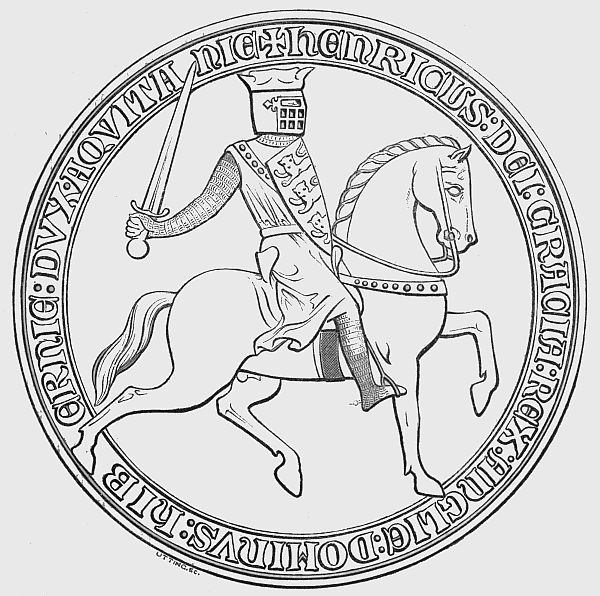
The flat-topped cylindrical Helm, with moveable ventail, appears about the middle of the century. The figure of Ferdinand, King of Castille, in the windows of Chartres Cathedral, affords a good example. He died in 1252: the monument is engraved by Willemin, vol. i., Pl. xcvii.: the helm is fig. 8 of our cut 71. A real helm of this type is in the Tower collection: the ventail opens by means of hinges on the side (see Archæol. Journal, vol. viii., p. 420, and our woodcut 71, fig. 9). It is entirely of iron, weighing 13lb. 8oz. And it is not unworthy of remark, that a much later helm, one with the beaked visor characteristic of the close of the fourteenth century, also in the Tower of London, differs in weight from the above example by only four ounces. (Archæol. Journal, vol. ix., p. 93.) The moveable ventail seems to be portrayed also on the second seal of Henry III., and on the seal of Edward I. (woodcuts, No. 81 and 85).
About 1270 the round-topped Helm came into vogue: not, however, to the entire exclusion of the old fashion, of which examples are found to the end of this century, and even during a portion of the next. See our Plate lxxi., fig. 10, from Cotton Roll, xv. 7. The seal of Patrick Dunbar, tenth earl of March, affords another good illustration of the helm with round crown: engraved in Laing's "Ancient Scottish Seals," p. 54. It has moveable ventail, with apertures for sight and breathing, as before. Other instances occur in the groups of the "Painted Chamber" and the "Lives of the Offas." A very curious variety of this type is furnished in the seal of Louis of Savoy, 1294; where the ventail has the form of an eagle displayed, the clefts for sight and air being contrived between the plumes of the wings. (Figured by Cibrario, in the Sigilli de' Principi di Savoia, Pl. xxx., and in our woodcut, No. 71, fig. 11.)
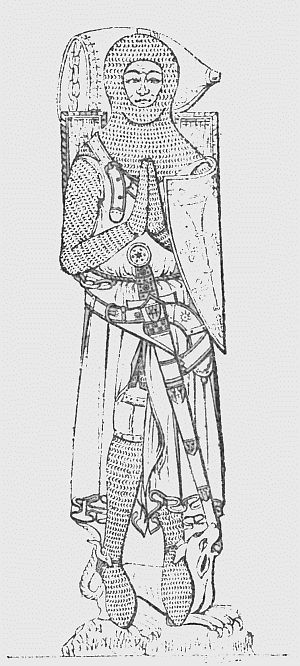
About 1280 the Helm takes the "sugar-loaf" form; having bands which make a cross in the front of it. See woodcut, No. 71, fig. 12, from Roy. MS. 20, D. i.; and the brass of Sir Roger de Trumpington, 1289 (woodcut, No. 73). It will be observed that this kind of heaume is continued so low as to rest on the shoulders.
It is not improbable that some of these casques were formed in part of leather. An early helm made of cuir-bouilli, with iron bands, is figured by Hefner (Trachten, Pt. ii., Pl. lxviii.); and for the Windsor tournament of 1278, were provided "xxxviii. galee de cor͂."
The helm was made fast by laces. In the Romance of Perceval, the hero
"Prant ses armes et s'aparoille: Sans atargier le haubert vest, L'iaume lace sans nul arest," &c.—Fol. 237.
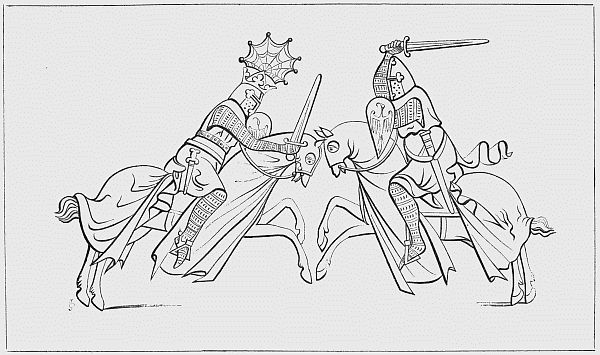
Plate LXXII.
These laces are very clearly shewn in our engravings, Nos. 47 and 62; from Roy. MSS., 20, D. i. and 2, A. xxii.
In order to recover the helm if struck off in the mêlée it was attached to some part of the knight's equipment by a chain. The brass of Sir Roger de Trumpington (cut, No. 73) supplies us with an illustration. And this usage is noticed in the Romance of Le tournois de Chauvenei, written about 1285:—
"Chescun son hiaume en sa chaaine, Qui de bons cous attent l'estraine." Vers 3,583.
No. 73.
Crests are frequently found surmounting the helm at the close of this century; but they are not of that distinctive kind, consisting of lions, griffins, eagles, wings, axes, and-so-forth, which appear in such diversity during the next age. They are merely of the fan form. The seal of De Quinci, indeed, seems an evidence to the contrary, and has been often described as an instance of a helm of the early part of the thirteenth century bearing a wyvern for a crest (woodcut, No. 87). But the wyvern in the upper part of this seal seems to be placed there merely to fill up the space between the letters, and belongs to the legend, not to the effigy; just as we see a flower occupying the space beneath the lion's feet, and in the obverse of the seal, the wyvern filling up the void beneath the horse and under the housing. Heraldic bearings do in fact appear on the casques of several figures previously to 1300. But they form part of the headpiece itself: they do not surmount it. The helm of Richard the First has a lion, but it is a figure embossed or painted on a part of the casque. The well-known effigy of a Plantagenet (Stothard, Pl. ii.) is an analogous instance. The monument of Le Botiler at St. Bride's, Glamorganshire, (woodcut, No. 74,) affords another example: and in the curious helm of Louis of Savoy (woodcut 71, fig. 11) we have the heraldic eagle forming the visor of the casque, while the crest is composed of the usual fan ornament. This fan we have already seen on the helm of Richard I., but it does not come into general use till towards the close of the thirteenth century. See examples on our woodcuts, Nos. 71 and 72. Other instances may be found in Laing's "Scottish Seals," p. 54; in the Lives of the Offas, Cott. MS., Nero, D. i.; and in great number among the miniatures of Roy. MS. 20, D. i., where they are attached to the heads of the horses as well as to the helms. At the Windsor tournament in 1278, also, crests were provided both for man and horse:—
"It̄ p̰ qualibet galea j. cresta } It̄ p̰ quolibet equo j. cresta } Sm͂. lxxvi. Cres̄t."
And for the making of these crests, calf-skins and parchment were employed:—
"lxxvi. pell' vitul' p̰ cres̄t faciend' p'̄c pell' iij. d."
"Īt p̰ qualibet cresta j. pell' parcamen̄ rud'. Sm͂. lxxvi. pell' rud' p̰cameni[352]."
Occasionally feathers supply the place of the fan ornament. A plume of seven peacock's feathers surmounts a crowned helm on folio 205 of Roy. MS. 20, D. i.; and similar examples occur at ff. 60vo. and 239vo. of the same manuscript. Compare also Add. MS. 15,268: both these books being of the close of the century.
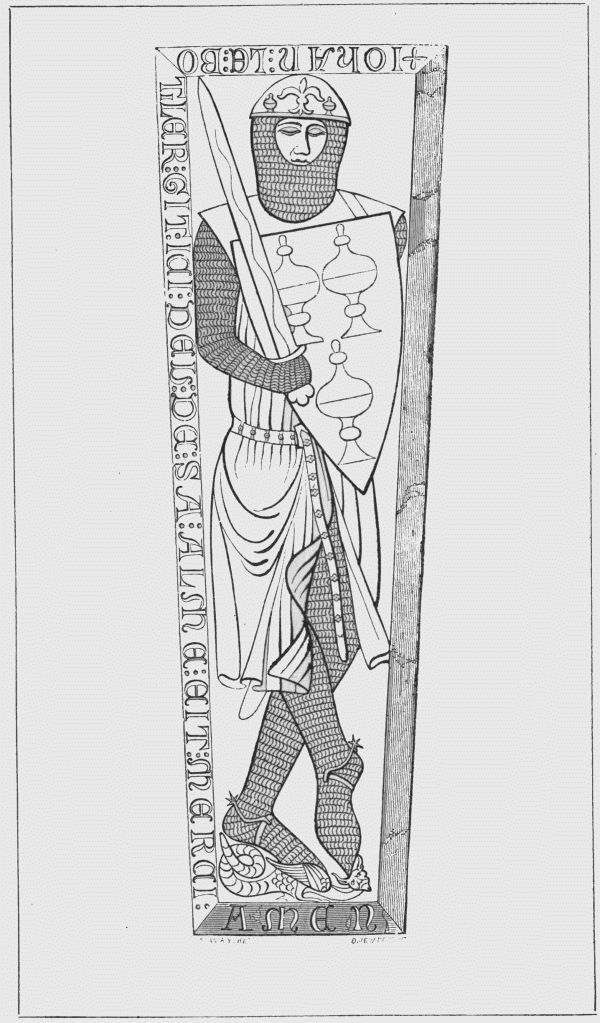
Plate LXXIV.
Another curious appendage to the knightly helm of this time consisted of Horns; made, as we learn from Guillaume le Breton, of whalebone, and borne for the purpose of striking terror by the gigantic appearance of the wearer. The Count of Boulogne at the Battle of Bovines, in 1214, adopts this expedient:—
"Cornua conus agit, superasque eduxit in auras, E costis assumpta nigris quas faucis in antro Branchia balenæ Britici colit incola ponti: Ut qui magnus erat magnæ super addita moli Majorem faceret phantastica pompa videri." Philipp., lib. xi. 322.
The Helms of kings have a crown encircling them, as seen in the seals of Henry III. and Edward I. of England (woodcuts, No. 79, 81 and 85); but on the capelline of King John is no such ornament. See also our engraving, No. 72. The crown is occasionally placed on the coif of chain-mail: as on folio 7 of the Lives of the Offas (woodcut, No. 80), and in the pictures of the Painted Chamber.
No. 75.
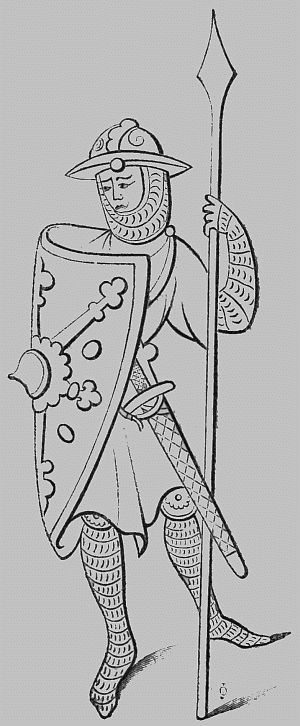
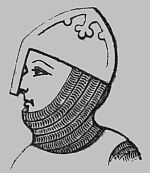
Of the smaller casque—helmet, or chapel-de-fer—we have already observed that some were worn beneath the coif-de-mailles. Others were placed above it, or formed of themselves the whole arming of the head. They are cylindrical, hemispherical, conical, wide-rimmed, and of the nasal kind. The first-named appears in our woodcut, No. 53, from Harl. MS. 5,102, of the beginning of the century. It is found also on the seal of St. Louis, and in the effigy in the Temple Church, figured by Stothard, Pl. x. The rounded helmet occurs on the seal of King John (woodcut 52); in our engraving, No. 53, from Harl. MS. 5,102, early in the century; and in Nos. 49 and 74, both monuments of the close of this period. It appears plentifully in Roy. MS. 20, D. i., and in the groups of the Painted Chamber. The conical chapel is seen in our engraving, No. 58; it occurs also in Harl. MS. 1,527, and in the Painted Chamber and Lives of the Offas. The Wide-rimmed Helmet is found throughout this century. An early example appears in our engraving, No. 50, from Harl. MS. 4,751. The figure here given is from Add. MS. 11,639, fol. 520; of the close of the century. It represents Goliath, and the casque is thus painted: crown, iron-colour; rim and crest, gold. The book is in Hebrew, but believed to have been written in Germany. See also our woodcut, No. 49, from Add. MS. 15,268; and Hefner's Plate v.; and the pictures of the Painted Chamber. A good example in sculpture occurs in the arcade of the north aisle of the Lady Chapel at Worcester Cathedral. On Cotton Roll, xv. 7, a variety of this headpiece has an upright spike at the top. In the Archæological Journal, vol. viii. p. 319, is engraved a knightly effigy in which the wide and pointed iron-hat is worn over a close skull-cap of plate, to which, is joined a coif of chain-mail. The Nasal Helmet is found of three varieties: the cylindrical, the round-topped, and the conical. The first occurs on the monumental effigy of Raoul De Beaumont, in the abbey of Estival, founded by him in 1210. (Kerrich Collections, Add. MS. 6,728.) The hemispherical appears in the Lives of the Offas and the Painted Chamber, and on Plate xxxiii. of Hefner. The pointed crown is found among the subjects of the Painted Chamber, of which the following is an example. See also our woodcut, No. 82.
No. 76.
Besides the above, which are the usual types of casque found in the thirteenth century, there are some varieties of occasional appearance. Among these may be mentioned the open-faced helmet of the Temple effigy figured by Stothard, Pl. xv. In this curious example, all the head above the neck is cased in a defence of some rigid material (metal or cuir-bouilli?), and encircled by a band or turban. Another singular headpiece occurs on folio 7 of the Lives of the Offas (woodcut, No. 80); where the coif of banded-mail is covered in front with a plate, perforated for vision and breathing, and strengthened with the cross-bands already seen in the knightly heaume. Helmets formed of a framework of metal covering a cap of leather, similar to the defence noticed at an earlier period (see page 69), seem to have been in use during this century. Hefner has figured the metal portion of a real one found in the island of Negropont, which he assigns to this period (Trachten, Pl. lxiii.) It closely resembles the bronze example discovered at Leckhampton (woodcut 18), consisting of a hoop from which spring two arcs of metal crossing at the crown. Of similar mixed materials appear to be those helmets seen in the groups of the Painted Chamber, where a frame of gold-colour encloses a cap of crimson or purple (Plates xxxv. and xxxvi.). And compare our woodcut, No. 82, also from the Painted Chamber, in which the frame of the headpiece is of iron-colour, while the enclosed portion is painted yellow.
The Bassinet and Cervellière are named in documents of this time, but do not appear to have been anything more than the round-topped skull-cap already noticed.
The bassinet is mentioned in the will of Odo de Rossilion in 1298, cited by Ducange[353]; a monument further curious from its giving us the detail of a knight's equipment in these days:—
"Idem do et lego domino Petro de Monte Ancelini predicto centum libras Turonenses et unam Integram Armaturam de Armaturis meis, videlicet meum heaume à vissere, meum bassignetum, meum porpoinctum de cendallo, meum godbertum[354], meam gorgretam, meas buculas[355], meum gaudichetum, meas trumulieres[356] d'acier, meos cuissellos, meos chantones[357], meum magnum cutellum, et meam parvam ensem."
The Bassinet with camail attached is not a characteristic of this century, though isolated examples may perhaps be found. The knightly effigy at Ashington, Somersetshire, already noticed, seems to be one of these: the mail-coif being fixed to the plate-cap by rivets. (Archæol. Journ., vol. viii. p. 319.) It will be remarked in that very valuable monument, the Pictures of the Painted Chamber, that the skull-caps of plate are in many instances so placed on the coif-de-mailles as to shew very clearly that the two defences are quite distinct.
Guiart, in the Chronique Métrique, frequently uses the name cervellière:—
"Sus hyaumes et sus cervelières Prennent plommées à descendre Et hachètes pour tout porfendre."—Line 1912. "Aucuns d'entr'eus testes desnuent De hyaumes et de cervelières."—Line 5267. "Hauberjons et cervelières, Gantlez, tacles et gorgières."—Line 5467.
An amusing tale is told in the Chronicon Nonantulanum, of the invention of the cervellière by Michael Scot, "Astrologus Friderici Imperatoris familiaris." Having foreseen that he should meet his death from the fall of a stone of two ounces weight upon his head, he contrived a cap (infulam) of plate-iron. But being at mass one day, at the exaltation of the host, he reverently lifted his cap, when a little stone fell upon his head, and inflicted a slight wound. Weighing the stone, he found it to be exactly two ounces; and then, knowing his doom to be sealed, he arranged his worldly affairs and died.
From the manuscript collection of "Proverbes" of the thirteenth century, preserved in the Imperial Library at Paris, and cited by Le Grand d'Aussy in the Vie privée des François[358], we learn that the "Heaumes de Poitiers" had obtained the highest meed of approbation.
The ordinary Shield of this period was the triangular: its dimensions decreasing as the century advanced. It was bowed or flat. Other targets of this time are the kite-shaped, the pear-shaped, the heart-shaped, the round, the quadrangular, and a shield angular at the top and rounded below.
The triangular, bowed shield appears in our engravings, Nos. 52, 53, 57 and 87; all early examples. Later instances occur in the seal of Edward I. (No. 85), and our woodcut, No. 75, from Add. MS. 11,639. The flat triangular shield is found in the very curious figure on folio 27 of Harl. MS. 3,244, circa 1250; in the brass of Sir John D'Aubernoun, 1277 (woodcut, No. 55); in the glass-painting at Oxford Cathedral (woodcut, No. 77); and in the effigy of Le Botiler (woodcut, No. 74): the last two monuments, of the close of the century. See also Painted Chamber, Plate xxxvi. It will be observed that the shield of D'Aubernoun is curiously small. Those of Crouchback and William de Valence on their tombs are scarcely larger. (Stothard, Pl. xliii. and xliv.) The Kite-shaped shield appears very frequently in Roy. MS. 20, D. i.; a subject from which, with this form of target, is given in our woodcut, No. 72. It occurs also in Harl. MS. 1,527, and on Plate xxxvi. of the Painted Chamber. This form, like the foregoing, is sometimes bowed and sometimes flat. The Pear-shaped variety is found on the seal of Saer de Quinci, 1210—19, engraved in Laing's Ancient Scottish Seals, Pl. xi.; and on that of John de Methkil, c. 1220 (Laing, Pl. vii. fig. 3). Another Scottish seal gives us the Heart-shaped shield, a rare and early example (Laing, Pl. x. fig. 11). The Round target supported by its guige appears in a group of fighters in Harl. MS. 1,527; again in the Malvern effigy (Stothard, Pl. xix.); in the Lives of the Offas; and among the pictures of the Painted Chamber. The quadrangular bowed shield is figured in our woodcut, No. 88, from a Tower Roll, commemorating a wager of battle in the reign of Henry III. The shield made angular at top and rounded below may be found on Plate xxxi. of the Painted Chamber, and occurs again on the seal of a Melros charter of 1285, engraved on page 30 of Laing's Scottish Seals. It is scarcely necessary to say that the types which we have endeavoured to distinguish will be found somewhat varied in particular examples: to describe every modification of the general forms we have detected, would be a tedious and a useless task.
The Boss is still retained in some of the shields of this time, though but rarely. It appears in our woodcuts, Nos. 75 and 88, and on folio 4 of the Lives of the Offas. The Enarmes, or straps by which the knight sustained his shield in combat, are well shewn in the effigy of De Shurland (Stothard, Pl. xli.), and receive some further illustration from the statues of De Vere at Hatfield Broadoak, Essex, and of Brian Fitz Alan at Bedale, Yorkshire. Compare also folio 4 of the Lives of the Offas, and Plate xxxviii. of the Painted Chamber. The Guige, or strap by which the shield was hung round the neck, is a usual adjunct to this defence during the whole of the century, and is sometimes of a highly enriched character. Many of our woodcuts shew the manner of its use.
From a passage of "The Ancren Riwle," lately printed by the Camden Society, from a MS. of the thirteenth century, we learn that the materials of the shield at this time were "wood, leather, and painting." (p. 393.) These ingredients frequently reappear in the real targets of a later time which have been saved from the destruction of passing centuries.
No. 77.
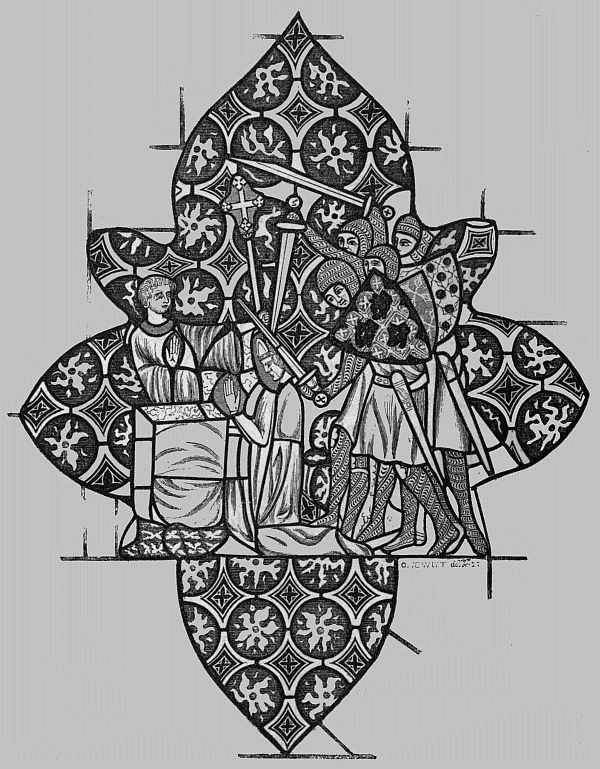
Armorial bearings are the usual adornment of the knightly shield throughout this period; and the field was sometimes richly diapered, as in this example from the window of the north transept of Oxford Cathedral. Compare the monument of De Vere at Hatfield (Stothard, Pl. xxxvi.) Where heraldic devices are not found, a "pattern" generally takes their place: a cross, a rosette, a star, a fret, or some such simple ornament. In other cases the face of the shield is painted of a single colour. In the effigies placed over the tombs of the knights, the shield is usually represented as borne on the arm. The figure of William de Valence in Westminster Abbey has it slung at the hip; an arrangement frequently adopted in French monuments, and occasionally in those of other continental countries.
Another continental custom sometimes imitated by our own countrymen, was that of adorning the walls of the banqueting-hall on great occasions with the shields of distinguished heroes. When, in 1254, the English king entertained the French monarch in the Temple in Paris, "the banquet was given," says Matthew Paris, "in the great hall of the Temple, in which were hung up, according to the continental custom, as many bucklers as the four walls could hold." Amongst others was seen the shield of Richard, king of England, concerning which a witty person present said to King Henry, "Why, my Lord, have you invited the French to dine with you in this house? See, there is the shield of the noble-hearted English king, Richard! your guests will be unable to eat without fear and trembling[359]."
From the curious volume already cited, the Ancren Rule, we learn that at the demise of a brave knight, his shield was hung aloft on the church walls, in honour and remembrance of his valorous deeds.
No. 78.
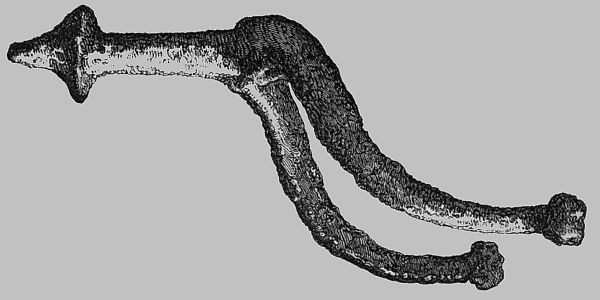
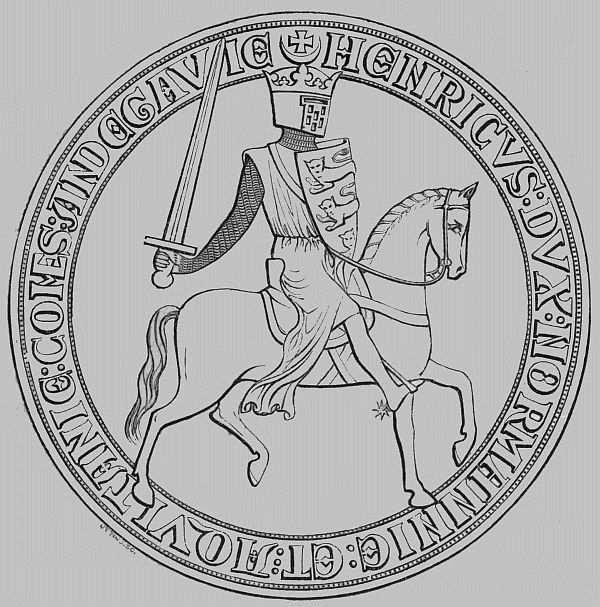
The Spur of this century is of three kinds: the simple goad, the ball-and-spike, and the rowel. The goad is sometimes straight, sometimes curved. The straight spike is seen in this example of an iron spur found in the churchyard of Chesterford, Cambridgeshire, and now preserved in the collection of the Hon. Richard Neville. Compare our engravings, Nos. 58 and 85. The curved goad appears in woodcuts 55 and 73. Our engravings, Nos. 62, 72 and 81 shew the ball-and-spike kind; of which we have already seen examples in the statues of Henry II. and Richard I. at Fontevraud. The rowel spur is found but in one or two instances during this century. It is represented on the seal of Henry III., here given; where, in order to bring up the rowel to the middle of the heel, the seal-engraver has resorted to the singular expedient of raising the field into a sort of hillock, on the top of which he has sculptured the star-like rowel. See Harleian Charter, 43, C. 38. The rowel spur again appears on the effigy of Le Botiler (woodcut, No. 74). It is, however, rather a characteristic of the fourteenth than of this century; and, generally speaking, its presence alone should lead one to hesitate long before assigning a monument to the earlier period, even though it should exhibit all the other features of the more ancient costume. The monument of Johan Le Botiler, just named, is by no means exempt from the operation of this rule.
GREAT SEAL OF KING HENRY III.
No. 79.
The shank of the spur is curved, each end being formed into a loop to receive the strap. The strap itself is single, buckling over the instep. See Stothard's Plates xvii. and xxii. Some exceptions occur to this usual arrangement. In the effigy of a De L'Isle, figured by Stothard, Plate xx., the outer shank is flattened into a trefoil and rivetted upon the leather. In the figure at Norton, Durham, (woodcut, No. 70,) the shanks terminate in rings, and two straps are employed to fix the spur to the foot. Both straps and spurs are occasionally shewn of an enriched character. On folio 27 of Harl. MS. 3,244, the spur is ornamented with a row of studs or bosses. In the brass at Acton, Suffolk, 1302 (Waller, Pt. ii.), the pattern consists of rosettes.
The gilded spurs of the knights occasionally became the trophy of a victory; as in the case of the battle of Courtray, in 1302. More than five hundred pairs, Froissart tells us, were suspended in a chapel of the church of Our Lady of Courtray: "Et ces éperons avoient jadis été des seigneurs de France, qui avoient été morts en la dite bataille; et en faisoient ceux de Courtray tous les ans, pour le triomphe, très grand solemnité[360]."
The Beard during this century appears to have been usually worn by the aged only. The young knight has commonly neither beard nor moustache: indeed, this imberbed state of the Western cavaliers is made a reproach to them by the Saracens. The Sultan, we are told by Matthew Paris, under 1250, addressing his chiefs, in arms against the forces of St. Louis, exclaimed: "What rash madness excites these men to attack us and endeavour to deprive us of our inheritance, who have inhabited this noble country since the Flood? A certain motive, however slight, urges the Christians to covet the land which they call Holy: but what have they to do with Egypt? Unfit indeed are they to lord it over a land which is watered and enriched by the river sent from Paradise: beardless, shorn men, unwarlike and imbecile, more like women than men, what rash daring is this[361]!"
For the arrangement of the beard of this time, see the effigies of King John and Henry III. (Stothard, Plates xi. and xxxi.), and Plate xxxix. of the Painted Chamber.
The fashion of the Hair differs considerably in the first and second portions of the century. In both it was cut short at the forehead: but in the first half it was allowed to fall in its natural flow to some length at the sides of the head and behind; while, in the second, it was most carefully arranged in large curls, which cover the ears, and give a strongly marked character to the monuments of this time. In the effigy of King John at Worcester, the side hair is cut sheer off just below the ear. In the figure of Prince John, the son of St. Louis, in the Abbey Church of St. Denis, the hair falls in a natural ringlet to the neck[362]. The large and formal curl of the later period is well shewn in the knightly sculpture from Norton Church, Durham (woodcut, No. 70). See also the statue of Henry III. (Stothard, Pl. xxxi.), and the series of monumental figures sculptured in 1263-4 by order of St. Louis, to perpetuate the memory of his ancestors entombed at St. Denis. (Guilhermy, pp. 218, 223, 225 and 228.)
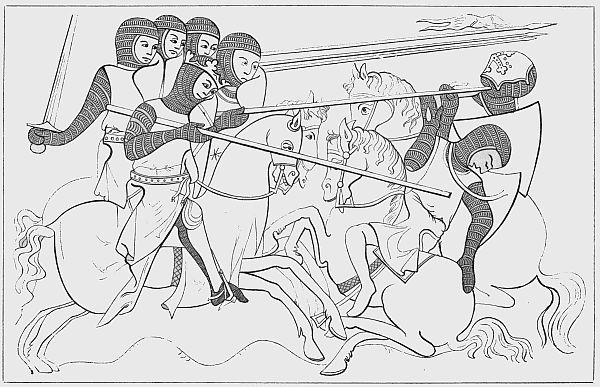
Plate LXXX.
The Spear for war of the thirteenth century offers no change from that of the preceding age. The shaft of it is still uniform from end to end, not yet being hollowed out for the grip, as in the lance of a later date. The head is of three forms: the lozenge, the leaf, and the barbed. The lozenge spear-head is the most usual, and appears in the accompanying group from the Lives of the Two Offas, Cott. MS., Nero, D. i. fol. 7. See also our woodcuts, No. 62 and 75. The leaf-shaped head occurs on fol. 4 of Nero, D. i.; on fol. 27 of Harl. MS. 3,244; and on the Shurland monument (Stothard, Pl. xli.) The barbed spear was probably not considered a knightly weapon, but carried by soldiers of an inferior grade. At all events, we occasionally find men-at-arms furnished with it, as in Roy. MS. 20, D. i., a book of about the close of this century. And earlier in the period, at the battle of Bovines in 1214, we have the curious account of Rigord, shewing the jeopardy in which the life of King Philip was placed through the attack of a soldier armed with a spear of this description. This soldier of the emperor's host struck at the neck of the king, the usual point of attack, and though the gorget of the monarch prevented the weapon from inflicting any wound, the barbs of the spear became so firmly fixed between the hauberk and the head-defence, that the sturdy German was enabled to pull Philippe Auguste from his horse and lay him prone at his feet. The king managed to raise himself again, but the soldier held firm. The emperor, who was near at hand, rushed forward to terminate the strife by the death of his rival, and all seemed over. Galon de Montigny meanwhile, the Bannerer of the king, proclaimed the danger of his master by incessantly raising and lowering the Standard over the spot where this contest was taking place. The French were animated to new exertions: a band of seigneurs and gentlemen cut their way to the spot where the king was struggling in unequal conflict with his foes: the spearman, struck down or slain, let go his hold: the fight continued, furiously as ever, but in numbers less disproportionate than before: Etienne de Longchamp, one of the bravest of the French nobles, is slain by the side of the king: Pierre Tristan, another distinguished knight, leaps from his steed, and gives it to his monarch: Guillaume des Barres at this moment comes up with reinforcements, charges the German host with impetuous bravery, and turns their triumph into a rout.
The Lance is occasionally furnished with a streamer, as at a former period. It is seen in our last engraving (No. 80), from the Lives of the Offas; and again in woodcuts, Nos. 55 and 62. Compare also Harl. MS. 3,244, fol. 27, and other groups from the Lives of the Offas. In some of these examples, the lance-flag is ensigned with a cross only; in others it is quite blank: in others, again, as the brass of D'Aubernoun, it bears a device clearly heraldic.
In a few rare instances the spear is represented on the tomb of the knight. The necessity of reducing it far beneath its legitimate proportions, in order to be comprised within the narrow limits of the sepulchral memorial, would furnish a sufficient reason for its being generally excluded from the monumental design: but it is not improbable that mere fashion (for the tomb has its fashions) contributed in some degree to this exclusion; because we find that the royal and knightly seals, which at a previous date constantly exhibited the lance with its streamer, now more usually represent the warrior armed with the sword. The lance is found on the brass of D'Aubernoun (woodcut, No. 55), on the sculptured effigy of a knight in the churchyard of Ruabon, in Wales, and in the incised slab at Ashington, Somersetshire, figured in the Archæological Journal, vol. viii. p. 319.
For the hastilude, the spear-head was blunted, and "about the breadth of a small knife;" as we learn from Matthew Paris, in his account of the Round-Table Game held at the Abbey of Wallenden in 1252. Here, one of the knights, Roger de Lemburn, aimed his weapon, the point of which was not blunted as it ought to have been, in such a way that it entered under the helm of his adversary, Arnold de Montigny, and pierced his throat; for he was uncovered in that part, and without a collar (carens collario). The Earl of Gloucester with the other knights immediately sought to extract the fragment of the lance, and when he had succeeded in withdrawing the wooden shaft of it, the iron head remained behind: on this being at length extracted, and examined by the surrounding knights, it was found to be very sharp at the point, like a dagger; though it ought to have been blunt, and about as broad as a small knife. Its shape was like that of a ploughshare on a small scale, whence it was commonly called a little plough (vomerulus), and in French, soket[363]. We have here the description of two spear-heads very distinct in character: one rebated for the Jousts of Peace, seemingly the prototype of the coronel which afterwards replaced it; and the other a sharp instrument, the form of which we may perhaps recognise among the tilting weapons of the Triumph of Maximilian. See, for instance, the group of knights armed for the "Course appelée Bund."
When, in battle, the charge had been made with the Lance, and that weapon was no longer available in the mêlée, it was cast aside, and the conquest carried on with the Sword:—
"Aprés le froisseis des Lances, Qui ja sont par terre semées, Giettent mains à blanches espées, Desquels ils s'entr'envaissent, Hyaumes e bacinets tentissent E plusieurs autres ferreures. Coutiaux trespercent armeures."—Guiart.
SECOND GREAT SEAL OF KING HENRY III.
No. 81.
The knightly Sword of this day resembled in its essentials that of the preceding century: indeed, it did not materially change during the whole Gothic period. The blade was straight, broad, double-edged, and pointed. The type is well shewn in the second seal of Henry III. (woodcut, No. 81).
The cross-piece was usually curved towards the blade, as represented in several of our engravings. Sometimes this curved guard threw out a kind of cusp in the middle, as in the sculpture at Haseley, (woodcut 46,) and the effigy figured by Stothard, Plate xx. The cross-bar was at other times straight, as in the seal of King John (woodcut, No. 52), and in our other woodcuts numbered 53, 56, and 63. Compare the sword of De Vere (Stothard, Pl. xxxvi.). A variety of the straight guard forms also a cusp over the centre of the blade, as in the example given in our engraving, No. 80. The knightly effigy in Walkerne Church (Hollis, Pt. i.) has a sword-guard in the form of a chevron. Edward I., on his great seal, (woodcut, No. 85,) offers us a further variety, in which the outline somewhat resembles that of the Greek bow.
The pommel of the sword during this century takes many forms: the round, the trefoil, the cinquefoil, the rosette, the lozenge, the conical, the pear-shaped, the square, and the fleur-de-lis. The round is either plain or ornamented on its sides: in the latter case the ornament is usually a cross, or a shield of arms. The plain round pommel is generally wheel-formed; that is, it has a projection in the centre something like the nave of a wheel. See Journal of Archæological Association, vol. i. p. 336. The sacred symbol of the Cross is very frequently found on the circular pommel; as in our woodcuts, No. 55 and 77. The shield of arms appears in our engraving, No. 70. Compare the Fitz-Alan monument (Hollis, Pt. iv.). The trefoil pommel is represented in our cuts, No. 56 and 74; the cinquefoil, on our engraving, No. 64, and in Plate xx. of Stothard's Monuments. The rose form occurs in our woodcut, No. 62; the lozenge on the effigy of King John (Stothard, Pl. xi.); the conical, in our print, No. 63; the pear-shaped, in Stothard's 37th Plate; the square, on Plate xxxv. of the Painted Chamber; and the fleur-de-lis on the seal of Edward I. (woodcut, No. 85).
The sword-handle is sometimes of a highly enriched character. That of King John, on his monument in Worcester Cathedral, represents a weapon in which both pommel and cross-bar were inlaid with precious stones. Ornamental grips are seen in the monument of Crouchback (Stothard, Pl. xliii. fig. 4), and the brass of De Bures, 1302 (Waller, Pt. ii.).
The Sheath also occasionally exhibits enrichments. These are either metal harnessings, of Gothic patterns, similar to the architectural designs of the day, as in our woodcut, No. 70, and the effigy of Brian, lord Fitz-Alan (Hollis, Pt. iv.); or the scabbard is embellished from end to end with a series of shields of arms, as in our engraving, No. 73, and the statue of De Montfort (Stothard, Pl. xxxix.). These escutcheons were probably tinctured by means of enamel.
The characteristic Sword-Belt of this century consisted of two straps, a long and a short one. The long strap was looped to the scabbard about two hands-breadths from the top, passed round the waist, and fastened to the buckle in front, leaving a long end tipped with a metal tag. The short strap held the buckle, and was split into two thongs, one of which was laced into the top of the (leather) scabbard; the other, passing obliquely across the sheath, being laced into the loop of the long strap below. See our woodcuts, Nos. 55 and 73. A variety of this mode consisted in attaching the long and short straps to the scabbard by ring-lockets of metal, in lieu of the loop and lacings. This occurs late in the century. See woodcut, No. 70, and the effigy of Brian Fitz-Alan (Hollis, Pt. iv.). The common sword-belt of the soldiery was formed on the old plan: at one end of a broad strap were two clefts, through which the two thongs into which the other end was split were passed and tied into a knot. See woodcut, No. 63. The figures there given represent the soldiers of Herod engaged in the Massacre of the Innocents. The knightly sword-belt is often highly enriched; being covered with elaborate patterns, worked in the most brilliant colours, and harnessed with bars and bosses of gilt metal, or perhaps of gold itself; the bosses, towards the end of the period, taking not unfrequently the form of lions' heads. The ornament of bars only, appears on a Temple Church effigy, figured by Hollis, Pt. i.; of bars and rosettes, in Stothard's 15th and 45th Plates; of a painted pattern, in Plate xxi. of Stothard's work; of bosses in the form of lions' heads, in Part iv. of Hollis. The sword-belt of Edmund Crouchback is enriched with heraldic bearings. See Stothard, Pl. xliii. detail 1.
Minute variations from the above types of Sword-belt may be found, but do not seem to require a particular description. We must not omit to remark, however, that, in some early monuments of this period, the sword is represented as worn at the right side of the warrior. Three effigies in the Temple Church, London, exhibit this arrangement.
At York, on Christmas-day, 1252, King Henry III. conferred knighthood on the young king of Scotland; who, the day following, espoused the Princess Margaret, daughter of Henry, amidst great rejoicings and a splendid ceremonial. To obtain a detailed description of the Sword used by the king of England on this occasion was scarcely within the hope of the archæologist; but, singularly enough, such an account, of curious minuteness, has come down to us. It is preserved in the Tower, (Close Rolls, 36 H. III. m. 31,) and has been Printed in Walpole's "Painting in England" (vol. i. chap. 1):—
"Mandatum est Edwardo de Westm. quod cum festinatione perquirat quendam pulchrum gladium et scauberg. ejusdem de serico, et pomellum de argento bene et ornate cooperiri, et quandam pulcram zonam eidem pendi faciat, ita quod gladium illum sic factum habeat apud Ebor., de quo Rex Alexandrum Regem Scotiæ illustrem cingulo militari decorare possit in instanti festo Nativitatis Dominicæ. Teste Rege apud Lychfeld xxi. die Novembr. Per ipsum Regem."
Besides the ordinary knightly sword of the thirteenth century, the size of which is authenticated by many existing monuments, we have the evidence of cotemporary writers that swords of differing sizes were employed by different nations. The Germans affected a large brand, the French a shorter weapon. Thus Guiart:—
"A grans espées d'Allemagne Leur tranchent souvent les poins outre."
"Là Francois espées reportent Courtes et roides, dont ils taillent."
And again, under 1301:—
"Epées viennent aux services Et sont de diverses semblances, Més Francois, qui d'accoutumance Les ont courtes, assez legieres, Gietent aux Flamans vers les chieres."
In the description of the Battle of Benevento, in 1266, Hugues de Bauçoi, an eye-witness of the conflict, tells us that the troops of Manfred, Germans and Saracens, fought with long swords, axes and maces; but the French, coming to close quarters, pierced them with their short swords: "ex brevibus spathis suis eorum latera perfodiebant[364]." Guillaume de Nangis gives similar testimony[365]. How far these German weapons approached the great two-hand swords of later times, or the French reverted to the short blade of the Romans, it is vain to inquire. Commentators have seen in the above descriptions both the types here named; but the evidence of pictorial monuments does not confirm the conclusion. As large and small are but comparative terms, it is probable that the swords of the French and Germans differed in no great degree.
Other varieties of Sword which appear in the thirteenth century are the Falchion, the curved Sabre, the Espée à l'estoc, the Cultellus, and the Anelace.
The Falchion (fauchon, Fr., from the Latin falx) is of two kinds: the first a broad blade, becoming wider towards the point, the edge convex, the back concave; as in this example from the Painted Chamber:
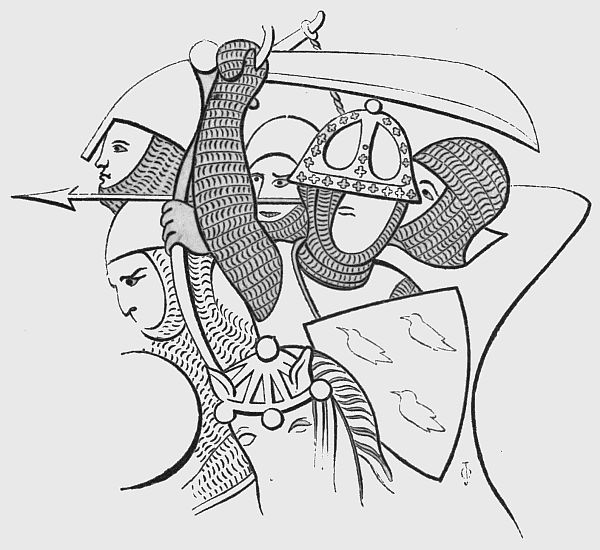
No. 82.
the other differing from it only in having the back quite straight. The latter is figured on Plate xxxi. of the Painted Chamber; and of this form is the curious tenure sword of the lordship of Sockburn, co. Durham, engraved in the Archæologia, vol. xv. Plate xxvi. See, in Blount's "Antient Tenures," an account of this weapon; of the "monstrous Dragon, Worm, or flying Serpent, that devoured Men, Women, and Children," which fell at last under its keen edge; and of the "tomb of the great Ancestor of the Conyers, having carvings of the falchion, and of a dog, and of the monstrous Worm or Serpent, lying at the Knight's feet, of his own killing, of which the History of the Family gives the above account." The passage is too long for extract[366].
The falchion is a weapon of very remote antiquity. It appears among the paintings on the tomb at Thebes of Rameses III., b.c. 1230. See Plate iii. of Wilkinson's "Ancient Egyptians" (ed. 1837). And it is found, almost identical in shape, in the wall-paintings of the Ajunta Caves, of the first century of the Christian era; of which a careful copy has been made for the Museum of the East India House. Guiart often mentions it in the Chronique Métrique, as in this passage:—
"Là ou les presses sont plus drues Est le chaple[367] aux espees nues, Aux fauchons, aux coutiaus à pointes, Si merveilleus que les plus cointes N'ont ores soing de vanteries."
The curved Sabre is of very rare appearance. It occurs among the pictures of the Painted Chamber, Plate xxxv.
The Epée à l'estoc (Stabbing Sword) is named in a judgment of the Parliament of Paris in 1268: "Sufficienter inventum est quod dictus Boso dictum Ademarum percussit cum Ense a estoc in dextro latero propria manu, et de ipso ictu cecidit dictus Ademarus." It appears also to be the weapon which Rigord assigns to some of the imperial troops at the battle of Bovines: "Habebant cultellos longos, graciles, triacumines, quolibet acumine indifferenter secantes, a cuspide usque ad manubrium, quibus utebantur pro gladiis."
The Cultellus, as we have seen[368], was a weapon partaking of the character of the sword and the dagger. It clearly varied in size; for Odo de Rossilion, in 1298, names in his will "meum magnum cultellum et meam parvam ensem." Being the chief arm of the coustillers, it must have been of some considerable size: and of this larger kind must also have been the weapon assigned, in the "Outillement du villain," to the peasant, for the defence of his home:—
"Si le convient armer Por la terre garder, Coterel e hauvet, Macue e guibet, Arc e lance enfumée," &c.
In other places, it appears as a mere secondary arm, a knife or dagger; as in the Statutes of Arms already cited, where the various classes of proprietors are directed to have "espe, cutel e cheval," or "espe e cutel," or "espes, arcs, setes e cutel."
The particular construction of the Anelace, as well as the derivation of its name, has hitherto eluded the most careful examination of antiquaries and glossarists. Some have referred the name to the Latin or Italian, annulus, or annello. Others to the Old-German, Laz, from latus; the weapon being therefore a "side-arm." Matthew Paris often uses the word, and tells us that the arm was worn at the girdle: "Loricâ erat indutus, gestans anelacium ad lumbare." Without hoping to settle this question, we may venture to point out that a weapon of the dagger kind, carried at the belt, and having a chain with a ring running loosely upon the grip, to prevent its being lost in the mêlée, was certainly in use during the middle-ages; an example of which may be seen in the effigy of William Wenemaer, at Ghent, dated 1325; engraved in the Archæological Journal, vol. vii. p. 287. We may note also that the wheel-like form of the guard may have supplied the name; for Florio, in the sixteenth century, defines "Annelle" to be "thin plates of iron made like rings, called of our gunners washers," &c. Guiart also mentions the anelace: under the year 1298, he has:—
"Aucuns d'entr'eus testes desnuent De hyaumes e de cervelieres, E plantent alenaz es chieres En pluseurs lieus jusques es manches."
In the manufacture of Swords at this period, Cologne seems to have had the palm. The volume of Proverbs already noticed gives the highest place to the "Espees de Cologne." And Matthew Paris, under 1241[369], relating how certain wicked German Jews, wishing to assist the Tartars, sent them certain barrels, (filled, as they told the Christians, with poisoned wine,) adds that, on the toll-man suspiciously scrutinizing the contents, "all the casks were found to be filled with Cologne swords and daggers, without hilts, closely and compactly stowed away. The Jews were, therefore, at once handed over to the executioners, to be either consigned to perpetual imprisonment, or to be slain with their own swords."
The Exercise of the Sword and Buckler (Eskirmye de Bokyler) was in vogue in this century, and schools were established for teaching it. But disorders arising from the practice, the schools were ordered to be closed. Thus the "Statuta Civitatis London" of the 13 Edw. I. has: "Primerement pur ceo qe multz des mals com des murdres robberyes e homycides ont este fetz ca en arrere deinz la Citee de nuyt e de jour, e gentz batues e mal tretes e autres diverses aventures de mal avenuz encontre sa pes (du roi), defendu est qe nul seit si hardi estre trove alaunt ne batraunt parmy les ruwes de la Citee apres coeverfu parsone a seint Martyn le grant, a espey ne a bokuyler ne a autre arme pur mal fere ne dount mal suspecion poet vienir, &c....
"Ensement pur ceo qe fous qe sei delitent a mal fere vount aprendre eskirmye de bokyler e de ceo plus sei abaudissent de fere lour folyes, purveu est e defendu qe nul ne tiegne eskole ne aprise de eskirmye de bokyler de deinz la Citee de nuyt ne de jour, e si nul le faceo, eit la prison de xl. jours."
Representations of the Sword-and-buckler contest occur in Roy. MSS. 14, E. iii. and 20, D. vi., both engraved in Strutt's Sports. See also Hefner, Pt. ii. Plate vii. All these, however, are miniatures of the fourteenth century; though 14, E. iii. is early in the period. From these examples we learn that the buckler was about a foot and a half in diameter, had a boss in the centre, and was held at arm's length by a bar crossing the hollow of the umbo, exactly in the manner of the Anglo-Saxon shields described and figured in a former page. (See woodcut, No. 20.)
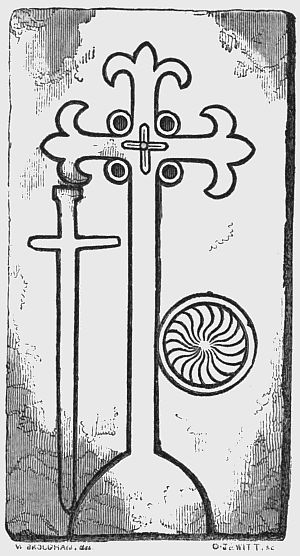
No. 83.
Occasionally the figure of a Sword was carved on the tomb of the knight, to indicate his calling, as in this incised slab from Brougham Church, Westmoreland, commemorating one of the Brougham family. The example is further curious from its including also the round shield of the period; differing, as we see, from the buckler named above, in having no boss. The sword is usually, on tombs of this kind, accompanied by a Cross: sometimes it forms itself the cross on the monument, as in the Gorforth memorial, engraved on page 84 of Mr. Boutell's work on Incised Slabs. At Aycliffe, Durham, is a tomb on which appears a cross, having on one side a sword, on the other a hammer and pincers. This group of emblems has been thought to indicate a weapon-smith. The monument is figured in the Archæological Journal, vol. v. p. 257. Not the sword only, but the spear, the axe, the dagger, and other weapons, are found on the incised slabs of the thirteenth and fourteenth centuries; many examples of which may be seen in the works on these memorials by the Rev. Mr. Cutts and the Rev. Mr. Boutell.
The Dagger by no means filled that prominent place in the knightly equipment during this century which it is found to occupy in the fourteenth; though, towards the close of the period, it is seen to be coming into vogue. It is worn by the knights represented in our engravings, Nos. 58 and 72; and the Ash Church effigy (woodcut, No. 59) shews us the lace by which the dagger, now destroyed, was fastened to the waist-belt. The figure of De Montford (Stothard, Pl. xxxix.) has the dagger. It appears also in the Shurland monument (Stothard, Pl. xli.), worn by the knight's attendant; and in this example the guard of it is formed of two knobs, a fashion occasionally found up to the sixteenth century. In Durham Cathedral is preserved a real dagger, which is believed to have belonged to one of the retainers of Bishop Anthony in 1283. It is entirely of iron, and the blade, which is sixteen inches in length, is inscribed "Anton: Eps: Dunolm.[370]"
Under the name of Misericordia, the dagger has an early mention in the Charter of Arras, in 1221: "Quicumque cultellum cum cuspide, vel curtam sphatulam, vel misericordiam, vel aliqua arma multritoria portaverit," &c. Under 1302, Guiart speaks of it by the same name:—
"Plusieurs piétons François ala, Qui pour prisonniers n'ont pas cordes, Mais coutiaux et misericordes, Dont on doit servir en tiex festes."
And under 1303:—
"Fauchons trenchans, espées cleres, Godendas, lances émoulues, Coutiaux, misericordes nues."
This name of misericorde appears to have been given because, in the last struggle of contending foes, the uplifted dagger compelled the discomfited fighter to cry for mercy. In this view, the murderous misericorde was by the middle-age poets assigned to "Pity," as an emblem of her benevolence. Thus Jean de Méun in the Romance of the Rose:—
"Pitiez, qui à tous bien s'accorde, Tenoit une Misericorde Decourant de plors e de lermes."
The Short Axe is very rarely given to the knightly combatant by the artists of the thirteenth century. It appears to have been resigned to the less dignified order of soldiery. The form of the head exhibits three principal varieties: the single blade, of which we have a good example in Harl. MS. 4,751, fol. 8 (woodcut, No. 50); the double weapon, in which one side has a vertical axe-blade and the other a pick (see Strutt's Dress and Habits, Pl. lxv.); and the double weapon, in which one side has a horizontal blade and the other a pick (see Stothard's Monuments, Pl. xix.). Guiart, under 1264, mentions the axe mingling in the strife of battle with the mace and the sword:—
"Le chaple commence aus espees, Dont là a de maintes manieres. Sus hyaumes e sus cervelieres Prennent plommees à descendre, E hachetes, pour tout porfendre."
And when, in the same year 1264, the Earl of Leicester assembled his army on Barham Downs, in addition to the ordinary military levy, every township was required to send eight, six, or four footmen well armed with spears, bows and arrows, swords, cross-bows, and hatchets. (New Rymer, 444.)
From the collection of thirteenth-century Proverbs, which has already supplied us with several curious particulars of this early time, we learn that the "Haches de Dannemark" held the first place among the axes of the period: but whether this distinction is accorded for the form or the manufacture of the weapon, is not clear. Matthew Paris speaks of it under 1256: "Cum jaculis——Danisque securibus et gesis[371]——hostiliter insequuntur."
The "Danish Axe" is mentioned in several military tenures of this century; but a more remote antiquity is usually assigned to the origin of the grant itself. The weapon (more or less original) was always exhibited with great pride in the family mansion. Dugdale tells us that Plumpton in Warwickshire "was possest in Henry 3. time by one Walter de Plompton, who held these lands by a certain weapon called a Danish Axe: which, being the very Charter whereby the said land was given unto one of his Ancestors, hung up for a long time in the Hall of the capitall messuage belonging thereto, in testimony of the said tenure; untill that the said House was seized upon by Sir John Bracebrigge, Knight, Lord of Kingsburie in Edward 3. time, and pulled to the ground: After which it remained a great while in the Hall of the mansion belonging to William de Plompton, in Hardreshull (about two miles distant), being commonly reputed and called the Charter of Plomton[372]."
And in the 12th Edw. I.: "Robertus Hurding tenet unam acram terrae et unum furnum in villa Castri de Lanceveton (Launceston, co. Cornwall) nomine serjantiae essendi in Castro de Lanceveton cum uno Capello ferreo et una Hachet Denesh per xl. dies tempore guerrae ad custum suum proprium, et post xl. dies, si Dominus Castri velit ipsum tenere in eodem Castro, erit ad custus ipsius domini[373]."
The Mace is both named and pictured in evidences of this century. Matthew Paris, describing the disasters of a tournament near Hertford in 1241, adds: "Many other knights and men-at-arms were also wounded and seriously injured with maces (clavis) at this same tournament, because the jealousy of many of those concerned had converted the sport into a battle[374]." This and similar mishaps led to the mace, with other weapons, being interdicted at these pastimes; for in a "Statutum Armorum ad Torniamenta" of this century, it is ordered by the king "qe nul Chivaler ne Esquier qe sert al Turney ne porte espeie a point, ne cotel a point, ne bastoun, ne mace, fors espee large pur turneer[375]." Pictured examples of the mace occur in Roy. MS. 20, D. i., ff. 12 and 69; and on Plate xxxiii. of the Painted Chamber. The striking part is formed in the manner of a cogged wheel: the top sometimes terminates in a knob; sometimes it is prolonged into a pike.
The Bâton named in the above Statute was probably no more than a stout cudgel. The form of the tournament bâton of a later time is given in full detail in the "Tournois du roi René."
The long-handled weapons of the infantry named in this century are the Guisarme, the Godendac, the Croc, the Faus, the Faussar, and the Pilete.
The Guisarme, or Pole-axe, has already been described, (ante, p. 50). It is named by Matthew Paris: "Gestabant autem gladios, bipennes, gaesa, sicas et anelacios." It occurs also in the Statute of Winchester: "E que ad meyns des chateus de xl. soudes, seyt juree as faus, gysarmes, coteaux e autres menus armes." The Pole-axe with a single vertical blade is seen in a miniature of the thirteenth century, inserted into the Gospels of Mac Durnan in the Lambeth Library (figured in Westwood's Palæographia); and it appears again in the Lives of the Offas, Cott. MS., Nero, D. i.
The Godendac was the name given by the Flemings to the Halbard. Guiart, describing the battle of Courtrai, in 1302, has this very curious passage:—
"A grans batons pesans ferrés Avec leur fer agu devant Vont ceux de France recevant Tiex baton qu'il portent en guerre Ont nom Godendac en la terre. Goden-dac, c'est Bon jour à dire, Qui en Francois le veut décrire. Cil baton sont long e traitis, Pour férir a deux mains faitis."
Should the axe-stroke fail, then the skilful halbardier repairs his mishap with a prompt thrust of the piked head:—
"Et quand l'on en faut au descendre, Si cil qui fiert y veut entendre, Et il en scache bien ouvrer, Tantot peut son cop recovrer, Et férir sans s'aller moquant, Du bout devant en estoquant Son ennemi."
The halbard, consisting of an axe-blade balanced by a pick, and having a pike-head at the end of the staff, is figured on Plate xxxi. of the Painted Chamber.
The Faus (falso: from falx) appears to have been a kind of spear with a broad, cut-and-thrust blade. It is made synonymous with the spear in this passage of the Synodus Nemausensis, in 1284: (de Clericis) "Enses non deferant, nec cultellos acutos, nec lanceas seu falsones," &c. But in the Statuta Eccles. Cadurcensis, in 1289, it is distinguished from the spear: "balistas et arcus, lanceas, falsones, costalarios seu alia arma non deferant." In the Statute of Winchester, as we have seen, (ante, p. 211,) it was placed at the head of the humbler class of weapons prescribed to the militia of small means.
The Faussar, a kindred word, was probably a kindred weapon. Like the falso, it most likely presented some variety in the exemplars turned out from the village weaponers' smithies. One kind was three-edged, and had a second name, the Trialemellum. At Bovines, "Ante oculos ipsius regis occiditur Stephanus de Longo Campo, in capite percussus longo, gracili Trialemello[376], quem Falsarium nominant[377]." The faussar appears to have been sometimes used as a missile: thus, in the Chron. de Duguesclin (of the fourteenth century) we are told that the combatants
"Gettent dars et faussars, moult en vont ociant."
The Croc was probably the Bill. It is named by Guiart among the weapons of the Ribauds in 1214:—
"Li uns une pilete porte, L'autre croc ou macue torte."
The fashion of the Bill of this time, a broad, cutting blade, forming a beak near the top and terminating in a pike, may be seen in Plate xxxi. of the Painted Chamber.
The Pilete (dimin. of Pilum) named in the above passage of Guiart, was a pike, the exact form of which, like that of so many of the weapons of this period, has not been ascertained. The "macue torte" is a knotted club.
The missile weapons of this day were the javelin, the long-bow, the cross-bow, the cord-sling and the staff-sling.
The Javelin is mentioned by Matthew Paris: "cum jaculis Danisque securibus et gesis[378]."
The Long-bow has already been noticed in our examination of the troops of this century. Its form is seen in our woodcuts, Nos. 47, 48, 49 and 50. The fashion of the Quiver appears in the engraving from Roy. MS. 20, D. i. (No. 47). The feathering of the arrows is shewn in the same print; the shaft and head in woodcut, No. 82, from the Painted Chamber. Besides the ordinary arrows, shafts armed with phials of quick-lime were occasionally discharged from the long-bow. Strutt, in his Horda[379], has furnished an example of this missile, from a MS. of Matthew Paris in Benet College, Cambridge (copied in our woodcut, No. 51); and in the Additamenta to the printed History of Matthew Paris, page 1091, is given the letter of Sir Guy, a knight of the household of the Viscount of Melun, in which, recounting the capture of Damietta, he says: "We discharged fiery darts (spicula ignita) and stones from our sea mangonels, and we threw small bottles full of lime (phialas plenas calce), made to be shot from a bow, or small sticks like arrows against the enemy. Our darts, therefore, pierced the bodies of their pirates, while the stones crushed them, and the lime, flying out of the broken bottles, blinded them."
The Cross-bow, as we have seen, (ante, p. 201,) was in general use throughout this century. It is figured in our woodcuts, Nos. 49 and 50. In both these examples there is a provision for holding down the bow with the foot, while the cord was drawn up to the notch. The bow might thus be bent by the hand: but there appears also to have been, at this early date, some apparatus similar to the moulinet of later days, by which a stouter bow might be easily bent by mechanical appliance. Such a bow was called an "arbaleste à tour," and the instrument by which it was wound up was named "la clef." No delineation of this little engine has yet been noticed among the monuments of the time. Guiart has:—
"Messire Alphonse un jour ataignent, Qui armez iert[380] de son atour, D'un quarrel d'arbaleste a tour."
And again:—
"En haste vont les clefs serrant des arbalestes." 2e. Partie, vers 8,625.
Several further varieties of the Cross-bow are named about this time:—Balistæ corneæ; ad stapham[381]; ad viceas[382]; de torno vel de lena[383]; ad unum pedem; ligneæ ad duos pedes; de cornu ad duos pedes; a pectoribus; a pesarola[384]; and among the rest, a Double Cross-bow, discharging two quarrels: "Balista sine nuce, quæ duos projicit quarrellos." See Ducange and Adelung, v. Balista.
The Quarrel (carreau), as its name indicates, was an arrow with a four-sided or pyramidal head. This distinctive form of the arbalest shaft is carefully kept in view in the illumination from Add. MS. 15,268 (our No. 49); where, while the archer plies his barbed arrow, the cross-bowman discharges his angular quarrel. The feathering of the quarrel is seen very clearly in woodcut, No. 50; where the markings shew that feathers are really intended, and not slices of wood, leather, or metal. These last-named materials being found in later monuments, it seems not unlikely that they may have been used thus early; and we have the distinct evidence of cotemporary writers that the larger quarrels discharged from the engines called espringales were "empennés d'airain[385]."
The Slings of this period have already been noticed (page 204): the cord-sling is figured in our woodcut, No. 50, the staff-sling in No. 51.
The Military Flail appears in the following woodcut from Strutt's Horda vol. i., Plate xxxii. The original miniature is in the MS. of Matthew Paris, at Benet College, Cambridge, which has already furnished us with examples of the Staff-sling and other weapons of this time. The flail-man in our engraving is engaged in the assault of a castle: other assailants in the same vessel are armed with bows and slings. Adelung cites the following passage, in which the flail is mentioned under the name of flaellum: "Cum ducentis hominibus in armis, electis et gleatis, et cum flaellis[386]."
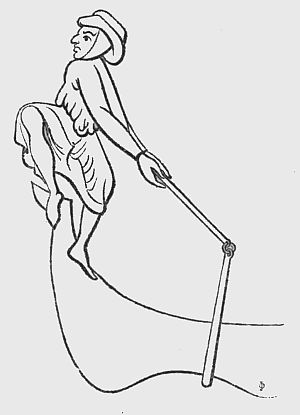
No. 84.
The Greek Fire, still rejected among the nations of Western Europe, for the reasons assigned in a former page, was in frequent use among the Saracens. In 1250, the Christians, advancing towards Damietta by water, were intercepted by their enemies. "The Saracens in their vessels met the Christians sailing down the river, where a most fatal naval conflict ensued, the missiles of the combatants flying like hail. At length, after an obstinate battle, rendered more dreadful by the Greek fire hurled on them by the Saracens, the Christians, being worn out by grief and hunger, suffered a defeat[387]." The letter "to his respected lord, Richard, earl of Cornwall," from "John, his Chancellor," gives a similar account of this terrible fight; from which one only of the Christians escaped, "Alexander Giffard, an Englishman of noble blood." "The Saracens, by throwing Greek fire on the Christians, burnt many of their boats and killed the people in them, thus obtaining the victory. The Christians were drowned, slain, and burnt[388]." The authors of the treatise, Du feu grégeois, Captain Favé and M. Reinaud, remark that during the fifty-seven years of the reign of French princes at Constantinople (taken in 1204), the secret of the Greek fire could not have remained concealed from men who had made some advances in the science of chymistry. "Mais alors les préjugés de l'ignorance se joignaient aux idées religieuses et aux sentimens chevaleresques, pour repousser l'emploi d'un art qui semblait rendre inutiles la force et le courage individuels[389]."
In the East, however, the employment of incendiary weapons was constant, and the variety of them very great. An Arabic treatise of this century, published in the work named above by MM. Reinaud and Favé, gives us the most curious information relating to them, and the interest of the manuscript is heightened by its containing drawings (somewhat rude, it is true) of the principal instruments and engines described. From this "Treatise on the Art of Fighting," by Hassan Alrammah, we learn that the Arabs of the thirteenth century employed their incendiary compositions in four different ways: they cast them by hand; they fixed them to staves, with which they attacked their enemies; they poured forth the fire through tubes; and they projected burning mixtures of various kinds by means of arrows, javelins, and the missiles of the great engines resembling the trebuchets and mangonæ of their Western neighbours. Among these fire-weapons we have—"Balles de verre; Pots à feu; La Maison de feu; Massue de guerre; Massue pour asperger; Lance de guerre; Lance à fleurs; Lance avec massue; La lance avec la flèche du Khatay; Flèches en roseau; Flèches du mangonneau; Flèches de la Chine; Marmite de l'Irac; Marmite de Mokharram; Vase de Helyledjeh; Cruche de Syrie (the last four for the mangonel); L'œuf qui se meut et qui brûle (Captain Favé takes this to be a projectile on the principle of our rockets); Dard du Khatay; Des Coupes; Des Volants; Des Lunes," &c.
The vessels of glass and pottery, discharged by hand or by machines, were so contrived that on striking the object at which they were aimed, their contents spread around, and the fire, already communicated by a fusee, enveloped everything within its reach. A soldier on whose head was broken a fire-mace, became suddenly soaked with a diabolical fluid, which covered him from head to foot with flame; and a flame of so terrible a nature that it was believed to be absolutely inextinguishable. The receipt for making the Massue de Guerre is given with great particularity: "Tu feras faire par le verrier une massue, &c. Ensuite tu feras les mélanges usités, &c. Tu mettras le feu à la massue et tu la briseras pour le service de Dieu[390]." One of the lances is furnished with a firework "so that the spear shall burn the enemy, after having wounded him with its point." Another lance "brulera bien et s' étendra à plus de mille coudées." It will be remembered that the Arabic superlative is commonly expressed by "a thousand." What we learn, therefore, is that this fire-missile was contrived to wound at a distance. In applying the Massue à asperger, you are to break it against the person of your antagonist, "but keep out of the current of the wind, lest the sparks return upon and burn you." The machines for casting forth the fire-pots and vases of larger dimension bear so close a resemblance to the trebuchets and mangonas in use by the Christian nations, that Captain Favé is inclined to think that the latter warriors copied their engines from those of the Arabs during the Crusades (p. 49).
On the second plate of the treatise are given examples of two of the Arabian mangonels. One is formed of a sling and weighted lever, like the instruments represented in Roy. MS. 16, G. vi., engraved in Shaw's "Dresses and Decorations," and on the ivory casket figured in the fourth volume of the Journal of the Archæological Association. The other differs only in having, in lieu of a weight, a number of cords hanging from the end of the lever; from which it would appear that the lever was in this case moved by men acting together by means of the cords. Captain Favé remarks that the expressions, La flèche de la Chine, La fleur de la Chine, in shewing us that the Chinese practised the fabrication of incendiary agents and contributed these names to the Arabs at so early a period, may permit us to suppose that this mode of warfare received its chief development from them, and even that to them may be ascribed its invention (p. 44).
The various Standards and Flags found in the last period are continued throughout the present. But the advancement of the science of heraldry gave to the devices of this age a permanence which has in many cases subsisted to the present day. The Dragon Standard was still in use in England. At the battle of Lewes, in 1264, between the king and his barons, "the king, being informed of the approach of his enemies, soon set himself in motion with his army, and went forward to meet them with unfurled banners, preceded by the royal ensign, which was called the Dragon[391]." In the same battle, on the barons' side, we find the ancient Carrocium. When the revolted nobles, with De Montford at their head, "had reached a place scarcely two miles distant from the town of Lewes, Simon with his friends ascended an eminence and placed his Car thereon, in the midst of the baggage and sumpter horses. There he displayed his Standard, fastening it securely to the car, and surrounded it with a great number of his soldiers[392]." The Milanese still held their Carrocio in the utmost veneration. When the Emperor Frederic, in 1236, crossed the Alps to attack them, "the citizens sallied forth from the city in great strength, to the number of about fifty thousand armed men, and proceeded with their Standard, which they call Carruca, or Carrochium, to meet the emperor, sending word that they were ready to fight him[393]." In 1237 the Milanese again placed their defiant Carrocium in front of the imperial host. They went forth with an army of about sixty thousand men, and fixed their Carrocium where their ranks seemed to be strongest. At sight of this, the emperor summoned his counsellors, and, animating them by warlike words, said: "Behold how these insolent Milanese, our enemies, dare to appear against us, and presume to provoke me, their lord, to battle; enemies as they are to the truth and to Holy Church, and borne down by the weight of their sins. Cross the river, unfurl my Banner, my victorious Eagle! and you, my knights, draw your formidable swords, which you have so often steeped in the blood of your enemies, and inflict your vengeance on these mice, which have dared to creep out of their holes, to cope with the glittering spears of the Roman Emperor[394]." From the letter of the emperor himself, addressed to "Richard, earl of Cornwall, his beloved brother-in-law," we learn that the Standard-Car was drawn by horses: "quod apud Crucem-Novam (Nuova Croce) in equorum celeritate præmiserant." And further on he writes: "We now directed our attention to the attack and capture of this standard, and we saw that some of our troops, having forced their way over the top of the trenches, had penetrated almost to the mast of the Carrocium. Night, however, coming on, we desisted from the attack till the following morning; lying down to rest with our swords drawn, and without taking off our iron hauberks. When day broke, however, we found the Carrocium deserted, left amidst a crowd of vile wagons, entirely undefended and abandoned, and from the top of the staff where the Cross had been, the Cross was now severed: but, being found too heavy for the fugitives to carry off in safety, they had left it half-way[395]."
The Car with its Dragon and Eagle, forming the standard of the Emperor Otho at Bovines, has already been noticed, (page 164). The Oriflamme of the French monarchs maintains its illustrious position. Captured by the Mahometans, with Saint Louis and his equipage, it still miraculously subsists; and when destroyed by the Flemings at the battle of Mons-en-Puelle, it is discovered that the banner which has been torn to pieces is, after all, only a counterfeit oriflamme, the real one being still intact under the guardianship of the Abbot of St. Denis. Thus Guillaume Guiart:—
"Aussi li Sire de Chevreuse Porta l'Oriflamme vermeille, Par droite semblance pareille A cele s'élevoit esgarde Que l'Abbé de Saint Denis garde.
Et l'Oriflamme contrefaite Chaï à terre, et la saisirent Flamans, qui après s'enfuirent." Chron. Mét., ann. 1304.
The "Royal Standard" of the French monarchs is described as of blue, adorned with fleurs-de-lis of gold. That of Philip Augustus at Bovines is thus noticed by Guiart:—
"Galon de Montigni porta, Ou la Chronique faux m'enseigne, De fin azur luisant Enseigne A fleurs de lys d'or aornée, Près du roi fut cette journée A l'endroit du riche Estendart."
An ordinance of Philip IV. in 1306, quoted by Père Daniel (Mil. Fran. j. 520), under the heading, "L'ordonnance du Roy quant il va en Armez," directs: That the chief Ecuyer Tranchant shall have charge of the Royal Standard: that the chief Chamberlain shall carry the Banner of the king: and that the chief Varlet Tranchant shall follow close behind the king, bearing his Pennon; and his duty is to accompany the king wherever he may go, in order that all may know where the monarch is stationed.
The knightly Banner of this time may be seen in Roy. MS. 20, D. i.; in the Lives of the Offas (Cott. MS., Nero, D. i.); and in many of the plates of the Painted Chamber. In all these examples it is quadrangular, but not square: its height is double its breadth. The effigy at Minster, Isle of Sheppey, (Stothard, Pl. xli.) gives us in sculpture a large specimen of the banner, and shews very distinctly how it was fastened to the staff by tasselled cords.
The office of Bannerer of the City of London was filled in the thirteenth century by the family of Fitz Walter, who held the castlery of Baynard's Castle in fee for the performance of this duty. The services and privileges attached to the office are laid down in a curious document printed in Blount's "Antient Tenures," from a MS. preserved by Dugdale. They are recorded under two heads: the rights in time of war, and the rights in time of peace. We give the first in full: a mere note will suffice for the other, which are privileges rather of a civil than a military character:—
"These are the rights which Robert Fitz Wauter, Castellan of London, Lord of Wodeham, has in the city of London: That is to say, the said Robert and his heirs ought to be, and are, Chief Bannerers of London, by fee, for the said Castlery, that his ancestors and he have of Castle Baynard in the said City. In time of War the said Robert and his heirs are to serve the city in manner following. The said Robert is to come on his barded horse (sus son Destrier covert), he the twentieth man-at-arms, all with horses housed with cloth or iron (coverts de teyle ou de fer), as far as the great gate of the minster of St. Paul, with the Banner of his arms displayed before him. And when he is come to the great gate of the aforesaid minster, mounted and equipped as aforesaid, then ought the Mayor of London, with his Sheriffs and Aldermen (ove touz ses Viscountz et ses Audermans), armed in their arms, to come out of the minster of St. Paul as far as the said gate, with his Banner in his hand; all being on foot. And the Banner shall be red, having an image of St. Paul in gold, the feet, hands and head of silver, with a silver Sword in the hand of the said image. And as soon as the said Robert shall see the Mayor and his Sheriffs and his Aldermen come on foot out of the said minster, bearing this Banner, then the said Robert, or his Heirs, who owe this service to the said City, shall dismount from his horse, and shall salute the Mayor as his companion and peer, and shall say to him: 'Sir Mayor, I am come hither to fulfil the service which I owe to the city.' Then the Mayor, Sheriffs, and Aldermen shall say: 'We deliver to you, as the Bannerer by fee of this City, this Banner, to bear and govern to the honour and profit of our City, to the best of your power.' Then the said Robert or his Heirs shall receive the Banner. Then the Mayor of the said City and his Sheriffs shall follow him to the gate, and shall deliver to the said Robert a horse of the value of twenty pounds[396]. And the horse shall have a saddle of the arms of the said Robert[397], and shall have a housing of Cendal silk of the same arms; and they shall take twenty pounds sterling, and shall deliver them to the Chamberlain of the said Robert, for his expenses this day. And the said Robert shall mount the horse which the said Mayor has given to him, holding the Banner in his hand. And as soon as he is mounted, he shall require the Mayor to cause to be elected a Marshal out of the troops of the City. And as soon as the Marshal is elected, the said Robert shall direct the Mayor and Citizens to have the Tocsin of the said city rung (que facent soner le Sein communal de la dicte Citee); and all the commonalty shall go with the Banner of St. Paul, which the said Robert shall carry, as far as Aldgate. Beyond that, the Banner shall be borne by one approved of the said Robert and the Mayor. If so be (si issint soit) they have to go forth out of the city, then ought the said Robert to elect two of the most discreet persons from each ward of the city, to provide for the safe keeping of the city during their absence. And this council shall be held at the Priory of the Trinity by Aldgate. And for every town or castle that the host of London shall besiege, the said Robert shall receive from the commonalty of London a hundred shillings for his pains, and no more, though the siege should last for a year. These are the rights that the said Robert shall have in London in time of War."
The rights of the Chief Bannerer in time of peace were the possession of one of those jurisdictions called a Soke, the power of imprisoning and punishing certain offenders within his district, the privilege of taking part in every "Great Council" held by the Mayor, and some others of a similar kind. And if the culprit within his jurisdiction has deserved death for treason, "then shall he be tied to the post which is in the Thames at the Wood Wharf, where boats are fastened, there to remain for two floods and two ebbs of the tide. And if he be condemned pur commun larcin, then is he to be taken to the Elms[398], and there undergo his punishment like other common thieves."
Not less in honour than was the gold-and-silver Banner of Saint Paul in the south, was the Banner of Saint John of Beverley in the north of England. It accompanied the heroic Edward the First in his wars in Scotland; and, besides the military bannerer, appears to have had a clerical custodian: as we learn from this curious document preserved in the Tower:—
"Rex dilecto et fideli suo, Johanni de Warenna, Comiti Surr', custodi suo regni et terræ Scotiæ, salutem.
"Cum nos, ob reverentiam Sancti Johannis de Beverlaco, gloriosi confessoris Christi, concesserimus dilecto clerico nostro Gileberto de Grymesby, qui Vexillum ejusdem Sancti ad nos usque partes Scotiæ, detulit, et ibidem de præcepto nostro cum Vexillo illo, durante guerra nostra Scotiæ, moram fecit, quandam ecclesiam, viginti marcarum vel librarum valorem annuum attingentem, ad nostram donationem spectantem, et in regno Scotiæ proximo vacaturam.
"Vobis mandamus quod præfato Gileberto, de hujusmodi ecclesia, in prædicto regno Scotiæ, provideri faciatis, quamprimum ad id optulerit se facultas.
"Teste Rege, apud Kyrkham xiij. die Octobris." (1296[399].)
The triangular Pennon occurs in many of the groups of the Painted Chamber. It is not always heraldically charged; but this may have arisen from the partial decay of the colours.
The Lance-flag, of one, of two, or of three points, may be seen in our woodcuts, Nos. 55, 62 and 80.
The Horns and Trumpets used in battle are not frequently represented in the pictures of the time; but good examples occur in Roy. MS. 20, D. i., and on Plate xxxvi. of the Painted Chamber. The trumpets are of two kinds, straight and slightly curved; and are figured as of four or five feet long. The straight trumpet appears on folio 222vo. of Roy. MS. 20, D. i.; and is borne as a heraldic charge on the shield of Sir Roger de Trumpington (woodcut, No. 73). The long, curved trumpet occurs on folio 21vo. of Roy. MS. 20, D. i. Both kinds are pictured in Plate xxxvi. of the Painted Chamber. The smaller semicircular Horn is drawn on folio 70 of 20, D. i.
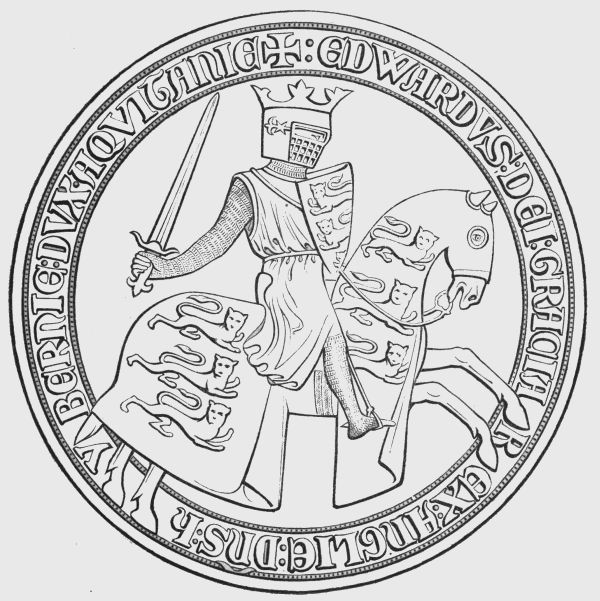
GREAT SEAL OF KING EDWARD THE FIRST.
No. 85.
From the collection of medieval "Proverbes" already cited, we learn that Spain was still the favourite mart for the knightly charger. Denmark and Brittany had also a celebrity for their breeds of horses of a different character. The fiat of popular approval is given to the
"Dextriers de Castille. Palefrois Danois. Roussins de Bretagne."
Such was the noble nature of the high-bred dextrarius that, when two knights had been dismounted and were continuing the fight on foot, their horses, left to themselves, instantly commenced a conflict of their own of the most gallant and desperate character. A representation of a double battle of this kind is given on folio 42 of Roy. MS. 12, F. xiii., a treatise "De natura Pecudum, Volucrum," &c. The form of the Saddle of this time, with its high pommel and cantle, may be seen in the Royal seals engraved on Plates 52, 79, 81 and 85; and again in the figure numbered 58. It was sometimes heraldically decorated. In the purchases for the Windsor Tournament[400], in 1278, we have:—
"D Felis͂ Le Seler. viij. sell' de arm̄ Angɫ. p'c͂. lxiiij. ɫi. P'i͂s.
"D Eodem. iiij. selle brond' de filo auri et argent͂ tract͂ videlicet una de arm̄ Rob'ti Tibetot una de arm̄ Joh͂is de Neele. j. de arm̄ Imb'ti Guidonis et una de arm̄ Comitis Cornub' p'c͂ xx/iiij. viij. ɫi.
"D Eodem. j. sella brond' eodem modo de arm̄ Joh͂is de Grely. c͂ scalop͂ argent' p'c͂. xxxviij. ɫi." &c.
On the seal of Alexander II. of Scotland, 1214—49, the king's saddle is ensigned with a lion rampant (Cotton Charter, xix. 2). And the seal of Robert Fitz-Walter, 1299, presents an analogous example (Plate xvii. of vol. v. of the Archæologia). The Stirrup of the period is shewn by numerous examples to have been triangular. See woodcuts, No. 47, 48 and 56. The Peytrel or breastplate was sometimes of plain fashion, as in the first seal of Henry III. (woodcut, No. 79): sometimes it had the pendent ornaments of the preceding period, as in the example on Plate xxxvii. of the Painted Chamber, where the pattern is a string of golden trefoils. From the Windsor Roll quoted above we find that the poitrail was of leather, and that this leather was occasionally gilt:—
"De Stephano de Perone xi. par͂. strep͂ et xi. pectoral' deaurat͂ p'c͂. xxij. ƚi.
"De eodem. iiij fren̄ cū pector͂ et strepis de corea. p'c͂. vi. ƚi.
"De eodem. ij. fren̄ ij. pector͂ et ij. strep͂ deaur͂. p'c͂. iiij. ƚi."
The Bridle presents two kinds of bits: one has the cheeks joined by a bar from their lower end, as in woodcut, No. 80; the other has no such cross-bar (see fol. 27 of Harl. MS. 3,244). The last quotation from the Windsor Roll shews us that the bridles were sometimes gilt. The group from the Painted Chamber on our woodcut, No. 82, offers a curious arrangement of the brow-band. The rounds in the original are gold-colour.
The Caparison of the knightly steed appears to have been of five kinds. 1. The horse has a "couverture" of chain-mail only. 2. The couverture is of quilted work. 3. The housing is of a light, fluttery material, probably covering an armour of chain-mail. 4. A light housing, heraldically decorated, which seems to have no armour beneath. 5. The horse has no furniture beyond the ordinary war-saddle, peytrel and bridle.
Of the mailed dextrier we have already had some notice in the preceding century (see page 169). The example here given is from the Painted Chamber.
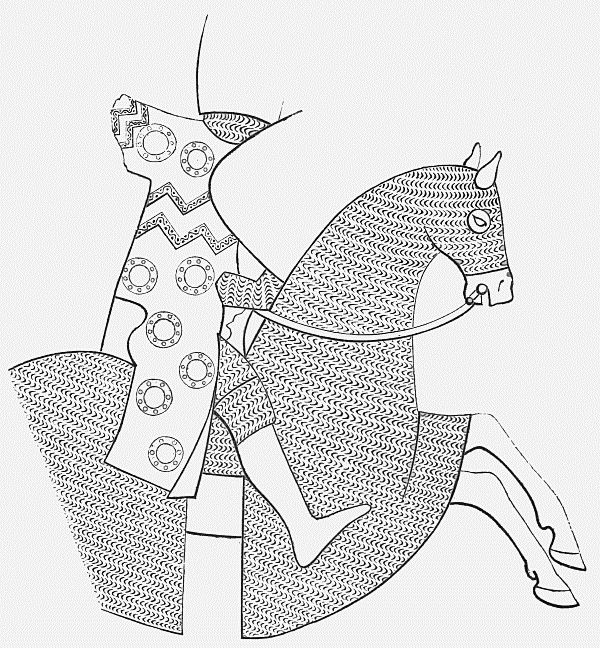
No. 86.
The trapper of chain-mail occurs on two of the plates of that work: those numbered 31 and 37. A fragment of a similar defence is seen on the Shurland monument at Minster (Stothard, Pl. xli.). But representations of this kind of armament are of the greatest rarity. It is, however, often mentioned by the writers of the time; though, perhaps, not without some exaggeration of the numbers of mail-clad steeds gathered in the host. At the battle of Nuova Croce in 1237, between the imperialists and the Milanese, Matthew Paris tells us that: "A credible Italian asserted that Milan with its dependencies raised an army of six thousand men-at-arms with iron-clad horses[401]." The Chronicon Colmariense, under the year 1298, describing the force of "Australes, qui armis ferreis utebantur," brought against the duke of Austria, says: "Habebant et multos qui habebant dextrarios, id est, equos magnos. Hi equi cooperti fuerunt coopertoriis ferreis, id est, veste ex circulis ferreis contexta." An ordinance of Philip the Fair in 1303 provides that every holder of an estate of 500 livres rental, shall furnish for defence of the realm "un gentilhomme bien armé et monté à cheval de cinquante livres tournois et couvert de couvertures de fer ou de couverture pourpointé[402]." The particular use of the barding of steel or pourpointerie was to defend the horses against the missiles of the enemy. Sutcliffe's "Practice of Arms," written in the sixteenth century, when the musquet was rapidly supplanting the long-bow, has: "Use of late times hath brought in divers sorts of Horsemen, which, according to their armes and furniture, have divers names. Some Horse are barded; others without bardes. The French Men-of-armes, in times past, used barded Horses, for feare of our Arrowes. Nowe, since Archerie is not so much reckoned of, and Bardes are but a weak defence against Shotte, Lanciers, leaving their bardes, are armed much like to the Albanian Stradiots."
The pourpointed housing is named in the ordinance of Philip IV. quoted above, and it may probably be implied in most cases where we read of a "cheval couvert." Rigord, under 1214, (battle of Bovines,) describes the approach of the Imperialists on their barded horses: "Dixit quod viderat equos militum coopertos, ... quod erat evidentissimum pugnæ signum." In a roll of expenses, of 1294, given by Du Cange[403], "Pour les gages de Monsieur Bertran Massole, retenu aux gages accoustumez pour lui et deux Ecuyers," we read: "Et estoit luy et autre à chevaux couverts, et un autre sans cheval couvert:" and again: "Pour onze Ecuyers à chevaux couverts, à chacun vii. sols vi. deniers par jour, et pour deux qui n'ont point chevaux couverts, chacun v. sols."
In England, the armed horse came into use between the years 1285 and 1298; for, while the Statute of Winchester in 1285 makes no mention of any defence for the steed, the Statute of 27 Edw. I. in every case requires such an armament:—