C.
Reading edition
Caaba, Arabic (lit. square house). The sacred mosque at Mecca. The temple is an almost cubical edifice, whence its name. It is a favourite subject of representation upon Mussulman works of art.
Caballaria, Cavalherium, hevallerie (Gr. κλῆρος ἱππικὸς), Med. A meadow set apart for military exercises.
Caballerius, Med. Lat. A cavalier, or knight.
Cabeiri were the personification of the element of fire. The precise nature attributed to them is unknown. There were two principal branches of their worship, the Pelasgian and the Phœnician. It is probable that this religion originated in Asia Minor, and penetrated to the island of Samothrace, in remote antiquity; it was very popular throughout Greece in the Pelasgic period. The principal temples were at Samothrace, Lemnos, Imbros, Anthedon, and other places.
Cabeiria, Gr. (καβείρια). Annual festivals in honour of the Cabeiri. (See Thronismus.)
Cabinet Pictures. Small, highly-finished pictures, suited for a small room.
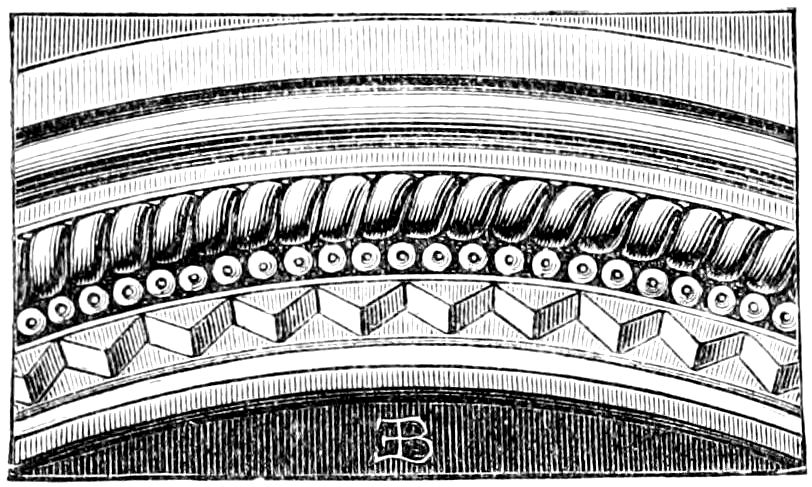
Fig. 122. Cable and tooth-mouldings.
Cabling, or Cable-moulding. A moulding in Roman architecture, made in imitation of a thick rope or cable.
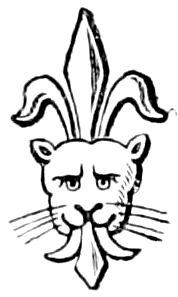
Fig. 123. Lion’s head cabossed.
Cabossed, Her. Said of the head of an animal represented full-face, so as to show the face only. (Fig. 123.)
Cabulus, Med. Latin (Old French, chaable). A machine for hurling stones; a large BALLISTA.
Caccabus, Gr. and R. (κάκκαβος or κακκάβη). A sort of pot or vessel for cooking any kind of food. It was made of bronze, silver, or earthenware, and assumed a variety of forms; but the one in ordinary use resembled an egg with an opening at the top which closed by a lid. The caccabus rested upon a trivet (tripus).
Cadafalsus, Cadafaudus. (See Cagasuptus.)
Cadas, O. E. An inferior silken stuff used for wadding; 13th century.
Cadency, Her. Figures and devices, by which different members and branches of a family are distinguished.
Cadet, Her. Junior.
Cadlys-drain, Welsh. Chevaux-de-frise.
Cadmium Yellow is the sulphide of cadmium, the finest and most permanent of all the yellow pigments in use.
Cadpen, Welsh. A chief of battle; captain.
Cadrelli, Med. Lat. Cross-bow quarrels. (See Carreaux.)
Cādūceus or Caduceum. A wand of laurel or olive, given by Apollo to Mercury in exchange for the lyre invented by the latter. Mercury, it is said, seeing two snakes struggling together, separated them with his wand, whereupon the snakes immediately twined themselves round it. This was the origin of the caduceus, as we know it; it was always an attribute of Mercury, who thence obtained his name of Caducifer, or caduceus-bearer. The caduceus was an emblem of peace.
Cadurcum, R. This term is applied to two distinct things: (1) the fine linen coverlets, and (2) the earthenware vases, manufactured by the Cadurci, or Gauls inhabiting the district now called Cahors.
Cadus, Gr. and R. (from χανδάνω, to contain), (1) A large earthenware jar, used for the same purposes as the amphora; especially to hold wine. An ordinary cadus was about three feet high, and broad enough in the mouth to allow of the contents being baled out. (2) The ballot-urn in which the Athenian juries recorded their votes with pebbles, at a trial.
Cælatura (cælum, a chisel). A general term for working in metal by raised work or intaglio, such as engraving, carving, chasing, riveting, soldering, smelting, &c. Greek, the toreutic art. Similar work on wood, ivory, marble, glass, or precious stones was called Sculptura.
Cæmenticius, Cæmenticia (structura). A kind of masonry formed of rough stones. There were two methods of construction to which this name applied. The first, called cæmenticia structura incerta, consisted in embedding stones of more or less irregular shape in mortar, so as to give them any architectural form, and then covering the whole over with cement. The second, called cæmenticia structura antiqua, consisted in laying rough stones one on the top of the other, without mortar, the interstices being filled by drippings or smaller stones.
Cæmentum. Unhewn stones employed in the erection of walls or buildings of any kind.
Caer, British (Lat. castrum; Saxon, chester). A camp or fortress.
Cæsaries (akin to Sanscrit keça, hair, or to cæsius, bluish-grey). This term is almost synonymous with Coma (q.v.), but there is also implied in it an idea of beauty and profusion, not attaching to coma, which is the expression as well for an ordinary head of hair.
Cæstus, Cestus. A boxing gauntlet. It consisted of a series of leather thongs, armed with lead or metal bosses, and was fitted to the hands and wrists.
Cætra. (See Cetra.)
Cagasuptus, Med. Lat. A CHAT-FAUX, or wooden shed, under which the soldiers carried on the operations of attack. (Meyrick.)
Cailloutage, Fr. Fine earthenware; pipe-clay; a kind of hard paste; opaque pottery. “Fine earthenware is most frequently decorated by the ‘muffle;’ the oldest specimens, those made in France in the 16th century, are ornamented by incrustation.” (Jacquemart.)
Cairelli, Med. Lat. (See Cadrelli.)
Cairn. A heap of stones raised over a grave, to which friends as they pass add a stone. The custom still prevails in Scotland and Ireland.
Caisson, Arch. A sunken panel in a ceiling or soffit. (See Coffer.)
Calamarius (calamus, q.v.). A case for carrying writing-reeds (calami). Another name for this case was theca calamaria.
Calamister and Calamistrum. A curling-iron, so named because the interior was partly hollow like a reed (calamus), or perhaps because in very early times a reed heated in the ashes was employed for the purpose; hence, Calamistratus, an effeminate man, or discourse. (Compare Ciniflo.)
Calamus (κάλαμος, a reed or cane). A haulm, reed, or cane. The term was applied to a variety of objects made out of reeds, such as a Pan’s pipe, a shepherd’s flute (tibia), a fishing-rod (piscatio), a rod tipped with lime, for fowling, &c. (See Arundo.) It was specially used, however, to denote a reed cut into proper shape, and used as a pen for writing.
Calantica. (See Calautica.)
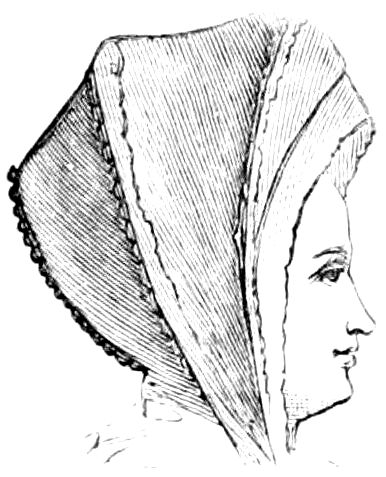
Fig. 124. Calash.
Calash (Fr. calèche). A hood made like that of the carriage called in France calèche, whence its name. It is said to have been introduced into England in 1765 by the Duchess of Bedford, and was used by ladies to protect their heads when dressed for the opera or other entertainments.
Calathiscus (καλαθίσκος). A small wicker basket.
Calathus (κάλαθος, a basket; Lat. qualus or quasillus). A basket made of rushes or osiers plaited, employed for many purposes, but above all as a woman’s work basket. The calathus was the emblem of the γυναικεῖον or women’s apartments, and of the housewife who devoted herself to domestic duties. The same term denoted earthenware or metal vases of various shapes; among others a drinking-cup.
Calautica or Calvatica, R. (Gr. κρήδεμνον, from κρὰς and δέω; fastened to the head). A head-dress worn by women; the Greek MITRA (q.v.).
Calcar (calx, the heel). A spur. It was also called calcis aculeus (lit. heel-goad), a term specially applied to the spur of a cock. The latter, however, was just as often called calcar. In mediæval Latin calcaria aurea are the golden, or gilt, spurs which were a distinctive mark of knighthood; calcaria argentea, the silver spurs worn only by esquires. Calcaria amputari, to hack off the spurs, when a knight was degraded:—
“Li esperons li soit copé parmi
Prés del talon au branc acier forbi.”
(Roman de Garin MS.)
Calcatorium (calco, to tread under foot). A raised platform of masonry, set up in the cellar where the wine was kept (cella vinaria), and raised above the level of the cellar-floor, to a height of three or four steps. On either side of this platform were ranged the casks (dolia) or large earthenware vessels in which the wine was made. The calcatorium served as a receptacle for the grapes when crushed (whence its name), and as a convenient place from whence to superintend the making of the wine.
Calceamen. Synonym of Calceus (q.v.), a term far more frequently employed.
Calceamentum. A general term denoting any description of boot and shoe. (Each will be found separately noticed in its place.)
Calcedony or Chalcedony (from the town Chalcedon). A kind of agate, of a milky colour, diversified with yellow, bluish, or green tints. The Babylonians have left us a large number of chalcedony cylinders, covered with inscriptions. (See also Agate, Cameos.)
Calceolus (dimin. of Calceus, q.v). A small shoe or ankle-boot worn by women. There were three kinds: the first had a slit over the instep, which was laced up when the boot was on. A second shape had a very wide opening, and could be fastened above the ankle by a string passed through a hem round the top. In the third description there was neither cord, lace, nor slit. The shoe was always low in the heel, and was worn like a slipper.
Calceus (calx, the heel). A shoe or boot made sufficiently high to completely cover the foot. The Romans put off their shoes at table; hence calceos poscere meant “to rise from table.”
Calculus (dimin. of calx, a small stone or counter). A pebble, or small stone worn by friction to present the appearance of a pebble. Calculi were used in antiquity for recording votes (for which purpose they were thrown into the urn), for reckoning, and for mosaic paving (hence the English word “calculation”).
Caldarium (calidus, warm). The apartment in a set of Roman baths which was used as a kind of sweating-room. This chamber, which is constructed nearly always on the same plan in the different baths which have been discovered, included a Laconicum, a Labrum, a Sudatorium, and an Alveus. (See these words.) Fig. 56 (on p. 32) represents a portion of the caldarium of Pompeii, restored.
Caldas Porcelain is from the Portuguese factory of that name, specialized for faiences in relief; the greater number are covered with a black coating; the others with the customary enamels of the country, violet, yellow, and green.
Caldron, for domestic use of the 14th century, is depicted as a tripod with a globular body, and broad mouth and two handles.
Calibre (or Caliper) Compasses. Compasses made with arched legs.
Caliga. A military boot worn by Roman soldiers and officers of inferior rank. The caliga consisted of a strong sole, studded with heavy pointed nails, and bound on by a network of leather thongs, which covered the heel and the foot as high as the ankle.
Caliptra. (See Calyptra.)
Caliver. A harquebus of a standard “calibre,” introduced during the reign of Queen Elizabeth.
Calix. A cup-shaped vase, used as a drinking-goblet. It was of circular shape, had two handles, and was mounted on a tolerably high stand. The term also denotes a water-meter, or copper tube of a specified diameter, which was attached like a kind of branch-pipe to a main one.
Calliculæ. A kind of very thin metal disk, more or less ornamented, worn by rich Christians, and especially priests, as an ornament for the dress. Calliculæ were also made of purple-coloured cloth. Many of the pictures in the catacombs represent persons wearing calliculæ on their colobia and other garments. (See Colobium.)
Callisteia (καλλιστεῖα). A Lesbian festival of women, in which a prize was awarded to the most beautiful.
Callot. A plain coif or skull-cap (English).
Calones (κᾶλα, wood). (1) Roman slaves who carried wood for the soldiers. (2) Farm servants.
Calote, Fr. A species of sabre-proof skull-cap worn in the French cavalry.
Calotype. A process of printing by photography, called also Talbotype.
Calpis, Gr. A water-jar with three handles, two at the shoulders and one at the neck.
Calthrops. (See Caltraps.)
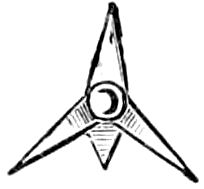
Fig. 125. Caltrap.
Caltraps (for cheval-traps). Spikes of metal thrown on the ground to resist a charge of cavalry. In Christian art, attributes of St. Themistocles.
Calvary, Chr. An arrangement of small chapels or shrines in which the incidents of the progress to the scene of the crucifixion are represented. To each such “station” appropriate prayers and meditations are allotted.
Calvatica. (See Calautica.)
Calyptra (from καλύπτω, to hide). A veil worn by young Greek and Roman women over the face. It is also called caliptra, but this term is less used.
Camail (for cap-mail). A tippet of mail attached to the helmet. In mediæval Latin called camale, camallus, camelaucum, calamaucus, calamaucum.
Camara. (See Camera.)
Camayeu. Monochrome painting, i. e. in shades of one colour, or in conventional colours not copied from nature.
Camber, Arch. A curve or arch.
Camboge or Gamboge. A gum-resin, forming a yellow water-colour. The best gamboge is from Siam, and the kingdom of Camboja (whence its name). It should be brittle, inodorous, of conchoidal fracture, orange-coloured or reddish yellow, smooth and somewhat glistening. Its powder is bright yellow. An artificial gamboge, of little value, is manufactured with turmeric and other materials.
Cambresian Faience. The “poterie blance” of Cambrai is mentioned in a MS. of the 16th century. It was an enamelled faience.
Camella. An earthenware or wooden vessel employed in certain religious ceremonies. It probably served for making libations of milk.
Cameo (Ital. cammeo). A precious stone engraved in relief; it is thus opposed to the Intaglio (q.v.), which is cut into the stone. Cameos are generally carved from stones having several layers. They were employed in the decoration of furniture, vases, clasps, girdles, and to make bracelets, rings, &c. Cameos were largely made by the Egyptians, Greeks, and Romans; by the two latter generally of sardonyx and onyx. (See Intaglio, Shell Cameo, &c.)
Cameo-glass. (See Glass.)
Camera, more rarely Camara. The vault or vaulted ceiling of an apartment. Camera vitrea, a vaulted ceiling, the surface of which was lined with plates of glass. The term was also used to denote a chariot with an arched cover formed by hoops; an underground passage; a pirate-vessel with a decked cabin; and, in short, any chamber having an arched roof, as for instance the interior of a tomb.
Camera Lucida. An optical instrument for reflecting the outlines of objects from a prism, so that they can be traced upon paper by a person unacquainted with the art of drawing.
Camera Obscura. A darkened room in which the coloured reflections of surrounding objects are thrown upon a white ground.
Camfuri, Camphio, Med. Lat. A decreed duel: from the German “kampf,” battle; and the Danish “vug,” manslaughter. (Meyrick.)
Camies, O. E. A light thin material, probably of silken texture.
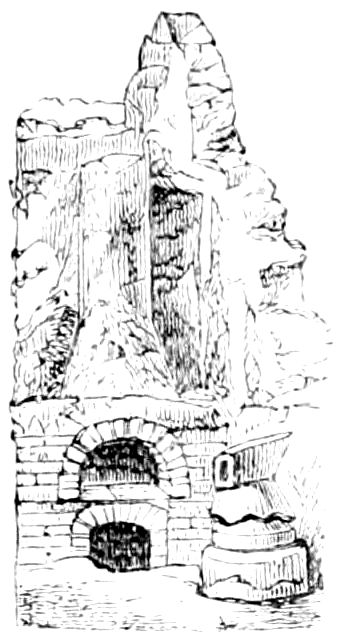
Fig. 126. Caminus.
Caminus. Literally, a smelting furnace, and then an oven for baking bread; also, a hearth or fireplace. Fig. 126 represents a baker’s oven at Pompeii.
Camisado, O. E. A sudden attack on a small party; a Spanish term.
“To give camisadoes on troupes that are lodged a farre off.” (Briefe Discourse of Warre.)
Camisia (a Gallic word, whence prob. Ital. camicia). A light linen tunic worn next the skin (tunica intima).
Camlet or Chamlet, O. E. Originally a tissue of goat’s and camel’s hair interwoven. In Elizabeth’s reign the name was given to a cloth of mixed wool and silk, first manufactured in Montgomeryshire, on the banks of the river Camlet.
Cammaka. A cloth of which church vestments were made, temp. Edward III.
Camoca, O. E., 14th century. A textile probably of fine camel’s hair and silk, and of Asiatic workmanship, much used for church vestments, dress, and hangings.
Campagus or Compagus. A kind of sandal. It was worn especially by the Roman patricians.
Campana, It. A bell; hence, Campanology, the science or study of bells.
Campanile. A belfry.
Camp-ceiling. Where all the sides are equally inclined to meet the horizontal part in the centre (as in an attic).
Campestre, R. (from campester, i. e. pertaining to the Field of Mars). A short kilt worn by gladiators and soldiers when going through violent exercises in public. The kilt fitted close to the body, and reached two-thirds down the thigh.
Campio Regis, Engl. The king’s champion, who on the day of the coronation challenges any one who disputes the title to the crown.
Campus Martius (i. e. Field of Mars). At Rome, as in the provinces, this term had the same meaning which it bears in some countries at the present day; i. e. a ground on which soldiers went through their exercises. In ancient times, however, the Field of Mars, or simply the Field, served also as a place of assembly for the comitia.
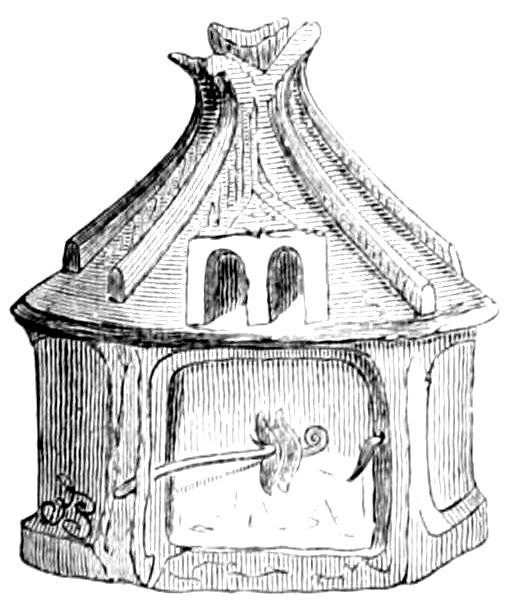
Fig. 127. Canaba.
Canaba, Gr. and R. A Low Latin name for the slight structures common in country places, such as we should now call sheds or hovels. Those who lived in them were called canabenses. Fig. 127 is from a terra-cotta vase found near the lake Albano.
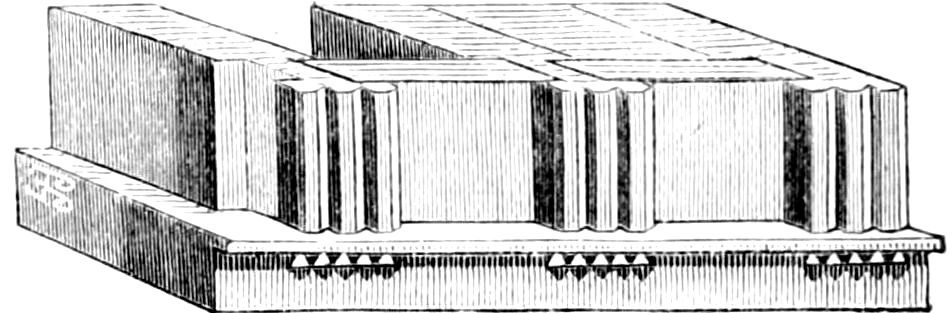
Fig. 128. Canaliculus.
Canaliculus (dimin. of Canalis, q.v.). A small channel or groove; or a fluting carved on the face of a triglyph. (Fig. 128.)
Canalis (akin to Sanscrit root KHAN, to dig). An artificial channel or conduit for water. The term canalis is also given to the fillet or flat surface lying between the abacus and echinus of an Ionic capital. It terminates in the eye of the volute, which it follows in such a way as to give it the proper contour.
Canathron (Gr. κάναθρον). A carriage, of which the upper part was made of basket-work.
Canberia, Med. Lat. (Fr. jambières). Armour for the legs.
Cancelli (from cancer, a lattice). A trellis, iron grating, or generally an ornamental barrier separating one place from another. In some amphitheatres the PODIUM (q.v.) had cancelli at the top. In a court of law the judges and clerks were divided from the place set apart for the public by cancelli (hence “chancel”).
Candela. A torch, made of rope, coated with tallow, resin, or pitch. It was carried in funeral processions (hence “candle”).
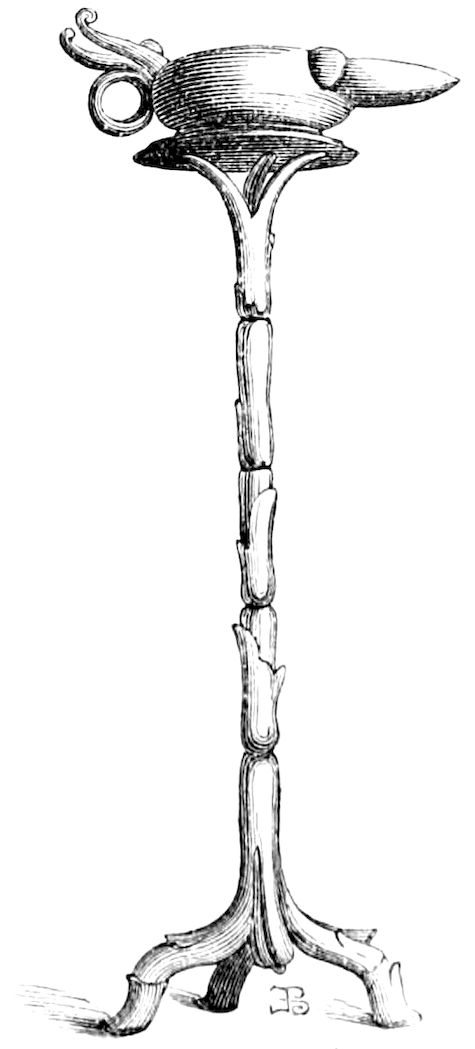
Fig. 129. Candelabrum.
Candelabrum. A candlestick, candelabrum, or generally any kind of stand by which a light can be supported. There were many different kinds. The same term is also used to denote the tall pedestal of a portable lamp (Fig. 129). (See Candlebeam.)
Candellieri, It. A style of grotesque ornamentation, characteristic of the Urbino majolica ware.
Candlebeam, O. E. A chandelier of the Middle Ages with “bellys of laton” (or brass cups) slung by a pulley from the ceiling.
Candles. The A.S. poets called the sun “rodores candel,” the candle of the firmament, “woruld candel,” “heofon candel,” &c. Originally, no doubt, the candle was a mere mass of fat plastered round a wick (candel-weoc) and stuck upon a “candel-sticca,” or upright stick; when the candlestick had several branches, it was called a candle-tree. There were iron, bone, silver-gilt, and ornamented candlesticks. Through the Middle Ages candles were stuck on a spike, not in a socket, and a chandelier of the 16th century shows the same arrangement.
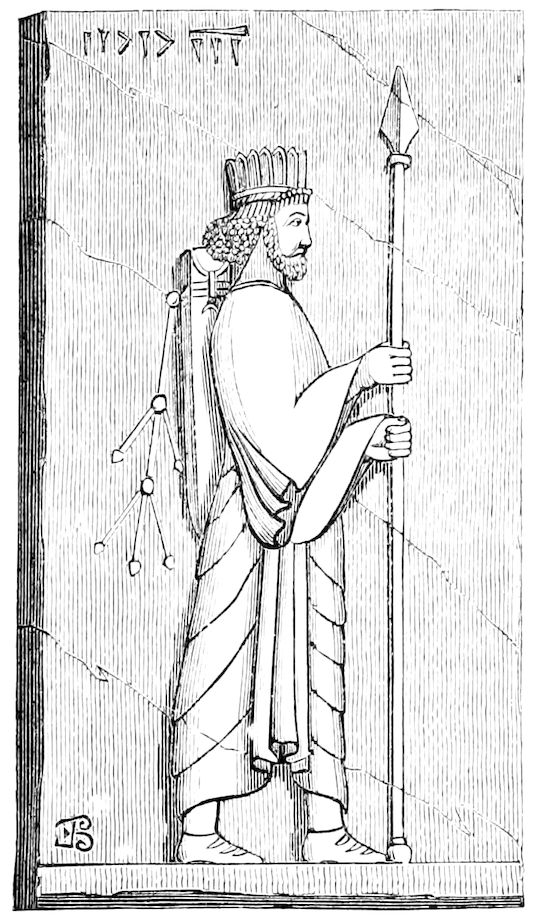
Fig. 130. Persian Candys.
Candys (κάνδυς). A Persian cloak of woollen cloth, generally purple in colour.
Canephoria. Greek festivals of Diana; or an incident of another feast, called pratelia, in which virgins about to marry presented baskets (canea) to Minerva. The name, Canephorus, or “basket-bearer,” was common to the virgins who attended processions of Ceres, Minerva, and Bacchus, with the consecrated cakes, incense, and other sacrificial accessories, in the flat baskets called canea.
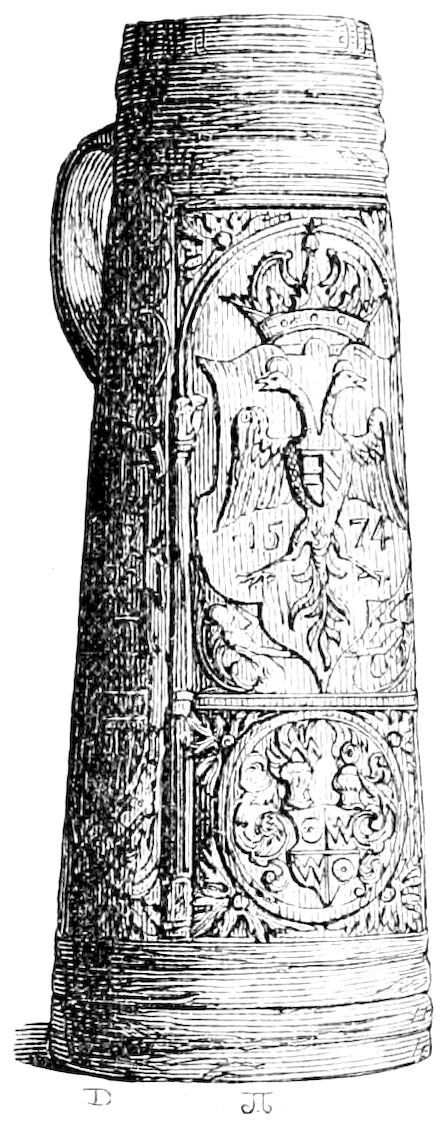
Fig. 131. Canette of white stone-ware, 1574.
Canette. A conic-shaped German drinking-mug, resembling the modern “schoppen,” of which highly ornamented examples in white stone-ware have been produced by the potters of Cologne and other parts of Germany. (Fig. 131.)
Caniple, O. E. A small knife or dagger.
Canis (akin to Sanscrit ÇVAN, Gr. κύων). A dog. This term has numerous diminutives: catulus, catellus, canicula. However ancient any civilization, the dog is always met with as the companion of man, and in each nation it follows a particular type. Thus a distinct difference is perceptible in the dogs of the Etruscans, Greeks, Romans, Egyptians, Indians, and Gauls. The Egyptians had terriers and greyhounds, wolf-dogs, and others for hunting or watchdogs. All these breeds are met with on the bas-reliefs of Egyptian monuments. The Egyptian name for a dog, wou, wouwou, is evidently onomatopoietic or imitative. (See also Dog.)
Canistrum, Canister, or Caneum (κάνιστρον, from κάνη, a reed). A wide shallow basket for carrying the instruments of sacrifice and offerings for the gods. It was generally carried on the head by young girls, who were called Canephoræ (κανηφόραι, i. e. basket-bearers), q.v.
Canon (κανὼν, from κάνη, i. e. anything straight like a reed). A fixed rule or standard which is supposed to have served, in antiquity, as a basis or model in forming statues, the various members of which bore a definite proportion one to the other. The Greeks had some such canon. The δορυφόρος (spearman) of Polycletus was, it is said, looked upon as affording a standard for the proportions of the human body. The Egyptians are also supposed to have had a canon, in which the middle finger formed the unit of measurement.
Canopea or Canopic Vases. An Egyptian vase, made of clay, and so named from its being manufactured at Canopus, a town of Lower Egypt, the present Aboukir. The same name was given to funereal urns made in the shape of the god Canopus, who is described by Russin as pedibus exiguis, attracto collo, ventre tumido in modum hydriæ, cum dorso æqualiter tereti (i. e. having small feet, a short neck, a belly as round and swelling as a water-jar, and a back to match). Canopean vases were made of earthenware, alabaster, and limestone. They were placed at the four corners of tombs or sarcophagi containing mummies. In them were deposited the viscera of the dead, which were placed under the protection of the four genii, symbolized each by the head of some animal which served at the same time for the lid of the canopea.
Cant, Arch. (1) To truncate. (2) To turn anything over on its angle.
Cantabrarii, Med. Lat. Standard-bearers: from Cantabrum, a kind of standard used by the Roman emperors. (Consult Meyrick.)
Canted Column, Arch. A column polygonal in section.
Cantellus, Med. Lat. (Fr. chanteau and cantel; Lat. quantillus). (1) A cut with a weapon, or the portion cut away. (2) Heraldic for the fourth part of a shield, since called a canton. (3) The hind part of a saddle.
Canteriolus (dimin. of canterius, a prop). A painter’s easel. The term, which is of doubtful Latinity, corresponds to the Greek ὀκρίβας.
Canterius, R. This term has numerous meanings; it serves to denote a gelding, a prop, the rafters forming part of the wood-work of a roof, and a surgical contrivance, of which the form is unknown, but which was used for suspending horses whose legs chanced to be broken, in such a way as to allow the bone to set.
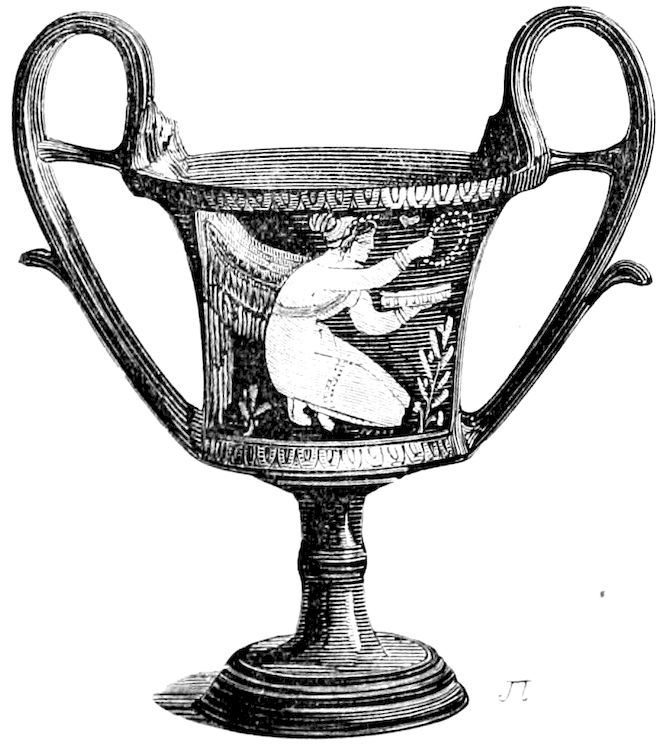
Fig. 132. Cantharus (Greek).
Cantharus (κάνθαρος, a kind of beetle). A two-handled vase or drinking-cup, of Greek invention. It was particularly consecrated to Bacchus, and accordingly, in representations of the festivals of that god, it figures constantly in the hands of satyrs and other personages. (Fig. 132.)
Cantherius. (See Canterius.)
Canthus (κανθὸς, the felloe of a wheel). A hoop of iron or bronze forming the tire of a wheel. The Greeks called this tire ἐπίσωτρον (i. e. that which is fastened to the felloe).
Canticum. An interlude of music in a Roman play.
Cantilevers or Cantalivers, Arch. Blocks framed into a wall under the eaves, projecting so as to carry a moulding. (See Modillion.)
Cant-moulding, Arch. Any moulding with a bevelled face.
Canum. A Greek basket, more generally called Canistrum (q.v.).
Canvas prepared for painting is kept stretched upon frames of various sizes: e. g. kit-cat, 28 or 29 inches by 36; three-quarters, 25 by 30; half-length, 40 by 50; bishop’s half-length, 44 or 45 by 56; bishop’s whole length, 58 by 94.
Cap-a-pie (Fr.). In full armour, from head to foot.
Caparison. The complete trappings of a war-horse.
Capellina, Med. Lat. The chapeline or small Chapel de Fer.
Capellum, Med. Lat. A scabbard (not the hilt of a sword).
Capellus ferreus. (See Chapel de Fer.)
Capillamentum, R. A wig of false hair, in which the hair was long and abundant. (See Coma.)
Capillus (from caput, the head). Hair; the hair of the head in general. (See Coma.)
Capis, R. A kind of earthenware jug, with a handle. Vessels of this kind were used in sacrifices, and the capis is often found represented on medals. Other names for it were capedo, capeduncula, and capula.
Capisterium (deriv. from σκάφη or σκάφος, i. e. that which is scooped out). A vessel resembling the alveus, or wooden trough, and which was employed for cleansing the ears of corn after they had been threshed and winnowed.
Capistrum (from capio, i. e. that which takes or holds). (1) A halter or head-stall. (2) A rope employed for suspending the end of the beam in a wine-press. (3) A muzzle made to prevent young animals from sucking after they have been weaned. (4) A broad leather band or cheek-piece worn by flute-players. It had an opening for the mouth to blow through.
Capita aut Navia (lit. heads or ships; of coins having the head of Janus on one side and a ship on the reverse). A game of “heads or tails” played by the Romans and Greeks.
Capital (caput, a head). A strip of cloth worn round the head, in primitive times, by Roman women, to keep in their hair. Later on it was worn only by women attached to the service of religion. (See Capitulum.)
Capitellum. (See Capitulum.)
Capitium. An article of female dress; a kind of corset or bodice.
Capitolium (i. e. the place of the caput; because a human head was supposed to have been discovered in digging the foundations). The Capitol, or enclosure containing the temple raised in honour of Jupiter. The first Capitol of Rome was built on the Mons Capitolinus or Capitolium. The chief cities of Italy possessed each its Capitolium.
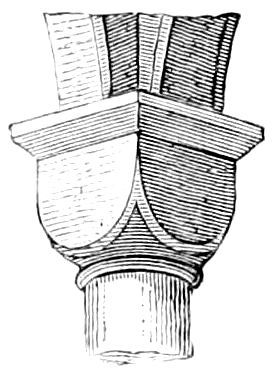
Fig. 133.
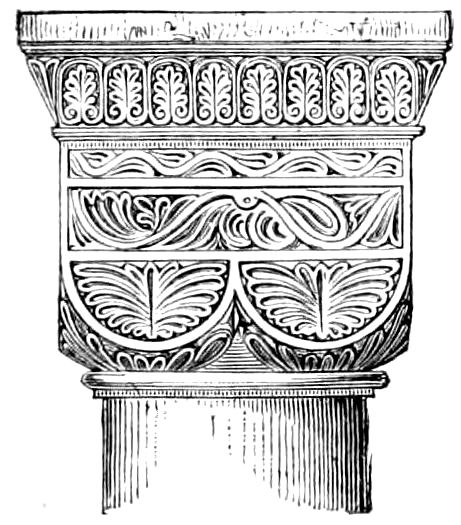
Fig. 134.
Capital. A term which denotes the member of architecture crowning the top of a column, pillar, or pilaster. Figs. 133 and 134 represent cushion capitals of the Romano-Byzantine epoch. Orders of Architecture are known by their Capitals. (See Composite, Corinthian, Doric, Ionic, and Tuscan.)
Capo di Monte, Naples. A manufactory of faience, established by Charles III.
Cappagh Browns, Light and Dark. Rich brown pigments, made of a bituminous earth from Ireland. Called also Mineral or Manganese Brown.
Capreolus, R. (lit. a wild goat or roebuck). A fork for digging, with two prongs converging together like the horns of a roebuck. The term is also used for a strut or brace. The tie-beams and king-posts in the frame of a roof are often connected by capreoli.
Capriccio, It. Caprice in art.
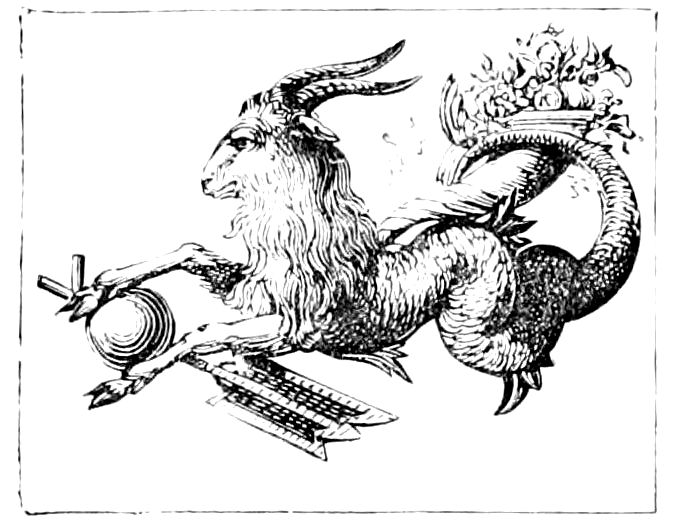
Fig. 135. Capricornus. The device of Cosmo de’ Medici.
Capricornus. The zodiacal sign of September employed by Augustus Cæsar in commemoration of his victory at Actium on the day when the sun enters that sign. The same device was used by Cosmo de’ Medici, and by the Emperor Rodolph II. of Germany, with the motto, “Fulget Cæsaris Astrum.” (Fig. 135.)
Caprimulgus, Lat. A goat-milker, a common device on antique gems and bas-reliefs, representing a man or a faun milking a goat.
Capronæ, R. (from caput and pronus, i. e. that which hangs down the forehead). The forelock of a horse, and by analogy, a lock of curling hair falling down over the centre of the forehead, in a man or woman.
Capsa or Scrinium, R. A box or case of cylindrical form, used for several purposes, but more particularly for the transport of rolls or volumes (volumina). The capsæ were generally provided with straps and locks, the former serving as a handle.
Capsella and Capsula, R. (dimin. of Capsa, q.v.). A case or casket for jewels, &c.
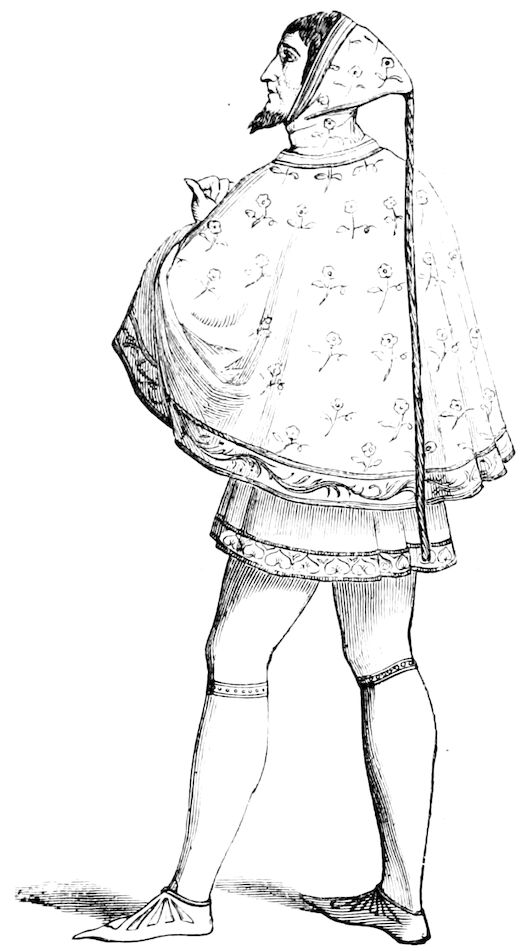
Fig. 136. Capuchon and mantle. From an Italian painting of the 13th century.
Capuchon. A hood with neck-piece and mantle. The engraving (Fig. 136) is a portrait of Cimabue.
Capula. Dimin. of Capis (q.v.).
Capularis, R. The straight handle or hilt of any kind of instrument or weapon, in contradistinction to ansa, which signifies a curved haft or handle. The term capularis was applied indifferently to the handle of a sword, a sceptre, &c.
Car, Chariot, or Carriage. (See Carrus and Currus.)
Carabaga, Med. Lat. Also Calabra. A kind of catapult or balista.
Carabine. (See Carbine.)
Carabus (κάραβος). A small boat made of wicker-work; a kind of shallop covered with raw hides. It was either propelled by itself or attached to the stern of a larger vessel. Similar to the coracle.
Caracalla (a Celtic word). A military garment introduced from Gaul into Rome by the Emperor Antonine, who obtained thus his surname of Caracalla.
Caracole, Arch. A spiral staircase.
Carbassus or Carbassum (κάρπασος, fine Spanish flax). This term was used indifferently to denote all textures made of the fine Spanish flax. Thus any kind of linen garment, the sails of a ship, the awning of a theatre or amphitheatre, all came under the term of carbassus.
Carbatinæ (καρβάτιναι). A rough kind of boot in common use, made of a single piece of leather, and worn by peasants.
Carbine, or Carabine, or Caraben. A short gun with a wheel lock and a wide bore, introduced in the 16th century.
Carbonate of Lead, or white lead, is the principal white pigment. It is prepared by exposing sheets of lead to the action of acetic and carbonic acids. It is called also Ceruse, Flake-white, Krems (or Vienna) white, Nottingham white. It is also known, under different modifications of colour, as Venice, or as Hamburg, or as Dutch white. It is a pigment very liable to injury from exposure to certain gases. (See Oxide of Zinc.)
Carbonates of Copper yield blue and green pigments, known from the earliest times, and under many names, as Mountain blue and green, blue and green Ash, or Saunders’ (for cendres’) blue and green. These names are also applied to the manufactured imitations of the native carbonates of copper. Powdered Malachite is a form of the native green carbonate. The colours called Emerald Green and Paul Veronese Green are artificial.
Carbuncle (Lat. carbunculus). A gem of a deep red colour. A jewel shining in the dark. (Milton.)
Carcaissum, Med. Lat. (Fr. carquois; It. carcasso; Mod. Gr. γαρκάσιον). A quiver.
Carcamousse, Med. A battering-ram. The name is onomatopoetic.
Carcanet, O. E. A necklace set with stones, or strung with pearls.
Carcass, Arch. The unfinished frame or skeleton of a building.
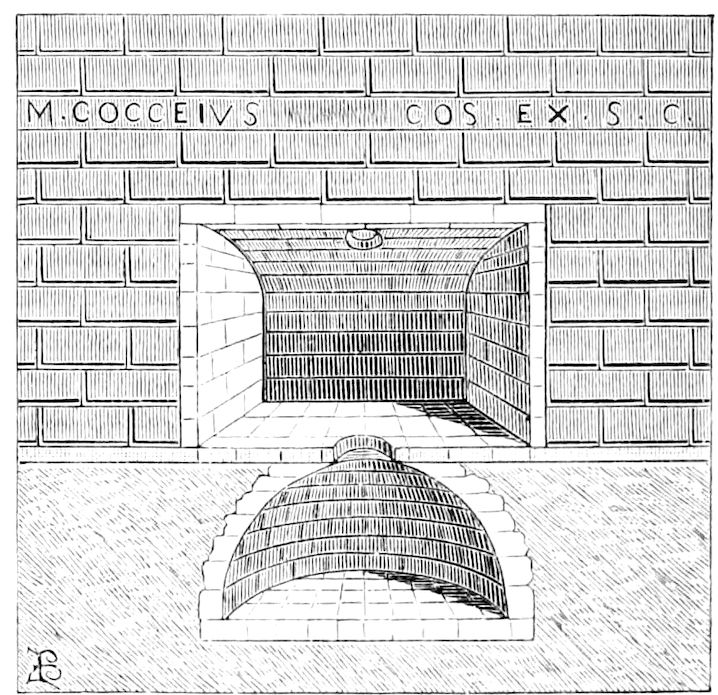
Fig. 137. Carceres. Roman prisons.
Carcer (akin to arceo, i. e. an enclosure (Gr. ἕρκος). (1) A prison. (2) The circus. At Rome the prisons were divided into three stages: the first, which formed a story above ground (carcer superior), was for prisoners who had only committed slight offences; the carcer interior, or stage on a level with the ground, served as a place of confinement in which criminals were placed to await the execution of their sentence; lastly there was the carcer inferior, or subterranean dungeon called robur, for criminals condemned to death. Fig. 137 represents the carcer built at Rome by Ancus Martius and Servius Tullius; Fig. 138 the carceres of the circus.
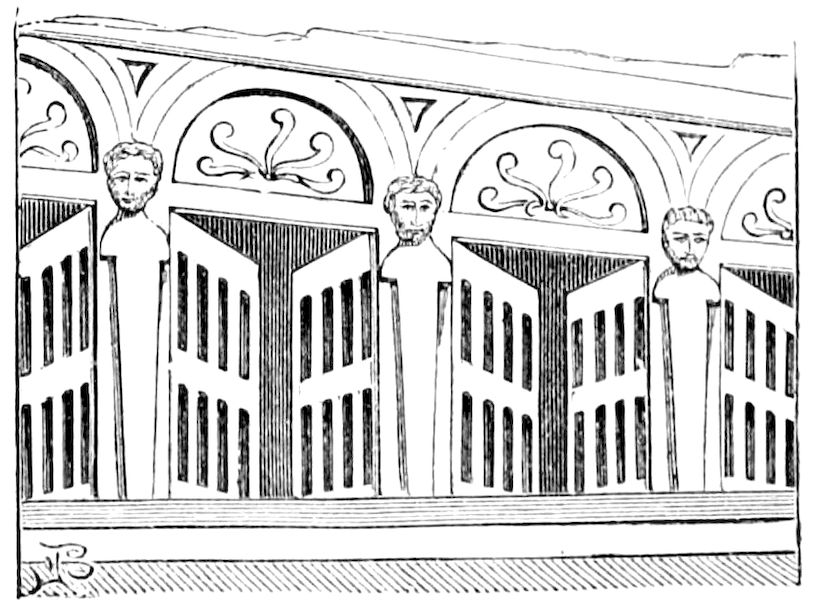
Fig. 138. Carceres. Stables in the circus at Rome.
Carchesium (καρχήσιον). (1) A drinking-cup of Greek invention, and having slender handles rising high over the edge, and reaching to the foot. It was an attribute of Bacchus, and was used in the religious ceremonies. (2) A scaffolding in the shape of the carchesium at the masthead of a ship. (Anglicè, “crow’s-nest.”)
Cardinalis. (See Scapus.)
Cardo. A pivot and socket used for the hinge of a door. The term was also used in carpentry to denote a dove-tailed tenon; this was called cardo securi-culatus, i. e. a tenon in the shape of an axe, the dove-tail bearing some resemblance to the blade of that tool.
Care-cloth, O. E. A cloth held over the bride and bridegroom’s heads at a wedding.
Carellus (Fr. carreau). A quarrel or arrow for cross-bows, the head of which was either four-sided or had four projections.
Carillon, Fr. A set of large bells, arranged to perform tunes by machinery, or by a set of keys touched by a musician. Antwerp, Bruges, and Ghent are celebrated for the carillons in their steeples.
Caristia (from χάρις, favour or gratitude). A Roman feast, at which the members of a family came together. It lasted three days: on the first, sacrifices were offered to the gods; the second was consecrated to the worship of deceased relations; and on the third the surviving members of the family met at a banquet. Strangers were not allowed in these gatherings.
Carminated Lakes. Also called Lake of Florence, Paris, or Vienna. Pigments made from the liquor in which cochineal and the other ingredients have been boiled to make carmine. (See Madder.)
Carmine. A beautiful pigment prepared from the insect, cochineal. Carmine is the richest and purest portion of the colouring matter of cochineal. The various kinds of carmine are distinguished by numbers, and possess a value corresponding thereto; the difference depending either on the proportion of the alumina added, or on the presence of vermilion added for the purpose of diluting and increasing the quantity of the colour: the alumina produces a paler tint, and the vermilion a tint different to that of genuine carmine. The amount of adulteration can always be detected by the use of liquor ammoniæ, which dissolves the whole of the carmine, but leaves the adulterating matter untouched. Carmine is chiefly used in miniature painting and in water-colours. It is made in large quantities in Paris.
Carmine-madder. (See Madder.)
Carnarium, R. (caro, flesh). (1) A larder for fresh or salted provisions. (2) The iron hooks on which they were hung.
Carnificia or Carnificina, R. (carnifex, executioner). Subterranean dungeons, in which criminals were put to the torture, and, in many cases, executed.
Carnix or Carnyx (Celtic and Gaulish word). A trumpet in the form of a long horn, of which the mouth was curved so as to resemble the mouth of an animal. This instrument gave out a peculiarly loud strident sound, and was used more particularly by the Celtic nations, notably the Gauls. It is constantly found represented on the coins of these nations, and on bas-reliefs. Some archæologists have mistaken the carnices on medals for cornucopiæ.
Carol, Chr. An enclosed place; a circular gallery. In old French, carole signified a round dance, or a circle of stone. In the last century the term was applied to the ambulatory, or circular gallery, behind the choir in churches.
Carpentum, R. A two-wheeled carriage of Gaulish invention; it was often covered with an awning, resembling in form that of the Camara (q.v.). The carpentum funebre or pompaticum was a hearse. It was made to resemble a shrine or small temple. Lastly, the term carpentum was used to denote a cart, with two wheels, employed for agricultural purposes.
Carrago (i. e. formed of carri or carts). A kind of intrenchment peculiar to certain barbarous nations. It was constructed by drawing up waggons and war-chariots in a curved line, approaching a circle as nearly as the nature of the ground permitted. It formed a first line of defence, behind which the combatants sheltered themselves in order to defend the camp proper, which lay in the centre of the carrago.
Carreaux, Med. Fr. Quarrels for cross-bows, so called from their square form.
Carriolum. (See Carrocium.)
Carroballista or Carrobalista (carrus, a car). A ballista mounted upon a carriage, to be transported from place to place. (See Ballista.)
Carrocium, Carrocerum, Med. Lat. A standard fixed on a carriage.
Carrotus. A quarrel. (See Carellus, &c.)
Carruca, Carrucha, or Carucha. A carriage of costly description, richly ornamented with bronze and ivory carvings and chased gold. It differed widely from the Essedo and the Rheda (q.v.).
Carrus or Carrum (Celtic root). A cart or chariot of Gaulish invention, on two wheels, used in the army as a commissariat waggon. A carrus occurs among the sculptures on the column of Trajan.
Cartamera (Gaulish word). A Gaulish girdle made of metal, and used to support the braccæ, or trousers. It was made sometimes in the form of a serpent with its tail in its mouth, but more generally resembled a fringe of twisted hemp, like the torques, by which name accordingly it was known among the Romans. (See Torques.)
Cartibulum, R. (corrupted from gertibulum, i. e. that which bears or carries). A side-board, consisting of a square slab of stone or marble, supported in the middle by a pedestal or stem. The cartibulum always stood against a wall.
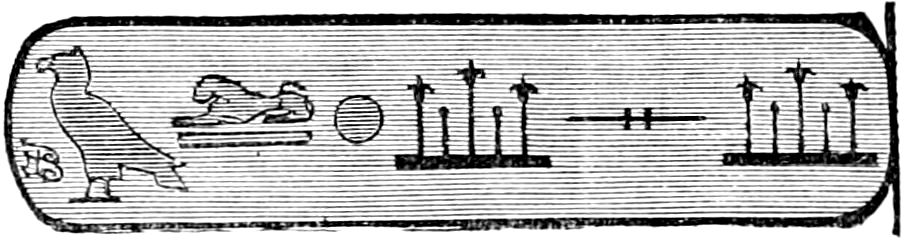
Fig. 139. Egyptian Cartouche.
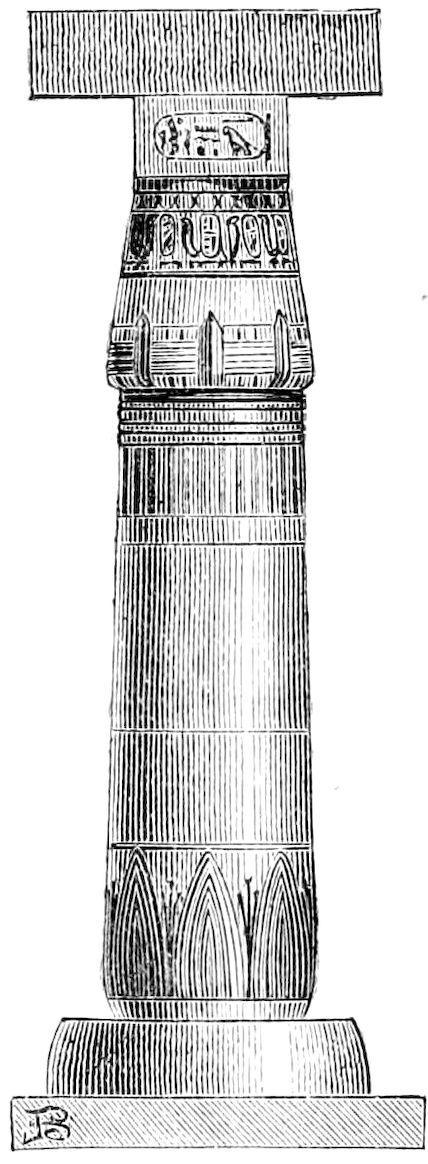
Fig. 140. Egyptian Column with Cartouche.
Cartouche, Egyp. An elliptical tablet of scroll-like form, containing the names of the Pharaohs. Fig. 139 represents the cartouche of King Artaxerxes. Cartouches were applied to decorate columns, an illustration of which may be seen on the abacus and capital of the column in Fig. 140.
Caryatides (Καρυάτιδες, i. e. women of Caryæ). Female figures, in an upright posture, which were employed in lieu of columns to support entablatures or any other members of architecture. One of the finest instances of the application of caryatides to this purpose is to be found in the portico of the temple of Pandrosos, at Athens.
Caryatis. A festival in honour of Artemis Caryatis, which was celebrated at Caryæ, in Laconia.
Case Bags, Arch. The joists framed between a pair of girders, in naked flooring.
Cash. A Chinese coin.
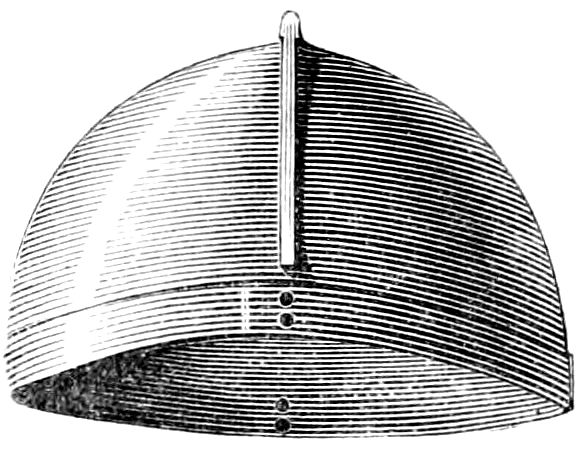
Fig. 141. Casque.
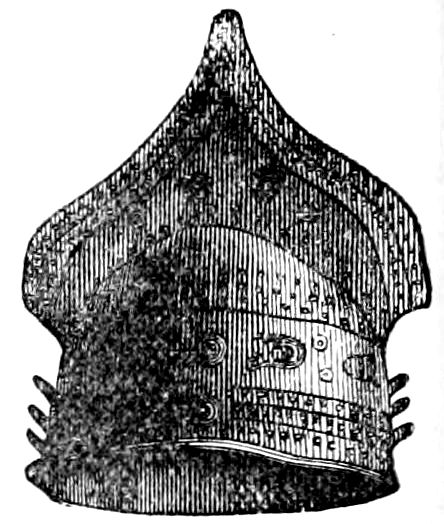
Fig. 142. Casque.
Casque, Fr. Helmets of every description, from those of classical times to the present, have been called casques by the poets; but the head-piece specially so designated is first seen in English armour of the reign of Henry VIII. The casque was generally without a visor, and worn more for parade than warfare. The engraving Fig. 141 represents a Gaulish and Fig. 142 an Oriental casque.
Casquetel. A small open helmet without beaver or visor, having a projecting umbril, and flexible plates to protect the neck behind.
Cassel Black. (See Black.)
Cassel Earth. A brown pigment.
Cassel Yellow. (See Turner’s Yellow.)
Cassida. (See Cassis.)
Cassilden, O. E. Chalcedony.
Cassis or, rarely, Cassida (perhaps an Etruscan word). A casque or helmet made of metal, and so distinguished from Galea (q.v.), a helmet made of leather. Figs. 141 and 142 represent respectively a Gaulish and an Eastern cassis (the latter, however, is considered by some antiquaries to be Gaulish). The war-casque of the Egyptian kings, although of metal, was covered with a panther’s skin; it was ornamented with the Uræus (q.v.).
Cassock signifies a horseman’s loose coat, and is used in that sense by the writers of the age of Shakspeare. It likewise appears to have been part of the dress of rustics. (Stevens.) It was called a “vest” in the time of Charles II. Later on it became the distinguishing dress of the clergy.
Cassolette, Fr. A perfume box with a perforated lid; the perforations in a censer.
Cassone. An Italian chest, richly carved and gilt, and often decorated with paintings, which frequently held the trousseau of a bride.
Castanets. Various peoples have employed flat pieces of wood to produce a certain kind of noise during religious ceremonies. The Egyptians seem to have had for this purpose “hands” of wood or ivory, which were struck one against the other to form an accompaniment to chants or rhythmic dances. (See Crotala, &c.)
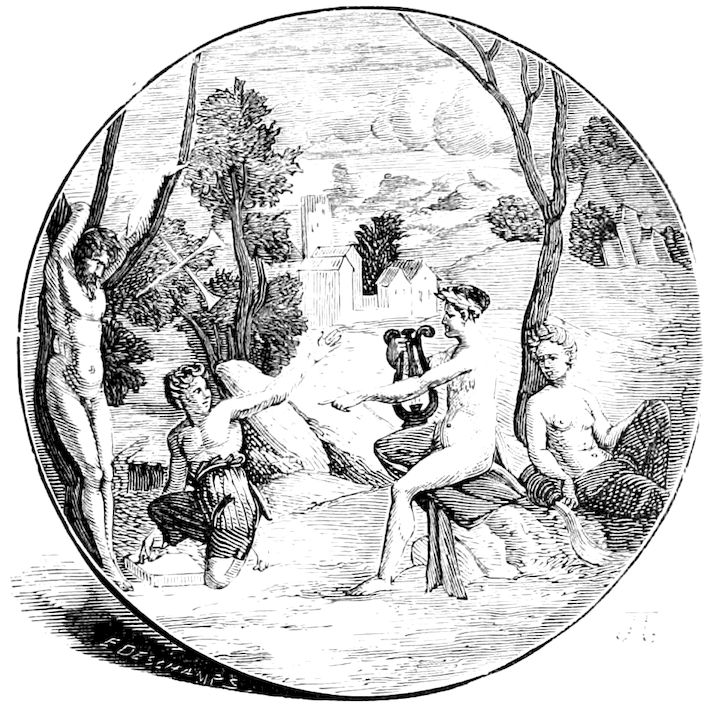
Fig. 143. Cup of Castel Durante (1525), in the Museum of the Louvre.
Castel Durante. An ancient manufactory of Urbino ware, established in the 14th century. Fig. 143, from a cup in the Louvre, is a fine specimen of Castel Durante majolica of the 16th century.
Castellum (dimin. of Castrum, q.v.; i. e. a small castle). A small fortified place or citadel; also a reservoir for water. The ruins of castella still existing are very few in number; one of the most perfect, as far as the basin is concerned, is that of the castellum divisorium or deversorium, at Nismes.
Casteria. A storehouse in which the rudder, oars, and movable tackle of a vessel were kept.
Castor. The beaver; hence applied to beaver hats.
Castoreæ, R. Costly fabrics and dresses made of the fur of beavers.
Castra, R. (plur. of castrum, which, like casa, = the covering thing). This term was applied solely to an encampment, a fortified or intrenched camp, while the singular castrum, an augmentative of Casa (q.v.), denotes a hut, or strongly-constructed post, and consequently a fort, or fortress; but for this last the Romans preferred to use the diminutive castellum.
Castula or Caltula, R. A short petticoat worn by Roman women, held up by braces.
Casula, R. (dimin. of casa). (1) A small hut or cabin. (2) A hooded cloak, or capote.
Cat. The Egyptian name for the cat (maaou) is evidently onomatopoetic. As a symbol, this animal played a part which has hitherto not been clearly determined. Certain papyri show us the cat severing the serpent’s head from its body, a symbol which would seem to point out the cat as the destroyer of the enemies of the daylight and the sun. Again, the goddess Bast is represented with a cat’s head, the animal being sacred to her.
Cat (Med. Lat. cattus or gattus). A covering under which soldiers lay for shelter, while sapping the walls of a fortress, &c.
Cataclista, R. A close-fitting garment worn by Roman ladies, bearing a great resemblance to those which are to be seen on Egyptian statues.
Catacombs, Chr. This term, the etymology of which is uncertain, serves to denote disused stone quarries, made use of by the early Christians for their meetings, and as subterranean cemeteries. We meet with catacombs in several cities, but the most celebrated are unquestionably those of Rome. Catacombs also exist at Syracuse, Catana, Palermo, Naples, and Paris.
Catadromus, R. (from κατὰ and δρόμος, i. e. a running down). A tight-rope for acrobats in a circus or amphitheatre. The catadromus was stretched in a slanting direction from a point in the arena to the top of the building.
Catafaltus, Med. Lat. (See Cagasuptus.)
Catagrapha, Gr. and R. (κατα-γραφὴ, i. e. a drawing or marking down). A painting in perspective (rarely met with in the works of the ancient painters).
Cataphracta, Gr. and R. (κατα-φράκτης, i. e. that which covers up). A general term to denote any kind of breastplate worn by the Roman infantry. [Cataphracti were heavy-armed cavalry, with the horses in armour.]
Cataphracti. Decked vessels, in opposition to aphracti, open boats.
Catapirates, Gr. and R. (κατα-πειρατὴς, i. e. that which makes trial downwards). A sounding lead, of an ovoid form, with tallow or a kind of glue at the end, by means of which sailors were able to ascertain the nature of the bottom.
Catapulta, Gr. and R. (κατα-πέλτης, i. e. that which hurls). A military engine for discharging heavy missiles. The ballista projected stones; the catapult, darts; the scorpio (uncertain). They were all called tormenta, from the twisting of the ropes of hairs or fibres which supplied the propelling force.
Catascopium, Gr. and R. (dimin. of Catascopus, q.v.). A post of observation or sentry tower.
Catascopus, Gr. and R. (κατάσκοπος, i. e. that which explores or spies). (1) A post of observation. (2) A vessel employed as a spy-ship; and by analogy (3) a scout, i. e. a soldier whose duty is to act as a spy on the enemy.
Catasta (from κατάστασις, i. e. a place of presentation). A platform upon which slaves were placed to be publicly sold. Some scaffolds of this kind were made to revolve, so that the purchaser might thoroughly inspect every part of the slave at his leisure. Catasta arcana was the name given to a gridiron, or iron bed, upon which criminals were laid to undergo torture. (See Gridiron.)
Cateja (Celtic word). A missile made of wood hardened in the fire. It was employed by the Gauls, Germans, and other barbarians in the way of a harpoon, a rope being fastened to one end of the weapon, by means of which it could be recovered after it had been launched.
Catella (dimin. of Catena, q.v.). A term specially used to denote the finer sorts of chains made of bronze, silver, and gold. Chains made of the precious metals were worn as trinkets. [The use of the diminutive indicates elegance and delicacy.]
Catellus, R. (dimin. of Catena, q.v.). A chain used to shackle slaves, or perhaps merely attached to them in the way of a clog.
Catena, R. (1) A chain, especially (2) a chain of gold or silver worn as an ornament round the body, like a balteus (shoulder-belt), by certain goddesses, dancing girls, bacchantes, or courtezans.
Catenarius. The chained dog kept at the entrance of their houses by the Romans.
Catharmata (καθάρματα, from καθαίρω, i. e. that which is thrown away in cleansing). Sacrifices in which human victims were offered up, in order to avert the plague or similar visitations. [They were thrown into the sea.]
Cathedra (καθέδρα, from κατὰ and ἕδρα, i. e. a place for sitting down). A chair having a back, but without arms. There were various kinds of cathedræ: the cathedra strata was a chair furnished with cushions; cathedra supina, a chair with long sloping back; cathedra longa, a chair with long deep seat. The cathedra philosophorum was the equivalent of our modern term, a professor’s chair.
Catherine Wheel. In Gothic architecture, a large circular window, filled with radiating divisions; called also rose-window.
Cathetus, Arch. (1) The axle of a cylinder. (2) The centre of the Ionic volute.
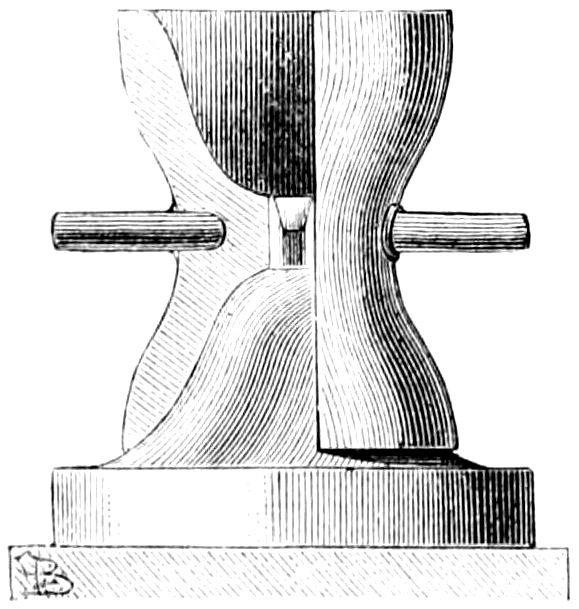
Fig. 144. Catillus for grinding corn.
Catillus and Catillum (dimin. of Catinus, q.v.; i. e. a small bowl). (1) The upper part of a mill for grinding corn, which served both as grindstone and hopper or bowl. Fig. 144 represents an ancient mill, a fourth part of the catillus being suppressed in order to show the reader the mechanism. (2) A small dish having much resemblance to the catinus, and so by analogy (3) a flat circular ornament employed to decorate the scabbard of a sword.
Catinus and Catinum, R. (akin to Sicilian κάτινον). Dishes used for cooking, and for the table. Catina might be of earthenware or metal, of glass or other precious material, and were employed as sacrificial vessels to hold incense, &c.
Catty. A Chinese weight = 1⅓ lb.
Catulus, R. When a slave ran away from his master, and was retaken, he was led back in chains, the catulus being the chain which was attached to an iron collar passing round his neck. A slave was thus said to be led back cum manicis, catulo, collarique, i. e. with manacles, leading chain, and neck-collar.
Caudex. (See Codex.)
Caudicarius, Codicarius, R. (from caudex, a tree-trunk). A wide flat barge employed in river transport. It was of rough construction, and was broken up on arriving at its destination.
Caudicius, R. A vessel of the same kind as the caudicarius, employed on the Moselle.
Caughley-ware (Shropshire). A soft porcelain; 18th century.
Caul, O. E. A cap or network enclosing the hair.
Cauliculi or Caulicoli, R. (dimin. of caulis, a stalk). Acanthus leaves springing from the capital of a Corinthian column.
Caupolus. (See Caupulus.)
Caupona, R. (caupo, an innkeeper). An inn or hostel for the accommodation of travellers. The cauponæ bore a general resemblance to our roadside inns. [Also, a cooked-meat shop.]
Cauponula, R. (dimin. of caupona). A small tavern, or low wine-shop of mean appearance.
Caupulus, R. A kind of boat, classed by authors among the lembi and cymbæ.
Caurus, R. An impersonation of the North-West wind; represented under the form of an old man with a beard, pouring down rain from an urn.
Causia, Gr. and R. (καυσία, from καῦσις, i. e. that which keeps off heat). A broad-brimmed felt hat, of Macedonian invention, and adopted by the Romans. It was especially worn by fishermen and sailors.
Cauter (καυτὴρ, i. e. that which burns). A cautery or branding-iron. The cauter was (1) an instrument used by surgeons; it was also used for branding cattle and slaves. (2) An instrument employed to burn in the colours in an encaustic painting.
Cauterium = Cauter (q.v.).
Cavædium, R. (from cavum and ædes, i. e. the hollow part of a house). An open courtyard. In early times the Romans had an external courtyard to their houses. In course of time, however, the increase of luxury and comfort brought about a change in the cavædium, which was partially covered in with a roof supported by columns, a partial opening being left in the centre, which was called the compluvium. When thus altered, the cavædium went under the name of Atrium (q.v.).
Cavalherium. (See Caballaria.)
Cavallerius or Cavallero, Med. Lat. A knight or cavalier.
Cavea, R. (from cavus, i. e. a hollow place or cavity), (1) A wooden cage with open bars, of wood or, more generally, of iron, used for the transport and exhibition of the wild beasts of a menagerie. (2) A bird-cage. (3) A frame of wicker-work employed by fullers and dyers. (4) A palisade to protect young trees when growing up, and (5) the vast reversed cone formed by the successive stages of a theatre or amphitheatre. This might be divided, according to the size of the building, into one, two, or three distinct tiers, called respectively upper, lower, and middle (summa, ima, media cavea). (6) A warlike machine used in attacking cities.
Cavetto, Arch. (deriv. from Ital. cavo). A concave moulding formed of a segment of a circle.
Cavo-relievo. Intaglio-sculpture cut into the stone, as in Egyptian art.
Ceadas or Cæadas (κεάδας or καιάδας). A deep cave into which the Spartans thrust condemned prisoners.
Ceinture or Ceint. A girdle. (See Cinctus.)
Celadon. A peculiar tinted porcelain, described by Jacquemart as the earliest tint of Chinese pottery.
Celebê (Κελέβη). A vase of ovoid form and with two handles. The lower part is shaped elegantly, like an amphora, but the upper part resembles a pitcher with a sort of projecting lip. Its peculiarity is in the handles, which are “pillared” and “reeded.”
Celes, R. A racing or saddle horse, as opposed to a draught horse. The same term was also applied to a vessel or boat of a peculiar form, propelled by oars, in which each rower handled only a single oar. It was also called celox.
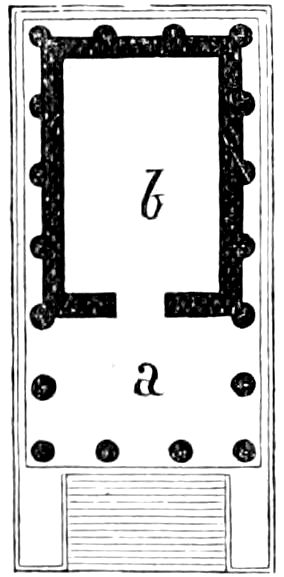
Fig. 145. Plan of temple showing the Cella.
Cella, R. (from celo, to hide). The interior of a temple, i. e. the part comprised within the four walls. In Fig. 145 a represents the portico, b the cella. The term is also used to denote a niche, store-room, or, in general, any kind of cellar; e. g. cella vinaria, cella olearia, and even a tavern situated in a cellar. The term was also applied to slaves’ dormitories, the parts of the public baths, &c.
Cellatio. A suite of apartments in a Roman house set apart for various purposes, but especially as quarters for slaves.
Cellula (dimin. of Cella, q.v.). A small sanctuary, i. e. the interior of a small temple, and by analogy any kind of small chamber.
Celox. (See Celes.)
Celt. A variety of chisels and adzes of the flint and bronze periods.
Celtic (Monuments) were usually constructed of huge stones, and are known, for that reason, as megalithic monuments. Such are Standing Stones, Dolmens, Menhirs or Peulvans, Cromlechs, Covered Alleys, Tumuli, &c. (See these words.)
Cembel. A kind of joust or HASTILUDE.
Cendal, Sandal, &c., O. E. The name, variously spelt, of a silken stuff used for vestments, and for banners, &c.; 13th century. We now call this stuff sarcenet.
Cenotaph (κενο-τάφιον, i. e. an empty tomb). A monument raised to a Roman citizen who had been drowned at sea, or who, from any other cause, failed to receive burial.
Censer. A sacred vessel used for burning perfumes.
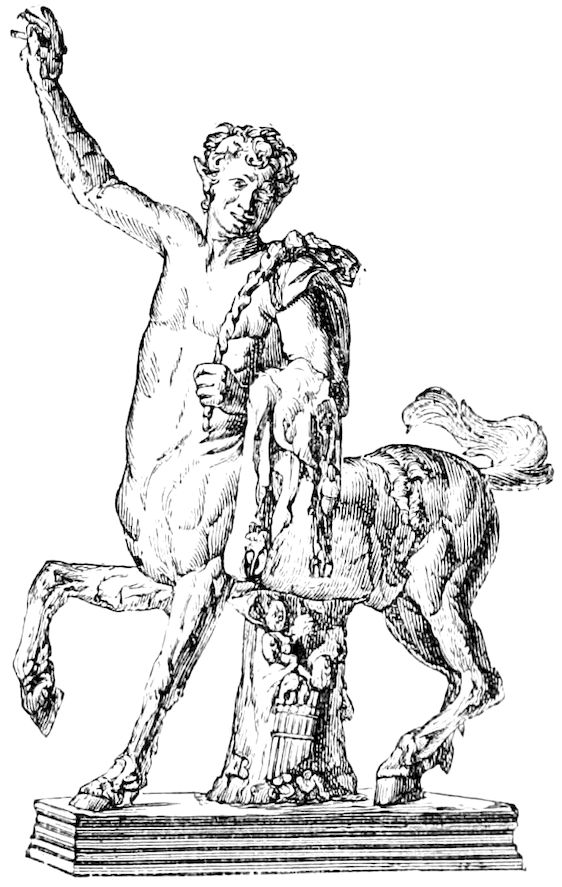
Fig. 146. Centaur.
Centaur (κένταυρος, according to some, from κεντέω and ταῦρος, i. e. herdsman; but prob. simply from κεντέω, i. e. Piercer or Spearman). The Centaurs are represented with the body of a horse, and bust, head, and arms of a man. (Fig. 146.) In Christian archæology, the Centaur is a symbol of the swift passage of life, the force of the instincts, and in a special sense, of adultery. The war of the Centaurs and the Lapithæ is the subject of the frieze at the British Museum, from a temple of Apollo in Arcadia. Hippo-centaurs were half horse; Onocentaurs, half ass; and Bucentaurs or Tauro-centaurs, half ox.
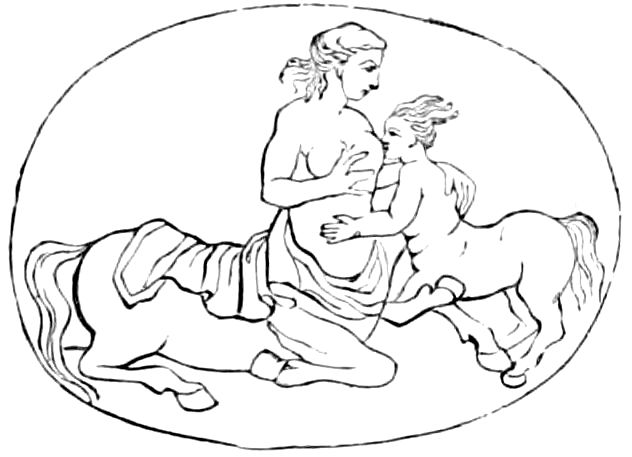
Fig. 147. Centaur and young.
Cento (κέντρων, patchwork). A covering made of different scraps of cloth, and used as clothing for slaves. The same term denotes a coarse cloth which was placed beneath the saddle of a beast of burden, to keep the back of the animal from being galled by the saddle. In Christian archæology the term was used to denote a coarse patchwork garment, and, by analogy, a poem composed of verses taken from various authors, like the Cento nuptialis of Ausonius.
Centunculus (dimin. of Cento, q.v.). A motley garment of various colours, like that of our harlequin. It was worn, according to Apuleius, by the actors who played in burlesques, and there are certain vases on which Bacchus is represented, arrayed in a similar costume.
Cepotaphium (κηπο-τάφιον). A tomb situated in a garden.
Cera (akin to κηρός). Wax, and, by analogy, any objects made of wax, such as images of the family ancestors (imagines majorum); or the wax tablets for writing on with the stylus. These were called respectively ceræ duplices, triplices, quintuplices, according as they had two, three, or five leaves. The first, second, third, and last tablet were called respectively prima, secunda, tertia, ultima or extrema cera.
Ceramic. Appertaining to Pottery (q.v.).
Cerberus. The three-headed dog who guarded the gates of hell.
Cercurus (κέρκουρος, perhaps from Κέρκυρα, the island Corcyra). A Cyprian vessel propelled by oars. Its form is unknown.
Cerebrerium. An iron skull-cap, temp. Edward I.
Cere-cloth (cera, wax). Cloth saturated with wax, used for enveloping a consecrated altarstone, or a dead body.
Cereus (cera, wax). A wax candle, made either with the fibres of cyperus or papyrus twisted together and dipped in wax, or with the pith of elder, or rush, covered with the same material.
Ceriolare (cera, wax). A stand, holder, or candelabrum for wax candles. There were a great variety of this kind of vessel. (See Candelabrum.)
Cernuus (from cer = κάρα, and nuo, i. e. with head inclined to the ground). A tumbler who walks upon his hands with his feet in the air. Women even used to turn series of summersaults, resting alternately on the feet and hands, among a number of swords or knives stuck in the ground. This exhibition was called by the Greeks εἰς μαχαίρας κυβιστᾶν, i. e. lit. to tumble head over heels between knives).
Cerōma (κήρωμα, a wax-salve). A room in which wrestlers rubbed themselves over with oil and fine sand. The room was so named from the unguent employed, which consisted of wax mixed with oil [which was also called cerōma].
Cero—plastic. The art of modelling in wax.
Cero-strotum or Cestrotum, Lat. A kind of encaustic painting upon ivory or horn, in which the lines were burnt in with the cestrum, and the furrows filled with wax.
Certosina Work. Florence, 15th century. Ivory inlaid into solid cypress-wood and walnut. The style is Indian in character, and consists in geometric arrangements of stars made of diamond-shaped pieces, varied with conventional flowers in pots, &c.
Certyl. Old English for kirtle.
Ceruse. A name for white lead. (See Carbonate of Lead.)
Cervelliere. (See Cerebrerium.)
Cervi (lit. stags). Large branches of trees with the forks still left upon them, but cut down close to the stock, so that the whole presented the appearance of a stag’s antlers. Cervi were employed to strengthen a palisade, so as to impede the advance of infantry, or resist attacks of cavalry.
Cervical (from cervix, a neck). A cushion or pillow for supporting the back of the head on a bed or dining-couch. (See Pulvinar.)
Cervus. (See Stag.)
Ceryceum (κηρύκειον, a herald’s staff). It is a synonym of Caduceus (q.v.).
Cesticillus (dimin. of Cestus, q.v.). A circular pad used as a rest by persons who had to carry burdens on their heads.
Cestra. (See Cestrosphendonè.)
Cestrosphendonè, Gr. (a dart-sling.) A dart fixed to a wooden stock with three short wooden wings, discharged from a sling.
Cestrotum. (See Cero-strotum.)
Cestrum or Viriculum (κέστρον, i. e. that which pricks or pierces). A graver used in the process of encaustic painting on ivory. It was made of ivory, pointed at one end and flat at the other. (See Cero-strotum, Rhabdion.)
Cestus (κεστὸς, embroidered), (1) In general any kind of band or tie; but specially the embroidered girdle of Venus. (2) A boxing gauntlet. (See Cæstus.)
Cetra (prob. a Spanish word). A small round shield in use among several barbarous nations, but never by the Romans.
Chaable, Old Fr. A large ballista. (See Cabulus.) Trees blown down by the wind are still called “caables” in France. (Meyrick.)
Chabasite (χαβὸς, narrow, compressed). A crystal of a white colour.
Chaconne, Fr. (Sp. chacona; It. ciacona). A modification of the dance chica (q.v.).
Chadfarthing, O. E. A farthing formerly paid among the Easter dues, for the purpose of hallowing the font for christenings. (Halliwell.)
Chafer, O. E. (1) A beetle or May-bug. (2) A saucepan.
Chafer-house, O. E. An ale-house.
Chafery, O. E. A furnace.
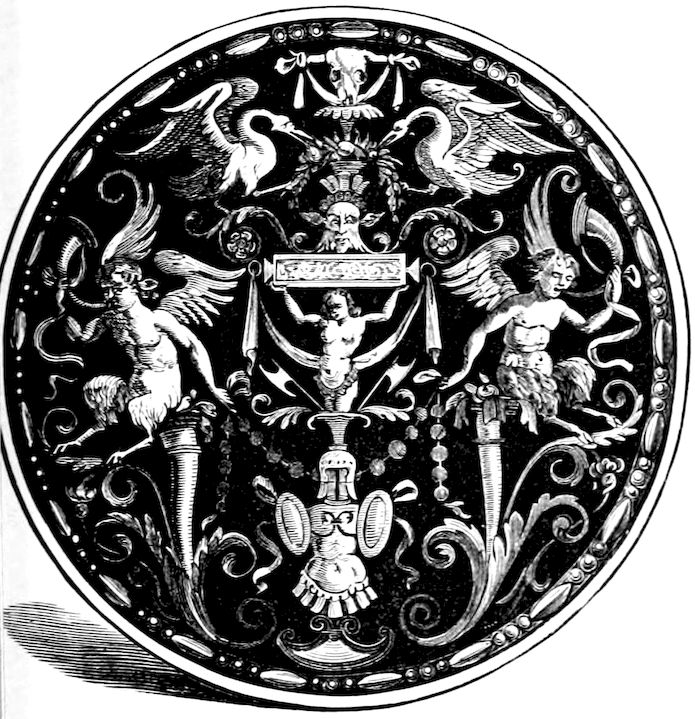
Fig. 148. Chaffagiolo ware. Sweetmeat plate, with arabesques, about 1509.
Chaffagiolo, or Caffagiolo, is the place where Cosmo the Great established the first Tuscan manufactory of majolica, and where Luca della Robbia acquired his knowledge of the stanniferous enamel. Fig. 148 is a specimen of Chaffagiolo ware of the 15th century.
Chain-moulding, Arch. An ornament of the Norman period, sculptured in imitation of a chain.
Chain-timbers, Arch. Bond timbers, the thickness of a brick, introduced to tie and strengthen a wall.
Chair. (See Sella.)
Chair de Poule (chicken’s flesh). An ornamentation of the surface of pottery with little hemispheric points; a Chinese method.
Chaisel, Old Fr. (1) An upper garment. (2) A kind of fine linen, of which smocks were often made.
Chalameau, Fr. Stem or straw-pipe. The lower notes of the clarionet are called the chalameau tone, from the ancient shawm.
Chalcanthum (χάλκ-ανθον, i. e. that which is thrown off by copper). Shoemaker’s black or copperas, used for imparting a dark colour to boot-leather. (See Atramentum.)
Chalcedony. (See Calcedony.)
Chalcidicum (Χαλκιδικὸν, i. e. pertaining to the city of Chalcis). The exact meaning of this term is unknown. According to some, it was a portico; according to others, a kind of long hall or transept.
Chalciœcia (χαλκι-οίκια, brazen house). A Spartan festival in honour of Athena under that designation.
Chalcography (χαλκὸς, copper). Engraving on copper. Chalcography was discovered in Florence, in the 15th century, and early introduced into England. Caxton’s “Golden Legend,” containing copper-plate prints, was published in 1483. The process is as follows:—A perfectly smooth plate of copper, having been highly polished, is heated in an oven, and then white wax rubbed over it until the whole surface is covered with a thin layer. A tracing is laid over the wax, with the black-lead lines downwards, which transfers the design to the wax. Then the tracing-paper is removed, and the engraver goes over the lines lightly with a fine steel point, so as just to penetrate the wax, and scratch a delicate outline upon the copper. The wax is then melted off, and the engraving finished with the graver, or burin, a steel instrument with a peculiar pyramidal point. Should the lines be cut too deeply, a smooth tool, about three inches long, called a burnisher, is used to soften them down, and to burnish out scratches in the copper. The ridges or burrs that rise on each side of the engraved lines are scraped off by a tool about six inches long, called a scraper, made of steel, with three sharp edges. This method has for printing purposes been generally superseded by other processes, principally etching.
Chalcus (χαλκοῦς). A Greek copper coin, somewhat less than a farthing.
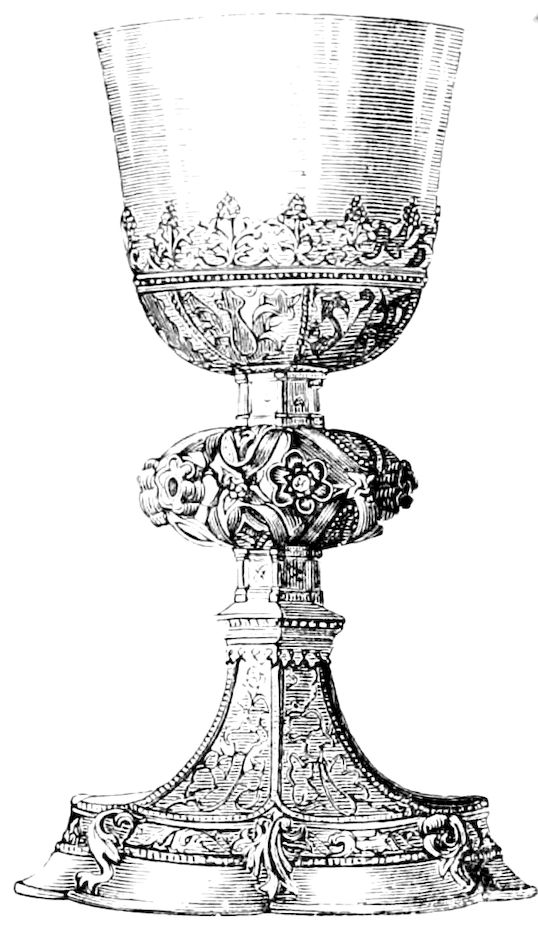
Fig. 149. Chalice, silver-gilt—14th century.
Chalice, Chr. (deriv. from calix, a cup). A sacred vessel used in the celebration of the mass. There were many different kinds, called ministeriales, offertorii, majores, and minores. The ministeriales served to distribute the wine; the offertorii were employed by the deacons to hold the wine offered by the faithful. Lastly, they were distinguished according to their size, as large or small (majores and minores). Vessels called calices were also frequently suspended from the arches of the ciborium, and other parts of the church, as ornaments. In Christian symbolism the chalice and serpent issuing from it are an attribute of St. John the Evangelist.
Chalon, O. E. A coverlet. (Chaucer.)
Chamade, Fr. A beat of drum or trumpet inviting the enemy to a parley.
Chamber Music, as opposed to concert music. Madrigals were probably the earliest specimens of chamber music.
Chambers, O. E. Small cannon for firing on festive occasions.
Chamberyngs, O. E. Bedroom furniture.
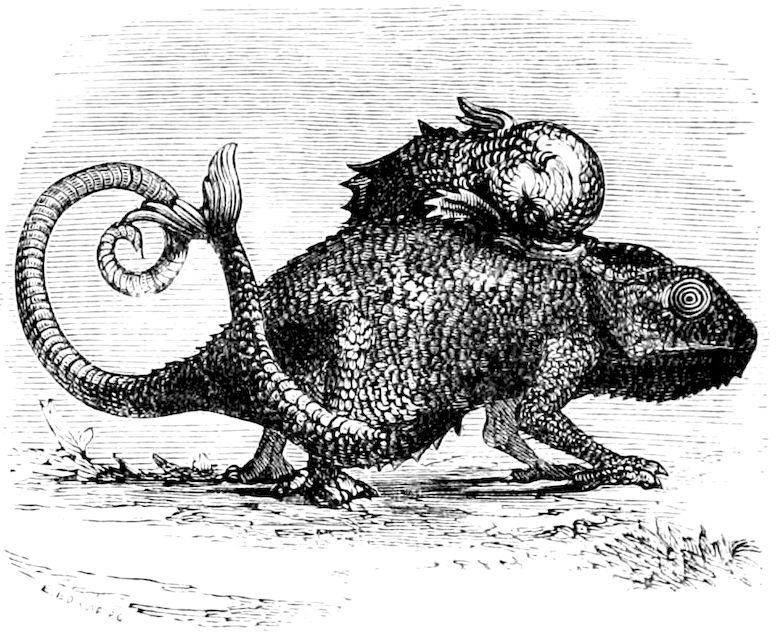
Fig. 150. Chameleon and Dolphin.
Chameleon (χαμαὶ, on the ground, and λέων, a lion). In Christian symbolism, the emblem of inconstancy; in Chemistry, manganate of potass is called chameleon from the changes of colour which its solution undergoes. The chameleon with a dolphin on its back (Fig. 150) was the device of Pope Paul III.
Chamfer, Arch. (1) The angle of obliquity (of the sides of a steeple, &c.). (2) A hollow channel or gutter, such as the fluting of a column.
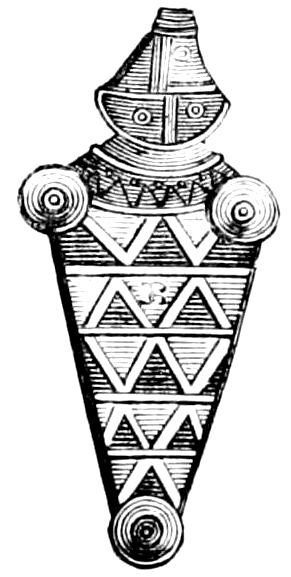
Fig. 151. Chamfron.
Chamfron, O. E. (Med. Lat. chamfrenum; Fr. champ-frein). A frontal of leather or steel to a horse’s bridle. (Fig. 151.)
Chamlet, O. E. (See Camlet.)
Chammer, O. E. (Fr. chamarre). A gown worn by persons of rank, temp. Henry VIII.
Champ, Arch. A flat surface.
Champ-levé. A form of enamelling in which the pattern is cut out of the metal to be ornamented.
Chamulcus, R. and Gr. A heavy dray for the transport of building materials, such as blocks of marble, columns, obelisks, &c.
Chance, O. E. The game of hazard.
Chancel, Chr. (from cancelli, a lattice). A term anciently used to denote the choir. It derived its name from the cancelli or stone screen by which it was enclosed.
Chandaras (Sanscrit, chanda-rasa, lit. moonjuice). An ancient name for copal.
Chandeleuse, Fr. Candlemas Day.
Chandi (from chand, the moon). Indian name for silver.
Chand-tara (lit. moon and stars) is the name of an Indian brocade, figured all over with representations of the heavenly bodies.
Changeable Silk, O. E., was woven of two colours, so that one of them showed itself unmixed and quite distinct on one side, and the second appeared equally clear on the other; mentioned A. D. 1327, 1543, &c.
Changes. The altered melodies produced by varying the sounds of a peal of bells.
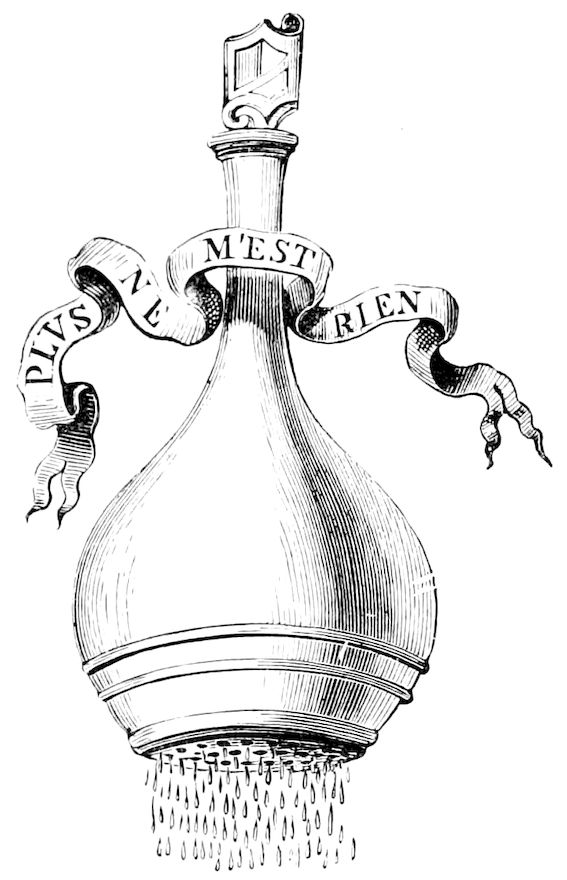
Fig. 152. Chante-pleure.
Chante-pleure, Fr. A water pot, made of earthenware, about a foot high, the orifice at the top the size of a pea, and the bottom full of small holes. Immersed in water, it quickly fills. If the opening at the top be then closed with the thumb, the vessel may be carried, and the water distributed as required. The widow of Louis I., Duke of Orleans, adopted this as her device, after the murder of her husband, in 1407.
Chantlate, Arch. A piece of wood under the eaves of a roof, by which two or three rows of overhanging slates or tiles are supported.
Chantry, Chr. (Fr. chanter, to sing). A chapel to which is attached a revenue as provision for a priest, whose duty it is to sing masses for the repose of the founder’s soul.
Chape, O. E. (Spanish chapa, a thin plate of metal). (1) The transverse guard of a sword. (2) A metal plate at the end of a scabbard. (3) A catch by which a thing is held in its place.
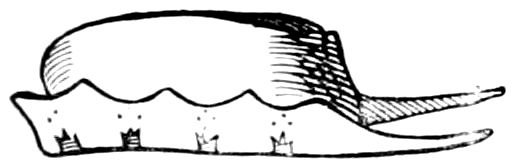
Fig. 153. Chapeau.
Chapeau, Her. Also called a cap of dignity, of maintenance, or of estate. An early symbol of high dignity.
Chapeau Chinois, Fr. A set of small bells arranged in the form of a Chinese hat.
Chapel or Chapelle de Fer. Iron helmet of knights of the 12th century. The diminutive is chapeline.
Chaperon, Fr. A hood or small cap for the head.
Chapiter, Arch. The upper part of a capital.
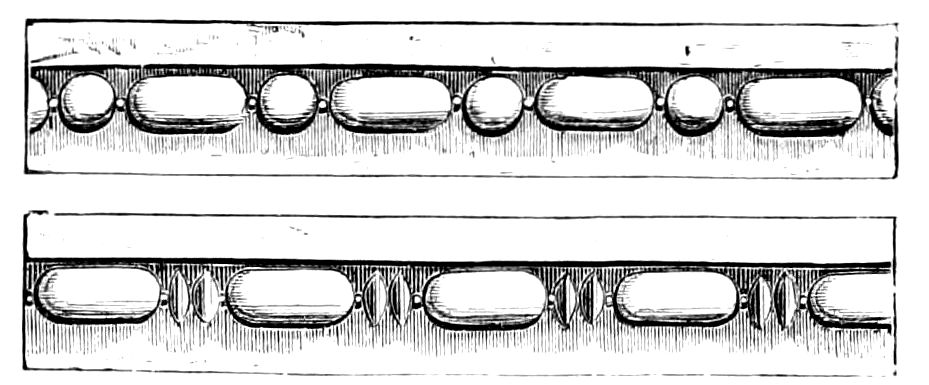
Fig. 154. Chaplet Moulding.
Chaplet, Arch. (Fr. chapelet). (1) A small cylindrical moulding, carved into beads and the like. (See Fig. 154.) (2) Chaplets of flowers, which were worn in England, by both sexes, on festive occasions, during the Middle Ages, and chaplets of jewels in earlier times. (3) Chr. It was anciently the custom to crown the newly baptized with a chaplet or garland of flowers. (4) Chr. A succession of prayers recited in a certain order, regulated by beads, &c. (5) In Heraldry. A garland or wreath. (See Crancelin.)
Chapter, Chr. (Lat. capitulum). The body of the clergy of a cathedral, united under the bishop.
Chapter-house, Chr. A place of assemblage for a Chapter of the clergy. That of Westminster contains some fine wall paintings of the middle of the 14th century.
Chaptrel, Arch. The capital of a column supporting an arch; an impost.
Character, Gr. and R. Generally, any sign or mark impressed, painted, or engraved on any object. In a more restricted sense, it denotes the instrument of iron or bronze with which such marks were made. In Art, the expression means a faithful adherence to the peculiarities of objects represented.
Charbokull, O. E. A carbuncle.
Charcoal Blacks are made of ivory, bones, vine-twigs, smoke of resin, &c., burned in a crucible excluded from the air. The best charcoal crayons are made of box and willow; the former produces a dense hard crayon, the latter a soft friable one. (Fairholt.) (See Blue Black.)
Chare Thursday, O. E. Maundy Thursday.
Charge, Her. Any heraldic figure or device.
Charisia, Gr. (Χάριτες, the Graces). Nocturnal festivals held in honour of the Graces, at which cakes and honey were distributed to those present.
Charisteria, Gr. (χάρις, gratitude). Festivals celebrated yearly at Athens, in remembrance of the Athenian general Thrasybulus, the saviour of his country.
Charistia. (See Caristia.)
Charistion. An instrument of Archimedes for weighing. Whether it bore most resemblance to the balance (libra), or the steelyard (statera), is uncertain, as its form is entirely unknown.
Charles’s Wain (Anglo-Saxon, carles-waen, the churl’s waggon). The seven stars forming the constellation generally called the Great Bear.
Charnel, O. E. Apex of the basinet.
Charnel-house. A small building attached to a cemetery, for a receptacle for the human bones disinterred when fresh graves were dug.
Charta, Gr. and R. Writing-paper in use among the ancients. There were eight different kinds, which were classed as follows in the order of their quality: (1) Charta Augustana or Claudiana; (2) Liviana; (3) hieratica; (4) amphitheatrica; (5) Saitica; (6) leneotica; (7) fanniana; (8) dentata. The last was so called from being polished by means of the tooth (dens) of some animal, or a piece of ivory. There was also a charta emporetica or packing-paper, and lastly a charta bibula. It is uncertain whether this last was blotting-paper, or a kind of transparent paper which had been steeped in oil or some other fatty substance.
Charter-room or Charter-house. A place in which the charters of a particular family or house were preserved.
Chartophylax, Chr. A man who had charge of the charters of a church.
Chasing. (See Cælatura.)
Chasse, Chr., Fr. A reliquary in the form of a box with a ridged top.
Chastelain, O. E. The lord of a castle.
Chastons, O. E. Breeches of mail; 13th to 16th century.
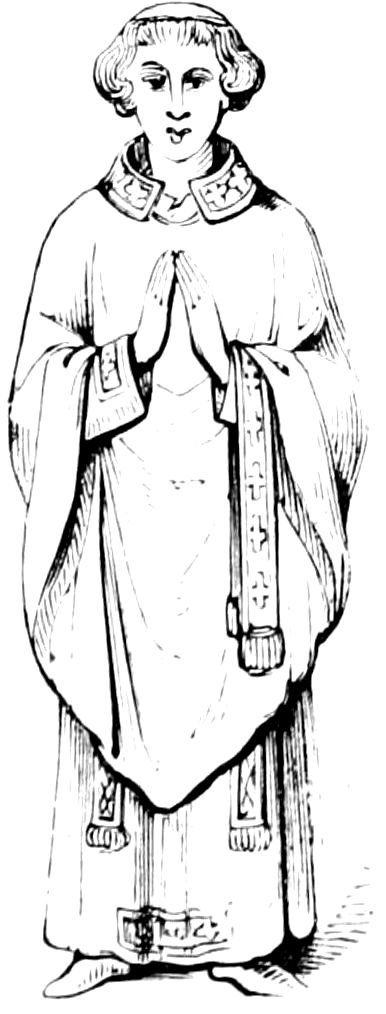
Fig. 155. Chasuble.
Chasuble (Lat. casula, a cottage). Part of ancient ecclesiastical costume common to all the Roman Catholic clergy, from the priest to the Archbishop. It was originally made of wool, and in one piece throughout, without sleeves, and without slit or opening in front, and perfectly circular; but the shape varied with the material; and from the 6th century downwards we hear of chasubles of brilliant colour and costly materials, such as silk or thickly-embroidered cloth of gold, and oval in form, hanging no longer in graceful folds as in the 11th century. The engraving (Fig. 155) shows a chasuble of the year 1387. (Compare Pænula, Planeta.)
Chatai, Hindoo. Mats, a common manufacture all over India. Those of Midnapore, near Calcutta, are remarkable for their fineness and classical design of the mosaic, like patterns of stained glass.
Chat-faux, Med. A wooden shed—modern scaffold. (See Cagasuptus.)
Chatrang (Sanscrit chatur-anga, the four angas or soldiers; or chaturaji, the four kings). The Persian name for a very ancient game of the “Four Kings,” supposed to be the origin of the four suits of playing-cards. (Rev. E. S. Taylor, “History of Playing-cards.”)
Chatzozerah, Heb. A Jewish trumpet mentioned by Moses, used chiefly for religious and warlike occasions.
Chauffault, Old Fr. A tower of wood.
Chausses, O. E. (1) Pantaloons of mail used by the Danes. (2) Tight pantaloons worn by the Normans and mediæval English.
Chaussetrap. (See Caltraps.)
Chaussons, O. E. Breeches of mail (or of cloth).
Chavarina, Med. Lat. A carbine.
Checkere, O. E. A chess-board.
Checkstone, O. E. A game played by children with small round pebbles.
Checky, Her. (See Chequée.)
Cheese, Chr. St. Augustine says that a sect called the Artotyrites offered bread and cheese in the Eucharist, saying “that the first oblations which were offered by men, in the infancy of the world, were of the fruits of the earth and of sheep.” (Aug. de Hæres. c. xlviii.)
Chef-d’œuvre, Fr. A work of the highest excellence.
Chekelatoun. (See Ciclatoun.)
Chekere, O. E. Chess (q.v.).
Chele (χηλὴ, prob, from a root χα- meaning cloven). This term is applied to a great variety of objects; it signifies a cloven foot, a hooked claw, or anything presenting a notched or serrated appearance. Thus a breakwater, the irregular projections of which bore some resemblance to the teeth of an immense saw, was also called chêlê. There were, besides, various engines and machines which went under this name.
Chelidoniacus, sc. gladius (from the Greek χελιδὼν, a swallow). A broad-bladed sword with a double point like a swallow’s tail.
Chelidonize, Gr. (lit. to twitter like a swallow). Singing the “Swallow Song” (χελιδόνισμα), a popular song sung by the Rhodian boys in the month Boedromion, on the return of the swallows, and made into an opportunity for begging. A similar song is still popular in Greece. (Fauriel, “Chants de la Grèce.”) (See Coronize.)
Cheliform (χηλὴ, a claw). In the form of a claw.
Chelonium (a tortoise-shell, from χελώνη, a tortoise), (1) A kind of cramp or collar placed at the extremities of the uprights of certain machines. (2) A part of a catapult, also called pulvinus. (See Catapulta.)
Chelys (χέλυς, a tortoise). (1) The lyre of Mercury, formed of strings stretched across a tortoise-shell. (2) In the 16th and 17th centuries, a bass-viol and division-viol were each called chelys. (See also Testudo.)
Chemise de Chartres, Fr. A kind of armour mentioned among the habiliments proper for knights who should engage in single combat. (Meyrick.)
Chenbele. (See Cembel [hastilude].)
Cheng, Chinese. A musical instrument, consisting of a box or bowl, into which a series of tubes of different length and pitch are inserted; the tubes have holes in them to be played upon with the fingers.
Chêniscus (χὴν, a goose). An ornament placed at the bow, and sometimes the stern of ships. In shape it resembled the neck of a swan or goose.
Chequée, Checky, Her. Having the field divided into contiguous rows of small squares; alternately of a metal (or fur) and a colour.
Chequers, O. E. (See Checkstone.)
Cherub, pl. Cherubim, Heb. According to the classification of Dionysius, the first hierarchy of Angels consists of three choirs called Seraphim, Cherubim, and Thrones, and, receiving their glory immediately from Deity, transmit it to the second hierarchy. The first hierarchy are as councillors; the second as governors; the third as ministers. The Seraphim are absorbed in perpetual love and worship round the throne; the Cherubim know and worship; the Thrones sustain the throne. The Seraphim and Cherubim are in general represented as heads merely with two or four or six wings, and of a bright red or blue colour, &c. (Cf. Mrs. Jameson’s Legendary Art.) (See Angels, Seraphim. Dominions, &c.)
Cherubic Hymn, Chr. A hymn sung in the Greek Church before the great entrance (see Entrance); so called from its first words, οἱ τὰ χερουβὶμ μυστικῶς εἰκονίζοντες, κ.τ.λ.
Chesible, for Chasuble (q.v.).
Chesnut Brown. A brown lake pigment prepared from the horse chesnut; very durable for oils and water-colour painting.
Chess. Writers immediately after the Conquest speak of the Saxons as playing at chess, which, they say, they learned from the Danes. The game of chess is very prominent in the romances of the Middle Ages. The Scandinavian navigators introduced some remarkable elaborately carved chessmen, of walrus ivory, from Iceland, in the 12th century. The castles are replaced by warriors on foot, called hrokr, from the Saracen roc, Persian rokh, our rook. In the Saracen game the vizier represented our queen, and the elephant our bishop, the roc, or hero, as aforesaid, our rook. Beautifully carved chessmen in the costumes of the 13th and 14th century exist in England. They were all very large, a king being four inches in height and seven in circumference. The chess-boards were of corresponding size, and made of all materials, including the precious metals, crystal, sapphires, and topazes. The pieces varied in form: the mediæval rook had a head like a fleur-de-lis, the knight was represented by a small upright column with the upper part bent on one side. The aufin or bishop was of the same shape, but the bent end was cleft to indicate a mitre. The figures of the 16th century much more nearly resemble those now in vogue.
Chesse, O. E. (Fr. chasse). A border, a circlet.
Chest of Viols, O. E. A set of instruments complete for a “consort” of viols, i. e. two trebles, two tenors, and two basses.
Chester, O. E. A person who places corpses in their coffins.
Chests and Coffers, in Norman times, were adorned with elaborate carving and richly inlaid. They were still the general depositories for clothes and treasures. Cupboards (armoires) were introduced by the Normans, and filled with household utensils.
Chevalet, Fr. The bridge of a violin or other stringed instrument.
Cheval-traps. (See Caltraps.)
Chevaucheurs. Anglo-Norman horsemen, or running messengers.
Chevaux-de-frize. An arrangement of iron spikes for the defence of a battlement against assault.
Cheveril, O. E. Kid leather, proverbially elastic; hence, a cheveril conscience (that will stretch).
Chevesaile, Old Fr. A necklace.
Chevetaine, Old Fr. A captain; hence the mediæval cheuptanus.
Chevron. (1) Arch. One of the mouldings frequently used in Norman architecture, usually called zigzag (q.v.). (2) A badge on the coatsleeve of a non-commissioned officer. (3) Her. One of the ordinaries; the lower half of a Saltire (q.v.).
Chevronel, Her. A diminutive of the Chevron, of half the size.
Chevroter, Fr. A musical term: “to skip, quiver, to sing with uncertain tone, after the manner of goats,” alla vibrato.
Chiaroscuro, It. (chiaro, light, and oscuro, dark). Light and shade.
Chiave of Pavia. One of the Italian literary academies, composed entirely of noble and illustrious persons, who wore a golden key suspended round the neck, and had for a motto, Clauditur et aperitur liberis, and the text from Rev. iii. 7.
Chica. A dance popular in Spanish South America, of a jig-like character; the origin of the Fandango. (See Chaconne.)
Chief, Her. One of the ordinaries; the chief bounded by a horizontal line contains the uppermost third of the field of a shield. In chief, arranged horizontally across the upper part of the field.
Childermas, O. E. Innocents’ Day.
Chilled (Fr. chancissure). Said of a moisture on the varnish of a picture by which the defect of cloudiness called Blooming is caused.
Chimæra, Gr. A monster described by Homer, with a lion’s head, a goat’s body, and a dragon’s tail. In Christian art it is a symbol of cunning. (See also Dog of Fo.)
Chime. (1) To play bells by swinging the hammers, opposed to ringing by swinging the bells. (2) A chime of bells is a Carillon.
Chimere, Chr. The outer dress of a Protestant bishop. It is made of black satin, without sleeves.
Chimneys (Gr. χιμήνη, winter), carried up in the massive walls of the castles, were first introduced into England by the Normans. The fire was still piled up in the middle of the hall, but fireplaces were built against the side walls in the more private apartments—the original of the well-known mediæval fireplace and “chymené.” Leland, in his account of Bolton Castle, which was “finiched or Kynge Richard the 2 dyed,” notices the chimneys: “One thynge I muche notyd in the hawle of Bolton, how chimeneys were conveyed by tunnells made on the syds of the walls, betwyxt the lights in the hawle, and by this means, and by no covers, is the smoke of the harthe in the hawle wonder strangely conveyed.”
Chin-band, Chin-cloth. A muffler of lace worn by ladies, temp. Charles I.
China. (See Pottery.)
China (or Chinese) Ink. (See Indian Ink.)
Chinese Paper. A fine absorbent paper of a yellowish tint, used for proofs of engravings, &c. Japanese paper is now frequently preferred.
Chinese White. Oxide of Zinc (q.v.). It is more constant than white lead.
Chinny-mumps. A Yorkshire music made by rapping the chin with the knuckles.
Chints or Chintz (Hindoo, chhint, spotted cotton cloth). Cotton cloth printed in more than two colours.
Chiramaxium, Gr. and R. (χειρ-αμάξιον, i. e. hand-cart). An invalid’s chair mounted upon two wheels, and drawn or pushed by slaves.
Chiridota, Gr. and R. (from adj. χειριδωτὸς, i. e. lit. having sleeves). Tunics with long sleeves, worn in especial by the Asiatic races and by the Celts. The early Britons, before the Roman invasion, wore close coats checkered with various colours in divisions, open before and with long close sleeves to the wrist.
Chirimia, Sp. (from chirimoya, a pear). An oboe.
Chirography. The art of writing with hands.
Chirology. The art of talking with the hands.
Chiromancy (μάντις, a soothsayer). Divination from the lines of the palms of the hands.
Chironomia, Gr. and R. (χειρο-νομία, i. e. measured motion of the hands). The mimetic art. By this term is expressed not only the art of speaking with gestures and by means of the hands, but also the action of speaking combined with gesticulation. This art dates from a high antiquity. It was originally part of the art of dancing,—clapping the hands in rhythm; also a gymnastic exercise, for pugilists and others.
Chiroplast. An instrument for teaching fingering of musical instruments, invented by Logier in 1810.
Chirothecæ (Gr. χειροθήκη; Lat. gantus). Gloves were unknown to the early Greeks and Romans, but in use among the ancient Persians. In Christian archæology they are first met with in the 12th century. (See Gloves.)
Chisleu, Heb. The ninth month of the Jewish year. It begins with the new moon of our December.
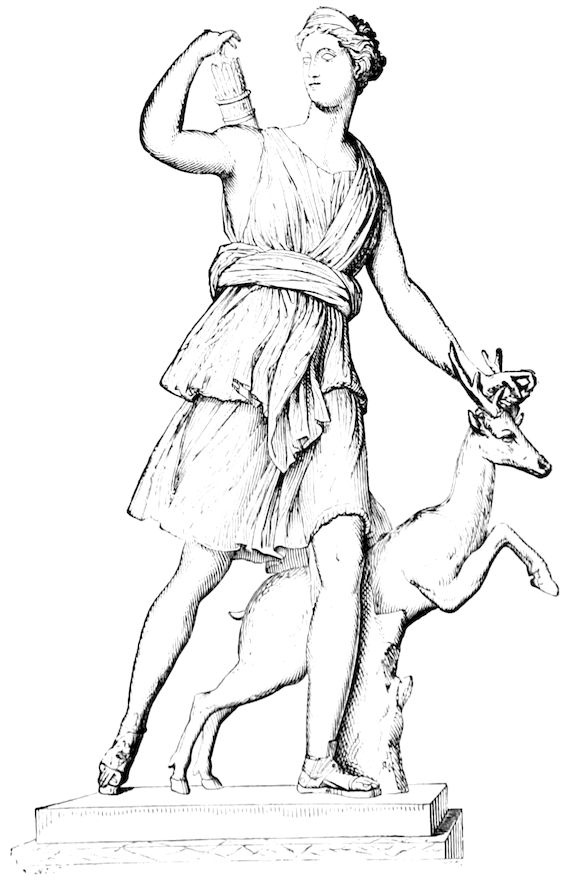
Fig. 157. Diana wearing the Greek chiton.
Chiton (χιτών). The Greek tunic. (Fig. 157.)
Chitte, O. E. A sheet.
Chivachirs (Chevaucheurs). Old Fr. Running messengers.
Chlaina (Lat. læna). A kind of cloak, of ample size, worn by the Greeks in campaigning. In time of peace it served as a bed coverlet. The diminutive χλανίδιον appears to have been a woman’s mantle.
Chlamyda. (See Chlamys.)
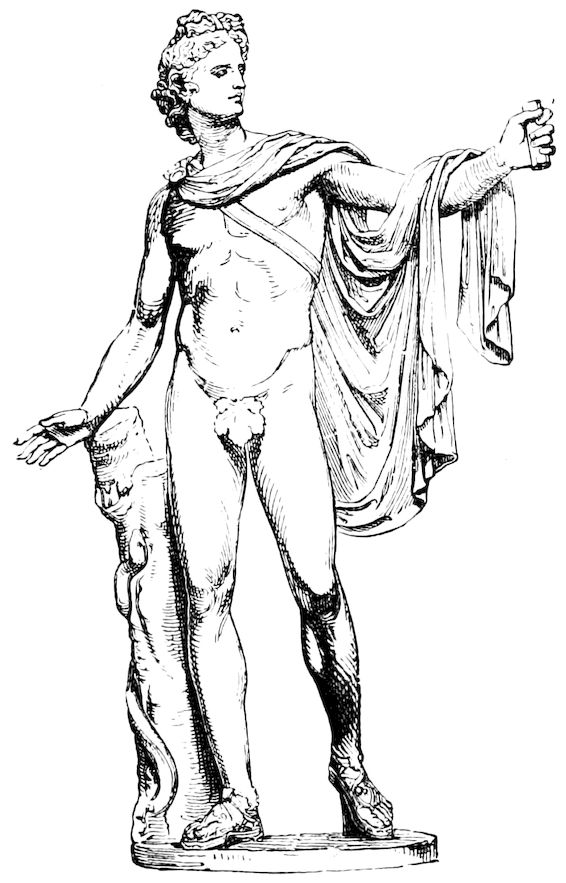
Fig. 158. Apollo wearing the chlamys folded round his arm.
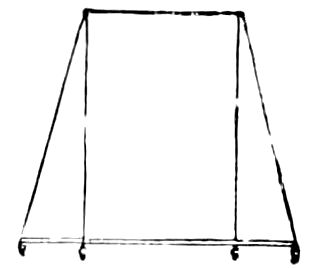
Fig. 159.
Chlamys, Gr. A short light mantle, which was worn by Greek youths (not by Romans) until they arrived at manhood. It was the regular equestrian costume, and was of an oblong square shape. (Fig. 159.) The chlamys is seen in representations of men hunting or fighting with beasts, as a shield wrapped round the left arm, the right poising the spear. (Fig. 158.) In Botany, the floral envelope.
Chœnix (χοῖνιξ). A Greek measure of capacity, variously valued from a pint and half to two quarts.
Choir, Quire, or Quere, Arch. The part of the church for the singers and clerks, i. e. the space between the NAVE (for the people), and the BEMA, or presbytery, for the celebrating clergy. But in mediæval writings the term includes the BEMA. (See Chancel.)
Choir Wall or Choir Screen (Fr. clôture). The wall or screen between the side aisles and the choir.
Choosing-stick (a Somersetshire provincialism). A divining-rod.
Chopines, It. Clogs or high shoes, of Asiatic origin, introduced from Venice in the 16th century.
Choragic Monuments. Small pedestals or shrines erected by the winner of a choral contest to display the tripod which was his prize. At Athens there was a street lined with such monuments, called the “Street of the Tripods.” The Choragic Monument of Lysicrates, still existing in Athens, is one of the most valuable remains of Greek architecture.
Choragium, Gr. and R. (χορηγὸς, or chorus-leader). A large space in a theatre, situated behind the stage. It was here that the “properties” were kept and the rehearsals of the chorus took place. The term is also used to denote the furniture, costumes, decorations, and, in a word, all the accessories required in the production of a piece.
Chordaulodion. A self-acting musical instrument invented by Kauffmann of Dresden in 1812.
Chorea, Gr. and R. (χορὸς, q.v.). A choral dance, in which the dancers took each other by the hand and danced to the sound of their own voices.
Chorus, Gr. and R. (χορὸς, i. e. prop. a circle). (1) A choir of singers in a dramatic entertainment. (2) A band of dancers who went through their movements to the sound of their own singing. (3) A round choral dance; in this last signification chorea may equally well be used.
Chorus or Choron, O. E. An instrument somewhat resembling a bagpipe; the name was also applied to certain stringed instruments. The word choron originally designated a horn. (Hebrew, Keren.)
Chous, Gr. and R. (χόος, contr. χοῦς, i. e. that from which one pours). An amphora, forming a measure of exact capacity. Another name for it was Congius (q.v.). It held twelve Cotylæ (q.v.).
Choutara, Hindoo. A kind of guitar with four wire strings.
Chrism, Chr. (from χρίω, to smear). A composition of balsam and oil of olives used by Christians of various denominations at the administration of the sacraments.
Chrismal, Chrismatory, Chr. (1) The vessel made to contain the consecrated oil. (See Labarum.) (2) A vessel for the reservation of the consecrated Host. (3) A cloth used to cover relics. (4) Old English chrisom, a white linen cloth put upon the child’s head in baptism. (See Font-cloth.)
Chrismarium, Chr. (See Chrismal, 1.)
Chrisom. O. E. (1) See Chrismal, 4. (2) A child that dies within a month after birth.
Christ-cross, O. E. (1) The Alphabet; so named from a school lesson beginning “Christe Crosse me spede in alle my worke.” (2) The mark made for his signature by a person who cannot write.
Christemporeia, Chr. Literally, the selling of Christ, simony.
Christian Horses, O. E. Bearers of sedan chairs.
Christmas-boxes. So called from the old practice of collecting them in boxes.
Chromatic Scale (χρῶμα, colour). In Music, the scale that proceeds by semi-tones; so called from the practice of printing the intermediate notes in various colours.
Chromatics. The science of colours.
Chromatrope. An optical instrument for assisting the invention of combinations of colours.
Chrome, Chromium. An important mineral, the green oxide of which furnishes the Chrome Green.
Chrome Green. A dark green pigment prepared from oxide of chromium; mixed with Prussian blue and chrome yellow it is called Green Cinnabar.
Chrome Ochre. Oxide of chromium of a fine yellowish green.
Chrome Red. A chromate of lead; a durable pigment used in oil painting. (See Red Lead.)
Chrome Yellow. A chromate of lead, which makes a bad pigment for oil painting. It is very poisonous and not durable; when mixed with white lead it turns to a dirty grey. As a water-colour pigment it is less objectionable.
Chromite. Chromate of iron; a mineral consisting of protoxide of iron and oxide of chromium, used in the preparation of various pigments.
Chronogram (χρόνος, time). An inscription which includes in it the date of an event.
Chryselephantine Statues of ivory and gold. The most celebrated were that of Minerva, by Pheidias, which stood in the Acropolis at Athens, and was 40 English feet in height; and that of Zeus, 45 feet high, likewise by Pheidias, in the temple of Olympia. A reproduction of this statue was shown in the Paris Exhibition of 1855.
Chrysendeta, R. (χρυσένδετα, i. e. set or inlaid with gold). A very costly description of plate-service employed by wealthy Romans. Of its precise character nothing unfortunately is known, but to judge from the epigrams of certain authors, it must have been chased and embossed.
Chrysoberyl (βήρυλλος, a beryl). A gem of a yellowish green colour; a species of corundum (q.v.).
Chryso-clavus (Lat. golden nail-head). All rich purple silks, woven or embroidered with the clavus in gold, were so named. They were used for altar frontals, and the clavi were sometimes made so large that a subject was embroidered upon them; they were then called sigillata or sealed. (See Clavus.)
Chrysocolla or Gold Green (χρυσόκολλος, inlaid or soldered with gold). (1) Native verdigris. Its principal use was for the preparation of a solder for gold. (See Santerna.) (2) The Greek term for Green Verditer and Armenian Green (Latin, Armenium); a pigment obtained from malachite and green carbonate of copper. It was also called pea green or grass-green.
Chthonia, Gr. and R. (χθὼν, the earth). Festivals held every spring at Argos in honour of Ceres, at which four aged women sacrificed heifers.
Church, in Christian art, is the attribute of a founder thereof, who is frequently represented holding it in his hand. The most ancient symbol of the Church is the ark of Noah, subsequently a ship, often covered with the waves, &c., very frequent in the catacombs. On tombs it is held to imply that the dead expired in full communion with the Church.
Churcheard, Church-haw, Church-litten. Old English provincialisms for a churchyard or burial-ground.
Church-stile, O. E. A pulpit.
Chymbe, O. E. A cymbal:—
“As a chymbe or a brazen belle,
That nouther can undirstonde my telle.”
Chymol, Gemell, O. E. A hinge, still called the eastern counties a “gimmer.”
Chytra, Gr. and R. (from χέω, to pour). A common kind of pot, of Greek origin, made with red clay. It was used for cooking.
Chytria, Gr. An Athenian festival, which derived its name from the χύτρα, or common pot in which were cooked the vegetables or other provisions offered to Bacchus and Mercury in memory of the dead.
Chytropus, Chytropous, Gr. (χυτρό-πους, lit. a pot-foot). A chytra with three or four feet.
Cibilla. (See Cilliba.)
Ciborium, Gr., R., and Chr. (κιβώριον, the pod of the καλοκασία, or Egyptian bean). (1) A drinking-vessel so called because it resembled the Egyptian bean in shape. (2) In Christian archæology a kind of baldachino or canopy, supported by a varying number of columns, which forms the covering of the high altar in a church. Called also the Tabernacle, Sacrament house, God’s house, or holyroof. (See Severey.) (3) Ciborium also signifies a vessel in which the consecrated wafer is “reserved.”
Ciclatoun or Siklatoun. The Persian name, adopted in England, for a textile of real gold thread; 12th century.
Ciconia, R. (lit. a stork). (1) A sign made in dumb show by bending the forefinger into the form of a stork’s neck. (2) An instrument, in shape like an inverted T, employed by farmers to make sure that trenches dug by the spade were of uniform depth. (3) Ciconia composita was the name given to a more elaborate instrument of the same kind invented by Columella.
Cicuta, R. (i. e. lit. the hemlock). A term used by analogy to denote anything made out of the hemlock plant, especially the Pan’s pipes.
Cidaris, Gen. (κίδαρις or κίταρις, a Persian tiara). A sort of diadem or royal bonnet worn by Eastern princes. It was tall, straight and stiff in shape, and was ornamented with pearls or precious stones. The same name was also applied to the bonnet worn at ceremonies by the high priest of the Jews. (See Tiara.)
Cilery, Arch. Drapery or foliage carved on the heads of columns.
Cilibantum, R. (See Cilliba.) A stand or table with three legs.
Cilicium, R. (1) A coarse cloth made of goat’s hair, and manufactured in Cilicia. It was much used in the army and navy: in the former for making the soldiers’ tents; in the latter for clothes for the sailors or for sails. (2) During the time of mourning, or when suffering under any calamity, the Jews put on a kind of cilicium made of coarse canvas. (3) A cloth mattress stuffed with sea-weed or cow-hair, which was placed outside the walls of besieged cities to deaden the blows of the battering-ram or of projectiles. (4) In Christian archæology the cilicium or hair-shirt is a sleeveless jacket made with a material of horsehair and coarse hemp. The Dominicans, Franciscans, and certain Carthusians wear the cilicium to mortify the flesh.
Cilliba, Gr. and R. (κίλλος, an ass) A trestle, and by analogy a dining-table supported by trestles. This form of table, which was commonly used by the early Romans, was replaced later on by the circular table.
Cimbal. An old name for the Dulcimer (q.v.).
Cimeter, Cymetar, Scimeter, &c. A short curved sword used by the Persians or Turks, mentioned by Meyrick as adopted by the Hussars, temp. Elizabeth.
Cincinnus, R. A long ringlet or corkscrew curl of hair produced with the curling-irons. (See Hair.)
Cincticulus, R. (dimin. of Cinctus, q.v.). A kind of short petticoat worn by youths.
Cinctorium, R. (from cinctus, a girdle). (1) A sword-belt worn round the waist, and thus distinguished from the Balteus or baldric, which passed over the shoulder. The balteus was worn by private soldiers, while the cinctorium was the distinctive badge of an officer. (2) The dagger, so called because it was suspended from or put into the girdle.
Cincture, Arch. The fillet, at each end of the shaft of a classical column (q.v.).
Cinctus, R. (from cingo, i. e. a girding). A short petticoat (or kilt) worn by men; also in the same sense as cingula and cingulum, a girdle. Cinctus gabinus was a particular manner of arranging the toga, by throwing one end over the head, and fastening the other round the waist like a girdle. As an adjective, cinctus was applied to any individual of either sex who wore any kind of belt or girdle. (See Discinctus.)
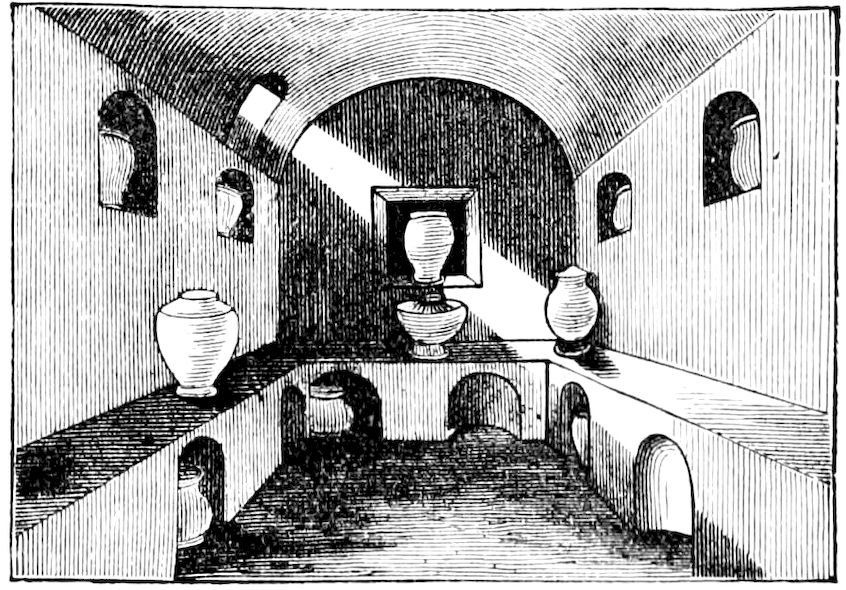
Fig. 160. Cineraria.
Cinerarium, R. (i. e. a place of ashes). A niche in a tomb, sufficiently roomy to hold an urn of large size, or a sarcophagus. The following was the disposition of one, or in many cases, three sides in a Roman tomb: in the centre of the wall was a large niche (cinerarium medianum) for a sarcophagus, and on each side of this two small niches (columbaria), and above each of the latter was a much larger recess for large urns. (See also Columbarium, Cubiculum, Cupella.)
Cinerarius. A hair-dresser (who heated his tongs in the cinders).
Cingulum, R. A girdle or other fastening round the waist. In modern archæology, cingulo militari decorare signifies to create a knight, from the practice of investing him with the military girdle; and cingulum militare auferre is to degrade a knight. (See Discinctus.)
Ciniflo, R. A synonym for Cinerarius (q.v.).
Cinnabar. Sulphide of mercury; an ancient red pigment used for sacred and imperial purposes. (See Chrome Green, Dragon’s Blood, Vermilion.)
Cinnamon-stone. A variety of lime-garnet of a clear cinnamon-brown tint.
Cinque-cento (literally, 500). The Italian art of the 16th century.
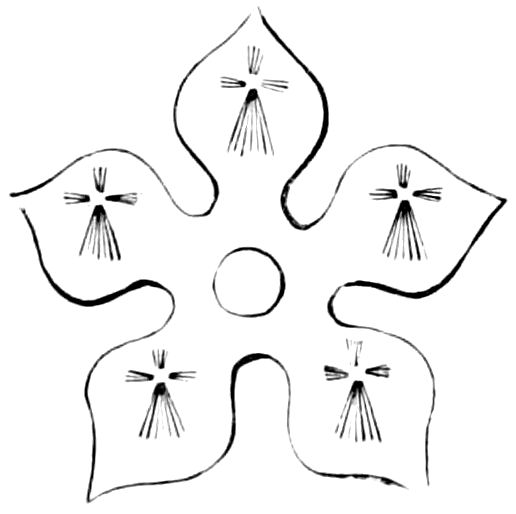
Fig. 161. Heraldic Cinque-foil.
Cinque-foil, Arch. (Fr. cinque and feuille, a leaf). An ornamental foliation or feathering of the lanceolated style, consisting of five projecting points or cusps. (Fig. 161.)
Cinta, Med. Lat. (Fr. enceinte). The outside wall of a fortress.
Cinyra. An old term for a harp.
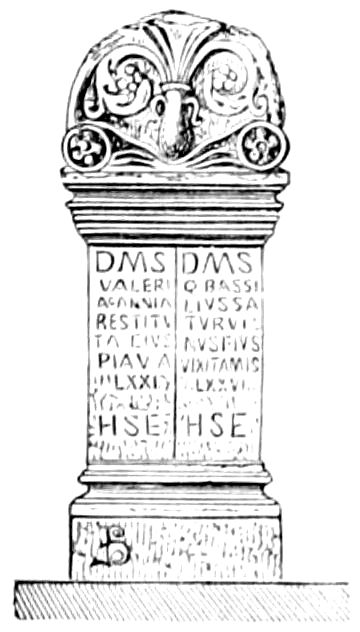
Fig. 162. Cippus (Tomb-stone).
Cippus, R. (1) A short stone pillar of cylindrical form, employed to mark the boundaries between adjoining estates or nations. (2) A pillar of cylindrical or rectangular form, and sometimes perfectly plain, sometimes richly ornamented, erected for a tomb-stone. (Fig. 162.) In some instances the cippus enclosed a cavity in which the urn containing the ashes of the dead person might be placed. A cippus was placed at the corner of a cemetery, and the measurements of the burying-ground were recorded upon it. In Med. Lat. the word is used for the keep of the castle.
Circenses Ludi, R. Games in the circus. (See Consualia.)
Circinate. Curled in the manner of the Ionic volute, or like the fronds of young ferns rolled inwards from the summit to the base.
Circinus, R. A compass; an instrument employed, as now, by architects, sculptors, masons, and various other trades. The Romans were also acquainted with reduction compasses.
Circle. The emblem of Heaven and eternity.
Circumlitio. An ancient Greek varnish, with which the statues of the Greeks were tinted. (Eastlake.)
Circumpotatio, R. (from circum and poto, i. e. a drinking-around). A funeral feast in which the guests passed round the wine from hand to hand. It took place at the tomb of the person in whose memory it was held, and on the anniversary of his death.
Circumvallation. A fortification made round a blockaded place by a besieging army.
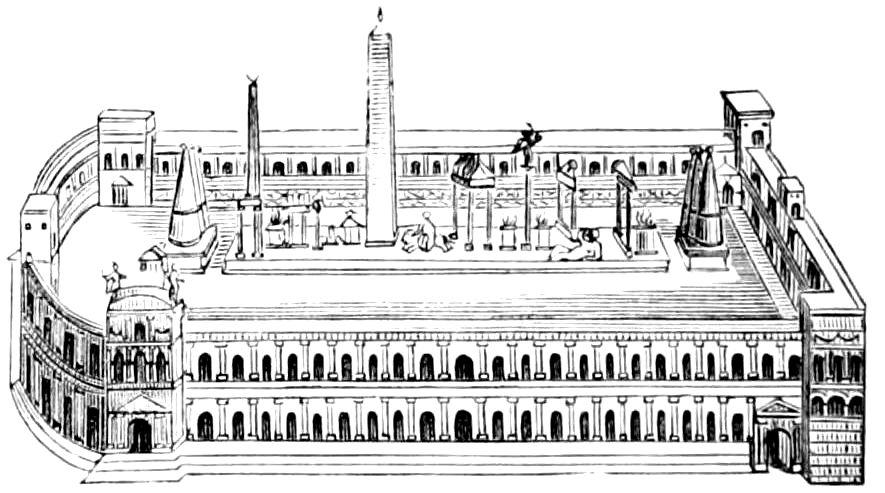
Fig. 163. Model of a Roman Circus.
Circus, Gr. and R. (i. e. a circle). A flat open space near a city, round which were raised scaffoldings for the accommodation of the spectators. This was the form of the earliest circuses; but as civilization advanced, they were regularly constructed of stone. The arena was in the form of a vast rectangle terminating at one extremity in a semicircle, and surrounded by tiers of seats for the spectators. At the end fronting the semicircular part was a rectangular pile of buildings, underneath which were the carceres or stalls for the horses, and down the centre of the circus ran a long low wall called the spina, adorned with statues, obelisks, &c. This spina formed a barrier by which the circus was divided into two distinct parts, and at each end of it was a meta or goal, round which the chariots turned. (See Meta and Ovum.) The Romans constructed circuses in England, wherever they had a large encampment. The ruins exist at Dorchester, Silchester, Richborough, and other places.
Cirrus, R. (1) A lock of hair; a ringlet curling naturally, and so distinguished from the cincinnus, a curl produced by means of the curling-iron. (2) A tuft; the forelock of a horse when tied up above its ears. (3) A tuft of flowers forming a bunch or head, such as phlox, calceolaria, &c. (4) Light curled clouds in the sky, portending wind, are hence called cirri.
Ciselure, Fr. Chasing. (See Cælatura.)
Cissibium or Cissybium, Gr. and R. (κισσύβιον, i. e. made or wreathed with ivy). A drinking-vessel, so called because the handle was made of ivy-wood, or more probably because it had an ivy-wreath carved upon it.
Cissoid (lit. ivy-shaped). A celebrated curve, applied in the trisection of an angle, invented by Diocles the geometer.
Cissotomiæ, Gr. (κισσο-τόμοι, sc. ἡμέραι, i. e. the days of ivy-cutting). A festival held in Greece, in honour of Hebe, goddess of youth, and a youth called Cissos, who, when dancing with Bacchus, had fallen down and been changed into ivy. Accordingly at this festival youths and girls danced with their heads wreathed with ivy.
Cista, Cistella, Sitella, R. (κίστη, a chest). (1) A large wicker-work basket in which the voters deposited their voting-tablets at the comitia. It was of a cylindrical shape, and about four or five feet high. (2) A smaller basket into which the judges cast the tablets recording their sentence. (3) A wicker-work basket in which children carried about their playthings. (4) The cist which was carried in procession at the Eleusinian festival, and which might be either a wicker basket or a box of metal. It was filled with corn, rice, sesame, salt, and pomegranates. Richly ornamented chests or boxes, with bronze mirrors in them, found among Etruscan ruins, are called cistæ mysticæ. The sitella, or situla, was a different vessel; viz. a bucket of water, into which the lots (sortes) were thrown. The situla had a narrow neck, so that only one lot could come to the surface when it was shaken. It was also called Urna or Orca.