C. (continued 2)
Reading edition
Cistella, R. A dulcimer; lit. a little box. (See Cista.)
Cistellula, R. (dimin. of Cista, q.v.). A very small cista.
Cistophorus, Egyp., Gr., and R. (κιστοφόρος, i. e. bearing a cista or cistus). A silver coin, current in Asia, and worth about four drachmæ. It was so called from bearing the impression of a cista (chest), or, more probably, of the shrub cistus. [Value four francs of French money.]
Cistula, R. Dimin. of Cista (q.v.).
Citadel (It. cittadella, a little town). A fortress within a city.
Cithara, Cither, Gr. and R. (κιθάρα). A stringed instrument of great antiquity, resembling our modern guitar. It was played with a plectrum. The name was afterwards applied to many stringed instruments of varied form, power of sound, and compass. The mediæval Rotta was called C. teutonica; the harp was called C. Anglica.
Cithara Bijuga. A guitar with a double neck.
Citole, O. E. A kind of guitar.
“A citole in hir right hand had sche.” (Chaucer.)
Cittern. A stringed instrument, like a guitar, strung with wire instead of gut. The cittern was at one time a part of the furniture of every barber’s shop, and customers played on it while waiting for their turns. (Niche 1 of Exeter Gallery. See Clarion.)
Civery, Arch. (See Severey.) A bay or compartment of a vaulted ceiling.
Civic Crown, Her. A wreath of oak leaves and acorns. (See Corona.)
Ckuicui, Peruvian. One of the divisions of the temple of the Sun (Inti), so named as being dedicated to the rainbow (Ckuichi). (See Inti.)
Clabulare. (See Clavulare.)
Clack or Clap-dish, O. E. A box with a movable lid used and rattled by beggars to attract attention:—
“His tongue moves like a beggar’s clapdish.”
Cladeuteria. A Greek festival held in honour of Bacchus, at the time when the pruning of the vines took place.
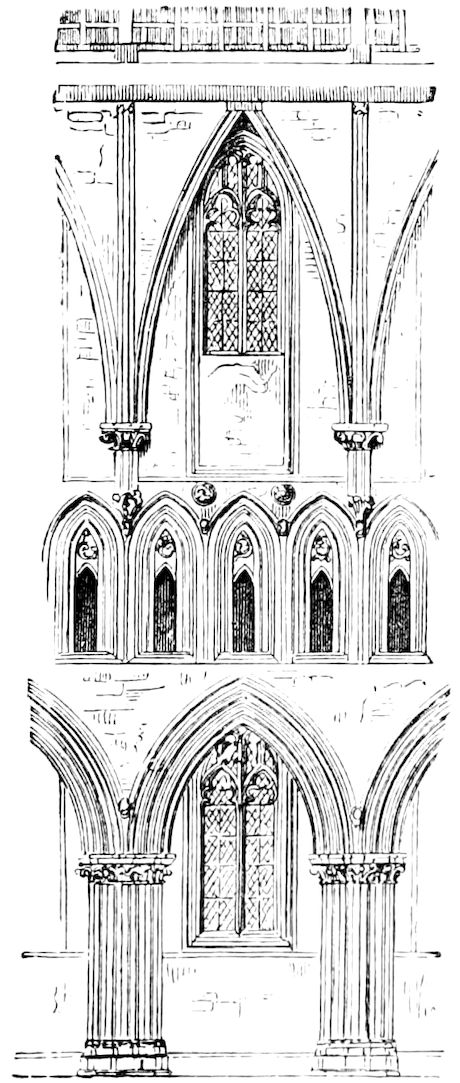
Fig. 164. Clerestory and Triforium in Worcester Cathedral.
Claire-voie (Anglicè, Clerestory), Arch. (i. e. clear-storey). A row of large windows, forming the upper storey of the nave of a church, rising clear above the adjoining parts of the building.
Clan (Gaelic, klann, children). A tribe of persons of one common family, united under a chieftain.
Clap-bene, O. E. Bene signifies a prayer, and children were invited by this phrase to clap their hands together, as their only means of expressing their prayers.
Clap-dish. (See Clackdish.)
Clappe or Clapper, O. E. A wooden rattle used to summon people to church on the last three days of Passion Week, when the bells were not rung.
Clarenceux, Her. The title of one of the three kings of arms at Heralds’ College. The others are called Garter and Norroy.
Clarichord, O. E. A stringed instrument, in the form of a spinet, of mediæval times. At the marriage of James of Scotland with the Princess Margaret, A. D. 1503, “the king began before hyr to play of the clarychordes, and after of the lute. And upon the said clarychorde Sir Edward Stanley played a ballad, and sange therewith.” (Wharton, “History of English Poetry.”) It is identical with the clavichord, the origin of the spinet, harpsichord, and pianoforte.
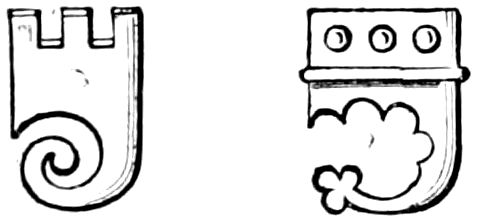
Fig. 165, 166. Clarions (heraldic).
Clarion, O. E. A small trumpet, with a shrill sound. (Represented in the third niche of the “Minstrels’ Gallery” of Exeter Cathedral, of which there is a cast in the South Kensington Museum.)
Classic Orders of Architecture. The Grecian: Doric, Ionic, and Corinthian;—and the Roman: Tuscan, Doric, Ionic, Corinthian, and Composite orders (q.v.) are generally thus distinguished.
Clathrate. Latticed like a grating (clathri).
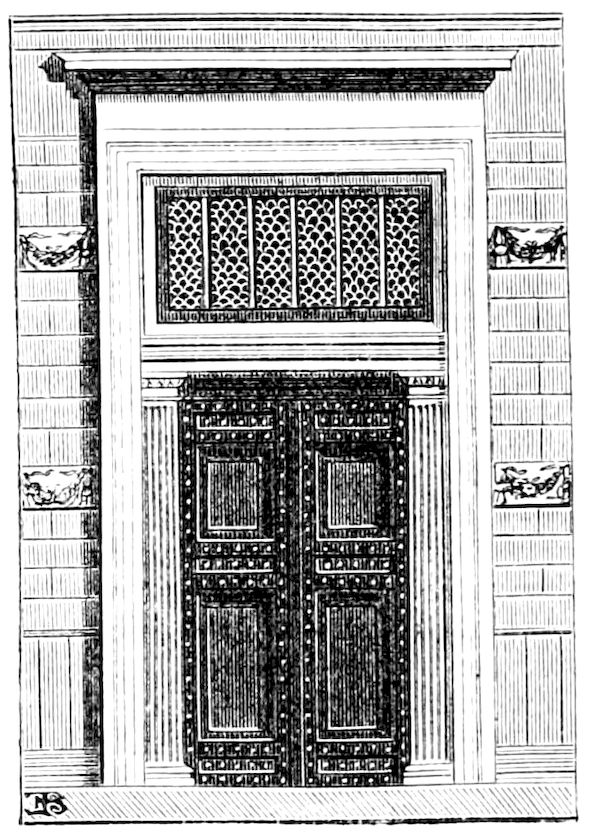
Fig. 167. Clathri over bronze doors.
Clathri, R. A grating or trellis formed of wooden or metal bars; clathri were employed to form the imposts over hypæthral doors, and to light the stables (carceres) under the circus, &c. Fig. 167 represents one of the bronze doors of the Pantheon at Rome with the grating above.
Claude Glass. A dark convex glass for studying the effect of a landscape in reverse. Its name is supposed to be derived from the similarity of the effects it gives, to those of a picture by Claude Lorrain.
Clausula, R. The handle of any instrument whatsoever, when made in such a way that the hand can be inserted into it, as for instance with a ring or sword-hilt. The Strigilis (q.v.) had a handle of this description. Clausula is thus to be distinguished from capulus (a straight handle), and ansa (a handle affixed to another object).
Clava, R. (1) A stout knotty stick, growing much thicker towards one end. (2) A very heavy club with which young recruits went through their exercises. (3) A club like that of Hercules, or a mace or war-club with an iron head, and studded with nails or (more commonly) sharp spikes.
Clavate. Club-shaped; tapering down from the top.
Clavesignati, Med. Lat. The Papal troops were so called, who had the keys of St. Peter on their standards and uniforms.
Claviary. In Music, an index of keys.
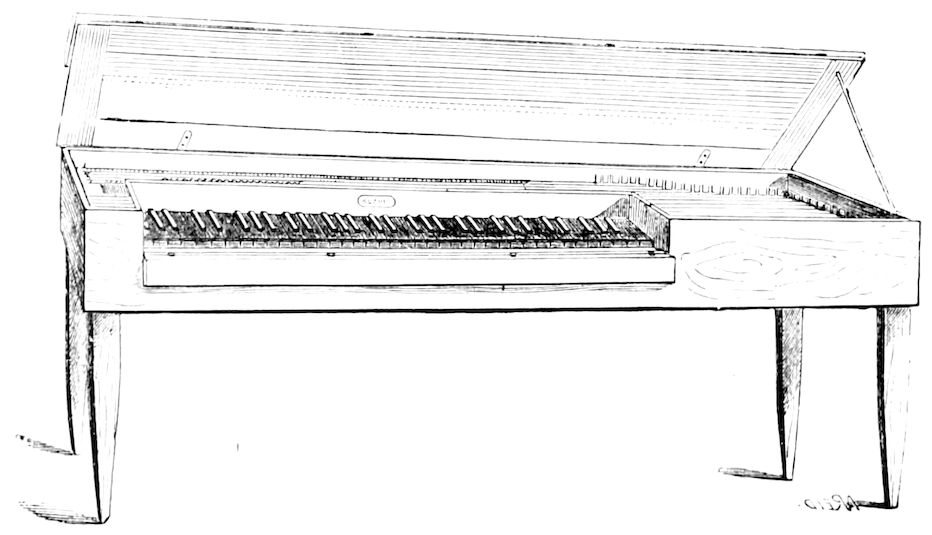
Fig. 168. Clavichord—18th century.
Clavichord. A stringed instrument in the form of a spinet. (Fig. 168.) (See Clarichord.)
Clavicula. Dimin. of Clavis (q.v.).
Clavier. Of a musical instrument, the key-board.
Clavis, R. A key. The clavis clausa was a small key without a neck or lever; clavis laconica, a key of Egyptian invention, having three teeth; clavis adultera, a false key; clavis trochi, a curved stick made of iron and having a hook at the end, which was used by Greek and Roman boys for trundling their hoops.
Clavius. A walled plain in the moon, more than a hundred miles in diameter.
Clavulare or Clabulare, R. A large open cart used for carrying provisions, especially dolia (casks) filled with wine. The body of the carriage was formed by a wooden trellis-work (clavulæ)—whence its name—and was of a semi-cylindrical shape, adapted to accommodate wine barrels.
Clavus, R. A nail. In Christian archæology, a purple hem or band applied as an ornament to a dress, which was then called vestis clavata. (See Chryso-clavus.)
Claymore (Gaelic, claidheamb, a sword, and mor, great). The highland broadsword.
Clechée, Her. (See Undée.) A variety of the heraldic cross.
Clef or Cliff, Music. A figure indicating the pitch to be adopted for the key-note of a piece of music; an invention of the 13th century.
Clepsydra, Gen. (κλεψ-ύδρα, i. e. a stealing-away of water). A water-clock, and by analogy an hour-glass or sand-clock. The clepsydra was used as an hour-glass in the courts of justice at Athens, to measure out the time allowed to each orator.
Clerestory. (See Claire-voie.)
Cleystaffe, O. E. A pastoral staff.
Clibanus, R. (1) A basket used for baking bread; the bread itself, when thus baked, being called clibanicius. (2) Med. Lat. A short hauberk, which the later Greeks called κλίβανον, because it covered the breast. (Meyrick.) (3) Med. Lat. A tower.
Clicket, O. E. A key.
“With his clicket
Damian hath opened this wicket.” (Chaucer.)
Cliff. (See Clef.)
Clipeolum. Dimin. of Clipeus (q.v.).
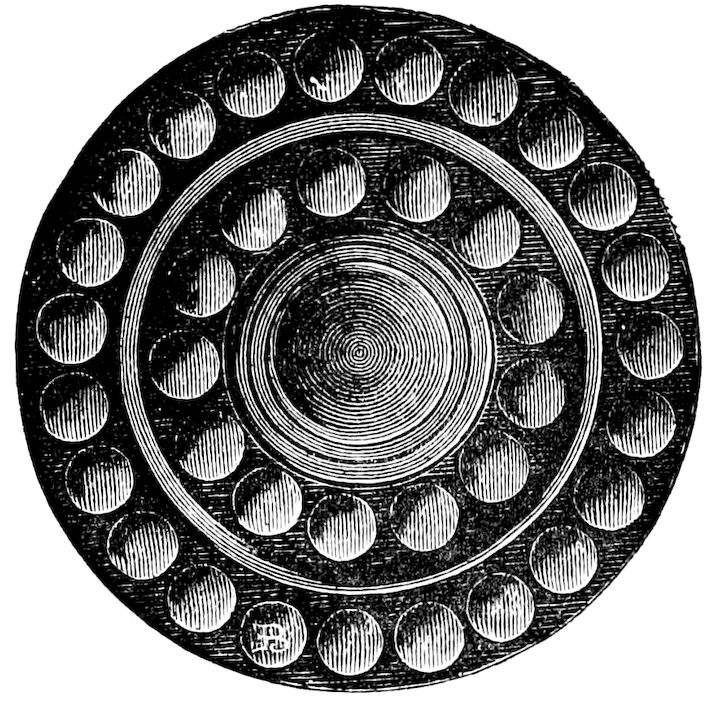
Fig. 169. Clipeus.
Clipeus and Clipeum, R. (akin to καλύπτω, to cover or conceal). A large broad shield of circular shape and concave on the inside. It was of great weight, and formed part of the special equipment of the cavalry. The original clipeus Argolicus was circular, and often likened to the sun: in Roman sculpture it is often oval. The outer rim was termed antyx; the boss in the centre, omphalos, or umbo; a leather strap for the arm, telamon. It was replaced, subsequently, by the Scutum (q.v.). Fig. 169 is an ornamented bronze clipeus, thought to be Gaulish. This term also serves to denote (1) a shield of metal or marble which was employed as an ornament (Fig. 170 represents an ornamental shield, such as was placed on the frieze of a building, and especially in the metopes of the Doric entablature); and (2) an apparatus employed in the laconicum (q.v.) to regulate the temperature. In the illustration to Caldarium a slave may be seen pulling the chains of the clipeus.
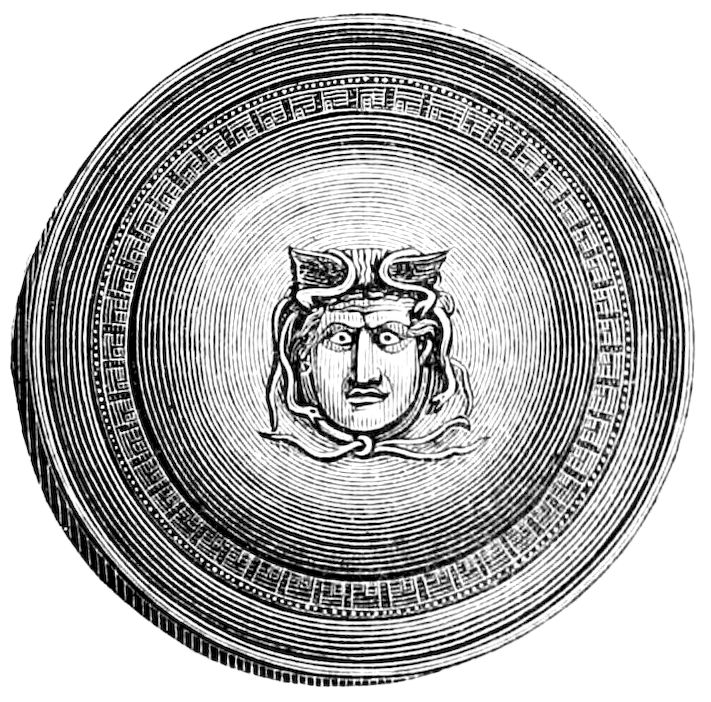
Fig. 170. Ornamental Clipeus.
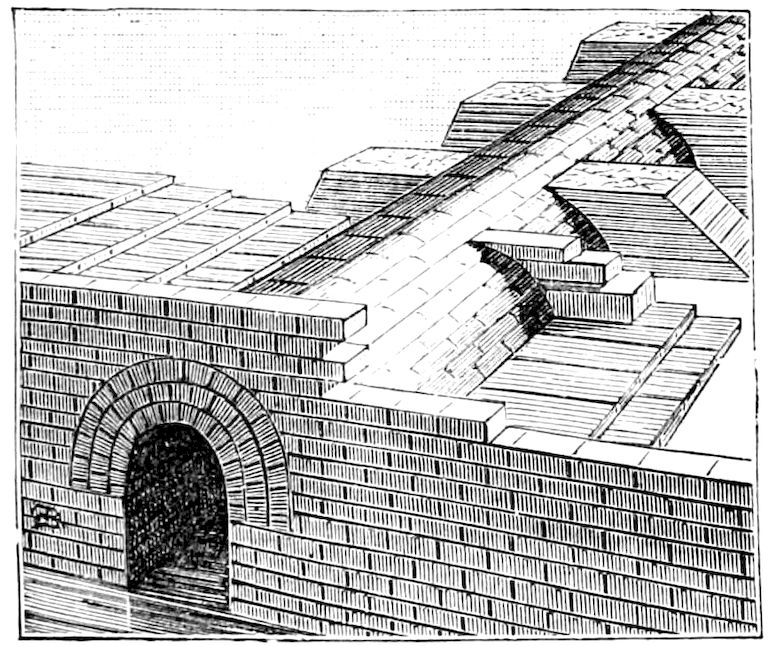
Fig. 171. Cloaca Maxima at Rome.
Cloaca, R. (from cluo, i. e. the cleanser). A subterranean sewer or canal constructed of masonry. The Cloaca Maxima, or Main Sewer of Rome, was constructed by the elder Tarquin to drain a marsh lying at the foot of the Palatine and Capitoline Hills. Fig. 171 represents one of its mouths. It was formed of three tiers of arches, the innermost being fourteen feet in diameter.
Clocks, O. E., “are the gores of a ruff, the laying in of the cloth to make it round, the plaites;” also ornaments on stockings and on hoods.
Clog-almanacks. The Anglo-Saxons calculated by the phases of the moon, set down on square pieces of wood, a foot or two long. These clogs are still common in Staffordshire. (Cf. Plott’s History of Staffordshire; Gough’s Camden’s Britannia, ii. 379.)
Cloish, or Closh, O. E. A kind of ninepins played with a ball. (Strutt, p. 202.) Cf. Club-kayles.
Cloisonné. A form of enamelling by incrustation, in which the pattern is raised by strips of metal or wire welded on.
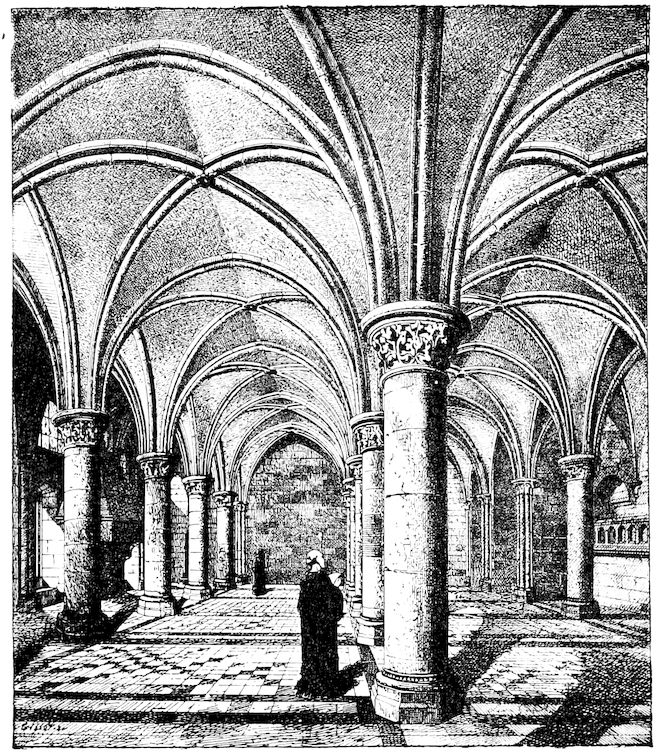
Fig. 173. Cloisters in the Church of Mont St. Michel.
Cloister, Chr. (from Lat. claustrum, q.v.). A kind of court or quadrangle surrounded by a covered way, and having much analogy to the atrium of a Roman house. The cloister was an essential appendage to an abbey. One of its sides was usually bounded by the church, with which it easily communicated. The walls of the cloisters were often adorned with frescoes, and the court was occasionally planted with trees, the centre being occupied by a fountain. A monastery was often called a cloister. The sides of the cloister were anciently termed the Panes of it, and the walks its alleys or deambulatories. (Fig. 173.)
Cloister Garth. The quadrangular space enclosed by the cloisters. The cloister garth at Chichester is still called the Paradise, and that at Chester the Sprise garden. (See Paradise, Sprise.)
Close, Her. With closed wings.
Close-gauntlets. Gauntlets with immovable fingers.
Closet, Her. A diminution of the BAR, one half its width.
Cloths of Estate. Costly embroidered hangings for the canopy of a throne.
Clouée, Her. Fastened with nails, and showing the nail-heads.
Clouts. Old name for kerchiefs.
Clown, in pantomime. Harlequin is Mercury, the Clown Momus, and the painted face and wide mouth taken from the ancient masks; Pantaloon is Charon, and Columbine Psyche. (Clarke’s Travels, viii. 104–7.)
Club, Gr. and R. (Gr. φάλαγξ). This weapon being used in close fight gave its name to the compact body of troops so called. The Scythians united it with the mace, both being spiked. Ducange mentions the vulgastus, a crooked club; the plumbata, loaded with lead, the spontonus with iron. In the army of Charles I. rustics untrained were called clubmen. (See Clava.)
Club-kayles, O. E. Skittles played with a club, instead of a ball. (See Cloish.)
Clubs, at cards, are the ancient trèfles, the trefoil or clover-plant. (See Trefle.)
Cluden, Gr. and R. A sword, the blade of which was contrived to recede into the handle. It was used for theatrical representations.
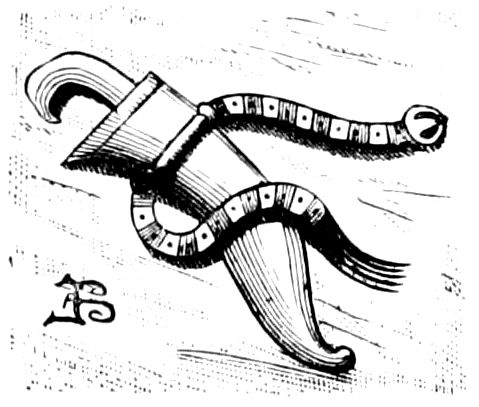
Fig. 174. Clunaculum.
Clunaculum, R. (1) A dagger so called because it was worn at the back; “quia ad clunes pendet,” as Festus says. (2) The sacrificial knife with which the victim was ripped up. The dagger represented in Fig. 174, taken from the arch of Carpentras, was probably a Gaulish clunaculum.
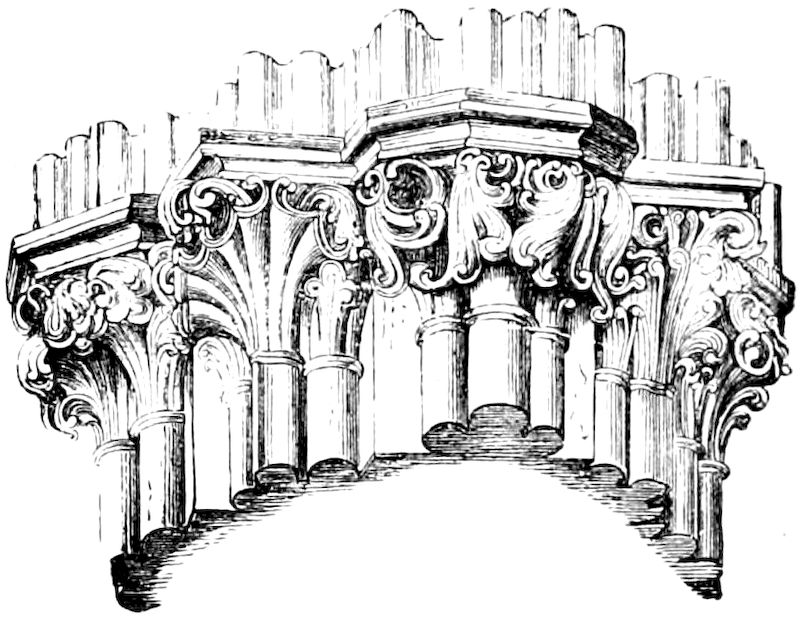
Fig. 172. Clustered column in Nave of Wells Cathedral.
Clustered Column, Arch. A pier formed of a congeries of columns or shafts clustered together, either attached or detached. It is also called a Compound Pier. Fig. 172 is a specimen from Wells Cathedral.
Clypeate. Shaped like a shield.
Cnopstara. A weapon used by the Caledonians; a ball filled with pieces of metal swung at the heads of their lances, to frighten cavalry.
Coa Vestis, or simply Coa (i. e. the Coan robe). A very fine robe [made of silk, spun in Cos], of such light texture as to be almost transparent. It was worn by hetairai and singing and dancing girls, &c.
Coactilis, sc. lana (from cogo, i. e. that which is forced together). A kind of felted cloth made of wool closely pressed together. It formed a texture analogous to our felt. Another name for it was coactus.
Coal as an ancient pigment was used both in water-colours and in oil; it furnishes a brownish tint. “The shadows of flesh are well rendered by pit-coal, which should not be burnt.” (De Mayerne.)
Coassatio (from coasso, to join planks together). A general term for planks joined together, such as the flooring of a room, the top of a table, the deck of a ship, the roadway of a wooden bridge, &c. (See Constratum.)
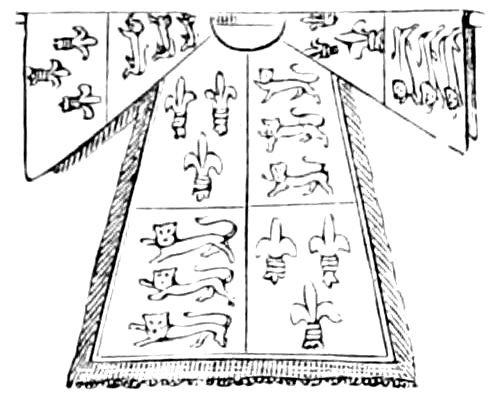
Fig. 175. Coat Armour.
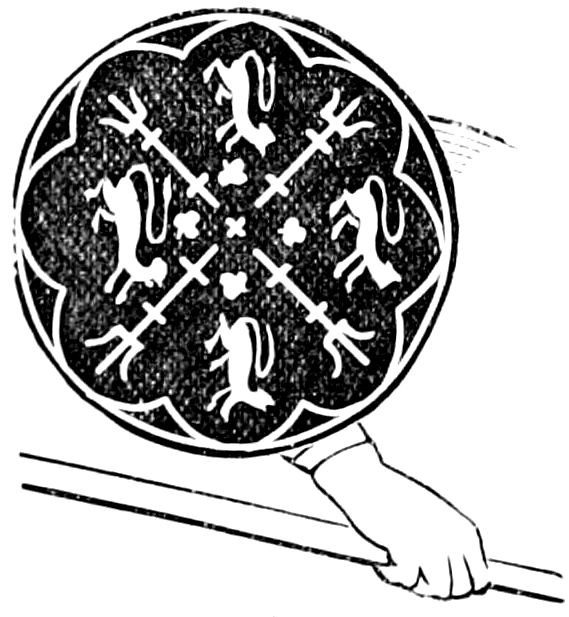
Fig. 176. Coat Armour. Devices on shield.
Coat Armour, Med. Embroidery of heraldic devices upon costume; hence a term for heraldry in general. (Figs. 175 and 176.)
Coat Cards, O. E. Court cards and tens, so named from the coat armour worn by the figures.
Cob. Irish name of a Spanish coin formerly current in Ireland; value about 4s. 8d.
Cobalt. A metal found in various combinations, from which various colouring matters are obtained of great use in the arts. Cobalt blue, a beautiful blue pigment, is obtained by mixing a salt of pure cobalt with a solution of pure alum, precipitating the liquid by an alkaline carbonate, washing the precipitate with care, drying and igniting it strongly. A fine green, known as Rinmann’s green, is similarly prepared. The chloride, the nitrate, and the sulphate of cobalt form sympathetic inks, which only become visible when the moisture is absorbed by the application of heat. From phosphate of cobalt a beautiful blue pigment is produced, called Thenard’s blue. It is said to have all the characters of ultramarine. Oxide of cobalt has the property of colouring glass blue; hence a glass formed of this oxide under the name of smalt is the blue colouring matter used for ornamenting porcelain and earthenware, for staining glass, for painting on enamel, &c.
Cobalt-bloom. (See Erythrine.)
Cobbards, O. E. The irons supporting a spit.
Cob-wall, Arch. A wall formed of unburned clay mixed with straw.
Cochineal. (See Carmine.)
Cochineal Lakes. (See Carminated Lakes.)
Cochlea (κοχλίας, i. e. a snail with spiral shell). Any object of spiral shape, like a screw; and so a worm and screw as a mechanical power in oil-, wine-, &c. presses; the “Archimedean Screw,” or “water-snail” for raising water; the revolving door through which the wild beasts were let out into the amphitheatre; and other contrivances similar to the Italian ruota, by which persons can be introduced through a wall without opening a door; also a spiral staircase, &c.
Cochlear, Cochleare (from κόχλος, a shell-fish). (1) A spoon having at one extremity a sharp point, and at the other a sort of small bowl. (2) A measure of capacity of very small size.
Cochlearium, R. A pond or nursery for fattening snails for the table. (English “cockles.”)
Cochlis, sc. columna (κοχλὶς, i. e. lit. a snail). A hollow monumental column, the interior of which was fitted with a cockle or spiral staircase, like the “Monument” of London.
Cock. In Christian art, the emblem of St. Peter, and of watchfulness.
Cockatrice. In Christian art, the emblem of sin; attribute of St. Vitus. (Her.: see the illustration to Basilisk.)
Cock-bead, Arch. A bead which projects from the surface of the timber on both sides.
Cockers, O. E. Ploughmen’s laced boots.
Cocket, O. E. A seal formerly attached to goods which had paid customs dues. Ancient cockets bear such inscriptions on them as “God willing,” “If God please,” &c.
Cockle-stairs, O. E. Winding stairs. (Cf. Cochlea.)
Coctilis, Cocta, Coctus, R. (prepared by fire). Later coctilis was a brick hardened artificially by fire, in contradistinction to one dried in the sun; murus coctilis, a wall built of hardened bricks. (See Acapna.)
Cocurra, Med. Lat. A quiver.
Cocytia (from Κωκυτὸς, the river of weeping). A festival held in honour of Proserpine, who had been carried off by Pluto. The latter, as king of the infernal regions, included in his sway the river Cocytus. The Cocytus and Acheron, two rivers of Epirus, remarkable for unwholesome and muddy water, and subterranean currents, were hence called the rivers of Hell. “Cocytia virgo” was Alecto, one of the Furies.
Cod, Scotch. A pillow (also pod).
Codex (caudex, the trunk of a tree). (1) A blank book for writing in, consisting of thin tablets of wood covered with wax; the term thus came to mean code, that is, a book containing laws, since these were inscribed in a book, the leaves of which were composed of thin leaves of wood. When parchment or paper was introduced, the term was still applied; and hence, later, became appropriate to any code of laws, e. g. the Gregorian, Theodosian, Justinian, &c. (2) An early manuscript book, such as the Codex of the Greek New Testament and of “Virgil” in the Vatican. (3) The term was also applied to the heavy logs attached to the feet of slaves; these were of various shapes, sometimes even serving the purpose of a seat.
Codicillus (dimin. of Codex, q.v.). A small book, or small leaves of wood covered with wax. The plural codicilli denoted a number of such sheets put together so as to form a sort of memorandum-book for taking rough notes. Any supplemental note made on the margin of the leaves composing a will, or added to them, was also called codicillus (codicil).
Codon (Gr. κώδων). A bell; the bell of a trumpet; a trumpet with a bell-mouth.
Cod-piece (from O. E. “cod,” a pillow or stuffed cushion; Fr. braguette); introduced temp. Henry VIII. An appendage to the taces over the os pubis, copied in the armour of the period. It continued in use to the end of Elizabeth’s reign.
Cœlum. In Architecture, that part of a building which was placed over any other part, and so a ceiling, or soffit.
Cœmeterium, Cemetery, Chr. (κοιμητήριον, from κοιμάω, i. e. a sleeping-place; Lat dormitorium). This term is an exclusively Christian one; it signifies a field of rest or refuge; the last resting-place of man. (See Hypogæum.)
Cœna (from Sanscr. khad-, to eat). The principal meal among the Romans, consisting of several courses termed respectively prima, altera or secunda, tertia, quarta cœna. The hour at which the cœna took place varied with the habits of the master of the house, but it was usually about four or five o’clock. It was the third meal of the day, being preceded by the jentaculum (breakfast), and the merenda or prandium (luncheon or early dinner). The corresponding Greek meal was called deipnon, which closed with a libation to Zeus; after which the drinking party that remained was called Symposium. (See Last Supper.)
Cœnaculum. In early times this term was used for the Triclinium (q.v.); later on it came to mean the upper stories of houses inhabited by the poor, our attic or garret. In the plural, cœnacula denotes the whole suite of rooms on the upper story of a house, and cœnacula meritoria such apartments let out on hire.
Cœnatio, like cœnaculum, a dining-room situated upstairs. It thus differed from the Triclinium (q.v.), which was a dining-room on the ground floor; the former was used in winter, the latter in summer. The cœnatio, or diæta, was a very magnificent apartment. Nero had one in his golden palace, constructed like a theatre, with a change of scenery for every course.
Cœnatoria, Cœnatoriæ Vestes. The garments worn by the Romans at the dinner-table.
Cœnobium (κοινό-βιον, i. e. a life in common). A monastery; a convent of monks who lived in common.
Cœur, Carreau, Pique, and Trèfle. The four French suits of cards, corresponding with our Hearts, Diamonds, Spades, and Clubs, probably introduced in the reign of Charles VII. of France (15th century). (Taylor.) Cœur is sometimes derived from Chœur. (See Coppe and Chatrang.)
“The hearts are the ecclesiastics, whose place is in the choir; the pike the military, &c.” (Menestrier.)
Coffer. (See Arca.) (1) In Architecture, a sunken panel in a ceiling or soffit. (2) A chest.
Cognizance, Her. Synonym for Badge.
Cogware, O. E. A coarse narrow cloth like frieze; 16th century.
Cohors, Cohort, R. A body of infantry forming the tenth part of a legion. The number of men composing a cohort varied at different periods between 300 and 600 men, according to the numerical strength of the legion. The first cohort of a legion was called a military cohort; the prætorian cohort formed the general’s body-guard, while to the city cohort was entrusted the protection of the city. The term was sometimes, though very rarely, applied to a squadron of cavalry.
Coif or Quoif. A close hood.
Coif de Fer, Coiffette. A skull-cap of iron of the 12th and 13th centuries.
Coif de Mailles. A hood of mail worn by knights in the 12th century.
Coiffe, Arch. A term employed during the 16th and 17th centuries to denote the vaulted ceiling of an apse.
Coillon. (See Coin.)
Coin or Coigne, Arch. The corner of a building. (See Quoin.)
Coin-stones, Arch. Corner-stones.
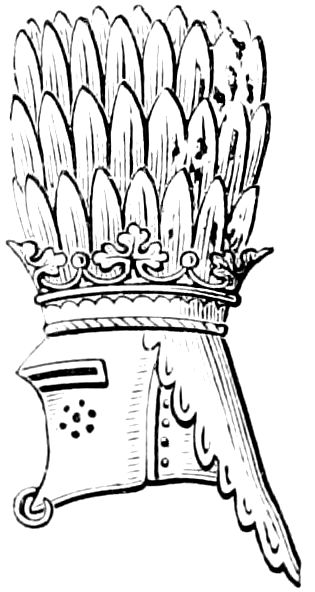
Fig. 177. Helmet with Cointise behind.
Cointise or Quintise. (1) A scarf wrapped round the body, and sometimes attached to the helmet. (2) Quaintly-cut coverings for the helmet. Fig. 177 represents a helmet decorated with PANACHE, CORO. E., and cointise. This is the origin of mantling in heraldry. (3) A garment worn over armour, temp. Edward II., was so termed. (4) Horses’ caparisons.
Colatorium. A colander. (See Collum Vinarium.)
Colayn Riban, O. E. An ecclesiastical textile, or orphrey web, for the manufacture of which Cologne was famous in the 15th century.
Colcothar of Vitriol. A red pigment formerly called caput mortuum.
Cold-harbour. This common topical name is the Anglo-Saxon ceald-herberga, cold “herberge” or shelter, and probably indicates a place where the ruins of a Roman villa or station were the only available shelter for travellers, in the ancient scarcity of inns.
Collar (of a shaft), Arch. The Annulet (q.v.). (See also Collar-beam.)
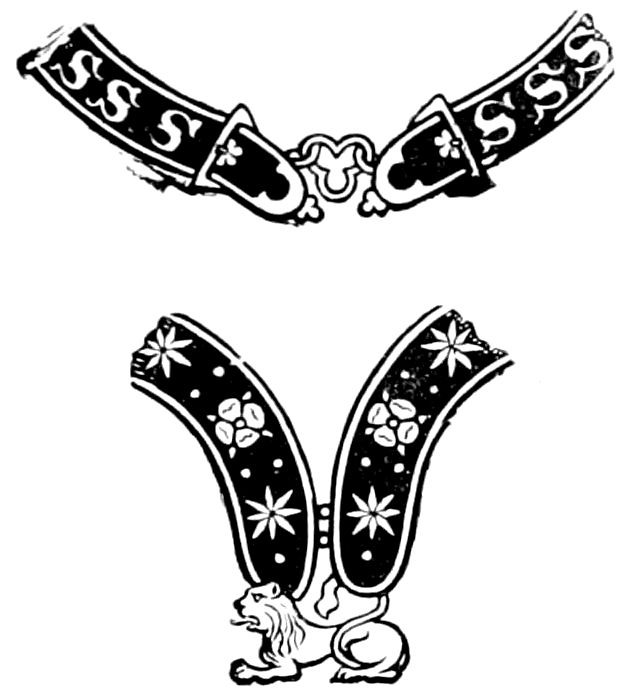
Fig. 178. Collar of Lancaster.
Collar, Med. (1) A defence of mail or plate for the neck. (2) Generally. An ornament for the neck. The Egyptians, Persians, Greeks, Romans, and Gauls wore collars, which were named variously streptos (στρεπτὸς), torquis, torques, &c. Collars were ornamented with heraldic badges in the Middle Ages. (3) Heraldic. One of the insignia of the orders of knighthood. (See Fig. 178.)
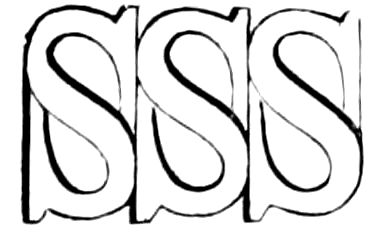
Fig. 179. Collar of S.S.
Collar of S.S. Originally adopted by Henry IV., on the canopy of whose tomb it is employed as decoration over the arms of himself and his queen. Its significance is doubtful. Camden says the letters are the initials of Sanctus Simo Simplicius, an eminent Roman lawyer, and that it was particularly worn by persons of the legal profession.
Collar-beam, Arch. A horizontal tie, connecting a pair of rafters together, across the vault of a roof.
Collare, R. (collum, neck). A collar made of iron or leather, and studded with spikes. It was used both to confine slaves, and as a dog-collar. When a slave ran away from his master, an iron collar, with a leading-chain attached to it, was put round his neck.
Collarium, Med. Armour for the neck.
Collegium, R. A religious or industrial corporation in ancient Rome. The corresponding Greek institutions were the Hetairiai. The collegia included trade companies or guilds.
Collet. The setting which surrounds the stone of a ring. (See Crampon.)
Colliciæ, Colliquiæ. (1) Broad open drains through fields. (2) Gutters of hollow tiles (umbrices) placed beneath the roof of a house to receive the rain-water, and convey it into the Impluvium.
Colliciaris (sc. tegula). A hollow tile employed in the construction of colliciæ.
Collodion. A solution of gun cotton in ether, used in photography.
Collum Vinarium (from collum, a neck). A colander or wine-strainer. The custom of straining wine dates back beyond our era, and Christ made an allusion to it when he told the Pharisees that their colla allowed a camel to pass, while they kept back a gnat. Snow was put into a strainer or a bag, called respectively collum nivarium, saccus nivarius, through which the wine was allowed to filter, not only to cool it, but because the intense cold cleared the wine, and rendered it sparkling and transparent; it was then called vinum saccatum. The Christian Church from the first adopted this instrument in its liturgy; another name for it was colatorium. (See Nassa.) The colander for wine was made of silver, or bronze, or other metal. The linen cloth called saccus was not used for wine of any delicacy, as it spoiled its flavour.
Colluviarium, R. An opening made at regular intervals in the channel of an aqueduct, for ventilation. As this opening formed a kind of well, it was also called Puteus (q.v.).
Collyra, Gr. and R. A kind of bread made in a special manner, which was eaten with soup or sauce; there was also a cake so called.
Collyris (κολλυρὶς, synonym of κολλύρα, q.v.). A head-dress worn by Roman ladies, resembling in shape the bread called κολλύρα; the latter was called κολλυρὶς as well.
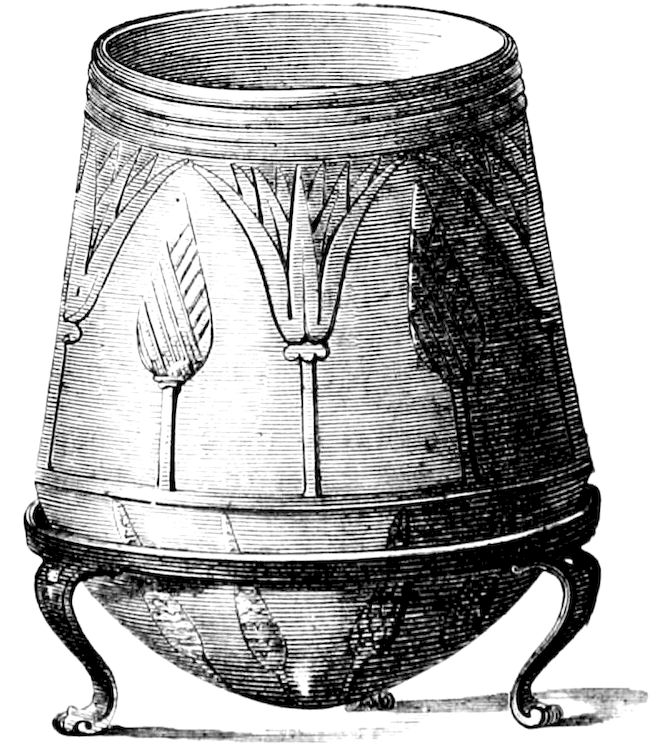
Fig. 180. Collyrium or unguent Vase; Egyptian. Museum of the Louvre.
Collyrium (κολλύριον, dimin. of κολλύρα, q.v.). (1) A term denoting anything we should now call an unguent, but especially the salve collyrium, which was a liquid medicament. (2) Collyria was a term applied to Egyptian vases of terra-cotta, with or without enamel; to small quadrangular boxes of wood or pottery; and, lastly, to small cylindrical cases of wood or bronze divided into compartments. There were three prevailing forms of the vases. The Egyptians used antimony to make their eyes look larger, and had some medicament for the relief of toothache; and inscriptions indicating these uses may be read upon vessels of this kind. (Fig. 180).
Colne, O. E. A basket or coop.
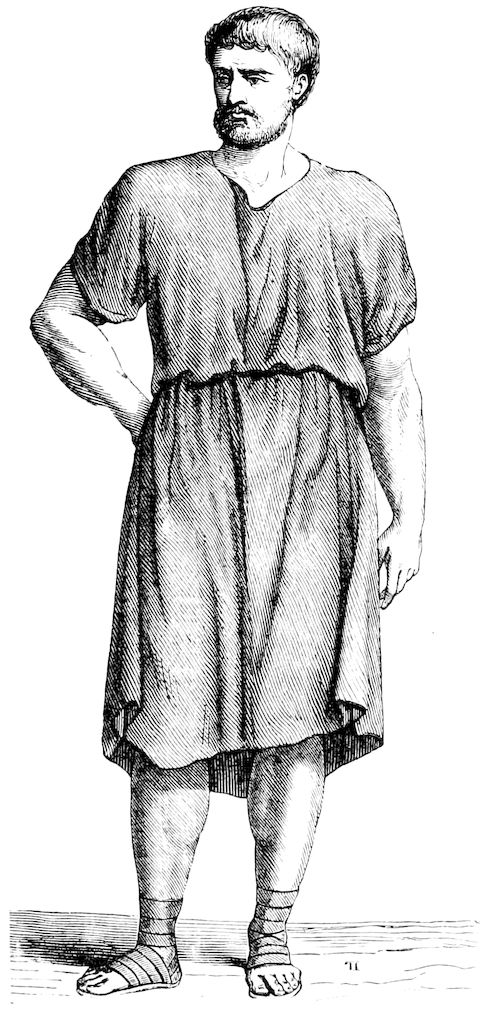
Fig. 181. Roman Plebeian wearing the Colobium.
Colobium (from κολοβὸς, docked or curtailed). A tunic with short sleeves, which scarcely covered the upper part of the arm. At Rome it was worn by men of free birth. The colobium appears to have been the first dress adopted by Christian deacons, and in the liturgical writings it is often met with under the name of levitonarium; when it was of fine linen, it was also called lebiton and lebitonarium. (Fig. 181.) Later on the sleeves were lengthened, and it became known as the Dalmatic (q.v.).
Cologne Black. (See Black.)
Cologne Earth. A bituminous earth of a violet-brown hue, transparent and durable in water-colour painting.
Colonica. Synonym of villa rustica. A farmhouse.
Color, Lat. (1) The term is used in several senses in mediæval treatises upon music, with a general idea of a quality of tone obtained by striking variations. (2) The coloured lines used in transcribing music. (See Neumes.)
Colores Austeri. Ancient pigments, not floridi.
Colores Floridi. Ancient expensive and brilliant pigments. They were chrysocollum, indicum (or indigo), cæruleum (smalt), and cinnabar.
Colossus (κολοσσός). The word was used for all statues larger than life; that at Rhodes was ninety feet high. The Minerva and Jupiter Olympus of Pheidias, the Farnese Hercules, and the Flora of the Belvidere, were all colossal.
Colours, in Heraldry, are five: Blue or Azure, Red or Gules, Black or Sable, Green or Vert, Purple or Purpure. In French heraldry Green is Sinope. The uses and general symbolism of each colour are described under its own heading. The best work on symbolic colours is the “Essay” of M. Portal. One of the best on the theory of colours is that of Chevreuil.
Colubrina, Med. Lat. (from coluber, a snake). A culverin.
Columbar, R. A kind of pillory used for punishing slaves. The instrument derived its name from the holes in it, which bore some resemblance to pigeon-holes.
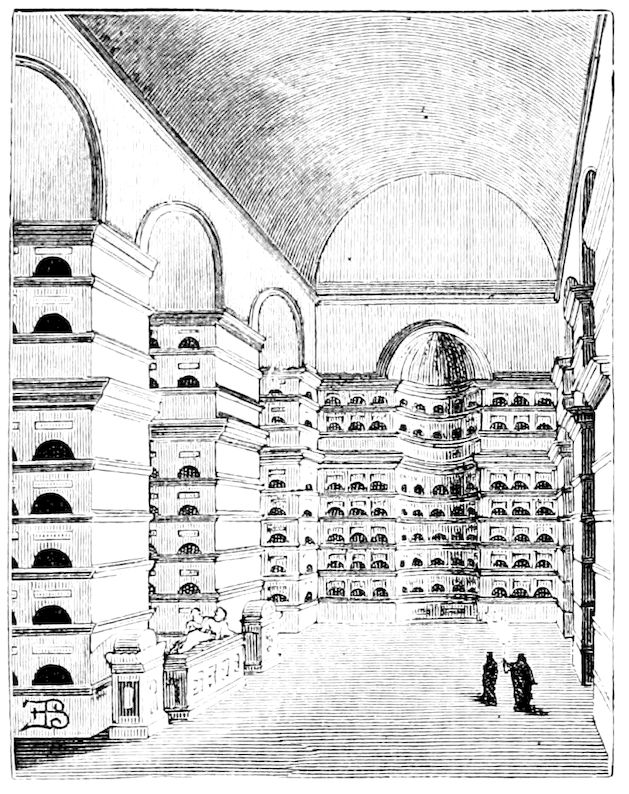
Fig. 182. Columbarium.
Columbarium. A dove-cote or pigeon-house, often constructed to hold as many as 4000 or 5000 birds. In the plural the term has many meanings. (1) It denotes the pigeon-holes or cells for the nests in a pigeon-house. (2) In a sepulchral chamber, the niches for holding the cinerary urns (ollæ). Fig. 182 represents the numerous columbaria in the tomb of the freedmen of Octavia. In the sepulchral architecture of the Jews, the rock-hewn walls forming the vestibules of certain tombs were honey-combed with minute columbaria, in which only lamps were placed. Fig. 183 represents cells of this character taken from the tomb of Quoublet-el-Endeh. (3) The openings in the side of a ship through which the oars passed. (4) The holes made in a wall to receive the head of a tie-beam. (5) The openings of the scoops in a particular kind of hydraulic wheel called Tympanum (q.v.).
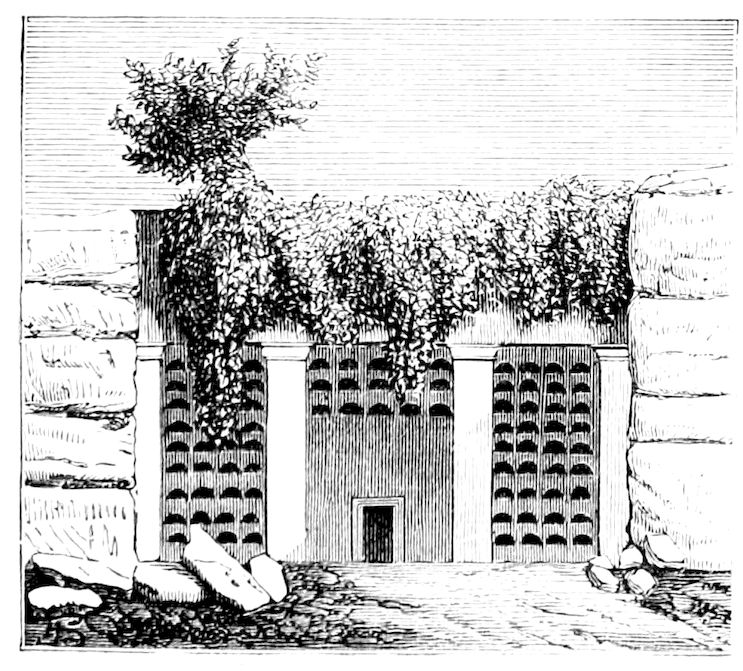
Fig. 183. Columbaria in rock-hewn walls.
Columella. Dimin. of columna. (See Column, Cippus.)
Columen, Gr. and R. The highest timber in the framework of a roof, forming what is now called the ridgepiece.
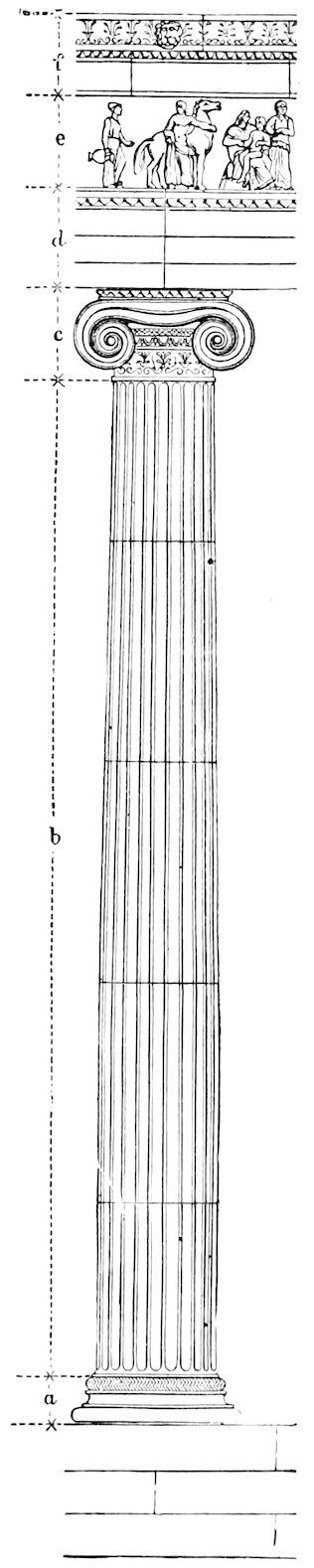
Fig. 184. Ionic column.
Column, Arch. A column consists of three principal parts: the base (a), the shaft (b), and the capital (c). In the Doric, or most ancient style, the columns in a row rest upon a common base (podium). In the Ionic and Corinthian, each column has its own base (spira). The shaft of all columns tapers gradually from the base to the capital. Any swelling introduced to modify the straightness of the line was called entasis. On the summit of a row of columns rests the architrave, or chief beam (d); above this the frieze (e), and the cornice (f) projects above the frieze. These three together are called the entablature. The triangular gable-end of the roof, above the entablature, is called the pediment. A circuit of columns, enclosing an open space in the interior of a building, was called a peristyle. A temple of two stories, with one peristyle upon another (Ionic or Corinthian columns over the heavier Doric), was called hypæthral. In Christian archæology the column is a symbol of the Church, which was called, so early as St. Paul, columna et firmitatum veritatis (the column and support of truth).
Colures. In Astronomy, the two circles which pass through the four cardinal points of the ecliptic—the equinoctial and solstitial points.
Coluria, Arch. Circular segments of stone, in the construction of a column, such as are now called tambours or disks.
Colus. A distaff. With the Romans it consisted of a thick cane (arundo, donax), split at the end in such a way that the opening formed a basket. Compta, plena, or lana amicta were the epithets applied to a colus when filled with wool. The thread obtained from it was called stamen. The ball of loose wool at one end, prepared for spinning, was called glomus. The lower end of the distaff rested under the left arm; the right hand spun and wound the thread on to the spindles (called fusus). (See Distaff.)
Colymbion, Chr., Med. A vessel for holy water at the entrance of a church.
Colymbus, Gr. and R. A basin or reservoir used either as a swimming-bath or for washing linen in.
Coma (κόμη). (1) The hair; hair of the head. (2) The mane of animals. (See Cæsaries, Cincinnus, Hair, &c.)
Comatorius or Comatoria (sc. acus). A long pin or bodkin of gold, silver, bronze, or ivory, used by the Roman ladies to keep up their hair when plaited. It was also called Acus Crinalis (q.v.). (Compare Discerniculum.)
Combattant, Her. Said of lions, or other animals of prey, rampant and face to face.
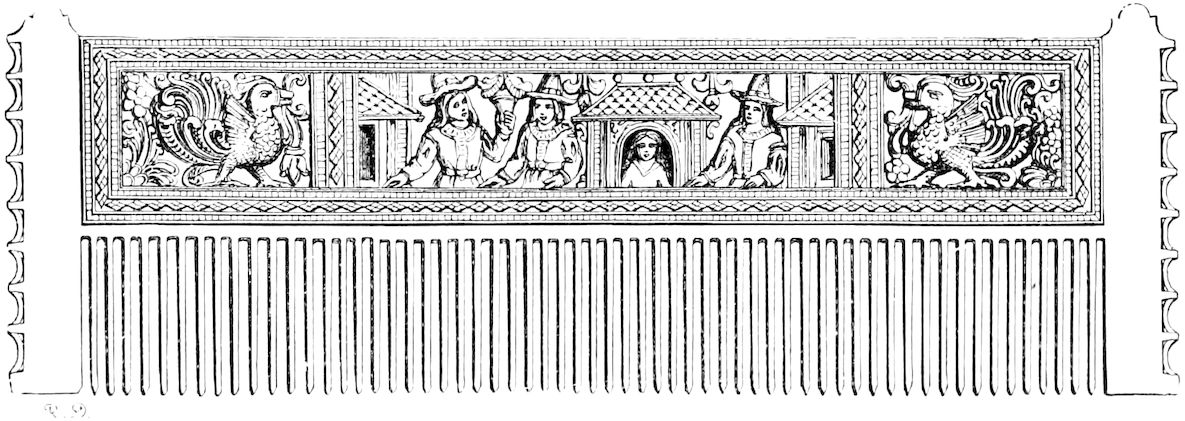
Fig. 185. Ancient Carved Ivory Comb.
Combs (Lat. pecten, Gr. κτεὶς), as used for combing the hair, but not for wearing upon the head, are found in Pompeian and Egyptian tombs, and in the early British, Roman, and Saxon barrows. In the Middle Ages ivory combs were richly carved, and the ceremonial combs for use in ecclesiastical ceremonies are especially splendid. Greek and Roman combs were of box-wood; Egyptian combs were of ivory. Uncombed hair was a general sign of mourning. (See Discerniculum.)
Commentaculum (from commento, to strike on the face). A staff or wand carried in sacred processions by the Roman priests to assist them in clearing a way and preventing the people from pressing in on them too closely. Commotaculum was also used.
Commissatio (from commissor, to revel). A revelling or feasting which began after the Cœna (q.v.), and lasted far on into the night. (See Symposium.)
Commistio or Commixtio, Chr. The placing of a portion of the bread into the chalice of wine, during the ceremony of consecration.
Common-house. The part of a monastery in which a fire was kept for the monks during winter.
Communicales, Chr. Communion vessels, made especially to be carried in procession in Rome.
Compass. In Music, the whole range of sounds capable of being produced by a voice or instrument.
Compass-headed, Arch. A semicircular arch.
Compass Roof, Arch. An open timber roof.
Compass Window, Arch. A bay-window on a circular plan.
Compes. (1) A ring of gold or silver worn by the Romans round the leg, just above the ankle. (2) The chains or shackles worn round the ankle by slaves or prisoners.
Compitalia, Compitales. A festival held by the Romans in honour of the Lares compitales, celebrated in the cross-roads, compitia, where the images of those deities were often placed in niches.
Complement, Her. Applied to the moon, when full.
Complement. In Music, the interval to be added to another interval to make an octave; e.g. a third to a sixth; a fourth to a fifth, &c.
Complementary Colours. If the whole of the light which is absorbed by a coloured body were reunited with the whole of the light which it reflects, white light would result; in this case the absorbed colours are complementary to those which are reflected. The colour given by a mixture of the colours of any portion of a spectrum is the complement of the remaining portion. Red is complementary to Green, Orange to Blue, Greenish-Yellow to Violet, Indigo to Orange Yellow, and, in each case, vice versâ.
Completorium, Chr. The last of the Hours of Prayer.
Compline, Chr. Short evening prayers completing the daily round of devotion prescribed by the Hours of Prayer.
Compluvium, R. An opening in the roof of the atrium, furnished with gutters all round, which collected the rain-water from the roof, and conveyed it into the basin (impluvium) in the middle of the atrium.
Compon-covert, O. E. A kind of lace.
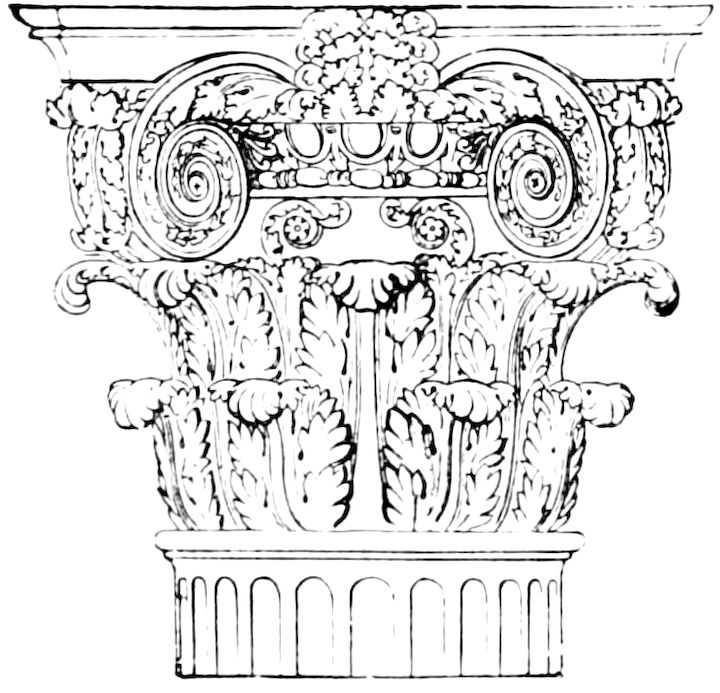
Fig. 186. Capital of the Composite Order.
Composite Order of Architecture. The last of the five Roman orders, composed of the Ionic grafted upon the Corinthian order. The examples at Rome are in the arch of Septimus Severus, the arch of the Goldsmiths, the arch of Titus, the temple of Bacchus, and the baths of Diocletian.
Compound Arch, Arch. A usual form of mediæval arch, which “may be resolved into a number of concentric archways, successively placed within and behind each other.” (Prof. Willis.)
Compound Pier, Arch. A clustered Column (q.v.).
Compounded Arms, Her. Bearings of two or more distinct coats combined, to produce a single compound coat.
Comus (Gr. κῶμος). (1) A revel, or carousal which usually ended in the guests parading the streets crowned with garlands, &c. (2) Festal processions instituted in honour of Bacchus and other gods, and of the victors at the games. (3) Odes written to be sung at such processions, e. g. those of Pindar.
Comus (Gr. κομμὸς, from κόπτω, to strike). (1) A beating of the head and breast in lamentation; a dirge. (2) A mournful song sung in alternate verses by an actor and a chorus in the Attic drama.
Concædes. A barricade constructed of trees which have been cut down and placed across the road (to impede the enemy’s march).
Concamerate, Arch. To arch over; to vault.
Concave. Hollowed in; opposed to convex, bulging out.
Concha (lit. a muscle or cockle). (1) A shell or shell-fish. (2) A Triton’s conch. In works of art, the Triton, or sea-god, has for a trumpet the buccina, remarkable for a spiral twist, long and straight; or the murex, equally twisted, but short and wide-mouthed. (3) The term was applied, by analogy, to various objects having the shape of a shell, such as cups or vases used for holding perfumes or for other purposes. (4) In Architecture, an apse, or a plain concave of a dome, is so called.
Conchoid. A mathematical curve in the form of the outline of a shell.
Conclave (with a key), Chr. (1) A meeting of cardinals assembled to elect a pope; and (2) the hall or apartment in which such meeting is held. The institution of the conclave dates from Gregory X.
Concrete, Arch. A mixture of gravel, pebbles, or broken stone with cement.
Condalium (κονδύλιον, dimin. of κόνδυλος, a knob or joint). A ring generally worn upon the first joint of the forefinger on the right hand.
Conditivium, Conditorium. (1) An underground vault in which were chests or coffins for holding bodies which had not been reduced to ashes. (2) A sarcophagus in which the body was placed. (3) A kind of arsenal or magazine in which military engines were kept.
Condrak, O. E. A kind of lace.
Condyle. A knuckle; the rounded end of a bone; hence—
Condyloid. Shaped like a condyle; and
Condylus. Synonym of Condalium (q.v.).
Cone. A figure broad and round at the base, tapering upwards regularly towards a point.
Coney, Cony, O. E. (1) A variety of the rabbit. (2) A beehive.
Confessio, Chr. Originally the place where a saint or martyr was buried; thence the altar raised over his grave; and subsequently the chapel or basilica built there.
Congé, Arch. The cavetto (hollow moulding) which unites the base and capital of a column to its shaft.
Congius (deriv. doubtful). A Roman measure containing six sextarii or twelve heminæ. It was used especially for measuring liquids. Angl. a pint and a half.
Conic Sections. Curves formed by the intersection of a cone and a plane; the circle, the ellipse, the hyperbola, and the parabola.
Conisterium, Gr. and R. A room in which wrestlers, after having had oil applied to their bodies, were rubbed over with fine sand (κόνις). The conisterium was an appendage to a palæstrum, gymnasium, &c.
Conopeum, Canopium, Gr. and R. (from κώνωψ, a gnat). A musquito-net, of very light material, introduced into Rome from Egypt. [This is the origin of the English word canopy.]
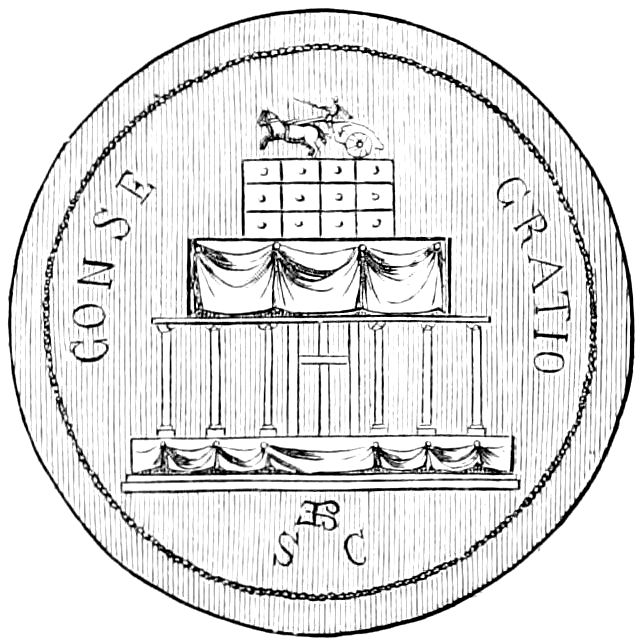
Fig. 187. Consecrated pyre on Roman medal.
Consecratio, R. A kind of apotheosis or deification by which a mortal was enrolled in the number of the gods. It was unknown under the republic, and was only instituted in the time and on behalf of the emperors. The ceremony was solemnized in the Field of Mars, and with the greatest splendour. A magnificent pyre was raised, from the top of which, when kindled, an eagle was let fly, which was supposed to carry up to the skies the soul of the deified emperor. Fig. 187, taken from a medal, represents one of these pyres.
Consentiæ, Gr. and R. Festivals held in honour of the twelve principal divinities of Rome or Greece.
Consignatorium Ablutorum, Chr. In early times there were baptisteries near churches, with a place closely adjoining in which to administer the rite of confirmation; it was the place specially set apart for the administration of this rite that was called consignatorium ablutorum.
Console. A projecting ornament, in wood or stone, used as a bracket.
Constant White. Sulphate of Barytes (q.v.).
Constellations. Groups of stars, mostly with classical names. Ancient C., forty-eight formed by Ptolemy in A. D. 150, with two others added by Tycho Brahe; Modern C., fifty-nine others since formed, many by Helvetius at the end of the 17th century. (Rossiter.)
Constratum, R. A flooring constructed of planks. (See Coassatio.)
Consualia, R. A festival of ancient Rome held in honour of the god Consus. It was from this festival that the games of the circus took their rise. Livy calls the god Neptunus Equestris. The feast was held with horse and chariot races. Horses and mules did no work, and were crowned with garlands during its celebration. The Rape of the Sabines took place at the first Consualia.
Contabulatio, R. The long parallel folds formed in any garment of ample size, such as the toga, palla, and pallium.
Contignatio, R. (a joining together of beams). The wood-work of beams and joists supporting the flooring in a building of several stories. The term is also used to denote the flooring and sometimes the story itself.
Continuous Impost, Arch. In Gothic architecture, the mouldings of an arch, when carried down to the ground without interruption, or anything to mark the impost-joint. (Newlands.)
Contoise, Fr. A flowing scarf worn attached to the helmet before 1350. (See Cointise.)
Contomonobolum, R. A game which consisted in leaping over a wide space by aid of a pole (contus) which was used as a fulcrum.
Contorniate. A class of antique medals having the contour, or edge, marked with a deep cut. They generally have monograms on the obverse, and scenes of mythology on the reverse.
Contour, Fr. Outline.
Contournée, Her. Facing to the sinister.
Contra, in compound words in music, signifies an octave below: contra-basso, a double bass, &c.
Contra Votum, Chr. (i. e. against one’s desires). A formula of grief, placed by the ancients on tombs, columns, and other sepulchral monuments, and adopted by Christians in the 5th century. (See Acclamations.)
Contractura, R. The tapering of the column, which begins from the upper part of the shaft, and gradually widens as it reaches the base. (See Entasis.)
Contralto, It. In Music, the voice of deepest tone in females, allied to the tenor in men.
Contrapuntal, Mus. Relating to Counterpoint (q.v.).
Contre-imbrications. An ornament cut in the form of fishes’ scales overlapping one another, the scales being indented. In the imbrications they stand out.
Contrepoint, O. E. (See Pourpoint.)
Contubernium, R. (1) A tent capable of accommodating ten soldiers and their corporal (decanus). (2) A dwelling-place, especially for slaves. Hence contubernales came to mean comrades, and generally persons living in intimacy under one roof together.
Contus (κοντὸς), Gr. and R. (1) A punting-pole, used also for taking soundings; each trireme was furnished with three poles of different lengths. (2) A cavalry pike or lance.
Conus, Gen. (κῶνος, a cone). (1) In general, any object of a conical form. (2) A kind of sun-dial described upon a hollow cone. (3) The metal ridge at the top of a helmet, to which the plume was attached. (See Fig. 252.)
Convivium, R. A banquet which generally took place at about the same hour as the cœna, but which was never followed by a commissatio. (See Cœna, Commissatio.)
Coopertorium, R. (that which covers). A rug of coarse cloth; a kind of blanket.
Cop, O. E. Generally the top of anything; a mound or heap. (See Battlement.)
Copal. A hard resin, which, dissolved in boiling linseed oil, forms an excellent varnish for pictures. It is also used as a vehicle for painting. The South African copal is the finest in quality. (See Varnish.)
Copatain, O. E. A sugar-loaf hat; “a copped-crown hat.”
Cope, Chr. A sacerdotal garment, also called a pluvial, because it was originally worn by priests in processions as a protection against the rain. It was open in the front, and fastened on the breast by a “morse” or clasp. In the primitive Church the cope was furnished with a hood, and hence mentioned as Cuculla.
Cope, Arch. To top a wall with thin bricks or stone.
Coperone, O. E., Arch. A pinnacle.
Cop-halfpenny, O. E. The game of “heads and tails.”
Cop-head, O. E. A crest of feathers or hair on an animal’s head.
Coping, Arch. The capping or covering of a wall, generally sloping to throw off rain. In Fig. 77 two of the merlons are coped.
Cophinus. Gr. and R. A large shallow wicker basket used for agricultural purposes. Cophinus et fænum, “a basket of hay,” is Juvenal’s word for the poor man’s bed. Compare English coffin.
Coppa Puerpera, It. Caudle-cup.
Coppe (It.), Cups (Sp. copa). The early Italian suit of playing cards corresponding to hearts. The Rev. E. S. Taylor suggests, “The notion of hearts, as the seat of the affections, &c., is in connexion with the office of the clergy;” hence the chalices. (See Cœur.)
Copped, O. E. Crested. (For Cop-head, q.v.)
Copperas (white) is considered the safest metallic drier for pigments and varnish.
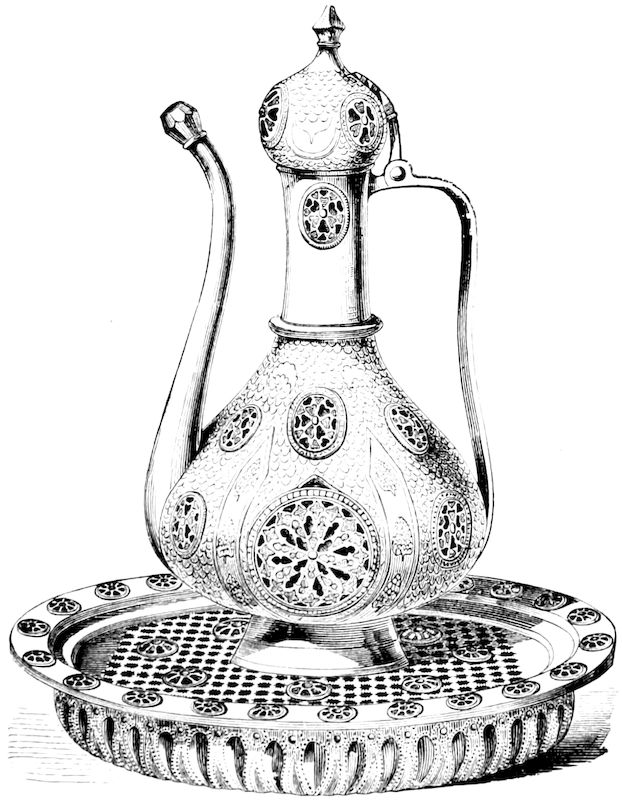
Fig. 188. Ewer and basin of enamelled copper (Turkish).
Copper-enamelling. (Fig. 188.) (See Enamels.)
Copper-plate Engraving. (See Chalcography.)
Coppet, O. E. Saucy.
Coppid, O. E. Peaked; referring to the fashion of the long peaked toe.
Copple-crowned, O. E. With a head high and rising up, said of a boy “with his hair on end.”
Coppull, O. E. A hen’s name (in the Turnament of Tottenham).
Cops or Merlons, Arch. The raised parts of a battlement. (See Fig. 77.)
Coracle, O. E. A boat of wicker-work covered with hides.
Coracoid (κόραξ, a crow). In the form of a crow’s beak, e. g. a bone in the shoulder-blade.
Coral (see Amulets) is mentioned in the Lapidarium of Marbodus as a very favourite and potent amulet.
“Wondrous its power, so Zoroaster sings,
And to the wearer sure protection brings.
And, lest they harm ship, land, or house, it binds
The scorching lightning and the furious winds.
Sprinkled ‘mid climbing vines or olives’ rows,
Or with the seed the patient rustic sows,
’Twill from thy crops avert the arrowy hail,
And with abundance bless the smiling vale.”
(King, Antique Gems.)
Coranach, Coronach, Gaelic (corah-rainach, a crying together). A dirge.
Coranto, It. An Italian form of the country dance or jig.
Corazza, O. E. A cuirass.
Corbel, Arch. A projecting bracket supporting a pier, cornice, or column.
Corbel Steps, Arch. Steps into which the outlines of a gable are sometimes broken; also called Corbie Steps.
Corbel Table. A term in mediæval architecture, applied to a projecting course and the row of corbels which support it.
Corbie, Scotch. A raven; hence a “corbie messenger,” one that is long upon his errand, like the raven sent from the ark, who returned not again.
Corbie Steps. (See Corbel Steps.)
Corbis, R. A wicker basket of conical shape, used especially for agricultural purposes. A similar basket in every-day use in parts of Italy is still called “la corbella.” Cf. the German “Korb.”
Corbita, R. A merchantman of the larger class, so called because it hung out a basket at the masthead. These vessels were also called onerariæ.
Corbona Ecclesiæ, Chr. The treasure of a church, accumulated from the offerings of communicants at the Sacrament. The Greek synonym for this term is gazophylacium.
Corbula. Dimin. of Corbis (q.v.).
Corce, O. E. The body, stomach.
“He start to hym with gret force,
And hyt hym egurly on the corce!”
(Old MS.)
Cordate, Cordiform. Heart-shaped.
Cordax, Gr. and R. A dance of the ancient Greek comedy of a ridiculous and indecent character. Fauns and satyrs are constantly represented dancing the cordax.
Cordeliers, Fr. The Franciscan friars are so called from the rope girdles they wear.
Cordevan, O. E. A leather of goat-skin, originally from Cordova in Spain. Spelt also Cordewayne; hence cordwainer or cordiner, a shoemaker.
Cordigard, Med. (from the French corps de garde). A detachment of troops appointed for a particular service.
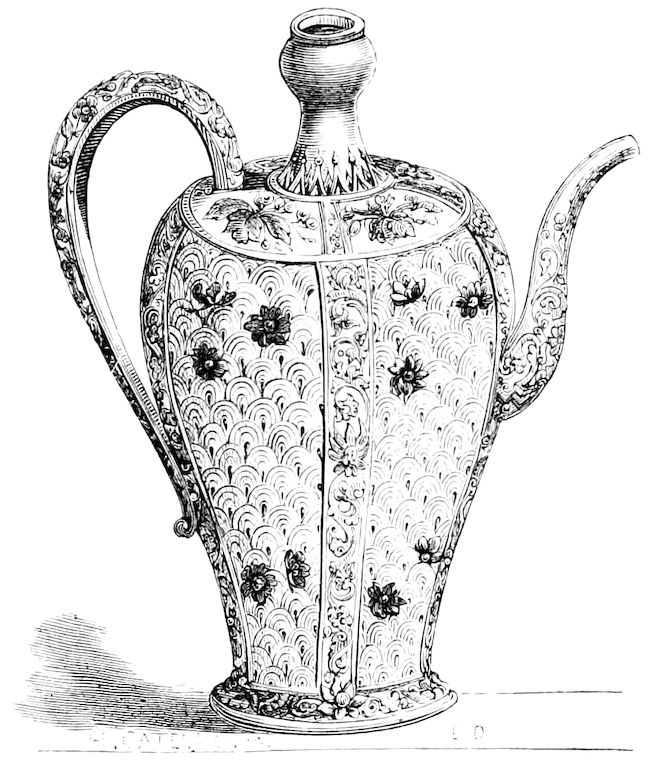
Fig. 189. Corean tea-pot. (About A. D. 1562.)
Corean Porcelain, from a country intermediate between China and Japan, combines the qualities of the most ancient art of each. The tea-pot represented in Fig. 189 is covered with gravings in the paste imitating the waves of the ocean, and shows four times repeated an imperial Japanese device, by which it appears that the piece was destined for the Mikado.
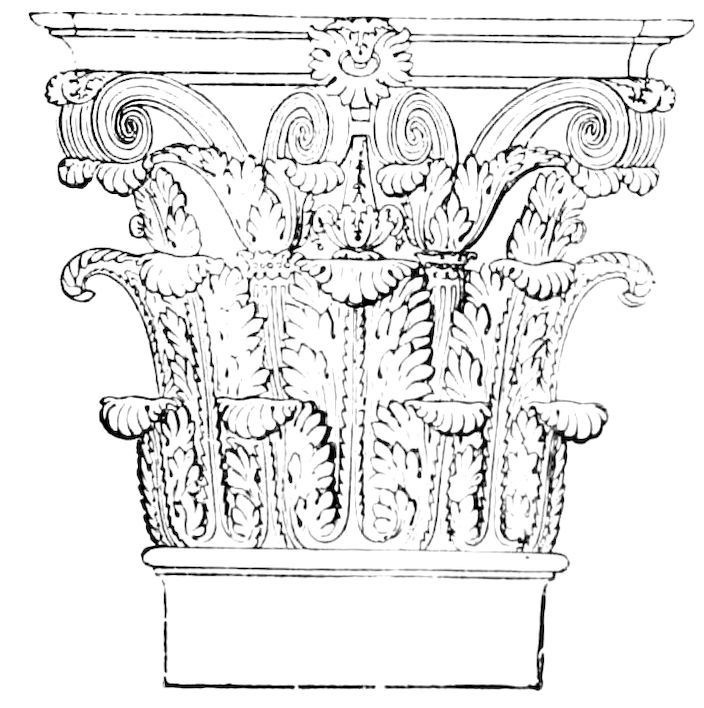
Fig. 190. Capital of the Corinthian Order.
Corinthian Order of Architecture. This order originated in Greece, and the capital is said to have been suggested by observing a tile placed on a basket left in a garden, and an acanthus growing round it. The principal distinction of this order is its capital, richly ornamented with leaves and flowers. Among the principal Corinthian examples are the temple of Vesta, the basilica of Antoninus, and the temples of Jupiter Tonans and Jupiter Stator; all at Rome.
Corium, R. Leathern body-armour cut into scale form.
Cork burned forms the pigment called Spanish Black.
Corn. In pagan art, the attribute of Ceres and Justitia and Juno Martialis.
Cornal. The head of a tilting-lance. (See Coronel.)
Cornelian, Carnelian, Gen. A variety of chalcedony of a horny transparency and a more or less deep red. Engraved cornelians have perpetuated much information about the manners and customs of the ancient Greeks and Romans. (See Sards.)
Cornemuse. A French form of the bagpipe.
Cornet. (1) A kind of heraldic banner. (2) The bearer of the colours of a regiment. (3) Square caps worn in the Universities. (4) Any object having corners, or angular extremities. (5) An obsolete musical instrument, once in common use in Germany and in England, something like a Hautboy, but larger and of a coarser tone. (See Waits.)
Cornice. (See Coronis.)
Cornichon, Fr. A kind of game at “quoits.”
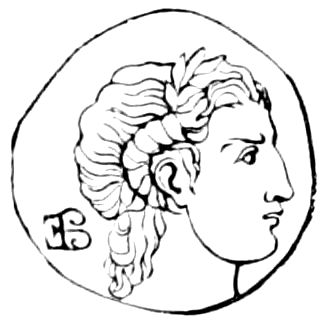
Fig. 191. Coin showing the Corniculum.
Corniculum, R. (dimin. of cornu, and so a small horn). It was a mark of distinction conferred on a soldier who had distinguished himself by his conduct or courage, and was worn on his helmet. On Thracian and other coins we find representations of this horn as part of the royal head-dress.
Cornish, O. E. The ring placed at the mouth of a cannon.
Cornlaiters, O. E. Newly-married peasants begging corn to sow their first crop with.
Cornu, Cornus, and Cornum, R. (1) The horn of an animal. (2) Any object made of horn or of a horn-like shape. The musical cornu was curved; the straight horn was called tuba.
Cornu Altaris (horn of the altar), in Christian archæology, means merely the corner or angle thereof. Cornu Evangelii is the angle to the left, c. Epistolæ that to the right, of the celebrating priest.
Cornu-copiæ, R. Horn of abundance, a symbol of concord, prosperity, and good fortune. It was represented as a wreathed horn, filled to overflowing with corn and fruit.
Corolla, R. (dimin. of Corona, q.v.). The corolla denoted in a general sense a small crown or even a garland; in a more restricted acceptation it was a garland of artificial flowers made of horn shavings and painted various colours. Women used to wear this kind of wreath during winter.
Corollarium, R. (dimin. of Corona, q.v.). It denoted especially a wreath made out of thin metal leaves, which the audience in a theatre presented to their favourite actors.
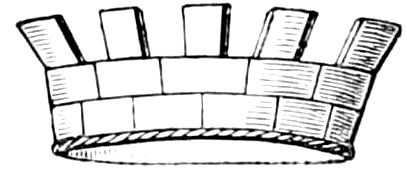
Fig. 192. Mural crown.
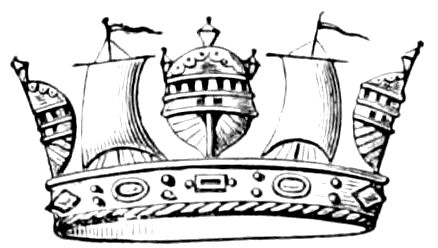
Fig. 193. Naval crown.

Fig. 194. Celestial crown.
Corona (κορώνη), R. A crown or garland made with natural or artificial leaves and flowers (of horn, parchment, &c., or metal). There were many different kinds of coronæ, of which the principal were the following: corona civica; corona classica, navalis, or rostrata; corona castrensis or vallaris; corona longa; corona muralis; corona obsidionalis; corona natalitia; corona oleagina; corona ovalis; corona pactilis, plectilis, or plexilis; corona triumphalis; corona sutilis, &c. The most honourable was the c. obsidionalis, presented by a beleaguered army, after its liberation, to the general who raised the siege. It was made of grass, or wild flowers plucked on the site. The c. civica was presented to a Roman soldier who had saved the life of a citizen in battle. It was made of oak leaves. The c. navalis was made of gold. The c. muralis, presented to the first man over the wall of a besieged city, was also made of gold, and it was ornamented with turrets. The c. castrensis, presented to the first soldier who forced an entrance into an enemy’s camp, was of gold ornamented with palisades. Of the c. triumphalis there were three kinds: one of laurel or bay leaves, worn by the commanding officer during his triumph; one of massive gold held over his head; and a third of still greater value, also of gold. The c. ovalis, to commemorate an ovation to an officer, was made of myrtle leaves. The c. oleagina, of olive leaves, was given to common soldiers. Besides these, there were the various sacerdotal coronæ, emblematical of their functions: the funereal chaplets of leaves and flowers for the dead, called c. funebres or sepulchrales; the wreaths of roses, violets, myrtles, ivy, &c., worn at convivial meetings, c. convivialis; and the bridal wreath, of Greek origin, made of flowers not bought, but plucked by the bride herself, the verbena being the chosen flower among the Romans, c. nuptialis; and finally the c. natalitia suspended over the door of a house where a child was born. At Athens this was of olive for a boy, and of wool for a girl. At Rome the wreath was made of laurel, ivy, or parsley. The various crowns used in heraldry are described under their respective headings. (See Crown.)
Corona or Drip-stone, Gen. A moulding forming part of a cornice, the lower part or drip of which is grooved, so as to throw off the rain-water from the structure. Drip-stones are sometimes plain, sometimes decorated with rich sculptures.
Corona Lucis, Chr. A lamp or chandelier suspended above the altar of a church, from which usually depended a jewelled cross.
Coronach, Scotch. A dirge.
Coronarium (aureum), R. The gold for a triumphal crown (corona triumphalis): it was sent by the provinces to a victorious chief or general.
Coronarium (opus), R. Stucco-work applied to the decoration of a cornice or projecting moulding.
Coronel, Med. The head of a jousting-lance, so called from its resemblance to a little crown. Twelve were allowed to a tilter in the time of Henry VI. (Meyrick.)
Coronell, O. E. A colonel.
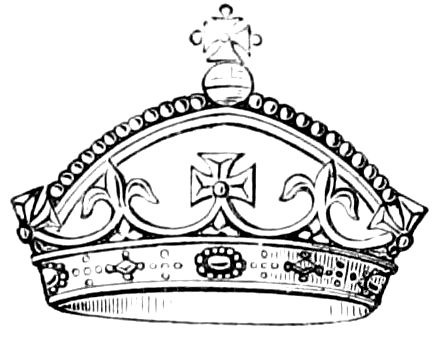
Fig. 195. Prince of Wales’s coronet.
Coronets. Ensigns of nobility worn upon the head, introduced into England about the middle of the 14th century. (See Baron, Duke, Earl, &c.) Ladies also wore them surmounting the horned head-dress of the reign of Henry V. The engraving (Fig. 196) represents Beatrice, Countess of Arundel, with coronet.
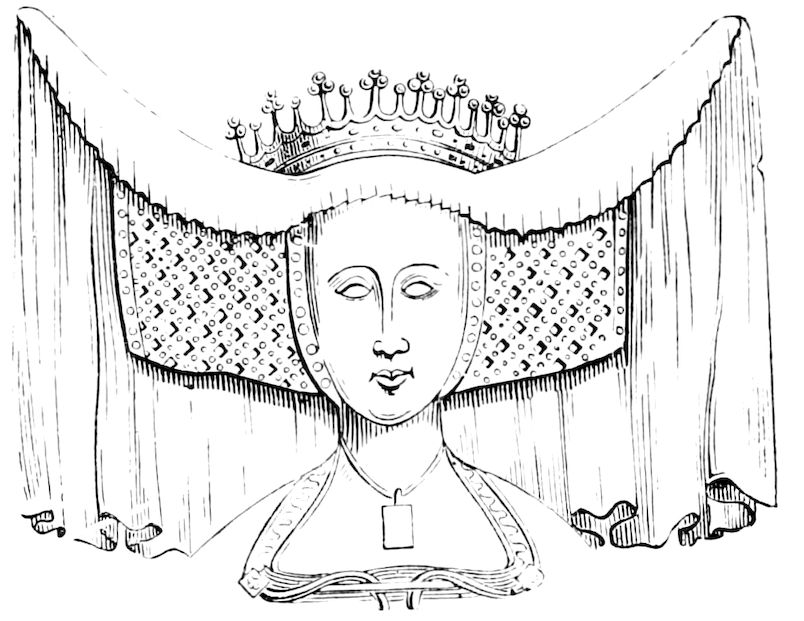
Fig. 196. Coronet of Countess of Arundel, temp. Henry V.
Coronis (κορωνίς). Anything curved; the cornice of an entablature.
Coronize (Gr. κορωνίζω, from κορώνη, a crow). To beg for the crow; said of strollers who went about begging with a crow, singing begging songs. (See Chelidonize.)
Corporal, O. E. The fine linen cloth or veil for the pyx, sometimes embroidered with golden thread and coloured silks. With such a “corporal” Mary, Queen of Scots, bandaged her eyes for her execution.
Corpse-candle, O. E. A thick candle used formerly at lake-wakes.
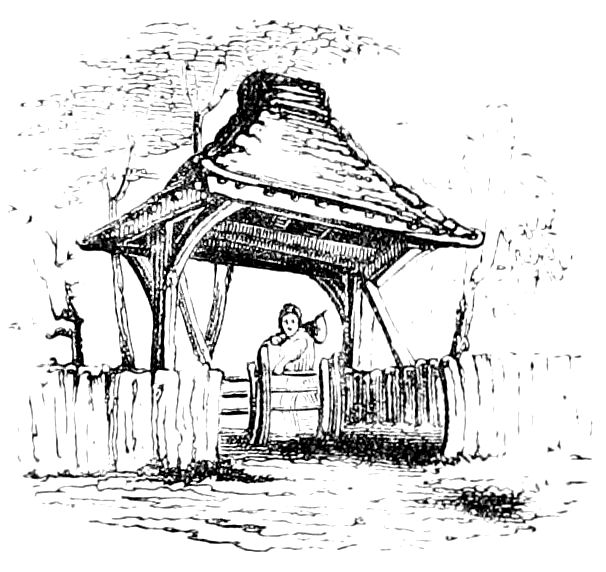
Fig. 197. Corpse or Lich-gate.
Corpse-gate or Lich-gate. A shed over the gate of a churchyard to rest the corpse under. (Fig. 197.)
Corrugis, R. (corrugo, to wrinkle). Literally, wrinkled; a loose garment which was wrapped round the body, and fell into numerous folds, so as to present the appearance of a wrinkled surface.
Cors, Arch. The shaft of a pinnacle.
Corsæ, R. The mouldings decorating the surface of a marble door-post.
Corse, O. E. (See Corce.)
Corse of Silk, O. E. Probably a silk ribbon.
Corselet, Fr. A light breastplate; 16th and 17th centuries.
Corspresant, Med. A mortuary.
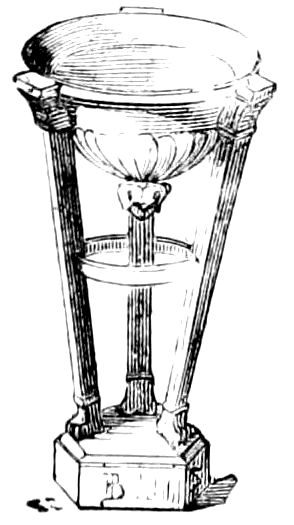
Fig. 198. Cortina.
Cortina, R. (1) A deep circular vessel in the shape of a saucepan, used for various purposes. (2) The snake’s skin spread over the tripod of the Pythoness at Delphi. (3) An altar of marble, bronze, or the precious metals, in the form of a tripod. (4) The vault over the stage in a theatre was called cortina, from its resemblance to the lid of a tripod. (5) Tables of marble or bronze, made to imitate the slab upon which the Delphic priestess sat, were also called cortinæ Delphicæ. (See Fig. 199.)
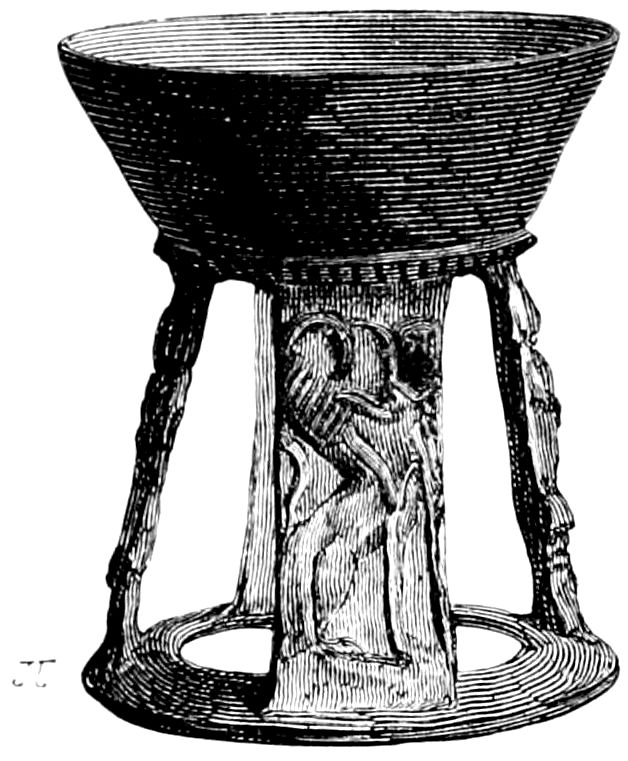
Fig. 199. Cortina (Etruscan).
Cortinale, R. A cellar in which wine was boiled in caldrons (cortinæ) to preserve it.
Corundum. The Indian name for a very hard mineral called adamantine spar. The ruby and sapphire are varieties of corundum.
Corven. O. E. for carven, cut.
“Corvene wyndows of glase,
With joly bandis of brase.”
(Lincoln MS.)
Corvus, R. (lit. crow). A crane or grappling-iron, used in naval warfare. It was a strong piece of iron with a spike at the end, which, being violently let down upon a ship from the yard-arm, or a special mast made for the purpose, went through the bottom and sank it, or at any rate grappled it fast. A variety of corvus was also made use of in the assault of fortified places.
Corybantica, Gr. and R. Festivals celebrated at Cnossus, in Crete, by the Corybantes, in honour of Atys and his mother Cybele. The priests ran through town and country carrying torches and uttering savage cries to the accompaniment of drums and cymbals. They performed frenzied dances known under the name of Corybantic dances.
Corycæum, Gr. and R. A large apartment in a gymnasium or a large bathing establishment, for the Corycobolia or sack-throwing, a game which consisted in suspending from the ceiling of the corycæum, at the height of about a yard from the ground, a sack filled with sand, bran, or seeds, to be thrust away with blows of the fist, and when it was in full swing to be stopped with the hands, back, or breast. The exercise was also called Corycomachia.
Corymbus, R. (κόρυμβος, a cluster). (1) A bunch of any fruit that grows in clusters, such as ivy-berries. (2) A head-dress or wig arranged in the form of corymbi, in a knot at the top of the head, as that of Venus is represented in the Medici statue. (3) The term is also sometimes used as a synonym of Aplustre (q.v.).
Corynalle, Arch. (See Cornal.)
“The schafte was strong over alle,
And a well-shaped corynalle.”
Coryphæus, Gr. (lit. at the head). (1) Any leader. (2) Esp. the leader of the chorus of the Attic drama. (3) An epithet of Jupiter Capitolinus.
Corytus, Gr. and R. A bow-case. The quiver for arrows was called pharetra.
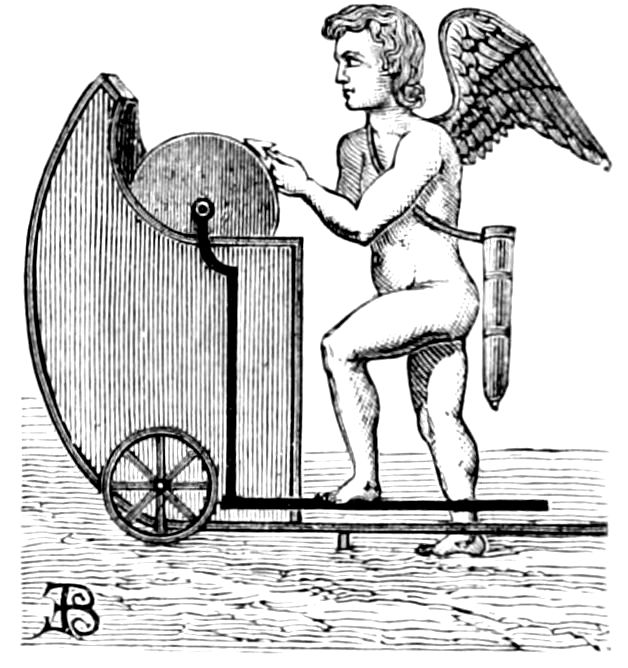
Fig. 200. Cos—a Roman Grindstone.
Cos, R. A hone, whetstone, or grindstone. Fig. 200 is taken from an engraved gem.
Cosmi (κόσμοι). The supreme magistrates in Crete.
Costanti. One of the Italian literary academies. They had for their device the sun shining on a column, with the motto Tantum volvitur umbra (the shadow only revolves).
Cote, O. E. A woman’s gown; 15th century.
Cote Armour. (See Coat Armour, Tabard.)
Cote-hardie. A tight-fitting gown; 14th century.
Cothurnus, Gr. and R. The Buskin; a high boot of Greek invention, met with on representations of certain divinities and of some of the emperors covered with rich ornamentation. It is an attribute of the huntress Diana. The sole was thickened with cork for tragic actors, to make them taller. Horsemen wore it as high as the knee.
Cotillion (Fr. cotte, an under-petticoat). A dance introduced from France, where it usually terminated a ball.
Cotise, Her. A diminutive of the Bend, being one-fourth of its width.
Cotta. A short surplice.
Cottabus, Cottabê, Cotabos, Gr. and R. A game of Greek origin, played in various manners, by throwing wine into empty cups swimming on a basin of water, or into scales suspended above a bronze ornament. The man who drowned most cups won a prize, or he who made the best sound had a good omen. There were other methods.
Cotyla, Gr. and R. A measure of capacity equal to half a pint English.
Cotyttia (κοττύτια). Nocturnal festivals celebrated by the Edonians of Thrace in honour of a goddess called Cotytto (Cybele).
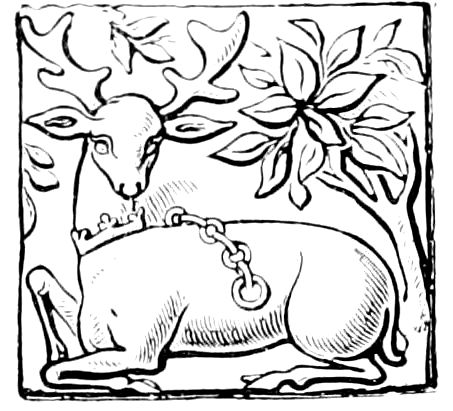
Fig. 201. Hart couchant.
Couchant or Dormant, Her. In repose. The illustration gives the device of King Richard II., a white hart couchant on a mount, &c. (Fig. 201.)
Coucher, O. E. A book kept couched or lying on a desk, e. g. books of the church services left in the places where they were used.
Coudières. (See Coutere.)
Coufic. (See Cufic.)
Coulisse, Tech. A piece of timber with a channel or groove in it, such as that in which the side-scenes of a theatre move.
Counter, Her. Reversed or opposite.
Counterfort, Arch. A buttress.
Counterpoint, Music. The art of combining melodies, or rather of adding to a melody harmonious parts. Double Counterpoint is “a kind of artificial composition, where the parts are inverted in such a manner that the uppermost becomes the lowermost, and vice versâ.” (See Stainer and Barrett, Dic. of Musical Terms.)
Counter-proof. An impression of an engraving printed from a wet proof.
Counter-seal or Secretum. A seal on the reverse or back of another seal. Early seals were generally impressed on both sides.
Countess, Arch. A roofing slate, 20 inches by 10 inches.
Couped, Her. Cut off smoothly. The reverse of erased.
Coupled (columns), Gen. Two columns are said to be coupled when they are placed quite close to each other without touching. Coupled heads is the term applied to two heads placed back to back upon the same pedestal or the same trunk. Many pedestals ornamented with Hermæ (q.v.) are surmounted by coupled heads.
Courant, Her. Running.
Course, Arch. One range, or stratum, of bricks, stones, or other material in the construction of a wall.
Court Cards. The king, queen, and knave of a suit. They were originally named in France; e. g. the four kings were Charlemagne, Cæsar, Alexander, and David; the four queens, Judith, Rachel, Argine, and Pallas; and the valets, Lahire, Hector, Lancelot, and Hogier. Of these the kings were said to represent the four ancient monarchies of the Jews, Greeks, Romans, and Franks; and the queens, wisdom, birth, beauty, and fortitude. (Taylor.) (See Chatrang.)
Court Cupboards, O. E. Richly carved and large cupboards for plate and other valuables, temp. Charles I.
Court Dish, O. E. A kind of drinking-cup.
Courtepy (Teutonic). Short cloak or gown.
Coussinet, Arch. The crowning stone of a pier, lying immediately under the arch.
Coutel, Fr. A short knife or dagger in use in the Middle Ages.
Coutere or Coutes. The elbow-piece in armour.
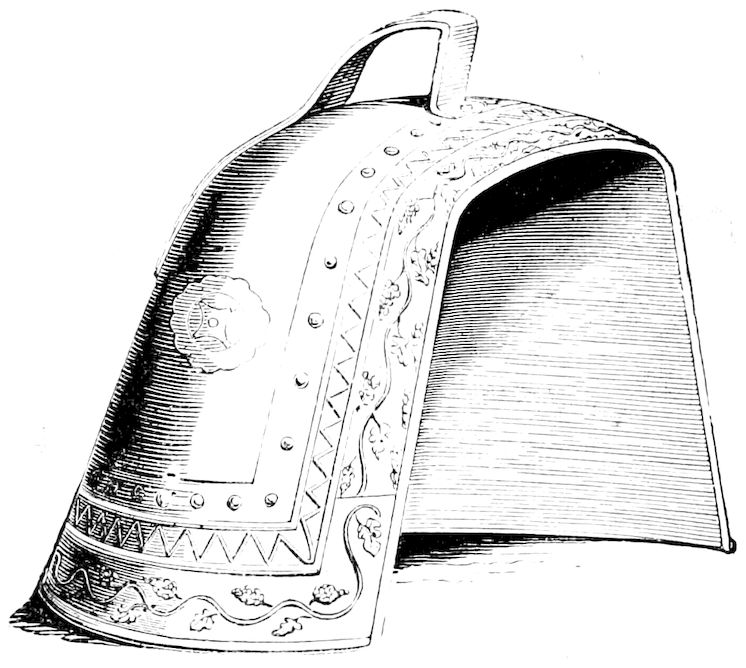
Fig. 202. Couvre-feu (Curfew).
Couvre-feu, Angl. Curfew. A screen used, as its name implies, for covering the fire; introduced with the famous Curfew-bell, temp. William Rufus. (Fig. 202.)
Cove, Arch. A name for concave mouldings or other concavities.
Coved Ceiling, Arch. A ceiling springing from the walls with a cove.
Coventry Blue. A celebrated “blew threde” made at Coventry, temp. Elizabeth.
Covert, Her. Partly covered.
Covinus, R. (Celtic, kowain). A war-chariot. The spokes of its wheels were armed with scythes. [It was used by the ancient Britons. The Romans gave the name to a close travelling carriage covered in all round.] (Compare Currus, Carpentum.)
Coward or Cowed, Her. An animal with its tail between its legs.
Cow-lady, O. E. The lady-bird.
“A paire of buskins they did bring
Of the cow-ladye’s corall wyng.”
(Musarum Deliciæ.)
Cowl, Mod. (from cuculla, Cucullus, q.v.). A priest’s hood.
Cox or Cokes, O. E. A fool; hence Coxcomb, for the top of a fool’s cap.
Crackle Porcelain or Cracklin. A kind of china, the glaze of which has been purposely cracked all over in the kiln. The Chinese have many kinds of this manufacture, some of which are extremely rare and valuable. White and grey are the common colours amongst modern crackle. The yellow and cream-coloured specimens are much prized: these are seldom seen in Europe. The greens, light and dark, turquoise, and reds are generally finely glazed, and have the crackle lines small and minute. In colouring, these examples are exquisite, and in this respect they throw our finest specimens of European porcelain quite into the shade. The green and turquoise crackle made in China at the present day are very inferior to the old kinds. Perhaps the rarest and most expensive of all ancient crackles is a yellowish stone-colour. (Fortune.)
Crackled Glass. (See Glass.)
Cracowes. Long-toed boots and shoes, introduced in 1384.
Cradle Vault, Arch. A cylindrical vault.
Cradling. A builder’s term for a timber frame for a ceiling, &c.
Craig, Scotch. (1) A rock. (2) The neck; throat.
Crampet. The decorated end of a scabbard.
Crampon. The border of gold which keeps a stone in a ring. (See Collet.)
Cramp-ring, O. E. A ring consecrated on Good Friday, an amulet against cramp.
Crancelin, Her. (from the German Kranzlein, a small wreath). The chaplet that crosses the shield of Saxony. It is said to be an augmentation conferred by the Emperor Barbarossa, who took from his head his own chaplet of rue, and threw it across the shield of the Duke of Saxony. (Boutell.)
Crane’s-bills. Geraniums, so called from the shape of their seed-vessels.
Crannogs, Irish. Lake fortresses constructed on artificial islands.
Crapaudine Doors. A technical name for doors that turn on pivots at top and bottom, or are hung with so called centre-pin hinges.
Crash. The grey linen used for the kind of embroidery called crewelwork.
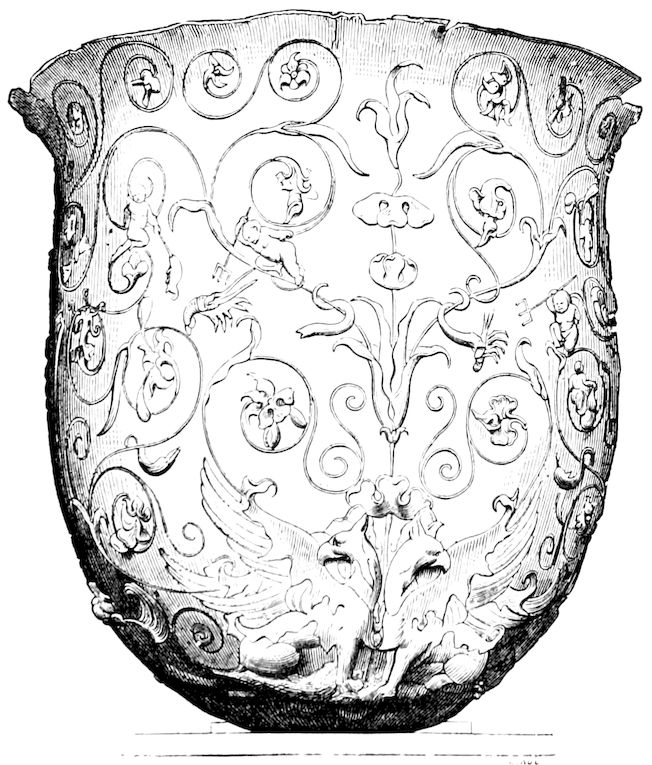
Fig. 203. Silver Crater (Roman). Found at Hildesheim.
Crater, Gr. and R. (κρατὴρ, from κεράννυμι, to mix). (1) A large and beautiful vase with a wide open mouth, in which the wine and water was mixed which was handed round at banquets and sacrifices. It was into vases of this description that slaves dipped a ladle (cyathus), with which they filled the cups. The beautiful silver crater shown in the illustration (Fig. 203), of a date not later than the 1st century, was found with other treasures of a similar kind at Hildesheim, near Hanover, in 1869. It is now in the Berlin Museum. (2) The mouth of a volcano is named from its resemblance to the Greek crater. (3) A small constellation of the southern hemisphere called the Cup.
Crates, R. A frame or basket made of hurdles, and so a hurdle itself. (English, “crate.”)
Craticula, R. (dimin. of crates). A small hurdle, and by analogy, a gridiron, which looks like a small hurdle.
Creag, O. E. The game of ninepins.
Creagra. Gr. (κράγρα, from κρέας and ἀγρέω, i. e. a flesh-hook). A synonym of the Latin term Harpago (q.v.).
Creasing. A builder’s word for a row of tiles under the coping of a wall.
Credence Table. The small table beside an altar, on which the communion was placed before consecration.
Creme-box, O. E. A chrismatory (q.v.).
Cremesyn, O. E. Crimson velvet.
Cremium, R. (cremo, to burn). Small wood, made up into bundles, used by bakers, and for lighting the hypocausts under the baths.
Crenel. The peak at the top of a helmet.
Crenellated, Her. Embattled. (See Battlement.)
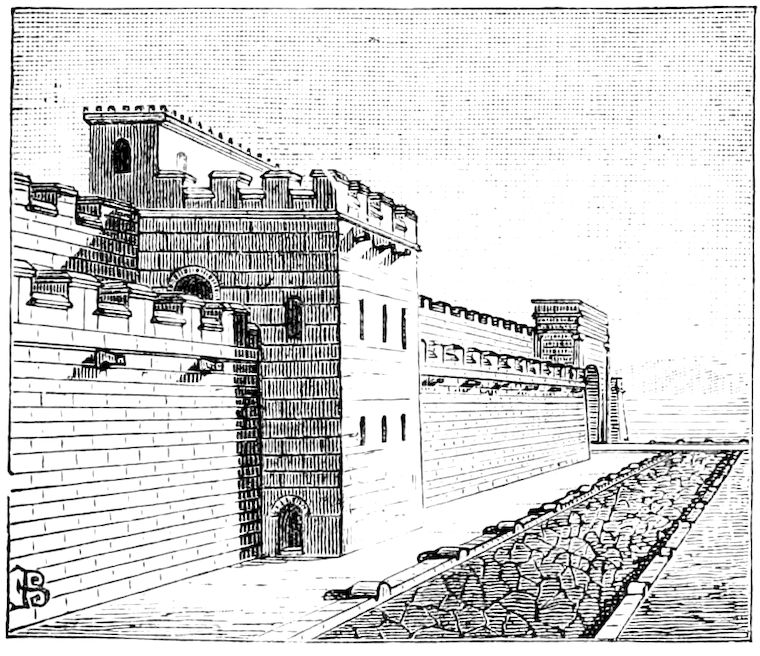
Fig. 204 Crenellated walls at Pompeii.
Crenelle, Fr. A cutting or indentation of the walls of a fortress or tower, &c. The spaces between the solid masonry are called embrasures, and the solid portions themselves merlons; usually the tops of the merlons are coped to throw off rain. (See Coping.) Fig. 204 shows a portion of the crenellated walls of Pompeii restored. (See Fig. 77.)
Crepida, Gr. and R. (κρηπίς). A slipper made of a strong leather sole, to the edges of which was fixed a piece of leather with eyelet-holes (ansæ) for the laces (corrigiæ) or a strap (amentum). This shoe was of Greek origin. Crepida carbatina was the name given to a shoe of the simplest and plainest description. (See Carbatina.) [This shoe is only found represented on figures clothed with the pallium, not the toga.]
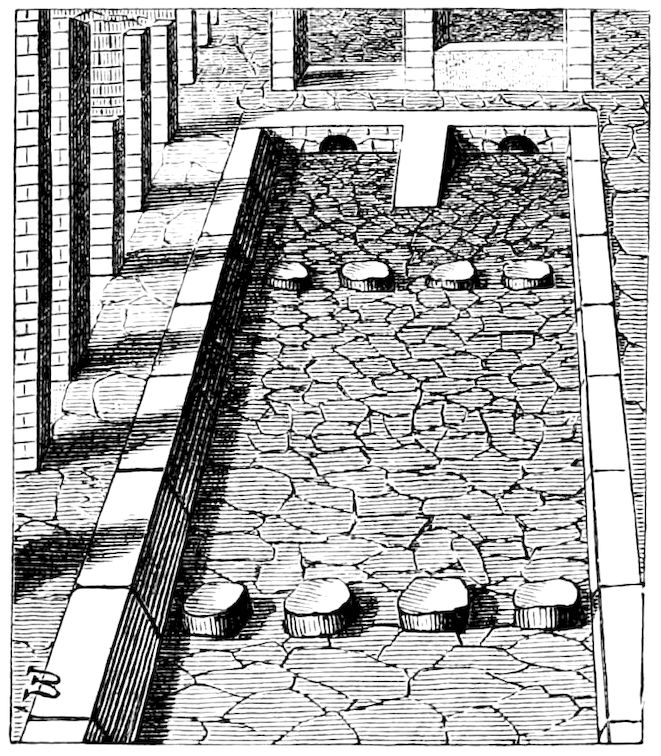
Fig. 205. Crepido in a street in Pompeii.
Crepido, Gr. and R. (κρηπίς). In a general sense, any kind of base or stand upon which another object rests, and by analogy the embankment of a quay, a dike, or jetty. The term is also applied to the raised causeway for foot passengers at the side of a road or street. Fig. 204 represents a crepido on a high road near Pompeii, and Fig. 205 a crepido in the streets of the same town.
Crepitaculum, R. (crepo, to creak). A child’s rattle, made in the form of a circle to which bells were attached. These rattles have been found in the excavations of Pompeii. Some authors apply the term to the Sistrum of the Egyptians.
Crepitus (sc. digitorum), R. A snapping of the fingers made by pressing the tip of the thumb firmly against the tip of the middle finger.
Crepundia, R. A general term for playthings for children, as well as for necklaces of various ornaments, or amulets. These were in some instances of great length, and were worn by the children like shoulder-belts.
Créquier, Her. The wild plum-tree: the device of the Créquy family.

Fig. 206. Crescent.
Crescent, Her. The difference of the second son. The moon is a crescent when she appears as in Fig. 206. (Compare Decrescent, Increscent.)
Cresolite, O. E. Crystal.
Crespine, Fr. A network to confine the hair of ladies; the calantica of the ancients. It is found in mediæval monuments in a variety of forms.
Cressets. A small pan or portable fireplace, filled with combustibles, used for illuminating purposes; 16th century. Her., a beacon. (See Fig. 54.)
Crest, Arch, (crista). A running ornament, more or less incised and perforated, which is placed on the ridge of roofs. Many monuments of antiquity have been adorned with terra-cotta crests; in the Romano-Byzantine architecture examples occur which are made of stone, while in Pointed or Renaissance art they were made of lead.
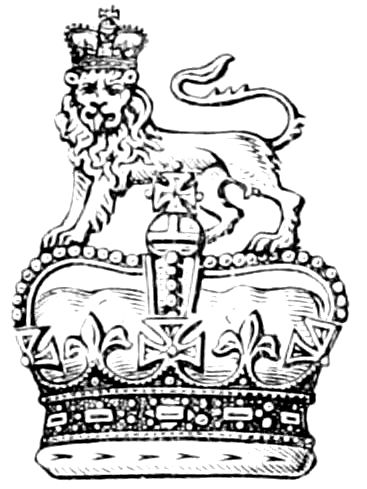
Fig. 207. Royal crest of England.
Crest, Her. (Lat. crista). This word, familiar to us as the name of an ornament surmounting the helmet and the insignia of a gentleman of coat armour, signified in classic times a comb terminating in a peak in front of the casque decorated with horsehair or plumes. (See Crista, Fig. 252.) The earliest appearance of a crest in England is on the second seal of Richard I. Fig. 207 illustrates the manner in which the crest is worn upon the royal crown of England. Crests are not worn by ladies, excepting by the Sovereign. (See Panache.)
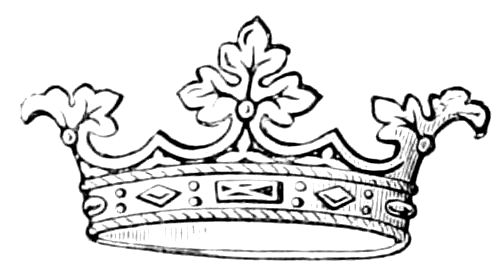
Fig. 208. Crest-coronet.
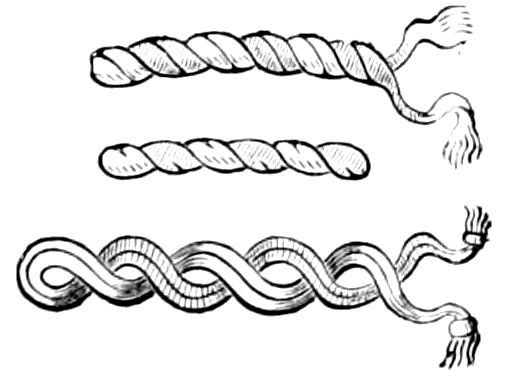
Fig. 209. Crest-wreaths.
Crest-coronet, Crest-wreath, or Orle, Her. A coronet or wreath to support a crest. (Fig. 208 and 209.)
Crest-tiles. Tiles used for covering the ridge of a roof.
Creta Lævis. A crayon of permanent colour for chalk drawing.
Crewel-work. (See Crash.)
Crewels. A worsted of two plies adapted for embroidery.
Crewetts. Small vessels used at the altar, to hold the wine and water for consecration.
Crimson (Arab, cremisi, the cochineal insect). A deep tone of red, tinged with blue.
Crinale, R. (crinis, the hair). A large convex comb worn by women and children at the back of the head.
Crined, Her. Having a mane or hair.
Crinetts, O. E. The long small black feathers on a hawk’s head. (H.)
Crinze, O. E. A drinking-cup. (H.)
Criobolè, Gr. (κριοβόλη). A sacrifice to Cybele, so called because the victim was a ram (κριός).
Crista, R. The crest of the helmet, which was attached to an elevated ridge (generally of horsehair). A fine example is given in the head of “Rome,” on the Tazza of Diruta. (Fig. 252.) (See Crest.)
Cristatus, R. (crista). Having a ridge and a crest. (Fig. 252.)
Cristendom, O. E. Baptism.
“And that bastard that to the ys dere,
Crystyndome schalle he none have here.” (H.)
Cristygrey. A kind of fur much used in the 15th century.
“Of no devyse embroudid hath hire wede,
Ne furrid with ermyn ne with cristygrey.”
Crites (κριτής). A judge in equity, as opposed to Dikastes, a judge in law.
Croakumshire. An ancient name for the county of Northumberland. (H.)
Crobbe, O. E. Knops of buds hung as ornaments from a roof.
Crobylus, Gr. and R. (κρωβύλος). A method of arranging the hair peculiar to the inhabitants of Athens. The hair, rolled up in a knot on the top of the head, was fastened with golden clasps in the shape of grasshoppers. The name applies only to men’s hair; the same fashion for women was called Corymbus.
Croc or Crook. A curved mace.
Crocea. A cardinal’s cloak.
Crochet. Knitting done with linen thread, and used under the name of nun’s lace from the 16th century for bordering altar-cloths, albs, &c.
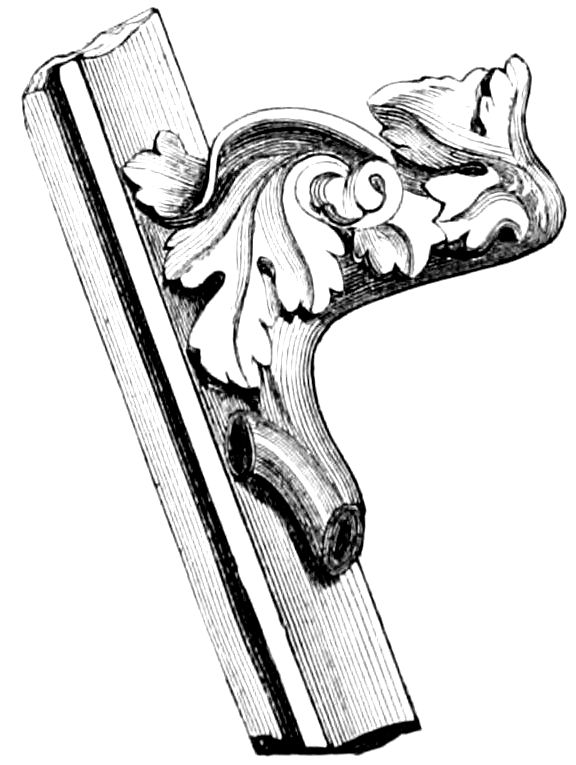
Fig. 210. Crocket.
Crocket. (1) An architectural enrichment, generally of leaves or flowers; an ornamentation peculiar to the pointed style of architecture. (Fig. 210.) (2) A large roll of hair, much worn in the time of Edward I.
“His crocket kembt, and thereon set
A nouche with a chapelet.”
Crocota, Gr. and R. (from κρόκος, crocus). A very rich robe of saffron colour, whence its name. It was worn by Greek and Roman women as a gala dress, especially at the Dionysia.
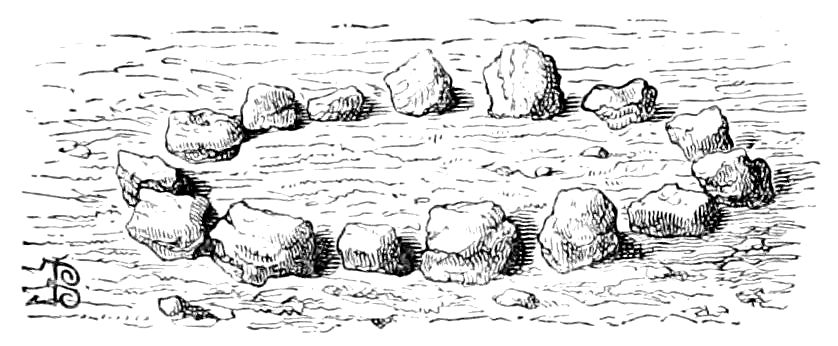
Fig. 211. Cromlech.
Cromlec’h, Celtic (from cromm, curved, and lec’h, place). An enclosure formed by menhirs, or huge stones planted in the ground in a circle or semicircle. These enclosures (Fig. 211) were consecrated places used as burying-grounds. (See Standing stones, Dolmens, Menhirs, &c.)
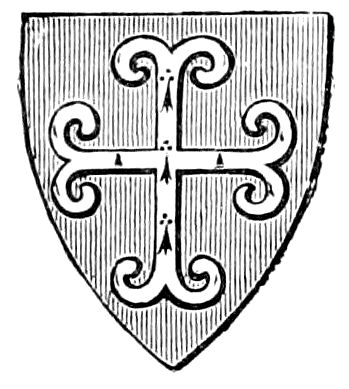
Fig. 212. Cross Recercelée.
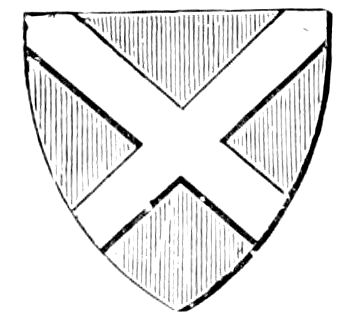
Fig. 213. St. Andrew’s Cross (Saltire).
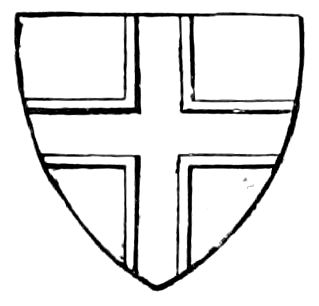
Fig. 214. St. George’s Cross fimbriated.
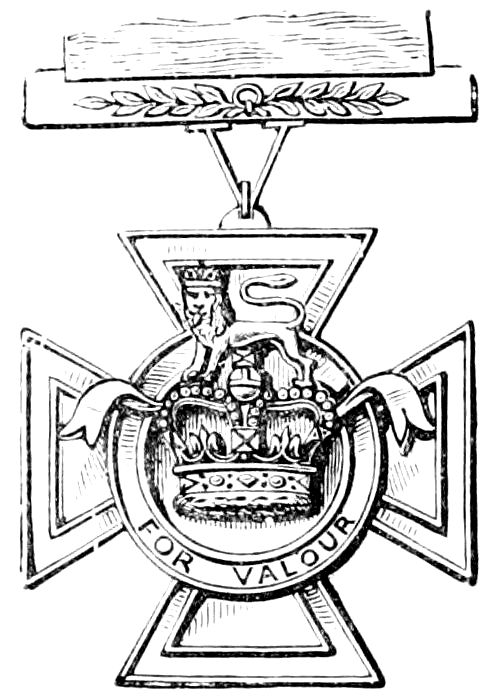
Fig. 215. Victoria Cross.
Cross, Chr. (Crux). The symbol of the Christian religion. The ordinary or primitive type of cross has no summit. It is called commissa or patibulata, and sometimes the Tau cross, from its resemblance to the Greek letter so named (T). Fig. 121 represents a stone cross of the Romano-Byzantine period, at Carew, in England. The St. Andrew’s cross has the form of an X. The Greek cross is of four equal parts. The Latin cross has the foot longer than the summit or arms. The Maltese cross and the cross of Jerusalem are varieties of the Greek cross. The Patriarchal cross (heraldic) has two cross pieces, the triple cross has three, &c. Per Cross, in heraldry, is the division of a shield quarterly (a combination of pale and fesse). (Figs. 212 to 215.)
Cross and Pile, O. E. The game of “heads and tails.”
Cross-aisled, Arch. Having TRANSEPTS.
Cross-bows were brought to England by the Crusaders. They were frequently richly carved and inlaid.
Cross-days, O. E. The three days before Ascension Day.
Cross-gartered. Having the garters crossed on the leg. (H.)
Cross-hatching. A term in engraving applied to lines which intersect at regular angles, to increase depth of shadow.
Crossos, Gr. (κρωσσός). A wide-bodied vessel narrowing towards the mouth; it is furnished with a stand and two handles or ears (δίωτοι).
Cross-row, O. E. The alphabet. (See Christ-cross.)
Cross-springer, Arch. In vaulting, the diagonal rib of a GROIN.
Cross-vaulting, Arch. That which is formed by the intersection of two or more simple vaults. When the vaults spring at the same level, and rise to the same height, the cross vault is termed a GROIN. The illustration (Fig. 173), the cloisters of the church of Mont St. Michel in France, shows the cross-vaulting.
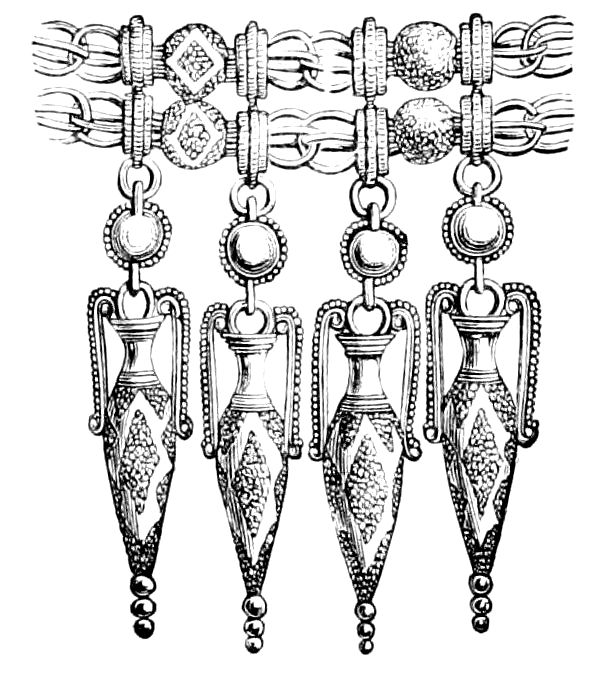
Fig. 216. Crotalia. Greek necklace.
Crotalium, Gr. and R. (from κροτέω, to rattle). A small rattle. The Greek and Roman ladies gave this name to their pendants formed of two or four pear-shaped pearls (elenchi), which rattled softly as the wearer moved about. (Fig. 216.)
Crotalum Gr. and R. (κρόταλον). Castanets made of slit cane, used by dancers in the worship of Cybele. The Middle Ages also had their crotala, which consisted of a metal rod, in which were inserted rings, which sounded when the instrument was shaken.
Crow or Raven. The attribute of St. Vincent.
Crowde or Croud, O. E. (1) The crypt of a church. (2) A fiddle.
Crown. (See Corona. See also Mural Crown, Naval Crown, Crest, &c.)
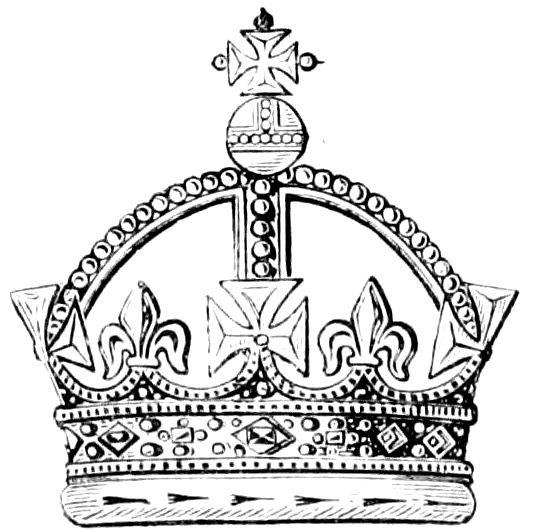
Fig. 217. Crown of Her Majesty the Queen.
Crown (of a bell). The top of the inside of a bell, in which the ring is fixed from which the clapper is suspended. In architecture the spire of a steeple is said to crown the tower, or a fleuron to crown a gable, &c.

Fig. 218. Crown of the Rose.
Crown. An old English coin, the value of which has varied at different periods. The illustration represents the gold crown of Henry VIII., dated 1462, called a crown of the Rose, value 4s. 6d. Other crown pieces were called, from the mint-mark, crowns of the Sun.
Croyle, O. E. Crewel; tightly-twisted worsted.
Crozier, Chr. The name is often improperly applied to the bishop’s crooked pastoral staff; it belongs to the staff surmounted by a cross which is borne before an archbishop. The Byzantine crozier was that of the T-shaped cross; it had sometimes curved serpents on both sides.
Crucifix. The representation of the Saviour on the Cross was first introduced in the time of Constantine. It has undergone considerable variation at different periods.
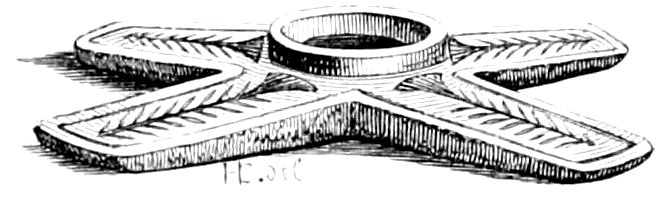
Fig. 219. Porcelain Cruciform Box (Egyptian).
Cruciform. Shaped to form a cross. The illustration represents a specimen of ancient Egyptian porcelain, of this shape, ornamented with the lotus. (See Egyptian Pottery.)
Crumata. (See Crusmata.)
Crumena, R. A leather pouch for carrying money. The balantion of the Greeks was worn suspended from the neck by a strap.
Crumenal, O. E. A purse.
Crupezia, Gr. (κρούω, to strike). A kind of sandal with a double sole, in the middle of which were castanets with springs. (See Crotalum.) Greek flute-players used them in the theatre to beat time to the singing and declamation of the chorus.
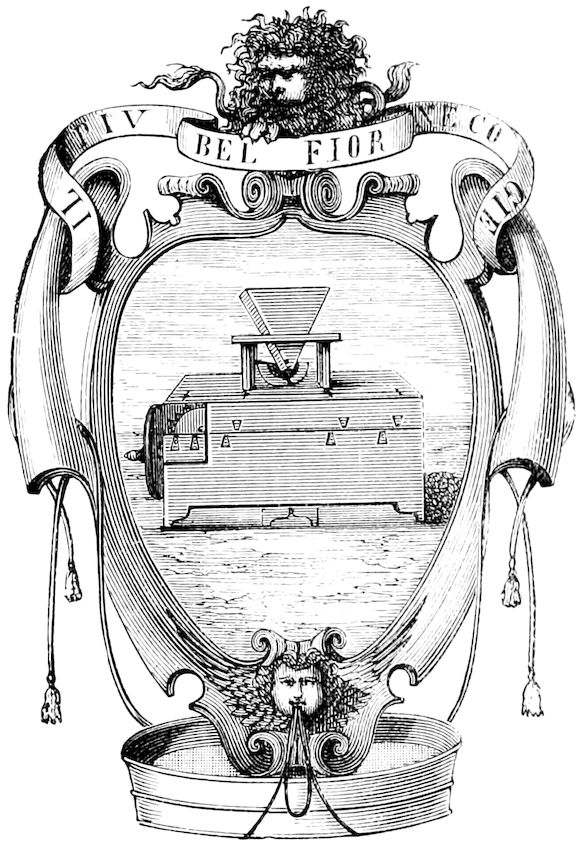
Fig. 220. Device of the Della Cruscan Academy.
Crusca, Accademia della. A literary academy established in Florence in the 15th century by Cosmo de’ Medici; their device, a bolting-mill, represented in Fig. 220, was symbolical of their object to cultivate the Italian language by winnowing the flour from the bran; and in allusion to it, the members called themselves by appropriate names, as Infarinato, Rimenato, Gramolato, Insaccato, &c. On the top of the shield is the Marzocco, or Lion of Florence, the emblem of the city.
Crusilée, Crusily, Her. Having the field semée of small crosses.
Cruske, O. E. An earthen vessel; cf. the Irish cruishkeen.
Crusmata, Crumata, Gr. and R. (κρούω, to strike). Castanets.
Crustæ, R. In the finest works of the chaser, the ornamental pattern was frequently distinct from the vessel, to which it was either fastened permanently, or so that it could be removed at pleasure, the vessel being of silver, and the ornaments of gold, which were called crustæ or emblemata (Dr. Smith). Of these the former were the figures embossed in low relief, and the emblemata were those in high relief. (See Damascening, Emblemata.)
Crustulum, R. (dimin. of crustum). Anything baked; plaster mouldings; a cheap kind of decoration in bas-relief.
Crutch. An attribute of St. Anthony, to denote his age and feebleness.
Crux. The Latin equivalent for Cross (q.v.).
Crwth (A.S. crudh, Eng. crowd). A Welsh instrument, a sort of violin, similar to the rébek of the Bretons.
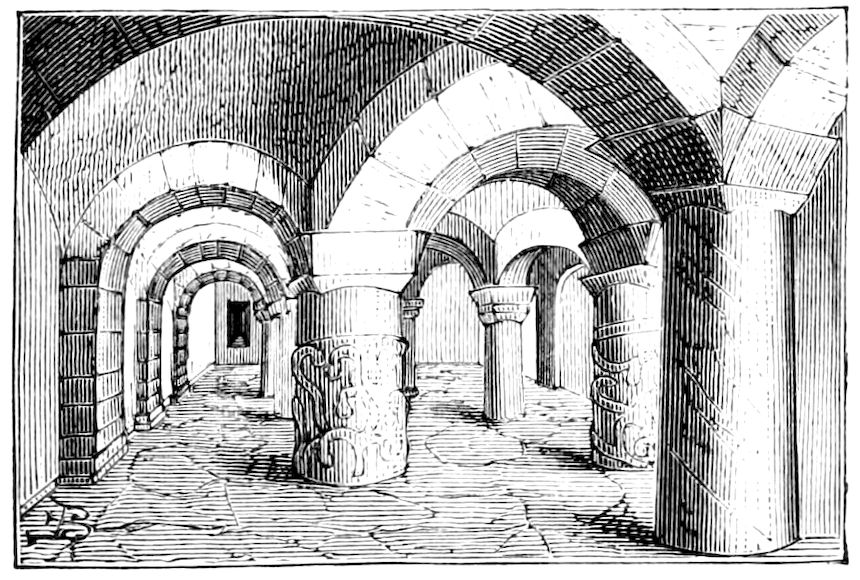
Fig. 221. Crypt at Lanmeur (France).
Crypta, Crypt, Chr. (κρύπτω, to bury). In ancient times the crypt was really a cloister; it formed, in fact, a long and narrow gallery surrounded by buildings, and itself surrounding a building, garden, or court. The courtyards of villæ were surrounded by crypts; the ruins of Diomed’s villa, at Pompeii, afford a curious instance of the kind. In modern archæology the term crypt is applied to a subterranean chapel underneath a church. (Figs. 221 and 222.) Among the Romans the word meant (1) a covered portico, or arcade, called crypto-porticus. (2) A grotto, or more accurately a tunnel. (3) A subterranean vault used for secret worship. (4) In the catacombs, a tomb in which a number of bodies were interred together.
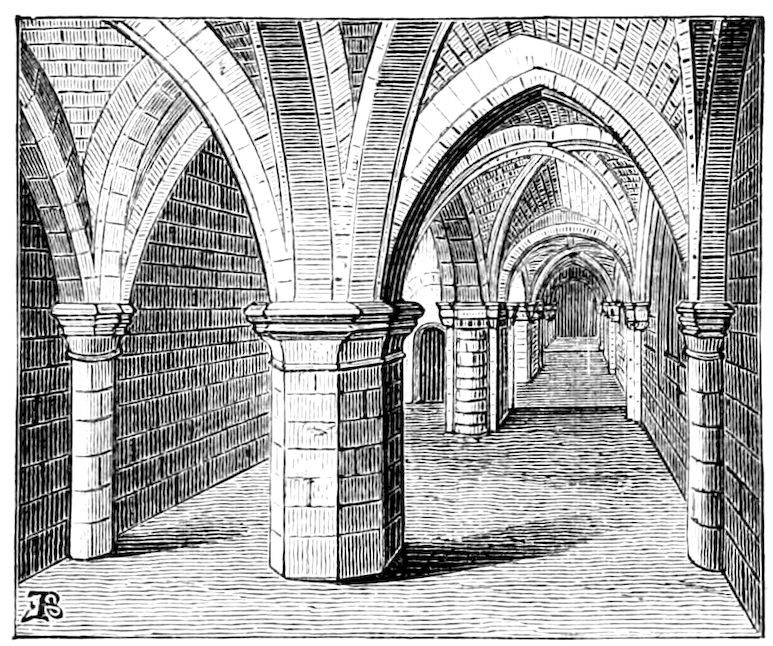
Fig. 222. Crypt of St. Mary’s Church, Warwick.
Crypteia (κρυπτεία). A systematic massacre of Helots at night, by young Spartans, who hid themselves during the day.
Crystal. Rock crystals are frequently found large enough to make vessels of. The Romans had crystal drinking-cups of extraordinary size and beauty. Crystal ornaments were especially chosen for ecclesiastical purposes, and for mediæval bookbinding, &c., and are frequently found in early British graves.
Crystalotype. A sun-picture taken and fixed on glass by the collodion process.
Cubiculum, R. and Chr. (cubo, to recline). (1) A bedroom. (2) The emperor’s pavilion or tent at the amphitheatre or circus. (3) In Christian archæology, the sepulchral chambers of the catacombs. (See Cinerarium.)
Cubile, R. (cubo). A bed, or chamber containing a bed.
Cubit (Gr. πῆχυς, Lat. cubitus, an elbow). A measure of length among the Egyptians, Greeks, and Romans. In Egypt there were two cubits; the natural cubit, or small cubit, was equal to 18 inches (6 palms or 24 fingers); the royal cubit to 21 inches (7 palms or 28 fingers). Each of the subdivisions of the cubit was consecrated to a divinity. The Greek cubit was equal to about 18¼ inches; the Roman cubit to very nearly 17½ inches.
Cubital, R. A bolster or cushion used by the Romans to rest the elbow on when reclining.
Cubit-arm, Her. A human arm couped at the elbow.
Cubitoria, -æ (sc. vestimenta, vestes). (See Cœnatoria.)
Cucullus, R. Literally, a piece of paper rolled into the shape of a funnel, used at Rome by apothecaries and other tradespeople for wrapping up certain kinds of goods; and hence, by analogy, the hood affixed to certain garments, such as the lacerna, pænula, sagum, &c. (See Cowl.)
Cucuma, R. A term applied to various earthenware or metal vessels, when they were used to heat water or any other liquid.
Cucurbita, R. A pumpkin or gourd, and thence a cupping-glass.
Cudo, Cudon, R. A skull-cap made of soft leather or furs.
Cuerpo (Span.). Body clothing, i. e. a jacket.
Cufic (characters), Arab. The Cufic is the most ancient form of Arabian writing, and bears a great resemblance to the Syriac writing called estranghelo; it appears to have originated in the city of Cufa or Coufa, whence the name.
Cuirass. (See Cingulum, Lorica, Pectorale, Thorax.)
Cuir-boulli, Fr. Boiled leather, frequently mentioned by mediæval writers. It has lately been revived under the name of impressed leather, and brought to a high state of perfection. (Fairholt.) Hence:—
Cuirbouly, O. E. Tanned leather.
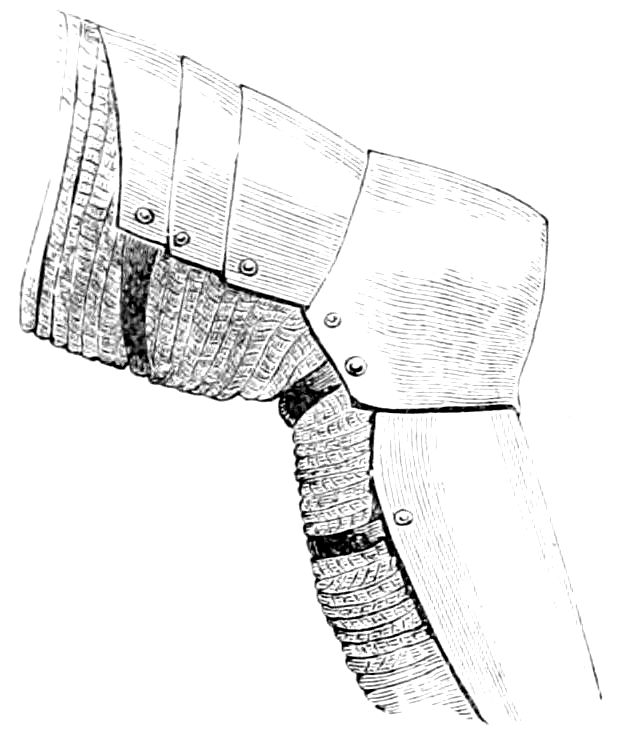
Fig. 223. Cuisse.
Cuisses, Fr. Armour for the thighs, introduced about the middle of the 14th century. In early examples they consisted of one, two, or three pieces of plate overlapping; later on they were formed of one piece only, and finally were finished with a back piece, enclosing the whole of the thigh in armour.
Cuitikins, Cutikins, Scotch. Guêtres, gaiters.
Cuker, O. E. Part of a woman’s horned head-dress, “furred with a cat’s skin.”
Culcita, R. A mattress of horsehair, wool, wadding, or feathers.
Culettes, Fr. Plates of armour protecting the back, from the waist to the saddle.
Culeus or Culleus, R. The largest liquid measure of capacity used by the Romans, containing 20 amphoræ, or about 119 gallons. The same name was also applied to a very large sack, of skin or leather, used for oil or wine. It was in the culei that parricides were sewed up.
Culigna, R. A vessel for holding wine. It was a kind of amphora of a broader form, its width exceeding its height.
Culina, R. A kitchen.
Cullis, Arch. Same as Coulisse (q.v.).
Culme, O. E. The summit.
Cultellus, R. (dimin. of Culter, q.v.). A knife. Cultellus ligneus, a wedge of wood.
Culter or Culta, R. A knife. Culter coquinaris was a kitchen-knife; culter venatorius, a hunting-knife; culter tonsorius, a razor; culter vinitorius, or falx vinitoria, a vine-dresser’s pruning knife. The term denoted as well (1) the knife with which the officiating priest cut the victim’s throat; (2) a knife for carving, also called cultellus; (3) the coulter of a plough fixed in front of the plough-share.
Culullus, R. (culeus, q.v.). Generally, any drinking-vessel, and more particularly any earthenware vessel used by priests and vestals at sacrifices.
Culver, A.S. A dove.
Culver-house. A pigeon-house.
Cumera, R. A kind of large box or basket employed by country people for keeping their seed-wheat in.
Cumerum, R. A bridal basket containing the presents of the bride and bridegroom; it was carried by a camillus in the bridal procession.
Cumpi-coptra, Peruv. One of the divisions in the royal arsenals of the ancient Peruvians. It contained llama-wool, and textures of alpaca, embroidered in the college of the Virgins of the Sun (Pasua-Huasi), (q.v.).
Cunabula, R. Literally, a child’s cradle, and thence a bird’s nest, a beehive, a native city; any place, in short, in which a living thing is born. A synonym for this term is Cunæ. Bibliologists call early specimens of printing by this name, or Incunabula (q.v.).
Fig. 224. Cuneiform characters.
Cuneiform (characters). Oriental characters formed by a single symbol, which is in the shape of a wedge (cuneus). This kind of writing has been in use among many nations; more particularly the ancient Persians, Persepolitans, Babylonians, and Ninevites. Fig. 224 represents the first cuneiform characters which found their way to Europe.
Cuneus, R. (1) A wedge of wood, iron, or any other metal. (2) In a theatre or amphitheatre, a set of tiers comprised within two staircases (scalæ), so called from its wedge-like form. (3) A body of soldiers drawn up in the form of a wedge to break through the enemy’s line. The common soldiers called the formation caput porcinum, a pig’s head.
Cuniculus, R. (cuneus). An underground passage to a fortified place.
Cupa, R. A barrel or hogshead. Vinum de cupâ was wine which had not been drawn off in amphoræ; it was wine from the cask, new wine. The cupa was sometimes made of earthenware like the dolium. It was used for many purposes besides that of a wine-vat. (See Cupella.)
Cupel. A melting-pot for gold.
Cupella, R. and Chr. (dimin. of Cupa, q.v.). In Christian archæology, a tomb. The word occurs on a catacomb marble, inscribed with grotesque Latin: “I, Secunda, erected this cupella to my two children,” &c. [The cupa was sometimes used by the Romans as a sarcophagus.] (See Cinerarium.)
Cupola, It. A concave roof, circular or polygonal.
Cups. (See Coppa.)
Curb Roof, Arch. A Mansard roof; a roof with a double set of rafters on each side, of peculiar construction.
Curch, Gael. A kerchief.
Curfew. (See Couvre-feu, Fig. 202.)
Curia, Curiæ, R. (1) A building in which the people met together to offer sacrifices and take part in the festivities on certain days of festival. (2) The senatorial curiæ were buildings in which the senate usually assembled. (3) The Salian curia was a place situated on the Palatine Hill, which formed the place of assembly for the Salian priests who guarded the anciles or sacred shields. (4) Curia calabra was a small temple founded, almost simultaneously with the building of Rome, on the Palatine; it formed the observatory for the petty pontiffs whose duty it was to watch the appearance of the new moon. In Christian archæology the Roman curia denotes the pontifical tribunals collectively.
Curliewurlies, Scotch. Fantastical circular ornaments.
Currach, Scotch. A coracle or small skiff; a boat of wicker-work covered with hides.
Fig. 225. Currus. The Chariot of the Sun. The device of Philip II. of Spain.
Currus, Chariot (Gr. ἅρμα). A two-wheeled car or carriage in use among nearly all the nations of antiquity. There were racing-chariots, riding-chariots, and triumphal chariots. Some of these were profusely decorated with ivory (currus eburnei). War-chariots armed with scythes or sharp blades were called falcati. (See Covinus.) The illustration (Fig. 225), a device of Philip II. of Spain, represents Apollo driving the chariot of the Sun.
Cursores. “Runners” before their masters’ carriages; messengers generally.
Curtail Dog, O. E. A dog belonging to a person not qualified to hunt game, which, by the forest laws, must have its tail cropped.
Curtail Step, Arch. The first step of a stair, when its outer end is finished in the form of a scroll; when it has a circular end, it is called a round-ended step.
Cushat, Scotch. A wood-pigeon.
Cushion-capital, Arch. (1) A capital resembling a cushion pressed by a weight. (2) A cube rounded off at its lower angles; the capital most prevalent in the Norman style.
Cusp. In Astrology, the “entrance” of a “house.”

Fig. 226. Cuspis.
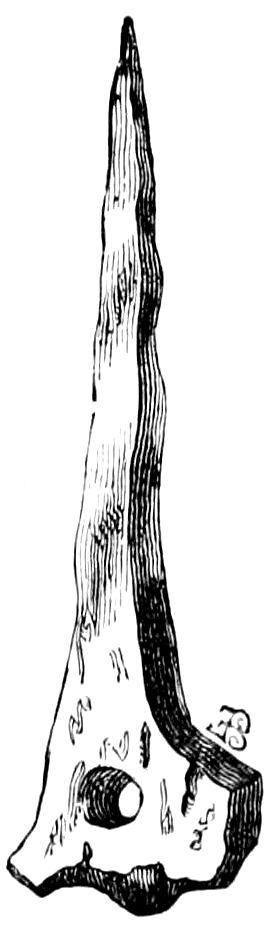
Fig. 227. Cuspis—Flint lance.
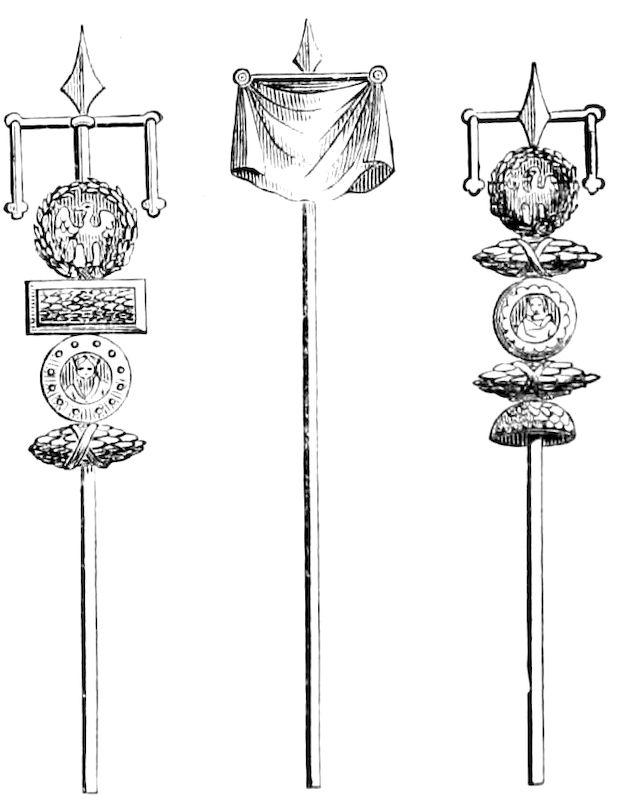
Figs. 228, 229, 230. Cuspides—Roman lances.
Cuspis, R. A point, more particularly the point of a lance, or javelin, since these were not barbed. Fig. 226 represents a javelin-head which gives a complete idea of the character of the point called cuspis; Fig. 227 shows a flint lance; and Figs. 228 to 230 the lance-headed cuspides affixed to the top of the Roman ensigns. (See Spiculum.)
Cusps. The foliations of architectural tracery, such as are formed by the points of a trefoil.
Custodia. The shrine or receptacle for the host in Spanish churches.
Cutlass, Coutel-hache, or Coutel-axe, O. E. This weapon was introduced at the end of the 15th century.
Cut-work. Also called “opus consutum;” Ital. “di commesso.” Open-work embroidery came into universal use in England in the 16th century. In the reign of Richard II., however, we are told,—
“Cut werke was greate both in court and townes,
Bothe in mene’s hoddies, and also in their gownes.”
(See Appliqué.)
Cyanogen. A gaseous compound of carbon and nitrogen, necessary to the formation of Prussian blue.
Cyathus, Gr. and R. A vase or ladle with one handle, used for taking wine from the crater (κρατὴρ), in order to fill the cups (pocula, calices) of the guests, at feasts and banquets. The term was also used to denote a small measure containing the twelfth part of the sextarius, or ·0825 of a pint. The cyathus was used in medicine to measure drugs with accuracy. [It is often represented, on vases, in the hands of Bacchus, in place of his proper goblet the Cantharus.]
Cybistic (dance), R. (κυβιστάω, to tumble). A part of the military exercises in which the performer threw himself at intervals on his hands, so as to rebound on his feet.
Cyclas, R. (κυκλὰς, circular). A long and loose piece of drapery, of a very fine texture; it was hemmed with purple or gold embroidery. The cyclas formed part of a woman’s costume, but it was also worn by men of an effeminate or dissolute character; hence—
Cyclas, O. E. The name of a long sleeveless gown worn by knights over their armour (from ciclatoun, q.v., of which it was made).
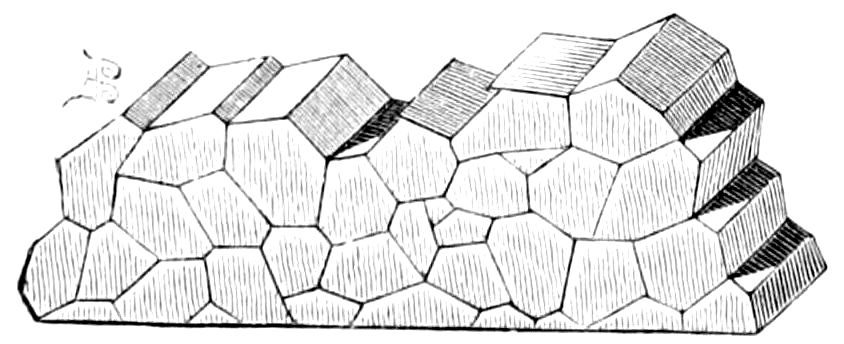
Fig. 231. Cyclopean Masonry.
Cyclopean (masonry, monuments), Gr. and R. (κυκλώπειον). Ancient structures, also known as Pelasgian, as being the work of Pelasgians who had learned in the school of Phœnician workmen called Cyclopes. These ancient structures are formed of enormous irregularly-shaped stones (Fig. 231), placed one above the other without cement or mortar. Remains of them are found in Asia Minor, Greece, and Italy; they consist chiefly of the walls of acropoles.
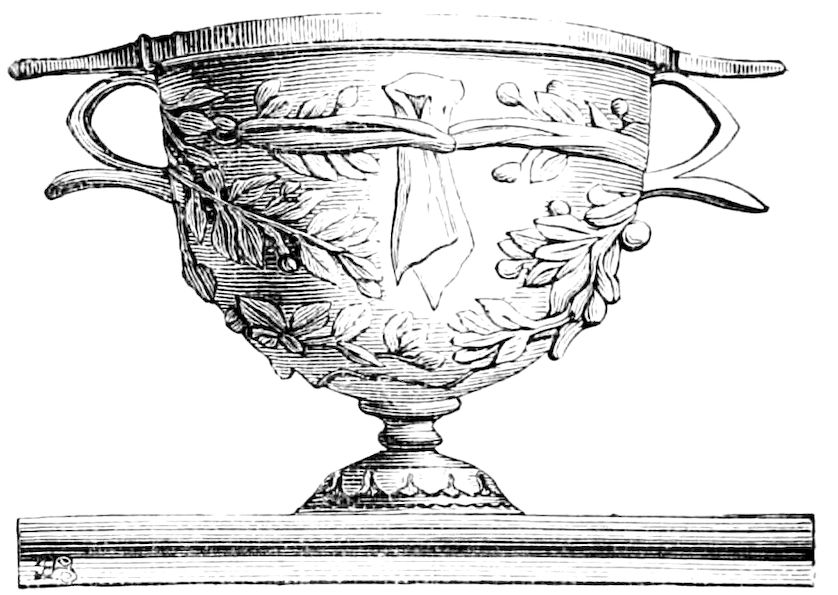
Fig. 232. Cylix. A Gallic drinking-cup.
Cylix, Gr. and R. A vase also known as a calix or cup. It was a wide flat drinking-cup, very shallow, of a circular form, with two handles, and mounted on a tolerably tall foot. Fig. 232 shows a silver cylix or Gaulish cup, found in the ruins of Alisia.
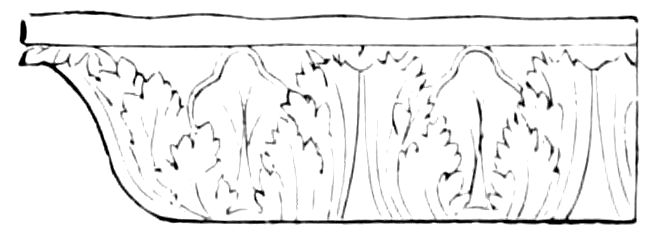
Fig. 233. Decorated Cyma.
Cyma, Cymatium (Eng. Ogee, Gr. κυμάτιον). An architectural moulding, named from the Greek κῦμα (wave or billow), the moulding consisting of an undulation. A cyma, the outline of which is convex at the top and concave below, is called cyma reversa; when it is hollow in the upper part, it is called a cyma recta. (Fig. 233.)
Cymatile, R. (κῦμα). A Roman female dress, of a changing sea-green colour, like the waves.
Cymba, R. (κύμβος, a hollow). (1) A small boat. (2) A vase of metal or clay in the form of a small boat. (See Cymbium.)
Cymbals, O. E. A contrivance of a number of metal plates, or bells, suspended on cords.
Cymbalum, R. (from κύμβος). The cymbals; a musical instrument made of two disks of bronze or brass. (See Crotalum, Flagellum.)
Cymbe, Gr. An ointment-pot, similar in shape to the Ampulla (q.v.).
Cymbium, R. (κυμβίον). A boat-shaped drinking-cup with two handles. (See Cymba.)
Cynocephalus, Egyp. An ape with a dog’s head; a sacred animal, representing Anubis in the Egyptian mythology.
Cynophontis (sc. ἑορτὴ), Gr. (derived from the Greek κύων, dog, and φόνος, slaughter). Festivals held at Argos during the dog-days, when dogs found straying in the city were killed.
Cynopolites, Egyp. (κυνοπολίτης). A nome of Upper Egypt.
Fig. 234. Branch of Cypress and of Myrtle. Device of M. A. Colonna.
Cypress. In Persian art, this tree is the frequently-occurring emblem of the religion of Zoroaster, and of the soul aspiring to Heaven. In Christian and modern symbolism it is the emblem of mourning. The device of cypress and myrtle assumed by Marc Antonio Colonna on the occasion of the defence of Ravenna is emblematic of “death or victory.” The wood of the cypress-tree was much used for statuary by the ancients. Carved chests of cypress were especially used, in the Middle Ages, for keeping clothes and tapestry; its aromatic properties were considered a specific against moth. (Fig. 234.)
Cyprus. Thin stuff of which women’s veils were made.
Cyprus or Verona Green. A pigment mentioned by Pliny as Appian Green: it is prepared from green earths found at Cyprus or Verona, which are coloured by oxide of copper. (See Appianum.)
Cysts or Cists, Etrus. (κίστη, a chest). Offerings dedicated by women in the temple of Venus, of cylindrical caskets of enchased bronze. The handles of these caskets represent small figures, and the feet the claws of animals. Those which have been found in Etruscan tombs, chiefly at Præneste, are in many cases decorated with a graffito designs.
Cyzicenæ, Gr. (κυζικηναί). Large and richly-decorated apartments, built for the first time at Cyzicus, which had their principal fronts to the north, and were situated in a garden.